What to look for in nature in Maine this January
January is the middle of meteorological winter in Maine, and on average its coldest stretch. Lakes lock up, bald eagles crowd the stretches of river and coast that stay open, smelt fishermen haul their shacks onto the tidal Kennebec, and deer settle into the dense softwood stands where they will spend the deep-snow weeks. Evening grosbeaks and crossbills may show up at feeders and in the spruce this winter, and the days are already lengthening: by January 31 Fort Kent’s day is a full hour longer than on the 1st. Below, the month’s stories across the state, from Casco Bay to the County.
Other months in Maine: October, November, December, February.
Start here
- Check open water for eagles. Scan any river reach, tidal bay or dam spillway that the ice has not closed. Maine’s eagles drift toward the coast and the big rivers this month.
- Get up early on Monday, January 4. Quadrantid season tops out between Sunday night, January 3, and Monday’s sunrise, with barely any moon to spoil it. Find a dark field and give it the last two hours before first light on Monday, when the radiant has climbed well up in the northeast.
- Read a maple twig. Snap no twigs, just look. Red maple twigs and buds are red, often with the buds bunched together; sugar maple buds are brown, slim and sharply pointed. Both sit in opposite pairs, which rules out the birches and the beech straight away.
Keep a record: draw the trough a deer leaves when it steps off a packed yard trail on the Naturalist’s Field Journal’s tracks-to-know plate, add grosbeaks or crossbills to the birds-I-have-seen page, and start a tree through the seasons with a sketch of one maple’s buds that you can revisit when they swell in spring. The mammal watch suits a frozen beaver pond, and the colours-of-the-day plate is made for a pink sunrise over sea smoke or the blue shadows on fresh snow.
Regions used below: Southern Maine and Casco Bay; Midcoast and Penobscot Bay; Downeast and Acadia; Western mountains and lakes; The Highlands, Moosehead and Katahdin; Aroostook County.
Where can you see bald eagles in Maine in January, and when do the owls start nesting?
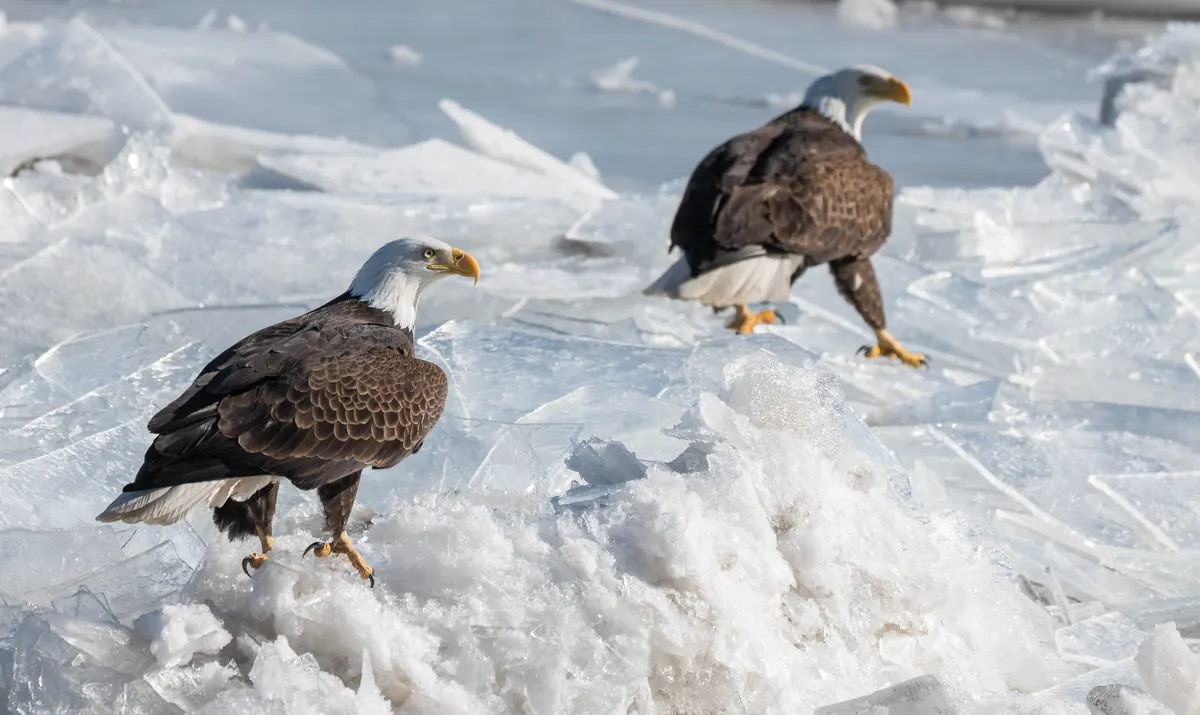
The ice decides where Maine’s big birds of prey spend January. As ponds and slow rivers freeze, the fish that bald eagles depend on are sealed away, and the birds gather wherever water still moves. The state Department of Inland Fisheries and Wildlife (IFW) says many Maine eagles never leave for the winter.
-
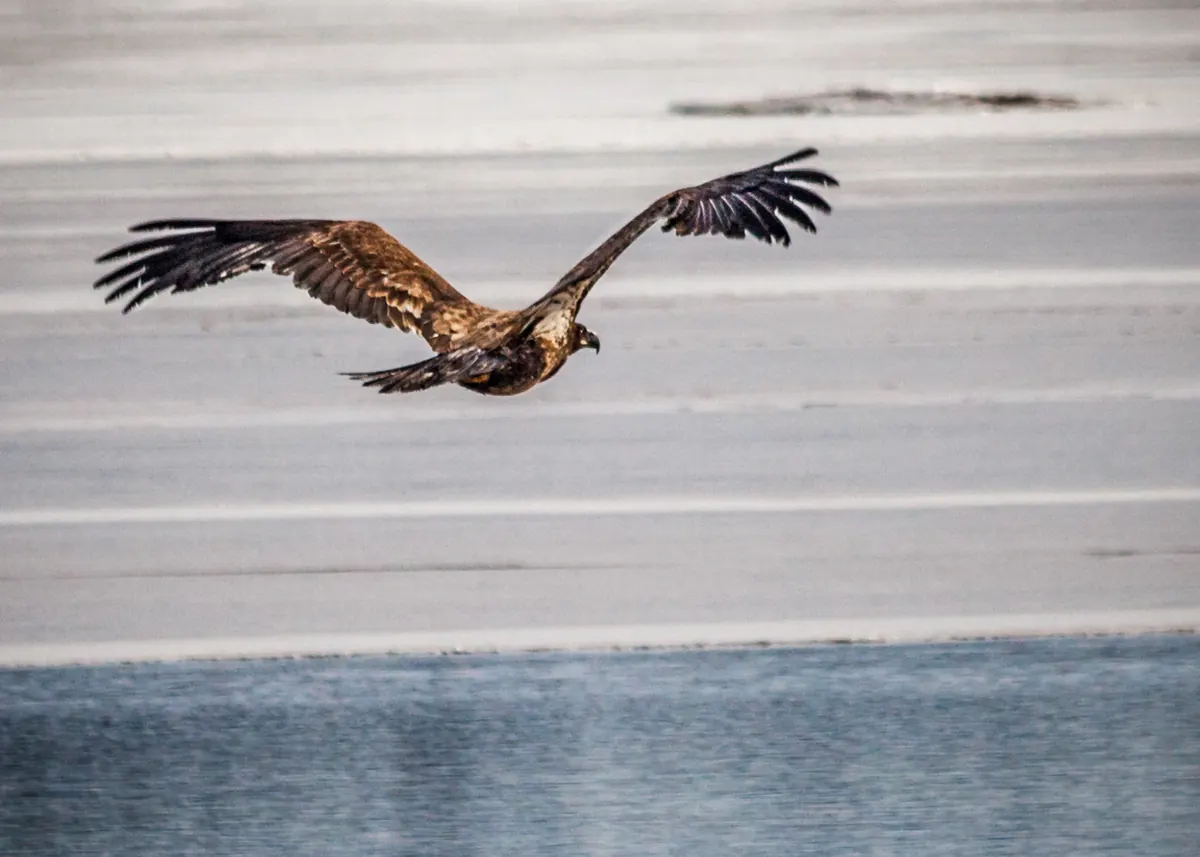
Bald eagles on open water
All month, best on cold, clear mornings · Ice-free stretches of the coast and the big rivers, especially below dams
IFW’s species assessment for the bald eagle describes the winter pattern plainly: eagles winter statewide, but their distribution is skewed toward the coast, and coastlines and major rivers that stay free of ice are the birds’ main winter habitat. Many inland eagles move to the shore for the cold months, and adults often keep visiting their nests through the winter. The same report notes that wintering eagles often congregate near dams, where the outflow keeps water open, stuns fish and draws ducks. Check tailraces and river mouths, scanning the shoreline pines for white heads.
-
Scavenging on the ice
Through the hardest freeze, often January and February · Frozen lakes, coves and fields wherever a carcass lies
When ice limits fishing, eagles turn scavenger. The assessment lists dead deer, livestock and seal pups among their carrion, and in the 1980s a winter feeding program in eastern coastal Maine drew at least 274 different eagles to seven stations in one winter.
-
Merrymeeting Bay and Swan Island
Year round, with open tidal water most winters · Where the Kennebec and Androscoggin meet, between Bath, Bowdoinham and Richmond
Tidal currents keep patches of this bay open in all but the hardest cold. Maine Audubon has run an annual eagle trip up the Kennebec to Swan Island since 1969, when the state had only 14 nesting pairs and the first trip found a single bird; the 50th trip, in 2018, counted 47. Maine Audubon describes Swan Island as home to one of the largest concentrations of eagle nests in the state.
-
Great horned owls pairing up
Mid-January into March, earliest in the south · Woodlots beside fields and farms statewide
December is for hooting; January is when the season turns serious. In IFW’s account, southern Maine’s great horned owls pair off first, from the middle of January, and the northern birds as late as mid-March. Each female then incubates one to three eggs for roughly a month, usually in a nest another big bird built and abandoned. Listen at dusk for a pair dueting, the female’s voice noticeably higher than the male’s, and look for whitewash and pellets under a big pine.
Boreal owls, IFW says, are rare and irregular winter visitors to the northern two thirds of the state; report one, or any snowy owl, to eBird.
Where can you go ice fishing for smelt on the Kennebec?
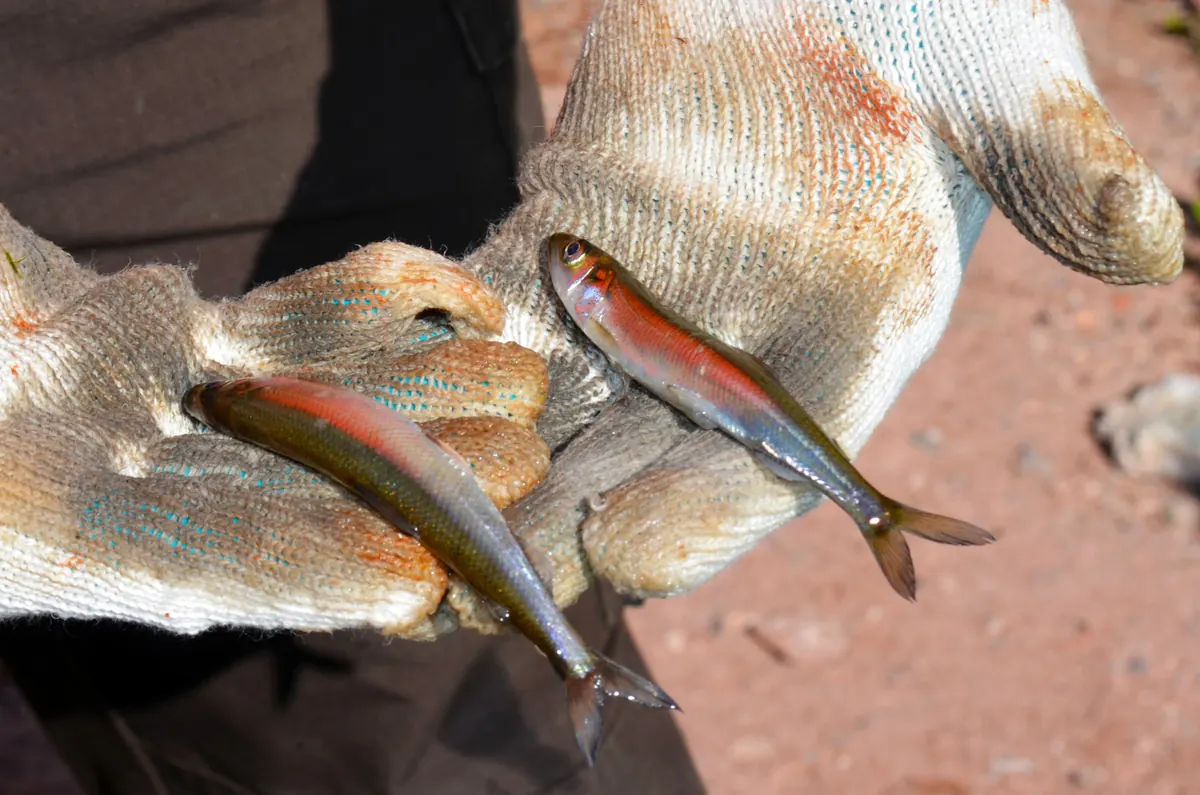
Every winter that the ice allows, a small village of heated shacks appears on the tidal rivers that feed Merrymeeting Bay. Rainbow smelt, small silvery fish that run up into fresh water to spawn in spring, gather here through the winter.
-
The smelt camps
Once the river ice is thick enough, often by January; the season historically ran from December into March · The Kennebec, Eastern, Cathance and Abagadasset rivers, in Bowdoinham, Dresden, Pittston and Randolph
About five commercial camps rent shacks by the tide, each with a woodstove or heater, a light and a slot in the floor over the water. The Bangor Daily News counted D’s Camps on the Cathance, Worthing’s on the Kennebec in Randolph, James Eddy on the Eastern River in Dresden, Baker’s in Pittston and Leighton’s on the Abagadasset when the camps opened in January 2026. Groups book a shack for a tide and fry the catch whole. Call ahead: openings depend entirely on the ice.
-
A season that depends on the cold
Varies widely from winter to winter · Tidal rivers above Merrymeeting Bay
Operators told reporters that poor ice had cut several recent seasons short, with only about a month of fishing in the 2024–25 winter, and that it now takes more sustained cold for the river to freeze solid. The 2025–26 winter brought early ice, and an operator quoted by the Kennebec Journal said that, after several years when nobody came close, anglers were hitting the daily limit on more than a few occasions. A strong El Niño winter could tilt toward a shorter season, but nobody can say in October how the ice will set.
-
The rules
October 1 to March 14 (winter limit) · Coastal waters from the New Hampshire line to Owl’s Head Light in Rockland (Zone 1)
Sea-run smelt are managed by the Department of Marine Resources rather than IFW. Its 2026 rules allow only hook and line in this zone, through the ice from February 1, with a limit of 4 quarts (one gallon) per person per day from October 1 through March 14.
Keep an eye on the sky over the shacks: eagles patrol these tidal rivers too.
Where do Maine’s deer and moose go when the snow gets deep?
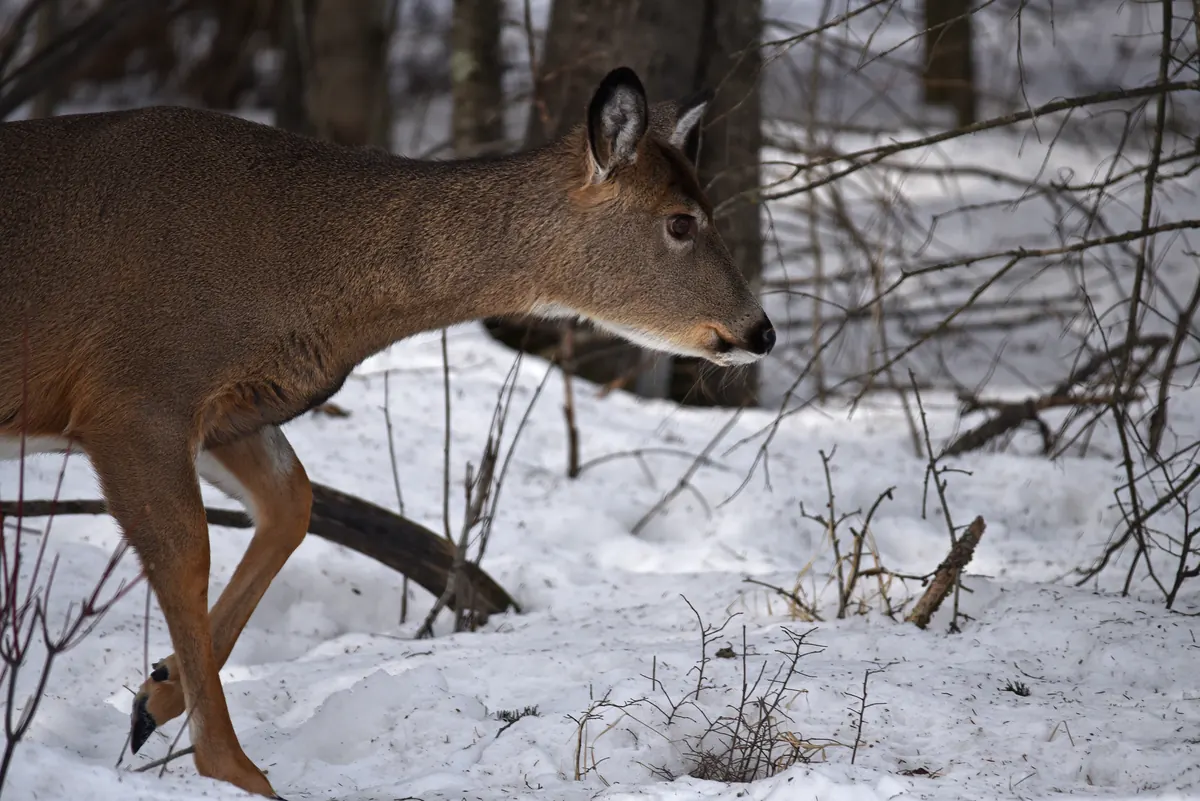
Deep snow is the hardest test of a Maine winter for hoofed animals. White-tailed deer are at the northern edge of their range here, and IFW’s long-range deer assessment says winter severity has a substantial effect on deer survival, with annual winter losses over the past three decades ranging from a negligible 3 percent to more than 35 percent of the herd. Moose, with their long legs, cope better, but they face troubles of their own.
-
Deer in their winter yards
Once snow averages a foot or more, often from January · Dense, mature stands of hemlock, cedar, spruce and fir, often along streams and in lowlands
An IFW biologist writes that when snow depths average about a foot, deer start moving into dense conifer stands, the traditional deer yards. The thick evergreen crowns catch snow before it reaches the ground, and some of it evaporates straight off the branches, so the snow underneath stays shallower and easier to walk through. Inside, the deer beat down a network of packed trails. IFW’s guidelines note that twigs and lichens dropped from the canopy can supply up to half of what wintering deer eat. A yard can hold 350 or more deer per square mile.
-
Measuring how hard the winter is
Through the snow season, December into April · Weather stations across the state
IFW keeps a winter severity index, recording snow depth, how far deer sink in the snow, and temperature through the season. One biologist watched deer leave a packed trail and sink nearly 20 inches at every step. If you find a yard, keep your distance: every time deer flee through deep snow, they burn fat they cannot replace until spring.
-
Moose browsing on fir
All winter · Young softwood and cutover land in the North Woods, the western mountains and Aroostook
IFW counted roughly 76,000 moose in Maine in 2012. In winter they live on twigs, and the department says balsam fir becomes especially important to them, though fir alone is not enough to keep a moose in good condition. Look for ragged, browsed tips on saplings at head height. The real winter threat is the winter tick, which attaches by the thousands in fall and stays on for five or six months; by late winter, heavily infested moose look gray and patchy where they have rubbed off their hair.
-
Shed antlers
Moose from early winter; deer mostly late December through January · Along trails, field edges and bedding cover
IFW says bull moose drop their antlers in early winter, once the rut is over and the weight is no longer worth carrying. Whitetail bucks tend to hold theirs a little longer, and the Bangor Daily News describes late December through January as the prime window. Collecting sheds needs no license; just stay out of deer yards.
For help with prints, see the tracks section of our Maine December guide.
Which winter finches will visit Maine this winter?
Winter finches wander wherever the seed crops are good, so some years Maine feeders are mobbed and others are quiet. For 2026–27 the Finch Research Network’s annual outlook expects a winter of grosbeaks, siskins and crossbills in the Northeast, with few redpolls or pine grosbeaks.
-
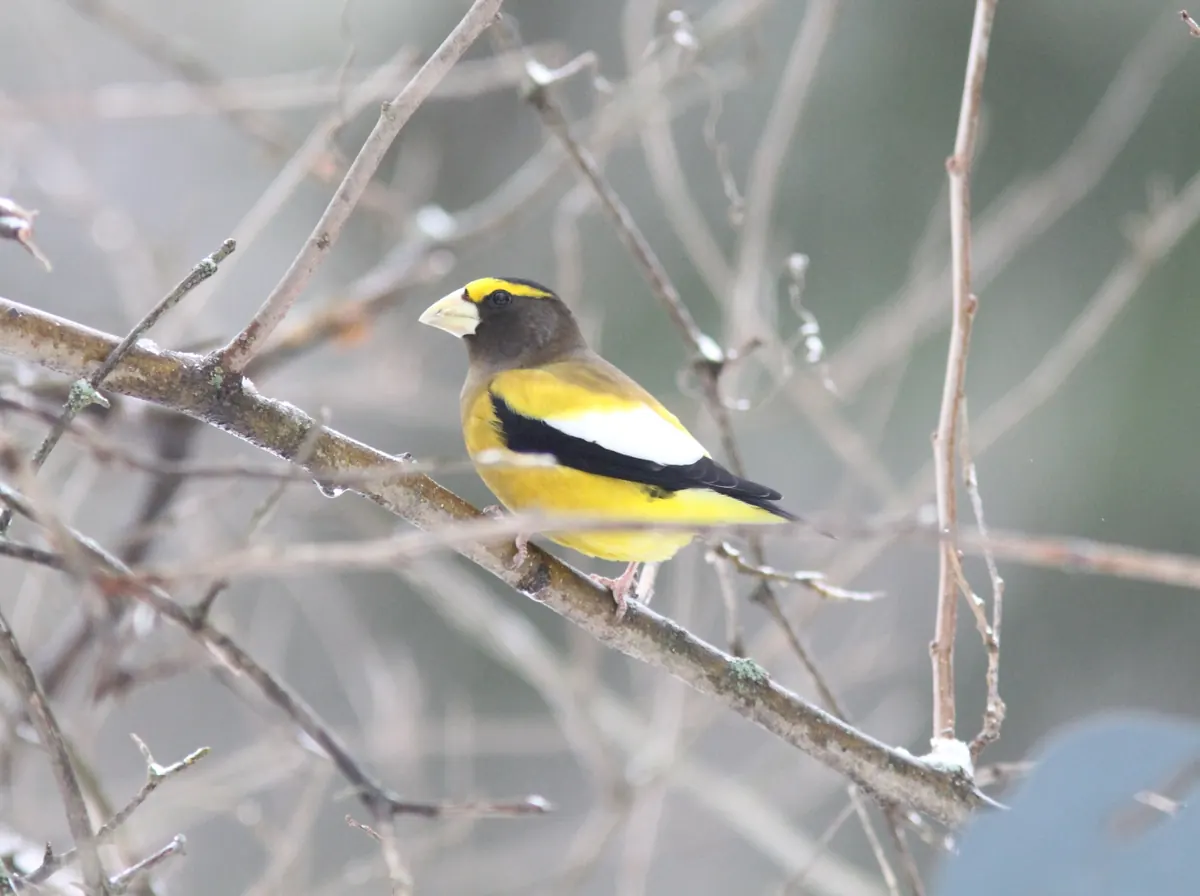
Evening grosbeaks
Through the winter, at feeders from fall to spring · Northern and western Maine especially, but possible statewide
Big-billed, yellow and black, and loud, evening grosbeaks follow the spruce budworm, a caterpillar whose outbreaks feed them well, and the forecast counts four irruptions in the past six years. It expects small to medium flocks across the northeastern United States this winter. They love black-oil sunflower seed and travel in noisy groups, so one sighting usually means several birds.
-
Pine siskins and purple finches
All winter, often lingering into spring · Spruce and pine woods and backyard feeders
The forecast expects many purple finches to come south into the northeastern states to feed on good spruce and pine seed crops, and it predicts a strong showing of pine siskins, which were already turning up by the hundreds at sites in Quebec. Siskins are small, streaky and flash yellow in the wings.
-
Red and white-winged crossbills
Any time in winter · Coniferous forest, especially spruce and white pine
The crossed bill is a tool for prying open cones. The forecast calls for a significant flight of red crossbills, and white-winged crossbills scattered wherever the spruce crop is best. Listen for chattering flocks high in the conifers and look for cone scales raining down onto the snow.
Good mountain-ash crops farther north should keep most pine grosbeaks and Bohemian waxwings out of Maine, the forecast adds. Project FeederWatch runs from November through April and takes counts from any backyard; the Naturalist’s Field Journal has a birds-I-have-seen page for the list.
What lives under the snow and ice in a Maine winter?
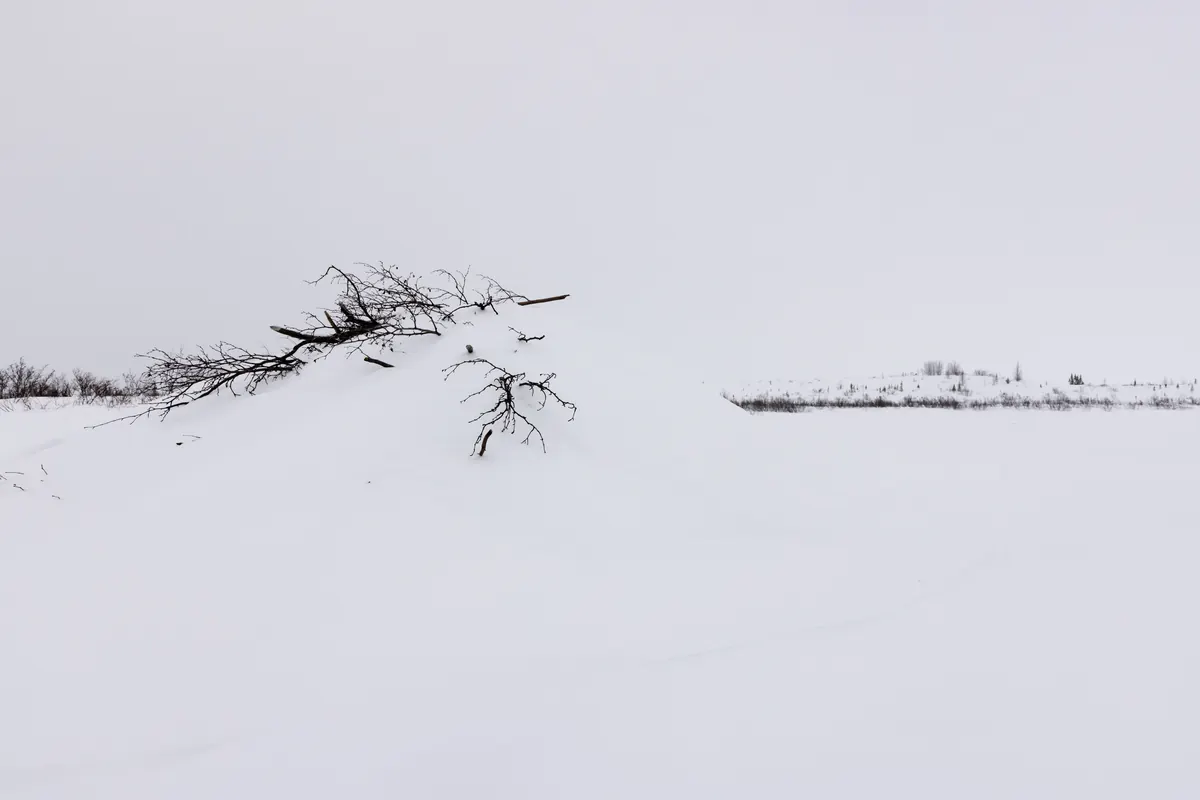
Some of the busiest winter life in Maine goes on where you cannot see it. A blanket of snow insulates the ground, and a lid of ice does the same for ponds, and a whole set of animals keeps working underneath.
-
Voles, mice and shrews
All winter, once the snow is deep enough to insulate · Fields, meadows and forest floor statewide
An IFW biologist describes the subnivean zone, a layer at ground level beneath the snow that holds close to 32 °F however bitter the night gets. Meadow voles tunnel through the matted grass there, eat seeds and stems, and even gnaw bark off small shrubs. A spring melt exposes their winding runways in the grass.
-
The hunters above
Day and night all winter · Open fields, edges and marshes
Weasels, foxes and owls hunt this hidden layer by sound. A fox will freeze, cock its head, then leap and plunge nose first into the snow, leaving a small crater that often holds a few spots of blood or a scattering of fur.
-
Beavers under the ice
From freeze-up until ice-out · Ponds, flowages and slow streams statewide
Beavers do not hibernate. IFW explains that in fall they anchor a pile of stems and branches in the mud near the lodge, and through the winter they swim out under the ice to feed on that cache, along with the roots of pond lilies and cattails. On a cold day, look for a frosty patch on top of a snow-covered lodge: it is the warm, damp air of the family breathing inside.
River otters stay active under the ice too, surfacing at openings below beaver dams and rapids. Their trail in snow is a series of bounds broken by long slides on the belly, especially on slopes down to the water.
How do you identify Maine’s hardwood trees in winter?
Without leaves, hardwoods are recognized by their buds, twigs and bark. Forest Trees of Maine, the state forest service’s free handbook, gives the winter clues for each species. Start with one test: are the buds and twigs set in opposite pairs, or alternate? In Maine, opposite branching almost always means a maple or an ash.
-
Sugar maple and red maple
All winter · Sugar maple on rich uplands; red maple everywhere, especially wet ground
Both have opposite buds. Sugar maple’s are brown and sharply pointed, with dark edges on the scales, and older trunks are deeply furrowed gray. Red maple is Maine’s most abundant maple: its twigs are red and its red buds are often bunched in clusters, and young bark is smooth and pale gray. It is among the first trees to flower in spring.
-
American beech
All winter · Uplands statewide, often in nearly pure stands
Beech buds are unmistakable: long, slender, many-scaled and sharp as a spear, set alternately on zigzag twigs. Smooth gray bark is now uncommon, because beech bark disease leaves most trunks rough and pocked with cankers. Look for claw marks on the bark, a sign that a black bear climbed the tree in fall for its nuts.
-
Yellow birch and paper birch
All winter · Yellow birch on cool, moist sites; paper birch statewide, often along streams and lakes
Yellow birch bark is shiny silvery gray to yellowish bronze and peels in thin, curly strips. Its twigs taste of wintergreen if you scratch and sniff one. Paper birch has chalk-white bark that peels in sheets, orange on the inside, and twigs without the wintergreen scent. The Forest Service asks that you never peel bark from a living birch.
-
White ash
All winter · Rich, moist soils on low hills statewide
Ash is the other common tree with opposite buds. Its bark has a regular pattern of crisscrossing ridges, like a woven basket, and the end bud is a blunt dome. Its hairless twigs carry deeply notched leaf scars.
Choose a single tree near home, draw its buds now, then return every few weeks; one plate in our field journal tracks a single tree across the year.
Are Maine’s lakes frozen in January, and when is the ice safe?
By January most ponds and many larger lakes have frozen, and the ice-fishing season is under way: under IFW’s general law, lakes and ponds in the South Zone are open to fishing all year, and many northern waters have their own special rules, listed in the lawbook. But the ice is never uniform, and a thaw or a heavy snow can weaken it fast. IFW’s guidance for new, clear ice:
- Under 4 inches: keep off.
- About 4 inches: may support one person walking.
- 5 to 7 inches: usually able to carry a snowmobile or an ATV.
- 8 to 12 inches: may hold most cars and light pickups.
Double those figures for cloudy white ice, which carries roughly half the load.
-
Where ice fools people
All winter, and especially during thaws · Inlets, outlets, narrows, springs, docks and pressure ridges
Current thins ice from below, so a stream mouth can be dangerous when the middle of the lake is a foot thick. A heavy snowfall insulates the ice and weighs it down, sometimes flooding the surface with slush. IFW’s short rule still applies: if you don’t know, don’t go. Test every few steps with an auger or chisel, wear ice picks, and bring a partner.
On tidal rivers, leave the ice to the smelt camps, which check theirs daily.
How much daylight does Maine gain in January?
The latest sunrises of the year arrive in the first days of January, but sunset has been moving later since mid-December, so the days are growing at both ends by the end of the month. Fort Kent goes from 8 hours 34 minutes of daylight on New Year’s Day to 9 hours 34 minutes on January 31, a gain of 60 minutes; along the southern coast, Kittery adds 51 minutes. Northern towns gain fastest.
| City | Jan 1 | Jan 31 | Gained | Per day |
|---|---|---|---|---|
| Kittery | 9 h 04 m | 9 h 55 m | 51 min | 1.7 min |
| Portland | 9 h 00 m | 9 h 52 m | 52 min | 1.7 min |
| Augusta | 8 h 56 m | 9 h 48 m | 52 min | 1.7 min |
| Bangor | 8 h 52 m | 9 h 46 m | 54 min | 1.8 min |
| Bar Harbor | 8 h 55 m | 9 h 49 m | 54 min | 1.8 min |
| Eastport | 8 h 51 m | 9 h 45 m | 54 min | 1.8 min |
| Millinocket | 8 h 45 m | 9 h 41 m | 56 min | 1.9 min |
| Fort Kent | 8 h 34 m | 9 h 34 m | 60 min | 2.0 min |
Even with all that gain, none of these towns gets a 5 p.m. sunset until February. Look up sunrise and sunset for any town in the state with our daylight calculator.
How cold does Maine get in January, and how might El Niño change it?
January is normally the coldest month of the year in Maine. The National Weather Service office in Caribou notes that since 1939, January has been the town’s coldest winter month about two years in three. NOAA’s 1991–2020 normals put the average January low near 15 °F on the coast at Portland and Eastport, around 9 °F at Bangor and close to 3 °F in Caribou and Presque Isle. The state’s all-time record low, confirmed by NOAA’s State Climate Extremes Committee, came on January 16, 2009, when a U.S. Geological Survey river gauge on the Big Black River near the Quebec border recorded 50 below zero; Caribou bottomed out at 37 below the same morning.
| Station | Average high | Average low | Precipitation | Snowfall |
|---|---|---|---|---|
| Portland International Jetport | 32.4 °F | 15.6 °F | 3.50 in | 18.6 in |
| Eastport | 30.3 °F | 15.1 °F | 4.20 in | 15.3 in |
| Bangor International Airport | 28.1 °F | 9.0 °F | 3.17 in | 18.6 in |
| Farmington | 26.8 °F | 5.6 °F | 3.53 in | 20.7 in |
| Presque Isle | 22.3 °F | 3.3 °F | 2.53 in | 21.1 in |
| Caribou Municipal Airport | 20.8 °F | 2.6 °F | 2.95 in | 25.0 in |
El Niño and a Maine January. Out in the tropical Pacific, the warm water is piling up fast. Will it still be running, and very strong, when Maine’s ponds freeze? Better than nine chances in ten, the Climate Prediction Center judged on September 10. Its winter outlook comes out October 15, with monthly revisions after that; look on the CPC 90-day outlook maps for the newest version as January nears. What does history suggest? A 2018 regional El Niño briefing from NOAA and its Northeast climate partners explains that storms tend to track up the East Coast in these winters, giving the Eastern Seaboard more precipitation than usual, and it points to research suggesting roughly two extra classic nor’easters in an El Niño winter, more often in strong events. Whether those storms bring snow or rain to Maine depends on the track and the temperature: the record 2015–16 event left the region mild and gave New England a snow deficit. Together, those findings hint at a stormy, changeable January, with more chance of rain and mixed precipitation along the coast, but a single season can go its own way.
For the days ahead, our weather page carries the local forecast, and the cloud outlook helps pick a clear night for the sky events below.
What can you see in Maine’s night sky in January 2027?
January starts with one of the best Quadrantid showers in years and ends with Jupiter and Mars climbing higher in the evening as both near opposition in February. Times are Eastern Standard Time.
-
The Quadrantid meteor shower
Night of Sunday, January 3, into Monday, January 4 · Face northeast from a dark spot; the radiant climbs through the night
The Quadrantid burst is short-lived, a few hours at most, and in 2027 it lands in darkness over North America: around 10:30 p.m. on the 3rd by the American Meteor Society’s reckoning, or just after midnight by EarthSky’s. A slim crescent moon stays below the horizon until a few hours before sunrise. Its radiant, off the tip of the Big Dipper’s handle, gains height through the night, which favors Monday’s predawn hours. Realistic counts from the Maine woods run to several dozen an hour; dress for subzero wind chill.
-
Earth closest to the sun, and Venus at its best
Perihelion Saturday, January 2, at 9:33 p.m.; Venus at greatest elongation Sunday, January 3 · Venus low in the southeast before sunrise
On Saturday evening Earth is about 91.4 million miles from the sun, its nearest for the year, in the middle of a Maine winter: so Maine’s cold has nothing to do with distance and everything to do with the low winter sun. On Sunday, January 3, Venus stands at greatest western elongation, at its widest angle from the sun for this stretch of mornings; look southeast before dawn any day of the month for the brightest point in Maine’s sky.
-
The Wolf Moon, the year’s closest full moon
Full at 7:17 a.m. Friday, January 22; best on the night of Thursday, January 21 · Rising in the northeast at dusk on the 21st, setting in the northwest near sunrise
January’s full moon is a supermoon, the year’s nearest full moon by Espenak’s figures: roughly 222,000 miles, because it falls less than a day after the moon’s nearest point in its orbit. It turns exactly full around moonset on Friday morning, so watch it rise on Thursday evening the 21st, or again on Friday evening. Look for bright Jupiter keeping the moon company on Saturday evening, January 23.
-
Planets
All month · Saturn low in the southwest after dark; Jupiter and Mars in the east by mid-evening
Saturn hangs low in the southwest at nightfall and slips lower every week. Jupiter, a month from opposition (February 10), is up in the east by mid-evening, and Mars trails it in Leo, growing brighter on the way to its own opposition on February 19. Mercury makes a cameo at month’s end: try a flat western horizon 30 to 45 minutes after sundown, with greatest elongation coming on February 3.
| Phase | Date | Time |
|---|---|---|
| New moon | Thursday, Jan 7 | 3:24 p.m. |
| First quarter | Friday, Jan 15 | 3:34 p.m. |
| Full moon, the Wolf Moon | Friday, Jan 22 | 7:17 a.m. |
| Last quarter | Friday, Jan 29 | 5:55 a.m. |
For faint stars and the Milky Way, the moonless stretch either side of the January 7 new moon is the time. Solar activity has eased from its 2024 maximum yet strong storms remain possible, and northern Maine’s long, dark nights are its best chance at aurora; keep an eye on NOAA’s Space Weather Prediction Center. Daily moonrise and moonset are on our moon phase calendar.
What can Maine families do outdoors in January 2027?
Few organizers have posted their January 2027 programs yet, so dates below come only from fixed calendars or the organizer’s own stated schedule. A Maine snowstorm can cancel anything, so confirm on the day.
- Friday, January 1: First Day Hikes, a national New Year’s Day program run in Maine by the state parks. In 2026 Maine offered free admission and guided hikes at four parks plus self-guided walks at several more; the parks had not announced their 2027 plans by early October, so check their First Day Hikes page in December.
- Through Tuesday, January 5: the final days of the Christmas Bird Count. Maine Audubon lists any Maine circles still to be counted.
- Third Saturday of the month: the free Casco Bay Wildlife Tracking Club, led by Northern Songlines through the Chebeague and Cumberland Land Trust, meets on the third Saturday of every month; it suits ages 12 and over, with children accompanied. Register through the organizer, who sends the meeting place.
- All winter: Project FeederWatch, from November to April, needs only a feeder or a window and a few counts a week.
- Coming in February: the Great Backyard Bird Count, normally a four-day count in mid-February. Its 2027 dates will appear at birdcount.org.
A smelt shack on the Kennebec is one of Maine’s most memorable family winter outings: warm, bright and close to shore. Or try a snow-day lesson in tree buds with three twigs found on the ground. For other months, browse our nature guides.
Safety notes for January in Maine
Hunting and trapping. The deer seasons are over, but some hunting goes on all month, from IFW’s 2026–27 schedule. In the Coastal Zone, duck, Canada goose and brant seasons run through Tuesday, January 5, so expect shooting around coastal marshes in the first week. Snow geese stay open through January 30, gray squirrel through January 30, snowshoe hare through March 31, bobcat through February 20 and fox through February 27. Coyote hunting has no closed season, and night coyote hunting is allowed through the winter. Spring crow seasons open January 15 in Wildlife Management Districts 7 to 29 and January 30 in districts 1 to 6. Beaver trapping continues into April. There is no hunting on Sundays.
Hunter orange. IFW’s orange law applies during the firearm, muzzleloader and crossbow deer seasons, and in districts open to moose hunting, so it is not required in January. Wearing a bright hat or vest in the woods is still sensible, for you and your dog.
Cold and wind chill. Frostbite is a real risk this month, above all on summits and the open ice of big lakes. Wear layers without cotton, cover face and fingers, and pack a dry spare.
Ice. No ice is ever guaranteed. Test it yourself, keep off moving water and slushy areas, and keep children and dogs close.
Short days and storms. Daylight is still under ten hours everywhere in Maine, so start early and carry a headlamp. Nor’easters can close roads and bring sleet and freezing rain to the coast; check the forecast before heading into the North Woods, where help is far away.
Back indoors, the Naturalist’s Field Journal holds a page each for tracks, trees, mammals and birds, and our Maine frost dates page gives each town’s typical last spring frost, handy once the seed catalogs arrive.
Sources
- Maine Department of Inland Fisheries and Wildlife: bald eagles
- Maine Department of Inland Fisheries and Wildlife: bald eagle species assessment
- Maine Audubon: trip report, 50th anniversary of the bald eagles of Merrymeeting Bay
- Maine Department of Inland Fisheries and Wildlife: owls
- Bangor Daily News: after a limited season last winter, smelt shacks return to a Maine river (January 7, 2026)
- Central Maine: in central Maine, early ice makes smelt fishing nice (February 1, 2026)
- Maine Department of Marine Resources: 2026 sea-run rainbow smelt regulations
- Maine Department of Inland Fisheries and Wildlife: surveying deer wintering areas (February 23, 2021)
- Maine Department of Inland Fisheries and Wildlife: white-tailed deer assessment and strategic plan (1997)
- Maine Department of Inland Fisheries and Wildlife: white-tailed deer population management system and plan (2011)
- Maine Department of Inland Fisheries and Wildlife: guidelines for managing deer wintering areas
- Maine Department of Inland Fisheries and Wildlife: managing your habitat for white-tailed deer (2023)
- Maine Department of Inland Fisheries and Wildlife: moose
- Bangor Daily News: antler shed hunting in Maine (January 20, 2026)
- Finch Research Network: winter finch forecast 2026–2027
- Project FeederWatch: how to participate
- Maine Department of Inland Fisheries and Wildlife: Maine’s wildlife uses different strategies to deal with winter (March 16, 2017)
- Maine Department of Inland Fisheries and Wildlife: beaver
- Maine Forest Service: Forest Trees of Maine, sugar maple
- Maine Forest Service: Forest Trees of Maine, red maple
- Maine Forest Service: Forest Trees of Maine, American beech
- Maine Forest Service: Forest Trees of Maine, yellow birch
- Maine Forest Service: Forest Trees of Maine, paper birch
- Maine Forest Service: Forest Trees of Maine, white ash
- Maine Department of Inland Fisheries and Wildlife: statewide general fishing laws
- Maine Department of Inland Fisheries and Wildlife: ice safety tips
- NOAA National Centers for Environmental Information: 1991–2020 monthly normals for Maine stations (January)
- National Weather Service Caribou: January climate outlook for Caribou
- NOAA National Centers for Environmental Information: State Climate Extremes Committee records
- Climate Prediction Center: ENSO diagnostic discussion, September 10, 2026
- Climate Prediction Center: seasonal outlooks (winter outlook issued October 15, 2026)
- NOAA and Northeast Regional Climate Center: El Niño impacts and outlook, Northeast region (October 2018)
- NOAA Climate.gov: United States El Niño impacts
- U.S. Naval Observatory: moon phases from December 30, 2026
- U.S. Naval Observatory: Earth’s seasons and apsides, 2027
- American Meteor Society: meteor shower calendar
- EarthSky: everything you need to know about the Quadrantid meteor shower
- Fred Espenak: Sky Event Almanac 2027
- EarthSky: what is a supermoon?
- Sea and Sky: astronomy calendar of celestial events 2027
- NOAA Space Weather Prediction Center: solar cycle progression
- Audubon: join the Christmas Bird Count
- Maine Audubon: Christmas Bird Count
- Maine State Parks: First Day Hikes
- America’s State Parks: First Day Hikes
- Chebeague and Cumberland Land Trust: Casco Bay Wildlife Tracking Club
- Great Backyard Bird Count
- Maine Department of Inland Fisheries and Wildlife: 2026–27 Maine hunting seasons
- Maine Department of Inland Fisheries and Wildlife: migratory game bird seasons 2026–27
- Maine Department of Inland Fisheries and Wildlife: laws pertaining to hunting equipment (hunter orange)
- Maine Department of Inland Fisheries and Wildlife: trapping laws and rules
- Photos via Wikimedia Commons; licenses and photographers are credited under each picture
