What to look for in nature in Maryland this March
March is the month Maryland’s woods and waters change over. Winter still lingers, with snow on the Garrett plateau and freezing nights across the west, yet the first warm rain pulls wood frogs and spotted salamanders to their pools, the rivers fill with shad and white perch, and ospreys settle back on the nest platforms along the Bay. At dusk, woodcock start their spiral flights over brushy fields, bald eagle chicks begin to hatch, and red maples flush pink above the swamps. Trout streams reopen on the last Saturday of the month, and the Sugar Shack at Cunningham Falls is usually boiling sap. Clocks jump ahead on March 14, the equinox falls on the 20th, and the full Worm Moon arrives at dawn on the 22nd.
Other months in Maryland: October, November, December, January, February, April.
Start here

- Visit a woodland pool on a warm, rainy night. Choose an evening with rain and mild air, stand still beside a wet hollow in the woods, and wait a few minutes for the wood frogs and peepers to resume. Stay on the trail and do not disturb any egg masses.
- Watch ospreys return to their nests. Choose a nest platform, channel marker or pole near water. Experienced birds usually come back first, so write down the day a bird is first on it.
- Stand at a field edge at dusk for woodcock. Maryland DNR dates the displays from mid-March to early April. Arrive before sunset, listen for a nasal “peent,” and watch the sky above the field for a bird spiraling upward.
Fitting plates for the month: a map of sounds for the first night of frog calls, with the temperature and any rain; dusk and dawn watch for a woodcock field; nest observed for an osprey platform you can visit weekly; the same place twice for a patch of bloodroot or spring beauty; and a daily field log for every first, so that next March has dates to beat.
Regions used below: Western Maryland (Garrett and Allegany); Hagerstown Valley and the Blue Ridge; Central Maryland and the Baltimore–Washington corridor; Southern Maryland; Eastern Shore and the Atlantic coast.
What is calling at Maryland’s woodland pools in March?
March is when the pools fill and the singing peaks. The first mild, rainy night after the ground thaws sets the season off, and what follows depends on the forecast more than the calendar: a warm downpour can bring out hundreds of animals at once, while a hard freeze sends everything back under the leaves. The pools that matter most are the shallow, woodland kind that fill from rain and snowmelt and dry out later in the year. No fish can live in them, so eggs laid there have a fair chance.
-
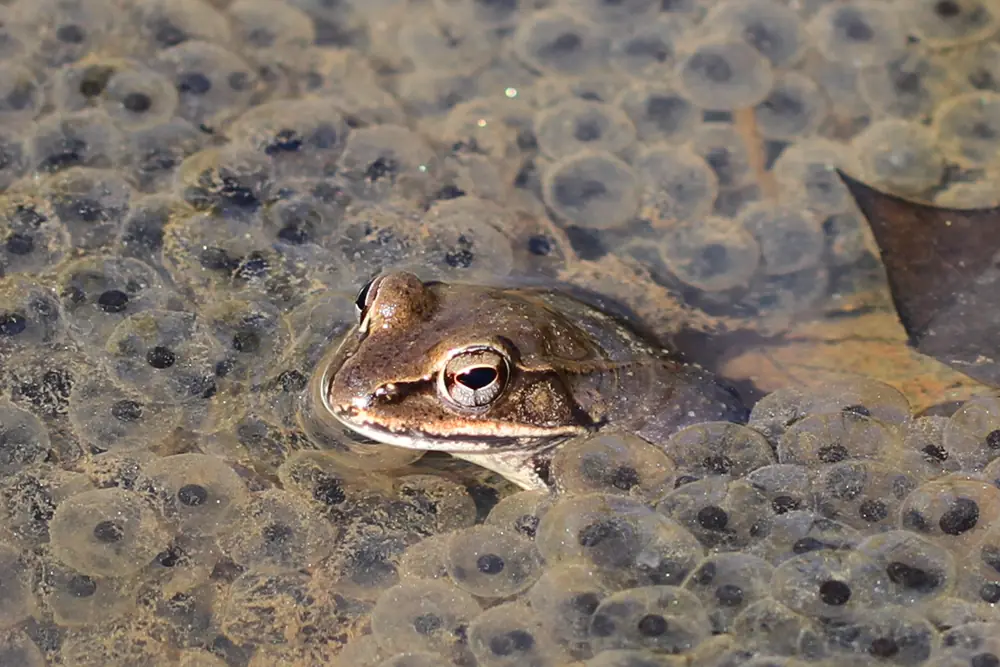
Wood frogs
Mating begins with the first warm spring rain and runs from March through May, per the Chesapeake Bay Program; Maryland DNR lists calling in February and March · Fishless vernal pools at the edge of or inside deciduous and mixed woods, statewide
A chorus of wood frogs sounds more like muttering ducks than frogs. DNR compares the call to hoarse quacking, and the Chesapeake Bay Program describes quacking or chuckling. According to the Bay Program, each female leaves 1,000 to 3,000 eggs in one mass that flattens and floats at the surface, its greenish jelly helping it blend in. Eggs laid in cold weather take longer to hatch, anywhere from about a week to a month. Outside the mating season these brown, masked frogs are silent and solitary, so a March visit is the best chance to hear them at all.
-
Spring peepers
Early spring, loudest on mild evenings · Ponds, ditches and wetland edges across the state
The Chesapeake Bay Program lists the northern spring peeper as one of the first frogs to breed and warns that hundreds singing together can be almost deafening. Most people meet peepers as sound alone, since the singers are tiny and hard to spot.
-
Spotted salamanders on the move
At the end of winter after the ground thaws, triggered by the first spring rains · Forest floors near vernal pools, returning each year to the pool where they hatched
The Bay Program says adult spotted salamanders walk to their breeding pools when the first spring rains arrive, males first, and that they come back to the same pool every year. Adults are 6 to 9 inches long, dark gray, black or bluish, marked by two rows of yellow or orange spots. Females lay 100 to 300 eggs a year, attached under water to twigs and stems, and the eggs hatch in four to seven weeks. The odds are long: more than 90 percent of the young die before leaving the pond, because of predators, disease or a drying pool. Adults can live 20 to 30 years.
On a rainy March night, slow down on roads that pass woodland pools, since amphibians cross them to reach the water. The February page for Maryland covers the earliest calling and the first signs of the season.
Which fish are running in Maryland in March, and when does trout season open?
Rivers warm slowly, and the fish follow the thermometer. Most runs reported by Maryland DNR in 2026 started in the last days of March or the first week of April, so the dates below describe a typical spring, not a promise for 2027. A warm March pulls everything earlier; a cold one pushes it back.
-
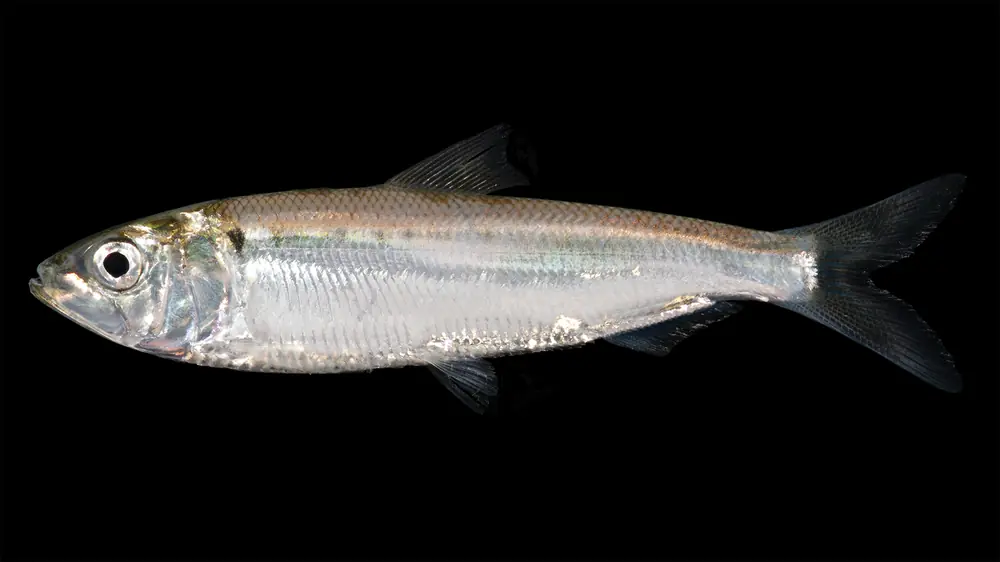
Hickory shad
First catches reported in late March in 2026; in early April 2026 fish were in the Susquehanna · Fletchers Landing and Mattawoman Creek on the Potomac side, then the lower Susquehanna, Deer Creek, Octoraro Creek and the Conowingo dam pool
DNR’s March 25, 2026 fishing report said hickory shad had reached the lower Bay, with the first catches at Fletchers Landing in the District’s waters and in Mattawoman Creek. By the April 8 report they were in the lower Susquehanna, near the mouth of Deer Creek, in the dam pool and up Octoraro Creek. Fishing for them is catch and release, using small spoons and shad darts, and the run is sensitive to water temperature and weather.
-
American shad
First fish noted in early April in 2026; peak spawning mid-April through early June at 55 to 68 °F · Fletchers Landing and the Susquehanna below Conowingo Dam; the Nanticoke and Patuxent also support runs
The larger shad come later. DNR’s April 8 report mentioned the first American shad near Fletchers Landing that week, and DNR’s fish facts place peak spawning from mid-April through early June, with 64 °F as the ideal temperature. Maryland’s commercial shad fishery has been closed since 1980. Only catch-and-release angling is allowed, and the fish lifts at Conowingo Dam have passed nearly 130,000 shad a year in recent years.
-
White perch
Spawning runs begin when water warms in late March · Fresh and slightly brackish stretches of the Potomac, Patuxent, Nanticoke, Wicomico and Pocomoke rivers and others
White perch are semi-anadromous, the Bay Program explains: they leave their deeper wintering water and travel upstream to spawn, then drop back downstream. DNR’s late-March report said the runs were already under way on several tidal rivers, and the April 1 report pointed anglers to low-salinity, warm shallows on sunny days. Small minnows and grass shrimp on jig heads were working.
-
Opening day for stocked trout
Closure 1 waters reopen at 6:30 a.m. on the last Saturday in March, which is March 27, 2027, under the regulation · Put-and-take streams and ponds statewide; Allegany and Garrett County waters are stocked from March
The rule in the Code of Maryland Regulations (COMAR 08.02.11.01) closes designated Closure 1 waters from the first Sunday after March 4 to the last Saturday in March, with fishing resuming at 6:30 a.m. that Saturday. Applying that rule to 2027 gives Saturday, March 27, but confirm it against DNR’s trout page before you plan a trip. The limit in put-and-take areas is five trout a day, ten in possession, and every brook trout must be released. In 2026 DNR expected to stock about 240,000 adult trout, a 26 percent increase, starting in February in the central, southern and eastern counties and in March in Allegany and Garrett. DNR posts daily stocking reports, and the 2027 totals will not be known until the season’s schedule is released.
-
Striped bass in their spawning rivers
In 2026, spawning rivers were closed to targeting from March 1 to May 31 · Choptank, Chester, Manokin, Nanticoke, Patuxent, Transquaking and Wicomico rivers and the upper Bay spawning area including the Susquehanna Flats
DNR’s March 31, 2026 announcement said those waters would stay closed to striped bass targeting through the spawning season, while the Bay itself was open to catch and release in April. Those are the 2026 rules; DNR will publish 2027 regulations later, so check before you fish.
A short log of river temperature and the first fish you see works well as a daily field log entry; the date the first shad appears in your river is a useful number to keep from year to year.
Which birds are returning or nesting in Maryland in March?
Spring migration is only beginning, but a handful of species mark March clearly. Some arrive, some leave, and one of the best shows is staged by a bird that does it at dusk on the ground.
-
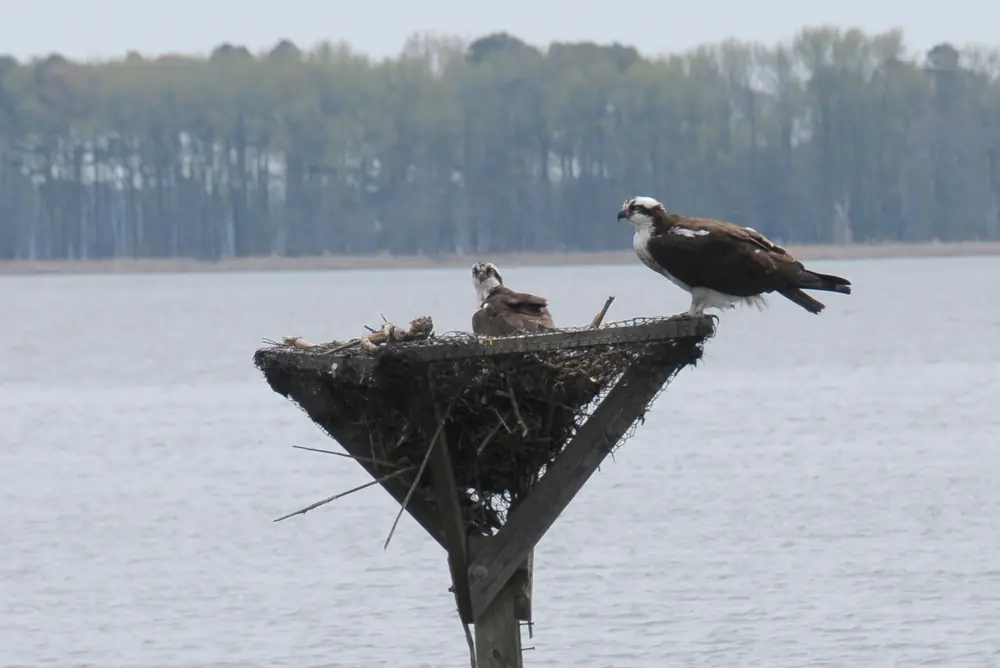
Ospreys back on their nests
Experienced breeders return in late February or early March; less experienced birds arrive later · Channel markers, utility poles, dead snags and nesting platforms along the Bay and its tidal rivers
The Chesapeake Bay Program puts the region’s osprey population at 8,000 to 10,000 breeding pairs, roughly a quarter of all ospreys nesting in the contiguous United States. Experienced breeders return to their old nest sites first, while younger birds may spend weeks finding a mate and a site. Incubation then lasts about a month. Live nest cameras are run by the Chesapeake Conservancy and the Chesapeake Bay Foundation.
-
Woodcock sky dances begin
Mid-March to early April, at dusk · Open fields and clearings next to young forest and thickets
DNR says male woodcock display in open areas from mid-March to early April, strutting and calling a nasal “peent,” then rising in spirals before returning to the ground. The performance lasts 30 to 60 minutes at dusk. The Chesapeake Bay Program notes the flight carries the bird to about 300 feet. Nesting usually begins around April, DNR adds. Arrive before sunset and stay put once the peenting starts.
-
Bald eagle eggs start hatching
Mid-March through April · Large pines and hardwoods near water; Blackwater National Wildlife Refuge hosts an annual Eagle Festival
Maryland’s eagles lay mostly in February, and the Maryland Bird Conservation Partnership gives an average incubation of 35 days, so the first chicks emerge around mid-March in the earliest nests. Broods usually hatch by mid-April and fledge in May or June. Because a female spends so much time brooding small chicks, a nest can look unchanged for days. The partnership’s tip: stay a while and see whether the male delivers food and the female tears off small pieces and leans down to feed it. Friends of Blackwater’s calendar lists the Eagle Festival on March 13, 2027, as a “save the date,” so confirm the details with the refuge before you go.
-
Tundra swans heading north
From the first week of March into early April · Wintering coves and refuges on the Bay, such as Eastern Neck, then across Pennsylvania toward Lake Erie
DNR says swans start leaving once the first spring thaw arrives. Birds that wintered on the Bay cross Pennsylvania to Lake Erie in this window, and several thousand pause at Long Point on Lake Erie.
Most songbirds and shorebirds migrate at night, DNR’s state zoologist notes, and bright lights can pull them off course. Groups such as Lights Out Baltimore ask residents to dim lights during migration. Turn off porch and decorative lights on spring nights; it costs nothing.
What blooms in Maryland in March?
The first big bloom days are small ones, low plants flowering in woods that have no leaves yet. They flower early because the sunlight reaches the forest floor for only a few weeks before the trees leaf out.
-
Daffodils
March, sometimes pushing up through melting snow · Yards, roadsides and old homesites
The Chesapeake Bay Program calls daffodils the first bulb plants up each March, appearing almost overnight. They are planted rather than native, but they make a dependable marker of the week when warmth finally takes hold.
-
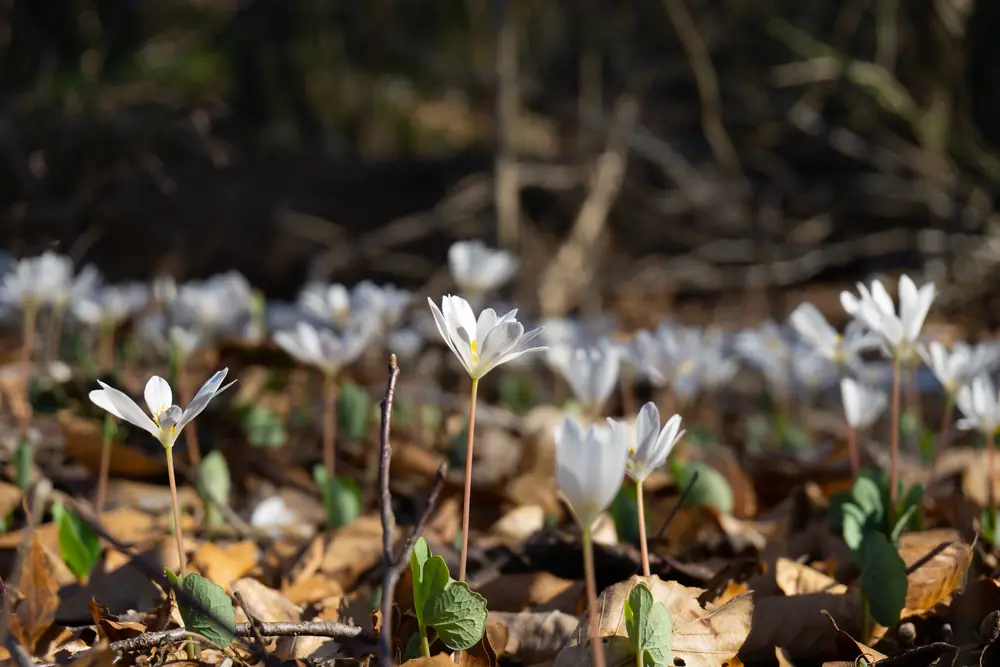
Bloodroot
March and April · Rich, shaded woods and floodplain slopes
Bloodroot blooms white with yellow stamens on a smooth stalk, the Bay Program says, and gets its name from the orange-red sap in the root. It makes pollen but no nectar, since many nectar-seeking insects are not yet flying. Ants carry off the seeds for the food packet attached to them.
-
Virginia spring beauty
March and April, per Maryland DNR’s seasonal list of pink native flowers · Moist woodlands and open meadows
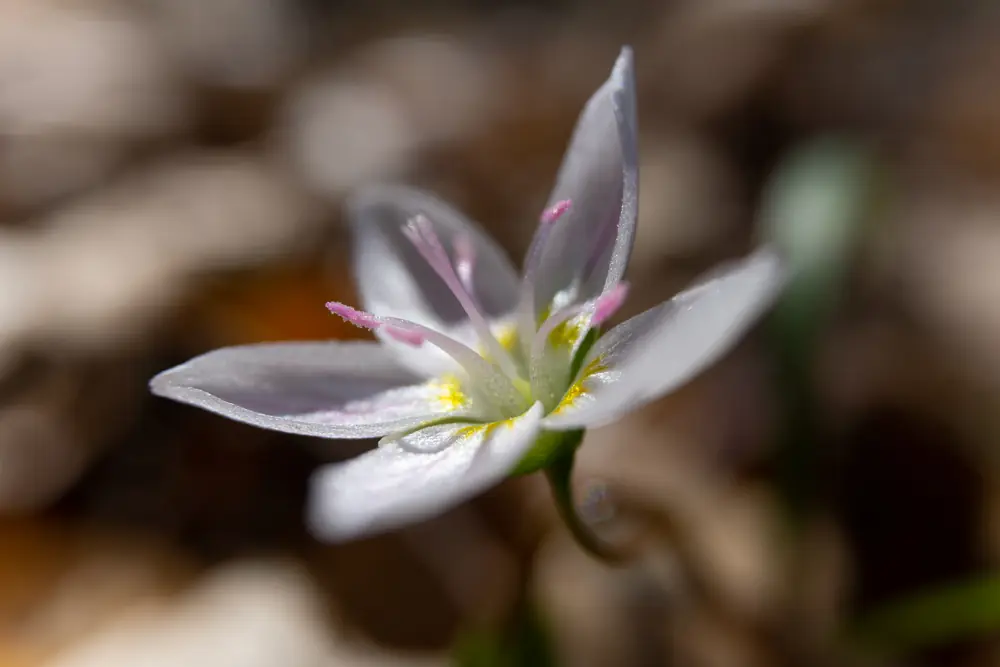
A plant 3 to 6 inches tall, with five white petals finely striped in pink, which can make a patch look pink from a distance. The Bay Program has counted at least 23 kinds of native bees and other insects visiting it, and it makes plenty of nectar. DNR also notes moss phlox, another low native, can start blooming as early as February and keep going on and off into September.
-
Red maple flowers
March and April · Swamps, bottomlands and upland woods statewide
The flowers form drooping clusters of pinkish red, the Bay Program says, and the winged fruits ripen between April and June. In a good year the treetops of a swampy wood turn red-brown from the blooms well before a single leaf opens.
-
Skunk cabbage, now in leaf
Late winter into early spring · Seeps, stream edges and wet woods
Once the spathe has been pollinated it dies back, and bright green leaves unfurl in a rosette, growing a foot wide and up to three feet long before the tree canopy closes.
Native bees emerge where flowers open, the Bay Program says, so a patch of spring beauty in a lawn or woodland edge feeds the first insects. Sketch each flower and the date you found it in the tree through the seasons plate.
Is it still maple sugaring season in Maryland?
For much of March, yes, in the western mountains. Maryland’s state parks say the best flow needs a repeating pattern of nights below freezing and mild days above 40 degrees, and the same swings that start the run also end it as spring settles in.

-
The Maple Syrup Festival at Cunningham Falls
Held in March for more than 50 years; the 2026 festival ran two weekends, March 14 to 15 and 21 to 22; 2027 dates are not yet posted · William Houck Area, Cunningham Falls State Park, near Thurmont
In 2026 the festival ran from 10 a.m. to 2 p.m. each day, with park staff boiling sap in the Sugar Shack, live bluegrass, hayrides through the maple grove, and a pancake breakfast with Maryland-made syrup. A donation of $5 per person was suggested, proceeds benefited the Friends of Cunningham Falls and Gambrill State Parks, and a sign language interpreter attended all four days. Two self-guided walks start at the Sugar Shack, a Sugar Bush Hike and a children’s storybook hike. The park office, at 301-271-7574, can say when the 2027 festival will be held.
-
How much sap makes syrup
February into March, depending on the weather · Maple groves and sugarbushes in western and central Maryland
Maryland’s state parks point out that maple sap is mostly water and only lightly sweet. Boiling 40 gallons gets you one gallon of real syrup, which is why sugarhouses burn so much wood and why a run can end quickly when the buds swell.
The run follows the thermometer: it needs freezing nights followed by mild days, so a stretch of warm nights usually slows it. If you want to see sap, go after a frosty morning that turns into a mild afternoon.
What are bears and groundhogs doing in Maryland in March?
March wakes the sleepers. The hungry ones come out first, and the first spring foods are scarce.
-
Black bears leaving their dens
Out of their dens by early April in 2026, per DNR · Forests of western Maryland and any place where easy food is left out
DNR said in April 2026 that bears had left their dens and were exploring nearby areas. “After months of not eating or drinking, bears are hungry and in search of easy food,” the department’s game mammal section leader said. DNR asks residents to take bird feeders down from April through November, since wild food is plentiful then. Never feed a bear, and give any bear you see a wide berth.
-
Groundhog mating season
Early March through April · Field edges, roadside banks and suburban yards
DNR says groundhogs mate from early March through April and that the young take up to 32 days to develop. A litter is usually two to six blind, naked pups, weaned after five to six weeks. The male stays in the den with the female until just before the young are born.
Note the date you first see a groundhog out in the open, or a bear’s tracks; either is a good entry for the mammal watch plate.
How much daylight does Maryland gain in March?
Baltimore has 11 hours 20 minutes of daylight on March 1 and 12 hours 36 minutes on March 31, a gain of 76 minutes, about 2.5 minutes per day. Cumberland and Hagerstown gain 78 minutes, Oakland, Frederick and Annapolis 77, Salisbury 76 and Ocean City 75. All eight cities end the month with more than twelve and a half hours of daylight. Clocks go forward an hour at 2 a.m. on March 14. That slides the whole day later on the clock but adds no light, so the change shows up as brighter evenings. The March equinox comes at 4:25 p.m. EDT on the 20th, a Saturday, near the time the daily gain is greatest.
| City | Mar 1 | Mar 31 | Gained | Per day |
|---|---|---|---|---|
| Oakland | 11 h 19 m | 12 h 36 m | 77 min | 2.6 min |
| Cumberland | 11 h 19 m | 12 h 37 m | 78 min | 2.6 min |
| Hagerstown | 11 h 19 m | 12 h 37 m | 78 min | 2.6 min |
| Frederick | 11 h 19 m | 12 h 36 m | 77 min | 2.6 min |
| Baltimore | 11 h 20 m | 12 h 36 m | 76 min | 2.5 min |
| Annapolis | 11 h 19 m | 12 h 36 m | 77 min | 2.6 min |
| Salisbury | 11 h 20 m | 12 h 36 m | 76 min | 2.5 min |
| Ocean City | 11 h 20 m | 12 h 35 m | 75 min | 2.5 min |
The day-length tool works out times for any date and any address.
When is Maryland’s last spring freeze?
Averages are most useful to gardeners and orchard owners, but any hiker’s feet and any flower’s buds feel the same chill. NOAA’s 1991–2020 station records give a median last freeze that runs from March 23 at Annapolis to May 6 at Oakland, a spread of six weeks across a small state. The table adds an early date, which only one spring in ten beats, and a late date that nine springs in ten have already passed. At Baltimore-Washington International the median is April 10, with the early date at March 27 and the late date at April 25. Hagerstown’s median is April 7, Cumberland’s April 15, and Frederick’s April 2.
Treat these as odds, not promises: in roughly one spring out of ten, a freeze still arrives after the late date. A warm March coaxes flowers out early, and an April freeze can nip them. The Maryland frost dates page has the same figures for many more places.
| Station | One year in ten | Median | Nine years in ten |
|---|---|---|---|
| Oakland | Apr 21 | May 6 | May 23 |
| Cumberland | Apr 2 | Apr 15 | May 5 |
| Hagerstown | Mar 25 | Apr 7 | Apr 21 |
| Frederick | Mar 17 | Apr 2 | Apr 15 |
| Baltimore | Mar 27 | Apr 10 | Apr 25 |
| Annapolis | Mar 8 | Mar 23 | Apr 6 |
| Salisbury | Mar 18 | Apr 3 | Apr 25 |
| Ocean City | Mar 24 | Apr 7 | Apr 23 |
A thermometer on a fence post and a note of the lowest reading each morning is a simple way to check these odds against your own yard.
What is March weather like in Maryland, and what are the hazards?
March swings hard. At Baltimore-Washington International, the 1991–2020 normal is a high of 54.8 °F and a low of 33.9 °F, with 4.01 inches of precipitation and 13.9 nights at or below freezing. Out at Oakland in Garrett County the normal day reaches only 48.9 °F, the normal night falls to 26.6 °F, and 22.5 nights drop to freezing or lower. Snow is still on the books in the west: Oakland averages 19.6 inches in March, with a median of 16.5. BWI averages 2.8 inches but its median is only 1.7, and Salisbury’s median is zero, so a typical March there brings none at all.
Three hazards stand out. Rivers can rise quickly when spring rain falls on wet or snow-covered ground. DNR’s 2026 flood summary recalls the 1868 Patapsco Valley flood, Hurricane Agnes in 1972, the 2016 and 2018 Ellicott City floods and recent flooding in Westernport. At Patapsco Valley State Park and other state parks with high flood risk, DNR has put up high-water exit signs and evacuation route markers on trails. Fire season is the second. Maryland averages 150 wildfires a year burning about 3,600 acres, the Forest Service says, and the leading cause, 36 percent, is outdoor debris burning. Warm days, dry fuels, low humidity and gusty wind are the ideal conditions. DNR also sets prescribed burns; in March 2026 it scheduled them at Dan’s Mountain Wildlife Management Area in western Allegany County, as early as March 26, and told visitors the smoke there was not a wildfire. Late snow on the western ridges is the third, so read the forecast before a trip to Garrett County.
NOAA’s Climate Prediction Center publishes seasonal outlooks each month. For the latest, open the CPC’s 90-day outlook maps.
| Station | High | Low | Nights ≤ 32 °F | Nights ≤ 0 °F | Precipitation | Snowfall, average | Snowfall, median | Days with 1 in. of snow |
|---|---|---|---|---|---|---|---|---|
| Oakland 1 SE (Garrett County) | 48.9 | 26.6 | 22.5 | 0.4 | 4.32 | 19.6 | 16.5 | 5.2 |
| Frostburg 2 (Allegany County) | 46.2 | 26.4 | 22.5 | 0.1 | 3.97 | 14.9 | 10.5 | 3.8 |
| Cumberland 2 | 53.0 | 31.2 | 17.6 | 0.0 | 3.42 | 6.8 | 4.0 | 1.8 |
| Hagerstown 1 E | 52.9 | 31.7 | 17.7 | 0.0 | 3.90 | – | – | – |
| Emmitsburg 2 SE (Frederick County) | 51.9 | 29.8 | 19.1 | 0.1 | 4.19 | 4.4 | 3.0 | 1.9 |
| Baltimore Washington International Airport | 54.8 | 33.9 | 13.9 | 0.0 | 4.01 | 2.8 | 1.7 | 0.8 |
| Mechanicsville 5 NE (St. Mary’s County) | 55.9 | 32.6 | 15.5 | 0.0 | 4.24 | 1.8 | 0.2 | 0.6 |
| Salisbury Wicomico Regional Airport | 55.3 | 35.2 | 14.2 | 0.0 | 4.17 | 1.0 | 0.0 | 0.4 |
Check the local forecast before trips to the mountains or the shore, and look at the clouds guide to read the sky for a weather change coming.
What is in Maryland’s night sky in March 2027?
-
Mercury at its best in the morning
Best from about March 8 to 25; greatest western elongation at 12:20 a.m. EDT on Wednesday, March 17 · Low in the east-southeast, about an hour before sunrise
SeaSky lists Mercury at its widest morning angle on March 17, when it stands 27.6 degrees from the Sun, and calls that the best time to view it. Look low in the east-southeast roughly an hour before sunrise. Venus, a much brighter point well above it, shows you where to look, and binoculars help.
-
Venus, Jupiter, Mars and Saturn
All month · Venus before dawn in the east; Jupiter and Mars in the evening sky; Saturn low in the west early in March
Venus blazes in the predawn east at magnitude −4.1, coming up around two hours ahead of daybreak on the 1st and creeping closer to the Sun each week. Jupiter, at magnitude −2.5, is up for most of the night, with Mars, at magnitude −1.1, in the same part of the sky. A bright gibbous Moon passes close to Jupiter on the 18th and 19th, within about one degree at closest, and Mars and Jupiter are roughly four degrees apart on the evening of the 30th. Saturn lingers low in the west just after dark in the opening days of March, then slips into the sunset glow; its conjunction with the Sun comes on April 7.
-
The equinox and the clock change
Clocks move forward at 2 a.m. on Sunday, March 14; the equinox is at 4:25 p.m. EDT on Saturday, March 20 · Everywhere
At 2 a.m. on Sunday the 14th, clocks are set forward an hour, pushing dawn and dusk later on the clock face. Six days on, the Sun crosses the celestial equator at 4:25 p.m. EDT, according to the U.S. Naval Observatory, and astronomical spring begins.
-
The Worm Moon
Full at 6:44 a.m. EDT on Monday, March 22; round on the evenings of March 21 and 22 · Rising in the east around sunset
Because the full moment falls shortly before sunrise on Monday, Sunday evening is the one to watch it rise. DNR’s wildlife writers note the “worm” in Worm Moon points back to caterpillars and other larvae rather than earthworms in historical texts, and that March has also been called the Goose Moon. SeaSky lists the Crow Moon and the Sap Moon among other names for this full moon.
| Phase | Date | Time |
|---|---|---|
| New moon | Monday, Mar 8 | 4:29 a.m. EST |
| First quarter | Monday, Mar 15 | 12:25 p.m. EDT |
| Full moon, the Worm Moon | Monday, Mar 22 | 6:44 a.m. EDT |
| Last quarter | Monday, Mar 29 | 8:54 p.m. EDT |
| New moon | Tuesday, Apr 6 | 7:51 p.m. EDT |
Faint stars show best on the moonless nights around March 8. Clouds decide everything, so look at the cloud outlook first, and the moon calendar lists moonrise for your town.
What can families do outdoors in Maryland in March 2027?
- Eagle Festival at Blackwater, March 13. The Friends of Blackwater calendar lists the date as a save-the-date, so check the refuge’s page for the program. The refuge’s calendar gives Visitor Center hours of 10 to 4 from Tuesday through Sunday, with Mondays and federal holidays off, and says the Wildlife Drive and trails stay open daily from dawn to dusk, with the drive closing on select dates for deer hunts.
- Walk to a vernal pool at dusk. Bring a flashlight, wear boots and stay on the path. Count the calls: how many different voices do you hear? Leave egg masses where they are.
- Watch an osprey nest. Pick a nest near you and see how many days pass between the first pair on the platform and the first stick delivered. Nest cameras run by the Chesapeake Conservancy and the Chesapeake Bay Foundation are an alternative.
- Plan a maple morning. The Cunningham Falls Maple Syrup Festival is an annual March event, usually spread over two weekends; the park office has the 2027 dates.
- Tell scientists what you see. Journey North takes public sightings of migrating species, and the USA National Phenology Network’s Nature’s Notebook lets you track the timing of the plants and animals in your own yard.
- Patuxent Research Refuge, near Laurel. The South Tract has 5 miles of walking trails and two lakes. The National Wildlife Visitor Center welcomes visitors Wednesday through Saturday between 10 a.m. and 4 p.m., except on federal holidays. Eastern Neck National Wildlife Refuge, on the Chester River, has 7 trails and a boardwalk for watching tundra swans.
A naturalist’s field journal keeps all these sightings in one place, and the guides for each state and month are good for planning more trips.
Safety notes for March in Maryland
- Late hunting seasons. The Eastern Zone light goose season (snow geese and Ross’s geese) runs February 8 through March 10, 2027, DNR’s October 2026 notice said, with special methods allowed in that segment, and DNR’s calendar shows the late resident Canada goose seasons ending on the same date. Spring turkey season comes next: DNR’s 2026–27 calendar lists the Junior Turkey Hunt on Saturday, April 17, 2027 and the regular season from April 19 through May 24. Check the calendar for trapping dates, which vary by county.
- Fluorescent orange or pink. Hunters of waterfowl, wild turkey, crows and furbearers are exempt from the rule, DNR says, but hikers on public land in any season are wise to wear bright colors, as are their dogs.
- Cold, high streams. March water is cold and fast, especially on trout opening day. Wade carefully and check for rain upstream.
- Floods. A road under water may be missing its surface. At Patapsco Valley State Park and other flood-prone parks, follow the high-water exit signs.
- Fire. Open burning in Maryland is limited to between 4 p.m. and midnight unless snow covers the ground, DNR’s fire guidance says, and you must clear a 10-foot fire break around the pile and stay with it until the last spark is out. Check with your local health department for permit rules.
- Bears. Bears are active again. Take down bird feeders by April, per DNR, secure garbage, and never approach or feed a bear.
- Amphibians on the road. Drive slowly on wet nights near wooded ponds, and watch for salamanders crossing.
Sources (50)
- Chesapeake Bay Program field guide: spotted salamander
- Chesapeake Bay Program field guide: wood frog
- Maryland DNR: wood frog
- Chesapeake Bay Program: five signs of spring in the Chesapeake Bay region
- Maryland DNR: Maryland Fishing Report, March 25, 2026
- Maryland DNR: Maryland Fishing Report, April 1, 2026
- Maryland DNR: Maryland Fishing Report, April 8, 2026
- Maryland DNR fish facts: American shad
- Chesapeake Bay Program field guide: American shad
- Chesapeake Bay Program field guide: white perch
- Maryland DNR: Maryland’s 2026 striped bass season opens for catch-and-release fishing in April
- Code of Maryland Regulations 08.02.11.01: put-and-take trout fishing areas
- Maryland DNR: trout stocking
- Maryland DNR: Maryland DNR offers enhanced trout stocking program for 2026
- Chesapeake Bay Program field guide: osprey
- Maryland DNR: American woodcock
- Chesapeake Bay Program field guide: American woodcock
- Maryland Bird Conservation Partnership: bald eagle biology
- Maryland DNR: bald eagle
- Friends of Blackwater: event calendar
- Maryland DNR: tundra swan
- Maryland DNR: how light pollution harms Maryland wildlife (April 2026)
- Chesapeake Bay Program field guide: bloodroot
- Chesapeake Bay Program field guide: Virginia spring beauty
- Chesapeake Bay Program field guide: red maple
- Chesapeake Bay Program field guide: eastern skunk cabbage
- Maryland DNR: Moon Mythology and Maryland Wildlife, spring moons (April 2026)
- Maryland DNR: Moon Mythology and Maryland Wildlife, winter moons (February 2026)
- Maryland DNR: Cunningham Falls State Park hosts 2026 Maple Syrup Festival two weekends in March
- Maryland Park Service: Maple Sugarin’ at Cunningham Falls State Park
- Maryland DNR: black bears emerging from winter dens (April 2026)
- Maryland DNR: woodchuck
- U.S. Naval Observatory: Earth’s seasons, 2027
- NOAA solar calculator equations (sunrise, sunset and day length)
- NOAA NCEI: monthly normals, 1991–2020, for the eight Maryland stations in the March table (data service)
- NOAA NCEI: U.S. climate normals, 1991–2020
- Maryland DNR: Maryland Forest Service offers safety rules and tips for spring wildfire season (April 2026)
- Maryland DNR: spring 2026 controlled burn for Dan’s Mountain Wildlife Management Area
- Maryland DNR: Maryland prepares for flood risk from rivers and rain (April 2026)
- Climate Prediction Center: seasonal (90-day) outlooks
- U.S. Naval Observatory: phases of the moon, March to April 2027
- SeaSky: astronomy calendar of celestial events, 2027
- Journey North: tracking migrations and seasons
- USA National Phenology Network: Nature’s Notebook
- U.S. Fish and Wildlife Service: Patuxent Research Refuge
- U.S. Fish and Wildlife Service: Eastern Neck National Wildlife Refuge
- Maryland DNR: hunting seasons calendar for 2026–2027 (PDF)
- Maryland DNR: waterfowl hunting schedule confirmed after federal light goose conservation order paused for 2026–27 (October 1, 2026)
- Maryland DNR: fluorescent orange and/or pink clothing requirements and exceptions
- Photos via Wikimedia Commons; licenses and photographers are credited under each picture
