What to look for in nature in Maryland this October
Maryland crams a mountain autumn and a tidewater autumn into one small state. Oakland, up on the Allegheny Plateau, usually sees its first freeze before Columbus Day, while Annapolis waits until the week before Thanksgiving. In between, the leaves turn from west to east, ducks and geese start stacking up in the Blackwater marshes, sika stags whistle in the Dorchester reeds, bears in the western counties eat almost around the clock, and the bald cypress on the Pocomoke goes rusty orange. Below, by region and by date, is where and when to look.
Start here

- Color moves west to east. Garrett and Allegany counties usually peak in mid-October, the Blue Ridge counties around October 25, the Baltimore–Washington suburbs around November 1 and the Eastern Shore about a week later. DNR foresters expect an average year, running slightly late after a warm start to fall. Their color report comes out every Thursday.
- Blackwater fills up. Duck and goose numbers at Blackwater National Wildlife Refuge begin climbing in October and keep rising into December, and tundra swans arrive from the Arctic in late October or early November. The Friends of Blackwater list free 8 a.m. birding walks on October 4, 10, 18 and 21, and the Wildlife Drive is free on October 11.
- Jupiter disappears behind the moon. Maryland gets a front-row seat on Tuesday, October 6, when a slim crescent moon slides over Jupiter before dawn. From Baltimore the planet vanishes at about 4:21 a.m. and reappears at about 5:25 a.m., with the sky still dark. Then the Hunter’s Moon rises round on both Sunday, October 25, and Monday, October 26.
Keep a record: log the season’s first tundra swan on the “birds I have seen” page of the Naturalist’s Field Journal, the tree-through-the-seasons page suits a sweetgum or a cypress you can visit weekly, the seeds, pods and cones plate takes persimmons and witch hazel capsules, the map of sounds takes a sika stag’s whistle or a flock of geese overhead, and the dusk and dawn watch fits a morning at the marsh. Put a date on every page.
Regions used below: Western Maryland (Garrett and Allegany); Hagerstown Valley and the Blue Ridge; Central Maryland and the Baltimore–Washington corridor; Southern Maryland; Eastern Shore and the Atlantic coast.
When is peak fall color in Maryland?
In Maryland, color follows elevation first and the coast last. The Maryland Forest Service’s regional windows, published with its 2025 preview, run from mid-October in the mountains to the second week of November on the Shore. For 2026, DNR calls the outlook average; regional forester Mark Muir warned that a warmer than usual start to fall “will push the timing of peak colors back slightly,” and the late-summer dryness could mean duller colors and leaves that drop early. In the September 24 report, early color was showing in blackgum, black walnut and dogwood in the west and in sycamores in central Maryland, while sweetgums and blackgums had begun to yellow on the Shore.

| Region | Reference places | Typical peak |
|---|---|---|
| Western Maryland | Garrett and Allegany counties: Deep Creek Lake, Swallow Falls, Green Ridge State Forest | About October 11–18 |
| Blue Ridge and Hagerstown Valley | Washington, Frederick and Carroll counties: South Mountain, Catoctin Mountain | About October 25 |
| West of I-95 | Montgomery, Howard, Baltimore, Harford, Anne Arundel, Prince George’s and Cecil counties | About November 1 |
| East of I-95 and the Eastern Shore | The Shore, the Bay counties and the coast | About November 8 |
In Garrett County, the short loop at Swallow Falls State Park, past Muddy Creek Falls and through a ravine of old hemlocks, is the classic mountain walk at peak. Oakland’s Autumn Glory Festival runs October 7–11, and Catoctin Colorfest fills Thurmont Community Park on October 10 and 11. Sign up at mddnr.info/fall for DNR’s Thursday reports. To see how early your own trees tend to change, the Field almanac gives green-up and leaf-off estimates from satellite records for any address.
What birds are migrating through Maryland in October?
The songbird rush of September thins out, the hawks come in smaller but more varied numbers, and the Bay’s wintering waterfowl begin to arrive. By the end of the month, Maryland has swapped much of its summer bird life for its winter one.
-
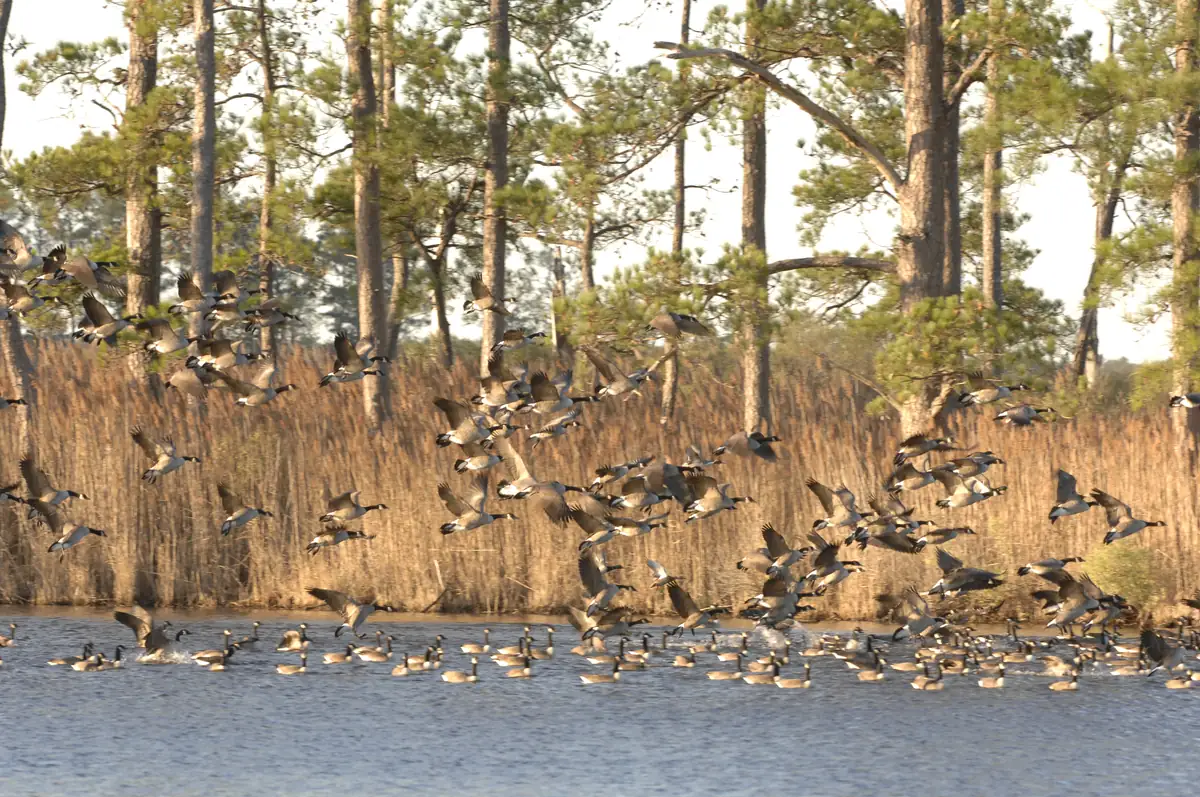
Ducks and geese at Blackwater
Building from mid-October; big numbers late October through December · Blackwater National Wildlife Refuge, Dorchester County
The refuge was set aside in 1933 as a sanctuary for Atlantic Flyway waterfowl, and its staff put the best viewing “between mid-October and mid-March.” Wintering birds include tundra swans, Canada and snow geese and more than 20 kinds of ducks, from pintails and wigeon to green-winged teal and black ducks. Drive the Wildlife Drive slowly, stop in the pull-offs, and scan the marsh and snags for bald eagles.
-
Tundra swans
Late October into early November · Open water and marshes around the Bay
The Chesapeake Bay Program says tundra swans and their gray cygnets reach the Bay in late October and early November after flying down from Arctic nesting grounds. The old name, whistling swan, fits: a flock’s high, yelping calls usually carry before the birds come into view. Note the date you first hear them.
-
Hawks on South Mountain
Broad-wings mostly past; a steady mix through October · Washington Monument State Park, near Boonsboro
The stone tower on South Mountain, first built by Boonsboro residents in 1827, is an official hawk watch site, and DNR says the migration there is best “especially in mid-September,” when the broad-winged hawk kettles pass. October brings fewer birds but more kinds: sharp-shinned and Cooper’s hawks, red-shouldered and red-tailed hawks, northern harriers, bald eagles and, on northwest winds, the occasional falcon. From October the park opens at 10 a.m. and closes at sunset, and the Appalachian Trail passes right by the monument.
-
Turkey Point, at the head of the Bay
Daily count August 1 to November 15 · Elk Neck State Park, Cecil County
Volunteers from the Cecil Bird Club counted hawks at the Turkey Point lighthouse from 1994 to 2016. There are no official hawk counters now, but the Maryland Biodiversity Project has run a daily fall count of every species there since 2021, and the Birders Guide to Maryland and DC says that on a good fall day “the skies and the woods are just full of migrating birds,” loons and waterfowl included.
-
Canada geese at Merkle
Arriving through October and November · Merkle Natural Resources Management Area, Upper Marlboro
Merkle, on the Patuxent in Prince George’s County, holds what DNR calls “the largest concentration of Canada geese on the Chesapeake Bay’s western shore” each winter. The grounds are open sunrise to sunset; visits to the visitor center need a reservation.
Birds hitting lit windows are a big part of fall migration. Lights Out Baltimore asks homes and buildings statewide to switch off nonessential lighting from 11 p.m. to 6 a.m. through October, and its volunteers survey about 20 city buildings each season. On the weekend of October 10–11, The Big Sit challenges birders to count species from inside a 17-foot circle, and eBird lists Saturday, October 10, as its October Big Day.
Are monarchs still passing through Maryland in October?
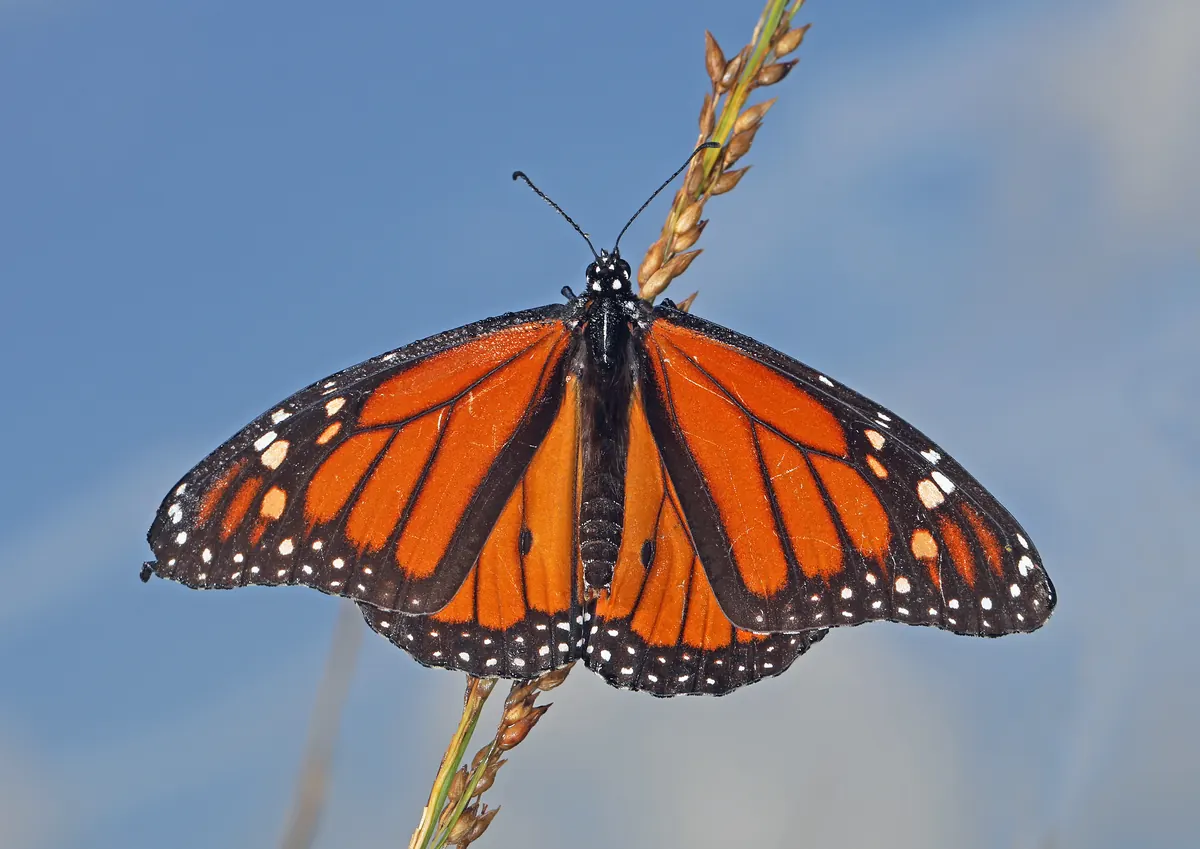
Inland, mostly not. Monarch Watch’s latitude table puts the peak at 39° N, the line through Baltimore and Hagerstown, at September 14–26, with a midpoint of September 22; Salisbury, at about 38.4° N, runs a few days later. The coast is different. North and west winds push migrating monarchs to the Atlantic shore, and they follow the beach south rather than cross open water, so Assateague and the Delmarva barrier islands tend to see monarchs later than inland yards do. Seaside goldenrod, which the Chesapeake Bay Program lists as blooming from August to October in dunes and marsh edges, is their fuel there; a U.S. Fish and Wildlife Service photo shows monarchs feeding on it at Chincoteague, on the Virginia end of Assateague, on October 31, 2021. On a sunny October day after a cold front, walk the dune line at Assateague State Park or the national seashore’s Maryland district and watch the goldenrod. Report what you see, and any overnight cluster, to Journey North; the pollinator watch plate is the place to log the last one you see.
What is happening on the Chesapeake Bay in October?
The Bay is losing heat fast. NOAA’s coastal water temperature guide puts the October average at about 67 °F at Baltimore and 65 °F at Cambridge, falling to about 56 °F and 53 °F in November; the Ocean City inlet averages about 66 °F in October. That cooling sets the calendar for everything that lives in the water.
-
Rockfish in the fall season
Harvest September 1 to December 5; catch and release December 6–31 · Chesapeake Bay and tidal rivers
Striped bass feed hard as the water cools. For 2026, DNR allows one striped bass per person per day in the Bay, between 19 and 24 inches, through December 5. The August closure that came before it is new this year, meant to protect resident rockfish in the hottest weeks; DNR says fish released and later dying made up 21 percent of the Bay’s fishing-related striped bass deaths in recent assessments.
-
Oyster season opens
Traditionally October 1 through March · Public oyster bars outside sanctuaries
Maryland’s public oyster season traditionally opens on October 1, when the first hand-tongers go out, and the recreational season runs on through winter. Sanctuaries, leased aquaculture grounds and grass-bed protection zones are off limits. The limits and hours change from year to year, so check DNR’s current recreational oyster notice before picking any.
-
Blue crabs head for deep water
October and November, as the water drops into the 50s · From the tributaries down the Bay
After mating, female crabs move toward the saltier water of the lower Bay, where each can carry between 750,000 and two million eggs, the Chesapeake Bay Program says. As the Bay cools, the rest “burrow into the sediment of the deeper portions of the Bay to overwinter.”
Jot the water temperature at your dock in the daily field log next to what is biting.
When is the first frost and freeze in Maryland?
For a small state, Maryland’s freeze dates are spread remarkably wide. On the Garrett County plateau, Oakland’s median first freeze is October 9, and in a tenth of years the first freeze has come by September 26. At the Naval Air Facility station on the Annapolis waterfront, the median is November 20, and Solomons, at the mouth of the Patuxent, holds out until November 26. That is six weeks between the two ends of the state. Most of the Piedmont and the Shore fall in between, with a first freeze in the last days of October or the first week of November. Local terrain matters too: the Glenn Dale station in Prince George’s County has a median of October 22, nine days ahead of the airport at BWI. Frost can whiten the grass a week or two before the thermometer hits 32 °F, on a clear, still night that dips into the mid-30s.
| Station | One year in ten | Median | Nine years in ten |
|---|---|---|---|
| Oakland 1 SE (Garrett County) | Sep 26 | Oct 9 | Oct 23 |
| Frostburg 2 (Allegany County) | Oct 5 | Oct 18 | Nov 1 |
| Cumberland 2 | Oct 9 | Oct 24 | Nov 6 |
| Hagerstown 1 E | Oct 14 | Oct 28 | Nov 11 |
| Emmitsburg 2 SE (Frederick County) | Oct 7 | Oct 20 | Nov 2 |
| Baltimore Wash International Airport | Oct 17 | Oct 31 | Nov 12 |
| Annapolis Naf (Annapolis, on the Severn) | Nov 4 | Nov 20 | Dec 5 |
| Mechanicsville 5 NE (St. Mary’s County) | Oct 12 | Oct 27 | Nov 9 |
| Salisbury Wicomico Regional Airport | Oct 15 | Oct 30 | Nov 12 |
Look up your own county’s stations on the Maryland frost dates page. On the first night the forecast calls for a clear sky and light wind, bring in the potted herbs and tender bulbs, pick the green tomatoes, and cover anything you want to keep with an old sheet. Then write the morning of the first white roof in your field log.
How much daylight does Maryland lose in October?
Roughly an hour and a quarter everywhere: 74 or 75 minutes in the mountains, 73 in Baltimore and Annapolis, 71 at Salisbury and Ocean City. In Baltimore, sunrise goes from 7:03 a.m. on October 1 to 7:33 a.m. on the 31st, and sunset from 6:49 p.m. to 6:06 p.m. When Maryland’s clocks drop back an hour (officially 2 a.m. EDT, Sunday, November 1), mornings get an hour of light back and sunset jumps to just after 5 p.m.
| City | Oct 1 | Oct 31 | Lost | Per day |
|---|---|---|---|---|
| Oakland | 11 h 46 m | 10 h 32 m | 74 min | 2.5 min |
| Cumberland | 11 h 46 m | 10 h 31 m | 75 min | 2.5 min |
| Hagerstown | 11 h 46 m | 10 h 32 m | 74 min | 2.5 min |
| Frederick | 11 h 46 m | 10 h 32 m | 74 min | 2.5 min |
| Baltimore | 11 h 46 m | 10 h 33 m | 73 min | 2.4 min |
| Annapolis | 11 h 46 m | 10 h 34 m | 72 min | 2.4 min |
| Salisbury | 11 h 47 m | 10 h 36 m | 71 min | 2.4 min |
| Ocean City | 11 h 47 m | 10 h 36 m | 71 min | 2.4 min |
For your street rather than the nearest city, the Field almanac calculates sunrise, sunset, twilight and this week’s loss from your address.
What is October weather like in Maryland, and what will El Niño bring this winter?
October is usually one of the most comfortable months of the year here. NOAA’s 1991–2020 normals put the average high at 68 °F and the low at 47 °F at BWI, 66 and 47 at Hagerstown, and 69 and 48 at Salisbury, while Oakland, at about 2,400 feet, averages 63 and 40. Rain normals run from 2.76 inches at Hagerstown to about 4 inches at BWI, Annapolis and Salisbury. Near the water, an occasional nor’easter or tropical remnant adds to the total and can push tides into low streets.
Snow in October is a mountain event. Oakland’s normal October snowfall is 1.6 inches, and November’s is 6.4; Frostburg’s October normal is 0.4 inch. East of the mountains it almost never happens: in BWI’s records since 1950, the only measurable October snow was 0.3 inch on October 10, 1979.
The bigger question is the winter. In its September 10 discussion, the Climate Prediction Center left its El Niño Advisory up and rated a very strong event as more than 90 percent likely for the coming fall and winter. The Baltimore/Washington office of the National Weather Service has studied what that has meant here. Across all El Niño winters, temperatures and precipitation came out close to normal and seasonal snowfall averaged above normal. Strong events leaned warmer and wetter than normal, because a strong subtropical jet sends storms up the coast from the south. The snow record is split: of the seven strong El Niño winters since 1950, four brought well above normal snow and three brought almost none. The office found the North Atlantic Oscillation, which decides whether cold air is in place when those storms arrive, matters more for Baltimore and Washington snow than El Niño alone. So the best bet is a mild, wet winter, with snow an open question. October’s weather has little to do with any of this, and NOAA’s official winter outlook comes out in mid-October.
What can you see in Maryland’s night sky in October?
-
The moon covers Jupiter
Tuesday, October 6, about 4:21 to 5:25 a.m. EDT · Eastern sky, the moon about 18 to 30 degrees up
About 20 percent lit, the waning crescent clears the Baltimore horizon at 2:37 a.m. with Jupiter less than two moon-widths away. By the International Occultation Timing Association’s numbers, the planet slips behind the moon’s bright edge at about 4:21 a.m. in Baltimore, Washington and Salisbury, and reappears on the unlit side at about 5:25 a.m. in Baltimore (5:24 in Washington, 5:26 in Salisbury). Both happen before the first hint of dawn. In binoculars Jupiter fades over a few seconds instead of blinking off, since it is a disk.
-
The Hunter’s Moon
Evenings of Sunday, October 25, and Monday, October 26 · Low in the east at sunset
The instant of full moon is 12:12 a.m. EDT on Monday the 26th, a few hours after Sunday’s moonrise, so Sunday’s moon is only hours short of full and Monday’s is barely past it. From Baltimore it comes up at 5:40 p.m. on the 25th, 34 minutes ahead of the 6:14 sunset, and at 6:13 p.m. on the 26th, a minute after sunset. It is not a supermoon.
-
Orionid meteors
Before dawn on October 21 and 22 · Anywhere dark; look high in the east and south
Halley’s Comet left the dust behind the Orionids; the shower runs October 2 to November 7, and its flat-topped peak spans the 21st and 22nd. Baltimore’s gibbous moon sets at 2:20 a.m. on October 21 and at 3:25 a.m. on October 22, so the darkest window runs from moonset until about 6 a.m., when the east begins to pale. A typical year gives 10 to 20 meteors an hour from a dark site, far fewer from the city.
-
Draconid meteors
Evening of Thursday, October 8 · Face north after dark
Draconid meteors fly early, soon after dark, so children can watch before a school-night bedtime. The thin crescent sets around 5:30 p.m., ahead of the sun, so the evening sky is moonless. Expect a handful an hour.
-
Saturn all night; Jupiter and Mars before dawn
Saturn opposition October 4; Mars at the Beehive October 11; Venus gone after the first few days · Saturn in the east at dusk; Jupiter and Mars in the east before dawn
October 4 is Saturn’s opposition: the ringed planet climbs out of the Bay-side haze as the sun goes down and sinks in the west at daybreak, and a backyard telescope at 30 or 40 power will show the rings. Watch for the gibbous moon beside Saturn on the 23rd and 24th. Anyone hoping for Venus needs a flat western view, such as the Bay shore, in the first few evenings of October; after that it is lost in the glare, and its inferior conjunction, between Earth and sun, falls on October 23. Jupiter, meanwhile, owns the predawn east all month. On the morning of Sunday the 11th, Mars sits inside the Beehive cluster; binoculars show the faint stars around the orange dot.
| Phase | Date | Time |
|---|---|---|
| Last quarter | Saturday, Oct 3 | 9:25 a.m. EDT |
| New moon | Saturday, Oct 10 | 11:50 a.m. EDT |
| First quarter | Sunday, Oct 18 | 12:12 p.m. EDT |
| Full moon, the Hunter’s Moon | Monday, Oct 26 | 12:12 a.m. EDT (looks full on the evenings of Oct 25 and 26) |
| Last quarter | Sunday, Nov 1 | 3:28 p.m. EST |
Cloud cover over the Bay can change fast in October, so check Today’s sky on the evening you plan to go out; our moon phases page gives local rise and set times for the moon.
What is blooming, turning and ripening in Maryland in October?
-
Bald cypress on the Pocomoke
Late October into November · Pocomoke River State Park (Shad Landing and Milburn Landing), Worcester County; Battle Creek Cypress Swamp, Calvert County
Bald cypress is a conifer that drops its needles, turning golden brown to rust before they fall. DNR calls the Pocomoke swamp the northernmost bald cypress swamp in the country, and its fall reports describe the cypress foliage turning “a rusty orange, with the tree’s knees visible below” by late October. The two-mile Corker’s Creek canoe trail at Shad Landing, 3 miles south of Snow Hill, goes right through it.
-
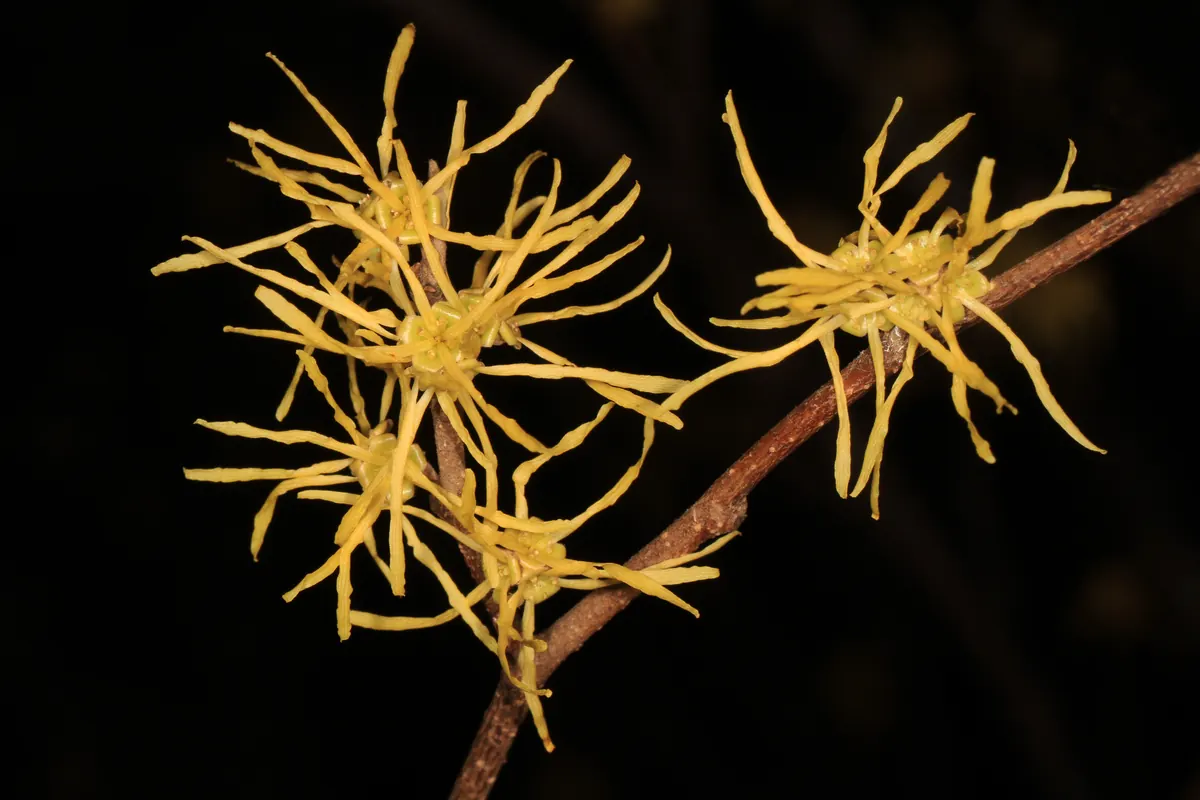
Witch hazel
Late October into November · Moist woods and stream valleys statewide
When nearly everything else in the woods has finished, American witch hazel opens thready yellow flowers along bare twigs; the Forest Service describes them as “the only sign of color in woods where all the autumn leaves lay upon the forest floor.” Last year’s woody capsules burst at the same time, throwing two shiny black seeds as far as 20 feet, rarely 40. On a dry, sunny afternoon, listen close to a shrub for the little pops.
-
Persimmons
Ripe from October, sweetest after frost · Old fields, fencerows and forest edges, especially in Southern Maryland and on the Shore
The orange, inch-to-two-inch fruits hang on after the leaves fall. Eat one too early and the tannins turn your mouth to felt; wait until it is soft and wrinkled and it turns rich and sweet. The Chesapeake Bay Program lists raccoons, foxes, black bears, turkeys, cedar waxwings, robins and mockingbirds among the animals that eat them, so the tree under a ripe one is a good place to look for tracks.
-
Walnuts, sweetgum balls and acorns
Through October · Yards, parks and woodlots
Black walnuts were already falling in late September, according to DNR’s first foliage report, and sweetgum balls follow. Acorns are the food that matters most: DNR calls them “the single most important natural food for bears in Maryland,” and deer, turkeys, squirrels and blue jays all depend on them. Count the acorns under one oak each week for your seeds, pods and cones plate; in a poor acorn year, DNR says, bears travel farther and come closer to people.
What are sika deer, black bears and white-tailed deer doing this month?
-
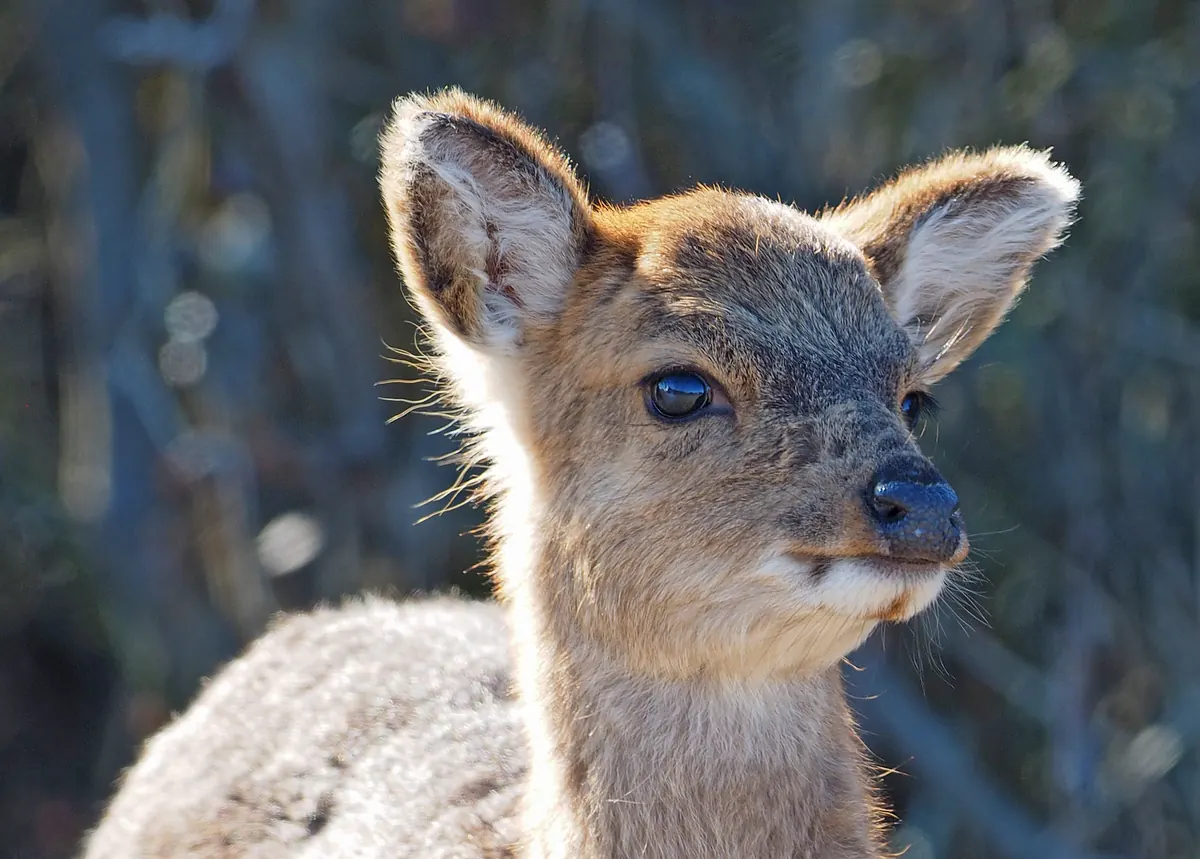
Sika stags whistling in the marsh
Rut in mid-October; calls at dawn and late afternoon · Southern Dorchester County marshes; also the lower Shore and Assateague
Maryland’s sika are a small Asian deer related to the elk, first released on James Island in 1916, and now found across the lower Eastern Shore, with the most in the marshes and wetlands of southern Dorchester County. Their breeding season is in mid-October. DNR describes the stag’s call as a bugle that “usually consist[s] of a series of three whistles,” heard mostly early in the morning and late in the afternoon and carrying a long way on calm days. Alarmed deer of both sexes give a sharp bark. Stand quietly at the edge of the marsh along the Blackwater Wildlife Drive or at Fishing Bay at dawn and listen; the map of sounds plate was made for this.
-
Black bears eating around the clock
October and November; denning from mid-November · Garrett, Allegany, Washington and Frederick counties
Maryland’s bears live mostly in the four western counties, with the most in Garrett and Allegany. In fall they go into hyperphagia, feeding up to 20 hours a day and taking in as many as 20,000 calories, and they add 30 to 35 percent to their weight before denning. DNR says they den from mid-November, with most tucked in by mid-December. Take bird feeders down until winter, keep trash and pet food locked up, and watch for bears crossing roads in the western counties in October and November.
-
White-tailed deer: the rut is coming
Rubs and scrapes from late October; the rut builds into November · Statewide, and at every road edge at dusk
Late October is the season of rubs, where bucks strip the bark from saplings at knee height, and scrapes, pawed patches under a low branch. Bucks move more by daylight as November nears, often right at commuting hours. The dusk and dawn watch plate is a good place to track how often you see them.
-
Woolly bears and the last crickets
Until the first hard freeze · Roads, trails and backyards
Banded woolly bears cross sidewalks on warm afternoons looking for a place under leaf litter to spend the winter; despite the folklore, its brown middle stripe forecasts nothing. Field crickets and snowy tree crickets keep singing into cool evenings, the tempo dropping with the temperature. Take a snowy tree cricket’s chirps over 14 seconds, add 40, and you have a fair Fahrenheit reading; log it on the cricket thermometer plate.
What are good outdoor outings for Maryland families in October?
- Walks at Blackwater. The Friends of Blackwater list free birding walks from the visitor center at 8 a.m. on Sunday, October 4, Saturday, October 10, Sunday, October 18, and Wednesday, October 21. There is no Wildlife Drive fee on Sunday, October 11, during National Wildlife Refuge Week, or on Tuesday, October 27, Theodore Roosevelt’s birthday. Call the visitor center to confirm before driving down.
- October 7–11: Autumn Glory in Garrett County. The grand parade is Saturday, October 10, at 1 p.m. in downtown Oakland; pair it with the short walk to Muddy Creek Falls at Swallow Falls State Park. The park also holds an Apple Butter Boil in October; check with the park for this year’s date.
- October 8–11: the dark weekend. Draconids after dinner on Thursday the 8th, new moon on Saturday the 10th, plus the Big Sit and eBird’s Big Day for families who like keeping lists.
- October 10–11: Catoctin Colorfest in Thurmont, then up the mountain at Cunningham Falls State Park or Catoctin Mountain Park for the Blue Ridge color.
- Mid-to-late October on the Shore. A calm dawn on the Blackwater Wildlife Drive for sika calls, or a paddle on Corker’s Creek through the turning cypress.
- Citizen science. Log Delmarva monarchs and any roost on Journey North, switch off porch lights for Lights Out Baltimore, and sign up for Project FeederWatch ($18 in the U.S.) before its season begins November 1.
For writing these days down, see the Naturalist’s Field Journal, and the nature hub lists every state’s month.
Safety notes for October in Maryland
- Hunting seasons. Deer archery has been open since September 11 and runs through October 21, then again from October 25 to November 27. Muzzleloader deer season is October 22–24 statewide. The black bear hunt, by lottery permit, runs October 26–31 in Allegany, Frederick, Garrett and Washington counties. Duck season opens October 3 in the Western Zone and October 10 in the Eastern Zone, both through October 17; dove reopens and woodcock opens on October 24; fall turkey runs October 31 to November 8 in Allegany, Garrett and Washington counties. Deer hunting is allowed on October Sundays on private land in most counties, and on designated public lands in Allegany, Cecil, Garrett, St. Mary’s, Washington, Wicomico and Worcester counties. The junior deer days are November 14–15, and firearms season opens November 28.
- Orange or pink. Maryland requires hunters and anyone helping them to wear a solid fluorescent orange or pink cap, a vest or jacket with at least 250 square inches of it front and back, or a camouflage garment above the waist that is at least half fluorescent. Waterfowl, dove, turkey and furbearer hunters are exempt, and so are archers in the bow-only season, but not during the muzzleloader and junior days or, in the bear counties, during bear season. So expect deer hunters in orange or pink everywhere on October 22–24, and in the four bear counties on October 26–31. The rule does not cover hikers, but on state forests and wildlife management areas this month, wear bright color yourself, and dress the dog in orange too.
- Bears and deer on the road. Slow down at dusk and dawn in the western counties. When a deer bolts out, stand on the brake and hold your line; a swerve into oncoming cars or a roadside tree usually does more damage than the deer would.
- Cold water. Bay water around 60 °F by late month can still take a swimmer’s breath away if a paddler capsizes. Wear the life jacket, and look at the wind forecast on Weather now first.
- Ticks and mushrooms. Adult blacklegged ticks stay active through fall and on warm winter days; Lyme disease is the most common tick-borne illness in Maryland. Run a tick check on children and dogs back at the car. A wild mushroom is for looking at, not eating, unless an expert has named it for you.
Sources
- Maryland DNR: fall foliage report, September 24, 2026
- Maryland DNR: fall foliage preview 2025 (regional peak windows)
- Maryland DNR: fall foliage recap for 2025 (Pocomoke bald cypress)
- Garrett County Chamber of Commerce: 59th Autumn Glory Festival, October 7–11, 2026
- Town of Oakland: 2026 Autumn Glory Grand Feature Parade
- Catoctin Colorfest: 62nd annual festival, October 10–11, 2026
- U.S. Fish and Wildlife Service: birding at Blackwater National Wildlife Refuge
- U.S. Fish and Wildlife Service: Blackwater National Wildlife Refuge, visit us
- Friends of Blackwater: event calendar (October 2026 walks and fee-free days)
- Chesapeake Bay Program field guide: tundra swan
- Maryland DNR: Washington Monument State Park
- Potomac Valley Audubon Society: hawk watch at Washington Monument State Park
- Birders Guide to Maryland and DC: Elk Neck State Park and Turkey Point
- Maryland DNR: Merkle Natural Resources Management Area
- Lights Out Baltimore
- The Big Sit! 2026 (October 10–11)
- eBird: October Big Day, October 10, 2026
- Monarch Watch: peak migration dates by latitude
- U.S. Fish and Wildlife Service: monarch butterflies on seaside goldenrod, Chincoteague refuge
- Chesapeake Bay Program field guide: seaside goldenrod
- Journey North: monarch sightings and roost reports
- NOAA NCEI: coastal water temperature guide (monthly averages)
- Maryland DNR: changes to the 2026 Chesapeake Bay recreational striped bass season
- Maryland DNR: oyster season opens October 1
- Chesapeake Bay Program field guide: blue crab
- NOAA NCEI: U.S. climate normals, 1991–2020 (freeze dates, temperature, precipitation and snowfall)
- NOAA Regional Climate Centers: ACIS station data (BWI, Hagerstown, Salisbury, Oakland and Frostburg normals; BWI October snowfall record)
- U.S. Naval Observatory: sunrise, sunset, moonrise and moonset (data API; Baltimore, October 2026)
- U.S. Naval Observatory: phases of the moon
- Climate Prediction Center: ENSO diagnostic discussion, September 10, 2026
- NWS Baltimore/Washington: El Niño and Washington–Baltimore winters
- NWS Baltimore/Washington: ENSO, the NAO and local winter snowfall
- International Occultation Timing Association: lunar occultation of Jupiter, October 6, 2026
- EarthSky: meteor shower guide
- EarthSky: visible planets tonight
- Maryland DNR: the Great Cypress Swamp at Pocomoke River State Park
- Chesapeake Bay Program field guide: bald cypress
- USDA Forest Service: American witchhazel
- Chesapeake Bay Program field guide: American persimmon
- Maryland DNR: Maryland’s sika deer
- Maryland DNR: black bear fact sheet
- Maryland DNR: black bear activity rises as leaves fall
- Maryland DNR: black bear activity increasing in fall months
- Maryland DNR: Maryland hunting seasons calendar for 2026–2027 (PDF)
- Maryland DNR: Sunday deer hunting 2026–2027 (PDF)
- Maryland DNR: 2026–27 archery deer season opens September 11
- Maryland DNR: migratory game bird seasons for 2026–2027
- Maryland DNR: fluorescent orange and/or pink clothing requirements and exceptions
- Maryland Department of Health: Lyme disease
- Project FeederWatch: project overview
- Photos via Wikimedia Commons; licenses and photographers are credited under each picture
