What to look for in nature in Maryland this December
December 1 marks the start of meteorological winter, which bundles December, January and February because no other three months run colder, and Maryland’s wildlife has already settled into its winter routine. Diving ducks gather on the open Bay by the tens of thousands, eagle pairs carry sticks back to last year’s nests, great horned owls hoot in duets after dark, and the first seals can haul out near Ocean City in the final days of the month. Volunteers spread across two dozen Christmas Bird Count circles, sunsets reach their earliest clock time around December 7, and on December 23 a supermoon, the biggest-looking full moon of the year, lifts over the Chesapeake at dusk. Below, region by region, is where to look.
Other months in Maryland: October, November.
Start here

- Count birds for a day. Maryland and DC have about two dozen Christmas Bird Count circles, from Oakland on the Allegheny plateau to Crisfield on Tangier Sound. This season’s counts fall between mid-December and early January, they are free, and newcomers join experienced teams. Ask a local bird club early in the month.
- Watch an eagle pair at work. Maryland DNR says bald eagles here begin courting in December. Find a known nest high in a tall pine or hardwood, stay at least 100 yards back, and watch for two adults perched side by side or one flying in with a stick in its feet.
- Geminids, then the Cold Moon. The best meteor shower of the year builds through the late evening of Sunday, December 13, and keeps going until Monday’s dawn; the slim crescent moon is down by mid-evening. On Wednesday the 23rd, at 8:28 p.m. EST, the Cold Moon reaches full, the nearest and brightest full moon of 2026.
Keep a record: copy your count-day species onto the “birds I have seen” plate (Naturalist’s Field Journal); an eagle pair you visit weekly earns the nest observed plate; a holly or hemlock can begin a tree through the seasons; and the first prints of winter, in snow or creek mud, go on tracks to know. Date every entry and note the weather.
Regions used below: Western Maryland (Garrett and Allegany); Hagerstown Valley and the Blue Ridge; Central Maryland and the Baltimore–Washington corridor; Southern Maryland; Eastern Shore and the Atlantic coast.
Where do ducks and swans spend the winter in Maryland?
By December the autumn rush is over and the Bay holds its winter crowd. Swans and geese that came in November feed in fields and shallows, and the diving ducks have joined them: canvasbacks, scaup, buffleheads, ruddy ducks and long-tailed ducks, which dive for clams, snails and underwater plants in open water long after inland ponds freeze. A hard freeze farther north pushes still more of them down.
-
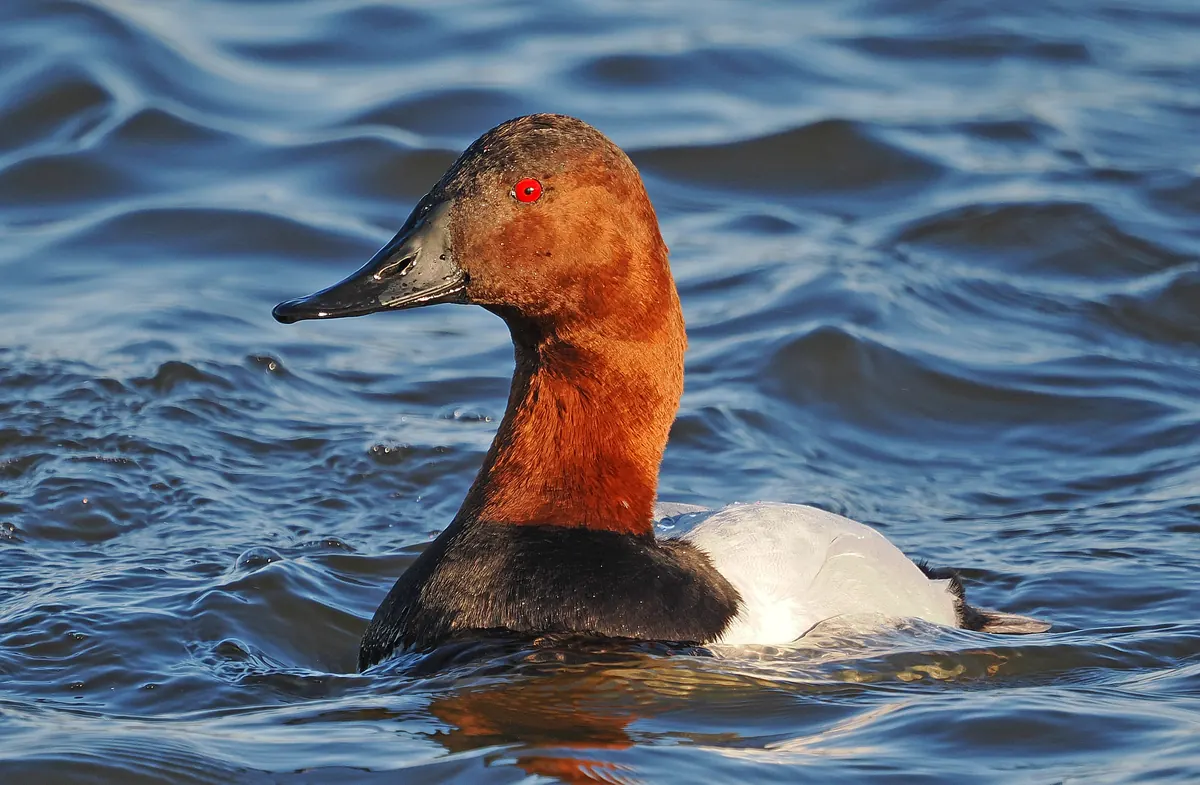
Canvasbacks on the Choptank
December through March · Open water off Cambridge where the Choptank meets the Bay; also the Middle River, east of Baltimore
The canvasback, with its rust-red head, pale back and long sloping forehead, is the Chesapeake’s signature duck. Maryland DNR notes that the Bay held about a million in colonial times and more than a quarter million around 1950; poorer water and the loss of the wild celery beds they fed on cut those numbers sharply, and today’s birds eat mostly small clams. They usually arrive by Thanksgiving or Christmas and leave by mid-March, and DNR points to the meeting of the Choptank and the Bay near Cambridge as a prime place to watch them. The Middle River count, east of Baltimore, set a record last season with 185.
-
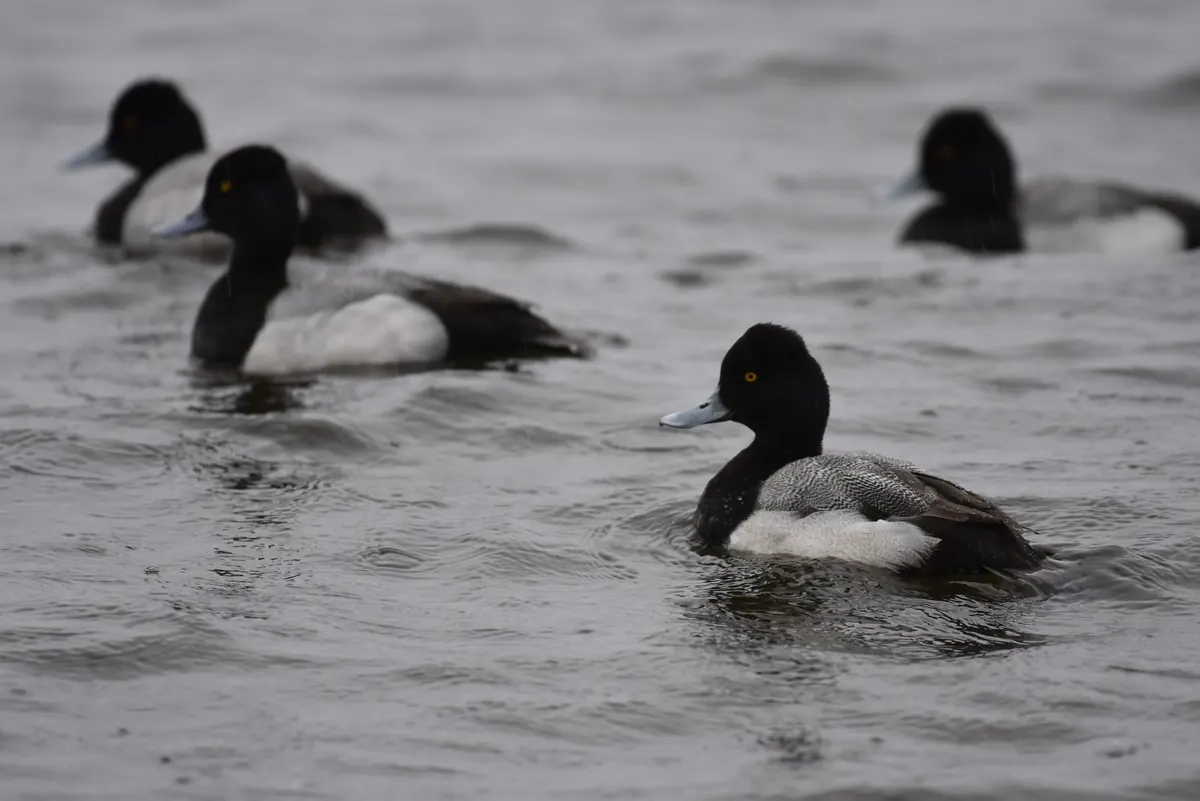
Scaup rafts and the midwinter survey
Building through December; counted from the air in early January · The open Bay, the tidal Potomac and the Atlantic coastal bays
Each January, DNR and U.S. Fish and Wildlife Service crews fly the Bay shoreline, the tidal Potomac and the coast to count wintering waterfowl, a survey run since the early 1960s. The January 2026 flights tallied about 926,900 birds, and diving ducks more than doubled from the year before. DNR credited the weather: a cold December and January across the Northeast and mid-Atlantic. Scaup, whose tight rafts can look like a dark slick on the water, nearly tripled.
-
Tundra swans settled in
All month · Shallow coves and marsh edges from Eastern Neck to Tangier Sound; flocks also feed in harvested cornfields
The Arctic swans that came in November are now spread across the Bay and its rivers. Last season the Crisfield count tallied 2,391, its highest ever. On a still day a feeding flock gives itself away with a soft, constant murmur of whistled notes. Flocks in cornfields are usually on private land; stay in the car.
| Group or species | January 2025 | January 2026 |
|---|---|---|
| All waterfowl | 705,300 | 926,900 |
| Canada geese | 414,200 | 509,400 |
| Diving ducks | 100,200 | 239,100 |
| Dabbling ducks | 126,000 | 117,300 |
| Scaup | 36,900 | 105,800 |
| Snow geese | 40,200 | 29,900 |
| Canvasback | 28,500 | 25,300 |
| Tundra swans | 12,900 | 16,900 |
Divers feed far out, so bring a spotting scope or brace binoculars on a fence post. The November arrivals are on the Maryland November guide.
When do bald eagles start nesting in Maryland?
Maryland DNR says the state’s bald eagles begin courting in December, and the Maryland Bird Conservation Partnership describes adults visiting a nest in November and December, patching storm damage and starting to defend the territory. Most eggs follow in mid- to late February, though pairs in Southern Maryland sometimes lay in January. Incubation takes about 35 days.
-
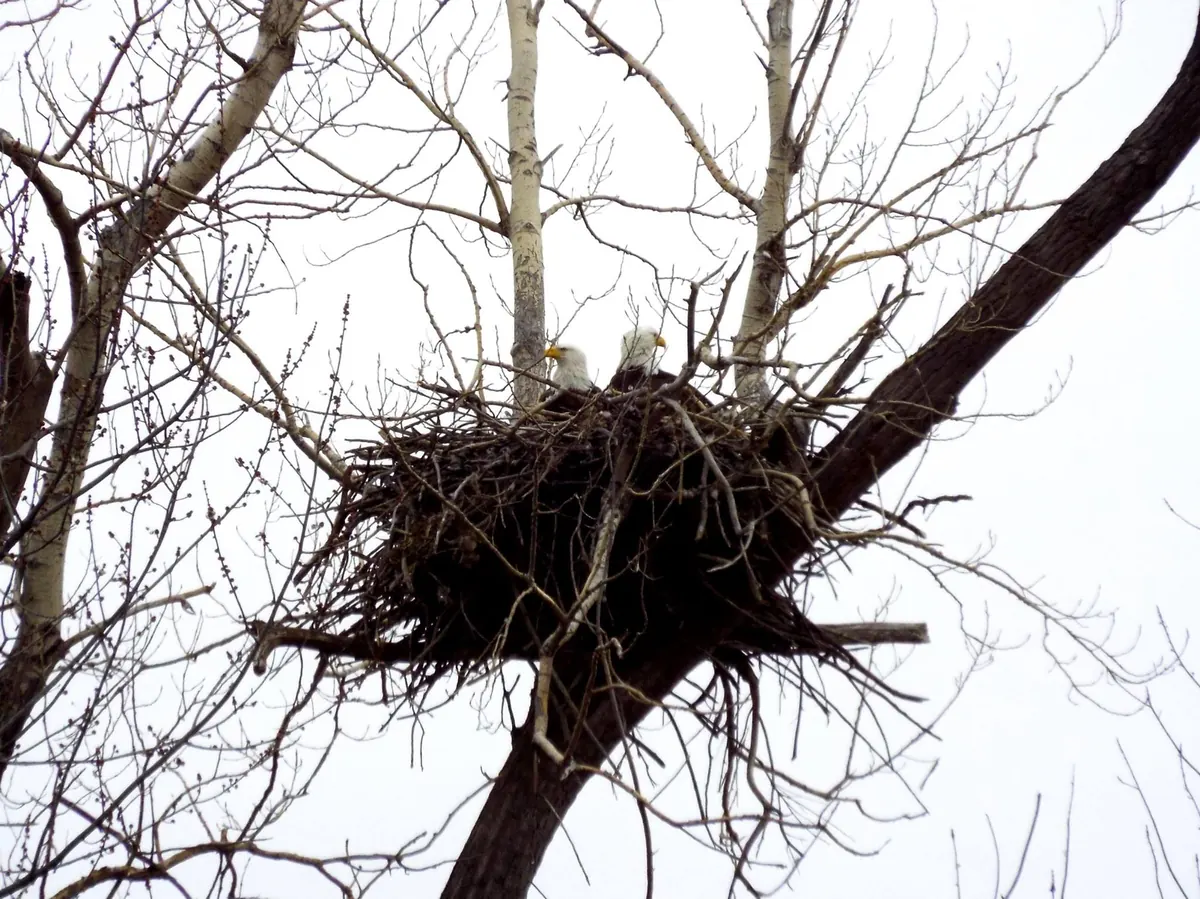
Nests in the tallest trees
Repairs from late November; pairs perched together through December · Shorelines of the Bay and its tidal rivers; DNR names Blackwater and Aberdeen Proving Ground as strongholds
An eagle nest is hard to mistake once the leaves are down: DNR describes nests 4 to 5 feet across and more than 3 feet deep, wedged into the upper fork of a pine or a big hardwood, and pairs add to them every year. The comeback has been dramatic. Maryland had just 44 nesting pairs in 1977, and the partnership now estimates at least 1,400. In December, look for two adults sitting close together near the nest, or for one carrying a stick or a clump of marsh grass.
-
Volunteer nest watchers
Monitoring season starts in December · Statewide, at nests mapped by the program
The Maryland Bird Conservation Partnership runs a Bald Eagle Nest Monitoring Program and asks volunteers to adopt a nest near home that nobody is watching yet. You visit at least three times, to note adults on the nest from January to March, chicks in April and fledged young in June or July. Federal eagle law calls for staying at least 100 yards from an active nest, so the work is done with binoculars from a road or trail.
Northern eagles also swell the winter crowds below Conowingo Dam; DNR notes that winter roosts can hold 100 to 200 birds. An eagle pair checked every week makes a fine nest observed entry, with the date, the time and what each bird was doing.
Which owls can you hear or see in Maryland in December?
Bare trees and early dark make December a good owl month. DNR lists eight owl species in Maryland; great horned and barred owls stay all year, while saw-whet, long-eared, short-eared and, in some winters, snowy owls come from the north.
-
Great horned owls calling in pairs
From dusk on calm December nights · Woodlots next to fields, parks and big suburban yards statewide
The deep, steady hooting you hear at dusk this month is usually a great horned owl, often two of them answering each other. The Chesapeake Bay Program’s field guide says courtship starts in fall, mates are chosen by December and a nest site is settled by January or February. The male’s voice is the deeper one, thanks to a larger voice box. Listen at a field edge on a windless night soon after sunset.
-
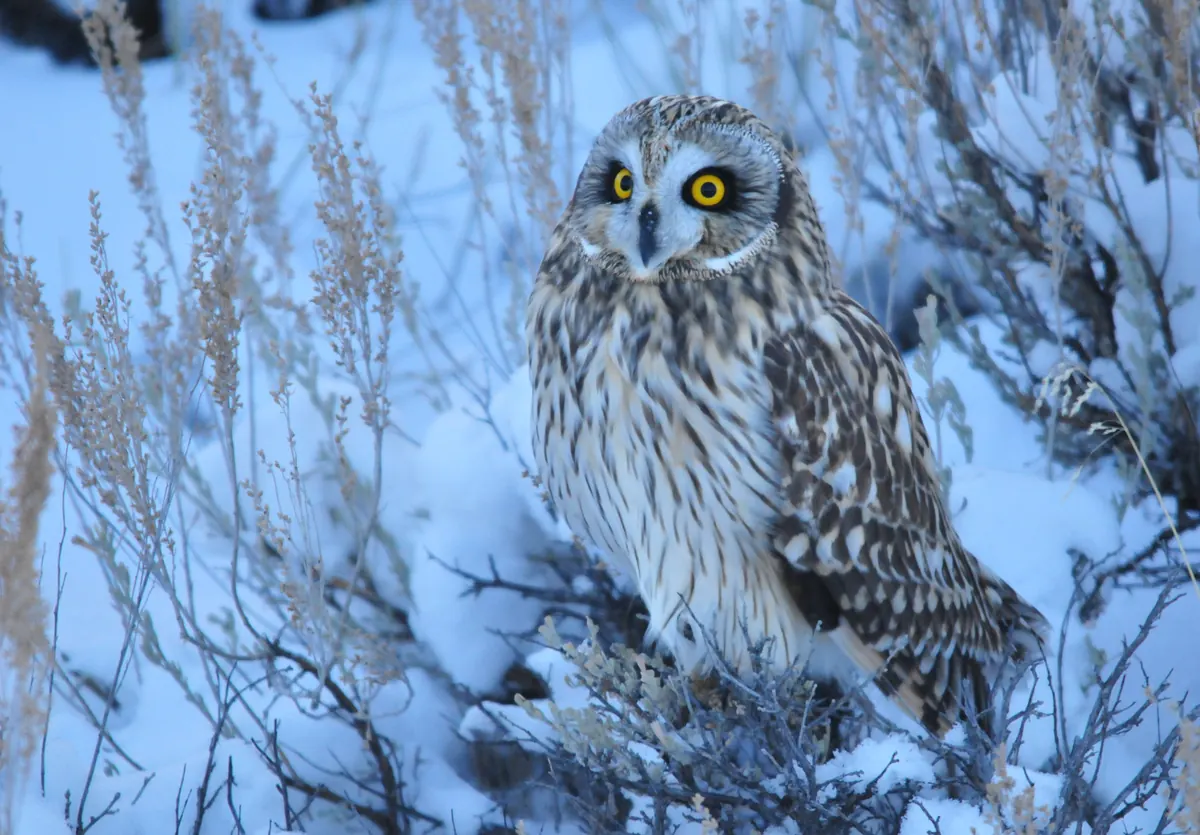
Short-eared owls at dusk
October to April; easiest in the last half hour of light · Large grassy fields, hayfields and marsh edges, from Howard and Frederick counties to the Shore
Short-eared owls hunt in the open in the last light, flying low and loose over fields and marsh, tilting like big moths on long, pale wings before dropping onto a vole. Maryland’s Natural Heritage Program lists them as endangered in the state. The Triadelphia count, in Howard and Montgomery counties, found four last season, its highest total. Watch from the car or the road edge, never by walking into the field.
-
Screech owls and saw-whets
All month · Screech owls in any woods with old cavities; saw-whets in pine thickets and dense evergreens
The eastern screech owl, about the size of a robin, gives a falling, horse-like whinny or a long, even trill rather than a screech, and it is commoner than most people think: the Crisfield count found 47 last winter. Tiny northern saw-whet owls roost by day in thick pines and hollies, and turned up on the Lower Kent County and Ocean City counts. Whitewash on branches and small gray pellets underneath give a roost away.
An owl heard but never seen still counts: note the time and the call on the map of sounds plate.
How do you join a Christmas Bird Count in Maryland?
Audubon’s Christmas Bird Count dates to Christmas Day, 1900, when it was offered as a gentler substitute for the holiday hunts of the time. For 2026–27 the counting period runs December 14 through January 5. Each count is a fixed circle 15 miles wide, and on one chosen day volunteers set out to record every bird within it. There is no fee, and beginners are teamed with people who know the calls.
Audubon’s summary for last season lists about two dozen Maryland circles, from Allegany and Oakland in the west through Seneca, Triadelphia, Loch Raven and Jug Bay to Crisfield, Salisbury and Ocean City on the Shore. Local bird clubs, many of them Maryland Ornithological Society chapters, run the counts; the Talbot Bird Club holds one each year, and the Anne Arundel Bird Club puts newcomers with seasoned birders. The society posts dates and compilers on its Christmas Bird Count page; the 2026–27 list was not up in early October, but most circles keep roughly the same weekend. Living inside a circle, you can ask the compiler about counting at your own feeder.
| Count circle | Bird | Count | Why it stood out |
|---|---|---|---|
| Crisfield | Tundra swan | 2,391 | Highest total in the count’s history |
| Crisfield | Eastern screech owl | 47 | Highest total in the count’s history |
| Loch Raven | American coot | 1,378 | Highest total in the count’s history |
| Middle River | Canvasback | 185 | Highest total in the count’s history |
| Triadelphia | Short-eared owl | 4 | Highest total in the count’s history |
| Sugarloaf Mountain | Turkey vulture | 494 | Highest total in the count’s history |
| Seneca | Trumpeter swan | 7 | First ever on that count |
| Oakland | Golden eagle | 6 | Unusual for the count |
Last season also gave Crisfield its first brown pelican, and Denton a banded loggerhead shrike, released in Canada, that stayed near Ridgely for weeks.
Are there seals in Maryland in winter?
Yes, from late this month. Maryland DNR lists four kinds that strand or haul out here: harbor, gray, harp and hooded seals. DNR names all four among the seals it commonly finds stranded.

-
The first seals of the season
Usually from the last days of December; through April, a few into May · Ocean City and Assateague beaches, the inlet jetties, and Assawoman Bay
The town of Ocean City, quoting the National Aquarium’s stranding coordinator, says seal season normally begins at the end of December and lasts through April, and that a small group now winters in Assawoman Bay. A seal on the sand is usually just resting; nine times out of ten, the aquarium says, it is healthy and returns to the water within about a day. Rough seas bring more ashore.
-
How to watch one
Any time you find a seal out of the water · From well up the beach
Give it plenty of room. The Ocean City notice cites a 100-yard rule under the Marine Mammal Protection Act, and DNR warns that seals bite, react badly to dogs and can pass infections to people and pets. NOAA’s signs you are too close: the seal stares at you, shuffles toward the water, waves a flipper or yawns. Never pour water on it or push it toward the surf. If it looks hurt, thin or tangled, call DNR’s free 24-hour stranding line at 1-800-628-9944.
Log a hauled-out seal in the daily field log with the date, tide and weather.
How do Maryland’s animals get through the winter?
Every animal missing from the December woods has a plan: some sleep, some freeze, and many stay active and eat what is left.
-
Bears in their dens
Most denned by mid-December · Garrett, Allegany, Washington and Frederick counties
DNR says Maryland’s black bears den from late November through December, depending on the weather: under boulders, in hollow trees, in shallow depressions and now and then under a porch. They are not true hibernators; heart rate and breathing slow, but a bear can wake if disturbed. In January mothers give birth in the den to cubs weighing half a pound to a pound, eyes closed and coats like down.
-
Bats in caves and old tunnels
Hibernation from about September to May · Caves, old mines and tunnels in western Maryland
Of Maryland’s 10 bat species, DNR counts six as cave bats that hibernate underground, including big brown, little brown, tricolored and the endangered Indiana bat; the tree bats migrate or shelter in tree cavities and leaf litter. A cold-loving fungus, the cause of white-nose syndrome, was first confirmed in Maryland on March 5, 2010, in an Allegany County cave near Cumberland. It rouses hibernating bats so often that they burn through their fat, and DNR has documented losses of 90 to 100 percent at infected sites. Maryland’s caves are closed to all but approved researchers.
-
Wood frogs frozen in the leaf litter
Through the coldest weather · Forests and woodland pools statewide
Under the leaves, a wood frog can let nearly half its body freeze, says the Chesapeake Bay Program: ice forms in its skin, and its heart and breathing stop until it thaws. Come the first warm rain in March, it is among the earliest frogs calling from woodland pools.
-
Tracks after the first snow
After any snowfall or a thaw that leaves soft mud · Field edges, stream banks and woods roads
The animals that stay awake leave a record. Gray squirrels bound in sets of four, big hind feet landing ahead of the front; red foxes walk a neat single line; deer leave split hearts; raccoons leave little handprints along creeks. Garrett County has snow to read most of the winter; east of the mountains, try creek mud after a thaw.
Draw a track at life size, with a coin for scale, on the tracks to know plate.
Which trees stay green in Maryland in December?
With oaks and beeches bare, the trees that keep their leaves jump out, which makes December a good month to learn three common ones: a broadleaf, a pine and a mountain conifer.
-
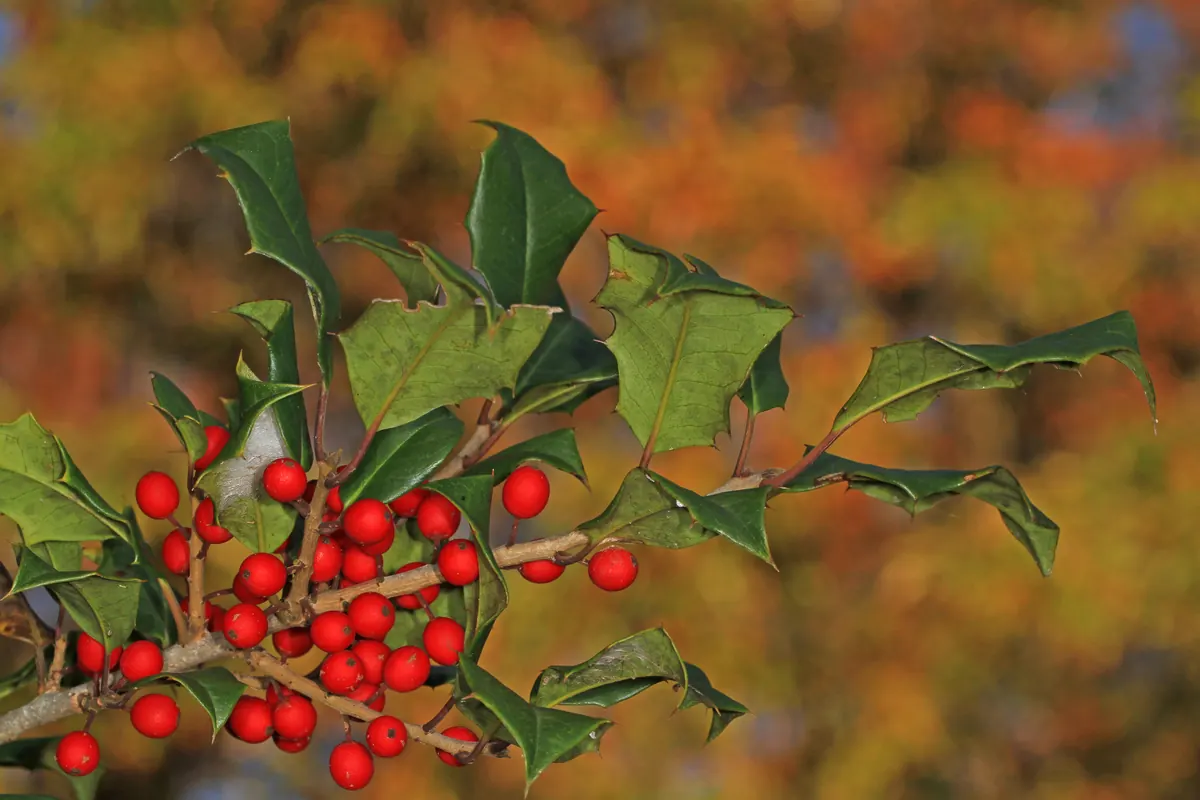
American holly
Red fruit from fall through winter · Moist woods across the Chesapeake watershed, from the Piedmont to the Shore
Maryland’s native holly usually grows 15 to 25 feet tall, with stiff, spine-tipped leaves that stay green all winter. Only female trees bear the red berries, which the Chesapeake Bay Program says ripen from September through December and hang on through the cold months, feeding deer, squirrels and birds. A holly with no berries is probably a male.
-
Loblolly pine
All year · Southern Maryland, the Bay shore and the Eastern Shore
The tall, straight pine of the Bay’s edges holds its needles in bundles of three and drops prickly cones 3 to 6 inches long. It rarely grows wild north of the Chesapeake, so it marks the Coastal Plain, and the Chesapeake Bay Program singles it out as important habitat for bald eagles.
-
Eastern hemlock
All year · Cool ravines and stream valleys, especially in Garrett County at Swallow Falls State Park
Hemlock needles are flat, a quarter to half an inch long, with two white stripes underneath, and the small cones shed seed through the winter for chickadees and goldfinches. At Swallow Falls, where the trail passes the 53-foot Muddy Creek Falls, tall hemlocks shade the gorge. Look under the twigs for white woolly tufts: the hemlock woolly adelgid, an invasive insect, is killing hemlocks across the East.
A fallen loblolly cone and a hemlock cone make a good pair on the seeds, pods and cones plate, with a pressed holly leaf beside them.
When is Maryland’s earliest sunset, and how short is the shortest day?
Winter’s solstice falls on Monday, December 21 (3:50 p.m. EST), a day on which Baltimore gets 9 hours 24 minutes of daylight. The earliest evenings come well before that. Because solar noon drifts later through December, Baltimore’s sun sets at its earliest, 4:43 p.m., around December 7, two weeks ahead of the shortest day, while the darkest mornings hold off until early January. The bottom of the curve is shallow, so the sunset time barely moves for a week or so either side of the dates in the table. In the far west, Oakland’s earliest sunset is 4:54 p.m., 14 minutes after Ocean City’s.
| City | Dec 1 | Dec 21 | Dec 31 | Earliest sunset |
|---|---|---|---|---|
| Oakland | 9 h 36 m | 9 h 23 m | 9 h 26 m | 4:54 p.m., Dec 7 |
| Cumberland | 9 h 34 m | 9 h 22 m | 9 h 25 m | 4:51 p.m., Dec 8 |
| Hagerstown | 9 h 34 m | 9 h 22 m | 9 h 25 m | 4:46 p.m., Dec 7 |
| Frederick | 9 h 36 m | 9 h 23 m | 9 h 26 m | 4:46 p.m., Dec 7 |
| Baltimore | 9 h 37 m | 9 h 24 m | 9 h 27 m | 4:43 p.m., Dec 7 |
| Annapolis | 9 h 38 m | 9 h 26 m | 9 h 29 m | 4:43 p.m., Dec 7 |
| Salisbury | 9 h 41 m | 9 h 29 m | 9 h 33 m | 4:42 p.m., Dec 7 |
| Ocean City | 9 h 42 m | 9 h 29 m | 9 h 33 m | 4:40 p.m., Dec 7 |
After December 21 the days lengthen again, slowly at first: only a few minutes by New Year’s Eve. The daylight tool works out sunrise, sunset and twilight at any address.
How much does it snow in Maryland in December, and will El Niño matter?
December splits Maryland in two. Oakland, on the Garrett plateau, has a 1991–2020 normal of 21.4 inches of December snow and a median above 18, so a snowy December there is the rule; Frostburg averages 13 inches. East of the mountains the totals drop fast, to 2.5 inches at BWI and under an inch at Salisbury, where the median is a tenth of an inch. Most stations average 20 to 23 nights at or below freezing this month, Oakland 26.
This winter has a strong card in play. An exceptionally powerful El Niño looks almost locked in, with odds above nine in ten through the Northern Hemisphere winter, according to the Climate Prediction Center’s ENSO discussion dated September 10. The Weather Service office for Baltimore and Washington has looked at how such winters went here: strong events tended to run mild and wet, with an active southern storm track. Snow is the gamble, since those storms only turn white when cold air is waiting. Of the seven strong events since 1950 in the office’s review, four were very snowy and three nearly snowless, and the tiebreaker was usually the North Atlantic Oscillation, an Atlantic pressure pattern that steers cold air south. El Niño’s influence peaks from December into February. NOAA’s formal winter outlook comes out on October 15; its temperature and precipitation maps will be posted with NOAA’s three-month outlooks.
| Station | High | Low | Nights ≤ 32 °F | Precipitation | Snowfall, average | Snowfall, median | Days with 1 in. of snow |
|---|---|---|---|---|---|---|---|
| Oakland 1 SE (Garrett County) | 41.5 | 23.8 | 26.0 | 4.29 | 21.4 | 18.2 | 6.3 |
| Frostburg 2 (Allegany County) | 38.0 | 23.9 | 25.8 | 3.43 | 13.0 | 11.5 | 4.0 |
| Cumberland 2 | 42.9 | 27.1 | 22.9 | 3.05 | 5.4 | 1.5 | 1.5 |
| Hagerstown 1 E | 44.0 | 27.3 | 22.5 | 3.69 | – | – | – |
| Emmitsburg 2 SE (Frederick County) | 44.2 | 27.1 | 22.1 | 3.76 | 4.5 | 1.2 | 1.5 |
| Baltimore Washington International Airport | 47.5 | 29.6 | 20.6 | 3.71 | 2.5 | 0.9 | 0.8 |
| Mechanicsville 5 NE (St. Mary’s County) | 48.1 | 28.6 | 21.2 | 3.99 | 2.0 | 0.7 | 0.7 |
| Salisbury Wicomico Regional Airport | 49.8 | 31.4 | 20.5 | 3.59 | 0.9 | 0.1 | 0.4 |
Snow on the plateau can come with bitter wind while the Bay counties get cold rain on the same day. Check current conditions before a drive west, and see the Maryland frost page for when the freezes began this fall.
What is in Maryland’s night sky in December 2026?
-
The Geminids
Night of Sunday, December 13, into dawn Monday the 14th · Anywhere dark; the radiant in Gemini climbs high in the east through the evening
The Geminids are the year’s most productive shower, and 2026 hands them a dark sky. The International Meteor Organization times the peak for December 14, when a slim waxing crescent sets during the evening and leaves the rest of the night moonless. The IMO rates the shower at about 150 meteors an hour, an ideal number that presumes pitch-black skies and Gemini straight above you; real counts are lower, but still the best of the year, and the richest hour is near 2 a.m., with the Twins high in the south. Unusually, this shower also performs before midnight, so children can catch a few before bed. Dress for hours of sitting still on a December night.
-
The Cold Moon, the year’s closest
Full at 8:28 p.m. EST, Wednesday, December 23 · Rising in the northeast around sunset
December’s full moon reaches perigee, its closest point to Earth, roughly seven hours after the moment of full, which makes it a true supermoon and the biggest-looking full moon of 2026. Watch it rise over the Bay or a field on the evening of the 23rd; by Christmas Eve it still looks almost round. Two nights before, on the evening of the 21st, the bright gibbous moon sits close to the Pleiades.
-
Venus and the morning planets
All month before sunrise · Southeast at dawn; Saturn in the southwest after dark
Low in the southeast before sunrise, Venus outshines every star and planet. A waning crescent moon pairs with it at dawn on the 4th and 5th, with Spica, Virgo’s brightest star, between them. Jupiter, among the stars of Leo, clears the horizon a little sooner every night, by mid-evening as the month closes, and Mars brightens before dawn. Saturn alone holds the early evening. The Ursid meteors on the night of the 22nd will be largely lost in the light of a nearly full moon.
| Phase | Date | Time |
|---|---|---|
| Last quarter | Tuesday, Dec 1 | 1:08 a.m. EST |
| New moon | Tuesday, Dec 8 | 7:52 p.m. EST |
| First quarter | Thursday, Dec 17 | 12:42 a.m. EST |
| Full moon, the Cold Moon | Wednesday, Dec 23 | 8:28 p.m. EST (a supermoon, the closest full moon of 2026) |
| Last quarter | Wednesday, Dec 30 | 1:59 p.m. EST |
| New moon | Thursday, Jan 7, 2027 | 3:24 p.m. EST |
A cold night out goes better with a look at Today’s sky first; moon phases gives moonrise and moonset times for your town.
What can families do outdoors in Maryland in December 2026?
- Blackwater bird walks. The refuge’s Friends group has posted an afternoon walk on Tuesday, December 8, at 2 p.m., and free morning walks on Sundays, December 13 and 27, at 8 a.m., all leaving from the visitor center south of Cambridge. Dress for wind off the marsh.
- A Christmas Bird Count (December 14 through January 5). Ask your local bird club which circle you live in.
- Lights on the Bay, November 23 to January 3. The SPCA of Anne Arundel County’s drive-through light show runs along two miles of shoreline road at Sandy Point State Park, near the Bay Bridge, from 5 to 9 p.m. Sunday through Thursday and until 10 p.m. Friday and Saturday, $25 a car.
- Winter Lights at Seneca Creek State Park. Gaithersburg’s drive-through festival fills the park’s loop road from about Thanksgiving through New Year’s Eve; confirm this year’s nights and prices with the city.
- The National Wildlife Visitor Center at Patuxent. Open Wednesday to Saturday, 10 a.m. to 4 p.m., closed on federal holidays including December 25 and January 1.
- Seal watch between Christmas and New Year’s. A beach walk at Ocean City or Assateague in the last week of December may turn up the season’s first seal. Keep dogs leashed and well back.
- First Day Hikes on January 1, 2027. Maryland State Parks runs ranger-led and self-guided New Year’s hikes every year; last year’s ran December 31 to January 2 at parks from Herrington Manor to Janes Island. The 2027 list was not posted in early October and usually appears in December.
- Citizen science. Log owls, Geminids or a seal on eBird or iNaturalist, and keep up a Project FeederWatch count if you began one in November.
Write each outing up in a field journal made for naturalists, and the nature index covers other states and months.
Safety notes for December in Maryland
- Deer seasons. Firearms deer season, open since November 28, closes Saturday, December 12. Archery reopens December 14–18, and muzzleloader season follows from December 19 through January 2. Sunday hunting for deer is permitted in many counties on December 6 (firearms) and on December 20 and 27 (muzzleloader): on private land everywhere it applies, and on designated public lands only in the western counties, Cecil, St. Mary’s, Wicomico and Worcester, plus hunt-club leases in Somerset. In several Southern Maryland and Shore counties, shooting on some of those Sundays ends at 10:30 a.m. Three counties, Baltimore, Howard and Prince George’s, allow no deer hunting on Sundays.
- Waterfowl seasons. Ducks and Atlantic Population Canada geese reopen December 15 and stay open to January 30. Snow geese are open November 30 to February 6, brant from December 28. Paddlers should give shoreline blinds a wide berth at first light.
- Orange or pink. Maryland requires hunters and their helpers to wear fluorescent orange or pink: a solid cap, or a vest or jacket carrying 250 square inches or more front and back, or a camouflage top with at least half its pattern fluorescent. Bowhunters must wear it too during the firearms and muzzleloader seasons, so nearly every deer hunter in the December woods should be in orange or pink; duck and goose hunters are exempt. The rule leaves walkers out, yet on state forests and wildlife areas this month a blaze-orange hat and vest, and orange on the dog, are worth wearing.
- Thin ice. DNR does not measure ice anywhere in the state and advises waiting for at least 4 inches of clear ice before stepping onto it. At Deep Creek Lake, springs and rising air bubbles leave weak spots even in a cold spell. Never go out alone, test in several places, carry ice picks around your neck, and call 911 or Natural Resources Police at 410-260-8888 if a person or pet breaks through.
- Short days. The sun sets before 5 p.m. everywhere in Maryland, so finish hikes by mid-afternoon and carry a headlamp anyway. On the Garrett ridges, wind and snow squalls can turn a mild day dangerous; wet feet plus wind is how hypothermia starts.
- Nor’easters. Coastal storms can push the Bay into the streets of Annapolis and the low Shore towns and close roads to the beach. Check the forecast and the tide, and never drive into a flooded road.
Sources
- Maryland DNR: midwinter waterfowl survey shows second consecutive increase (February 2026)
- Maryland DNR: 2025 midwinter waterfowl survey shows higher bird counts
- Maryland DNR: the canvasback still graces the Chesapeake
- Audubon: the 125th Christmas Bird Count in Maryland and Delaware
- Audubon: Christmas Bird Count
- Maryland Ornithological Society: Christmas Bird Counts and winter bird counts
- Anne Arundel Bird Club
- Maryland DNR: bald eagle
- Maryland Bird Conservation Partnership: bald eagle biology
- Maryland Bird Conservation Partnership: Bald Eagle Nest Monitoring Program
- Maryland DNR: native animal profile, owls
- Chesapeake Bay Program field guide: great horned owl
- Maryland DNR Natural Heritage Program: list of rare, threatened and endangered animals of Maryland (December 2025, PDF)
- Cornell Lab of Ornithology, All About Birds: short-eared owl
- Town of Ocean City: Ocean City has become a popular resting spot for migrating seals (PDF)
- Maryland DNR: Marine Mammal and Sea Turtle Stranding Response Program
- NOAA Fisheries: share the shore with seals in New England and the mid-Atlantic
- Maryland DNR: black bear fact sheet
- Maryland DNR: black bear activity increases as they prepare for hibernation (September 28, 2026)
- Maryland DNR: bats and diseases (white-nose syndrome)
- Maryland DNR: guide to Maryland’s bats
- Chesapeake Bay Program field guide: wood frog
- Chesapeake Bay Program field guide: American holly
- Chesapeake Bay Program field guide: loblolly pine
- Chesapeake Bay Program field guide: eastern hemlock
- Maryland Park Service: Swallow Falls State Park
- NOAA solar calculator equations (sunrise, sunset and day length)
- U.S. Naval Observatory: Earth’s seasons, 2026 (December solstice)
- NOAA NCEI: U.S. climate normals, 1991–2020
- NOAA NCEI: monthly normals, 1991–2020, for the eight Maryland stations in the December table (data service)
- Climate Prediction Center: ENSO diagnostic discussion, September 10, 2026
- Climate Prediction Center: seasonal (90-day) outlooks
- NWS Baltimore/Washington: El Niño and Washington–Baltimore winters
- NWS Baltimore/Washington: ENSO, the NAO and local winter snowfall
- U.S. Naval Observatory: phases of the moon
- International Meteor Organization: 2026 meteor shower calendar (PDF)
- EarthSky: what is a supermoon? (2026 list)
- NASA JPL Horizons: planetary and lunar ephemerides
- Friends of Blackwater: event calendar (December 2026 walks)
- Lights on the Bay: about the 2026–27 show at Sandy Point State Park
- Maryland Park Service: 2026 park events (holiday light displays and First Day Hikes)
- City of Gaithersburg: Winter Lights Festival
- Maryland Park Service: First Day Hikes
- U.S. Fish and Wildlife Service: Patuxent Research Refuge visitor center
- Project FeederWatch: project overview
- eBird
- Maryland DNR: hunting seasons calendar for 2026–2027, with Sunday deer hunting (PDF)
- Maryland Guide to Hunting and Trapping (eRegulations): migratory game bird seasons and limits, 2026–27
- Maryland DNR: fluorescent orange and/or pink clothing requirements and exceptions
- Maryland DNR: practice ice safety awareness as temperatures drop (January 2026)
- Photos via Wikimedia Commons; licenses and photographers are credited under each picture
