What to look for in nature in Maryland this November
November is when Maryland trades its summer birds for its winter ones for good. Tundra swans drop into the marshes at Eastern Neck and Blackwater, snow geese follow late in the month, a flock of American white pelicans settles in at Blackwater, and bald eagles from the north crowd the Susquehanna below Conowingo Dam. On land, bucks are chasing does across every back road, bears in the mountains are looking for a den, and Garrett County averages six inches of snow in November while the Shore is still raking leaves. Here is where and when to look, region by region.
Other months in Maryland: October, December.
Start here

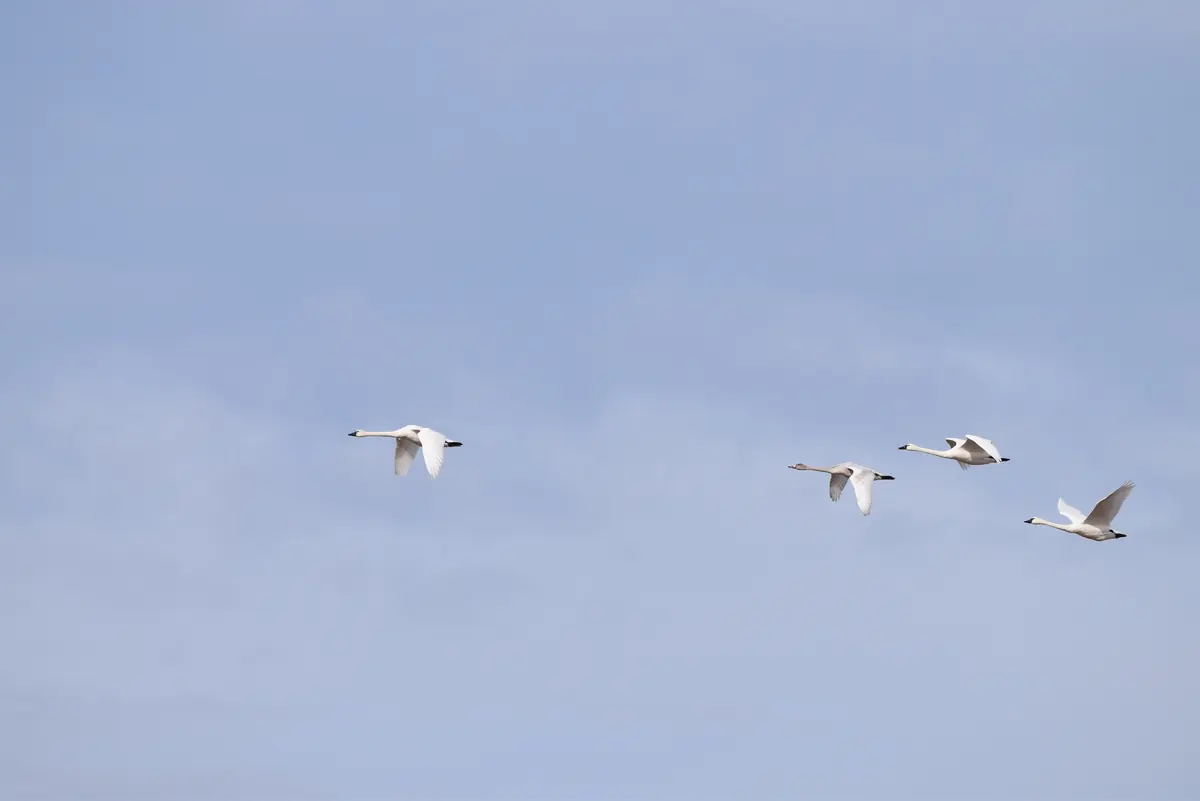
- Swans come in from the Arctic. Tundra swans settle onto the upper Bay through November. Stand on the boardwalk just past the bridge onto Eastern Neck Island, near Rock Hall, and listen for their high, yelping calls. At Blackwater, swan counts climbed from zero to 95 between late October and November 18 in the 2022 refuge survey.
- Eagles at the dam. From late fall into winter, bald eagles gather below Conowingo Dam on the lower Susquehanna to grab fish swept through the turbines. Fisherman’s Park, on the Harford County side, is the place to stand. Weekday mornings are the least crowded.
- Leonids, then a supermoon. The Leonids peak in the small hours of Wednesday the 18th, once a half-lit moon has gone down. November’s Beaver Moon turns full on Tuesday, November 24, at 9:53 a.m. EST, a mild supermoon; both Monday and Tuesday evenings show it round.
Keep a record: your first swan, snow goose or white pelican of the season belongs on the bird list (the “birds I have seen” plate) in the Naturalist’s Field Journal, while a map of sounds can hold a swan flock passing over at night; the tracks to know plate fits a deer trail in fresh mud; and if a beech or oak in your yard holds its brown leaves, give it a page in the same place twice and visit again in March. Date every entry.
Regions used below: Western Maryland (Garrett and Allegany); Hagerstown Valley and the Blue Ridge; Central Maryland and the Baltimore–Washington corridor; Southern Maryland; Eastern Shore and the Atlantic coast.
When do tundra swans and snow geese arrive in Maryland?
November is the month the Bay fills up. The early ducks of October are joined by the big birds: swans first, then geese by the thousand, then the diving ducks that ride out the winter on open water. The best places to watch are national wildlife refuges with roads, boardwalks and scopes.
-
Tundra swans at Eastern Neck
Arriving through November; present all winter · Eastern Neck National Wildlife Refuge, Kent County, south of Rock Hall
The swans that winter on the upper Bay nest on the Arctic tundra and arrive here in November. The Friends of Eastern Neck say hundreds spend the winter around the island, often on both sides of the causeway as you drive in. The Tundra Swan Boardwalk, on the right just past the bridge, has two viewing scopes, one of them wheelchair accessible. Refuge counts have topped 20,000 waterfowl of 33 species on and around the island, with Canada geese, tundra swans, lesser scaup and mallards the most numerous. Go on a still morning, when you can hear the swans before you pick them out against the water.
-
Blackwater fills up week by week
Numbers climbing all month · Blackwater National Wildlife Refuge, south of Cambridge, Dorchester County
The refuge’s weekly ground surveys show how fast November changes things. In 2022, staff and volunteers counted 1,620 Canada geese along the survey route on October 27 and 6,158 on November 18; mallards went from 243 to 2,042, and northern pintails, only a handful in late October, numbered 2,746 by the 18th. Total waterfowl rose from about 2,300 to nearly 11,500 in three weeks. The year-to-year numbers swing with weather, but the pattern holds: each weekend in November shows more birds than the last. Drive the Wildlife Drive slowly and use your car as a blind.
-
Snow geese
Late November into early March · Delmarva marshes and farm fields, especially Dorchester and the mid-Shore farm counties
The Chesapeake Bay Program’s field guide puts the snow goose’s arrival in the Bay region, and especially on the Delmarva Peninsula, in late November. They travel in flocks that can run into the thousands, flying in long ragged lines and V’s; in the air, look for white bodies with black wingtips. Blue morphs, gray-bodied with white heads, mix in with them. When a flock lifts off a stubble field all at once, the noise is something you remember.
-
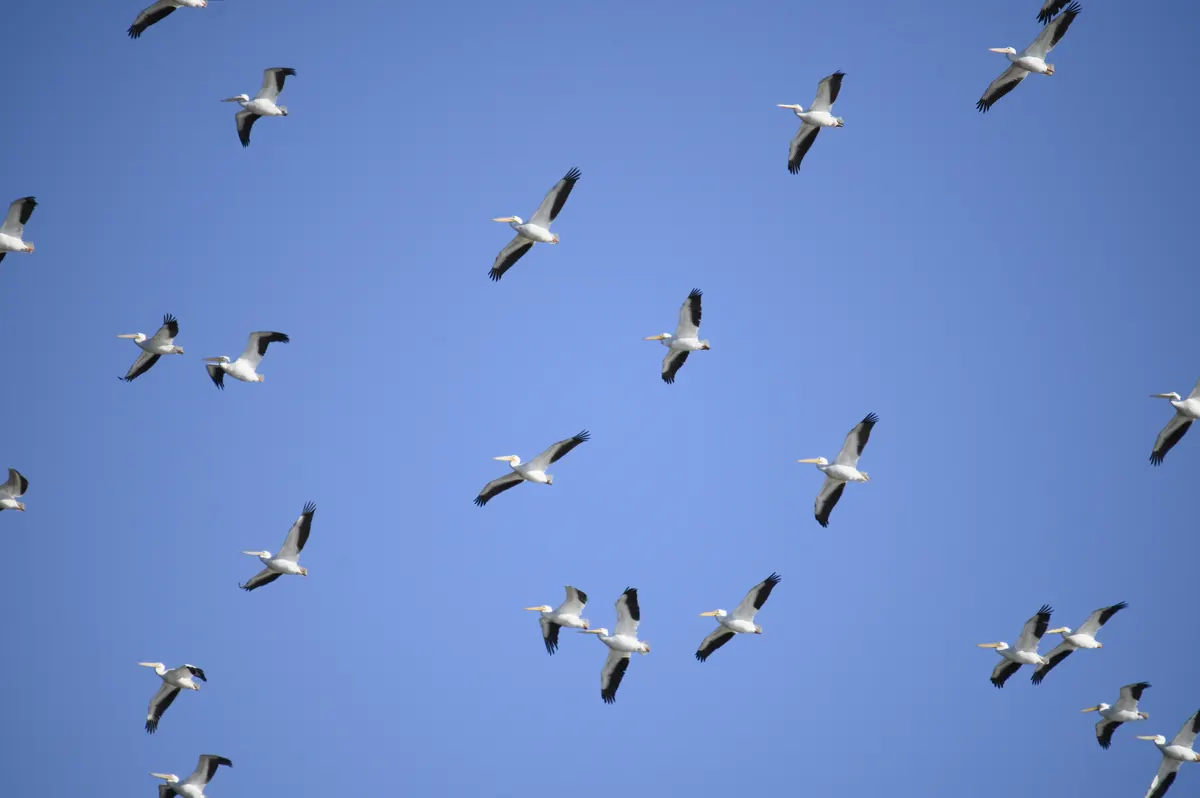
American white pelicans at Blackwater
Arriving in November; some stay until April · Shallows of the upper Blackwater River and the impoundments along the Wildlife Drive
This is the bird people don’t expect on the Chesapeake. A western species that nests on prairie lakes, the American white pelican was once a rare stray here, but the Bay Journal reports that a sizable group has wintered at Blackwater for more than a decade, starting to show up in November. Their wingspan can pass 9 feet, wider than a bald eagle’s. In the 2022 survey, 29 were counted on November 3 and 42 on November 10. Unlike brown pelicans, they do not dive; they swim in a loose line and dip their bills together to herd fish.
Check each refuge’s page for hours and any closures before you drive down, and write the date of your first swan in the field log.
Where can you see bald eagles in Maryland in November?
Maryland has eagles year-round, but November adds a third group. The Chesapeake Bay Program describes three populations on the Bay: residents, birds from the Southeast that come for the summer, and birds from the Northeast that come to spend the winter. The winter visitors start turning up this month.
-
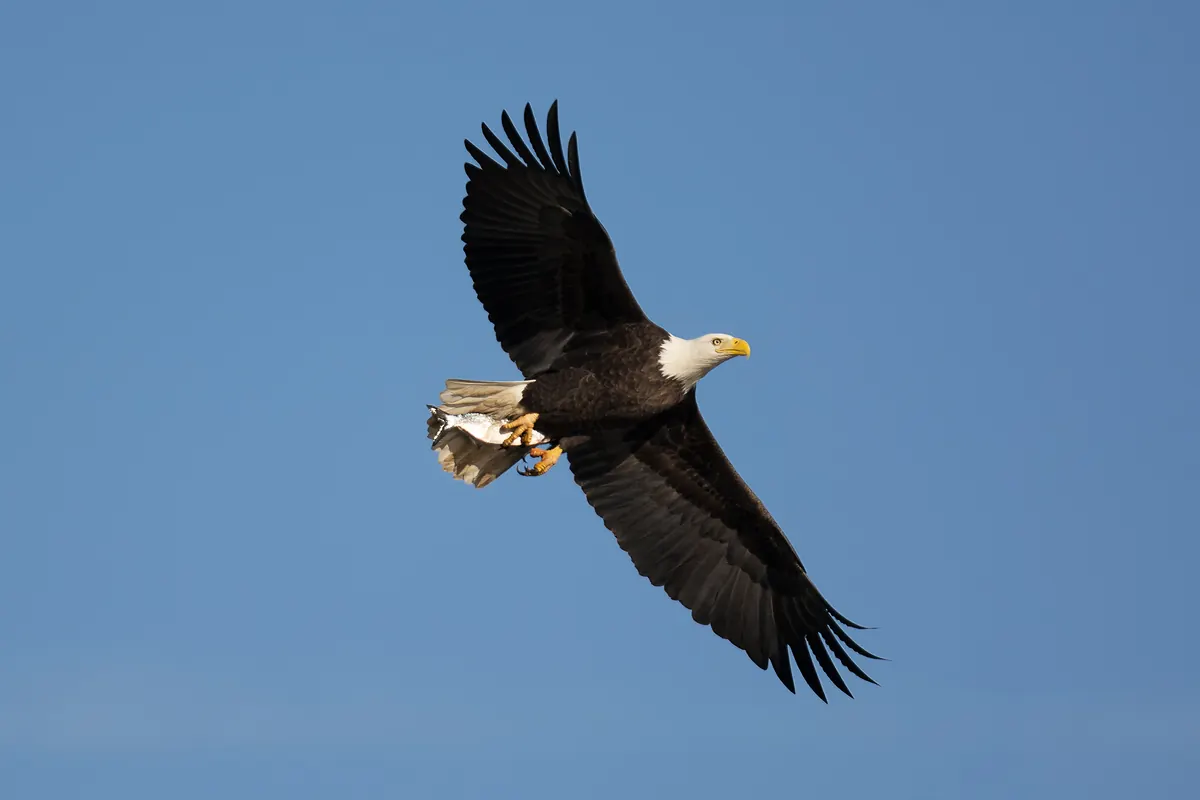
Conowingo Dam
October through mid-March; numbers build from late November · Fisherman’s Park, below the dam on the Harford County side, Darlington
Water that passes through the dam’s turbines carries stunned shad, herring, eels and other fish into the river below, and the eagles have learned to wait for them. Eagles collect here in large numbers from October through mid-March, according to the Birders Guide to Maryland and DC, and high counts on a single winter day can top 250. Late November into winter is when the show builds. It is aerial: adults and brown immatures swoop down for a fish, then chase each other for it. Look everywhere, the guide advises: overhead, in the trees on both shores, on the power towers and on the rocks below the dam. Bring binoculars, or a scope if you have one, dress for wind off the water, and arrive early, because the lot fills at the height of the season.
-
Blackwater’s eagles
All month · Snags and marsh edges along the Wildlife Drive
In November 2022 the refuge’s weekly surveys counted 14 to 23 bald eagles along the survey route. Look for white heads on dead loblolly pines at the marsh edge. The Chesapeake Bay Program notes that Bay eagles build and repair nests in early winter and lay eggs from January to March, so a pair carrying sticks this month is getting an early start.
An eagle feather found on the ground is protected by federal law, so photograph it for the feather found page and leave it where it lies.
What turns up on the Maryland coast and the Chesapeake in November?
Once the beach crowds leave, the inlet at Ocean City becomes one of the best winter birding spots in the state. The Bay itself is cooling quickly, and its animals are on the move.
-
Sea ducks and loons at the Ocean City inlet
Fall through early spring · The inlet jetty at the south end of the Boardwalk, Ocean City
The Birders Guide to Maryland and DC lists the winter regulars at the inlet: common and red-throated loons, horned grebes, brant, greater scaup, long-tailed ducks, red-breasted mergansers, all three scoters and northern gannets. Purple sandpipers and ruddy turnstones work the jetty rocks. Scan the rip line at the mouth of the inlet for loons and diving ducks, and look across the water at the South Jetty, where harlequin ducks and eiders sometimes sit close to the rocks. The Birders Guide recommends the stretch from fall to early spring, after summer parking fees end; it can be bitterly windy on the jetty, so bring a hat.
-
Rockfish and oysters
Striped bass harvest open to December 5 · Chesapeake Bay and tidal rivers
Under Maryland’s 2026 rules, the recreational Bay season allows one striped bass a day, 19 to 24 inches, through December 5, after which it is catch and release only. Oyster tongers keep working the public bars. Check the current DNR notices before you go; seasons and limits change.
-
Blue crabs bury themselves
As the water drops through the 50s · Deeper channels of the Bay
NOAA’s coastal water guide puts the average November water temperature at about 56 °F at Baltimore and 53 °F at Cambridge. As it cools, blue crabs slow down and settle into the mud of deeper water to spend the winter, which is why crab houses switch to oysters and rockfish this month.
When is the deer rut in Maryland, and when do bears go into their dens?
-
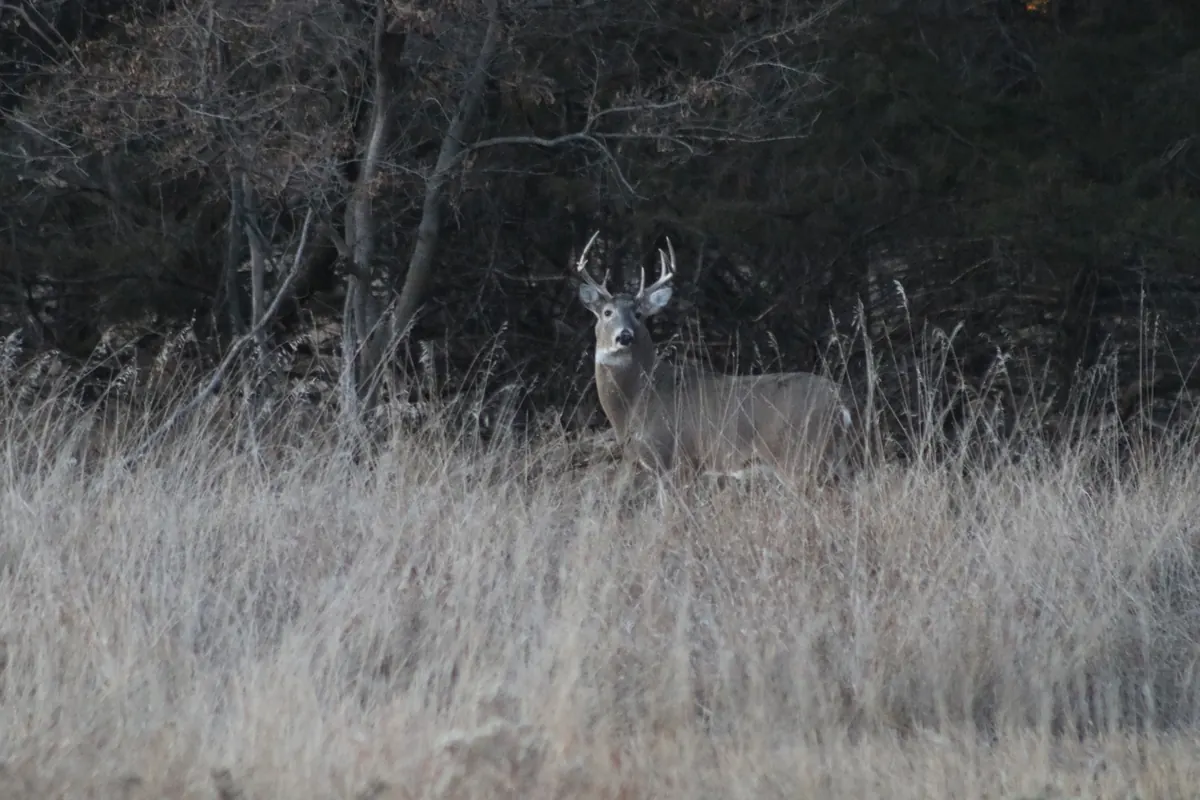
The whitetail rut
Building from late October; busiest through November into early December · Statewide, along field edges and roadsides
DNR says shorter days set off the breeding season, and that deer movement peaks from mid-October through November and into early December. Bucks travel far looking for does and cross roads at all hours, without paying much attention to cars. Look at the ground as well as the woods: fresh rubs on saplings, scrapes pawed into the leaf litter under low branches, and tracks in the mud along a creek. A buck nose to the ground with his neck swollen is following a doe’s scent. The tracks to know plate is good for comparing a heavy buck’s print with a doe’s.
-
Black bears heading for their dens
Starting mid-November; most denned by mid-December · Garrett, Allegany, Washington and Frederick counties, and sometimes farther east
Maryland’s bears are still feeding hard in early November, eating upward of 20,000 calories daily, and then they start looking for a den. DNR says the first go in by mid-November and most are tucked away by mid-December, depending on the weather. Dens can be under boulders, in hollow trees or simple hollows on the ground, and sometimes under a porch. Bears are not true hibernators; their heartbeat and breathing slow, but the females give birth in January to cubs that weigh half a pound to a pound. Until the bears settle in, DNR asks western Maryland residents to hold off on putting up bird feeders.
-
Gray squirrels and beechnuts
Through November · Oak and beech woods statewide
The Forest Service notes that American beech drops its nuts in October or November, after a frost, and that mice, squirrels, chipmunks, black bears, deer, foxes, ruffed grouse, ducks and blue jays eat them. Watch a gray squirrel bury acorns one by one in a lawn: the ones it never digs up again can sprout in spring. Gather a handful of cups, husks and nuts for the seeds, pods and cones page.
The dusk and dawn watch is the right plate for keeping track of how many deer you see along the same road, morning and evening, through the rut.
Will winter finches come to Maryland feeders this year?
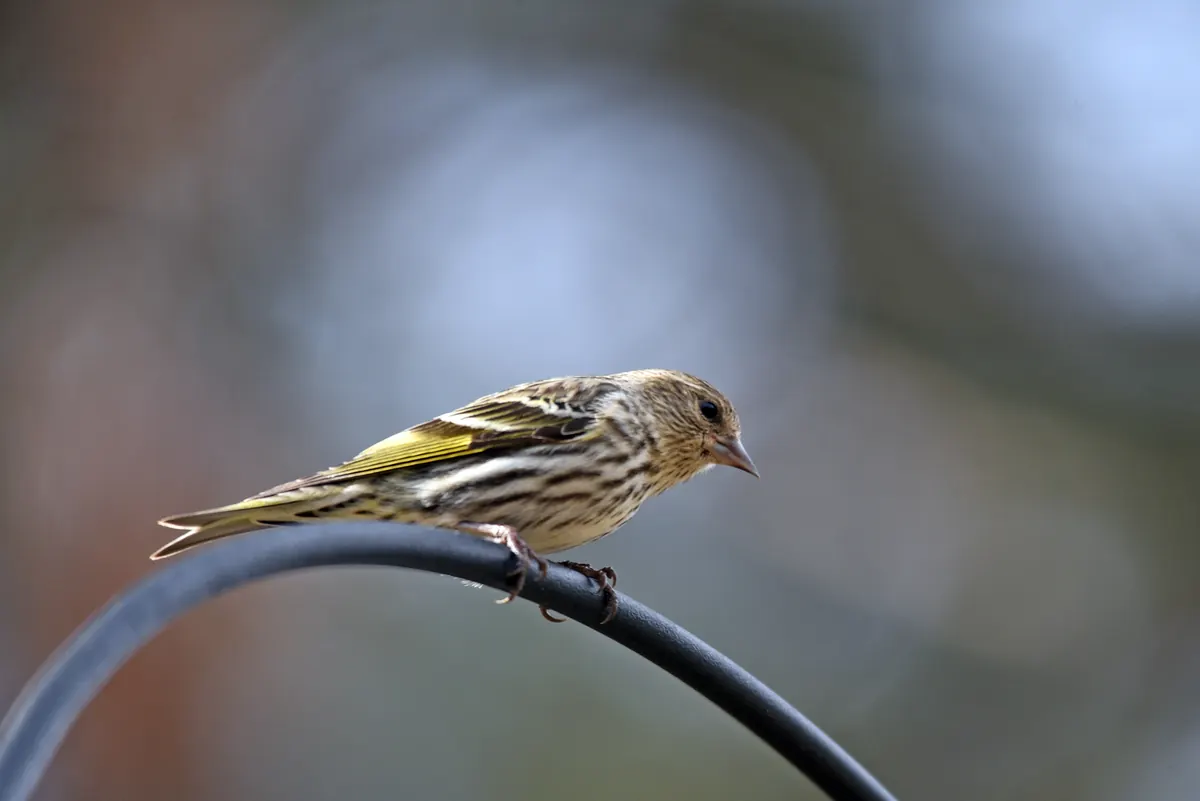
Probably not in big numbers. The Finch Research Network’s 2026–27 winter finch forecast, published September 25, describes good cone and seed crops in eastern Canada and the northeastern forests, which means most northern finches can stay put. The forecast says no big irruptions of any finch are expected in the southeastern states. For birds that might still reach Maryland, it allows for a small to moderate southward flight of pine siskins, a late, small flight of purple finches at best, and a small one of evening grosbeaks south into Pennsylvania. Red-breasted nuthatches, which came south in numbers last winter, are not expected to do it again.
That makes any siskin or purple finch at a Maryland feeder this month worth noting. Siskins look like small, heavily streaked goldfinches with yellow edging on the wings and tail; purple finches are raspberry-washed, not the brick red of a house finch. Look for them in sweetgum and birch seed heads as much as at feeders.
The Cornell Lab and Birds Canada start a new Project FeederWatch season on November 1 that lasts into April; it costs $18 a year in the U.S., and you can count as often or as rarely as you like. In Garrett, Allegany, Washington and Frederick counties, wait to fill feeders until the bears have denned.
Which trees still have fall color in Maryland in November?
Maryland’s color finishes on the coast. In the Maryland Forest Service’s regional timetable, the counties west of I-95 usually peak around November 1 and the Shore and the Bay counties around November 8, so the first half of November is the last good stretch of color in the state. By now the mountain counties are mostly bare.
-
Oaks and sweetgums
Early to mid-November east of I-95 · Southern Maryland, the Bay counties and the Shore
Oaks finish the season, turning brown, russet or, in scarlet oak, a deep red. Sweetgums can mix purple, scarlet and yellow on a single crown. Count the gumballs and acorns on the ground under one tree each week.
-
Beech leaves that stay all winter
From November until new leaves push them off in spring · Understory of woods statewide
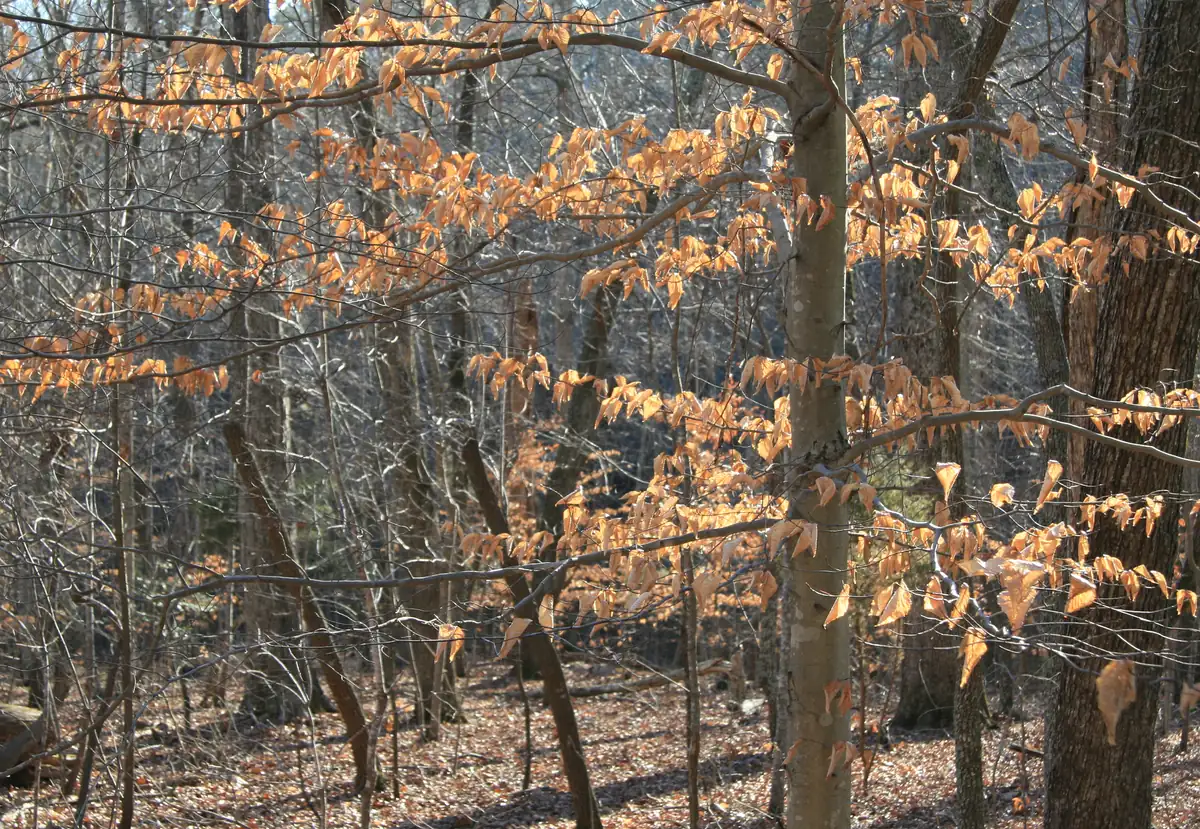
Young American beeches, and many young oaks, keep their dead leaves through the winter instead of dropping them. Beech leaves fade from gold to the color of parchment and rattle in the wind. Botanists call this marcescence, and nobody is quite sure why trees do it. Pick one small beech near a trail and draw it now and again in March.
-
Bald cypress dropping its needles
Early November · Pocomoke River State Park, Worcester County; Battle Creek Cypress Swamp, Calvert County
By early November the rusty orange of the cypress swamps along the Pocomoke is falling into the water, and the knees stand out over the dark tannin-stained river. A walk or paddle at Shad Landing in the first week of the month catches the end of it.
Satellite records behind the Field almanac estimate when leaves drop at your own address, a handy check on whether your trees ran early or late this year.
Has Maryland had its first freeze yet?
Across most of Maryland, the answer by November is yes. In the NOAA station medians below, every station except one has had its first 32 °F night by the end of October: early October on the Garrett plateau, mid to late October in the Hagerstown Valley and around Frederick, and the last days of October at BWI, in St. Mary’s County and at Salisbury. The exception is the Bay shore. Annapolis, warmed by the water around it, has a median first freeze of November 20, and one autumn in ten stays above freezing there past December 5. Solomons, at the mouth of the Patuxent, runs later still. In a cold year, though, even BWI can freeze in mid-October, and in a mild one Salisbury waits until about November 12.
| Station | One year in ten | Median | Nine years in ten |
|---|---|---|---|
| Oakland 1 SE (Garrett County) | Sep 26 | Oct 9 | Oct 23 |
| Frostburg 2 (Allegany County) | Oct 5 | Oct 18 | Nov 1 |
| Cumberland 2 | Oct 9 | Oct 24 | Nov 6 |
| Hagerstown 1 E | Oct 14 | Oct 28 | Nov 11 |
| Emmitsburg 2 SE (Frederick County) | Oct 7 | Oct 20 | Nov 2 |
| Baltimore Wash International Airport | Oct 17 | Oct 31 | Nov 12 |
| Annapolis Naf (Annapolis, on the Severn) | Nov 4 | Nov 20 | Dec 5 |
| Mechanicsville 5 NE (St. Mary’s County) | Oct 12 | Oct 27 | Nov 9 |
| Salisbury Wicomico Regional Airport | Oct 15 | Oct 30 | Nov 12 |
If you are near the water and still have tomatoes or peppers on the vine, watch for the first clear, calm night with a forecast low in the mid-30s. Every Maryland station, spring and fall, is on the Maryland frost dates page.
How much daylight does Maryland lose in November?
Just under an hour across the state, about 53 minutes in Baltimore, at a little under 2 minutes a day. The bigger shock comes on day one. Halloween is the last evening of daylight saving time; the switch back to EST that night shoves Baltimore’s sunset from 6:06 p.m. EDT on Halloween to 5:05 p.m. EST the next day. By November 30 the sun sets at 4:44 p.m. and rises at 7:06 a.m. Sunsets keep creeping earlier into early December before they turn around.
| City | Nov 1 | Nov 30 | Lost | Per day |
|---|---|---|---|---|
| Oakland | 10 h 30 m | 9 h 37 m | 53 min | 1.8 min |
| Cumberland | 10 h 29 m | 9 h 36 m | 53 min | 1.8 min |
| Hagerstown | 10 h 30 m | 9 h 35 m | 55 min | 1.9 min |
| Frederick | 10 h 30 m | 9 h 37 m | 53 min | 1.8 min |
| Baltimore | 10 h 31 m | 9 h 38 m | 53 min | 1.8 min |
| Annapolis | 10 h 32 m | 9 h 39 m | 53 min | 1.8 min |
| Salisbury | 10 h 34 m | 9 h 42 m | 52 min | 1.8 min |
| Ocean City | 10 h 34 m | 9 h 42 m | 52 min | 1.8 min |
Sunrise, sunset and twilight for your exact address, plus how much light you lose this week, are on the Field almanac.
What is November weather like in Maryland, and when does it first snow?
November is the month the heat goes out of the ground. NOAA’s 1991–2020 normals give BWI an average November high of 57 °F and low of 37 °F, Hagerstown 54 and 37, and Salisbury 59 and 38. Oakland, up on the plateau, averages 52 and 30. Precipitation runs about 2.6 inches at Hagerstown and a little over 3 inches at BWI, Salisbury and Oakland, often from a nor’easter that can push tides into the streets of Annapolis and the Shore towns.
Snow is a western Maryland story this month. Oakland’s normal November snowfall is 6.4 inches, against a tenth of an inch at BWI and none at Salisbury, so the plateau often has its first snow on the ground while the rest of the state is still raking leaves. A November snow in Baltimore is the exception, not the rule, though it can come early: the Baltimore/Washington Weather Service office lists 0.3 inch at Baltimore on October 10, 1979, as the earliest snowfall on record there.
Looking past November, the Pacific is sending a loud signal. Sea temperatures along the equator are running warmer than normal, and the Climate Prediction Center’s monthly diagnostic of September 10 kept its advisory posted, giving an exceptionally strong warm event lasting into early 2027 odds of better than 90 percent. The Baltimore/Washington Weather Service office has found that the stronger the El Niño, the warmer and wetter Maryland’s winters have tended to be, with more storms riding the southern jet stream up the coast. Snow is a coin toss. Since 1950 there have been seven strong El Niño winters here; four buried the region in well above normal snow, and three delivered next to nothing. The deciding factor has usually been the North Atlantic Oscillation, which controls whether cold air is waiting when those storms arrive. The record 2009–10 winter, when Washington got 56.1 inches, paired El Niño with a strongly negative NAO. El Niño matters most from December to February, not in November. The government’s formal December-to-February forecast is due out October 15, and its maps will be posted on NOAA’s 90-day outlook page.
For today’s conditions where you are, check Weather now before a long walk.
What can you see in Maryland’s night sky in November?
-
Leonid meteors
Best before dawn on Wednesday, November 18 · Anywhere dark; face east and look high
Peak rates are due at 6:45 p.m. EST on Tuesday the 17th, per the International Meteor Organization, which is wasted on Marylanders: the meteors stream out of Leo, and Leo is still under the horizon from Oakland to Ocean City until near midnight, so the best show is in the early hours of the 18th. The first-quarter moon sets around midnight, leaving the sky dark until dawn. Expect around 15 meteors an hour from a dark site, without any outburst this year. If clouds spoil the 18th, try the morning before or after.
-
The Beaver Moon, a supermoon
Full at 9:53 a.m. EST, Tuesday, November 24 · Rising in the east-northeast around sunset on the 23rd and 24th
Because the exact moment of full falls on a Tuesday morning, Monday night’s moon and Tuesday night’s both look complete. It reaches perigee, its closest point, about 30 hours after full, which makes it a modest supermoon; December’s Cold Moon will be bigger. Between Monday evening and Tuesday’s dawn it brushes past the little dipper-shaped Seven Sisters, though moonlight will wash out all but its brightest stars.
-
Taurid fireballs around the new moon
Southern Taurids peak November 5; Northern Taurids November 12 · High in the south and east around midnight
The Taurids are a thin shower, rarely more than ten an hour, yet they move slowly and now and then throw a bright fireball. Both branches come from dust left by Comet Encke. Between the two peaks, the November 9 new moon keeps the nights dark.
-
Morning planets
All month before dawn · East and southeast before sunrise; Saturn in the south in the evening
Venus is now the morning star, climbing higher each morning in the east-southeast and growing brighter toward the end of the month. Spica, the brightest star in Virgo, hangs barely a degree from the planet on the morning of November 9. Farther up the sky, among the stars of Leo, Mars draws alongside Jupiter, the two closest, a little over a degree apart, at dawn on Sunday the 15th and Monday the 16th. From mid-month Mercury shows low in the twilight below them, and is easiest to find roughly November 18 to 25. Saturn holds the evening sky by itself, a steady yellowish point in the south once twilight fades.
| Phase | Date | Time |
|---|---|---|
| Last quarter | Sunday, Nov 1 | 3:28 p.m. EST |
| New moon | Monday, Nov 9 | 2:02 a.m. EST |
| First quarter | Tuesday, Nov 17 | 6:48 a.m. EST |
| Full moon, the Beaver Moon | Tuesday, Nov 24 | 9:53 a.m. EST (looks full on the evenings of Nov 23 and 24) |
| Last quarter | Tuesday, Dec 1 | 1:08 a.m. EST |
Bay clouds often roll in on November nights; Today’s sky shows whether a predawn alarm is worth it, and moon phases lists moonrise and moonset for your town.
What are good outdoor outings for Maryland families in November?
- Birding walks at Blackwater. Volunteer leaders from the Friends of Blackwater take free guided walks out from the visitor center on Sunday, November 1, at 8 a.m.; Tuesday, November 10, at 8 a.m.; Sunday, November 22, at 8 a.m.; and Sunday, November 29, at 8 a.m. Bring binoculars, snacks and layers. On Wednesday, November 11, Veterans Day, entry to the Wildlife Drive is free under the Fish and Wildlife Service’s 2026 fee-free days.
- November 7: Fungi Fest at Pocomoke River State Park. Maryland State Parks lists a Fungi Fest 5K with vendors; check with the park for times. Pair it with a walk under the cypress at Shad Landing.
- November 13–15: the Waterfowl Festival in Easton. Decoy carvers, wildlife painters and photographers, duck and goose calling contests and retriever demonstrations fill downtown Easton; a $25 pass covers all three days.
- Kids’ programs at Patuxent. The National Wildlife Visitor Center on Patuxent Research Refuge’s South Tract, near Laurel, runs its Kids Discovery Center on birds, owls and woodpeckers this November, Wednesday to Saturday at 10, 11 and noon, by reservation at 301-497-5772. Its family program on soil, “Dirt: Dig It!”, runs November 20 and 21 from 10 a.m. to 1 p.m.
- A weekday dawn at Conowingo. Eagles, gulls and fishing herons below the dam; dress warmly.
- The Leonids. An alarm at 4 a.m. on Wednesday, November 18, a blanket and a thermos make a good family memory.
- Citizen science. Start a Project FeederWatch count on November 1, or report your first swans and snow geese to eBird.
Write each outing up in the Naturalist’s Field Journal, and see what other states are noticing this month on the nature hub.
Safety notes for November in Maryland
- Deer seasons. Archery deer season, open since September 11, runs through November 27 (it closed only October 22 to 24 for muzzleloaders). Junior deer hunt days are Saturday and Sunday, November 14 and 15. The firearms season opens the Saturday after Thanksgiving, November 28, and runs to December 12, so expect gunfire in the woods all weekend. Sunday deer hunting is allowed in many counties on November 1, 8, 15, 22 and 29, on private land and on listed state forests and wildlife management areas in Garrett, Allegany, Washington, Cecil, St. Mary’s, Wicomico and Worcester counties; in several Southern Maryland and Shore counties, Sunday shooting ends at 10:30 a.m. on some of those dates. Baltimore, Howard and Prince George’s counties have no Sunday deer hunting.
- Other seasons. In Allegany, Garrett and Washington counties, the fall turkey season lasts from October 31 through November 8. Dove and woodcock are open October 24 to November 27. Ducks are open November 14–27 in the Eastern Zone and November 21–27 in the Western Zone; Atlantic Population Canada geese November 24–27; snow geese from November 7; and the youth, veteran and military waterfowl day is November 7.
- Orange or pink. Maryland requires anyone hunting, and anyone helping a hunter, to show solid fluorescent orange or pink in one of three ways: a cap in that color, a vest or jacket whose front and back panels hold at least 250 square inches of it, or a camo-pattern top in those colors that is 50 percent fluorescent or more. Deer bowhunters during archery season are exempt (except on the junior days, November 14–15), as are hunters after ducks, geese, brant, doves or turkeys. In practice, the woods fill with orange from the junior days and above all from the firearms opener on November 28. Nothing in the law applies to walkers, yet a bright hat and jacket on public land in November, and orange for the dog, is simple sense.
- Deer on the road. November is the worst month for deer collisions. Slow down at dawn and dusk, and when one deer crosses, expect a second. Brake hard and keep straight rather than swerve.
- Early dark. With sunset before 5 p.m., a late-afternoon hike ends in the dark. Toss a headlamp in the pack, and text someone your route and expected return time.
- Cold water and wind. With the Bay in the 50s, a capsized kayaker can lose the use of their hands within minutes. Wear a life jacket and dress for immersion, not for the air temperature, and check Weather now for wind before launching.
- Bears. In the western counties, take feeders and trash in until bears are denned, and keep dogs leashed near rocky ledges where a bear might be bedding down.
Sources
- Friends of Eastern Neck: the refuge (tundra swans and the swan boardwalk)
- U.S. Fish and Wildlife Service: birding at Eastern Neck National Wildlife Refuge
- U.S. Fish and Wildlife Service: birding at Blackwater National Wildlife Refuge
- U.S. Fish and Wildlife Service: Blackwater NWR ground waterfowl survey, fall 2022 weekly comparison (PDF)
- U.S. Fish and Wildlife Service: Blackwater NWR ground waterfowl survey, winter 2023–24 (PDF)
- Chesapeake Bay Program field guide: snow goose
- Chesapeake Bay Program field guide: tundra swan
- Bay Journal: Too far north for white pelicans? Not anymore (February 2022)
- Chesapeake Bay Program field guide: bald eagle
- Birders Guide to Maryland and DC: Conowingo Dam and Fisherman’s Park
- Birders Guide to Maryland and DC: Ocean City Inlet
- Maryland DNR: changes to the 2026 Chesapeake Bay recreational striped bass season
- NOAA NCEI: coastal water temperature guide
- Chesapeake Bay Program field guide: blue crab
- Maryland DNR: fall wildlife activity increases drivers’ collision risk
- Maryland DNR: black bear fact sheet
- Maryland DNR: black bear activity increases as they prepare for hibernation (September 28, 2026)
- USDA Forest Service Fire Effects Information System: American beech
- Finch Research Network: winter finch forecast 2026–2027
- Project FeederWatch: project overview
- Maryland DNR: fall foliage preview 2025 (regional peak windows)
- Maryland DNR: fall foliage recap for 2025
- Maryland DNR: the Great Cypress Swamp at Pocomoke River State Park
- NOAA NCEI: U.S. climate normals, 1991–2020
- NOAA Regional Climate Centers: ACIS station data (1991–2020 November normals for BWI, Hagerstown, Salisbury and Oakland)
- Climate Prediction Center: ENSO diagnostic discussion, September 10, 2026
- Climate Prediction Center: seasonal (90-day) outlooks
- NWS Baltimore/Washington: El Niño and Washington–Baltimore winters
- NWS Baltimore/Washington: ENSO, the NAO and local winter snowfall
- NWS Baltimore/Washington: snowfall and cold records (earliest snow, October 10, 1979)
- U.S. Naval Observatory: phases of the moon (November 2026)
- NOAA solar calculator equations (sunrise, sunset and day length)
- International Meteor Organization: 2026 meteor shower calendar (PDF)
- EarthSky: what is a supermoon? (2026 list)
- NASA JPL Horizons: planetary and lunar ephemerides
- EarthSky: best stargazing of 2026 (Mars–Jupiter conjunction)
- Friends of Blackwater: event calendar (November 2026 walks)
- U.S. Fish and Wildlife Service: federal recreation passes and 2026 fee-free days
- Maryland Park Service: 2026 signature events
- Talbot County Office of Tourism: Waterfowl Festival, November 13–15, 2026
- U.S. Fish and Wildlife Service: Patuxent Research Refuge visitor center (Kids Discovery Center, November 2026)
- eBird
- Maryland DNR: hunting seasons calendar for 2026–2027, with Sunday deer hunting (PDF)
- Maryland DNR: migratory game bird seasons for 2026–2027
- Maryland Guide to Hunting and Trapping (eRegulations): migratory game bird seasons and limits, 2026–27
- Maryland DNR: fluorescent orange and/or pink clothing requirements and exceptions
- Photos via Wikimedia Commons; licenses and photographers are credited under each picture
