What to look for in nature in Michigan this April
April is when Michigan's spring stops being a rumor. Piping plovers, an endangered shorebird that nests only on Great Lakes beaches, start to reappear on the dunes at Sleeping Bear, and common loons arrive on lakes as the ice goes out. At Whitefish Point the formal count of passing waterbirds begins April 15. After dark the swamps fill with peepers, wood frogs and, by the middle of the month, American toads. In the Cheboygan County woods, lake sturgeon move up the Black River to spawn while volunteers stand guard along the bank. Smelt dippers head to Upper Peninsula streams, steelhead are spawning in the rivers, and the last Saturday of the month opens trout and walleye water in the Lower Peninsula. The first trillium and, with luck and rain, the first morels can follow in the south by the end of the month. April can also throw the whole range at you: in the spring of 2026 a run of heavy rain, melting snow and tornadoes put dozens of counties under a state of emergency. Earth Day is April 22, Arbor Day follows on April 30, and the full Pink Moon rises on the evening of April 20.
Other months in Michigan: October, November, December, January, February, March.
Start here

- Listen at dusk for toads and wood frogs. Pick a pond, ditch or flooded woodlot on a mild evening above freezing and stand still for five minutes. Peepers jingle, wood frogs quack, and toads begin to trill around the middle of the month.
- Scan the Lake Michigan or Superior beach, or a big lake, from a distance. Look for a small, pale plover on pebbly sand at Sleeping Bear and other northern beaches, or a loon on a lake where the ice has gone. Keep your distance from roped nesting areas.
- Visit a forest of the first wildflowers. In the south, go late in the month to a hardwood forest for trillium and other spring ephemerals, and stay on the trail. Check a preserve or park calendar for dates.
Keep a record: set the day each toad, peeper and wood frog starts calling on a map of sounds, and log first arrivals under birds I have seen, from the first loon to the first hummingbird. The dusk and dawn watch suits a woodland edge with drumming grouse, a tree through the seasons can track one red maple or serviceberry, and reading the signs fits morel weather. Write the date you first see trillium in the daily field log.
Regions used below: Western Upper Peninsula; Eastern Upper Peninsula; Northern Lower Peninsula; West Michigan and the Lake Michigan shore; The Thumb and Saginaw Bay; Southeast Michigan and Metro Detroit; Southwest Michigan.
Which birds return to Michigan's beaches, lakes and skies in April?
This month brings shorebirds to the dunes, loons to open water and hawks into the afternoon sky. Well-known places help, but a lake, beach or backyard works too if you know when to look.
-
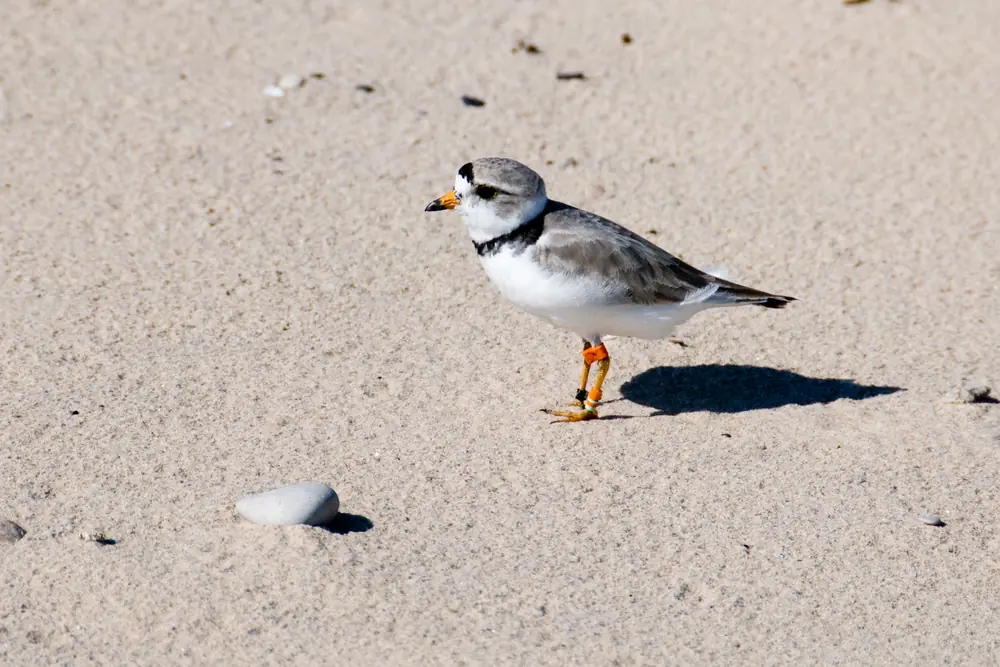
Piping plovers come back to the Great Lakes shore
First arrivals usually in April; by early May most are on their beaches · Sleeping Bear Dunes National Lakeshore and other Lake Michigan and Lake Superior beaches
The Great Lakes piping plover breeds only on Great Lakes beaches, and Sleeping Bear Dunes is summer home to more than one-third of the population, according to a National Park Service article posted by the state environment department. The count rose from 81 pairs in 2024 to 88 in 2025, a record and well above halfway to the recovery goal of 150 pairs. Monitors follow the birds from first arrival in April through nesting in May. A U.S. Fish and Wildlife Service biologist told the Associated Press in 2015 that plovers are typically spotted beginning the week of April 6, and in 2020 the first Sleeping Bear bird was reported back April 16. Respect roped-off nesting areas, and leash your dog.
-
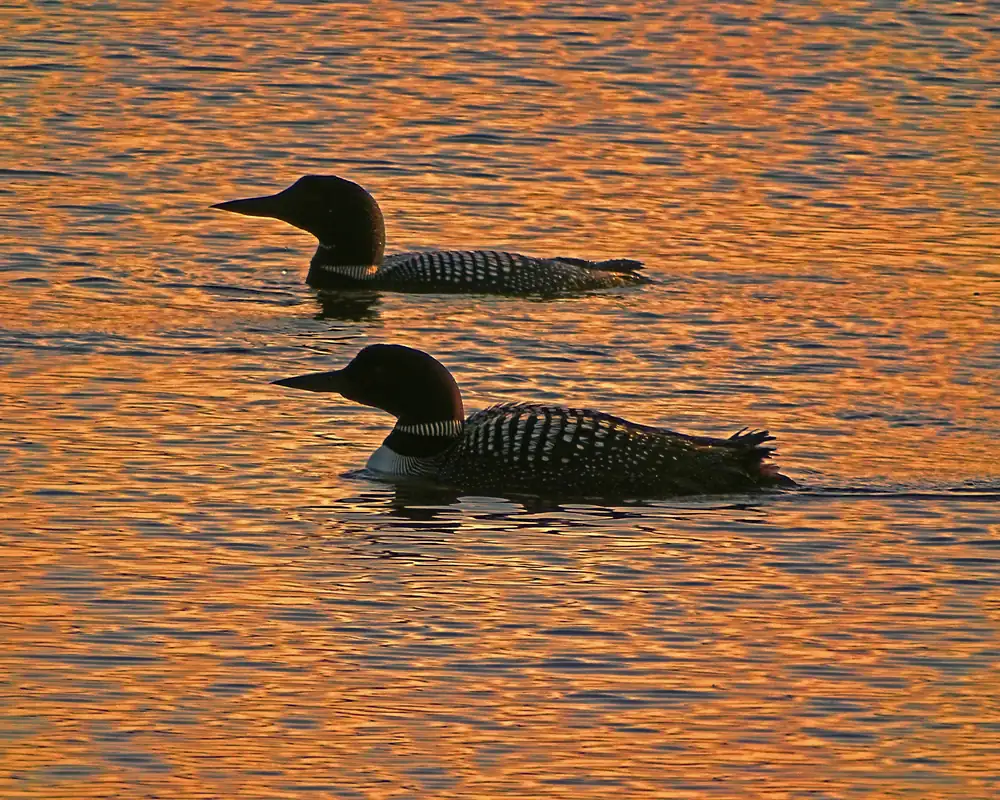
Common loons arrive as the ice leaves
April on the inland lakes; early May at Whitefish Point · Northern Lower Peninsula and Upper Peninsula lakes; Whitefish Point on Lake Superior
An officer of the Michigan Loon Preservation Association told public radio in 2023 that loons return as soon as a lake thaws, usually within a day or two, and that the northern migration typically happens in April. Dawn and dusk on a large, clear lake are the best times. At Whitefish Point Bird Observatory the waterbird count begins April 15, often with big flights of Canada geese and sandhill cranes; by month's end loons stream past, and the observatory describes one of the largest spring common loon flights in the country, usually peaking in early May.
-
Broad-winged hawks begin to kettle
Late April into early May; 2027 weekend dates not yet posted · Mackinaw City and Mackinac Island hawk watches; Whitefish Point
March belongs to golden eagles and red-tailed hawks; late April brings broad-winged hawks, which spiral upward in groups on warm air, a behavior called a kettle. The Mackinac Straits Raptor Watch held a Broad-winged Bonanza Weekend on April 25 and 26 in 2026 and a Red-tailed Hawk Weekend on April 11 and 12; 2027 weekends are not announced, so check mackinacraptorwatch.org. Whitefish Point Bird Observatory says its broad-winged flight peaks in early May, when hundreds can kettle over the dunes. Go in the afternoon, with sun on the ground.
-
Ruby-throated hummingbirds start to show up
Mid to late April in the south in the years above; later farther north · Feeders and flowering shrubs in the southern Lower Peninsula first
Journey North's recap of the 2025 migration says Michigan's first report arrived April 18, from Lansing, and a Detroit television station noted in 2023 that the previous year's map points began as early as April 16. Hang a clean feeder with fresh sugar water as the first reports reach neighboring states, and report your own first bird to Journey North.
Swallows, phoebes, kinglets and yellow-rumped warblers push north in the same weeks. Add every first arrival to the birds I have seen section of your Naturalist's Field Journal. For the earlier stage of migration, see the March page.
When do frogs and toads reach full chorus in Michigan?
March brought the first chorus frogs. April is the month the ponds, ditches and flooded woods reach full volume on mild nights, and each species has its own voice and its own moment.
-
Spring peepers and chorus frogs
Early to mid April in the south; later in the north · Flooded woods, ditches and shallow ponds near forest edges
Michigan State University Extension calls the spring peeper Michigan's smallest frog, at 1 to 1.5 inches, and its loudest. Most breed in April, and females lay roughly a thousand eggs, clustered on twigs and plants. A retired MSU Extension biologist in the southern Upper Peninsula describes a few early peeps in April and a roar from some woodlands by mid-May. The midland chorus frog, which sounds like a fingernail drawn over comb teeth, is usually first of all and often heard in March.
-
Wood frogs: a short, noisy window
One to two weeks, beginning around April 1 in the south · Vernal pools in hardwood forest
The Friends of the Rouge watershed group describes wood frogs as up to 3.25 inches long, with a dark line across the eyes like a mask. They begin calling around April 1 and have the shortest breeding window of any Michigan frog or toad, one to two weeks, so a pool that roars one warm evening may soon go quiet. Their call has been likened to a duck's quack or a chicken's cluck. Go out after dark when the air is above freezing.
-
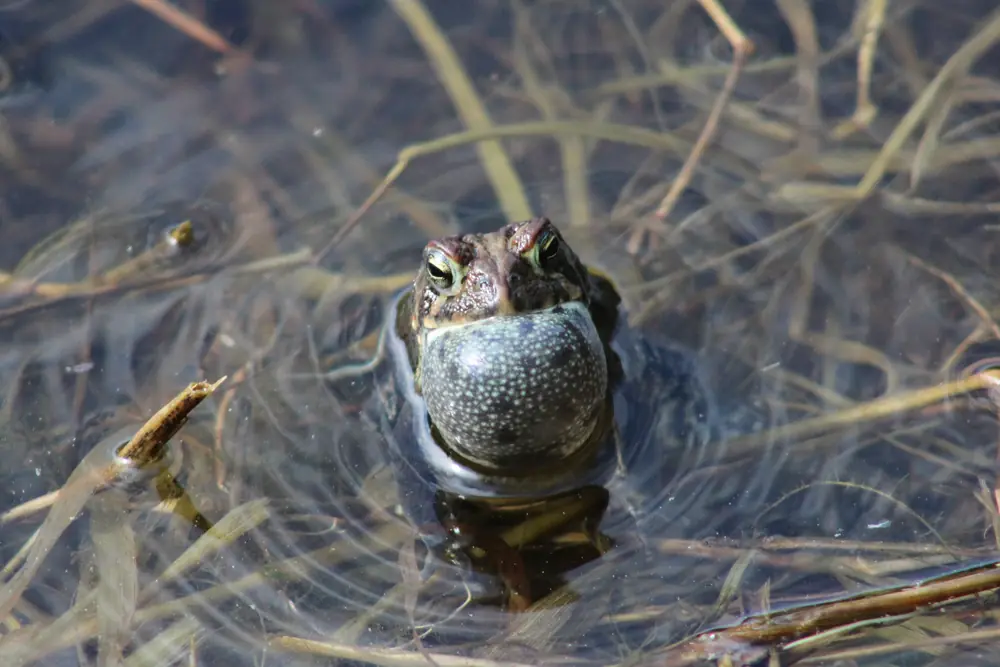
American toads begin to trill
Around April 15, with calling building through May · Shallow ponds, ditches and roadside pools
The Friends of the Rouge page says American toads begin calling around April 15, and MSU Extension describes the song as a high-pitched trill lasting 15 to 20 seconds, with neighbors singing at slightly different pitches. Gray treefrogs call from spring into fall, with a bubbly sound people often take for a bird. The calendar shifts with the weather, so trust your ears over these dates.
The state's Frog and Toad Survey depends on volunteers who learn exactly these voices; see the families section. A phone app that identifies sound can help you practice. Log the first date for each species on the map of sounds pages of the Field Journal.
What else wakes up in Michigan's woods and wetlands in April?
Away from the water, April is the month of drumming and gobbling and of the first warm days that bring a shy snake out to bask.
-
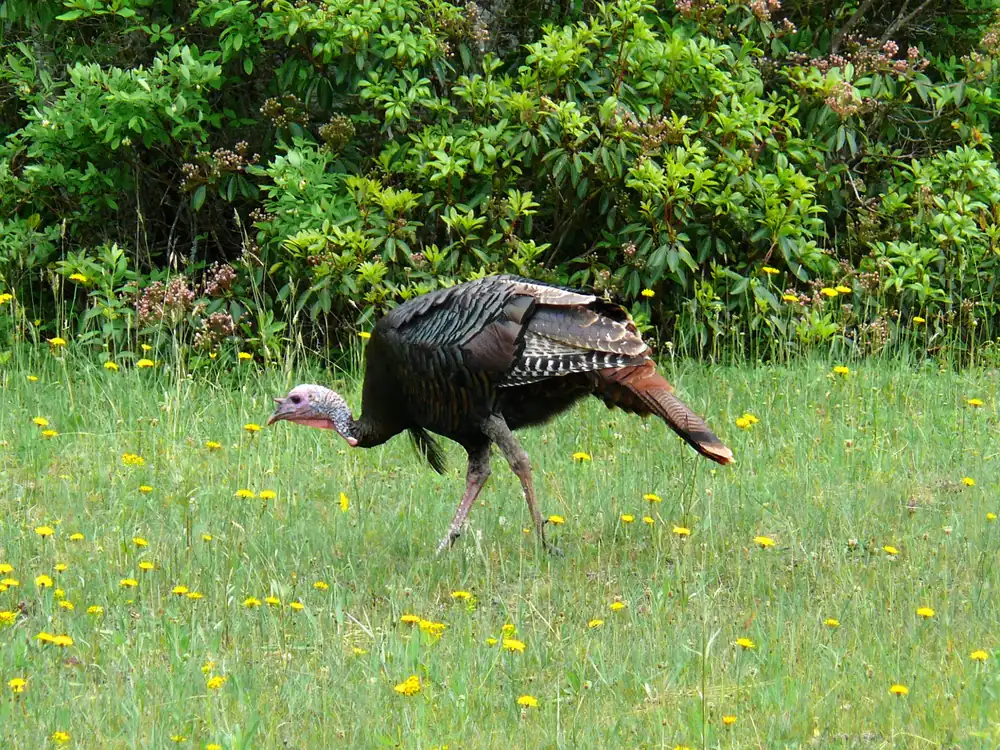
Wild turkeys gobble, and the spring season opens
The DNR sets the season to begin on the second-to-last Saturday of April, which falls on April 17 in 2027; 2027 unit dates and quotas not yet announced · Hardwood edges, fields and woodlots statewide
The DNR says spring turkey dates follow a formula in the Wildlife Conservation Order: the second-to-last Saturday in April, then a set number of days. In 2026 hunt periods began April 18 in three units, Unit M in the Upper Peninsula, Unit NN in the northern Lower Peninsula and Unit ZZ in the southern Lower Peninsula, down from 14 units. Successful hunters must now report a harvest within 72 hours. Hunter or not, expect gobblers at dawn and strutting males in fields. The DNR has not posted 2027 quotas or end dates; check its spring turkey page.
-
Ruffed grouse drum
April and May, mostly at dawn and dusk · Young aspen and mixed woods, often along old logging roads
A male ruffed grouse stands on a log and beats his wings, slowly at first and then faster, until it sounds like a distant engine starting. A Michigan DNR release explains that staff and volunteers survey grouse and woodcock each spring by listening on set routes starting 30 minutes before sunrise, since grouse are most active in the morning. The DNR and the Ruffed Grouse Society have also led evening woodcock walks in April. If a thumping puzzles you, stand still and watch the logs ahead.
-
Massasauga rattlesnakes come out to bask
Emergence typically early to mid April · Fens, wet meadows and shrubby wetlands
The Michigan Natural Features Inventory says spring emergence typically starts in late March and early April, and at one Michigan fen it was recorded in early to mid-April. The snakes bask on sedge hummocks, muskrat lodges and embankments, and stay active until late October. Michigan's only venomous snake is shy and rarely seen, and the state appears to be the species' last stronghold. Watch your step in wet meadows, and never handle or move one.
The tree through the seasons and tracks to know pages of the Field Journal are good places to write down what the woods are doing.
Which fish run up Michigan rivers in April, and when do the seasons open?
April is when Michigan's cold rivers fill with spawning fish, and the opening days that anglers wait for arrive at the end of the month.
-
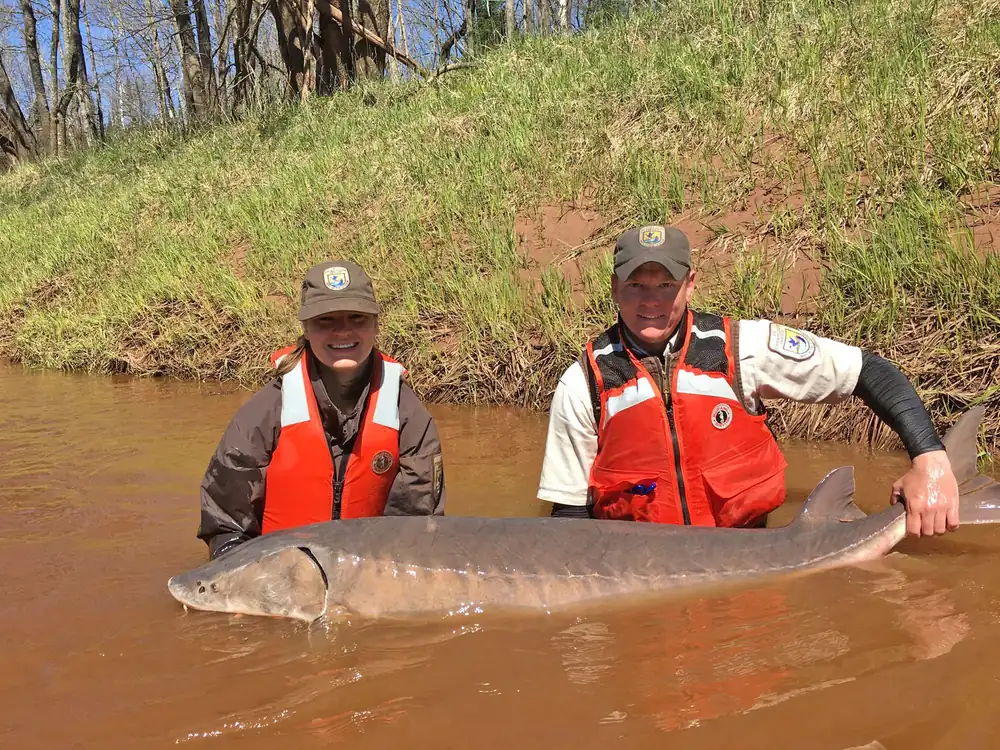
Lake sturgeon spawn in the Black River
The guarding program runs mid-April through early June, a six-week spawning season · Black River, Cheboygan County
In mid-April mature lake sturgeon begin heading up the Black River to spawn. Sturgeon For Tomorrow, with the Michigan DNR and tribes, recruits volunteers to stand shifts along the river from mid-April to early June to guard the fish from illegal harvest, according to a 2025 DNR release. Its volunteer coordinator says the program has run for over 20 years and has virtually eliminated poaching. If you go to watch, stay on public land, leave the fish alone, and report anything suspicious to the DNR poaching line, 800-292-7800 (call or text), as the fishing guide lists.
-
Smelt dipping in Upper Peninsula streams
April, during the smelt's spawning run · Streams that are not designated trout streams, mostly in the Upper Peninsula
The DNR says people typically use dip nets for rainbow smelt in streams during their April spawning period, that Great Lakes smelt are no longer as plentiful as they were, and that the best dipping now is in Upper Peninsula streams. The 2026 fishing guide lists a dip net season of March 20 to May 31 on streams other than designated trout streams, a daily limit of two gallons of smelt, and nets no larger than 9 feet square. A new guide takes effect April 1, 2027, so confirm the rules before you go.
-
Steelhead finish spawning
April for spring-run fish · Rivers that drain into Lake Michigan, Lake Huron and Lake Superior
The DNR's steelhead page says lake steelhead enter spawning streams from late October to early May, that fall-run fish spawn first, often in March, and that spring-run fish follow in April. They spawn on fine gravel in riffles above pools and do not necessarily die afterward. If you wade a stream this month, avoid stepping on gravel beds.
-
The last Saturday of April: trout and walleye openers
Last Saturday in April, which is April 24, 2027, by the 2026 guide's rule; Upper Peninsula walleye and pike open May 15 · Lower Peninsula inland waters; many trout streams
The 2026 fishing guide, in force through March 31, 2027, lists the last Saturday in April as the start of the possession season for walleye and northern pike on Lower Peninsula inland waters, and the DNR's 2026 release said trout seasons opened the same day that year. Upper Peninsula walleye and northern pike open May 15. Walleye can be kept all year in the Lower Peninsula waters of the Great Lakes, in Lake St. Clair and in the rivers that join Lake Huron to Lake Erie. A new guide takes effect April 1, 2027, and the DNR's interactive Inland Trout and Salmon map shows the rules stream by stream.
High water makes streams dangerous in April; see the safety section. Our weather pages can help you judge a river's mood before you drive north.
When do wildflowers bloom, trees leaf out and morels appear in Michigan?
The woods wake in an order: forest-floor flowers first, before the canopy shades them, then shrubs and trees. April is the first stage, and it moves north slowly.
-
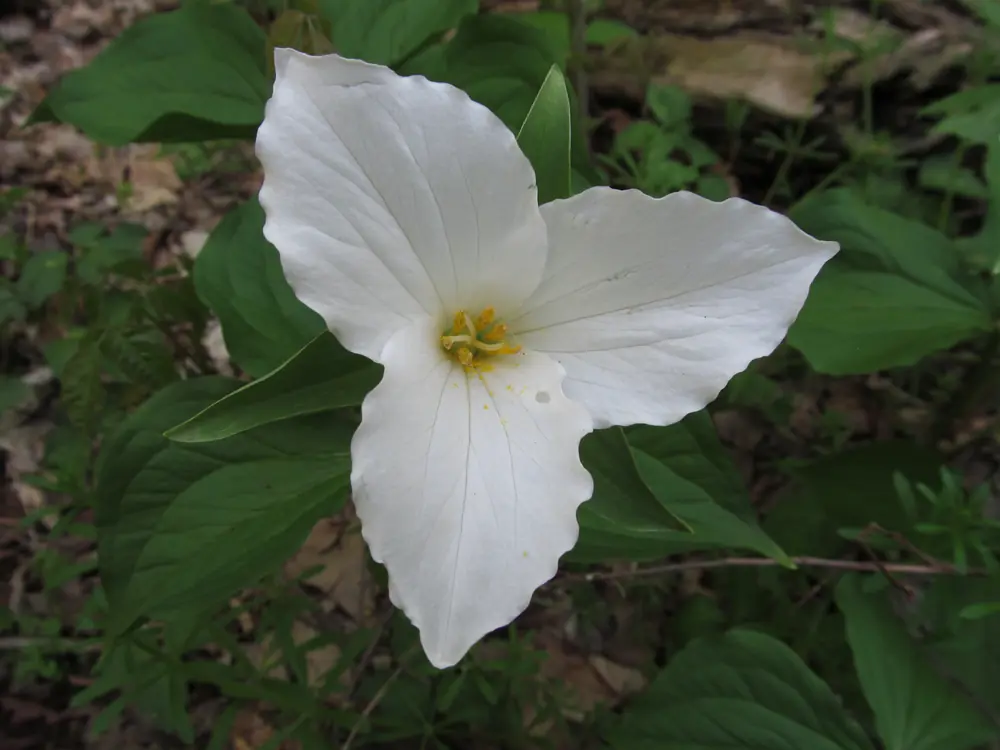
Trillium and the spring ephemerals
Typically late April to mid-May in the south; later in the north · Hardwood forest, especially in Southwest Michigan; Michigan Nature Association preserves such as Dowagiac Woods and Trillium Ravine
A Michigan radio station's guide says trillium carpets normally begin in late April and run through mid-May, and the Michigan Botanical Society has led late-April field trips to the Michigan Nature Association's Dowagiac Woods and Trillium Ravine preserves. Two trilliums at Trillium Ravine are state-listed as threatened. Michigan BLUE magazine says the tiny blue-eyed Mary blooms for about six weeks beginning in April at Loda Lake Wildflower Sanctuary, a national forest preserve north of White Cloud. Never pick trillium, which can take years to bloom again, and stay on the trail.
-
Morels follow the trees
Late April to May; no agency posts a date · Beech-maple and oak woods, old orchards, and ground near dying elms
MSU Extension's morel bulletin says rainfall is probably the most important factor, then temperature, and that veteran hunters watch for cues: oak leaves the size of a squirrel's ear, maple leaves the size of a mouse's ear, blooming serviceberry or wild plum, asparagus pushing up, or hepatica and white violets in flower. Black morels usually appear first. Be sure of a mushroom's identity before you eat it, and check landowner and public-land rules before you collect.
-
Arbor Day
Last Friday in April: April 30, 2027 · Everywhere; community and state park programs
Michigan's Arbor Day falls on the last Friday of April, the DNR explains, and in 2026 the governor proclaimed April 24 as Arbor Day and April 19 to 25 as Arbor Week. That makes Friday, April 30 the date in 2027; check with local parks and your city for tree-planting events.
Note one maple or serviceberry near home and log the day its leaves reach the size of a mouse's ear on the same place twice page.
How warm, wet and stormy is April in Michigan?
Mild in the south, still wintry in the north, and wet nearly everywhere. The table gives NOAA's 1991 to 2020 averages: highs reach the upper 50s in the southern Lower Peninsula but stay in the 40s at Marquette, which still averages 17.6 inches of snow in April. Any single April can be far from average.
| Station | Average high | Average low | Precipitation | Snowfall |
|---|---|---|---|---|
| Marquette (NWS office, Negaunee Township) | 46.5 °F | 27.1 °F | 3.35 in | 17.6 in |
| Sault Ste. Marie | 48.5 °F | 30.2 °F | 2.63 in | 7.6 in |
| Alpena | 52.2 °F | 30.2 °F | 2.93 in | 6.6 in |
| Traverse City | 53.9 °F | 32.8 °F | 2.79 in | not published |
| Grand Rapids | 57.8 °F | 37.3 °F | 3.99 in | 2.0 in |
| Saginaw (MBS Airport) | 55.8 °F | 36.1 °F | 3.19 in | 2.4 in |
| Flint | 56.7 °F | 35.3 °F | 3.13 in | 2.4 in |
| Lansing | 57.6 °F | 36.4 °F | 3.26 in | 1.7 in |
| Detroit (Metro Airport) | 58.7 °F | 39.1 °F | 3.26 in | 1.5 in |
Flooding and storms. On April 4, 2026, the National Weather Service in Detroit confirmed an EF-1 tornado in Van Buren Township, Wayne County, after widespread 5-day rainfall totals of 3 to 5 inches across much of the Lower Peninsula. The governor's April 17 emergency order described prolonged rainfall, rapid snowmelt, straight-line winds and tornadoes beginning April 12, with flooding, high rivers and damaged roads; an April 10 order had covered the threat of overtopping at the Cheboygan Lock and Dam. These are examples of what a wet April can do, not a forecast.
Late snow in the north. The National Weather Service office at Marquette summarized April 2014 as a month with 35.8 inches of snow, 21.3 inches above normal and fourth highest on its record. Keep the shovel handy in the Upper Peninsula until May.
Wildfire season. The DNR says most Michigan wildfires occur in April, May and June, and that April is when they start becoming a problem. One in three starts from burning yard debris. A burn permit is required when the ground is not snow-covered; northern Michigan residents can get a free one at Michigan.gov/burnpermit, and southern residents should ask the local fire department.
NOAA's latest 90-day outlook is posted by the Climate Prediction Center; we leave its contents to NOAA. Our weather pages and cloud guide help with reading the sky on the day.
How much daylight does Michigan gain in April?
About 80 to 90 minutes. From April 1 to April 30 the days lengthen by 79 minutes at Detroit and 92 at Marquette, a little over 3 minutes a day in the north, and every city on the list passes 14 hours of daylight before the month ends. The clocks have already changed, so the gain shows up mostly as later sunsets by the clock.
| City | Apr 1 | Apr 30 | Gained | Per day |
|---|---|---|---|---|
| Ironwood | 12 h 49 m | 14 h 20 m | 91 min | 3.1 min |
| Marquette | 12 h 49 m | 14 h 21 m | 92 min | 3.2 min |
| Sault Ste. Marie | 12 h 49 m | 14 h 20 m | 91 min | 3.1 min |
| Traverse City | 12 h 46 m | 14 h 12 m | 86 min | 3.0 min |
| Alpena | 12 h 46 m | 14 h 13 m | 87 min | 3.0 min |
| Grand Rapids | 12 h 44 m | 14 h 04 m | 80 min | 2.8 min |
| Lansing | 12 h 43 m | 14 h 03 m | 80 min | 2.8 min |
| Detroit | 12 h 43 m | 14 h 02 m | 79 min | 2.7 min |
That is why dusk choruses and the woodcock hour start later each week. The gain runs a little faster in the north. For sunrise and sunset times at your own address, use the daylight calendar; the March page covers the equinox and the clock change.
What can you see in Michigan's night sky in April 2027?
Times are Eastern daylight time. Menominee, Dickinson, Iron and Gogebic counties are on Central time, so take an hour off there. The headline is the full Pink Moon on April 20, then a meteor shower that moonlight mostly washes out.
-
The Pink Moon
Full at 6:27 p.m. EDT on Tuesday, April 20 · Rising in the east around dusk
Sea and Sky says early Native American tribes named this full moon for the moss pink, a wild phlox among spring's earliest flowers, and that coastal tribes also called it the Fish Moon because shad swam upstream. The Moon is full at 6:27 p.m., before it rises, so a full-looking Moon climbs the eastern sky at dusk on both the 20th and the 21st.
-
A poor year for the Lyrids
Active about April 14 to 30; the peak is the evening of Thursday, April 22 (about 9:41 p.m. EDT) · Look to the northeast and east in the early evening, before the Moon rises
Sea and Sky puts the Lyrids at about 20 meteors an hour at best, and the American Meteor Society gives a similar figure. This year the Moon, about 95 percent bright and just past full, rises near 10 p.m. in most of the country, a little later in the north. Just the early evening is dark, and the shower's source point, in the constellation Lyra, sits low toward the northeast then. Expect a few meteors an hour; bright ones can still cut through moonlight. The Eta Aquariids become active April 19 and peak in early May under a dark Moon.
-
Venus before dawn, Jupiter and Mars after dark
All month · Venus low in the east before sunrise; Jupiter and Mars in the evening sky
Our own sky calculations put very bright Venus rising roughly an hour to an hour and a quarter before sunrise in April, for a viewer in the central United States; times shift by up to half an hour from place to place. By the same calculations, Jupiter and Mars stay in the evening sky in and near Leo, with Jupiter up for most of the night.
| Phase | Date | Time |
|---|---|---|
| New moon | Tuesday, Apr 6 | 7:51 p.m. EDT |
| First quarter | Tuesday, Apr 13 | 6:56 p.m. EDT |
| Full moon, the Pink Moon | Tuesday, Apr 20 | 6:27 p.m. EDT |
| Last quarter | Wednesday, Apr 28 | 4:18 p.m. EDT |
| New moon | Thursday, May 6 | 6:58 a.m. EDT |
The moon calendar shows the phase on any date, and the March page has the Worm Moon and the equinox.
When is the last spring freeze in Michigan?
Not until May in most of the north, and sometimes not until the end of the month. Each row below is NOAA's normal for a main station; a warm April spell can start growth that a late freeze then burns.
| Station | One year in ten | Median | Nine years in ten |
|---|---|---|---|
| Marquette | Apr 26 | May 8 | May 23 |
| Sault Ste Marie | May 5 | May 22 | Jun 4 |
| Alpena Co Rgnl Ap | May 1 | May 17 | May 31 |
| Traverse City Cherry Cptl Ap | Apr 26 | May 12 | May 27 |
| Grand Rapids | Apr 14 | Apr 29 | May 15 |
| Lansing Capital City Ap | Apr 18 | May 1 | May 18 |
| Flint Bishop Intl Ap | Apr 21 | May 6 | May 23 |
| Detroit City Ap | Apr 7 | Apr 21 | May 6 |
Each row is one NOAA station, and a low frost pocket or a spot inland from the lakes can run several degrees colder. Check the Michigan frost dates page for your own town, and hold tender plants until the nine-in-ten date has passed.
What can Michigan families do outdoors in April?
Rain boots, a flashlight and a notebook cover most of April's best nature. No 2027 programs are posted yet, so use the typical timing and check with each organizer.
-
Join the Frog and Toad Survey
The survey has launched around the end of March or early April; 2027 start dates not yet posted · A route of ten wetland stops near you
The DNR's Frog and Toad Survey is run by volunteers who drive an established route of ten stops, half a mile apart, pause five minutes per stop, and rate each species on a 0 to 3 scale, where 3 means too noisy to count calls. The DNR said it covers an average of 200 routes a year, though not every route is covered every year. Look on the DNR's wildlife pages for how to sign up and learn the calls.
-
Visit Isle Royale as the park opens
The National Park Service says the park is open each year April 16 through October 31 · Isle Royale National Park, Lake Superior
The park service says spring visitors should expect to be completely self-sufficient, with services and emergency response limited to non-existent, visitor centers closed in April and no potable water on the island. Ferries typically run from mid-May, so April trips mostly mean a seaplane or private boat. Read the park's spring page before planning.
-
Earth Day
Thursday, April 22 · Local parks and nature centers
Earth Day's organizers have named Food for Our Planet the theme for 2027. The Gillette Visitor Center at P.J. Hoffmaster State Park lists an Earth Day Hike among its regular programs, and nature centers often plan something near the date; check their 2027 calendars.
-
Report what you see to Journey North
Whenever you see a first · Your yard or a local park
Journey North takes public reports of hummingbirds, loons and other first sightings, and its maps show spring advancing north week by week. Write down the date and place in a notebook as well.
Write your sightings in the field journal, and compare notes with other states in the nature index.
Safety notes for April in Michigan
- Spring turkey hunting. The 2026 season began April 18 in all units. The DNR's formula puts the 2027 start on the second-to-last Saturday in April, April 17, but 2027 end dates and quotas are not posted. Spring turkey hunters are exempt from the hunter orange rule, so if you walk in woodlots or on public land during the season, consider a bright hat or jacket.
- Fishing openers. Many Lower Peninsula inland waters open to walleye, northern pike and some trout on the last Saturday in April; Upper Peninsula walleye and pike open May 15. Read the current guide and map for your stream.
- Swift, cold water. After a wet spring, the DNR warned anglers in April 2026 to take care navigating, wading or walking beside swollen streams and to avoid fishing in floodwaters, which can hide new hazards. Never drive through water over a road.
- Wildfire. Get a burn permit if the ground is not snow-covered, and do not burn debris when conditions are dry or windy.
- Ticks. The state health department says blacklegged ticks are active from March to November, with adults active in spring and fall, and that adult American dog ticks, active April through July, are the ones that mainly bite people and pets. Wear light-colored clothing, check yourself after walking through brush, and remove ticks promptly.
- Snakes and nesting birds. Watch your step in wet meadows, and leave any snake alone. Stay out of roped plover areas, keep dogs leashed, and give a loon a wide berth.
- Storms. A tornado watch means conditions could produce one; a warning means one is happening or shown on radar, so go to shelter at once.
Sources (48)
- Whitefish Point Bird Observatory (Michigan Audubon): plan your visit and what to see season by season
- Michigan EGLE: going the distance for piping plovers (National Park Service article, April 8, 2026)
- Leelanau Ticker: first piping plover returns to Sleeping Bear Dunes (April 16, 2020)
- WNMU-FM (Associated Press): piping plover return anticipated (2015)
- WCMU Public Media: loons are returning to northern Michigan (April 5, 2023)
- 9and10 News: Mackinac Straits Raptor Watch begins 2026 spring hawk count
- Journey North: a look back at the 2025 spring hummingbird migration
- ClickOnDetroit: hummingbirds spotted in Michigan for the first time in 2023
- MSU Extension: ringing in spring with a peep, the spring peeper (April 23, 2025)
- MSU Extension: frogs and toads' songs of spring (Bill Cook, 2018)
- Newberry News: the frogs in the forest (Bill Cook, retired MSU Extension, 2022)
- Friends of the Rouge: frog and toad species descriptions and calls
- Michigan DNR: volunteers set to begin annual Frog and Toad Survey
- Michigan DNR: spring turkey regulations summary (2026)
- Michigan DNR: spring turkey season starts soon, harvest reporting now mandatory (April 9, 2026)
- Michigan DNR: turkey hunting overview page
- Michigan DNR: woodcock walk in Gladwin County, with the Ruffed Grouse Society (2023 bulletin)
- OutdoorHub (Michigan DNR release): spring roadside surveys to monitor wildlife, ruffed grouse and woodcock
- Mackinac Straits Raptor Watch: home page
- Michigan Natural Features Inventory: eastern massasauga rattlesnake
- Michigan DNR: volunteers needed to protect spawning sturgeon along Black River (April 7, 2025)
- Michigan DNR: smelt species page
- Michigan DNR: 2026 Michigan Fishing Regulations, in force April 1, 2026 to March 31, 2027 (PDF)
- Michigan DNR: trout, Lower Peninsula walleye and pike seasons open Saturday (April 23, 2026)
- Michigan DNR: steelhead species page
- MSU Extension: May is morel month in Michigan (bulletin E2755)
- 99.7 WFMK: trillium season marks the beginning of spring for Michigan (April 22, 2023)
- Michigan Botanical Society: field trip to Dowagiac Woods and Trillium Ravine (April 30, 2022)
- Chikaming Open Lands: Trillium Woodlands Preserve
- Michigan BLUE: wildflower rituals, watch spring unfold
- MSU Extension: tree, turf and ornamental plant update (April 19, 2019)
- Michigan DNR: on Arbor Day, may the forest be with you (2021)
- Governor of Michigan: April 24, 2026, Arbor Day proclamation
- Earth Day Network (EARTHDAY.ORG): official site, Earth Day 2027 theme
- NOAA NCEI: U.S. climate normals 1991-2020, monthly (data service, ten Michigan stations)
- National Weather Service Detroit: April 4, 2026 severe weather and Van Buren Township tornado
- Governor of Michigan: Executive Order 2026-8, declaration of state of emergency (April 17, 2026)
- National Weather Service Marquette: April 2014 climate summary (PDF)
- Michigan DNR: fire season builds during Wildfire Prevention Week (2015)
- NOAA Climate Prediction Center: 90-day seasonal outlook
- U.S. Naval Observatory: moon phases, 2027 (data API)
- Sea and Sky: astronomy calendar of celestial events, 2027
- American Meteor Society: meteor shower calendar
- National Park Service: visiting Isle Royale in spring
- Michigan Public: Michigan's national park set to reopen after winter season (2026)
- Michigan Department of Health and Human Services: ticks and your health (PDF)
- Gillette Nature Association: weekly programs at P.J. Hoffmaster State Park
- Photos via Wikimedia Commons; licenses and photographers are credited under each picture
