What to look for in nature in Michigan this December
Winter starts on December 1 by the meteorologists’ calendar, and in Michigan the month usually earns the name. Lake-effect snow buries the hills behind Lake Superior, the first skins of ice spread across the sheltered bays, and deer in the north walk to the same cedar swamps their mothers showed them. Volunteers head out for the Christmas Bird Count, snowy owls settle onto the hayfields south of Sault Ste. Marie, and bald eagles gather wherever the water stays open. The sun sets at its earliest around December 10, the Geminids arrive on a dark night, and the Cold Moon of December 23 is the year’s closest full moon.
Other months in Michigan: October, November.
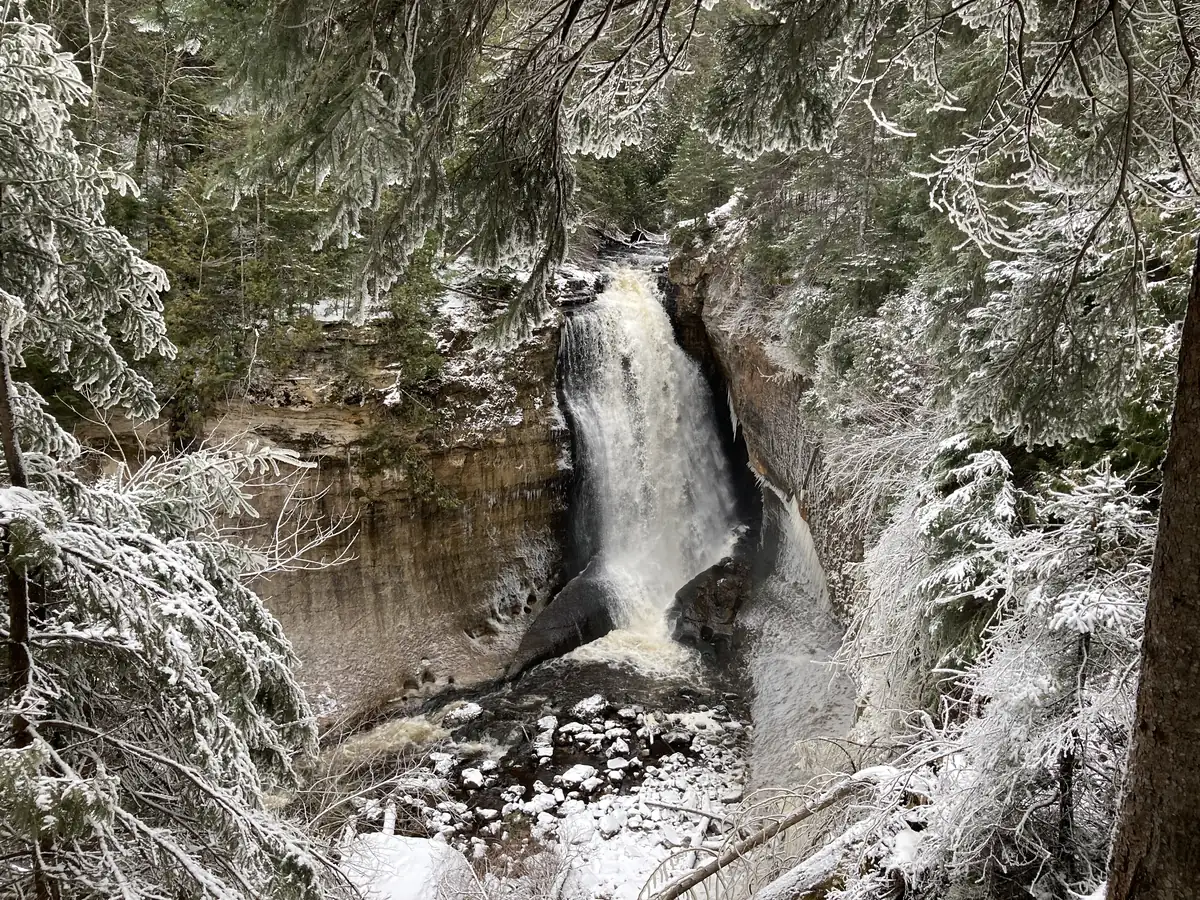
Start here
- Join a Christmas Bird Count. Michigan fields about 75 count circles, from the Keweenaw to Monroe and Berrien counties, and each picks one day from December 14 to January 5. No experience is needed: find the nearest circle on Audubon’s map and email its compiler a week or two ahead.
- Snowy owls on the Rudyard Loop. The farm country south of Sault Ste. Marie is where Michigan’s snowy owls are most dependable, and Rudyard Township calls itself the state’s Snowy Owl Capital. Drive slowly, scan fence posts and barn roofs, and stay in the car.
- The Geminids, then the Cold Moon. On the night of Sunday, December 13, the thin Moon sets in mid-evening and the Geminids can put on the best meteor show of the year until dawn. Ten nights later, on December 23, the full Cold Moon rises as the closest full moon of 2026.
Keep a record: give the count-day tally its own page under birds I have seen, press a twig of cedar or hemlock beside the seeds, pods and cones plate, and sketch the first clean set of prints in new snow on tracks to know. On the solstice, stand at the same window at sunset for the dusk and dawn watch, and mark on the daily field log the date your nearest pond first holds a lid of ice.
Regions used below: Western Upper Peninsula; Eastern Upper Peninsula; Northern Lower Peninsula; West Michigan and the Lake Michigan shore; The Thumb and Saginaw Bay; Southeast Michigan and Metro Detroit; Southwest Michigan.
When is the Christmas Bird Count in Michigan in 2026?
The 127th Christmas Bird Count, Audubon’s winter census, starts December 14, 2026, and ends January 5, 2027. Every circle measures 15 miles in diameter, and its volunteers choose one calendar day in that window to tally every bird seen or heard, species and numbers both. In the most recent Michigan summary Audubon has posted, for the 124th count, 75 circles were covered (14 in the Upper Peninsula, 25 in the northern Lower Peninsula and 36 in the southern Lower Peninsula) by more than 1,200 people. That mild season set a state record of 161 species, against a ten-year average of 150.
-
How to join
Sign up from late November; count days fall between December 14 and January 5 · Any of Michigan’s roughly 75 circles
There is no fee. Open Audubon’s circle map, click the nearest circle and write to the compiler named there; you will be paired with an experienced leader, so a beginner with binoculars and warm boots is useful from the first hour. If you live inside a circle you can count the birds at your feeder on the day instead. Each compiler sets the date, and many choose a weekend.
-
The richest circles are in the southeast
Count days in late December · Monroe, Rockwood, Ann Arbor, Anchor Bay, Battle Creek
Open water and varied habitat make the circles along western Lake Erie and the Detroit River the state’s species leaders. In the 124th count Monroe found 87 species, Rockwood 86, Ann Arbor 83, and Anchor Bay and Battle Creek 82 each; Monroe’s tally included 332 American white pelicans, a striking winter rarity.
Count day is the easiest way to learn the winter regulars, from tree sparrows and juncos at the feeder to the ducks and gulls on open water. The Jackson Audubon Society, for one, runs its count around Waterloo State Recreation Area (December 19 in 2025; the 2026 date is not yet posted). Your tally joins a record kept since 1900.
Where can you see snowy owls and other winter owls in Michigan?
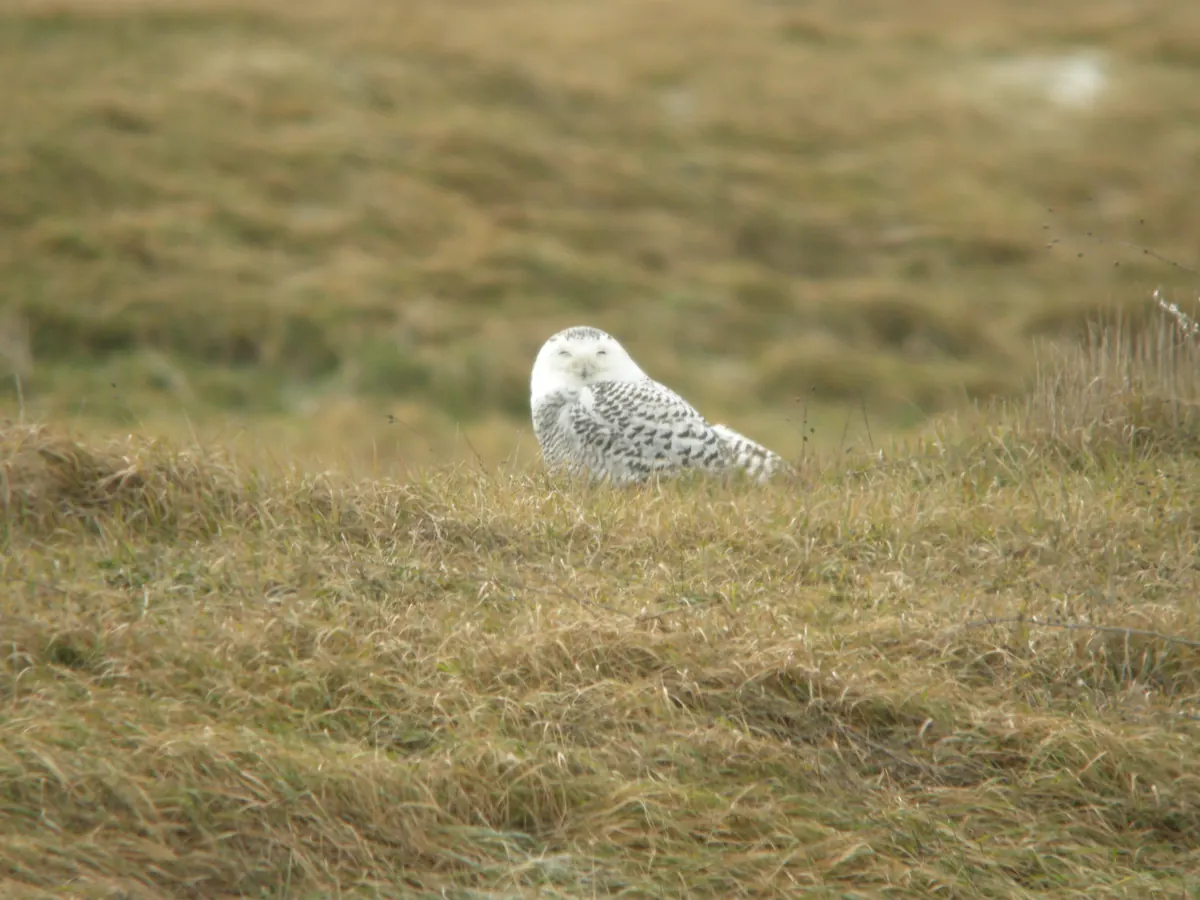
By December the snowy owls that came south this year have mostly picked their winter hunting grounds, and they tend to stay put, which makes them easier to find than in November. The Michigan DNR notes that they favor places that look like tundra: Great Lakes beaches, big meadows and farm fields, sports fields, even parking lots and airports. Their numbers swing widely from winter to winter with lemming crops in the Arctic, so treat every one as a gift.
-
Rudyard, the Snowy Owl Capital
December through March · Farm roads around Rudyard, Pickford and Sault Township, Chippewa County
Rudyard Township passed a resolution in 2023 naming itself the Snowy Owl Capital of Michigan, after years of reliable sightings in the open hayfields south of Sault Ste. Marie. A Michigan Sea Grant educator told reporters that the owls there are about as consistent as anywhere in the lower 48 states, and a local TV station reported that the Rudyard circle once tallied 23 on a single Christmas Bird Count, tied for the top count anywhere. Local birders work a loop on M-48, Hantz Road and Centerline Road, where a few owls are usually found even in lean years. Scan the same fields for snow buntings, which the DNR says flock along the edges of harvested fields and vanish against the snow until they move. In some winters a great gray owl or northern hawk owl drifts into the same corner of the U.P. from Canada, though never on schedule.
-
Great horned owls start courting
Hooting builds through December; nesting begins in January and February · Woodlots, river bottoms and big suburban trees statewide
The deep, stuttering hoot on a still December night is a great horned owl, and the pairs answer each other more and more as the month goes on. Naturalists in Oakland Township put their mating and nesting in January and February, earlier than any other Michigan bird, usually in an old hawk, crow, eagle or heron nest or a broken-off trunk. Listen at dusk near a woodlot for two birds trading calls.
Many snowy owls that reach Michigan are young and underweight. If an owl turns to stare at you or shifts its feet, back off; watch from the car.
Where do bald eagles spend the winter in Michigan?
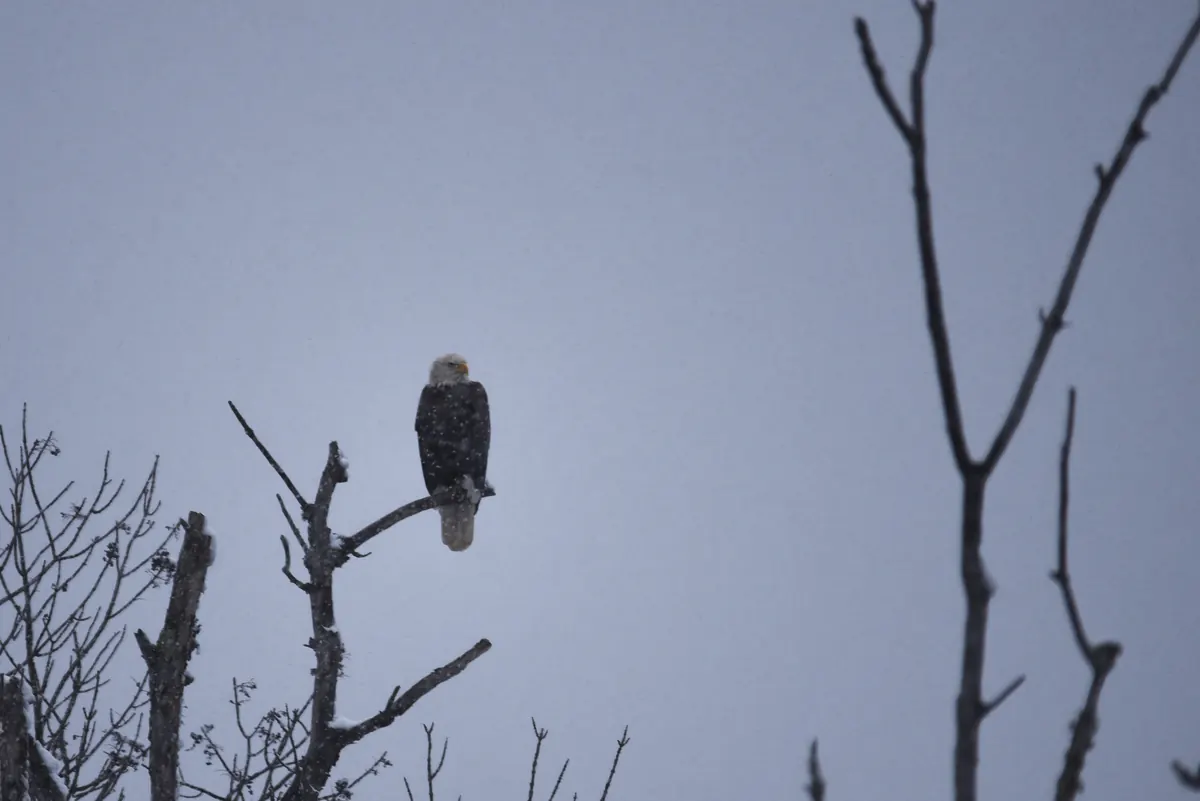
Wherever there is food, and in December that mostly means open water. As inland lakes freeze, eagles crowd onto whatever stays open: dam tailwaters, fast rivers and river mouths on the Great Lakes. The DNR adds that a deer carcass draws them just as surely, and that in winter eagles drop their territorial habits, so two, three or more may work the same stretch of river or the same carcass.
-
Dam tailwaters
Best after the lakes freeze, through February · Below Tippy Dam on the Manistee River, Mio Dam on the AuSable, and other river dams
Birders regularly report wintering eagles at these tailwaters. Water churning out below a dam rarely freezes, and fish that come through it stunned are easy pickings. Look for eagles perched in tall trees along the bank in the first hours after sunrise, when they hunt most. Tippy Dam State Recreation Area keeps a rustic campground open all year.
-
The Detroit River
All winter · Detroit River International Wildlife Refuge; Belle Isle; Lake Erie Metropark
The refuge points visitors to the bald eagles that nest on islands in the river, and to the canvasbacks that rest and feed on its beds of wild celery. In winter the diving ducks ride whatever current stays open, and the DNR’s Belle Isle bird walks go looking for waterbirds on the river. Humbug Marsh and the Refuge Gateway are open year-round during daylight hours, free of charge; dress for the wind off the water.
The comeback is real but not finished. DNR aerial surveys counted about 52 nesting pairs in 1961 and roughly 835 by 2017, before bird flu hit eagles hard from 2022. The state wildlife pathologist reports that nearly 13 percent of eagles examined since 1987 died of lead poisoning and about a third were hit by vehicles, and winter scavenging on roadkill and gut piles raises both risks. Lead-free ammunition and a slower drive past a feeding eagle both help.
Where do Michigan’s deer go in winter?
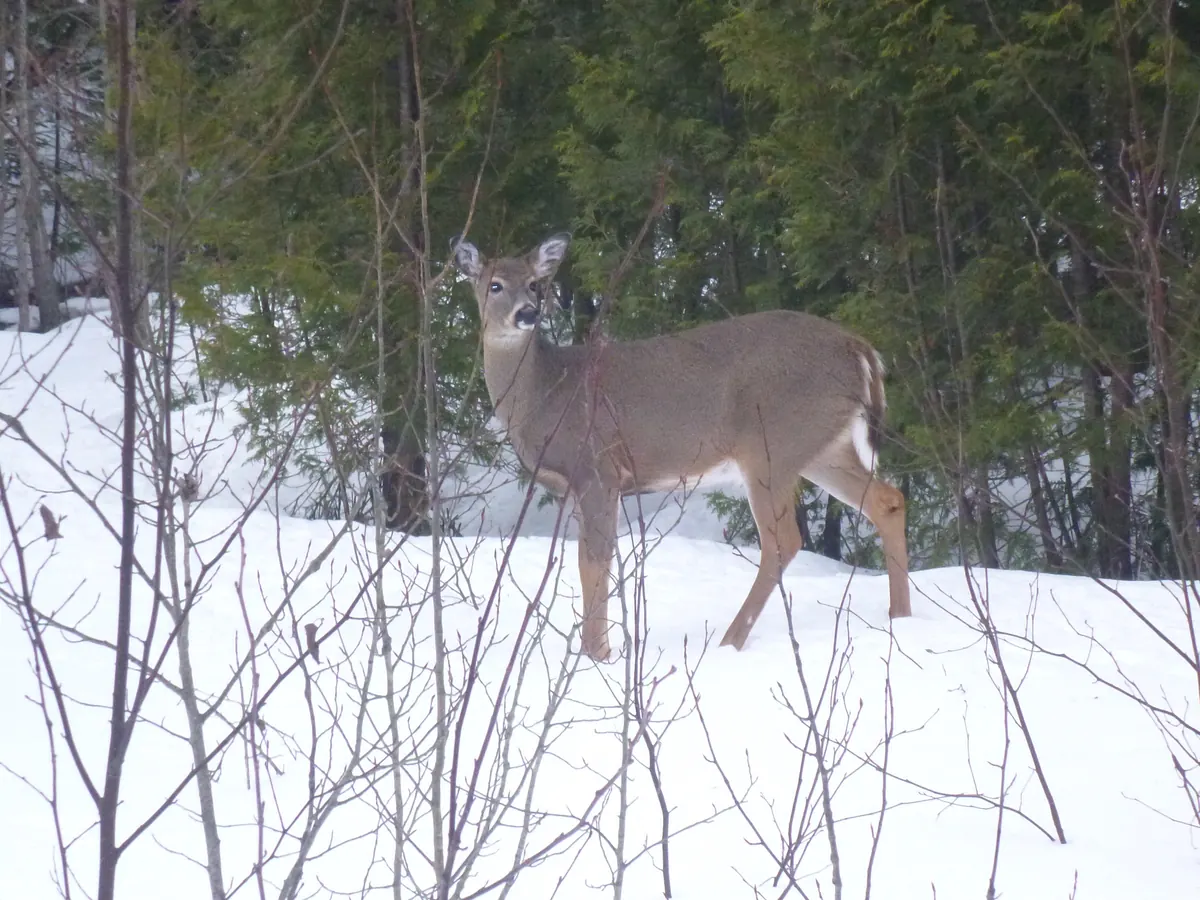
In most of the Upper Peninsula, deer do not spend the winter where they spend the summer. Once snow on the ground reaches about 12 to 18 inches, they start walking to traditional wintering areas, sometimes as far as 50 miles, and may stay more than 100 days. The DNR calls these places deer wintering complexes, older hunters call them deer yards, and the routes are learned: fawns follow their mothers and come back to the same swamp for life.
-
Cedar swamps and hemlock stands
From the first deep snow, often in December in the snowbelts · Northern white cedar swamps and hemlock-pine uplands across the U.P.
Dense conifers catch falling snow in their crowns, so the ground beneath them stays shallower, and they break the wind. A DNR habitat manager describes good wintering cover as conifers more than 30 feet tall with about 70 percent of the sky closed overhead; near Lake Superior that often means hemlock with white pine, and farther south mostly cedar. Northern white cedar is both roof and food, and the DNR says the best complexes are roughly half conifer cover and half hardwood browse.
-
Trails, browse lines and beds
December to March · The edges of conifer swamps
Look for packed trails linking cover to food, cedar trimmed bare as high as a deer can reach, and oval beds melted into the snow under low boughs.
Wintering deer live on their fat, so give them room, and leash the dog near cedar swamps. The DNR monitors 46 of these complexes in the U.P.; some of the cedar stands took 300 to 400 years to grow.
How do Michigan’s animals get through the winter?
Three ways: sleep through it, toughen up, or move out. The Michigan Wildlife Council counts only a handful of true hibernators in the state (woodchucks, striped skunks, chipmunks, thirteen-lined ground squirrels and some bats), whose heart rate, breathing and digestion fall almost to nothing. Black bears are dormant rather than truly hibernating and can wake if disturbed. Wood frogs freeze partly solid under the leaves, protected by a natural antifreeze. Everything else stays up and copes.
-
Twenty thousand bats inside Tippy Dam
Hibernating now, until spring · Inside the hollow spillway of Tippy Dam, Manistee County (not open to visitors)
When Tippy Dam was finished in 1918, its spillway was built hollow, and the chambers inside stay a few degrees above freezing all winter, held there by the river behind them. About 20,000 little brown bats hibernate inside, now the largest known bat colony in Michigan. White-nose syndrome, a fungus that reached Michigan around 2014, killed about 90 percent of the bats hibernating in Upper Peninsula mines, yet the Tippy bats carry the fungus and survive. Researchers are still working out why, and Consumers Energy, which is selling the dam, has pledged that protection for the bats will continue.
-
Snowshoe hares and ermine turn white
Molting into white through late fall; fully white by midwinter · Conifer swamps and young aspen of the north
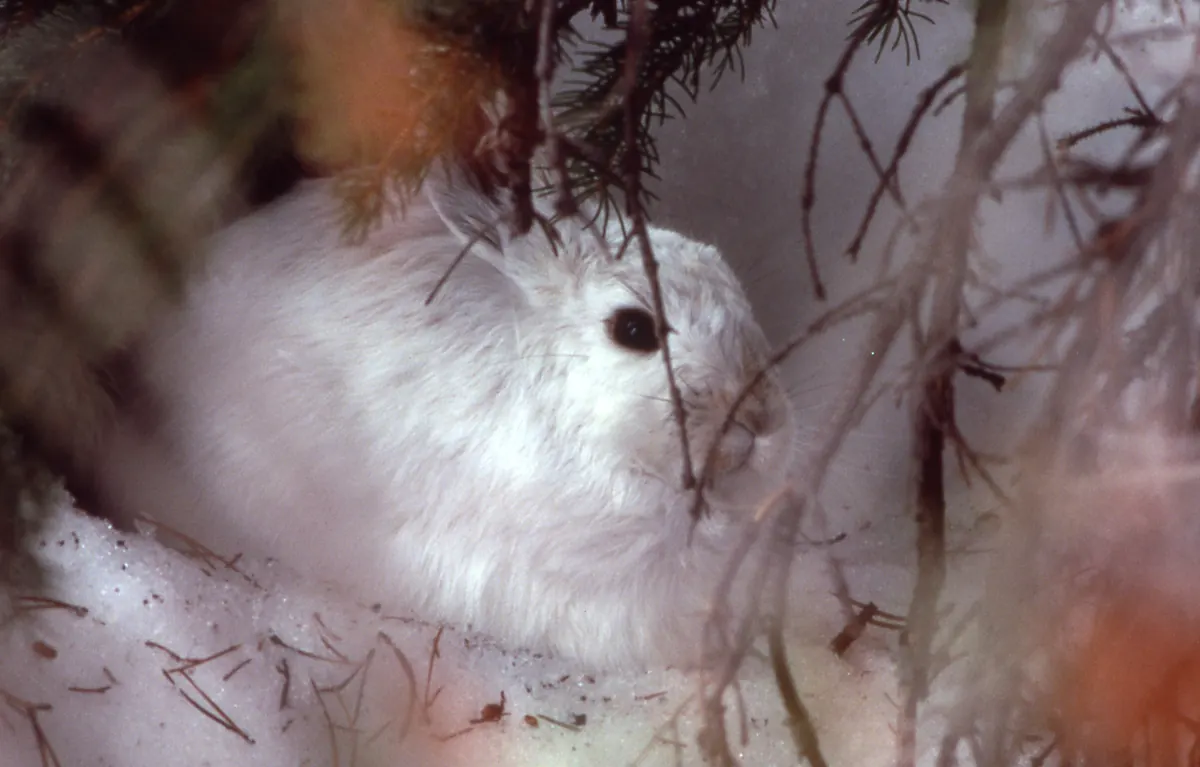
Snowshoe hares, ermine and ruffed grouse are what biologists call chionophiles, snow lovers. The hare grows broad, furred hind feet that work like snowshoes and a coat that matches the ground while grouse spend cold nights buried in powder. When snow comes late, a hare already gone white stands out against bare ground, and predators notice.
-
Life under the snow
Once snow is several inches deep · Fields, lawns and woods everywhere
Voles and shrews live all winter in the subnivean zone, a thin gap between the ground and the snowpack where the temperature stays near freezing however cold the air gets. Their tunnels show up at the melt as winding gray tracks across the grass. A red fox hunting a field will stop, cock its head to listen, then pounce headfirst into the snow; it buries spare kills in the snow to eat later.
Deer farther south change their menu rather than their address, turning to buds, twigs and bark. Every one of these lives leaves a sign in fresh snow; read them the morning after a snowfall, before the wind does.
Which evergreens can you identify in a Michigan winter?
In a leafless December woods the conifers jump out, and a few needles are all you need to name them. White pine carries soft needles in bundles of five (count the letters in white). Red pine has long, stiff needles in pairs. Eastern hemlock has short, flat needles with two white stripes underneath and tiny cones at the twig tips. Spruce needles are square and sharp, and roll between your fingers; balsam fir needles are flat and soft, and the bark has resin blisters that smell like Christmas when you press them. Northern white cedar has flat sprays of scaly leaves.
-
Hartwick Pines
Open all year · Hartwick Pines State Park, north of Grayling
A 49-acre stand of old-growth pine, one of the few upland forests in the northern Lower Peninsula that escaped the logging era, survives here. Karen Michelson Hartwick gave the land to the state in 1927, including 86 acres of forest that had never been cut; a fierce windstorm on November 11, 1940, knocked the closed-canopy grove down to about 49 acres. The accessible, paved Old Growth Forest Trail runs 1.25 miles through it; in December, with snow on the boughs, it is quiet enough to hear the wind in the tops.
-
Michigan Christmas trees
Farms open from late November; December is Michigan Christmas Tree Month · More than 500 farms statewide
Michigan ranks third in the nation for Christmas trees harvested, about two million a year from more than 500 farms on some 33,000 acres, and its growers sell more kinds than any other state. Fraser fir is the favorite; Scotch pine, Colorado blue spruce, Douglas fir, concolor and Canaan fir follow. A tree takes six to eight years to reach the size most families buy.
-
Cut your own in a national forest
Through December 24 in recent seasons · Huron-Manistee National Forests
In recent years the Huron-Manistee National Forests have sold permits for $5 a tree, up to five per household, online through Recreation.gov or at district offices. The rules have been to cut only conifers under 20 feet tall, leave cedar and hemlock alone (both are deer food and shelter), and keep the stump under six inches. Families with a fourth grader’s Every Kid Outdoors voucher have been able to claim theirs free. Check the forest’s 2026 announcement before you go.
Bring home one twig of each and compare.
When do Michigan’s lakes freeze, and when is the ice safe?
December is when the ice season begins. NOAA’s Great Lakes Environmental Research Laboratory says the northern lakes can show their first ice in late November or early December, starting in enclosed bays and along the shoreline, yet across all five lakes ice usually covers only 1 to 2 percent of the water in mid-December. Most of the growth comes in January and February, and the maximum normally arrives between late February and early March. NOAA’s scientists call December the priming month: a cold one sets up a big ice year, while a warm one can leave the lakes nearly open, as in 2024, when the maximum reached only about 16 percent.
-
Pancake ice and slush
First cold snaps of December · Lake Superior and Lake Michigan shores, harbors, bays
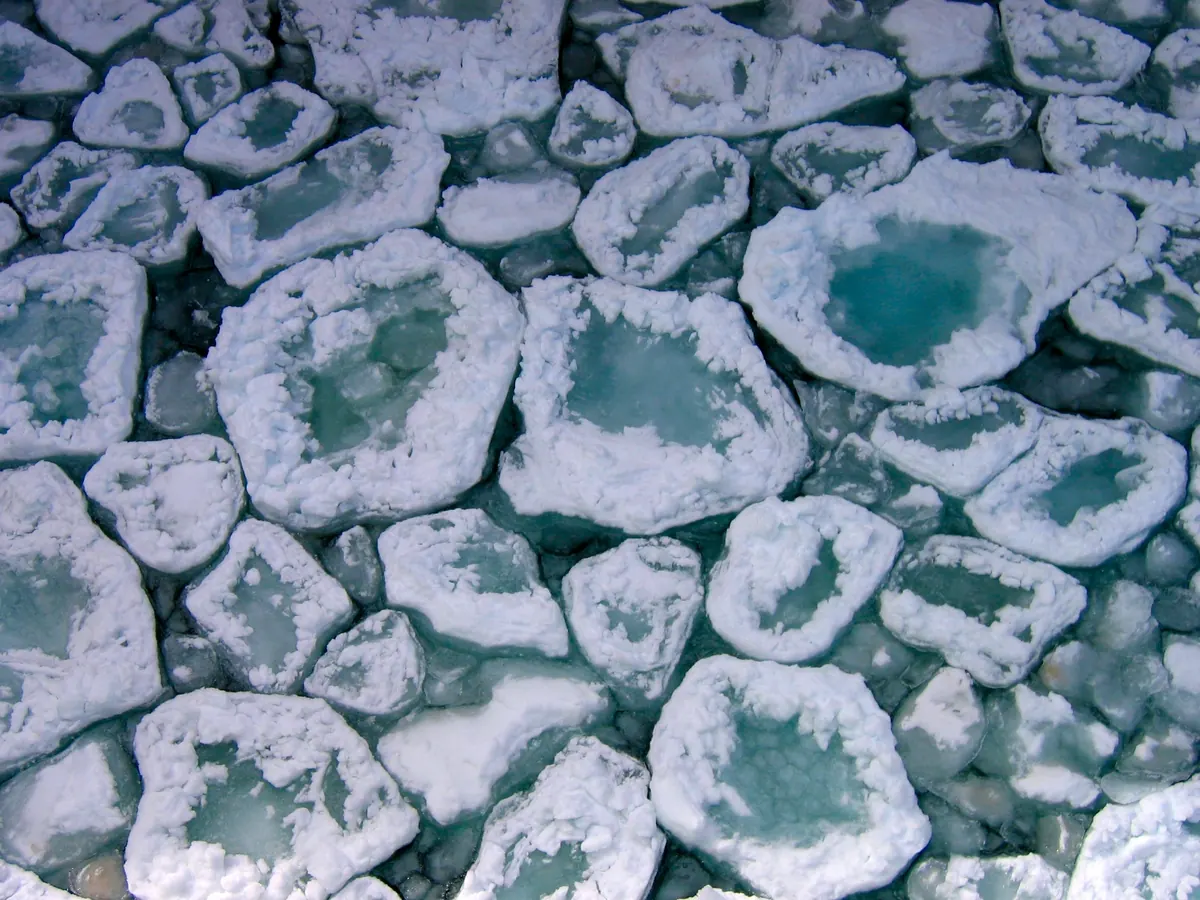
Before the bays lock up, waves churn slush into round plates with raised rims, called pancake ice, and push it into ridges along the beach. Small, shallow ponds and lakes lock up well before big, deep ones, and anything with current lags behind.
Do not trust first ice. The DNR says plainly that no thickness can be relied on. Clear ice with a blue tint is strongest; milky ice from refrozen snow is weak, and ice with slush on top is only about half as strong as clear ice. Treat snow-covered ice as unsafe, since snow insulates it and slows freezing. Keep away from inlets, outlets, dock bubblers and any shore with open water, test with a spud as you go, carry ice picks, and never go out alone. NOAA’s GLERL ice cover page tracks the Great Lakes ice day by day.
How snowy is December in Michigan, and what could a very strong El Niño bring?
Now the Upper Peninsula snowbelts really load up. Lake Superior and Lake Michigan are still mostly open and relatively warm, so each blast of arctic air crossing them turns into lake-effect snow on the downwind shores and hills. NOAA’s 1991–2020 normals put the National Weather Service office near Marquette at nearly 40 inches of December snow, more than four times Detroit’s total. Afternoon highs average in the mid-30s across the southern Lower Peninsula and only about 27 °F on the Marquette hills.
| Station | Average high | Average low | Precipitation | Snowfall |
|---|---|---|---|---|
| Marquette (NWS office, Negaunee Township) | 26.6 °F | 13.9 °F | 2.60 in | 39.9 in |
| Sault Ste. Marie | 30.5 °F | 17.1 °F | 2.80 in | 30.4 in |
| Alpena | 33.6 °F | 19.6 °F | 1.87 in | 16.9 in |
| Traverse City | 34.6 °F | 23.5 °F | 1.79 in | not published |
| Grand Rapids | 36.1 °F | 24.7 °F | 2.48 in | 20.8 in |
| Saginaw (MBS Airport) | 34.7 °F | 23.1 °F | 1.85 in | 11.8 in |
| Flint | 34.9 °F | 22.5 °F | 1.89 in | 11.4 in |
| Lansing | 35.7 °F | 23.3 °F | 1.90 in | 11.3 in |
| Detroit (Metro Airport) | 37.2 °F | 25.3 °F | 2.25 in | 8.9 in |
Grand Rapids, downwind of Lake Michigan, averages nearly twice the December snow of Lansing at the same latitude. This winter adds a wild card: the Climate Prediction Center’s September 10 ENSO discussion gives better than 90 percent odds that the El Niño now building in the Pacific will be very strong this fall and winter. The National Weather Service office in Gaylord has looked back: in all three very strong El Niño winters on record (1982–83, 1997–98 and 2015–16), Gaylord averaged more than 7 °F above its 1991–2020 normal for December through February, and across seven strong events its winter snowfall ran about 21 inches short. Warm Decembers line up closely with strong El Niños, the office found, while December precipitation shows little pattern, and about 30 percent of northern Michigan’s El Niño winters still brought above-normal snow. Sault Ste. Marie, ringed by cold water, has warmed far less in those winters. The state climatologist also leans toward a milder, less snowy season. NOAA’s own winter outlook, due out in mid-October, will be posted on the CPC seasonal outlook page. A mild winter can still deliver one sharp storm, so look at conditions for your town before a long drive north, and keep the Michigan frost dates handy for planning next spring’s garden.
When is the earliest sunset in Michigan?
In the second week of December, well before the solstice. Detroit’s sun sets at 5:00 p.m. every evening from December 2 through the 15th, so the 9th sits in the middle of that run; Sault Ste. Marie bottoms out at 4:50 p.m. around December 10, the earliest of the eight cities below, and Marquette at 5:02 p.m. around the 11th. Mornings keep getting darker for another month. By the solstice on the 21st, Detroit’s sunset has crept back to 5:03 p.m. while its sunrise has slid to 7:58 a.m., giving 9 hours 5 minutes of daylight; Marquette gets just 8 hours 34 minutes, with the sun up at 8:31. On New Year’s Eve Detroit’s sun rises at 8:01 a.m., still near its latest, and sets at 5:09. The mismatch comes from Earth’s tilt and its slightly oval orbit, which push solar noon later through December. Gogebic, Iron, Dickinson and Menominee counties run on Central time, so their sunsets read an hour earlier.
| City | Dec 1 | Dec 21 | Dec 31 | Earliest sunset |
|---|---|---|---|---|
| Marquette | 8 h 51 m | 8 h 34 m | 8 h 38 m | 5:02 p.m., Dec 11 |
| Sault Ste. Marie | 8 h 51 m | 8 h 35 m | 8 h 39 m | 4:50 p.m., Dec 10 |
| Traverse City | 9 h 03 m | 8 h 48 m | 8 h 51 m | 5:02 p.m., Dec 9 |
| Alpena | 9 h 01 m | 8 h 46 m | 8 h 50 m | 4:52 p.m., Dec 10 |
| Grand Rapids | 9 h 15 m | 9 h 00 m | 9 h 04 m | 5:08 p.m., Dec 9 |
| Lansing | 9 h 16 m | 9 h 02 m | 9 h 05 m | 5:04 p.m., Dec 9 |
| Flint | 9 h 15 m | 9 h 00 m | 9 h 04 m | 5:00 p.m., Dec 9 |
| Detroit | 9 h 19 m | 9 h 05 m | 9 h 08 m | 5:00 p.m., Dec 9 |
Our Field almanac gives the times for your own address, day by day, so a late-afternoon walk can end before dark.
What is in Michigan’s night sky in December 2026?
With close to fifteen hours of darkness, and more than that in the U.P., December nights give the sky its longest run of the year, whenever the lake-effect clouds part. Times below are Eastern Standard Time; the four western U.P. counties on Central time should subtract an hour.
-
The Geminids on a dark night
Night of Sunday, December 13, into Monday, December 14 · Anywhere dark; the radiant in Gemini is high after midnight
The Geminids are the strongest regular shower of the year, with a theoretical peak of around 150 meteors an hour for a perfect sky, though real skies show fewer. This year a thin waxing crescent drops below the horizon around 9 or 10 p.m., leaving the rest of the night dark, and rates are best around 2 a.m., when Gemini stands highest. Dress for a December night on your back: sleeping bag, hat, a thermos.
-
The solstice
Monday, December 21, 3:50 p.m. · Everywhere
At this moment the Sun reaches its farthest point south and winter begins by the astronomical calendar, three weeks after it began by the meteorological one. From here the days lengthen, slowly at first; the evenings have only just begun to brighten, by a minute or three since the earliest sunsets.
-
The Cold Moon, the biggest of the year
Wednesday, December 23 · Rising in the northeast at dusk
The Moon turns full at 8:28 that Wednesday evening, and perigee follows within about seven hours, so this is the nearest and biggest-looking full moon of 2026. Christmas Eve’s Moon is nearly as round. Two nights earlier, on the evening of the 21st, the gibbous Moon slides very close to the Pleiades, though its glare hides the fainter stars of the cluster.
-
Planets: Saturn at dusk, Venus at dawn
All month · Saturn in the south and southwest after dark; Venus in the southeast before sunrise
In the evening, Saturn shines alone among the bright planets and sets earlier each week. The morning belongs to Venus, dazzling low in the southeast, while Jupiter and reddish Mars ride higher in Leo; Jupiter clears the eastern horizon a little earlier each night. On December 4 and 5, look before sunrise for the thin crescent Moon beside Venus, with Spica close by.
-
Northern lights
Any clear night; darkest around the December 8 new moon · Lake Superior shoreline, the Keweenaw, the Headlands near Mackinaw City
The Sun is past the peak of its 11-year cycle but still active, so strong storms remain possible, and Michigan’s north shore is well placed for them. Look north over open water, away from town lights.
| Phase | Date | Time |
|---|---|---|
| Last quarter | Tuesday, Dec 1 | 1:08 a.m. |
| New moon | Tuesday, Dec 8 | 7:52 p.m. |
| First quarter | Thursday, Dec 17 | 12:42 a.m. (Wednesday, Dec 16, 11:42 p.m. Central) |
| Full moon, the Cold Moon | Wednesday, Dec 23 | 8:28 p.m. |
| Last quarter | Wednesday, Dec 30 | 1:59 p.m. |
| New moon | Thursday, Jan 7, 2027 | 3:24 p.m. |
Moonlight all but erases the Ursids, which crest on the 22nd. The Quadrantids, late on January 3, 2027, get a dark sky just before new moon. Check Today’s sky for clouds before a late night, and the moon page for moonrise in your town.
What can Michigan families do outdoors in December?
- Walk a lantern-lit trail, December 3 to 5, at Seven Lakes State Park in northern Oakland County. The Enchanted Borealis night hike leaves from the Dickinson Shelter in hourly time slots from 5:30 to 8:30 p.m., with warming fires along the way; reservations are required, and the route is hilly and uneven.
- Or try the Ionia version, December 10 to 12, at Ionia Recreation Area, 5:30 to 8:30 p.m.: a lantern-lit trail with holiday lights and a lakeside campfire afterward. Registration is required; private fire pits cost extra, and the event raises money for the park.
- Look for winter ducks on Belle Isle, Sunday, December 13, 9 to 11 a.m., with the DNR’s Outdoor Adventure Center. The free program caravans to spots on the island to see waterbirds on the Detroit River; preregister, borrow binoculars if you need them, and bring a Recreation Passport for the island.
- Stay up for the Geminids that same night, from about 10 p.m. on, and count how many you see in half an hour.
- Sign up for a bird count. Ask a Christmas Bird Count compiler whether your family can join a team; feeder watchers inside a circle can report from the kitchen window; Project FeederWatch continues through April.
- Cut your own tree in the Huron-Manistee National Forests with a permit, once the 2026 permits are announced.
- Plan a New Year’s Day walk. Michigan state parks have joined America’s State Parks’ New Year’s Day program in past years; the 2027 listings were not out in early October, so check in December.
Carry a headlamp on every December outing; the light goes fast after four.
Safety notes for December in Michigan
- Deer seasons are not over. Late archery runs December 1 to January 1 statewide. A December firearm season runs December 4 to 6 in the Lower Peninsula, and the muzzleloader season covers the same three days in the U.P. The late antlerless firearm season follows from December 7 to January 1 in Lower Peninsula deer management units except 145 and 245, on public and private land. Elk hunts run December 1 to 15 in the northeast Lower Peninsula elk range.
- Birds and small game. Duck season closes December 13 in the South Zone and reopens December 26 and 27; the Middle Zone adds December 12 and 13. Goose seasons run to December 16 in the North Zone and December 18 in the Middle Zone; in the South Zone they close December 13 and reopen December 26 to January 3. Late ruffed grouse and the December pheasant season run December 1 to January 1; rabbit, snowshoe hare and squirrel stay open to March 31.
- Hunter orange. Deer hunters using a firearm need an orange outer garment (a hat or cap, a vest or jacket, or rain gear) that can be seen from every side, and orange camouflage qualifies only when at least half of it is orange. A bowhunter out during any firearm deer season has to meet the same rule. Small-game hunters, crow hunters excepted, must wear orange until April 30. The DNR asks anyone outdoors near hunting areas to wear orange too, and an orange vest on the dog is a sensible extra.
- Ice. Keep children and dogs off December ice; first ice is the most dangerous of the year, and ice under snow is weaker than it looks.
- Lake-effect squalls and cold. A single band of lake-effect snow can drop visibility to nothing on one stretch of road while the next town sits in sunshine. Keep a shovel, blanket, boots and a charged phone in the car, and turn back early on short afternoons.
Sources
- National Audubon Society: Christmas Bird Count, find a circle and join
- National Audubon Society: join the 126th Christmas Bird Count (circle rules, no fee)
- National Audubon Society: the 124th Christmas Bird Count in Michigan (John L. Trapp)
- Michigan Audubon: the Christmas Bird Count, all are welcome
- Jackson Audubon Society: Christmas Bird Count (Waterloo)
- Michigan DNR: winter birding opportunities (snowy owls, bald eagles)
- UpNorthLive: Rudyard Township named the Snowy Owl Capital of Michigan
- Michigan Sea Grant: Eastern Upper Peninsula birding update, what to see and where
- Oakland Township Parks and Recreation: listen, owls are out courting
- U.S. Fish and Wildlife Service: Detroit River International Wildlife Refuge, visit us
- America’s State Parks: Tippy Dam State Recreation Area
- Great Lakes Now: Michigan’s bald eagle success story faces new threats (June 2026)
- Michigan DNR: deer wintering complexes
- From Common Ground: providing quality winter deer habitat in Michigan’s Upper Peninsula (DNR’s Bill Scullon)
- Michigan Wildlife Council: surviving in winter, how Michigan animals make it to spring
- Huron-Clinton Metroparks: prepping for winter, mammals
- Interlochen Public Radio: Tippy Dam is home to thousands of bats (December 2025)
- Kurta and others, PLOS ONE: survival of hibernating little brown bats unaffected by white-nose syndrome (Tippy Dam)
- Michigan DNR: Hartwick Pines State Park natural resource stewardship plan, November 2025 (PDF)
- Michigan DNR: Hartwick Pines State Park (Old Growth Forest Trail)
- Michigan Department of Agriculture and Rural Development: December marks Michigan Christmas Tree Month (2025)
- The Alpena News: Huron-Manistee National Forests Christmas tree permits
- Recreation.gov: Huron-Manistee National Forest Christmas tree permit
- NOAA GLERL: preparing for the ice season (typical December ice cover)
- NOAA GLERL: causes and impacts of 2024’s historically low Great Lakes ice cover
- NOAA GLERL: Great Lakes ice cover data
- Michigan DNR: ice safety
- NOAA NCEI: 1991–2020 monthly normals for ten Michigan stations (data API)
- NOAA NCEI: U.S. climate normals 1991–2020
- National Weather Service Gaylord: Northern Michigan winter 2023–2024 outlook (El Niño winter statistics) (PDF)
- Climate Prediction Center: ENSO diagnostic discussion, September 10, 2026
- Climate Prediction Center: seasonal outlooks (winter outlook issued October 15)
- WKAR: El Niño could bring a milder, less snowy winter to Michigan, state climatologist says
- U.S. Naval Observatory: moon phases from November 2026 (data API)
- U.S. Naval Observatory: dates of the seasons, 2026 (data API)
- International Meteor Organization: 2026 meteor shower calendar (PDF)
- EarthSky: what is a supermoon? (2026 full supermoons)
- EarthSky: everything you need to know about the Geminid meteor shower
- RASC Observer’s Handbook 2026: lunar occultations (the Pleiades, December 21) (PDF)
- BBC Sky at Night: supermoons of 2026 (the Cold Moon)
- NOAA Space Weather Prediction Center: solar cycle progression
- Michigan DNR calendar: Enchanted Borealis hike, Seven Lakes State Park, December 3–5, 2026
- Michigan DNR calendar: Enchanted Borealis, Ionia Recreation Area, December 10–12, 2026
- Michigan DNR Outdoor Adventure Center: birding Belle Isle Park, December 13, 2026
- America’s State Parks: First Day Hikes
- Project FeederWatch: how to participate
- Michigan DNR: 2026 hunting season calendar
- Michigan DNR: 2026 deer hunting regulations summary (December seasons, hunter orange)
- Michigan DNR: 2026 small game regulations summary (hunter orange)
- Michigan DNR: hunting safety and hunter orange
- Wikipedia: time in Michigan (the four Central-time counties)
- Photos via Wikimedia Commons; licenses and photographers are credited under each picture
