What to look for in nature in Michigan this November
November is when Michigan changes hands. The crane roosts near Jackson swell to their biggest numbers of the year, tundra swans pour onto Saginaw Bay whenever a sharp cold front swings through, and the turkey vultures and red-tails over the Detroit River give way to golden eagles and rough-legged hawks from the Arctic. On the 15th the firearm deer season opens and the woods fill with orange. The snowbelts of the Upper Peninsula pile up their first deep lake-effect snow, clocks fall back on the 1st, and the evenings go dark before most people leave work.
Other months in Michigan: October, December.
Start here
- The crane peak near Jackson. The roost at Haehnle Sanctuary usually holds the most cranes of the season in the second half of November. Jackson Audubon’s final count of 2025, on November 24, found 3,455 birds, the best total since 2012. Stand on the hill above Mud Lake Marsh from mid-afternoon until the light fails.
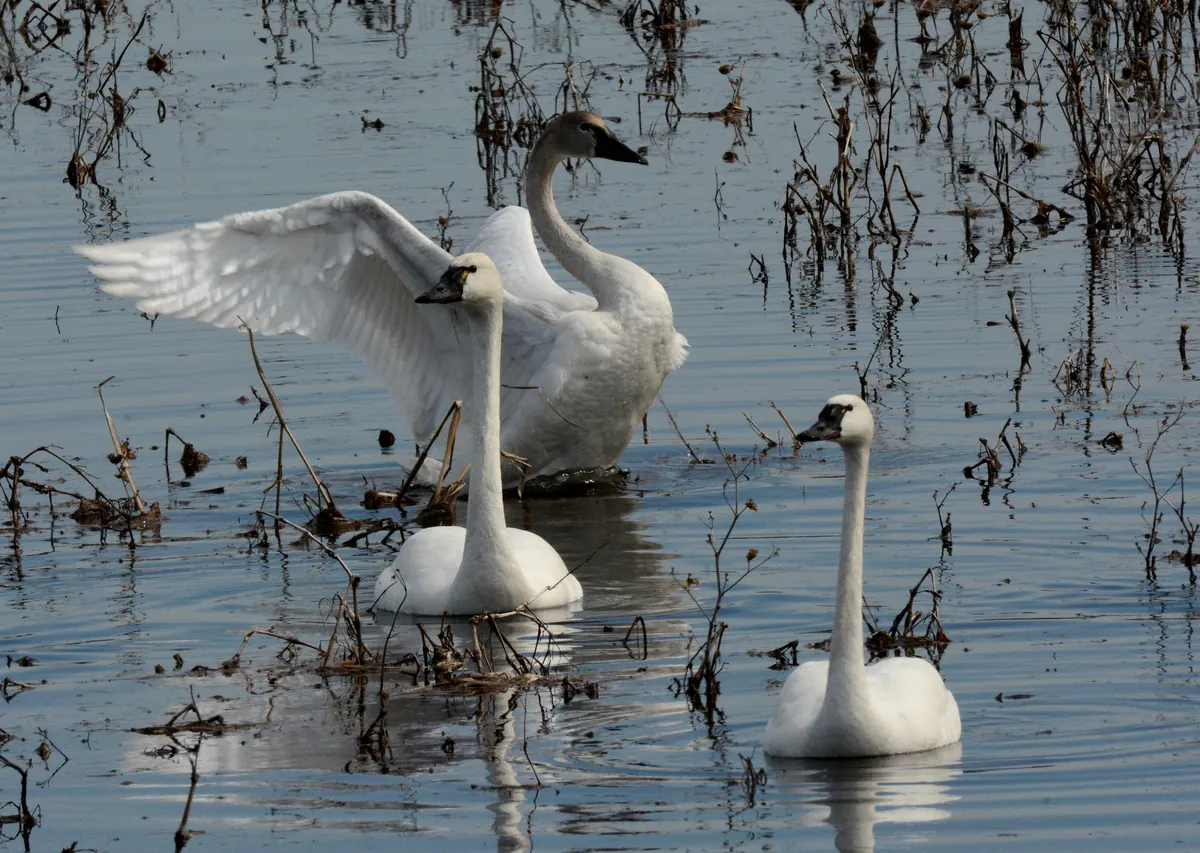
- Swans ahead of the cold. Tundra swans from Alaska and the Canadian Arctic stop on Saginaw Bay on their way to the Chesapeake. Big flights tend to follow a strong cold front with west or northwest winds, anywhere from the first week of November to Thanksgiving weekend. Try the viewing platform at Nayanquing Point or the tower at Pinconning County Park.
- Mars meets Jupiter, then the Leonids. Look south-southeast at first light on the 15th and 16th: Mars and Jupiter hang little more than a degree apart in Leo. Two nights later, once the half-lit Moon goes down soon after midnight, the Leonids offer perhaps 15 meteors an hour until twilight on the 18th.
Keep a record: time the Haehnle fly-in against sunset on the dusk and dawn watch plate of the Naturalist’s Field Journal; use birds I have seen for your first swan, rough-leg or snowy owl of the winter; and give the same place twice plate to a beech or oak that keeps its brown leaves, drawn now and again in early spring. Save tracks to know for the first snow.
Regions used below: Western Upper Peninsula; Eastern Upper Peninsula; Northern Lower Peninsula; West Michigan and the Lake Michigan shore; The Thumb and Saginaw Bay; Southeast Michigan and Metro Detroit; Southwest Michigan.
When do sandhill cranes peak in Michigan in November?
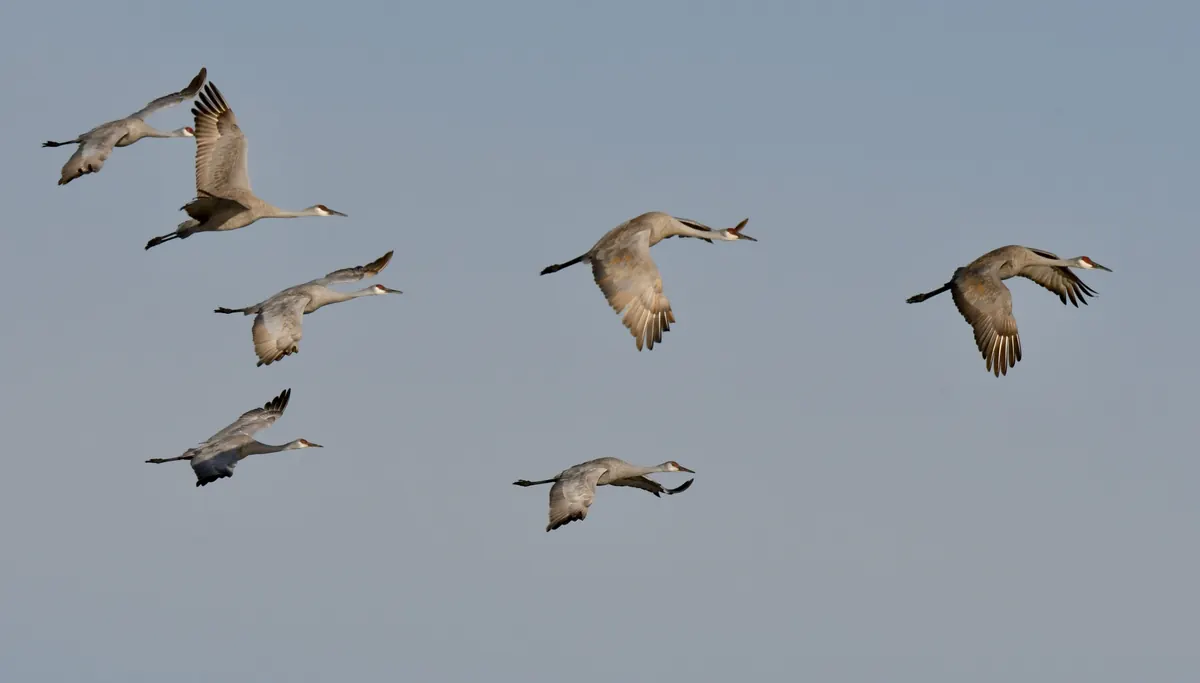
October brings the crowds and the festival, but the biggest crane nights in southern Michigan usually come in November. Birds that nested farther north, in the Upper Peninsula and Ontario, keep arriving in the Jackson and Calhoun county marshes until the roosts are at their fullest, and they leave only when hard cold and snow push them south. Michigan Audubon puts the end of the big-flock migration in late November. Some cranes never leave at all; as long as a few patches of open water stay unfrozen for roosting, small groups spend the winter here.
-
Haehnle Sanctuary, Jackson County
Weekly Monday counts run to about late November; peak usually the last two weeks · Seymour Road, six miles northeast of Jackson
Jackson Audubon volunteers have counted the cranes roosting in Mud Lake Marsh every fall since 1969, and the biggest numbers in the record are November numbers: 4,019 in November 2001, 5,523 on November 15, 2010, and the sanctuary high of 8,177 on November 19, 2012. The 2025 season ran true to form. A cold, brisk count on November 10, with temperatures in the upper 20s, still found 1,482 cranes, and the final count on November 24 reached 3,455; the counters thought another 200 to 300 slipped past in the failing light. Watch from the observation hill, and arrive two or three hours before sunset to see the first flocks come in.
-
Big Marsh Lake and the Kiwanis viewing weekend
Saturday and Sunday, November 7 and 8, until dusk · Kiwanis Youth Conservation Area, 22300 15 Mile Road, Bellevue
The last of the Kiwanis Club of Battle Creek’s weekend openings after CraneFest falls on November 7 and 8, with the lakeshore viewing areas open until dark. The cranes roost on Big Marsh Lake in Michigan Audubon’s Baker Sanctuary next door. There is a pavilion and restrooms; dress for whatever November decides to do.
-
Cranes in the fields
Mornings before 10 a.m. and afternoons after 2 p.m. · Harvested corn and soybean fields near marshes in the southern Lower Peninsula
By day the roosting birds scatter to feed in harvested fields, often in threes: two adults and this year’s colt, still rusty brown on the head. Pull well off the road to watch, and leave them be.
Make your own count on two evenings a week apart: the number of flocks, the minutes after sunset when the last one lands, and the temperature. Sunset in Jackson slips from 5:31 p.m. on November 1 to 5:07 p.m. on the 30th, so the fly-in comes a little earlier each week.
When do tundra swans migrate through Michigan?
Many tundra swans that nest in western Alaska winter on Chesapeake Bay and in North Carolina, and the line between the two crosses central Michigan on a diagonal. Thousands rest on Saginaw Bay before the next push east. A DNR wildlife writer who listened for them every fall wrote in 2012 that he starts expecting them around November 1, and has heard big flights as early as November 4 and 5 and as late as Thanksgiving weekend. His best day was November 12, 2012, when a strong cold front and westerly winds sent flock after flock over mid-Michigan until dark; the next day Fish Point reported at least 3,000 new arrivals.
-
Nayanquing Point State Wildlife Area
October and November; best after a cold front · End of Kitchen Road, three miles north of Linwood, Bay County
This 1,505-acre DNR area on the west shore of Saginaw Bay has a viewing platform at the end of Kitchen Road, and the Bay County Birding Trail describes huge numbers of migrating waterfowl there each spring and fall. A few miles north, the observation tower at Pinconning County Park overlooks water where tundra swans, dabblers and diving ducks gather in October and November.
-
Fish Point State Wildlife Area
Through November · Near Unionville on the east side of Saginaw Bay, Tuscola County
The DNR calls Fish Point, 2,477 acres of marsh and flooded fields, the “Chesapeake of the Midwest,” and swans and ducks pile in by the thousand during migration. It is also one of the places where a few snowy owls usually spend the winter.
-
Shiawassee and the Lake Erie shore
November · Ferguson Bayou Trail, Shiawassee NWR; Lake Erie Metropark
Shiawassee’s auto tour closed October 1, but the Ferguson Bayou Trail along the dikes stays open on foot. In the southeast, the marshes around Lake Erie Metropark and Pointe Mouillee catch swans on the same route.
Listen before you look. A tundra swan’s call is a high, soft, wavering whoop, quite unlike the honk of a goose or the rolling rattle of a crane, and a flock may be calling a mile up. Remember that both state wildlife areas are managed for waterfowl hunting, with daily drawings for hunting zones while the duck season is open (through November 29 in the Middle Zone), so keep to the platforms and roads.
What else is migrating over Michigan in November?
November migration is smaller and colder than October’s, and the birds that are left are the hardy ones from the far north. The river mouths and lake points that funnel migrants are still the places to stand.
-
Golden eagles and rough-legged hawks on the Detroit River
Through November 30, on cold, clear days after a front · Boat launch, Lake Erie Metropark, Brownstown Township
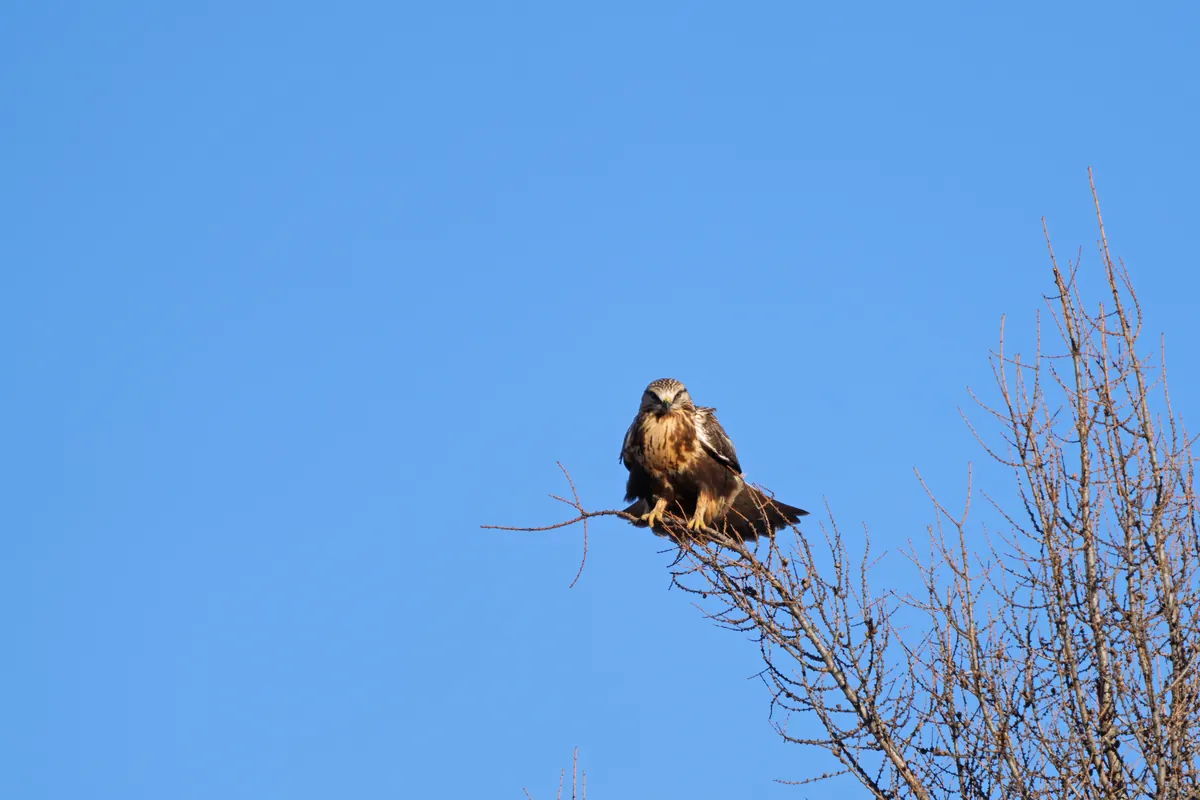
The Detroit River Hawk Watch counts every day until the end of November. Its counters call the month “worth the wait”: species variety is low, but golden eagles, northern goshawks and rough-legged hawks from Arctic Canada come through, along with northern harriers and red-shouldered hawks. A rough-leg hunts open fields, often hanging in one place on beating wings, and shows a dark belly band and dark patches at the bend of the wing.
-
The last sea ducks at Whitefish Point
Waterbird count runs to November 15 · Whitefish Point, Chippewa County
The Whitefish Point Bird Observatory’s fall waterbird count runs from mid-August to November 15, and in 2025 long-tailed ducks were among the main birds moving in its final days, November 12 to 15. This fall the observatory has also logged unusually large numbers of Type 2 red crossbills, part of a movement from the West that the Finch Research Network is tracking.
-
Steelhead, and the last coho
Steelhead from late October onward · Lake Michigan and Lake Huron tributaries; the St. Joseph River at Berrien Springs
The DNR says lake-run steelhead enter their rivers from late October to early May; many fall fish stay all winter and spawn in March. Coho can still be running in November, and on the St. Joseph as late as Christmas, while lake whitefish spawn over rocky or sandy shallows in early winter.
The best November days follow a cold front: falling temperature, a north or northwest wind and rising pressure. You can watch those signs build for your own town on our weather page.
Will winter finches and snowy owls come to Michigan this year?
The Finch Research Network posted its 28th Winter Finch Forecast on September 27, 2026. For Michigan the message is mixed: seed crops failed across a wide band of the central boreal forest, which should push finches toward the Great Lakes, but white pine, northern white cedar and spruce cones are heavy across the eastern forests, so expect many of them deep in the conifers rather than on the feeder.
-
Red crossbills and pine siskins
From now through winter · White pine, hemlock and spruce stands, especially in the north
A west-to-east irruption of Type 2 red crossbills began in midsummer after a pine failure in the interior West, and the forecast expects Type 2 to dominate in the western Great Lakes early in the winter. Pine siskins should find plenty of cedar and hemlock seed. Crossbill types are told apart only by flight call, so record one on your phone and attach it to an eBird checklist.
-
Evening grosbeaks, purple finches and redpolls
Late fall into winter · Northern Michigan feeders and maple woods
The forecast notes that evening grosbeaks have wandered south of the boreal forest in most recent winters, and it looks for small to medium flocks in their usual Great Lakes haunts this year, where they take black oil sunflower seed from platform feeders. Purple finches should be widespread; pine grosbeaks and redpolls will probably stay mostly north.
-
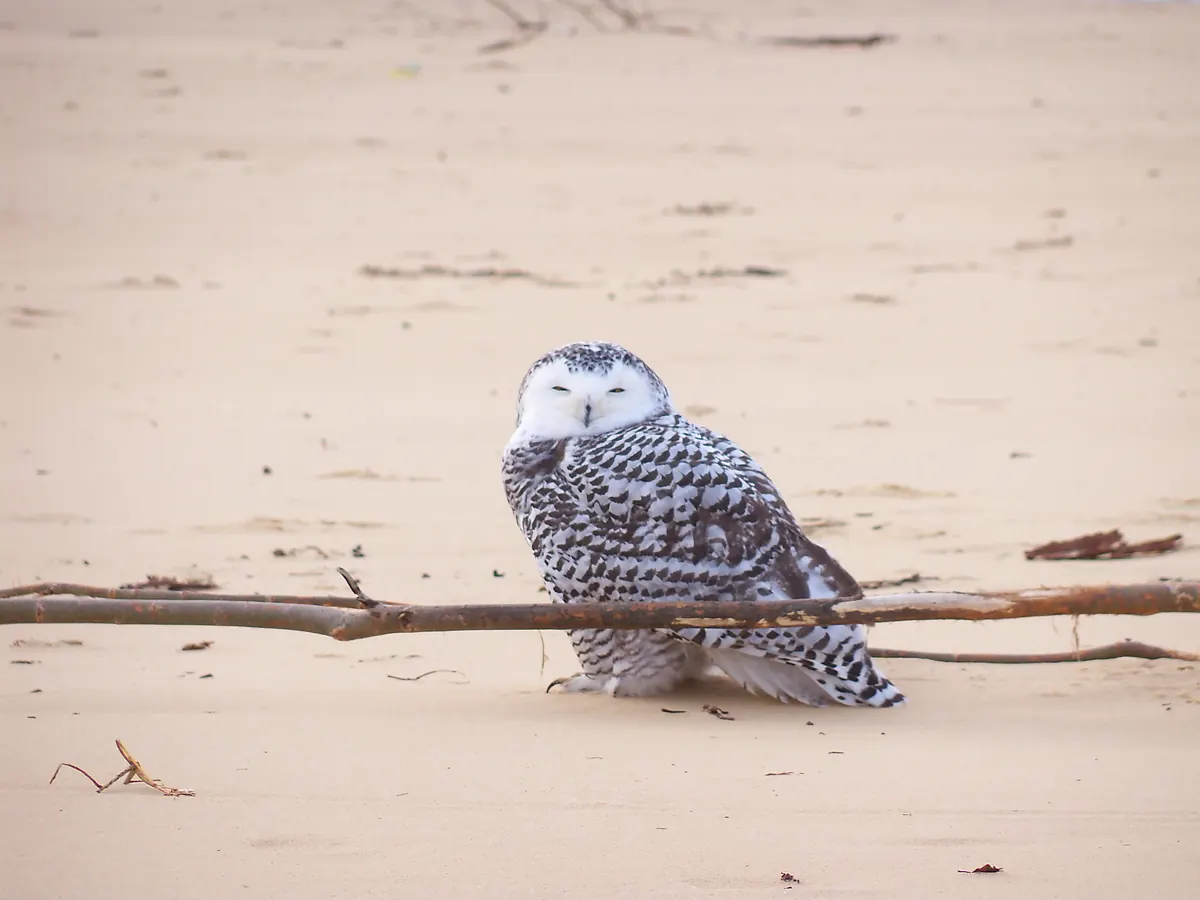
Snowy owls
Irregular; arrivals usually build in November and December · Open shorelines, airports and big farm fields; Fish Point; the Lake Superior beaches
Snowy owls come south from the Arctic in numbers that vary hugely from year to year, tied to food, the summer’s crop of young and weather, and no one can promise a big winter in advance. In one irruption the DNR logged sightings from Saginaw Bay to Sault Ste. Marie and from Kalamazoo to Escanaba, with an early wave in the U.P. by mid-October. Many arrive thin and exhausted, so watch from a distance and call the DNR about an injured bird.
Project FeederWatch’s 2026–27 season starts November 1 and ends April 30. Choose a pair of consecutive count days whenever you like, weekly or just once, and jot down the biggest group of each kind in view at once. Note blue jays too: the forecast reports a huge September flight at Hawk Ridge in Minnesota, and expects some of those birds to head east toward the heavy acorn crops.
When is the deer rut in Michigan, and when does firearm season open?
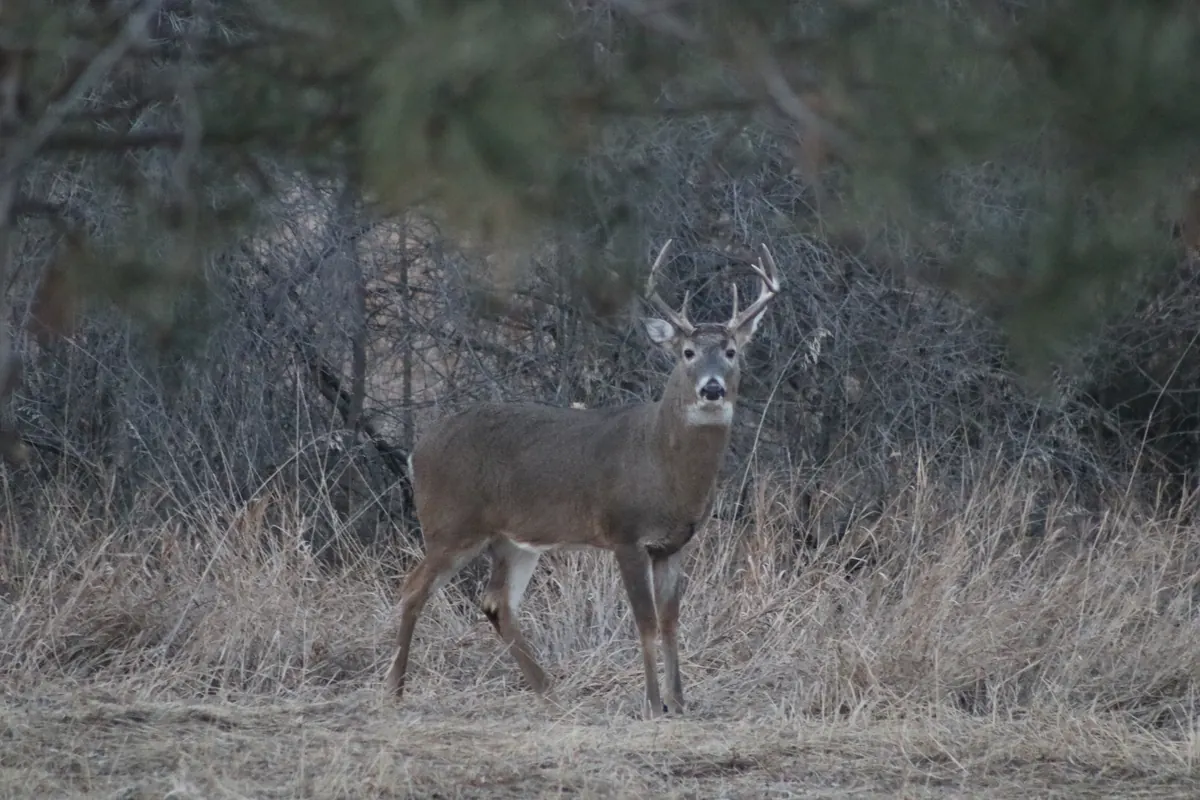
A DNR wildlife technician puts most Michigan deer breeding in roughly the first half of November, which keeps bucks moving by day and by night as they follow does and check scrapes. That restlessness makes November the worst month for deer on the road: in 2025 Michigan drivers reported 9,821 deer crashes in November alone, 16.9 percent of the year’s 58,271 and more than in any other month.
-
Rubs, scrapes and chasing
Peaks in the first half of November · Field edges, woodlots and suburban green space statewide
Look for saplings rubbed raw by antlers, and for scrapes: pawed patches of bare earth under a low branch. A buck trailing a doe with his nose low, oblivious to everything else, is the sight of the season.
-
Opening day, November 15
Regular firearm season November 15 to 30 · Statewide, on public and private land
For many Michigan families, opening day means deer camp. In 2024 hunters took nearly 180,000 deer in the two weeks, about half the year’s harvest from every season combined. New this year: licenses bought on the DNR Hunt Fish app carry an electronic harvest tag, and the old limited firearms zone in the southern Lower Peninsula is gone. Anyone walking or birding in the woods from the 15th through the 30th should wear orange.
-
Bears, mostly asleep
Most are denned by late November · Upper Peninsula and northern Lower Peninsula
The DNR found plenty of acorns in the Upper Peninsula this year, and a good mast crop can keep bears feeding later than usual. Most will still be denned under a windfall or in a hollow by month’s end. Bring bird feeders in until the woods go quiet.
Which Michigan trees still have leaves in November?
By November the maples, aspens and birches are bare, the bog tamaracks have shed their gold needles, and the woods open up. The leaves that remain are brown, bronze and worth a closer look.
-
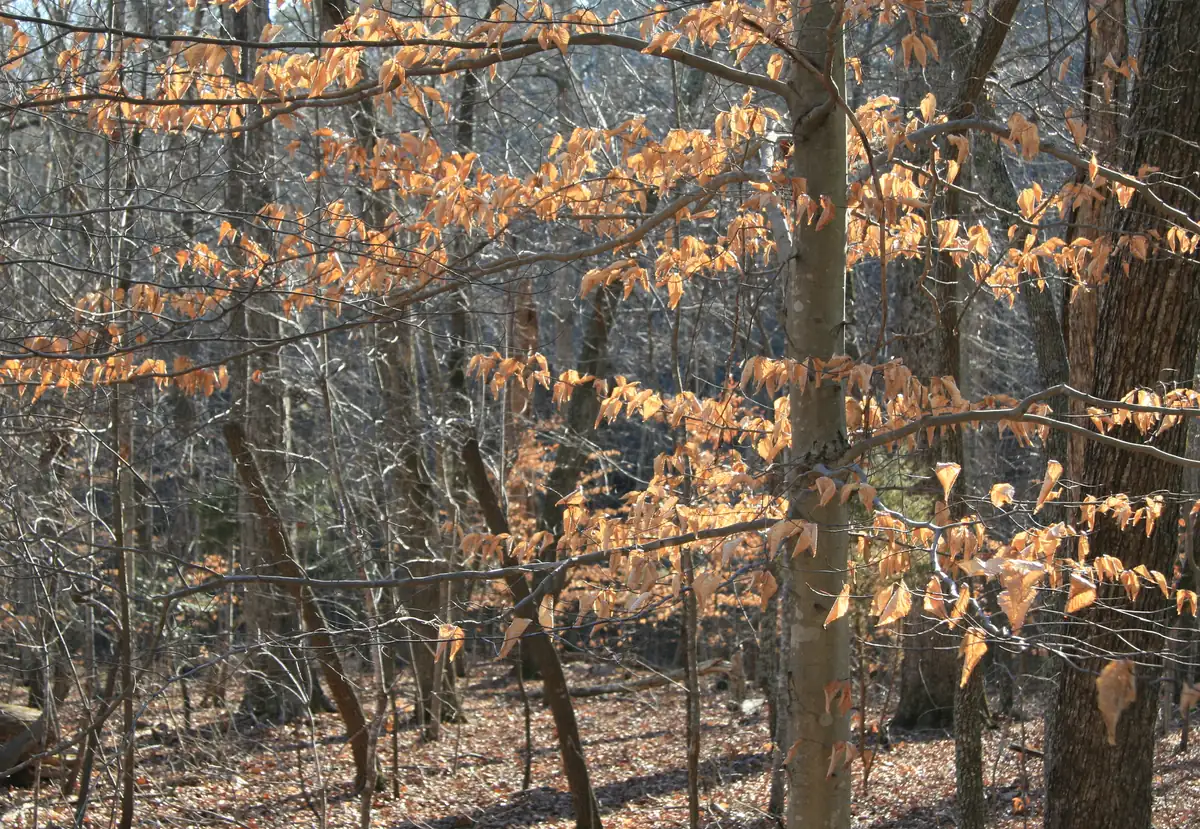
Oaks and beeches that keep their leaves
All winter, until new leaves push them off in spring · Young oaks and beeches, and the lower branches of older trees
Holding dead leaves through the winter has a name, marcescence: the layer of cells that should cut each leaf free does not finish forming until spring. Clemson’s extension service notes that it shows up most on young trees and on lower branches, in oaks, American beech, ironwood (hophornbeam), musclewood (hornbeam) and even witch hazel. The pale, papery beech leaves glow almost white against snow. One theory is that dry leaves at deer height hide the tender buds from browsing.
-
Witch hazel in flower
Into November, after its leaves fall · Dry oak woods in the Lower Peninsula and the western U.P.
Michigan’s latest-blooming native shrub holds thin, crinkled yellow petals on nearly bare twigs into November, and its woody seed capsules burst to throw glossy black seeds. Some young witch hazels keep their dead leaves too.
With the hardwoods bare, the conifers stand out: white pine, hemlock, northern white cedar and spruce, the trees this winter’s finches will feed in. Pick one beech or oak that is holding its leaves, sketch a twig, and come back to it in March.
Has Michigan had its first freeze yet?
Almost certainly, unless you live in Detroit. Every station in the table has a median first freeze in October, and most have frozen in nine years of ten by the first days of November. Detroit is the holdout: the city and Lake St. Clair keep frost away, and one year in ten the first 32 °F night waits until after November 11. Marquette and Grand Rapids can also go into the first week of November in a mild fall. From Sault Ste. Marie and Flint to Lansing, Alpena and Traverse City, a frost-free start to November would be rare.
| Station | One year in ten | Median | Nine years in ten |
|---|---|---|---|
| Marquette | Oct 6 | Oct 21 | Nov 5 |
| Sault Ste. Marie | Sep 22 | Oct 4 | Oct 18 |
| Traverse City | Oct 1 | Oct 15 | Nov 1 |
| Alpena | Sep 30 | Oct 17 | Nov 1 |
| Grand Rapids | Oct 4 | Oct 20 | Nov 2 |
| Lansing (East Lansing) | Oct 1 | Oct 17 | Nov 1 |
| Flint | Sep 30 | Oct 13 | Oct 27 |
| Detroit (City Airport) | Oct 17 | Oct 31 | Nov 11 |
For your own town, our Michigan frost page has the same three dates. In the south, a hard frost in the mid-20s finishes the garden; cut back nothing yet that birds can eat.
When does lake-effect snow start in Michigan, and what will El Niño bring?
November is the month the snowbelts wake up. Cold air crossing lakes that are still holding summer’s heat picks up moisture and dumps it downwind, so snow piles up on the hills south of Lake Superior and along the Lake Michigan shore long before Detroit sees a flake. The 1991–2020 normals from NOAA show the spread: 24.2 inches of November snow at the National Weather Service office near Marquette, 16 at Sault Ste. Marie, 6.6 at Alpena, 7.1 at Grand Rapids, about 3 to 4 inches at Lansing, Flint and Saginaw, and just 1.9 at Detroit Metro. Across November as a whole, the normal afternoon high is in the upper 40s in the south and about 37 °F on the Marquette hills, where the average low is about 24 °F.
-
The gales
Late October through November · Lake Superior above all; every Great Lake
Autumn has produced many of the strongest storms in Great Lakes history, a large share of them in November. In a reconstruction of the storm of November 9 and 10, 1975, forecasters from the National Weather Service at Marquette found its worst winds and waves packed into about six hours on the evening of the 10th, just when the Edmund Fitzgerald sank near Whitefish Point at about 7:15 p.m. Lake Superior can raise waves taller than a four-story house. Watch from a high bluff, never a pier.
-
A very strong El Niño
Building through the winter · Statewide
The Climate Prediction Center’s September 10, 2026, ENSO update put Michigan’s coming winter under a very strong El Niño, with odds it set above 90 percent. Michigan had a preview in 2015–16, when a near-record El Niño gave the United States its warmest winter on record and Michigan its third warmest, most places five to seven degrees above normal, according to the state’s winter hazards packet prepared with the National Weather Service. Lake-effect snow was held down, but the season opened with a bang: on November 21, 2015, 6 to 16 inches fell from Benton Harbor through Lansing and Flint into metro Detroit, 16.8 at Howell. A long, quiet middle and a stormy spring followed, which the packet calls typical of a strong El Niño. The state climatologist expects this year’s event to favor a milder, less snowy winter. Michigan’s official NOAA winter outlook arrives October 15, posted with the CPC’s 90-day outlooks.
Every El Niño winter differs, and a warm season overall can still bring a sharp cold snap or one heavy storm. For the clouds over your own sky today, see our cloud forecast.
How much daylight does Michigan lose in November?
About an hour, a little more the farther north you go: Detroit loses 59 minutes over the month, Lansing and Grand Rapids just over an hour, and Marquette and Sault Ste. Marie 71 and 70, close to 2.4 minutes a day. Yet the change people notice comes first. With the return to standard time on Sunday, November 1, Detroit’s sunset jumps from 6:27 p.m. the evening before to 5:25 p.m., and it is down to 5:01 by the 30th. Marquette’s sun sets at 5:34 p.m. on the 1st and 5:04 on the 30th, and Sault Ste. Marie’s last November sunset comes at 4:52 p.m. Clocks in the four Central-time counties of the western U.P. show every one of these moments an hour earlier.
| City | Nov 1 | Nov 30 | Lost | Per day |
|---|---|---|---|---|
| Marquette | 10 h 03 m | 8 h 52 m | 71 min | 2.4 min |
| Sault Ste. Marie | 10 h 03 m | 8 h 53 m | 70 min | 2.4 min |
| Traverse City | 10 h 10 m | 9 h 05 m | 65 min | 2.2 min |
| Alpena | 10 h 10 m | 9 h 03 m | 67 min | 2.3 min |
| Grand Rapids | 10 h 18 m | 9 h 16 m | 62 min | 2.1 min |
| Lansing | 10 h 19 m | 9 h 18 m | 61 min | 2.1 min |
| Flint | 10 h 18 m | 9 h 16 m | 62 min | 2.1 min |
| Detroit | 10 h 19 m | 9 h 20 m | 59 min | 2.0 min |
Look up your own street in the Field almanac, which lists sunrise, sunset and twilight, and the minutes of light this week will cost you.
What can you see in Michigan’s night sky in November?
Long nights and the end of daylight saving time make November a good month for skywatching after supper, if the lake-effect clouds allow. All times are Eastern Standard Time; in Gogebic, Iron, Dickinson and Menominee counties, which keep Central time, subtract an hour.
-
The Leonids
Before dawn on Wednesday, November 18 · Face east or straight up; anywhere dark
By the International Meteor Organization’s reckoning, the Leonids crest around suppertime on November 17 in Eastern time, at roughly 15 meteors an hour under an ideal sky; nothing unusual is expected. Leo, where the meteors seem to start, is up by about midnight and keeps climbing, and the half-lit Moon goes down soon after midnight. That leaves the hours from about 1 a.m. until dawn on the 18th, with the mornings either side worth a try. Leonids are swift, and the brightest leave glowing trails.
-
Taurid fireballs and the new moon
Southern Taurids peak November 5; Northern Taurids November 12 · Taurus, high in the southeast by late evening
Shed by Comet Encke, the Southern and Northern Taurids together manage just five to ten meteors an hour; what they lack in numbers they make up in slow, sometimes spectacular fireballs. The new moon on the 9th falls between their peaks, so the whole week is dark. Negwegon State Park, on Lake Huron near Harrisville, hosts a free Dark Sky Night with telescopes and a beach bonfire on Saturday, November 7; register ahead with the Friends of Negwegon State Park.
-
Mars and Jupiter side by side
Pre-dawn, November 15 and 16 · High in the south-southeast before sunrise
Bright Jupiter and fainter, orange Mars close to about 1.2 degrees apart in Leo, near Regulus. Below them, dazzling Venus rises in the east-southeast, and from a clear, flat horizon you may catch Mercury very low beneath it. Venus climbs higher each morning and blazes brightest between about November 24 and 27; Mercury’s best mornings run from roughly November 18 to 25.
-
The Beaver Moon
Evenings of Monday, November 23, and Tuesday, November 24 · Rising in the east-northeast near sunset
The Moon turns full at 9:53 in the morning on Tuesday the 24th; perigee follows about a day and a quarter later, making this a modest supermoon. Before dawn on the 24th it brushes past the Pleiades, but its glare leaves the cluster hard to pick out. The Farmers’ Almanac ties the name to the weeks when beavers finish their lodges and dams before freeze-up, and when trappers once sought their thick winter pelts.
-
Saturn, Uranus and the northern lights
Evenings all month; Uranus at opposition November 25 · Saturn in the south after dark; Uranus in Taurus near the Pleiades
Saturn is the only bright evening planet, steady and yellowish in the south. Opposition for Uranus falls on the 25th; with binoculars and a chart it is a faint blue-green dot near the Pleiades, though the full moon interferes that week. The Sun passed the peak of its cycle in October 2024 but can still throw strong storms, and Michigan’s northern shores are well placed for aurora; the darkest week is the one around the new moon.
| Phase | Date | Time |
|---|---|---|
| Last quarter | Sunday, Nov 1 | 3:28 p.m. |
| New moon | Monday, Nov 9 | 2:02 a.m. |
| First quarter | Tuesday, Nov 17 | 6:48 a.m. |
| Full moon, the Beaver Moon | Tuesday, Nov 24 | 9:53 a.m. (round on the evenings of Nov 23 and 24) |
| Last quarter | Tuesday, Dec 1 | 1:08 a.m. |
Lake-effect cloud can blanket one shore while the other is clear, so look at Today’s sky before heading out; the moon calendar lists when the moon rises over any Michigan town.
What can Michigan families do outdoors in November?
- Listen for owls, Friday, November 6. Hudson Mills Metropark, near Dexter, runs an Owl Night Hike from 6:30 to 8 p.m.: a talk on Michigan’s owls, then a quiet walk of under a mile. It is $5 a person, for ages 8 and up with an adult; register by 4 p.m. the day before and confirm the date on metroparks.com.
- Look through a telescope, Saturday, November 7, at the Dark Sky Night at Negwegon State Park, with astronomy talks, laser constellation tours and a beach bonfire. Tickets are free but you must register; the site is a short walk over gravel and sand.
- Watch the cranes. November 7 and 8 is the last Kiwanis viewing weekend at Big Marsh Lake near Bellevue; on other evenings head for the Haehnle overlook near Jackson, where volunteer greeters are out on weekend afternoons and the biggest counts usually come later in the month.
- Visit a national park free on Wednesday, November 11. Veterans Day is one of the Park Service’s 2026 fee-free days, open to Americans and U.S. residents, so Sleeping Bear Dunes costs nothing to enter that Wednesday.
- Count birds from November 1 for Project FeederWatch, and post any snowy owl or evening grosbeak to eBird.
- Walk off Thanksgiving on Friday, November 27. We found no 2026 announcement of free state park entry that day (Michigan’s free “Three Free” weekend is in June), so bring the Recreation Passport, pick a park closed to hunting, and wear orange anyway.
Safety notes for November in Michigan
- Hunting seasons and orange. Regular firearm deer season runs November 15 to 30 statewide; early archery ends November 14, and late archery opens December 1. Ruffed grouse, fall turkey and pheasant in Zones 2 and 3 close November 14. Duck season stays open to November 22 (plus November 28 and 29) in the North Zone, to November 29 in the Middle Zone and to December 13 in the South Zone, and goose seasons run into December. Rabbit, snowshoe hare, squirrel and coyote are open all month. Firearm deer hunters must wear a hunter orange cap, hat, vest, jacket or rain gear as their outer layer, seen from every direction, and orange camouflage must be at least 50 percent orange. Bowhunters are exempt in the archery seasons, but not during a firearm season, and small-game hunters except crow hunters wear orange from August 15 to April 30. The DNR asks hikers, dog-walkers and anyone else near hunting land to wear orange too.
- Deer on the road. In 2025, about 24 percent of Michigan’s deer crashes came in the three hours from 6 a.m. and another 24 percent from 6 p.m., and more than half on unlit roads. Once the clocks change, the drive home is in the dark. Slow down and brake straight rather than swerve.
- Gales and cold water. When a gale warning is posted, keep off piers and breakwalls. The National Weather Service notes that the gasping and rapid breathing of the first two or three minutes in cold water can drown a strong swimmer, and that a life jacket buys time; wear one in any boat.
- First ice. Up north, a skin of ice may creep across small ponds and cattail edges by late November, but no November ice is safe. The DNR says no thickness guarantees safe ice, slushy ice is about half as strong as clear ice, and open water along the shore is a warning sign.
- Short days and squalls. Carry a headlamp on afternoon walks, tell someone your route, and keep a scraper, blanket and boots in the car; lake-effect squalls can cut visibility to near zero in minutes.
Sources
- Jackson Audubon Society: Haehnle Sanctuary crane counts since 1969
- Jackson Audubon Society: Haehnle crane count, November 10, 2025
- Jackson Audubon Society: final Haehnle crane count, November 24, 2025
- Michigan Audubon: fall migration, viewing sandhill cranes in Michigan 2026
- Michigan DNR: tundra swan migration, a natural spectacle (2012)
- Michigan DNR: Nayanquing Point State Wildlife Area
- Michigan DNR: Fish Point State Wildlife Area
- Saginaw Basin Land Conservancy: Bay County Birding Trail
- U.S. Fish and Wildlife Service: Shiawassee National Wildlife Refuge, visit us
- Detroit River Hawk Watch: migration brief (November)
- Whitefish Point Bird Observatory: migration counts
- Michigan DNR: steelhead
- Michigan DNR: coho salmon
- Michigan DNR: lake whitefish
- Finch Research Network: Winter Finch Forecast 2026–2027
- Project FeederWatch: how to participate
- Michigan DNR: agency aids effort to study and help snowy owls
- TV6 (Upper Michigan’s Source): AAA and the DNR on deer activity and the November rut
- Michigan Traffic Crash Facts 2025: motor vehicle-deer crashes (PDF)
- Michigan DNR: 2026 hunting season calendar
- Michigan DNR: 2026 deer hunting regulations summary (season dates, hunter orange)
- Michigan DNR: 2026 small game regulations summary (hunter orange)
- Michigan DNR: hunting safety and hunter orange
- Michigan DNR: 2026 deer hunting preview (eHarvest tags, U.P. acorn crop)
- Michigan DNR: firearm deer hunting season begins Saturday (2025 release, 2024 harvest)
- Clemson Cooperative Extension: when leaves don’t let go, marcescence
- North American Bear Center: the five stages of activity and hibernation
- Farmers’ Almanac: the Beaver Moon, November 24, 2026
- MSU Extension: native shrubs for Michigan landscapes (witch hazel)
- University of Minnesota Season Watch: American tamarack phenology
- NOAA NCEI: U.S. climate normals 1991–2020 (first-freeze probabilities)
- NOAA NCEI: 1991–2020 monthly normals for ten Michigan stations (data API)
- Hultquist, Dutter and Schwab (NWS Marquette, NWS Cleveland, NOAA GLERL): reexamination of the November 1975 Edmund Fitzgerald storm (PDF)
- National Weather Service Gaylord: 2016–2017 Michigan Winter Hazards Awareness packet (the 2015–16 El Niño winter) (PDF)
- Climate Prediction Center: ENSO diagnostic discussion, September 10, 2026
- Climate Prediction Center: seasonal outlooks (winter outlook issued October 15)
- WKAR: El Niño could bring a milder, less snowy winter to Michigan, state climatologist says
- National Weather Service: cold water safety
- Michigan DNR: ice safety
- U.S. Naval Observatory: moon phases, November 2026 (data API)
- International Meteor Organization: 2026 meteor shower calendar (PDF)
- EarthSky: what is a supermoon? (2026 supermoons)
- EarthSky: best stargazing of 2026 (Mars and Jupiter, November 16)
- EarthSky: Uranus at opposition
- Sea and Sky: astronomy calendar 2026
- NOAA Space Weather Prediction Center: solar cycle progression
- Michigan DNR calendar: Dark Sky Night at Negwegon State Park, November 7, 2026
- Huron-Clinton Metroparks: Owl Night Hike at Hudson Mills, November 6, 2026 (via The Sun Times News calendar)
- National Park Service: 2026 fee-free days
- Michigan DNR: “Three Free” Weekend, June 2026
- Wikipedia: time in Michigan (the four Central-time counties)
- Photos via Wikimedia Commons; licenses and photographers are credited under each picture
