What to look for in nature in Mississippi this April
In Mississippi, April is when the songbirds arrive in waves. After a storm front on the Gulf Coast, warblers, tanagers and orioles that have just crossed the water can fill a woodlot, and the wave moves inland in the weeks after. Wet pine savannas open yellow pitcher plants, butterwort, grasspink orchids and Osceola's plume while blue flag iris and native azaleas flower at the water's edge, Natchez Trace roadsides fill with mayapple, spiderwort, blue phlox and dogwood, and red-cockaded woodpeckers begin laying eggs in old pines. Turkey hens settle onto nests, bottlenose dolphin calves appear in the Mississippi Sound, and terns and plovers scrape out nests on the island beaches. The days gain 51 to 61 minutes, the Pink Moon turns full on the 20th, and tornadoes and flooded roads remain real risks.
Other months in Mississippi: October, November, December, January, February, March.
Start here
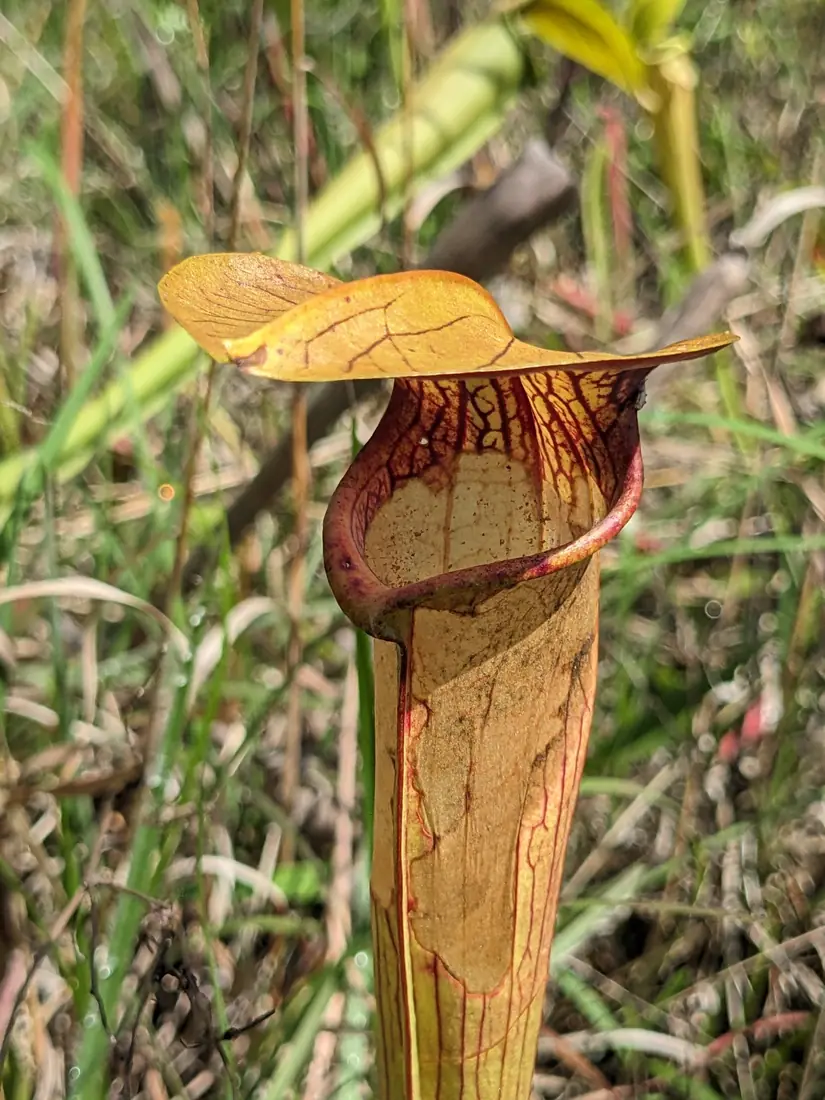
- Walk a wet pine savanna on a sunny morning. Grand Bay and Mississippi Sandhill Crane National Wildlife Refuges are the two places Mississippi State Extension recommends. Look for yellow butterwort, grasspink orchids and Osceola's plume, and bring boots, since the ground is wet.
- Visit a coastal woodlot the day after a cold front. Audubon says Ansley Preserve in Hancock County peaks in April and early May, especially after a storm with northerly winds. Stand still under the trees and count what has dropped in.
- Watch the Pink Moon rise on April 20. The Moon is full at 5:27 p.m. CDT, before it rises, so it climbs out of the east already full at about 8 p.m. A nearly full Moon three days later spoils the Lyrid meteors.
In the Naturalist's Field Journal, a warbler's song and the first turkey gobble fit the map of sounds, and your first coastal tanager or warbler goes on birds I have seen. A mayapple or dogwood suits a tree through the seasons, a savanna in bloom suits the same place twice, a bass bed or a hen's nest fits nest observed, a dolphin calf fits mammal watch, and the Pink Moon rising belongs on the dusk and dawn watch.
Regions used below: The Delta; North Mississippi hills and Tupelo; Central Mississippi and Jackson; The Pine Belt; Southwest Mississippi and Natchez; The Gulf Coast.
When do the big waves of songbirds reach the Mississippi coast in April?
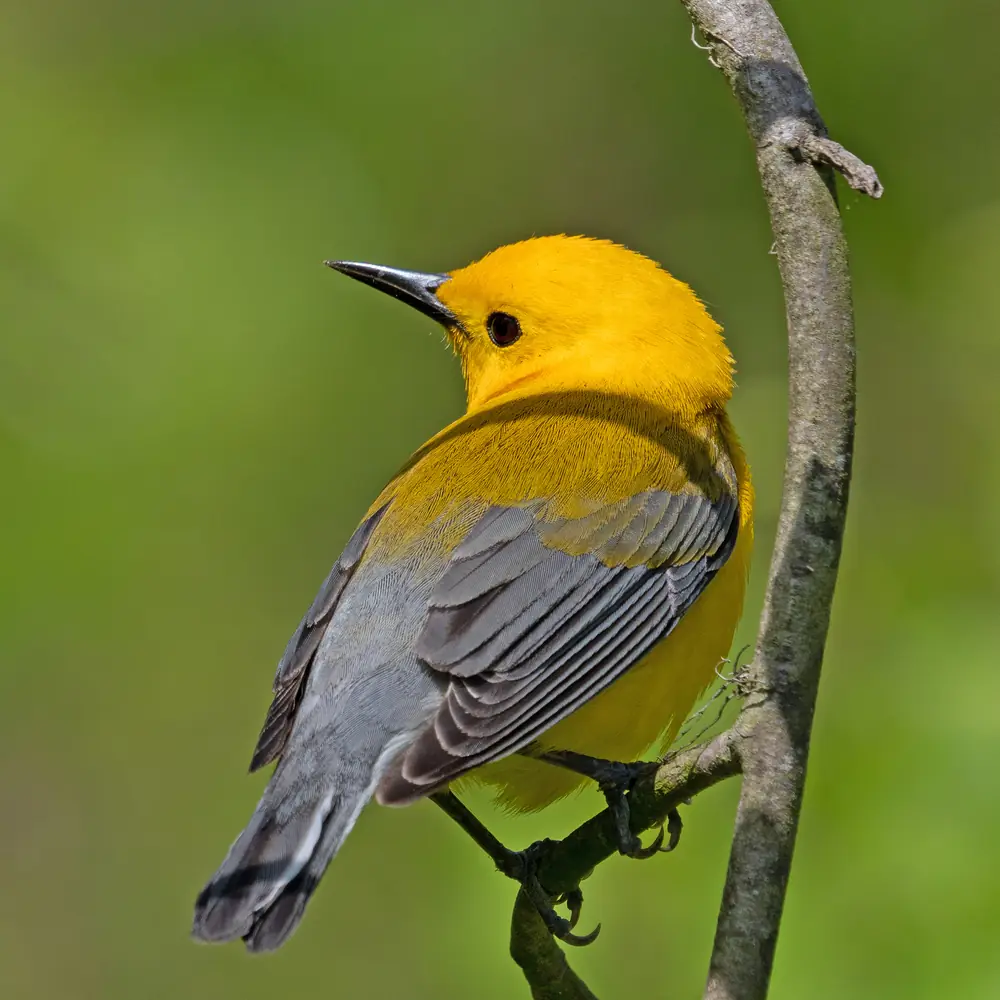
April and the first days of May are the peak weeks. Audubon's birding guide to Mississippi describes the Ansley Preserve in Hancock County as at its best in that stretch, especially after a storm with northerly winds, when vireos, thrushes, warblers, tanagers and orioles can fill the trees. The guide calls a spring fallout one of the great birding experiences of the Gulf Coast: birds heading north that have just crossed the Gulf of Mexico drop into the first patch of woods they find. It adds that these events depend on the weather and cannot be predicted far ahead, so a cold front arriving from the north is a better signal than any date on the calendar.
-
Ansley Preserve and Buccaneer State Park
April and early May, best after a front with northerly winds · Ansley Road, about seven miles south of Highway 90 in Hancock County; Buccaneer State Park, Waveland
Audubon says the Ansley Preserve, part of the Hancock County Marshes Preserve, has a bird list of more than 230 species, with trails through woods and past marshes and ponds. It warns that parts of the area are open to hunting in fall and winter. At Buccaneer State Park, the same guide says the grounds can be a good fallout spot in spring migration and describes a 1.8-mile nature trail through woodland that was still recovering from Hurricane Katrina (2005) when the guide was written. The guide dates from 2016, so call ahead.
-
Davis Bayou, Ocean Springs
Spring migration, with the best days after bad weather offshore · Davis Bayou Area, Gulf Islands National Seashore
The Park Service describes the Davis Bayou area as a place with a campground, a visitor center with exhibits and an observation deck, trails, and several boardwalks over the bayous. Audubon says the maritime forest here can be especially good in spring, and still works as a migrant trap when birds fresh from the Gulf stop to rest and feed. The Park Service counts more than 300 bird species across the whole national seashore and calls it a stopover where migrants can rest before continuing.
-
Noxubee refuge and the interior
Spring migration · Sam D. Hamilton Noxubee National Wildlife Refuge, Noxubee, Oktibbeha and Winston counties
Migrants do not all stop at the coast. The Fish and Wildlife Service says Noxubee was set up to protect migratory birds and is home to many neotropical migratory species, and that the National Audubon Society has named it an Important Bird Area, one of five of global importance in Mississippi. Audubon's guide puts the refuge at about 48,000 acres, more than half of it bottomland hardwood forest, and says its wading bird peak is in August and September, so spring here is a songbird visit. Ask at the refuge what has been seen lately.
Log each newcomer with its date and location in your Field Journal, on the birds I have seen plate. If the coast sees a species a week before your inland yard does, that gap shows how fast the wave is traveling, which no long-term average will tell you. Songs you cannot name yet belong on a map of sounds.
What is nesting and calving along the Mississippi coast in April?
Small birds on bare sand, and bottlenose dolphins in the shallow Sound. The National Park Service says that from February until late summer, Gulf Islands National Seashore gives ground-nesting shorebirds, including least terns, snowy plovers, Wilson's plovers and black skimmers, a place to raise young. April sits in the middle of that season, when eggs are out and the nests are almost invisible.
-
Closed beaches on the barrier islands
February to late summer · Ship Island, Cat Island, Horn Island, Petit Bois Island and West Petit Bois Island
Park staff watch for nesting activity, then sign and close areas as needed. The Park Service asks visitors not to enter a roped-off area, never to touch eggs or chicks, and to keep pets off the beach and out of the water everywhere in the park. If terns or plovers start diving at you, it means you are near a hidden nest or small chicks. The Park Service's advice is to retrace your steps and leave, since the eggs are tiny, well camouflaged and hard to see.
-
A boat ride to Ship Island
Ferries typically run from mid-March through October · Gulfport Yacht Harbor, in Jones Park, about 11 miles across the Mississippi Sound
Ship Island Excursions, which runs the boats, describes a one-hour crossing and says passengers are sure to see dolphins along the way. Fort Massachusetts stands on the island, and the company says the Park Service gives fort tours in season. Ask the company for its 2027 sailing days.
-
Dolphin calves
Births begin in March and early April, according to the Institute for Marine Mammal Studies · Shallow water of the Mississippi Sound
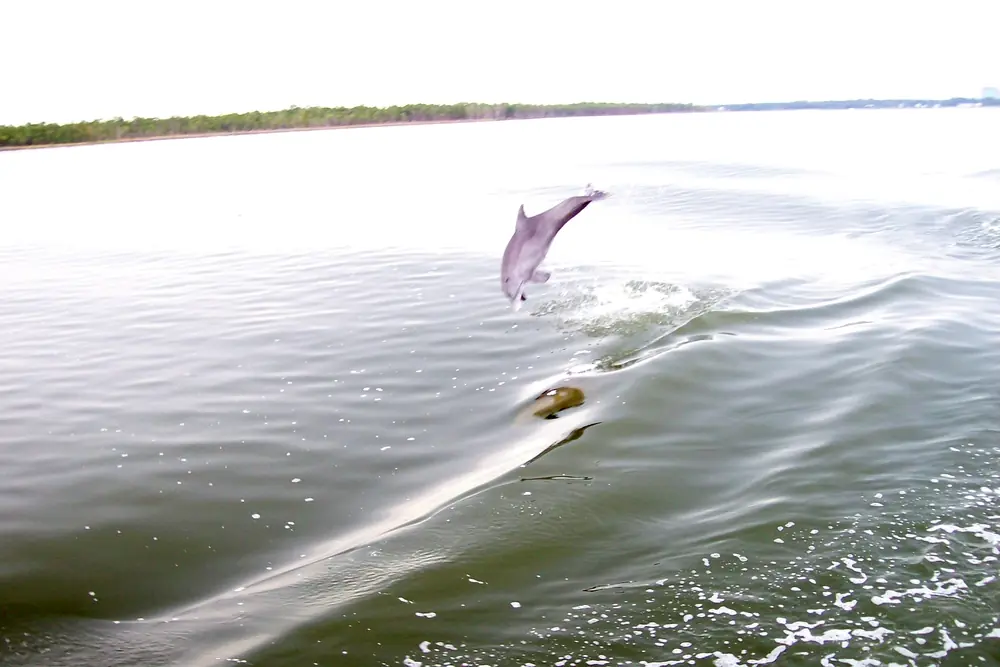
A Coast television report from March 2022, quoting the institute's executive director, said warm, shallow, murky water gives mothers a safe place to give birth beginning in March and early April, and that the Sound's dolphin population grows each spring as a result. He called the same weeks the start of stranding season, as water warms and animals move. Do not touch a stranded animal, alive or dead. The institute's response line is 1-888-SOS-DOLPHIN (1-888-767-3657), reported as open around the clock. Treat the timing as a typical pattern, not a promise.
-
Cobia off the barrier islands
Late March and April in many years; weather and water temperature decide · Mississippi Sound and the waters around the islands
Cobia are a spring run along the coast. A Gulf Coast Research Laboratory biologist quoted in a 2013 state outdoors magazine feature, an older source, described them moving in from Florida in late March and early April, earlier after a warm spring, drawn by water of about 67 to 70 degrees, so treat the timing as a long-standing pattern and not a 2027 forecast. The Department of Marine Resources lists a minimum length for cobia of 36 inches (fork length) and a limit of 2 fish, so check its current page before fishing.
A fresh nest scrape or a dolphin surfacing close to the bow fits on a nest observed or mammal watch page in the Naturalist's Field Journal, with the date and tide.
What blooms in Mississippi's wet pine savannas and bogs in April?
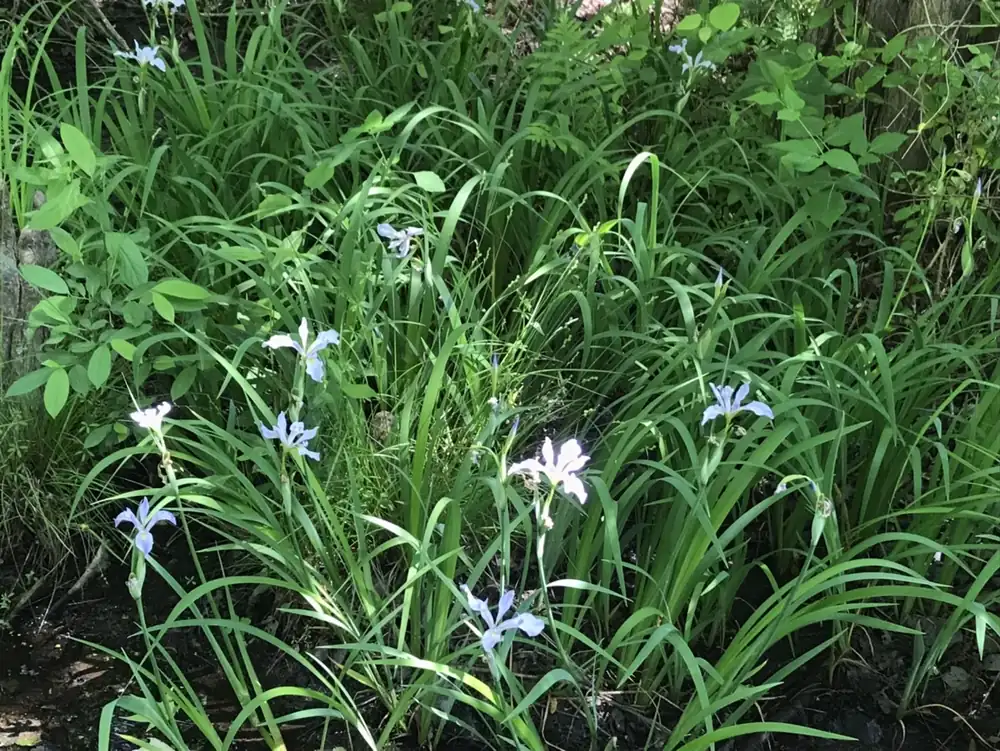
Color arrives in waves from March through May, according to Mississippi State University's Extension Service. A 2026 Extension column describes wet pine savannas as fire-dependent grasslands on flat ground with a high water table, kept open by regular burns so that sunlight reaches the grasses, sedges and wildflowers. Three plants stand out in its list for spring, and the Crosby Arboretum's own April sheet adds a longer list for its bog and pond.
-
Butterwort, grasspink and Osceola's plume
Butterwort one of the first; Osceola's plume flowers in April, May or June · Grand Bay National Wildlife Refuge and Mississippi Sandhill Crane National Wildlife Refuge, which the column recommends
Yellow butterwort has a single small yellow flower on a thin stalk and a star-shaped rosette of sticky leaves that traps insects, which the plant digests for nutrients in poor soil. The tuberous grasspink is an orchid that can wait years underground without flowering. Its bright color attracts pollinators but it offers no nectar. Osceola's plume rises from a bulb that sprouts in February or March, opens cream-colored flowers from the top of the spike downward over days to weeks, and often blooms in the spring after a fire.
-
The bog at the Crosby Arboretum
April, by the Arboretum's own bloom sheet · South Pitcher Plant Bog, Crosby Arboretum, Picayune
The Arboretum's April list for the bog and its edges names yellow pitcher plant, bladderwort, sunbonnets, yellow star grass, daisy fleabane, sneezeweed, wild black cherry and red chokeberry. The sheet notes that crushed black cherry leaves smell of almonds, because the plant makes a chemical to deter browsing animals, so leave them alone. An April 2022 column from the Arboretum described yellow pitcher plants unfurling in the bog, pink honeysuckle azaleas along the paths and southern blue flag iris at the water's edge.
-
Beaver Pond and the water's edge
April · Beaver Pond and the paths around it
The April sheet lists star anise, with deep maroon flowers of 18 or more petals and fragrant leaves, along with golden club, buckwheat tree, Louisiana iris, white floating hearts, yellow cow lily and two native azaleas, one orange-flowered and one white and pink. Elsewhere on the grounds it lists flowering dogwood, red maple seeds, candy root, yellow jessamine and wax myrtle. Hours and admission change, so check before you drive.
Walked a savanna in March? Return now and compare, using a same place twice spread in the Field Journal. Notice which plants have stood up since your first visit.
Which flowers line the Natchez Trace Parkway in April?
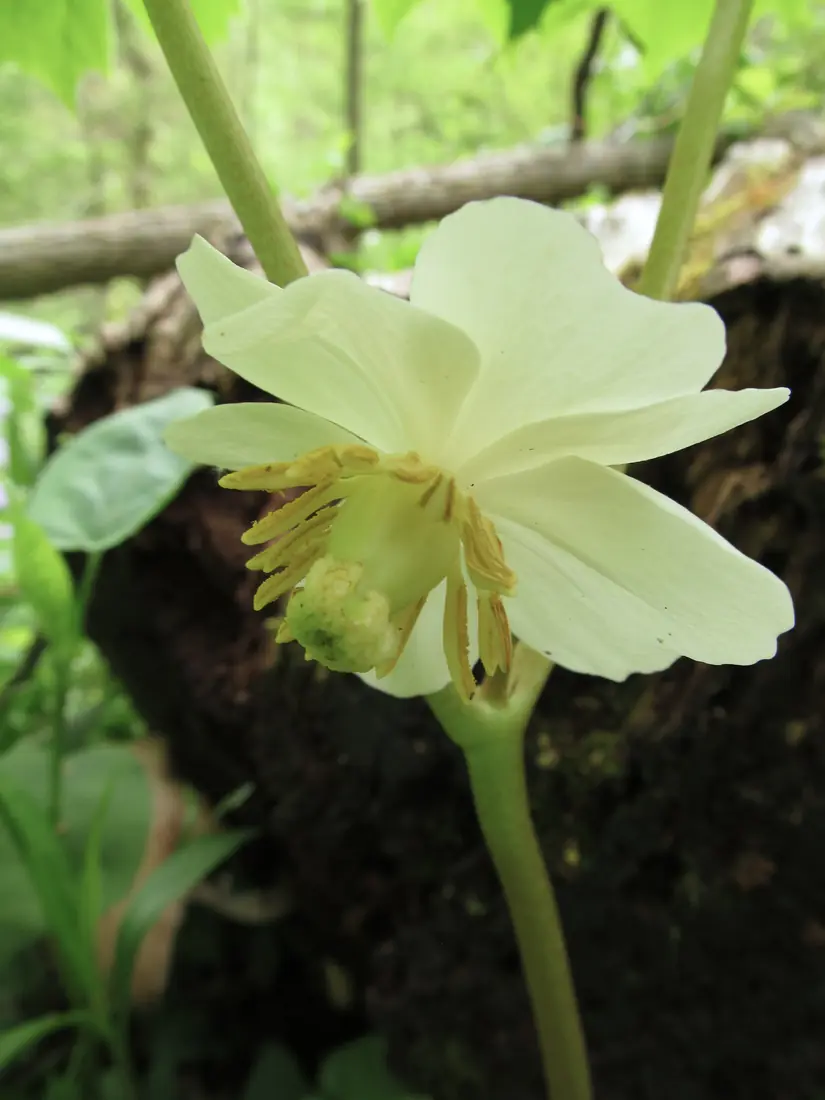
The Park Service keeps week-by-week bloom lists for four stretches of the Parkway, and the three that cover Mississippi are Natchez to Jackson (mileposts 0 to 105), Jackson to Tupelo (105 to 266) and the miles north of Tupelo. They describe what typically blooms, not a promise, and the Parkway's own rule is short: enjoy the flowers, but leave them as you found them.
-
Natchez to Jackson, mileposts 0 to 105
April; magnolia and yellow poplar by the first week of May · The southern Parkway
The first-week list names blue-eyed grass, crimson clover, daisy fleabane, evening primrose, lyre-leaved sage, mayapple, ragwort and white clover. The second week adds honeysuckle azalea and multiflora rose, and by the third week the list includes heal-all and periwinkle. For the first week of May the Park Service lists magnolia and yellow poplar among the flowering trees, with thistle and verbena among the wildflowers.
-
Jackson to Tupelo, mileposts 105 to 266
Flowering dogwood and buckeye in the second week of April · The central hills
Here the first week brings bluet, buttercups, false wild garlic, ground ivy, mayapple, ragwort, spiderwort and spring beauty. The second-week list adds black locust, flowering dogwood and red buckeye among the trees, with oak-leaf hydrangea among the shrubs. By early May the list moves on to blackberry, black-eyed Susan, Queen Anne's lace and vetch.
-
North of Tupelo, from milepost 266
Dogwood, painted buckeye and wisteria in the second week; black locust by the third · The northern Parkway
The list for this stretch has blue phlox, mayapple, water parsnip and crimson clover in April, with flowering dogwood, painted buckeye, honeysuckle azalea and wisteria in the second week. Black locust shows up in the third week, and magnolia and privet in the first week of May. This list runs on to the Tennessee line, so part of it lies outside Mississippi.
Pick a milepost you pass often, walk to the same roadside each week, and note what changed in a tree through the seasons or same place twice page in the Naturalist's Field Journal.
Who is nesting and laying eggs in Mississippi in April?
Woodpeckers in old pines, turkey hens on the ground, monarchs on milkweed and bass in the shallows. Most of them are not easy to see, and that is the point: this is the month to learn where not to walk and what to leave alone.
-
Red-cockaded woodpeckers
Breeding season begins in April; eggs usually laid in mid-April · Mature pine forest, including Noxubee National Wildlife Refuge
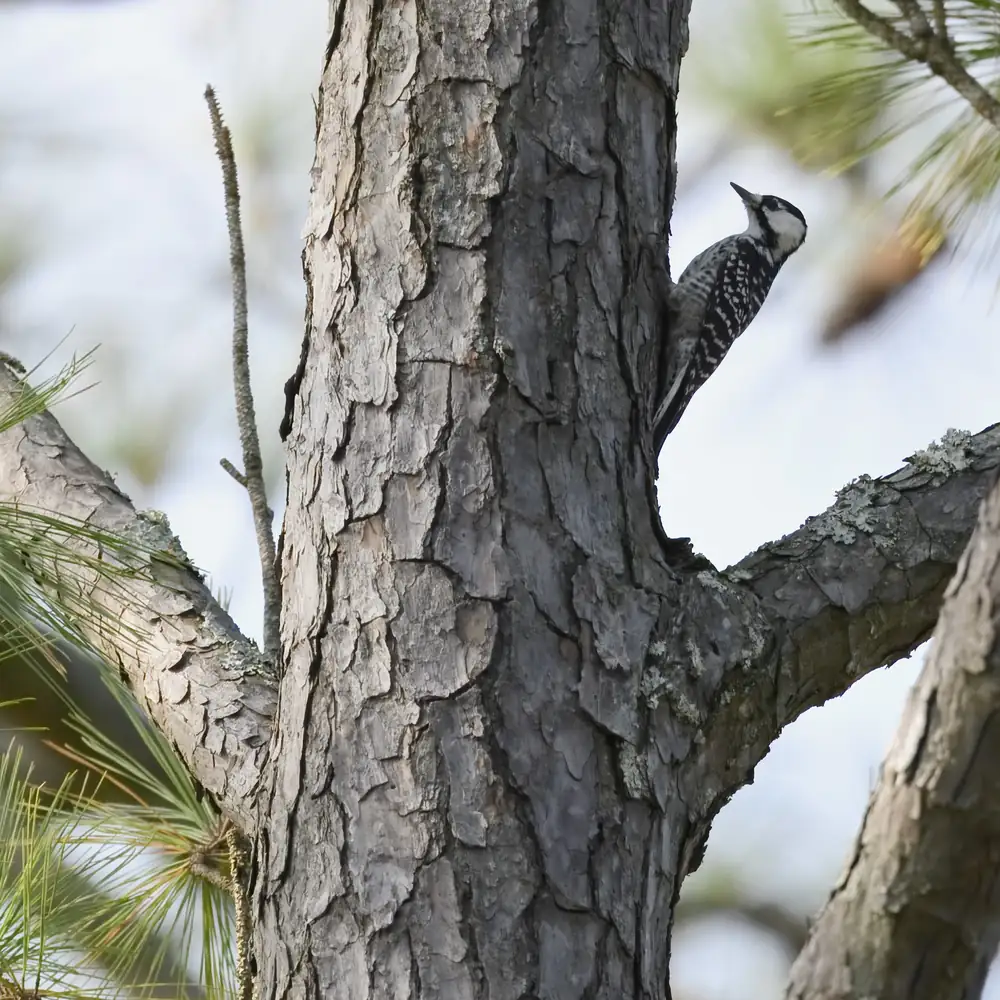
The Fish and Wildlife Service says the female usually lays three to five white eggs in mid-April, in the breeding male's roost cavity. They hatch after 10 to 12 days, among the shortest incubations of any bird, and the nestlings leave the cavity 24 to 27 days after hatching. These are cooperative breeders: a breeding pair may have up to six non-breeding helpers, and each bird has its own cavity in a living pine at least 65 to 80 years old. The birds keep resin wells flowing around the cavities, apparently to deter rat snakes. The Service lists Noxubee refuge as home to the species. Watch from a distance and keep dogs away from the tree.
-
Turkey hens on the nest
Incubation starts from mid-April to mid-May; most hens begin within a couple of weeks either side of May 1 · Dense ground cover, including young pine plantations
A publication from the state wildlife agency and Mississippi State University says very little incubation happens before mid-April, and that a hen sits almost constantly for about 28 days, leaving only for brief midday feeding breaks. Camouflage is her only defense, and the same source says only 20 to 40 percent of nesting attempts hatch a brood. Wet weather can lower success. If you flush a hen from a nest, back away quietly and do not return.
-
Monarchs and milkweed
Eggs laid from March on in the southern states; the next generation moves north from late April through May · Milkweed patches, gardens and roadsides
The Monarch Joint Venture says monarchs that wintered in Mexico begin heading north in March, laying eggs and feeding on nectar as they go, and that their offspring continue north through the central latitudes in approximately late April through May. A Crosby Arboretum column from April 2019 describes the Arboretum's research on native milkweeds in Mississippi and recommends swamp milkweed for home gardens, while warning that tropical milkweed is invasive and toxic. If you plant milkweed, plant a native kind and report your sightings to Journey North.
-
Bass on their nests
Spring, when the water is between 60 and 75 degrees · Brush piles, underwater logs and the shade of overhanging limbs
Mississippi's wildlife agency describes the male largemouth bass, the state fish, as the nest builder: he stays to guard the eggs, fans them until they hatch, and keeps watch over the young for a week or more afterward. The agency's record for rod and reel is 18.15 pounds, caught in 1992 in Natchez State Park Lake.
Nest sites fit a nest observed page in the Field Journal: write what you saw from a safe distance and then walk on.
When is the last spring freeze in Mississippi?
By April the question is mostly settled on the coast and still open in the northeast. In the NOAA normals below, the median last freeze falls on Feb 23 at Gulfport, Mar 8 at Hattiesburg and Mar 14 at Jackson, but not until Mar 21 at Tupelo and Apr 9 at Iuka. Gulfport is done by Mar 16 in nine years out of ten, and Tupelo and Natchez by Apr 6. Iuka's late date is Apr 24, a reminder that an April freeze is far from rare in the northeast hills.
| Station | One year in ten | Median | Nine years in ten |
|---|---|---|---|
| Iuka (northeast hills) | Mar 23 | Apr 9 | Apr 24 |
| Tupelo Regional Airport | Feb 28 | Mar 21 | Apr 6 |
| Greenville (Delta) | Feb 24 | Mar 13 | Mar 31 |
| Jackson International Airport | Feb 22 | Mar 14 | Apr 2 |
| Natchez (southwest) | Feb 25 | Mar 16 | Apr 6 |
| Hattiesburg (Pine Belt) | Feb 16 | Mar 8 | Mar 28 |
| Gulfport (coast) | Jan 25 | Feb 23 | Mar 16 |
Gardeners in the north who put out tomatoes in early April are betting against the late column. Freeze dates for the town nearest you are on our Mississippi frost page, and the National Weather Service issues freeze warnings when a late cold snap threatens tender plants.
How much daylight does Mississippi gain in April?
Between 51 and 61 minutes, though the gain slows a little week by week compared with March. Gulfport adds 51 minutes between April 1 and April 30, and Southaven adds 61. When April ends, the Sun spends more than 13 hours above the horizon anywhere in Mississippi, 13 h 20 m on the coast and 13 h 35 m near the Tennessee line. Sunrise comes earlier and sunset later, so both ends of the day move.
| City | Apr 1 | Apr 30 | Gained | Per day |
|---|---|---|---|---|
| Southaven | 12 h 34 m | 13 h 35 m | 61 min | 2.1 min |
| Tupelo | 12 h 34 m | 13 h 32 m | 58 min | 2.0 min |
| Columbus | 12 h 32 m | 13 h 29 m | 57 min | 2.0 min |
| Greenville | 12 h 33 m | 13 h 29 m | 56 min | 1.9 min |
| Jackson | 12 h 32 m | 13 h 26 m | 54 min | 1.9 min |
| Meridian | 12 h 32 m | 13 h 26 m | 54 min | 1.9 min |
| Hattiesburg | 12 h 30 m | 13 h 23 m | 53 min | 1.8 min |
| Gulfport | 12 h 29 m | 13 h 20 m | 51 min | 1.8 min |
Southaven picks up about 2.1 minutes a day and Gulfport about 1.8, so the north edges ahead as the month goes on. The clocks already moved on March 14, which means these lengths stay put whatever the clock says. The daylight tool covers other towns.
Is April tornado and flood season in Mississippi?
It can be, and the count swings widely from one April to the next. The National Weather Service office in Jackson publishes a tornado tally for each year, and its monthly breakdowns give these April counts for Mississippi: 34 in 2017, 20 in 2018, 67 in 2019, 24 in 2020 and 5 in 2021. The 2017 page calls its total the second highest April count since 1950, and the 2019 page says its 67 ties the most for any April, the same as 2011. The office's statistics page lists the widest Mississippi tornado since 1950 as 2.25 miles across, on April 12, 2019, in Covington County.
April is also wet. Normals at the six stations below run from about 5 to 5.8 inches of rain and melted snow, which is enough to put creeks over their banks after a stormy week. Nights are mild enough that freezes are rare at the stations shown. Tupelo averages half a night at 32 degrees or below, and the others average a third of a night or less.
| Station | Average high | Average low | Rain and melted snow | Freezing nights |
|---|---|---|---|---|
| Tupelo | 74.9 °F | 51.6 °F | 5.51 in | 0.5 |
| Greenville | 74.5 °F | 53.5 °F | 5.01 in | 0.2 |
| Jackson | 76.5 °F | 53.3 °F | 5.84 in | 0.1 |
| Meridian | 78.2 °F | 52.6 °F | 5.56 in | 0.3 |
| Hattiesburg | 78.0 °F | 53.9 °F | 5.37 in | 0.0 |
| Gulfport | 76.5 °F | 58.4 °F | 5.51 in | 0.0 |
Before a storm line arrives, decide where you would shelter and leave phone alerts switched on overnight. The Jackson office also posts river forecasts, so look up a stream before launching a boat. For the long view, NOAA issues a fresh seasonal outlook each month, and the place to read it is the Climate Prediction Center's 90-day maps, not this page. Our cloud guide and weather guide explain the skies that come with spring storms, the frost page has freeze dates for your town, and the March page has that month's tornado counts.
What can you see in the night sky over Mississippi in April?
Daylight time has been in force since March 14, so every clock time here and in the moon table is CDT. No eclipses fall in April 2027.
-
The Pink Moon
Full on Tuesday, April 20, at 5:27 p.m. CDT · Low in the east around 8 p.m.
The full moment comes late in the afternoon, before the Moon has risen, so on the evening of the 20th the Moon comes up already full, at about 8 p.m. in nearby cities (7:58 p.m. in Houston, 8:19 p.m. in Atlanta). The Sea and Sky calendar says early tribes called this the Pink Moon after moss pink, or wild ground phlox, one of the first spring flowers. It lists other names too, including Sprouting Grass Moon and, for the shad that swam upstream to spawn, Fish Moon.
-
A poor year for the Lyrids
Peak the evening of Thursday, April 22, about 8:41 p.m. CDT · Anywhere with dark skies, away from the Moon
Lyrid activity runs through the second half of April, and the International Meteor Organization puts the maximum at 01:41 universal time on April 23, which is the evening of the 22nd in Mississippi. With a nearly full Moon climbing at about 10 p.m., the dark window is just the early evening, and Sea and Sky expects the glare to drown the fainter streaks. At best a few meteors an hour will show, most of them bright. A shower that can reach about 20 an hour in a good year is not worth a late night this time.
-
Jupiter, Mars and the Moon
All month; the Moon passes both on April 14 and 15 · High in the south and southwest after dark
Jupiter, in Leo, hangs in the evening sky all spring. It stays up for roughly nine hours after dusk at the start of April and roughly seven by the start of May, so it is above the horizon most of the night. By our own calculation, the waxing Moon, about two-thirds lit, swings past Jupiter on the 14th and 15th, coming within a degree on the morning of the 15th, so both evenings should show a close pair. That same day the Moon also lies about 3 degrees from Mars, which glows at magnitude 0.0, brighter than most stars. Both planets fade slowly through spring.
-
Venus before dawn, Saturn out of sight
Venus all month; Saturn passes behind the Sun on April 7 · Low in the east before sunrise
Venus, the brilliant morning star, opens April with a 75-minute head start on the Sun and ends the month with about an hour. By our calculation, the thin old Moon sits close to it at dawn on April 3 and again on the 4th. Saturn slips behind the Sun on April 7 and only returns to the dawn sky toward month's end, and even then it is a faint, low target, up about 40 minutes ahead of the Sun on May 1.
-
The Milky Way before dawn
April 1 to 15 and April 27 to 30, around the April 6 new Moon · A dark site with a clear southeast sky before dawn
The galactic center is low in the south before dawn, and our calculation for 30 degrees north, the latitude of the coast, finds dark windows without the Moon from April 1 to 15 and again from April 27 to 30. Farther north the dates shift only slightly. The windows are short, but they grow longer in the coming months.
| Phase | Date | Time |
|---|---|---|
| New moon | Tuesday, Apr 6 | 6:51 p.m. CDT |
| First quarter | Tuesday, Apr 13 | 5:56 p.m. CDT |
| Full moon, the Pink Moon | Tuesday, Apr 20 | 5:27 p.m. CDT |
| Last quarter | Wednesday, Apr 28 | 3:18 p.m. CDT |
| New moon | Thursday, May 6 | 5:58 a.m. CDT |
The moon phase calendar lists every night, and the cloud guide helps when you cannot work out what is blocking the stars.
What can Mississippi families do outside in April 2027?
- Natchez Spring Pilgrimage, through April 10. Natchez Pilgrimage Tours lists the 2027 spring pilgrimage as March 11 to April 10, so the first days of April are the last stretch. These are paid house tours with gardens, so confirm times and tickets with the organizer.
- Strawberries and Cream Festival, Crosby Arboretum, Picayune. The Arboretum lists it as a Sunday in April, with free admission, ice cream, fresh strawberries and lemonade. No 2027 date was posted on the Arboretum's events page when this page was written, so check with the Arboretum. Its spring native plant sale also falls in March or April.
- Earth Day, Thursday, April 22, and National Arbor Day, Friday, April 30. Earth Day is always April 22. The Arbor Day Foundation says National Arbor Day is the last Friday in April. Mississippi marks its own Arbor Day on the second Friday in February, according to the Mississippi Forestry Commission, so tree giveaways come earlier in the year.
- City Nature Challenge photo weekend, April 30 through May 3. Cities around the world compete to photograph wild plants and animals, then spend May 4 to 16 identifying the finds, and results come out May 20. Its website shows which areas have joined, so look there before assuming yours has.
- Count frogs by ear. The Mississippi Amphibian Monitoring Program is a volunteer system with over 60 routes statewide, each surveyed three times a year, and the National Park Service's Vicksburg page describes it. FrogWatch USA, run through the Akron Zoo, offers another way to learn the calls.
- All month: CoCoRaHS and Journey North. Measure rain with CoCoRaHS, the volunteer rain, hail and snow network, or report a monarch or a first hummingbird to Journey North.
Organizers shift dates and weather can cancel an outing, so check with each host. Every state has a page through the nature hub, and the March page for Mississippi covers cranes, turkeys and frog nights.
Safety notes for April in Mississippi
- Spring turkey hunting. The wildlife agency's seasons table for 2026 to 2027 shows the regular spring season running March 15 to May 2. Residents may take one gobbler a day, three a season, and nonresidents two, only one before April 1, with nonresidents barred from public land before April 1 unless drawn. Hunters 16 and older need the Wild Turkey Stamp unless exempt. The statewide rules allow only shotguns loaded with No. 2 shot or smaller, plus bows and crossbows, for spring gobblers, and forbid running dogs where the season is open. Many wildlife management areas set their own turkey dates or permits, so read the area's rules. Walkers in turkey country at dawn should wear a bright cap or vest.
- Blaze orange. Under the 2025 to 2026 wildlife management area rules, orange or pink is required for firearm deer and hog hunts, for quail and rabbit hunters, and for horseback riders in any open season, and turkey is not mentioned. A 2026 to 2027 edition may have changed this, so check it before you go.
- Frog season. The state's seasons list frogs open from April 1 through September 30 at 25 a night. The table gives no details, so check MDWFP for license and method rules before going out with a light.
- Alligators. MDWFP says young alligators disperse in late spring and early summer, and may turn up in ditches, ponds, pools and parking lots. Never feed one, which is illegal. For an alligator in an unavoidable place, the hotline is 1-800-BE-SMART.
- Nests and strandings. Stay out of roped-off beach areas, keep dogs away from cavity trees, and call 1-888-SOS-DOLPHIN rather than touching a stranded animal.
- Storms and rivers. Know your shelter before a warning, and turn around at a flooded road.
- Snakes. Look before reaching into a woodpile or stepping over a log as the days warm.
Sources (48)
- Audubon: Birding in Mississippi
- National Park Service, Gulf Islands National Seashore: Sharing the shore with birds
- National Park Service, Gulf Islands National Seashore: Birds
- National Park Service, Gulf Islands National Seashore: Davis Bayou area
- Ship Island Excursions: The Ship Island ferry
- WLOX: Spring brings stranding season for dolphins along the Coast (March 2022)
- Mississippi Sportsman: Mississippi's mystery cobia (April 2013)
- Mississippi Department of Marine Resources: Recreational catch limits
- MSU Extension: Wet pine savannas are popping off in coastal Miss. (May 2026)
- Crosby Arboretum: April blooms (PDF)
- Crosby Arboretum: Bloom times
- Picayune Item, Crosby Arboretum column: Spring blooms (April 2022)
- Crosby Arboretum: Recurring events and hours
- National Park Service: Natchez Trace Parkway wildflowers
- U.S. Fish and Wildlife Service: Red-cockaded woodpecker species profile
- U.S. Fish and Wildlife Service: Sam D. Hamilton Noxubee National Wildlife Refuge
- MDWFP and MSU Extension: Wild turkey ecology and management (PDF)
- MDWFP: Wild Turkey Program
- MDWFP: General hunting rules and regulations
- MDWFP: 2026-2027 hunting seasons (PDF)
- MDWFP: 2025-2026 WMA regulations (PDF)
- MDWFP: Largemouth bass
- MDWFP: Alligator program
- Monarch Joint Venture: Monarch migration
- Picayune Item, Crosby Arboretum column: The monarchs are here, where's their milkweed (April 2019)
- Journey North: Monarch butterflies
- Journey North: All about ruby-throated hummingbird migration
- National Park Service: Amphibian monitoring in Vicksburg National Military Park
- FrogWatch USA
- CoCoRaHS: Community Collaborative Rain, Hail and Snow Network
- NWS Jackson: General tornado statistics for Mississippi
- NWS Jackson: 2017 Mississippi tornado count
- NWS Jackson: 2018 Mississippi tornado count
- NWS Jackson: 2019 Mississippi tornado count
- NWS Jackson: 2020 Mississippi tornado count
- NWS Jackson: 2021 Mississippi tornado count
- NOAA NCEI: U.S. climate normals 1991-2020, monthly (Tupelo, Greenville, Jackson, Meridian, Hattiesburg, Gulfport)
- NOAA NCEI: U.S. climate normals (freeze and frost dates)
- NOAA Climate Prediction Center: Seasonal outlooks
- U.S. Naval Observatory: Moon phases 2027
- Sea and Sky: Astronomy calendar 2027
- Natchez Pilgrimage Tours: Spring Pilgrimage 2027
- Living History Natchez
- City Nature Challenge
- Earth Day Network (earthday.org)
- Arbor Day Foundation: History of Arbor Day
- Mississippi Forestry Commission: Governor proclaims Mississippi Arbor Day
- Photos via Wikimedia Commons; licenses and photographers are listed on each file page