What to look for in nature in Mississippi this December
Winter arrives in Mississippi on the calendar December 1 and on the ground whenever the first hard front comes through. By mid-month the Delta’s rice fields are white with snow geese and the duck count is climbing toward its January peak. Christmas Bird Count teams spread out from Vicksburg to the coast, and on rainy nights the first frog choruses of the year start up in flooded ditches. The hardwoods stand bare, which makes it the best month to learn magnolia, holly, mistletoe and the other plants that stay green. December opens with the year’s earliest sunsets, turns on the solstice of the 21st and closes its third week with a supermoon.
Other months in Mississippi: October, November.
Start here
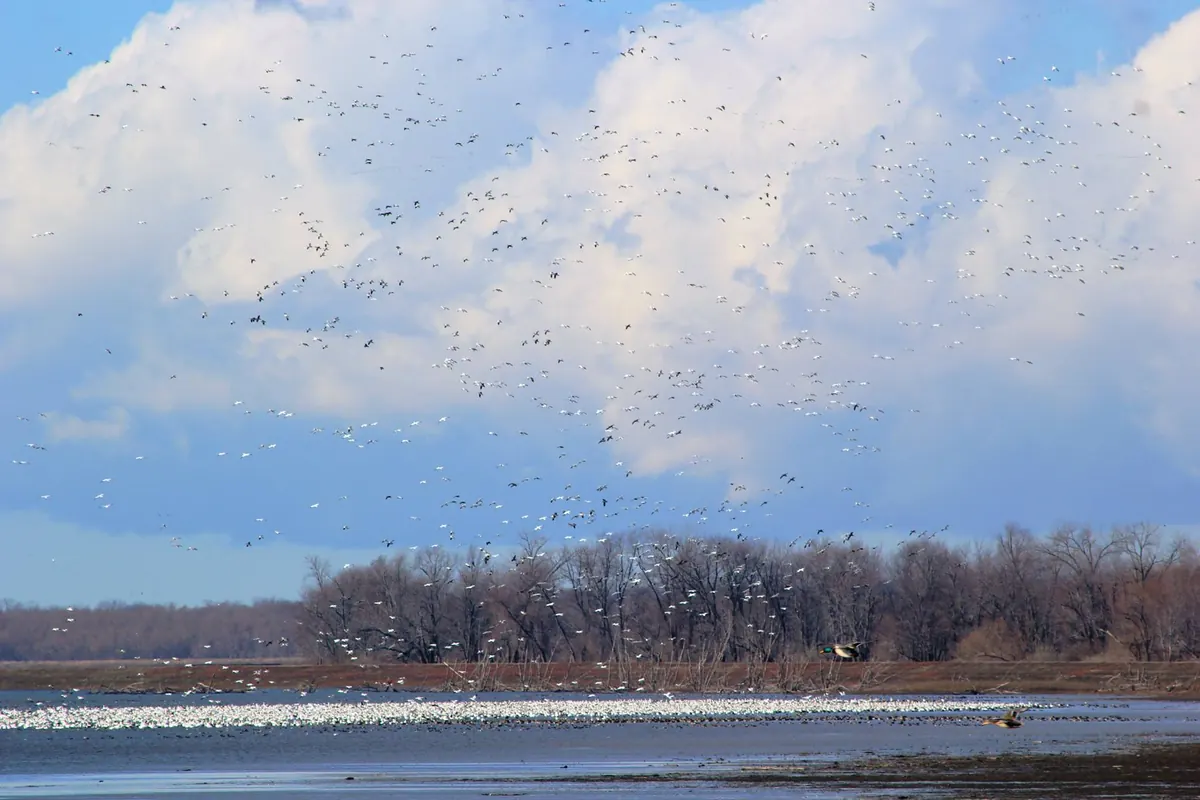
- Drive the Delta for snow geese. MDWFP’s mid-December flights in 2024 and 2025 both found large flocks of snow, blue and Ross’s geese spread across the Delta, where November’s survey had found few. Go at first light on farm roads near the refuges, and stay in the car so you don’t flush them.
- Join a Christmas Bird Count. Counts run December 14 to January 5. Vicksburg counts on Saturday, December 19, and Jackson and Leroy Percy State Park on Saturday, December 26; contact the compiler ahead of time to join a team.
- Geminids, then the Cold Moon. On the night of December 13, the crescent Moon sets early and the Geminids can reach dozens an hour after midnight. Ten days on, the evening of the 23rd brings the nearest full moon of 2026, coming up in the east as the light fades.
In the Naturalist’s Field Journal, the first snow geese of the winter go in the daily field log, and your Christmas Bird Count finds go to “birds I have seen.” A holly sprig or magnolia leaf suits a tree through the seasons, a winter frog chorus belongs on the map of sounds, a raccoon print from creek mud goes on tracks to know, and the Geminids and the Cold Moon fill the dusk and dawn watch.
Regions used below: The Delta; North Mississippi hills and Tupelo; Central Mississippi and Jackson; The Pine Belt; Southwest Mississippi and Natchez; The Gulf Coast.
When do snow geese and the big duck flocks fill the Mississippi Delta?
December is when the Delta goes from promising to crowded. MDWFP biologists fly their second waterfowl survey of the season in mid-December, and the reports from the last two winters read almost the same way: far more ducks than in November, and, “in stark contrast to November,” big flocks of snow, blue and Ross’s geese spread across the region along with many white-fronted geese. The agency adds that wintering waterfowl usually peak in January, so December is the build-up, not the summit.
-
The December flight
Mid-December; the 2025 survey flew December 15 to 19 · The Delta from the Mississippi River east to the loess hills
Last December the plane counted its way to an estimated 390,183 ducks, up from November but about 19 percent under the December long-term average. Mallards jumped to 92,947, the best December mallard figure since 2020, while gadwall and northern shovelers again led the other dabblers and scaup and ruddy ducks led the divers. Ice that week pushed ducks into deeper sloughs and oxbows or into tight packs that kept small holes open. The northeastern Delta, where the most flooded habitat was, held the most birds of every kind. Expect the 2026 report on MDWFP’s aerial survey page a few days after the flight.
-
Light geese in the rice country
Through December, building toward January · Harvested rice, soybean and corn fields, often near Delta refuges and catfish ponds
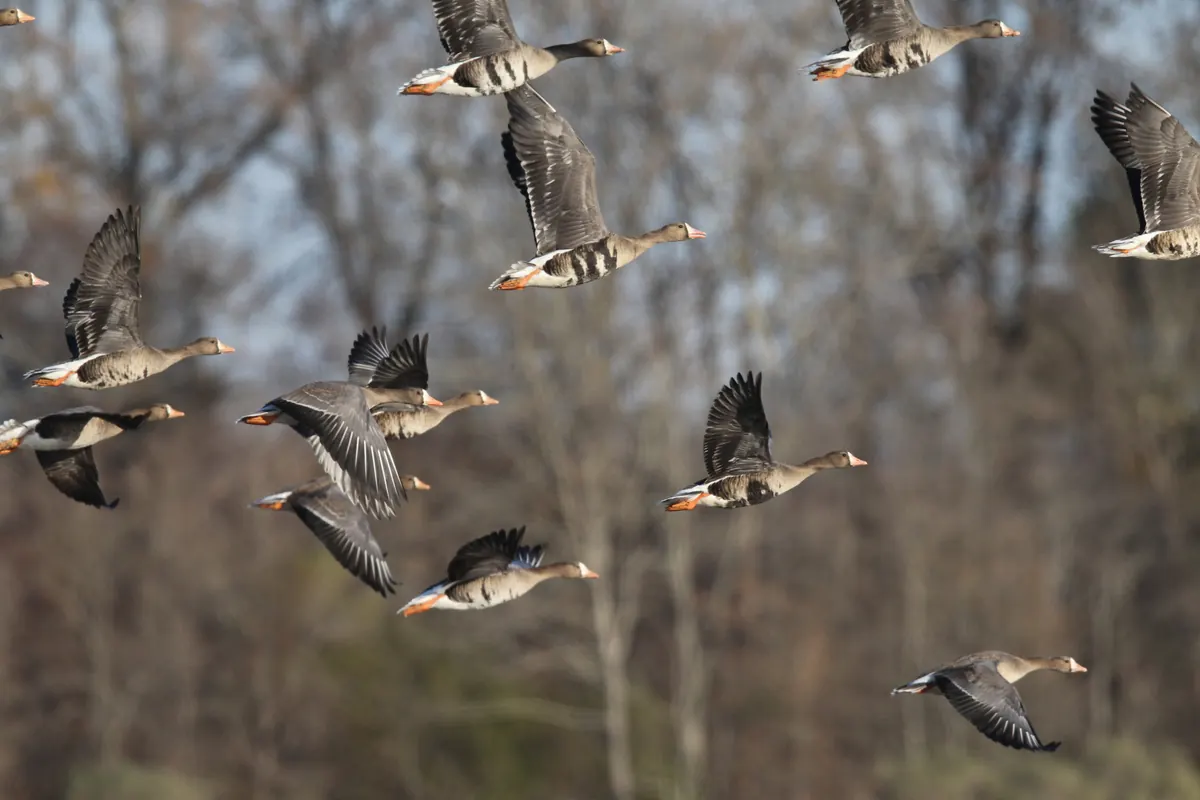
A field of snow geese looks like a late snowfall until the whole sheet lifts at once. The “blue” birds are a dark color phase, not a separate species; the smaller white ones with short, stubby bills are Ross’s geese. White-fronted geese travel in smaller, browner flocks and give a laughing, high-pitched call. MDWFP’s December maps for 2025 placed light goose flocks across much of the Delta rather than in one or two spots, so a slow drive on Delta farm roads at first light has a fair chance of finding them. Nearly all of this is private farmland; birdwatch from the shoulder.
-
Why water decides where the birds go
All winter · Public impoundments and large private wetland complexes
The 2024 and 2025 December reports both found Delta wetlands below average and many harvested fields disked, burying the waste grain ducks rely on. Birds massed on public impoundments and large managed private wetlands, and divers stuck to aquaculture ponds. With a drought fall behind it, the 2026 season will again depend on how much December rain the Delta catches and holds.
| December survey | Mallards | Other dabblers | Diving ducks | Total ducks |
|---|---|---|---|---|
| 2020 | 99,767 | 167,139 | 143,458 | 410,365 |
| 2021 | 26,403 | 151,460 | 177,615 | 355,478 |
| 2022 | 44,554 | 155,597 | 73,045 | 273,196 |
| 2023 | 29,753 | 108,173 | 21,809 | 159,735 |
| 2024 | 49,533 | 210,620 | 41,975 | 302,128 |
| 2025 (Dec 15–19) | 92,947 | 223,389 | 73,847 | 390,183 |
| Average, 2007–2025 | 113,358 | 256,942 | 112,409 | 482,708 |
The swings are huge: the December total has ranged from about 160,000 in 2023 to nearly 970,000 in 2013. A cold, wet December up the Mississippi Valley and plenty of shallow water at home usually mean more birds. Duck and goose seasons reopen December 4, so give hunting areas room at dawn; the safety notes list the dates.
How do you join a Christmas Bird Count in Mississippi?
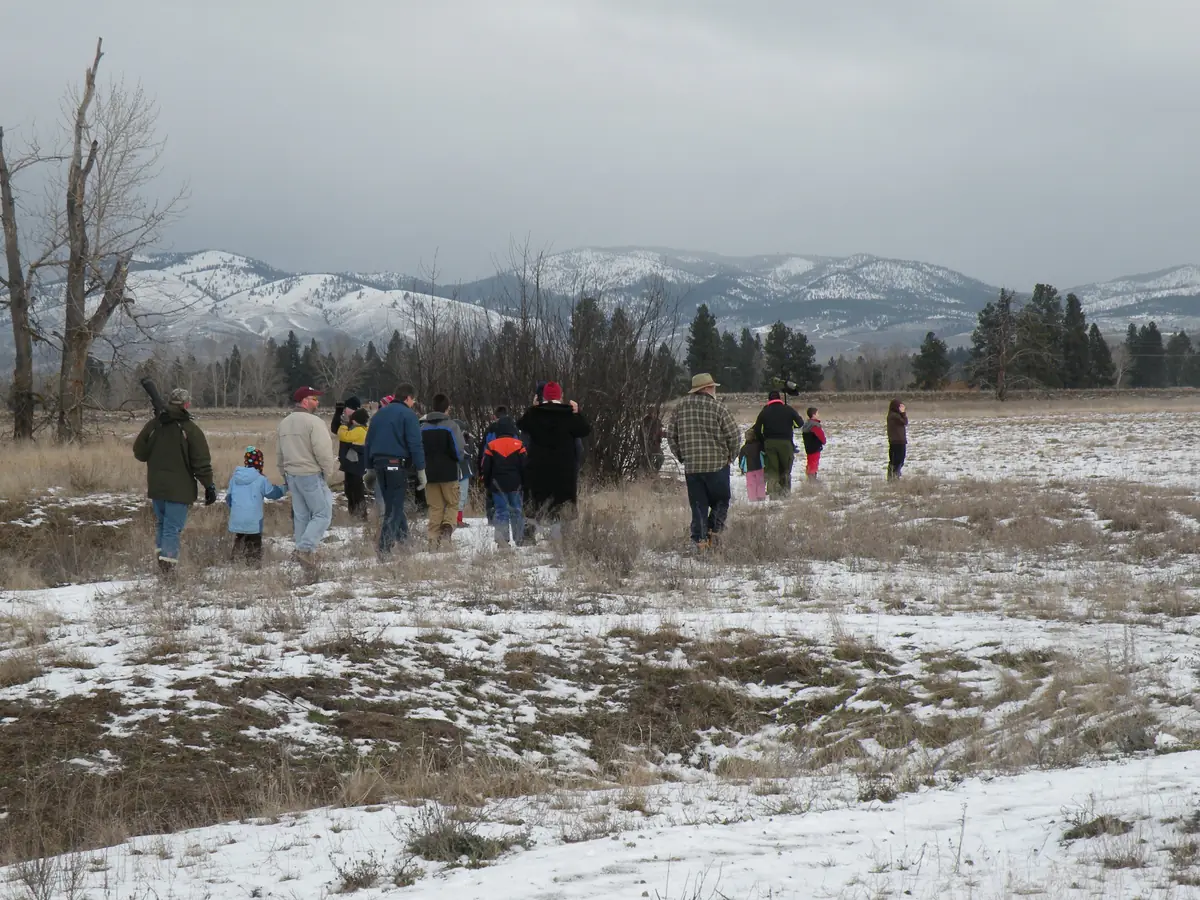
For 2026–27, counts can be held on any single day from mid-December (the 14th) until the 5th of January. On a single day within that span, each team works a circle 15 miles wide and tries to record every bird inside it. Mississippi ran nineteen counts in the 125th season (2024–25), from Arkabutla Lake and Strawberry Plains in the north to Natchez, Hattiesburg and the coast, and together they found 197 species on count day. Many counts welcome newcomers who pair up with a seasoned team leader, and feeder watchers who live inside a circle can usually count their own yard.
-
Vicksburg and Jackson counts
Vicksburg: Saturday, December 19, 2026. Jackson: Saturday, December 26, 2026 · Circles centered near Vicksburg and the Jackson metro
Jackson Audubon Society lists both dates on its calendar, along with the compiler to contact for an assignment. In the 2024–25 season the Jackson circle found 102 species, a strong total for an inland count.
-
A count at Leroy Percy State Park
Saturday, December 26, 2026, about 6 a.m. to 5 p.m. · Leroy Percy State Park, west of Hollandale in Washington County
MDWFP lists this Delta count on its events calendar and says birders of every skill level are welcome. Sign up through the compiler named on the park’s event listing before the day.
-
The coast counts lead the state
Dates are set each fall, mid-December to early January · Southern Hancock County and Jackson County circles
Mississippi Coast Audubon Society runs both, and they are the state’s richest: in the 125th count Jackson County found 142 species and Southern Hancock County 141, the two highest totals in the state. The society says these long, all-weather days suit solid birders rather than first-timers, and it posts each year’s dates on its website and social pages.
-
Noxubee and the hill counts
Mid-December to early January · Sam D. Hamilton Noxubee National Wildlife Refuge, Tupelo, Grenada, Sardis Lake and others
Noxubee’s circle found 113 species in the 125th count. For any other circle, Audubon’s online map shows its outline and how to reach the compiler.
Audubon’s Alabama and Mississippi summary for that season blamed a long July-to-December drought for fewer ducks and sparrows on some counts, which is worth remembering after this year’s dry fall. Write your count-day list in the Naturalist’s Field Journal, then see how it compares once your circle’s results are posted.
Why are frogs calling in Mississippi in December?
Because for several Mississippi frogs, winter is the breeding season. Cold fronts bring the soaking rains that fill shallow, temporary ponds, and those ponds have one great advantage: they dry up in summer, so no fish live in them to eat eggs and tadpoles. On a mild, rainy December night, a roadside ditch or a woodland pool can be louder than it was in July.
-
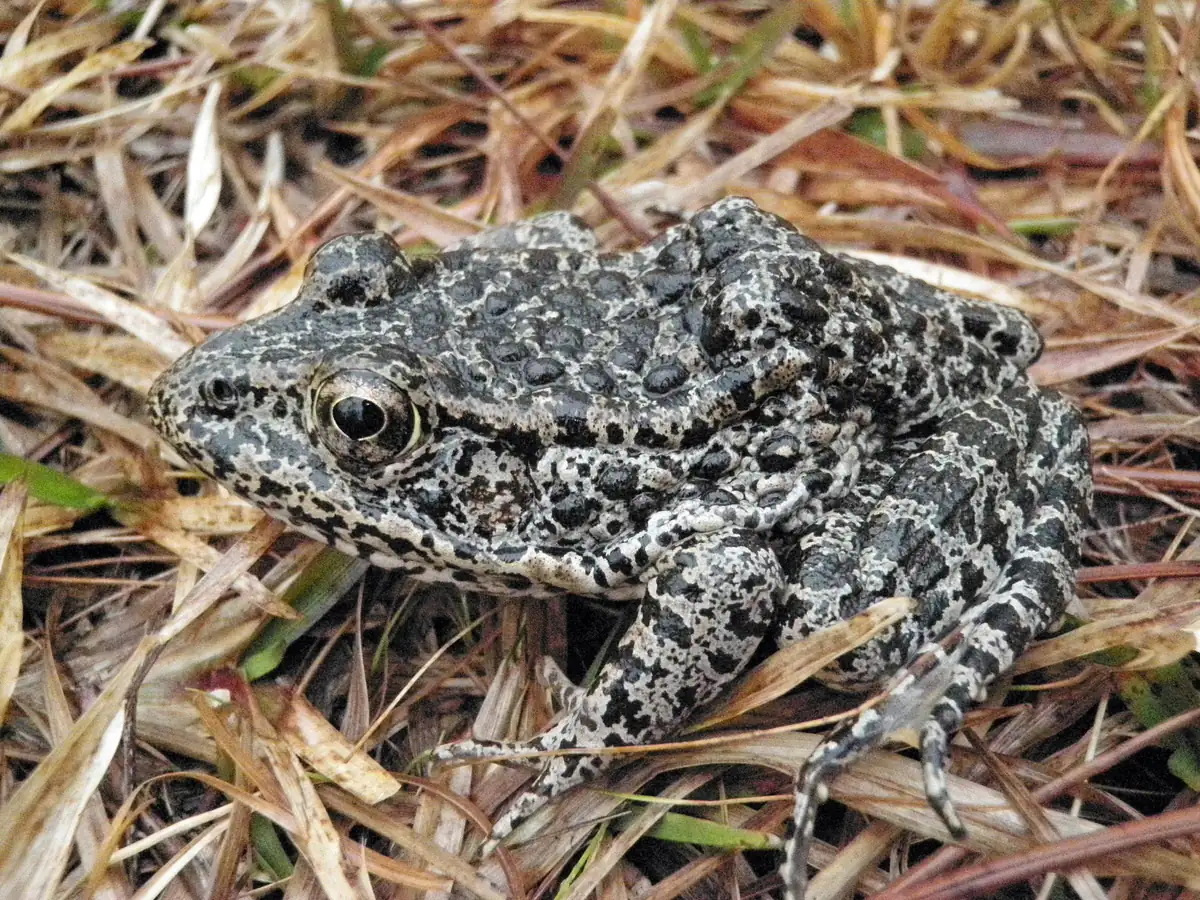
The dusky gopher frog
Breeding usually December through March, after heavy rain · A few restored ponds in longleaf pine forest in south Mississippi, including Glen’s Pond on the De Soto National Forest in Harrison County
This endangered frog survives in the wild only in Mississippi. The Fish and Wildlife Service’s recovery plan says the adults spend most of their lives underground in stump holes and small mammal burrows, and historically in gopher tortoise burrows, then travel to breeding ponds on the rains that come with passing cold fronts. The breeding call is a low, snoring croak. From its discovery in 1988 until 2004, Glen’s Pond held the only known population, and biologists have since restored more ponds and moved frogs to them. The ponds are few and fragile, so this is a frog to know about rather than go looking for; the best way to help is to support prescribed burning, which keeps longleaf forests open and the ponds sunny.
-
Spring peepers and chorus frogs
Warm, wet nights from late fall into early spring · Flooded ditches, woodland pools and wet pastures across most of the state
The spring peeper is a small brown or orange frog with a dark X on its back. Its name fits poorly in the South: the North Carolina Wildlife Resources Commission calls it more of a “winter peeper,” breeding in winter and even autumn in the southern parts of its range, with the busiest choruses on rainy nights. In Mississippi, listen for it on mild, wet nights from late fall into early spring. The call is a clear, high “peep,” repeated slowly and evenly, and a ditch full of them carries a long way on a still night.
Listen from the road edge or your porch rather than wading into pools, and keep a note of each first chorus, with the date, temperature and rain, on the map of sounds page. If you drive at night after a winter rain, slow down near wet ground; frogs and salamanders cross roads in numbers on those nights.
How do Mississippi animals get through the winter?
Mostly by slowing down, not by sleeping for months. Mississippi winters come in short cold snaps between mild spells, and many animals here stay at least partly active all season. December is a good month to see the strategies in action, because the leaves are down and tracks show in mud and sand.
-
Black bears in the den
Females den first; cubs are born in January · The Delta bottoms, the loess bluffs of southwest Mississippi and the coastal counties
MDWFP explains that black bears are not true hibernators. In their winter torpor, body temperature falls, metabolism drops by about half and the heart slows to 15 to 30 beats a minute. Pregnant females must den to give birth and go in first, followed by females with young and then solitary bears, with males last; some males stay in only a few weeks. Mississippi bears den for a shorter time and stay more active in winter than bears farther north, probably because food is easier to find. In flood-prone bottoms, dens are often hollows high in cypress or oak; on higher ground a bear may simply rake together a ground nest. Newborn cubs weigh about half a pound. If you find a den, leave quietly.
-
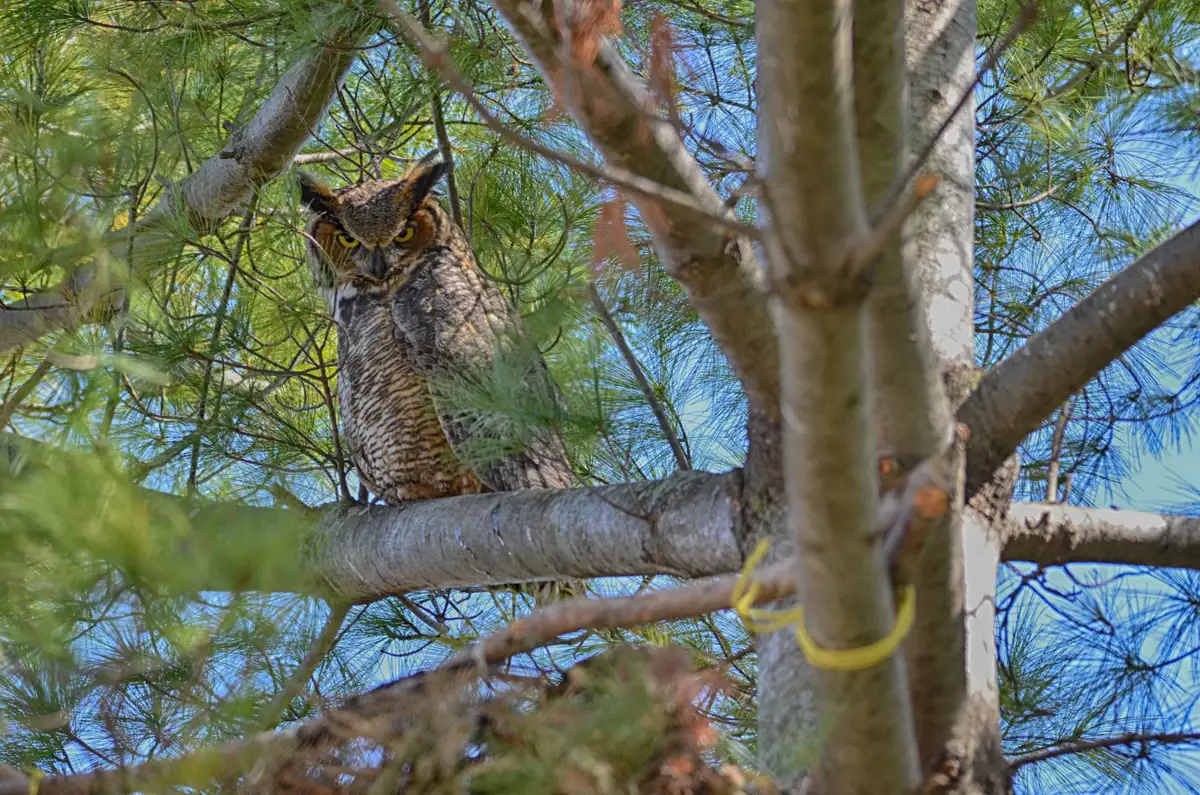
Great horned owls already nesting
Hooting on December nights; nesting begins in winter · Woodlots, farm edges, city parks and river bottoms statewide
While most birds are simply getting by, great horned owls are starting families. Audubon’s field guide notes that they begin nesting very early and that their deep hoots carry through the woods on midwinter nights. They build almost nothing, taking over an old nest of a hawk, crow, heron or eagle, and lay two or three eggs that the female incubates for about four to five weeks. At dusk, listen for a pair hooting back and forth.
Look for signs as well as animals: raccoon handprints in creek mud, deer trails through bare woods, squirrel leaf nests that show in the treetops once the leaves are down. They belong on the tracks to know and reading the signs pages.
Which trees and plants stay green in Mississippi in winter?
Once the hardwoods drop their leaves, Mississippi’s woods turn out to be full of green. Some of it is evergreen trees and shrubs, some grows on other trees, and one fern greens up only after rain. With the hardwoods bare, they are easy to pick out now.
-
Southern magnolia, the state tree
Evergreen all year · Rich woods and stream terraces, especially in the south; planted everywhere
The magnolia is both Mississippi’s state tree and its state flower. In winter you notice the leaves: thick and leathery, 5 to 10 inches long, shiny above and rusty below. Look also for the cone-like seed pods, whose large red seeds dangle on silky threads when the pods open. Fallen magnolia leaves are tough and slow to rot, and they make good leaf rubbings.
-
American holly and yaupon
Berries through winter · Moist woods and fencerows statewide (holly); coastal plain thickets and yards (yaupon)
American holly is the classic Christmas holly, a pyramid-shaped tree with spine-tipped, dull green leaves. Only female trees bear the red berries. Songbirds, game birds and mammals eat them, but they are poisonous to people, so keep them away from small children. Yaupon has small, round-toothed leaves without spines.
-
Mistletoe and Spanish moss
Easiest to see December to February · Mistletoe high in hardwoods such as oaks and hackberries; Spanish moss on live oaks and cypress, mostly in the southern half
Those round green clumps in bare treetops are oak mistletoe, a semi-parasitic shrub with green, jointed stems that grows on the sunny branches of hardwoods. Spanish moss is neither a moss nor a parasite but an air plant that makes its own food and takes in water and minerals through tiny scales on its gray threads.
-
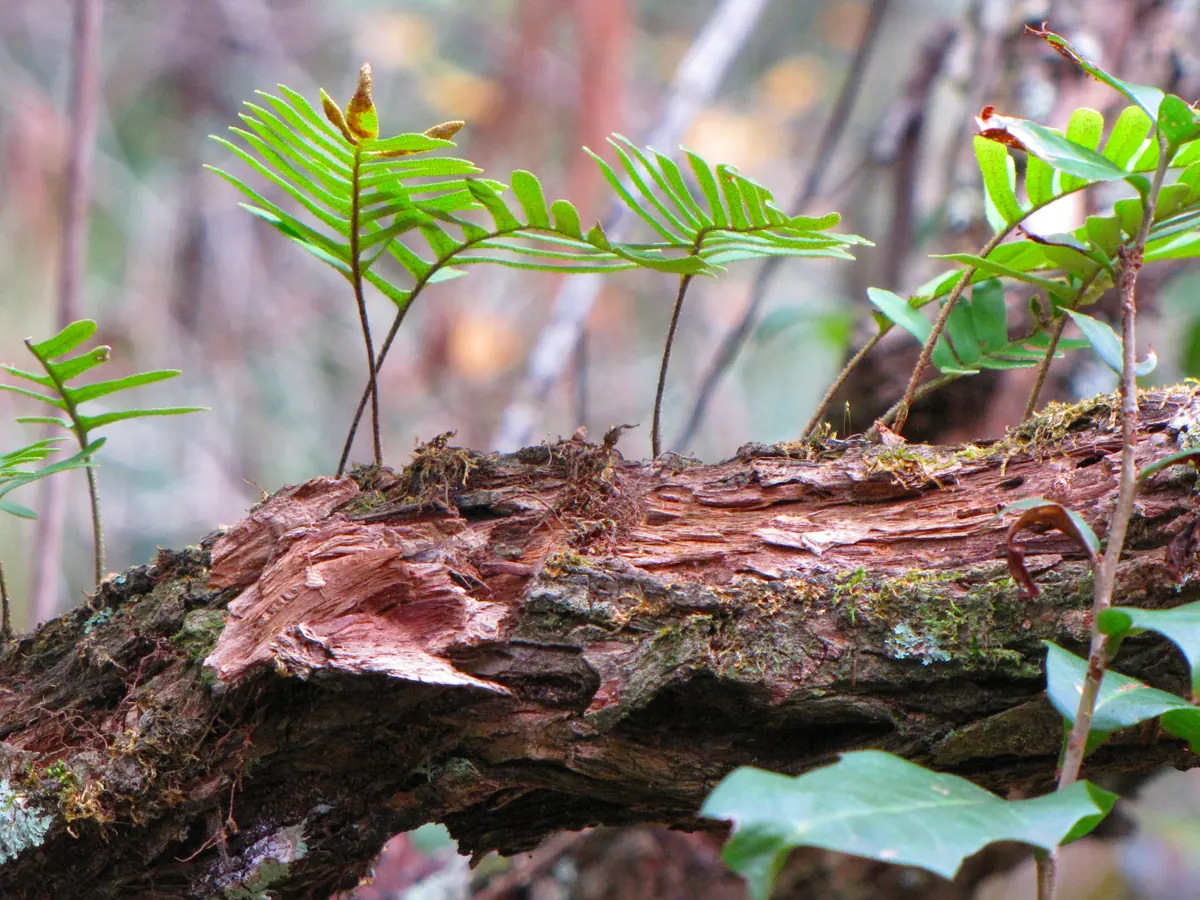
Resurrection fern after rain
Any wet spell; brown and curled in dry weather · Upper sides of live oak and other big hardwood limbs
After the dry fall, many oak limbs are coated with what look like dead brown curls. LSU AgCenter notes that this harmless air plant can lose up to 97 percent of its moisture and still turn green again within hours of a good rain. Check one limb before and after a winter front to see the change.
-
Longleaf pine and bare cypress
All winter · Pine Belt and coastal uplands (longleaf); swamps, oxbows and the Natchez Trace’s Cypress Swamp (cypress)
Longleaf carries the longest needles of any eastern pine, in bundles of three, and its seedlings spend years in a tufted “grass stage” near the ground. Bald cypress, though a conifer, sheds its needles each autumn, so in December a cypress swamp is all gray trunks and knees standing in dark water.
Pick one evergreen and one bare tree near home and sketch both on the tree through the seasons plate; you will come back to them in spring. A cone, a magnolia seed head and a holly leaf fit the seeds, pods and cones page.
When is the earliest sunset in Mississippi, and how short is the shortest day?
The earliest sunsets of the year come before the solstice, in the first week of December, at about 4:45 p.m. in Tupelo and Columbus, 4:48 in Southaven and 4:55 in Jackson and Gulfport. The shortest day is December 21, when Southaven gets 9 h 48 m of daylight and Gulfport 10 h 11 m. The two do not line up because the latest sunrises come after the solstice: in Jackson the Sun rises at 6:58 a.m. on the 21st and at 7:02 on December 31, still creeping later into the first week of January. Evenings, meanwhile, are already gaining. Jackson’s sunset moves from 4:55 p.m. on December 1 to 5:00 at the solstice and 5:06 on New Year’s Eve.
| City | Dec 1 | Dec 21 | Dec 31 | Earliest sunset |
|---|---|---|---|---|
| Southaven | 9 h 58 m | 9 h 48 m | 9 h 51 m | 4:48 p.m., Dec 5 |
| Tupelo | 10 h 02 m | 9 h 52 m | 9 h 54 m | 4:45 p.m., Dec 5 |
| Columbus | 10 h 06 m | 9 h 56 m | 9 h 58 m | 4:45 p.m., Dec 4 |
| Greenville | 10 h 06 m | 9 h 57 m | 9 h 59 m | 4:56 p.m., Dec 4 |
| Jackson | 10 h 11 m | 10 h 02 m | 10 h 04 m | 4:55 p.m., Dec 3 |
| Meridian | 10 h 11 m | 10 h 02 m | 10 h 04 m | 4:49 p.m., Dec 4 |
| Hattiesburg | 10 h 16 m | 10 h 07 m | 10 h 09 m | 4:54 p.m., Dec 3 |
| Gulfport | 10 h 20 m | 10 h 11 m | 10 h 13 m | 4:55 p.m., Dec 2 |
Sunset times barely move near the minimum, so each date in the last column is the middle of the week or two when sunset holds at its earliest minute. Look up your own town’s winter sunrises and sunsets in the Field almanac.
What is December weather like in Mississippi, and could El Niño make it wetter?
December is mild by national standards, and rainy: Jackson’s normal December rainfall tops both October’s and November’s. NOAA’s 1991–2020 normals give Jackson an average December high of 59.6 °F, a low of 38.7 °F and 5.13 inches of rain, with about 11 nights at or below freezing. Tupelo runs cooler (55.6 and 36.3 °F, 5.94 inches, nearly 14 freezing nights), while Gulfport averages 63.5 and 44.6 °F with only about four freezing nights. Greenville, in the Delta, is about as chilly as Tupelo, while Meridian and Hattiesburg sit between Jackson and the coast; and the freeze dates for each station are on the Mississippi frost page.
Snow is rare but not unheard of. On December 8, 2017, a band of heavy snow fell from Brookhaven to Meridian; the Jackson weather office measured 5.1 inches at its own site, the most there since 1982, and two spots reported 8 inches. On December 10 and 11, 2008, a similar storm dropped up to 9 inches near New Hebron with temperatures hovering between 32 and 35 °F. NOAA’s normal December snowfall is half an inch at Jackson and a tenth of an inch at Tupelo and Meridian, which tells you most Decembers bring none.
December storms can also be violent. Between about 4:10 and 5:25 p.m. on December 23, 2015, an EF4 tornado with peak winds near 170 mph tracked 75 miles from Tate County through Holly Springs and Ashland into Tennessee, killing nine people, according to the Memphis weather office. Keep weather alerts on through the holidays.
Out in the tropical Pacific, a powerful El Niño has taken hold; federal forecasters (the September 10 ENSO discussion) put better than nine-in-ten odds on a very strong episode carrying through the winter. The Jackson weather office describes what that has usually meant here: a jet stream bent farther south, a deep trough over the middle of the country, and wetter, cooler winters and springs across the Gulf states. For a drought-stressed state, that could finally refill ponds, swamps and duck impoundments. For the official NOAA winter outlook (due October 15), read the maps themselves at cpc.ncep.noaa.gov.
| Station | Average high | Average low | Rain and melted snow | Freezing nights | Snowfall |
|---|---|---|---|---|---|
| Tupelo | 55.6 °F | 36.3 °F | 5.94 in | 13.8 | 0.1 in |
| Greenville | 55.2 °F | 37.1 °F | 5.10 in | 11.0 | – |
| Jackson | 59.6 °F | 38.7 °F | 5.13 in | 11.1 | 0.5 in |
| Meridian | 61.1 °F | 38.6 °F | 5.27 in | 12.9 | 0.1 in |
| Hattiesburg | 62.3 °F | 40.5 °F | 4.98 in | 9.7 | – |
| Gulfport | 63.5 °F | 44.6 °F | 4.49 in | 4.0 | – |
Before heading out to a stand, a CBC route or a frog pond after dark, check the hour-by-hour forecast on our local weather page.
What can you see in the night sky over Mississippi in December?
Long nights and a moonless start to the Geminids make December one of the best sky months of the year. All times below are Central Standard Time.
-
The Geminid meteors
Night of Sunday, December 13, into Monday the 14th · Anywhere dark; the radiant in Gemini rises in the east-northeast after dusk
The IMO, the international body that tracks meteor showers, puts the Geminids’ theoretical best at 150 per hour, and in 2026 a slim crescent Moon is gone from the western sky around 9 p.m., so moonlight is no problem after that. Gemini climbs all evening, and counts are usually highest in the small hours, near 2 a.m. Real skies never reach that ideal, but from a dark spot in the Delta or a national forest you may still see a meteor every minute or two; from town, far fewer. Many are bright, unhurried streaks, a few tinged yellow or green.
-
The solstice
Monday, December 21, 2:50 p.m. CST · Watch where the Sun sets that evening: as far south on the horizon as it gets
That instant marks astronomical winter: the Sun stands farthest south of the equator all year. Weather records treat the 1st of the month as winter’s start instead, grouping the three coldest months (December through February) as one season. Note the sunset spot from a fixed window and check it again in March.
-
The Cold Moon, the year’s closest full moon
Full at 7:28 p.m. Wednesday, December 23; nearly as full on Christmas Eve · Rising in the east-northeast near sunset
This one is a supermoon: within a single night the Moon is both full and at perigee, its low point in a slightly oval orbit, so it shines a shade bigger and brighter over Mississippi than any other full moon this year. Watch it clear the treeline just after sunset, when it looks largest. On the 21st, two nights before, the gibbous Moon is near the Pleiades as the sky darkens.
-
Planets: Saturn after dark, Venus before dawn
All month · Saturn in the south and southwest in the evening; Venus low in the southeast before sunrise
Saturn hangs in the southern sky at nightfall, unrivaled until the morning planets rise, and it sets a little sooner every week. Venus is a brilliant morning star, higher every morning this month; it swings farthest from the Sun (as we see it) on January 3. Before sunrise on the 4th, then the 5th, an old crescent Moon keeps company with Venus and the blue-white star Spica. Jupiter and Mars, both in Leo, rise before midnight and shine high in the south at dawn.
| Phase | Date | Time |
|---|---|---|
| Last quarter | Tuesday, Dec 1 | 12:08 a.m. CST |
| New moon | Tuesday, Dec 8 | 6:52 p.m. CST |
| First quarter | Wednesday, Dec 16 | 11:42 p.m. CST |
| Full moon, the Cold Moon | Wednesday, Dec 23 | 7:28 p.m. CST (a supermoon; still nearly full on Dec 24) |
| Last quarter | Wednesday, Dec 30 | 12:59 p.m. CST |
| New moon | Thursday, Jan 7, 2027 | 2:24 p.m. CST |
A nearly full Moon spoils the small Ursid shower around the 22nd. The Quadrantids, overnight from January 3 to 4, get a dark sky with only a thin crescent. See the moon phase calendar for rise and set times, and the cloud cover map before a late night out.
What can Mississippi families do outside in December 2026?
- Friday, December 4, 9 a.m. to noon: S.T.E.M. with Snowflakes at the state’s natural science museum in LeFleur’s Bluff State Park, Jackson. Children cut paper snowflakes, play with instant snow and dry ice and hear the story of “Snowflake” Bentley, who first photographed snow crystals. Included with museum admission.
- Saturday, December 5, 8 to 10 a.m.: family bird walk at LeFleur’s Bluff State Park, led by Jackson Audubon Society; park entrance fee only.
- Saturday, December 12, 10 a.m. to noon: Cookies with Santa at J.P. Coleman State Park near Iuka, with cookie decorating and photos; included with park admission.
- Saturday, December 12, 6 to 8:30 p.m.: Snow Much Fun at the Museum of Natural Science, an evening of indoor “snow,” winter science activities and the museum’s Ice Age story. Tickets in advance through noon on December 11, or at the door.
- Sunday night, December 13: the Geminids. After the Moon sets, lie back on a blanket in the darkest spot you can reach and count meteors for half an hour.
- Saturdays, December 19 and 26: Christmas Bird Counts at Vicksburg (the 19th) and at Jackson and Leroy Percy State Park (the 26th). Patient older children make good spotters.
- December 23, at sunset: watch the Cold Moon lift over the trees, the largest full moon of 2026.
- Friday, January 1, 2027: First Day Hikes. Buccaneer State Park in Waveland invites walkers onto its Pirate’s Alley Nature Trail, included with park admission. More parks usually take part; watch MDWFP’s First Day Hikes page for this year’s list.
- All month: citizen science. Enter backyard bird lists in eBird, and keep counting for Project FeederWatch if you signed up in November.
Programs can change with weather, so check each listing on MDWFP’s events calendar or with the organizer before you go. The nature guides cover every state, and the November page has the fall story leading into this one.
Safety notes for December in Mississippi
- Deer seasons run all month. In every deer management unit, gun season with dogs ends December 1, primitive weapon season runs December 2 to 15, gun season without dogs December 16 to 23, and gun season with dogs reopens December 24 and lasts to January 20.
- Wear fluorescent orange or pink. During any firearms deer season, MDWFP rules call for 500 square inches of unbroken blaze orange or pink worn in plain sight, on the way to the stand as well; the exceptions are elevated stands 12 feet or higher and fully enclosed blinds. Because the gun and muzzleloader weeks follow one another all December, anyone walking the woods this month should put on a bright orange cap and vest too.
- Waterfowl and other seasons. The special light goose conservation order runs November 30 to December 3. Duck and goose seasons are open December 4 to 6 and again from December 9 to January 31, with shooting from half an hour before sunrise. Woodcock season opens December 18 and the third dove split December 26. Quail, rabbit and squirrel seasons are open. Refuges and wildlife management areas have their own hunt days, so check them before a winter walk.
- Cold water. December lakes and rivers are cold enough to bring on hypothermia after a fall overboard. Duck hunters and paddlers alike should keep a life jacket on, not just aboard.
- Short days. Sunset comes before 5 p.m. in much of the state in early December. Carry a light on any afternoon hike, and wear a reflective layer near roads at dusk, when deer are also moving.
- Winter storms. The Holly Springs tornado of 2015 struck as darkness fell, two days before Christmas. Know where you would shelter, including at a hunting camp. On the rare icy morning, stay off bridges and overpasses until they are treated.
Sources
- MDWFP: aerial waterfowl survey reports
- MDWFP: Aerial Waterfowl Survey Report, December 15 to 19, 2025 (PDF)
- MDWFP: Aerial Waterfowl Survey Report, December 10 to 13, 2024 (PDF)
- MDWFP: waterfowl program
- Audubon: Christmas Bird Count (December 14 to January 5)
- Audubon: the 125th Christmas Bird Count in Alabama and Mississippi
- Audubon: join or start a Christmas Bird Count (circle map)
- Jackson Audubon Society: calendar (Vicksburg and Jackson counts, LeFleur’s Bluff bird walks)
- MDWFP: Leroy Percy State Park Christmas Bird Count, December 26, 2026
- Mississippi Coast Audubon Society: Christmas Bird Count
- U.S. Fish and Wildlife Service: Sam D. Hamilton Noxubee National Wildlife Refuge
- U.S. Fish and Wildlife Service: Dusky Gopher Frog Recovery Plan (2015, PDF)
- U.S. Fish and Wildlife Service: A program with legs (dusky gopher frog recovery)
- USDA Forest Service: rediscovering the snoring dusky gopher frog and restoring longleaf pine forests
- North Carolina Wildlife Resources Commission: spring peeper wildlife profile (PDF)
- MDWFP: black bear program (denning ecology)
- National Audubon Society: great horned owl field guide
- Mississippi.gov: state emblems and symbols (magnolia, state tree and flower)
- MSU Extension: southern magnolias add evergreen charm, beauty
- Lady Bird Johnson Wildflower Center: Magnolia grandiflora (southern magnolia)
- Lady Bird Johnson Wildflower Center: Ilex opaca (American holly)
- Lady Bird Johnson Wildflower Center: Ilex vomitoria (yaupon)
- Lady Bird Johnson Wildflower Center: Phoradendron leucarpum (oak mistletoe)
- Lady Bird Johnson Wildflower Center: Tillandsia usneoides (Spanish moss)
- LSU AgCenter: resurrection fern makes itself known after rainfall
- Lady Bird Johnson Wildflower Center: Pinus palustris (longleaf pine)
- NOAA NCEI: U.S. climate normals 1991–2020, monthly (Tupelo, Greenville, Jackson, Meridian, Hattiesburg, Gulfport)
- NWS Jackson, MS: December 8, 2017 snow event
- NWS Jackson, MS: December 10 to 11, 2008 heavy snow event
- NWS Memphis: December 23, 2015 tornado information (Holly Springs and Ashland)
- Climate Prediction Center: ENSO diagnostic discussion, September 10, 2026
- NWS Jackson, MS: El Niño and La Niña
- Climate Prediction Center: seasonal outlooks (winter outlook due October 15, 2026)
- U.S. Naval Observatory: phases of the Moon, November 2026 to January 2027
- U.S. Naval Observatory: Earth’s seasons, 2026 (December solstice)
- International Meteor Organization: 2026 meteor shower calendar (PDF)
- EarthSky: what is a supermoon? (2026 full supermoons)
- EarthSky: Venus at greatest western elongation
- Royal Astronomical Society of Canada: lunar occultations 2026 (Pleiades, December 21)
- Mississippi Museum of Natural Science: S.T.E.M. with Snowflakes, December 4
- Mississippi Museum of Natural Science: Snow Much Fun, December 12
- MDWFP: J.P. Coleman State Park Cookies with Santa, December 12
- MDWFP: Buccaneer State Park First Day Hike, January 1, 2027
- MDWFP: First Day Hikes
- America’s State Parks: First Day Hikes
- MDWFP: events calendar
- eBird: Mississippi
- MDWFP: 2026–2027 hunting seasons and bag limits
- MDWFP: white-tailed deer regulations (fluorescent orange and pink)
- Photos via Wikimedia Commons; licenses and photographers are credited under each picture
