What to look for in nature in Missouri this March
March is when Missouri’s spring gets going, though never tidily. Trout anglers crowd the spring branches on opening day, a few greater prairie-chickens boom at dawn on a northwest hilltop, and the snow geese hit their mid-March peak at Loess Bluffs as the first pelicans and phoebes pass through. Frogs and toads take over the evenings, spring beauty and Dutchman’s breeches open in the woods, and redbuds follow near the end of the month. Days stretch by well over an hour, yet a freeze, a flood or a tornado warning can still turn up. Details by place and date follow.
Other months in Missouri: October, November, December, January, February, April.
Start here

- Go to Loess Bluffs for the mid-March snow goose peak. The refuge near Mound City says its spring snow goose migration usually peaks in mid-March. Drive the 10-mile auto tour from 30 minutes before sunrise, when flocks lift off the pools with a roar, and phone the refuge (660-442-3187) to hear what its latest count found.
- Stand at a pond edge on the first mild, damp evening. Southern leopard frogs, spring peepers and, later in the month, American toads begin calling as the weather warms. Go at dusk, switch the flashlight off and let your ears sort the quacks, jingles and long trills.
- Walk a wooded slope for spring beauty and Dutchman’s breeches. Look beneath bare trees along a stream or on a north-facing slope. Pink-veined spring beauty and white flowers like tiny trousers open before the leaves shade the ground, and in warm years redbuds follow by the end of the month.
In the Naturalist’s Field Journal, a frog evening fits the “map of sounds” page, one line for each voice and where it came from. “Birds I have seen” can collect the first phoebe, martin and waterthrush of the year, while “a tree through the seasons” can trace a redbud from bare twig to magenta flowers. “The same place twice” works well for a wooded slope you will revisit in April.
Regions used below: Northwest Missouri; Northeast Missouri; Kansas City area; St. Louis area; Central Missouri/Columbia; the Ozarks; Southwest Missouri/Springfield; Southeast Missouri and the Bootheel.
When do Missouri’s trout parks open, and what else is biting in March?
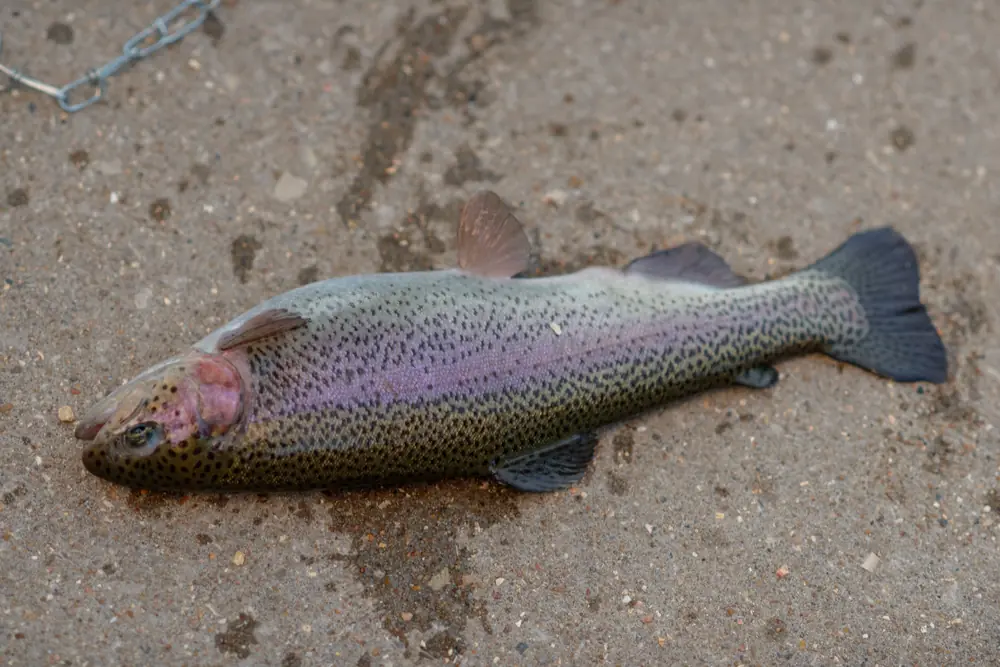
The Missouri fishing year starts on March 1, the annual opening of catch-and-keep trout fishing at the state’s four trout parks: Bennett Spring near Lebanon, Montauk near Salem, Roaring River near Cassville and Maramec Spring near St. James. The Missouri Department of Conservation (MDC) says the season runs through October 31 and that its staff stock more than 800,000 trout a year in the four parks. March 1, 2027, is a Monday.
Spectators are welcome. On opening morning hundreds of anglers line the banks of the spring branches, and a cluster of onlookers gathers to watch.
-
Opening day at the trout parks
March 1 each year; in 2026 the start was 6:30 a.m. · Maramec Spring, Montauk, Roaring River and Bennett Spring
In 2026 a daily trout tag cost $5 for adults and $3 for anglers 15 and younger, the daily limit was four trout, and the possession limit was eight. Missouri residents 16 to 64 and nonresidents 16 and older also needed a fishing permit, which MDC listed at $9 for a day. Tags are sold at the parks. The 2027 start time and prices were not posted when we wrote this, so check with the park.
-
Paddlefish snagging
March 15 to April 30 in 2026; Mississippi River March 15 to May 15 · Lake of the Ozarks, Truman Lake, Table Rock Lake and other waters; the Mississippi River
Paddlefish, the long-snouted giants of Missouri’s big rivers and reservoirs, are taken by snagging in a short spring season. MDC’s 2026 table lists March 15 through April 30, and March 15 through May 15 on the Mississippi. Limits and minimum lengths differ by water, so read MDC’s current rules first. An earlier MDC announcement urged snaggers to use landing nets rather than gaffs and to avoid passing fish around for photos.
-
Walleye spawning
MDC says spawning peaks in March · Lakes and rivers with walleye
MDC’s March list notes that walleye spawning peaks this month. Rocky shorelines and tailwaters are the places to ask a local bait shop about.
Dress in layers, wear boots with good grip, and read each park’s posted rules for gear and fishing hours.
Where can you hear greater prairie-chickens boom in Missouri in March?
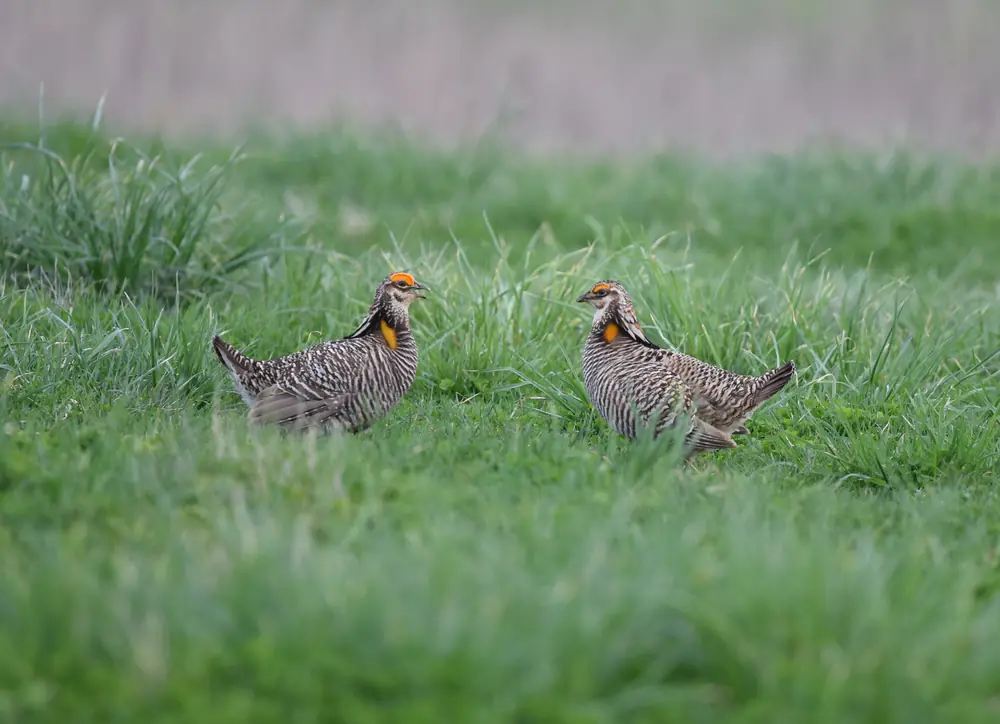
On a few hilltops in the far northwest. MDC’s field guide says a tiny population persists in Harrison County and neighboring Ringgold County, Iowa, and that fewer than 25 birds remain in isolated populations in northwest and west-central Missouri. The species is endangered in the state. The breeding season runs from March through mid-April, when males gather at dawn on traditional display grounds called leks, show off orange air sacs and boom.
-
Dunn Ranch Prairie
Dawn, from March into mid-April · West of Eagleville, Harrison County; open dawn to dusk
The Nature Conservancy’s Dunn Ranch is a 3,258-acre prairie where more than 200 bison graze. The Conservancy says the booming on its historic lek is a dawn event that draws birders, schools and community groups. Visitors must stay in the designated public areas, trails and parking lots, and no one may enter the pasture with the bison.
-
Guided blind viewing
Late March to mid-April in a past spring; reservations required; 2027 schedule not posted · Dunn Ranch Prairie, by reservation through MDC
In one past spring, MDC and The Nature Conservancy offered free viewings from March 26 through April 19, from a blind that held eight people, with reservations through MDC’s Northwest Regional office (816-271-3100). We do not know whether a 2027 program will run, so call first, and plan to arrive well before sunrise.
-
Following from home
All spring · Online
The Conservancy lists a live prairie webcam for Dunn Ranch. MDC adds that one or two lone males have been reported in St. Clair County, though official counts have not documented them there since 2023.
The birds are protected, and a disturbed lek can lose a morning’s display. Stay in the vehicle or blind, leave dogs at home and never walk toward them. Dunn Ranch’s spring offers wet conditions, migrating birds, bison calves, wildflowers and the bright green of burned areas.
Are snow geese still in Missouri in March, and when do the pelicans arrive?
Yes: March brings the peak. The U.S. Fish and Wildlife Service says snow geese reach Loess Bluffs National Wildlife Refuge in mid-February, with the peak in mid-March, and that the refuge sometimes holds millions of geese at a time. Anyone who missed the late-February rush gets a second chance. The refuge covers 7,440 acres with 15 wetland impoundments, and its manager has called it one of the best places in the country to witness the migration. American white pelicans come next, and refuges closed for the winter begin to reopen.
-
Loess Bluffs National Wildlife Refuge
Peak in mid-March · Near Mound City, Holt County; the auto tour runs from 30 minutes before sunrise to 30 minutes after sunset
The 10-mile auto tour loops through wetlands, grassland and forest, and the visitor center keeps hours of 10 a.m. to 3 p.m. Tuesday to Saturday. Go at first light for the takeoff, and call 660-442-3187 for the latest count.
-
American white pelicans
Arrive in late March, peak in mid-April, depart by late May (MDC) · Large lakes, reservoirs and marshes; many more in the western half of the state
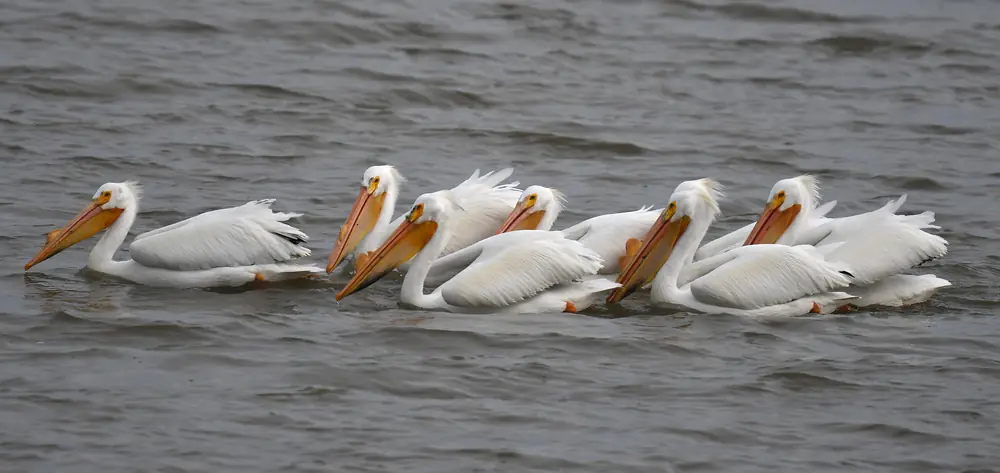
MDC describes a bird with a 108-inch wingspan that migrates in formation, circling higher and higher before moving on. On arrival it favors large lakes, reservoirs and marshes, where it hunts cooperatively. A distant string of white birds with black wingtips overhead is often the first sign.
-
Swan Lake National Wildlife Refuge
Wildlife drive reopens the first Saturday in March (March 6, 2027 by that rule; confirm with the refuge) · Near Sumner, Chariton County; the drive is open from dawn to dusk through October
The interior is closed from the end of October until the first Saturday in March so migrating waterfowl are left alone. The refuge says nearly every Central Flyway waterfowl species uses its wetlands and recommends April and May for shorebirds. Its phone is 660-362-5375.
-
Eagle Bluffs and Mingo
Eagle Bluffs closed areas reopen after March 1; Mingo’s auto tour runs March through November · Eagle Bluffs near McBaine, southwest of Columbia; Mingo near Puxico, Stoddard County
MDC closes parts of Eagle Bluffs Conservation Area from October 15 through March 1 for waterfowl; its 17 pools flood about 1,100 acres, and the Katy Trail State Park crosses part of it. Mingo’s 0.8-mile Swampwalk boardwalk is open year-round, and the refuge calls April and May the best months for spring migrants.
-
Cranes and swans
Trumpeter swans through late March; sandhill cranes February to May · Marshes, lakes and rivers; cranes mostly in the west
MDC lists the trumpeter swan as critically imperiled in Missouri, present from late November through late March, and asks you to report the color and numbers of any neck collar. Sandhill cranes are rare migrants here, mostly in the west, while spectacular flocks gather on Nebraska’s Platte River.
Check each refuge’s page for closures before going. Our February guide to Missouri covers the first arrivals and the hunting seasons that run alongside the geese.
Which frogs and toads are calling in Missouri in March?
More with each week. MDC says peepers gather near swampy pools in early March, where their high whistles blend like sleigh bells, and Shaw Nature Reserve says to listen for them on warm, cloudy days or in the evening. A mild, damp night after rain brings the biggest choruses, and a cold snap quiets them again.
-
Southern leopard frog
Breeding peaks from mid-March to mid-May; calling season peaks from early March · Creeks, marshes, ponds and flooded ditches, except the northwest corner
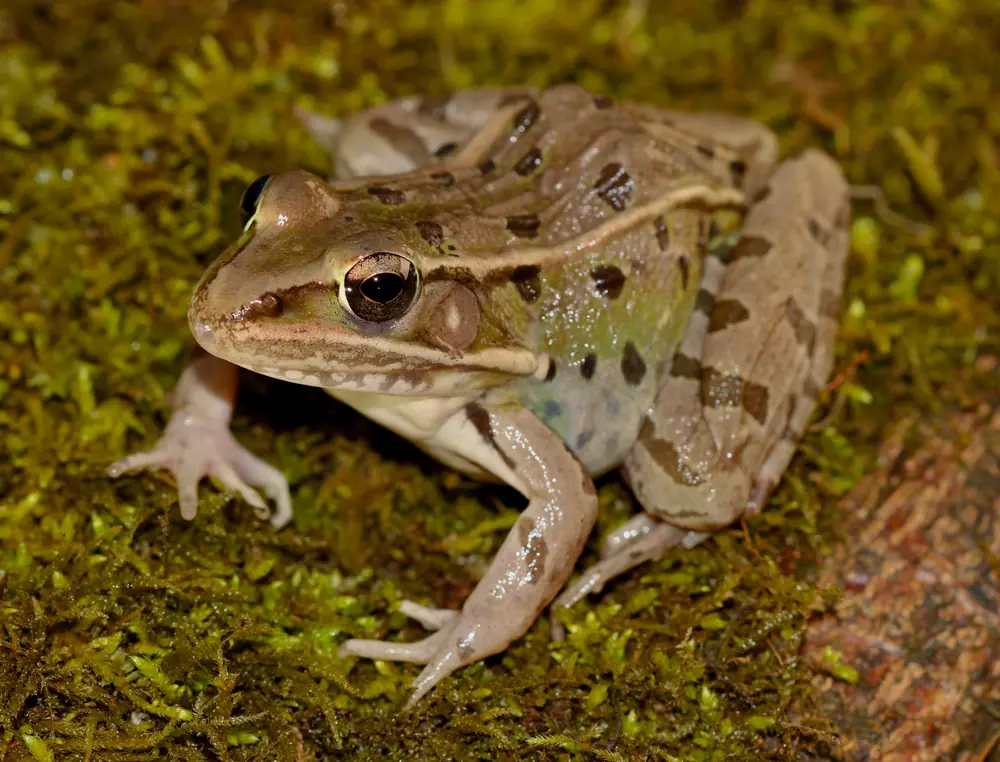
MDC describes abrupt, chucklelike quacks. Its numbers swing with the weather: Missouri’s 2012 drought silenced many, and the frogs rebounded in wetter years.
-
American toad
Males begin calling on warm nights in mid-March or early April; breeding peaks late April into May · Almost anywhere, especially rocky, wooded country
The call is a sustained, high trill lasting 6 to 30 seconds. MDC calls it Missouri’s most common toad and adds that toads do not cause warts.
-
Pickerel frog
Breeding March through May, peaking mid-April to early May · Southern and eastern Missouri; absent from the northwestern third
The voice is a low, descending snore. This is the only Missouri frog that shelters in caves in large numbers, sometimes hundreds to a cave, and its skin releases a toxin that can irritate human skin, so wash your hands after touching one.
Walk slowly, keep your light low, and wet your hands before touching any amphibian. Slow down on wet roads near ponds. Our February page has more on chorus frogs and the first salamander nights.
What blooms first in Missouri woods in March, and when do redbuds open?
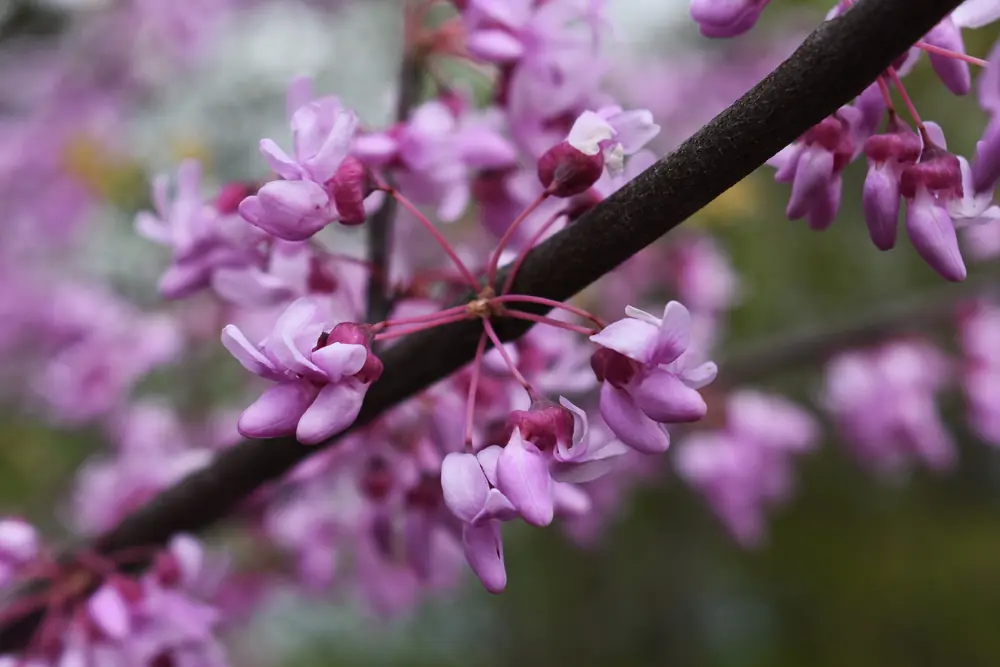
The spring ephemerals lead. Shaw Nature Reserve, the Missouri Botanical Garden’s reserve at Gray Summit, lists Dutchman’s breeches, hepatica, violets and spring beauty as the early March flowers, along with the first butterflies. These plants race to flower and set seed before the trees leaf out and shade the forest floor. Woody bloomers follow, with red maple already in flower and redbuds opening near the end of the month.
-
Spring beauty and harbinger of spring
Spring beauty February to May; harbinger of spring January to April · Spring beauty in open woods, valleys and lawns; harbinger of spring in bottomlands and ravines, most common in the east and south
MDC describes spring beauty as a five-petaled white or pink flower with darker pink veins, about 5 inches tall, rising from an underground corm. A native bee, the spring beauty mining bee, specializes in it. Harbinger of spring, nicknamed “pepper and salt” for its white petals and dark red-brown anthers, flowers at 2 to 3 inches tall and reaches 8.
-
Dutchman’s breeches and bloodroot
Dutchman’s breeches March to May; bloodroot March to April · Rich wooded slopes and bottomlands; Dutchman’s breeches statewide except the Southeast Lowlands, bloodroot scattered in the Ozarks
Dutchman’s breeches look like tiny white knee breeches hanging on a line, and MDC says the federally endangered rusty patch bumble bee is a key pollinator. Bloodroot’s white flower, about 1¼ inches across, lasts only a day or two, and a cut stem bleeds bright red sap that can irritate skin.
-
Eastern redbud
Late March to early May (MDC) · Statewide; woodland edges, glades, rocky stream banks and bluffs
Rose-purple, pea-like flowers crowd the bare branches before the heart-shaped leaves unfold, and MDC lists redbuds among its late-March signs. The blossoms are an early nectar source for native bees, and edible. Shaw adds that in warm years redbud and dogwood flower early in April, though most years they bloom later.
-
Red maple and pawpaw
Red maple March to April; pawpaw March to May · Red maple in bottomlands and swamps of the Ozarks and Bootheel and planted statewide; pawpaw on moist lower slopes
Red maple’s small red flowers are among the first color in the woods. The pawpaw’s dark reddish-purple flowers smell faintly of rotting meat, which draws the blow flies and carrion beetles that pollinate them, and in 2019 Missouri named it the state fruit tree. Zebra swallowtails, whose caterpillars eat only pawpaw leaves, begin flying in late March.
Bloom dates shift with the weather by a week or more, so use these as a sequence and not a calendar. Look, but do not pick: ephemeral wildflowers take years to rebuild a colony.
Which birds return to Missouri in March, and are eagles hatching?
Early flycatchers, martins and streamside warblers return, the woodcock migration peaks, and the first eagle chicks begin to hatch. MDC gives most of these timings by month, so treat them as a sequence and not a schedule.
-
Eastern phoebe
Arrives in March · Bridges, barns and porches near water
MDC calls it very early for a flycatcher. It bobs its tail constantly, calls a raspy “fee-bee,” and builds a cup nest of mud and moss under a roof or ledge.
-
Purple martin
Begins arriving in early March · Colony houses and gourds in open country and towns
MDC says martins now depend almost entirely on nest boxes people put up. Extended cold, wet weather is hard on early arrivals, and populations are falling across much of North America.
-
Louisiana waterthrush
Present from mid-March through early October · Wooded streams and rivers in hilly country
This streamside warbler walks instead of hopping and bobs its tail nonstop. Its loud song has two to five clear, down-slurred whistles followed by a jumbled warble.
-
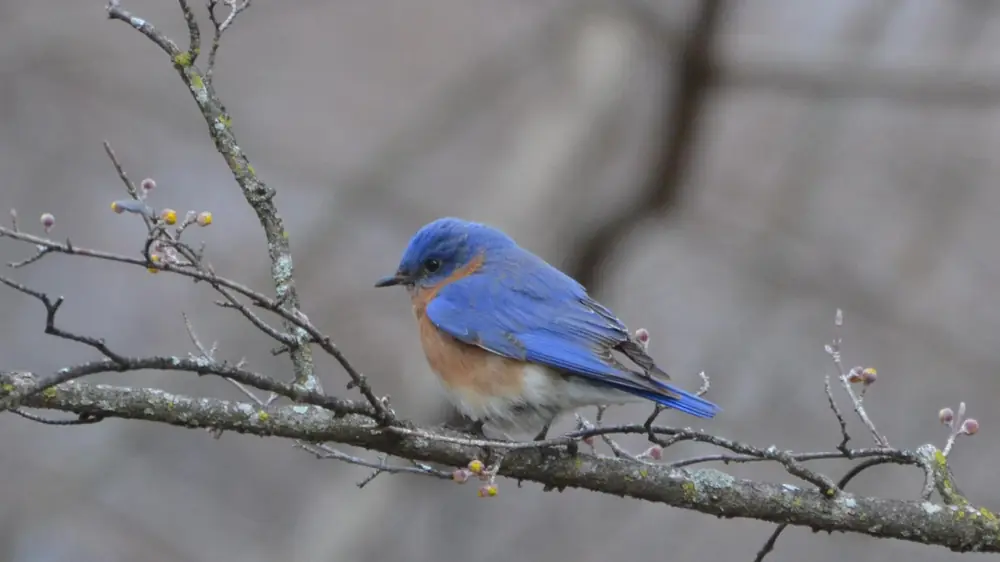
Eastern bluebird
Arrives at nesting sites in March and April · Fields and pastures with nest boxes
MDC credits a widespread effort to erect and protect nest boxes for the species’ recovery, and notes that territorial males may attack their reflections in windows. The woodcock migration also peaks this month, when MDC says numbers are highest.
-
Bald eagle chicks
Most hatch from mid-March into early April, by our reading of MDC’s dates · Large stick nests in tall trees by rivers and lakes
MDC’s eagle nesting guide says eggs are laid in early to mid-February or early March and that incubation lasts 35 days with very little deviation, so the first chicks are due from mid-March on. In 2025 MDC and the City of Blue Springs launched what MDC called Missouri’s only 24/7 eagle nest camera. We do not know whether it returns in 2027, so check MDC. Keep well back from any real nest.
Project FeederWatch runs through April, and Journey North maps accept your sightings. The Naturalist’s Field Journal includes a page for your new arrivals.
How warm is a Missouri March, and what are the weather hazards?
March warms fast, and it swings. Springfield’s average high climbs about 9 degrees from February, from 49.5 to 58.9 °F, and Kansas City’s average low rises 10 degrees, from 23.6 to 33.6 °F. The north–south spread is wide: Kirksville’s average high is 50.5 °F and Joplin’s is 59.8 °F. Precipitation rises from 2.06 inches at St. Joseph to 4.69 at Cape Girardeau. Snow can still fall, with small normals of 1.5 to 2.3 inches where NOAA publishes them.
| Station | Average high | Average low | Precipitation | Snowfall |
|---|---|---|---|---|
| Kirksville | 50.5 | 29.2 | 2.67 | 2.2 |
| St. Joseph | 55.1 | 31.5 | 2.06 | not published |
| Kansas City (airport) | 55.4 | 33.6 | 2.36 | 1.7 |
| Columbia | 56.3 | 35.6 | 2.97 | 1.5 |
| St. Louis (Lambert) | 56.6 | 36.7 | 3.50 | 2.3 |
| Springfield | 58.9 | 36.2 | 3.51 | 2.0 |
| Joplin | 59.8 | 37.4 | 3.29 | not published |
| Cape Girardeau | 58.1 | 37.3 | 4.69 | not published |
Storms. Each year Missouri’s emergency management agency (SEMA) and the Weather Service set aside a preparedness week in the first days of March, including a statewide tornado drill. In 2026 that was March 2 to 6, with the drill at 11 a.m. on Wednesday, March 4; the 2027 dates were not posted when we wrote this. Spring is Missouri’s main tornado season, and the Weather Service reported that 16 Missourians died in tornadoes in 2025.
Floods and fire. Spring downpours flood low-water crossings. In dry, windy weeks, dead grass burns fast: MDC lists strong winds, low humidity and dry conditions as the spring fire danger, and says improper burning of debris is the main cause of wildfires.
Late freezes. Blossoms opened by a warm week can be nipped by hard frost; see the freeze dates below. For the latest seasonal outlook, open the Climate Prediction Center’s outlook page, updated near the middle of each month. Town-by-town conditions are on our forecast page, and our cloud guide explains what the sky is doing before a front arrives.
When is the last spring freeze in Missouri?
Later than most gardeners hope. By the median date in the table, half of all springs are past their final 32 °F night. St. Louis, at April 2, comes first of our stations, then Cape Girardeau on April 5, Columbia on April 7, Springfield and Joplin on April 9, Kansas City on April 13, St. Joseph on April 19 and Kirksville on April 21. In one spring in ten, the last freeze falls after April 17 in St. Louis and after May 5 in Kirksville.
| Station | One year in ten | Median | Nine years in ten |
|---|---|---|---|
| Kirksville | Apr 7 | Apr 21 | May 5 |
| St. Joseph | Apr 5 | Apr 19 | May 3 |
| Kansas City | Mar 30 | Apr 13 | Apr 29 |
| Columbia | Mar 23 | Apr 7 | Apr 21 |
| St. Louis | Mar 17 | Apr 2 | Apr 17 |
| Springfield | Mar 26 | Apr 9 | Apr 27 |
| Joplin | Mar 24 | Apr 9 | Apr 26 |
| Cape Girardeau | Mar 19 | Apr 5 | Apr 21 |
Treat the median as the date to start watching, not the date to plant. Redbud and pawpaw flowers, fruit buds and tender seedlings can all be nipped by a late frost, and a cover overnight is cheap insurance. For your own town, see our Missouri frost dates.
How much daylight does Missouri gain in March, and when do the clocks change?
Between 72 and 80 minutes, with the north gaining most. Kirksville’s day grows from 11 hours 18 minutes on March 1 to 12 hours 38 minutes on March 31, while Springfield, Joplin and Cape Girardeau go from 11 hours 23 minutes to 12 hours 35 minutes. Each day adds roughly 2.4 to 2.7 minutes, the quickest pace of the year, and every city ends the month with more than 12 and a half hours of sun. The gap between Kirksville and Cape Girardeau shrinks from 5 minutes to 3.
The clocks change on Sunday, March 14, at 2:00 a.m. Per NIST, daylight saving time starts that morning, the second Sunday of March. Clocks leap forward, so by the dial both sunrise and sunset arrive an hour later: in Chicago, which keeps Missouri’s time, the Sun sets at about 5:55 p.m. on March 13 and 6:56 p.m. on March 14 by our calculation. Mornings turn dark again for a few weeks and evenings brighten, so any sunrise or sunset time you see in March belongs to one side of that jump.
| City | Mar 1 | Mar 31 | Gained | Per day |
|---|---|---|---|---|
| Kirksville | 11 h 18 m | 12 h 38 m | 80 min | 2.7 min |
| St. Joseph | 11 h 18 m | 12 h 37 m | 79 min | 2.6 min |
| Kansas City | 11 h 20 m | 12 h 36 m | 76 min | 2.5 min |
| Columbia | 11 h 20 m | 12 h 36 m | 76 min | 2.5 min |
| St. Louis | 11 h 21 m | 12 h 36 m | 75 min | 2.5 min |
| Springfield | 11 h 23 m | 12 h 35 m | 72 min | 2.4 min |
| Joplin | 11 h 23 m | 12 h 35 m | 72 min | 2.4 min |
| Cape Girardeau | 11 h 23 m | 12 h 35 m | 72 min | 2.4 min |
The gain slows but continues until the June solstice. Our daylight calculator gives sunrise and sunset for your own street.
What can you see in Missouri’s night sky in March 2027?
Jupiter and Mars shine high in the evening, Mercury and Venus climb out of the dawn, and the Worm Moon is full on a Monday morning. Moon times use Central Standard Time on March 8, then Central Daylight Time.
-
Jupiter and Mars in the evening
All month; the Moon passes Jupiter March 18 and 19; Mars and Jupiter are closest on the night of March 30 to 31 · High in the sky after dusk, up most of the night
By our own calculation, Jupiter, near magnitude −2.5, is the brightest starlike point in the evening sky and sets about 12 hours after sunset on March 1, close to dawn. Rust-colored Mars, near magnitude −1.1, is in Leo as well. On March 18 and 19 the Moon, nearly nine-tenths lit, passes less than a degree from Jupiter, and on the night of March 30 to 31 Mars and Jupiter sit about 4 degrees apart, a wide but easy pair.
-
Mercury and Venus before sunrise
Mercury farthest from the Sun the night of March 16 to 17, best March 8 to 25; Venus all month · Low in the east and east-southeast before dawn
Mercury’s greatest western elongation, 27.6 degrees, comes at 11:20 p.m. CDT on March 16. For the first two weeks of March it climbs into the dawn about an hour before the Sun, low in the east-southeast. Venus, far brighter at magnitude −4.1, clears the horizon roughly 115 minutes before sunrise on the first of the month (our computation) and sits far above Mercury. Early on the 4th and 5th, by the same calculation, a slim crescent Moon sits close to Venus.
-
Saturn’s last evenings
Early March · Low in the west just after dusk
By our calculation for central Missouri, Saturn sets about 2 hours 35 minutes after sunset on March 1 and 93 minutes after sunset on March 15, then slips into twilight by April 1. Its conjunction with the Sun, when it is hidden in the glare, comes on April 7.
-
The March equinox
Saturday, March 20, 3:25 p.m. CDT · Everywhere
The Sun crosses the celestial equator and astronomical spring begins; the U.S. Naval Observatory gives the moment as 20:25 UTC.
-
The Worm Moon
Full at 5:44 a.m. CDT Monday, March 22; best on the evening of Sunday, March 21 · Rising in the east near dusk
Sea and Sky says the name recalls the season when soil softens and earthworms reappear; other names include the Crow, Crust and Sap Moon. Because the full moment arrives before dawn Monday, Sunday’s moonrise is the best one to catch, with Monday’s nearly as good.
| Phase | Date | Time |
|---|---|---|
| New moon | Monday, Mar 8 | 3:29 a.m. CST |
| First quarter | Monday, Mar 15 | 11:25 a.m. CDT |
| Full moon, the Worm Moon | Monday, Mar 22 | 5:44 a.m. CDT (looks full the evenings of Mar 21 and 22) |
| Last quarter | Monday, Mar 29 | 7:54 p.m. CDT |
For the Moon’s phase on any date, use our moon phases page. Planet times shift slightly with latitude, and Missouri spans about four degrees of it.
What are good March nature outings for Missouri families?
- Monday, March 1: the trout parks open. All four trout parks open for catch-and-keep fishing on March 1 each year. The first morning is lively to watch from the bank. Check the park for the 2027 start time.
- Early March: preparedness week. Hold a tornado drill at home: pick the shelter, grab shoes and a flashlight, and practice. The 2026 week was March 2 to 6; the 2027 dates were not yet posted.
- Saturday, March 6: Swan Lake’s wildlife drive reopens. The refuge near Sumner opens it on the first Saturday in March each year, which falls on March 6 in 2027; confirm with the refuge.
- Mid-March: snow geese at Loess Bluffs. The auto tour suits small children, who can watch from a warm car.
- Dawn in northwest Missouri: prairie-chickens. Reservations are required for guided blind viewing, which has run from late March to mid-April in past springs. Ask MDC’s Northwest Regional office.
- A frog evening. Take a flashlight and rain jacket to a pond or wet ditch and name the voices.
- A wildflower walk. Shaw Nature Reserve, the Missouri Botanical Garden’s reserve in Gray Summit, describes March as the time for Dutchman’s breeches, hepatica, violets and spring beauty, with garter snakes leaving their dens. Call for hours.
- Project FeederWatch runs November through April, so feeder counts are still welcome.
- Journey North: report the first ruby-throated hummingbirds you see, though most arrive in April.
We gathered these from MDC, the U.S. Fish and Wildlife Service and organizers’ pages in early October 2026. Most 2027 dates were not posted yet, so confirm each event. For the earlier months, see our February guide, and every state’s guide is on the nature index.
Safety notes for March in Missouri
- Hunting and trapping open in March (MDC, 2026–27): the Light Goose Conservation Order, February 7 to April 30, 2027; falconry for ducks, coots and mergansers through March 10; beaver and nutria trapping through March 31; crow hunting ends March 3; and, on private land, extended trapping for opossum, raccoon, striped skunk and coyote from March 1 to April 14. Expect hunters near goose areas and stay on marked trails.
- Spring turkey: MDC had not published the 2027 spring turkey season when we wrote this. In 2026 the youth weekend was April 11 and 12 and the regular season ran April 20 to May 10, so turkey hunters usually appear after this month. Check MDC for 2027.
- Hunter orange: Missouri requires it for firearms deer, elk and black bear hunting, none open in March, and does not list turkey. No orange is required this month.
- Tornadoes: have a weather radio or phone alerts ready and know your shelter. The Weather Service says to go to a basement, safe room or interior room away from windows, and never to shelter in a mobile home or tent. Caught in a vehicle, reach a sturdy building if you can; otherwise get down below window level or lie in a low ditch.
- Flash floods: the Weather Service notes that just six inches of rushing water can topple a grown adult and a foot can float most cars away. Never drive or walk into flood water, and keep children back from swollen creeks.
- Ticks: University of Missouri Extension says activity climbs through April and that lone star ticks can transmit alpha-gal syndrome, a meat allergy. Use DEET repellent, tuck pants into socks, stay on trail centers and check skin and pets afterward.
- Burning: skip outdoor fires on dry, windy days, honor local burn bans and keep hot vehicles off dry grass.
Sources (61)
- MDC: 2026 fishing seasons table (trout parks, paddlefish, snagging)
- Missouri State Parks: catch-and-keep trout season opens March 1 (2026)
- Missouri Conservationist, February 2026: Brief (trout opener, tags, 2026 turkey dates)
- MDC newsroom: trout opener (stocking per angler, opening day crowds)
- MDC newsroom: paddlefish season begins March 15 (snagging tips)
- Missouri Conservationist, March 2026: Get Outside in March
- Missouri Conservationist, March 2025: Get Outside in March
- MDC field guide: greater prairie-chicken
- MDC newsroom: prairie-chicken viewing at Dunn Ranch Prairie (past spring program)
- The Nature Conservancy: Dunn Ranch Prairie
- U.S. Fish and Wildlife Service: Loess Bluffs National Wildlife Refuge, visit us
- U.S. Fish and Wildlife Service: Loess Bluffs National Wildlife Refuge, species
- KBIA: Snow geese touch down at Loess Bluffs on annual migration (March 4, 2026)
- U.S. Fish and Wildlife Service: Swan Lake National Wildlife Refuge, visit us
- U.S. Fish and Wildlife Service: Mingo National Wildlife Refuge, visit us
- MDC: Eagle Bluffs Conservation Area
- MDC field guide: American white pelican
- MDC field guide: sandhill crane
- MDC field guide: trumpeter swan
- MDC field guide: southern leopard frog
- MDC field guide: American toad
- MDC field guide: pickerel frog
- MDC field guide: harbinger of spring
- MDC field guide: spring beauty
- MDC field guide: Dutchman’s breeches
- MDC field guide: bloodroot
- MDC field guide: eastern redbud
- MDC field guide: red maple
- MDC field guide: pawpaw
- MDC field guide: zebra swallowtail
- Missouri Botanical Garden: Shaw Nature Reserve month-by-month natural history guide
- MDC field guide: eastern phoebe
- MDC field guide: purple martin
- MDC field guide: Louisiana waterthrush
- MDC field guide: eastern bluebird
- MDC field guide: American woodcock
- MDC: Bald Eagle Nesting Ecology and Phenology (Missouri Eagle Watch Program guide)
- MDC newsroom: Missouri’s only bald eagle camera goes live in the Kansas City area (2025)
- Project FeederWatch: project overview
- Journey North: hummingbirds
- NOAA NCEI: 1991–2020 monthly normals for Missouri stations (data API)
- Amphibian Publishing: Missouri frost dates (NOAA 1991–2020 last spring freeze normals)
- Climate Prediction Center: seasonal outlooks
- Missouri State Emergency Management Agency: Severe Weather Preparedness Week 2026 release
- National Weather Service Springfield: Severe Weather Preparedness Week
- National Weather Service St. Louis: Severe Weather Preparedness Week
- National Weather Service: tornado safety, during a tornado
- National Weather Service: Turn Around Don’t Drown
- MDC newsroom: MDC encourages people to help prevent wildfires
- University of Missouri Extension: ticks (2026)
- MDC: 2026–27 hunting and trapping seasons
- MDC: 2026–27 hunting and trapping seasons, page 2 (Light Goose Conservation Order)
- MDC: migratory game bird and waterfowl seasons 2026–27
- MDC newsroom: deer and turkey hunting dates for 2026–2027 seasons
- MDC: hunter orange requirement
- U.S. Naval Observatory: Earth’s seasons 2027 (data API)
- U.S. Naval Observatory: moon phases (data API)
- Sea and Sky: Astronomy Calendar of Celestial Events 2027
- NIST: Daylight Saving Time
- Photos via Wikimedia Commons; licenses and photographers are credited under each picture
- MDC: crow hunting regulations (season ends March 3, 2027)