What to look for in nature in Missouri this December
Missouri’s meteorological winter, which climatologists count from December 1 through the end of February, opens this month, and open water takes center stage. Northern bald eagles settle wherever water stays open, trumpeter swans gather above St. Louis, and Mingo’s ducks reach their yearly high. On land, groundhogs and gray bats are deep in hibernation, the bare woods show off pods, pine cones and red holly berries, and a skim of snow or creek mud records who walked by in the night. Sunsets bottom out early in the month, the Geminids follow, and the solstice comes on the 21st. Below are the places and dates.
Other months in Missouri: October, November.
Start here

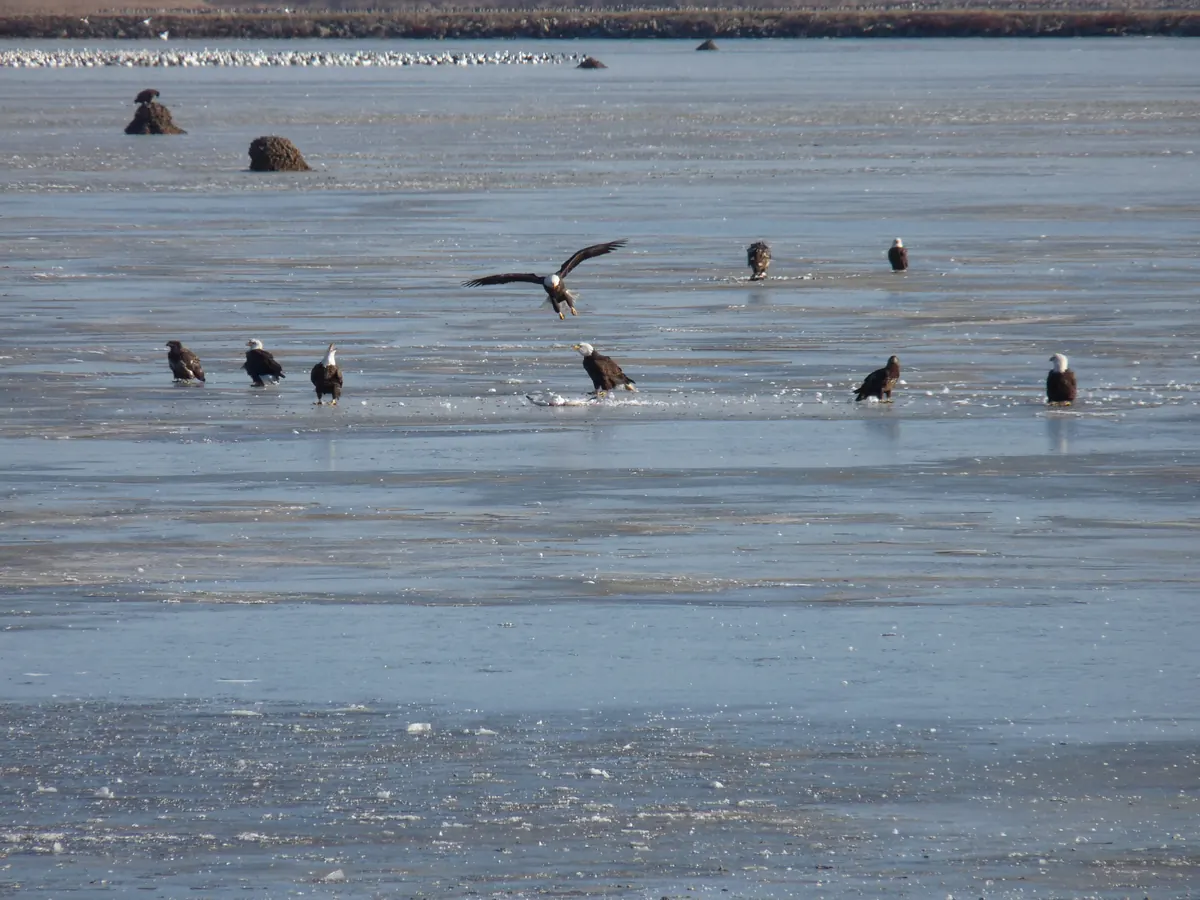
- Eagle Days at Loess Bluffs. The 47th Eagle Days fills the refuge near Mound City on Saturday, December 5, and Sunday the 6th, from 8:30 a.m. until 4 p.m., with World Bird Sanctuary programs featuring live eagles and spotting scopes set up along the auto tour. It lands right on time: the refuge’s eagle numbers usually crest around the start of December.
- Count birds for science. Every Missouri Christmas Bird Count is a one-day census inside a 15-mile circle, held on some date from December 14 to January 5. Beginners are welcome; Columbia’s count is usually held around December 15, and other circles post their dates with the Missouri Birding Society as compilers set them.
- Geminids, then the biggest full moon. Watch for the Geminids from Sunday evening the 13th until dawn Monday; by about 9:15 p.m. the slim crescent Moon is down, and moonlight is no longer a problem. On Wednesday, December 23, the Cold Moon is exactly full at 7:28 that evening (Central time), the nearest full moon to Earth in all of 2026.
In the Naturalist’s Field Journal, start the “birds I have seen” list on your Christmas Bird Count day, and use “tracks to know” for the first raccoon hand-prints you find in creek mud. The “seeds, pods and cones” plate suits a Kentucky coffee tree pod or a shortleaf pine cone picked up off the ground. If you find an eagle feather, the “feather found” page is the place for it, as a sketch only: federal law makes it an offense to keep any part of a bald eagle, feathers included, without a permit.
Regions used below: Northwest Missouri; Northeast Missouri; Kansas City area; St. Louis area; Central Missouri/Columbia; the Ozarks; Southwest Missouri/Springfield; Southeast Missouri and the Bootheel.
When and where can you see bald eagles in Missouri in December?
To the surprise of many people, MDC says, Missouri is one of the country’s leading states for wintering bald eagles. Birds that nest in Canada and around the Great Lakes come south each autumn to wherever rivers, lakes and wetlands stay free of ice, and MDC’s 2025 eagle brochure puts the number reported here each winter at roughly 1,200 to 2,700. December is the build-up. At Loess Bluffs National Wildlife Refuge the fall flight usually crests around the first of the month with up to about 300 adult and young eagles, and the refuge names December and January as its best eagle months. Statewide, MDC’s list of viewing spots points to late December through early February along the big rivers and reservoirs.
-
Eagle Days at Loess Bluffs
December 5–6, 8:30 a.m.–4 p.m. · Loess Bluffs National Wildlife Refuge, south of Mound City, Holt County
MDC lists hourly World Bird Sanctuary shows with live eagles (the first at 9 a.m. Saturday and 11 a.m. Sunday), scopes at stops along the 10-mile auto tour, an open visitor center and food for sale. If midday is crowded, come back for the levees at first light; the tour route opens 30 minutes before sunup.
-
The lock-and-dam eagles
Late December into February, mornings · Lock and Dam 24 at Clarksville, Lock and Dam 20 at Canton, the Old Chain of Rocks Bridge in St. Louis
Below the Mississippi dams the water stays open in hard cold, and eagles gather to fish it. MDC’s advice: come early, when the birds are flying and feeding, and scan the tall trees at the water’s edge. Away from the Mississippi, its list names Bagnell Dam, Smithville Lake, Truman Reservoir, Stockton and Table Rock lakes, and Lake Wappapello.
-
Pairs at the nest
Nest repair in late fall; nesting at Mingo from December · Large trees near water, statewide
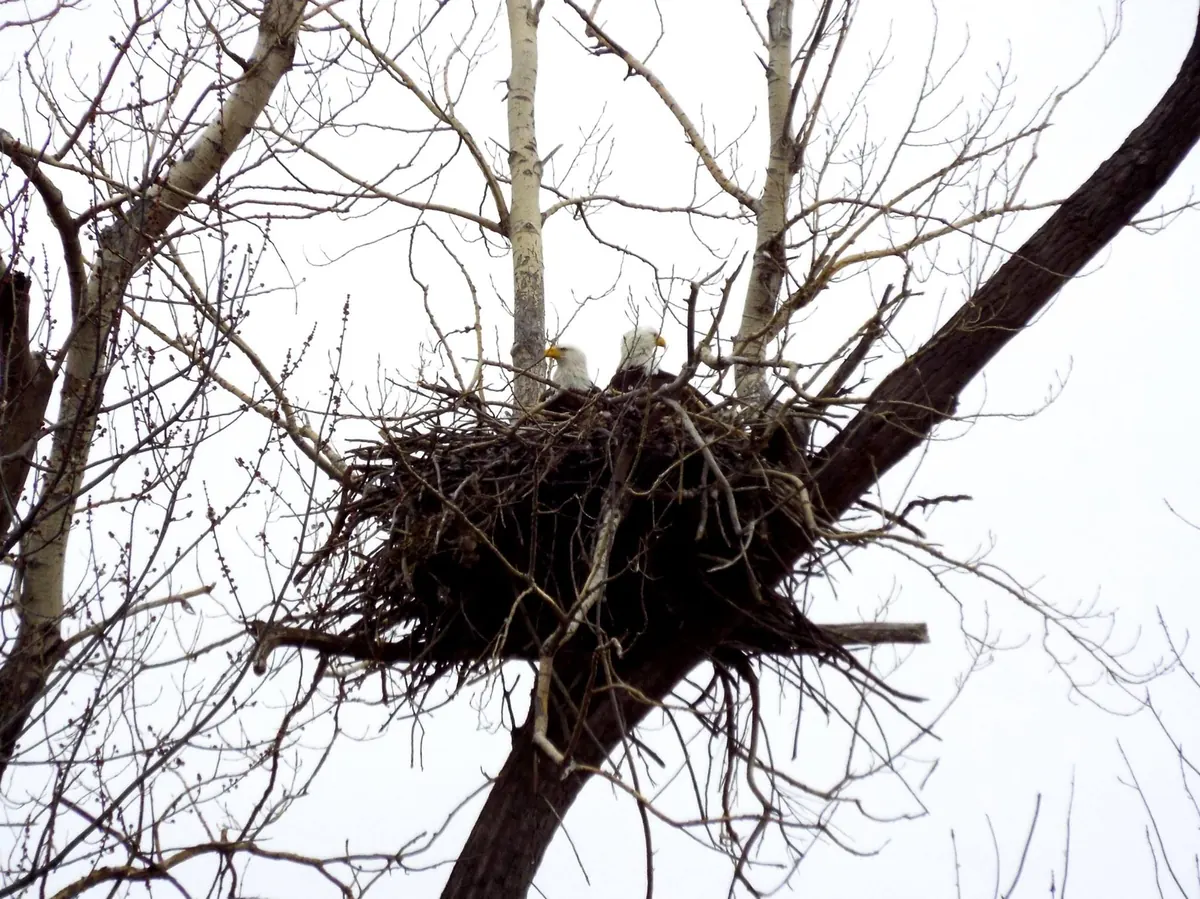
Not every eagle here is a visitor. Missouri had more than 600 active nests in 2025, and MDC says resident adults usually return to the old nest in October or November and add new sticks every late fall or early winter; Missouri nests average about 5 feet across. At Mingo National Wildlife Refuge in southeast Missouri, one of two places where MDC and its partners released 74 young eagles in the 1980s to restore nesting, the refuge says nesting runs from December to April. Watch with binoculars from a road or trail and keep well back; disturbing a nest is a federal offense.
Riverlands holds its Eagle Ice Fest in January and Roaring River State Park has a Bald Eagle Day on Saturday, January 16, 2027, if December weekends are full. The Loess Bluffs auto tour runs every day, holidays included, even when the visitor center is shut.
Where are the trumpeter swans and ducks in Missouri in December?
By December the snow goose spectacle in the northwest is winding down or moving on, and the waterfowl story shifts east and south. Trumpeter swans, here as a rule between the end of November and the end of March, collect in the hundreds on the backwaters where the Illinois and Missouri rivers meet the Mississippi. In southeast Missouri, Mingo National Wildlife Refuge says its winter waterfowl usually peak in early to mid-December, though big numbers can linger from November into February.
-
Trumpeter swans at Riverlands
Peak from mid-December to mid-January · Riverlands Migratory Bird Sanctuary, West Alton, St. Charles County
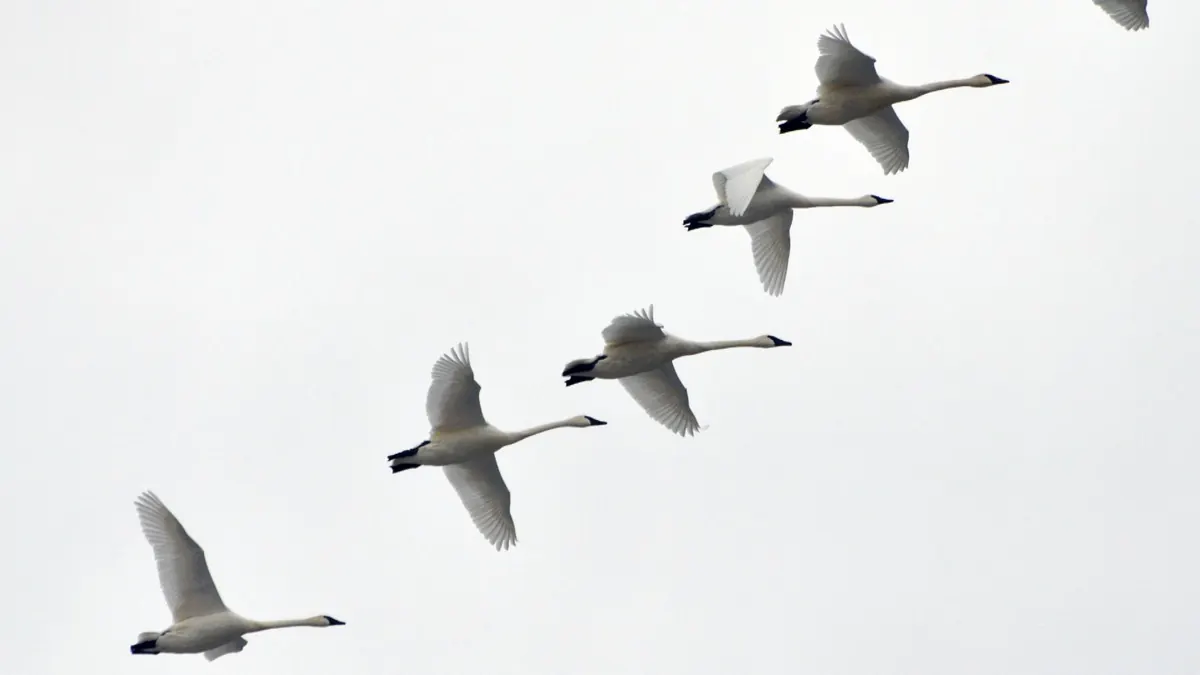
The Audubon Center at Riverlands’ executive director told St. Louis Magazine that swan numbers there generally top out between mid-December and mid-January, and that more than 2,000 have been tallied in a single day. Teal Pond, the first big pond on the right after you turn onto Riverlands Way from U.S. 67, is good in the morning; on Ellis Bay the flocks look like a fleet of small white boats. The center (8 to 4, Tuesday to Sunday) has scopes aimed at the bay. Trumpeters were down to about 70 known birds in the 1930s; MDC puts the Midwest’s population today at about 5,000.
-
Trumpeter or tundra?
Whenever a swan is close · Riverlands, Columbia Bottom and other big wetlands
Tundra swans pass through in smaller numbers; the Confluence Christmas count of 2020–21 found a state-record 55. Check the bill: the tundra is smaller, its bill slightly concave in profile, the base tapering to a point that just touches the eye. MDC reminds waterfowl hunters that a trumpeter stands about double a snow goose in size.
-
Mingo’s December ducks
Early to mid-December · Mingo National Wildlife Refuge, near Puxico, Stoddard County
Duck numbers usually top out here now; the refuge’s 2020–21 Christmas count set a record of 5,600 northern shovelers. The Ozark Highlands auto tour is closed after November, but Red Mill Drive, Bluff Road and the 0.8-mile Swampwalk boardwalk stay open all year. A managed muzzleloader deer hunt is scheduled for December 5–6; check the refuge page before that weekend.
-
A snowy owl, maybe
Mid-November to February, in some winters only · Open grassland, mostly in the northern counties
MDC calls it a rare, sporadic visitor, most numerous about every fourth winter, after a productive Arctic summer leaves too many young owls for the space. Look on fence posts, hay bales and bare ground, and keep back far enough that the owl does not react to you.
Ring-billed gulls gather along the Mississippi in December, another reason to stop below a dam. In the northwest, read the latest Loess Bluffs waterfowl survey before driving up: once the pools freeze, the geese move on.
When is the Christmas Bird Count in Missouri, and can beginners join?
Yes, and they are wanted. MDC notes that the count began on Christmas Day, 1900, with Missouri among the first states to take part, and calls it the country’s longest-running citizen-science effort. A compiler splits a 15-mile circle among teams, who log every bird seen or heard over one day; newcomers are usually teamed with veterans, and people living inside a circle can often report from their own feeders.
MDC puts the state’s total at about 20 counts a year; Audubon’s summary of 2020–21 listed 25, which found 138 species, with Clarence Cannon National Wildlife Refuge highest at 105. The Columbia Audubon Society holds its count around December 15 in a circle centered on Rock Bridge Elementary School, covering Missouri River bottoms, prairie, marsh and woods. In the St. Louis area, circles include the Confluence (Riverlands, Columbia Bottom and the Chain of Rocks), Weldon Spring and Elsah, which crosses into Illinois.
The 2026–27 dates were not posted when we checked in early October. Compilers add them through the season to the Missouri Birding Society’s count page, and Audubon’s online map links each circle to its organizer. Sign up a few weeks ahead and pack layers and a thermos.
How do Missouri animals survive the winter?
Some leave, some sleep, and some stay awake and tough it out. Of the sleepers, only a handful are true hibernators; many more slip into a lighter, on-and-off dormancy.
-
Bats in the caves
Hibernating now through early spring · Some of Missouri’s 7,500-plus known caves
Gray bats depend on a startlingly small number of caves: across the whole range, 98 percent hibernate in just 15 of them, Missouri holds about a fifth of the species, and a single hibernating colony has been counted at 345,000. A bat roused in midwinter burns fat it cannot replace. That is why MDC closed every cave on its land in 2010 after white-nose syndrome, a fungal disease that disrupts hibernation and starves bats before spring, arrived in North America. Since 2012 it has turned up in seven of Missouri’s 12 bat species, including the endangered Indiana and gray bats. Stay out of caves that are posted closed, and watch MDC’s events calendar for guided cave programs when they are offered.
-
Groundhogs asleep
Late October to February · Burrows along field edges and fencerows
MDC calls the groundhog a true hibernator, and a much deeper sleeper than a bear. Most are asleep by early November in a nest chamber plugged with soil, waking only in an unusually warm spell, and they come out in early February as much as half lighter than they went in, looking for green shoots rather than shadows.
-
Bears in the den
Denning through winter; cubs born late January or February · Southern Missouri, in hollow trees, rock crevices and brush piles
MDC estimated about 998 black bears in Missouri in 2024. Bears are not true hibernators; their body temperature drops only a little, and on a mild day one may wander out for a snack. Pregnant females den first and give birth in the den, usually to two cubs, in late January or February.
-
Frogs and turtles under the leaves
Dormant since the first killing frosts · Leaf litter, soil and pond mud
Three-toed box turtles dig into leaf litter and soil after the first killing frost, usually between mid-September and early November, and stay there until spring warms the ground to about 45 °F. Gray treefrogs need not dig below the frost line at all: they rest in the soil under leaf litter, protected by antifreeze their livers make (glucose, plus glycerol in the gray treefrog proper). Some other frogs bury themselves in pond-bottom mud. Leaf litter left at the yard’s edge shelters all of them.
MDC’s backyard advice: build a brush pile, keep a source of unfrozen water, and fill the feeder during ice and snow.
How can you identify Missouri trees in winter?
With the leaves gone, look for what is left: needles, berries, pods, bark and the shape of the crown. A few Missouri plants make December easy.
-
Shortleaf pine
Green all year · Ozark ridges and slopes; planted elsewhere
Missouri’s only native pine. Its needles come in twos (now and then threes) and run 3 to 5 inches, slender and flexible, and its small cones carry a sharp curved spine on each scale and hang on in clusters. The pine woodlands of the Ozarks were cut almost entirely between 1890 and 1920, much of them for railroad ties, and MDC is now reintroducing the tree to its former range. Any pine you find in a north Missouri yard was planted.
-
Possum haw
Red berries from fall through most of the winter · The Ozarks, the Bootheel lowlands and counties along the Mississippi
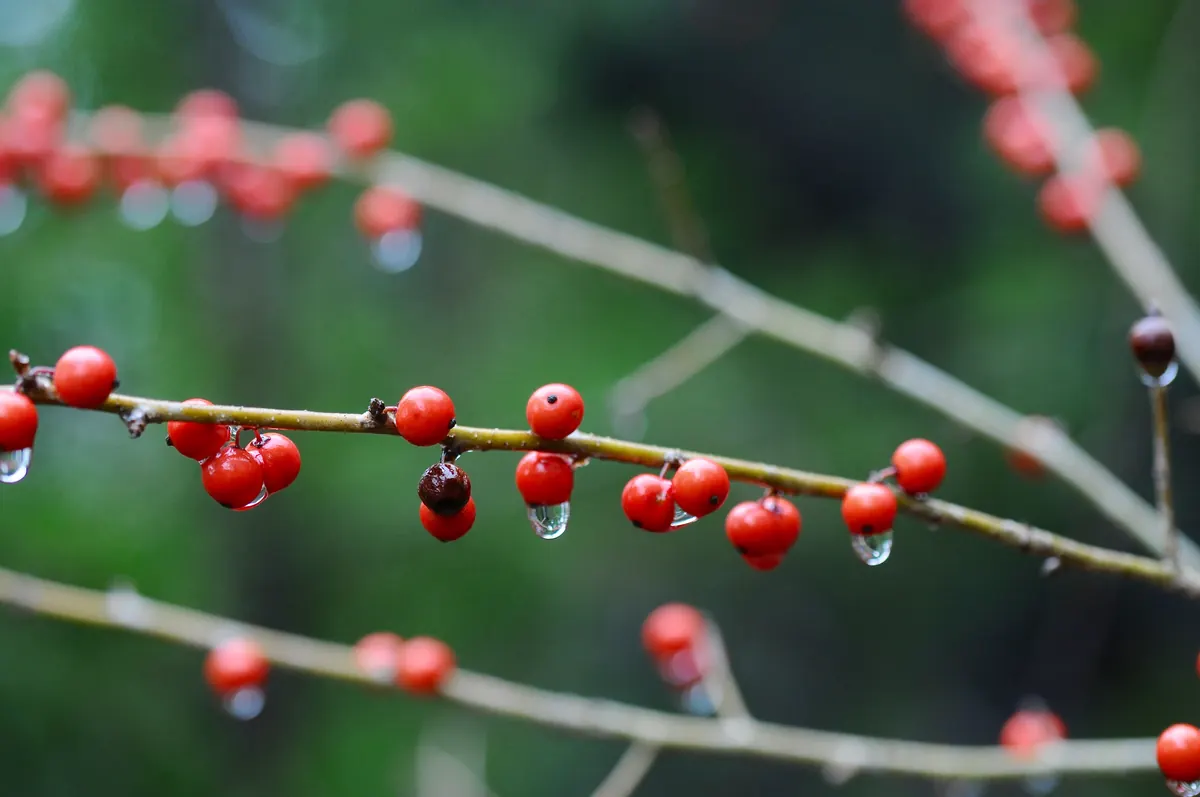
A deciduous holly, usually a spreading shrub, whose leaves drop to reveal orange-red berries about a quarter-inch across, single or in twos and threes, that hang on most of the winter. Only female plants bear fruit. It is one of the few splashes of red in a December woods.
-
Kentucky coffee tree
Pods hang October to late winter · Bottomland forests and the moist foot of bluffs
Short, blunt, crooked twigs and dangling leathery pods 4 to 10 inches long, brownish black, each with three to five very hard seeds in sticky pulp. The pods stay shut on the tree and drop, still unopened, in late winter. Native Americans roasted the seeds for a coffee, but MDC warns that raw seeds are toxic.
-
Christmas fern
Evergreen all winter · Shaded, wooded slopes statewide
MDC lists it among December’s sights: leathery green fronds on a shady wooded slope when the rest of the forest floor is brown. The small ear at the base of each leaflet gives the fern its stocking shape.
After the holidays, a real tree can go back into the water. In January 2026 MDC collected live Christmas trees at five central Missouri sites, from Columbia to Camdenton, and sank them in lakes and ponds as fish cover; trees had to be bare of decorations. Watch for a 2027 notice in late December.
What tracks can you find in Missouri snow and mud?
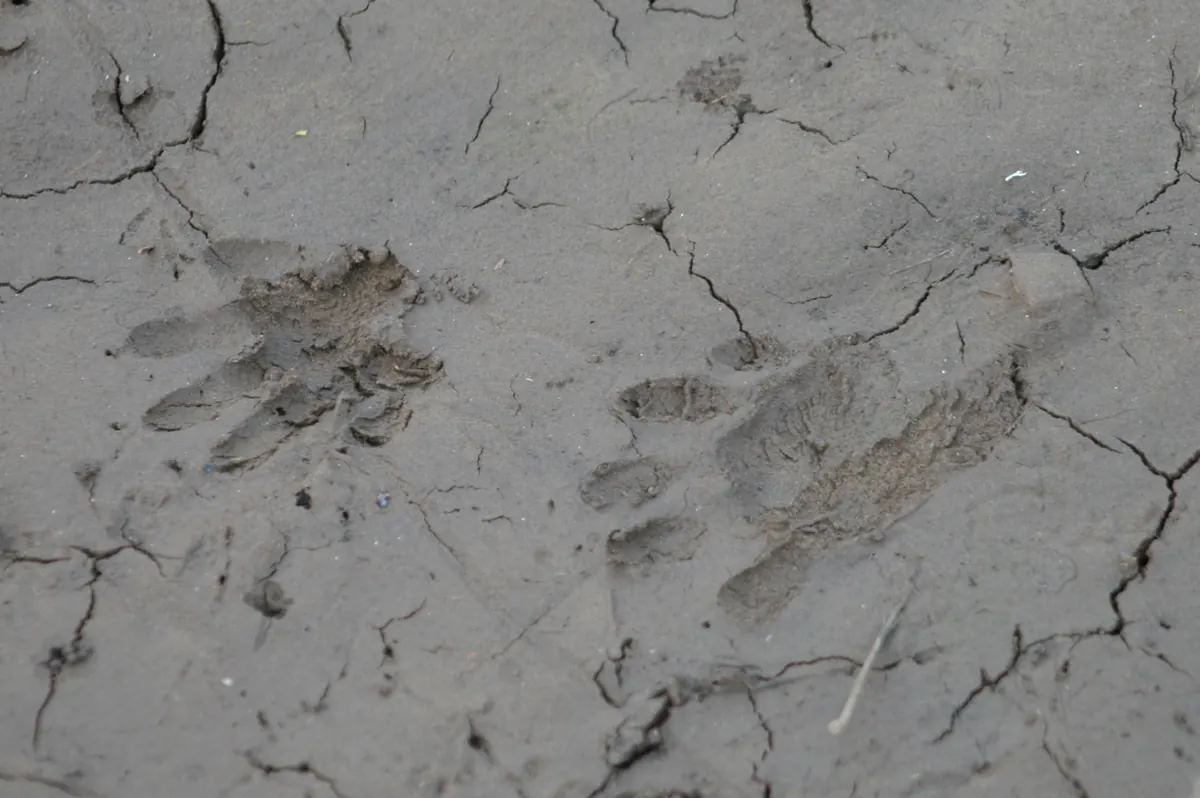
Missouri’s snow rarely lasts, so the best tracking is often in mud: the edge of a creek gravel bar, a farm pond bank, a muddy field road the morning after rain. Measure the print, count the toes, note whether claws show, and then look at the pattern of the whole trail; MDC’s track guide is built around those questions.
-
Raccoon
Any night above freezing · Creek banks and pond edges
Prints like small human hands, the front 2½ to 3 inches long and the hind 3¾ to 4 inches, both with five long toes. Raccoons walk flat-footed, so the heel of the hind foot shows.
-
Opossum
Any winter night · Woodland edges, under decks
Two-inch prints with five toes spread like a star on the front foot; on the hind foot the thumb sticks out sideways. In snow the tail often leaves a wavy drag line between the prints.
-
Coyote and red fox
All winter; red foxes mate in January · Field edges, farm lanes, frozen creeks
A coyote’s front print is about 2½ inches long with four toes, egg-shaped, the two middle toes often pinched inward; the trail runs in a straight, purposeful line. A red fox leaves smaller, neater prints, the front about 2 inches long and the hind print diamond-shaped.
-
Bobcat and cottontail
Dawn and dusk · Brushy edges, glades, fencerows
Bobcat prints are round, about 2 inches long, four toes, usually no claws. A cottontail’s small front feet (about an inch) land behind the long hind prints (3½ inches) when it hops, so the bigger marks point the way it went.
-
Deer, otter and armadillo
All winter · Trails to water; streams; southern counties
Deer prints are split hearts 2½ to 4 inches long, pointed end forward. Otters leave five-toed prints about 2½ inches long by streams; in southern counties, a print with four toes in front and five behind may be an armadillo.
For a family, the easiest tracking project is a smooth patch of mud by the back door or a shallow tray of sand by the feeder: rake it flat at dusk and read it in the morning.
How cold and snowy is a Missouri December, and what might El Niño bring this winter?
Cold enough to freeze the ponds, rarely white for long. NOAA’s 1991–2020 normals give Kirksville an average December high in the upper 30s and Joplin one in the upper 40s, with average lows from about 21 °F in the far north to about 30 °F at Cape Girardeau, and the stations that keep snow records average 3 to 4 inches for the month. Precipitation follows the north-south split you saw in November: about 1¼ inches at St. Joseph, about 3.6 at Cape Girardeau. And a white Christmas? NOAA’s daily normals put the odds of an inch or more of snow cover on December 25 at about one in five in Kansas City, 17 percent in St. Louis, 15 in Columbia and 12 in Springfield.
| Station | Average high | Average low | Precipitation | Snowfall |
|---|---|---|---|---|
| Kirksville | 38.6 | 21.1 | 1.78 | 4.0 |
| St. Joseph | 41.1 | 21.1 | 1.25 | not published |
| Kansas City (airport) | 42.3 | 23.9 | 1.57 | 4.0 |
| Columbia | 43.6 | 26.7 | 2.09 | 3.4 |
| St. Louis (Lambert) | 44.5 | 28.5 | 2.50 | 3.2 |
| Springfield | 47.0 | 27.8 | 2.61 | 3.3 |
| Joplin | 47.8 | 28.5 | 2.60 | not published |
| Cape Girardeau | 46.3 | 29.8 | 3.62 | not published |
This winter comes with a strong El Niño in the Pacific: forecasters at NOAA put the chance of it reaching very strong status this winter at over 90 percent in their September 10 update. In mid-continent Missouri its influence is weaker and less reliable than along the Gulf Coast. Writing for MU Extension in August, University of Missouri climatologist Zach Leasor said El Niño winters here have usually been wetter, with the north of the state tending warm and the south sometimes cool, and that no two events play out alike. The December inside the last strong one, 2015–16, is a reminder of what “wetter” can mean: from December 26 to 28, 2015, 6 to 12 inches of rain fell in a band from southwest Missouri through St. Louis, the Meramec and Bourbeuse rivers set record crests, three interstates closed, and the National Weather Service counted six deaths. That does not mean a repeat this year. We wrote this before NOAA released its official winter outlook (due October 15); look for it among the CPC seasonal outlook maps. For the days ahead, check our local weather page, and for the last spring frost to plan next year’s garden around, see our Missouri frost dates.
When is the earliest sunset and the shortest day in Missouri?
They fall on different dates, and the early sunsets arrive first. Around December 6 to 8, every Missouri city reaches its earliest sunset of the season: 4:39 p.m. in St. Louis, 4:44 in Kirksville, 4:55 in Kansas City and St. Joseph, 4:56 in Springfield and 5:01 in Joplin. The minimum is so shallow that the sunset clock sits within a minute of those times for about two weeks around them. Day length bottoms out at the solstice, at 2:50 p.m. Central on Monday the 21st: 9 hours 19 minutes of daylight at Kirksville and 9 hours 37 minutes at Joplin. After it, evenings gain light first; sunrise keeps slipping later until early January.
| City | Dec 1 | Dec 21 | Dec 31 | Earliest sunset |
|---|---|---|---|---|
| Kirksville | 9 h 31 m | 9 h 19 m | 9 h 21 m | 4:44 p.m., Dec 7 |
| St. Joseph | 9 h 34 m | 9 h 21 m | 9 h 25 m | 4:55 p.m., Dec 8 |
| Kansas City | 9 h 37 m | 9 h 25 m | 9 h 29 m | 4:55 p.m., Dec 7 |
| Columbia | 9 h 38 m | 9 h 26 m | 9 h 29 m | 4:47 p.m., Dec 7 |
| St. Louis | 9 h 40 m | 9 h 28 m | 9 h 31 m | 4:39 p.m., Dec 7 |
| Springfield | 9 h 48 m | 9 h 36 m | 9 h 39 m | 4:56 p.m., Dec 6 |
| Joplin | 9 h 48 m | 9 h 37 m | 9 h 40 m | 5:01 p.m., Dec 6 |
| Cape Girardeau | 9 h 47 m | 9 h 35 m | 9 h 38 m | 4:40 p.m., Dec 6 |
St. Louis and Cape Girardeau get the earliest sunsets because they lie farther east in the Central time zone; Joplin, Springfield and Kansas City, well to the west, keep their light longer by the clock. Look up your own street in the daylight calculator, which works for any date this winter.
What is in Missouri’s night sky in December?
The year’s longest nights, a new moon on the 8th, then the strongest meteor shower of the year. All times are Central Standard Time.
-
The Geminids
Night of Sunday, December 13, into Monday, December 14 · Anywhere dark; the radiant is high by late evening
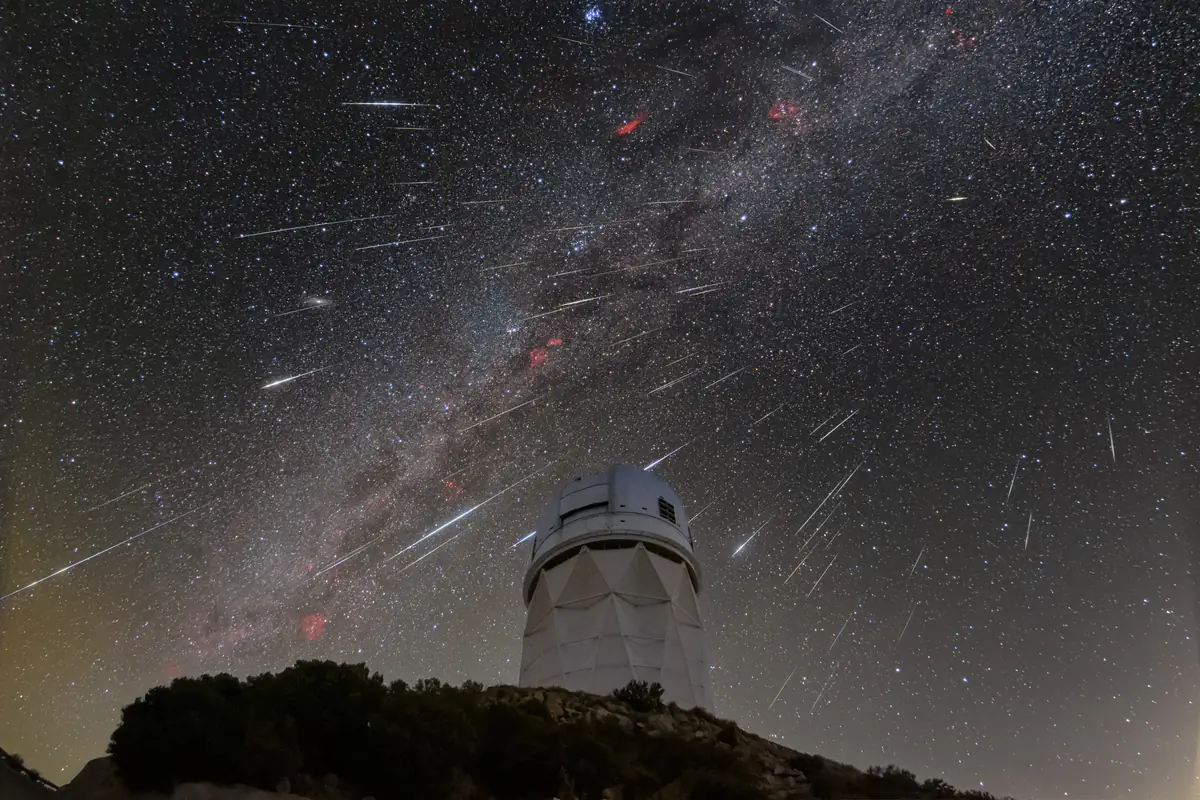
The International Meteor Organization gives the Geminids a zenithal rate of 150, the figure for an ideal dark sky with the radiant overhead; a Missouri backyard will see far fewer, but still plenty. The crescent Moon is down by about 9:15 p.m., and the count improves through the night until around 2 a.m., with Gemini then at its highest. Activity spans December 4–20, so neighboring nights count too. Unusually, the parent is an asteroid, 3200 Phaethon, not a comet.
-
The Cold Moon, nearest of the year
Full at 7:28 p.m. on Wednesday, December 23 · Rising in the east-northeast at dusk
Full moon falls about seven hours from perigee, making this the year’s nearest full moon and a supermoon on any common definition. The size difference is too small to see without a side-by-side photograph, but the Moon rides high and bright on the long December night, and Christmas Eve’s moon is nearly as full.
-
The solstice
Monday, December 21, 2:50 p.m. · Note where the sun sets
The noon sun stands lowest now. From one fixed spot, note the sunset point on the skyline, a barn roof or a particular tree, then look again in mid-January and see how far north it has moved. That evening the gibbous Moon passes the Pleiades.
-
Planets
All month · Saturn after dusk; Venus, Jupiter and Mars before dawn
After dark only Saturn shines among the bright planets, low in the south and southwest and setting a little sooner each night. Dawn is where the action is: brilliant Venus in the southeast, nearing its greatest angle from the sun (reached January 3), and Jupiter and Mars in Leo, with Jupiter up by mid-evening late in the month. Look before sunrise on December 4 and 5 for a crescent Moon with Venus and the star Spica.
-
Quadrantids for New Year’s week
Peak about 9:25 p.m. on Sunday, January 3, 2027 · Northeast sky, late night and before dawn
A sharp peak just before new moon. (December 22’s Ursids are lost to moonlight.)
| Phase | Date | Time |
|---|---|---|
| Last quarter | Tuesday, Dec 1 | 12:08 a.m. |
| New moon | Tuesday, Dec 8 | 6:52 p.m. |
| First quarter | Wednesday, Dec 16 | 11:42 p.m. |
| Full moon, the Cold Moon | Wednesday, Dec 23 | 7:28 p.m. |
| Last quarter | Wednesday, Dec 30 | 12:59 p.m. |
Missouri State Parks opens Elephant Rocks State Park after dark for the Geminids on Saturday, December 12, details below. Check our cloud cover forecast before a cold night out, and our Moon phase page has times for your town.
What can Missouri families do outdoors in December?
- December 1 to January 31: Jingle Bell Hikes at Knob Noster State Park. Staff hang five sets of bells along the trails; find them, ring them, snap a photo. Trails are open sunrise to sunset.
- Friday, December 4: a beginner bird walk from MDC’s Discovery Center in Kansas City, 10:30 to 12; sign-up opens October 23.
- December 5–6: Eagle Days at Loess Bluffs, with live eagle shows and scopes on the auto tour.
- Saturday, December 5: a bison saunter at Prairie State Park, a free two-hour, 2-mile ramble from 1 p.m. among the herd’s tallgrass range; 30 places, register by phone.
- Friday, December 11: Owl Prowl at Rockwoods Reservation in Wildwood, 6:30 to 8 p.m. (registration opens October 12). A second MDC owl prowl runs at Busch Memorial Conservation Area in St. Charles on Friday, December 18, same hours (registration opens October 16).
- Saturday, December 12: Geminid viewing at Elephant Rocks State Park near Belleview, 5 to 10 p.m.: free, no registration, chairs and blankets welcome, no tents, lanterns, heaters or fires. It falls the night before the peak, still well inside the shower.
- Thursday, December 17: Toddler Thursday, Animals in Winter at Mastodon State Historic Site in Imperial, 10 a.m., free, with a story and a craft.
- Saturday, December 19: Christmas Candlelight and Cookie Stroll at Roaring River State Park, south of Cassville: hundreds of luminaries along the river, a tree lighting at 4:30 p.m. and activities from 5 to 8. Free; bring a flashlight.
- Saturday, December 26: Nature Center Saturdays at Powder Valley in Kirkwood, a Wildlife of Missouri program at 10 a.m. and again at noon.
- Christmas Bird Count, December 14 to January 5: join a field team, or report your feeder birds if you live in a count circle.
- New Year’s Day 2027: First Day Hikes. Twenty-six Missouri state parks and historic sites led New Year’s Day hikes for 2026, with preregistration through the state park reservation site; the 2027 list usually appears just before Christmas.
We took these from MDC and Missouri State Parks calendars in early October. Programs fill, and winter weather cancels them, so confirm before you drive. Our Missouri November guide covers the snow geese, the rut and the first swans.
Safety notes for December in Missouri
- Hunting seasons in December (MDC, 2026–27): archery deer through January 15; the firearms antlerless portion December 5–13 in the counties open for it; the alternative methods portion (muzzleloaders and other methods) December 26 to January 5; elk firearms December 12–20 in the elk zone around Peck Ranch; ducks in the North Zone through December 29, in the Middle Zone through December 13 and again December 19 to January 10, and in the South Zone from December 7; Canada and light geese all month; quail through January 15; rabbits, crows, bobcats and trapping all month. The Peck Ranch elk driving tour is closed December 6–7 for a managed hunt.
- Hunter orange: during every firearms deer portion, antlerless and alternative methods included, hunters of any game must wear an orange hat and an orange shirt, vest or coat visible from all sides, with exemptions for migratory bird hunters, archery-permit holders during the alternative methods portion, and small game and furbearer hunters during that portion; elk hunters and anyone with them need orange during the elk firearms portion. Hikers are not covered, but wear orange anyway on public land those weeks, and put a vest on the dog.
- Ice: MDC wants at least 4 inches of hard, clear ice before anyone walks out, and only after several days in a row with highs well below freezing. Ice is never even, so test it every few yards, and remember that snow on top slows freezing. A thaw can weaken Missouri ice within a day, so keep children and dogs off unless an adult has checked it.
- Cold water: wear the life jacket in any duck boat or canoe; December water disables swimmers in minutes.
- Winter floods: bare ground and wet soil can turn a heavy December rain into fast-rising creeks, as in 2015. Never drive into water over a road.
- Short days, cold rocks: with sunset before 5 p.m. almost everywhere, start hikes early and carry a headlamp. Elephant Rocks’ staff warn that the granite is colder than the air around it.
- Caves: respect closures; disturbing hibernating bats can kill them.
Sources
- MDC: Eagle Days (47th Eagle Days at Loess Bluffs, December 5–6, 2026)
- MDC: The Bald Eagle in Missouri (2025 brochure; winter numbers, viewing hot spots, nesting)
- MDC field guide: bald eagle (more than 600 active nests in 2025)
- U.S. Fish and Wildlife Service: Loess Bluffs National Wildlife Refuge, species (eagle peak and numbers)
- U.S. Fish and Wildlife Service: Loess Bluffs National Wildlife Refuge, visit us (best months, auto tour, visitor center)
- U.S. Fish and Wildlife Service: Mingo National Wildlife Refuge, visit us (waterfowl peak, eagle nesting, roads open in winter)
- MDC field guide: trumpeter swan
- St. Louis Magazine: A guide to seeing the trumpeter swans at Riverlands (December 19, 2024)
- National Audubon Society: Audubon Center at Riverlands, Birds of Winter
- MDC field guide: snowy owl
- Missouri Conservationist, December 2025: Get Outside in December
- National Audubon Society: The 121st Christmas Bird Count in Missouri
- MDC Discover Nature Notes: Christmas Bird Counts
- MDC News: MDC needs birders to help with the Audubon Christmas Bird Count (December 8, 2025)
- Missouri Birding Society: Christmas Bird Count dates for 2026–2027
- Columbia Audubon Society: bird counts (Columbia Christmas Bird Count)
- MDC field guide: gray myotis (gray bat)
- MDC field guide: bats (hibernation and white-nose syndrome)
- Missouri Conservationist, March 2023: Missouri Caves
- MDC field guide: woodchuck (groundhog)
- MDC News: Some wildlife hibernate, while others need a helping hand as they den up for winter (December 5, 2019)
- MDC field guide: American black bear (denning and cubs)
- MDC: 2024 Missouri Black Bear Program Annual Report (population estimate)
- MDC Discover Nature Notes: The Groundhog Way
- MDC field guide: three-toed box turtle
- MDC field guide: gray treefrog and Cope’s gray treefrog
- MDC field guide: shortleaf pine
- MDC field guide: possum haw (deciduous holly)
- MDC field guide: Kentucky coffee tree
- MDC News: Donate live Christmas trees to MDC after the holiday season (December 23, 2025)
- MDC: mammal tracks
- NOAA NCEI: 1991–2020 monthly normals for December temperature, precipitation and snowfall (data API)
- NOAA NCEI: 1991–2020 daily normals, chance of 1 inch of snow on the ground on December 25 (data API)
- Climate Prediction Center: ENSO diagnostic discussion, September 10, 2026
- NOAA Climate.gov: United States El Niño impacts
- Climate Prediction Center: seasonal outlooks (winter outlook due October 15, 2026)
- University of Missouri Extension, Integrated Pest Management: El Niño Returns in 2026 (August 6, 2026)
- National Weather Service St. Louis: December 2015 historic heavy rainfall and flooding event
- U.S. Naval Observatory: moon phases (data API)
- U.S. Naval Observatory: Earth’s seasons 2026 (solstice time)
- International Meteor Organization: 2026 meteor shower calendar
- EarthSky: what is a supermoon (2026 full supermoons)
- EarthSky: Venus at greatest western elongation, January 2027
- Missouri State Parks: Geminid Meteor Shower Viewing Event, Elephant Rocks State Park, December 12, 2026
- Missouri State Parks: Jingle Bell Hikes, Knob Noster State Park
- Missouri State Parks: Christmas Candlelight and Cookie Stroll, Roaring River State Park, December 19, 2026
- Missouri State Parks: Guided Bison Saunter, Prairie State Park, December 5, 2026
- Missouri State Parks: Toddler Thursday, Animals in Winter, Mastodon State Historic Site, December 17, 2026
- Missouri Department of Natural Resources: Start 2026 on the right foot with a First Day Hike (December 22, 2025)
- MDC events listing (December 2026 programs and registration)
- MDC: 2026–27 hunting and trapping seasons
- MDC: deer hunting (antlerless and alternative methods portions, 2026–27)
- MDC: elk hunting (firearms portion December 12–20, 2026)
- MDC: waterfowl hunting seasons 2026–27
- MDC: quail hunting 2026–27
- MDC: rabbit hunting and trapping 2026–27
- MDC: hunter orange requirement
- MDC: elk driving tours at Peck Ranch (2026 closures)
- MDC: ice fishing (ice safety)
- Photos via Wikimedia Commons; licenses and photographers are credited under each picture
.jpg)