What to look for in nature in Missouri this February
February is the hinge of the Missouri winter. Cold snaps still come, and at Kansas City the normal snowfall actually tops January’s, but the year is turning all the same. Snow geese stream north into the Missouri River wetlands by the hundreds of thousands, woodcocks begin their twilight flights, and on the first warm, rainy night chorus frogs and salamanders head for the ponds. Eagle pairs settle onto eggs, maple sap rises in the cold, and the days grow by more than an hour in the north. Here is where and when to look.
Other months in Missouri: October, November, December, January.
Start here

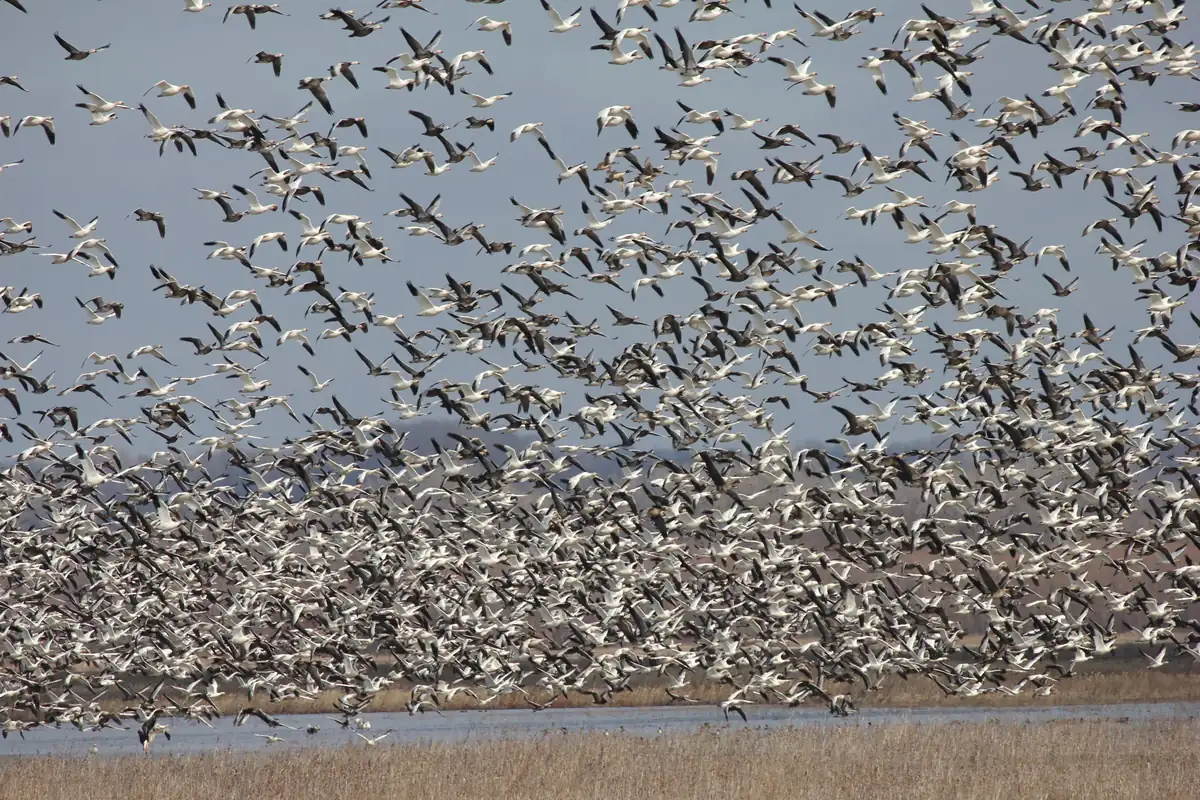
- Drive the auto tour at Loess Bluffs for snow geese. Snow geese start arriving at the refuge near Mound City in mid-February, and the survey of February 24, 2026, counted more than 750,000 of them. Be there at first light, when the geese rise from the pools to feed in nearby fields, and stay for their noisy return around sunset.
- Listen for a woodcock at dusk. From the first thaw, male American woodcocks give a nasal “peent” from the ground at twilight, then spiral up out of sight on twittering wings and drop back down. Stand at the edge of a damp field or young woodland after sunset on a calm evening and listen.
- Count birds for the Great Backyard Bird Count, February 12–15. Fifteen minutes is enough to take part. Tally the birds in your yard, a park or a refuge on any of the four days, Friday through Presidents’ Day, and enter your list in the Merlin or eBird apps.
In the Naturalist’s Field Journal, the “dusk and dawn watch” page suits an evening spent waiting at a field edge for woodcocks, noting the minute the first woodcock peents and the temperature. Turn “a map of sounds” over to the first night of frog calls, marking which ditch or pond the chorus comes from. Snow geese, juncos and your Great Backyard Bird Count tally go on “birds I have seen,” and “a tree through the seasons” can start with a sugar maple or silver maple in bud, ready for its first flowers.
Regions used below: Northwest Missouri; Northeast Missouri; Kansas City area; St. Louis area; Central Missouri/Columbia; the Ozarks; Southwest Missouri/Springfield; Southeast Missouri and the Bootheel.
When and where can you see snow geese in Missouri in February?
February is when the white tide starts. MDC says snow geese winter in Missouri and move north from February through April, and the birds that wintered farther south pass through the state on their way to Arctic nesting grounds. They travel in big, noisy flocks and feed in harvested crop fields by day, then rest on open wetlands. Look up on any clear February day and you may see long, wavering lines of them very high overhead, calling in a nasal chorus you can hear before you find the birds.
Some of the birds in any big flock are dark “blue geese,” which MDC notes were once treated as a separate species. They are the same snow goose in a different color: a gray-brown body with a white head and neck.
-
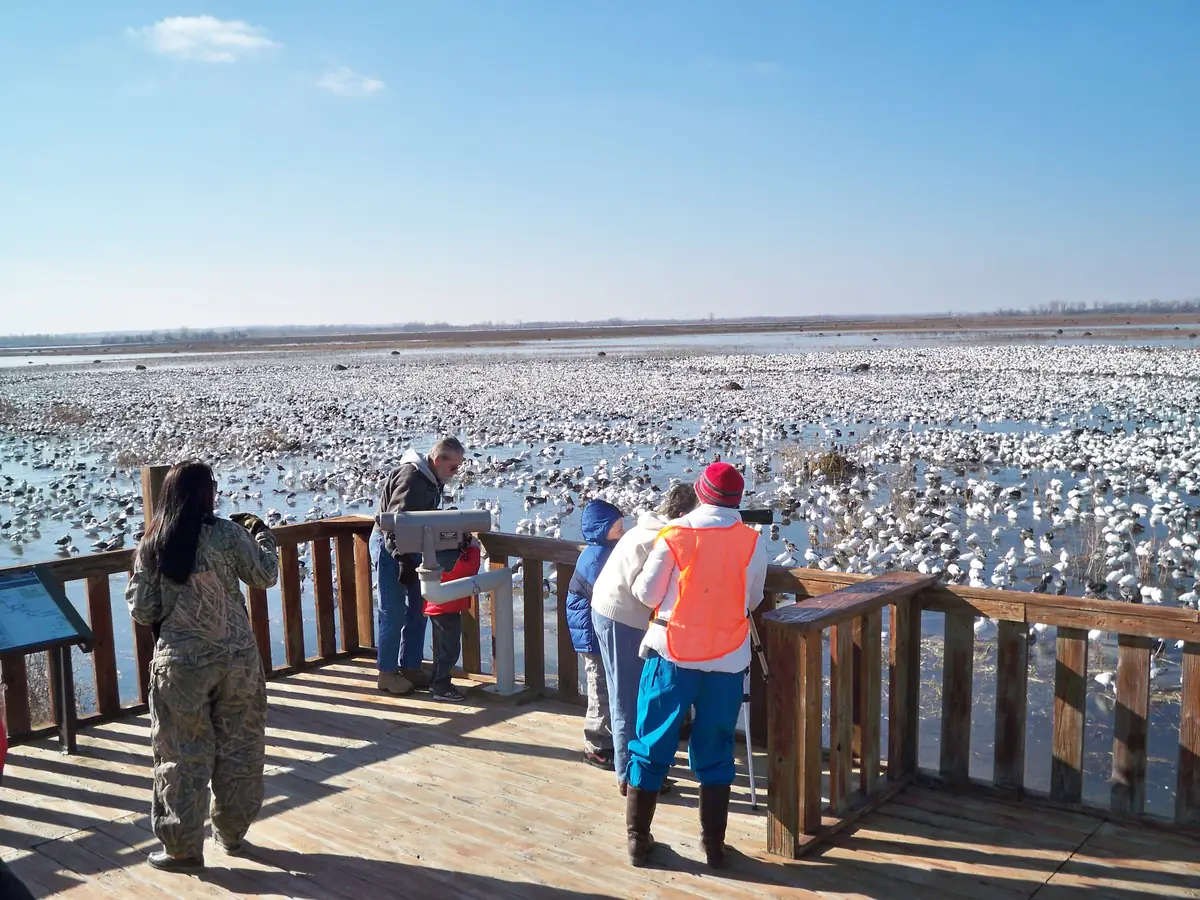
Loess Bluffs National Wildlife Refuge
Arrivals from mid-February; MDC and the refuge put the peak in mid-March · Near Mound City, Holt County; 10-mile auto tour open daily from 30 minutes before sunrise to 30 minutes after sunset
MDC calls this refuge Missouri’s most dependable place to see snow geese. Set where the Mississippi and Central flyways squeeze together, with the Missouri River close by and farm fields all around, it can hold staggering numbers: the refuge’s weekly survey of February 24, 2026, counted 755,550 snow geese, public radio station KBIA reported, and its single-day record is near 1.5 million. Mid-March is the usual peak, but the last days of February are often spectacular. Come at dawn for the mass takeoff, and the refuge (660-442-3187) can tell you what its latest weekly survey found.
-
Grand Pass Conservation Area
Peak usually the last week of February into the first week of March · Missouri River bottoms in Saline County, northwest of Marshall
This mostly wetland area along the Missouri River draws big flocks right on schedule, and MDC says the peak usually comes in the last week of February and first week of March. You can watch from your vehicle on the area roads, and an observation tower open all year looks out over the pools.
-
Southeast Missouri
Through the month, unpredictably · Otter Slough and Ten Mile Pond conservation areas and nearby fields
Snow geese also pass through the Bootheel, and MDC names these two areas and the fields around them as good bets. They warn, though, that the flocks can be gone the next day and often roost where you cannot reach them, so check recent eBird reports before you make the drive.
Why so many? MDC reports that snow and Ross’s geese have grown to historic highs, enough that they are overgrazing and damaging the Arctic tundra where they and other birds nest. That is the reason for the Light Goose Conservation Order, which opens February 7 and lets hunters take extra snow and Ross’s geese through April 30. Expect hunters near refuges and conservation areas, and read our February safety notes below.
When do woodcocks start their sky dance in Missouri?
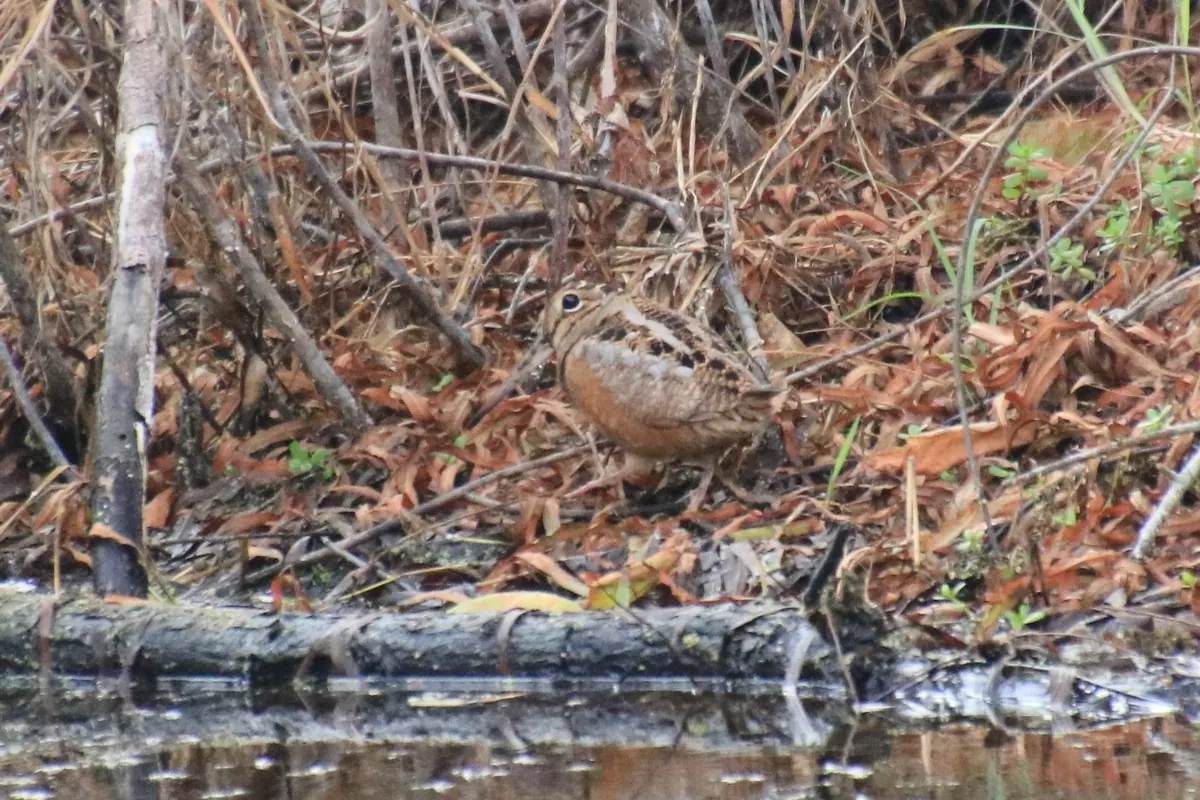
As soon as the ground softens. MDC says American woodcocks are in Missouri from February through November, and males begin their twilight courtship flights at the first February thaw, continuing through April. Woodcocks are stocky, long-billed shorebirds that live in woods and wet thickets instead of on beaches, probing soft ground for worms, and its dead-leaf colors make it nearly invisible by day. At dusk, though, a displaying male is easy to hear.
-
The peent and the flight
Twilight, especially dusk · Moist fields, marsh edges, shrub swamps, young woods near water and wet pastures, statewide
The male starts on the ground in a small opening, giving a loud, buzzy “peent” every few seconds. Then he launches into a widening spiral, climbing so high you may lose him against the sky while his wings make a twittering sound. At the top he drops in a chirping zigzag, settling close to his takeoff spot to start the peents all over. MDC describes the whole performance as a sky dance.
-
How to watch one
Calm, mild evenings from mid-February · Conservation areas with brushy old fields beside wet bottomland
Get there before the sun goes down and wait quietly beside a clearing. When the peenting starts, note where it comes from. Each time the bird takes off, walk a few steps closer, and freeze before the twittering stops and he drops back down. With patience you can watch him land in the last light. Keep dogs leashed and leave flashlights off.
MDC notes that woodcock numbers peak in March as migrants pass through. Nests are just shallow scrapes on the ground in open woods, where the female alone tends up to a dozen eggs; the chicks can run soon after hatching. Stay on trails in spring so you do not step on a hidden nest.
When do frogs and salamanders wake up in Missouri?
On the first warm, wet night of late winter. MDC’s February notes say spring peepers and chorus frogs begin calling on mild evenings in late February, and salamanders start moving to their breeding pools at the same time. The trigger is a soaking rain after a cold spell, with air near or above 50 °F. On a night like that, a flooded field or roadside ditch can go from silent to deafening in an hour.
-
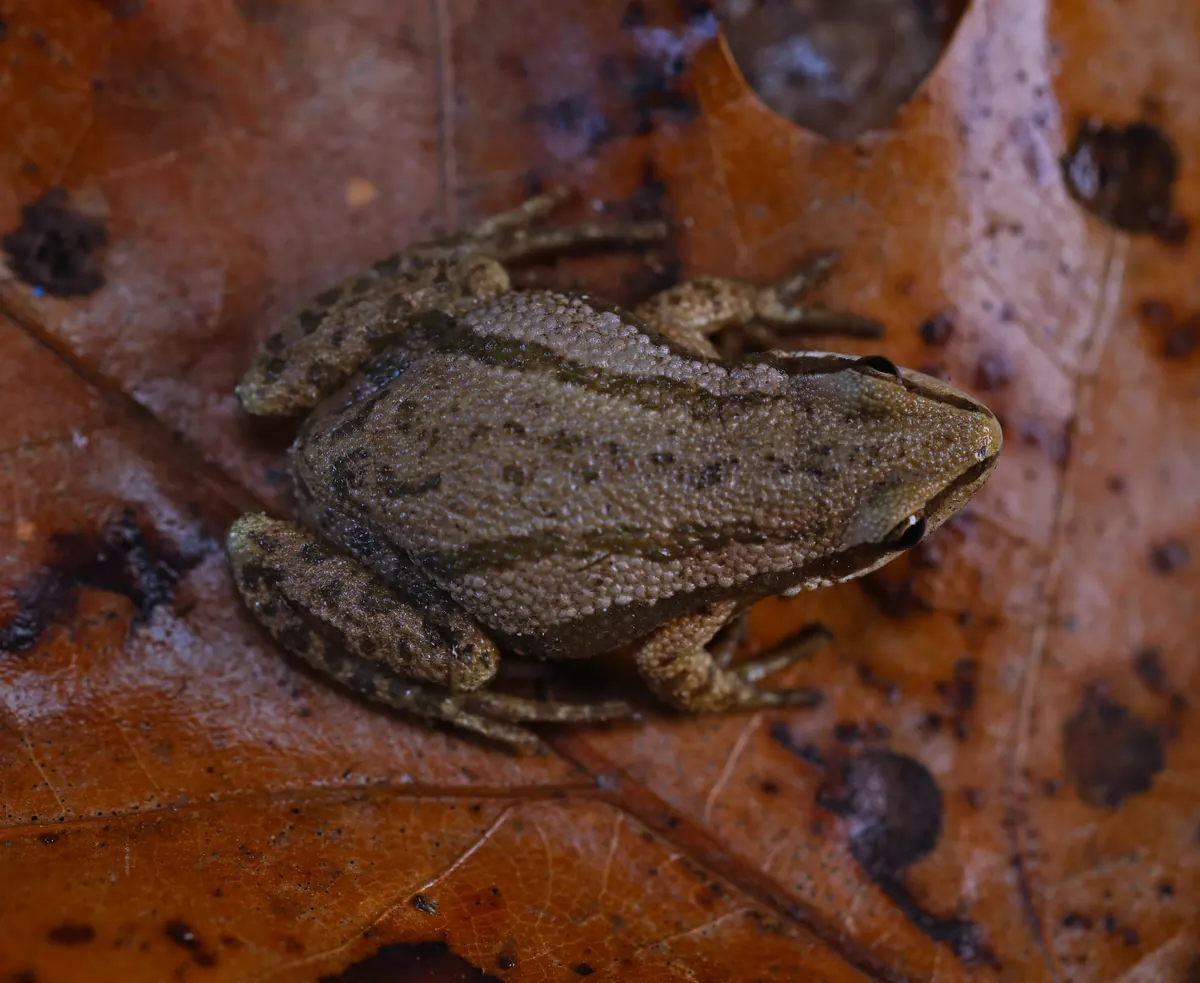
Boreal chorus frog
Breeding begins in late February or early March; peaks in April · Nearly statewide except the southeastern quarter; flooded fields, ditches, sloughs, marsh edges, even towns
A tiny striped frog with an outsized voice. MDC describes its call as a metallic “crrreeeeek” that climbs at the end and lasts about a second, like a fingernail drawn along the teeth of a comb. In the southeast, the upland chorus frog takes its place: MDC says it becomes active in February, with most breeding in March in the Mississippi Lowlands and southeastern Ozarks.
-
Spring peeper
Mostly late February to mid-May · Nearly statewide except the far northwest; fishless woodland ponds and swampy pools
Each male gives a single clear, high peep, rising slightly, about once a second, and a full pond of them sounds to MDC like hundreds of small jingle bells. Finding the singer is another matter: follow one voice with a dim light and expect to search a long time.
-
Wood frog
Early February to late March, after heavy, warm rains · Scattered: a few north-central and eastern counties and parts of the southeastern and southwestern Ozarks
The earliest breeder of all when the weather allows. MDC says males need air of at least 50 °F and a warm downpour; then they gather in woodland ponds and give a hoarse, ducklike “waaaduck.” The chorus is quiet and does not carry far. Females leave jelly masses of 500 to 1,000 eggs, sometimes 50 to 100 masses packed into a few square yards.
-
Spotted and small-mouthed salamanders
Late February into March and early April, on rainy nights · Spotted: forests of the southern two-thirds of the state. Small-mouthed: much of Missouri outside the Ozark Highlands
Both are mole salamanders, out of sight in burrows for most of the year and seen in numbers only during these breeding runs. MDC says spotted salamanders move to shallow, fishless woodland ponds on the first warm rains of late February to mid-March, where hundreds may court in the shallows; the next morning the pond floor can be covered in stalks of jelly. Small-mouthed salamanders breed from late February to early April in temporary pools, roadside ditches and flooded fields, laying their eggs singly or in small clusters on submerged twigs.
To join the chorus without harming it: listen from the road shoulder or a trail, use a dim red light, and do not handle salamanders with lotion or insect repellent on your hands. On rainy nights, drive slowly on roads that cross wetlands, where frogs and salamanders cross in numbers.
Are Missouri’s bald eagles on eggs in February?
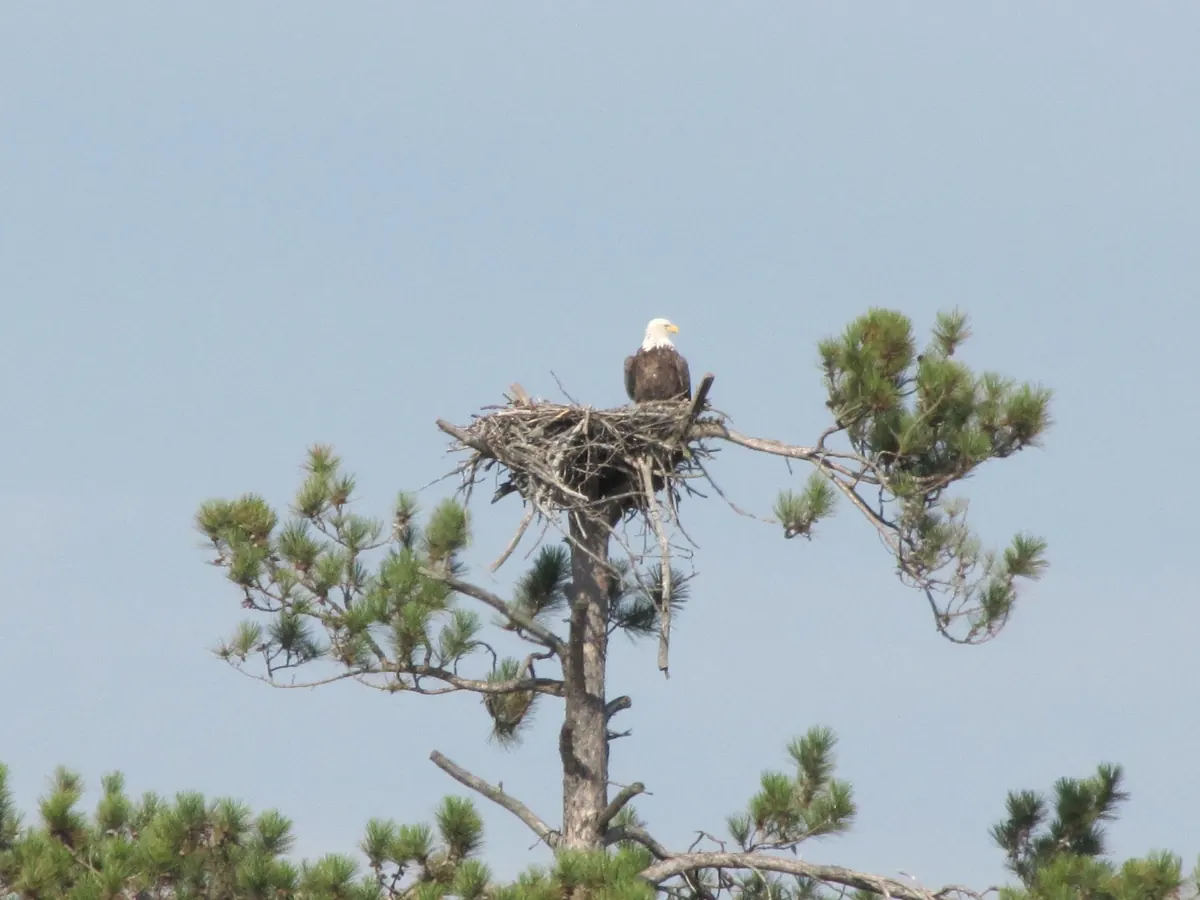
Many are. In the Midwest, MDC’s eagle nesting guide says the first eggs come in early to mid-February, with some pairs waiting until early March. February is when a nest you have been watching changes character: the comings and goings stop, and one adult sits low in the bowl, so that sometimes just a white head pokes over the rim of sticks.
-
Reading an active nest
From early February · Large stick nests in sycamores and cottonwoods along rivers and lakes, statewide
Eagles usually lay one egg a day, often with a day off before the next, and two eggs is the usual clutch. Incubation starts with the first egg and lasts 35 days, so the first chicks hatch a day or more ahead of their siblings. Both parents incubate and both grow a bare brood patch on the breast to warm the eggs, but the female does most of the sitting. An adult that stays put through several visits, hunched low, is the best sign that eggs have been laid.
-
Eagle Days at Riverlands
Usually a Saturday in early February (February 7 in 2026); 2027 date not yet posted · Audubon Center at Riverlands, West Alton
MDC and the Audubon Center hold a festival here each February, with staffed spotting scopes on the Mississippi, live World Bird Sanctuary eagles and craft stations for children. The center also runs Eagle Saturdays and Self-Guided Sundays through January and February. Look for 2027 dates on the center’s Birds of Winter page or MDC’s events calendar.
An incubating eagle is easy to flush and easy to chill. Use binoculars or a spotting scope from a long distance, keep to your car where possible, and back away if the sitting bird rises or starts calling. For courtship flights and nest building, see our Missouri January guide.
When does the maple sap run in Missouri, and which trees flower first?
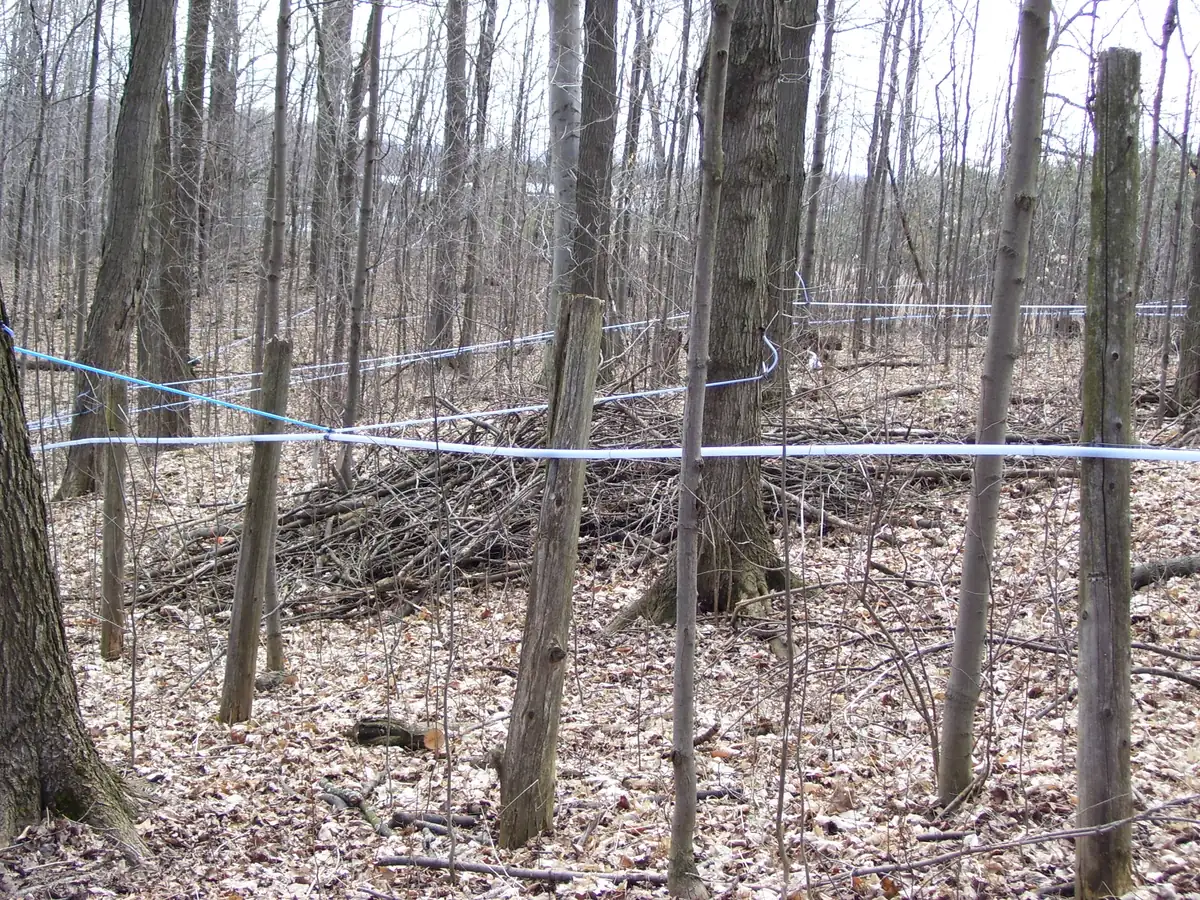
Right now. Maple syrup is a New England picture, but people have boiled sap in Missouri for a very long time: MDC’s backyard sugaring guide quotes a European visitor who found Warren County families busy making sugar in February 1826, and the 1860 census recorded more than 18,000 gallons of Missouri syrup. Sap flows only when nights fall below freezing and days climb above it, and the bigger the swing, the better the run. That makes February, with its hard frosts and sunny afternoons, the heart of the season.
-
Tapping sugar maples
Tap in late January or early February; the run usually ends in the first half of March · Sugar maples, and the look-alike black maples, in yards and woods where they already grow
MDC’s guide recommends tapping at the end of January or start of February to catch the whole season. Sugar maple sap is about 97 percent water and only 2 to 3 percent sugar, so every gallon of finished syrup starts as roughly 40 gallons of sap (black walnut takes twice that). One tree may give 5 to 15 gallons over a season. Only trees at least 10 inches across should be tapped. When the sap turns yellow, usually in the first two weeks of March in Missouri, the season is over. MDC’s foresters add a request: don’t plant sugar maples for syrup, since their dense shade crowds out oaks and hickories. Use the trees you have.
-
Sapsucker wells
Yellow-bellied sapsuckers are here mid-September through April · Trees in yards, parks and woods, statewide
Look for neat rows of small holes ringing a trunk: the work of the yellow-bellied sapsucker, a woodpecker that drills sap wells and comes back to drink and to catch the insects drawn to them. MDC notes that squirrels and other birds use the wells too, and in spring hummingbirds often get their first meals there, before flowers open. Listen for its drumming, an uneven rhythm like Morse code.
-
Silver maple, the first maple in flower
MDC gives January to April · Bottomlands and stream banks statewide; common in towns
MDC calls silver maple the earliest Missouri maple to bloom. Its petal-less flowers come in tight clusters well before the leaves. Red maple, scattered in the Ozarks and Bootheel and planted statewide, follows: MDC says its buds may begin to open on warm days in late February.
-
American elm and American hazelnut
Elm flowers February to April; hazelnut late February to April · Elm in bottomlands statewide; hazelnut on woodland borders, savannas and stream banks statewide
Elm flowers are small, red to green, petal-less tufts dangling on stalks from the bare twigs. Hazelnut’s brown catkins, 1½ to 3½ inches long, dangle beside tiny red-tipped female buds.
To follow one tree all year, choose a silver maple near home and look at its twigs every week from now into April.
Which Missouri animals wake up or start mating in February?
Several mammals start their year in February, which is why you see more of them, and more of them on roadsides, as the month goes on.
-
Groundhogs
Emerging as early as the first week of February · Field edges, fencerows, road banks and wooded slopes statewide
Groundhogs, also called woodchucks, are Missouri’s true hibernators: MDC says they sleep in their burrows from late October into February. Breeding begins soon after they emerge. Pregnancy lasts about a month, and young are born toward the end of March. Groundhog Day falls on Tuesday, February 2, about when Missouri’s groundhogs really are beginning to stir.
-
Striped skunks
Breeding starts in February · Statewide, often near farms and towns
Skunks don’t truly hibernate, MDC explains; in freezing weather they stay in their dens and doze off and on. Breeding starts in February, when adult females mate, and younger females follow about a month later. Litters of four to six are born in May or early June.
-
Coyotes, opossums and cottontails
Late winter · Statewide
MDC says coyotes howl at any season but most during mating time in early spring, which starts building now, so February nights can be loud. Its February phenology lists opossums mating and giving birth, and eastern cottontails starting to breed.
Snow or mud at the mouth of a burrow records who has been coming and going; check one along a fencerow after a fresh dusting.
Is February snowy in Missouri, and what might a strong El Niño do?
Each of the eight stations below runs a few degrees warmer in February than in January, and the north–south spread stays wide: Springfield and Joplin average highs near 50 °F, while Kirksville in the north averages 38.4 °F. Snow is still very much possible. At Kansas City International, NOAA’s normal February snowfall is 5.9 inches, a full inch more than January’s, while St. Louis and Columbia normally see a bit less in February than in January.
| Station | Average high | Average low | Precipitation | Snowfall |
|---|---|---|---|---|
| Kirksville | 38.4 | 19.0 | 2.01 | 4.6 |
| St. Joseph | 42.8 | 21.2 | 0.95 | not published |
| Kansas City (airport) | 43.6 | 23.6 | 1.48 | 5.9 |
| Columbia | 45.1 | 26.4 | 2.12 | 4.6 |
| St. Louis (Lambert) | 45.8 | 27.6 | 2.23 | 4.3 |
| Springfield | 49.5 | 28.0 | 2.40 | 3.3 |
| Joplin | 50.0 | 28.7 | 1.98 | not published |
| Cape Girardeau | 48.2 | 29.7 | 3.31 | not published |
This winter comes with a likely very strong El Niño: NOAA’s ENSO discussion of September 10 put the odds above 90 percent. In Missouri the signal is mostly about moisture. University of Missouri climatologist Zach Leasor wrote in August that Missouri has usually come out of El Niño winters on the wet side, often milder in the north and sometimes chillier in the south, and warned that each El Niño behaves in its own way. In September the NWS office in Springfield, as reported by the Cassville Democrat, said that most of the strong El Niño winters it studied were wetter than normal across its Ozarks territory, while fewer than half were snowier, with a slight lean toward fewer snowstorms.
The last strong event shows how far a single month can stray from the pattern. NWS Springfield’s summary of February 2016 shows Springfield 4.3 degrees warmer than normal, with only 0.36 inch of precipitation, its third-driest February in 129 years, and just a trace of snow. Springfield reached a record 77 °F on February 20, and the office warned of extreme fire weather on several windy days. We wrote this before NOAA’s October 15 winter outlook, which gets a fresh version each month; to see the current one, open the Climate Prediction Center’s seasonal pages. Day-to-day conditions for any Missouri town are on our forecast page, and once garden catalogs arrive, our Missouri frost dates tell you how late a spring freeze tends to linger where you live.
How much daylight does Missouri gain in February?
About an hour everywhere, and a little more in the north. Kirksville’s sun is up 10 hours 10 minutes on February 1 and 11 hours 16 minutes by the 28th, a gain of 66 minutes, while Springfield and Joplin add 58 minutes, climbing from 10 hours 22 minutes to 11 hours 20 minutes. The north is catching up fast: the gap between Kirksville and Joplin shrinks from 12 minutes at the start of the month to 4 at the end. Each day now adds a little over 2 minutes, a much quicker pace than in January.
| City | Feb 1 | Feb 28 | Gained | Per day |
|---|---|---|---|---|
| Kirksville | 10 h 10 m | 11 h 16 m | 66 min | 2.4 min |
| St. Joseph | 10 h 12 m | 11 h 16 m | 64 min | 2.4 min |
| Kansas City | 10 h 14 m | 11 h 17 m | 63 min | 2.3 min |
| Columbia | 10 h 15 m | 11 h 18 m | 63 min | 2.3 min |
| St. Louis | 10 h 16 m | 11 h 18 m | 62 min | 2.3 min |
| Springfield | 10 h 22 m | 11 h 20 m | 58 min | 2.1 min |
| Joplin | 10 h 22 m | 11 h 20 m | 58 min | 2.1 min |
| Cape Girardeau | 10 h 21 m | 11 h 20 m | 59 min | 2.2 min |
The pace keeps quickening until the March equinox, when days lengthen fastest of all. Daylight saving time begins Sunday, March 14, which will push sunsets an hour later overnight. For sunrise and sunset at your own address on any date, use our daylight calculator.
What can you see in Missouri’s night sky in February 2027?
A rare double: within eight days of each other, the two outer planets Jupiter and Mars each line up opposite the Sun, both of them among the stars of Leo. Add Mercury’s best evening showing of the winter and a faint eclipse on the night of the Snow Moon. All times below are Central Standard Time.
-
Mercury in the evening
Late January to about February 10; greatest elongation February 3 · Low in the west-southwest, 30 to 45 minutes after sunset
Mercury rarely climbs far from the Sun; Missouri’s best evening look of the winter comes in early February, with the planet some 18 degrees east of the Sun. A clear view low to the west-southwest helps. On the evening of Sunday the 7th, a hairline crescent Moon, just a day old, hangs near Mercury in the afterglow and can lead your eye to it.
-
Jupiter at opposition
Wednesday, February 10, 6:21 p.m. · Rising in the east at sunset, highest around midnight
Opposition puts our planet directly between Jupiter and the Sun. In Missouri that means the giant planet climbs over the eastern skyline as daylight fades, rides high around midnight and gleams at its peak brilliance, about magnitude −2.5, at a distance of roughly 405 million miles. Brace binoculars on a fence post and look for Jupiter’s big moons, tiny sparks strung out beside the disk, then try a backyard telescope for the dark belts.
-
Mars at opposition
Friday, February 19 (closest to Earth on the 20th) · In Leo, up all night, near Jupiter and the star Regulus
Mars hits opposition on Friday the 19th, during Missouri’s morning hours, and on Saturday it passes closest, a little over 63 million miles from Earth. With the red planet close to its most distant stretch from the Sun, 2027’s encounter is a lean one, and the planet will look like a bright, unblinking, rust-colored star of magnitude −1.2. Still, the red planet won’t come nearer again until 2029. Late on the 19th and into the early hours of the 20th, watch the almost-full Moon slide right past Jupiter.
-
The Snow Moon and a faint eclipse
Full at 5:23 p.m. Saturday, February 20 · Rising in the east around sunset
Full Moon arrives before moonrise, in late afternoon, and the Moon then clears the eastern horizon around sunset on the 20th, close to Jupiter, Regulus and Mars. Some almanacs call it a supermoon; others do not, since it is not quite as close as January’s. The same evening brings a penumbral lunar eclipse, the faint kind in which the Moon passes only through Earth’s outer shadow. It begins at 3:12 p.m., is deepest at 5:13 p.m. and ends at 7:13 p.m. In Missouri the Moon rises a little after the deepest point, so at most you might notice a slight gray shading on one edge of the low Moon in the first hour after moonrise. Most people will see nothing unusual. As for the ring-shaped solar eclipse on February 6, its path lies over the far Southern Hemisphere and misses North America entirely, so Missourians will see nothing of it.
-
The real middle of winter
February 3–4 · Everywhere
Groundhog Day on February 2 jumps the gun slightly. Winter’s true halfway mark, measured between the solstice and the spring equinox, lands on February 3–4 in 2027. Venus still blazes low in the southeast before sunrise, and Saturn sinks lower in the southwest evening twilight all month.
| Phase | Date | Time |
|---|---|---|
| New moon | Saturday, Feb 6 | 9:56 a.m. |
| First quarter | Sunday, Feb 14 | 1:58 a.m. |
| Full moon, the Snow Moon | Saturday, Feb 20 | 5:23 p.m. (with a faint penumbral eclipse) |
| Last quarter | Saturday, Feb 27 | 11:16 p.m. |
Evenings free of moonlight last from roughly February 2 through the 11th. Sunspot numbers have been falling since the solar maximum of late 2024, although a strong storm can still erupt, so a Missouri aurora is possible even if unlikely; NOAA’s Space Weather Prediction Center posts the alerts. Before any night out, look at our cloud cover forecast, and use our moon calendar to see when the Moon rises in your town.
What are good February nature outings for Missouri families?
- Tuesday, February 2: Groundhog Day. Read the groundhog section above, then go look for a burrow with fresh dirt at the entrance along a fencerow or field edge.
- Early February: Eagle Days at Riverlands, West Alton. Usually on a Saturday early in the month (February 7 in 2026); the 2027 date was not yet posted, so check with MDC or the Audubon Center. The center’s Eagle Saturdays and Self-Guided Sundays continue through February.
- February 12–15: the Great Backyard Bird Count. Spend 15 minutes or more watching birds, at home or anywhere, then enter your tally in Merlin or eBird. It is the 30th year of the count.
- Maple sugaring programs. MDC has taught backyard sugaring in late winter (its how-to guide comes from Rockwoods Reservation in Wildwood); in 2026, the Boone County Nature School near Columbia held a morning session on February 21. Look on MDC’s events calendar for 2027 sessions, which usually require registration.
- A snow goose drive. Late February at Loess Bluffs or Grand Pass, with a thermos and binoculars, is one of the great wildlife sights in the Midwest, and children can watch from a warm car.
- A frog night. On the first warm, rainy evening, take a short walk to a pond or wet ditch, turn the lights off and listen. Try to tell the comb-like chorus frog from the bell-like peeper.
- Project FeederWatch continues through April 30. Counting the same feeder through late winter shows when the juncos leave.
We gathered these from MDC, Audubon and organizers’ pages in early October 2026. Winter weather can cancel events, so confirm before setting out. For the rest of the season, see our December guide to nature in Missouri, and all our state guides are on the nature index.
Safety notes for February in Missouri
- Hunting and trapping open in February (MDC, 2026–27): regular goose hunting for all species, brant included, through February 6, followed by the Light Goose Conservation Order from February 7 to April 30; falconry for ducks, coots and mergansers February 11 to March 10; rabbit and squirrel hunting through February 15; bobcat, raccoon, opossum and striped skunk hunting and trapping, plus coyote, mink, otter and muskrat trapping, all to February 28; crow season to March 3; beaver and nutria trapping to March 31; coyotes may be hunted year-round.
- Hunter orange: Missouri’s orange rule applies during firearms deer season and to elk and black bear hunting, none of which is open in February, so no orange is required this month. Hikers near refuges and wetlands will still be sharing the area with goose hunters, who often shoot from blinds at dawn; bright clothing is a sensible choice, and stay on marked public-use trails and roads.
- Thin and rotting ice: February thaws weaken ice quickly. MDC’s minimum is 4 inches of clear, solid ice built up over several days of highs far below 32 °F, and warns that thickness can change from 6 inches to 2 within a few feet. Snow on top insulates the ice rather than strengthening it. Never go out alone, and stay off ice entirely during and after a thaw.
- Late-winter rain and flooding: the warm rains that wake the frogs can also flood low-water crossings. NWS warns that 6 inches of fast water can knock an adult down and 12 inches can carry off most cars. Turn around at any flooded road.
- Fire weather: dry, windy, mild days are common in late winter, and dead grass burns fast. Avoid outdoor burning on windy days and follow local burn bans.
- Night drives on amphibian nights: slow down on wet roads near ponds and wetlands after dark, both for the frogs and salamanders and for people out watching them.
- Nests: keep well back from eagle nests, where an adult is now sitting on eggs, and from great horned owl nests, where incubation is well under way.
Sources
- U.S. Fish and Wildlife Service: Loess Bluffs National Wildlife Refuge, species (snow geese from mid-February)
- U.S. Fish and Wildlife Service: Loess Bluffs National Wildlife Refuge, visit us (hours, peak timing, phone)
- KBIA: Snow geese touch down at Loess Bluffs on annual migration (March 4, 2026)
- Missouri Conservationist, January 2023: Ask MDC (where to see snow geese)
- Missouri Conservationist, March 2017: Places to Go, Grand Pass Conservation Area
- MDC field guide: snow goose
- MDC field guide: American woodcock
- Missouri Conservationist, February 2026: Get Outside in February
- Missouri Conservationist, February 2024: Get Outside in February
- MDC field guide: boreal chorus frog
- MDC field guide: upland chorus frog
- MDC field guide: spring peeper
- MDC field guide: wood frog
- MDC field guide: spotted salamander
- MDC field guide: small-mouthed salamander
- MDC: Bald Eagle Nesting Ecology and Phenology (Missouri Eagle Watch Program guide)
- MDC: The Bald Eagle in Missouri (2025 brochure; viewing season)
- MDC newsroom: Eagle Days festival February 7 at the Audubon Center at Riverlands (2026)
- MDC: Eagle Days events
- National Audubon Society: Audubon Center at Riverlands, Birds of Winter
- MDC Rockwoods Reservation: Guide to Backyard Maple Sugaring
- MDC newsroom: Learn the art of maple sugaring with MDC in Columbia, February 21 (2026)
- MDC field guide: yellow-bellied sapsucker
- MDC field guide: silver maple
- MDC field guide: red maple
- MDC field guide: American elm
- MDC field guide: American hazelnut
- MDC field guide: woodchuck (groundhog)
- MDC field guide: striped skunk
- MDC field guide: coyote
- NOAA NCEI: 1991–2020 monthly normals for Missouri stations (data API)
- Climate Prediction Center: ENSO diagnostic discussion, September 10, 2026
- Climate Prediction Center: seasonal outlooks (winter outlook due October 15, 2026)
- University of Missouri Extension, Integrated Pest Management: El Niño Returns in 2026 (August 2026)
- Cassville Democrat: Winter outlook, what does El Niño mean? (NWS Springfield, September 22, 2026)
- National Weather Service Springfield: February 2016 monthly climate report
- U.S. Naval Observatory: moon phases (data API)
- U.S. Naval Observatory: Earth’s seasons 2027
- Fred Espenak: Sky Event Almanac 2027
- NASA Goddard: lunar eclipses 2021–2030
- NASA Goddard: solar eclipses 2021–2030
- Old Farmer’s Almanac: eclipses
- Sea and Sky: Astronomy Calendar of Celestial Events 2027
- NOAA Space Weather Prediction Center: aurora forecast
- National Audubon Society: About the Great Backyard Bird Count (February 12–15, 2027)
- Project FeederWatch
- MDC: 2026–27 hunting and trapping seasons
- MDC: 2026–27 hunting and trapping seasons, page 2 (geese, Light Goose Conservation Order, small game, furbearers)
- MDC: hunter orange requirement
- MDC: ice fishing (ice safety)
- National Weather Service: Turn Around Don’t Drown
- Photos via Wikimedia Commons; licenses and photographers are credited under each picture
