What to look for in nature in Missouri this May
May is Missouri at full volume. Warblers and tanagers pour through the treetops in the first half of the month, Mississippi kites circle over the river bottoms, and Rocky Mountain toads trill across the Missouri River floodplain. Glades open with paintbrush, primrose and puccoon while fawns are born in the grass and bowfin guard their nests in the Bootheel. Days stretch past fourteen hours, tornado season is at its peak, and the Flower Moon rises on May 19.
Other months in Missouri: October, November, December, January, February, March, April.
Start here

- Spend a morning under the canopy in the first half of May. Songbird migration peaks now. Pick a wooded park, a river bottom or a refuge forest, arrive at first light, stand still near water, and listen for warblers, tanagers, orioles and thrushes high in the trees.
- Go to a glade or prairie for the flower show. Indian paintbrush, birdsfoot violet, Carolina larkspur and orange puccoon take over from the woodland wildflowers as May goes on. Missouri evening primrose opens in late afternoon on limestone glades.
- Listen at dusk for toads and nighthawks. Rocky Mountain toads trill along the Missouri River floodplain, narrow-mouthed toads bleat in the south, and nighthawks boom over rooftops and prairies at sunset. Take a flashlight, switch it off and let your ears work.
In the Naturalist’s Field Journal, each first-of-the-year warbler, tanager and kite belongs on a “birds I have seen” plate, and a frog or toad evening fits “a map of sounds.” A nest you watch from a distance suits “nest observed,” a glade bloom suits “the same place twice,” and a dusk or dawn walk fills “dusk and dawn watch.” “Mammal watch” is the plate for a fawn or a beaver seen from afar.
Regions used below: Northwest Missouri; Northeast Missouri; Kansas City area; St. Louis area; Central Missouri/Columbia; the Ozarks; Southwest Missouri/Springfield; Southeast Missouri and the Bootheel.
Which songbirds pass through Missouri in May, and where can you see them?
The Missouri Botanical Garden’s Shaw Nature Reserve at Gray Summit calls the first half of May the peak time to see migrating songbirds, with warblers, tanagers, orioles and thrushes working the treetops for insects. Late April’s early wave is behind us and the leaves are filling in, so you will hear many birds well before you spot them. World Migratory Bird Day is celebrated in the U.S. and Canada on the second Saturday in May according to the organizers, who had posted no 2027 date in October 2026, so check their site and make it an excuse for a morning under the canopy.
-
Treetop migrants: warblers, tanagers, thrushes
First half of May, mornings · Wooded parks, river bottoms and refuge forests
Shaw’s monthly notes name May’s first two weeks as the peak, and they describe the birds feeding on insects high in the trees. Go early, when the insects are active and the light is soft, stand under a leafy edge near water, and watch for movement rather than color. In the southeast, Mingo National Wildlife Refuge names the prothonotary warbler as one of its featured species; the federal refuge page adds that songbirds and wading birds gather in the marshes and bottomland forests as spring turns to summer. The refuge’s page gives no date for the warbler, so treat the timing as a general late-spring window.
-
Northern refuges in late spring
May into early summer · Swan Lake and Loess Bluffs National Wildlife Refuges, northern Missouri
The northern refuges shift from geese to nesting. Loess Bluffs, near Mound City, says bald eagle pairs build in its trees, that the larger eagle migration moves north by spring and summer, and that songbird nesting is abundant as summer begins, with deer fawns, snakes and turtles along the auto tour. Swan Lake, near Sumner, runs ranger-led First Fridays events from April through August and lets visitors borrow a key to its observation tower during visitor-center hours. Both are wet underfoot, so wear waterproof shoes and carry insect repellent.
-
Baltimore oriole
May, in tall trees at parks, farms and river edges · Open woods, parks, backyards and riverfront forest
The Missouri Department of Conservation (MDC) calls the Baltimore oriole an uncommon summer resident. The female weaves a gray, basket-like nest over about a week, using milkweed silk, plant fibers and hair, and hangs it from the high branches of tall trees such as maples or elms. A clutch holds 3 to 7 eggs, which hatch after 11 to 14 days, and the young leave the nest after about two weeks. Orioles take nectar from feeders and eat the pulp of halved oranges, and Shaw lists them among May’s migrants.
-
Mississippi kite
Present from late April to late September, with numbers highest from late May through August · Mississippi River valley, mature bottomland forest and grassland
MDC describes a swallow-like raptor that flies on slow wingbeats and catches insects in midair, often in small groups and often above the forest canopy or a river. Reports come mostly from the Mississippi River valley, and the field guide notes that more than 100 have been seen circling over the river in southeastern Missouri. They nest in colonies in tall bottomland trees, usually raising one brood. Near a nest a kite may dive at a person who gets too close; MDC says the dives are alarming but rarely make contact.
-
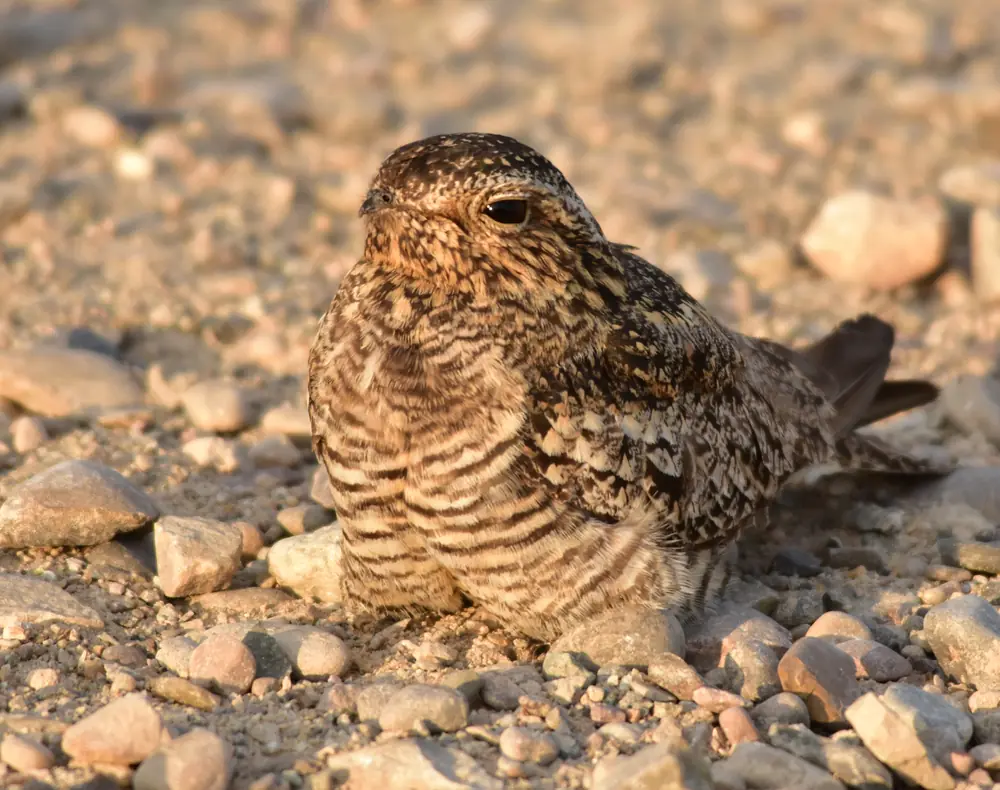
Common nighthawk
Back from late April; courtship dives in May and June evenings · Flat rooftops, parking lots, streetlights, prairies and glades
Despite the name, the nighthawk hunts at dawn and dusk. MDC says it flies in an erratic, bat-like way, gathers around streetlights where insects collect, and gives a harsh, nasal “peent.” In courtship the male dives steeply and pulls out with a loud whirr of feathers. Many city nighthawks lay their eggs straight onto flat gravel roofs; historically they used glades, barrens and prairies. MDC calls it a common summer resident that is declining because of habitat and food loss. Stand in an open lot near sunset and look up.
Keep a running list of arrivals in your Naturalist’s Field Journal on the “birds I have seen” plate; add the date next to each first-of-year bird. Over a few Mays you will have your own arrival calendar for your own backyard.
Which birds are nesting in Missouri fields and woods in May?
By May, the early settlers are on eggs and the late arrivals are claiming ground. Most of what follows nests on or near the ground in grass and brush, which makes it easy to disturb without meaning to. Admire from the path, and keep dogs on a leash through nesting season.
-
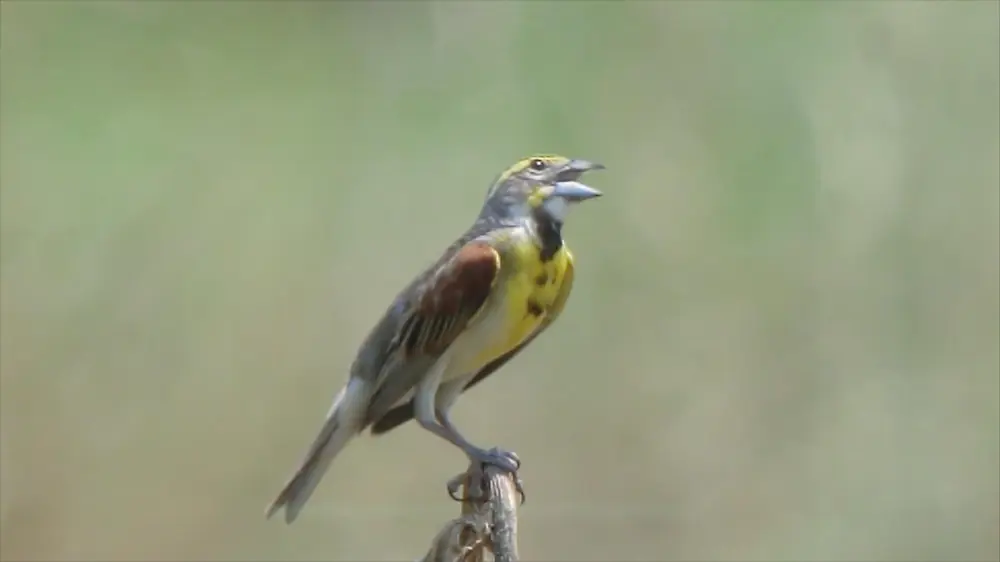
Dickcissel
Back in late April and May; singing from fence posts through summer · Prairies, hayfields, weedy fields and farmland
MDC says the dickcissel’s song sounds like its name. The species is abundant in the Glaciated and Osage Plains and in the Mississippi Lowlands, and some years it appears in larger Ozark fields. The female builds a cup of grass and weed stems low in grass or sapling trees and lays 3 to 6 eggs. MDC points out that hayfields that offer nesting cover are often mowed before the young can leave the nest, which is a reason for landowners to delay cutting where they can.
-
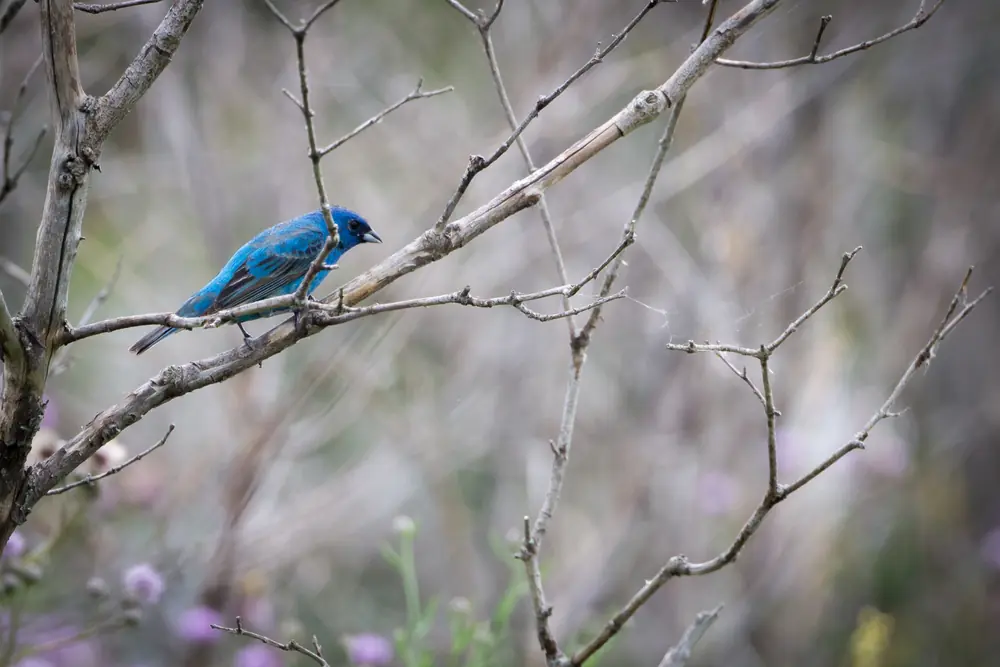
Indigo bunting
Arrives in April; singing on territory by May · Brushy fields, forest openings, hedgerows and gravel-road edges
The male sings paired, whistled notes, and each pair usually sits a little lower than the one before it. MDC says the female builds a cup of leaves and grasses held together with spider webs, low in a shrub. Clutches hold 3 or 4 eggs that hatch after 11 to 14 days, the young stay in the nest about two weeks, and a pair may raise one to three broods. Look along fence lines and the shrubby edges of pastures.
-
Northern bobwhite
Calling through the nesting season · Grassland with shrubby cover
The “bob-white” whistle is the male’s mating call, according to MDC. Eggs are laid about one a day and hatch in 23 days, and a hen can produce up to three clutches before the season closes around October. Newly hatched chicks are about the size of bumblebees, leave the nest roughly a day later and live mostly on insects, which is why growing, flower-rich ground matters. MDC adds that the species has declined steadily because of habitat loss, though areas with targeted habitat work have held steady.
-
Eastern whip-poor-will
In Missouri from April to September; call on the dusk to dawn shift · Woodlands with open understory
MDC says a whip-poor-will may repeat its call hundreds of times in a single night. By day it crouches motionless on leaf litter, perfectly camouflaged, and it builds no nest: two eggs are laid on the ground and incubate about 20 days. The field guide says the birds are especially active on moonlit nights, since they need light to catch insects, and that egg-laying is timed so chicks hatch about 10 days before a full moon. With the Flower Moon on May 20, the nights around it are good ones to stand on a dark rural road and listen. Declines are reported from free-ranging hogs and pets, and from forest loss to suburbs and farms.
For a bigger prairie, Prairie State Park, a Missouri State Parks site, keeps a resident bison herd and a wildflower checklist, and its page says to call the park office at 417-843-6711 for current conditions, since it gives no calf dates. Our nature index has other states’ months if you travel.
Which frogs and toads are calling in Missouri in May?
The chorus changes as the nights warm. MDC’s May notes in 2024 and 2025 mention green frogs, gray treefrogs, and both narrow-mouthed toads among the voices you can learn this month. Dusk and the first hour after dark, especially after a warm rain, are the best times to listen.
-
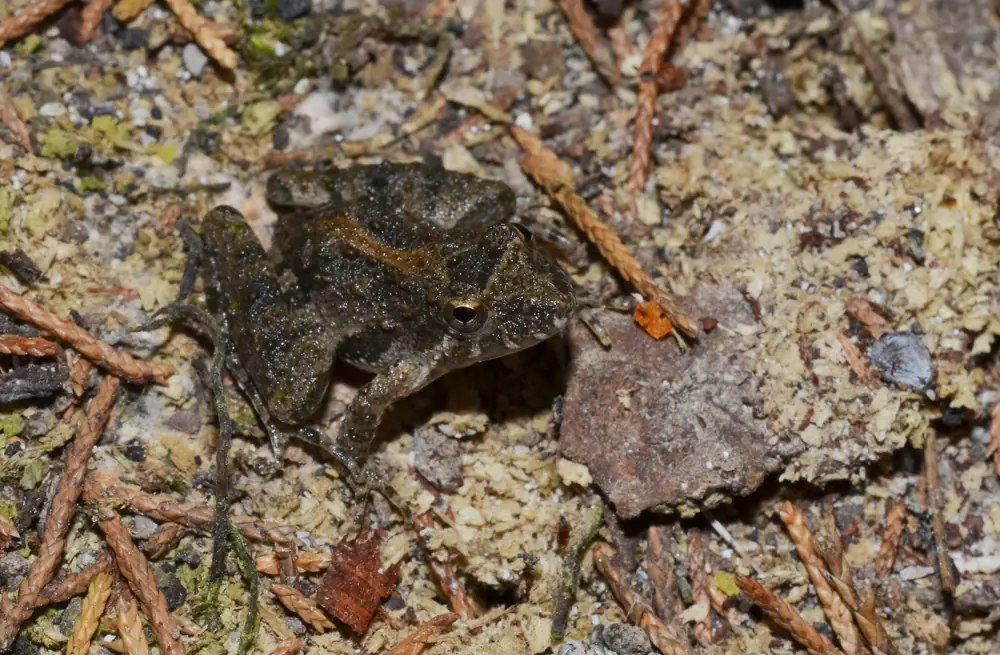
Rocky Mountain toad
Breeding starts late April to early May and usually peaks from mid-May to early June · Missouri River floodplain, sloughs, shallow ditches and flooded fields
MDC describes a short, nasal “w-a-a-ah” that lasts one to two and a half seconds and resembles a Fowler’s toad at a lower pitch. The field guide says this is the most abundant toad in the sandy soils of the Missouri River floodplain, with a range running from the central part of the state to the far northwest, and possibly east to St. Charles County and western St. Louis County. MDC’s May 2026 notes also say its breeding peaks in mid-May.
-
Eastern narrow-mouthed toad
Chorus starts in late April; often after heavy rain, and again in June or early July · Southern half of the state, including rice fields in the southeast
The male makes a bleating, nasal “baaaa” of one to four seconds that sounds like a lamb, and one calling toad often sets its neighbors off. MDC says it breeds in large puddles, temporary pools and fishless flooded ditches. In May 2025 the agency also pointed to the western narrow-mouthed toad’s short, buzzy “peel.”
-
Blanchard’s cricket frog
Late April to mid-July; calls day and night · Sandy, gravelly or muddy edges of ponds, streams and lakes
The call is a rapid, metallic “gick, gick, gick” that MDC compares to small pebbles struck together. The frog is considered common in Missouri, and numbers drop in drought years and rebound when rain returns. MDC notes that in the upper Midwest populations have vanished or declined, for reasons not fully understood, so a Missouri chorus is worth noting down.
-
Gray treefrog and green frog
May and later · Trees and shrubs near water; pond edges
MDC’s May 2025 notes describe the gray treefrog as a musical, birdlike trill. Its May 2024 issue says the green frog breeds from late April through mid-August and gives a loud, explosive call like a loose banjo string.
To make the listening count, the Saint Louis Zoo’s FrogWatch USA program collects observations through the breeding season, February through August. The zoo’s page showed 2026 training dates and none yet for 2027, so check with the zoo. A calm evening of frog listening fits the “map of sounds” plate in the field journal.
What blooms in Missouri in May, from woods to glades?
Shaw Nature Reserve describes the month as a handoff: woodland wildflowers mature and fade by month’s end, and the sunny glades take over with what it calls a spring flower show of Indian paintbrush, birdsfoot violet, Carolina larkspur and orange puccoon. Shrubs and trees bloom too, and pollinators are suddenly everywhere.
-
Dogwoods, five kinds
May · Woods, thickets and streamsides
MDC’s May 2024 notes say Missouri has five dogwood species and that all bloom in May. Flowering dogwood, the state tree, has the showy four-bracted heads. The other four lack showy bracts and carry small white, cream or greenish-yellow flowers, so they look more like clusters of tiny petals than like the familiar tree.
-
Indian paintbrush
April to July · Prairies, glades, fields and moist thickets; statewide except the northwest and southeast lowlands
The true flowers are small, tubular and greenish yellow, and the color comes from red, orange or yellow bracts around them, according to MDC. The plant is a partial root parasite that taps nearby plants such as little bluestem and penstemons, which is one reason it is hard to transplant. Look for it on sunny hillsides and glade edges.
-
Missouri evening primrose
May through August · Limestone glades, bluffs and rocky prairies, especially in the Ozarks south of the Missouri River
The flowers are bright lemon yellow and up to 4 inches wide, but each lasts a single day: MDC says they open in late afternoon and close the next morning. Night-feeding bees and moths pollinate them. If you walk a glade at dusk, you may catch the first blooms of the evening.
-
Blue-eyed Mary
April through June · Moist, open wooded hills and streamsides; most common in central Missouri, mostly absent from the Ozarks
MDC describes flowers about half an inch wide with a white upper lip and a sky-blue lower lip, on plants up to about 15 inches tall. It is a winter annual whose seedlings sprout in late fall, so a patch can be blooming in late April and be gone by midsummer. MDC chose it for its May Wild Guide in 2024 and again in 2026, a sign of how reliably it blooms around now.
-
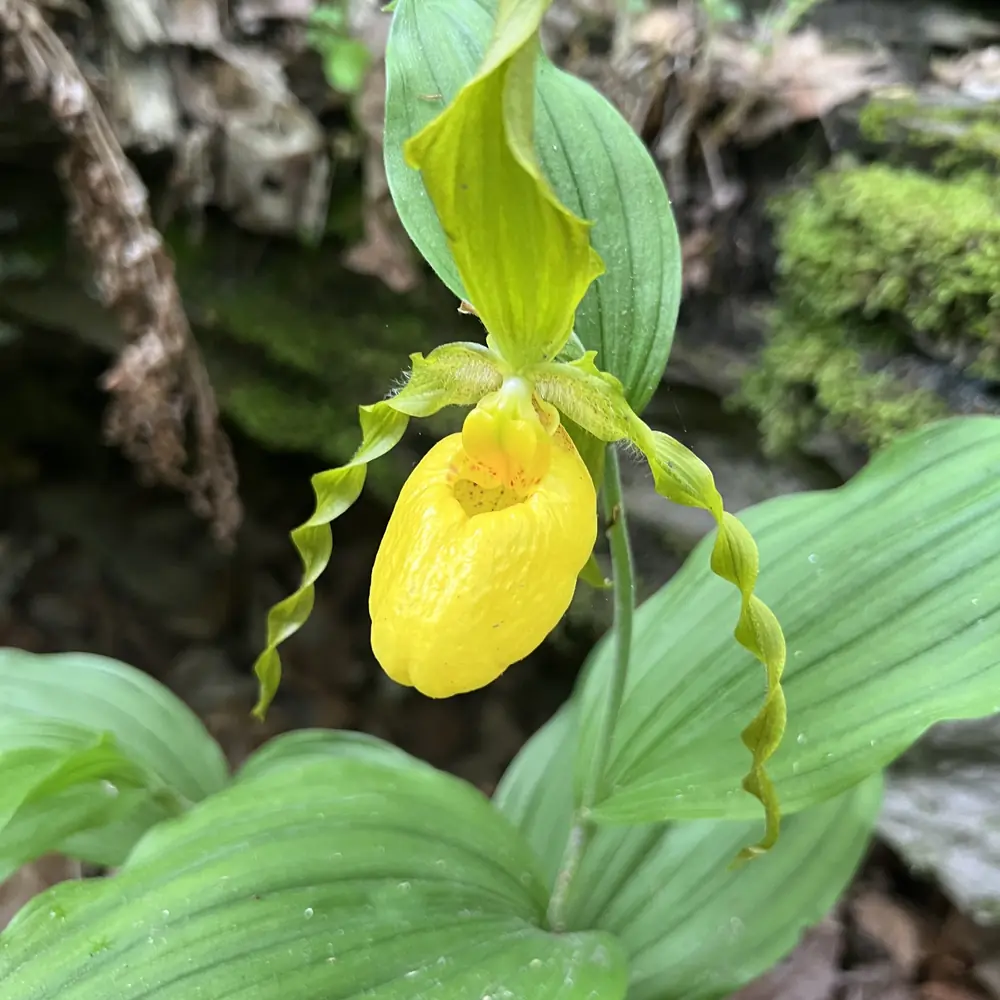
Yellow lady’s slipper
April through June · North- and east-facing ravine slopes and stream valleys; scattered nearly statewide, absent from the Mississippi Lowlands
This orchid has twisted brown or purplish “flags” and a bright yellow slipper-shaped lip, and it often grows in colonies. MDC separates a small variety, found in the west and south, from a large variety, found in the east. Touching the plant can cause a rash in some people. MDC warns that populations are falling from logging, grazing and illegal root digging, and that transplants usually fail. Photograph it and leave it.
-
American smoke tree
Flowers in May; smoky seed clusters in June and July · Dolomite glades and bluffs in the western Ozarks
Missouri has a rare native smoke tree, found mostly along the old White River valley near Lake Taneycomo, Table Rock Lake and Bull Shoals Lake. The greenish-yellow flowers are small, and the “smoke” comes from the hairy stalks of sterile flowers that remain after the blossoms drop. MDC adds that most smoke trees sold in nurseries are a nonnative Eurasian species.
-
Bumblebees and World Bee Day
All of May; World Bee Day on May 20 · Flowers in gardens, glades and fields
MDC’s May notes in 2024 and 2025 say that at least six bumblebee species live in the state, that many are declining, and that they become easy to notice this month. If one nests on your property, MDC suggests watching from a distance. The agency also marks World Bee Day on May 20.
Hawthorn, the state flower, keeps blooming through June, and black walnut trees are shedding yellow-green catkins (MDC, May 2026). Pick a single glade or woodland bank and visit it three times in the month: the “same place twice” plate of the Naturalist’s Field Journal works just as well for three.
Which wild animals have young in Missouri in May, and what should you do if you find one?
Late spring is baby season, and the most common mistake people make is rescuing an animal that is not in trouble. MDC’s advice is consistent: a young animal found alone usually has a parent out searching for food, and the parent will return.
-
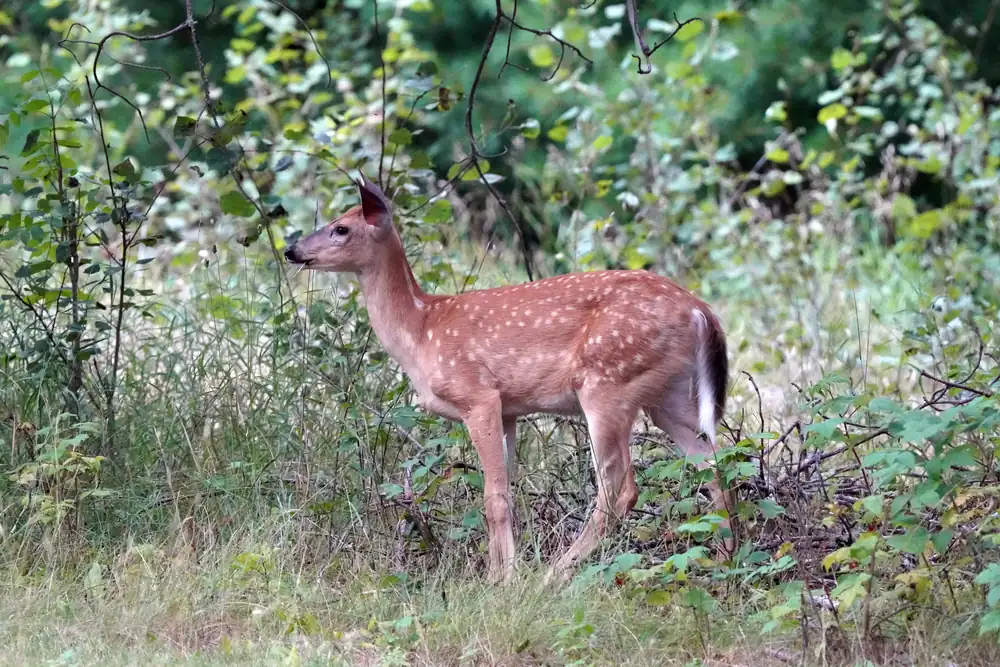
White-tailed deer fawns
Most are born in late May or early June · Woodland edges and fields
MDC’s field guide says births cluster in the last days of May and the first of June, following roughly 200 days of gestation. Does usually have twins, each weighing 4 to 7 pounds, and the fawns are reddish brown with white spots until they trade the spots for a uniform coat at 3 to 4 months. Remember MDC’s general rule that a young animal alone is usually not an orphan.
-
Fledglings and cottontail nests
All of May · Yards, fields and wood edges
MDC explains that a feathered chick hopping about the ground is a fledgling, which can take as long as 10 days to learn flight while its parents hover nearby, so walk away. A chick with no feathers has likely fallen from its nest and can be returned if you can find the nest. The agency adds that newborn cottontails should not be rescued, since they can die of fright when handled and the mother will most likely return, and that human scent does not make wild mothers abandon their young.
-
Beaver kits, woodchucks and coyote pups
May · Ponds, streams, fencerows and brushy fields
MDC’s May 2026 notes say the female beaver leaves the den with month-old kits and begins swimming with them, and that woodchucks born in March are now leaving the burrow to play and wrestle. The May 2024 notes say coyotes are bearing young this month and are quiet. Quiet dusk watching at a pond edge may reward you.
-
Hoary bats
Migration peaks in May and September; pups arrive from late May to early July · Treetops at clearing edges; hunting over water and grass
The hoary bat is a tree bat that hangs by its hind feet from leafy branches 10 to 15 feet up. MDC says it feeds heavily on moths, flies high and fast late in the evening, and is seen most during migration. Pups, usually two per litter, are born from late May to early July and can fly at about one month; females roost alone in foliage while raising them. MDC’s May 2025 notes list hoary bats among the month’s sights.
MDC notes that wildlife rehabilitation takes special training, permits and facilities, and that wild animals can carry disease and parasites as they grow, so call a licensed rehabilitator rather than taking an animal home. Record distant sightings on the journal’s “mammal watch” plate (see the Naturalist’s Field Journal).
What is biting or spawning in Missouri waters in May?
Water temperatures climb through the 60s and fish move to the shallows. Season dates below come from MDC’s 2026 fishing table, the latest one we could read; confirm the 2027 dates in MDC’s regulations before you go.
-
Crappie
May · Brushy coves and banks of lakes and ponds
MDC’s May 2024 notes say crappie spawn this month. Fish stay in the shallows around structure while the water is warm enough, so small jigs and minnows near brush piles and docks are the classic approach.
-
Bowfin
April into early June · Swamps, ditches and sluggish pools; Bootheel backwaters and oxbows
MDC says bowfin spawn from April into early June, and its May 2026 notes pick out southeast Missouri for spawning. Males build nests in shallow weedy sites and guard the eggs and fry, and the fry leave in a swarm with the male until they are about 4 inches long. By day bowfin hide in deeper water; at night they feed in the shallows and rise to gulp air, since the swim bladder works something like a lung. The emerald bowfin is most abundant in the Mississippi Lowlands.
-
Season dates to confirm
2026 dates below; 2027 to be posted · Ozark streams, the Mississippi River, trout parks
In 2026, MDC’s table listed Ozark stream black bass opening May 23 and Mississippi River paddlefish open through May 15, with trout parks open March 1 to October 31 and frog fishing starting June 30. Those are last year’s dates, so check the 2027 table for each.
Keep only what the regulations allow, and release the rest quickly and gently. Check MDC’s regulations for the permit rules that apply to you.
How warm is a Missouri May, and what are the weather hazards?
May is the first month when summer’s warmth settles in. Average highs run from 72.1 °F at Kirksville to 78.1 °F at Cape Girardeau, and average lows from 51.2 °F in the northeast to 57.9 °F in St. Louis. Precipitation is the heaviest of the spring, with normals from 4.77 inches at Columbia to 6.56 inches at Joplin.
| Station | Average high | Average low | Precipitation |
|---|---|---|---|
| Kirksville | 72.1 | 51.2 | 5.79 |
| St. Joseph | 75.8 | 53.7 | 4.87 |
| Kansas City (airport) | 75.0 | 54.3 | 5.32 |
| Columbia | 75.9 | 55.7 | 4.77 |
| St. Louis (Lambert) | 77.1 | 57.9 | 4.82 |
| Springfield | 76.3 | 55.6 | 5.56 |
| Joplin | 77.0 | 56.0 | 6.56 |
| Cape Girardeau | 78.1 | 57.5 | 5.27 |
Severe weather. Spring is Missouri’s tornado season, and the Weather Service offices that cover the state issue the watches and warnings. The state’s deadliest, the EF5 that struck Joplin, came on May 22, 2011. The Weather Service tells people to shelter in a basement, a safe room, or an inside room with no windows. Sheds, mobile homes and tents give no protection, and a vehicle is the last choice. Have alerts ready on a weather radio or a phone, and do not mute the overnight ones.
Flash floods. According to the Weather Service, six inches of rushing water is enough to topple an adult, a foot can float most cars, and two feet will sweep away SUVs and trucks. Low-water crossings fill fast in May downpours. Never drive around a barrier.
Outlooks. The Climate Prediction Center keeps its newest monthly and 90-day maps on a seasonal outlook page. To read the sky ahead of a storm, try our weather page and cloud guide.
Can Missouri still get a freeze in May?
Rarely, and mostly in the north. The table below gives, for each station, the date by which a given share of springs have had their final 32 °F night. In one northern spring out of ten, the last freeze lands later than May 5 at Kirksville and May 3 at St. Joseph, and later than April 29 at Kansas City. In the south the last freeze in nine springs out of ten has passed by the third or fourth week of April.
| Station | One year in ten | Median | Nine years in ten |
|---|---|---|---|
| Kirksville | Apr 7 | Apr 21 | May 5 |
| St. Joseph | Apr 5 | Apr 19 | May 3 |
| Kansas City | Mar 30 | Apr 13 | Apr 29 |
| Columbia | Mar 19 | Apr 5 | Apr 21 |
| St. Louis | Mar 14 | Apr 1 | Apr 18 |
| Springfield | Mar 26 | Apr 9 | Apr 27 |
| Joplin | Mar 24 | Apr 9 | Apr 26 |
| Cape Girardeau | Mar 19 | Apr 5 | Apr 21 |
Tender garden plants, young tomato transplants and fruit blossoms can still be hurt in the unlucky tenth spring, so watch the forecast on clear, calm nights. Our Missouri frost dates page gives your own town.
How much daylight does Missouri gain in May?
Between 47 and 55 minutes, with the north gaining the most. At Kirksville the day grows from 13 hours 55 minutes on May 1 to 14 hours 50 minutes on May 31, while Cape Girardeau goes from 13 hours 45 minutes to 14 hours 32 minutes. A day adds roughly 1.6 to 1.8 minutes, noticeably less than the two-plus minutes of April, and by May 31 every city on the table has at least 14 and a half hours of sunlight. Missouri keeps daylight time all month, so sunrise and sunset clock times follow the same pattern as the day length.
| City | May 1 | May 31 | Gained | Per day |
|---|---|---|---|---|
| Kirksville | 13 h 55 m | 14 h 50 m | 55 min | 1.8 min |
| St. Joseph | 13 h 54 m | 14 h 47 m | 53 min | 1.8 min |
| Kansas City | 13 h 51 m | 14 h 43 m | 52 min | 1.7 min |
| Columbia | 13 h 50 m | 14 h 42 m | 52 min | 1.7 min |
| St. Louis | 13 h 49 m | 14 h 40 m | 51 min | 1.7 min |
| Springfield | 13 h 44 m | 14 h 32 m | 48 min | 1.6 min |
| Joplin | 13 h 43 m | 14 h 32 m | 49 min | 1.6 min |
| Cape Girardeau | 13 h 45 m | 14 h 32 m | 47 min | 1.6 min |
The gain keeps shrinking toward the June solstice, when day length stops growing. Find your own sunrise and sunset in any town with the daylight calculator.
What can you see in Missouri’s night sky in May 2027?
May brings a dark-sky meteor shower before dawn, a close pair of planets in the east, Mercury’s best evening of the year, and a May 20 full moon that carries a seasonal Blue Moon footnote. Clock times below are Central Daylight Time, in force for all of May.
-
Eta Aquariid meteors
Mornings of May 5, 6 and 7, in the last hours before dawn · Anywhere dark, facing east to southeast
Peak is around May 5 to 7, and the Moon is new on May 6, so the sky is dark all night. The American Meteor Society gives “medium rates of 10 to 30 per hour just before dawn” for sites from the equator northward, and the shower’s radiant (in Aquarius) rises only an hour or two before dawn at Missouri’s latitude, so expect fewer than the higher published peaks. One sky calendar lists up to 60 per hour from the Southern Hemisphere. Give your eyes 20 minutes to adjust.
-
Venus and Saturn, low in the east
Morning of May 7 (also May 6 and 8) · Low in the east before sunrise
On May 7 the two planets sit only 0.6 degrees apart, and the days on either side they are about a degree from each other. Venus blazes, while Saturn is a dim yellowish dot close by. Both sit only 3 to 6 degrees above the horizon 30 minutes before sunrise, so you need a flat, clear eastern horizon, and binoculars help. This is a challenging sight, not an easy one.
-
Mercury’s evening show
Best May 12 to June 5; greatest elongation May 28 · Low in the west-northwest, 45 to 90 minutes after sunset
Mercury’s widest separation east of the Sun, about 22.8 degrees (SeaSky gives 22.9), comes on May 28. By mid-May it sets about 97 minutes after sunset and glows near magnitude -0.6, then dims fast in June. Of the evening Mercury appearances this year, this one suits northern and central latitudes best. Choose a clear western horizon and sweep it with binoculars.
-
Jupiter and Mars in the evening
All month · South and southwest after dark
Jupiter outshines every star after dusk and sets roughly seven hours after dusk on May 1; reddish Mars, dimmer and fading, sets near the same hour. Jupiter has the first-quarter Moon as a neighbor on May 12, the closest approach (about 1.2 degrees) coming in the afternoon, and lies roughly three degrees away from Mars the next day, May 13. Watch the Moon step from planet to planet over those two evenings.
-
The Flower Moon, also a seasonal Blue Moon
Full at 5:59 a.m. CDT on Thursday, May 20; best view the evening of Wednesday, May 19 · Rising in the east around 8 p.m.
The full instant falls before dawn, so it looks full on both May 19 and May 20, rising at about 8 p.m. (a little later toward the west side of the state) on May 19. The Old Farmer’s Almanac-style name is Flower Moon. This spring contains four full moons (the dates are March 22, April 20, May 20, then June 19), and SeaSky labels May’s, the third of the four, a blue moon in the old seasonal sense. It will not look blue, and counting by calendar months instead, 2027 has none.
-
Milky Way season begins
The first two weeks of May and the last week · Southern sky, in the hours before dawn
The brightest part of the Milky Way, in Sagittarius, rides low in the south and shows only before dawn this month. Moonless pre-dawn windows open from May 1 through May 14 and again from May 25 through May 31, offering as much as about 3.8 hours of dark pre-dawn sky with the galactic core up, for observers near 40 degrees north. Find a spot well away from town lights, such as a conservation area.
| Phase | Date | Time |
|---|---|---|
| New moon | Thursday, May 6 | 5:58 a.m. CDT |
| First quarter | Wednesday, May 12 | 11:44 p.m. CDT |
| Full moon, the Flower Moon | Thursday, May 20 | 5:59 a.m. CDT (looks full the evenings of May 19 and 20) |
| Last quarter | Friday, May 28 | 8:58 a.m. CDT |
No eclipse falls in May 2027. Other dates are on the moon phases page.
What are good May nature outings for Missouri families?
- Through Monday, May 3: City Nature Challenge. Observing began April 30 and ends May 3 in the organizers’ 2027 schedule; identifying runs May 4 to 16, with results on May 20. Use iNaturalist for wild plants and animals, and look up your metro area’s local organizer to join its count.
- Date still open: World Migratory Bird Day. Nothing for 2027 appeared on the organizers’ site in October 2026, so look there first. Spend the morning at a wooded park and write down every species you hear.
- Sunday, May 9: Mother’s Day, a gentle excuse for a walk to a pond where there may be nests or ducklings. Watch from a distance.
- Wednesday, May 19: the Flower Moon rises, and May 20 is World Bee Day, a good pairing for an evening among flowers.
- Early to late May: report your sightings. Journey North takes reports of the first hummingbirds, monarch eggs, larvae and adults, and other spring signs.
- Any warm evening: a frog and toad walk. Learn three calls in the first week and tally them in the FrogWatch USA program.
- Monday, May 31: Memorial Day. Many conservation areas and parks are busy; go early or go to a smaller site.
Few organizers have posted 2027 dates for nature events, so check with the organizer or MDC’s events page before you plan around a specific date. The nature index lists every state.
Safety notes for May in Missouri
- Spring turkey season: MDC had not posted 2027 spring turkey dates when we checked. In 2026 the regular season ran April 20 through May 10, so hunters may be in the woods at dawn in early May in 2027, and you should check MDC’s spring turkey page. MDC’s hunter orange page lists firearms deer, the firearms portion of elk season and black bear hunting among its requirements and does not mention spring turkey one way or the other. Wearing bright clothing on spring woodland walks is a sensible precaution.
- Ticks: MU Extension reports that tick numbers climb through April and usually crest in June and July, and it names the lone star, American dog and deer ticks as the common ones. Wear light-colored clothing, tuck pants into socks, use an EPA-approved repellent, stay in the center of trails, and check yourself and your pets afterward. The lone star tick is linked to a meat allergy called alpha-gal syndrome; see a doctor if fever, rash, headache or joint pain follows a bite.
- Black bears: bears have left their dens and are hunting for food. MDC advises against bird feeders in bear country from April through November, and if you keep one, to hang it at least 10 feet high and 4 feet from any structure.
- Baby animals: leave fawns, fledglings and nests alone unless MDC or a licensed rehabilitator says otherwise.
- Storms and floods: May is peak season. Know your shelter before the sky turns green, and do not drive through water.
Sources (45)
- MDC: Get Outside in May 2024 (Missouri Conservationist)
- MDC: Get Outside in May 2025 (Missouri Conservationist)
- MDC: Get Outside in May 2026 (Missouri Conservationist)
- MDC field guide: common nighthawk
- MDC field guide: indigo bunting
- MDC field guide: dickcissel
- MDC field guide: Baltimore oriole
- MDC field guide: Mississippi kite
- MDC field guide: eastern whip-poor-will
- MDC field guide: northern bobwhite
- MDC field guide: Rocky Mountain toad
- MDC field guide: eastern narrow-mouthed toad
- MDC field guide: Blanchard's cricket frog
- MDC field guide: blue-eyed Mary
- MDC field guide: yellow lady's slipper
- MDC field guide: Indian paintbrush
- MDC field guide: Missouri evening primrose
- MDC field guide: American smoke tree
- MDC field guide: white-tailed deer
- MDC field guide: hoary bat
- MDC field guide: bowfin
- MDC newsroom: leave wildlife wild this spring
- MDC newsroom: Be BearWise to avoid conflicts with black bears
- MDC: 2026 fishing seasons table
- MDC: 2026-27 hunting and trapping seasons
- MDC newsroom: deer and turkey hunting dates for 2026-2027 seasons
- MDC: hunter orange requirement
- Missouri Botanical Garden: Shaw Nature Reserve natural history by month
- U.S. Fish and Wildlife Service: Mingo National Wildlife Refuge, seasons of wildlife
- U.S. Fish and Wildlife Service: Swan Lake National Wildlife Refuge, visit us
- U.S. Fish and Wildlife Service: Loess Bluffs National Wildlife Refuge, seasons of wildlife
- Missouri State Parks: Prairie State Park
- World Migratory Bird Day: official site
- City Nature Challenge: official site (2027 dates)
- Saint Louis Zoo: FrogWatch USA
- Journey North: hummingbirds
- Journey North: monarchs
- MU Extension: ticks have no off season
- NOAA NCEI: 1991-2020 monthly normals for Missouri stations (data API)
- National Weather Service: tornado safety, during a tornado
- National Weather Service: Turn Around Don't Drown
- Climate Prediction Center: seasonal outlooks
- U.S. Naval Observatory: moon phases (data API)
- Sea and Sky: Astronomy Calendar of Celestial Events 2027
- Photos via Wikimedia Commons; licenses are listed with each picture