What to look for in nature in Missouri this October
October is the month Missouri turns. The Ozarks color up around mid-month, the pelicans thin out at Loess Bluffs as the first snow geese come in, bull elk bugle in the Current River hills, walnuts and persimmons come down, and most towns north of the Missouri River see their first freeze before Halloween. Below, section by section, are the dates and places for each of these across the state.
Start here

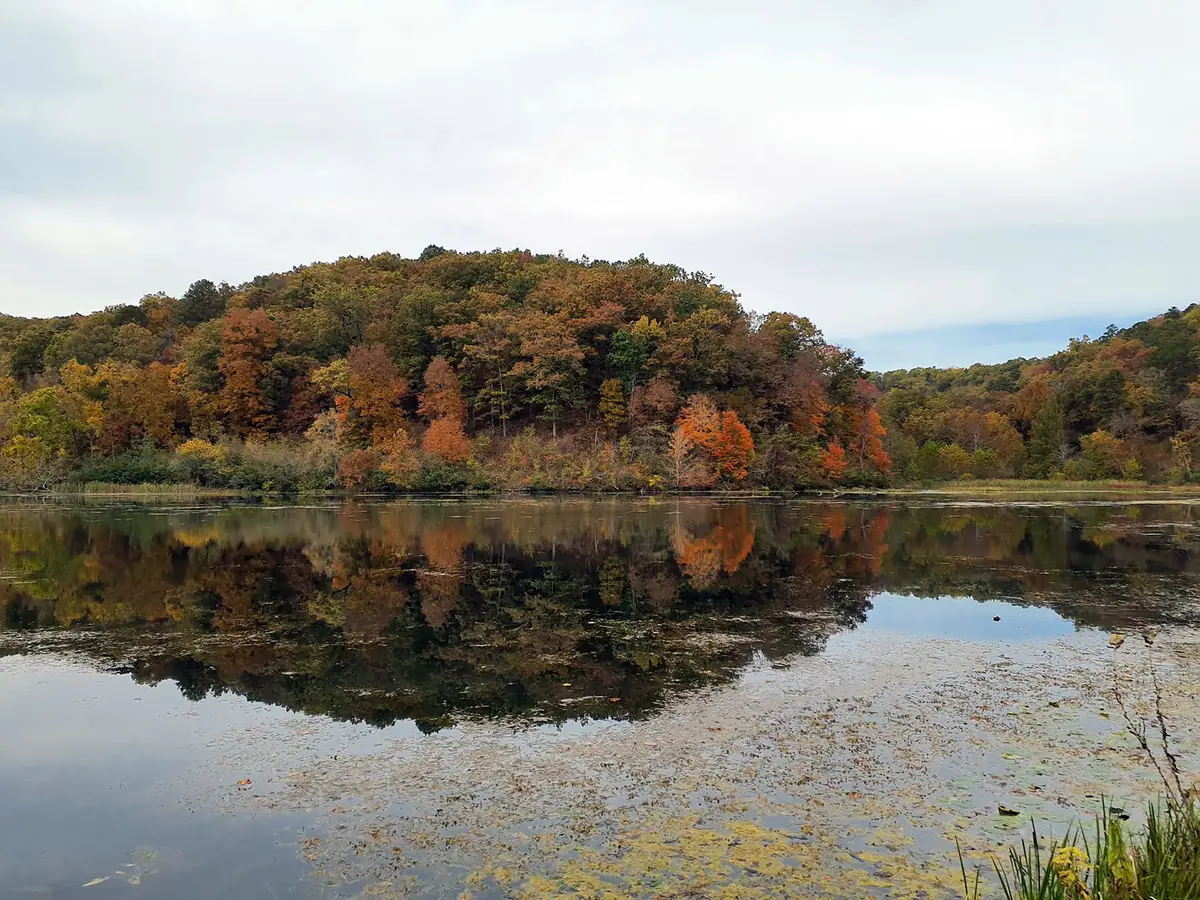
- Fall color. Peak is usually around mid-October, earliest in the north and west and last in the Bootheel, and the Missouri Department of Conservation posts a weekly report by region. The September 24 report had most regions still green and warned that this year’s drought could make the season short and muted, so go the week your region turns rather than waiting for a better weekend.
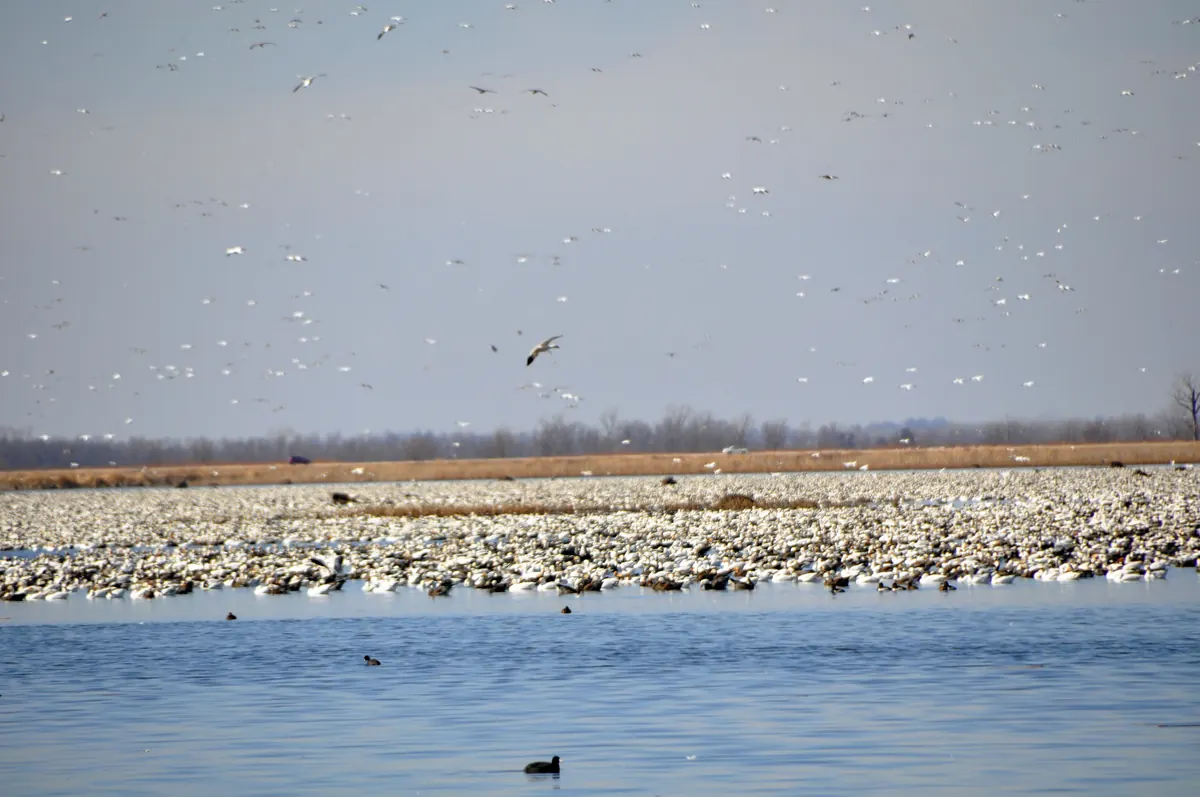
- Loess Bluffs. The refuge near Mound City is the state’s great October stage. American white pelicans are past their late-September peak but still present, the first snow geese arrive in mid-October, and the flocks build toward a peak in mid-to-late November; the refuge counts upwards of a million over the fall and winter. The 10-mile auto tour opens half an hour before sunrise.
- The Moon hides Jupiter, then the Hunter’s Moon. Before dawn on Tuesday, October 6, the thin crescent Moon covers Jupiter about half an hour after moonrise, very low in the east-northeast, from about 3:18 to 4:16 a.m. Central. The Hunter’s Moon comes up around sunset on October 25, reaching full at 11:12 that night, and the Orionids are best after moonset on the mornings of the 21st and 22nd.
Keep a record of it: in the Naturalist’s Field Journal, the “seeds, pods and cones” plate suits the walnuts, hickory nuts and acorns now falling, the “map of sounds” page can hold a bugling bull elk or snow geese calling overhead at night, and the “dusk and dawn watch” is made for deer season. End the month on the cricket thermometer plate, counting chirps on the last mild evenings before the freeze.
Regions used below: Northwest Missouri; Northeast Missouri; Kansas City area; St. Louis area; Central Missouri/Columbia; the Ozarks; Southwest Missouri/Springfield; Southeast Missouri and the Bootheel.
When is peak fall color in Missouri, and where does it start?
The Missouri Department of Conservation says peak color “is usually around mid-October,” that it “usually starts earliest in northern and western Missouri and moves southward and eastward across the state,” and that its weekly reports run from the second half of September to about the middle of November. The order of the trees is more reliable than the calendar: sassafras, sumac and Virginia creeper first, then black gum, bittersweet and dogwood, and the big show of maples, ashes, hickories and oaks last. White oaks, in a good year, turn claret red in the second half of October across most of the state, and shagbark hickories go a rich golden yellow. At the far southeastern end, Mingo National Wildlife Refuge puts its peak in the last week of October, with the bald cypress already turning in September.
| Region | MDC report region | Typical peak | What turns |
|---|---|---|---|
| Northwest Missouri | Northwest | Oct 5 – 20 | Sumac red on the roadsides first, then the loess-hill oaks |
| Northeast Missouri | Northeast | Oct 5 – 20 | Sumac and Virginia creeper, then hickory gold on the river hills |
| Kansas City area | Kansas City | Oct 10 – 25 | Cottonwood, walnut and elm yellow along the streams before the oaks |
| Central Missouri/Columbia | Central | Oct 10 – 25 | Dogwood and sassafras early; oaks and hickories on the Katy Trail bluffs late |
| St. Louis area | St. Louis | Oct 15 – 30 | Tulip trees first, then maples and the oaks |
| the Ozarks | Ozark | Oct 15 – 31 | Black gum and dogwood red, hickory gold, oaks last |
| Southwest Missouri/Springfield | Southwest | Oct 15 – 31 | A short, muted season is forecast for 2026 because of drought |
| Southeast Missouri and the Bootheel | Southeast | Oct 20 – Nov 5 | Cypress and tupelo in the swamps; Mingo peaks in the last week of October |
The 2026 caveat is dry ground. On September 22 the U.S. Drought Monitor had 62 percent of Missouri abnormally dry or worse, a third in moderate drought, 22 percent in severe drought and 11 percent in extreme drought, and MDC’s September 24 report described stressed trees browning and dropping leaves early in the Ozarks and the southwest, where “a short, muted fall color season” is expected. Drought does not cancel color; it shortens it. Check the MDC fall color report each week and go the week your region turns. For your own woods, drop a pin in the Field almanac and it will show when satellites usually see the leaves turn there.
When do the snow geese and pelicans reach Loess Bluffs?
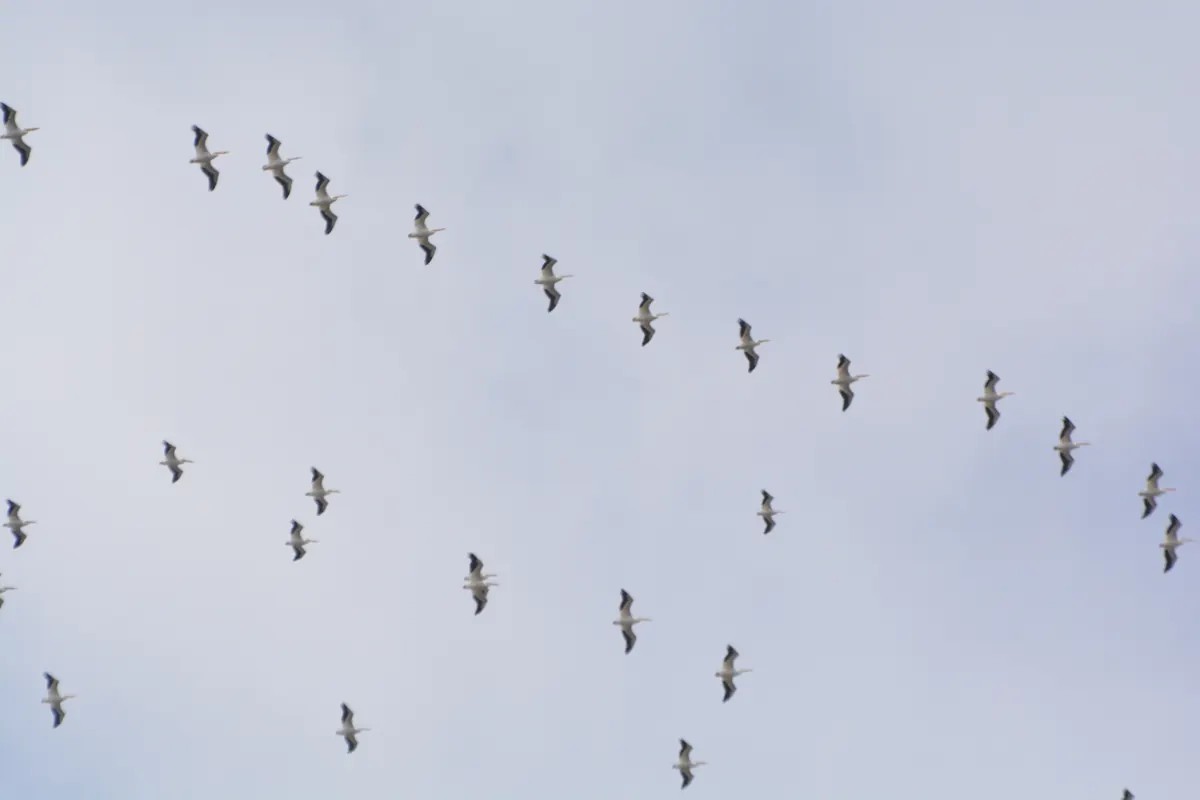
Loess Bluffs National Wildlife Refuge, formerly Squaw Creek, is 7,440 acres of wetland under the loess hills near Mound City in the far northwest, and October is when it fills. American white pelicans are the September bird: MDC puts the statewide fall peak in mid-to-late September, with the last birds gone by mid-November, and October is their long tail. Snow geese “begin to arrive at the refuge in mid-October with the peak in mid to late November,” and the fall-and-winter total runs to “upwards of a million,” with up to 200,000 ducks alongside. Bald eagles follow the geese: as many as 300 by about the first of December, and a record of more than 660 in a 2020 survey. The 10-mile auto tour opens half an hour before sunrise and closes half an hour after sunset. Go at first light or last light, when the flocks trade between the pools and the fields.
| Place | Where | What is there in October | Note |
|---|---|---|---|
| Loess Bluffs NWR | Mound City, Holt County | Pelicans thinning, first snow geese from mid-October, ducks building | 10-mile auto tour; eagles peak about December 1 |
| Swan Lake NWR | Sumner, Chariton County | Waterfowl gathering; wildlife drive open through the end of October | Interior closed from the end of October to the first Saturday in March; tower open year-round |
| Eagle Bluffs CA | McBaine, near Columbia | Ducks and shorebirds on 17 pools; fall color on the limestone bluffs | Parts closed to protect waterfowl from October 15 to March 1 |
| Mingo NWR | Puxico, Stoddard County | “September and October are the best months for fall migratory birds”; cypress turning | Auto tour open March to November; 0.8-mile Swampwalk boardwalk; visitor center open Wednesday and Friday |
Elsewhere the pelicans use the big western reservoirs and the Missouri River, and MDC is candid that the eastern half of the state sees far fewer. Trumpeter swans are not an October bird here; MDC says they are typically present from late November until late March. Swan Lake’s wildlife drive closes for the season at the end of the month, so that one is now or March.
Are monarchs still passing through, and which birds are on the move?
Monarchs, honestly: Missouri’s peak is a September event. Monarch Watch’s recovery data put the twelve-day peak at latitude 39° N (Kansas City, Columbia, St. Louis) at September 14–26 and at 37° N (Springfield, Joplin) at September 19 to October 1, so October is the tail of the migration, thickest in the first week and in the south, with stragglers into mid-month. They are still worth reporting: Journey North wants fall roosts especially, gatherings in trees at night, whether “of 10 monarchs or 1,000,” and Monarch Watch pays about $5 for each tag recovered in Mexico.
-
Hummingbirds leaving
Most gone by early October · Feeders statewide
MDC’s line is exact: “Our Missouri hummingbirds begin migrating in mid-August; most are gone by early October,” and there is “no evidence that keeping nectar feeders up late into the fall delays the migration.” Leave the feeder up for the stragglers and write down the date of the last one.
-
White-throated sparrows and juncos arriving
White-throats from late September; juncos as the weather turns · Brush piles, hedgerows, feeders
White-throated sparrows “start arriving in Missouri in late September and are present through the winter,” common in the southern half and uncommon in the north; their slow “Old Sam Peabody” whistle is a sound of late fall. Dark-eyed juncos are close behind. MDC gives no date, only that their arrival “heralds the change of season,” so watch the feeder after the first hard cold front.
-
Hawks: the big day was September
Third week of September for broad-wings; smaller flights in October · Bluff tops and ridges, mid-morning
Missouri’s kettles of broad-winged hawks, “up to 500 and even 1,000 individuals,” pass in the third week of September, lifting on thermals between 8 and 10 a.m.; the species is gone by the end of October. We could find no staffed hawk-count site in Missouri, so the October flight is watched informally: a bluff overlook on the Missouri or Mississippi, a north wind behind a cold front, and patience.
-
Ducks and eagles
Ducks building all month; eagles by late fall · Refuges and the big rivers
Every cold front pushes more ducks into the refuges, and North Zone duck hunting opens October 31. Bald eagles are a common winter migrant that arrives “by late fall and early winter,” and at Loess Bluffs the count usually peaks around December 1, so October’s eagles are the early ones.
| Latitude | Missouri towns | Peak window |
|---|---|---|
| 40° N | Kirksville, St. Joseph, Maryville | Sept 11 – 23 (interpolated) |
| 39° N | Kansas City, Columbia, St. Louis | Sept 14 – 26 |
| 37° N | Springfield, Joplin, Cape Girardeau | Sept 19 – Oct 1 |
| 36.5° N | The Bootheel | About Sept 20 – Oct 2 (interpolated) |
eBird’s global October Big Day is Saturday, October 10, and a list from the yard counts. Project FeederWatch begins on November 1.
When is the first freeze in Missouri?
It depends on which side of the Missouri River you live on, and on how much pavement is around you. In the far north the first freeze is an early-October risk: at St. Joseph one year in ten has already frozen by September 30 and at Kirksville by October 2, with medians in the third week of October. Kansas City’s median is October 24, Springfield’s October 27 and Columbia’s October 31, while the St. Louis station, downtown at the Science Center, holds out to November 4 on the strength of the city’s heat. Joplin and Cape Girardeau run within a day or two of Kansas City. The month’s normals tell the same story: an October normal high of 67–71 °F and a normal low of 43–49 °F, with September’s 80s behind and November’s 50s ahead.
| Station | One year in ten | Median | Nine years in ten |
|---|---|---|---|
| Kirksville | Oct 2 | Oct 19 | Oct 31 |
| St. Joseph | Sep 30 | Oct 17 | Oct 30 |
| Kansas City | Oct 9 | Oct 24 | Nov 5 |
| Columbia | Oct 17 | Oct 31 | Nov 14 |
| St. Louis | Oct 24 | Nov 4 | Nov 21 |
| Joplin | Oct 8 | Oct 24 | Nov 6 |
| Springfield | Oct 14 | Oct 27 | Nov 9 |
| Cape Girardeau | Oct 12 | Oct 25 | Nov 6 |
Look up the station nearest you on our first and last frost dates for Missouri, which covers hundreds of towns. North of the river, pot up the geraniums and pick the last peppers early in the month, and note the night of the first frost; south of it, the tomatoes usually get a few more weeks. Persimmons do not wait for the frost, whatever the old rule says: MDC dates the fruit September–October, and the tree decides.
How many minutes of daylight disappear across Missouri in October?
Between 67 and 75 minutes, depending on latitude. That is about two and a half minutes a day at Kirksville and two and a quarter at Cape Girardeau. Kansas City’s sunrise slips from 7:14 to 7:45 a.m. across the month and its sunset from 7:01 to 6:18 p.m.; St. Louis goes from 6:57 and 6:43 to 7:27 and 6:02. Evening civil twilight in Kansas City ends at 7:27 p.m. on October 1 and 6:46 p.m. on Halloween. Standard time returns early on Sunday, November 1, when 2:00 a.m. becomes 1:00 a.m., and the evening commute goes dark.
| City | Oct 1 | Oct 31 | Lost | Per day |
|---|---|---|---|---|
| Kirksville | 11 h 45 m | 10 h 30 m | 75 min | 2.5 min |
| St. Joseph | 11 h 46 m | 10 h 31 m | 75 min | 2.5 min |
| Kansas City | 11 h 47 m | 10 h 33 m | 74 min | 2.5 min |
| Columbia | 11 h 47 m | 10 h 34 m | 73 min | 2.4 min |
| St. Louis | 11 h 46 m | 10 h 35 m | 71 min | 2.4 min |
| Springfield | 11 h 47 m | 10 h 39 m | 68 min | 2.3 min |
| Joplin | 11 h 47 m | 10 h 40 m | 67 min | 2.2 min |
| Cape Girardeau | 11 h 47 m | 10 h 39 m | 68 min | 2.3 min |
To see how fast your own evenings are shrinking, open the Field almanac: it lists sunrise, sunset and twilight for any Missouri address along with this week’s loss in minutes.
How much rain does Missouri get in October, and what might El Niño bring this winter?
October is a middling month for rain here and, by Missouri standards, a kind one. The 1991–2020 normals run from 2.8 inches at St. Joseph to 3.8 at Joplin, with Kansas City at 3.3, St. Louis 3.2, Columbia 3.5, Springfield 3.6 and Cape Girardeau 3.6. September is wetter than October at every one of those stations except Cape Girardeau, where November is the wetter neighbor.
This year starts dry: the drought figures in the fall color section above mean low rivers and a short color season.
The bigger question is winter, and the answer runs through the Pacific. The Climate Prediction Center’s September 10 discussion put the odds of a very strong El Niño this fall and winter above 90 percent, and gave a 75 percent chance that it tops every El Niño in the record back to 1950. For Missouri the signal is mixed. In CPC’s September 17 outlook the reliable wet signal runs from the southern Plains to the Gulf and Southeast coasts, the Great Lakes lean slightly dry, and warmer-than-normal odds cover the northern and central states east of the Rockies. Missouri sits between the wet south and the dry lean to the northeast, inside the warm-leaning area. We found no Missouri-specific outlook yet, so read this as a tilt, not a forecast: if the usual pattern holds, a milder winter than normal, with any wet tendency more likely toward the Bootheel than the north. No two events are alike; as climate.gov puts it, “associated with” does not mean it happens every time. CPC’s next ENSO discussion is due October 8, and NOAA issues its winter outlook on October 15, after which we will explain what it says for Missouri.
Which sky events are worth staying up (or getting up) for in Missouri this October?
-
The Moon hides Jupiter
Early Tuesday, October 6, about 3:18 to 4:16 a.m. CDT · Barely above the east-northeast horizon; find a flat, open view
The waning crescent rises at 2:53 a.m. in Kansas City and 2:35 in St. Louis with Jupiter beside it, and about half an hour later the Moon’s bright edge covers the planet: at 3:19 a.m. in Kansas City with the Moon only 4 degrees up, at 3:18 in St. Louis at 6 degrees. Jupiter reappears from the dark edge at 4:14 a.m. in Kansas City (Moon 14 degrees high) and 4:16 in St. Louis (18 degrees). Farther southwest the Moon is lower still, so from Springfield and Joplin plan on the reappearance. Binoculars, a clear view to the northeast and an alarm clock are the whole kit.
-
Draconid meteors
Thursday, October 8, after dark · Northern sky, from nightfall
Rates are low, perhaps ten meteors an hour under a dark sky, yet this is an early-evening shower, since the radiant is highest as night falls. The predicted peak lands at 8 p.m. Central and the sky is moonless: the 4-percent crescent sets at 5:45 p.m. in Kansas City. Good for children.
-
Saturn all night
Opposition Sunday, October 4; the Moon passes it October 23 and 24 · Eastern sky at nightfall, south by midnight
Opposition falls on October 4, when Saturn is nearest Earth and at its 2026 best, magnitude 0.3. It comes up in the east as the sun goes down and stays up until dawn, a steady yellowish point in a part of the sky with few bright stars. The waxing gibbous Moon sits beside it on October 23 and 24.
-
Orionid meteors
Mornings of Wednesday, October 21, and Thursday, October 22 · Anywhere dark; face southeast after moonset
The American Meteor Society lists the shower from October 2 through November 7, peaking broadly on the 21st and 22nd at a usual 10–20 meteors an hour. Moonset comes at 2:36 a.m. on the 21st and 3:40 a.m. on the 22nd in Kansas City (2:18 and 3:22 in St. Louis; 3:36 on the 22nd in Springfield), leaving a dark window until a little after 6 a.m. By the 23rd the Moon is up until 4:45 a.m.
-
The Hunter’s Moon
Moonrise near sunset, Sunday, October 25 and Monday, October 26 · Any spot with an open view east
October’s full moon, which follows the Harvest Moon, is exactly full at 11:12 p.m. It rises at 5:53 p.m. in Kansas City (sunset 6:26) and 5:36 in St. Louis (sunset 6:09) on the 25th, and on the 26th at 6:27 and 6:11, almost exactly at sunset: two good evenings.
-
Venus exits the evening; Jupiter and Mars rule the dawn
Venus in the first week only; Jupiter and Mars before dawn · Venus low in the west after sunset; the others in the east before sunrise
Catch Venus low in the west after sunset during the first week; it then sinks into the glare and crosses between us and the sun on October 23–24. Before dawn, bright Jupiter stands high in the east, fainter Mars sits higher still, and Regulus is near both; Mars crosses the Beehive cluster on the morning of October 11.
| Phase | Date | Time |
|---|---|---|
| Last quarter | Saturday, Oct 3 | 8:25 a.m. |
| New moon | Saturday, Oct 10 | 10:50 a.m. |
| First quarter | Sunday, Oct 18 | 11:12 a.m. |
| Full moon, the Hunter’s Moon | Sunday, Oct 25 | 11:12 p.m. (looks full Oct 25 and 26) |
| Last quarter | Sunday, Nov 1 | 2:28 p.m. CST |
Before you set an alarm, check the cloud forecast for your part of Missouri; our Moon phase calendar has local moonrise and moonset times.
What is ripening, dropping and fruiting in Missouri’s woods?
-
Persimmons
September–October; sweet only when soft · Old fields, fencerows and woodland edges, statewide
MDC dates the fruit September–October: orange to orange-purple, ¾ to 1½ inches across, “sweet, edible when ripe” and puckery and astringent before that. Pick them up off the ground, soft and wrinkled, and leave plenty; deer, opossums, raccoons, turkeys, foxes, coyotes and many birds are counting on them.
-
Pawpaws
September–October; a short window · Rich bottomland woods, statewide except the far north
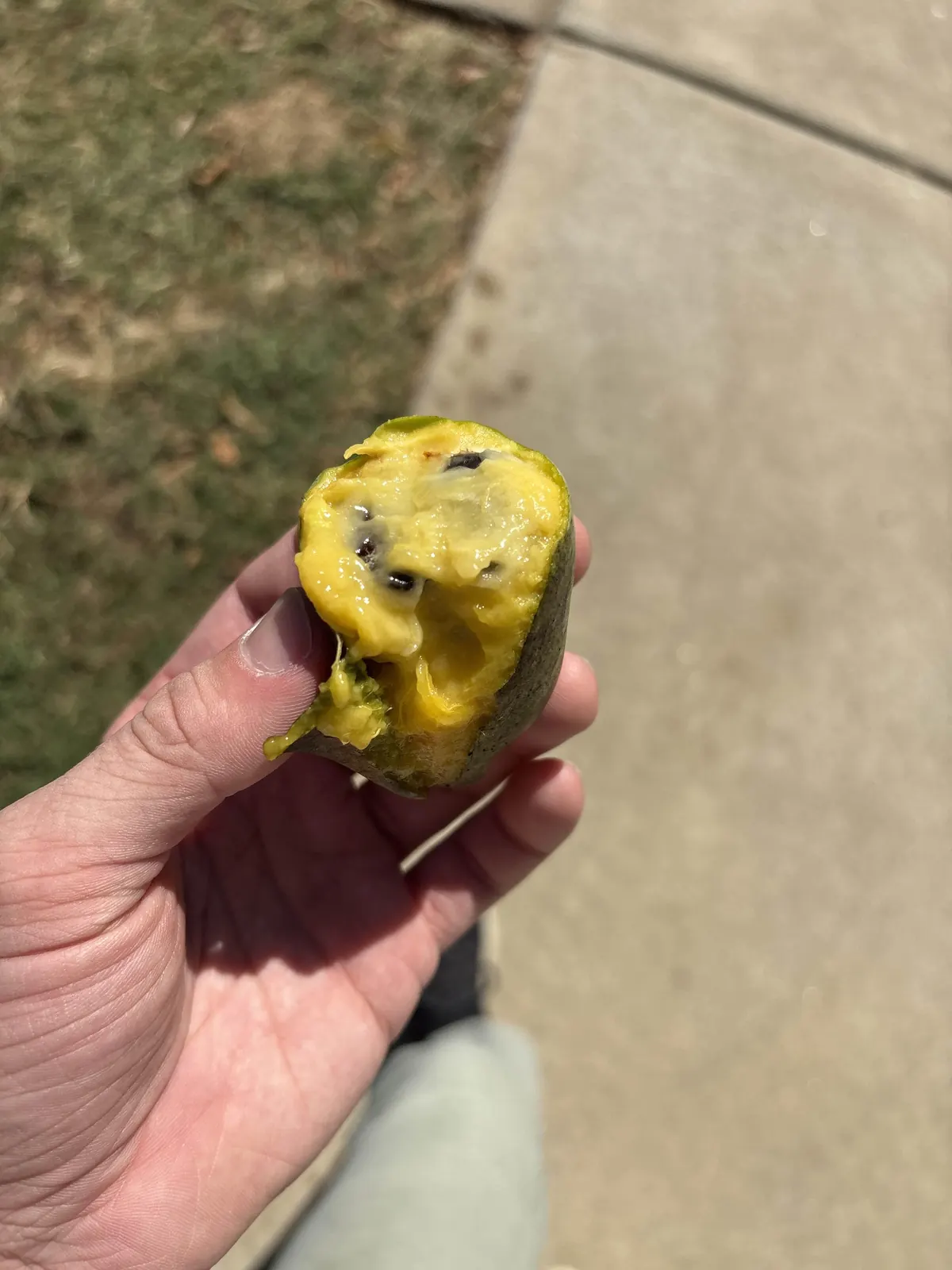
Banana-shaped, three to five inches long, green going to yellow, and dated September–October by MDC, so early in the month is the time. Birds, squirrels, opossums and raccoons “relish” it, and the tree is the only host of the zebra swallowtail.
-
Black walnuts
Dropping now; buying stations open October 1 · Statewide, best on deep bottomland soils
Black walnut “fruits September–October,” and the leaflets drop early, leaving bare branches hung with green balls. Missouri leads the world in black walnut production, and Hammons opens its hulling and buying stations on October 1; a pickup bed of nuts sells by weight. Mice and squirrels cache the rest.
-
Hickory nuts and acorns
September–October drop · Shagbark most common north of the river; white oak everywhere
Shagbark hickory nuts fall September–October under leaves going golden yellow; white oak acorns drop in the same window and feed blue jays, woodpeckers, wood ducks, turkeys, bobwhites, mice, squirrels, raccoons and deer. Pick one oak, tally the acorns beneath it each fall, and over a few years you will see which ones were bumper crops.
-
Fall mushrooms
Hen of the woods September–November; oysters into early winter · Base of oaks; dead and dying hardwoods
Hen of the woods fruits September–November “at the base of oak trees,” a choice edible with three lookalikes to learn: black-staining polypore, Berkeley’s polypore and the eastern cauliflower mushroom. Oysters run “from spring clear through to the beginning of winter,” and lion’s mane is a fall find. MDC’s rule is absolute: “if you’re not 100 percent positive of the ID, don’t eat it.” Most state parks and conservation areas allow collecting, but rules vary, so check first.
What are the elk, deer, snakes and tarantulas doing?
-
Elk bugling at Peck Ranch
Rut late September to mid-October; tour closed Oct 11–12 · Peck Ranch and Current River conservation areas, Shannon, Carter and Reynolds counties
MDC puts the rut at “late September to mid-October,” when bulls bugle and hold harems of up to 25 cows. The self-guided driving tour starts at the Peck Ranch office near Winona and is open sunrise to sunset every day except during managed deer hunts and the November firearms deer season; this year that means closed October 11–12, then November 5–9 and December 6–7. “Your best chances of seeing elk are the hours right after sunrise or right before sunset.” Stay in the vehicle, windows down and engine off; the bugle carries farther than you can see.
-
Deer: October is the run-up
Rut peaks mid-November; rubs and scrapes now · Statewide; worst on the roads at dusk and dawn
“In Missouri, the peak of the mating (rutting) season is in mid-November,” and October is when the signs appear: bucks rub their antlers on saplings, shredding the bark at knee height, and paw scrapes of bare earth under a low branch. Season dates are in the safety notes below. Drive slower at dusk and dawn from now to Thanksgiving, and log what moves at those hours on the journal’s dusk and dawn watch page.
-
Copperheads and timber rattlesnakes
Copperheads to early November, denning mid-to-late October; rattlesnakes to mid-October · Rocky south-facing slopes, glades, woodpiles
The eastern copperhead is “our most common venomous snake,” active “from mid-March through early November,” and “most copperheads enter overwintering sites from mid-to-late October”; it bites an estimated 100 or more Missourians a year, almost never fatally. The timber rattlesnake is “mainly active from April through mid-October” and basks on sunny rocks in autumn; bites are rare. Both mostly bite people trying to kill or handle them. Step onto a log before you step over it, and keep hands out from under rocks.
-
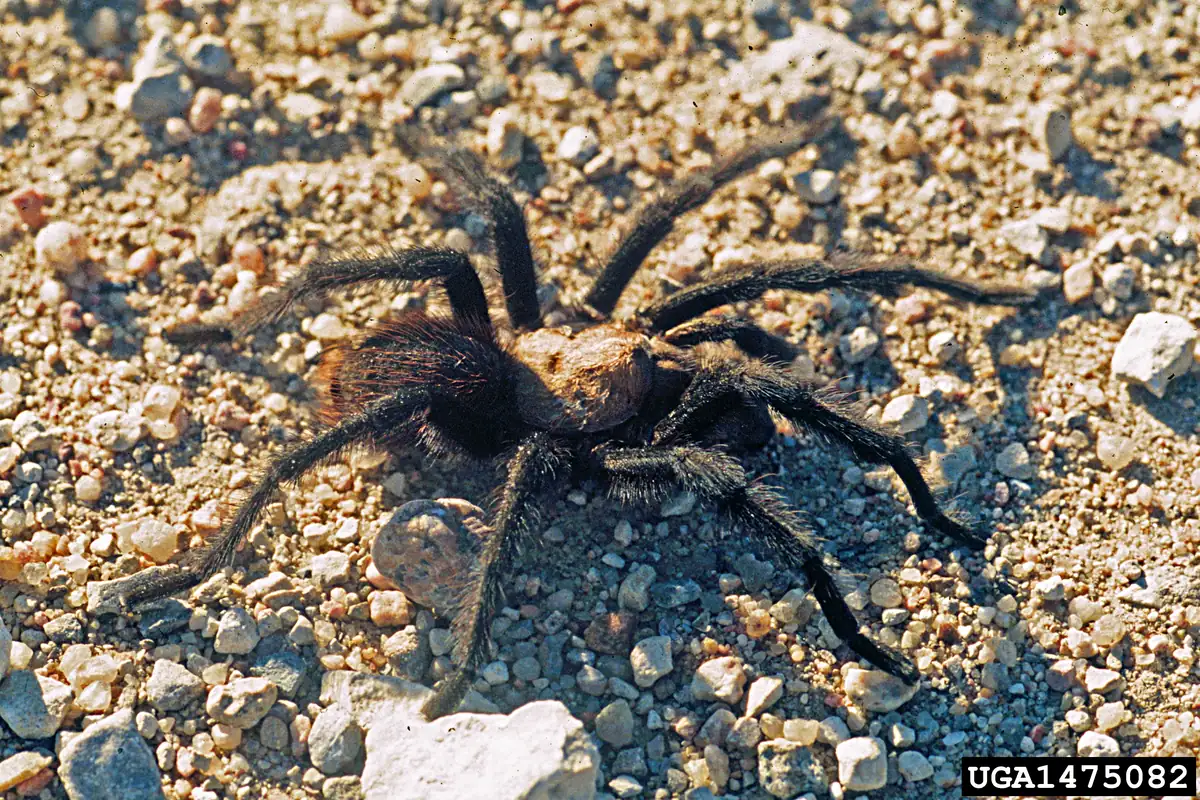
Tarantulas on the road
Late summer and fall · South of the Missouri River; glades and dry rocky ground
“In late summer and fall, Missourians in the southern part of the state may see these large arachnids crossing roads.” The Texas brown tarantula lives in south and central Missouri, and MDC notes that the Missouri River has blocked its spread north. It is shy, not aggressive, and its venom is “something like a bee sting.” Let it cross.
-
The cricket thermometer
Warm evenings until the first hard freeze · Any hedge or porch light
The snowy tree cricket keeps time with the temperature: count the chirps in 13 seconds and add 40 for degrees Fahrenheit, and the chirping “becomes slower as the temperature falls.” Check it against a thermometer on a warm evening, then listen for the night it stops.
Can you still float the Current, Jacks Fork and Eleven Point in October?
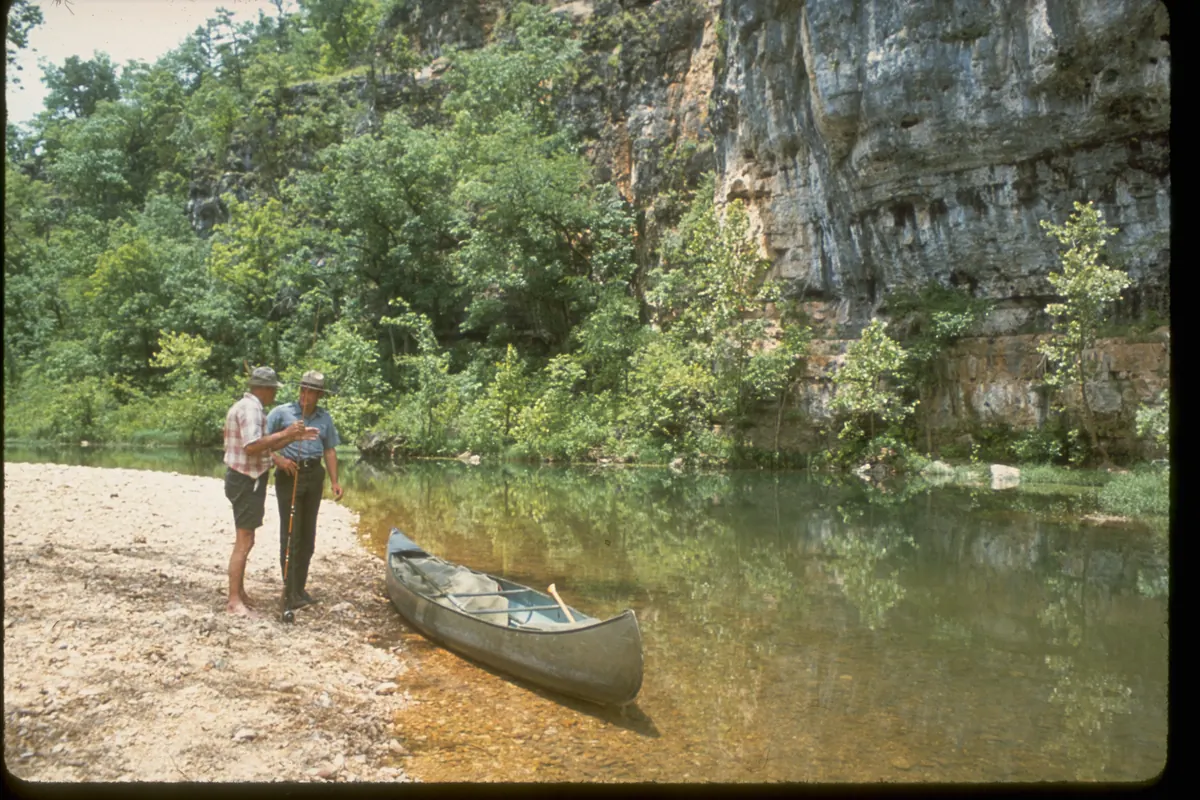
Yes, and October is the quiet, clear-water month, but it is a low-water month too, and this year more so. The Forest Service says of the Eleven Point, a 44-mile Wild and Scenic river fed by Greer Spring, that “July through October is generally the low flow period and canoeing may not be possible” from the top access at Thomasville, so put in lower, where the springs have added their share. On the Current and Jacks Fork the Park Service closes the rivers to paddlers at two feet above normal, which is not October’s problem; the fall question is whether there is enough water above Akers or above Alley Spring to float without walking. Read the USGS gauges before you drive; the Park Service’s river-levels page links the ones at Montauk, Akers and Van Buren on the Current and Mountain View, Alley Spring and Eminence on the Jacks Fork. One life jacket per person on board, children under seven wearing theirs, no glass, no lashing boats together.
The trout parks close catch-and-keep on Saturday, October 31. Bennett Spring, Montauk, Roaring River and Maramec Spring are stocked daily until then, with a $5 daily tag ($3 for age 15 and under) and a four-fish limit; the flies-only winter catch-and-release season opens Friday, November 13. If you visit the Big Muddy refuge units along the lower Missouri, watch the river stage and stay away when it reaches action flood stage or higher.
Where can Missouri families get outdoors together in October?
- Saturday, October 3: Evening on the Prairie. The Missouri Prairie Foundation’s annual gathering at Friendly Prairie near Ionia, 2 to 9 p.m., with guided prairie walks and room to pitch a tent, free with registration (dinner is extra).
- Saturday, October 10: the Missouri Chestnut Festival at MU’s research farm in New Franklin, 10 a.m. to 3 p.m., free: chestnuts cooked several ways, pawpaw ice cream, hay wagon rides through the orchards, a kids’ zone. The same day is eBird’s October Big Day; count the yard.
- Drive the Loess Bluffs auto tour from mid-October for the first snow geese.
- Drive Peck Ranch for elk at first or last light, any day but October 11–12.
- Saturday, October 17: a foraging walk at Powell Gardens near Kingsville, 3 to 5 p.m.; the gardens are open Wednesday to Sunday, 9 to 5, through November 1.
- October 28–29: Katy Trail Fall Colors tram tours from the Rocheport trailhead to McBaine, 10 a.m. to noon and 1:30 to 3:30 p.m., a suggested $5 donation, preregistration required through the park office.
- Find a monarch roost? Send it to Journey North that same night; families with a Monarch Watch tagging kit can tag the stragglers. Join Project FeederWatch before it starts on November 1.
- Set the alarm for Jupiter behind the Moon on October 6, or for the Orionids on the mornings of October 21 and 22.
MDC’s nature centers in Kansas City, St. Louis, Jefferson City, Springfield and Cape Girardeau usually run free programs in the fall, but their October calendar was not posted when we checked, so call or look online before you go.
Safety notes for October in Missouri
- Deer on the roads: the rut peaks in mid-November and the run-up is now. MDC’s advice is to “be careful when driving at night, at dusk, and at dawn.”
- Ticks: “most active April–July, but they may be encountered nearly any time of year.” Check yourself after every walk.
- Snakes: copperheads until they den in mid-to-late October, rattlesnakes to mid-month. Watch hands and feet.
- Hunting seasons this month: archery deer and turkey all month; fall firearms turkey October 1–31; early antlerless firearms deer October 9–11 in select counties; black bear October 17–30 in the southern half; elk archery October 17–25; early youth firearms deer October 24–25; youth waterfowl October 24–25 (North Zone) and October 31 – November 1 (Middle Zone); North Zone ducks from October 31; the November firearms deer portion opens November 14. The hunter-orange rule binds anyone hunting any game during a firearms deer portion, including the October 9–11 and 24–25 weekends, and all black bear hunters, with a few exemptions (mainly migratory-bird hunters and some archery hunters): “You must wear both a hunter-orange hat and a hunter-orange shirt, vest, or coat. The hunter-orange color must be plainly visible from all sides. Camouflage orange does not satisfy this rule.” It does not bind hikers, but MDC urges orange “whenever you are hunting,” and our advice for anyone on public land those weekends and from November 14 is an orange hat and vest.
- Managed hunts close areas on short notice: Peck Ranch’s driving tour on October 11–12, and waterfowl closures on parts of Eagle Bluffs from October 15. Check the area page before you drive.
- Rivers: low and clear; a life jacket aboard for everyone, worn by children under seven.
- Drought: much of the state is in drought and the leaves are coming down dry; check local burn bans before a campfire.
Sources
- Missouri Department of Conservation: fall color reports (weekly, by region)
- MDC field guide: white oak (acorns; claret red in the second half of October)
- MDC field guide: shagbark hickory
- U.S. Drought Monitor: Missouri (map of September 22, 2026)
- U.S. Fish and Wildlife Service: Loess Bluffs National Wildlife Refuge, species (snow goose and bald eagle timing)
- U.S. Fish and Wildlife Service: Loess Bluffs National Wildlife Refuge, visit us (auto tour, best months)
- U.S. Fish and Wildlife Service: Loess Bluffs National Wildlife Refuge, about us (numbers)
- MDC field guide: American white pelican (Missouri migration timing)
- MDC field guide: trumpeter swan
- U.S. Fish and Wildlife Service: Swan Lake National Wildlife Refuge, visit us
- U.S. Fish and Wildlife Service: Mingo National Wildlife Refuge, visit us (fall color and migration timing)
- MDC: Eagle Bluffs Conservation Area
- U.S. Fish and Wildlife Service: Big Muddy National Fish and Wildlife Refuge
- Monarch Watch: peak migration dates by latitude
- Monarch Watch: tagging program
- Journey North: monarch sightings and fall roost reports
- MDC field guide: ruby-throated hummingbird
- MDC field guide: white-throated sparrow
- MDC field guide: dark-eyed junco
- MDC field guide: broad-winged hawk
- Global Birding: October Big Day, October 10, 2026
- Project FeederWatch: how to participate
- NOAA NCEI: 1991–2020 first-freeze probability normals (data API; the table uses the city stations on our frost page)
- NOAA NCEI: 1991–2020 monthly precipitation and temperature normals (data API)
- Climate Prediction Center: ENSO diagnostic discussion, September 10, 2026
- Climate Prediction Center: prognostic discussion for the long-lead outlooks (September 17, 2026)
- NOAA Climate.gov: United States El Niño impacts
- U.S. Naval Observatory: sunrise, sunset, moonrise and moonset (data API; example for Kansas City, October 22)
- U.S. Naval Observatory: moon phases 2026 (data API)
- EarthSky: meteor shower guide (Draconids and Orionids 2026)
- EarthSky: visible planets (Saturn at opposition, Venus, Jupiter and Mars, October 2026)
- American Meteor Society: 2026 meteor shower calendar
- International Occultation Timing Association: lunar occultation of Jupiter, October 6, 2026 (city times and Moon altitudes)
- MDC field guide: persimmon
- MDC field guide: pawpaw
- MDC field guide: black walnut
- Hammons Products: black walnut harvest and buying stations
- MDC field guide: hen of the woods (maitake)
- MDC: mushrooming in Missouri (rules and safety)
- MDC field guide: elk (rut timing)
- MDC: elk driving tours at Peck Ranch and Current River conservation areas (2026 closures)
- MDC field guide: white-tailed deer (rut timing)
- MDC: 2026–27 hunting and trapping seasons
- MDC: turkey hunting (fall firearms season, October 1–31, 2026)
- MDC: black bear hunting (October 17–30, 2026)
- MDC: waterfowl hunting seasons 2026–27
- MDC: hunter orange requirement
- MDC field guide: eastern copperhead
- MDC field guide: timber rattlesnake
- MDC field guide: Texas brown tarantula
- MDC field guide: tree crickets (the snowy tree cricket thermometer)
- MDC field guide: ticks
- U.S. Forest Service, Mark Twain National Forest: Eleven Point National Wild and Scenic River
- National Park Service, Ozark National Scenic Riverways: river levels and gauges
- National Park Service, Ozark National Scenic Riverways: floating rules
- MDC: trout parks (catch-and-keep through October 31; winter catch-and-release)
- Missouri Prairie Foundation: events (Evening on the Prairie, October 3, 2026)
- MU Center for Agroforestry: Missouri Chestnut Festival, October 10, 2026
- Powell Gardens: October 2026 events and fall hours
- Missouri State Parks: 2026 Katy Trail Fall Colors Tours, October 28–29
- Photos via Wikimedia Commons; licenses and photographers are credited under each picture
