What to look for in nature in Montana this April
April is when Montana finally breaks into spring, a month at a time rather than all at once. Rivers rise and discolor, ice leaves the big eastern lakes, and the first long-distance travelers fill in: American white pelicans, sandhill cranes, ospreys and a growing choir of meadowlarks. Wild turkeys gobble on the pine hillsides at dawn, pasqueflowers and shooting stars open at the edges of the snow, boreal chorus frogs begin calling from roadside ponds, and Yellowstone’s bison herds start to drop their calves. Even so, the last freeze is a month away at many airports, and a heavy snowstorm is still possible in the mountains. The light keeps lengthening by about ninety minutes over the month, the Pink Moon is full on the 20th, and the month closes with Arbor Day on the 30th. The sections below take one subject at a time, and every date comes with its source.
Other months in Montana: October, November, December, January, February, March.
Start here
- Find the first meadowlark or crane. Stand at a fence line or hayfield edge at dawn and listen. Western meadowlarks are the first sign, and sandhill cranes pass overhead from mid-April in the northeast and the Bozeman area.
- Listen for a turkey at first light. Climb a ridge before sunrise and listen for gobbling, which is loudest in the first two hours of daylight. Wear something bright if hunters may be about.
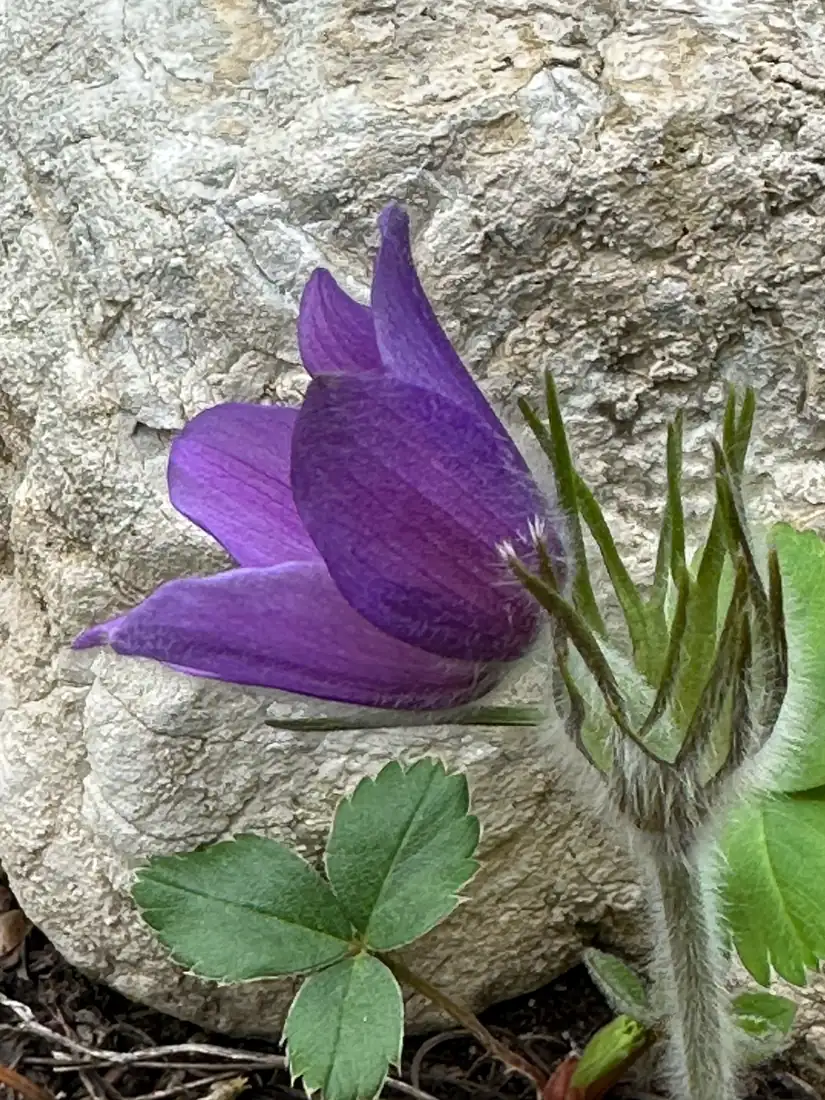
- Look for the first pasqueflower. Check sunny, snow-free slopes for the fuzzy purple blooms. Look, photograph and leave them where they are.
A Naturalist’s Field Journal is busy in April. Put the first meadowlark, crane and osprey on the birds-I-have-seen plate, log the first pasqueflower and frog chorus in the daily log, use the map-of-sounds plate for a dawn turkey or a pond at dusk, and check a river or hillside weekly on the same-place-twice plate.
Regions used below: Northwest and Glacier; Missoula and the western valleys; Southwest and Yellowstone country; Central Montana and the Rocky Mountain Front; Hi-Line and the northeast; Billings and the southeast.
Where do American white pelicans and prairie birds return to Montana wetlands in April?
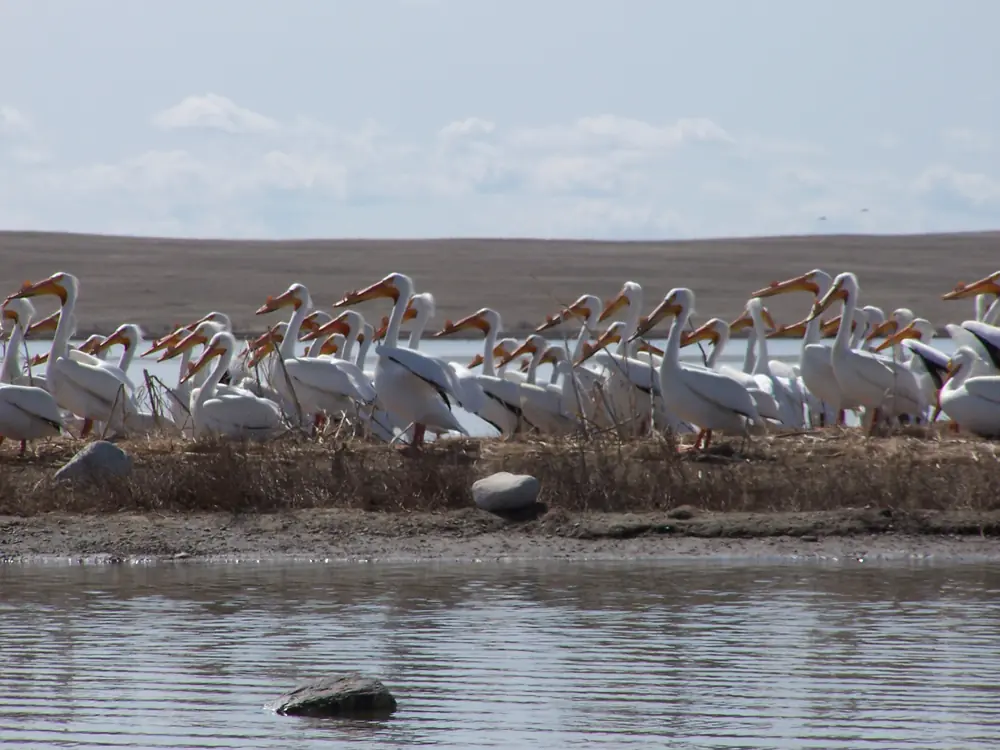
April is when the ice goes off the big eastern wetlands and the first long-distance nesters drop in. Montana Fish, Wildlife & Parks’ Field Guide says American white pelicans arrive at Montana colonies in April, with egg-laying and incubation from late April through May and young hatching in late May and June. It adds that the earliest arrivals can show up up to three weeks before pairing begins. The same account names Medicine Lake and Bowdoin in the east and Canyon Ferry in the west among the breeding sites, and notes that the birds from the eastern colonies mostly winter toward the Gulf Coast while western birds head to the Pacific side.
-
Medicine Lake and the thaw
Pelicans in April; the lake itself usually thaws in late April, according to a regional tourism account · Medicine Lake National Wildlife Refuge, northeast corner of the state
A Missouri River Country tourism article describes the refuge as home to the largest pelican rookery in Montana, and says it is usually late April before the lake loses its ice, with geese already in place since February and March. The same article names May, June and October as the best months to visit, so April is the early, quiet edge of the season. The U.S. Fish and Wildlife Service describes spring and fall migrations here as bringing thousands of waterfowl, mostly ducks, Canada and white-fronted geese and tundra swans, with fewer snow geese. Roads and viewing spots can be wet or closed in thaw, so check the refuge before driving out.
-
Grassland songbirds at Bowdoin
Chestnut-collared longspurs from about mid-April; Sprague’s pipits and white-faced ibis from about late April; Baird’s sparrows around mid-May · Bowdoin National Wildlife Refuge, near Malta on the Hi-Line
The refuge’s seasonal wildlife page gives these arrival windows, along with tundra swans arriving as early as mid-March. Most of the grassland birds are small and streaky, so the easiest way into them is by ear at first light, standing at a gate or pullout along the refuge drive and listening for the thin, high songs over open prairie. Treat each window as typical rather than a promise, since a cold April pushes them later.
-
Tundra swans, ospreys and cranes in the Bitterroot
Spring, with most of the refuge checklist present by the end of May · Lee Metcalf National Wildlife Refuge, near Stevensville
The refuge’s species page says spring is its wettest season and that 89 percent of the birds on its checklist can be found in the spring months, with waterfowl, osprey, tundra swans and many songbirds among the arrivals. It also lists bald eagles and sandhill cranes working the upland fields during migration. If a western valley is closer to you than the northeastern lakes, this is the April outing.
Nesting colonies deserve distance. Watch from the road or a marked viewing spot with binoculars, and never approach an island or shoreline colony. If you keep a Naturalist’s Field Journal, the birds-I-have-seen plate is the place for a first pelican or longspur, with the date and the weather.
When do sandhill cranes, ospreys and meadowlarks reach Montana?
The best guide to when migrants appear is the Montana Natural Heritage Program’s Field Guide, which records observations by region. Its dates are typical windows for one area and can run a week or two either way with snow cover and wind, so they work better as a calendar for when to start paying attention than as a deadline.
-
Sandhill cranes
Spring migration April 15 to May 12 around Bozeman; large flocks in northeastern Montana from mid-April · Wet meadows, hayfields and river valleys; look and listen overhead for the rattling, rolling call
The Field Guide gives those dates for the Bozeman area and says big flocks pass through the northeast around mid-April. Nesting follows later: eggs from mid-May to mid-June, with newly hatched young recorded near Bozeman from late May to mid-June. A crane standing in a hayfield in April is probably still on the move, not a local nester.
-
Ospreys back at their platforms
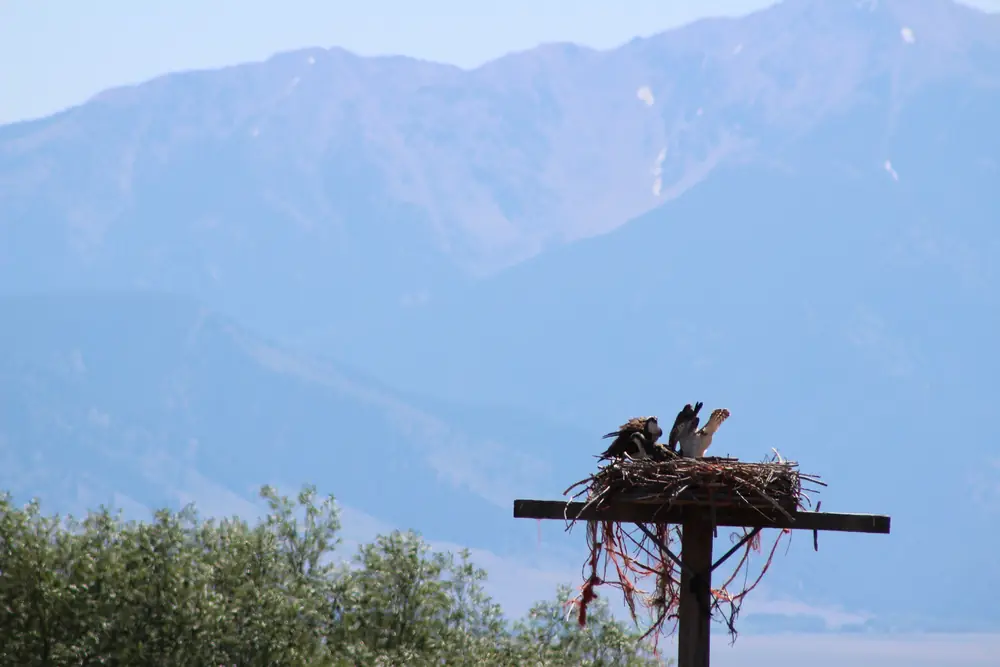
Arrival in March and April; April 20 to May 1 is the typical Bozeman-area window; eggs laid in April or May · Rivers, lakes and reservoirs, often on a power pole or nest platform
According to the Field Guide, ospreys arrive in Montana during March and April, lay eggs in April or May, and keep nests from April into July. Young leave the nest in July and August. This is the month to clean off and check a nest platform if you maintain one, before the birds do the work for you.
-
Western meadowlarks on every fence post
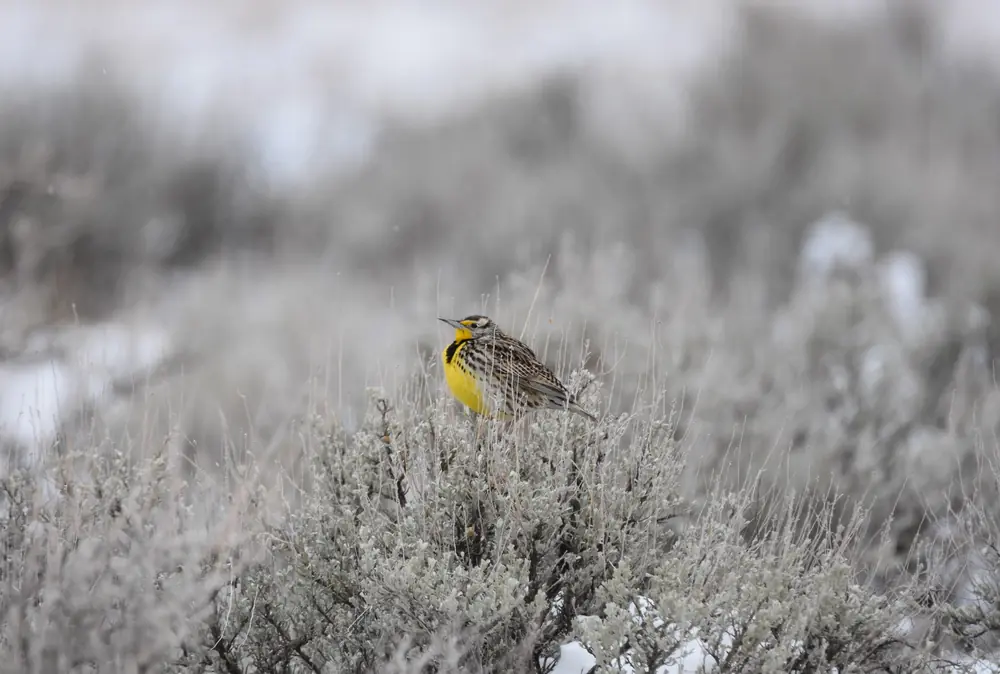
A Montana writer logged the first in mid-March one year and said they were everywhere by early April · Open prairie, hayfields and roadside fences across the state
The state bird sings from fence posts and rocks, a sweet, melodic song delivered by a bird with a bright yellow chest. One conservation writer described the first meadowlark of 2015 on March 16 and said the birds were absolutely everywhere by early April, which is a single observer’s notes rather than a rule. Hearing the first one is a good thing to enter in a daily log.
When do wild turkeys gobble in Montana, and when does the spring season open?
Montana’s wild turkeys are a transplant story. According to the Flathead Beacon, the state received its first birds in 1954, when 13 Merriam’s turkeys from Colorado were released in the Judith Mountains, followed by more releases from Wyoming. Merriam’s turkeys have since spread across the state, while Eastern turkeys, illegally introduced, remain in the northwest, in the Flathead Valley. The two differ in the tips of their tail feathers: white on Merriam’s, chestnut on Eastern.
-
Dawn gobbling and strutting
Most of April and May; the loudest calling comes in the first two hours of daylight · Ponderosa pine hillsides, river bottoms and edges of hayfields
The Beacon says males gobble most at dawn, with calls carrying a half mile on a still morning. A walk to a ridge before sunrise, with a thermos and a folding stool, is all you need to hear it.
-
The spring hunting season
In 2026 it ran April 15 to May 31; no 2027 dates were out as of October 2026 · Check the Montana FWP turkey regulations page for your area
FWP’s regulations page shows the 2026 spring season and says the 2027 dates had not yet been released. A general statewide license is valid for male turkeys in spring, with other licenses for certain regions. Anyone walking in the woods at dawn from mid-April on should assume a hunter may be nearby, so it is sensible to carry something bright on a public hillside early in the day. FWP’s turkey page tells hunters to leave white, red, black and blue clothing at home and suggests something bright on the walk in and out where many hunters park.
Which wildflowers bloom in Montana in April?
April flowers are small and low, and they come in on south-facing slopes first. The big yellow balsamroot hillsides arrive later: one Bozeman guide says arrowleaf balsamroot blooms as early as the end of May near town. What is in bloom in April depends on elevation and how fast the snow has melted, so use the dates below only as a sequence.
-
Pasqueflower
Sometimes as early as March in low country; continues into June at higher elevations · Grassland, sagebrush steppe and open forest, from the plains up past treeline
A Great Falls Gazette native-plant column describes pasqueflower as a familiar sight across much of Montana, with fuzzy purple flowers, four to six inches tall at bloom, and a feathery globe of seeds afterward. The name comes from the Old French word for Easter. The column asks readers to leave wild plants in place and to buy garden plants from legitimate native-plant nurseries.
-
Shooting star
As early as late April · Open ground as the snow melts away
A Bozeman nature guide lists the pink, swept-back petals of shooting star as blooming as early as late April. Look low on open ground as the snow leaves, and admire it without picking.
-
Glacier lilies at the edge of the snow
Opening as the snow recedes; low sites first, then higher basins as the season goes on · Forest openings and subalpine slopes; the Bozeman guide names Middle Cottonwood early in the season
The same guide says glacier lilies emerge at the edges of receding snow, and that you should look lower early and higher later. This is a nice example of following a bloom uphill through the spring, the way a naturalist follows the snow line.
For a year-long record, the seeds-pods-and-cones and same-place-twice plates of a Naturalist’s Field Journal work well for a single slope you check every week.
What stirs at Montana ponds and dens in April: frogs, salamanders and rattlesnakes?
Once the ice leaves a pond, the amphibians do not wait. The U.S. National Park Service says long-toed salamanders in Glacier breed in early spring as soon as the ice melts in wetlands, and that Columbia spotted frogs, which overwinter in the water, breed after the ice goes. March’s page covered the first spotted frogs; April brings the choruses.
-
Boreal chorus frogs
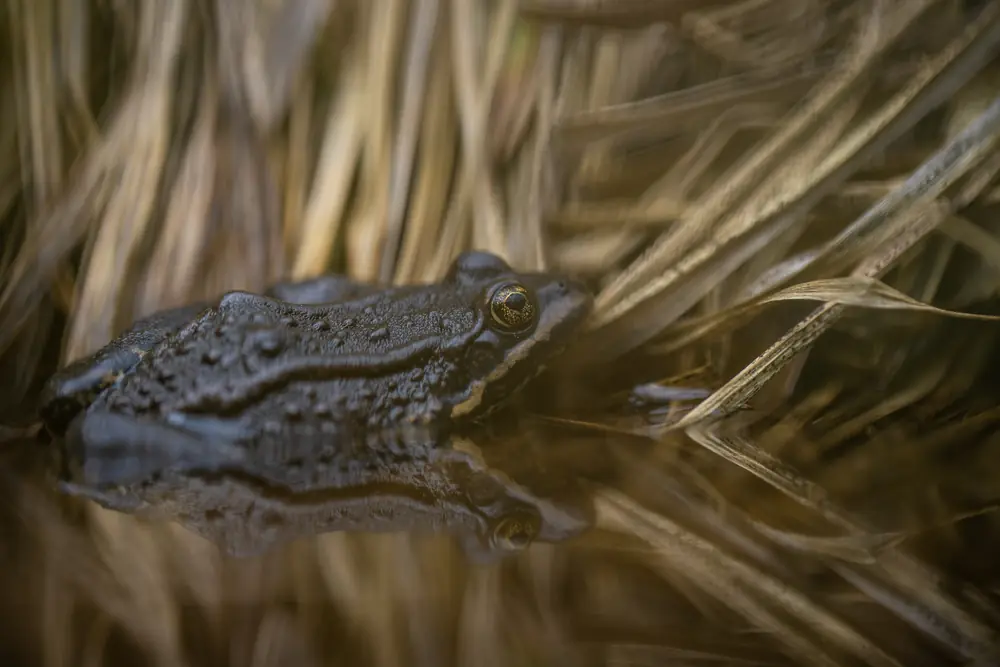
Breeding from late April to June, by the state Field Guide; Glacier’s account says May and June · Temporary ponds, ditches and shallow wetlands at low and middle elevations
The Field Guide says males call frequently at night and sometimes by day, with a series of short chirps like running a finger along a comb, loud enough to be heard from about 400 meters away. Sources differ a little on timing by region, which is natural in a state with this much elevation range. Listening at dusk beside a roadside pond is the easiest way in.
-
Long-toed salamanders
As soon as the ice melts out of breeding ponds · Ponds and wetlands that have just thawed
Adults move overland to the water as the snow goes. Park Service staff in Glacier describe the breeding as an early spring event timed by the melting of wetland ice. On wet nights, watch your step on gravel roads near a pond.
-
Prairie rattlesnakes leave winter dens
Spring, with most bites reported between April and September · Widely distributed in suitable habitat; dry, open country
Montana has one venomous native snake, the prairie rattlesnake. Montana State University Extension says most bites happen from April through September, when snakes and people are both active. The Field Guide notes that the snakes den communally and can travel up to seven miles from the den in summer. On a sunny afternoon in April, stay out of rock crevices you cannot see into, and keep dogs at your side.
What hatches on Montana rivers in April, and when does spring runoff start?
Montana’s rivers have their own April calendar, set by water temperature. The first big hatch is the skwala stonefly, which, according to a Missoula fly shop’s guide, begins when daytime water temperatures reach a steady 45 °F. It appears on the Bitterroot first, then about a week later on the Clark Fork and Rock Creek.
-
Skwalas, then March browns
Early April is a good window on the Missoula rivers; conditions change as the month goes on · Bitterroot, Clark Fork and Rock Creek near Missoula
The Missoula guide says the Clark Fork and Rock Creek catch up with the Bitterroot by early April. As the month moves on, warm days start to melt snow, river levels fluctuate and the water can discolor. It adds that the Clark Fork is the last river to discolor and the last to clear, so it is not a reliable indicator of the others. A river that is brown from bank to bank in April may be the first sign of runoff.
-
The Mother’s Day caddis starts late
Near the end of April on the lower Yellowstone around Big Timber; upstream into Paradise Valley through mid-May · Yellowstone River
A Montana fishing guide service says the hatch generally begins on the lower river near Big Timber near the end of April and works upstream toward the upper reaches through mid-May, with strong action as water reaches 52 to 54 °F. It also says low-elevation snowpack drives the year-to-year variation: more snow left in late April means faster runoff and clouded water. Whether you fish or just watch, the rivers are a good place to see spring arrive from the bottom of the valley to the top.
-
Open waters
Lakes and reservoirs open all year; Western District rivers and streams open on the third Saturday in May · All districts; check exceptions
FWP’s 2026 regulations page puts the Western District’s rivers and streams on a late season that starts on the third Saturday in May and ends November 30, with exceptions. Central and Eastern district rivers are listed as open year-round. Look up the 2027 rules for the exact water you plan to visit, since many carry exceptions.
What is open in Yellowstone in April, and when are bison calves born?
The park’s oversnow season ends in mid-March, so April is the transition between sleds and cars. The Park Service’s 2026 schedule shows how it usually goes, but as of October 2026 no dates for 2027 had been posted, and the Park Service warns that any date can move with the weather.
-
The wheeled-vehicle schedule
In 2026: April 17 for the West Entrance, Madison, Old Faithful, Mammoth to Norris and Norris to Canyon; May 1 for the East Entrance and Canyon to Bridge Bay; May 8 for the South Entrance and Tower-Roosevelt to Tower Fall; May 22 for Dunraven Pass · Yellowstone National Park roads; check the park roads page for the 2027 schedule
Use that list only as a pattern. The road from Gardiner through Mammoth and Tower to Cooke City stays open all year, according to the Park Service. Late snow can delay any opening.
-
Red dogs
Late April and May · Yellowstone’s grasslands and valleys, often within sight of park roads
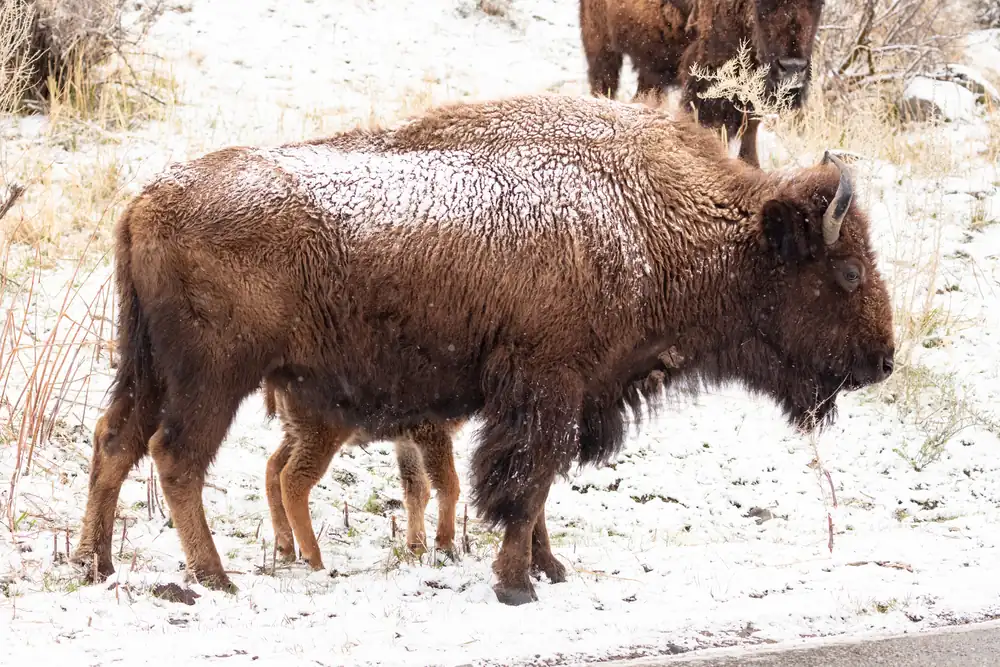
The Park Service says bison calves are born in late April and May, after a pregnancy of nine to nine and a half months, and calls the newborns reddish-brown. Cows defend their calves, and the Park Service’s rules set 25 yards as the minimum distance from bison and 100 yards from bears and wolves.
-
Glacier’s lower trails
Lower elevations usually snow-free by late April · Glacier National Park
The Park Service says plow crews start on the Going-to-the-Sun Road around the beginning of April and need roughly ten to twelve weeks to finish. Trails above the valley floors are generally buried in snow, and concessions mostly wait until the end of May or June. A short walk near Apgar is a realistic April plan.
What is April weather like in Montana, and what hazards come with it?
April is the month the thermometer finally gets comfortable, without giving up the snow shovel. NOAA’s 1991–2020 normals put average highs between 51 °F at Butte and 58 °F at Miles City, with average lows near or just above freezing at most stations and below 30 °F at Butte, Bozeman and Great Falls. Great Falls averages 9.4 inches of snow in April and Billings 7.5, and Butte still counts about 25 nights below freezing. Precipitation runs from 1.01 inches at Glasgow to 1.73 at Great Falls.
| Station | Average high | Average low | Precipitation | Snowfall | Nights below 32 °F |
|---|---|---|---|---|---|
| Missoula | 56.1 | 32.3 | 1.36 | 1.30 | 15.2 |
| Helena | 56.7 | 32.4 | 1.02 | 2.90 | 15.1 |
| Great Falls | 54.9 | 29.9 | 1.73 | 9.40 | 18.1 |
| Bozeman (Gallatin Field) | 55.3 | 29.1 | 1.68 | not published | 21.0 |
| Butte | 51.1 | 26.4 | 1.33 | not published | 24.8 |
| Billings | 56.9 | 34.7 | 1.72 | 7.50 | 10.6 |
| Glasgow | 56.8 | 32.8 | 1.01 | 2.50 | 16.2 |
| Miles City | 58.1 | 32.9 | 1.54 | not published | 12.8 |
The Western Regional Climate Center’s Montana narrative sets out the month’s main hazards. Rain falling on melting snow is the classic recipe for river flooding, and the narrative adds that small, sudden flash floods from local storms are probably the most frequent kind in spring and summer. In the higher southwest, a heavy snowfall can still arrive in the first days of May. The climate center counts about two tornadoes a year, almost all of them east of the Continental Divide. Late freezes are the other hazard for early gardens and fruit blossoms; see the frost table below.
The Climate Prediction Center issues a new seasonal map once a month, near mid-month, at its 90-day outlook page, and our weather page is the place to look for the next few days.
When is the last spring freeze in Montana?
The frost table is a reminder that April is still too early for tender plants nearly everywhere in the state. By the median, the last freeze comes in early to mid-May along the eastern stations, around the middle of the month in Missoula, and in the last days of May at Bozeman and Kalispell. In a late year, Kalispell does not finish until about June 22. Gardeners often wait until the “nine years in ten” date to set out tomatoes and squash, and use a row cover on warm-looking nights until then.
| Station | One year in ten | Median | Nine years in ten |
|---|---|---|---|
| Kalispell Glacier Airport (Flathead valley) | May 13 | May 31 | Jun 22 |
| Missoula International Airport | May 3 | May 16 | Jun 1 |
| Helena Regional Airport | Apr 29 | May 9 | May 25 |
| Great Falls International Airport | May 7 | May 19 | Jun 2 |
| Bozeman Gallatin Field | May 11 | May 26 | Jun 12 |
| Billings Logan International Airport | Apr 20 | May 4 | May 18 |
| Glasgow International Airport (Hi-Line) | Apr 24 | May 6 | May 18 |
| Miles City F Wiley Field (southeast) | Apr 26 | May 8 | May 21 |
For other towns, see our Montana frost-date guide. The March page covers the month before this one.
How much daylight does Montana gain in April?
Light keeps growing, though more slowly than at the March equinox: the eight towns below add between about 88 and 98 minutes between April 1 and April 30, about three minutes every day. Kalispell, Glasgow and Great Falls, the northernmost of the group, add the most, and by April 30 each has passed fourteen hours of daylight. These figures are lengths of day, not clock times.
| City | Apr 1 | Apr 30 | Gained | Per day |
|---|---|---|---|---|
| Kalispell | 12 h 52 m | 14 h 30 m | 98 min | 3.4 min |
| Missoula | 12 h 50 m | 14 h 23 m | 93 min | 3.2 min |
| Helena | 12 h 49 m | 14 h 21 m | 92 min | 3.2 min |
| Great Falls | 12 h 51 m | 14 h 26 m | 95 min | 3.3 min |
| Bozeman | 12 h 48 m | 14 h 16 m | 88 min | 3.0 min |
| Billings | 12 h 48 m | 14 h 17 m | 89 min | 3.1 min |
| Glasgow | 12 h 52 m | 14 h 29 m | 97 min | 3.3 min |
| Miles City | 12 h 49 m | 14 h 20 m | 91 min | 3.1 min |
Our daylight tool will give sunrise and sunset for your own town. Daylight time began on March 14, which is why April sunrises and sunsets read an hour later than they would on standard time.
What can you see in Montana’s night sky in April 2027?
Times here are Mountain daylight time. Moonless skies come around the new moon on April 6, while the nights near the full Moon are bright, so a faint-star outing belongs in the first week and a half of April.
-
The Pink Moon
Full on Tuesday, April 20, at 4:27 p.m. MDT, so look for it rising on the evening of the 20th · Anywhere with a clear eastern horizon
The name has nothing to do with color. SeaSky’s calendar says early Native American tribes used it because the bloom of moss pink, a wild ground phlox, came about now. The Moon reaches full in the afternoon, before it has risen over Montana, so it first climbs into view round on the evening of the 20th.
-
Lyrid meteors in a moonlit week
Peak around the evening of Thursday, April 22 (about 7:41 p.m. MDT by the International Meteor Organization) into the morning of the 23rd · Dark, open sky, ideally with the Moon behind a building or hill
SeaSky describes the Lyrids as a middling shower, around twenty an hour in the best of conditions, and warns that a nearly full Moon washes out most faint streaks this year. Three days after full, the Moon is close to 95 percent lit and does not rise until late evening. That leaves a short dark window after dusk, when the shower’s home constellation sits low in the northeast. Plan on a handful of meteors per hour, with the occasional bright one as a reward.
-
Planets in April
Venus before dawn; Jupiter and Mars in the evening; Mercury and Saturn out of reach · Low east before sunrise; high in the south and west after dusk
Venus is the dazzling object low in the east before dawn, coming up an hour or so before the Sun in early April and a bit closer to sunrise by the end. Jupiter shines in the evening sky, and by our own calculation a bright, waxing Moon sits roughly one degree from it on April 14 and 15, near Mars on the 15th as well. Neither Saturn, which is in solar conjunction on the 7th, nor Mercury, hidden in the horizon haze, is worth a Montana evening or morning in April. Our rise-and-set estimates assume a central U.S. location, so at Montana’s latitudes they may be off by as much as half an hour.
| Phase | Date | Time |
|---|---|---|
| New moon | Tue, Apr 6 | 5:51 p.m. MDT |
| First quarter | Tue, Apr 13 | 4:56 p.m. MDT |
| Full moon (Pink Moon) | Tue, Apr 20 | 4:27 p.m. MDT |
| Last quarter | Wed, Apr 28 | 2:18 p.m. MDT |
Keep the moon phase calendar handy, and use the cloud guide to judge whether skies will clear by dark.
What can Montana families do outside in April 2027?
Organizers had mostly not published April 2027 calendars when this page went up. A date appears below only when the organizer’s own site already shows it, and anything else is described as an annual pattern to confirm with the host. March in Montana covers the weeks before this one, and the full set of state nature guides sits one click away.
-
Earth Day
Thursday, April 22, 2027 · Wherever you are
EARTHDAY.ORG says Earth Day is observed every April 22, and that its 2027 theme is “Food for Our Planet.” A good family version is a walk with a bag for litter, then a notebook entry about what you found.
-
Arbor Day
Friday, April 30, 2027, the last Friday in April · Schools, parks and towns that hold planting events
State law makes the last Friday of April Arbor Day, which puts it on April 30 in 2027. Towns and schools schedule their own plantings, so ask locally. A native tree or shrub from a reputable nursery is a fitting thing to plant.
-
City Nature Challenge
April 30 to May 3, 2027 for observations, according to the organizer · Online and in participating cities; check whether a Montana area is signed up
The City Nature Challenge’s own site gives April 30 to May 3, 2027 for observations and May 4 to 16 for identification. The organizer’s home page named no Montana cities in October 2026, so look on the site for a local team, or simply post your finds to iNaturalist yourself.
-
Project FeederWatch ends, NestWatch begins
FeederWatch runs through April; NestWatch whenever nests are active · Backyard feeders and nest boxes
Project FeederWatch counts run from November through April, at a flexible schedule, for an $18 fee for U.S. residents. NestWatch, also from the Cornell Lab of Ornithology, is free and open to anyone; you learn how to monitor a box without disturbing it, then report your findings. Take your feeders down once bears are out.
-
Native plant and natural-history centers
Check the calendars; no April 2027 events were posted yet · Montana Natural History Center, Missoula; Montana Audubon Center, Billings
Both centers’ online calendars ran only into late October 2026 at the time of writing. Look again in spring for garden tours, owl programs and the like.
-
Add to the migration map
All spring · Online
Journey North lets anyone report spring sightings and browse maps of what others have seen. Its featured projects lean toward monarchs and hummingbirds, which reach Montana later in the season, so April is a good time to learn the tools.
Safety notes for April in Montana
- Spring bear and turkey seasons. The 2026 spring black bear season opened April 15 and closed May 31 or June 15, depending on the hunting district, and the spring turkey season ran April 15 to May 31. No 2027 dates were out as of October 2026, so look at FWP’s regulations pages. Anyone buying a black bear license must first pass the state’s Bear Identification Test. On public land at dawn, assume a hunter could be nearby, and keep dogs close.
- Turkey hunters’ clothing. FWP’s turkey page tells hunters to leave white, red, black and blue clothing at home, since those colors can resemble a gobbler, and suggests blaze orange for the walk to and from a vehicle in crowded areas. A hiker on a hillside in spring might copy the idea and carry something bright.
- Bears. Black bears and grizzlies are awake and hungry. Carry bear spray where a hand can find it fast, call out around blind bends, and hike with others. FWP recommends certified bear-resistant garbage containers and no bird feeding while bears are active. Inside Yellowstone the minimums are 100 yards from a bear or wolf and 25 yards from a bison.
- Ticks. Montana State University Extension says the Rocky Mountain wood tick is the most common tick in the state, and that tick season peaks in spring and early summer. Wear long sleeves, use repellent, check your body and pets after hiking, and pull a tick straight out with fine-tipped tweezers.
- Rattlesnakes. MSU Extension advises staying about three body lengths back and walking around a snake, never trying to kill or handle it, and calling 911 right away after a bite. Dogs are bitten more often than people, so a hiker in dry country can ask a veterinarian about a vaccine.
- Cold, fast water. Rivers start to rise and discolor as snowmelt picks up. Stay back from undercut banks and never wade a swift river alone.
- Floods and storms. Heavy rain on thawing snow is a flood risk, and the climate center says flash floods are common in spring and summer. Never drive through water on a road.
- Late snow. A warm week can be followed by a heavy snowstorm in the mountains; carry layers, a map and a light on any trail.
- Young animals. Spring brings fawns, calves and other young. FWP urges people to leave young wildlife alone: they often only look abandoned, and the agency no longer accepts deer, moose or elk because captivity stresses them. Keep dogs leashed near nesting birds and calving areas.
Give animals plenty of room this month, from pelican colonies and sage-grouse leks to any young animal you find. For garden timing, the Montana frost-date guide has dates for other towns.
Sources (42)
- Montana Field Guide: American White Pelican
- Montana’s Missouri River Country: Medicine Lake National Wildlife Refuge
- U.S. Fish and Wildlife Service: Medicine Lake National Wildlife Refuge, seasons of wildlife
- U.S. Fish and Wildlife Service: Bowdoin National Wildlife Refuge, seasons of wildlife
- U.S. Fish and Wildlife Service: Lee Metcalf National Wildlife Refuge, seasons of wildlife
- Montana Field Guide: Sandhill Crane
- Montana Field Guide: Osprey
- Adventure Scientists: Waiting for the meadowlark
- Flathead Beacon: A tale of two turkeys
- Montana FWP: spring turkey hunting
- Great Falls Gazette: Buck’s Native Plant Corner, pasqueflower
- Outside Bozeman: What’s that flower?
- National Park Service: amphibians of Glacier National Park
- Montana Field Guide: Boreal Chorus Frog
- Montana Field Guide: Prairie Rattlesnake
- Montana State University Extension: Rattlesnake safe in Montana
- Montana State University Extension, Judith Basin: tick season alert
- Missoulian Angler: Missoula spring fly fishing
- Montana Angler: fishing the Mother’s Day caddis hatch on the Yellowstone River
- Montana FWP: fishing regulations
- National Park Service: Yellowstone park roads
- National Park Service: Yellowstone bison
- National Park Service: Yellowstone safety
- National Park Service: visiting Glacier National Park in spring
- Western Regional Climate Center: climate of Montana
- NOAA NCEI: April 1991–2020 normals for the eight Montana airports in the table (data service)
- NOAA Climate Prediction Center: seasonal outlooks
- U.S. Naval Observatory: moon phases, 2027
- SeaSky: astronomy calendar 2027
- Montana FWP: black bear hunting
- Montana FWP: living in bear country
- Montana FWP: sage-grouse
- Montana FWP: leave baby animals alone (bulletin, May 31, 2018)
- Montana Code Annotated 1-1-225: Arbor Day
- EARTHDAY.ORG
- City Nature Challenge
- Cornell Lab: Project FeederWatch
- Cornell Lab: NestWatch
- Journey North
- Montana Natural History Center: events
- Montana Audubon Center, Billings: events
- Photos via Wikimedia Commons; licenses and photographers are credited under each picture
