What to look for in nature in Montana this January
January is the heart of the Montana winter, and the wildlife story of the month is open water. Bald eagles line the Missouri below the dams, trumpeter swans feed on the spring-warmed Madison, and dippers dive in mountain creeks that never freeze. Out on the valleys and the Hi-Line, rough-legged hawks from the Arctic hunt voles from the power poles, and in an irruption year snowy owls join them. Great horned owls are duetting, and Bohemian waxwings roam the towns for berries. The evenings are stretching, too, with every town in our table gaining close to an hour of daylight by month’s end. Below is the month section by section, with a source behind every date.
Other months in Montana: October, November, December, February.
Start here
- Find the eagles at open water. On a cold, clear morning, drive to a river stretch that stays open below a dam, such as the Missouri below Canyon Ferry, and scan the bankside cottonwoods with binoculars.
- Listen for owls after sunset. Great horned owl pairs are duetting before they nest in February. Stand quietly at the edge of a cottonwood bottom on a still evening and count how many different voices you hear.
- Watch the Wolf Moon rise. The closest full moon of 2027 rises in the northeast at dusk on Thursday, January 21, and is exactly full at 5:17 a.m. MST on the 22nd.
In your Naturalist’s Field Journal this month, keep a running list on “birds I have seen” of every eagle, rough-legged hawk and swan, noting whether the water was open or frozen. Draw a cottonwood, willow or red-osier dogwood twig with its buds on the “a tree through the seasons” page and return to the same tree in March. Use “reading the signs” for grouse snow holes, owl pellets and whitewash, and on the “dusk and dawn watch” page write down the time the first owl calls each evening as the days lengthen.
Regions used below: Northwest and Glacier; Missoula and the western valleys; Southwest and Yellowstone country; Central Montana and the Rocky Mountain Front; Hi-Line and the northeast; Billings and the southeast.
Where can you see bald eagles in Montana in January?
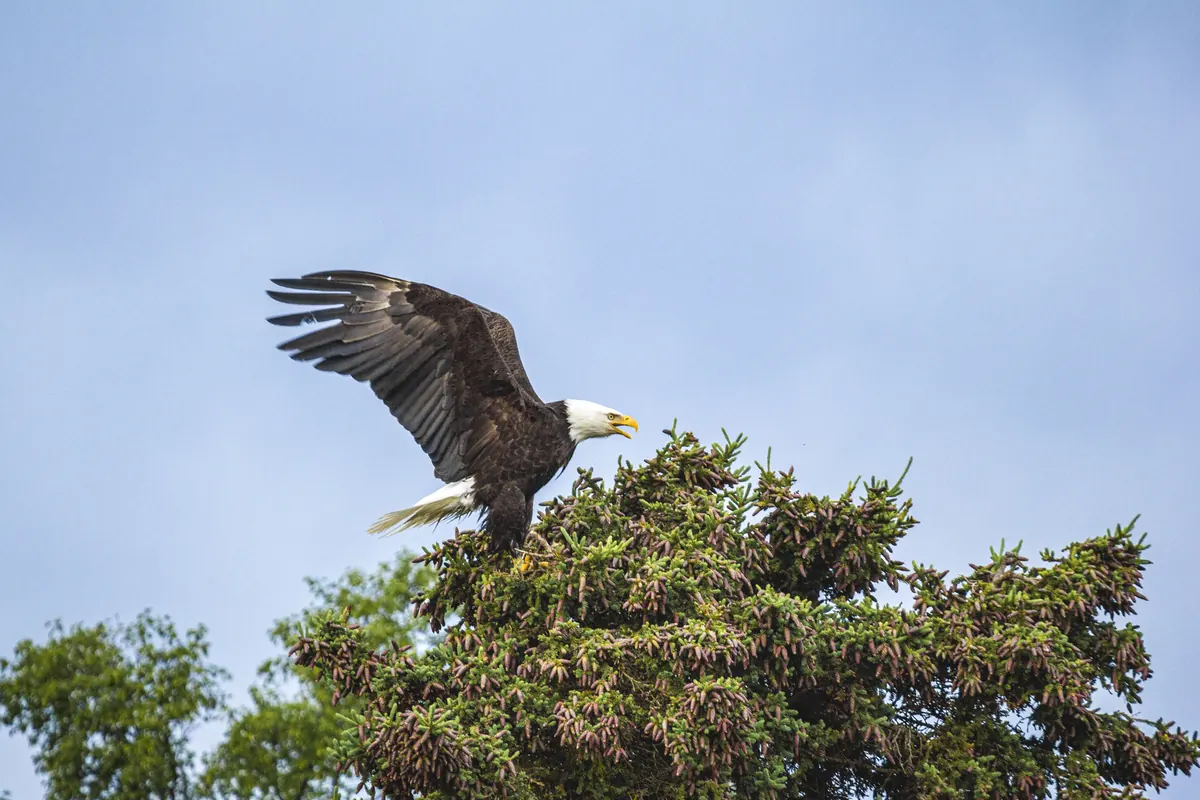
January is the month to look for bald eagles wherever Montana still has open water. Once ponds and backwaters lock up, fish and ducks are only reachable where a dam’s outflow, a spring or a fast riffle keeps the surface moving, and eagles crowd onto those stretches. Some are Montana’s own breeders, while others fly down from Canada for the winter, as FWP’s Montana Outdoors magazine has described. Around Bozeman, the Montana Field Guide puts their arrival near November 20 and their departure in late April.
-
Eagles at the dams on the Missouri
All winter; most concentrated in the coldest spells · The Missouri River below Canyon Ferry Dam near Helena, and the Fort Peck area in the northeast
The Montana Field Guide lists Canyon Ferry Dam on the Missouri, and the Fort Peck country, among the state’s known winter gathering places. Fast water below a dam stays open through the coldest spells, keeping fish and ducks within reach. Scan the big bankside cottonwoods early in the morning, and check the ice edge for white heads. Watch from a pullout; walking up the bank flushes the birds and wastes energy they cannot spare.
-
Scavengers on the winter range
All winter · Foothill valleys, highway shoulders and big-game winter ranges statewide
Bald eagles eat far more than fish in winter. The field guide notes that they take many waterfowl in the cold months and fill in with carrion and small mammals, so look for them on a road-killed deer or a gut pile beside ravens and magpies. That scavenging has a cost: in a 2017 Montana Outdoors article, Raptor View Research Institute reported that over 90 percent of the bald and golden eagles it tested carried elevated lead.
-
The Midwinter Bald Eagle Survey
The first two weeks of January · Standard routes along rivers and reservoirs
Every January, during its first two weeks, agency biologists and volunteers cover standard routes for the national midwinter eagle count, a program that began in 1979 and is now hosted by the U.S. Army Corps of Engineers, with state coordinators, usually on one or two target days. Early in the recovery, the field guide records Montana’s January totals rising from about 260 eagles in 1980 to about 450 by 1984. Private volunteers can join; the Corps’ program page lists contacts.
Only 12 nesting pairs were left in Montana in 1978; by 2014 biologists counted about 700. Eggs come in March or April, so two adults sitting side by side near a huge stick nest this month are likely already claiming it for spring.
Which birds stay on Montana’s open rivers all winter?
A river that refuses to freeze becomes the busiest place in the January landscape. Spring creeks, the outflows of reservoirs and the faster mountain streams hold swans, ducks and one remarkable songbird through the coldest weeks.
-
Trumpeter swans on the Madison and at Red Rock Lakes
All winter; Canadian swans leave from early March · Ennis Lake and the Madison River, Hebgen Lake, and the spring-fed creeks of Red Rock Lakes National Wildlife Refuge in the Centennial Valley
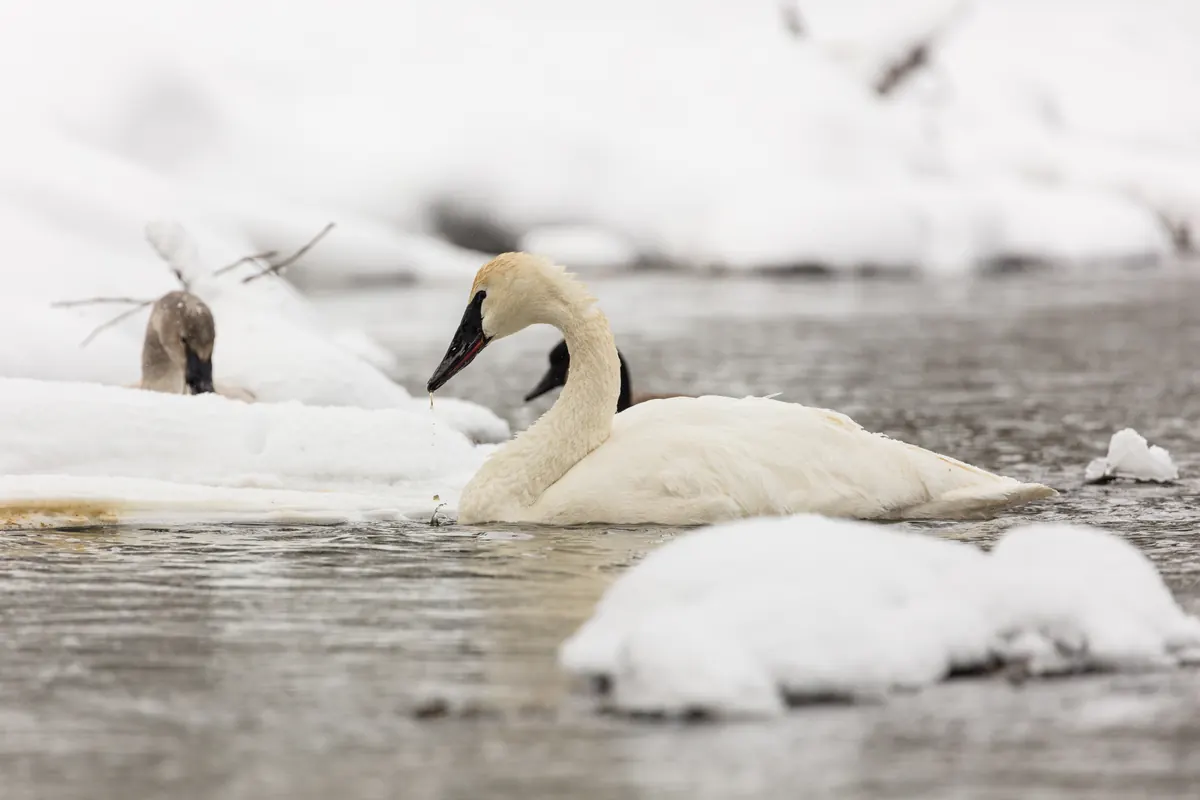
North America’s largest waterfowl winter in southwest Montana wherever the water stays open. The Montana Field Guide names Ennis Lake and the Madison River, and Hebgen Lake, as wintering areas, where Montana’s resident swans are joined by birds that nest in Alberta, British Columbia and the Yukon. Red Rock Lakes National Wildlife Refuge, a famous swan nesting ground, mostly empties out by early November, but the Fish and Wildlife Service says about 20 swans stay through winter on creeks fed by warm springs. Midwinter surveys cited in the field guide have counted from 214 swans (1995) to 704 (2002), gray young among the white adults.
-
The Blackfoot’s returned swans
Away for the winter; back in early March · Wintering in southwest Montana and beyond; nesting in the Blackfoot Valley near Ovando
Trumpeters had vanished as nesters from the Blackfoot until partners led by the Blackfoot Challenge and the Fish and Wildlife Service began releasing young swans in 2005. Some 218 cygnets went out over 16 years, and the group now counts 15 active swan territories. In winter the birds scatter; tracked pairs have wintered on spring ponds in the Ruby Valley, and one young swan turned up on the Colorado River in southern California.
-
American dippers diving under the ice
All winter, even on subzero days · Fast, clear mountain creeks such as Rattlesnake Creek in Missoula, and larger rivers below the canyons
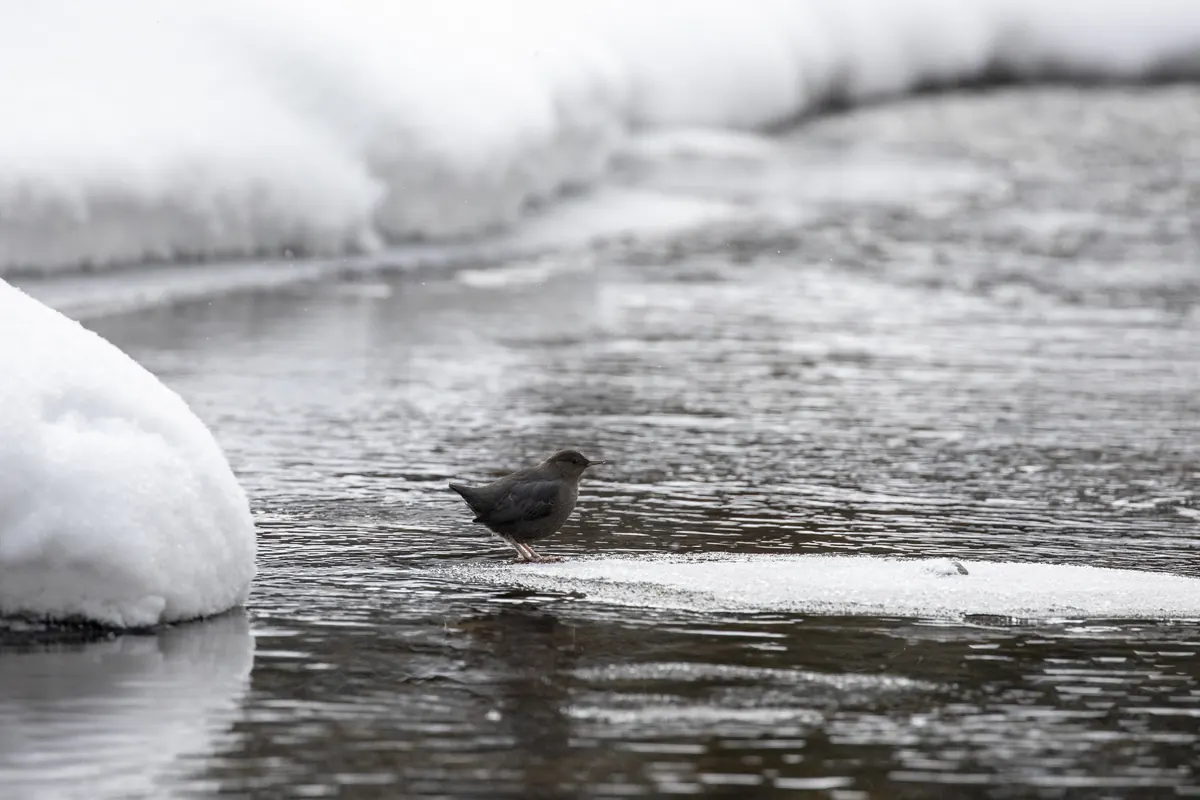
The dipper is a gray, wren-shaped songbird that walks underwater along the stream bed hunting insect larvae. It does not migrate; when its creek freezes, it moves downstream or downhill to open water. In Montana Outdoors, Montana Bird Advocacy’s Jeff Marks explained that dippers carry roughly 4,200 feathers, against fewer than 3,000 for similar-sized songbirds, which is how they shed icy water so well.
Which hawks and owls hunt Montana’s open valleys and prairie in January?
Montana’s wide valleys and wheat country fill with Arctic raptors in winter. Voles keep busy under the snow, and the hawks and owls that hunt them line up along fence posts and power poles.
-
Rough-legged hawks on every other pole
Arrives in late fall; most leave by early April · Grasslands, hay meadows and farm country statewide
The Montana Field Guide calls the rough-leg the most common buteo of a Montana winter. It nests in the Arctic and comes south to hunt small mammals, mainly mice, voles and rabbits. Look for a hawk whose white tail ends in a broad dark band, with pale undersides in flight. Its name comes from the feathering that covers its legs down to the toes, a built-in pair of leggings for the cold.
-
The Mission Valley’s winter raptor count
One full day in the middle of each month, November through March · Roads throughout the Mission Valley, near Charlo
The Owl Research Institute in Charlo runs this survey; 2024–25 was its sixth season. Teams drive set routes, stopping every mile to log each raptor within half a mile. Montana Public Radio reported that the January 2025 count found 909 raptors in one day, about six per mile: rough-legged and red-tailed hawks, golden eagles, northern harriers, prairie falcons and more.
-
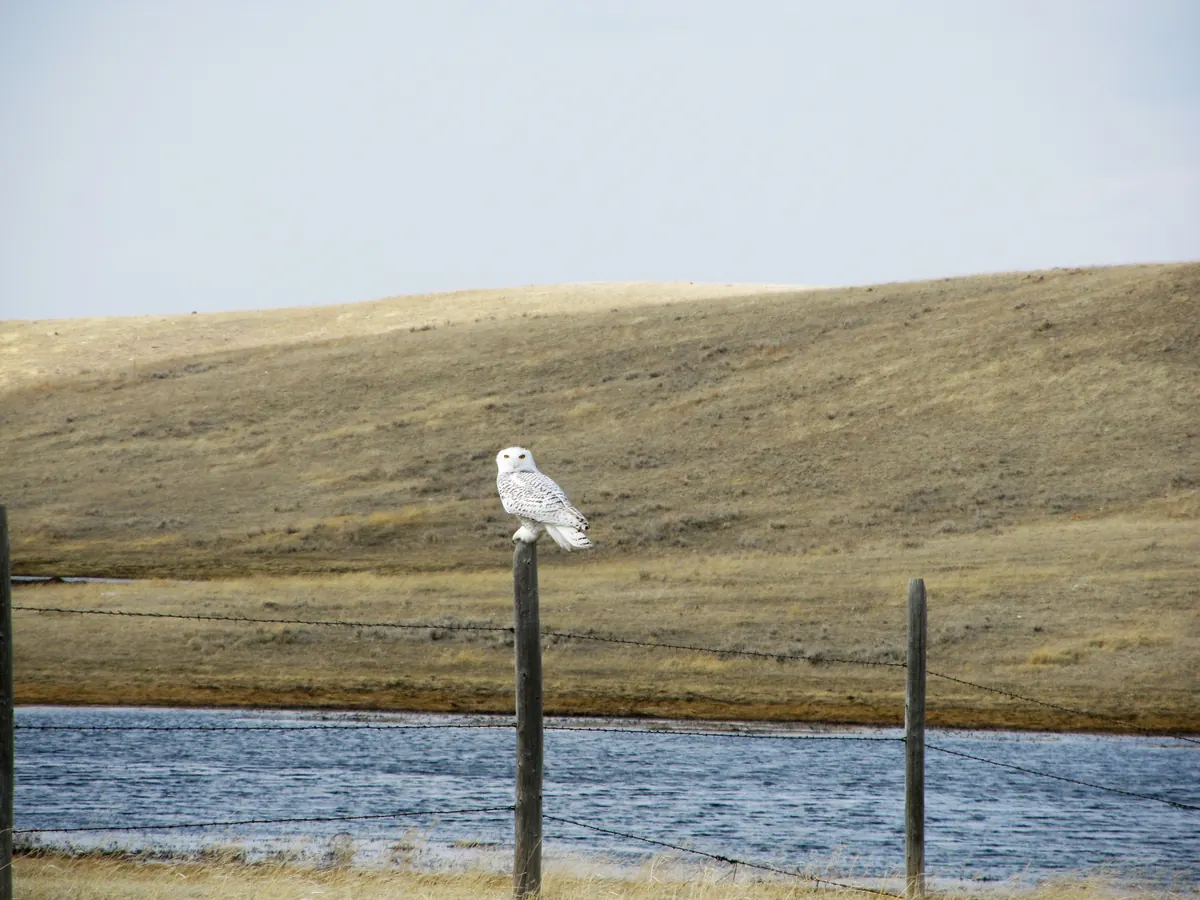
Snowy owls in an irruption year
Mostly mid-December to mid-February, in the winters they come · The Hi-Line and other open plains and farm country, especially north-central Montana
The snowy owl is the only one of Montana’s 15 recorded owl species that does not nest here, according to the Montana Natural History Center. Montana Outdoors explains that the owls come south every several years, after Arctic lemming numbers crash, in what birders call an irruption; in other winters you may find none. Look for a white or barred bump on a fence post, haystack or field rise, and check recent eBird reports for your county first. Watch from the car, since an owl that keeps flushing burns reserves it needs.
When do great horned owls start nesting in Montana, and where do long-eared owls roost?
Owls start Montana’s breeding year, and January is when their courtship is in full voice. On a still evening after sunset, stand at the edge of a river bottom or shelterbelt and listen.
-
Great horned owl pairs choosing a nest
Duetting through January; eggs from mid-February to late March · Cottonwood bottoms, shelterbelts, cliffs and town parks statewide
Great horned owl pairs hold their territories year round, and in midwinter mates answer each other’s deep hoots across the river bottom. The Owl Research Institute says western Montana pairs take turns inspecting possible nest sites before laying, usually from mid-February until late March. They never build their own: the institute lists old nests of red-tailed hawks, crows, herons and squirrels, tree cavities, cliff ledges and abandoned buildings. Two eggs is the usual clutch, incubated by the female for about 33 days, and the institute notes that females have kept eggs warm through nights colder than minus 33 °C (about minus 27 °F).
-
Long-eared owls sleeping in a crowd
Communal roosts all winter; birds disperse in February and March · Dense thickets and shelterbelts in the Missoula and Mission valleys and similar country
Most owls roost alone in winter. The long-eared owl is the exception, gathering in groups in thick cover. The Owl Research Institute has studied long-eared owls near Charlo since 1987, banding more than 2,000, and does much of that work in winter while the birds are concentrated at roosts. They eat mostly voles and are easily disturbed, so if you find a roost, leave quietly and keep the spot to yourself.
-
Finding any owl by its signs
Any winter day · Under conifers, in thickets and beneath barn eaves
The Montana Natural History Center suggests searching good habitat for pellets (balls of fur and bone the owl coughs up) and whitewash on the snow below a favorite perch, then returning at dusk to listen. Most other Montana owls wait until February to call.
Will Bohemian waxwings and winter finches come to Montana this winter?
Some of the best winter flocks in Montana towns ignore the feeder entirely and head for the fruit trees. Mountain ash and crabapples along streets and in yards can draw hundreds of northern birds at once.
-
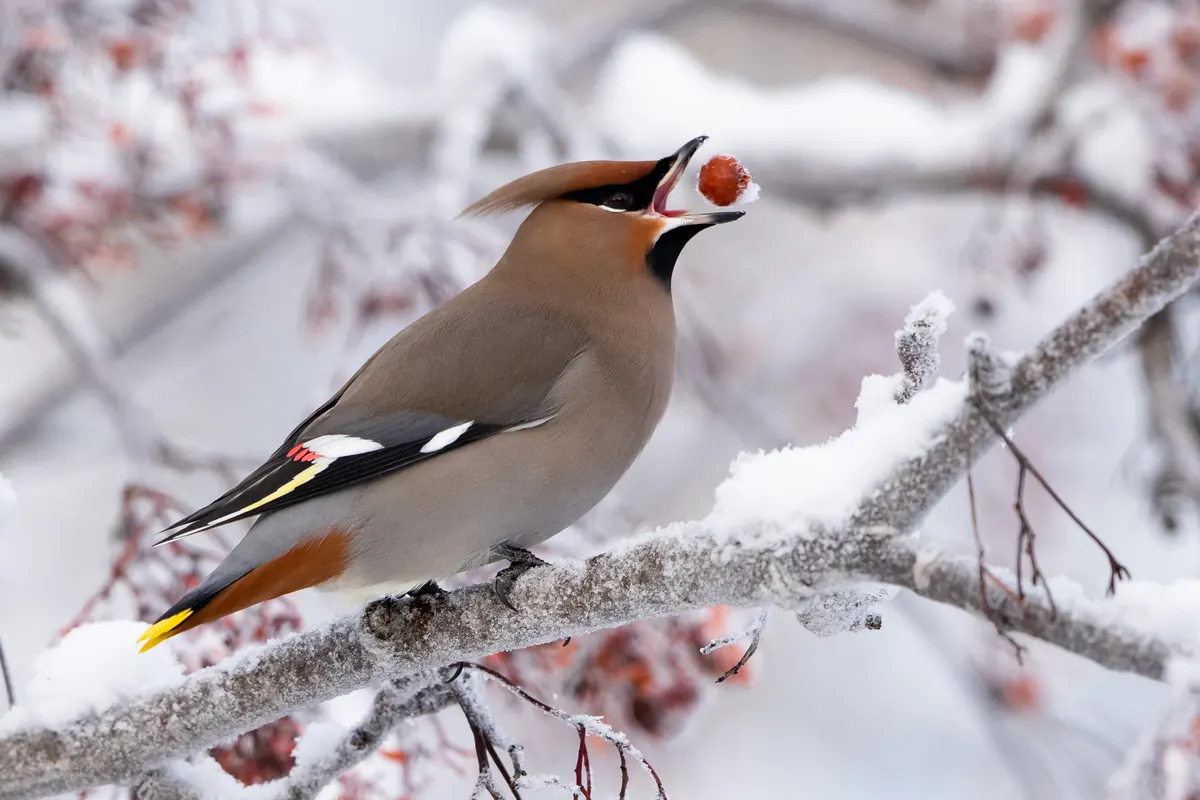
Bohemian waxwings stripping the mountain ash
Late October through winter; numbers vary from year to year · Towns and ranch yards with fruiting mountain ash, crabapple, hawthorn and juniper; riverside thickets with dogwood and snowberry
A Montana Outdoors portrait describes these birds as strictly winter visitors, arriving from northern Canada in late October and wandering as far south as California and Arizona wherever berries hold out. A flock can strip a tree in a few hours and move on, and the birds sometimes act tipsy on fermented fruit. Flathead Audubon’s tip for telling them from cedar waxwings: look under the tail. A Bohemian’s undertail is rusty red, a cedar’s white, and the Bohemian is chunkier and grayer, with yellow and white wing marks.
-
What the 2026–27 finch forecast says
Published September 25, 2026 · Mountain forests and feeders statewide
The Finch Research Network’s annual forecast, by Tyler Hoar, expects most of the action in the East this winter. Cone crops are poor across the interior West, which has already pushed Type 2 red crossbills eastward. A strong spruce crop from Alaska into British Columbia should hold white-winged crossbills in the far northwest, and a robust boreal mountain-ash crop should keep most pine grosbeaks north. Mixed birch seed crops should hold most redpolls in Canada, and the same mountain-ash crop is expected to keep most Bohemian waxwings north as well. For Montana, that points to a quiet finch winter, with local surprises always possible; eBird will show what turns up.
How do Montana’s birds and small animals survive the coldest weeks?
A Montana winter night can last 15 hours and fall more than 100 degrees below a bird’s body temperature of about 105 to 108 °F. A 2019 Montana Outdoors article, drawing on Montana Bird Advocacy’s scientists, explains how the birds that stay make it through, and much of it is visible if you know where to look.
-
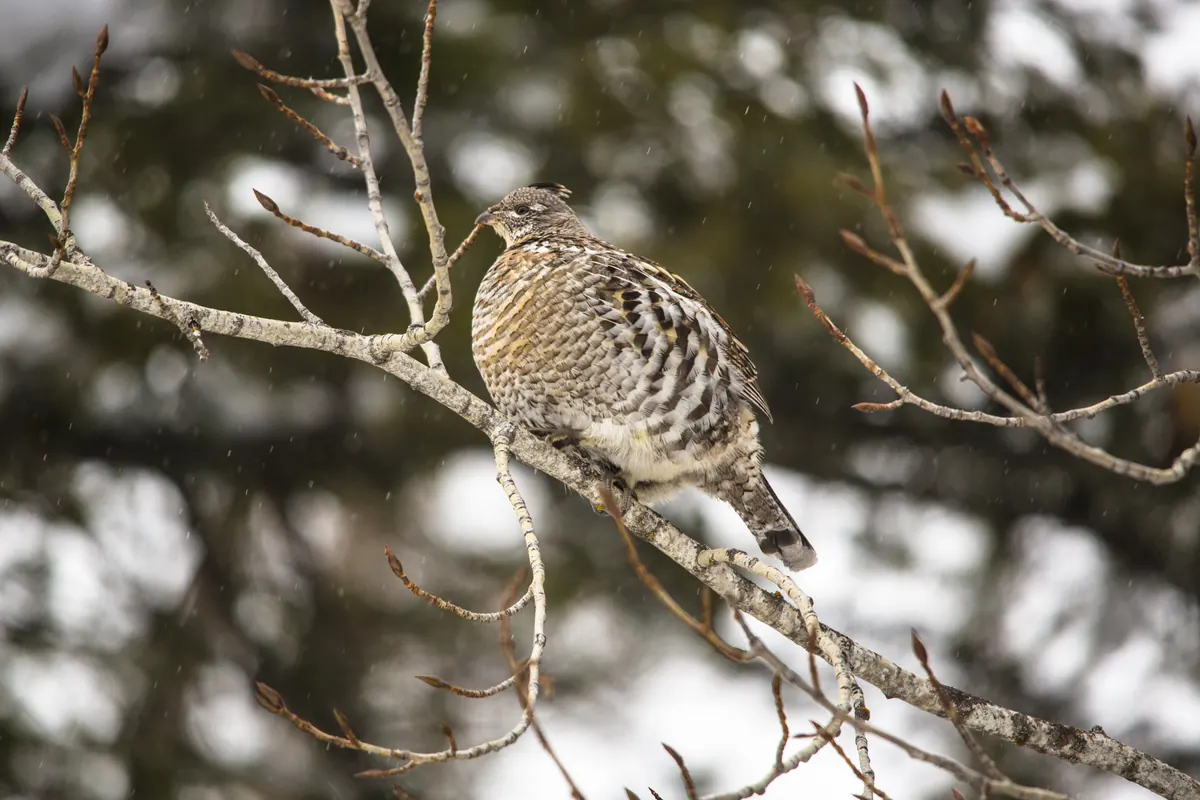
Grouse that sleep under the snow
Nights and the coldest days, whenever the snow is deep and soft · Aspen stands and forest edges in the mountains; white-tailed ptarmigan above timberline in Glacier and the high ranges
Ruffed grouse and white-tailed ptarmigan dive into powder to spend the night in a snow roost, which stays between about 20 and 32 °F even when the air above is far colder. In an aspen grove, look for a hole in the snow with wing marks on either side where a grouse burst out at dawn. Each fall, ruffed, spruce and dusky grouse also grow comb-like fringes on their toes that act as snowshoes and grip icy branches.
-
Chickadees, nuthatches and kinglets in shared shelters
Every winter night · Tree cavities, nest boxes and dense conifers
Chickadees, red-breasted nuthatches and woodpeckers sleep in tree holes. Pygmy nuthatches of ponderosa pine country pile into one cavity together, and golden-crowned kinglets, Montana’s smallest year-round birds, huddle shoulder to shoulder on inner conifer branches. Goldfinches grow about 500 extra feathers for winter on top of their summer 1,500.
-
Life in the space under the snow
Whenever snow covers the ground · Meadows, sagebrush and forest openings
Once snow piles up, voles, mice and shrews live in tunnels at ground level, sheltered from wind and cold. From above you see their world as small holes and air shafts and, after a thaw, winding grass-lined runways. The hawks and owls watching the fields are listening for them.
How can you identify Montana’s bare trees and shrubs in winter?
Without leaves, winter tree identification comes down to buds, bark and twigs. MSU Extension’s Trees and Shrubs in Montana works the broadleaf trees into a simple key, and the 1962 Winter Field Key to the Native Shrubs of Montana, kept online by the Montana Natural Heritage Program, was written to help range managers recognize the shrubs elk and deer browse in winter.
-
Cottonwoods and aspen: squeeze a bud
Any time; easiest on a mild day · River bottoms for cottonwoods; moist mountain slopes for aspen
The MSU key separates the poplars partly by the buds. Quaking aspen buds are not sticky, while plains cottonwood buds are sticky with resin. Black cottonwood and narrowleaf cottonwood, the trees of western and mountain rivers, have resin-sticky buds that are fragrant when crushed. Aspen bark is thin, gray-white to cream, often marked with dark, wart-like swellings; black cottonwood bark, smooth and greenish on young stems, becomes gray and deeply furrowed with age.
-
Willows, alders and birches along the creek
All winter · Stream banks at nearly every elevation
A willow bud wears a single scale like a little cap. Alder buds sit on short stalks, and most alders still carry last year’s small, dark cone-like catkins. Water birch has shiny brown bark crossed by short corky streaks, while paper birch has white bark and brown twigs.
-
Red-osier dogwood, the red stems in the snow
All winter · Streamsides and moist thickets
The dark red stems stand out from far away. Up close, the buds are paired (opposite) and have no scales, and the flower buds at the tips sit on short stalks and look, in the 1962 key’s words, like old Edison light bulbs. The same guide rates the plant highly valuable winter food for deer and elk, so look for browsed, clipped tips.
How cold is January in Montana, and what could a strong El Niño mean?
Meteorological winter is half over by mid-January; forecasters treat the December-to-February stretch as one season, Montana’s coldest. NOAA’s 1991–2020 normals show the range across Montana: an average January afternoon tops out at 36 °F in Billings but only about 23 °F in Glasgow, where nearly a dozen nights a month on average fall below zero. Valleys in the southwest, such as Butte and Bozeman, trap cold air on clear, calm nights. Glasgow, exposed to every Arctic outbreak that slides south from Canada, averages about 20 January days that stay below freezing all day.
| Station | Average high | Average low | Snowfall | Days with a high below 32 °F | Nights below 0 °F |
|---|---|---|---|---|---|
| Missoula | 31.6 | 18.0 | 9.9 | 13.6 | 2.6 |
| Helena | 32.4 | 13.5 | 6.6 | 12.8 | 6.3 |
| Great Falls | 35.3 | 15.0 | 9.2 | 10.1 | 6.3 |
| Bozeman (Gallatin Field) | 32.2 | 10.2 | not published | 13.2 | 7.7 |
| Butte | 32.1 | 7.9 | not published | 14.3 | 9.0 |
| Billings | 36.0 | 17.9 | 10.6 | 10.3 | 4.4 |
| Glasgow | 23.5 | 5.8 | 9.8 | 20.3 | 11.9 |
| Miles City | 30.1 | 8.9 | not published | 15.1 | 8.5 |
In the mountains, January is when the snowpack that feeds summer rivers builds. The Natural Resources Conservation Service says Montana’s mountain snowpack typically peaks between late March and early May, so a dry January matters. Last winter showed how much: in its February 1, 2026, outlook the agency reported that snow accumulation stalled in a warm, dry January and that 30 SNOTEL sites had their lowest snow depth on record.
The big unknown is the Pacific. In mid-September, NOAA’s seasonal team said chances exceed 90 percent that the developing El Niño turns very strong and persists all winter (its September 10 discussion). Federal scientists at the USGS climate science centers point out that strong El Niño winters lean warm across the northern tier, Montana included, and that warmer or drier weather can cut snow accumulation and bring earlier snow loss; the same USGS analysis says parts of Montana and northern Wyoming have more often seen near-normal to below-normal precipitation in those winters. That is a tendency, not a promise, and hard cold snaps still come. NOAA’s new winter outlook is due October 15 and is revised monthly on the Climate Prediction Center’s outlook page; for this week in your valley, open our local weather forecast.
How much daylight does Montana gain in January?
January returns close to an hour of daylight to every town in the table. The far north gains fastest: Kalispell and Glasgow each go from 8 hours 26 minutes on New Year’s Day to 9 hours 28 minutes by January 31, about 2.1 minutes a day. Bozeman and Billings, the southernmost cities listed, start with the most light (8 hours 46 and 8 hours 45 minutes) and gain 56 minutes. At first the extra light comes mostly in the evening; mornings brighten more slowly.
| City | Jan 1 | Jan 31 | Gained | Per day |
|---|---|---|---|---|
| Kalispell | 8 h 26 m | 9 h 28 m | 62 min | 2.1 min |
| Missoula | 8 h 37 m | 9 h 36 m | 59 min | 2.0 min |
| Helena | 8 h 39 m | 9 h 37 m | 58 min | 1.9 min |
| Great Falls | 8 h 32 m | 9 h 32 m | 60 min | 2.0 min |
| Bozeman | 8 h 46 m | 9 h 42 m | 56 min | 1.9 min |
| Billings | 8 h 45 m | 9 h 41 m | 56 min | 1.9 min |
| Glasgow | 8 h 26 m | 9 h 28 m | 62 min | 2.1 min |
| Miles City | 8 h 40 m | 9 h 38 m | 58 min | 1.9 min |
The daily gain grows week by week until the March equinox. Look up your own town’s sunrise, sunset and twilight on our daylight calculator.
What can you see in Montana’s night sky in January 2027?
The month opens with a meteor shower and a dazzling morning planet, and its full moon is the closest of 2027. All times are Mountain Standard Time.
-
The Quadrantid meteor shower
Night of Sunday, January 3, into Monday, January 4 · Look high in the northeast after midnight, from anywhere dark
The Quadrantid peak is brief, and forecasts differ: the American Meteor Society puts it near 8:30 p.m. on January 3, EarthSky near 10:47 p.m. The radiant rises higher as the night goes on, so Montana observers should do best in the small hours of Monday, until twilight washes them out. A thin old moon climbs up late and barely interferes. At best, expect a few dozen meteors an hour under dark skies.
-
Venus, the morning star, at its farthest from the sun
Sunday, January 3, and the mornings around it · Low in the southeast before sunrise
Venus reaches its greatest angle from the sun, 47 degrees west, on January 3, and outshines everything but the moon at dawn all month. Telescope users will see a half-lit disk.
-
Earth at perihelion
Saturday, January 2, at 7:33 p.m. · Everywhere
At perihelion the sun is only about 91.4 million miles off, its nearest all year. Montana is frigid anyway, because the January sun rides low and the nights run long.
-
The Wolf Moon, the closest full moon of 2027
Full at 5:17 a.m. on Friday, January 22 · Rising in the northeast at dusk on Thursday, January 21
The moon is full before dawn on the 22nd, about 222,229 miles away, a supermoon by every common definition. Watch it rise over snow on Thursday evening, January 21. On Saturday evening, January 23, Fred Espenak’s 2027 almanac places the moon, a day past full, close beside bright Jupiter.
-
Mercury low in the evening twilight
The last days of January into early February · Very low in the west-southwest, 30 to 45 minutes after sunset
Mercury appears low in the west after sunset in late January and is farthest from the sun on the evening of February 2 in Montana; binoculars and a flat horizon help. Saturn sits in the southwest after dark, sinking a little lower every week.
| Phase | Date | Time |
|---|---|---|
| New moon | Thursday, Jan 7 | 1:24 p.m. |
| First quarter | Friday, Jan 15 | 1:34 p.m. |
| Full moon, the Wolf Moon | Friday, Jan 22 | 5:17 a.m. |
| Last quarter | Friday, Jan 29 | 3:55 a.m. |
Moonless evenings for the Milky Way and faint aurora run from about January 3 through 12, either side of the new moon. Solar activity is easing from the 11-year peak but has not gone quiet, and northern Montana still catches the aurora on good nights; check the NOAA space weather center’s short-range aurora map. For nightly moonrise and moonset, open our moon phase calendar, and the satellite cloud map shows where the overcast is breaking up.
What can Montana families do outside in January 2027?
Most Montana groups post winter programs in December, so few January 2027 dates were public when this page was written. Dates below are fixed ones; otherwise we give the usual timing, so check each host’s site before you go. For the month before, read Montana in December, and for elsewhere, browse our nature guides by state.
-
First Day Hikes
Friday, January 1, 2027 · Montana state parks
Montana state parks lead short, family-friendly guided walks every New Year’s Day for the nationwide First Day Hikes. FWP’s most recent list had hikes at Cooney, Makoshika, Pictograph Cave, Spring Meadow Lake, Travelers’ Rest and several other parks, including a cluster around Flathead Lake. Check FWP’s page in late December for 2027.
-
The last days of the Christmas Bird Count
Counts may be held through Tuesday, January 5, 2027 · Count circles statewide
Audubon’s 127th Christmas Bird Count season closes January 5, 2027. Where a nearby Montana circle has picked an early-January count day, Audubon’s circle finder shows whether it still wants field teams or feeder watchers; beginners are paired with experienced birders.
-
Mission Valley Winter Raptor Survey
One full day in the middle of each month, November through March; dates set in October · The Mission Valley, starting from Charlo
The Owl Research Institute takes volunteers of all skill levels for its monthly driving survey, which involves no walking. You commit to at least two survey days and apply through the institute’s website.
-
Montana Natural History Center, Missoula
Tuesdays, 10 to 11 a.m.; Thursdays, 10 to 11:30 a.m. · 120 Hickory Street, Missoula, and sites around town
The miniNaturalist hour for preschoolers, free with admission or membership, meets Tuesday mornings, September through May, and the free nature journaling club gathers Thursday mornings at a different Missoula site each week. Check the center’s calendar for holiday breaks and weather.
-
Snowshoe walks and winter roads in the parks
Glacier: winter weekends. Yellowstone: all winter · Apgar in Glacier; Gardiner to Cooke City in Yellowstone
On Saturdays and Sundays in winter, Glacier’s rangers guide snowshoe outings, and the lower Going-to-the-Sun Road stays plowed to Lake McDonald Lodge when weather allows. In Yellowstone, the northern road between Gardiner and Cooke City is open to cars all year, the region’s best winter wildlife drive. Call ahead to confirm.
Safety notes for January in Montana
- Who is hunting in January. Pheasant, grouse, partridge and fall turkey seasons close January 1, except chukar in part of Carbon County, which runs to January 10. West of the Divide (Pacific Flyway), duck and goose seasons end January 15. East of it (Central Flyway), Zone 1 closes to ducks on January 7 and to geese on January 15; Zone 2 closes to ducks on January 19 and to geese on January 27. Late antlerless deer and elk hunts run into January in some districts, a few to February 15 (many on private land only). General wolf hunting continues until March 15, 2027, and winter mountain lion hunting until April 14 unless quotas close it sooner.
- Hunter orange. Under MCA 87-6-414, anyone hunting game animals, and any guide with them, must wear, as the outermost layer above the belt, blaze orange covering 400 square inches or more. Wolf hunters are exempt once the general deer and elk season is over. Skiers, hikers and dogs on public land are still wise to wear something bright.
- Traps on the trail. Bobcat trapping runs from December 1 to February 15 or March 1, depending on the FWP region, and marten trapping to February 15. Wolf trapping runs January 1 to February 15 across western Montana (FWP Regions 1, 2 and 3 and nearby country, the area set by a federal court order) and November 30 to March 15 elsewhere. Keep dogs leashed or close near creeks and trailheads.
- Ice. FWP says to keep off ice thinner than 4 inches; it takes 4 inches to walk or fish on and 7 for a snowmobile or ATV. Snow cover hides weak spots, and springs, inlets, outlets, docks and pressure ridges are dangerous. The agency’s firmest rule: never walk out on river ice.
- Cold and wind chill. Wind on a subzero day can freeze exposed skin in minutes. Check the National Weather Service’s wind chill chart, cover face and fingers, turn back early and carry a headlamp, since the days are still short.
- Avalanches and roads. January storms load mountain slopes. Before skiing, snowmobiling or snowshoeing in steep terrain, read the regional avalanche forecast (the Gallatin National Forest Avalanche Center covers southwest Montana), and travel with a beacon, probe, shovel and a partner trained to use them. Mountain passes and the road through Yellowstone’s northern range bring ice and the chance of elk or bison standing on the road.
When you start planning next season’s garden, our Montana frost dates show the typical last spring freeze for your town.
Sources
- Montana Field Guide: Bald Eagle
- Montana Outdoors (FWP), “The Eagles Have Landed,” November–December 2017
- U.S. Army Corps of Engineers: National Midwinter Bald Eagle Survey
- Montana Field Guide: Trumpeter Swan
- U.S. Fish and Wildlife Service: Red Rock Lakes National Wildlife Refuge, species
- Blackfoot Challenge: Trumpeter Swans
- Blackfoot Challenge: Return of the Swans
- Montana Field Guide: American Dipper
- Montana Natural History Center: A Diving Songbird
- Montana Outdoors (FWP), how birds stay warm through Montana winters, November–December 2019
- Montana Field Guide: Rough-legged Hawk
- Montana Public Radio: Birders count raptors in the Mission Valley, March 4, 2025
- Owl Research Institute: volunteering (winter raptor and short-eared owl surveys)
- Montana Field Guide: Snowy Owl
- Montana Natural History Center: Winter Owls
- Owl Research Institute: Great Horned Owls, the nesting season begins
- Montana Field Guide: Great Horned Owl
- NBC Montana: Owl Research Institute studies long-eared owls at the same location for 32 years
- Montana Outdoors (FWP): Bohemian Waxwing outdoor portrait
- Flathead Audubon Society: Bohemian and Cedar Waxwings
- Finch Research Network: Winter Finch Forecast 2026–2027
- eBird: Montana
- MSU Extension: Trees and Shrubs in Montana
- Morris, Schmautz and Stickney, Winter Field Key to the Native Shrubs of Montana (1962), Montana Natural Heritage Program
- NOAA NCEI: U.S. Climate Normals, 1991–2020
- NOAA NCEI: monthly normals 1991–2020 for the eight Montana airports in the January table (data service)
- USDA NRCS: Montana Water Supply Outlook Report, February 1, 2026
- NOAA Climate Prediction Center: ENSO diagnostic discussion, September 10, 2026
- NOAA Climate Prediction Center: seasonal outlooks
- USGS Climate Adaptation Science Centers: Regional super El Niño impacts, North Central U.S.
- U.S. Naval Observatory: Moon phases
- U.S. Naval Observatory: Earth’s seasons and apsides
- U.S. Naval Observatory: sun and moon rise and set for one day
- American Meteor Society: meteor shower calendar
- EarthSky: What is a supermoon?
- Fred Espenak, Sky Event Almanac 2027
- NOAA Space Weather Prediction Center: aurora 30-minute forecast
- Montana FWP: First Day Hikes
- Audubon: Join the Christmas Bird Count
- Montana Natural History Center: events
- Glacier National Park: winter visits
- Yellowstone National Park: visiting in winter
- Montana FWP: hunting seasons
- Montana FWP: 2026 deer, elk and antelope regulations
- Montana FWP: 2026 wolf and furbearer regulations
- Montana FWP: 2026 upland game bird regulations
- Montana FWP: 2026 waterfowl, sandhill crane, dove and snipe regulations
- Montana FWP: mountain lion regulations
- Montana Code Annotated 87-6-414, hunter orange
- Montana FWP: ice safety
- National Weather Service: wind chill chart
- Gallatin National Forest Avalanche Center
- Photos via Wikimedia Commons; licenses and photographers are credited under each picture
