What to look for in nature in Montana this December
December opens meteorological winter in Montana, and the state settles into its cold-season routines. Elk crowd onto foothill winter ranges as FWP shuts the gates behind them, Audubon volunteers spread across the state to tally birds, wolves trail the herds across Yellowstone’s northern range, and great horned owls begin calling in the river bottoms. Sunsets reach their earliest around December 10 and 11, from 4:12 p.m. in Glasgow to 4:47 p.m. in Missoula, and on the Hi-Line the solstice brings just 8 hours 20 minutes of daylight. Here is what to watch for this month, region by region, with the sources behind each date.
Other months in Montana: October, November.
Start here
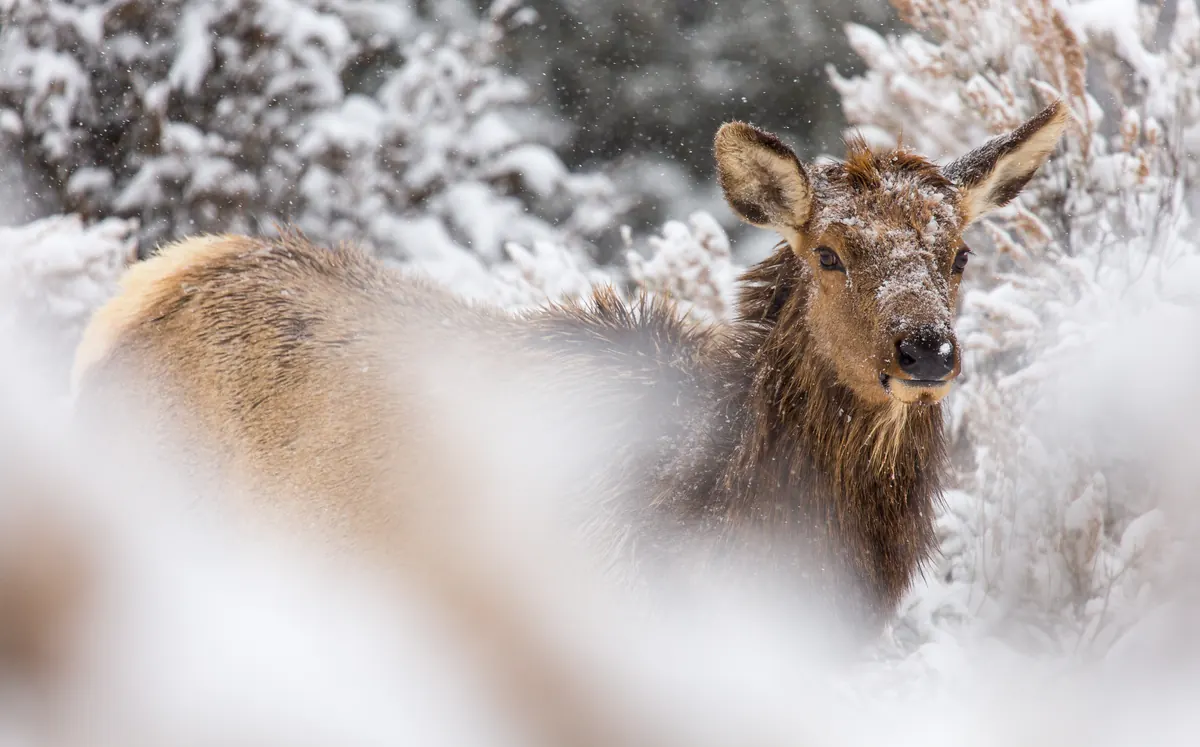
- Elk on the winter range. Most of FWP’s winter-range wildlife areas close to people from December 2 to May 15. The Sun River WMA near Augusta, where up to 95 percent of the Sun River elk herd winters, is one you can watch from the county road with binoculars.
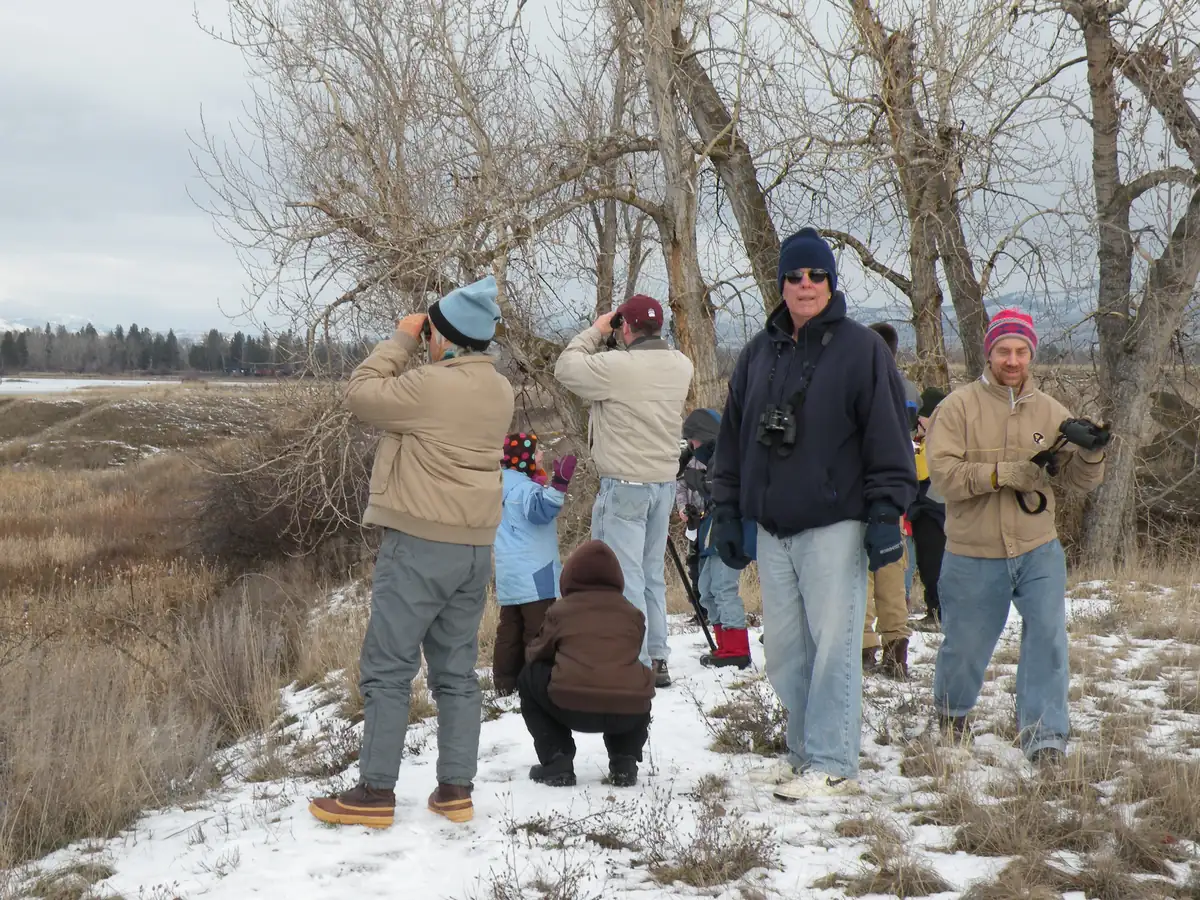
- Count birds for science. Audubon’s winter bird census fills the window from December 14 to January 5. Missoula’s count is Saturday, December 19, and Montana’s other Audubon chapters post their dates in late fall; beginners and feeder watchers are welcome.
- Geminids under a dark sky. Montana’s best shooting stars of the year fly on the night of December 13 into 14, and a slim moon is gone by mid-evening. Bundle up and watch after midnight.
December gives a Naturalist’s Field Journal some of its best winter pages. Write your Christmas Bird Count finds into “birds I have seen,” sketch a hare or weasel trail on the tracks-to-know plate, draw a Douglas-fir cone with its three-pointed bracts on the seeds-pods-and-cones page, and let the dusk-and-dawn page record the earliest sunset and the first night the owls call. Add elk or wolves to the mammal watch if you make it to a winter range.
Regions used below: Northwest and Glacier; Missoula and the western valleys; Southwest and Yellowstone country; Central Montana and the Rocky Mountain Front; Hi-Line and the northeast; Billings and the southeast.
Where do Montana’s elk go in winter, and why do some wildlife areas close in December?
Snow pushes elk, mule deer and bighorn sheep downhill in early winter, onto south-facing foothill slopes where wind keeps the grass bare. Much of that low ground is private ranchland, so Montana Fish, Wildlife and Parks owns or leases big blocks of it as wildlife management areas (WMAs) for one job: feeding and sheltering big game from December to spring. To give the animals that quiet, most of these winter-range WMAs lock their gates at 11:59 p.m. on December 1 and stay closed to all public entry until noon on May 15, according to FWP’s closure chart. Elk that run from a skier or a dog in January burn fat they cannot replace until green-up.
-
The Sun River elk herd
On the winter range from early winter; the WMA is closed from December 2 until noon May 15 · Sun River WMA, about 9 miles northwest of Augusta on the road to Gibson Reservoir
FWP set this 19,745-acre block of foothill grassland, timber and brushy draws aside in 1948 as winter range, and says up to 95 percent of the Sun River elk herd spends the winter there. Once the gate closes, glass the slopes from the county road that leads toward the WMA boundary, with binoculars or a spotting scope; elk often graze in the open in the last hour of daylight.
-
Other winter ranges you can see from a road
December to spring · Mount Haggin near Anaconda, Robb-Ledford in the southwest, Judith River near Utica, Beartooth near Holter Lake, Gallatin and Dome Mountain in the Gallatin and Paradise valleys
All of these appear on FWP’s chart with the same December 2 to May 14 closure. A few areas differ: Mount Silcox reopens April 1 and Missoula’s Mount Jumbo on May 1, while Beckman and Marias River close only from January into March. The closures apply to people on foot, skis and snowshoes, not just vehicles, and the chart also lists most winter-range areas as closed during the December muzzleloader hunt.
-
Yellowstone’s northern herd
All winter · Gardiner Basin and the park’s northern range, inside and just north of the park
The park’s 2026 resource handbook calls the northern range winter range for its largest elk herd, plus bison, deer and pronghorn. Counts of northern Yellowstone elk fell to 3,915 in early 2013, the lowest since culling ended in the 1960s, and have climbed since; the 2022 count was 6,673.
When is the Christmas Bird Count in Montana, and how can you join?
From December 14 through January 5 each winter, volunteers give one day to counting every bird inside a fixed circle 15 miles across. In Montana, the counts are organized by Audubon chapters, and roughly 30 circles run each winter, from Troy and Libby in the northwest to Miles City and Fort Peck in the east. Beginners are welcome; you join a team led by an experienced birder, or stay home and report your feeder birds if you live within a count circle. For 2026–27, counting may start on Monday, December 14, and must wrap up by Tuesday, January 5.
Each chapter sets its own dates, and most are posted in November or early December. As this page was written, Five Valleys Audubon had confirmed the 127th Missoula count for Saturday, December 19, 2026. For other circles, look up the nearest chapter (Flathead, Bitterroot, Five Valleys, Last Chance in Helena, Sacajawea in Bozeman, Upper Missouri in Great Falls, Yellowstone Valley in Billings) and email its compiler.
-
What Montana counters found last winter
Count season December 14, 2025, to January 5, 2026 · 31 circles statewide
The Montana summary for count number 126 lists 147 species on count days, a few above the recent average of 142, and 720 people in the field. Ninepipe, in the Mission Valley, had the most species (88), with Bigfork, Missoula and Kalispell each over 80; Bigfork still holds the state record of 98 from count 118. Canada geese (59,716) and mallards (38,432) were the most numerous birds, helped by open water on many circles.
-
A count that reached 100
December 19, 2025 · Libby, in the Kootenai valley
The Western News reported that the Libby count marked its 100th year in December 2025, and celebrated with a long-tailed duck in the Libby Dam spillway, a sea duck reported only a handful of times in a typical Montana year.
| Season | Counts run | Species statewide | Field participants | Most species on one count |
|---|---|---|---|---|
| 2022–23 (count 123) | 31 | 133 | 617 | Bigfork, 83 |
| 2023–24 (count 124) | 31 | 142 | 714 | Missoula, 86 |
| 2024–25 (count 125) | 31 | 153 | 671 | Bigfork, 88 |
| 2025–26 (count 126) | 31 | 147 | 720 | Ninepipe, 88 |
Which owls and winter finches can you find in Montana in December?
December birding in Montana is about a few hardy residents and a handful of northern visitors. Listen at dusk as well as looking at midday.
-
Great horned owls tuning up
Calling from December; nesting begins in February · River bottoms, farm shelterbelts, cottonwood groves and town parks statewide
The Heritage Program’s field guide says Montana’s great horned owls begin nesting in February, which puts them among the state’s earliest nesters. Pairs start calling weeks earlier; an Audubon account of a nesting pair describes them hooting back and forth at night from December on. On the 2025–26 bird count this was Montana’s most numerous owl, with 60 birds on 17 circles.
-
Short-eared owls over the marsh
Dawn and dusk in winter · Ninepipe and the Mission Valley grasslands, and other open marsh and stubble country
These moth-winged owls hunt voles low over open ground in the last half hour of daylight. Ninepipe alone counted 17 of the state’s 20 short-eared owls on the 2025–26 count. Watch from the road or a parking area; do not walk out into the grass after them.
-
Gray-crowned rosy-finches
Winter · Windswept ridges, plowed fields and feeders near the mountains; in some winters out on the prairie
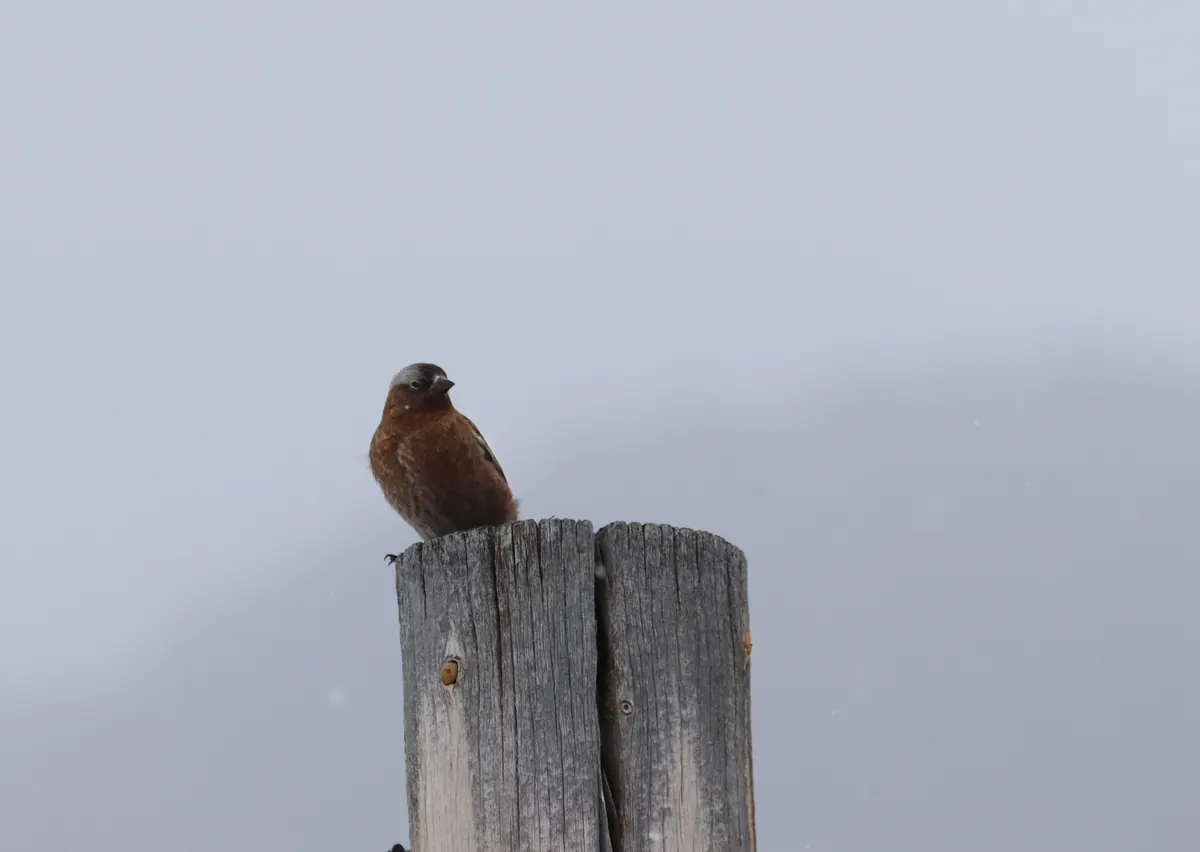
Rosy-finches nest among glaciers and snowfields above treeline and drop lower for the winter in noisy, wheeling flocks. The Heritage Program notes that some of Montana’s winter birds belong to a race that breeds in the Cascades, British Columbia and Alaska, that flocks have been tracked moving at least 40 kilometers across a mountain range near Bozeman and Livingston, and that the birds sometimes roost in old mine shafts.
Can you see wolves in Yellowstone in December?
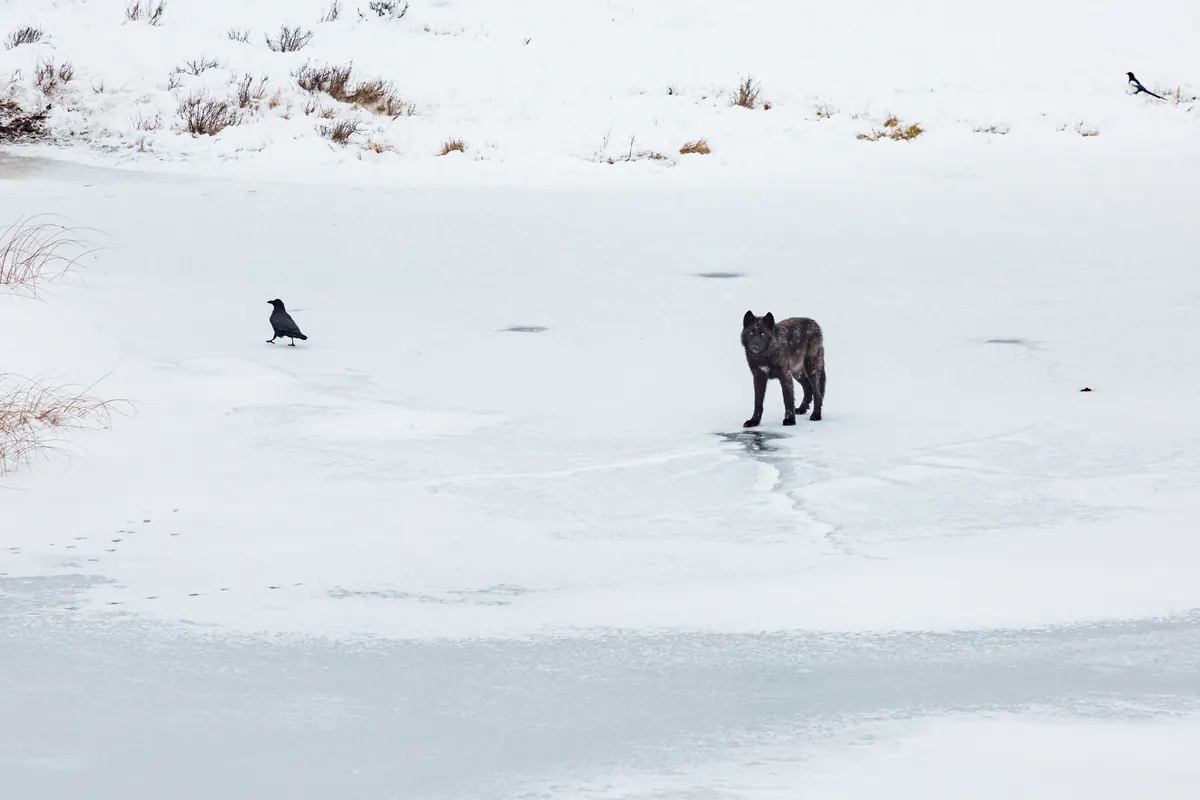
Yes, and winter is the classic time to try. Snow makes dark animals stand out, elk and bison crowd onto the low northern range, and the wolves follow them. The park’s 2026 handbook says elk make up 90 percent of a Yellowstone wolf’s winter diet. Montanans have the easiest access in the country: the road from Gardiner through Mammoth, the Blacktail Plateau and the Lamar Valley to Cooke City is the one route in the park that cars can use all winter.
-
Wolf watching in the Lamar and on the Blacktail
Dawn and dusk, all winter · Pullouts between Mammoth Hot Springs and the Northeast Entrance, especially the Lamar Valley and Slough Creek
The park counted at least 84 wolves in eight packs in 2025, near the low end of the 83 to 123 range it has seen since 2009. That means sightings take patience. Start at first light, look for clusters of parked cars with spotting scopes, and scan ridgelines for ravens and magpies circling a carcass. Park rules require you to stay at least 100 yards from wolves.
-
The rest of the park opens to snowcoaches
Oversnow season begins Tuesday, December 15, 2026 · From West Yellowstone, and from Mammoth toward Norris and Old Faithful
Most park roads close to cars in early November and reopen in mid-December for guided snowmobiles and snowcoaches only. The park lists December 15, 2026, as opening day for every groomed road, with closing dates from March 7 to March 15, 2027, depending on the stretch, all subject to weather. Old Faithful Snow Lodge and Mammoth Hot Springs Hotel are the two lodges open in winter.
-
Bison in the thermal basins
All winter · Along the Madison River, in the geyser basins, and on the Blacktail Plateau and around Gardiner
About 5,300 bison lived in the park in August 2025, the handbook says. In winter they gather where hot ground melts the snow and swing their heads side to side to clear grass.
The park says winter days typically range from zero to 20 °F, with subzero nights common, so dress for standing still beside a scope, not for hiking.
How do Montana animals survive the winter, and what tracks do they leave?
Montana animals get through the cold in three main ways: they sleep it out, they store food, or they change their coats and keep hunting. December is when you can see the evidence, and fresh snow turns every meadow into a record of who walked by in the night.
-
Snowshoe hares and ermine go white
Coats finish turning by early winter · Dense young conifer stands and willow thickets in the western mountains; riparian thickets farther east
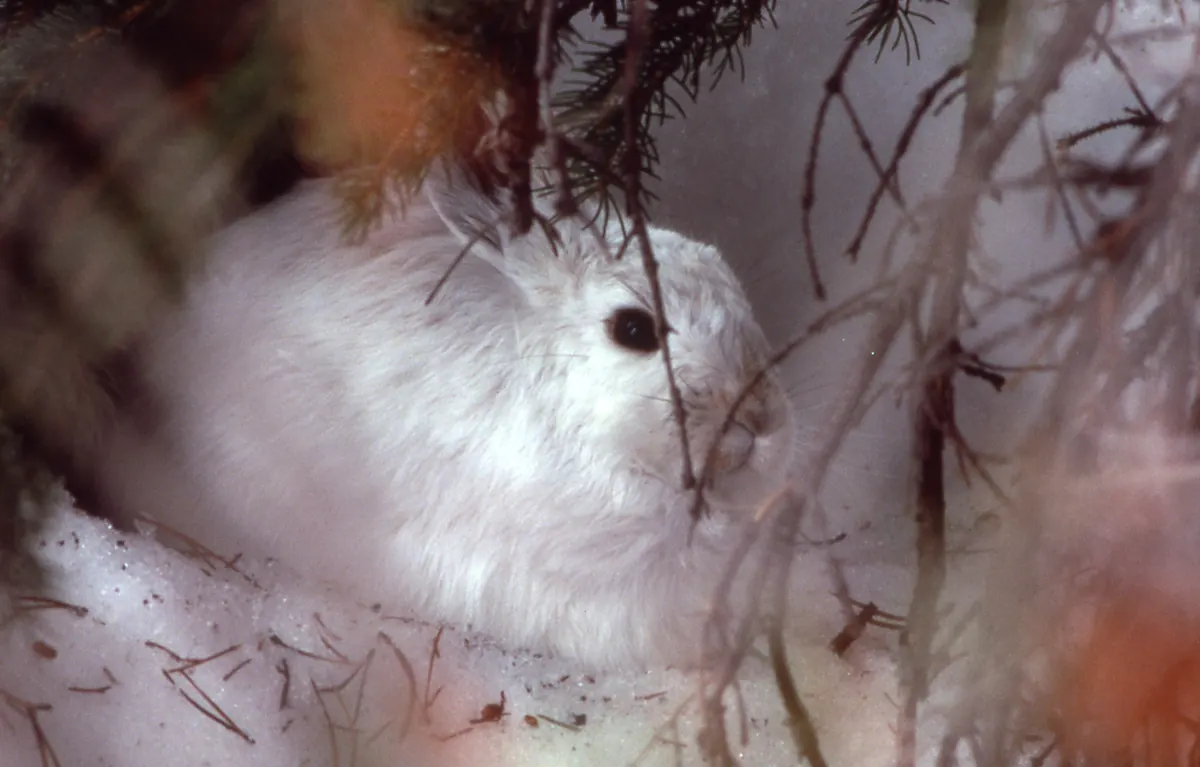
A snowshoe hare’s change from gray to white takes about 70 to 90 days and seems to be triggered partly by day length, according to Yellowstone’s handbook, which is why a white hare on brown ground stands out in a late-snow year. The Heritage Program flags that mismatch as a real risk as snow seasons shorten. The ermine, a small weasel, turns white too, keeping only a black tip on its tail, and hunts voles in the tunnels under the snow.
-
Pikas living off their hay
All winter, under the snow · Talus slopes and rockslides near mountain meadows, such as the high country of Glacier
Pikas do not hibernate. All summer they cut grasses and flowers and stack them in haypiles under the rocks, and in winter they stay active beneath the snowpack, eating from their stores.
-
Bats asleep in caves and old mines
Hibernating through the winter · Caves and old mine tunnels in the mountains
The Townsend’s big-eared bat lives in Montana all year, and the Heritage Program notes that its summer nursery colony at Lewis and Clark Caverns has used the cave for more than a century. In winter these bats hibernate alone, hanging in the open, in caves and mines that hold between about 30 and 46 °F. Waking one costs it fat it needs to last until spring, so never enter a mine or wild cave in winter.
-
Reading the tracks
The morning after a fresh snowfall · Field edges, creek crossings and forest trails
Look for the snowshoe hare’s four-print groups, with the large hind prints set in front of the smaller fore prints; a weasel’s paired prints in short bounds that dive into the snow and pop out again; a wolf or coyote line where the prints fall almost in a single straight trail; and the drag marks of wingtips where an owl struck at a vole.
Montana’s grizzlies are in their dens by now, and pregnant females will give birth there in midwinter, according to the Heritage Program.
How do you tell Montana’s evergreens apart, and where can you cut a Christmas tree?
With the cottonwoods bare and the larches dropped, the conifers are suddenly easy to pick out, and worth learning. MSU Extension’s guide, Trees and Shrubs in Montana, keys them out with a few simple checks, starting with whether the needles come in bundles or one at a time.
-
Pines: count the needles in a bundle
Any time · Foothills to timberline
Ponderosa pine, the state tree, carries long needles, usually 4 to 7 inches, in bundles of three or sometimes two, and old trees have cinnamon bark in jigsaw-puzzle plates. Lodgepole has short needles in twos and lopsided, prickly cones that may stay shut until a fire opens them. Whitebark and limber pine have five needles to a bundle and grow on high, rocky, windy ground; whitebark’s purplish cones crumble apart, while limber pine’s open and last for years on the ground. Whitebark pine is listed as threatened.
-
Single needles: fir, spruce or Douglas-fir
Any time · Mountain forests statewide
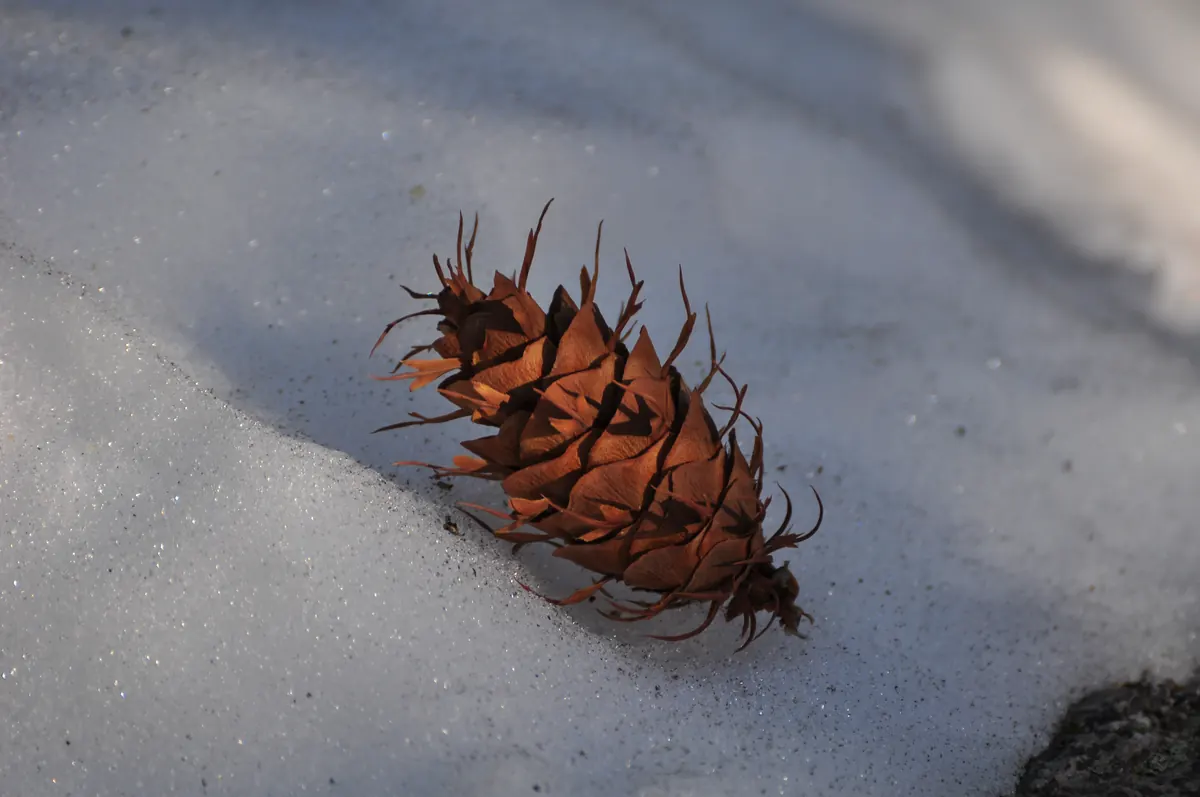
Roll a needle between your fingers. If it rolls easily because it is four-sided and stiff, it is a spruce; Engelmann spruce is the common one in the mountains. If it is flat, look at the cones. Subalpine fir holds its cones upright, and they drop their scales one at a time, so you find loose scales beneath the tree rather than whole cones. Douglas-fir cones hang down and have a three-pointed bract poking out from under every scale.
-
A permit for a Christmas tree
Permits go on sale in late fall; check your forest · Montana’s national forests: Beaverhead-Deerlodge, Bitterroot, Custer Gallatin, Flathead, Helena-Lewis and Clark, Kootenai and Lolo
Each forest sells inexpensive tree permits online through Recreation.gov and at ranger district offices. The Helena-Lewis and Clark permit limits trees to 12 feet and stumps to 6 inches, and both it and the Custer Gallatin rule out any pine with five needles in a bundle, which protects whitebark and limber pine. Carry chains and a shovel, since many forest roads are not plowed.
How cold and snowy is December in Montana, and what might El Niño do this winter?
Meteorological winter begins on December 1. It is the three-month block (December through February) that forecasters use because it holds the coldest weather of the year; the astronomical start, the solstice, comes on December 21. In Montana, December is less about huge snow totals in the valleys than about cold. NOAA’s 1991–2020 normals give December afternoon highs of only 27 to 36 °F at the larger airports, and the coldest valley stations average about seven to ten nights below zero.
| Station | Average high | Average low | Precipitation | Snowfall | Days with 1 in or more of snow on the ground | Nights below 0 °F |
|---|---|---|---|---|---|---|
| West Glacier | 29.2 | 19.9 | 3.21 | 31.4 | 28.4 | 2.3 |
| Kalispell airport | 31.0 | 17.2 | 1.50 | 15.9 | 17.2 | 2.4 |
| Missoula airport | 30.9 | 17.8 | 1.08 | 11.6 | 16.2 | 1.8 |
| Helena airport | 32.6 | 14.2 | 0.46 | 7.7 | 13.7 | 4.5 |
| Great Falls airport | 35.6 | 16.3 | 0.53 | 9.6 | 11.3 | 4.6 |
| Bozeman Gallatin Field | 31.7 | 9.7 | 0.44 | not published | not published | 7.1 |
| Butte airport | 30.7 | 7.2 | 0.48 | not published | not published | 9.6 |
| Billings airport | 36.1 | 19.2 | 0.57 | 9.8 | 12.4 | 3.1 |
| Glasgow airport | 27.2 | 9.7 | 0.43 | 8.3 | 17.1 | 8.3 |
| Miles City airport | 33.1 | 11.7 | 0.22 | not published | not published | 5.5 |
West of the Divide, Pacific storms keep December gray and snowy but milder at night; West Glacier averages more than 31 inches of snow. East of the mountains the air is drier and the cold deeper, and Butte, in its high basin, averages nearly ten subzero nights.
The other Montana specialty is the chinook, a warm, dry west wind that pours down the east face of the Rockies and can turn a frozen morning into a thaw within hours. NOAA’s state climate summary for Montana singles out January 14 and 15, 1972, when a chinook took Loma, northeast of Great Falls, from −54 °F to 49 °F, a 103-degree swing. The same summary notes that Montana has nothing to the north to block Arctic air, and that the state’s record low, −70 °F at Rogers Pass in 1954, is the coldest reading ever made in the lower 48. December can bring both extremes in the same week.
What about this winter? Federal forecasters at NOAA’s Climate Prediction Center now give El Niño odds above 90 percent of reaching very strong levels and lasting through the coming winter (their September 10 discussion). The center’s official three-month outlook for December through February is due on October 15 and had not been released when this page was written; once it is, you can find it on NOAA’s seasonal outlook page. In August, State Climatologist Kelsey Jencso told the Missoula Current that past El Niño winters have tended warm and dry in the western third of the state, and that the signal is fainter and less reliable on the plains. A Montana Climate Office analysis from 2018 found the warmth reaches the whole state and is strongest in the northeast, while precipitation changes are slight. For the days ahead where you are, our hour-by-hour local forecast is the place to check.
When is the earliest sunset in Montana, and how short is the shortest day?
On the solstice, Monday, December 21, Glasgow on the Hi-Line gets 8 hours 20 minutes of daylight and Kalispell 8 hours 21 minutes; Bozeman, the southernmost town in the table, gets 8 hours 41 minutes. The darkest evenings come sooner. Because solar noon drifts later through December (a result of Earth’s tilted, oval orbit), the earliest sunset arrives a week or two before the solstice and the latest sunrise a week or so after it. In this table the earliest sunsets fall on December 10 or 11: 4:12 p.m. in Glasgow and 4:16 in Miles City, both far east in their time zone, and 4:47 in Missoula, far to the west.
From December 1 to the solstice each town loses only 16 to 19 minutes more; by December 31 every one has regained 4 or 5. Mornings, though, keep getting darker until around the turn of the year, when the sun rises at about 8:20 to 8:30 a.m. in Missoula and Kalispell.
| City | Dec 1 | Dec 21 | Dec 31 | Earliest sunset |
|---|---|---|---|---|
| Kalispell | 8 h 38 m | 8 h 21 m | 8 h 25 m | 4:43 p.m., Dec 11 |
| Missoula | 8 h 48 m | 8 h 32 m | 8 h 36 m | 4:47 p.m., Dec 10 |
| Helena | 8 h 50 m | 8 h 34 m | 8 h 38 m | 4:40 p.m., Dec 10 |
| Great Falls | 8 h 44 m | 8 h 27 m | 8 h 31 m | 4:34 p.m., Dec 11 |
| Bozeman | 8 h 57 m | 8 h 41 m | 8 h 45 m | 4:40 p.m., Dec 10 |
| Billings | 8 h 56 m | 8 h 40 m | 8 h 44 m | 4:29 p.m., Dec 10 |
| Glasgow | 8 h 39 m | 8 h 20 m | 8 h 25 m | 4:12 p.m., Dec 11 |
| Miles City | 8 h 52 m | 8 h 35 m | 8 h 39 m | 4:16 p.m., Dec 10 |
For your own town, our sunrise and sunset calculator shows how many minutes come back each week once the solstice is past.
What can you see in Montana’s night sky in December 2026?
Montana’s December nights last more than 15 hours, and the cold, dry air between storms is often very clear. All times below are Mountain Standard Time.
-
The Geminids, the year’s best meteor shower
Night of Sunday, December 13, into Monday, December 14 · Anywhere dark; the radiant near Castor and Pollux is high by midnight
Far from city lights the Geminids may top 100 meteors an hour at the peak, and in 2026 only a slim crescent moon is up early, setting by about 9 or 10 p.m. The best hours are around 2 a.m. Lie back in a sleeping bag on a pad and face any part of the sky away from town lights. Expect fewer in the haze of a valley inversion; drive up out of it if you can.
-
The Cold Moon, the closest full moon of 2026
Full at 6:28 p.m. on Wednesday, December 23 · Rising in the northeast at sunset
The moon turns full early in the evening of December 23, not long after it rises at dusk, and its closest approach to Earth comes about seven hours later, making it 2026’s closest full moon. Christmas Eve’s moon will look almost as full, and on fresh snow its light is strong enough for a headlamp-free snowshoe.
-
The winter solstice
Monday, December 21, at 1:50 p.m. · Everywhere
At the solstice the sun stands lowest at noon, and its shadows are the longest of the year. Measure a fence post’s noon shadow on the 21st and again in March.
-
Venus at dawn, Saturn at dusk
All month · Venus low in the southeast before sunrise; Saturn in the south and southwest after dark
The brightest point in the dawn sky is Venus, which gains height every week; its greatest separation from the sun comes January 3, 2027. Look east at first light on the 4th and 5th to catch a crescent moon beside Venus, Spica between the two. Jupiter and orange Mars ride in Leo through the late night and dawn hours; by Christmas, Jupiter is up by mid-evening. Saturn is the lone evening planet and sets earlier each week.
| Phase | Date | Time |
|---|---|---|
| Last quarter | Monday, Nov 30 | 11:08 p.m. |
| New moon | Tuesday, Dec 8 | 5:52 p.m. |
| First quarter | Wednesday, Dec 16 | 10:42 p.m. |
| Full moon, the Cold Moon | Wednesday, Dec 23 | 6:28 p.m. |
| Last quarter | Wednesday, Dec 30 | 11:59 a.m. |
For moonrise times in your own town, see our moon calendar, and before a late night out check our cloud map for gaps in the overcast.
What can Montana families do outside in December 2026?
FWP’s statewide events calendar showed no December 2026 listings when this page was written, so the dates below come from each host’s own site; check again before you go, since winter weather cancels plenty of outings. For the month before, see November in Montana, and for other states browse our state nature guides.
-
Christmas Bird Count in Missoula
Saturday, December 19 · Missoula count circle; feeder watchers count from home
Five Valleys Audubon welcomes people of any experience on its 127th count, either in a field team or as a feeder watcher inside the circle. Contact the chapter to be placed on a team. Other chapters will post their 2026 dates through early December.
-
Montana Natural History Center, Missoula
Tuesdays (December 1, 8, 15, 22 and 29), 10 a.m.; Thursdays, 10 a.m.; Wednesday, December 2, 6 p.m.; Wednesday, December 30, 11:30 a.m. · 120 Hickory Street, Missoula, and sites around town
The free miniNaturalist hour for toddlers and preschoolers runs Tuesday mornings with songs, stories and play outdoors, and the center lends snow clothes. The weekly nature journaling club meets Thursday mornings at different spots in town, free. On December 2, a mini-wreath workshop at Western Cider starts with a lesson on telling local conifers apart by needle and cone ($20 for members, $25 for others; registration required). A drop-in journaling session on December 30 closes the year.
-
Candlelight tours of Lewis and Clark Caverns
Dates to be announced; tickets go on sale online on the Monday after Thanksgiving, November 30 · Lewis and Clark Caverns State Park, between Three Forks and Whitehall
The cave is closed to regular tours in winter, but FWP runs guided holiday tours lit partly by candle lanterns. In 2025 they ran December 19 to 21 and 26 to 28. The route is about two miles with hundreds of stairs, wet and slippery, so it suits older children; tickets are sold online only. The visitor center is closed Mondays and Tuesdays from December through April.
-
Snowshoeing in Glacier
Winter weekends; call to confirm December dates · Apgar and the unplowed Going-to-the-Sun Road above Lake McDonald
The park offers ranger-led snowshoe walks on winter weekends, and the Apgar Visitor Center keeps weekend hours. White-tailed deer are the large animal you are most likely to meet. Call the park before driving to confirm a walk is scheduled.
-
First Day Hikes on New Year’s Day
Friday, January 1, 2027 · State parks statewide
Every New Year’s Day, Montana state parks take part in America’s State Parks’ First Day Hikes. Recent hosts have included Cooney, First Peoples Buffalo Jump, Makoshika, Missouri Headwaters, Pictograph Cave and Travelers’ Rest, plus a parks-hopping expedition across the Flathead. FWP posts the new list in late December.
Safety notes for December in Montana
- Who is hunting in December. The general deer and elk rifle season closed on November 29, but several seasons continue. The heritage muzzleloader season for deer and elk runs December 12 to 20, and elk shoulder seasons in some districts run as late as February 15. Mountain lion winter season opens December 1 and runs to April 14. The general wolf season continues to March 15, 2027. Pheasant, grouse, partridge and fall turkey run through January 1. Ducks stay open to January 15 in the Pacific Flyway (scaup only to December 27); in the Central Flyway, Zone 1 closes January 7 and Zone 2 runs to January 19.
- Hunter orange. Under MCA 87-6-414, firearm hunters of game animals, including muzzleloader, shoulder-season and lion hunters, plus any guide with them, must wear fluorescent orange totaling at least 400 square inches on outer clothing above the waist, visible at all times. Wolf hunting after the general deer and elk season closes carries no orange rule. Hikers, skiers and their dogs are wise to wear bright orange too on public land through December.
- Traps. Bobcat and marten trapping open December 1 in much of the state, and wolf trapping opened November 30 outside the area under a federal court order (January 1 inside it). Keep dogs close on trails and near creeks.
- Ice. FWP’s rule of thumb: no foot traffic on clear ice thinner than 4 inches, and no snowmobile or ATV below 7. A snow blanket hides thin spots, and ice near inlets, springs, docks and pressure ridges stays weak. Go with a friend and tell someone where you are.
- Cold, wind and short days. With early-December sunsets between about 4:10 and 4:50 p.m., start winter walks early and carry a headlamp, extra layers and something hot to drink. A north wind behind an Arctic front can drop the wind chill far below zero in an hour.
- Avalanches and roads. Before skiing, snowshoeing or snowmobiling in steep terrain, check the regional avalanche advisory, such as the Gallatin National Forest Avalanche Center’s. On mountain passes and the Yellowstone road, expect ice and animals on the pavement, especially at dawn and dusk.
Frost and freeze dates for your corner of the state, useful when planning next spring, are on our Montana frost page.
Sources
- Montana FWP: WMA closure chart (seasonal closure dates by wildlife management area)
- Montana FWP: Sun River Wildlife Management Area (location, acreage, Sun River elk herd)
- Montana FWP: Mount Haggin Wildlife Management Area
- National Park Service: Yellowstone Resources and Issues Handbook 2026, wildlife chapter (wolves, bison, elk counts, snowshoe hares)
- National Park Service: wolf ecology, Yellowstone
- National Park Service: Yellowstone park roads and 2026–27 oversnow season dates
- National Park Service: explore Yellowstone in winter
- Five Valleys Audubon Society: Missoula Christmas Bird Count (December 19, 2026)
- Montana Summary, Christmas Bird Count 126 (2025–26), via Five Valleys Audubon
- Montana Summary, Christmas Bird Count 125 (2024–25), via Five Valleys Audubon
- Montana Summary, Christmas Bird Count 124 (2023–24), via Five Valleys Audubon
- Montana Summary, Christmas Bird Count 123 (2022–23), via Five Valleys Audubon
- Montana Audubon: Montana Christmas Bird Counts and chapter contacts
- Montana FWP: Christmas Bird Count news release (December 17, 2025)
- National Audubon Society: the 125th Christmas Bird Count in Montana
- The Western News: a new species makes for an unforgettable Christmas bird count (January 16, 2026)
- Montana Natural Heritage Program field guide: great horned owl
- National Audubon Society: why great horned owls start nesting in the winter
- Montana Natural Heritage Program field guide: gray-crowned rosy-finch
- Montana Natural Heritage Program field guide: snowshoe hare
- Montana Natural Heritage Program field guide: American ermine
- Montana Natural Heritage Program field guide: American pika
- Montana Natural Heritage Program field guide: Townsend’s big-eared bat
- Montana Natural Heritage Program field guide: grizzly bear
- MSU Extension: Trees and Shrubs in Montana (key to conifers)
- U.S. Fish and Wildlife Service: whitebark pine, threatened under the Endangered Species Act
- Recreation.gov: Helena-Lewis and Clark National Forest Christmas tree permit (height, stump and species rules)
- Recreation.gov: Custer Gallatin National Forest Christmas tree permit
- NOAA NCEI: U.S. monthly climate normals, 1991–2020 (December values for ten Montana stations)
- NOAA NCEI and NCICS: State Climate Summaries, Montana (chinooks, Loma 1972, Rogers Pass record low)
- NOAA Climate Prediction Center: ENSO diagnostic discussion, September 10, 2026
- NOAA Climate Prediction Center: seasonal (90-day) outlooks
- Missoula Current: Climate Connections, seasonal forecasts from the Montana Climate Office (August 8, 2026)
- Montana Climate Office: winter outlook and El Niño in Montana
- KRTV: what an El Niño year means for Montana’s winter
- U.S. Naval Observatory: sun and moon rise and set data
- U.S. Naval Observatory: phases of the moon
- U.S. Naval Observatory: Earth’s seasons, 2026 (December solstice)
- International Meteor Organization: 2026 meteor shower calendar
- EarthSky: what is a supermoon? (2026 full supermoons)
- EarthSky: Venus before sunrise, greatest western elongation
- Montana FWP events calendar
- Montana Natural History Center: events calendar (December 2026)
- Montana Natural History Center: make a mini wreath at Western Cider, December 2, 2026
- Montana FWP: Lewis and Clark Caverns State Park (candlelight tours, winter hours)
- NBC Montana: candlelight tours return to Lewis and Clark Caverns for the holidays (November 7, 2025)
- National Park Service: winter in Glacier National Park
- Montana FWP: First Day Hikes
- Project FeederWatch: project overview
- eBird: Montana region explorer
- Montana Natural Heritage Program: submit observations
- Montana FWP: 2026 hunting season dates
- Montana FWP: 2026 deer, elk and antelope regulations (heritage muzzleloader season, hunter orange)
- Montana FWP: 2026 wolf, furbearer and trapping regulations
- Montana FWP: 2026 upland game bird regulations
- Montana FWP: 2026 waterfowl, sandhill crane, dove and snipe regulations
- Montana Code Annotated 87-6-414: hunter orange while big game hunting
- Montana FWP: ice fishing safety (ice thickness guidance)
- Gallatin National Forest Avalanche Center
- Photos via Wikimedia Commons; licenses and photographers are credited under each picture
