What to look for in nature in Montana this May
May is the month Montana turns green and loud. Bitterroot, the state flower, opens on dry gravelly slopes while arrowleaf balsamroot turns the hillsides yellow, long-billed curlews sit on their ground nests in the short grass, and the last songbirds of spring pass through the river bottoms. Painted turtles climb out of ponds to dig their nests, western toads lay eggs in the shallows, and pronghorn fawns, elk calves and mountain goat kids are born. Rivers run high and cold with snowmelt as the park gates open one by one, though at many airports the last freeze has not yet come. Days grow by about 70 minutes over the month, the Flower Moon is full before dawn on the 20th, and Mercury shows itself low in the western dusk at the end of the month. Each section below takes one subject at a time, with a source for every date.
Other months in Montana: October, November, December, January, February, March, April.
Start here
- Find a bitterroot on a dry slope. Walk a sunny, gravelly slope with sagebrush on a warm afternoon and look low for pink flowers spread across bare ground. Photograph it and leave it where it grows.
- Listen for a curlew over the short grass. Stand at a prairie gate at first light and listen for a loud, rising call. If a long-billed bird circles and screams, there is a nest or chicks near, so back away.
- Slow down for turtles. On a warm late-May afternoon, drive slowly near ponds and watch road shoulders for painted turtles looking for nesting ground.
A Naturalist’s Field Journal is busy in May. Put the first curlew, warbler and loon on the birds-I-have-seen plate, use the daily log for the day the bitterroot opens, switch to the nest plate if you find a ground nest from a distance, note tracks and young on the mammal-watch plate, and revisit one slope weekly on the same-place-twice plate.
Regions used below: Northwest and Glacier; Missoula and the western valleys; Southwest and Yellowstone country; Central Montana and the Rocky Mountain Front; Hi-Line and the northeast; Billings and the southeast.
When do bitterroot and arrowleaf balsamroot bloom in Montana?
May is the month the dry, sunny slopes turn gold and pink. Two flowers do most of the work, and one of them is the state flower. The high country is a different story: Glacier National Park’s spring page says mid- and high-elevation trails generally have near-complete snow cover in spring, and some do not fully melt out until late July. For wildflowers in May, stay low, face south, and look at the sagebrush and grass slopes first.
-
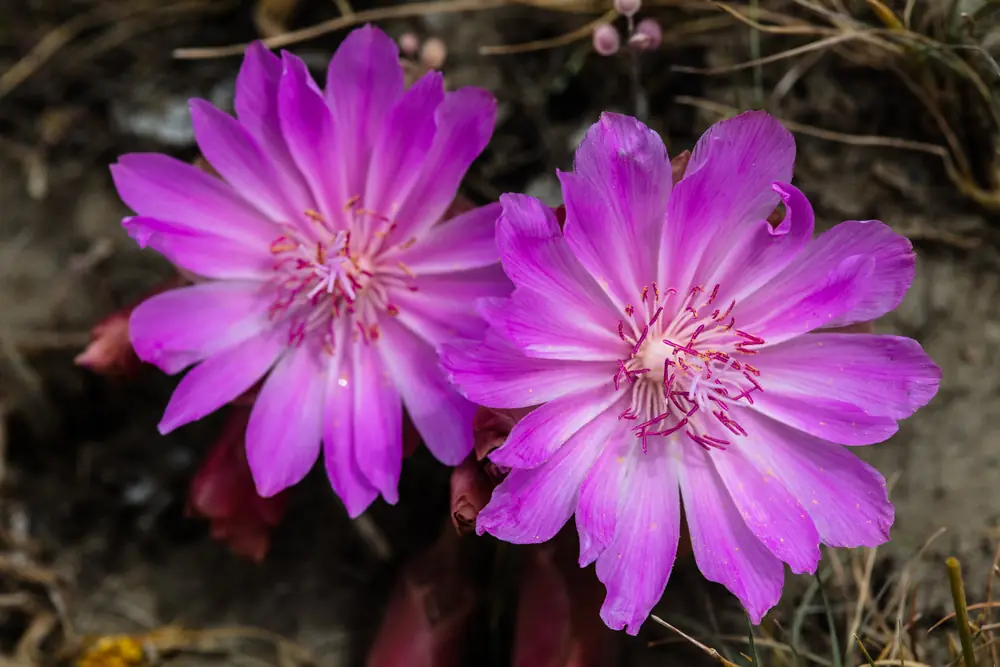
Bitterroot, the state flower
The Wikipedia entry says flowering runs from April through July, so May is inside the window; elevation and the spring’s warmth set the exact days · Dry, gravelly, south-facing slopes and sagebrush benches, mostly in the west
The U.S. Forest Service describes bitterroot as a plant of well-drained, gravelly soils in dry shrublands, often among sagebrush, with deep pink to rose flowers (sometimes white) up to 2 inches across that seem to sit scattered over bare gravel. The flowers come after the fleshy, fingerlike leaves have withered, so look for blooms, not foliage. The Montana Native Plant Society names it the state flower. The Forest Service adds that Meriwether Lewis first collected it for western science in July 1806 near Travelers’ Rest Creek, in what is now the Bitterroot Valley. Look, photograph, and leave it in place.
-
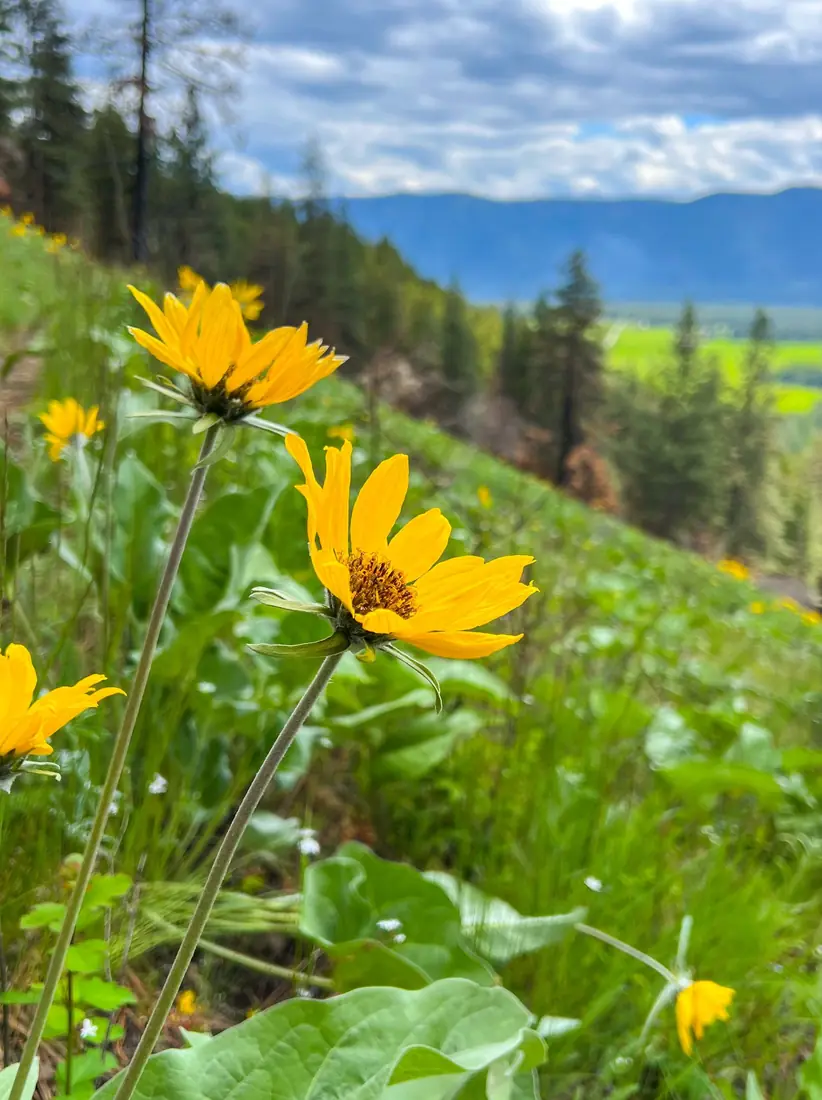
Arrowleaf balsamroot
May through July, according to the Forest Service · Open, dry slopes and mountain fields
Arrowleaf balsamroot is the big yellow sunflower relative that blankets hillsides in the drier valleys. The Forest Service lists its bloom as May through July, says it is most abundant in mountain fields and can grow in the understory of conifer forests, and notes that the flowers are good browse for wildlife. Many Native American groups ate nearly all parts of the plant, from baked or steamed roots to young flower stems and oil-rich seeds. The clumps are easy to spot from a car, but a slope that looks tough is surprisingly fragile; stay on trails and let the roots stay put.
-
Camas in the wet meadows
Bloom timing varies by valley and year; no organization had posted a 2027 bloom estimate · Seasonally moist meadows in western Montana
Common camas grows in meadows that are wet in spring and dry out by late spring, and the Forest Service says its range reaches east to western Montana. The bulbs were an important food for the Blackfoot, Cree and Nez Perce peoples, who steamed or pit-cooked them for one to three days. The Montana Native Plant Society’s chapters are a good place to ask where local meadows are in bloom.
A spring that runs late in the mountains runs early in the valleys, so the same flower can be at its best in two places three weeks apart. A weekly visit to one slope, logged with the date, is the best way to learn your own valley’s calendar.
Which grassland birds nest on Montana’s prairie in May: curlews, longspurs and Baird’s sparrows?
By May the prairie has gone from quiet to loud. The grouse leks of April are winding down, and the nesting season for the open-country birds is under way. Most of these are small, brown and best found by ear at first light, so the trick is to stand still at a gate or pullout and listen.
-
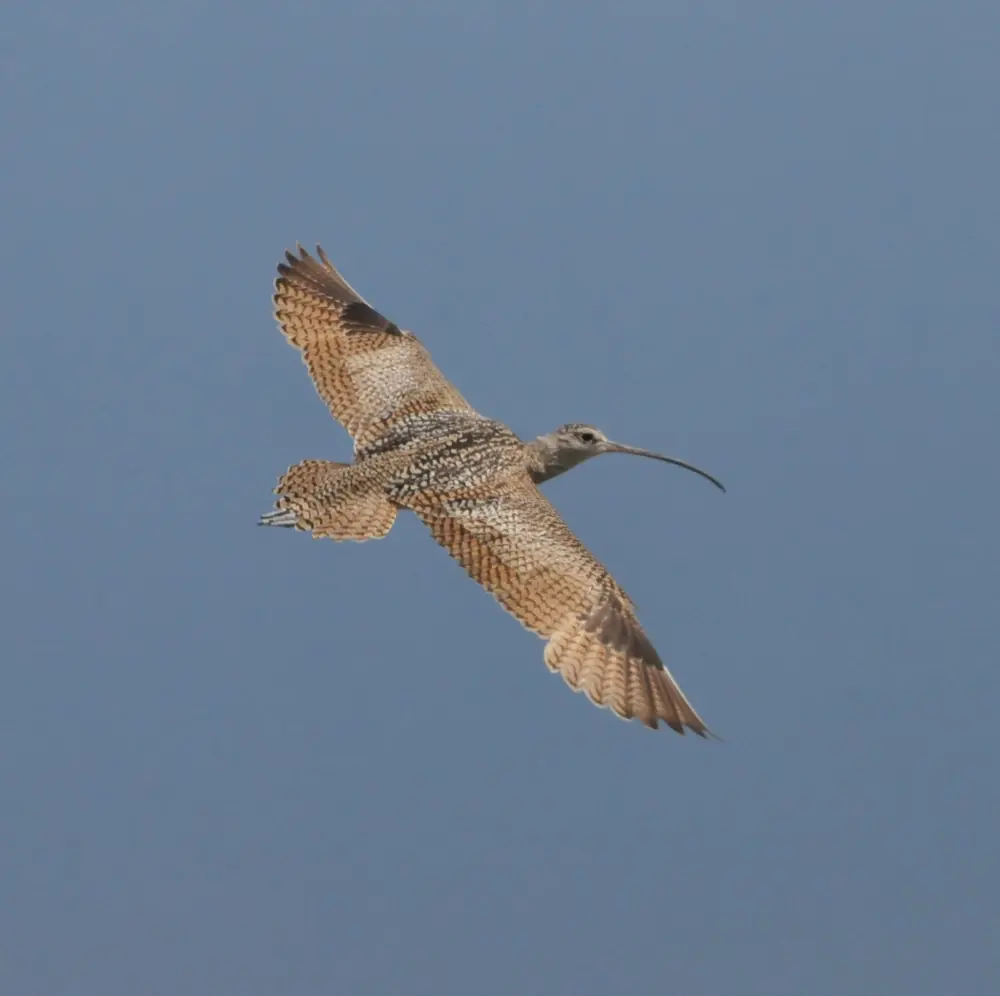
Long-billed curlew
Arrives late March to mid-April; adults on nests with eggs from mid-May to late May, according to the Montana Field Guide · Mixedgrass prairie and moist meadows, statewide
You will often hear the long-billed curlew before you see it, a big buff shorebird with a bill that curves down. The Montana Field Guide says migrants reach the state in late March to mid-April, pairs establish territories quickly, and the nest is a shallow ground scrape that usually holds four eggs. Both parents incubate for 28 to 31 days, and adults with young are seen from early June to early July. The species is described as common to uncommon in grasslands and as a Montana Species of Concern. The Field Guide says it prefers open, short grasslands and avoids trees, dense shrubs or tall, dense grass, and names grassland conversion to cropland and illegal shooting among the threats. A bird that wheels and screams overhead is telling you a nest or chicks are near, so back away.
-
Baird’s sparrows, longspurs and ibis at Bowdoin
Chestnut-collared longspurs arrive about mid-April and nest in early to mid-May; Baird’s sparrows arrive around mid-May and begin nesting in late May; white-faced ibis reach the refuge in late April · Bowdoin National Wildlife Refuge, near Malta on the Hi-Line
The refuge’s species page gives these windows. It also says Sprague’s pipits arrive in late April, and that staff fill Piping Plover Pond before May in hopes of drawing plovers, though it gives no arrival date for them. Treat each window as typical, since a cold spring pushes arrivals later. Bowdoin is a good place to practice picking out grassland songs, but it is also a nesting place, so keep to roads, pullouts and marked trails.
-
Ducks, shorebirds and broods at Benton Lake
Some duck broods may appear in late May; shorebirds arrive last of all, according to the refuge · Benton Lake National Wildlife Refuge, north of Great Falls
The refuge says pintails, mallards and tundra swans arrive from mid-March, and that by May the ducks in breeding plumage have paired and are looking for nest sites. Shorebirds are the last to appear, gathering on mudflats as water levels fall, and the refuge adds that by June all the birds that will nest there have arrived. If a bird flushes from the grass as you walk a shoreline, there may be a nest underfoot.
Visiting two or three refuges in a day is easy in May, but the prairie roads turn to slick clay after rain, and refuges ask visitors to stay on posted routes. When in doubt, check the refuge before driving out.
When does songbird migration peak in Montana, and where do you see it?
Montana does not get the warbler waves of the Great Lakes shores, but the same long-distance travelers pass through, mostly after mid-May, and many stay to nest. The best places are the green ribbons of cottonwood and willow along rivers, which act as stopover habitat for birds that have just crossed dry country.
-
Warblers and flycatchers in the river bottoms
In the Bozeman area, the Field Guide’s normal spring migration period for yellow warblers is May 15 to June 5 · Riparian woodlands such as Lee Metcalf National Wildlife Refuge in the Bitterroot Valley
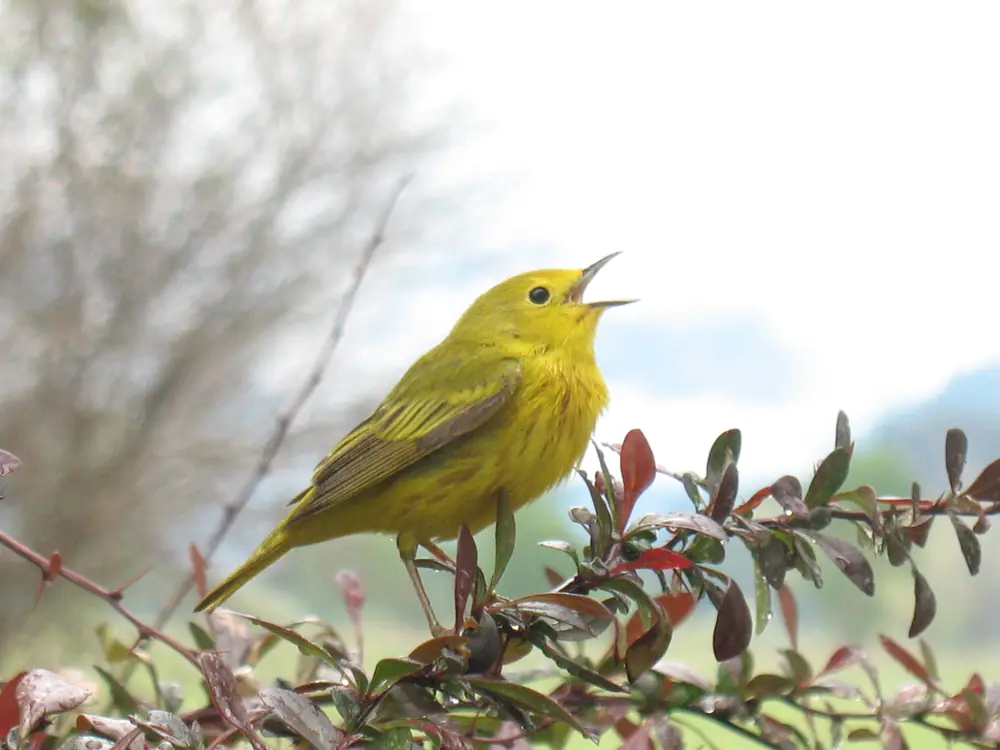
The yellow warbler is the easy one to learn: a bright yellow bird with a sweet, fast song. The Montana Field Guide gives May 15 to June 5 as the normal migration period near Bozeman, with nesting statewide from early June into July. Lee Metcalf National Wildlife Refuge, about 2 miles north of Stevensville and 25 miles south of Missoula, lists least flycatcher and yellow warbler among the neotropical songbirds that use its riverfront woodland for nesting, foraging and stopover, and names Lewis’s woodpecker as a riparian bird of interest in spring. Dawn is the time to go.
-
Eagles and ospreys on their nests
Bald eagles lay in March or April, so many pairs have young in the nest by May, according to the Field Guide’s timing · Large cottonwoods and nest platforms along rivers
The Montana Field Guide says bald eagle clutches, usually two eggs, are laid in March or April, incubation lasts about five weeks, and first flight comes at about 10 to 12.5 weeks. That puts eaglets in the nest in May for many pairs, though the page gives no Montana hatching dates. Lee Metcalf says its riverfront forest provides nesting and perching sites for large raptors including osprey and bald eagles. Use binoculars from a distance; a bird that keeps standing up on the nest is a bird you are too close to.
-
Hummingbirds are the rare ones
Montana records of broad-tailed hummingbirds are all from May, June or July · Mountain meadows in south-central and parts of western Montana
Hummingbirds are a small part of Montana’s bird list. The Field Guide describes the broad-tailed hummingbird as uncommon in montane parts of south-central and western Montana, with every state record from May to July and no recorded nest in Montana. Journey North takes hummingbird sightings year-round, so a feeder watcher who spots one can add it to the maps.
-
World Migratory Bird Day
The organizer’s page lists 2026 as May 9 and October 10; it shows no 2027 dates yet · Anywhere, with local birding walks
The international day highlights migration, and local Audubon chapters often hold walks around it. Because the organizer had not posted 2027 dates, check the World Migratory Bird Day site and your local chapter’s calendar before planning around it.
Every migrant you hear but cannot see still counts. A phone app that listens to birdsong is a handy aid, but writing down what you actually heard and when is the habit that pays off a year later.
What lives at Montana’s ponds and lakes in May: loons, painted turtles and western toads?
The water warms, the ice is long gone, and the shallows fill up with action. Three of the month’s stories happen at the edge of the water, and all three involve animals that are easy to harm by accident.
-
Common loons settling in
Spring migration begins in early to mid-March and tracks ice-out; egg laying starts one to four and a half weeks after arrival, per the Field Guide · Lakes larger than about 13 acres and below about 5,000 feet, in western Montana
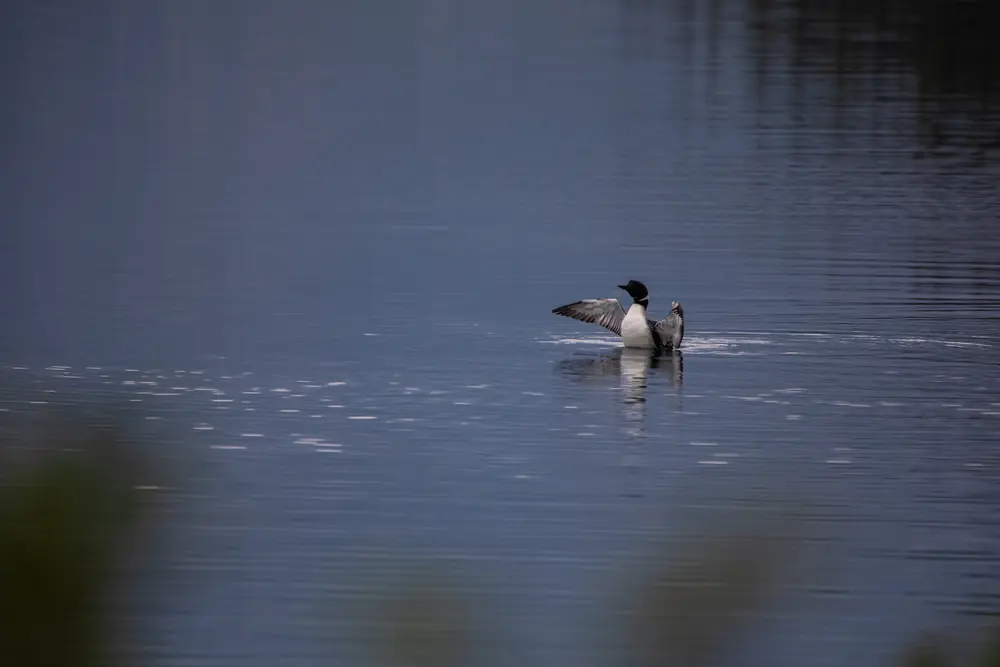
The Montana Field Guide calls the common loon an uncommon to rare breeding resident in parts of western Montana, with a stable population and low-level threats. Pairs prefer small islands for nesting and sheltered, shallow coves with small fish and insects for raising young. Clutches are usually two eggs, and incubation takes roughly 26 to 31 days. The chicks swim off the nest the day they hatch. The Field Guide names human disturbance as the main concern and recommends floating signs, steady water levels during the breeding season and no-wake zones. In practice that means keeping a boat well back from a loon on a nest, staying out of marked areas, and driving a boat slowly near shorelines.
-
Painted turtles come ashore to nest
Nesting runs from May to mid-July, mostly June and early July; most road deaths in a Mission Valley study were from late May to mid-July · Ponds, marshes and slow streams at lower elevations, with nest sites in sandy or loamy soil up to about 600 meters from water
The Field Guide calls the painted turtle the most abundant turtle in Montana, active from late March or early April and basking on logs and banks. Most nests are started in the afternoon, and digging and egg-laying can take up to four hours. That is why a turtle on a road shoulder in late May is usually a female looking for soft ground, not a lost one. The Field Guide lists road mortality among the main threats and says that in the 1995 Mission Valley study, most of the turtles found dead on roads were killed from late May to mid-July. Slow down near ponds, and if you stop to help one across, carry it the way it was facing.
-
Western toads and their tadpoles
Eggs from early May to late June; tadpoles from late May to early September; toadlets from early June to late August · Shallow, slow or still water in the mountains of western Montana and parts of central Montana
The western toad (also called the boreal toad) breeds mostly from May to July, according to the Field Guide, with eggs hatching in about five days, tadpoles gathering in dense groups in warm shallows and metamorphosis taking roughly 40 to 75 days. The species is a Montana Species of Concern with a state rank of S2, and populations are below historic levels after declines linked to chytrid fungus. Black tadpole clouds in a warm pond edge are worth a look, but keep your hands, boots and dogs out of the shallows.
Water draws wildlife, and it draws people. Give lakeshore nests, road-crossing turtles and breeding ponds plenty of space, and tell friends who boat or fish the same.
When are elk calves, pronghorn fawns, bighorn lambs and mountain goat kids born in Montana?
May is the start of birthing season for Montana’s big mammals, and the Montana Field Guide dates it species by species. The rule for people is simple: if you find a young animal alone, it is almost never abandoned. The mother is nearby, waiting for you to leave.
-
Pronghorn fawns
Mid- to late May, according to the Field Guide · Open sagebrush and grassland in central and eastern Montana
The Field Guide says pronghorn are widespread across eastern and central Montana and that births occur in mid- to late May. Litters are typically two grayish-brown fawns. Drive slowly on gravel roads and fence lines, where does and fawns cross, and do not walk toward a fawn that is bedded in the grass.
-
Elk calves
Mid-May to mid-June per the Montana Field Guide; May to late June per the National Park Service · Mountain meadows, burns and forest openings; Mammoth Hot Springs at the north edge of Yellowstone
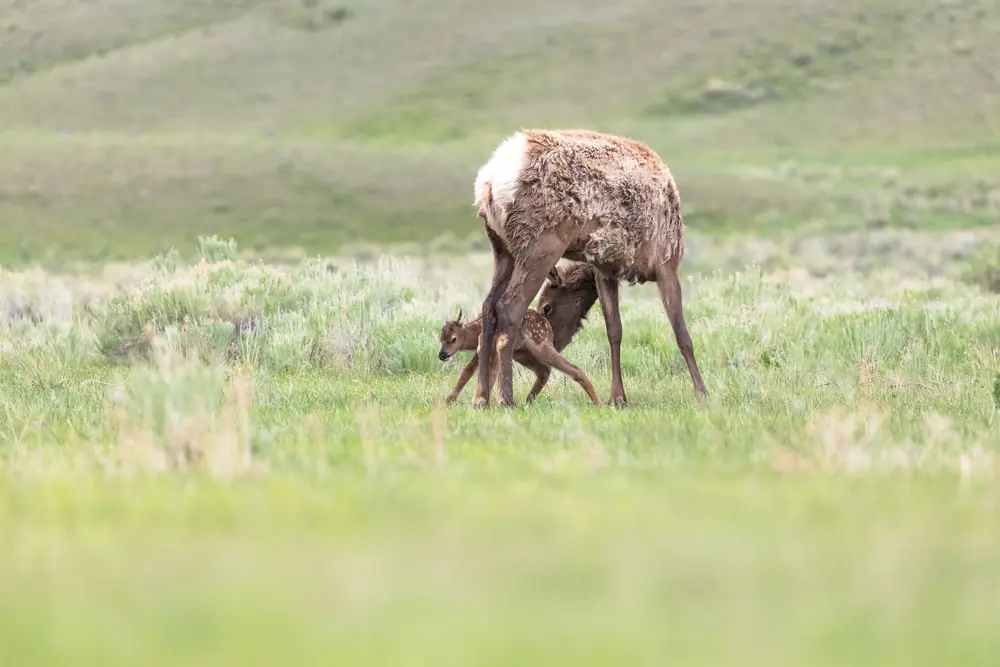
The Park Service says single elk calves arrive from May to late June and weigh about 30 pounds at birth. Its safety page warns that from May to early July cow elk are especially protective of calves and may charge or kick even when you are more than 25 yards away, and that near Mammoth Hot Springs they often hide calves near cars and buildings, so be careful when leaving buildings and rounding blind corners.
-
Bighorn lambs
Late April to late June, sometimes early July, according to the Field Guide · Cliffs, mountain slopes and rolling foothills
Ewes usually have a single lamb. The Field Guide says spring and summer use depends on high-quality green forage, and that sheep prefer semi-open to open vegetation and often use south-facing slopes. Rocky cliffs nearby are important year-round.
-
Mountain goat kids
Late May to early June, according to the Field Guide · South- and west-facing cliffs in spring
The Field Guide says births follow a 182-day pregnancy, that females usually have one kid, and that newborns are highly precocious. The state rank is S4, but the page says native populations are declining, with loss of alpine habitat from warming temperatures as the main threat. Goats are best seen from a distance on cliffs; mothers with kids will not welcome closer visits.
Montana Fish, Wildlife & Parks says its Wildlife Rehabilitation Center in Helena does not accept deer, elk or moose, and a 2018 FWP bulletin adds that these animals often die from stress and disease in captivity and that fawns are seldom orphaned. The agency’s message to the public was to keep a distance and watch from afar. The Park Service’s story of a Yellowstone bison calf that tourists moved, and which could not be reunited with its herd, is the reason to take that advice.
What do May runoff and park openings mean for Montana rivers, roads and trails?
May is when the mountains start to let go of their snow. Rivers run high, cold and brown, and the park gates swing open one by one. The Lee Metcalf refuge says May and June together bring about 25 percent of the year’s precipitation to its part of the Bitterroot Valley and about 55 percent of the Bitterroot River’s annual discharge. The Western Regional Climate Center adds that nearly half of the year’s long-term average precipitation falls from May through July. Plan around high water.
-
Fishing seasons
The Park Service states Yellowstone’s opener as the Saturday of Memorial Day weekend each year (confirm the 2027 date); the Western District river opener was the third Saturday in May in 2026 · Yellowstone National Park and Montana’s Western District rivers
The Park Service says most Yellowstone waters open on the Saturday of Memorial Day weekend and close after October 31, with parts of the Firehole, Gibbon and Madison rivers open from May 1 and parts of the Gardner and Madison open year-round. The page states that as an annual rule and gives no 2027 date, so confirm the opening day with the park before you go. The park requires its own fishing permit for anglers 16 and older, barbless or pinched hooks and lead-free lures, and requires that cutthroat trout, Arctic grayling and mountain whitefish be released unharmed. Montana Fish, Wildlife & Parks’ 2026 regulations show Western District rivers and streams opened on the third Saturday in May and stayed open through November 30, while Central and Eastern district waters stayed open all year. The 2027 regulations were not out yet, so check them.
-
Yellowstone’s roads
The Park Service projected the 2026 openings as April 17, May 1, May 8 and May 22; no 2027 dates were posted · Yellowstone National Park, including the Montana gateways at Gardiner and Cooke City
For 2026 the Park Service projected that East Entrance to Fishing Bridge and Canyon Village to Bridge Bay would open May 1, the South Entrance and the Craig Pass and Tower-Roosevelt segments May 8, and Dunraven Pass, Beartooth Highway and the Chief Joseph Scenic Byway May 22, noting that dates change with weather and roads typically open at 8 a.m. Only the road linking the north and northeast gates, from Gardiner to Cooke City, stays open all year. For 2027, the page lists no wheeled-vehicle dates, so use the 2026 schedule only as a rough guide and check the park roads page, which says Beartooth Highway typically opens on the Friday of Memorial Day weekend.
-
Glacier’s roads and trails
Most roads open by mid-to-late May; concessions in late May to early June · Glacier National Park
The Park Service says plowing on Going-to-the-Sun Road starts in early April and can take two and a half to three months, so the whole road does not open in May. Apgar and St. Mary campgrounds are open year-round, with water at Apgar by early May. Services outside the park may be closed in early May. Vehicle reservations were not required in 2026; look at the park’s site for 2027. Backcountry camping needs a permit, and many trails are still under snow.
-
Lewis and Clark Caverns
Cave tours run May through September; from May 1 to Memorial Day tickets can be booked in advance or bought the same day · Lewis and Clark Caverns State Park, between Butte and Bozeman
The state parks page lists the 2026 pattern: tours May through September, with advance reservations required from Memorial Day to Labor Day. White-nose syndrome, a fungal disease lethal to bats but harmless to people, is the reason visitors are asked not to wear clothes or shoes used in another cave or mine in the past five years. The page gives no 2027 hours, so check before you plan.
Treat rivers like weather in May: stay back from undercut banks, never wade a swift river alone, and turn around at a flooded road. Our weather guide explains how to read a river forecast from the forecast office.
What is May weather like in Montana, and what hazards come with it?
May is the wettest part of the year for much of Montana, and it can feel like three seasons in a week. NOAA’s 1991–2020 normals put average highs between 61 °F at Butte and 68 °F at Miles City, and average lows from 34 °F at Butte to nearly 44 °F at Billings. Precipitation ranges from 1.77 inches at Missoula to 2.73 inches at Miles City, and Great Falls still averages 1.90 inches of snow. Butte averages 12 nights below freezing in May, Bozeman about seven and Great Falls six, while Billings and Miles City average fewer than three.
The Western Regional Climate Center describes the hazards in its Montana climate narrative. Rain on a thaw can mean serious flooding, and locally heavy storms can bring flash floods. Tornadoes are rare, about two a year, almost all east of the Divide, and hail is mostly a July and August problem. Snowstorms can still hit the high southwestern mountains as late as the start of May. Late freezes are the other risk for gardens; see the table below.
The Climate Prediction Center posts its official seasonal outlooks each month, around the middle, on its 90-day outlook page; the latest map is there. Our weather guide explains how to read forecasts.
| Station | Average high | Average low | Precipitation | Snowfall | Nights below 32 °F |
|---|---|---|---|---|---|
| Missoula | 66.2 | 39.8 | 1.77 | 0.30 | 4.4 |
| Helena | 66.4 | 41.5 | 1.95 | 0.10 | 3.4 |
| Great Falls | 64.6 | 38.4 | 2.43 | 1.90 | 6.0 |
| Bozeman (Gallatin Field) | 65.0 | 37.6 | 2.12 | not published | 7.4 |
| Butte | 61.0 | 34.3 | 2.02 | not published | 12.0 |
| Billings | 66.9 | 43.8 | 2.36 | 0.90 | 1.7 |
| Glasgow | 67.7 | 43.3 | 2.22 | 0.90 | 3.7 |
| Miles City | 68.1 | 42.9 | 2.73 | not published | 2.7 |
When a thunderstorm builds over the mountains, get off ridges and open prairie early, and watch rivers that drain steep, snowy country.
When is the last spring freeze in Montana?
May is when Montana gardeners start to relax, but not everywhere. Across the main stations below, the middle date for the last freeze runs from May 4 at Billings to May 31 at Kalispell, and the late end, nine years in ten, stretches into mid-June at Bozeman and past the solstice at Kalispell. A gardener at 4,000 feet is not on the airport’s schedule, so treat these dates as a guide, not a promise.
| Station | One year in ten | Median | Nine years in ten |
|---|---|---|---|
| Kalispell Glacier Airport (Flathead valley) | May 13 | May 31 | Jun 22 |
| Missoula International Airport | May 3 | May 16 | Jun 1 |
| Helena Regional Airport | Apr 29 | May 9 | May 25 |
| Great Falls International Airport | May 7 | May 19 | Jun 2 |
| Bozeman Gallatin Field | May 11 | May 26 | Jun 12 |
| Billings Logan International Airport | Apr 20 | May 4 | May 18 |
| Glasgow International Airport (Hi-Line) | Apr 24 | May 6 | May 18 |
| Miles City F Wiley Field (southeast) | Apr 26 | May 8 | May 21 |
Look up your own town in the Montana frost-date guide. A cold frame, a row cover and a thermometer are worth more than the table on a clear, still night in May.
How much daylight does Montana gain in May?
The gain in daylight slows in May compared with April, but it is still steady. Across the state, the days lengthen by between 67 and 75 minutes from May 1 to May 31, or 2.2 to 2.5 minutes a day, and Kalispell and Glasgow top 15 hours 47 minutes by the last day. The northern towns gain a little more because they sit farther north. On the last day of May the Sun is above the horizon for more than 15 hours in every city listed, and the longest day is three weeks off.
| City | May 1 | May 31 | Gained | Per day |
|---|---|---|---|---|
| Kalispell | 14 h 32 m | 15 h 47 m | 75 min | 2.5 min |
| Missoula | 14 h 25 m | 15 h 36 m | 71 min | 2.4 min |
| Helena | 14 h 24 m | 15 h 34 m | 70 min | 2.3 min |
| Great Falls | 14 h 29 m | 15 h 41 m | 72 min | 2.4 min |
| Bozeman | 14 h 19 m | 15 h 26 m | 67 min | 2.2 min |
| Billings | 14 h 19 m | 15 h 28 m | 69 min | 2.3 min |
| Glasgow | 14 h 32 m | 15 h 47 m | 75 min | 2.5 min |
| Miles City | 14 h 23 m | 15 h 32 m | 69 min | 2.3 min |
Montana’s long days come from its latitude. The daylight guide shows how day length changes for any town through the year.
What can you see in Montana’s night sky in May 2027?
Times are Mountain daylight time. Moonless evenings arrive around May 6, when the Moon is new, and the sky brightens again toward the 20th, so plan faint-sky outings for the first half of the month.
-
Eta Aquariid meteors
Best mornings are May 5, 6 and 7 before dawn; the new moon is May 6 · Look toward the eastern sky before dawn, from a dark site
SeaSky rates this an above-average year for the shower, quoting a peak of up to 60 meteors an hour, about half that for the Northern Hemisphere, and the nearly absent Moon leaves the sky dark. Aquarius, the shower’s radiant, climbs above the eastern skyline only shortly before dawn lightens the sky. The window is short and the counts modest here, far fewer than the best rates seen farther south. Dress warmly, give your eyes 20 minutes, and look generally upward rather than at one spot.
-
The Flower Moon, a seasonal Blue Moon
Full on Thursday, May 20, at 4:59 a.m. MDT; look for it rising on the evening of Wednesday, May 19 · Low in the east at dusk
The Moon is full before dawn, so the Moon you see rising at dusk on the evening of May 19 looks full, and so does the one on the 20th. SeaSky counts four full moons in this stretch of spring (March 22, April 20, then this one, then June 19) and, by the older seasonal reckoning, labels the third a blue moon. Under the newer calendar-month meaning, 2027 has none. The traditional name for this one is the Flower Moon.
-
Mercury at dusk
Best evenings May 12 to June 5; greatest elongation at 7:14 a.m. MDT on Friday, May 28, so the evenings of May 27 and 28 are the best · Low in the west-northwest, about 45 to 90 minutes after sunset
Mercury swings farthest from the Sun on its evening side on May 28, about 22.9 degrees according to SeaSky, which advises looking low in the west right after dark falls. For the northern United States this is the best evening show of the year for the planet. You will need a clear, level horizon, and binoculars help you find it first.
-
Venus, Saturn and the Moon with Jupiter
Venus and Saturn about 0.6 degrees apart on the morning of May 7; the first-quarter Moon sits near Jupiter on the evening of May 12 · Low in the east before sunrise; high in the south in the evening
Venus and Saturn pass close together low in the east before sunrise, but both hug the horizon thirty minutes before sunup, so this one is for people with a flat eastern horizon and binoculars. On the evening of Wednesday, May 12, the first-quarter Moon (at 10:44 p.m. MDT) stands close to Jupiter, which is high in the evening sky. We computed the planet positions ourselves rather than copying a published almanac, so check a sky app before heading out.
-
Northern lights
Any clear, dark night; check the forecast · The northern horizon
Strong geomagnetic storms are still possible, and March and September are statistically the most active months. In May the nights are short, so the window for seeing anything is smaller. NOAA’s Space Weather Prediction Center runs a short-range aurora forecast: a map of the auroral oval that turns red when stronger activity is expected, which can be worth watching because a bright display may show up to about 1,000 kilometers from the oval.
| Phase | Date | Time |
|---|---|---|
| New moon | Thu, May 6 | 4:58 a.m. MDT |
| First quarter | Wed, May 12 | 10:44 p.m. MDT |
| Full moon (Flower Moon) | Thu, May 20 | 4:59 a.m. MDT |
| Last quarter | Fri, May 28 | 7:58 a.m. MDT |
Check the moon phase calendar for the nights around each phase, and read the cloud guide to guess whether the sky will clear after sunset.
What can Montana families do outside in May 2027?
Few organizers had set May 2027 programs by October 2026. Dates below come only from organizers’ own pages; everything else is a typical pattern that you should confirm with the host. April’s outings are on the April page, and every state has its own guide in the nature index.
-
City Nature Challenge wrap-up
Observations April 30 to May 3, 2027; identifications May 4 to 16; results May 20 · Anywhere with a phone or camera
The organizer’s site shows these 2027 dates. It does not say whether a Montana area has signed up, so check the participation page for a nearby city.
-
Memorial Day weekend
Monday, May 31, 2027, with the weekend of May 29 to 31 · Parks, lakes and rivers
The federal 2027 holiday schedule shows Memorial Day on Monday, May 31. Expect crowds at trailheads and campgrounds, and book ahead where reservations are offered, including cave tours at Lewis and Clark Caverns from Memorial Day on.
-
Start a NestWatch card
Whenever nests are active · Your yard, a park or a nest box
NestWatch is a Cornell Lab of Ornithology project in which anyone can help scientists study bird breeding by finding nests and recording what they see. Its code of conduct and monitoring protocol are on the site; read them first.
-
Report a hummingbird or a first sighting
All spring · Journey North
Journey North takes sightings year-round. Reports from the northern Rockies add data to the maps, and a note on the date of your first sighting is the sort of thing that pays off later.
-
Missoula programs
Check the calendars; no May 2027 dates were posted · Montana Natural History Center, Missoula
The center’s page lists a Drop-In Nature Journaling program on the last Wednesday of the month, September through May, and volunteer sessions at the Fort Missoula Native Plant Garden on select Sundays, May through October. These are 2026–27 listings, so confirm the dates with the center.
-
Audubon and native plant groups
Check the calendars · Montana Audubon, the Bitterroot Bird Alliance and the Montana Native Plant Society
Montana Audubon’s homepage mentions colonial waterbird surveys with Fish, Wildlife & Parks, and its center page lists events with no May 2027 dates yet. The Bitterroot Bird Alliance lists monthly programs and field trips, and the Montana Native Plant Society keeps a statewide calendar and local chapters. Lee Metcalf refuge mentions the Bitterroot Birding and Nature Festival among community events, with no date given.
Children make fine field recorders. The Naturalist’s Field Journal gives them pages to fill in, with room for sketches and notes.
Safety notes for May in Montana
- Spring turkey and bear seasons. In 2026 FWP set the spring turkey season at April 15 to May 31 and the spring black bear season at April 15 to June 15, with some districts closing sooner once quotas are reached. Neither had 2027 dates in October 2026, and FWP says turkey regulations typically appear in early March. Anyone buying a black bear license must show proof of passing the free Bear Identification Test. Assume hunters may be out on public land at dawn.
- Clothing. FWP’s turkey page warns hunters off white, red, black and blue, and recommends blaze orange on the walk in and out in busy areas and when carrying a bird. Hikers can borrow the idea.
- Bears. Montana Fish, Wildlife & Parks says grizzlies usually leave dens in March and April and that females with cubs are highly protective. Wear bear spray on a hip belt or chest strap, not buried in a pack, and make noise on blind bends. Yellowstone’s rule is at least 100 yards from a bear, wolf or cougar and 25 yards from any other animal. Use certified bear-resistant garbage containers and keep pet food and grills clean.
- Elk, moose and other mothers. Cow elk with calves may charge or kick, and the Field Guide says moose cows are very protective of calves. Keep dogs leashed.
- Shed antlers. FWP says the Blackfoot-Clearwater Wildlife Management Area, a popular antler-hunting spot, opens for the season annually at noon on May 15 (vehicle entry required registration on opening day in 2026), and other areas post their own dates; the Park Service does not allow antler collecting in national parks. Shed-hunting rules for nonresidents changed recently, so check FWP’s page for the area before collecting.
- Ticks. In a 2020 alert, Montana State University Extension described the Rocky Mountain wood tick and the American dog tick as the common ticks and says neither carries Lyme disease, though the wood tick can transmit Colorado tick fever and, rarely, Rocky Mountain spotted fever. Use repellent on pants and socks and remove a tick with slow, steady pressure with tweezers.
- Rattlesnakes. MSU Extension says most bites occur from April through September and advises staying at least three body lengths away and keeping dogs leashed. Call 911 at once after a bite.
- Cold, fast water. Rivers are at their coldest and strongest. Stay back from undercut banks.
- Floods and storms. Heavy rain on snowmelt makes flash floods. Never drive through water.
- Late snow. Carry layers on any mountain trail.
- Young animals and nests. Leave fawns, calves, goslings and fledglings where they are. Keep dogs away from ground nests.
Garden planners can look up their own town in the frost-date guide for Montana.
Sources (54)
- Montana Field Guide: common loon
- Montana Field Guide: painted turtle
- Montana Field Guide: western toad
- Montana Field Guide: long-billed curlew
- Montana Field Guide: bighorn sheep
- Montana Field Guide: mountain goat
- Montana Field Guide: bald eagle
- Montana Field Guide: broad-tailed hummingbird
- Montana Field Guide: yellow warbler
- Montana Field Guide: elk
- Montana Field Guide: pronghorn
- Montana Field Guide: moose
- U.S. Fish and Wildlife Service: Bowdoin National Wildlife Refuge species
- U.S. Fish and Wildlife Service: Benton Lake National Wildlife Refuge species
- U.S. Fish and Wildlife Service: Lee Metcalf National Wildlife Refuge species
- U.S. Fish and Wildlife Service: Lee Metcalf National Wildlife Refuge
- Montana FWP: turkey regulations
- Montana FWP: black bear regulations
- Montana FWP: fishing regulations
- Montana FWP: living in bear country
- Montana FWP: all about bears
- Montana FWP bulletin on young wildlife, May 31, 2018
- Montana FWP: Lewis and Clark Caverns State Park
- National Park Service: Yellowstone park roads
- National Park Service: Yellowstone safety
- National Park Service: Yellowstone elk
- National Park Service: Yellowstone fishing
- National Park Service: Glacier in spring
- National Park Service: Glacier Going-to-the-Sun Road
- U.S. Forest Service: bitterroot
- U.S. Forest Service: arrowleaf balsamroot
- U.S. Forest Service: common camas
- Montana Native Plant Society
- Journey North: hummingbirds
- Journey North
- World Migratory Bird Day
- City Nature Challenge
- NestWatch
- Montana Natural History Center events
- Montana Audubon
- Montana Audubon Center events
- Bitterroot Bird Alliance
- Montana State University Extension: rattlesnake safety
- Montana State University Extension: tick season alert
- Western Regional Climate Center: Montana climate narrative
- NOAA NCEI: 1991–2020 monthly normals, May, eight Montana stations
- NOAA Climate Prediction Center: 90-day outlooks
- NOAA Space Weather Prediction Center: aurora 30-minute forecast
- U.S. Naval Observatory: moon phases 2027
- SeaSky: astronomy calendar 2027
- U.S. Office of Personnel Management: federal holidays
- Montana FWP: injured and orphaned wildlife
- Montana FWP: Blackfoot-Clearwater antler hunting, 2026 opening day
- Photos via Wikimedia Commons; licenses and photographers are credited under each picture
