What to look for in nature in Nebraska this April
April is when the grass starts to move. In the first week the last great flocks of cranes are lifting off the Platte, while out in the Sandhills the prairie-chicken leks reach their busiest mornings of the year. Avocets and phalaropes drop into shallow wetlands, upland sandpipers and long-billed curlews return to the pastures, and burrowing owls reappear on prairie dog towns. By the end of the month toads are trilling after dark, the first hummingbirds are turning up in the east, and Nebraskans are planting a tree on Arbor Day, a holiday that began in this state. It is also a month of sharp swings: the weather service has recorded a blizzard in mid-April, an outbreak of tornadoes on April 26, and, in 2026, a month that went from 14 °F to 99 °F in different corners of the state. New moon comes on April 6, the Pink Moon on the 20th, and a nearly full Moon will drown most of the Lyrid meteors two nights later.
Other months in Nebraska: October, November, December, January, February, March.
Start here
- Be at a lek before the sun. Reserve a blind in the Sandhills or the Niobrara valley, or park on a public road near known grassland and listen with the window down. Arrive in the dark, switch everything off and stay until the birds leave on their own.
- Walk to a shallow wetland at midday. Take binoculars to a Rainwater Basin wetland, a sandpit or a reservoir cove. Avocets, phalaropes and snipe feed in the open, and a slow scan with a notebook turns up more than a quick look.
- Plant something on Arbor Day. Nebraska’s Arbor Day falls on Friday, April 30, 2027. Choose a native tree or shrub for your yard, write the date on a tag, and follow its buds next April.
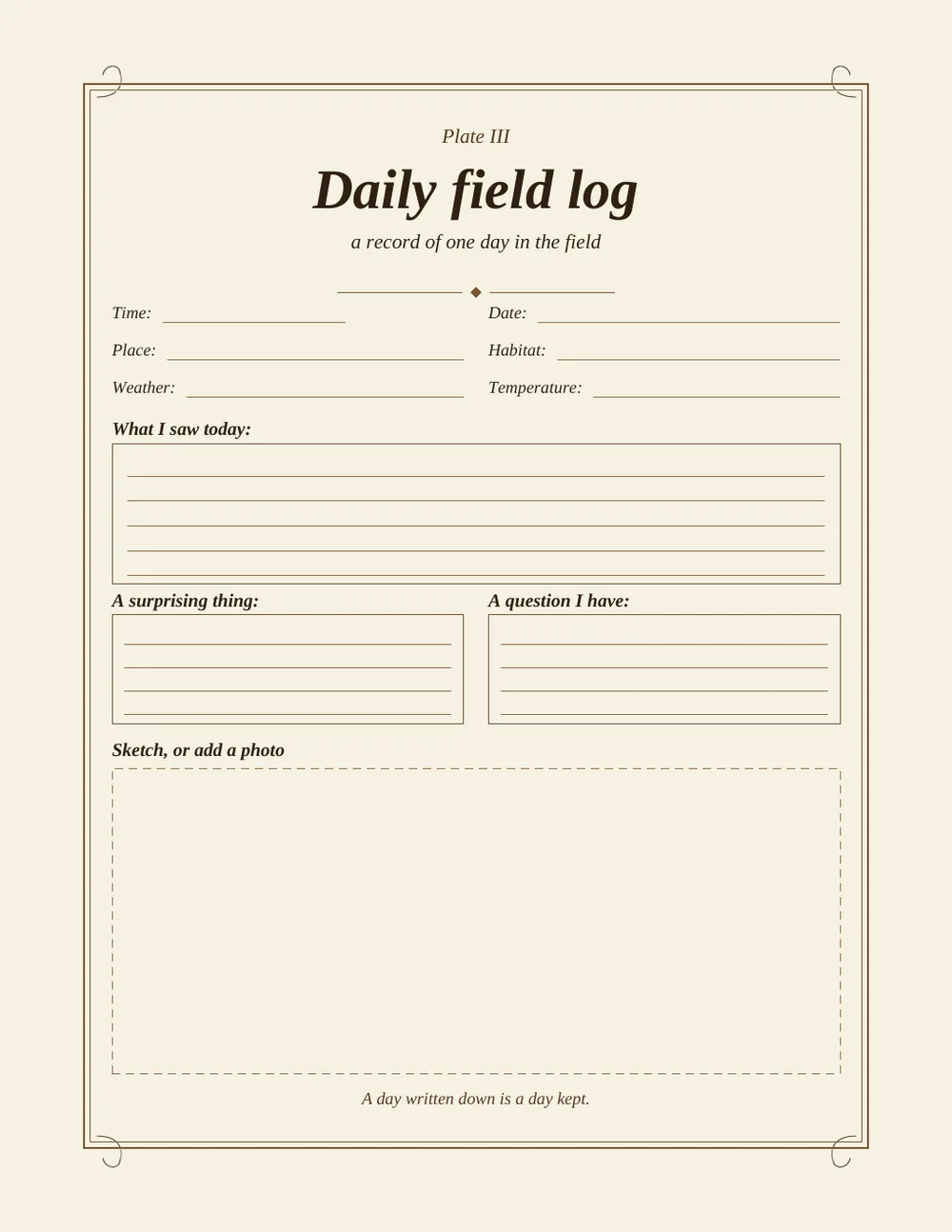
April fills pages in the Naturalist’s Field Journal. Use “birds I have seen” for each arrival, “dusk and dawn watch” for a lek morning or a snipe at dusk, and “a map of sounds” for toads, meadowlarks and the drumming of a grouse. “A tree through the seasons” is the right plate for an Arbor Day planting, “nest observed” suits an eagle or a killdeer on gravel, and “the same place twice” lets you compare one wetland in early and late April.
Regions used below: The Panhandle and Pine Ridge; The Sandhills and Niobrara valley; Southwest Nebraska and the Republican valley; The central Platte and Rainwater Basin; Northeast Nebraska and the Missouri bluffs; Lincoln, Omaha and the southeast.
When do prairie chickens and sharp-tailed grouse dance best in Nebraska in April?
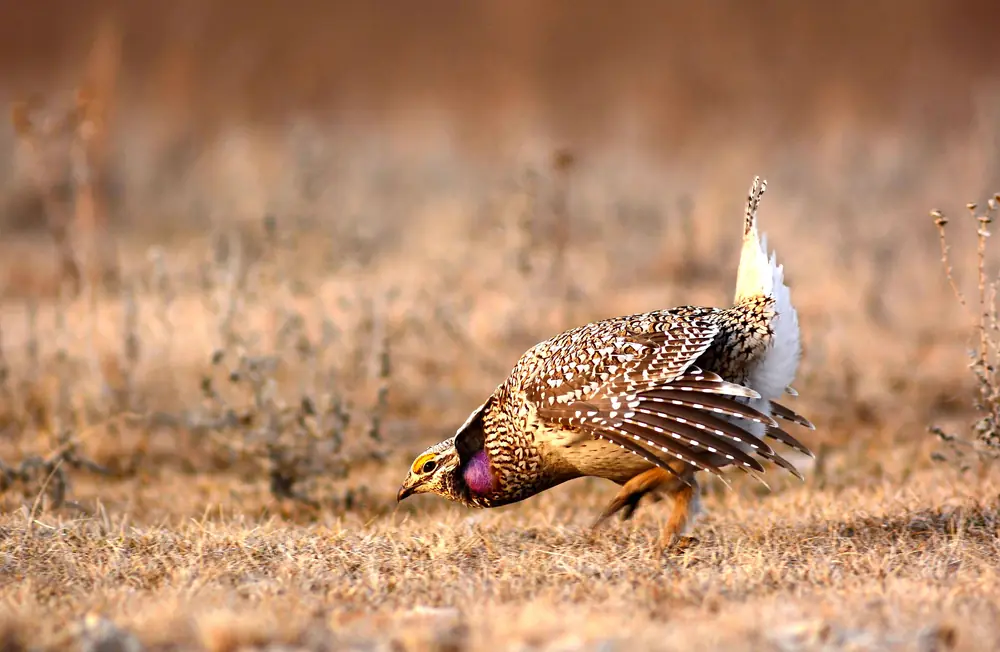
April is prime time for greater prairie-chickens. The state’s Birds of Nebraska account sets prairie-chicken lek activity anywhere from February 7 to June 20, with a peak around April 10, and the first nests with eggs appear from about April 19. At Fort Niobrara National Wildlife Refuge, the Fish and Wildlife Service says male sharp-tailed grouse and prairie-chickens both display on their courting areas in April and May.
Nebraska holds the highest densities of prairie-chickens in the north-central part of the state, especially the eastern Sandhills, and the birds thin out toward the east, south and west where grassland is broken up by cropland.
-
Greater prairie-chickens at their busiest
Peak activity around April 10; males are on the lek at first light, with the busiest hour usually around sunrise · North-central Nebraska and the eastern Sandhills; scattered leks in the Platte valley and southeast grasslands (Central time)
A prairie-chicken lek is a patch of short grass where a dozen or more males stamp, leap, inflate the orange sacs at their throats and let out a deep, hollow boom. Hens visit the lek to choose a mate, and egg-laying follows, which is why the state account lists nest eggs from the second half of April.
-
Sharp-tailed grouse in the north
April and May at Fort Niobrara; the Niobrara valley and Sandhills edge · Valentine and Fort Niobrara National Wildlife Refuges, Niobrara State Park and Sandhills grassland north of the Platte (Central time)
Valentine National Wildlife Refuge says spring is the best time to see these grouse up close and offers reserved blinds for watching them. Sharp-tailed males stamp their feet in a fast, quiet rattle and turn in tight circles on their dancing grounds.
-
Booking and behaving at a blind
Reservations for 2027 had not been posted in early October; confirm with the host before you plan a trip · Refuge offices, Niobrara State Park and private Sandhills lodges (Central time)
Blinds fill quickly in April. Be inside well before dawn and stay until the grouse have left on their own, because walking out early can flush the birds. Turn off the dome light, and do not use a flashlight or flash.
Both grouse also use roadsides and fields near leks. Park well off the road, keep to public roads, and treat every fence and field as someone’s property. Our March page covers the earlier part of the lek season.
Are sandhill cranes still on the Platte River in April, and when do whooping cranes pass through?
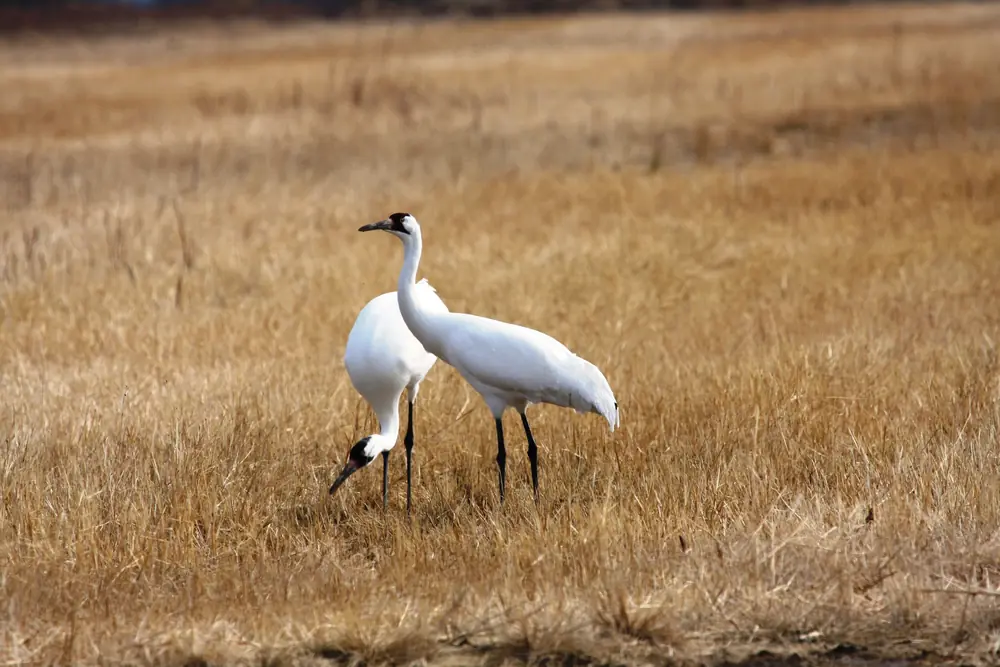
The great gathering is nearly over by April. The state’s bird account says most sandhill cranes depart by the end of April, and it adds that stragglers have turned up as late as the first days of June in the Keith County area. The first week of April is the last good window to see crowded roosts and field flocks on the central Platte, and by the second week the sky is quieter.
-
The last of the sandhill cranes
Thinning through the first half of April; most gone by the end of the month · The central Platte between Chapman and Overton, the North Platte valley and Rainwater Basin fields (Central time)
Watch the late-afternoon sky over a cornfield: groups of a few dozen to several hundred circle up on thermals and then head north in loose lines. Go early in the month, and ask Rowe Sanctuary or the Crane Trust how many birds remain before you drive.
-
Rowe Sanctuary’s 2027 season ends in the first week of April
Guided crane viewing March 3 to April 6, 2027; photography experiences through April 4 · Audubon’s Rowe Sanctuary near Gibbon (Central time)
Audubon has posted the 2027 dates. The announcement says booking opens January 7, 2027, so anyone hoping for an early April evening has to reserve in midwinter. The Crane Trust offers its own tours; check the organizer for what remains open once April begins.
-
Whooping cranes
Most records between March 30 and April 21; the average group is three birds that stay about four days · The central Platte valley and the Rainwater Basin, mostly in Central time; rare elsewhere
The Birds of Nebraska account shows that more than 71 percent of the 391 confirmed spring records between 1942 and 2016 fall between March 30 and April 21, with an average group size of 3.1 birds and a mean stopover of 4.2 days. April is therefore the best month to see one. A whooping crane stands taller than a sandhill and is white, with black wingtips that show in flight and a red crown. If you think you have found one, note the place and time, keep your distance and report it to Game and Parks or the Fish and Wildlife Service rather than approaching.
If the cranes have gone, the wetlands are next: the waders arrive just as the cranes leave.
Which shorebirds, curlews and owls arrive in Nebraska in April?
April is the month the long-legged birds come back. The dates below are typical windows from the Birds of Nebraska accounts and other state sources, not promises, and cold snaps move everything. The same accounts show that the real peak for most shorebirds comes in May, so April is the arrival month: a few birds on the first warm day, then more each week.
-
American avocets
Arrive in early to mid-April; peak numbers at the end of April · Shallow wetlands, lake edges and flooded fields, especially in the west and central parts of the state (Central and Mountain time)
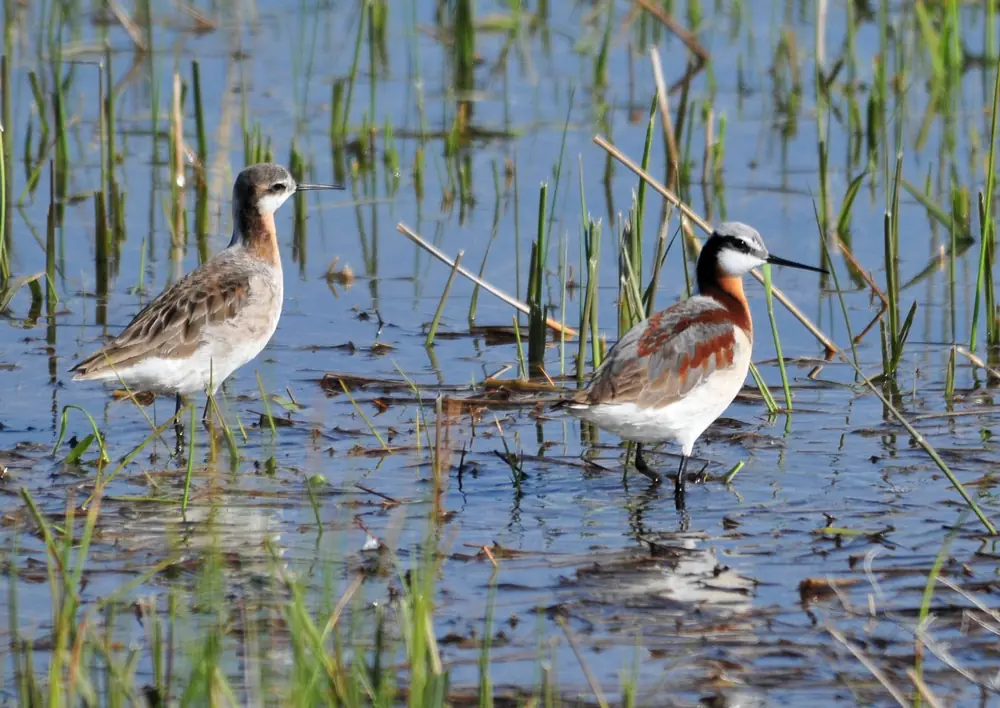
The avocet’s upturned bill and tan neck make it easy to recognize. The state account lists a count of 480 at Lakes North and Babcock in Platte County on April 19, 2025, and 600 to 700 near Niobrara on April 25, 2013, so a good April wetland can hold hundreds.
-
Wilson’s phalaropes
Arrive in mid-April; peak numbers in the first half of May · Wetlands in the Rainwater Basin, North Platte and Crescent Lake area (Central and Mountain time)
The account calls this species an abundant spring migrant in central and western Nebraska, with 10,000 counted at North Platte on May 6, 1996. Phalaropes spin in circles as they feed, stirring up insects.
-
Upland sandpipers and long-billed curlews
Curlews often arrive by the last week of March and peak in April; upland sandpipers usually arrive in the second half of April, peaking in early and mid-May · Sandhills and western grasslands, the Panhandle and North Platte area (Central and Mountain time)
The long-billed curlew has the longest bill of any North American shorebird, curved like a sickle. The state account follows a satellite-tagged curlew called Bailey who left northeast Mexico on April 8, 2010 and was back in Garden County the next day,. The upland sandpiper has a different style: a slim, long-necked bird that perches on fence posts and gives a wolf-whistle call.
-
Wilson’s snipe, winnowing at dusk
Migrants arrive by the end of March and peak in early April; males begin to winnow from about April 11 · Wet meadows and marsh edges, Sandhills lakes and the Rainwater Basin (Central time)
Wilson’s snipe are long-billed, striped birds that sit tight in wet grass until you nearly step on them. The state account lists 130 in the eastern Rainwater Basin on April 3 and 4, 1997, and says the breeding display, called winnowing, begins on about April 11. In the display a male flies high and dives, and air through its outer tail feathers makes a quavering whistle.
-
Buff-breasted sandpipers, just beginning
First records in the last week of April; the large flocks come in May · Fields near Rainwater Basin wetlands in Clay, Seward and nearby counties (Central time)
Game and Parks notes that more than 90 percent of the buff-breasted sandpiper population stages in the eastern Rainwater Basin in May, and the state account lists the earliest dates around April 25 and 26. They are tan, upright and tame, and they forage in short grass rather than mud. Expect the big flocks only after the first week of May.
-
Burrowing owls on prairie dog towns
Arrive generally in early April; earlier birds turn up in March · Prairie dog colonies, most numerous in the Panhandle, plus a few in the Rainwater Basin (Mountain and Central time)
This small, long-legged owl stands on the ground near a burrow by day. The state account lists a count of 41 in southwest Scotts Bluff County on April 19, 1999 and 23 at Crescent Lake National Wildlife Refuge on April 27, 2015. Stay on public land, watch from your car and never approach a burrow.
For the Omaha and Council Bluffs region, the Audubon Society of Omaha’s April checklist names ospreys, turkey vultures, broad-winged hawks and Swainson’s hawks, with large numbers of Swainson’s hawks around mid-month, plus waterfowl at the Omaha dam sites and Lake Manawa. It lists species by period, so use it as a checklist rather than a calendar of firm dates.
Which songbirds, hummingbirds and nesting birds should you watch for in Nebraska in April?
The big warbler wave belongs to May, but April brings the first handful. Backyards and brushy edges fill up with sound, and a few large birds are already on eggs.
-
Brown thrashers
Arrive in the south and east at the end of March and spread west through April; a month later in the north and west · Thickets and shelterbelts statewide (Central and Mountain time)
The state account says migrants reach the south and east in late March and are found in the Platte valley through April, reaching the north and west nearly a month later. The male sings from the top of a bush in pairs of phrases, each repeated twice.
-
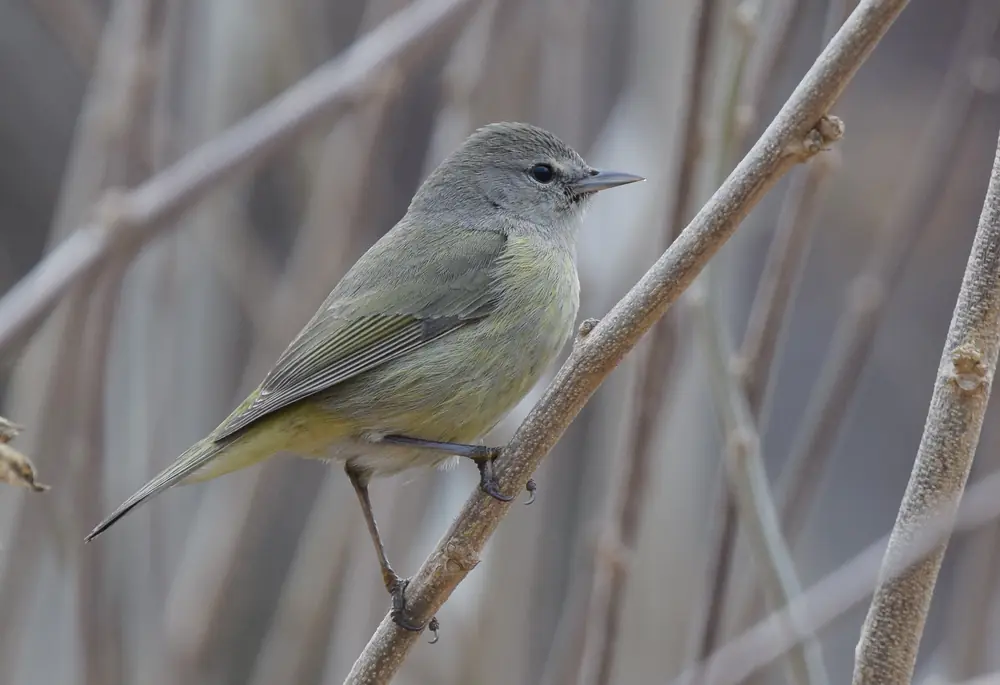
Orange-crowned warblers
Mid-April to late May, with most arriving mid- to late April · Woodlots, brushy edges and city parks statewide (Central and Mountain time)
Plain and olive-green, this is the first warbler many people find. The state account gives the earliest April dates as the first week and counts of 72 at Twin Lakes Wildlife Management Area in Seward County on April 28, 2019 and 85 at Gering Cemetery on May 1, 2016.
-
Ruby-throated hummingbirds, only just
Earliest records April 15 to 22 in the southeast; migration is mostly in May · Southeast and eastern Nebraska first; the Platte valley later (Central time)
The Birds of Nebraska account lists earlier dates of April 15, 2023 in Nemaha County and April 17, 2024 in Douglas County, but says migration occurs mostly in May. Put a feeder out in the last week of April in the east. Journey North tracks first sightings, though it had not announced its 2027 schedule by early October.
-
Bald eagles at the nest
Pairs are incubating or tending young in April · Large trees along rivers and reservoirs, including a nest within the Lincoln city limits (Central time)
A Game and Parks biologist writes that a pair needs three to four months to turn two or three eggs into independent young, and that Nebraska pairs have raised an average of 1.8 young a year. The most common cause of nest failure is a nest tree blown down in a severe thunderstorm, and eagles do not re-nest in the same year after a failure. Use binoculars from far off, and stay away from the base of the tree.
-
Least terns and piping plovers, not yet
Least tern arrival is typically in the latter half of May; the earliest records are in April · Sandbars, sand and gravel pits and river valleys such as the Platte (Central and Mountain time)
The state account puts the earliest least tern records at April 10 and shows that arrival typically does not occur until the latter half of May. Terns use sand and gravel mines as well as rivers. The piping plover is a threatened species, listed in 1986, and the Fish and Wildlife Service names disturbance of nesting adults and chicks among its threats along the central Platte. If you walk a sandy beach in late April, scan for a small tan bird running ahead of you and go around it.
Killdeer are nesting on gravel roads and parking lots. A bird running off with a drooping wing is leading you from a nest, so go another way.
What wakes up in Nebraska ponds, lakes and dens in April?
April is the first month of warm nights, and most of the state’s frogs, toads and salamanders are moving. Nebraska has 11 species of frogs and toads, and Game and Parks lists four of them as at risk: the northern leopard frog, American toad, Blanchard’s cricket frog and western narrow-mouthed toad. A damp, mild evening is the best time to listen.
-
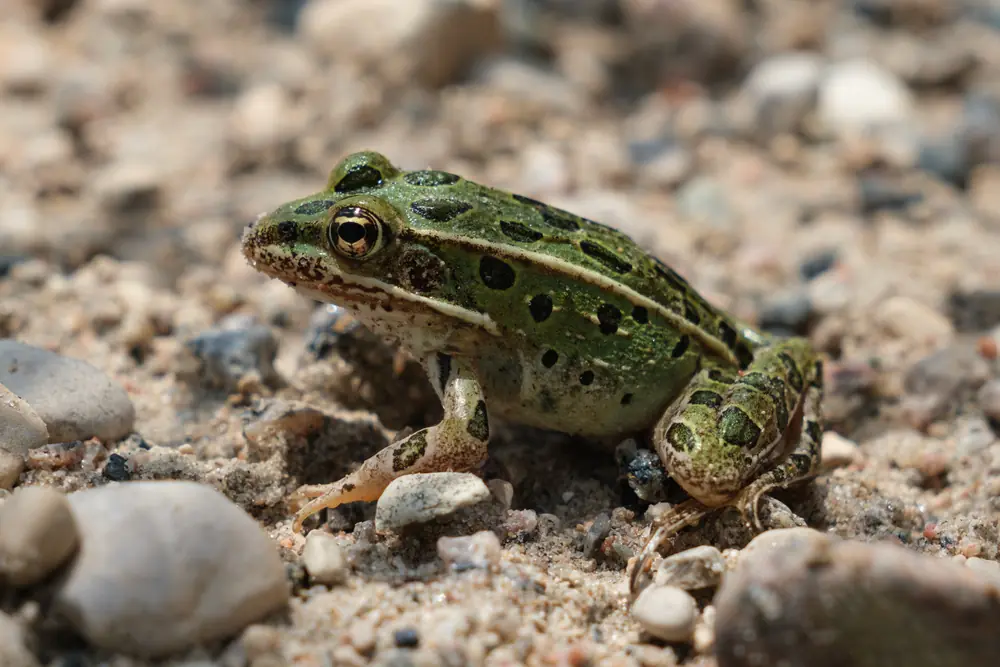
Leopard frogs, north and south of the Platte
Northern leopard frog breeds from mid-March to June · Permanent water in the northern two thirds of the state, with plains leopard frogs south and east of the Platte (Central and Mountain time)
A state biologist explains that leopard frogs were once treated as a single species, and that genetic work split them along the Platte River: northern leopard frogs to the north, plains leopard frogs to the south and east. The northern leopard frog is a species of greatest conservation need in Nebraska.
-
Woodhouse’s toads and Great Plains toads
Woodhouse’s toad active April to October, breeding April to early September; Great Plains toad active from late March, breeding April to September · Woodhouse’s toads near streams, parks and backyards statewide; Great Plains toads in grassland and floodplain (Central and Mountain time)
The University of Nebraska–Lincoln’s herpetology pages give these windows, and the Great Plains toad can lay up to 20,000 eggs. Nebraskaland Magazine describes the Woodhouse’s toad as having a white stripe down the middle of its back and a short, nasal call that sounds like a sheep.
-
Tiger salamanders
Breeding from early spring to early summer · Fishless ponds, moist woods and prairie dog towns (Central and Mountain time)
The western tiger salamander spends most of the year below ground in burrows, and the university’s page lists prairie dog towns and other small-mammal burrows among its habitats. Rain brings them to breeding ponds, and a road crossing on a wet night is the likeliest place to see one. Take a photograph and report it, and do not handle the animal.
-
Snakes leave their dens
Many snakes emerge in April; bullsnakes are active from May · Rock outcrops, burrows and buildings used as dens, then grassland and farmland (Central and Mountain time)
Game and Parks’ viewing calendar names April as the month many snakes come out of winter dens, which can be an animal burrow, a rock outcrop or a building’s basement. As the weather warms they scatter to summer habitat where small rodents and insects are plentiful.
-
Walleyes on the spawn
In some years crews collect eggs from early April; the spawning run continues into the middle of the month · Sherman Reservoir, Merritt Reservoir and Lake McConaughy (Central and Mountain time)
Game and Parks fisheries crews capture spawning walleyes each spring, take eggs for the hatcheries and release the adults, and in 2018 they began at Sherman on April 2, at Merritt on or before April 7 and at McConaughy in the week of April 16. The agency closed an area along the Sherman dam to bank anglers after sunset and asked boaters to avoid its nets. The schedule changes with water temperature and ice, so check the Game and Parks news page for the year’s plan.
On wet nights drive slowly near ponds and low spots, since toads and salamanders cross roads.
What blooms in Nebraska in April, and what is Nebraska’s Arbor Day?
April is when the prairie starts to stir. The Nature Conservancy’s Chris Helzer, who works at the Platte River Prairies near Aurora, notes that activity in prairies picks up very fast from the middle of April, and that most wildflowers are still scattered and small. The woody plants change faster, which is one reason Nebraska created a holiday around trees.
-
Arbor Day on Friday, April 30, 2027
Nebraska’s statute puts Arbor Day on the last Friday in April, which is April 30 in 2027 · Statewide; the original Arbor Day was proposed by J. Sterling Morton of Nebraska City
Under Nebraska Revised Statute 25-2221, the state’s holiday falls on the final Friday of April. The State Historical Society says Morton proposed the first Arbor Day in 1872, and the Nebraska legislature set a state holiday on April 22, Morton’s birthday, in 1885, and Earth Day still falls on that date. Arbor Lodge State Historical Park in Nebraska City, Morton’s home, has an arboretum, a terraced garden and more than 200 varieties of lilacs; the grounds are open year-round and need no park permit.
-
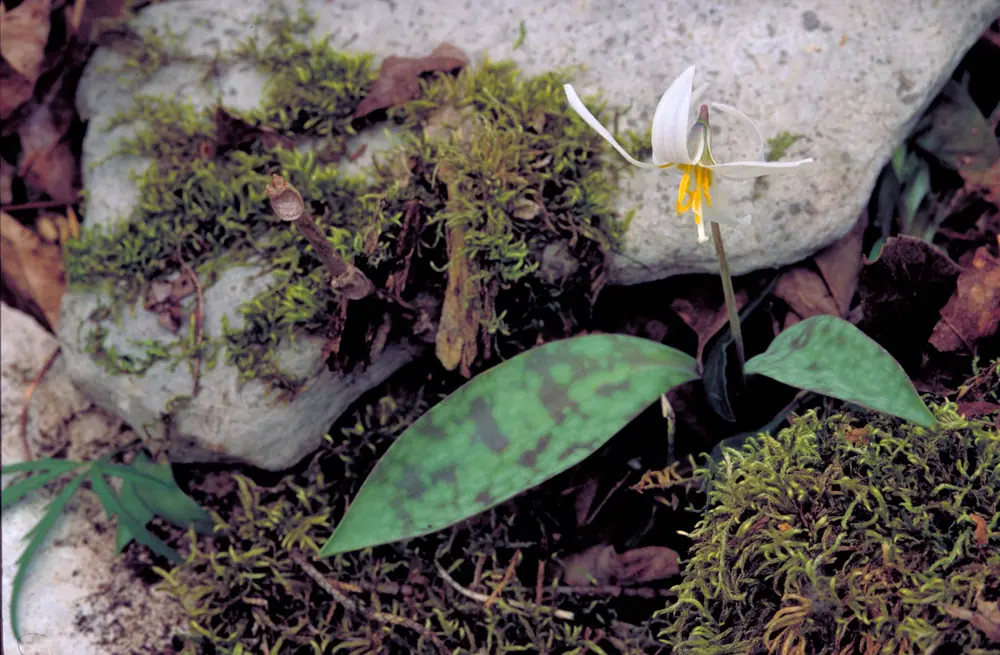
Trout lilies, dandelions and early morels
One observer’s notebook: trout lilies and dandelion flowers began April 6, 2020; the first morel was found April 27, 2020 · Woodlands in the east and south (Central time)
The yearly phenology log of Brad Kindler (Nebraska Statewide Arboretum and Nebraska Forest Service) includes April 2020 entries that are a snapshot of one spring, not a schedule. Spring ephemerals follow soil temperature and sun, so a cold April moves every date. Morel dates vary widely and are not predicted here; check the Nebraska Statewide Arboretum or your local extension office for guidance before you forage.
-
Prairie dandelion, ground plum and pussytoes
Mid- to late April in the Platte valley, according to a 2020 field note · Loess and sand prairie around Aurora and the central Platte (Central time)
Helzer’s April 24, 2020 field notes record prairie dandelion starting to bloom, ground plum (also called buffalo pea), an early legume, pussytoes and rockjasmine, along with tiger beetles and ground-nesting bees at work. The flowers are low, so kneel with a hand lens.
-
Prescribed burns and green-up
Burns are planned across the spring and into the fall wherever weather allows · State wildlife management areas, parks and recreation areas across all Game and Parks districts
Game and Parks announces that it burns many of its areas to set back invasive brome and bluegrass and to improve habitat, and that burned acres often attract wildlife. Smoke on the horizon in April is often a managed burn, not a wildfire. Check with the park or area office for closures before you visit.
-
A tallgrass prairie to walk
Mowed trails wind through the grass; check hours with the center · Spring Creek Prairie Audubon Center near Denton, southwest of Lincoln (Central time)
Audubon says the center holds 1,160 acres of tallgrass prairie, five miles of trails and a list of 240 observed bird species.
For more on frost dates and what is safe to plant outdoors, see the Nebraska frost page.
How warm is April in Nebraska, and what weather hazards come with it?
By NOAA’s 1991–2020 normals, an average April afternoon reaches the low 60s in the west and the mid 60s around Lincoln and Omaha, with average lows just above freezing in the west and around 40 °F in the east. Precipitation runs from about 1.9 inches at Scottsbluff to 3.2 inches at Omaha. Snow still falls in the west, with a normal of 5.6 inches at Valentine, though most of it melts within a day or two. April can swing from winter to summer inside a week.
| Station | Average high | Average low | Precipitation | Snowfall |
|---|---|---|---|---|
| Omaha Eppley Airfield | 64.1 °F | 41.1 °F | 3.17 in | 1.0 in |
| Lincoln Municipal Airport | 64.8 °F | 39.2 °F | 2.69 in | 1.2 in |
| Grand Island Airport | 63.3 °F | 38.6 °F | 2.52 in | 1.6 in |
| North Platte Regional Airport | 63.2 °F | 33.2 °F | 2.29 in | 3.6 in |
| Valentine Miller Field | 61.2 °F | 33.1 °F | 2.48 in | 5.6 in |
| Scottsbluff Heilig Airport | 62.3 °F | 32.6 °F | 1.92 in | 5.2 in |
Tornadoes and thunderstorms: the National Weather Service documented 25 tornado tracks across eastern Nebraska and western Iowa on April 26, 2024, in an outbreak that included an EF-4 tornado that traveled 31.2 miles through Elkhorn, Bennington and Blair, and an EF-3 on a 40.9-mile path from Minden to Harlan that caused one death and three injuries. The tornadoes began around 2 p.m. and the last ended after 7 p.m. April is early in the season, but the rotating storms do not wait for summer. Decide in advance where you would shelter, and keep weather alerts switched on.
Late-season winter weather: the weather service in Hastings describes a mid-April 2018 blizzard that ran from the late evening of April 13 into most of April 14, with strong north winds, a gust of 64 mph at Ord, freezing drizzle that coated the area east of Grand Island and Hastings with ice, and numerous snapped power poles. One utility worker told the office it downed more poles than any other storm in his career.
Fire weather and swings: the State Climate Office’s summary of April 2026 describes a high of 99 °F at Lodgepole and a low of 14 °F at Harrison, relative humidity in the single digits across western and central Nebraska, widespread Red Flag Warnings and snow of 2.5 inches at most in the Panhandle. Dry grass, wind and low humidity can turn a spark into a grass fire, so check fire weather before you burn, grill or drag a trailer chain.
The Climate Prediction Center publishes new 90-day outlooks every month at its seasonal outlook page. Use our weather guide to read the forecast and our cloud guide to read the sky.
When is the last spring freeze in Nebraska?
April ends the freeze season in the southeast but not in the northwest. Omaha’s median last freeze falls in the middle of the month, while Chadron’s is not until mid-May. That is why a mild week in April can be followed by a hard freeze that kills new leaves, blossoms and tender seedlings. Each row below shows three dates.
| Station | One year in ten | Median | Nine years in ten |
|---|---|---|---|
| Chadron Municipal Airport (Pine Ridge) | May 2 | May 14 | May 27 |
| Scottsbluff Heilig Airport (Panhandle) | Apr 25 | May 5 | May 18 |
| Valentine Miller Field (northern Sandhills) | Apr 30 | May 12 | May 25 |
| North Platte Regional Airport (west-central) | Apr 30 | May 11 | May 26 |
| McCook Municipal Airport (southwest) | Apr 17 | May 1 | May 15 |
| Norfolk Karl Stefan Airport (northeast) | Apr 16 | Apr 30 | May 14 |
| Grand Island Airport (central Platte) | Apr 9 | Apr 23 | May 6 |
| Lincoln Municipal Airport (southeast) | Apr 10 | Apr 24 | May 7 |
| Omaha Eppley Airfield (Omaha) | Apr 5 | Apr 18 | Apr 30 |
Peas, spinach and radishes shrug off a freeze, and many gardeners plant them as soon as the soil can be worked. The Nebraska frost page shows the dates for more towns.
How much daylight does Nebraska gain in April?
Nebraska’s days keep lengthening through April, at a pace of about 2.5 to 2.8 minutes each day, which is a little slower than the sprint of late March. Over the month Omaha’s day grows by 75 minutes, ending just short of 14 hours, while Valentine, farther north, gains 81 minutes and crosses the 14-hour mark. Clocks have already moved to daylight saving time (Central and Mountain, since March 14), so every sunrise and sunset in April is on the later daylight-time clock. The table shows day length, which the clock change does not affect.
| City | Apr 1 | Apr 30 | Gained | Per day |
|---|---|---|---|---|
| Omaha | 12 h 42 m | 13 h 57 m | 75 min | 2.6 min |
| Lincoln | 12 h 41 m | 13 h 55 m | 74 min | 2.6 min |
| Norfolk | 12 h 42 m | 14 h 00 m | 78 min | 2.7 min |
| Grand Island | 12 h 41 m | 13 h 56 m | 75 min | 2.6 min |
| McCook | 12 h 40 m | 13 h 53 m | 73 min | 2.5 min |
| North Platte | 12 h 41 m | 13 h 57 m | 76 min | 2.6 min |
| Valentine | 12 h 43 m | 14 h 04 m | 81 min | 2.8 min |
| Scottsbluff | 12 h 42 m | 14 h 00 m | 78 min | 2.7 min |
Many migrants and nesting birds respond to day length. Our daylight guide gives sunrise and sunset for any town.
What can you see in the Nebraska night sky in April 2027?
Clock times below are Central, with Mountain in parentheses for the Panhandle and the far southwest. Everything this month is on daylight time, which began March 14. The planet and Moon-pairing notes here come from our own computations and make rough guides, not exact predictions.
-
The Pink Moon
Full on Tuesday, April 20, at 5:27 p.m. CDT (4:27 p.m. MDT); looks full on Monday and Tuesday evenings · Statewide
Tuesday’s full Moon takes its Pink Moon name from moss pink, an early wildflower, according to SeaSky; the same list gives Fish Moon and Sprouting Grass Moon as alternates. The exact moment arrives in daylight, so the best view is the Moon climbing out of the east that evening around sunset. By our own calculation it is not a supermoon.
-
The Lyrids, in bright moonlight
Maximum about 8:41 p.m. CDT (7:41 p.m. MDT) on Thursday, April 22; active roughly April 14 to 30 · Look northeast to east before the Moon rises, about 10 p.m. or a little later in most of the state
This is a poor Lyrid year. The Moon will be roughly 95 percent lit on the peak night, three days past full, and will clear the horizon around 10 p.m. Real darkness lasts only through the early evening, before moonrise, when the radiant in Lyra hangs low in the east-northeast. At its best the shower yields roughly 20 meteors an hour, according to SeaSky, so with a bright Moon in the sky expect only a few.
-
Jupiter, Mars and the Moon
The Moon passes Jupiter around April 14 and 15, and Mars about April 15 · High in the southwest to west in the evening
Jupiter, bright and steady, sits in Leo near the Cancer border and does not set until the early morning hours. By our calculation, on April 14 and 15 the waxing Moon, about two-thirds lit, passes within a degree of it. Mars, much fainter and orange, sits about three degrees from the Moon around April 15 and is near magnitude zero. By the same calculation the Moon also passes near the star Regulus around April 16.
-
Venus before dawn
Before sunrise all month; a thin crescent Moon joins it on the mornings of April 3 and 4 · The eastern sky before dawn
On April 1 Venus clears the eastern horizon roughly 75 minutes ahead of sunrise; by month’s end the lead has shrunk to about an hour. Mercury has faded as a morning target, and Saturn slips into the Sun’s glare at its April 7 conjunction.
-
The Milky Way before dawn
Pre-dawn windows near April 1 to 14 and April 28 to 30, around the April 6 new moon · A dark southern horizon, away from town lights
In April the bright galactic core appears low in the south, and only just before dawn. For 40° north our calculations give a window of up to roughly two hours with the core up and the sky fully dark, so go out in the last stretch of the night, when no Moon is up.
| Phase | Date | Time |
|---|---|---|
| New moon | Tuesday, Apr 6 | 6:51 p.m. CDT (5:51 p.m. MDT) |
| First quarter | Tuesday, Apr 13 | 5:56 p.m. CDT (4:56 p.m. MDT) |
| Full moon, the Pink Moon | Tuesday, Apr 20 | 5:27 p.m. CDT (4:27 p.m. MDT) |
| Last quarter | Wednesday, Apr 28 | 3:18 p.m. CDT (2:18 p.m. MDT) |
The moon phase page gives moonrise for any Nebraska town, and the cloud guide helps you pick a clear night.
What can Nebraska families do outdoors in April 2027?
Few April 2027 programs were public when this page was written, so only dates the organizer has already published appear here; contact the host for the rest.
- Arbor Day, Friday, April 30, 2027: a state holiday by statute. Plant a tree, visit Arbor Lodge State Historical Park in Nebraska City, or adopt a tree on your street.
- Earth Day, Thursday, April 22: a good day to start a backyard habitat patch, pick up litter along a creek or begin a yearly bird list.
- City Nature Challenge: the organizer’s 2027 observation window runs April 30 through May 3, and identification continuing to May 16. Nebraska cities join in some years; check the organizer’s page for participating areas.
- Project FeederWatch runs through April 30, so there is still time to count your feeder.
- Rowe Sanctuary crane season ends April 6, 2027; the Crane Trust and public roads on the Platte are the options for any cranes left.
- Spring Creek Prairie Audubon Center: walk the trails and check its events page for programs.
- Journey North collects first sightings of hummingbirds and other migrants; its 2027 spring schedule had not been announced.
- iNaturalist is a good place to log toads, salamanders, first flowers and tracks, and to get help with an identification.
Other months are in the nature guide, and you can also look back to March.
Safety notes for April in Nebraska
- Spring turkey season (Nebraska Game and Parks): the state had not published 2027 dates when this was written. For 2026, archery ran March 25 to May 31, the youth shotgun season began April 11 and the shotgun season began April 18, both ending May 31. Hunters may buy up to two spring permits and take one bird a day. Check the Game and Parks seasons page for the 2027 dates.
- Hunter orange: the state’s 2025 turkey guide lists orange as recommended, not required, for spring turkey hunting. Wear something bright on public land in April and May anyway, because you may share it with a turkey hunter in camouflage.
- Late goose season: the 2027 light goose conservation order ends April 5 in two of the three zones (West and Rainwater Basin), April 15 in the East, and has no daily limit.
- Storms: April can bring tornadoes, hail and blizzards. Check the forecast, know your shelter and carry a winter kit.
- Fire: Red Flag Warnings are common in April. Do not burn, park on dry grass or throw cigarettes.
- Ticks: Nebraska’s health department calls spring and summer the tick season, with the American dog tick across the state and the lone star tick in the southeast. Permethrin on clothing, a full body check afterward and ten minutes in a hot dryer all help.
- Snakes: many species leave dens in April. Look before you reach under rocks, boards or brush.
- Nests and young: deer fawns, eagle nests, killdeer on gravel and plover beaches all need space. Leave a fawn alone; its mother is nearby.
- Cold water: April rivers and reservoirs are cold and often high. Wear a life jacket and stay off moving ice.
- Roads at night: toads, salamanders and snakes cross wet roads; drive slowly.
Sources (52)
- Birds of Nebraska Online (Nebraska Game and Parks): greater prairie-chicken (archived copy)
- Birds of Nebraska Online: sandhill crane (archived copy)
- Birds of Nebraska Online: whooping crane (archived copy)
- Birds of Nebraska Online: American avocet (archived copy)
- Birds of Nebraska Online: Wilson’s phalarope (archived copy)
- Birds of Nebraska Online: upland sandpiper (archived copy)
- Birds of Nebraska Online: long-billed curlew (archived copy)
- Birds of Nebraska Online: Wilson’s snipe (archived copy)
- Birds of Nebraska Online: buff-breasted sandpiper (archived copy)
- Birds of Nebraska Online: burrowing owl (archived copy)
- Birds of Nebraska Online: brown thrasher (archived copy)
- Birds of Nebraska Online: orange-crowned warbler (archived copy)
- Birds of Nebraska Online: ruby-throated hummingbird (archived copy)
- Birds of Nebraska Online: least tern (archived copy)
- Audubon’s Iain Nicolson Audubon Center at Rowe Sanctuary: 2027 crane season dates and registration
- U.S. Fish and Wildlife Service: Fort Niobrara National Wildlife Refuge, seasons of wildlife
- U.S. Fish and Wildlife Service: Valentine National Wildlife Refuge, species
- Platte River Recovery Implementation Program: piping plover fact sheet (U.S. Fish and Wildlife Service)
- Nebraska Game and Parks: wildlife viewing timeline (archived copy)
- Nebraskaland Magazine: Bald eagle nesting in Nebraska (archived copy)
- Nebraskaland Magazine: April at-risk species spotlight, northern leopard frog, April 12, 2023 (archived copy)
- Nebraskaland Magazine: Hopping into Amphibian Week, May 6, 2025 (archived copy)
- Nebraskaland Magazine: It is that time again (walleye egg collections), April 2, 2018 (archived copy)
- Nebraskaland Magazine: Prescribed burns planned for several WMAs and state park areas this spring, April 4, 2022 (archived copy)
- UNL School of Natural Resources: Great Plains toad
- UNL School of Natural Resources: Woodhouse’s toad
- UNL School of Natural Resources: northern leopard frog
- UNL School of Natural Resources: western tiger salamander
- UNL School of Natural Resources: bullsnake
- Plant Nebraska: the science of phenology (Brad Kindler)
- The Prairie Ecologist: photos of the week, April 24, 2020
- The Prairie Ecologist: photos of the week, April 17, 2020
- Nebraska Revised Statute 25-2221, state holidays
- Nebraska State Historical Society: Happy Birth-Arbor-Earth Day
- Nebraska Game and Parks: Arbor Lodge State Historical Park (archived copy)
- Audubon: Spring Creek Prairie Audubon Center, explore (archived copy)
- Audubon Society of Omaha: migration calendar, April 2027
- NOAA NCEI: 1991–2020 monthly normals for Omaha, Lincoln, North Platte, Valentine, Scottsbluff and Grand Island
- National Weather Service Omaha: tornado outbreak of April 26, 2024
- National Weather Service Hastings: April 2018 weather and climate review, south central Nebraska
- Nebraska State Climate Office: April 2026 monthly climate summary
- NOAA Climate Prediction Center: seasonal (90-day) outlooks
- Nebraska Game and Parks: hunting seasons 2026–27 (archived copy)
- Nebraska Game and Parks: 2025 turkey guide (spring and fall seasons)
- Nebraska Department of Health and Human Services: tick-borne diseases in Nebraska (2021)
- U.S. Naval Observatory: moon phases, 2027
- SeaSky: astronomy calendar 2027
- City Nature Challenge
- Project FeederWatch: how to participate
- Journey North
- iNaturalist
- Photos via Wikimedia Commons; licenses and photographers are credited under each picture
