What to look for in nature in Nebraska this February
February is when Nebraska’s winter starts to break. The month can still bring the heaviest snow of the season, but the birds are already moving: cranes drift onto the Platte, snow geese stream north over the Rainwater Basin in flocks that fill the sky, and the first red-winged blackbirds and meadowlarks sing from the fence lines. Eagles settle onto eggs late in the month, red-tailed hawks court over the windbreaks and skunks start roaming at night. And every evening the light lingers a little longer than the one before.
Other months in Nebraska: October, November, December, January.
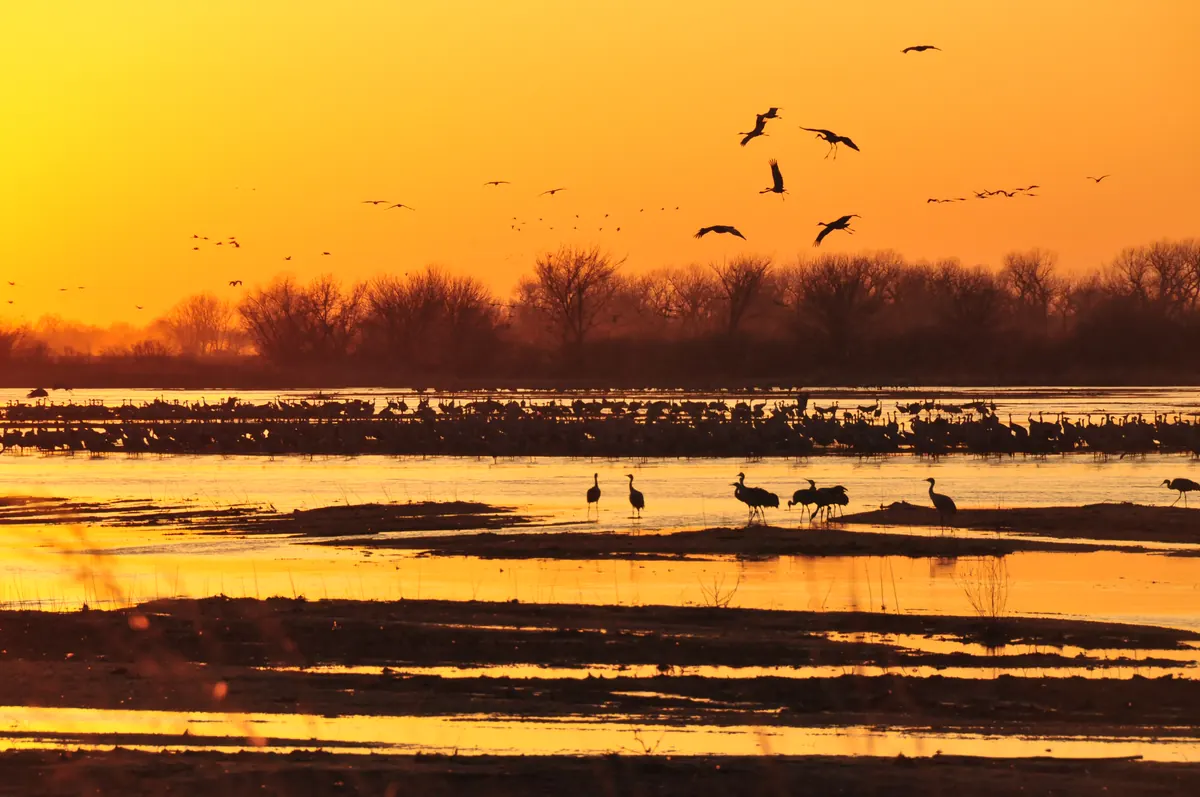
Start here
- Listen for the first cranes. On a mild afternoon in the last half of February, drive the county roads south of Interstate 80 between Grand Island and Kearney with the windows down. Note the date and the count of your first cranes.
- Find a goose flock on the move. After a thaw, scan the sky over the Rainwater Basin or Harlan County Reservoir for long, wavering lines of white birds with black wingtips. The noise alone is worth the trip.
- See Jupiter on opposition night. Wednesday, February 10, is opposition night, when Jupiter rises at sunset and stays up until dawn. After supper, find it low in the east, the brightest thing there, and draw the dots of its moons beside it; repeat the next night.
The year’s first sandhill crane earns a line in the Naturalist’s Field Journal on “birds I have seen,” noting the date, the county and the size of the flock. Use the dusk and dawn watch for an evening at the river as the flocks come in to roost, and put a crane’s bugle, a goose flock’s roar and a meadowlark’s first song on “a map of sounds.” Skunk or coyote prints in a late snow go on “tracks to know,” and “reading the signs” is the place to list each first arrival as winter loosens its grip.
Regions used below: The Panhandle and Pine Ridge; The Sandhills and Niobrara valley; Southwest Nebraska and the Republican valley; The central Platte and Rainwater Basin; Northeast Nebraska and the Missouri bluffs; Lincoln, Omaha and the southeast.
When do sandhill cranes arrive on the Platte River in Nebraska?
The great crane gathering on the central Platte is a March event, but it starts in February. Audubon’s Rowe Sanctuary sums up the season as cranes showing up around Valentine’s Day and leaving around Tax Day. Game and Parks’ Birds of Nebraska Online adds that the first flocks often appear in late January and may slide back south if a hard cold snap sets in, and that the typical spring arrival has crept earlier for decades: from about May 1 in 1920 to February 10 by 1965 and February 1 by 2010.
-
The first flocks over the river
Scattered flocks from late January; numbers usually climb through the second half of February · The Big Bend of the Platte between Chapman and Overton, centered on Grand Island, Wood River, Gibbon and Kearney (Central time); smaller groups near North Platte and Lewellen (Central and Mountain time)
A crane’s rolling, wooden bugle carries for miles, so the first February birds are often heard before they are seen. At sunset they leave the cornfields to stand overnight in shallow water on wide, open river channels. The Crane Trust’s weekly aerial surveys show how fast a late-February buildup can be: in 2020 its crews tallied about 6,150 cranes on February 11, 13,120 a week later and 34,500 on February 24. Some recent years have gone far beyond that by month’s end, so expect anything from a few thousand to a couple hundred thousand birds in the valley by February 28.
-
Where to watch without disturbing them
Late afternoon and the half hour after sunset; again at first light · Crane Trust Nature and Visitor Center near Wood River; the hike-bike trail at Fort Kearny State Recreation Area; county roads south of Interstate 80 between Grand Island and Kearney
The Crane Trust’s visitor center south of Alda, near Wood River, is open Monday through Saturday most of the year, closing for a week around Christmas and New Year’s. Before the guided blinds open, watch feeding flocks from your car, pulled well onto the shoulder of a gravel road. Cranes that are flushed off a roost at night waste energy they came here to store, so stay off the river banks after dark, skip the flashlight and never walk toward a flock. Rowe Sanctuary restricts its own trails from February 15 through April 15 for the same reason.
-
Booking the March blinds
Reservations open in winter · Rowe Sanctuary near Gibbon; the Crane Trust near Wood River
Rowe Sanctuary’s guided crane viewing runs March 3 to April 6, 2027, and reservations open January 7 at 9 a.m. Central. The Crane Trust’s March blind, bus and footbridge tours go on sale on its website in November, after a members-only window.
| Survey | Cranes counted |
|---|---|
| Last week of February 2009 | 62,900 |
| Last week of February 2016 | 213,650 |
| Last week of February 2017 | 194,825 |
| February 11, 2020 | 6,150 |
| February 18, 2020 | 13,120 |
| February 24, 2020 | 34,500 |
Crane timing now swings with each winter’s weather. One study cited by Birds of Nebraska found crane migration dates moving earlier by about a day per year from 2002 to 2017. If you can’t get to the river, Rowe Sanctuary streams a live crane camera through explore.org.
When do snow geese come through Nebraska?
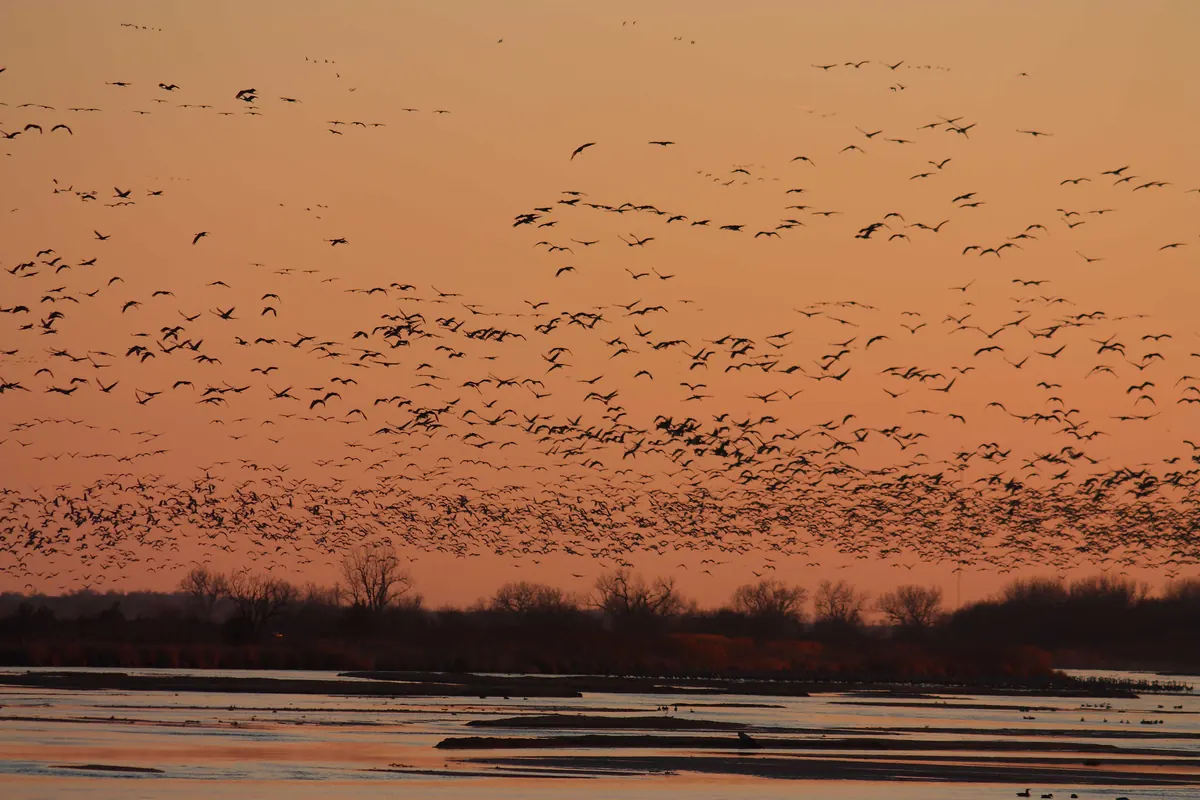
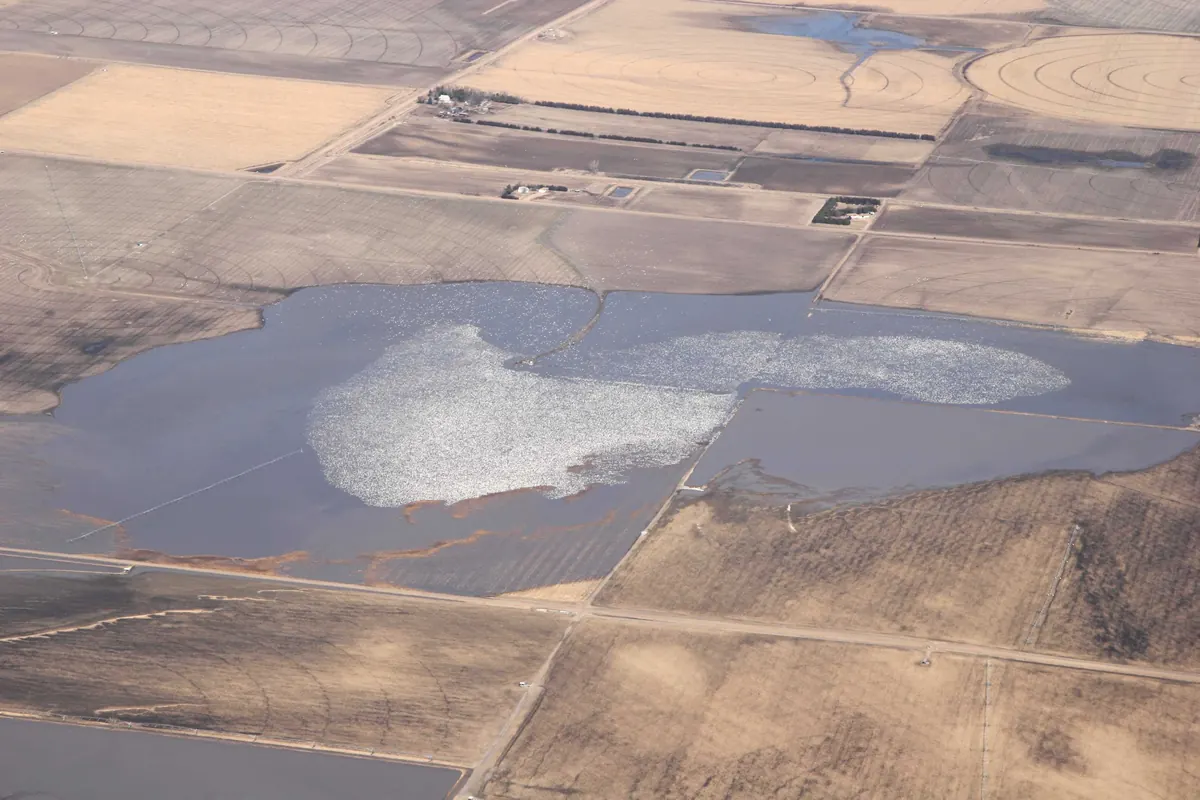
Snow geese are the sound of late February in south-central Nebraska: a high, yelping roar from flocks so large they look like smoke on the horizon. Birds of Nebraska says that from mid-February into early March, hundreds of thousands and in some years millions move across the state, and that how long they linger depends on the weather. A mild spell can push most of them through in a week; a stubborn late winter can hold them for up to three.
-
Snow and Ross’s geese
Mid-February to early March, in waves tied to thaws · The Rainwater Basin south of the Platte (Clay, Fillmore, Phelps, Kearney and York counties), Harlan County Reservoir, the central Platte valley; also big eastern lakes such as Branched Oak
The numbers are staggering. One observer carefully estimated 1,074,080 snow geese passing over Nuckolls County in just under two hours on February 4, 2017, and about two million were in the central Platte valley on February 23–26, 2005. Smaller, stubby-billed Ross’s geese travel with them.
-
Greater white-fronted geese
Migrant flocks from late January; most numerous in March · Rainwater Basin waterfowl production areas such as Harvard and Funk; central Platte; the east
White-fronts are gray-brown geese with orange legs, a pink bill and black bars across the belly. The U.S. Fish and Wildlife Service, which manages the Rainwater Basin Wetland Management District, says the basin’s shallow wetlands host 90 percent of the North American white-fronted goose population in spring. Birds of Nebraska cautions that this reflects the situation of the 1980s and that more white-fronts now stage east of the basin and into Iowa, possibly because snow geese and the spring hunting of them crowd the wetlands.
-
Pintails and the first ducks
Arriving with the snowmelt; peak in late February and early March · Rainwater Basin wetlands as soon as they thaw; sandpits and river channels
Northern pintails are among the first ducks north each year. The Fish and Wildlife Service puts 30 percent of the North American pintail population and nearly half of its mallards in the Rainwater Basin each spring. In a radio-tracking study, tagged hens reached the basin on February 18 in 2004 and March 7 in 2003, which shows how much a single winter can shift things.
The public wetlands of the Rainwater Basin are federal waterfowl production areas and state wildlife management areas, and visitors can walk in. Starting February 10, they are also open for the spring Light Goose Conservation Order (see the safety notes), so wear a bright color and check the hunting rules before walking out.
Are bald eagles still in Nebraska in February?
Yes, and in some places the count rises. Birds of Nebraska says migrating eagles start moving north in February as the ice breaks up, with totals building into early or mid-March alongside the passing ducks and geese. Meanwhile the state’s own nesting pairs switch from building to sitting on eggs.
-
Late-winter high counts
Mid- to late February, especially during a thaw · Kingsley Dam and Lake Ogallala (Mountain time); Calamus Reservoir in Loup and Garfield counties; Branched Oak Lake northwest of Lincoln
The best February tallies on record are impressive: 284 at Kingsley Dam on February 11, 1994, 265 at Branched Oak Lake on February 25, 2023, and 500 at Calamus Reservoir on February 21, 2020. Nebraskaland magazine’s winter viewing guide says the J-2 power plant near Lexington usually peaks in December and early January, Kingsley in February. Last winter bore that out: the district that runs the two indoor viewing rooms counted 26 eagles at Kingsley on February 14, 2026, and 47 the next day, against just three each day at J-2.
-
Nesting pairs on eggs
Incubation from about February 19 · Wooded river valleys, mostly in the north and east
The Nebraska nest records compiled for Birds of Nebraska show mating from February 19 and incubation starting the same day, with the first nestlings at the end of March. When a pair is incubating, often all you see is a white head poking above a mass of sticks. Give the tree a wide berth, at least 330 feet under federal guidelines, and watch with a spotting scope from the road.
Midwinter eagle hot spots are on the January page.
Which Nebraska birds start nesting in February?
A few hardy species don’t wait for spring. Their timetables come from the Nebraska Ornithologists’ Union’s collected nest records, summarized in Birds of Nebraska.
-
Red-tailed hawks courting
Nest building from February 5; mating from February 10 · Shelterbelts, farmyard groves and river woods statewide; city parks
Two red-tails circling high together on a calm day, one dangling its legs or swooping at the other, are courting. Pairs add fresh sticks to an old nest in a tall cottonwood or windbreak tree, and egg laying follows from March 1. On Christmas Bird Counts, red-tails turn up about five times more often per hour of searching in eastern Nebraska than in the west, so the show is easiest to find along the Missouri and lower Platte.
-
Great horned owls already sitting
Incubating through February; first chicks from mid-March · Statewide
Owls that laid in late January are still incubating, and the state’s records show the first nestlings in mid-March. The female barely moves; the male brings food at dusk and hoots from a nearby perch. An owl nest found in January is worth rechecking from a distance in February to see whether she is still on it.
-
Horned larks on territory
Territorial birds from February 16; eggs from mid-March · Bare fields, pastures and gravel roadsides statewide
Horned larks are among the very first Nebraska songbirds to claim territories. While big winter flocks are still roaming the stubble, local males start singing a thin, tinkling song from clods of dirt or high in the air. Their first nests are cups scraped into bare ground, and the state’s records include nestlings found on March 20 with snow on the ground.
Watch nests with binoculars and don’t linger; a trampled path can lead raccoons and crows straight to one.
When do red-winged blackbirds and other spring birds return to Nebraska?
Most of these species leave a few birds behind all winter, so the sign of a true return is behavior: a male singing on a territory, or a flock moving with purpose.
-
Red-winged blackbirds
Males from late February and early March; females about two weeks later · Cattail marshes, ditches and wet meadows statewide
The male’s gurgling “conk-la-ree” from a cattail is the first song of spring for many Nebraskans. Birds of Nebraska notes early males on territory in the Sandhills on February 8, 1998, in Scotts Bluff County on February 12, 2016, and at North Platte on February 13, 2014.
-
Western meadowlarks
Singing as early as late January; small migrant flocks through February · Pastures, fence lines and roadsides statewide
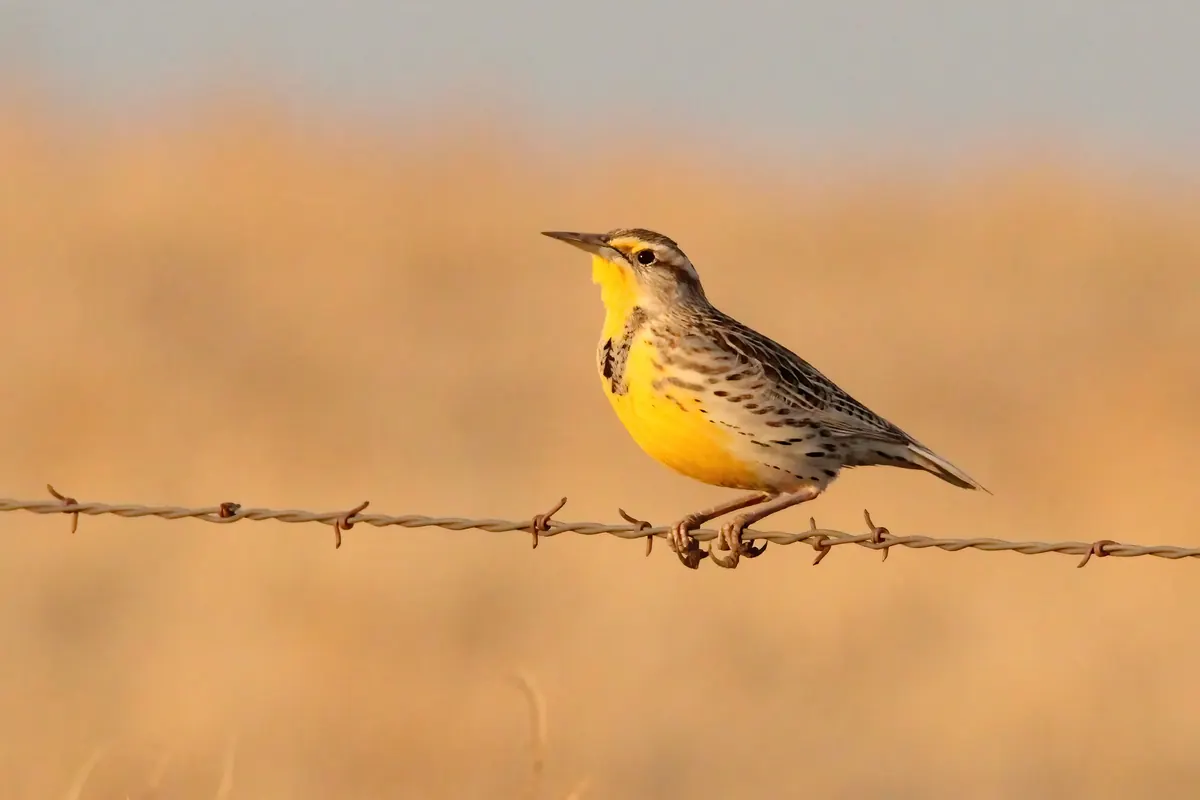
Nebraska’s state bird returns in loose groups of 15 to 40, which local birders call “choirs,” and they sing almost as soon as they land.
-
Killdeer, robins and grackles
Killdeer by late February; robins and grackles building through the month · Statewide; robins and grackles first in the south and east
The earliest killdeer away from known wintering spots appear around February 6–8, and most arrive at the end of the month. Robins are trickier, since wintering flocks of thousands roam the cedar canyons, but Birds of Nebraska says numbers climb noticeably in late February, when territorial birds start appearing in yards; mating has been seen from February 24. In the south and east, grackle flocks of 100 or more in early February are probably migrants.
-
Mountain bluebirds and woodcock
A few of each in the last half of February · Mountain bluebirds in the Panhandle and west-central grasslands; woodcock in the eastern river woods
These two mark opposite ends of the state. Mountain bluebirds usually return to the Panhandle in early March, but birds have appeared as early as February 14 at Gering and in the Wildcat Hills. American woodcock, plump forest shorebirds, usually arrive in the eastern river woods in early to mid-March, with the first stragglers in the last days of February. In 2024 one was heard at Two Rivers State Recreation Area, west of Omaha, on February 12, earlier than any other Nebraska date in Birds of Nebraska, and males begin their twittering dusk display flights soon after arriving.
Keep a first-arrival list on the fridge this month and compare it with next year’s. Dated sightings in eBird add to the state’s record.
When do prairie chickens and sharp-tailed grouse start dancing in Nebraska?
Prairie grouse are one of the great sights of Nebraska’s grasslands. Males gather at dawn on leks, traditional display grounds, to stamp, coo and spar. The peak is in April, but the first dances begin in late winter.
-
Sharp-tailed grouse
Males on leks from about February 13; busiest from mid-April to early May · Sandhills and the north and west, on broad hilltops of short grass
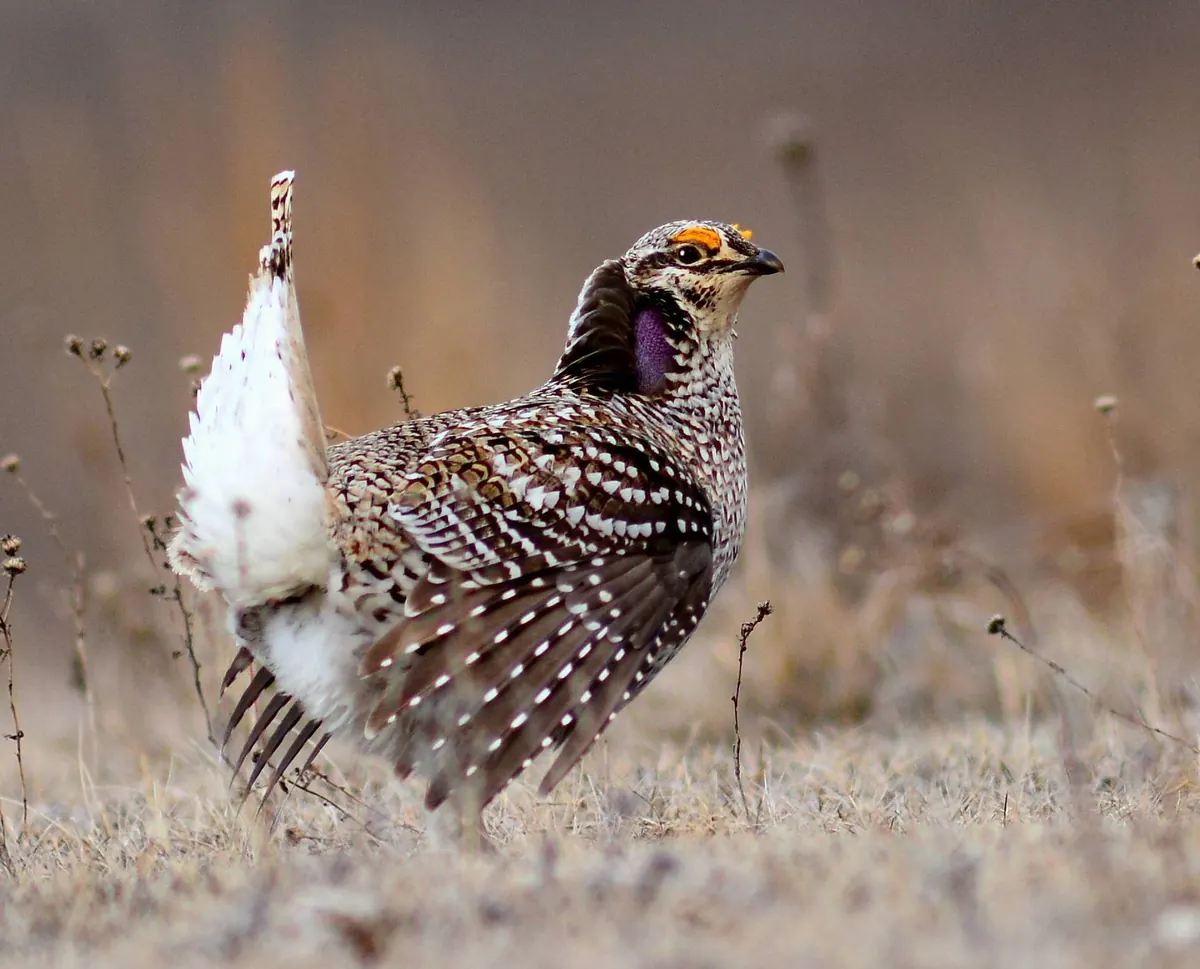
Sharp-tailed grouse males dance with wings spread and tails up, rattling their tail feathers and stamping so fast their feet blur. Birds of Nebraska records displaying males on leks as early as February 13, though most hens don’t visit until spring.
-
Greater prairie-chickens
Lek visits by males can start in late winter; the main season is March to May · Central Nebraska, the Sandhills’ eastern and southern edges, the Republican valley, parts of the Rainwater Basin and the southeast
Prairie-chicken males inflate orange air sacs on their necks and give a low, hollow “booming” that Game and Parks says can carry a mile. A lek on Mormon Island near Grand Island was occupied by males from January 30 in 2015, more than a month ahead of the usual lekking season, possibly a response to a run of mild weather. Late-February flocks can be large: 160 along a road in Lincoln County on February 19, 2025, and 120 nearby three days later.
If you find a lek, watch from your vehicle and stay put until the birds leave on their own; the same grounds are used year after year, and a flushed lek may not settle again that morning. Guided blinds, such as the sharp-tailed grouse blind Game and Parks has offered at Niobrara State Park, are booked ahead through the parks and ranches that run them, mostly for March and April mornings.
What are skunks and coyotes doing in February in Nebraska?
For several of Nebraska’s mammals, late winter is the breeding season, and that means more of them are out and about at night. You may notice them on the road, on a trail camera or, in one case, by smell.
-
Striped skunks on the move
Mating from mid-February to mid-March · Statewide, especially around farmsteads, towns and woodland edges
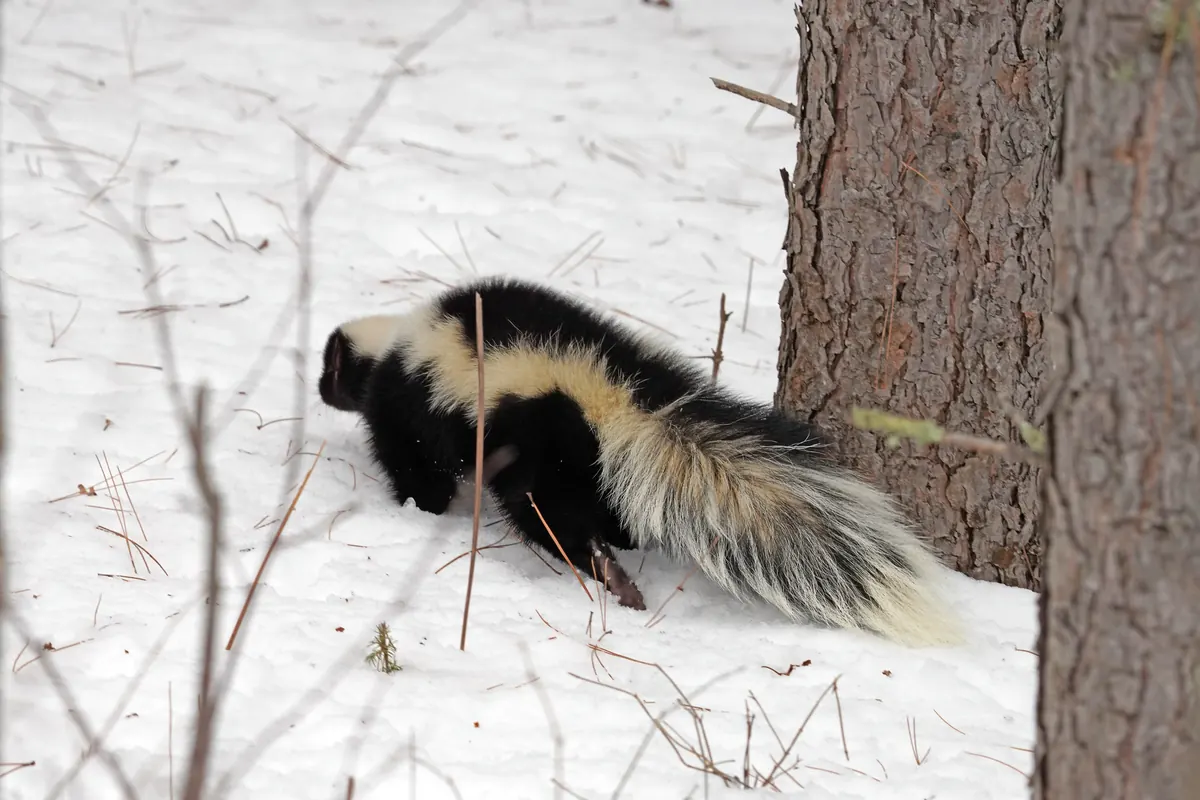
Skunks don’t truly hibernate. Nebraska Extension’s guide to them says they can stay in their dens for days or weeks in bitter cold, and that females often share a den while males live alone. In mid-February the males go looking, covering up to 5 miles a night. Females that aren’t interested sometimes spray their suitors, which explains the sudden whiff of skunk on a February evening. Kits are born about 63 days after mating.
-
Coyotes pairing and denning
Breeding mainly January to March · Statewide, including city edges
Coyotes breed once a year, mostly between January and March, and pups arrive after about a nine-week pregnancy. For a den they often dig out or enlarge a hole first made by some smaller animal, and some dens run 50 feet with several entrances. Fresh snow may show two coyote trails running side by side.
Is February snowy in Nebraska, and how might El Niño shape the end of winter?
February is a little milder than January, with average afternoon highs from the upper 30s in Omaha to the mid-40s in Scottsbluff and North Platte, according to NOAA’s 1991–2020 normals. It is also, at all six airports in the table, a snowier month than January on average, even though it has three fewer days.
This winter the equatorial Pacific is in an exceptionally strong El Niño. A September 10 federal update rated a very strong event through December–February as better than 90 percent likely. Nebraska’s state climatologist and colleagues at the University of Nebraska–Lincoln wrote on September 21 that past strong events most dependably brought warmth, while rain and snow were a toss-up. The most recent of the three events they compared, 2015–16, shows why that matters for February. The High Plains Regional Climate Center’s summary of February 2016 reports a very warm month across the region, yet a storm on February 1–2 brought blizzard conditions to central Nebraska and closed Interstate 80. Grand Island picked up 17.0 inches on the 2nd alone, its biggest one-day February snowfall on record, and Lincoln finished the season with its wettest winter on record. A warm-leaning winter, in other words, still has room for a big February storm.
NOAA’s official outlook for the season comes out in mid-October and is updated every month; find the newest maps through the NOAA seasonal outlook page, where the issue released in mid-January spans February to April.
| Station | Average high | Average low | Precipitation | Snowfall |
|---|---|---|---|---|
| Omaha Eppley Airfield | 38.6 °F | 19.3 °F | 0.95 in | 7.8 in |
| Lincoln Municipal Airport | 40.6 °F | 18.4 °F | 0.89 in | 7.1 in |
| Grand Island Airport | 40.4 °F | 19.1 °F | 0.74 in | 7.3 in |
| North Platte Regional Airport | 43.9 °F | 14.8 °F | 0.57 in | 6.9 in |
| Valentine Miller Field | 40.9 °F | 14.2 °F | 0.61 in | 6.5 in |
| Scottsbluff Heilig Airport | 44.6 °F | 17.0 °F | 0.56 in | 7.5 in |
Before a crane or goose trip, the forecast guide helps you read what the models expect for the weekend. Gardeners can start counting toward spring with the last-frost dates for Nebraska towns.
How much daylight does Nebraska gain in February?
By February the returning light is plain to see. Across the eight towns below, days lengthen by 65 to 72 minutes between February 1 and February 28, about two and a half minutes a day, shared fairly evenly between mornings and evenings. Valentine starts the month just under 10 hours and, like the rest of the state, finishes it with more than 11.
| City | Feb 1 | Feb 28 | Gained | Per day |
|---|---|---|---|---|
| Omaha | 10 h 05 m | 11 h 13 m | 68 min | 2.5 min |
| Lincoln | 10 h 07 m | 11 h 15 m | 68 min | 2.5 min |
| Norfolk | 10 h 01 m | 11 h 12 m | 71 min | 2.6 min |
| Grand Island | 10 h 06 m | 11 h 14 m | 68 min | 2.5 min |
| McCook | 10 h 10 m | 11 h 15 m | 65 min | 2.4 min |
| North Platte | 10 h 06 m | 11 h 14 m | 68 min | 2.5 min |
| Valentine | 9 h 58 m | 11 h 10 m | 72 min | 2.7 min |
| Scottsbluff | 10 h 03 m | 11 h 13 m | 70 min | 2.6 min |
The daylight tool gives sunrise and sunset for any Nebraska town, day by day, through the switch to daylight saving time on March 14.
What can you see in the Nebraska night sky in February?
Two bright planets reach opposition in Leo this month, nine days apart. Nebraska straddles two zones, so each time is given twice, in Central standard time (CST) for the east and center and Mountain standard time (MST) for the Panhandle and the far southwest.
-
Mercury low in the evening twilight
Late January to about February 10; best around February 2–3 · Low in the west-southwest, 30 to 45 minutes after sunset
Early February gives Mercury’s finest evening display of the winter, with its widest gap from the Sun coming at about midnight CST on the night of the 2nd (11 p.m. MST). Look just above the west-southwest horizon in deep twilight; a flat Plains skyline helps. A hair-thin crescent Moon joins it after sunset on Sunday the 7th, a good binocular target.
-
Jupiter at opposition
Wednesday, February 10, and the weeks around it · Low in the east at dusk, high in the south near midnight
At opposition, Jupiter and the Sun lie on opposite sides of Earth, so the giant planet clears the eastern horizon around dusk and is still up at dawn. The exact moment is 6:21 p.m. CST (5:21 p.m. MST) on Wednesday the 10th, but the view is as good for weeks either side. Nothing in the evening sky except the Moon outshines it. Binoculars held steady on a fence post show its largest moons as specks in a row, reshuffled every night.
-
Mars at opposition
Friday, February 19 · Up all night in Leo, near Jupiter and Regulus
The red planet’s turn comes Friday morning, the 19th, with its closest pass the next day at roughly 63 million miles. With Mars out near the far end of its lopsided orbit, the planet makes a modest showing: a steady orange light, bright to the eye but tiny in a telescope, and there won’t be another opposition until 2029. Regulus, Leo’s brightest star, shines a few degrees away. Late on Friday the 19th, the almost-full Moon slides just past Jupiter.
-
The Snow Moon and a faint eclipse
Saturday, February 20 · Rising in the east around sunset
The Snow Moon is full at 5:23 p.m. CST (4:23 p.m. MST), so it rises already round in the dusk. It is close to perigee, and a few almanacs label it a supermoon, though stricter lists leave it off. A penumbral eclipse of the Moon is happening at the same time, but by moonrise in Nebraska its deepest part is over. In Central time the last of it fades at 7:13 p.m. CST; at best you might sense a faint dusky tint on one side of the disk, and most watchers will see nothing unusual. In Mountain time it is over at 6:13 p.m. MST, before the Moon has cleared the horizon haze. Nobody in Nebraska will see the February 6 annular solar eclipse, which is confined to the Southern Hemisphere.
| Phase | Date | Time |
|---|---|---|
| New moon | Saturday, Feb 6 | 9:56 a.m. CST (8:56 a.m. MST) |
| First quarter | Sunday, Feb 14 | 1:58 a.m. CST (12:58 a.m. MST) |
| Full moon, the Snow Moon | Saturday, Feb 20 | 5:23 p.m. CST (4:23 p.m. MST) |
| Last quarter | Saturday, Feb 27 | 11:16 p.m. CST (10:16 p.m. MST) |
Groundhog Day falls on Tuesday, February 2, though winter’s real halfway mark between the solstice and the March equinox comes on the 3rd or 4th. For dark-sky stargazing, aim for the moonless evenings around the February 6 new moon, roughly the 2nd through the 11th. Although the sunspot cycle has passed its maximum, a strong geomagnetic storm can still light up the northern horizon; alerts come from NOAA’s Space Weather Prediction Center. Our cloud outlook tells you if the night will be clear, and the lunar calendar gives moonrise times for Nebraska towns.
What can Nebraska families do outdoors in February 2027?
Few organizers had posted February 2027 programs by early October, so dated events below are only those already confirmed. Vehicles in state parks need a park entry permit.
- Great Backyard Bird Count, Friday, February 12, through Monday, February 15: four days over Presidents’ Day weekend, organized by Cornell, Audubon and Birds Canada. Count for a quarter hour or longer at a feeder, a field edge or a goose-filled sky and enter the tally in eBird or Merlin.
- A first crane trip: the Crane Trust Nature and Visitor Center near Wood River is open most of the year, with trails and exhibits, and late-February afternoons there can bring the season’s first crane flights. Rowe Sanctuary’s 2027 crane registration opens January 7; its trails are restricted from February 15.
- Eagle viewing rooms: the free heated rooms at J-2 near Lexington and Kingsley Dam near Ogallala stayed open on weekend mornings until February 22 last winter; the district’s page will show this season’s dates once they are set.
- Game and Parks nature programs: nature centers such as Schramm near Gretna and the Wildcat Hills near Gering hold winter programs for children and families. Watch the Game and Parks events calendar.
- Citizen science: Project FeederWatch counts continue into April, eBird takes first-arrival dates for blackbirds, killdeer and meadowlarks, and iNaturalist is a good home for photos of tracks in late snow.
Each Nebraska month has its own page in the nature guide, from October onward.
Safety notes for February in Nebraska
- Hunting and trapping in February 2027 (Nebraska Game and Parks): all deer seasons ended January 15, and elk, antelope, pheasant, quail, partridge and prairie grouse closed January 31. Still open: squirrel, cottontail and jackrabbit through February 28, and crow through March 11. In the Platte River and Niobrara units, dark goose hunting continues until February 9, the same closing day as the statewide white-fronted and light goose seasons. The spring Light Goose Conservation Order then opens February 10 and runs to April 5 in the West and Rainwater Basin zones and to April 15 in the East zone, so expect hunters in fields and wetlands across the south and center. Bobcat, fox, raccoon, opossum, badger, mink, weasel and river otter seasons close February 28; beaver and muskrat trapping continues to March 31. The 2027 mountain lion season had not been announced in early October; the 2026 season ran from January 2 to February 28.
- Hunter orange: Nebraska law requires a minimum of 400 square inches of blaze orange, but only during firearm seasons for deer, antelope, wild turkey, elk and bighorn sheep, and none of those is open in February. Goose hunters dress in camouflage and lie in the fields, so non-hunters on public land should still put on something blaze orange.
- Thawing ice: February ice is the least trustworthy of the winter. A few days above freezing turns it gray and honeycombed, and it can lose strength even while it still looks thick. For one person on foot, Game and Parks advises no less than 4 inches of clear ice; white or slushy ice needs twice as much. Keep well away from inlets, culverts and the open holes where geese and eagles gather.
- Blizzards and wind: as the 2016 Groundhog Day storm showed, a mild winter can still deliver a crippling February blizzard. Check Nebraska 511 before driving the Interstate or Sandhills highways, carry a winter kit, and if you get stuck, stay with your vehicle.
- Daylight: even on February 28 Nebraska has only a little over 11 hours of daylight. Plan crane and goose outings so you are back to the car before it gets fully dark.
Sources
- Birds of Nebraska Online (Nebraska Game and Parks): sandhill crane (read from the archived copy at web.archive.org)
- Birds of Nebraska Online: snow goose
- Birds of Nebraska Online: Ross’s goose
- Birds of Nebraska Online: greater white-fronted goose
- Birds of Nebraska Online: northern pintail
- Birds of Nebraska Online: bald eagle
- Birds of Nebraska Online: red-tailed hawk
- Birds of Nebraska Online: great horned owl
- Birds of Nebraska Online: horned lark
- Birds of Nebraska Online: red-winged blackbird
- Birds of Nebraska Online: western meadowlark
- Birds of Nebraska Online: killdeer
- Birds of Nebraska Online: American robin
- Birds of Nebraska Online: common grackle
- Birds of Nebraska Online: mountain bluebird
- Birds of Nebraska Online: American woodcock
- Birds of Nebraska Online: sharp-tailed grouse
- Birds of Nebraska Online: greater prairie-chicken
- Audubon’s Iain Nicolson Audubon Center at Rowe Sanctuary: crane season (2027 dates and registration)
- Explore.org: Rowe Sanctuary crane camera
- Crane Trust: crane viewing
- Crane Trust: visit
- U.S. Fish and Wildlife Service: Rainwater Basin Wetland Management District, species
- U.S. Fish and Wildlife Service: Rainwater Basin Wetland Management District, about
- U.S. Fish and Wildlife Service: National Bald Eagle Management Guidelines (2007), 330-foot buffer for non-motorized recreation
- Nebraska Game and Parks: wildlife viewing timeline
- Nebraskaland Magazine: February wildlife viewing, bald eagles
- Nebraskaland Magazine: Winter Wildlife Viewing (J-2 and Kingsley peaks)
- Nebraska Game and Parks: explore opportunities for early spring wildlife watching (prairie grouse, Niobrara State Park blind)
- Central Nebraska Public Power and Irrigation District: eagle viewing facilities (2025–26 schedule and weekend counts)
- Nebraska Extension NebGuide G1769: Dealing with Skunks
- Internet Center for Wildlife Damage Management: coyote biology
- Nebraska Game and Parks: hunting seasons 2026–27 (read from the September 25, 2026 archived copy)
- Nebraska Revised Statute 37-527, hunter orange
- Nebraska Game and Parks: top 8 ice safety tips
- Nebraska Game and Parks: park permits
- Nebraska Game and Parks: events calendar
- Nebraska 511 traveler information
- NOAA NCEI: 1991–2020 U.S. climate normals
- NOAA NCEI: 1991–2020 monthly normals for Omaha, Lincoln, North Platte, Valentine, Scottsbluff and Grand Island
- High Plains Regional Climate Center: February 2016 climate summary
- CPC ENSO diagnostic discussion, September 10, 2026
- CPC: seasonal (90-day) outlooks
- Nebraska State Climate Office: What does the 2026 El Niño mean for Nebraska? (Sept. 21, 2026)
- U.S. Naval Observatory: moon phases
- U.S. Naval Observatory: Earth’s seasons and apsides, 2027
- U.S. Naval Observatory: one-day sun and moon data
- Fred Espenak, Sky Event Almanac 2027
- NASA Goddard: lunar eclipses 2021–2030
- NASA Goddard: solar eclipses 2021–2030
- EarthSky: Jupiter at opposition
- Old Farmer’s Almanac: eclipses
- NOAA Space Weather Prediction Center: aurora dashboard
- National Audubon Society: Great Backyard Bird Count (February 12–15, 2027)
- Project FeederWatch
- eBird
- iNaturalist
- Photos via Wikimedia Commons; licenses and photographers are credited under each picture
