What to look for in nature in Nebraska this October
October in Nebraska starts in the west and finishes in the east. The Pine Ridge usually has its first freeze before the month begins, while Omaha typically waits until about the 21st. In between, whooping cranes drop onto Platte River sandbars for a night or two, pintails and white-fronted geese pour into the Rainwater Basin, bull elk are still bugling south of Chadron, and the cottonwoods along every river go yellow. The notes below go across the state from the buttes to the Missouri, each with its dates and sources.
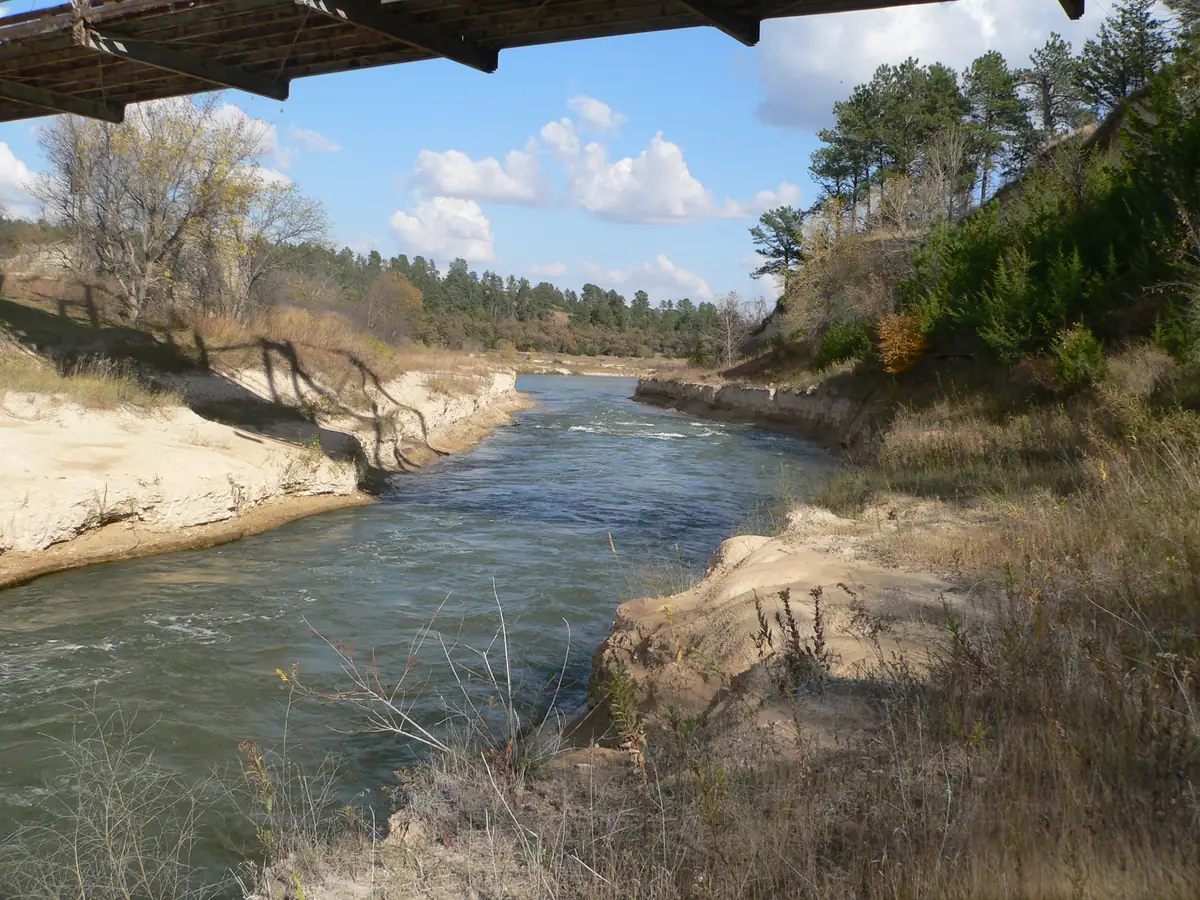
Start here
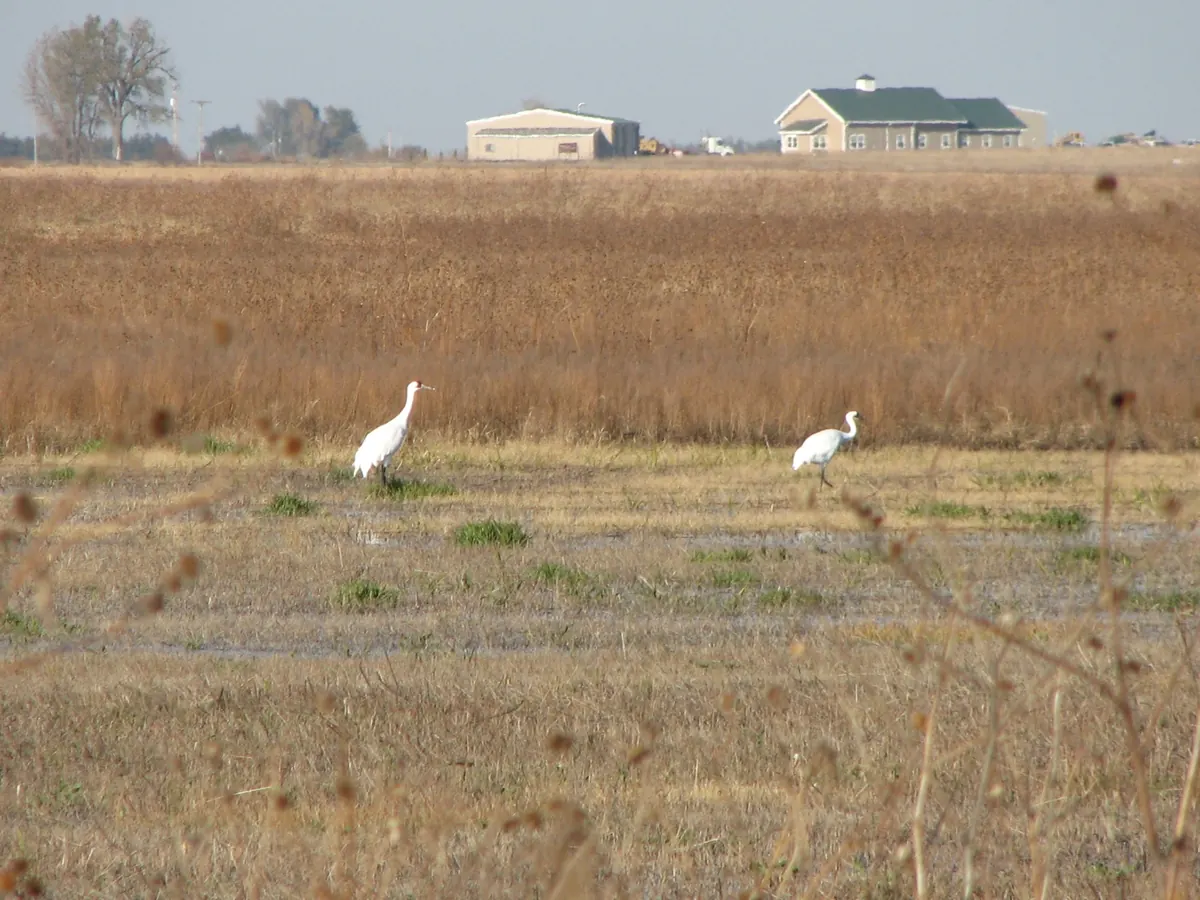
- Whooping cranes on the Platte. Most fall whooping crane sightings in Nebraska come between mid-October and early November, on the central Platte between Grand Island and Kearney and in the shallow wetlands of the Rainwater Basin. They rarely stay more than a few days. Watch from your car, a long way off.
- The first freeze, west to east. By NOAA’s 1991–2020 normals, the typical first 32 °F night comes on September 30 at Chadron, October 1 at North Platte, October 13 at Lincoln and October 21 at Omaha’s Eppley Airfield. In the Panhandle, the first snow arrives before Halloween more often than not.
- Jupiter vanishes behind the Moon. Jupiter goes behind a thin crescent Moon before dawn on Tuesday, October 6. In Omaha and Lincoln the planet disappears at about 3:22 a.m. with the Moon barely risen and comes back at about 4:13 a.m.; in the Panhandle it comes back around 3:11 a.m. Mountain time. The Hunter’s Moon is full late on Sunday, October 25.
For the Naturalist’s Field Journal this month: a whooping crane, if you are lucky, or a skein of white-fronted geese goes on the “birds I have seen” list with the date and the wetland. Give one cottonwood its own tree-through-the-seasons page, press a ponderosa cone or a sumac head onto the seeds, pods and cones plate, and give the October 6 occultation a dusk-and-dawn entry. An elk bugle or a crane’s rattle belongs on the map of sounds.
Regions used below: The Panhandle and Pine Ridge; The Sandhills and Niobrara valley; Southwest Nebraska and the Republican valley; The central Platte and Rainwater Basin; Northeast Nebraska and the Missouri bluffs; Lincoln, Omaha and the southeast.
When do whooping cranes and sandhill cranes pass through Nebraska in the fall?
Spring is Nebraska’s famous crane season, when hundreds of thousands of sandhills pack the Platte. Fall is quieter and far less predictable, but it is the season with the best chance of seeing the rarest crane in North America.
-
Whooping cranes
Mid-October to early November; most reports late October · Central Platte River between Grand Island and Kearney; Rainwater Basin wetlands; Loup River system
The one self-sustaining wild flock, which nests in northern Canada and winters on the Texas coast, crosses Nebraska twice a year. Nebraska Game and Parks puts the fall peak from late October into early November, mostly along the central Platte, in the Rainwater Basin and on the Loup; the Central Platte Natural Resources District adds that most birds stay only a few days. A 2022 study in the journal Avian Conservation and Ecology found that more than 27 percent of all Nebraska whooping crane records from 1995 to 2015 came from the central Platte valley, and that birds lingered longer where there were shallow wetlands to feed in.
Once in a while they gather. In November 2021 about 95 whooping cranes stopped on the Platte near Rowe Sanctuary, a group the district calls the largest ever documented in the United States outside the Aransas refuge on the Texas coast. Scan any big white birds on a wet field or river bar for black wingtips, stay in the car, and report sightings to the Crane Trust or the U.S. Fish and Wildlife Service rather than posting the spot online.
-
Sandhill cranes: brief and scattered
Late September through mid-December; late October and early November busiest · Central Platte; smaller groups on the North Platte River and Sandhills wetlands
The Platte River Recovery Implementation Program sums up the fall pattern plainly: sandhills come through from late September to mid-December, peak in late October and early November, and often stop for a single night on their way south. Audubon notes why: in autumn the midcontinent flocks stage farther north and then move briskly south. That may be changing. The Crane Trust reported about 50,000 sandhills on the Platte in mid-November 2024, and roughly 17,000 of them spent the whole winter, the first time more than 5,000 had overwintered on the river. Whether 2026 repeats it depends on weather to the north. At dusk near Gibbon, Alda or Wood River, the bugling rattle of a passing flock usually arrives well before the birds come into view.
What other birds come through Nebraska in October?
October is when Nebraska’s wetlands fill. By the U.S. Fish and Wildlife Service’s figures, 90 percent of North America’s white-fronted geese, nearly half its mallards and 30 percent of its northern pintails rest and feed in the Rainwater Basin, most of them in spring, and the basin is also a site in the Western Hemisphere Shorebird Reserve Network.
-
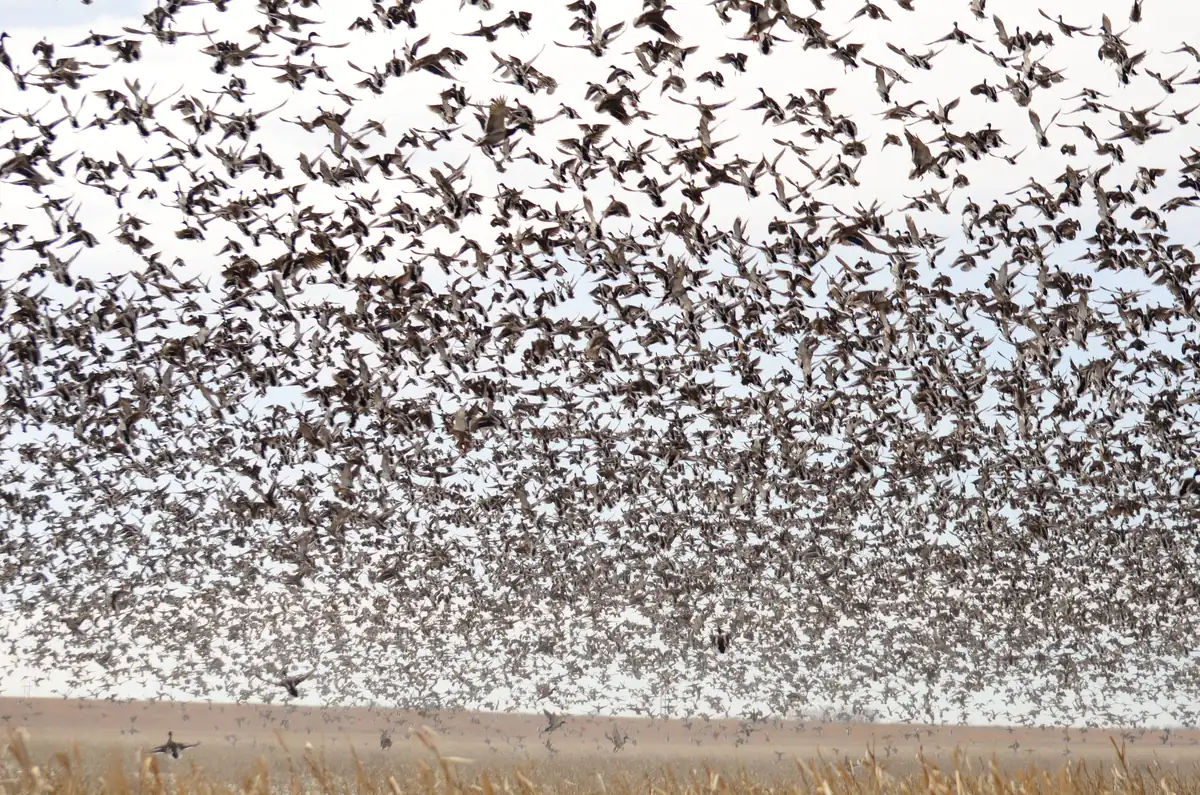
Pintails and white-fronted geese in the Rainwater Basin
Pintails peak in October; geese build into November · Waterfowl Production Areas from York and Clay counties west to Phelps and Kearney counties
The Rainwater Basin is a scatter of shallow, clay-bottomed playa wetlands south of the Platte, and in a dry fall some hold water only because managers pump it in. Nebraska Game and Parks lists northern pintail numbers here as peaking in October. The 61 Waterfowl Production Areas the U.S. Fish and Wildlife Service manages are open for birding, but they are also hunted, so on October weekends go at midday, stay on the roads and wear something bright. Most basins are private; view from public roads.
-
Loons, grebes and Franklin’s gulls on the big lakes
Gulls early to mid-month; loons and horned grebes mid to late month · Lake McConaughy, Branched Oak, Harlan County, the Omaha-area reservoirs
The Audubon Society of Omaha’s migration calendar gives October a clear order. Large flocks of Franklin’s gulls come first, double-crested cormorants gather on the lakes, and common loons and horned grebes peak in the second half of the month, with western and eared grebes on the water all month. Late in October the ducks and geese build on the reservoirs and the first American tree sparrows return to country roadsides.
-
Hawks on the move
All month, best on northwest winds after a front · Open country statewide; the Missouri River bluffs
Harriers, sharp-shinned, Cooper’s and red-tailed hawks move through all month by the Omaha calendar, with ospreys, kestrels and Swainson’s hawks early. The Swainson’s, bound for Argentina, are mostly gone by mid-month.
-
Sparrows at Spring Creek Prairie
October; SparrowFest October 23–25 · Spring Creek Prairie Audubon Center, Denton, southwest of Lincoln
Tallgrass prairie in October is sparrow country, and a morning in the grass and plum thickets can turn up Harris’s, Lincoln’s, fox and white-crowned sparrows. Spring Creek Prairie celebrates them with SparrowFest from Friday evening, October 23, to Sunday, October 25, including banding demonstrations, a sketching workshop and a program for children and families. Its guided Third Tuesday Bird Outing meets Tuesday, October 20, from 8 to 10 a.m., for beginners and experts alike.
-
Blue jays, siskins and an honest finch forecast
October into November · Feeders and shelterbelts
Blue jays are moving in force: the Finch Research Network, in its September 25 outlook, cites more than 13,000 over Hawk Ridge in Minnesota on September 16 and expects a big flight, plus some pine siskins roaming between seed crops. Red-breasted nuthatches, redpolls, crossbills and Bohemian waxwings should mostly stay north this winter, since northern cone and seed crops are good.
eBird’s October Big Day falls on Saturday, October 10. Even one checklist from a backyard or a city park adds a Nebraska data point to the global count, and the list you make that morning can go straight into the journal’s “birds I have seen” pages.
When do the leaves turn in Nebraska, and where is the best fall color?
Nebraska’s color follows its trees, and its trees follow its rivers and escarpments. Visit Nebraska’s byway guide puts the Pine Ridge and the U.S. 20 corridor from Harrison to Valentine at their best in early to mid-October and the Outlaw Trail along Highway 12, from Valentine east to Ponca, in the middle to late part of the month. The Missouri River bluffs in the southeast usually come last, at the end of October.
-
The Niobrara valley
Mid-October · Valentine to Norden; Smith Falls State Park; Fort Niobrara National Wildlife Refuge
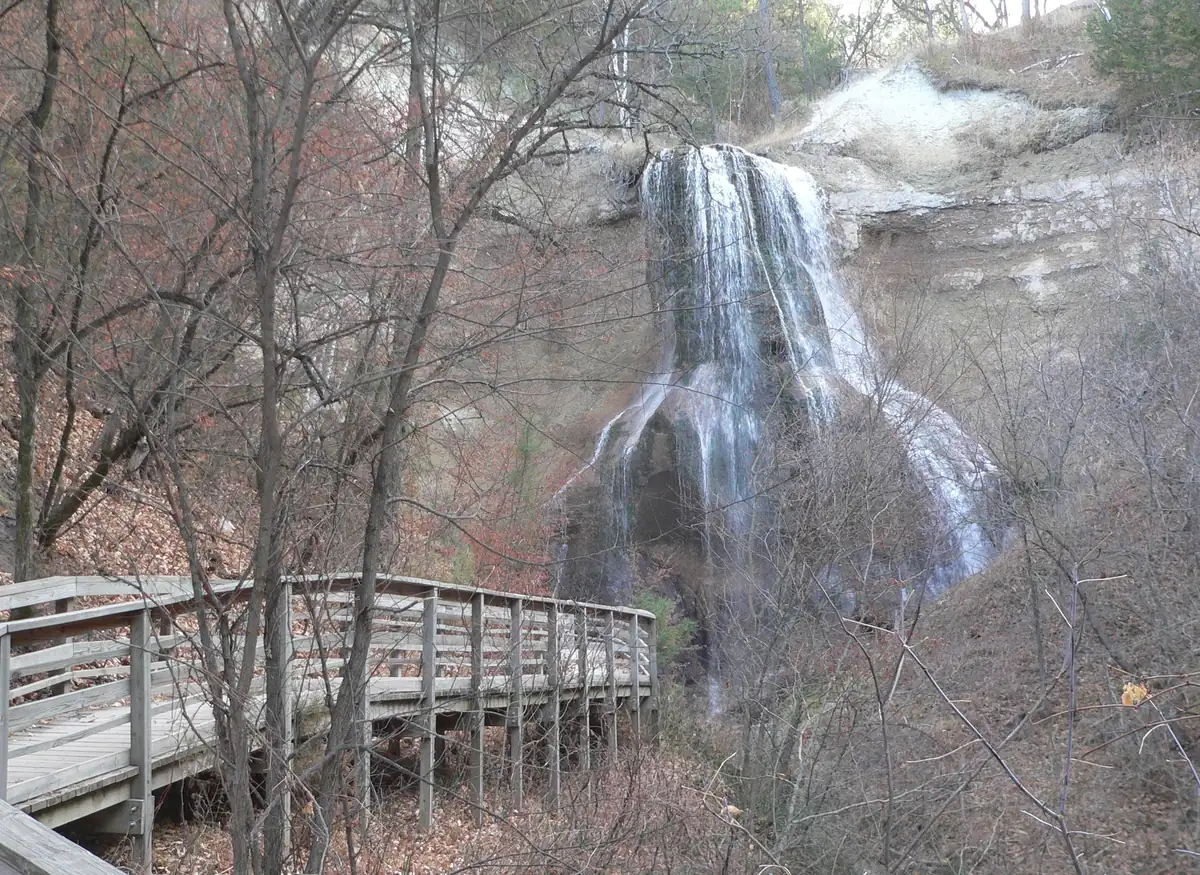
The National Park Service calls the Niobrara valley a biological crossroads: northern boreal forest, western ponderosa pine forest, eastern deciduous woods and three kinds of prairie meet along one river, and about 160 plants and animals live at the edges of their ranges there. More than 230 waterfalls drop into the river along its western stretch, the tallest being Smith Falls at about 63 feet.
-
Pine Ridge, Wildcat Hills and Scotts Bluff
Early to mid-October · Chadron and Fort Robinson state parks; Pine Ridge National Recreation Area; Wildcat Hills
Out west the color is gold rather than red: cottonwoods and green ash in the draws, chokecherry and skunkbush sumac on the slopes, all set against dark ponderosa pine. Fragrant sumac, which Nebraska Statewide Arboretum writers recommend for western yards partly for its fall color, turns orange and scarlet on the buttes.
-
Indian Cave, Ponca and the Missouri bluffs
Late October into early November · Indian Cave State Park near Shubert; Ponca State Park; Fontenelle Forest in Bellevue
The loess bluffs along the Missouri hold Nebraska’s most eastern forest: oaks, hickories, sugar maple in the ravines, and redbud and pawpaw at their western limits. Nebraska Game and Parks names Indian Cave among its best parks for fall color, and Fontenelle Forest says its color carries from October through November across 17 miles of trail. Shining sumac on the roadcuts and prairie edges goes red first, often before any tree.
Some yellowing is not autumn color at all. A Nebraska Statewide Arboretum forester notes that pines and spruces drop their oldest inner needles each fall, white pines most visibly, and that it is not a disease. Choose a single tree, photograph it weekly from one spot, and note the date the last leaf falls; the Field almanac has a satellite estimate of leaf-off for your coordinates to check it against.
What are elk, bison, deer and monarchs doing in Nebraska in October?
The big mammals of the west are in the rut or getting ready for winter, and the last insects of the year are either leaving or looking for a warm crack in your siding.
-
Elk bugling in the Pine Ridge
September through early October · Pine Ridge National Recreation Area south of Chadron; Fort Robinson State Park
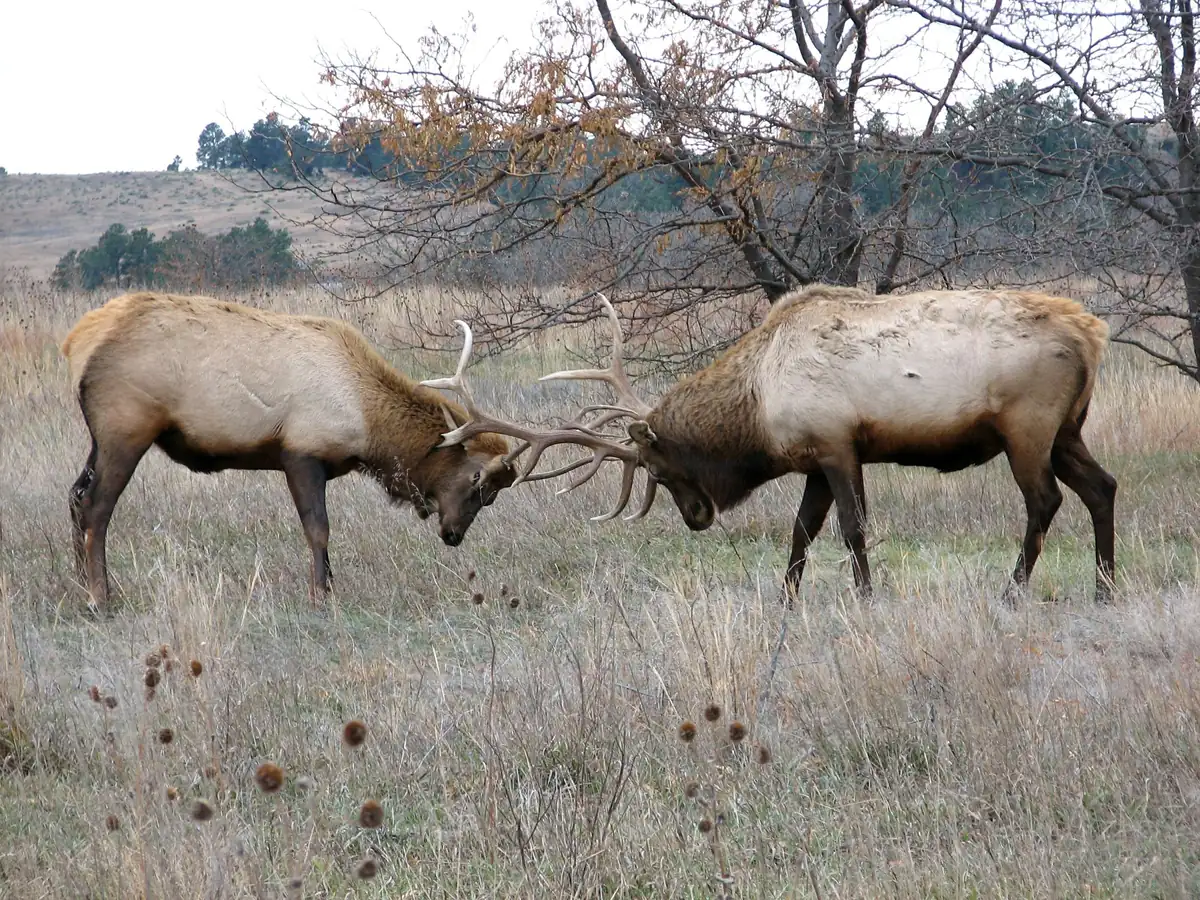
Nebraska’s tourism office sends elk watchers to the Pine Ridge National Recreation Area from September through October for the mating season, when bulls bugle and sometimes spar. The peak is usually in September, so early October gives you the tail of it, best at first light on a calm, cold morning. An estimated 2,500 elk now live in the western third of the state, in the Pine Ridge, the Wildcat Hills, the Loess Canyons and along the North Platte. Stay in the car or at a distance; a rutting bull is short-tempered.
-
Bison and bighorns
Bison year-round; bighorn rut late November · Fort Niobrara National Wildlife Refuge near Valentine; Fort Robinson and Chadron state parks; Cedar Canyon WMA near Gering
Fort Niobrara keeps a herd of about 350 bison and rounds them up each fall to check their health and genetics, sending surplus animals to tribes. The roundup is not a public event, but the herd is often visible from refuge roads. Bighorn sheep, reintroduced at Fort Robinson and now established in the Pine Ridge and Wildcat Hills, are easiest to find on the buttes in late November and early December when the rams butt heads, though October scans of the Fort Robinson pinnacles sometimes find a band.
-
Deer on the move
Rut building from late October; peak in November · River corridors, shelterbelts and crop edges statewide
With corn and soybeans coming out of the fields, white-tailed and mule deer lose their cover and start to travel. Bucks rub saplings and scrape the ground in late October ahead of the November rut. This is also when collisions rise, so treat every creek crossing at dusk as a place a deer may step out.
-
Monarchs: the last few
Stragglers into early October · Late asters and goldenrod
For Omaha, North Platte and Scottsbluff, all near 41° N, Monarch Watch dates the heaviest flight to September 8–20; along the South Dakota line it comes a few days sooner. By October only stragglers remain, usually on a warm afternoon with a south wind, working the last aster or goldenrod before the next front. The last monarch of the year in your yard is worth a date on the pollinator watch plate and a report to Journey North.
Soft mud at the edge of a drying wetland holds tracks well; copy one onto the journal’s “tracks to know” plate.
Where can you catch a stocked rainbow trout in Nebraska this fall?
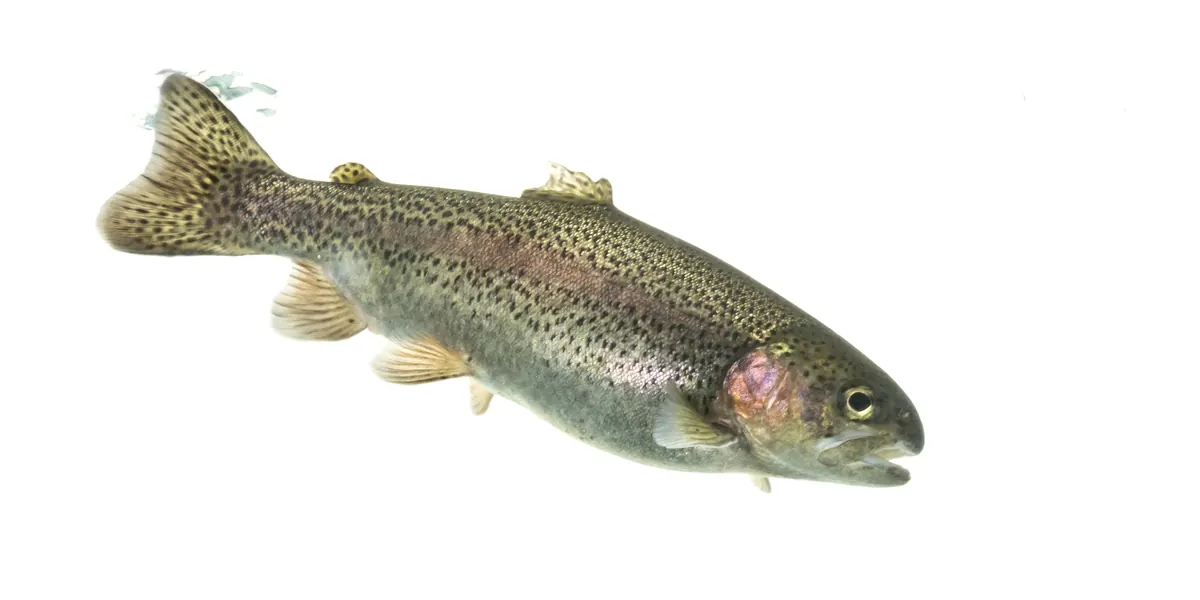
Nebraska Game and Parks began releasing thousands of 12-inch rainbow trout into community lakes and ponds in late September 2026, its annual fall stocking that keeps trout in town waters through the winter. They make a fine first fish for a child; a worm on a hook is enough.
-
West first, then east
Late September to late October · Fort Robinson and Chadron ponds first; Lincoln, Omaha, North Platte and South Sioux City in mid-October
The 2026 list is on the Game and Parks website; last year’s shows the pattern. Fort Robinson and Chadron ponds came first, in late September, and the week of October 6 put 3,000 into Crystal Cove Lake at South Sioux City. The week of October 13 brought 2,500 to Holmes Lake in Lincoln, 2,000 to Kramer Park Lake in Bellevue and about 1,300 across three Omaha park ponds. The week of October 20 put 3,000 into Birdwood Lake at North Platte and 1,500 into Grove Lake near Royal. Check the current schedule before you go; the fish are easiest to catch in the first days after a release.
Jot the water temperature beside each catch in the daily field log.
When is the first frost and freeze in Nebraska?
Nebraska’s first freeze is a west-to-east story with some local twists. In the Pine Ridge and the high Panhandle it usually comes before October begins: Chadron’s median is September 30, Alliance’s September 22, and two stations in the Agate area of Sioux County have a median of September 11. Across the Sandhills and the central Platte it falls in the first half of October, and Omaha and the Missouri River towns wait until the third week. Low ground freezes first. North Platte’s airport, in the valley, has a median of October 1, while Kingsley Dam, on the shore of Lake McConaughy 60 miles upstream, holds out until October 18, because the big lake keeps nights warmer. White frost on lawns and car roofs can show up several nights before the thermometer itself reaches 32.
| Station | One year in ten | Median | Nine years in ten |
|---|---|---|---|
| Chadron Municipal Airport (Pine Ridge) | Sep 15 | Sep 30 | Oct 11 |
| Scottsbluff Heilig Airport (Panhandle) | Sep 21 | Oct 4 | Oct 15 |
| Valentine Miller Field (northern Sandhills) | Sep 16 | Sep 29 | Oct 12 |
| North Platte Regional Airport (west-central) | Sep 16 | Oct 1 | Oct 13 |
| Mccook Municipal Airport (southwest) | Sep 26 | Oct 9 | Oct 22 |
| Norfolk Karl Stefan Airport (northeast) | Sep 21 | Oct 5 | Oct 18 |
| Grand Island Airport (central Platte) | Sep 29 | Oct 15 | Oct 27 |
| Lincoln Municipal Airport (southeast) | Sep 29 | Oct 13 | Oct 24 |
| Omaha Eppley Airfield (Omaha) | Oct 6 | Oct 21 | Nov 1 |
Every Nebraska station in NOAA’s normals, more than 180 of them, is on the Nebraska frost dates page. West of Kearney, assume the tomatoes are finished by the first week of October; in Lincoln and Omaha they often last to mid-month. On the first clear, still, dry night in the forecast, bring in the pots and pick what is left, then write down the morning ice first forms on the birdbath.
How much daylight does Nebraska lose in October?
Between 77 and 82 minutes, or 2.6 to 2.7 minutes each day. The north loses a little more than the south: Valentine drops 82 minutes over the month, Omaha 78, Lincoln and Kearney 77. In Omaha, sunrise moves from 7:21 to 7:54 a.m. and sunset from 7:05 to 6:20 p.m. Scottsbluff, on Mountain time, goes from a 6:52 sunrise and 6:36 sunset on the first to 7:26 and 5:50 by month’s end. Standard time returns in both of Nebraska’s time zones early on Sunday, November 1.
| City | Oct 1 | Oct 31 | Lost | Per day |
|---|---|---|---|---|
| Omaha | 11 h 44 m | 10 h 26 m | 78 min | 2.6 min |
| Lincoln | 11 h 45 m | 10 h 28 m | 77 min | 2.6 min |
| Norfolk | 11 h 44 m | 10 h 24 m | 80 min | 2.7 min |
| Grand Island | 11 h 45 m | 10 h 27 m | 78 min | 2.6 min |
| Kearney | 11 h 45 m | 10 h 28 m | 77 min | 2.6 min |
| North Platte | 11 h 45 m | 10 h 27 m | 78 min | 2.6 min |
| Valentine | 11 h 43 m | 10 h 21 m | 82 min | 2.7 min |
| Scottsbluff | 11 h 44 m | 10 h 24 m | 80 min | 2.7 min |
Type an address into the Field almanac for sunrise, sunset and the weekly loss at that spot.
What is October weather like in Nebraska, and what could El Niño mean for the winter?
October brings warm afternoons, cold nights and a wide daily swing. Averaged over 1991–2020 in NOAA’s station records, October highs run about 63 to 66 °F almost everywhere, from Valentine to Lincoln, but the lows split the state in two: about 40 to 42 °F in Lincoln and Omaha and about 33 to 34 °F at Scottsbluff, North Platte and Valentine, where dry air and altitude let the heat escape on clear nights. Rain tapers off from east to west, from roughly 2.3 inches in Omaha to 1.2 in Scottsbluff. Dryness is the backdrop in 2026. The U.S. Drought Monitor for September 22 showed that about 76 percent of Nebraska was abnormally dry or worse and 57 percent was in moderate drought or worse.
Snow can come early. We went through NOAA’s daily records for the 30 snow seasons from 1991 to 2020, noting the first day with 0.1 inch or more. Scottsbluff’s median first snow is October 27, and it came by Halloween in 18 of the 30 seasons; Valentine’s median is November 1 and North Platte’s November 2. Farther east, the median first snow is November 11 at Grand Island, November 15 at Omaha and November 21 at Lincoln, and October snow came in only 7 or 8 of those seasons. The storm people remember is October 26, 1997, when 13.2 inches landed on Lincoln’s still-leafy trees.
The bigger question is the winter. A very strong El Niño is now close to certain: the Climate Prediction Center’s discussion of September 10 gives it better than nine chances in ten for fall and winter, and NOAA’s full winter outlook is due in mid-October. Writing on September 21, the Nebraska State Climatologist and University of Nebraska colleagues said the outlook favors a warmer-than-normal winter across Nebraska and leans wet in the south, with no tilt either way in the north. They note that El Niño’s grip on Nebraska is weaker in fall than in winter, so October says little either way. In NOAA’s records for the three strongest El Niño winters since 1950 (1982–83, 1997–98 and 2015–16), every December-to-February season ran warmer than the 1991–2020 average at all six stations we checked, by roughly 1 to 5 °F. Precipitation had no pattern: 2015–16 brought Omaha about 7 inches against a typical 2.9, while 1997–98 left Grand Island under an inch against 2.2. A Weather Service meteorologist in Omaha has cautioned that warm and wet can also mean more ice storms. Three winters are too few for firm rules.
For the days ahead where you live, our plain-language forecast has the details. When NOAA’s winter outlook comes out in October, this page will add a short note on what it says for Nebraska.
What can you see in Nebraska’s night sky in October?
Nebraska has some of the darkest skies in the country, especially in the Sandhills and the Panhandle. Most of the state keeps Central time; the Panhandle and a band of counties just east of it, including Ogallala and Imperial, keep Mountain time, an hour behind. Both are listed here.
-
The Moon covers Jupiter
Before dawn, Tuesday, October 6 · Very low in the east-northeast at first; a flat horizon helps
The 17-percent crescent rises at 2:54 a.m. in Omaha and 2:58 in Lincoln. By International Occultation Timing Association predictions, Jupiter disappears at about 3:22 a.m. in both cities, with the Moon only 3 or 4 degrees up; you will need an open view east and binoculars. The reappearance is the easier half: Jupiter pops back out from the Moon’s dark side at 4:13 a.m. in Lincoln and 4:14 in Omaha, with the Moon about 12 to 13 degrees up. Farther west the pair rise with Jupiter at or behind the lunar edge, so watch for the return instead, close to 4:12 or 4:13 a.m. across central Nebraska. In the Panhandle, where the Moon rises at 2:25 a.m. Mountain time in Scottsbluff, the IOTA times for Cheyenne and Denver put the reappearance at about 3:11 a.m. MDT. The central and western times are our estimates from nearby listed cities.
-
Saturn at opposition
Sunday, October 4, and all month; Moon nearby October 23 and 24 · East after sunset, south around midnight, west before dawn
Saturn is at opposition on October 4. That means sunset-to-sunrise visibility: low in the east at dusk, high in the south near midnight, low in the west at daybreak, and brighter than at any other time this year. It looks like a steady, yellowish star with no bright neighbors. A small telescope shows the rings. Fontenelle Forest in Bellevue holds a stargazing program for the opposition that evening, 7:30 to 9:30 p.m. The gibbous Moon passes close by on the 23rd and 24th.
-
The Draconids
Thursday evening, October 8 · Face north, early in the evening
Unusually, this shower is an evening one, best soon after dark. This year the Moon is a 4-percent crescent that sets at 5:50 p.m. in Omaha, before the Sun, so the whole evening is moonless. Expect only a few meteors an hour, but it is an easy one to try with children before bed.
-
The Orionids
Active October 2 to November 7; best the mornings of October 21 and 22 · Anywhere dark, after moonset
The Orionids are bits of Halley’s Comet. The peak is broad, and a dark rural site may show 10 to 20 an hour in the last hours before dawn. The waxing Moon sets at 2:38 a.m. on Wednesday the 21st and 3:44 a.m. on Thursday the 22nd in Omaha, at 2:58 and 4:04 a.m. in North Platte, and at 2:09 and 3:16 a.m. Mountain time in Scottsbluff. After that you have dark sky until twilight begins around 7:15 a.m. Central.
-
The Hunter’s Moon
Sunday and Monday evenings, October 25 and 26 · Open view east at sunset
Full moon falls at 11:12 on Sunday night, October 25, Central time. Omaha sees it come up at 5:55 p.m., about 33 minutes ahead of the 6:28 sunset, and at 6:27 p.m. on the 26th, the same minute the sun goes down. North Platte sees it rise at 6:15 and 6:47 p.m.; Scottsbluff at 5:25 and 5:57 p.m. Mountain time. It is not a supermoon, but rising orange over a cut cornfield or the Sandhills it does not need to be.
-
Venus leaves the evening, the morning fills up
Venus only in the first few evenings; Jupiter and Mars all month before dawn · West after sunset; east before sunrise
Catch Venus in the opening days of October, just over the western skyline in bright twilight; it is gone within a week, and it reaches inferior conjunction on October 23. The dawn sky is fuller, with brilliant Jupiter in the east and fainter, rust-colored Mars nearby. Sunday, October 11, is the morning to put binoculars on Mars, which will sit among the faint stars of the Beehive cluster in Cancer.
| Phase | Date | Central time | Mountain time |
|---|---|---|---|
| Last quarter | Saturday, Oct 3 | 8:25 a.m. | 7:25 a.m. |
| New moon | Saturday, Oct 10 | 10:50 a.m. | 9:50 a.m. |
| First quarter | Sunday, Oct 18 | 11:12 a.m. | 10:12 a.m. |
| Full moon, the Hunter’s Moon | Sunday, Oct 25 | 11:12 p.m. (looks full on the evenings of Oct 25 and 26) | 10:12 p.m. |
| Last quarter | Sunday, Nov 1 | 2:28 p.m. CST | 1:28 p.m. MST |
Before setting the alarm for October 6, look at the cloud forecast. The moon calendar gives moonrise and moonset for your own town.
What can Nebraska families do outdoors in October 2026?
Nebraska Game and Parks puts on its biggest run of fall events in October, and the nature centers around Lincoln and Omaha fill their calendars too. A park entry permit is required at state parks. Dates below are from the organizers’ own pages; confirm times before you drive.
-
Haunted Hollow at Indian Cave State Park
October 9–10, 17 and 24 · Indian Cave State Park, near Shubert
The 31st Haunted Hollow includes trick-or-treating along the old town site of St. Deroin on Friday evening, October 9, then pumpkin rolls at 2 p.m., campground trick-or-treating and haunted hayrack rides from 7 to 9 p.m. on October 10, 17 and 24. A craft market runs on the 17th. Hayrack tickets go on sale October 1 by phone or at the park office.
-
More state park Halloween days
October 10, 17 and 24 · Ponca, Mahoney, Calamus and Chadron
Ponca State Park’s 28th Hallowfest runs on Saturdays, October 10 and 17, with haunted hayrack rides, a pumpkin roll, s’mores and a pet parade. Mahoney State Park has an Outdoor Osteology program on bones and skeletons on October 10. Calamus State Recreation Area holds a downhill pumpkin rolling derby on October 17, and Chadron State Park has a campground decorating contest on October 24. Chadron also runs a fly fishing workshop on October 10, and Fort Atkinson State Historical Park, near Fort Calhoun, has a living history weekend October 3–4.
-
Fontenelle Forest, Bellevue
Through October · Fontenelle Forest, Bellevue
Highlights of the forest’s October calendar: Saturn stargazing on the 4th (7:30 p.m.), a mushroom program called Fungus Among Us on the 11th (2 p.m.), the Bewitched Boardwalk on the 17th (5:30–7:30 p.m.), a Hunter’s Moon hike on the 23rd (6:30 p.m.) and a Family Campfire Festival on the 24th (4–7 p.m.).
-
Spring Creek Prairie, Denton
October 20 and October 23–25 · Spring Creek Prairie Audubon Center, southwest of Lincoln
The Third Tuesday Bird Outing on October 20 (8–10 a.m.) is gentle enough for a first-time birder. SparrowFest, October 23–25, includes a banding demonstration, where children can see a sparrow up close before it is released, and a special program for schoolkids and families.
-
Citizen science
All month · Anywhere
Count birds for eBird’s October Big Day on Saturday, October 10. Report the last monarchs to Journey North. Post photos of mushrooms, snakes and late wildflowers to iNaturalist, where Nebraska records help map species at the edges of their ranges. Project FeederWatch begins in November; October is the time to set up a feeder so birds have found it by then.
The Naturalist’s Field Journal’s “colours of the day” plate is a good job for a child on a fall drive: one swatch for the Sandhills grass, one for the cottonwoods, one for the evening sky.
Safety notes for October in Nebraska
- Hunting seasons this month (Nebraska Game and Parks, 2026–27): archery deer all month (September 1 to December 31); an October antlerless firearm season in the river units, listed for October 1–15; fall turkey from October 1; duck season open in Zone 2 (the High Plains) from October 3, and in Zones 1 and 3 from October 24, with youth, veteran and military waterfowl days October 17–18 in Zones 1 and 3; dark geese from October 3 in the North Central Unit and from October 28 in the Platte River and Niobrara units; youth pheasant, quail and partridge October 24–25; and the regular pheasant, quail and partridge opener on Saturday, October 31. The November firearm deer season runs November 14–22. Confirm your unit and zone on the Game and Parks season page before you go.
- Hunter orange: Nebraska law requires anyone hunting deer, antelope, elk, bighorn sheep or wild turkey during an authorized firearm season to display 400 square inches or more of blaze orange, split across head, chest and back, unless Game and Parks regulations exempt them. In October it matters mostly for the river-unit antlerless deer season; fall turkey hunters should check the current guide for exemptions. The law does not cover hikers or birders, but an orange cap and vest are wise on public land during duck and pheasant weekends.
- Grassland fire: most of the state is abnormally dry and the grass has cured. Sparks from a dragging chain, a hot muffler over tall grass or a cigarette out the window can set off a grass fire that outruns a pickup in a strong wind. Check county burn bans and red flag warnings, and park on gravel. Crescent Lake National Wildlife Refuge warns that after a recent wildfire its roads may be impassable even with four-wheel drive.
- Deer on the roads: as the crops come out and the rut builds, deer cross roads most at dawn and dusk. Slow down near river crossings and shelterbelts.
- Early storms in the west: an October snowstorm can close roads in the Panhandle and Sandhills, where towns are far apart and cell coverage is patchy. Carry a coat, water and a full tank.
- Rattlesnakes: prairie rattlesnakes gather near their winter dens on sunny October afternoons in the Pine Ridge, Wildcat Hills and Sandhills. Watch where you put your hands on rocky slopes and keep dogs leashed.
- Cranes and bison: keep well back from whooping cranes and stay in your vehicle; disturbing an endangered crane is against federal law. Fort Niobrara’s bison are wild and far faster than they look.
Sources
- Nebraska Game and Parks: hunting seasons
- Nebraska Revised Statute 37-527, hunter orange
- Central Nebraska Today: 2026–2027 waterfowl seasons approved (March 23, 2026)
- Nebraska Game and Parks: 2026 big game recommendations approved
- Your News: 2026 big game seasons (June 3, 2026)
- HuntingSeason.com: Nebraska 2026–27 deer seasons
- HuntingSeason.com: Nebraska 2026–27 season dates
- Nebraska Game and Parks via Newsroom America: fall trout, turkey season and October events (Sept. 24, 2026)
- Nebraska Game and Parks via Newsroom America: Halloween events and fall camping (Sept. 22, 2026)
- Nebraska Game and Parks calendar: Haunted Hollow at Indian Cave State Park
- Nebraska Game and Parks calendar: Hallowfest at Ponca State Park
- Central Nebraska Today: 2025 fall trout stocking schedule
- Nebraska Game and Parks: whooping crane
- Nebraska Game and Parks: northern pintail
- Central Platte NRD: Platte River crane viewing
- Platte River Recovery Implementation Program: visitors
- Avian Conservation and Ecology: whooping crane use of the central Platte (2022)
- Crane Trust: Fall Migration Week 0 (October 2025)
- Audubon: Don’t sleep on the other sandhill crane season
- USFWS: Rainwater Basin Wetland Management District
- USFWS: Rainwater Basin species
- WHSRN: Rainwater Basin
- Audubon Society of Omaha: migration calendar, October
- Audubon: Spring Creek Prairie events
- Spring Creek Prairie Audubon Center: SparrowFest
- Finch Research Network: Winter Finch Forecast 2026–2027
- eBird: October Big Day 2026
- Visit Nebraska: fall byway drives
- National Park Service: Niobrara National Scenic River, nature
- Nebraska Statewide Arboretum: Don’t be scared by evergreen needle drop (Sept. 29, 2026)
- Nebraska Statewide Arboretum: top native shrubs for eastern and western Nebraska
- Fontenelle Forest: experience fall
- Fontenelle Forest: October 2026 calendar
- Visit Nebraska: watchable wildlife
- USFWS: Fort Niobrara National Wildlife Refuge
- USFWS: Crescent Lake National Wildlife Refuge
- Monarch Watch: peak migration dates by latitude
- Journey North: monarchs
- NOAA NCEI: 1991–2020 U.S. climate normals
- NWS Omaha/Valley: local climate data (NOWData)
- Applied Climate Information System: station data used for our snow and El Niño tallies
- U.S. Drought Monitor: Nebraska statistics
- CPC ENSO diagnostic discussion, September 10, 2026
- Nebraska State Climate Office: What does the 2026 El Niño mean for Nebraska? (Sept. 21, 2026)
- KMTV 3 News Now: a super El Niño and Omaha’s winter
- CPC: Oceanic Niño Index
- U.S. Naval Observatory: moon phases 2026
- U.S. Naval Observatory: sun and moon data, Omaha, October 6
- U.S. Naval Observatory: sun and moon data, Omaha, October 25
- U.S. Naval Observatory: sun and moon data, Scottsbluff, October 21
- U.S. Naval Observatory: one-day sun and moon data
- IOTA: occultation of Jupiter, October 6, 2026
- American Meteor Society: meteor shower calendar
- iNaturalist
- Project FeederWatch: how to participate
- Photos via Wikimedia Commons; licenses and photographers are credited under each picture
