What to look for in nature in Nebraska this March
March is the month Nebraska has been waiting for. The central Platte fills with sandhill cranes, the Rainwater Basin rings with geese and ducks, and on cold, still mornings the grassland leks come alive with booming and stamping. Woodcock whirl up out of the east, chorus frogs start rasping from roadside ditches, and the first bees find the first flowers. It is also a month with a temper: a blizzard, a flood or a wind-driven grass fire can arrive within days of a spring-like afternoon. Clocks jump an hour on March 14, the equinox lands on the 20th, and the Worm Moon, full before dawn on the 22nd, shines round on the evening of the 21st.
Other months in Nebraska: October, November, December, January, February, April.
Start here
- Go to the river at dusk. Book a guided evening at Rowe Sanctuary or the Crane Trust, or watch from a public spot along the Platte between Grand Island and Kearney. Stay quiet, stay put, and let the flocks come in over your head to roost.
- Listen to a wet ditch after dark. On the first mild night with open water, stand beside a roadside ditch or pond edge and switch off your flashlight. The dry, ratcheting call of boreal chorus frogs can rise to a roar. Write down the date and the temperature.
- Keep a first-arrivals list. Killdeer, eastern phoebes, red-winged blackbirds, woodcock, tree swallows: note the day and place you first see or hear each. Your list becomes a small local record you can compare year to year.
A March evening on the Platte earns a full page in the Naturalist’s Field Journal: log it on “dusk and dawn watch,” with the flock sizes and the time the last birds came in. “A map of sounds” is made for the roar of cranes, the rasp of chorus frogs and the first meadowlark song, while “birds I have seen” collects each arrival. Use “reading the signs” for pussy willow catkins and the first bee, and “the same place twice” to compare one wetland in early and late March.
Regions used below: The Panhandle and Pine Ridge; The Sandhills and Niobrara valley; Southwest Nebraska and the Republican valley; The central Platte and Rainwater Basin; Northeast Nebraska and the Missouri bluffs; Lincoln, Omaha and the southeast.
How many sandhill cranes are on the Platte River in Nebraska in March?
Game and Parks calls March the peak of both the sandhill crane and the waterfowl migration through Nebraska, and the Crane Trust says the birds gather in the middle of February, build through March and are gone from the valley by early April. Estimates of the total vary with method and year, so treat any single number with care. Game and Parks’ wildlife calendar speaks of more than a million cranes; a 2024 Game and Parks release said more than half a million; the Fish and Wildlife Service puts the Rainwater Basin’s share of the visit at around 600,000 birds staying four to six weeks. The Crane Trust’s weekly flights, which it describes as a reliable index that undercounts, show how much the numbers change from week to week.
The timing is moving. The Birds of Nebraska Online account reports that arrival and peak dates moved earlier at roughly a day each year between 2002 and 2017, with the peak landing somewhere from March 8 to April 8 in those years. Its 2025 entry lists a Crane Trust flight on March 17 that counted about 736,000 birds between Chapman and Overton, noted as a record for that survey. In 2026 the same trust estimated at least 400,000 on March 19 and wrote that its “peak” is really a long plateau; its ten-year average for that week was about 468,700.
-
The big gathering on the central Platte
Builds through February and holds across March; most birds gone by early April · The Big Bend reach between Chapman and Overton, around Wood River, Gibbon, Kearney and Grand Island (Central time)
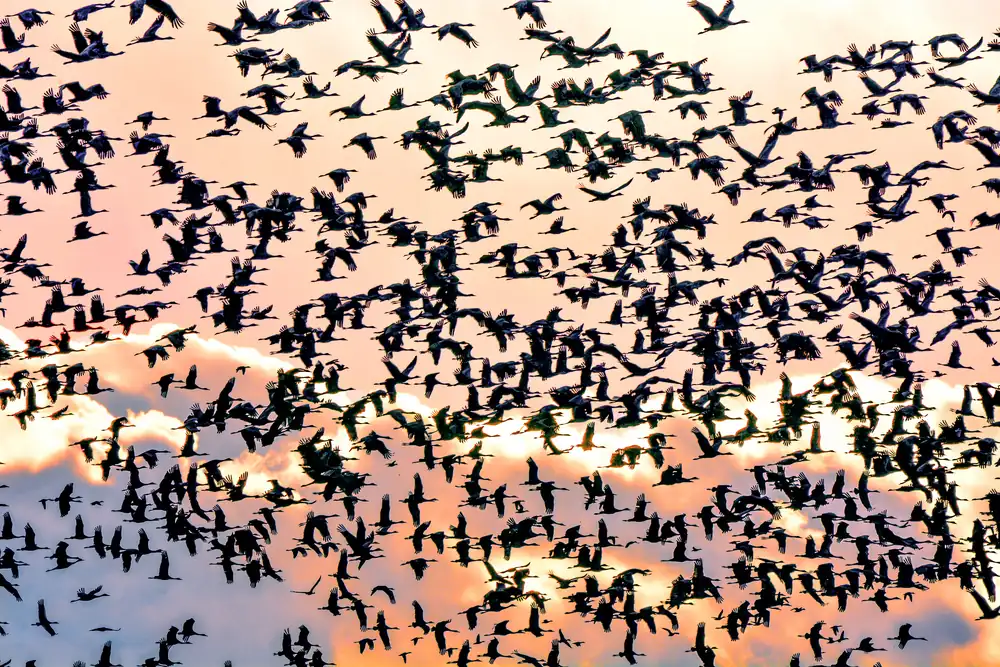
By day the cranes feed in cornfields, wet meadows and prairie remnants, eating waste grain and insects. At dusk they stream back to wide, shallow channels of the Platte to roost standing in the water overnight. Game and Parks suggests the Crane Trust visitor center near Wood River, Rowe Sanctuary near Gibbon, the hike and bike trail at Fort Kearny State Recreation Area and North River Wildlife Management Area. The hours around sunrise and sunset are the ones that matter, because that is when the sky is full and the river is loud.
-
Rowe Sanctuary and the Crane Trust in 2027
Rowe: guided viewing March 3 to April 6, 2027; registration opens January 7, 2027, 9 a.m. CST · Audubon’s Rowe Sanctuary near Gibbon and the Crane Trust near Wood River (Central time)
Rowe has posted its 2027 dates: guided crane viewing from March 3 to April 6, indoor evening viewing on selected dates in that span, and photography experiences from March 11 to April 4. Program details are due in early December 2026, and all reservations open online or by phone on January 7, 2027 at 9 a.m. Central standard time. The Crane Trust runs riverfront blind tours, daytime driving tours and footbridge tours in March, and says members get priority booking. Rowe stresses silence, and the Crane Trust bans flashlights and flash photography; book early.
-
Cranes beyond the Big Bend
Through March, with northward movement in the last third of the month · The North Platte River valley around North Platte, with more near Lewellen (Central and Mountain time), then the northeast (Central time)
Not every crane stops at Grand Island. The Birds of Nebraska Online account describes flocks of roughly 10,000 to 25,000 east of Hershey in most years and a larger count of 80,000 north of North Platte on March 22, 2025, plus about 10,000 near Lewellen on March 15 of that year. It also records an unprecedented 47,000 at Bohemia Prairie Wildlife Management Area in Knox County on March 26, 2025, birds that had probably just left the Platte. Game and Parks also points to a drive-through at Buffalo Bill Ranch State Recreation Area and evening flyovers at Cody Park in North Platte, and has run a crane blind at North River Wildlife Management Area in some years, so call before you plan around it.
-
Whooping cranes, a rare few among the sandhills
Mostly late March through mid-April · Mainly the central Platte valley and Rainwater Basin (Central time); rare elsewhere
Whooping cranes are tall, snow-white and critically scarce. The Birds of Nebraska Online account calls them locally rare regular spring migrants in central Nebraska, typically in groups of about three that stay four days or so, with most reports from late March to mid-April. The average first spring record this century is April 3, so March sightings are the early end of the range. If you see a white crane with black wingtips among the gray flocks, note the exact place and time and report it to Game and Parks rather than moving closer; the Fish and Wildlife Service lists the Rainwater Basin as a regular whooper stop.
Where are the snow geese and ducks in Nebraska in March?
In the Rainwater Basin of south-central Nebraska, March means wings by the hundreds of thousands. Federal biologists report that the basin feeds and rests 90 percent of North America’s greater white-fronted geese, about half the continent’s mallards and three in ten of its northern pintails, with green- and blue-winged teal in the mix. The Nebraska Bird Trail warns that these wetlands can sometimes be dry, so check conditions before you drive.
-
Snow, Ross’s and white-fronted geese
Late February through March; the state bird account counts hundreds of thousands to millions across Nebraska around the turn of the month · Rainwater Basin wetlands in Clay, Phelps, Fillmore and nearby counties; Funk and Harvard Waterfowl Production Areas (Central time)
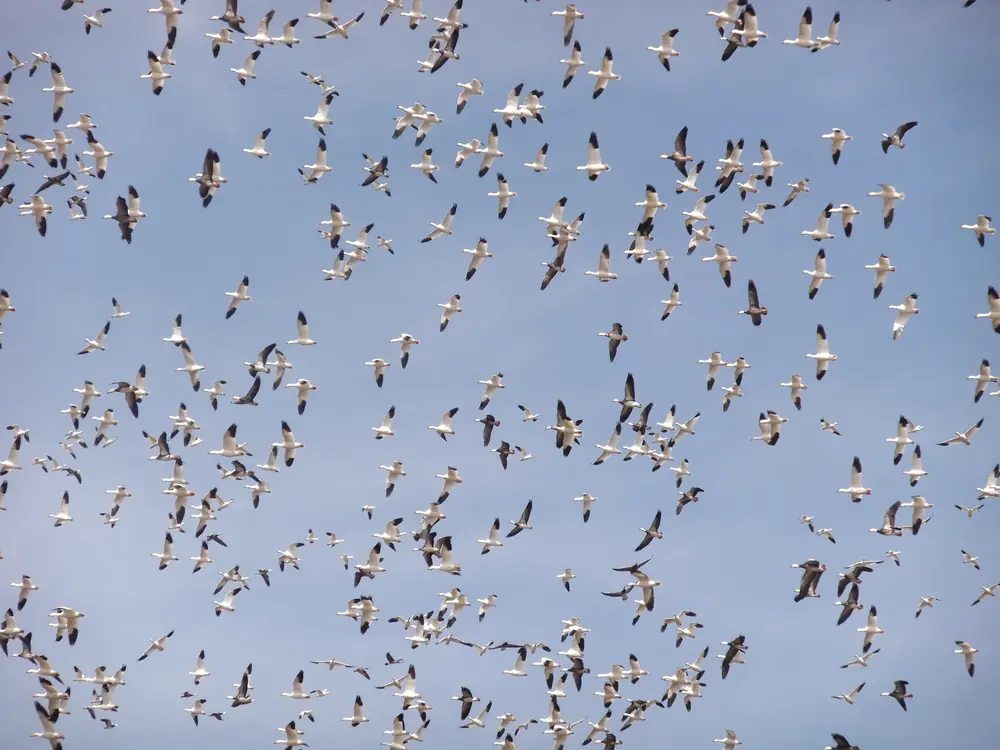
Audubon Society of Omaha describes concentrations of half a million snow geese and 100,000 greater white-fronted geese in the Rainwater Basin, and the Nebraska Bird Trail says Harvard Waterfowl Production Area can peak in mid-March with up to 500,000 waterfowl. The state’s bird account is a reminder of how fast it moves: in some years the peak is short-lived, and most snow geese can leave within about a week. White-fronted geese tend to peak a little earlier, with the largest concentrations in early March. A flock rising off a wetland sounds like surf and fills the sky in a minute. Bald eagles are also regular at these wetlands in early spring.
-
Pintails, mallards and courting ducks
Pintails peak in late February and early March; courtship displays are at their showiest in March · Shallow wetlands across the Rainwater Basin and along the Platte (Central time)
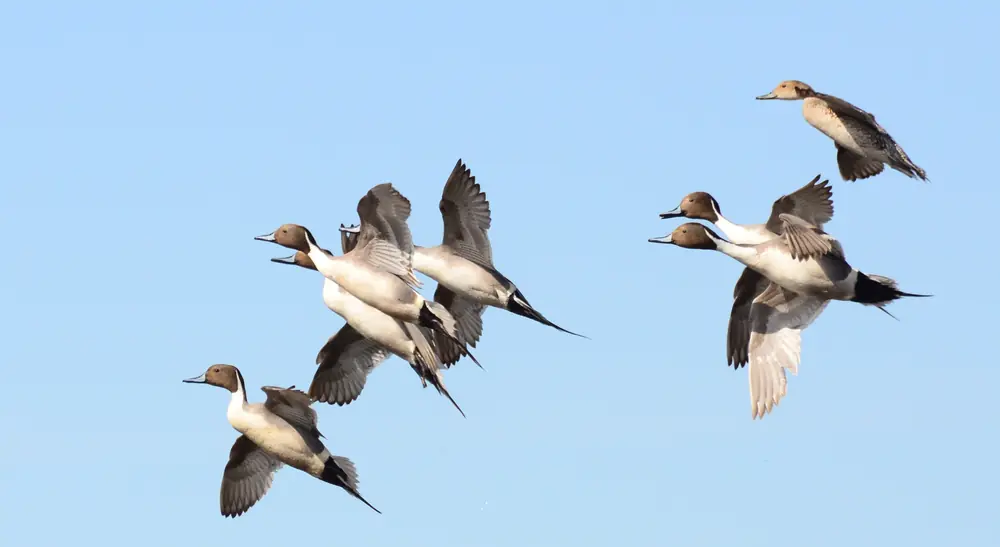
Northern pintails are early, long-necked birds that arrive as soon as the ice goes out. Radio-tagged hens were first logged in the Rainwater Basin on February 18 in 2004 and not until March 7 in 2003, a reminder of how much a mild or hard winter can move the schedule. In March, males chase females in noisy, twisting flights, the courtship display that wildlife refuge staff photograph each spring over Funk Waterfowl Production Area. Scan puddles in flooded fields too: ducks use them as well as the named refuges.
-
Swans and pelicans
Tundra swans: movement peaks in mid-March; American white pelicans: flocks usually arrive in late March, with the largest numbers in late April · Large reservoirs and lakes, such as Harlan County, Calamus and Lake McConaughy (Central time)
Tundra swans are rare in Nebraska but regular, passing through between mid-February and the end of March, and their peak movement is in mid-March. American white pelicans show up as big white flocks soaring in lines on the thermals. The Birds of Nebraska Online account says flocks typically arrive in late March and peak in late April, while Game and Parks noted in 2024 that a mild spring could advance that peak into March. In warm years, scan the middle of a big lake early in the month.
Hunters share some of these wetlands. In 2027 the spring light goose season, called the Light Goose Conservation Order, ends April 5 for the West and Rainwater Basin zones and April 15 for the East zone, with no daily limit, so shooting and decoys are common around the best goose fields. Wear a bright jacket if you are walking public land, and see the safety section below. You can also add the February page to your goose plans for the earlier part of the flight.
When do prairie chickens and sharp-tailed grouse dance in Nebraska in March?
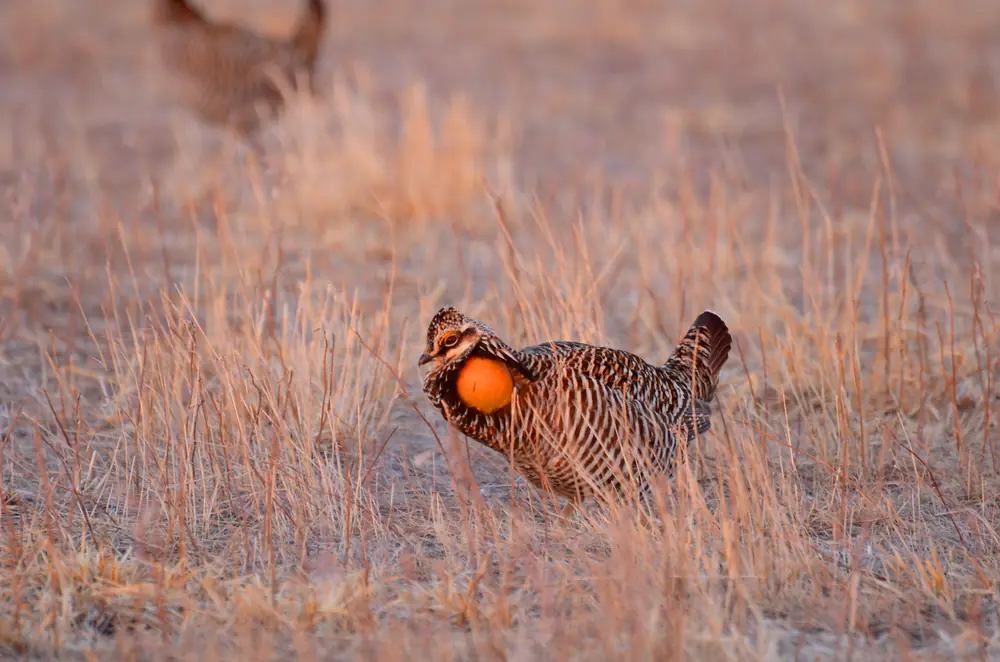
Nebraska has two grouse that gather every spring on traditional dancing grounds called leks: the greater prairie-chicken and the sharp-tailed grouse. Both are birds of native grassland, and both begin well before most people expect them to. A lek is a hushed, cold place at first light, and the birds are easily spooked by a car door or a flashlight. That is why public blinds exist.
-
Greater prairie-chickens
Booming usually gets going in early March; Game and Parks calls April the best time to view · The Sandhills edge, central Nebraska, the Rainwater Basin and scattered southeast grasslands; viewing blinds on public land (Central time)
Males stamp, strut, leap and whirl, inflating bright orange air sacs on their necks and uttering a deep “boom” that can carry a mile. On Mormon Island near Grand Island, the Birds of Nebraska Online account notes, males held one lek from January 30 in 2015, over a month ahead of the usual start, which researchers suggested may reflect a run of mild winters. Game and Parks lists free, self-guided blinds on public land and guided visits packaged with lodging, and Burchard Wildlife Management Area in the southeast has had a long-standing booming ground, where the state bird account logged 41 birds on April 7 to 9, 2017.
-
Sharp-tailed grouse
Males display from mid-February; the strongest activity is from mid-April to early May · Mainly north of the Platte River, including Niobrara State Park and the Niobrara valley (Central time)
Sharptails stamp their feet so fast the sound is a rattle, spin in circles and coo. The Birds of Nebraska Online account has displaying males from February 13 to April 19, and 40 at the Niobrara Valley Preserve on March 7, 2023. Niobrara State Park’s trailer blind, which holds up to 12 people, took reservations through May 1 in 2024, with peak viewing from March 15 to April 15; the park office at 402-857-3373 can tell you whether birds are active and which mornings are open.
-
Watching a lek without disturbing it
Reservations are usually made in advance; call to confirm dates · Niobrara State Park; Valentine National Wildlife Refuge; N-CORPE near North Platte; Burchard WMA (Central time)
Valentine National Wildlife Refuge says blinds on prairie-chicken and sharp-tailed grouse leks are available by reservation in April and May; a Game and Parks blind south of North Platte, run with the Nebraska Cooperative Republican Platte Enhancement project, has also operated in spring in past years. Dates change from year to year, and some blinds have closed for health reasons, so confirm before you drive. Arrive in the dark, be quiet and settled well before sunrise, and stay until the birds have left on their own.
Which birds return to Nebraska in March?
March is when Nebraska’s common birds start to sound different. Many winter residents are still around, so “arrival” dates blur: a meadowlark singing in February may have wintered nearby. The dates below, from the Game and Parks bird accounts and Audubon Society of Omaha’s migration calendar, are typical windows rather than promises. A cold snap sends everything south for a few days.
-
American woodcock
Arrive by early to mid-March; peak numbers in the second half of March · The eastern half of the state, and especially the northeast and the Missouri River valley (Central time)
A woodcock looks like a stout shorebird with a very long bill, but it lives in damp woods and brushy fields. The Birds of Nebraska Online account says males begin their courtship display soon after they arrive, a twittering spiral flight at dusk and dawn, and that nesting can start in the second half of March. Many birds move on north to Minnesota, Manitoba and beyond by early or mid-April. In 2024 arrivals were so early that four of the six earliest records came that February. Stand at the edge of an open, damp field at dusk and listen.
-
Killdeer, phoebes and blackbirds
Killdeer by late February or early March; eastern phoebes about March 8 to 14; red-winged blackbird males as winter ends, females about two weeks behind them · Statewide; phoebes are most common in the east and central areas (Central time)
Killdeer are ubiquitous by March, calling over fields and parking lots. The eastern phoebe is the first flycatcher to return, bobbing its tail on a porch rail or bridge. Red-winged blackbird males stake out cattails and fence lines first, with the females trailing behind. Audubon Society of Omaha also lists loggerhead shrikes arriving in mid-March and fox sparrows in the final fortnight of March.
-
Mountain bluebirds in the west
Early March on the Panhandle breeding range · The Panhandle, the Wildcat Hills and Pine Ridge (Mountain time)
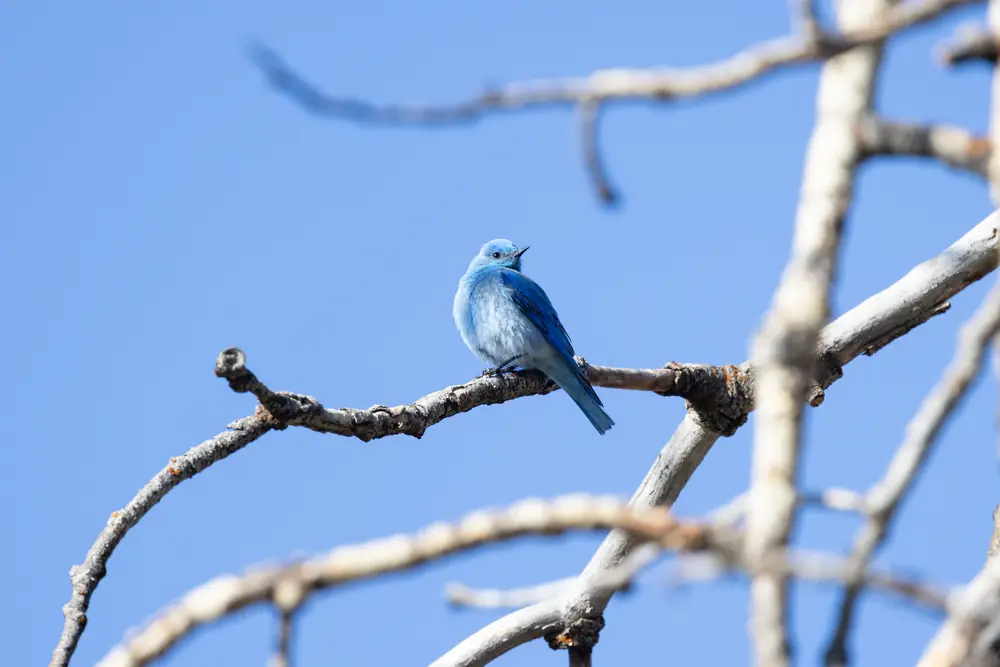
The sky-blue mountain bluebird reaches its western Nebraska nesting areas in early March and is soon on territory. The state’s bird account records a pair using a nest box by March 10 in 1995 and eight pairs in nest boxes in the Wildcat Hills by March 22, 2003. Look along fence lines and pine edges in open country.
-
Meadowlarks and tree swallows
Meadowlark choirs from late winter; tree swallows usually in late March · Grasslands and farm country statewide; swallows near water and nest boxes (Central and Mountain time)
Western meadowlark flocks of 15 to 40 birds, which observers call choirs, can begin singing as early as late January. The bubbling song from a fence post is one of March’s plainest signs. Tree swallows show up in late March, usually over ponds and lakes, though their peak is in April and May.
When do frogs, turtles and snakes wake up in Nebraska?
The first cold-blooded animals to move in Nebraska are the small ones that live near water. A warm, rainy March evening, with the ground thawed and the night air above about 40 degrees, is a good time to listen.
-
Boreal chorus frogs
From mid-March; often right after snowmelt, sometimes as early as March · Ponds, ditches, lakes and wetlands statewide (Central and Mountain time)
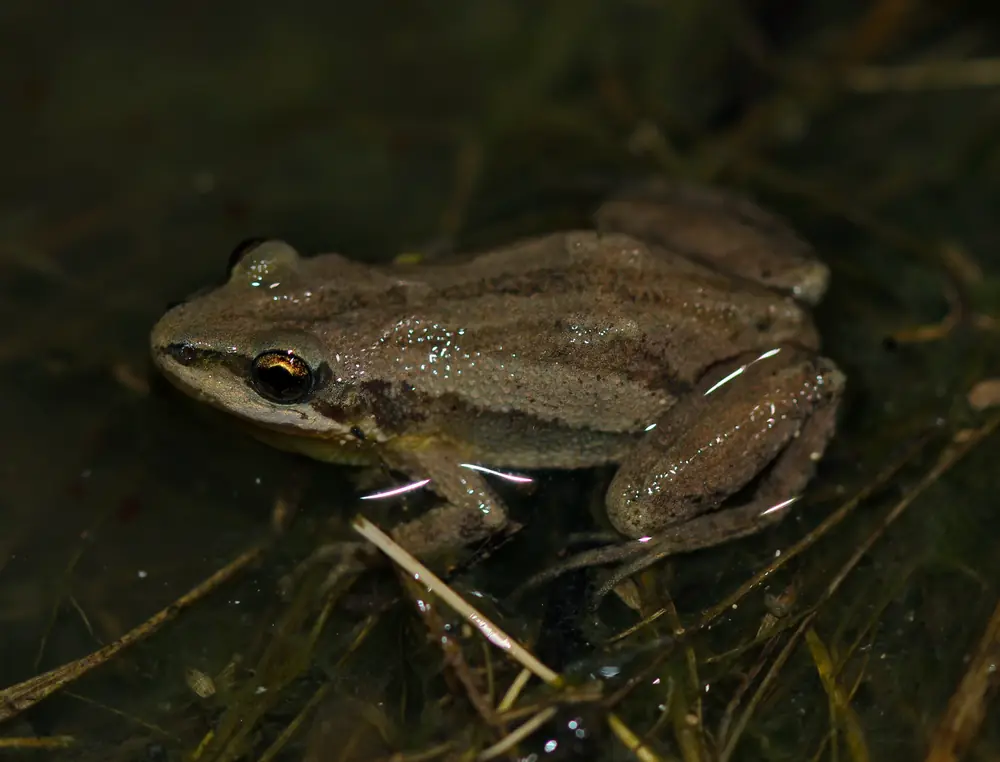
Nebraskaland Magazine says boreal chorus frogs are among the first frogs heard in spring and that the sound is like running a fingernail along a comb. They are rarely longer than an inch and a third, with stripes through the eyes and down the back. Hundreds can call at once, loud enough to be deafening near a temporary pond. Game and Parks says to listen from mid-March through summer.
-
Small-mouth salamanders
March and April for small-mouth salamanders; April and May for western tiger salamanders · Fishless ponds and nearby woods, especially in eastern Nebraska (Central time)
These amphibians live below ground for most of the year. After a rainy spring evening they head for breeding ponds and are sometimes found crossing roads. Game and Parks and the University of Nebraska–Lincoln have asked for sightings of both species, counted only if the report includes a photograph and a location. Drive slowly on wet nights and take the picture without handling the animal.
-
Painted turtles and ringneck snakes
Painted turtles from March through summer; ringneck snakes from late March · Pond edges for turtles; under rocks, logs and boards in the east for ringnecks (Central time)
Nebraska’s most-seen turtle, the northern painted turtle, basks on logs and rocks along the edges of ponds and lakes once the weather warms. Ringneck snakes, about as long as a ruler, are some of the first snakes to emerge, and are harmless. Game and Parks’ wildlife calendar says April is when many other snakes leave their winter dens.
What blooms in Nebraska in March?
Nebraska’s March blooms are small and easy to miss, and their timing depends heavily on the weather. The University of Nebraska–Lincoln recorded one extreme example in 2016, when March temperatures averaged about 10 degrees above normal; a climatology professor’s photo archive showed a magnolia in bloom on March 14, 2016, compared with April 5 in 2011. A cold snap can just as easily blacken flowers that opened too soon.
-
The first woody and bulb blooms
Early to late March, with big year-to-year swings · Yards, parks and wooded edges; strongest in the south and east (Central time)
Brad Kindler of the Nebraska Statewide Arboretum and the Nebraska Forest Service names cornelian cherry dogwood, American hazelnut, witch hazel, American pussy willow, Lenten rose and early bulbs such as snowdrops, crocus and reticulated iris as plants to watch in March and early April. In his own notebook the iris bloomed on March 3, 2022, the dogwood on March 29, 2020, and pussy willow was in full bloom on March 30, 2020, with the first flies, honeybees and native bees on it. Trout lilies began opening on April 6 that year. Take any date as one year’s record, not a schedule.
-
Pasqueflower
Very early spring; April where Helzer watches it near Aurora, early May at the Niobrara Valley Preserve · Dry, rocky prairie in the north and northwest (Central and Mountain time)
Pasqueflower is a low, furry perennial with soft purple flowers that bloom close to the ground. A UNL guide calls it a very early bloomer and an important source of nectar for emerging pollinators. Chris Helzer of The Nature Conservancy, writing from Aurora, says it blooms in April, risks frost and even snow, and flowers before its leaves appear. He notes that wild populations are in the rocky prairies farther north, where he has seen full bloom at the Niobrara Valley Preserve in early May.
How cold and snowy is March in Nebraska, and what weather hazards come with it?
March is the month in which Nebraska’s weather changes most. By NOAA’s 1991–2020 normals, an average March afternoon tops out in the low to mid 50s from Omaha to Scottsbluff, and average lows near or just below freezing in the east and in the mid 20s in the west. Precipitation is light in the west (about 1 inch) and heavier in Omaha (1.79 inches). All six airports below still average between 3 and almost 7 inches of snow.
| Station | Average high | Average low | Precipitation | Snowfall |
|---|---|---|---|---|
| Omaha Eppley Airfield | 52.1 °F | 30.0 °F | 1.79 in | 3.0 in |
| Lincoln Municipal Airport | 53.6 °F | 28.7 °F | 1.55 in | 3.4 in |
| Grand Island Airport | 52.6 °F | 28.8 °F | 1.39 in | 3.8 in |
| North Platte Regional Airport | 55.2 °F | 23.9 °F | 1.00 in | 4.2 in |
| Valentine Miller Field | 51.6 °F | 23.5 °F | 1.01 in | 6.0 in |
| Scottsbluff Heilig Airport | 54.9 °F | 25.0 °F | 1.00 in | 6.8 in |
Flood and blizzard: March 2019 is Nebraska’s warning. The National Weather Service in Hastings describes a stretch from March 13 to 23, peaking March 13 to 17, with frozen ground (to 25 inches on March 11), 10 to 17 inches of snow in places, heavy rain of 3 to nearly 4 inches in two days at several stations, ice jams on the Middle Loup and Cedar rivers and record crests at Dannebrog, Gibbon and Genoa. The weather service’s preliminary damage estimate was more than a billion dollars. It lists snowmelt, ice jams and flash floods as the spring flood threats for Nebraska.
Fire weather: March 2026 showed the opposite risk. A Red Flag Warning covered the entire state on March 12, 2026, and the Morrill Fire, first reported that day, went on to burn about 640,000 acres in Morrill, Garden, Grant, Arthur and Keith counties, the largest wildland fire in the state’s history by the State Climate Office’s account (counts differ slightly by source). The office noted a relative humidity near 20 percent, a temperature of only 67 °F and winds averaging 34 mph with gusts above 70 mph. Cured grass, low humidity and a strong wind need no heat to do harm, so read the day’s fire weather before you burn, camp or park on dry grass.
Severe weather: Nebraska’s statewide tornado drill, run by the National Weather Service and carried on NOAA Weather Radio, was held on a Wednesday morning in late March in 2026 during Severe Weather Awareness Week. Nothing had been announced for 2027 by early October; your local forecast office will post the date.
New 90-day outlooks come out monthly from the Climate Prediction Center, and the current one is posted on its seasonal outlook page. For forecasts and radar, see our weather guide, and our cloud guide can help you read an approaching front.
When is the last spring freeze in Nebraska?
March is too early to plant tender things almost anywhere in Nebraska. Each row shows when a station typically sees its final reading of 32 °F or colder, along with the dates for unusually early and late springs. Omaha usually clears its last freeze in mid-April; the Pine Ridge and the northern Sandhills are not usually done until mid-May.
| Station | One year in ten | Median | Nine years in ten |
|---|---|---|---|
| Chadron Municipal Airport (Pine Ridge) | May 2 | May 14 | May 27 |
| Scottsbluff Heilig Airport (Panhandle) | Apr 25 | May 5 | May 18 |
| Valentine Miller Field (northern Sandhills) | Apr 30 | May 12 | May 25 |
| North Platte Regional Airport (west-central) | Apr 30 | May 11 | May 26 |
| McCook Municipal Airport (southwest) | Apr 17 | May 1 | May 15 |
| Norfolk Karl Stefan Airport (northeast) | Apr 16 | Apr 30 | May 14 |
| Grand Island Airport (central Platte) | Apr 9 | Apr 23 | May 6 |
| Lincoln Municipal Airport (southeast) | Apr 10 | Apr 24 | May 7 |
| Omaha Eppley Airfield (Omaha) | Apr 5 | Apr 18 | Apr 30 |
Cool-season crops such as peas, spinach and radishes tolerate a freeze, so gardeners often start them in the second half of March. The Nebraska frost page gives the dates for more towns.
How much daylight does Nebraska gain in March?
Spring brings the fastest change of the year, and Nebraska’s day lengthens by about three minutes a day through March. Daylight saving time starts at 2 a.m. on Sunday, March 14, 2027, in both the Central and Mountain zones, moving every clock ahead one hour, so sunrise and sunset on the clock suddenly arrive an hour later. The table is day length, which that jump does not affect. Spring begins astronomically on Saturday, March 20, as the Sun passes over the equator at 3:25 p.m. CDT (2:25 p.m. MDT) and day and night are nearly equal.
| City | Mar 1 | Mar 31 | Gained | Per day |
|---|---|---|---|---|
| Omaha | 11 h 16 m | 12 h 39 m | 83 min | 2.8 min |
| Lincoln | 11 h 17 m | 12 h 38 m | 81 min | 2.7 min |
| Norfolk | 11 h 15 m | 12 h 40 m | 85 min | 2.8 min |
| Grand Island | 11 h 16 m | 12 h 38 m | 82 min | 2.7 min |
| McCook | 11 h 18 m | 12 h 38 m | 80 min | 2.7 min |
| North Platte | 11 h 17 m | 12 h 39 m | 82 min | 2.7 min |
| Valentine | 11 h 13 m | 12 h 41 m | 88 min | 2.9 min |
| Scottsbluff | 11 h 15 m | 12 h 40 m | 85 min | 2.8 min |
Sunset jumps about an hour later on the clock overnight between March 13 and 14, so the first Sunday evening of daylight time feels like a gift. Our daylight guide lets you check any town.
What can you see in the Nebraska night sky in March 2027?
Times below are given for Central time and, in parentheses, Mountain time, which covers the Panhandle and far southwest. The March 8 new moon is the one phase still on standard time, and every later time follows the March 14 clock change. The planet notes come from our own calculations, so treat them as approximate guides.
-
The full Worm Moon
Monday, March 22, at 5:44 a.m. CDT (4:44 a.m. MDT); looks full on both Sunday and Monday evenings · Statewide
Almanacs name the March full moon for thawing soil and surfacing earthworms; other names include the Crow Moon and the Sap Moon. Since the exact full moment arrives before dawn Monday, Sunday evening gives the best view: the disk climbs out of the east about as the Sun goes down. Over a flooded wetland it makes a fine backdrop.
-
Mercury at dawn
Widest from the Sun on March 17 (late on March 16 in Central time); easiest to find from about March 8 to 25 · Near the east-southeast horizon in morning twilight
Mercury swings out to about 27.6 degrees from the Sun on March 17, its widest separation of the month. A spring dawn tilts the planet’s path low for northern observers, so you need a flat horizon and a clear sky. Expect a modest star-like dot, with far brighter Venus well above it.
-
Venus at dawn, Jupiter and Mars at night
Venus before sunrise all month; Jupiter and Mars after dark · Venus: the southeastern dawn sky. Jupiter and Mars: high overhead once it is dark
Venus is the dazzling morning star and climbs above the horizon about two hours before dawn as March opens. By our calculation a thin old crescent Moon passes near Venus at dawn on March 4 and 5. Jupiter, in Leo, is the strongest point of light in the evening sky and does not set until near dawn early in the month. Mars, a duller orange glow in the same constellation, is also high after dark; by our figures the pair sit roughly four degrees from each other on March 30’s evening. A waxing Moon sweeps by Jupiter around March 18 and 19.
-
The Milky Way and aurora
Milky Way: before dawn, best near the new moon on March 8; aurora: whenever it is clear and dark · A dark horizon to the south for the galaxy; a clear northern horizon for aurora
The galaxy’s brightest region clears the southern horizon only before dawn this month. By our own calculation the best nights run from roughly March 5 to 16, and at Nebraska’s latitude that buys about an hour of properly dark sky. Aurora may show whenever the sky is clear and dark, and the weeks around the equinox are statistically among the busiest, though nobody forecasts them weeks ahead. NOAA’s aurora dashboard shows tonight and tomorrow night.
| Phase | Date | Time |
|---|---|---|
| New moon | Monday, Mar 8 | 3:29 a.m. CST (2:29 a.m. MST) |
| First quarter | Monday, Mar 15 | 11:25 a.m. CDT (10:25 a.m. MDT) |
| Full moon, the Worm Moon | Monday, Mar 22 (looks full the evening of Mar 21) | 5:44 a.m. CDT (4:44 a.m. MDT) |
| Last quarter | Monday, Mar 29 | 7:54 p.m. CDT (6:54 p.m. MDT) |
Look up moonrise for any Nebraska town on the moon phase page, and read the cloud guide before you drive out for a dark sky.
What can Nebraska families do outdoors in March 2027?
Most organizers had not yet posted March 2027 programs in early October, so only dates already confirmed are listed. For anything else, check with the organizer.
- Rowe Sanctuary crane season, March 3 to April 6, 2027: guided viewing and photography experiences; registration opens January 7, 2027 at 9 a.m. CST online or at 308-468-5282. In 2026 Audubon ran a speaker series on Fridays and Saturdays through the season; its 2027 programs are due in early December 2026.
- Crane Trust, near Wood River: the visitor center lists longer March hours (8 a.m. to 5 p.m. before the clock change and to 6 p.m. after it), with ten miles of trails and several kinds of tours; confirm hours and tour dates before you go.
- Free viewing: Fort Kearny State Recreation Area’s hike and bike trail, and public roads in the Platte valley, give a look at the evening flights; park well off the road, keep to the verge and stay out of fields.
- Project FeederWatch runs through April 30, so March is still a good month to keep counting your feeder.
- Journey North tracks hummingbirds and monarch butterflies; the dates for its 2027 spring reports had not been announced.
- Salamander sightings: Game and Parks and UNL accept photographs with a location of small-mouth and western tiger salamanders.
- iNaturalist is a good home for photographs of first blooms, frogs, turtles and tracks.
- Audubon Society of Omaha keeps a migration calendar for the Omaha and Council Bluffs area, and the Nebraska Game and Parks wildlife calendar describes other spring wildlife to watch.
Other months of the year are in the nature guide.
Safety notes for March in Nebraska
- Hunting and trapping in March 2027 (Nebraska Game and Parks): the spring light goose season began February 10 and closes April 5 in the Rainwater Basin and West zones, April 15 in the East, with no daily bag limit. Crow season closes March 11. Falconry, furbearer trapping and the species that may be taken year-round have their own dates and rules, so read the current Game and Parks guide before you go. Spring turkey seasons had not been posted for 2027 in early October. In 2026 the archery season opened March 25 and ran to May 31, with shotguns allowed from mid-April, so only archery hunters are normally out in the last week of March. Check the Game and Parks seasons page.
- Hunter orange: Nebraska law requires at least 400 square inches of orange for hunting deer, antelope, wild turkey, elk or mountain sheep during an authorized firearm season, and exempts archery hunters. No firearm season for those species is open in March on the 2026 pattern, but wear something bright on public land where goose hunters are out.
- Wind and fire: March winds can turn a small ember into a fast grass fire. Check for Red Flag Warnings, skip burning on those days and never leave a fire.
- Rivers and ice: ice thins unpredictably in March and rivers can rise quickly with snowmelt. Stay off ice you cannot test and out of flooded roads.
- Ticks: the Nebraska health department says spring and summer are the main tick seasons; the American dog tick is found statewide and the lone star tick mainly in the southeast. Treat clothes with 0.5 percent permethrin, check your body afterward and dry clothes on high heat for 10 minutes.
- Leks and roosts: grouse leks and crane roosts are easily disturbed. Use blinds, keep to roads and trails and do not use flashlights or flash.
- Muddy roads and late snow: a spring thaw turns county roads to soup, and a late blizzard can close highways. Carry a winter kit and check Nebraska 511.
Sources (57)
- Birds of Nebraska Online (Nebraska Game and Parks): sandhill crane (read from the archived copy at web.archive.org)
- Birds of Nebraska Online: whooping crane (archived copy)
- Birds of Nebraska Online: snow goose (archived copy)
- Birds of Nebraska Online: greater white-fronted goose (archived copy)
- Birds of Nebraska Online: northern pintail (archived copy)
- Birds of Nebraska Online: tundra swan (archived copy)
- Birds of Nebraska Online: American white pelican (archived copy)
- Birds of Nebraska Online: greater prairie-chicken (archived copy)
- Birds of Nebraska Online: sharp-tailed grouse (archived copy)
- Birds of Nebraska Online: American woodcock (archived copy)
- Birds of Nebraska Online: killdeer (archived copy)
- Birds of Nebraska Online: eastern phoebe (archived copy)
- Birds of Nebraska Online: red-winged blackbird (archived copy)
- Birds of Nebraska Online: mountain bluebird (archived copy)
- Birds of Nebraska Online: western meadowlark (archived copy)
- Birds of Nebraska Online: tree swallow (archived copy)
- Audubon’s Iain Nicolson Audubon Center at Rowe Sanctuary: 2027 crane season dates and registration
- Audubon’s Rowe Sanctuary: crane season
- Audubon Great Plains: 2026 crane season at Rowe Sanctuary
- Crane Trust: crane viewing
- Crane Trust: visit
- Crane Trust: week 6 of the 2026 spring crane migration
- Crane Trust: crane counts and methods
- U.S. Fish and Wildlife Service: Rainwater Basin Wetland Management District, species
- U.S. Fish and Wildlife Service: Rainwater Basin Wetland Management District, about
- U.S. Fish and Wildlife Service: Valentine National Wildlife Refuge, species
- Nebraska Bird Trail: Harvard Waterfowl Production Area (archived copy)
- Nebraska Bird Trail: Valentine National Wildlife Refuge (archived copy)
- Audubon Society of Omaha: migration calendar, March 2027
- Nebraska Game and Parks: wildlife viewing timeline (archived copy)
- Nebraska Game and Parks: explore opportunities for early spring wildlife watching, March 12, 2024 (archived copy)
- Nebraskaland Magazine: Game and Parks closing public access to wildlife viewing blinds, March 20, 2020 (archived copy)
- Nebraskaland Magazine: Hopping into Amphibian Week, May 6, 2025 (archived copy)
- SciStarter: Nebraska Salamander Search (Game and Parks and UNL; archived copy)
- Nebraska Game and Parks: hunting seasons 2026–27 (read from the archived copy)
- Nebraska Revised Statute 37-527, hunter orange
- Plant Nebraska: the science of phenology (Brad Kindler)
- University of Nebraska–Lincoln News: has spring arrived early on the Great Plains (March 2016)
- UNL Backyard Farmer: pasqueflower (Pulsatilla patens)
- The Prairie Ecologist: photos of the week, April 17, 2020
- NOAA NCEI: 1991–2020 monthly normals for Omaha, Lincoln, North Platte, Valentine, Scottsbluff and Grand Island
- National Weather Service Hastings: mid-March 2019 flooding in central and south central Nebraska
- National Weather Service: flooding in Nebraska
- Nebraska State Climate Office: fire weather fundamentals and the Morrill Fire
- Nebraska Public Media: firefighters battle new wildfires as red flag warnings continue (March 30, 2026)
- 1011 Now: Nebraska and Iowa conduct statewide tornado drill (March 25, 2026)
- NOAA Climate Prediction Center: seasonal (90-day) outlooks
- Nebraska Department of Health and Human Services: tick-borne diseases in Nebraska (2021)
- U.S. Naval Observatory: moon phases, 2027
- U.S. Naval Observatory: Earth’s seasons, 2027
- SeaSky: astronomy calendar 2027
- 15 U.S. Code 260a: daylight saving time
- NOAA Space Weather Prediction Center: aurora dashboard
- Project FeederWatch: how to participate
- Journey North
- iNaturalist
- Photos via Wikimedia Commons; licenses and photographers are credited under each picture
