What to look for in nature in Nebraska this December
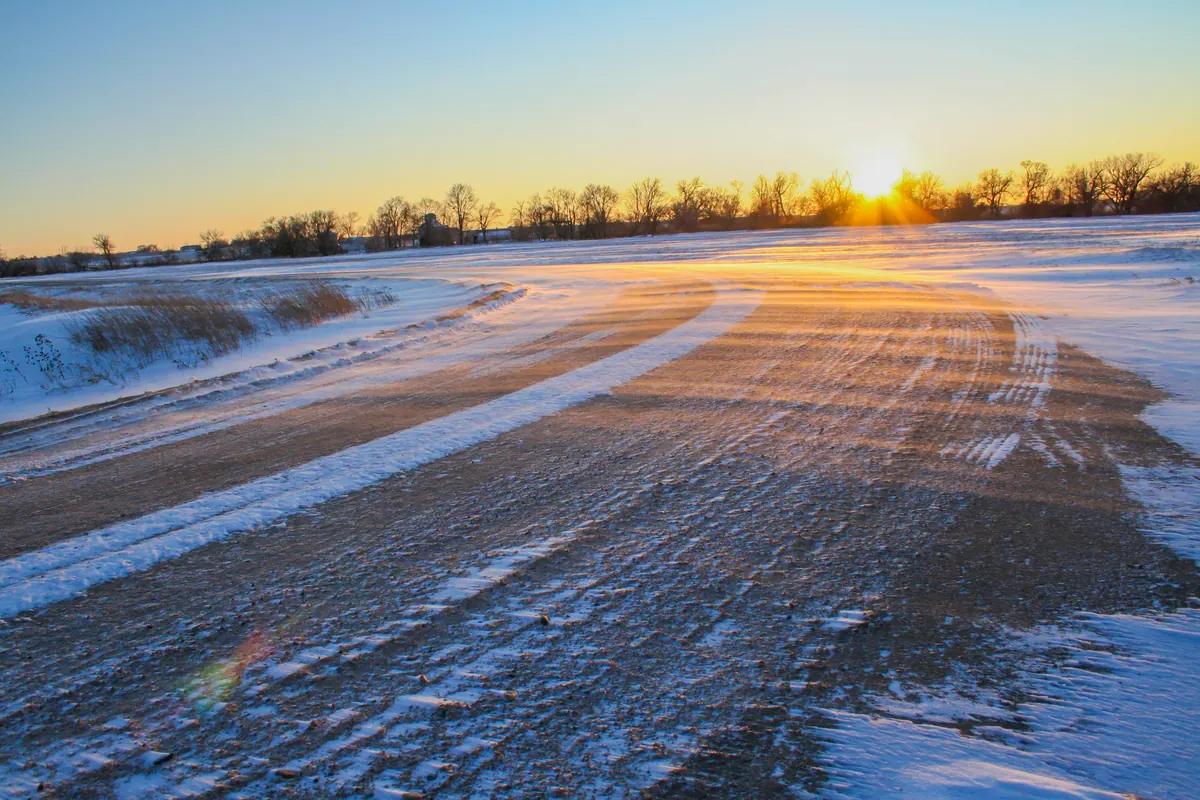
December 1 opens meteorological winter, the three months that are coldest on average, and in Nebraska you see the change on the water first. Marshes and farm ponds lock up, the last open lakes and dam outflows collect gulls, ducks and eagles, and the owls have the long nights to themselves. Great horned owls are already pairing off for nests that can hold eggs by the third week of January. Sunsets bottom out in early December, the shortest day falls on the 21st, and in between, volunteers fan out across the state for the Christmas Bird Count. These notes run from the Pine Ridge to the Missouri, with dates and a source for each.
Other months in Nebraska: October, November.
Start here
- Listen for great horned owls after dark. Pairs hoot back and forth from shelterbelts, farmyards and river woods all month. Nebraska’s recorded egg dates for this owl begin on January 18, so December is courtship season. Stand outside in the first hour after dark when the wind is still; the pair’s deep, measured hoots carry a long way, his lower than hers.
- Count birds for one day. Nebraska compilers each choose a single count day, anywhere from Monday, December 14, through the first Tuesday of 2027, January 5. Look up the nearest circle with Audubon’s circle finder and email the compiler ahead of count day. Backyard birders who live within a circle’s boundary may report their feeder birds as well.
- The Geminids, then the Cold Moon. Geminid meteors are at their best from Sunday evening, December 13, to dawn on Monday, and a thin crescent Moon sets by mid-evening. Ten nights later the Cold Moon is full at 7:28 p.m. Central (6:28 p.m. Mountain) on Wednesday, December 23, and it is the nearest full moon of 2026.
In the Naturalist’s Field Journal, December could add a long-eared owl in a cedar roost or a Townsend’s solitaire guarding its juniper to “birds I have seen,” with the windbreak or canyon named. A juniper sprig or a ponderosa cone fits the seeds, pods and cones plate; the first crisp prints in new snow go on “tracks to know”; the dusk and dawn watch is the place to note your town’s sunset on the solstice. A pair of owls calling to each other goes on the map of sounds.
Regions used below: The Panhandle and Pine Ridge; The Sandhills and Niobrara valley; Southwest Nebraska and the Republican valley; The central Platte and Rainwater Basin; Northeast Nebraska and the Missouri bluffs; Lincoln, Omaha and the southeast.
When is the Christmas Bird Count in Nebraska, and how can I join?
Audubon’s Christmas Bird Count began in 1900, and Lincoln has been part of it for more than a century. Every count area is a 15-mile-wide circle, surveyed on a single calendar day chosen by its compiler between December 14 and January 5. Teams drive and walk set routes and tally every bird they see or hear from dawn to dusk.
-
Finding a count and signing up
One day per circle, December 14, 2026, to January 5, 2027 · Count circles statewide, from Scottsbluff and Crawford to Lake McConaughy, Lincoln, Omaha and the Missouri River parks
Audubon’s online circle finder shows every count with a link to its compiler. Participation is free, and Audubon says every skill level is welcome. The Nebraska Ornithologists’ Union keeps a statewide list of counts as compilers set their dates, and in early October it had none posted for 2026–27 yet, which is normal this far ahead. In the Omaha area, the Audubon Society of Omaha announces its counts on its events calendar, and Wachiska Audubon organizes the Lincoln count. A feeder watcher inside a circle can also report from the kitchen window on count day.
-
What Nebraska counts turn up
Late December and early January · Shelterbelts, open water, juniper canyons and town feeders
Counts have produced some of the state’s best winter records. The Lincoln count found 39 long-eared owls on December 18, 1977. Great horned owl totals of 30 or more have come from Norfolk, Omaha and Lincoln counts. The Lake McConaughy count logged 157 Townsend’s solitaires on January 2, 2006. And in a strong flight year, Bohemian waxwings showed up by the hundreds on the Panhandle counts: 325 on the Harrison count on December 30, 2007.
Count days mean gravel roads and short daylight, so pack a thermos and warm boots.
Which owls can you find in Nebraska in December?
Bare branches and fourteen-hour nights make this the easiest month for owls. Four species are worth looking for: one that breeds early, one that roosts in groups, one that hunts open grassland, and one that only comes some winters.
-
Great horned owls pairing up
Hooting builds through December; eggs from mid to late January · Statewide: shelterbelts, farmsteads, river woods, city parks and cemeteries
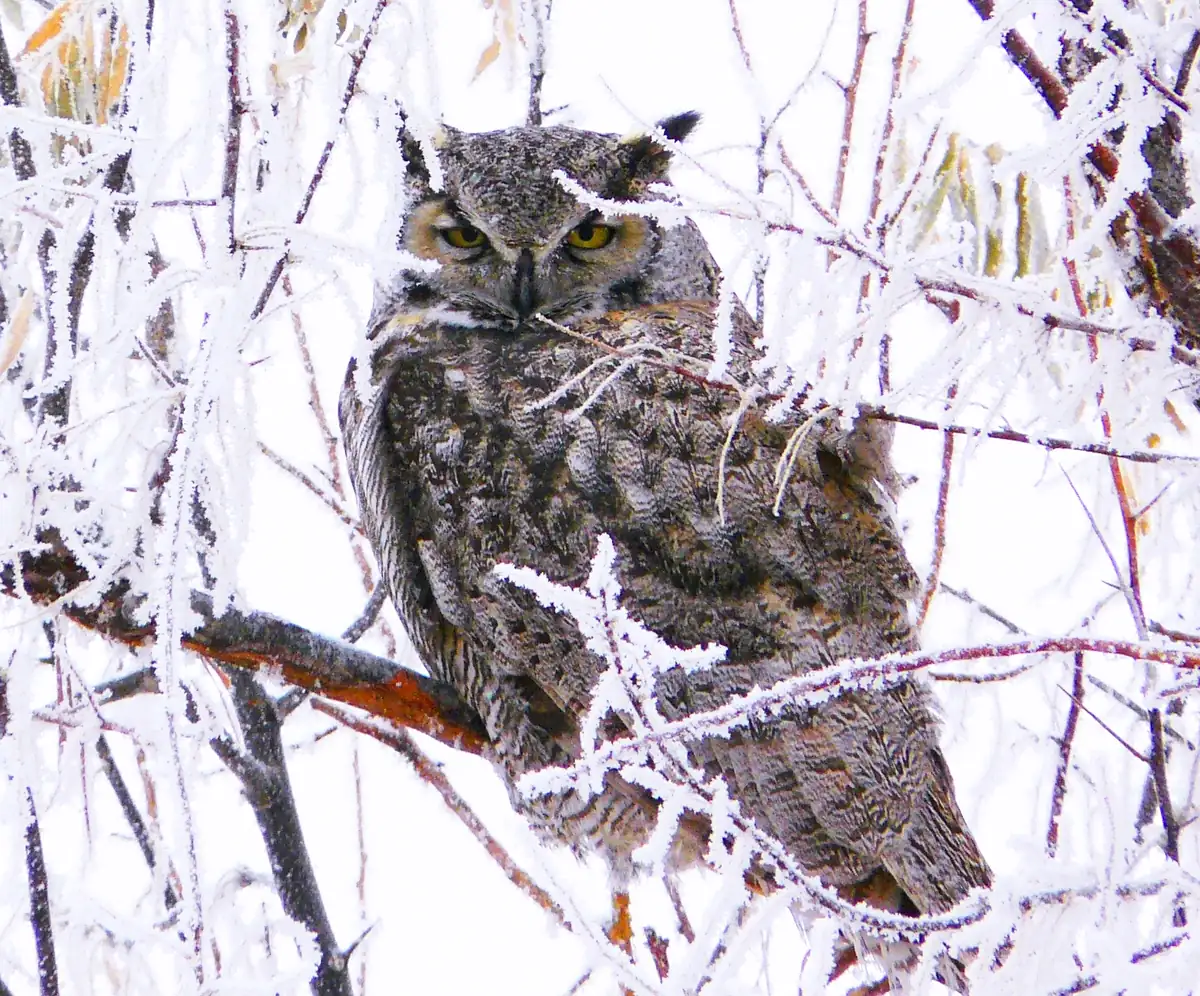
The great horned owl is a common resident in every county, and it nests earlier than any other Nebraska bird. The Birds of Nebraska species account lists eggs from January 18, incubation the same week, and territorial fights and mating in late January and early February. That puts December’s calling at the heart of courtship: a pair often perches near last year’s nest, frequently an old hawk or crow platform, and trades hoots at dusk. The female’s voice is the higher of the two. In some winters, very pale owls from the Canadian prairies wander south into Nebraska; several have been photographed in Keith, Lincoln and Washington counties.
-
Long-eared owls in cedar roosts
Mainly November through March; arrivals in early November · Dense eastern redcedar and juniper stands near grassland or fallow fields, statewide; Cunningham Lake in Omaha has hosted a roost for years
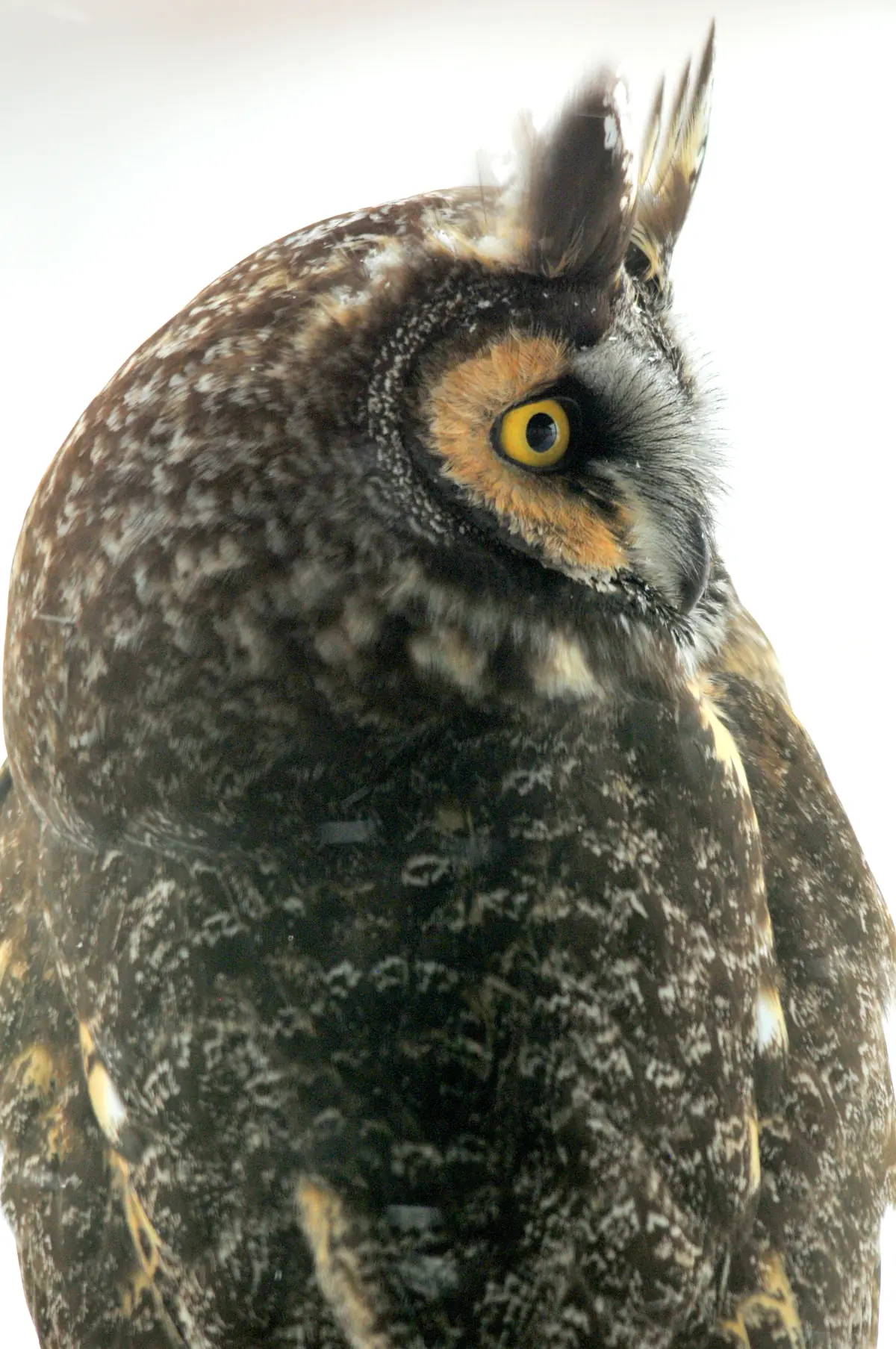
Long-eared owls are fairly common winter visitors, but they are hard to find because they spend the day pressed against the trunk inside thick cedars, often several to a grove. Observations at a roost near Omaha’s Cunningham Lake found birds present from about November 21 to late March in at least six winters, with as many as 25 at once, and their arrival seemed tied to snow cover building in South Dakota. Look for whitewash and pellets under a dense conifer next to open ground where voles live. If you find one, back away quietly: a flushed owl loses roost time and becomes a target for crows and hawks.
-
Short-eared owls at dusk
Mid-October to late April; numbers vary from winter to winter · Open grassland, CRP fields and wet meadows, most often where snow is light
This is the owl you can see without searching through trees. Short-eared owls hunt low over open country at dusk with a loose, moth-like flight, and they follow voles, so they gather wherever rodents are plentiful and leave when deep snow hides them. Reports top out in some winters and almost vanish in others; about 44 were reported statewide in 2021–22. Watch from a quiet county road at sunset over a big grassland.
-
A snowy owl, maybe
Usually from mid-November, most often December to February · Open farmland, often near big reservoirs and rivers
Most winters bring only a few. The invasion of 2011–12 left about 200 reported in Nebraska; in 2024–25 there were two through February. Most Nebraska records come from near big lakes and rivers.
Owls are protected by state and federal law. Keep your distance, skip the flash and the recorded calls, and don’t post the exact location of a roost.
Where do gulls and eagles gather on Nebraska’s open water in December?
As ice closes over the smaller lakes, birds that need open water crowd onto the few places that stay unfrozen: big, deep reservoirs, canals and the outflows below dams. December is the month when that squeeze begins in earnest.
-
Gulls at Lake McConaughy
Numbers build through December and may keep rising into January · Lake McConaughy and Lake Ogallala near Ogallala; Sutherland Reservoir; Harlan County Reservoir; Branched Oak Lake near Lincoln
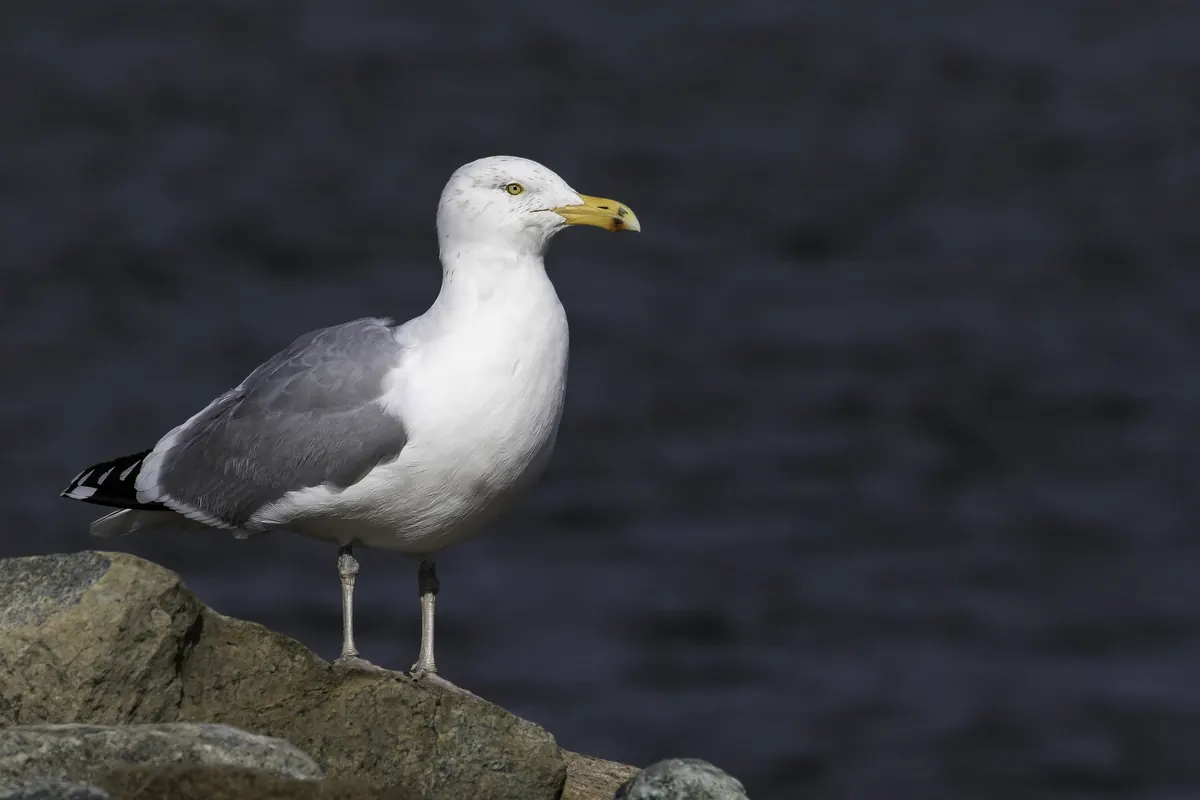
Lake McConaughy, the state’s largest reservoir, supplies a large share of Nebraska’s gull records, and late fall is when they pile in. Herring gulls are the bulk of the flocks; their numbers swing with the severity of the winter, and big December gatherings have included 540 at Sutherland Reservoir on December 30, 2007, 446 at Harlan County Reservoir and 416 at Lake McConaughy. Mixed in, birders look for rarer northern gulls. Glaucous gulls, pale and with no black in the wing, show up from mid-November and become more frequent in December; McConaughy has had as many as 9 on December 30, 2000. A spotting scope from the dam or the north shore roads helps.
-
Eagles where the water stays open
Building through December; largest numbers usually once ice spreads, in January and February · Below Kingsley Dam; the J-2 hydropower plant south of Lexington; Harlan County Reservoir; the Missouri River
Bald eagles that wander widely in November settle close to unfrozen water as ice forms. The Central Nebraska Public Power and Irrigation District runs indoor eagle-viewing rooms at its J-2 plant near Lexington and at Kingsley Dam, where eagles fish the open water below the outlets. In each of the past two winters the season opened on the last Saturday of December (December 28, 2024, and December 27, 2025), with weekend hours from 8 a.m. to 1 p.m., local time. The 2026–27 dates had not been posted in early October; the district’s eagle webcam shows whether birds are present before you drive.
November’s arrival of swans, snow geese and the first eagles is on the Nebraska November page.
Which evergreens grow wild in Nebraska, and can you cut your own Christmas tree?
With the cottonwoods and oaks bare, the state’s conifers stand out on every slope. Only a few are native, and each has its own birds.
-
Ponderosa pine
Year-round; easiest to pick out against snow · The Pine Ridge, Wildcat Hills and Scotts Bluff; the Niobrara valley east to Keya Paha County
Nebraska’s only native pine grows here at the eastern edge of its range. The Nebraska Forest Service notes that it reaches down the Niobrara as far as Keya Paha County and south to Custer County. Look for long needles bundled in threes, big prickly cones, and thick bark broken into orange-brown plates on older trees. The seeds feed nuthatches, jays, wild turkeys and red crossbills, nomadic finches whose winter numbers swing wildly: Birds of Nebraska tallied about 900 statewide in 2023–24, but only 65 the next winter, most of them in the Pine Ridge.
-
Junipers and Townsend’s solitaires
Solitaires from October through April; densest in midwinter · Rocky Mountain juniper in the Pine Ridge, Wildcat Hills and around Ash Hollow; eastern redcedar statewide
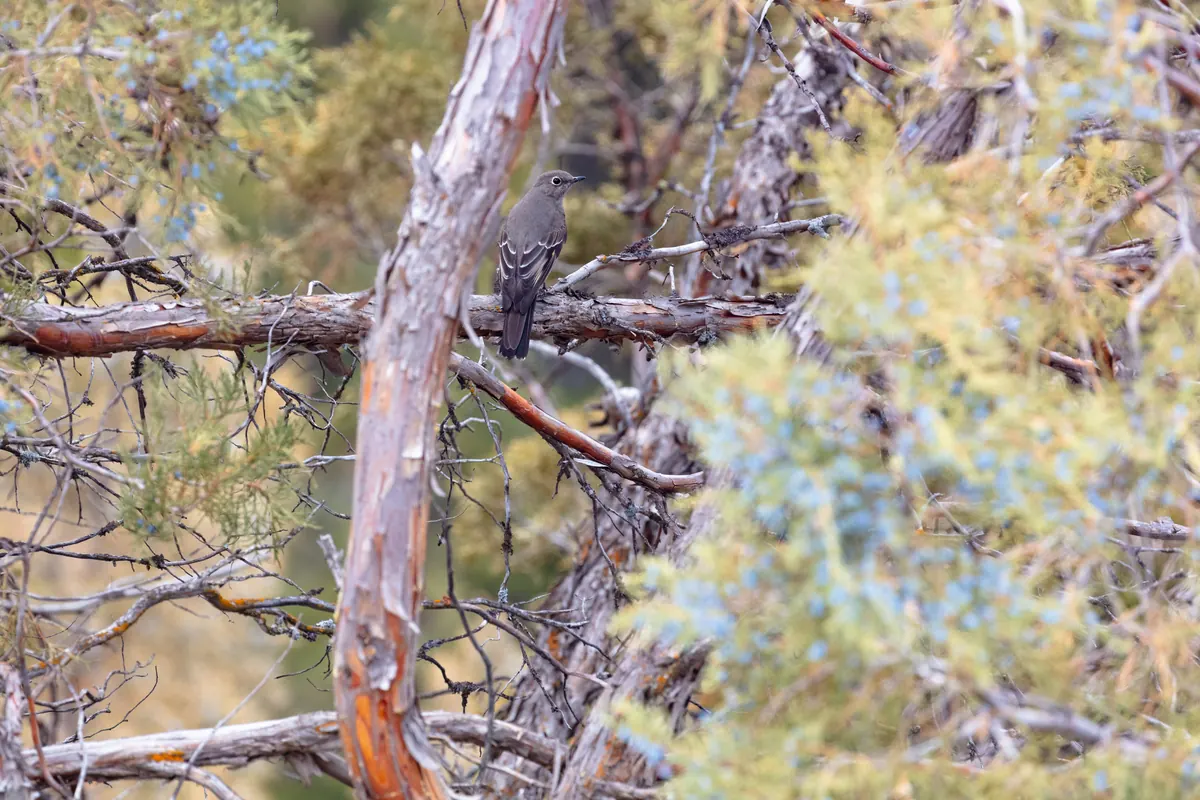
Two junipers grow here. Rocky Mountain juniper is native to the Panhandle canyons, eastern redcedar is everywhere, and where they meet, as around Ash Hollow, they hybridize. Both carry waxy blue berries, which are really cones. In the west they feed the Townsend’s solitaire, a slim gray thrush with a white eye-ring and buff wing patches that comes down from the Wyoming and South Dakota mountains for the winter. A solitaire typically claims a few berry-laden junipers and chases other fruit eaters away from them, calling from a treetop with a single clear whistle. Christmas Bird Count data show the highest numbers in the Panhandle, dropping off sharply to the east, and 33 were counted at Cedar Canyon Wildlife Management Area near Gering in February 2022.
-
A tree from the national forest
Permit season has run from late November to December 31 · Bessey Ranger District near Halsey; Pine Ridge Ranger District near Chadron; Samuel R. McKelvie National Forest in Cherry County
The Bessey district near Halsey began in 1902 as an experiment in planting trees on the Sandhills, and the Forest Service calls it the largest human-planted forest in the United States. Each winter the Nebraska National Forests and Grasslands sell Christmas tree permits for ponderosa pine and eastern redcedar in marked cutting areas. In 2025, permits were sold on Recreation.gov from November 24, cost $10 a tree, up to five trees, for trees up to 20 feet tall with stumps no taller than 6 inches, and cutting ran through December 31. Fourth-grade pass holders in the Every Kid Outdoors program paid just the $2.50 booking fee. As of early October the 2026 season had not been announced; look on Recreation.gov after mid-November.
Eastern redcedar shelters winter birds, but it has also spread into native grassland across the state, so a cedar cut for Christmas is rarely missed.
How do Nebraska animals survive the winter?
Nebraska wildlife handle the cold in three ways: they leave, they sleep through it, or they stay active and tough it out. Game and Parks educators point out that true hibernators are few here, among them woodchucks, ground squirrels, some bats and the snakes. Many more animals rely on torpor, a short drop in body temperature that lasts a night or a few days and from which they wake easily.
-
Prairie dogs stay up
All winter, on mild sunny days · Prairie dog towns in the Panhandle, the Sandhills and southwest Nebraska
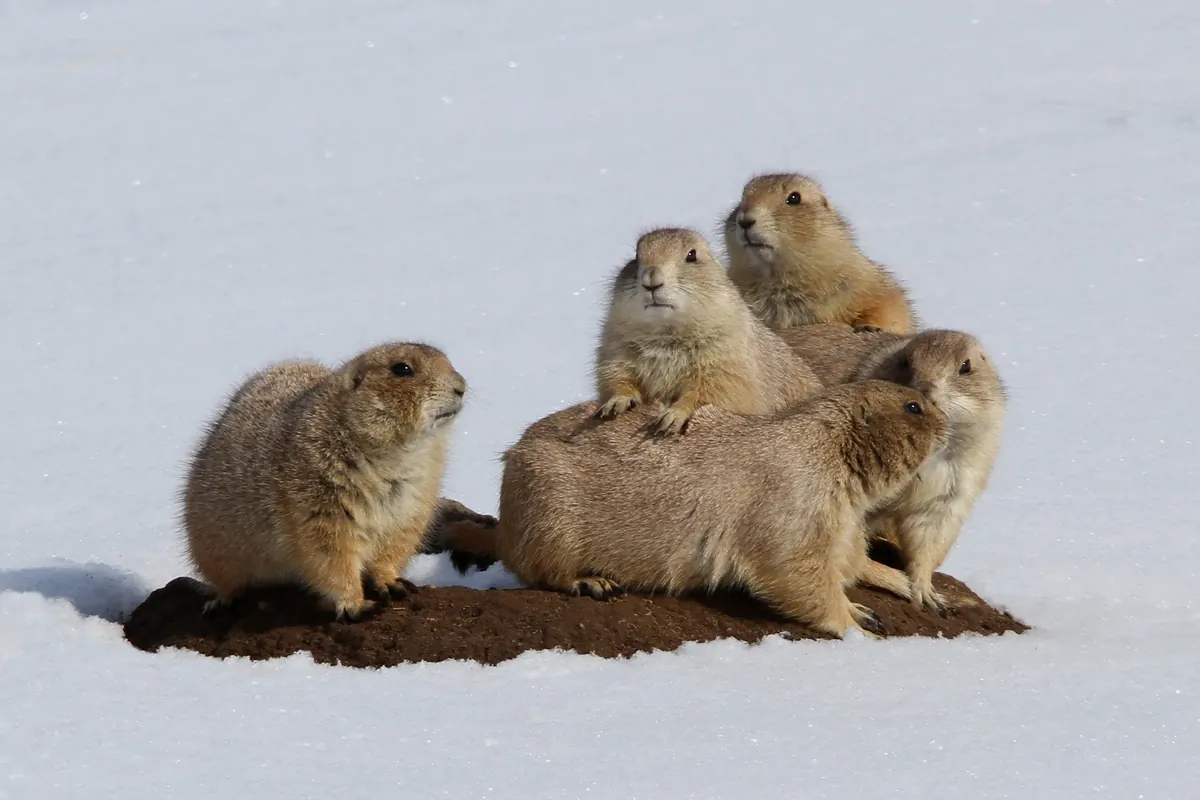
Black-tailed prairie dogs do not hibernate, unlike most of their squirrel relatives. The National Park Service notes that they fatten up in fall, may stay underground for several days in harsh weather, and come up to feed when it turns mild. A calm, bright afternoon after a cold snap is the time to visit a town and watch them clear snow from the mounds and sun themselves at the entrances.
-
Turtles and frogs under the ice
From freeze-up until spring · Ponds, marshes and slow rivers; box turtles in sandy grassland
A Nebraskaland article explains how painted and snapping turtles get through the winter: they settle into the mud at the bottom of a pond, slow their metabolism almost to a stop, and take in the little oxygen they need through the skin of the cloaca, so they never come up for air. Ornate box turtles, common in the Sandhills, go dormant on land instead, digging a burrow or borrowing one for three to five months. Most hatchlings do not survive their first winter.
-
Reading the snow
The morning after any fresh snowfall · Field edges, creek banks, shelterbelts and your own yard
A thin fresh snow writes down the night’s traffic. Cottontails leave two long hind prints set ahead of two small front prints. A coyote or fox trots in a nearly straight line of single prints, while a dog wanders. Pheasants and quail leave three-toed tracks that go from cover to food and back again, and mice and voles make tiny paired prints that end at a hole or a tunnel. Follow one trail as far as you can and draw what you find.
Leave brush piles and woodpiles as they are until spring; dormant toads, snakes and insects shelter inside.
What are the chances of a white Christmas in Nebraska?
Lower than the cards suggest. Weather forecasters call it a white Christmas when at least an inch of snow is on the ground on the morning of December 25, and in most of Nebraska that happens about one year in three.
-
The odds, town by town
December 25 · Omaha, Lincoln, Valentine and North Platte
The National Weather Service in Omaha puts Omaha’s chance at 33 percent, 42 white Christmases in 126 years of records through 2018. The University of Nebraska–Lincoln’s climate pages count 41 in Lincoln over the 128 years from 1897 to 2024, or 32 percent. Valentine had snow on the ground in 46 of 127 years, about 36 percent, and North Platte in 36 of 136, about 27 percent, according to the Weather Service office in North Platte. North Platte, on the drier High Plains, has the lowest odds of the four.
-
The Christmas to remember
December 1983 · Statewide
The coldest Christmas Day on record at Omaha and Valentine came in 1983. In Omaha the high was 2 °F and the low −17 °F, with 13 inches of snow on the ground; Lincoln had 14 inches of snow cover and topped out at 4 °F, and Valentine fell to −22 °F. The same Valentine records also hold a 65 °F Christmas Day, reached twice, in 1928 and in 1979.
Measure new snow on a flat board away from buildings and log the depth each morning.
When is the earliest sunset in Nebraska, and how short is the shortest day?
The earliest sunset comes before the solstice, not on it. Omaha’s sun sets at 4:55 p.m. every evening from December 1 to December 14, the earliest of the year, yet on the solstice it already sets at 4:58. Mornings keep getting darker for another two weeks: Omaha’s sunrise is 7:46 a.m. on December 21 and 7:49 on the 31st. The effect is strongest in the far west of the Central time zone. North Platte’s sun doesn’t rise until 8:05 a.m. on the solstice, and Valentine’s comes up at 8:10.
The solstice itself comes at 2:50 p.m. Central (1:50 p.m. Mountain) on Monday, December 21. That day, the sun is up for 9 hours 18 minutes at McCook but only 9 hours 1 minute at Valentine. Over in the Panhandle, Scottsbluff keeps Mountain time, so its sun goes down by the clock at 4:24 p.m. every evening from December 1 to 15, earlier than anywhere else in Nebraska.
| City | Dec 1 | Dec 21 | Dec 31 | Earliest sunset |
|---|---|---|---|---|
| Omaha | 9 h 25 m | 9 h 12 m | 9 h 16 m | 4:55 p.m., Dec 8 |
| Lincoln | 9 h 28 m | 9 h 14 m | 9 h 18 m | 4:59 p.m., Dec 8 |
| Norfolk | 9 h 21 m | 9 h 07 m | 9 h 10 m | 4:58 p.m., Dec 9 |
| Grand Island | 9 h 27 m | 9 h 14 m | 9 h 17 m | 5:05 p.m., Dec 8 |
| McCook | 9 h 31 m | 9 h 18 m | 9 h 22 m | 5:16 p.m., Dec 8 |
| North Platte | 9 h 26 m | 9 h 13 m | 9 h 16 m | 5:14 p.m., Dec 8 |
| Valentine | 9 h 16 m | 9 h 01 m | 9 h 05 m | 5:08 p.m., Dec 9 |
| Scottsbluff | 9 h 21 m | 9 h 08 m | 9 h 11 m | 4:24 p.m., Dec 8 |
Ten days past the solstice, each town in the table is up three or four minutes, nearly all of the gain at the sunset end. Type in your own town on the sunrise and sunset calculator to see its turning point.
What is December weather like in Nebraska, and what might El Niño mean for the winter?
December in Nebraska is cold, mostly dry and often windy. The table shows NOAA’s 1991–2020 averages for six airports. Afternoon highs run from the upper 30s in Omaha to about 42 °F at North Platte, while the western stations average lows near 13 to 14 °F, roughly 4 to 7 degrees colder than Omaha, Lincoln and Grand Island. The west is drier still, with roughly 0.4 to 0.5 inch of December precipitation, compared with about 1.2 inches in Lincoln and Omaha. Snow is not much of a west-to-east story this month. Scottsbluff leads with nearly 8 inches on average, but Omaha’s 5.8 inches tops North Platte, Grand Island and Valentine.
Nebraska heads into this winter with the tropical Pacific running hot: the Climate Prediction Center’s September 10 update rates the chance that this El Niño stays very strong through December, January and February at above 90 percent. Nebraska’s state climatologist and University of Nebraska colleagues, writing on September 21, said strong El Niño winters have often been warmer than normal here, but their rain and snow totals have been all over the map, because the state lies between stronger signals to the north and the south. The early outlooks they reviewed tilt warm statewide and lean wet in the south, with no lean in the north. As they put it, El Niño shifts the odds without deciding the winter. Look for NOAA’s formal December–February outlook after its October 15 release, posted among the Climate Prediction Center’s seasonal outlook maps.
| Station | Average high | Average low | Precipitation | Snowfall |
|---|---|---|---|---|
| Omaha Eppley Airfield | 37.7 °F | 19.8 °F | 1.22 in | 5.8 in |
| Lincoln Municipal Airport | 39.4 °F | 18.2 °F | 1.18 in | 5.3 in |
| Grand Island Airport | 38.9 °F | 18.9 °F | 0.84 in | 4.7 in |
| North Platte Regional Airport | 42.0 °F | 13.1 °F | 0.45 in | 4.5 in |
| Valentine Miller Field | 39.4 °F | 13.1 °F | 0.43 in | 5.0 in |
| Scottsbluff Heilig Airport | 41.6 °F | 14.4 °F | 0.52 in | 7.8 in |
Typical first-freeze and last-frost dates for 180-plus stations are on our Nebraska frost guide. For the days just ahead, the local forecast page explains the latest model runs in everyday language.
What can you see in Nebraska’s night sky in December?
These are the longest nights of the year. Times below are standard time, Central for most of the state and Mountain for the Panhandle and its neighbors to the south and east, Ogallala and Imperial among them.
-
The Geminids
Night of Sunday, December 13, into Monday, December 14 · Anywhere dark; the radiant near Castor and Pollux rises in the east-northeast in early evening
No shower of 2026 is richer than the Geminids. Its zenithal rate, as the International Meteor Organization calls it, is of about 150 an hour for an observer under perfect skies with the radiant overhead; a dark Nebraska pasture shows far fewer, yet still beats every other shower Nebraskans can watch this year. With the young Moon down by mid-evening, the richest hours come around 2 a.m., when Gemini stands highest. Geminids are bright and fairly slow, and some show color. Lie back on a lawn chair under a sleeping bag rather than craning your neck.
-
Venus at dawn, Saturn at dusk
All month · Southeast before sunrise; south and southwest after sunset
Over the southeastern horizon at daybreak, brilliant Venus gains height morning after morning, and it keeps pulling away from the Sun until January 3, when the gap between them is widest. Look for the old crescent Moon below it, with Spica nearby, early on Friday and Saturday, December 4 and 5. Jupiter and reddish Mars sit in Leo and are up well before dawn; by late December Jupiter rises in mid-evening. After dusk, Saturn has the evening to itself, steady and yellowish in the south after dark and setting earlier as the month goes on.
-
The Cold Moon, nearest of the year
Wednesday evening, December 23; nearly as full on Christmas Eve · Rising in the east-northeast around sunset
Full phase comes at 7:28 p.m. Central and 6:28 p.m. Mountain on December 23, only about seven hours before perigee, the Moon’s closest approach of its orbit. No full moon this year comes closer to Earth or looks bigger, so it counts as a supermoon. It rides very high across the sky at midnight, as December full moons do, and on snow it throws real shadows. On the solstice evening the waxing Moon slides close by the Pleiades.
| Phase | Date | Time |
|---|---|---|
| Last quarter | Tuesday, Dec 1 (Monday, Nov 30, on Mountain time) | 12:08 a.m. CST (11:08 p.m. MST, Nov 30) |
| New moon | Tuesday, Dec 8 | 6:52 p.m. CST (5:52 p.m. MST) |
| First quarter | Wednesday, Dec 16 | 11:42 p.m. CST (10:42 p.m. MST) |
| Full moon, the Cold Moon | Wednesday, Dec 23 | 7:28 p.m. CST (6:28 p.m. MST) |
| Last quarter | Wednesday, Dec 30 | 12:59 p.m. CST (11:59 a.m. MST) |
December skies over Nebraska are clear more often than November’s, but check the cloud cover forecast before a late night out. The Moon phase calendar has moonrise and moonset times for Kearney, Chadron or anywhere else in the state.
What can Nebraska families do outdoors in December 2026?
December programs lean toward short afternoon walks, evening events and the holidays. We took these listings from organizers’ own calendars in early October; Game and Parks’ own December 2026 calendar was not yet posted, so the state park traditions are described from past years. Check before you go. A park entry permit is required for vehicles in Nebraska state parks.
- Fontenelle Forest, Bellevue: Twilight Trekking on Saturday, December 12 (5 to 7 p.m.); a forest habitat hike on Sunday, December 13 (2 to 4 p.m.); a Winter Solstice Celebration on Sunday, December 20 (4 to 6 p.m.); an astronomy day camp for homeschoolers on Monday, December 7, and a winter break camp on December 28. The nature center is closed December 24 and 25.
- Holiday evenings in state parks: in recent years Buffalo Bill Ranch State Historical Park in North Platte has held Christmas at the Codys on several December evenings, Ponca State Park has run free lighted hayrack rides on December Saturdays, and Mahoney State Park has hosted a Classic Christmas day of crafts and cookie decorating. Look for 2026 dates on the Game and Parks events calendar from November.
- Eagle watching: the J-2 plant near Lexington and Kingsley Dam viewing rooms have opened on the last weekend of December in recent winters; confirm on the Central Nebraska Public Power and Irrigation District’s eagle page.
- First Day Hikes, Friday, January 1, 2027: on New Year’s Day 2026, Game and Parks listed guided hikes at 17 state parks and recreation areas, from Wildcat Hills and Chadron to Indian Cave and Ponca, with extras such as a soup lunch at Ash Hollow and a trail ride at Branched Oak. Expect the 2027 list in December; America’s State Parks runs the national program.
- Citizen science: a count circle near home, a weekly FeederWatch tally, eBird lists of owls, solitaires and gulls, and iNaturalist photos of tracks all add useful records.
Other months are listed on the nature guide index.
Safety notes for December in Nebraska
- Hunting seasons open in December 2026 (Nebraska Game and Parks): muzzleloader deer runs December 1–31 statewide and archery deer through December 31; the bighorn sheep lottery season runs December 1–22 in the Panhandle; late antlerless elk and late doe and fawn antelope seasons continue through January 31, 2027. Pheasant, quail, partridge and prairie grouse stay open through January 31. Duck season in Zone 1 closes December 6 and reopens December 19, Zone 2 closes December 15 and Zone 3 runs through January 5; white-fronted geese close December 27 and light geese December 30, while dark geese continue into January and February in their units. Bobcat season opens December 1, and trapping for other furbearers is under way.
- Hunter orange: Nebraska Revised Statute 37-527 and the Game and Parks Big Game Guide require deer, elk, antelope and bighorn hunters in a firearm season to display blaze orange on the head, chest and back, 400 square inches or more in all, and the guide says this applies to muzzleloader hunters during the December muzzleloader season. Archery deer hunters must wear it only during the November firearm and January late antlerless seasons. Hikers aren’t required to, but orange is smart on public land all month.
- Ice: Game and Parks says 4 inches of clear ice is the minimum for one person on foot, and 7.5 inches for a group or an ATV. Cloudy, slushy ice is only about half as strong, so the agency advises twice the thickness. Ice near shore, over springs, around reeds and logs, and anywhere current flows is thinner than it looks; river ice is never safe. Carry ice picks, go with someone, and tell someone where you are going.
- Early dark: sunset comes around 5 p.m. in Omaha and Lincoln and around 4:25 p.m. in Scottsbluff until mid-month. Start winter walks by early afternoon and carry a headlamp.
- Blizzards and wind chill: a December storm can close roads across the Sandhills and Panhandle for a day or more. Carry blankets, water, a shovel and a phone charger, and check 511 road reports first.
Sources
- Nebraska Game and Parks: hunting seasons 2026–27 (live site blocks automated access; checked against the September 25, 2026 archived copy at web.archive.org, which lists every December date on this page)
- Nebraska Game and Parks: Big Game Guide, hunter orange (checked against the May 12, 2026 archived copy)
- Nebraska Revised Statute 37-527, hunter orange
- Nebraska Game and Parks: top 8 ice safety tips
- Nebraska Game and Parks: park permits
- Nebraska Game and Parks: events calendar
- Nebraska Game and Parks: explore the parks with these events in December (2025 traditions)
- Nebraska Game and Parks via KTCH: First Day Hikes offered at 17 Nebraska state parks (Dec. 29, 2025)
- America’s State Parks: First Day Hikes
- Birds of Nebraska Online (Nebraska Game and Parks): great horned owl
- Birds of Nebraska Online: long-eared owl
- Birds of Nebraska Online: short-eared owl
- Birds of Nebraska Online: snowy owl
- Birds of Nebraska Online: herring gull
- Birds of Nebraska Online: glaucous gull
- Birds of Nebraska Online: bald eagle
- Birds of Nebraska Online: Townsend’s solitaire
- Birds of Nebraska Online: red crossbill
- Birds of Nebraska Online: Bohemian waxwing
- Audubon: join the Christmas Bird Count
- EarthSky: Audubon Christmas Bird Count, December 14 to January 5
- Nebraska Ornithologists’ Union: Christmas Bird Counts
- Audubon Society of Omaha: bird counts
- Wachiska Audubon Society, Lincoln
- Central Nebraska Public Power and Irrigation District: eagle watching opportunities (2024–25 season)
- Central Nebraska Public Power and Irrigation District: eagle viewing facilities (2025–26 schedule; checked October 2, 2026)
- KRVN: Central’s eagle viewing facilities set to open Dec. 27 (2025–26 season)
- USDA Forest Service: Nebraska National Forest, Bessey Recreation Complex
- USDA Forest Service: Christmas tree permits available through Recreation.gov (Nov. 24, 2025)
- Recreation.gov: Nebraska National Forests and Grasslands Christmas tree permit
- Sandhills Express: harvest your Christmas tree on the Nebraska National Forests (Nov. 28, 2025)
- Nebraska Forest Service: ponderosa pine
- Nebraska Forest Service: Rocky Mountain juniper
- Nebraska Forest Service: eastern redcedar
- Nebraskaland Magazine: The Hibernation Checklist (Nov. 21, 2023)
- Nebraskaland Magazine: Turtles, slowing down for winter (Dec. 2, 2019)
- National Park Service: black-tailed prairie dogs
- NWS Omaha/Valley: white Christmas probabilities
- University of Nebraska–Lincoln, Lincoln Weather and Climate: white Christmas climatology
- NWS North Platte: Christmas Day climatology, Valentine
- NWS North Platte: Christmas Day climatology, North Platte
- NOAA Climate.gov: are you dreaming of a white Christmas?
- NOAA NCEI: 1991–2020 U.S. climate normals
- NOAA NCEI: 1991–2020 monthly normals for Omaha, Lincoln, North Platte, Valentine, Scottsbluff and Grand Island
- CPC ENSO diagnostic discussion, September 10, 2026
- CPC: seasonal (90-day) outlooks
- Nebraska State Climate Office: What does the 2026 El Niño mean for Nebraska? (Sept. 21, 2026)
- U.S. Naval Observatory: moon phases
- U.S. Naval Observatory: Earth’s seasons, 2026
- U.S. Naval Observatory: one-day sun and moon data
- International Meteor Organization: 2026 meteor shower calendar
- EarthSky: what is a supermoon?
- BBC Sky at Night: supermoons in 2026
- EarthSky: Venus at greatest western elongation
- NOAA Space Weather Prediction Center: solar cycle progression
- Fontenelle Forest: December 2026 calendar
- Project FeederWatch
- eBird
- iNaturalist
- Photos via Wikimedia Commons; licenses and photographers are credited under each picture
