What to look for in nature in Nebraska this January
January is the coldest month in Nebraska, and the cold sorts the wildlife. Ponds and marshes are sealed, so anything that eats fish or needs to paddle crowds onto the stretches of river and reservoir that stay open: eagles below the dams, trumpeter swans on spring-fed creeks, rafts of mergansers on the big lakes. Out in the stubble fields, flocks of Arctic songbirds swirl ahead of the snowplows. Meanwhile the year’s first nests are already occupied, because great horned owls start laying eggs in the third week of the month. Daylight is returning, a little faster each week.
Other months in Nebraska: October, November, December, February.
Start here
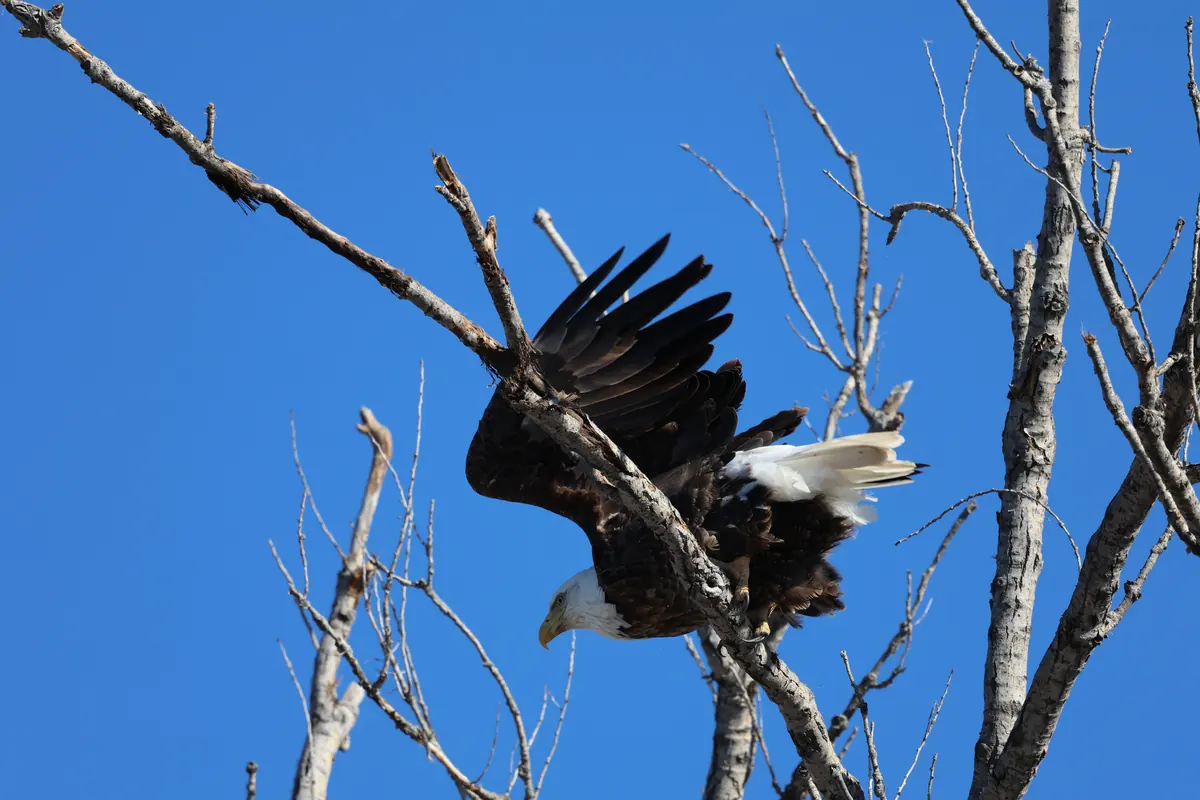
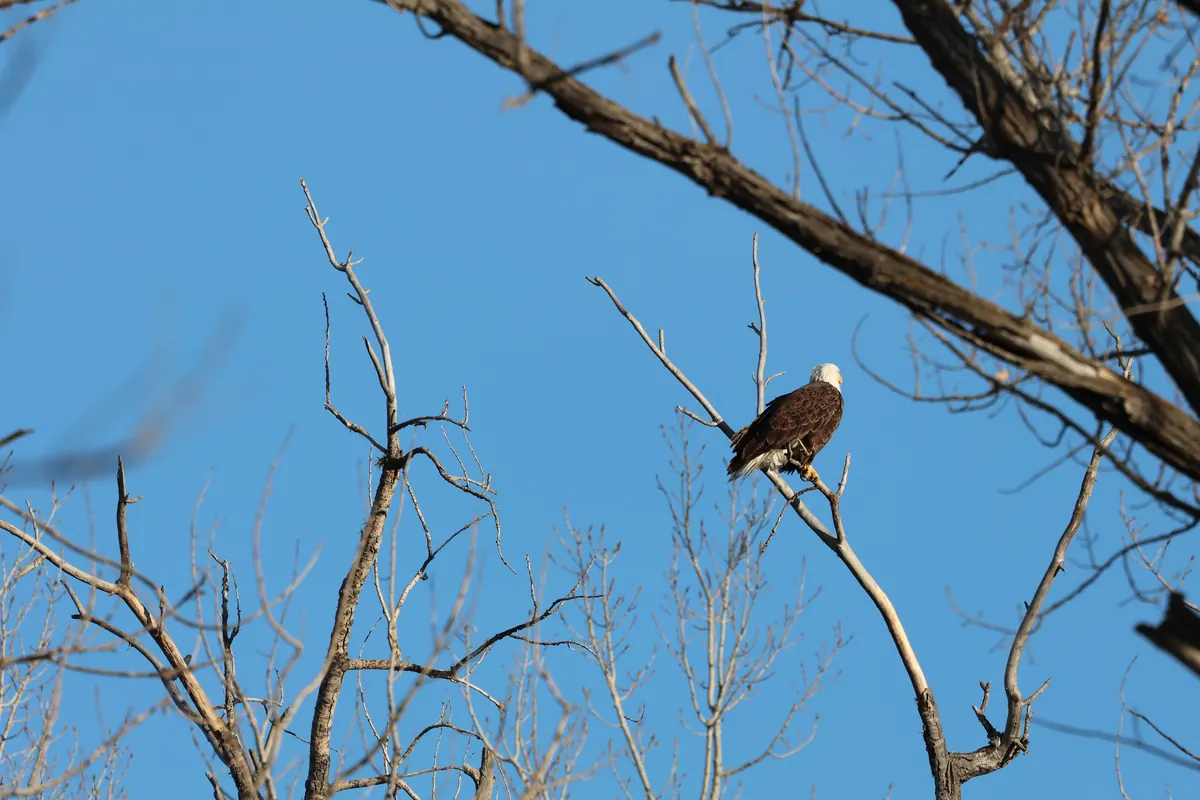
- Count eagles where the ice ends. Pick a still, sunny morning after a run of subzero nights and drive to a dam outlet or a big river bend. Eagles perch in the bare cottonwoods closest to the open water and take turns dropping onto fish. Stay in or right beside the car so the birds stay put, and tally adults (white heads) and young birds (mottled brown) separately.
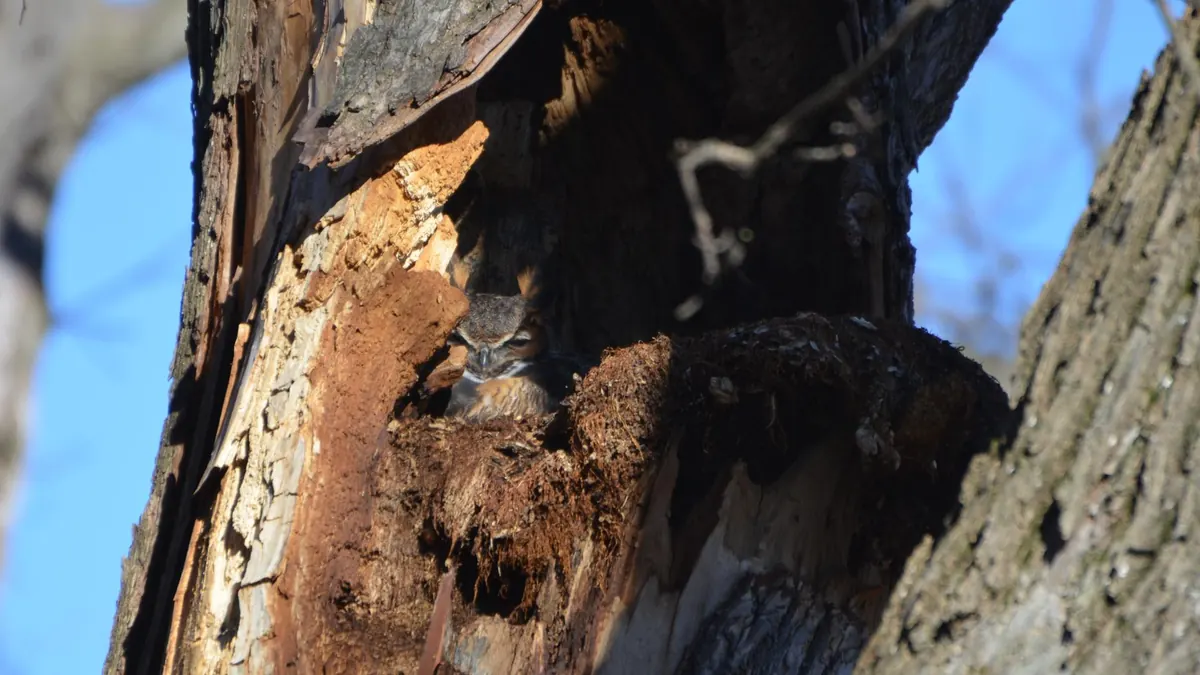
- Check old stick nests for an owl’s ear tufts. Great horned owls lay their first Nebraska eggs around January 18. Scan last summer’s hawk and crow nests in shelterbelts and river woods with binoculars; an incubating owl sits low, and often only two feathery tufts and a pair of yellow eyes show above the rim.
- Watch the Wolf supermoon set at dawn. This year’s nearest full moon is exact early on Friday, January 22: 6:17 a.m. CST, or 5:17 a.m. MST. It comes up in the east-northeast around sunset on Thursday the 21st and goes down in the west-northwest at about sunrise, so a Friday commute toward the west gets the best view.
In the Naturalist’s Field Journal, this is the month for the “birds I have seen” plate to gain a snow bunting or a Lapland longspur, with the field and the depth of snow noted beside it. An owl sitting tight on an old hawk nest belongs on “nest observed,” and an otter’s hop-hop-slide trail across a frozen creek is a fine entry for “tracks to know.” Press a Kentucky coffeetree pod or a sticky-budded cottonwood twig into the seeds, pods and cones plate. Use “the same place twice” to sketch your eagle spot in January and again in March, when the ice is gone.
Regions used below: The Panhandle and Pine Ridge; The Sandhills and Niobrara valley; Southwest Nebraska and the Republican valley; The central Platte and Rainwater Basin; Northeast Nebraska and the Missouri bluffs; Lincoln, Omaha and the southeast.
Where can you see the most bald eagles in Nebraska in January?
Bald eagles spread out across the state in late fall, but once the lakes freeze they bunch up wherever fish are still within reach. Birds of Nebraska describes them as common and locally abundant winter visitors, and says midwinter numbers depend on the weather and swing widely from one year to the next.
-
The heated viewing rooms on the Platte
Weekends in recent winters, from the last weekend of December into late February · J-2 hydropower plant south of Lexington (Central time); Kingsley Dam below Lake McConaughy, near Ogallala (Mountain time)
Each winter the irrigation and power district known locally as Central opens two warm indoor viewing rooms, with spotting scopes and staff on hand. Game and Parks notes that numbers at J-2 usually top out in December and early January, while Kingsley peaks in February. Last winter’s weekend tallies fit that pattern: J-2’s best count was 33 eagles on December 28, 2025, and 30 on January 3, while Kingsley reached 100 on January 31 and had just 6 to 14 on the quietest January weekends. In 2025–26 both rooms opened on weekend mornings, 8 a.m. until 1 p.m. by local clocks, from December 27 through February 22. No 2026–27 schedule was up as of early October; the district’s eagle page will list it.
-
Harlan County Dam and the Republican River
Mostly January, during cold spells · Harlan County Reservoir near Republican City and Alma
Game and Parks’ Nebraska Birding Trail says the area around Harlan County Dam can draw 150 to 400 bald eagles in January, and the largest single-site count in Birds of Nebraska, 316, was made there on January 30, 2015. Look along the outlet channel below the dam and in the tall cottonwoods along the river downstream, where eagles loaf between feeding bouts.
-
The Missouri River parks
All winter, best on cold, clear days · Ponca State Park near Ponca; Indian Cave State Park near Shubert; overlooks along the river
Game and Parks’ winter wildlife guide singles out Ponca and Indian Cave, where large numbers of eagles perch in trees along the river. Watch the banks for otter and raccoon tracks too.
-
Nesting pairs already at work
Nest building from early January · River valleys statewide, most from the Platte northward and east
Not every January eagle is a visitor. Nebraska’s nesting eagles vanished around 1900, and the first successful modern nest, near Valley, fledged a young eagle in 1991; by 2017 Game and Parks estimated 209 active nests, mostly along rivers in the north and east. Birds of Nebraska’s nest records show territorial pairs and nest building from January 6, with eggs from February 19. If you see an eagle carrying a stick, you have found a pair. Watch from 100 yards or more.
Nebraska ran a statewide midwinter eagle count for decades, averaging 744 birds a year from 1980 to 1995 and 990 from 1996 to 2011, then stopped in 2013 because the population had recovered. Your own January tallies, entered in eBird, help fill that gap. Their arrival is on the December page.
When do great horned owls lay eggs in Nebraska?
The hooting you heard in December was courtship. In January it turns into nesting, weeks before any other Nebraska bird. Birds of Nebraska, drawing on the state’s collected nest records, lists territorial fights from January 17, eggs and incubation from January 18, and mating from January 20 into February 10.
-
Great horned owls on borrowed nests
Eggs recorded from January 18 into mid-April · Statewide: shelterbelts, farmsteads, river woods, city parks and cemeteries
Great horned owls don’t build their own nests. Birds of Nebraska says they rely on large abandoned nests of other birds in mature trees, hollows in broken stumps, and cliff ledges, so the nest is ready made and they can start in the depths of winter. Look for a nest with a lump in it that has two ears, and listen at dusk for the pair still trading hoots nearby. The earliest nestlings in the state’s records date from mid-March.
-
Barred owls in the eastern river woods
Calling all winter; eggs begin in early February · Mature river-bottom woods in the east: Ponca and Indian Cave state parks, Schramm Park State Recreation Area, Rock Creek Station State Historical Park
The barred owl is a fairly common resident of the eastern woodlands and rare elsewhere in the state. Its rhythmic eight-note hooting carries through bare bottomland timber at dawn and dusk. Nebraska egg dates for barred owls start on February 2, so January calling is the run-up to nesting. Game and Parks suggests an early-morning or evening drive or walk through river-bottom parks for the best chance of hearing one.
-
Short-eared owls over open grass
Through winter, most visible when snow cover is light · Grassland wildlife management areas such as Kiowa, North Lake Basin and Jack Sinn Memorial
Game and Parks recommends open, little-developed grassland for this owl, which flies low and floppy over the grass in the last light of the afternoon.
Keep well back from any owl nest, don’t use calls or playback, and don’t share the location of an active nest online. A flushed female leaves her eggs exposed to the cold.
Which Arctic birds spend January in Nebraska?
Some of Nebraska’s winter birds nest on the tundra and treat the Plains as their south. Their numbers rise and fall with the snow line, so no two winters look alike.
-
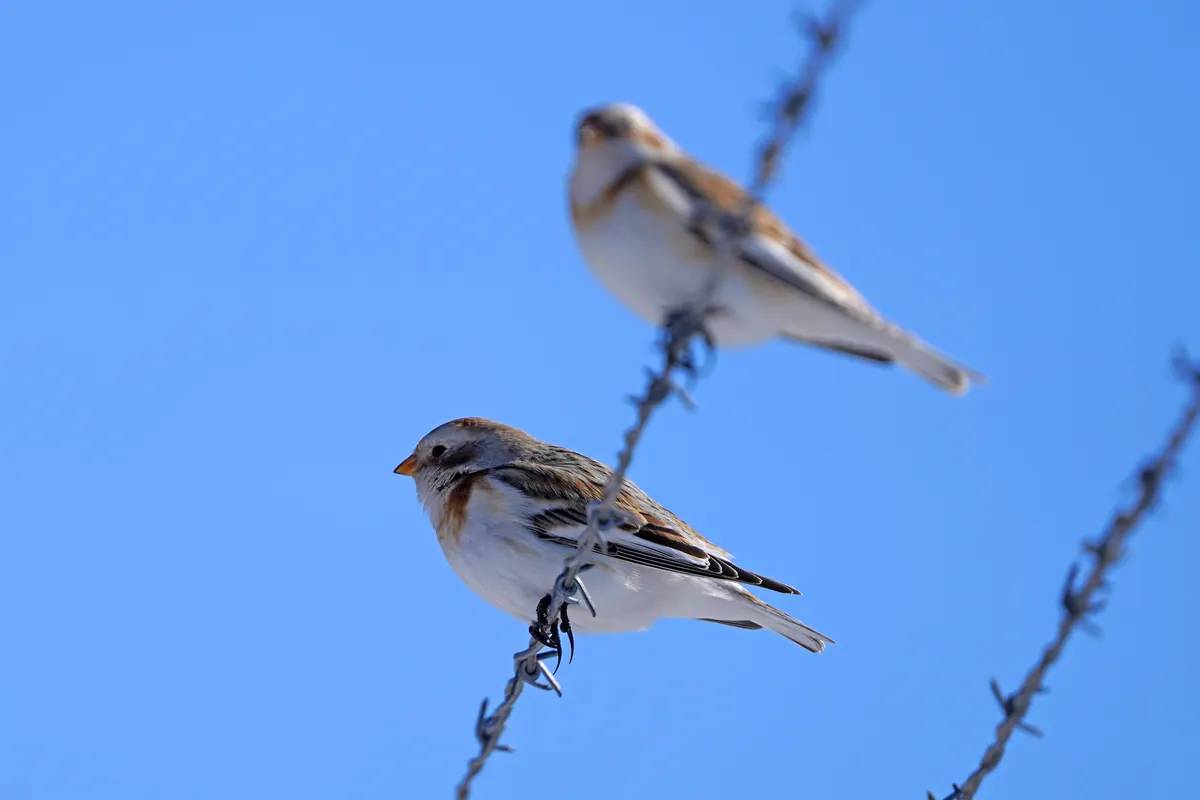
Snow buntings
Late October to mid-March; in 2022–23 the peak was squarely in January · Rocky riprap on reservoir dams, plowed fields and gravel roads, statewide
A snow bunting flock flashes white as it lifts, the birds tumbling low over a field and landing a little farther on. Nebraska sits near the southern edge of the species’ winter range, but Birds of Nebraska says it has become more common in recent years, especially around reservoirs with long stretches of rock riprap, and calls it an uncommon regular winter visitor. Winter 2022–23 shows how much January matters: about 2,600 were reported in Nebraska that winter, nearly all of them in January, including 1,200 in Saunders County on January 26, 2023.
-
Lapland longspurs and horned larks
Mid-October through mid-April · Stubble and feedlot edges statewide; the largest flocks in the west, around Alliance and Hemingford
Lapland longspurs are abundant winter visitors, usually traveling with horned larks. They move around all winter as snow covers and uncovers their food, so a field can hold thousands one week and none the next. The biggest January count on record is 50,000 in Dodge County on January 16, 1999. Observers have long noted that big flocks gather over towns during snowstorms. Look for a sparrow-sized bird with a rattling flight call and, in good light, a rusty patch on the folded wing.
-
Gray-crowned rosy-finches on the buttes
Late October to March, in small numbers most winters · Rocky buttes and ranch feeders in Sioux, Dawes and Scotts Bluff counties
These brown-and-pink finches nest in the high mountains of western Canada and the northern Rockies, and some winter as far east as Nebraska’s Panhandle. Most Nebraska reports come from regular roost sites on buttes in the far northwest, and flocks occasionally reach the hundreds, though single birds also mix with siskins and goldfinches at feeders. One visited the Wildcat Hills Nature Center feeders south of Gering on January 12–14, 2022.
What about winter finches? In its forecast for this winter, issued in late September, the Finch Research Network reports big flights of pine siskins already moving through Minnesota and Quebec, and expects at most a small to modest redpoll flight toward the western Great Lakes. It also reports a widespread failure of ponderosa, limber and pinyon pine crops in the interior West and a large west-to-east movement of Type 2 red crossbills. None of that is a Nebraska prediction, but it is a reason to check the Pine Ridge ponderosas and the Wildcat Hills feeders, where siskins can arrive in the hundreds.
Where do trumpeter swans and mergansers spend the winter in Nebraska?
Waterbirds that stay through January need open water, and in Nebraska that means spring-fed creeks, sandpit lakes along the Platte, the outflows below dams and the deepest reservoirs. A few of those spots hold some of the state’s most striking winter flocks.
-
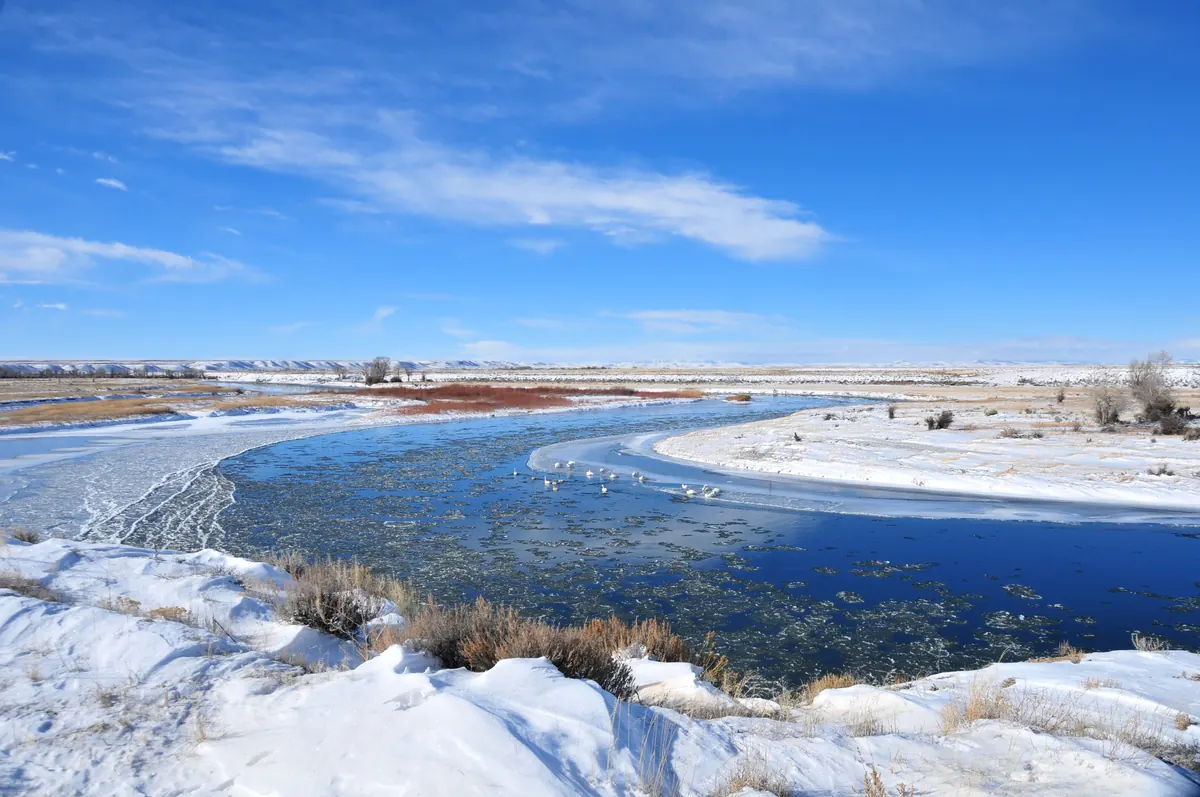
Trumpeter swans
Wintering flocks from late December; departures from mid-February into March · Blue Creek in Garden County, the Snake River in Cherry County, parts of the Loup system, Lake Ogallala; in the east, Platte River sandpits, DeSoto National Wildlife Refuge and Carter Lake in Omaha
The trumpeter, North America’s largest waterfowl, has made a remarkable comeback here. Swans that nest in the Sandhills once spent the cold months just over the line in South Dakota, at Lacreek refuge, but by the 1980s some began staying on Nebraska’s ice-free streams. Since then birds from the reintroduced Interior population of Iowa and Minnesota have joined them, especially in the east, and Birds of Nebraska estimates the state’s resident trumpeters at 200 in 2000 and 311 in 2015, with more recent surveys suggesting more than 700. Some swans carry red neck collars or orange wing tags from Iowa, Minnesota or Nebraska studies, and the codes are worth reporting.
-
Common mergansers by the thousand
Numbers build to a December peak and hold where water stays open · Harlan County Reservoir, Sutherland Reservoir, Lake McConaughy
Common mergansers, long-bodied diving ducks, the males white with dark green heads, winter on Nebraska’s big reservoirs in huge numbers. Winter counts have reached 12,000 at Lake McConaughy on January 15, 1998, and 15,000 at Sutherland Reservoir in February 1994. Harlan County Reservoir is the state’s classic site, but Birds of Nebraska reports a steep drop in counts after 2019, possibly tied to that year’s major flooding, and a slow recovery since, with about 4,000 in December 2024.
Scan the edges of a big flock for common goldeneyes and buffleheads.
What signs of mammals can you find in the Nebraska snow?
Snow and bare trees make January the easiest time to learn who lives near you, even when the animals themselves stay out of sight. Game and Parks’ watchable-wildlife staff suggest getting out at sunrise, when animals are feeding after a cold night, and keeping quiet, since sound carries farther through leafless woods.
-
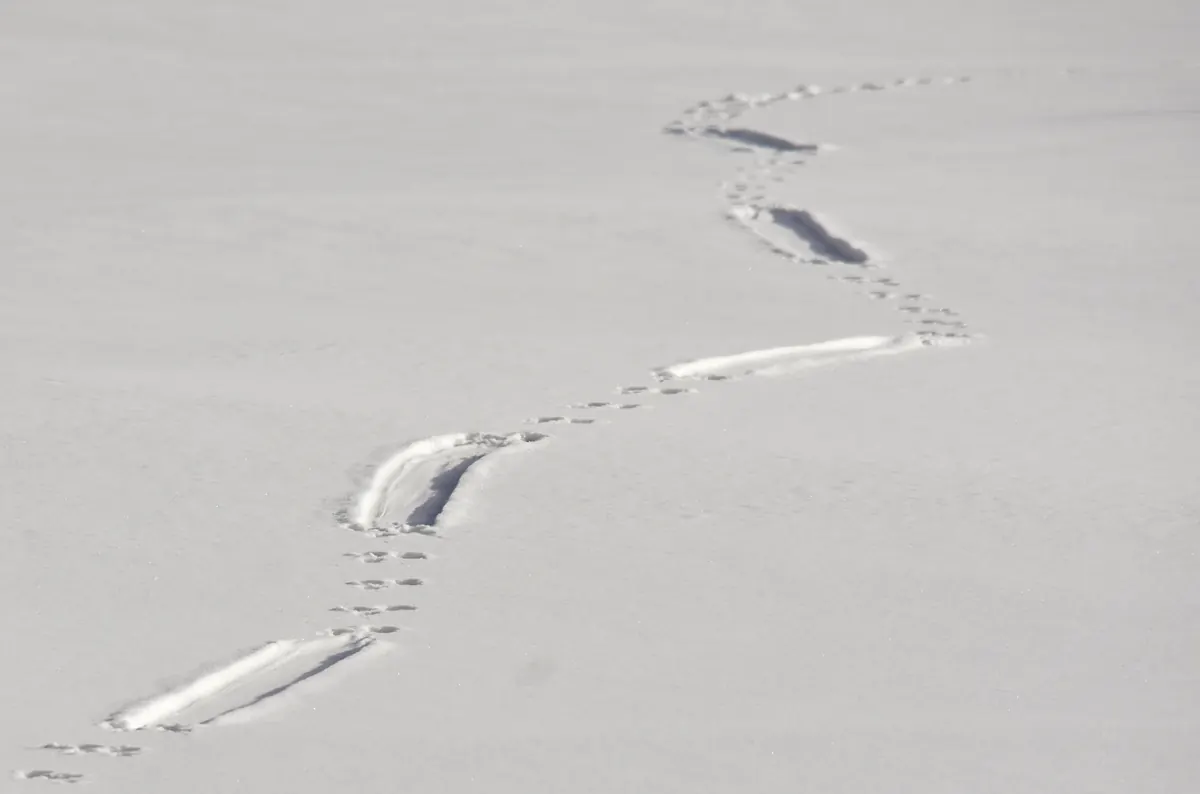
River otter slides
Any snowy stretch from December to March · Snowy creek banks and river ice statewide; Ponca and Indian Cave state parks on the Missouri are good places to look
Game and Parks names January as the month to look for otter slides. To save energy in winter, otters bound a few steps and then slide on their bellies, often 10 feet or more, so the trail reads like Morse code: a cluster of prints, a smooth trough, then prints again. River otters were reintroduced to Nebraska beginning in 1986, and the slides are one of the easiest ways to know they are using your stretch of river.
-
Jackrabbits starting their breeding season
January and February · Black-tailed jackrabbits mainly in the south, white-tailed in the north; most often seen in the Panhandle and Sandhills
Game and Parks notes that Nebraska’s two jackrabbits begin breeding in late winter, and its winter viewing guide says January and February are a good time to spot them, usually at dusk as they come out to nibble shrubs and grass. The white-tailed jackrabbit turns mostly white in winter and is now found mainly in the northern half of the state; the black-tailed keeps its brown coat and black-topped tail.
Lay a coin or pencil beside a track before you photograph it, so you can judge its size later. How prairie dogs and turtles ride out the cold is on the December page.
How can you identify Nebraska trees in winter?
Without leaves, trees still carry plenty of clues: bark texture, buds, the shape of the twig and whatever fruit is still hanging on. The University of Nebraska–Lincoln’s tree identification pages describe each of these native trees in winter terms.
-
Eastern cottonwood
All winter · Along every river and stream; the state tree
Look for stout gray-green twigs with a large, pointed, sticky yellow-green bud at the tip. Older trunks have thick bark in deep furrows separated by flat-topped ridges. The Nebraska Forest Service notes that the state champion, at Pibel Lake Recreation Area in Wheeler County, is also the national champion for the species.
-
Bur oak
Acorn caps and corky twigs show all winter · River and stream valleys in the eastern third of the state, with outposts west to Hitchcock and Dawes counties
Nebraska’s most common native oak has thick, deeply furrowed gray bark, rounded reddish-brown buds clustered at the twig tips, and twigs that often carry corky ridges. A fringed acorn cap under the tree settles it. The Forest Service lists a nearly 500-year-old bur oak at Ponca State Park and an isolated western population in Bur Oak Canyon near Culbertson.
-
Kentucky coffeetree
Pods hang on female trees into winter · A Nebraska native of woodlots and stream valleys, also planted in parks and along streets
This is the easiest tree to recognize in January. Its twigs are very thick, light gray and few, so the crown looks coarse and stubby against the sky. There is no bud at the tip, the side buds are tiny, and if you cut a twig the pith is pinkish. Female trees hold leathery brown pods with hard seeds. Pick up a fallen pod and shake it to hear the seeds rattle, but don’t eat them; they are toxic.
-
Hackberry, honeylocust and black walnut
All winter · Woodlots, river bottoms and windbreaks, mostly in the east and center
Hackberry bark is gray with hard, corky warts and ridges. Honeylocust has zigzag red-brown twigs, often stiff thorns on the trunk, and long, twisted pods. Black walnut twigs are stout and fuzzy, and a lengthwise cut shows a pith divided into tiny chambers.
Snip a single twig only from your own trees or with permission, and never in a state park or nature preserve.
How cold does January get in Nebraska, and what could a strong El Niño mean?
Deep winter has arrived. Averaged over 1991–2020, NOAA’s normals put average afternoon highs between the low 30s at Omaha and the low 40s at Scottsbluff, and nights fall to the low or middle teens across the state. January is also dry, with roughly two-thirds to three-quarters of an inch of precipitation in the east and under half an inch in the west. Unlike December, Omaha averages more January snow than any other airport in the table.
Subzero cold belongs to this month more than any other. Lincoln weather records kept by the University of Nebraska–Lincoln count 773 January days at or below 0 °F in the 139 winters from 1887 through 2025, far more than any other month; the city averages 12 such days a year, though the 2015–2024 average was 9. Lincoln’s all-time low, −33 °F, came on January 12, 1974.
The tropical Pacific is running an exceptionally warm El Niño into this winter, and the federal forecasters who track it gave odds above 90 percent, on September 10, that it holds at very strong levels through the December–February season. In a September 21 review, the state climatologist and University of Nebraska colleagues compared the three strongest recent events, 1982–83, 1997–98 and 2015–16, and found warmth was the more dependable signal while precipitation differed from one event to the next. The U.S. Geological Survey’s North Central Climate Adaptation Science Center reads past strong El Niños as tilting wet across the southern part of its region, Nebraska included, but notes that the models agree least in Nebraska, Kansas, Colorado and Wyoming. Both speak to the whole December–February season, not January alone, and a mild winter can still bring a week of Arctic air. For the official odds, open NOAA’s 90-day outlook maps, which are refreshed each month; the January–March maps issued in mid-December will be the most current.
| Station | Average high | Average low | Precipitation | Snowfall |
|---|---|---|---|---|
| Omaha Eppley Airfield | 33.6 °F | 15.2 °F | 0.75 in | 7.2 in |
| Lincoln Municipal Airport | 35.6 °F | 14.4 °F | 0.73 in | 6.5 in |
| Grand Island Airport | 36.1 °F | 15.6 °F | 0.61 in | 6.8 in |
| North Platte Regional Airport | 40.7 °F | 11.9 °F | 0.39 in | 5.1 in |
| Valentine Miller Field | 37.8 °F | 11.2 °F | 0.32 in | 4.4 in |
| Scottsbluff Heilig Airport | 41.7 °F | 14.9 °F | 0.39 in | 5.3 in |
When the next cold wave or snow is on the way, the forecast explainer walks through what the models are showing for your town. Average spring frost dates for stations around the state are in the Nebraska frost tables, handy for planning seed orders this month.
How much daylight does Nebraska gain in January?
The darkest mornings of the year are over by the first week of January, and the gain picks up as the month goes on. Every town in the table adds between 46 and 50 minutes of daylight from New Year’s Day to January 31, more of it at the evening end than in the morning. Valentine, the farthest north of these towns, gains the most, yet it and Norfolk still end January just shy of 10 hours.
| City | Jan 1 | Jan 31 | Gained | Per day |
|---|---|---|---|---|
| Omaha | 9 h 16 m | 10 h 03 m | 47 min | 1.6 min |
| Lincoln | 9 h 19 m | 10 h 05 m | 46 min | 1.5 min |
| Norfolk | 9 h 11 m | 9 h 59 m | 48 min | 1.6 min |
| Grand Island | 9 h 18 m | 10 h 04 m | 46 min | 1.5 min |
| McCook | 9 h 22 m | 10 h 08 m | 46 min | 1.5 min |
| North Platte | 9 h 17 m | 10 h 04 m | 47 min | 1.6 min |
| Valentine | 9 h 06 m | 9 h 56 m | 50 min | 1.7 min |
| Scottsbluff | 9 h 12 m | 10 h 00 m | 48 min | 1.6 min |
For your own town’s day-by-day sunrise and sunset, try the daylight calculator.
What can you see in Nebraska’s night sky in January?
Long, frosty nights and dry air reward anyone who bundles up and steps outside. All times here are standard time: Central for most of Nebraska, Mountain for the Panhandle and the southwestern counties that keep Mountain time.
-
The Quadrantid meteor shower
Late evening Sunday, January 3, through dawn Monday, January 4 · Anywhere dark; the radiant, between the Big Dipper’s handle and Boötes, is low in the evening and climbs through the night
This shower’s maximum is brief, a matter of hours, and the two main predictions for 2027 both fall in the American night of January 3–4. Only a sliver of waning Moon is up, and not until a few hours before dawn, so conditions are about as good as this shower gets. The predawn hours of Monday are the safest bet. From a dark Sandhills or Panhandle site, count on a few dozen an hour at best, and much less under Kearney or Omaha skyglow.
-
Perihelion and Venus at its farthest
Saturday evening, January 2, and Sunday morning, January 3 · Venus in the southeast before sunrise
Perihelion, Earth’s nearest point to the Sun, comes on Saturday, January 2, at 8:33 p.m. CST (7:33 p.m. MST), when the two are roughly 91.4 million miles apart. Winter cold comes from Earth’s tilt, not its distance. On Sunday, Venus reaches its widest morning separation of this apparition, 47 degrees from the Sun, and it stands high in the predawn southeast, outshining everything but the Moon. Saturn sits in the southwest after dark all month, while Jupiter, brighter than any star, is up by mid-evening and gaining on its February opposition.
-
The Wolf Moon, closest of 2027
Night of Thursday, January 21, into Friday, January 22 · Rises in the east-northeast near sunset, sets in the west-northwest near sunrise
The Moon is exactly full on Friday morning, January 22 (6:17 a.m. CST, 5:17 a.m. MST), about 14 hours after perigee, the closest point of the Moon’s orbit. That makes it the nearest full moon of 2027, and every almanac counts it as a supermoon. On fresh snow it lights the countryside well enough to cast sharp shadows, which makes it a good night for an owl walk. Jupiter keeps the Moon company low in the east as it comes up after dusk on Saturday the 23rd.
| Phase | Date | Time |
|---|---|---|
| New moon | Thursday, Jan 7 | 2:24 p.m. CST (1:24 p.m. MST) |
| First quarter | Friday, Jan 15 | 2:34 p.m. CST (1:34 p.m. MST) |
| Full moon, the Wolf Moon | Friday, Jan 22 | 6:17 a.m. CST (5:17 a.m. MST) |
| Last quarter | Friday, Jan 29 | 4:55 a.m. CST (3:55 a.m. MST) |
The solar cycle peaked in 2024, but sunspots have not vanished, and a big geomagnetic storm can still paint a glow low on the northern horizon on a clear night; NOAA’s Space Weather Prediction Center posts alerts. Moonless evenings bracket the new moon of January 7. Before you head out, the cloud forecast shows where skies will be clear, and the moon calendar lists rise and set times for your town.
What can Nebraska families do outdoors in January 2027?
Most organizers post their January programs in December, so few 2027 dates were available in early October. The fixed dates and recurring programs below are a starting point; confirm details with each organizer, and remember that vehicles in Nebraska state parks need a park entry permit.
- First Day Hikes, Friday, January 1, 2027: Game and Parks leads guided New Year’s Day walks at state parks across Nebraska each year, as part of the national program run by America’s State Parks, and dogs on leashes are welcome. On January 1, 2026, 17 parks took part, from the Wildcat Hills and Chadron in the west to Ponca and Indian Cave in the east. The 2027 list should appear on the Game and Parks events calendar in December.
- Christmas Bird Count, through Tuesday, January 5: the season’s last count days fall in the first week of January. Find a circle and its compiler through the Nebraska Ornithologists’ Union.
- Eagle viewing at J-2 and Kingsley Dam: free weekend mornings in recent winters (see the eagle section). Groups can arrange weekday visits by calling the district.
- Game and Parks nature programs: in January 2026 the Schramm Education Center south of Gretna offered a toddler program on hibernation and eagle-themed homeschool hikes, the Wildcat Hills Nature Center near Gering ran a free preschool session on animal tracks and snowy survival, and there was a free online talk on owls. Expect similar programs in January 2027; watch the Game and Parks calendar.
- Citizen science: Project FeederWatch runs all winter, eBird welcomes your eagle, swan and longspur counts, and iNaturalist is a good home for track and twig photos. The Great Backyard Bird Count follows in mid-February.
Every Nebraska month is linked from the nature guide.
Safety notes for January in Nebraska
- Hunting and trapping seasons open in January 2027 (Nebraska Game and Parks): late antlerless firearm deer and the river antlerless late season run January 1–15, as do season-choice antlerless and limited landowner deer permits. Late antlerless elk and the late doe and fawn antelope season continue through January 31. Pheasant, quail, partridge and prairie grouse close January 31; squirrel, cottontail and jackrabbit run through February 28; crow season reopens January 9. For ducks, Zone 1 closes January 17, Zone 3 stays open through January 27, and the High Plains part of Zone 2 reopens January 6–27. The dark goose season lasts until January 15 in the North Central unit and to February 9 in the Platte River and Niobrara units, while white-fronted and light geese reopen January 25. Bobcat, fox, raccoon, mink and other furbearer seasons run through February 28, beaver and muskrat trapping to March 31. Mountain lion season dates for 2027 had not been published in early October.
- Hunter orange: under state law, a firearm deer, elk or antelope hunter must wear hunter orange on the head, chest and back, totaling 400 square inches or more. Game and Parks’ Big Game Guide applies the same rule to archery deer hunters during the late antlerless seasons, which run January 1–15. Wearing a bright color yourself is sensible on any public land this month.
- Ice: Game and Parks treats 4 inches of clear, solid ice as the least that will hold one person on foot and 7.5 inches as the minimum for a group or an ATV. White or slushy ice has roughly half the strength of clear ice, so you need double the thickness. Test with a spud bar as you go; keep off ice near inlets, springs, cattails, logs and dam outlets, and never trust river ice. Wear ice picks and cleats, carry a throw rope, and tell someone your plan.
- Cold and wind chill: subzero mornings are routine, and wind on the open Plains makes them dangerous. Dress in layers, cover fingers, ears and face, and head indoors as soon as someone shivers uncontrollably or has pale, numb patches of skin.
- Winter storms: a January blizzard can close Interstate 80 and leave Sandhills and Panhandle highways drifted shut. Check 511 road reports, keep a winter kit (blankets, water, food, shovel, phone charger) in the car, and if you slide off the road, remain in the car.
- Short days: even with the daylight returning, Nebraska still has less than 10 hours of it for most of the month. Plan to be off the trail before dusk and carry a headlamp.
Sources
- Nebraska Game and Parks: hunting seasons 2026–27 (live site blocks automated access; checked against the September 25, 2026 archived copy at web.archive.org)
- Nebraska Game and Parks: Big Game Guide, hunter orange (checked against the May 12, 2026 archived copy)
- Nebraska Revised Statute 37-527, hunter orange
- Nebraska Game and Parks: top 8 ice safety tips (Jan. 7, 2025)
- Nebraska Game and Parks: park permits
- Nebraska Game and Parks: events calendar
- Nebraska Game and Parks: wildlife viewing timeline
- Nebraskaland Magazine: Winter Wildlife Viewing
- Nebraskaland Magazine: January wildlife viewing, go owling (Jan. 3, 2023)
- Nebraska Game and Parks via The Outdoor Wire: Game and Parks education events in January (Dec. 17, 2025)
- America’s State Parks: First Day Hikes
- Nebraska Birding Trail (Game and Parks): bald eagles
- Birds of Nebraska Online (Nebraska Game and Parks): bald eagle
- Birds of Nebraska Online: great horned owl
- Birds of Nebraska Online: barred owl
- Birds of Nebraska Online: snow bunting
- Birds of Nebraska Online: Lapland longspur
- Birds of Nebraska Online: gray-crowned rosy-finch
- Birds of Nebraska Online: redpoll
- Birds of Nebraska Online: trumpeter swan
- Birds of Nebraska Online: large increase in number of wintering trumpeter swans in Nebraska, 2013–2023
- Birds of Nebraska Online: common merganser
- Central Nebraska Public Power and Irrigation District: eagle viewing facilities (2025–26 schedule and weekend counts; checked October 2, 2026)
- Finch Research Network: Winter Finch Forecast 2026–2027 (Sept. 25, 2026)
- Nebraska Ornithologists’ Union: Christmas Bird Counts
- Audubon: join the Christmas Bird Count
- Nebraska Forest Service: eastern cottonwood
- Nebraska Forest Service: bur oak
- UNL School of Natural Resources tree identification: Kentucky coffeetree
- UNL School of Natural Resources tree identification: honeylocust
- UNL School of Natural Resources tree identification: hackberry
- UNL School of Natural Resources tree identification: eastern cottonwood
- UNL School of Natural Resources tree identification: black walnut
- UNL School of Natural Resources tree identification: bur oak
- NOAA NCEI: 1991–2020 U.S. climate normals
- NOAA NCEI: 1991–2020 monthly normals for Omaha, Lincoln, North Platte, Valentine, Scottsbluff and Grand Island
- University of Nebraska–Lincoln, Lincoln Weather and Climate: Lincoln’s cold weather climatology, 1887–2026
- CPC ENSO diagnostic discussion, September 10, 2026
- CPC: seasonal (90-day) outlooks
- Nebraska State Climate Office: What does the 2026 El Niño mean for Nebraska? (Sept. 21, 2026)
- USGS Climate Adaptation Science Centers: regional super El Niño impacts, North Central U.S.
- U.S. Naval Observatory: moon phases
- U.S. Naval Observatory: Earth’s seasons and apsides, 2027
- U.S. Naval Observatory: one-day sun and moon data
- Fred Espenak, Sky Event Almanac 2027
- American Meteor Society: meteor shower calendar
- EarthSky: Quadrantid meteor shower
- EarthSky: what is a supermoon?
- NOAA Space Weather Prediction Center: aurora dashboard
- Project FeederWatch
- eBird
- iNaturalist
- Nebraska Examiner: ‘First Day’ Hikes offered at 17 Nebraska state parks (Dec. 2025)
- Photos via Wikimedia Commons; licenses and photographers are credited under each picture
