What to look for in nature in Nebraska this November
November is when Nebraska trades its migrants for its winter residents. The last whooping cranes slip south in the first days of the month, while trumpeter swans drift out of the Sandhills marshes onto the few streams that never freeze. Snow geese fill the big southern reservoirs, bald eagles follow the open water, and on the Panhandle buttes the bighorn rams begin to fight. Standard time returns on the morning of November 1, so the sun sets before half past five almost everywhere that first evening, and before five by Thanksgiving. These notes run from Scottsbluff to the Missouri, with dates and sources for each.
Other months in Nebraska: October, December.
Start here
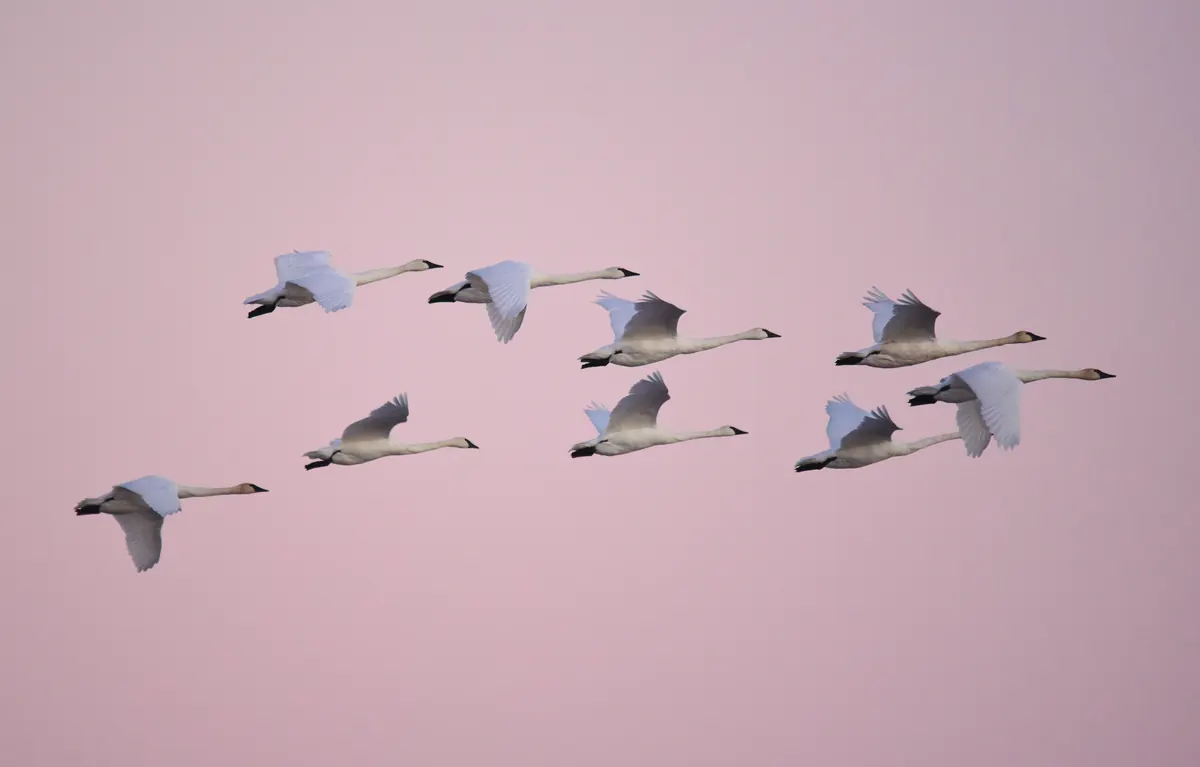
- Trumpeter swans find open water. Nebraska Game and Parks’ Birds of Nebraska account says swan movements usually begin around mid-November, and its biggest fall tallies all come from the last week of the month: 288 along West Suburban Road at North Platte on November 25, 2022, and 140 near Ashby in Grant County on November 29, 2024. Look on spring-fed creeks and river channels that stay ice-free.
- Bighorn rams in rut. Game and Parks names November as the rut for the roughly 300 bighorn sheep on the Panhandle buttes. Scan the rims at Fort Robinson or Cedar Canyon Wildlife Management Area at dawn or late afternoon for the pale rump patches, and keep a spotting scope between you and the herd.
- Leonids, then a Beaver supermoon. The Leonids peak on the night of Tuesday, November 17; the dark hours run from moonset, near 12:30 a.m., to dawn on the 18th. Seven days on, the Beaver Moon reaches full at 8:53 a.m. Central (7:53 Mountain) on Tuesday, November 24, a slight supermoon that should appear full to the eye on Monday evening and Tuesday evening alike.
For the Naturalist’s Field Journal this month: put the first trumpeter swan, rough-legged hawk and Harris’s sparrow of the season on “birds I have seen” with the creek or field where you found them. Sketch a bighorn’s heart-shaped hoofprint or a buck’s track on “tracks to know,” log a rub line on “reading the signs,” tuck a cedar sprig with its blue berries onto the seeds, pods and cones page, and use the dusk and dawn watch on November 1 to note how early the dark comes.
Regions used below: The Panhandle and Pine Ridge; The Sandhills and Niobrara valley; Southwest Nebraska and the Republican valley; The central Platte and Rainwater Basin; Northeast Nebraska and the Missouri bluffs; Lincoln, Omaha and the southeast.
When do trumpeter swans and snow geese gather in Nebraska?
Two white birds define late fall here, and they behave very differently. Trumpeter swans are mostly Nebraska’s own, moving short distances to water that stays open. Snow geese come from the Arctic by the tens of thousands, and in recent decades they have been arriving later and staying longer.
-
Trumpeter swans
Movements usually start mid-November; largest fall flocks in the last week of the month · Blue Creek in Garden County, the Snake River in Cherry County, the Loup system, the North Platte below Lake Ogallala; in the east, Carter Lake in Omaha and the sandpit lakes near Ashland
Trumpeters were wiped out on the Sandhills lakes before 1900. Cygnets released at Lacreek National Wildlife Refuge in South Dakota in the early 1960s started a flock that now summers mainly in Nebraska, and the Birds of Nebraska account says the state may hold more than 700 resident swans. Until the 1980s they flew north to Lacreek for the winter. Now most stay, moving in late fall to spring-fed water that doesn’t freeze, while swans from Minnesota and Iowa, some with neck collars or wing tags, swell the numbers in the east.
Look for them as the marshes ice over. Another big fall count: 130 at Long Lake in Lincoln County on November 28, 2023. A trumpeter is bigger than any goose, with an all-black bill and a call like a bicycle horn; the rarer tundra swan, which seldom shows up before November 1, is smaller and usually has a yellow spot in front of the eye.
-
Snow geese on the big southern reservoirs
Building through November; may linger into December or January in a mild year · Harlan County Reservoir; Swanson Reservoir near Trenton; Lake McConaughy; the Rainwater Basin and the Republican valley; Missouri River lakes
Game and Parks notes that the fall peak now comes later than it did a few decades ago, and that far fewer snow geese use western Nebraska in autumn than in spring. Still, its record list is full of late-November dates: about 116,000 in Nuckolls County on November 25, 2020, and 30,000 at Harlan County Reservoir and 20,000 at Swanson Reservoir on November 26, 2022. Lake McConaughy has held 10,000 in early November and, on December 7, 2022, some 60,000 at Lakeview. The Audubon Society of Omaha suggests searching big snow goose flocks for the smaller Ross’s goose, with its stubby bill and rounder head.
-
The last cranes
Whooping cranes into the first days of November; sandhills scattered into mid-December · Central Platte between Grand Island and Kearney; Rainwater Basin wetlands
A Game and Parks review of every whooping crane record through 2016 found 63 percent fell between October 20 and November 3, so the opening days of the month still count; its latest fall dates fall between November 23 and 28. Sandhill cranes have been seen away from Hall County as late as mid-December, and in some recent winters thousands have stayed on the Platte: 9,700 on December 16, 2023, for example. If you find a whooping crane, keep to your car, give it plenty of room, and send the sighting to the Fish and Wildlife Service instead of social media.
Swans and geese both feed in cut cornfields by day. October’s crane and duck notes are on the Nebraska October page.
When do bald eagles arrive in Nebraska for the winter?
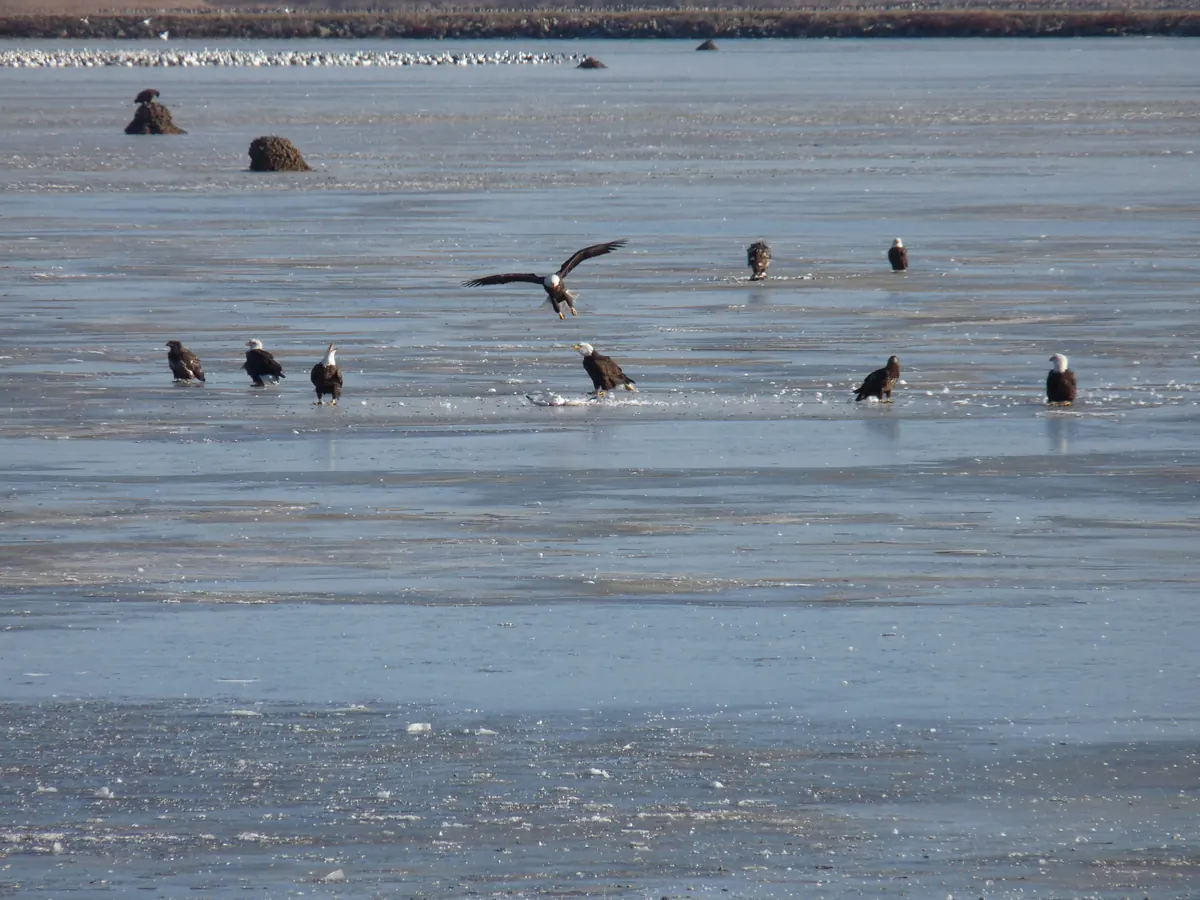
Nebraska has nesting bald eagles all year now, which blurs the start of migration, but the northern birds come in on the cold fronts. Game and Parks uses flocks of fifteen or more as the sign of migrants and puts the fall peak in late November.
-
Eagles at open water
Building through November; largest gatherings once ice forms · Harlan County Reservoir, Lake McConaughy and Kingsley Dam, Branched Oak Lake, the Missouri River below the dams, the Platte
Eagles in winter go where the fish and the sick or crippled waterfowl are, and that means below dams and on any stretch of river or lake that stays unfrozen. As ice spreads, they crowd into fewer places. The single-site record counts show where to look: 316 at Harlan County Reservoir in January 2015, 284 at Kingsley Dam in February 1994, 265 at Branched Oak Lake near Lincoln in February 2023, and 259 counted along 55 miles of the Missouri in Nemaha and Richardson counties on December 23, 2019. November numbers are smaller, but this is when the build-up begins.
-
Rough-legged hawks, Harris’s sparrows and tree sparrows
Hawks from mid-October; sparrows through the winter in the south and east · Open grassland and stubble fields statewide; brushy edges and shelterbelts
The rough-legged hawk breeds on the tundra and hunts Nebraska’s pastures all winter, hovering in place over the grass like a giant kestrel. Hawk counters at Hitchcock Nature Center, across the Missouri in Iowa’s Loess Hills, record the first ones in mid-October. Harris’s sparrow, the big black-bibbed sparrow that nests only in the far north of Canada, winters across southern and eastern Nebraska, and its latest fall dates in the north and west run to late November. American tree sparrows, rust-capped with one dark breast spot, settle into the roadside weeds for the winter.
Snowy owls are rare winter visitors here, plentiful in a few winters and absent in most; check fence posts and round bales on open farmland.
Where can you watch bighorn sheep in Nebraska in November?
Audubon’s bighorn, the native sheep of the Panhandle buttes, was gone by the early 1900s. Since 1981 Game and Parks has brought Rocky Mountain bighorns back to the Pine Ridge and the Wildcat Hills, and its wildlife diversity staff now put the population at about 300.
-
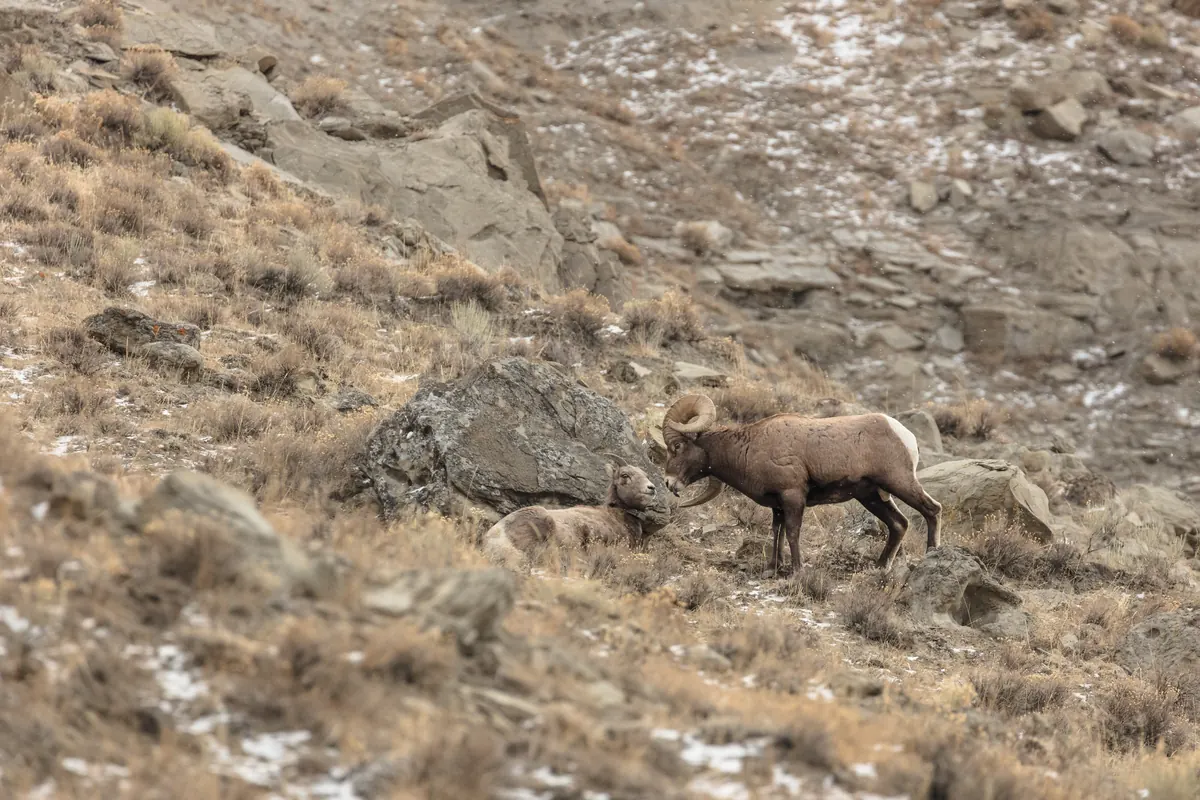
Rams in rut
November, with the most action late in the month and into early December · Wildcat Hills: Cedar Canyon, Montz Point and Williams Gap wildlife management areas. Pine Ridge: Fort Robinson State Park and WMA, Bighorn, Ponderosa and Peterson WMAs, and pastures 16 to 18 of the Pine Ridge National Recreation Area
During the rut, rams follow ewes closely and drive off rivals, and the contests can end in the head-on collisions bighorns are famous for. Mature rams can grow horns up to about 45 inches long; ewes, at most about 150 pounds, have short, thin horns, and young rams look much like them. The tan coat blends into dry grass and sandstone, so scan for white rumps and for silhouettes on the butte tops, mainly early and late in the day.
Two cautions from the agency’s own viewing notes. Keep your distance and let binoculars or a spotting scope do the work. And the same WMAs become busy hunting grounds from mid-November, when the firearm deer season opens, so wear blaze orange if you visit then.
Bighorn tracks are blunt and squarish, more like a heart split in two than a deer’s pointed print. A light snow on the butte trails makes them easy to find.
When is the deer rut in Nebraska, and why are deer on the roads?
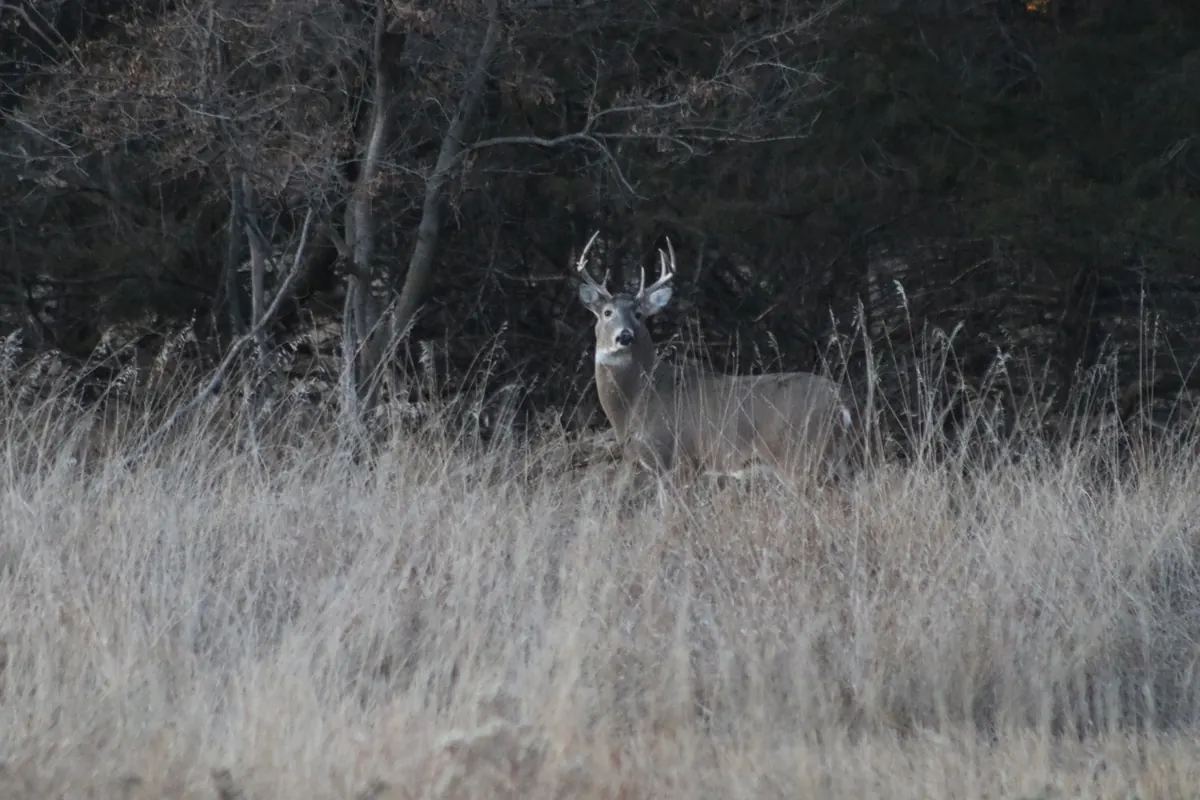
White-tailed and mule deer both breed in November, and bucks that spent the summer in hiding start to travel. The state’s nine-day firearm deer season, November 14–22 in 2026, is set to fall in the middle of it.
-
Signs of the rut
Building in early November and peaking around mid-month · River bottoms, shelterbelts, cedar draws and the edges of cut fields statewide
Walk a field edge for the signs bucks leave: cedar or willow saplings polished raw by antlers, and scrapes, bare scuffed patches beneath an overhanging limb that bucks mark with scent. Whitetails dominate the river corridors and the east; mule deer, with their big ears, black-tipped tails and bounding gait, hold the canyons, Sandhills and Pine Ridge.
-
Deer, dark roads and the time change
Dawn and the hour after sunset, all month · Any road through river valleys, shelterbelts or crop fields
Collisions with deer climb to their yearly high in November. A Game and Parks biologist explained the timing to KSNB in 2025: deer move most around first light and just before dark, and the switch to standard time suddenly puts the evening commute in that window. If a deer runs out, hit the brakes hard and hold your line; the Nebraska State Patrol’s advice is that if a collision can’t be avoided, hitting the deer is safer than veering into a ditch or another lane. Where you see one deer, expect more behind it.
A muddy field edge after rain holds tracks well. The two dewclaw marks behind a deer’s hoofprint show up when it is running or in soft ground; draw them in the journal if you see them.
What is still on Nebraska’s trees and prairies in November?
By the middle of the month the cottonwoods and ash are bare and the prairie has gone to tawny gold and russet. What remains is worth a closer look: dead leaves that hang on, fruits that feed the winter birds, and animals that have already gone underground.
-
Oaks that keep their brown leaves
All winter, often until spring · Missouri River bluffs, Fontenelle Forest, Indian Cave and Ponca state parks, city parks and yards
Most trees seal off each leaf stalk in fall and let the leaf drop. In some oaks that seal never finishes, and the dry leaves rattle on the branches into spring, a habit called marcescence. A Nebraska Statewide Arboretum feature names shingle, white, scarlet, black, hill’s and pin oaks among the most persistent, notes that young trees hold more than old ones, and offers two leading explanations: the dead leaves may discourage deer from browsing the buds, and they may trap snow that later waters the roots.
-
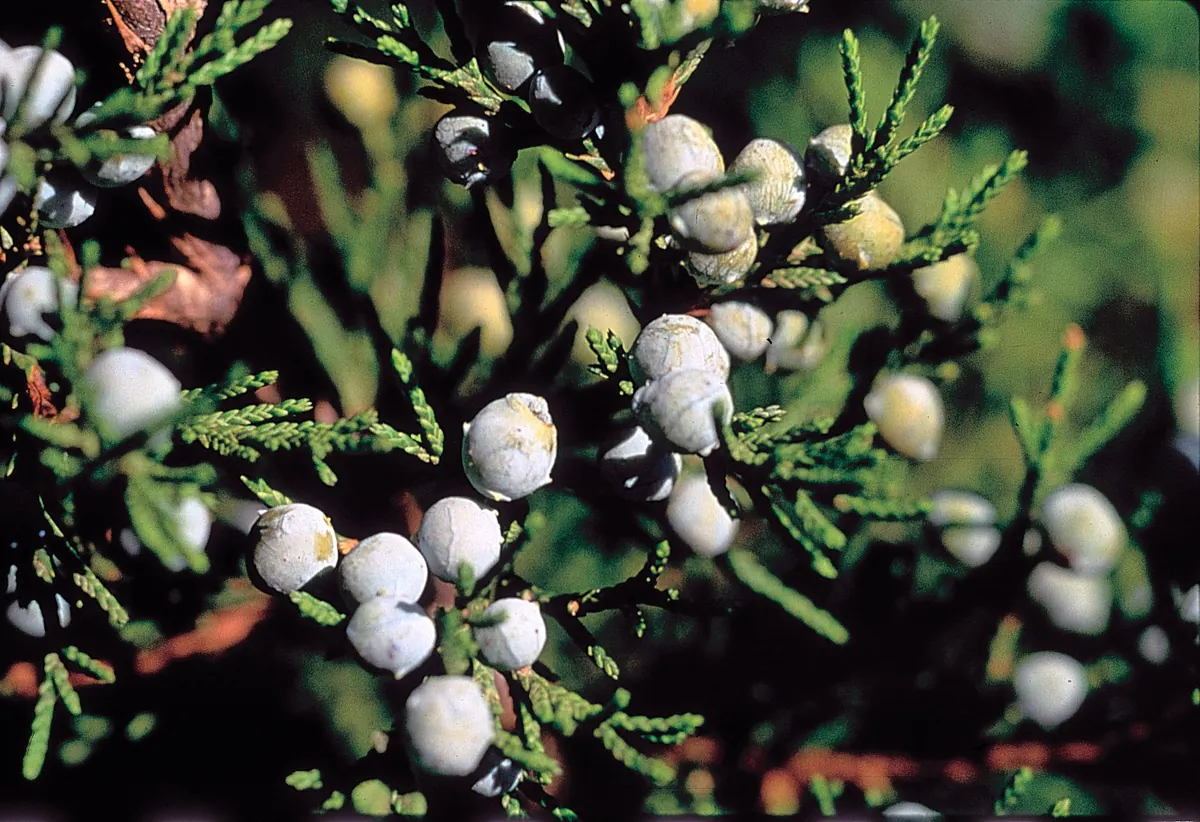
Eastern redcedar berries
Through the winter · Windbreaks, pastures, canyon slopes and the Loess Canyons
The dusty blue “berries” on a redcedar are really small cones. The Nebraska Forest Service lists cedar waxwings as one of their main eaters, and juncos and sparrows roost in the dense foliage on cold nights, which makes a cedar windbreak a good place to stand still on a frosty morning. The same agency warns that redcedar has spread far into grasslands where fire once kept it out, so it is both a winter shelter and a problem for prairie birds.
-
Who has already gone to sleep
From October; out again in late March or April · Lawns, pastures and roadsides
University of Nebraska–Lincoln Extension says thirteen-lined ground squirrels, which double their weight by fall, go down into their burrows in October and stay there until the soil warms in late March or early April. Woodchucks, many bats and the snakes are also out of sight by now. Raccoons and skunks are not true hibernators; on a mild afternoon they may still be active.
Our nature guides list what to look for in each season.
Has Nebraska had its first freeze by November?
Almost always. By November 1, all nine stations below have reached even their late-year freeze date: the Pine Ridge and the northern Sandhills usually see their first freeze around the end of September, Scottsbluff and North Platte in the first days of October, the central Platte and Lincoln by mid-October, and Omaha’s Eppley Airfield by the third week of October, with its latest date in nine years of ten falling on November 1. Even in Omaha, getting to November without a freeze happens only about one year in ten. November brings the hard freeze instead, a night in the low 20s that skims the shallow marshes with ice and pushes swans and geese onto bigger water. NOAA’s 1991–2020 normals put the average November low at about 21 to 23 °F in Scottsbluff, North Platte and Valentine and about 28 to 30 °F in Lincoln, Grand Island and Omaha.
| Station | One year in ten | Median | Nine years in ten |
|---|---|---|---|
| Chadron Municipal Airport (Pine Ridge) | Sep 15 | Sep 30 | Oct 11 |
| Scottsbluff Heilig Airport (Panhandle) | Sep 21 | Oct 4 | Oct 15 |
| Valentine Miller Field (northern Sandhills) | Sep 16 | Sep 29 | Oct 12 |
| North Platte Regional Airport (west-central) | Sep 16 | Oct 1 | Oct 13 |
| Mccook Municipal Airport (southwest) | Sep 26 | Oct 9 | Oct 22 |
| Norfolk Karl Stefan Airport (northeast) | Sep 21 | Oct 5 | Oct 18 |
| Grand Island Airport (central Platte) | Sep 29 | Oct 15 | Oct 27 |
| Lincoln Municipal Airport (southeast) | Sep 29 | Oct 13 | Oct 24 |
| Omaha Eppley Airfield (Omaha) | Oct 6 | Oct 21 | Nov 1 |
The Nebraska frost and freeze dates page has the same figures for more than 180 stations, and it lists the last spring frost too, for anyone already sketching next year’s garden. Write down the first morning the birdbath stays frozen all day; it is a good marker to compare from year to year.
How early does it get dark in Nebraska in November?
Very early, and all at once. Both of Nebraska’s time zones drop daylight saving time early on Sunday, November 1. Omaha’s sunset jumps from 6:20 p.m. on Halloween to 5:19 p.m. the next day and is down to 4:57 p.m. by Thanksgiving, November 26. In Scottsbluff, on Mountain time, the sun sets at 4:49 p.m. on November 1 and at 4:25 p.m. on the 30th. Day length shrinks by 55 minutes at McCook and an hour at Valentine between the 1st and the 30th, roughly two minutes per day, gentler than October’s pace.
| City | Nov 1 | Nov 30 | Lost | Per day |
|---|---|---|---|---|
| Omaha | 10 h 24 m | 9 h 27 m | 57 min | 2.0 min |
| Lincoln | 10 h 26 m | 9 h 29 m | 57 min | 2.0 min |
| Norfolk | 10 h 21 m | 9 h 22 m | 59 min | 2.0 min |
| Grand Island | 10 h 25 m | 9 h 28 m | 57 min | 2.0 min |
| McCook | 10 h 27 m | 9 h 32 m | 55 min | 1.9 min |
| North Platte | 10 h 24 m | 9 h 27 m | 57 min | 2.0 min |
| Valentine | 10 h 17 m | 9 h 17 m | 60 min | 2.1 min |
| Scottsbluff | 10 h 22 m | 9 h 23 m | 59 min | 2.0 min |
Sunrise also jumps an hour earlier on November 1, which gives early risers a few weeks of light before work. The daylight calculator shows sunrise, sunset and twilight for any Nebraska address.
What is November weather like in Nebraska, and what might El Niño bring this winter?
November is the month Nebraska tips into winter. In NOAA’s 1991–2020 normals, average highs sit near 50 to 53 °F everywhere from Omaha to Scottsbluff, but the west is far colder at night, with average lows near 21 to 23 °F at North Platte, Valentine and Scottsbluff against 28 to 30 °F in the east. It is a dry month. Normal precipitation runs about 1.3 to 1.5 inches at Lincoln and Omaha and only about half an inch at North Platte, Valentine and Scottsbluff. Snow is more common in the west, averaging about 5 inches for the month at Scottsbluff and Valentine, 3 at North Platte and under 2 at Lincoln and Omaha.
The National Weather Service office in North Platte has worked out first-snow odds from more than a century of records. At North Platte there is a 50 percent chance of the first snowflakes by October 23 and a 90 percent chance by November 15; the first inch or more comes by November 17 in half of all years. Valentine runs about a week earlier, with half of its first one-inch snows by November 11.
The state is going into winter dry. The U.S. Drought Monitor map for September 29 showed about 71 percent of Nebraska abnormally dry or worse and about half in moderate drought or worse, with roughly 6 percent in extreme or exceptional drought.
And this winter has an unusual backdrop. Forecasters expect an unusually powerful El Niño: a discussion from NOAA’s Climate Prediction Center dated September 10 put those odds over 90 percent for fall and winter. The Nebraska State Climate Office, writing on September 21, said past strong El Niño winters were often warmer than normal across Nebraska, but their precipitation differed a great deal from one event to the next. Nebraska sits in a transition zone between the clearer El Niño signals to the north and south, the office noted, and the early outlooks favor a warm winter statewide, lean wet in the south and favor neither wet nor dry in the north. NOAA’s official winter outlook is due on October 15, 2026, and will be posted with NOAA’s other 90-day outlooks.
For the coming week, our forecast page turns the latest model runs into plain words for your town.
What can you see in Nebraska’s night sky in November?
The long nights after the time change are the best of the year for stargazing before bedtime. Most of Nebraska is on Central time; the Panhandle and the neighboring counties, Ogallala and Imperial among them, are on Mountain time, an hour behind. Times below are standard time in both zones.
-
The Leonids
Peak night Tuesday, November 17, into the morning of the 18th · Anywhere dark; the radiant in Leo rises late in the evening
The International Meteor Organization forecasts a modest rate, about 15 an hour under dark skies, and no outburst. The Moon is just past first quarter on the 17th and sets roughly half an hour after midnight. From then until first light the sky is dark and Leo rides high in the east. Being among the swiftest of all shower meteors, Leonids sometimes leave a glowing wisp that hangs for a second or two.
-
Taurid fireballs
Southern Taurids peak around November 5; Northern Taurids around November 12 · Most of the night, after the Moon is out of the way
Taurids are sparse, a few an hour, yet they crawl across the sky and the occasional one blazes bright enough to light the ground. They are debris from Comet Encke. New moon falls on November 9, between the two maxima, which leaves moonless evenings for both.
-
Planets before dawn
All month; Mars and Jupiter closest on the mornings of November 15 and 16 · East and south before sunrise
Venus, past its October passage between Earth and the Sun, climbs quickly into the dawn as a brilliant morning star and on November 9 it has Virgo’s leading star, Spica, roughly a degree away. Jupiter and fainter, reddish Mars stand in Leo; before sunrise on the 15th and 16th the two planets sit just a degree apart. Mercury makes a short appearance low in the east-southeast; the best mornings are roughly November 18 to 25. Saturn has the evening sky to itself, shining without twinkling in the south after dusk.
-
The Beaver Moon
Evenings of Monday, November 23, and Tuesday, November 24 · Low in the east-northeast at sunset
Full phase arrives at 8:53 a.m. Central on the 24th, with perigee, its nearest approach, following some 30 hours later, enough to call it a mild supermoon. Watch it rise orange over a stubble field on either evening. Before dawn on the 24th, Nebraskans will find it sitting almost on top of the Pleiades, and its glare leaves only a few of the cluster’s stars showing.
| Phase | Date | Time |
|---|---|---|
| Last quarter | Sunday, Nov 1 | 2:28 p.m. CST (1:28 p.m. MST) |
| New moon | Monday, Nov 9 | 1:02 a.m. CST (12:02 a.m. MST) |
| First quarter | Tuesday, Nov 17 | 5:48 a.m. CST (4:48 a.m. MST) |
| Full moon, the Beaver Moon | Tuesday, Nov 24 | 8:53 a.m. CST (7:53 a.m. MST) |
| Last quarter | Tuesday, Dec 1 (Mountain: Monday, Nov 30) | 12:08 a.m. CST (11:08 p.m. MST on Nov 30) |
Clear skies are never a given in November; the cloud forecast shows the gaps. Rise and set times of the Moon for any Nebraska town are on the moon calendar.
What birds come to Nebraska feeders in November, and how can you count them?
Feeders get busy as the natural seed is eaten down and the first snow covers the rest. Dark-eyed juncos, American tree sparrows and, in the south and east, Harris’s sparrows join the chickadees, nuthatches, cardinals and woodpeckers that stay all year.
-
Project FeederWatch starts November 1
November 1, 2026, to April 30, 2027 · Any yard, schoolyard or balcony with a feeder, water or bird-friendly plants
Participants in this Cornell Lab and Birds Canada project watch one patch of yard on two consecutive days and write down, species by species, the largest flock in view at any one moment. A Nebraska yard tallied every week is ideal; one tally between November and April is still worth sending.
-
The winter finch outlook
Through the winter · Feeders, conifers and weedy fields
The Finch Research Network, writing on September 25, expects good Canadian seed and cone crops to keep most redpolls, pine grosbeaks, Bohemian waxwings and red-breasted nuthatches in the north, with siskins moving mainly in the Northeast. It says nothing about the Plains, so treat any siskin or redpoll here as a bonus.
Clean feeders and birdbaths every couple of weeks. Once nights fall below freezing, a heated birdbath draws more birds than any seed.
What can Nebraska families do outdoors in November 2026?
Nature centers around Omaha and Lincoln make the most of the early dark with owl walks and night programs. A park entry permit is still needed for Nebraska state parks in November. These listings were current on the organizers’ own calendars in early October; confirm before driving.
- Fontenelle Forest, Bellevue: a November birding walk on Saturday the 7th (9 to 10:30 a.m.); Owl Prowls on Friday and Saturday, the 13th and 14th (6 to 8 p.m.); a wetlands habitat hike on Sunday the 15th (2 to 4 p.m.); a Leonids viewing program on Tuesday the 17th (5:30 to 7:30 p.m.); and a Beaver Moon full moon hike on Friday the 20th (5:30 to 7:30 p.m.). The nature center is closed on Thanksgiving Day.
- Spring Creek Prairie Audubon Center, Denton: Nocturnal November, which Audubon describes as a free nighttime festival for the whole family, on Saturday, November 14, from 5 to 8 p.m., and a program titled “We are the Buffalo and the Buffalo are Us” on Sunday, November 8, from noon to 3 p.m. The center’s winter weekend hours, 12:30 to 4:30 p.m., begin in November; the trails stay open from sunrise to sunset.
- A Thanksgiving weekend walk: wildlife management areas need no park permit, and Fort Niobrara National Wildlife Refuge near Valentine is open daily from sunrise to sunset. Go midday, wear orange and stay on the roads near the WMAs, where upland hunters will be out.
- Citizen science: start a FeederWatch count on November 1; add swans, with any collar or tag numbers, to eBird. Audubon’s 127th Christmas Bird Count fills the weeks from December 14 into January 5, and the Nebraska Ornithologists’ Union lists the state’s count circles as compilers send in their dates.
Safety notes for November in Nebraska
- Hunting seasons open in November 2026 (Nebraska Game and Parks): archery deer continues through December 31; a special landowner deer season runs November 7–9 and the November firearm deer season Saturday, November 14, through Sunday, November 22; fall turkey is open until November 30; pheasant, quail and partridge run from October 31 to January 31, 2027. Duck and coot seasons are open all month in every zone (Zone 1 to December 6, Zone 2 to December 15, Zone 3 to January 5). Dark geese are open in the North Central, Platte River and Niobrara units, white-fronted geese statewide through December 27, and light geese statewide through December 30. In recent years Game and Parks has also released rooster pheasants on 18 public wildlife areas just before Thanksgiving; it had not announced a 2026 release when we checked, but if one is made, expect extra hunters on those WMAs that weekend.
- Blaze orange: state law (Nebraska Revised Statute 37-527) applies to hunters of deer, antelope, elk, bighorn or turkey during any firearm season to display 400 or more square inches of hunter orange spread over head, chest and back. Archery hunters are exempt only when no center-fire rifle season is open in their unit, and fall turkey hunters must wear it during the November firearm deer season. Hikers and birders are not covered by the law, but an orange hat and vest on public land from November 14 to 22 are simple sense.
- Short afternoons: once clocks change, sunset comes before 5:30 p.m. in the east and before 5 p.m. in the Panhandle. Pack a headlamp for late-afternoon walks and leave word of your route.
- First snowstorms and wind: a November blizzard in the Sandhills or Panhandle can close highways and leave you far from the next town with no cell signal. Keep a winter kit in the car: blankets, water, a shovel, a phone charger and a full tank.
- Thin ice: farm ponds and marshes skim over in November long before the ice can hold anyone. Keep children and dogs off it until mid-winter, and never walk onto river ice, where current wears it thin from below.
- Grass fires: with half the state in drought and the prairie fully cured, a spark can still start a fast-moving fire on a dry, windy November day. Heed red flag warnings and local burn bans.
Sources
- Nebraska Game and Parks: hunting seasons 2026–27 (live site blocks automated access; checked against the September 25, 2026 archived copy at web.archive.org/web/20260925190500/https://outdoornebraska.gov/hunt/hunting-seasons/)
- Nebraska Game and Parks: commission approves 2026 big game hunting recommendations
- Nebraska Game and Parks via Central Nebraska Today: commissioners approve 2026–2027 waterfowl recommendations
- Nebraska Game and Parks via Central Nebraska Today: fall turkey season opens Oct. 1 (Sept. 16, 2026; hunter orange for turkey hunters during the Nov. 14–22 firearm deer season)
- Nebraska Game and Parks: upland bird hunting prospects
- Nebraska Game and Parks: pheasants to be released for hunting before Thanksgiving
- Nebraska Revised Statute 37-527, hunter orange
- Nebraska Game and Parks: Turkey Guide
- Birds of Nebraska Online (Nebraska Game and Parks): trumpeter swan
- Birds of Nebraska Online: tundra swan
- Birds of Nebraska Online: snow goose
- Birds of Nebraska Online: whooping crane
- Birds of Nebraska Online: sandhill crane
- Birds of Nebraska Online: bald eagle
- Birds of Nebraska Online: rough-legged hawk
- Birds of Nebraska Online: Harris’s sparrow
- Birds of Nebraska Online: snowy owl
- Audubon Society of Omaha: migration calendar, November
- Visit Nebraska: watchable wildlife, where and when
- Nebraskaland Magazine: November wildlife viewing, bighorn sheep
- KSNB: deer collisions spike during hunting season in Nebraska (Nov. 13, 2025)
- NTV News: November marks peak for deer collisions (Nebraska State Patrol advice)
- Columbus Telegram: Winter persistent, marcescent (Nebraska Statewide Arboretum)
- Nebraska Forest Service: eastern redcedar
- UNL Extension: the thirteen-lined ground squirrel (G1964)
- NOAA NCEI: 1991–2020 U.S. climate normals
- NOAA NCEI: 1991–2020 monthly normals for Omaha, Lincoln, Grand Island, North Platte, Valentine and Scottsbluff
- NWS North Platte: climatology of a first snowfall for North Platte and Valentine
- U.S. Drought Monitor: Nebraska statistics
- CPC ENSO diagnostic discussion, September 10, 2026
- CPC: seasonal (90-day) outlooks
- Nebraska State Climate Office: What does the 2026 El Niño mean for Nebraska? (Sept. 21, 2026)
- U.S. Naval Observatory: moon phases
- U.S. Naval Observatory: one-day sun and moon data
- International Meteor Organization: 2026 meteor shower calendar
- EarthSky: what is a supermoon?
- BBC Sky at Night: supermoons in 2026
- EarthSky: best stargazing of 2026 (Mars and Jupiter, November 16)
- EarthSky: Mercury at greatest western elongation
- NOAA Space Weather Prediction Center: solar cycle progression
- Fontenelle Forest: November 2026 calendar
- Audubon: Spring Creek Prairie events
- Spring Creek Prairie Audubon Center: hours and visiting
- Nebraska Game and Parks: park permits
- USFWS: Fort Niobrara National Wildlife Refuge
- USFWS: Valentine National Wildlife Refuge
- Project FeederWatch: how to participate
- Finch Research Network: Winter Finch Forecast 2026–2027
- Audubon: join the Christmas Bird Count
- Nebraska Ornithologists’ Union: Christmas Bird Counts
- eBird
- iNaturalist
- Photos via Wikimedia Commons; licenses and photographers are credited under each picture
