What to look for in nature in New Hampshire this April
April is when New Hampshire turns green at the edges. Tree swallows come back to the ponds, loons return as lakes open, piping plovers reach Hampton and Seabrook, the first warblers pass through, and wood frogs and peepers fill vernal pools with sound. On the mountain, April is still winter. The days stretch by roughly 80 to 90 minutes before the month ends, the last freeze is still a month or more away in the north, and the Pink Moon rises on April 20. Every date below has a source.
Other months in New Hampshire: October, November, December, January, February, March.
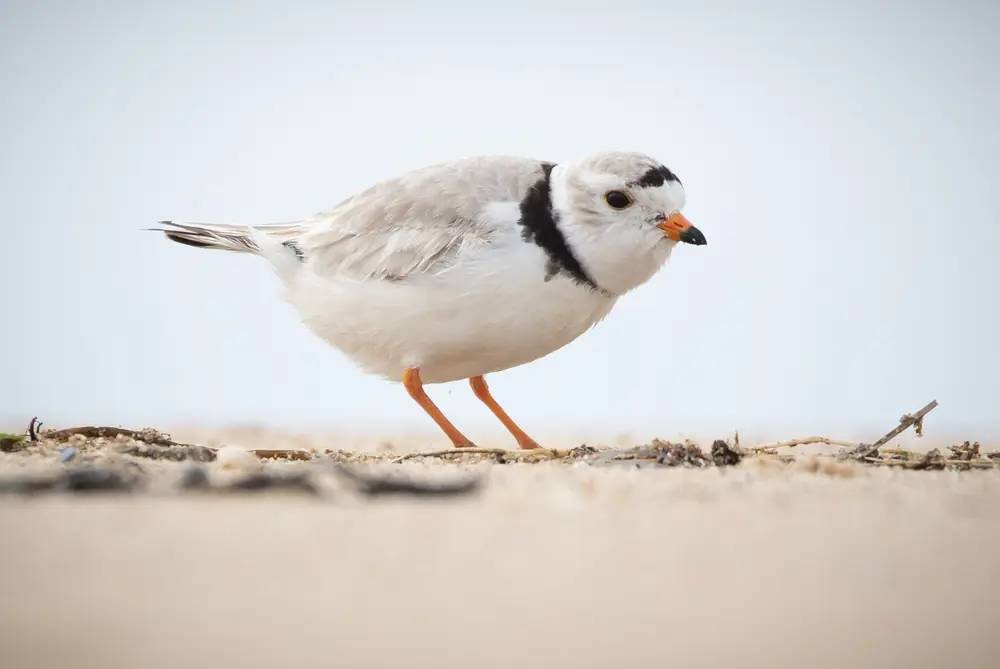
Start here
- Listen at a pool at dusk. On a rainy evening above 40 °F, stand at the edge of a vernal pool and count the voices: quacking wood frogs, peeping peepers. Keep a flashlight low and stay out of the water.
- Watch for the first swallows. NH Audubon says tree swallows come back in early April. Look over ponds and fields with nest boxes, then add chipping sparrows by mid-month.
- Look for broad-winged hawks. NH Audubon advises watching the sky in the third week of April, especially when a warm south wind blows.
Good plates in the Naturalist’s Field Journal for April: log the first arrivals in the daily field log, list the swallows, kinglets and hawks on birds I have seen, map of sounds for the frog chorus, nest observed for eagles and ospreys, and the same place twice for the woodland wildflowers.
Regions used below: Great North Woods; White Mountains; Lakes Region; Dartmouth–Lake Sunapee and the Upper Valley; Monadnock Region; Merrimack Valley; Seacoast.
Which birds return to New Hampshire in April?
Winter visitors such as American tree sparrows, redpolls and siskins are usually gone by April, according to NH Audubon, and the month fills with arrivals instead. Its Joy of Birding guide lays out a rough order: tree swallows in early April, chipping sparrows and ruby-crowned kinglets by mid-month, and the first warblers of the main wave at the very end. Dates shift with the weather, so treat each one as a typical window. Use eBird’s maps to see how far north a species has already reached.
-
Tree swallows and hermit thrushes lead the way
Early April, sometimes late March · Ponds, marshes, fields with nest boxes; woodland edges for thrushes
NH Audubon calls tree swallows the first swallows back, followed by northern rough-winged swallows. Hermit thrushes also appear in early April, and they are the one thrush likely to be here this early: the other thrushes usually wait until May.
-
Chipping sparrows, kinglets and the first warblers
Mid-April · Lawns, brushy edges, evergreens and streamsides
NH Audubon calls the chipping sparrow the tree sparrow look-alike, and it comes back around mid-April. Ruby-crowned kinglets arrive in the second week, and NH Audubon warns that their song can be mistaken for a common yellowthroat or even a Carolina wren. Pine, palm and yellow-rumped warblers are the earliest warblers, with the Louisiana waterthrush joining them along fast, rocky streams. The first Black-and-white, northern parula and black-throated green warblers of the May wave often appear in the last days of the month.
-
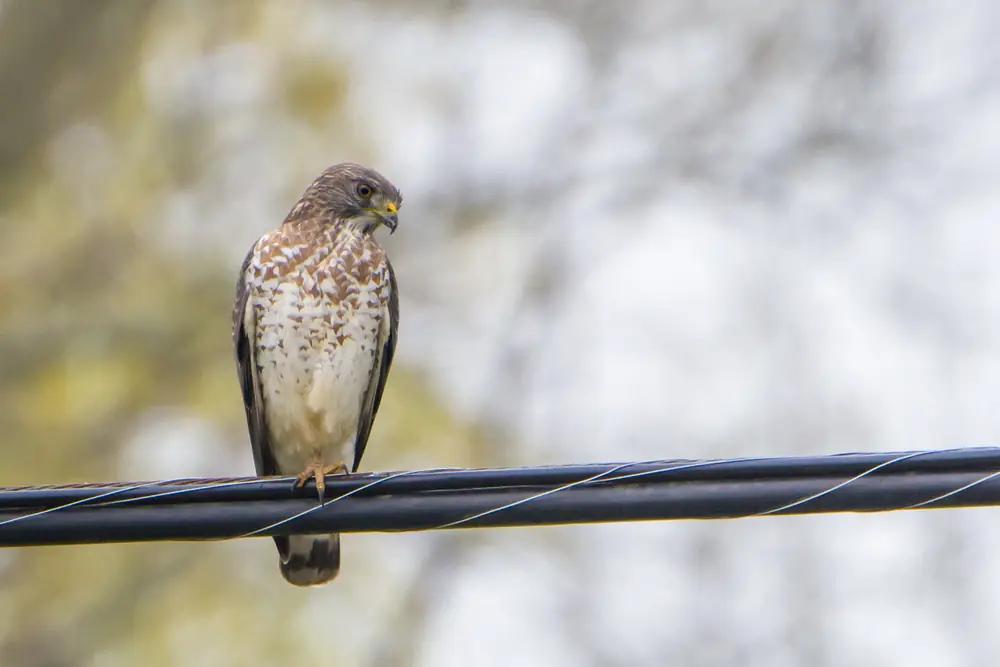
Broad-winged hawks on a warm south wind
Third week of April · Overhead, anywhere with a wide view of the sky
Watch for broad-winged hawks in the third week of April, NH Audubon advises, especially when a warm south wind blows. Note the date for the birds-I-have-seen plate of the Naturalist’s Field Journal.
-
Weather can drop grebes and sea ducks onto big lakes
Cold or rainy days · Lake Winnipesaukee, Newfound Lake, Spofford Lake and other large lakes
Cold or rainy weather can bring horned and red-necked grebes, along with sea ducks such as red-breasted mergansers and long-tailed ducks, down onto large lakes, NH Audubon says. A raw, drizzly April afternoon with a spotting scope on a lake shore can be better than a sunny one. The last days of the month bring northern house wrens, which NH Audubon says begin to trickle in.
The earlier stage of the story is on our March page.
Which animals return to New Hampshire’s beaches, lakes and rivers in April?
As the ice leaves, the water animals reappear. Four are worth a trip: a tiny shorebird on two beaches, the loons of the lakes, the river herring at the fishways and the ospreys on their poles.
-
Piping plovers on Hampton and Seabrook beaches
April, when the birds return · Hampton Beach and Seabrook Beach
Piping plovers are state-endangered and federally threatened. NH Fish and Game staff rope off nesting areas on the dunes at Hampton and Seabrook with yellow rope and signs soon after the birds return. The department’s 2023 report counted at least 15 nesting pairs on the two beaches, a record, up from 14 the year before, and 28 chicks fledged the year earlier. It lists what beachgoers can do: stay outside the rope, keep dogs leashed, fill holes that trap sand-colored chicks the size of cotton balls, and volunteer. Chicks that survive migration to Florida and the Gulf Coast may come back to the beach where they hatched.
-
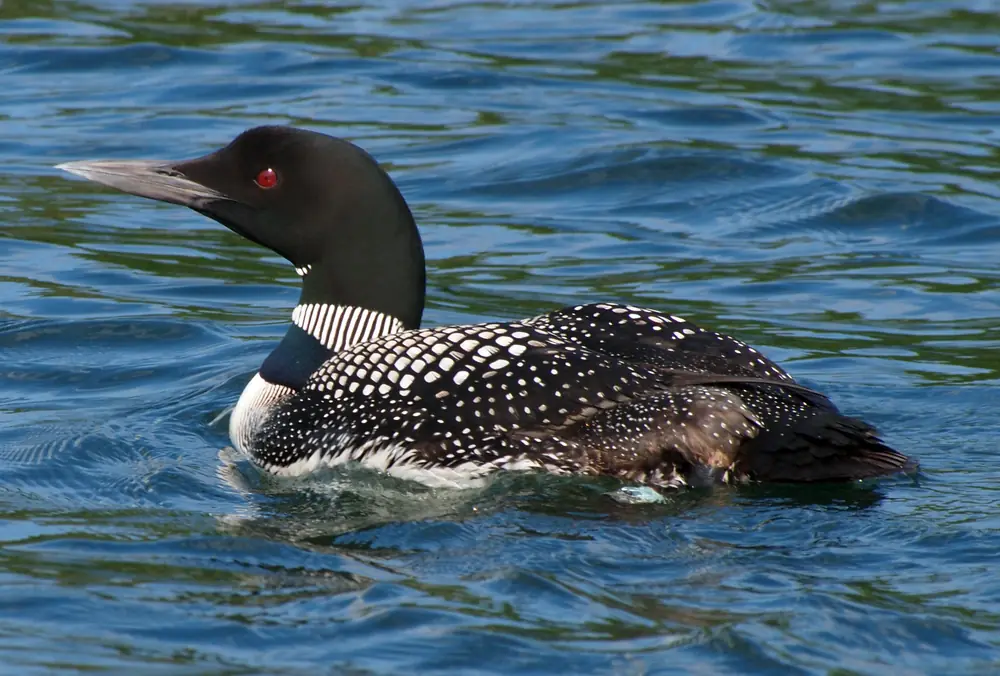
Loons return as the lakes open
As ice leaves each lake · Lakes statewide, from the Seacoast to the Great North Woods
Loons come back when a lake has enough open water, which is why the same date varies from one lake to the next. The Loon Preservation Committee in Moultonborough has kept records on nearly every territorial pair since the late 1970s and follows more than 350 lakes a year. Its volunteers and staff float nest rafts only where natural nests have failed for three or more years running; rafts have produced about a quarter of New Hampshire’s loon chicks over the past two decades. The committee notes its annual Loon Census was Saturday, July 18, 2026 from 8 to 9 a.m.; no 2027 date is posted yet. Until then, give loons a wide berth on the water and keep wakes small near any shoreline where one is sitting.
-
River herring at the coastal fishways
Fishways open at the start of April; counts run May to mid-June · Exeter, Lamprey, Cocheco, Oyster and Winnicut rivers
NH Fish and Game opens seven fishways on six coastal river systems at the beginning of April each year to monitor the spawning runs of river herring (alewives and blueback herring) and American shad. The runs are usually bigger in May. Since the Great Dam came out at Exeter, herring can reach more than seven miles of spawning habitat on the river, according to the department, and volunteers in May and June make 10-minute counts. Contact details for the volunteer program are on the department’s page; the 2027 sign-up is not posted.
-
Ospreys return to their nests
April · Utility poles, platforms and cell towers near rivers, lakes and the coast
NH Audubon says ospreys begin to arrive in April. Once rare, they now nest in every major watershed: the Forest Society puts the number at about 150 pairs, after the state’s count of three active nests in 1980. Nearly half of the 21 nests monitored in the Lakes Region are on cell towers.
What are frogs and salamanders doing in New Hampshire in April?
March brings the first crossings in the south; April is when the breeding season spreads across the whole state. In late April 2025, NH Fish and Game said large-scale migration nights were close, especially in southern New Hampshire, and that rainy evenings above 40 °F are the ones that matter. Our March page has the Big Night details; this page is about what you can find at the pool.
-
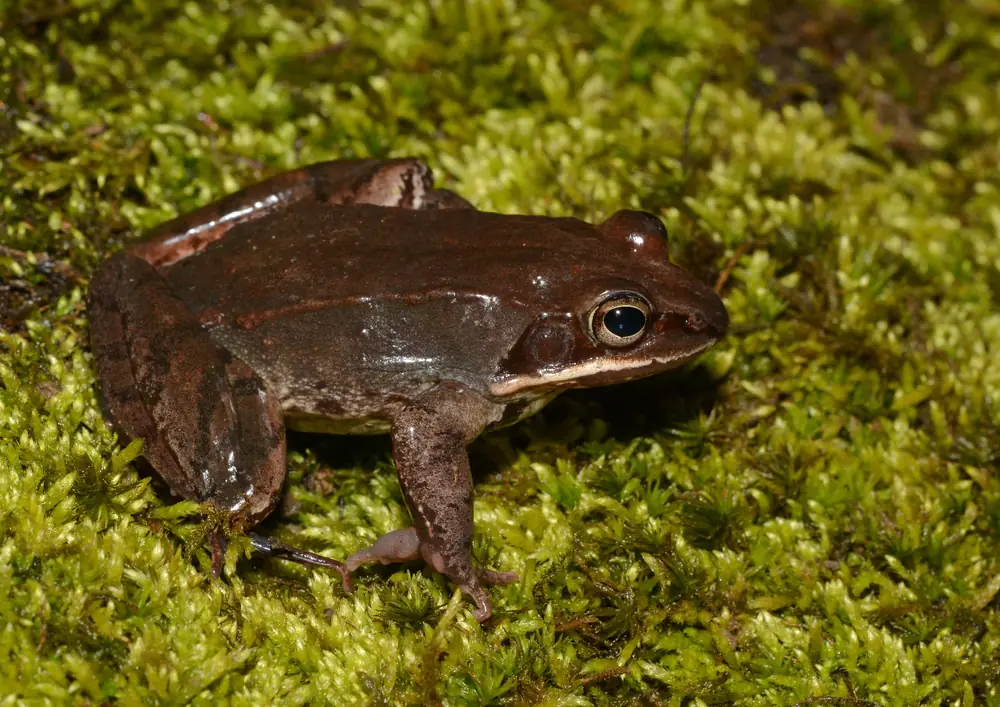
Wood frogs quack, then spawn
Early spring, as vernal pools thaw; April in the north · Vernal pools
NH Audubon says the males arrive first and gather in groups called leks, calling to attract females. A pool can sound like a flock of ducks. This frog survives winter frozen solid, with its heartbeat stopped, and thaws from the inside out when the weather warms. After the chorus, look for the eggs in the pool itself.
-
A peeper chorus that moves north
When nights hold in the 40s · Wet woods and pond edges
The Forest Society explains that spring peepers spend the winter beneath leaf litter and wake once nights are regularly in the forties. Southern towns report them before northern ones. Males sit in cracks, tall vegetation or beside open water, which amplifies the call and makes a single frog hard to find. A group heard from a distance measures around 65 decibels, the Society says, about the level of a conversation in a bar. The season at one pool lasts only a few weeks, and afterward the frogs go back to the woods.
-
Vernal pools worth knowing
Late April, when the pools are full · Monadnock Region and statewide
The Harris Center for Conservation Education documents vernal pools in the Monadnock Region, and its 2023 field report brought the total to 358 pools in 17 towns, with an online map for the public. Fish and Game adds that 85 percent of the amphibians that use these pools return each year to breed in the one where they were born, even when a road lies in the way. That is why a single pool on private land deserves care. Look from the edge, and do not wade or move egg masses. Send sightings, or reports of heavy road deaths, to RAARP@wildlife.nh.gov. State-listed rare species include the marbled salamander, Fowler’s toad and northern leopard frog, which Fish and Game asks people to report.
What are bald eagles and wild turkeys doing in April?
For two of New Hampshire’s biggest birds, April is the middle of the breeding season, one on a nest and one on a ridge.
-
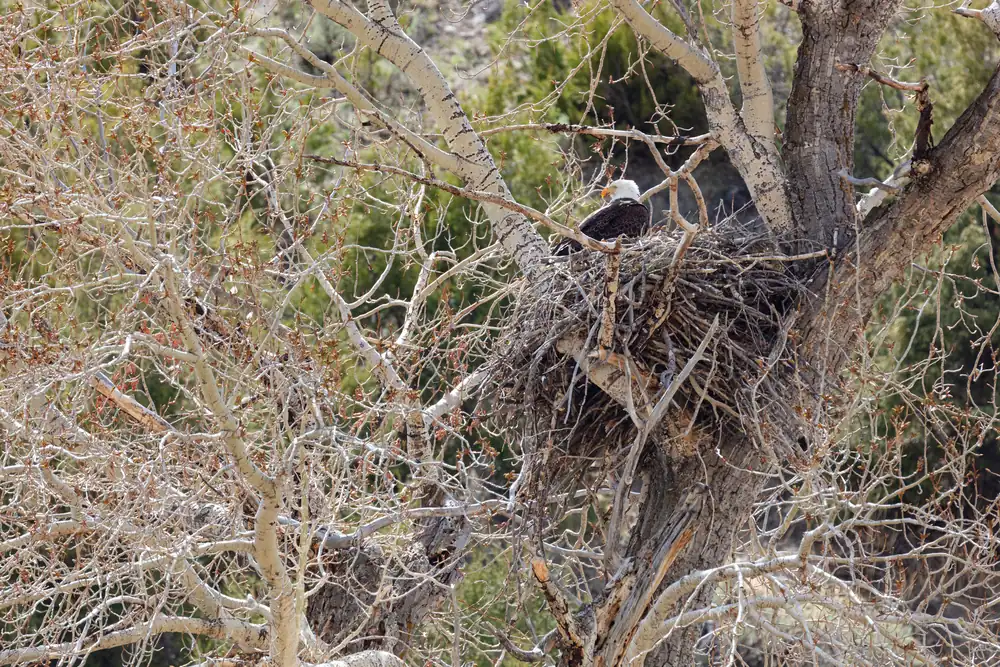
Eagle pairs with eggs and small chicks
Eggs and small chicks · Rivers, lakes and the Great Bay estuary
Many eagle pairs are well into the nesting cycle by April, tending eggs or small chicks. The 2024 season shows how weather affects a nest: two snowstorms, on March 23 and April 5, struck while pairs were incubating or tending small chicks, and snow deeper than 18 inches can pack around eggs and chill or kill embryos. That year had a record 115 territorial pairs and 80 incubating pairs, but fledglings fell to 81 from the previous record of 93. Watch only from a distance with binoculars; NH Audubon asks people to report nest-building or pairs to its raptor biologist.
-
Wild turkeys gobble at dawn
Mid-March to May, peaking in April · Forest edges and fields, statewide
Gobbling is long-range advertising and strutting is the short-range display, a Fish and Game biologist told Northern Woodlands. Males call at dawn from the roost and then strut for hens. Hens lay about one egg a day for two weeks in a leaf-lined hollow, and incubate only once a year, though a hen whose nest fails may try again. Turkeys vanished from the state for more than a century and were brought back in 1975. Fish and Game reported a 2025 harvest of 4,846 turkeys, a modest increase, and said nesting success was normal in 2024 and 2025.
Log what you see on the nest-observed plate of the Field Journal, including the date the chicks first appear.
When do New Hampshire’s spring wildflowers bloom?
Northern Woodlands calls the early forest flowers spring ephemerals, plants that photosynthesize only for a few weeks before the leaves overhead bring deep shade. They appear in April and May, and in New Hampshire the real show in most of the state falls in the last week of April and first weeks of May. Nothing about these dates is fixed: a cold spring holds them back, and the north and the high ground are weeks behind the south.
-
Trout lily
Late April, in the south and low ground first · Rich hardwood slopes and floodplains
Trout lily is the emblem of northern New England spring: yellow, nodding flowers over leaves splotched like the sides of a brook trout. Northern Woodlands notes it spreads more by expanding underground than by seed, so a patch you see this year is likely one that has been there for years.
-
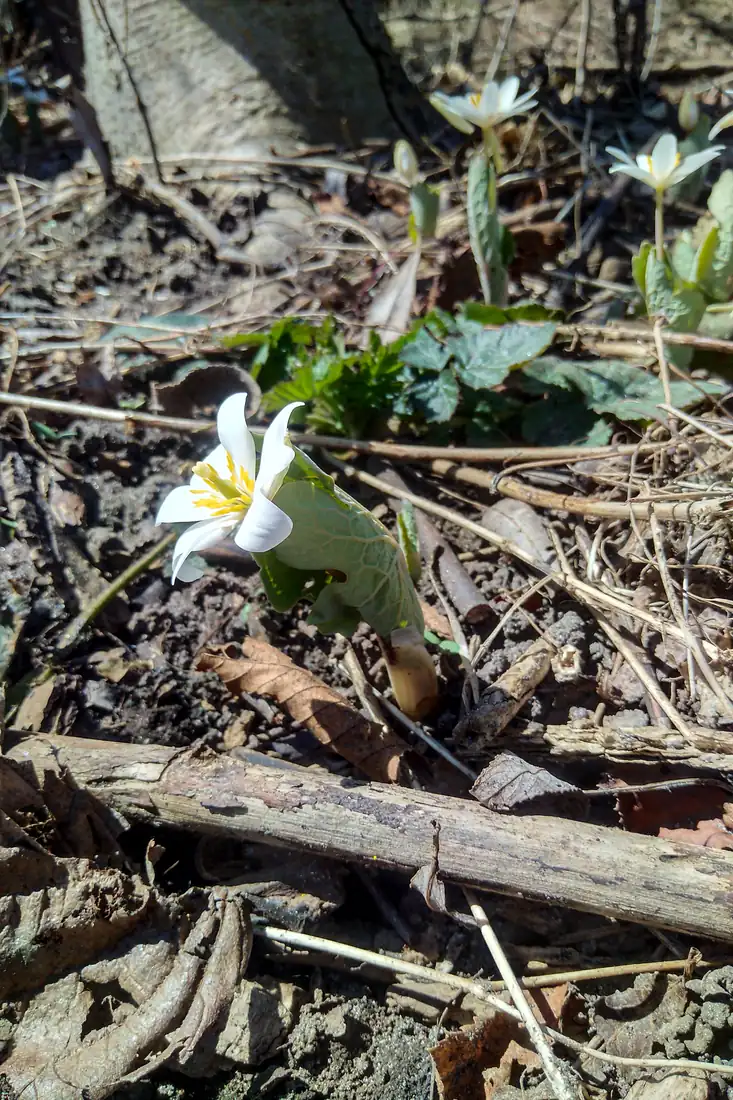
Bloodroot and red trillium
Late April to May · Rich woods and stream banks
Bloodroot opens wide for a day in good sun before its petals fall, and is named for its bright orange-red sap. It is listed by the state as a watch species, so look rather than pick. Red trillium carries a faint smell of rotting meat that draws its pollinating insects. Dutchman’s breeches and spring beauty belong to the same group.
Photograph one patch weekly and note the date of first bloom on the same-place-twice plate.
What is April like on Mount Washington?
The Mount Washington Observatory describes April as the changeover between the white season and the green season. By its climate summary, the summit’s normal April average is 23.9 °F, climbing from about 18 °F at the start to about 30 °F at the end, and no April day has dropped below 0 °F. Normal April snowfall is 35.6 inches, with a record month of 110.9 inches in 1988. NOAA’s 1991–2020 normal in the table below is 33.1 inches because it covers a different span of years. The observatory also mentions 21.5 inches falling on April 27 and 28, 2010, and a gust of 118 mph on April 23, 2009. It says rapid swings from spring-like to winter-like weather are closer to normal than abnormal.
-
Spring skiing and its hazards
April into early summer, snow permitting · Tuckerman Ravine
The Mount Washington Avalanche Center names five spring hazards that have contributed to hundreds of accidents: falling ice and rock (ice can exceed 60 mph, and Lunch Rocks is singled out), glide cracks and snow holes deep enough to swallow a person, hard refrozen surfaces that call for crampons and an ice axe, snow hollowed out from below by meltwater, and wet slides. Read the center’s page before climbing into the ravine, and do not rely on the pack of other skiers.
How much daylight does New Hampshire gain in April?
Every town gains between 79 and 87 minutes of daylight over April, a little less than in March because the rate slows as the days lengthen. On April 1, daylight runs from 12 h 44 m in Nashua to 12 h 46 m in Colebrook. By April 30 it ranges from 14 h 03 m in Nashua to 14 h 13 m in Colebrook, so the north, with its longer days, gains slightly more, at 2.7 to 3.0 minutes a day. Clocks changed on March 14, so April’s sunrises and sunsets are already on daylight time; the table counts hours of daylight, which the clock change does not alter.
| City | Apr 1 | Apr 30 | Gained | Per day |
|---|---|---|---|---|
| Colebrook | 12 h 46 m | 14 h 13 m | 87 min | 3.0 min |
| Berlin | 12 h 46 m | 14 h 11 m | 85 min | 2.9 min |
| Littleton | 12 h 45 m | 14 h 10 m | 85 min | 2.9 min |
| North Conway | 12 h 45 m | 14 h 09 m | 84 min | 2.9 min |
| Hanover | 12 h 45 m | 14 h 07 m | 82 min | 2.8 min |
| Concord | 12 h 44 m | 14 h 05 m | 81 min | 2.8 min |
| Portsmouth | 12 h 44 m | 14 h 05 m | 81 min | 2.8 min |
| Nashua | 12 h 44 m | 14 h 03 m | 79 min | 2.7 min |
Other towns are on our daylight page.
What is April weather in New Hampshire, and what are the hazards?
April is the month the south warms and the north waits. NOAA’s 1991–2020 normals below show average highs from the upper 40s in the far north to the upper 50s in Durham, Concord and Hanover, with lows near or above freezing in the south and below it in the north. Snow is mostly a northern and mountain story now: Concord averages 2.5 inches in April, Pinkham Notch 9.4 and the Mount Washington summit 33.1. The Climate Prediction Center’s 90-day outlooks are issued once a month near mid-month; the latest is at NOAA’s 90-day outlook page.
-
Wildfire danger before green-up
April, before leaves open · Statewide, especially in dry spells
The Forest Protection Bureau’s chief told NHPR in April 2026 that drought makes fires burn deep and slow to put out. January to March 2026 was the sixth driest start in records back to 1895, and in 2025 the state saw 27 percent more wildfires and 16 percent more acres burned than the year before. The state set Wildfire Awareness Week for April 19 to 25 in 2026; the 2027 week is not posted. Get a burn permit before any outdoor fire when snow is not covering the ground, clear leaves and needles from roofs and gutters, and be careful with equipment and target shooting.
-
Late snow and cold snaps
Any week in April · North and the mountains most, but snow can reach the south
The 2024 eagle season, with snowstorms on March 23 and April 5, shows that a late storm can reach nests in the south. Sap that ran in March is finished, and fruit trees that bloom early can lose flowers to a freeze, since the median last freeze in the table below falls from late April in the south to late May in the north.
-
Lake ice-out as a calendar
Varies by lake · Lakes statewide
The state Department of Environmental Services keeps decades of ice-out records, and a staff member told NHPR that lakes are thawing earlier than historical averages, which exposes them to pollutants for longer. Lake Winnipesaukee’s declaration is covered on our March page.
| Station | Average high | Average low | Precipitation | Snowfall |
|---|---|---|---|---|
| First Connecticut Lake (Great North Woods) | 47.1 °F | 25.5 °F | 3.60 in | 9.7 in |
| Lancaster (upper Connecticut valley) | 52.2 °F | 28.2 °F | 3.15 in | 4.0 in |
| Berlin (Androscoggin valley) | 51.9 °F | 29.4 °F | 3.43 in | 4.2 in |
| York Pond (White Mountains) | 49.3 °F | 27.3 °F | 3.73 in | 6.1 in |
| Pinkham Notch (White Mountains) | 48.5 °F | 27.3 °F | 5.75 in | 9.4 in |
| Mount Washington summit | 30.7 °F | 16.7 °F | 7.31 in | 33.1 in |
| Hanover (Upper Valley) | 58.1 °F | 34.8 °F | 3.24 in | 1.9 in |
| Lakeport 2 (Laconia, Lakes Region) | 55.6 °F | 32.7 °F | 3.65 in | 1.6 in |
| Concord Municipal Airport | 57.5 °F | 33.3 °F | 3.43 in | 2.5 in |
| Keene (Monadnock Region) | 56.6 °F | 30.1 °F | 3.39 in | 2.2 in |
| Durham (Seacoast) | 57.8 °F | 33.9 °F | 4.11 in | 1.8 in |
| Greenland (Seacoast) | 55.8 °F | 34.8 °F | 4.56 in | 2.3 in |
When is the last spring freeze in New Hampshire?
Not before late April, even in the warmest valleys. NOAA’s 1991–2020 normals put the typical last 32 °F night on April 21 at Manchester Airport, April 30 at Lakeport, and May 30 at Berlin. In the Great North Woods the median is May 25, and nine springs in ten are done only by June 8. Check the date for your own station before planting anything tender.
| Station | One year in ten | Median | Nine years in ten |
|---|---|---|---|
| First Connecticut Lake (Great North Woods) | May 9 | May 25 | Jun 8 |
| Berlin Municipal Airport (Androscoggin valley) | May 15 | May 30 | Jun 11 |
| Pinkham Notch (White Mountains) | May 3 | May 18 | Jun 1 |
| Hanover (Upper Valley) | Apr 21 | May 1 | May 15 |
| Lakeport 2 (Laconia, Lakes Region) | Apr 19 | Apr 30 | May 13 |
| Keene (Monadnock Region) | Apr 30 | May 14 | May 28 |
| Concord Municipal Airport | Apr 27 | May 8 | May 22 |
| Manchester Airport | Apr 8 | Apr 21 | May 6 |
| Greenland (Seacoast) | Apr 23 | May 4 | May 18 |
For a town not listed here, try the frost dates page for the state.
What can you see in the New Hampshire night sky in April 2027?
Clocks have been on daylight time since March 14, so every time here is Eastern daylight time. The moon table uses U.S. Naval Observatory phase times.
-
The Pink Moon
Full at 6:27 p.m. EDT, Tuesday, April 20 · Rising in the east around sunset
The April full moon, the Pink Moon, becomes full in the late afternoon, so it climbs above the eastern horizon near sunset on both the 20th and the 21st. By our own calculation, none of the full moons from March through September 2027 is a supermoon.
-
The Lyrids, in a poor year
Peak about 9:41 p.m. EDT on Thursday, April 22 · Look northeast and overhead before moonrise
Lyrid meteors streak from Lyra for roughly two weeks, mid to late April. In 2027 the bright, nearly full moon rises around 10 p.m. in Boston that night, leaving only the early evening dark, and the International Meteor Organization expects poor conditions. Count on a few meteors per hour at best. Rare, brief outbursts can happen but nobody can predict them.
-
Jupiter, Mars and the moon
Moon beside Jupiter the evenings of April 14 and 15 · High in the south after dark, in Leo and Cancer
Jupiter, the brightest point in the evening sky, stays up well past midnight in early April. By our calculation, the gibbous moon (68 percent lit) passes within about one degree of it as night falls on the 14th and 15th, with Mars a few degrees from the moon on the 15th. Both planets dim slowly through the spring.
-
Venus before sunrise, and Saturn out of sight
Moon near Venus the mornings of April 3 and 4 · Low in the east before dawn
By our calculation, on those mornings a slim waning crescent, about 9 percent lit, hangs within three degrees of brilliant Venus, which rises about 75 minutes before the sun at the start of the month. Saturn sits directly behind the sun on April 7, so it is hidden in the glare for a few weeks.
| Phase | Date | Time |
|---|---|---|
| New moon | Tuesday, Apr 6 | 7:51 p.m. EDT |
| First quarter | Tuesday, Apr 13 | 6:56 p.m. EDT |
| Full moon (Pink Moon) | Tuesday, Apr 20 | 6:27 p.m. EDT, so it rises near sunset that evening and again on Apr 21 |
| Last quarter | Wednesday, Apr 28 | 4:18 p.m. EDT |
Phases for other months are on our moon page; cloud types cover the daytime sky.
What can New Hampshire families do outdoors in April 2027?
- Early April: watch the beach fences go up. Plovers return to Hampton and Seabrook; stay outside the rope and keep dogs leashed.
- Rainy evenings above 40 °F: listen at a pool. Go out with a flashlight and a jacket, and stay on the edge.
- Tuesday, April 20: Pink Moon. Watch it rise near sunset.
- Thursday, April 22: Earth Day. EARTHDAY.ORG dates the first Earth Day to 1970. The Lyrid meteors peak that night, though the moon will wash most of them out.
- Saturday, April 24: trout ponds open. Fish and Game opens designated trout ponds and fly-fishing-only ponds on the fourth Saturday in April, which falls on April 24 in 2027; confirm in the 2027 fishing digest.
- Friday, April 30: Arbor Day. UNH Extension says the state marks Arbor Day every year on the final Friday in April, and that Forest Conservation Week follows in the first full school week after it. Plant a tree or tend one.
Spring firsts go into the Naturalist’s Field Journal; the nature index links the rest of our states and months.
Safety notes for April in New Hampshire
- Hunting seasons. The 2027 spring turkey season is not posted. In 2026 Fish and Game ran it from May 1 to 31, with a youth weekend on April 25 and 26 for hunters 15 and younger with a licensed adult; dates are set each year, so check the department’s page.
- Hunter orange. The state hunter-orange statute (RSA 207:38-b) is a recommendation, not a mandate, so an orange hat or vest is your own choice. It is a sensible one on trails during turkey season.
- Black flies are coming. UNH Extension says the main biting species emerges in early to mid-May in southern New Hampshire and late May to early June in the north, and only females bite.
- Ticks. UNH Extension says nymphs are most active from May 15 through early or mid-July, when most Lyme cases occur. Wear long pants tucked into socks, check yourself every evening, and pull a tick off slowly with tweezers.
- Wildfire. Get a fire permit before open burning when snow is not covering the ground.
- Mountain conditions. Treat Tuckerman Ravine and the summit as winter places: icefall, glide cracks, undermined snow and wet avalanches are all real.
- Cold water. Snowmelt keeps lakes and rivers dangerously cold in April, and ice that remains is rotten. Wear a life jacket.
Sources (34)
- NH Audubon, Joy of Birding: April birding highlights
- NH Audubon: What to watch for in April (2026)
- NH Fish and Game: 2026 spring turkey season opens May 1
- UNH Extension: Arbor Day and Forest Conservation Week
- NH Fish and Game: Volunteers sought to monitor river herring returns on the Exeter River
- NHPR: Fish and Game says record number of piping plovers hatched in NH
- NH Fish and Game: Endangered piping plovers continue their upturn on New Hampshire beaches (2023)
- Mount Washington Observatory: Winter weather in April
- UNH Extension: Black flies fact sheet
- NH Audubon: Osprey monitoring and management
- NH Forest Society, Something Wild: Celebrating New Hampshire’s osprey success story
- Northern Woodlands: Spring wildflowers, fleeting flashes of color
- NHPR: Drought, wildfire risk and New Hampshire’s spring (April 23, 2026)
- Loon Preservation Committee: Counting loons
- Loon Preservation Committee: Loon census
- Loon Preservation Committee: Nest rafts
- NH Fish and Game: Spring opener coming for waterbodies managed specifically for trout (2026)
- Mount Washington Avalanche Center: Springtime mountain hazards
- NH Audubon: It’s raptor spring!
- NOAA NCEI: Monthly climate normals 1991–2020 for twelve New Hampshire stations
- NHPR: Ice-out times as a harbinger of spring and lake health
- NH Audubon: NH bald eagle 2024 breeding season results
- Northern Woodlands: Wild turkey mating season
- UNH Extension: Biology and management of ticks in New Hampshire
- New Hampshire RSA 207:38-b, hunter orange recommendation
- EARTHDAY.ORG: About Earth Day
- NOAA Climate Prediction Center: 90-day outlooks
- NH Audubon: Wood frogs
- NH Fish and Game: Watch for amphibians crossing Granite State roads (April 21, 2025)
- NH Forest Society, Something Wild: Why are spring peepers so loud?
- Harris Center for Conservation Education: Field report from the 2023 Vernal Pool Project
- U.S. Naval Observatory: Moon phases, April 2027
- Fred Espenak: Sky Event Almanac 2027
- Photos via Wikimedia Commons; licenses and photographers are credited on each file page