What to look for in nature in New Hampshire this October
New Hampshire’s October runs downhill. The color that started in the Great North Woods in September slides south through the notches and the Lakes Region toward the Monadnock hills and the coast. Hawks stream past Pack Monadnock, the last loons fatten on quiet lakes before heading for salt water, moose are still on the move after the rut, and the summit of Mount Washington settles into winter while Seacoast gardens often go frost-free until the second week of the month. What follows goes region by region, with a source for every date.
Start here
- Color heading south. Yankee Magazine’s foliage reporter expects the display to work its way down from the mountains to the coast over four to six weeks from late September, in what forest experts are calling an unusually vivid and drawn-out year. The Kancamagus and the notches go first; the Monadnock hills and the Seacoast finish the month.
- Raptors over Pack Monadnock. The Harris Center’s count on the summit of Miller State Park had passed 15,000 raptors by September 24, including a record day of 5,209 on September 19. October brings fewer birds but a richer mix: golden eagles, goshawks and a steady trickle of sharp-shinned hawks on northwest winds.
- Jupiter vanishes before dawn. Before dawn on Tuesday, October 6, a slim crescent moon covers Jupiter at about 4:28 a.m. and releases it near 5:28, both well before first light. The Orionids follow in the dark hours of October 21 and 22, and the Hunter’s Moon rises in the east on the evenings of October 25 and 26.
Keep a record: the Naturalist’s Field Journal has a place for each of these. Use the tree-through-the-seasons page for one sugar maple or a bog tamarack from green to bare, the “birds I have seen” list for the hawks off Pack Monadnock and the first siskins, the tracks-to-know plate for moose prints in roadside mud, and the dusk-and-dawn watch for the loon still calling on your lake. Put a date on every line.
Regions used below: Great North Woods; White Mountains; Lakes Region; Dartmouth–Lake Sunapee and the Upper Valley; Monadnock Region; Merrimack Valley; Seacoast.
When does fall color peak in New Hampshire in 2026?
This is shaping up as a strong year. On September 17 the Forest Society’s Dave Anderson told NHPR’s Something Wild that the state was set for “a spectacular and prolonged fall foliage season,” thanks to summer rain that eased the drought without breeding leaf fungus, a quiet hurricane season, and a pattern of warm days and cool nights under persistent high pressure. A week later Yankee Magazine’s Jim Salge, who drove the White Mountains on September 20, told NHPR he expects “a nice slow progression down the mountains, north to south, over the next four to six weeks.” He did expect a shorter season near the drier coast.
-
Great North Woods and the high White Mountains
Late September into the first days of October · Pittsburg and the Connecticut Lakes, Dixville Notch, the upper Kancamagus, Crawford and Franconia notches
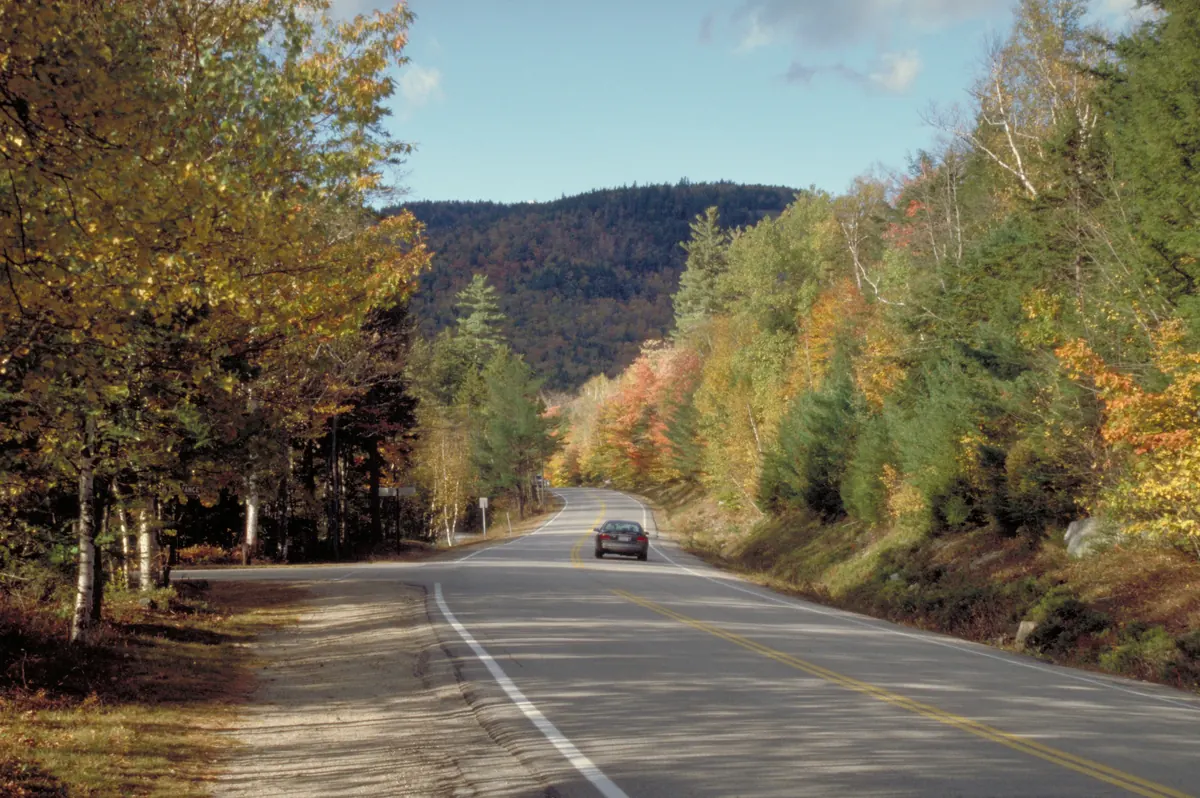
The top of the Kancamagus was already turning in the third week of September, and Salge expected most of the highway in color by the month’s last weekend. Go midweek if you can. Up here the show is birch yellow against dark balsam fir and red spruce, with red maple in the wet ground.
-
Lakes Region and the Upper Valley
The first half of October, in a typical year · Squam and Winnipesaukee shores, Sunapee, Hanover and the Connecticut River towns
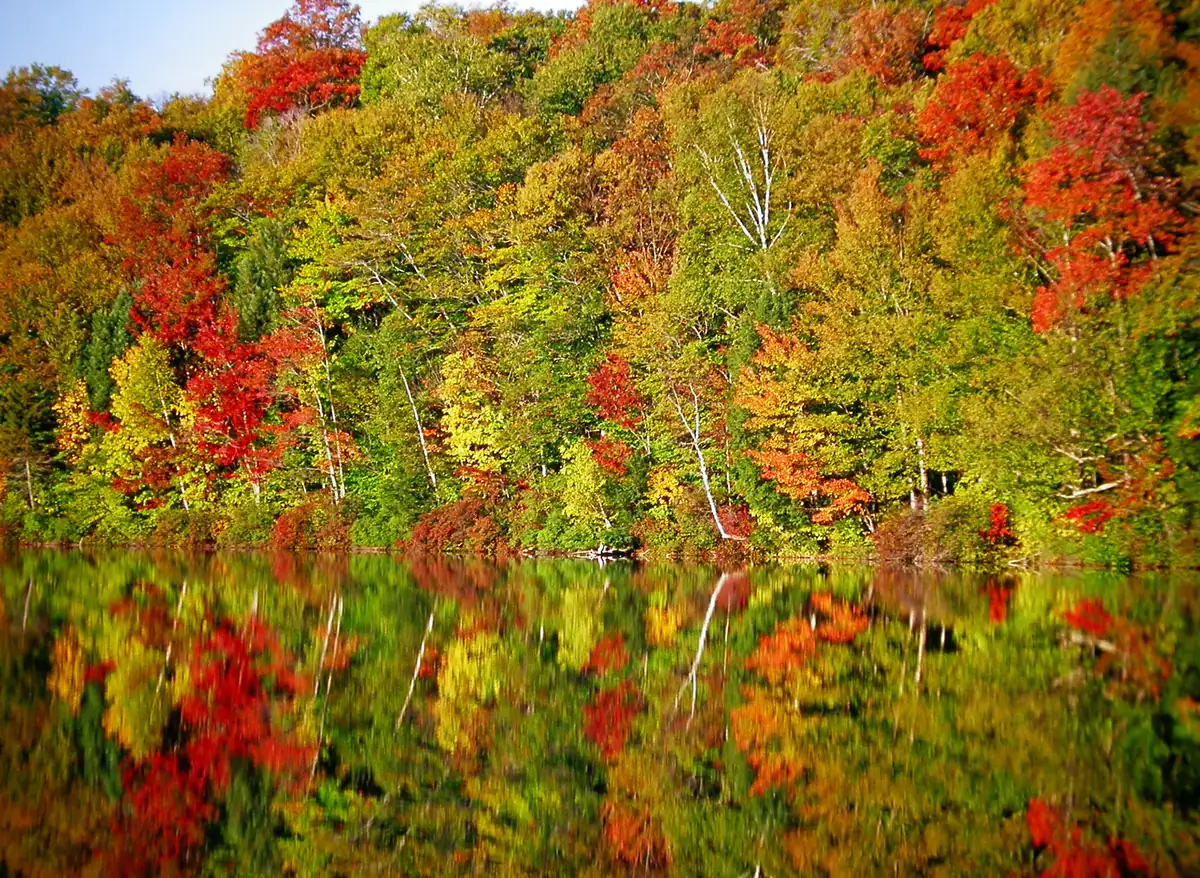
Sugar maple and beech carry the middle of the season. On a calm morning after a cold night, Squam and Winnipesaukee double every color. Around Sunapee and the Upper Valley, Anderson points to mixed hardwoods set off by white pine and hemlock.
-
Monadnock, the Merrimack Valley and the Seacoast
Mid-October into the last week of the month · Peterborough, Keene, Concord, Manchester, Nashua, Portsmouth and the Great Bay towns
The south finishes last, with red oaks and late sugar maples giving the Monadnock hills their rust and orange in the back half of the month; oaks near Great Bay often keep some color into November. The first trees of all to turn were the red maples in southern swamps, back in late summer.
If city Norway maples look spotted with black this fall, that is tar spot, a fungus Anderson says rarely harms the tree. Pick one maple you pass every day and note the date of first red, full color and bare branches; the Field almanac adds satellite estimates of green-up and leaf-off for any address.
Where can I watch hawks migrate in New Hampshire in October?
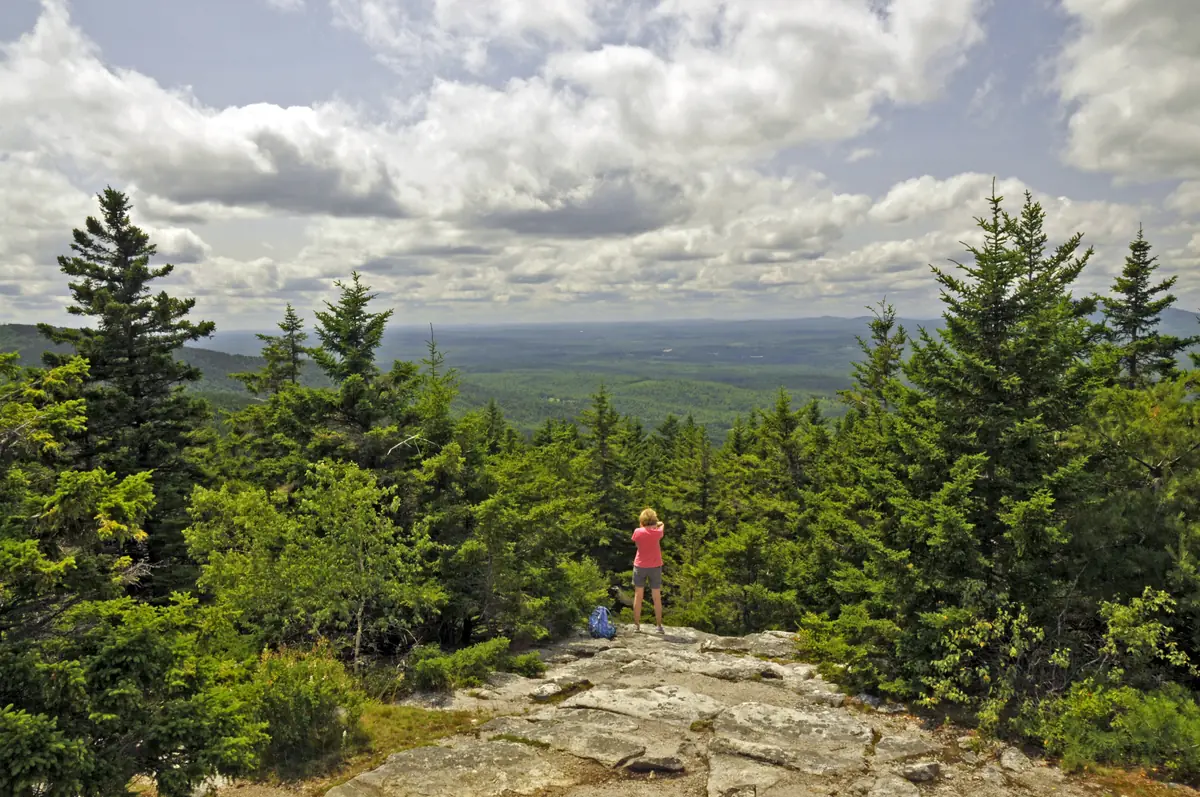
The best-known spot is the Pack Monadnock Raptor Observatory, a platform just below the 2,290-foot summit in Miller State Park, Peterborough, the oldest state park in New Hampshire. The Harris Center for Conservation Education runs the count every day, weather permitting, from September 1 to November 20, and its biologist and volunteers help visitors sort out what is flying past.
-
A record September
Already past, but worth knowing · Pack Monadnock
The Harris Center had counted more than 15,000 raptors by September 24. On September 19 its observers logged 5,209, a new one-day high for the site, 4,435 of them broad-winged hawks in the noon hour alone. Sharp-shins passed 700; ospreys, bald eagles and kestrels each topped 100; and more than 800 monarchs drifted by.
-
What October brings
October, best on the day or two after a cold front · Pack Monadnock and other open summits
The broad-wings have gone by October. The Monadnock Ledger-Transcript’s guide calls it a month of fewer birds but more kinds: golden eagles and American goshawks, the big prizes of a New Hampshire fall, with sharp-shinned hawks still passing and red-tailed and red-shouldered hawks building toward November. The Harris Center’s tip is to go the day after a cold front, when a northwest wind carries birds along the ridge. The summit is often fogged in this month, so read the latest field report before you drive.
-
Getting there
Any day through November 20 · Miller State Park, Route 101, Peterborough
A 1.3-mile paved road climbs to a small summit lot that fills early on fine weekends; otherwise park at the base and walk up the road or a trail, each roughly a mile and a half. Admission is $4 for adults and $2 for ages 6 to 11, and the park takes day-use reservations up to 30 days out, which the Harris Center strongly recommends. The last stretch to the platform is a short, steep gravel path. Bring a hat; it is windy up there.
Daily totals go to HawkCount, the Hawk Migration Association’s database, so you can see what flew yesterday.
Which birds arrive and leave New Hampshire in October?
October is changeover month: the last warblers leave, sparrows and kinglets pour through, loons slip away from the lakes one at a time, and the first northern visitors turn up at the coast and in the conifers.
-
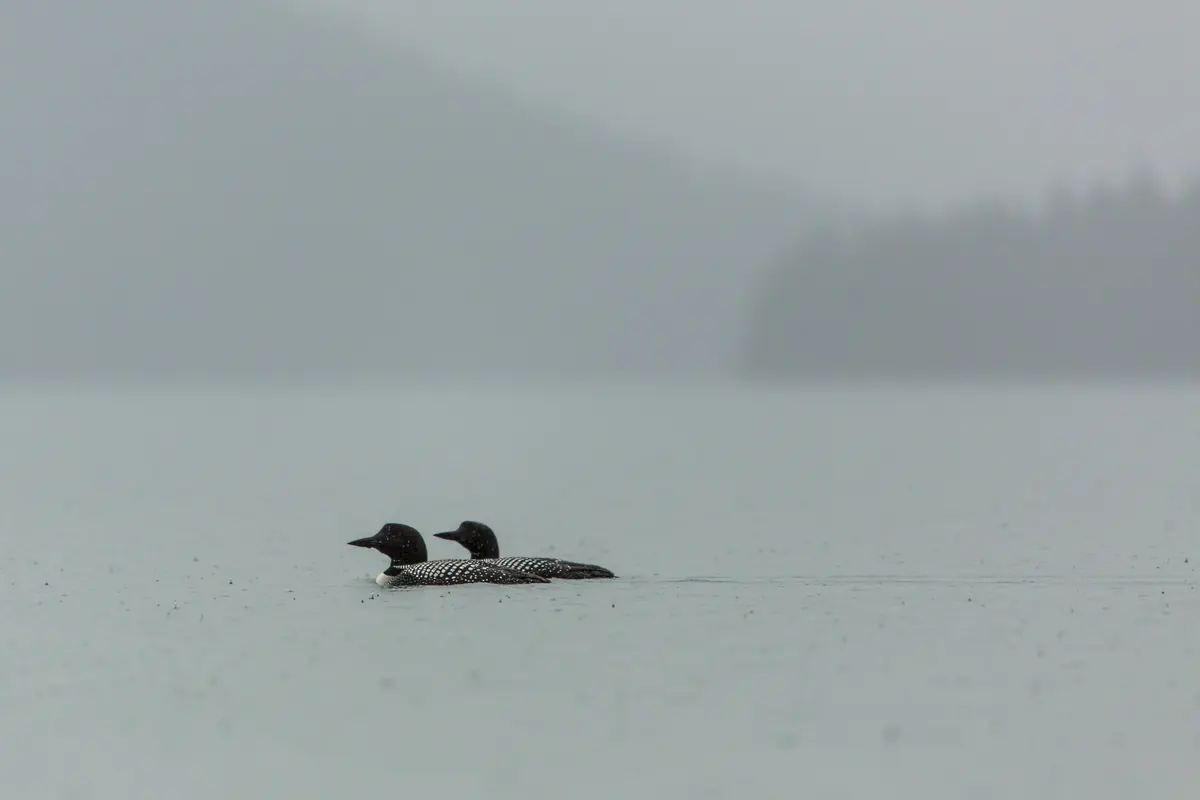
Loons leaving the lakes
Adults mostly in October; the young later · Squam, Winnipesaukee, Umbagog and hundreds of smaller lakes
A loon pair does not leave together. In a study of 32 pairs in New Hampshire and Maine, summarized by the Vermont Center for Ecostudies, the first adult left on October 10 on average, the second on October 27 and the last chick around October 30, with departures scattered from early September to past November 20; usually the female went first. Chicks linger alone before heading to the ocean, where New England’s loons winter in gray plumage. Note the last call you hear from your lake, and report any loon still there when ice starts to form.
-
Sparrows, kinglets and the last warblers
All month · Brushy edges, community gardens, coastal thickets
White-throated sparrows are everywhere this month, with white-crowned, Lincoln’s and swamp sparrows mixed in, and golden-crowned and ruby-crowned kinglets move through the spruce and pine. Yellow-rumped warblers are the one warbler you can count on through October. NH Audubon’s Seacoast Chapter leads a coastal migration walk at Odiorne Point State Park in Rye on Saturday, October 3, from 8 a.m. to noon.
-
Siskins and crossbills from the north
October into winter · White pine and cedar stands statewide; spruce in the north
Posted on September 25, the Finch Research Network’s outlook calls for a sizable pine siskin irruption across the Northeast on an excellent white pine and white cedar crop, plenty of red crossbills including an eastward Type 2 flight, perhaps a few evening grosbeaks, and moderate purple finch numbers. Pine grosbeaks and bohemian waxwings should stay north on a big mountain-ash crop, red-breasted nuthatches should be scarcer than last year, and good beechnut and acorn crops point to a strong blue jay movement.
-
Late monarchs
Stragglers only, on warm afternoons · Asters, goldenrod and garden sedum
Monarch Watch dates the main passage at 43° N, the latitude of Concord and Portsmouth, to September 3–15. An October monarch is a late traveler that needs sun and nectar; send the sighting to Journey North and give it a line on the pollinator watch page.
Mark your calendar for Saturday, October 10, eBird’s fall Big Day, which sits in the middle of Global Bird Weekend (October 9–11). Even an hour of counting from the back step is a useful checklist.
Where can I see moose in New Hampshire in October, and when is the moose hunt?
New Hampshire has about 3,000 moose, by Fish and Game’s count, most of them in the north. Early fall is their breeding season, and in 2025 the department’s biologists noted that by the hunt in the third week of October the animals had passed from the rut into the post-rut, calling less but still moving between feeding areas. That movement is what puts them on the roads.
-
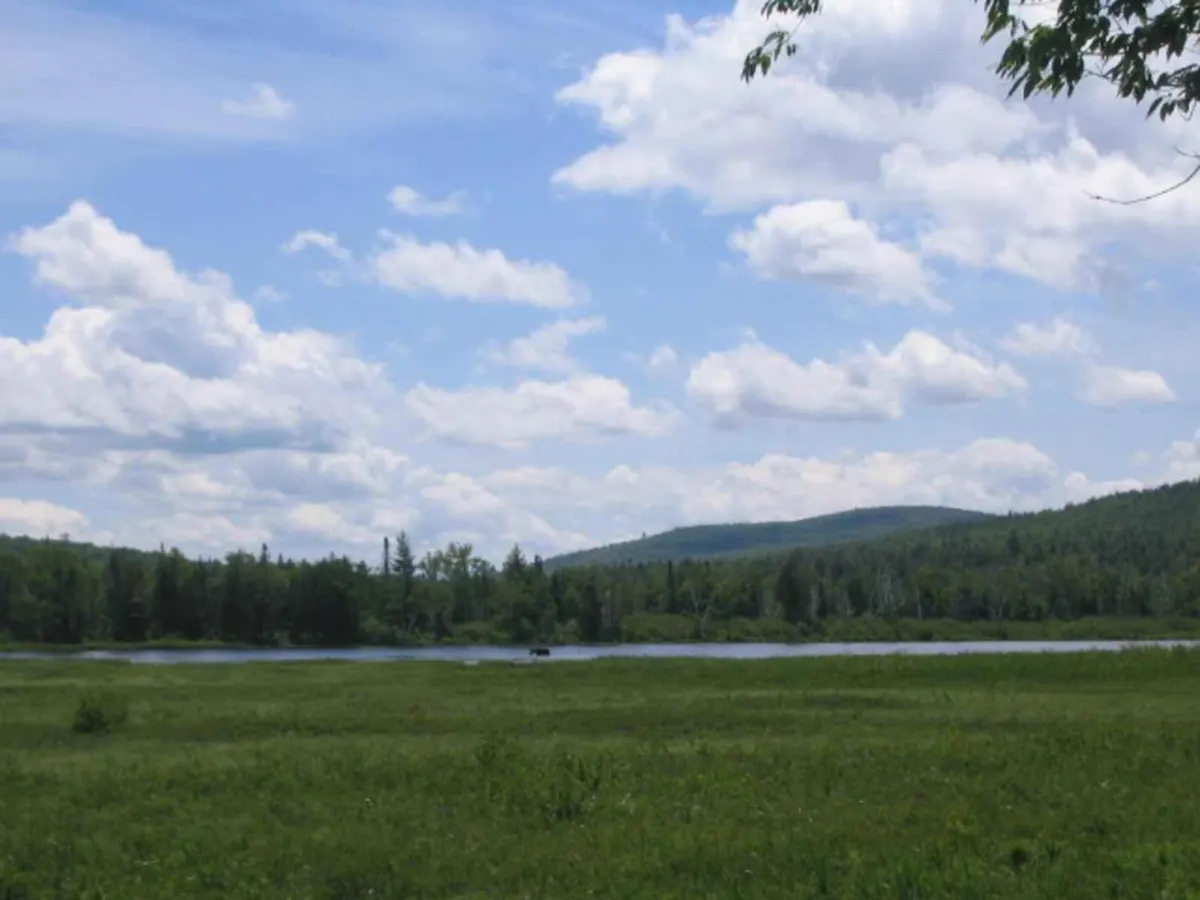
Moose Alley and the northern roads
Dawn and dusk, all month · Route 3 from Pittsburg to the Canadian border, and back roads across the Great North Woods
Route 3 above Pittsburg, toward the Canadian border, is known locally as Moose Alley, and Fish and Game lists it among the roads with roadside salt licks that draw moose out of the spruce. Drive it slowly at first and last light, pull fully off the road to stop, and watch from the car; a cow with a calf or a bull still in rut is not an animal to approach. In soft roadside mud, look for the long split-heart tracks, bigger than any deer’s, and sketch one on the tracks-to-know page.
-
The moose hunt
Saturday, October 17, through Sunday, October 25 · Eight wildlife management units, mostly in the north
The hunt runs nine days from the third Saturday in October. This year 33 permit holders were drawn from more than 5,900 applicants, plus two charity permits, and every moose taken is checked by biologists at one of three stations, who collect data on the herd’s health. Last year hunters took 25 moose, 20 bulls and 5 cows; the heaviest dressed out at 825 pounds and the widest antlers spread 57.5 inches. If you are hiking or driving the northern units that week, wear orange and expect trucks on the logging roads.
-
Brake for moose
Especially after dark · Statewide, on every kind of road
Fish and Game counts about 64 moose–vehicle crashes a year over the last five years, most at dusk and after dark, and flags May through October as the riskiest months. A moose’s dark coat vanishes against pavement and its head stands above the headlights. Slow down, use high beams where you can, and stop if one is near the road.
What is October like on Mount Washington and the high peaks?
Winter. NOAA’s 1991–2020 normals give the summit of Mount Washington an average October high of 37.7 °F and low of 24.9 °F, with 9.99 inches of precipitation and 19.0 inches of snow; November’s mean falls to 20.8 °F. Rime ice builds on the summit towers, and a hiker who starts from Pinkham Notch in shirtsleeves can meet sleet and fog above treeline by early afternoon.
-
The summit building closes
Full services through October 12; closed after October 18 · Sherman Adams building, Mount Washington State Park
New Hampshire State Parks lists full hours in the summit building through October 12, then limited services, possibly none, from October 13 until it closes for the season on October 18. After that there is no shelter on top. The park asks visitors to read the Mount Washington Observatory’s higher-summits forecast before going up, which is good advice for any peak above treeline.
-
Short days on long trails
All month · The Presidentials, Franconia Ridge, the 4,000-footers
Fish and Game’s September incident log reads like a warning for October: an injured hiker on Mount Lafayette, another helped off Mount Washington, and a Boot Spur descent that began before noon and ended in a rescue after midnight. With the sun down by about 5:40 p.m. at month’s end, start early, keep to a turnaround time, pack a headlamp and extra layers, and turn back when anyone in the group is fading.
-
First snow in the valleys
Occasionally late October; usually November · The notches and northern valleys first
By the same NOAA normals, Concord averages 0.8 inch of snow in October and 2.5 inches in November, so a coating in the capital this month is possible but unusual. On the summits a few inches at a time is routine, and the snow line can drop to the notches overnight.
When is the first frost in New Hampshire?
Up north it has already happened: the median first freeze at Berlin’s airport is September 19 and First Connecticut Lake’s September 24. October belongs to the southern valleys, the big lakes and the coast. Cold air pools in low ground on still nights, so a river-valley station like Keene can freeze before towns higher up, while Winnipesaukee’s warm water keeps Lakeport frost-free until October 18 in a typical year. Manchester Airport, on the Merrimack, is among the last at October 19.
| Station | One year in ten | Median | Nine years in ten |
|---|---|---|---|
| First Connecticut Lake (Great North Woods) | Sep 9 | Sep 24 | Oct 7 |
| Berlin Municipal Airport (Androscoggin valley) | Sep 5 | Sep 19 | Oct 3 |
| Pinkham Notch (White Mountains) | Sep 15 | Oct 1 | Oct 14 |
| Hanover (Upper Valley) | Oct 1 | Oct 13 | Oct 29 |
| Lakeport 2 (Laconia, Lakes Region) | Oct 4 | Oct 18 | Nov 3 |
| Keene (Monadnock Region) | Sep 18 | Oct 1 | Oct 14 |
| Concord Municipal Airport | Sep 21 | Oct 3 | Oct 16 |
| Manchester Airport | Oct 4 | Oct 19 | Nov 4 |
| Greenland (Seacoast) | Sep 27 | Oct 8 | Oct 24 |
More than fifty stations, from Errol to Nashua, are on the New Hampshire frost dates page. On clear, windless nights the grass can whiten a week or two ahead of a true 32 °F freeze. Bring in the last tomatoes before the first one, and log the morning the pumpkins turn white.
How much daylight does New Hampshire lose in October?
Close to an hour and a half. Colebrook, the northernmost town in the table, loses 89 minutes over the month, about 3 minutes a day; Nashua loses 83. In Concord the sun comes up at 6:44 a.m. on October 1 and 7:20 a.m. on October 31, and sets at 6:27 p.m. and then 5:39 p.m. Once standard time returns (2 a.m., November 1), Concord’s sun sets at 4:38 p.m.
| City | Oct 1 | Oct 31 | Lost | Per day |
|---|---|---|---|---|
| Colebrook | 11 h 42 m | 10 h 13 m | 89 min | 3.0 min |
| Berlin | 11 h 42 m | 10 h 14 m | 88 min | 2.9 min |
| Littleton | 11 h 43 m | 10 h 15 m | 88 min | 2.9 min |
| North Conway | 11 h 43 m | 10 h 16 m | 87 min | 2.9 min |
| Hanover | 11 h 43 m | 10 h 17 m | 86 min | 2.9 min |
| Concord | 11 h 43 m | 10 h 19 m | 84 min | 2.8 min |
| Portsmouth | 11 h 44 m | 10 h 20 m | 84 min | 2.8 min |
| Nashua | 11 h 44 m | 10 h 21 m | 83 min | 2.8 min |
Our Field almanac works it out for your own street: sunrise, sunset, twilight and the week’s loss.
What is October weather like in New Hampshire, and will El Niño change the winter?
October is crisp and changeable. NOAA’s 1991–2020 normals give Concord an average high of 60.9 °F and low of 37.8 °F, with 4.43 inches of precipitation; Manchester runs a little milder, 62.1 °F and 42.3 °F, and Whitefield, in the north, a good deal colder, at 57.6 °F and 33.9 °F. A warm, hazy day near 70 °F and a raw, wet one in the 40s can come in the same week.
The state is still short of water. In mid-September State Climatologist Mary Stampone told NHPR that more than half of New Hampshire was in moderate drought, worst in the central and eastern parts of the state, with the hardest-hit areas about 10 inches behind on precipitation. About 250 people had reported dry wells to the Department of Environmental Services over the past year. NHPR’s late-September foliage report expected a nor’easter to ease the coastal dryness, but it takes a long run of soaking rain before the ground freezes to refill wells.
Looking past October: in its September 10 discussion, NOAA’s Climate Prediction Center held its El Niño Advisory and gave a very strong event better than a 90 percent chance for the coming fall and winter. Northern New England feels El Niño less than the southern states do. NOAA’s climate.gov composites lean toward a warmer Northeast winter but call the link there “not very strong.” Speaking to the Boston Globe in June, NOAA scientist Jared Rennie said strong events warm Northeast winters, and the University at Albany’s Paul Roundy expected long mild spells and fewer big snowstorms, while reminding readers that some strong El Niño winters have still delivered surprise big snows. Snow is the shakiest part of the forecast: the same NOAA composites actually tilt slightly toward more snow in the Northeast during El Niño, the opposite of Roundy’s lean. For New Hampshire the safer reading is a milder winter, perhaps more coastal storms, and a rain-or-snow question settled by elevation: the mountains and the north stand a better chance of a normal snow year than Nashua or the coast. This month’s weather owes little to the Pacific. The official winter outlook from NOAA arrives in mid-October; for the coming days, see Weather now.
What is in the New Hampshire night sky in October 2026?
-
The moon covers Jupiter
Tuesday, October 6, roughly 4:28 to 5:28 a.m. EDT · Due east, about 22 degrees up at the start and 33 at the end
All of New Hampshire sees this one in full darkness. IOTA’s prediction list has no New Hampshire city, but it brackets the state: Jupiter goes behind the moon’s bright limb at 4:27 a.m. in Boston and 4:29 in Burlington and Montpelier, and comes back at the dark limb at 5:30 in Boston and 5:27–5:28 in Vermont. Expect your times within a minute or two of those. In Concord the 18 percent crescent rises at 2:07 a.m. and civil twilight waits until 6:21. In binoculars, Jupiter’s moons slip behind the lunar edge minutes apart, and then the planet’s disk fades out over the better part of a minute.
-
Draconids in a moonless evening
Evening of Thursday, October 8 · Look high in the north after dark
A slow, thin shower that performs, when it performs at all, in early evening rather than before dawn, so it suits children. The moon stays below the horizon until after 4:30 the following morning. Two days later comes the new moon, making October 9–11 the darkest weekend of the month.
-
Orionids before dawn
Pre-dawn, October 21 and 22; shower active October 2 to November 7 · A dark site with a wide view; the radiant is in Orion, high in the south-southeast
Debris from Halley’s Comet, the Orionids are swift and often leave glowing trains. Their broad maximum spans the 21st and 22nd, predawn, while a waxing gibbous moon brightens the evening. In Concord it sets at 1:53 a.m. on the 21st and at 3:00 a.m. on the 22nd; civil twilight starts at 6:40, and the sky pales well before then, which leaves about two and a half truly dark hours on the second morning. From a dark rural field a strong year brings roughly 10 to 20 an hour; town skies show far fewer.
-
The Hunter’s Moon
Evenings of Sunday, October 25, and Monday, October 26 · Low in the east-northeast at sunset
The moon is full at 12:12 a.m. on the 26th, so both evenings qualify. In Concord it rises at 5:11 p.m. on the 25th, 37 minutes before sunset, and at 5:41 p.m. on the 26th, five minutes before the sun goes down. A bare hill or a lake shore facing east gives the best view of it coming up orange over the trees. It is not a supermoon this year, whatever you may read.
-
Saturn all night, planets at dawn
Saturn at opposition October 4; moon beside it October 23–24; Mars at the Beehive the morning of October 11 · Saturn low in the east at dusk; Jupiter and Mars in the east before sunrise
Saturn comes to opposition on October 4, up from dusk to dawn as a steady, pale-gold point in a dim region of sky; a small telescope will show its rings, and the waxing moon drifts past it over the 23rd and 24th. Venus is only a low evening glimmer in the west for the first few days of October, then vanishes into the twilight ahead of its inferior conjunction on October 23. Before sunrise the brilliant one in the east with ruddy Mars above it, and on October 11 Mars crosses the Beehive cluster, a lovely binocular view.
| Phase | Date | Time |
|---|---|---|
| Last quarter | Saturday, Oct 3 | 9:25 a.m. EDT |
| New moon | Saturday, Oct 10 | 11:50 a.m. EDT |
| First quarter | Sunday, Oct 18 | 12:12 p.m. EDT |
| Full moon (Hunter’s Moon) | Monday, Oct 26 | 12:12 a.m. EDT, just after midnight; full-looking on the evenings of both Oct 25 and Oct 26 |
| Last quarter | Sunday, Nov 1 | 3:28 p.m. EST, after the clocks change |
For clear-sky odds before any of these, see Today’s sky, and for moonrise and moonset where you live, see our moon phases page.
What is blooming, turning gold and dropping in New Hampshire in October?
-
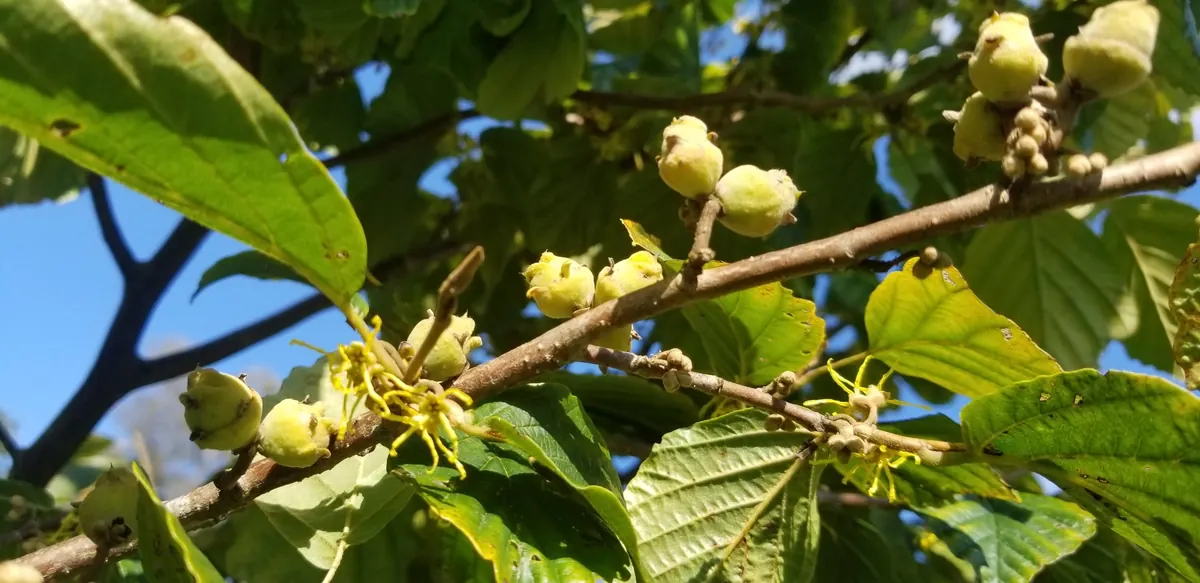
Witch hazel
October into November · Woods edges and understory statewide
Just as the maples drop, American witch hazel opens its yellow, thread-thin flowers, four crinkled petals apiece, often on twigs that have lost their leaves. The Forest Service describes the bloom as mid to late fall and the range as running north to Nova Scotia, so it is at home across New Hampshire. The woody seed capsules from last year split at the same time and shoot two black seeds as far as 20 feet, occasionally twice that. Crouch beside a shrub on a dry afternoon and listen for the snap.
-
Tamarack goes gold
Mid-October into November, after the hardwoods · Bogs and wet lowlands, especially in the north and the Lakes Region
Tamarack is a conifer that acts like a hardwood. The Forest Service calls it deciduous: its soft needles, in tufts of 10 to 20, turn yellow in fall and then drop. After the maples are bare, a bog full of tamaracks glows gold against dark spruce. It suits the tree-through-the-seasons page because it changes so completely.
-
Bottle gentian and the last asters
Until a hard freeze · Wet meadows, ditches, pond edges; asters on every roadside
Bottle gentian, a deep blue flower that never opens, blooms from August into October. The Forest Service notes that only strong bees can pry the petals apart to reach the nectar, so if you wait by a patch you may see a bumblebee force its way in and disappear. New England aster and the late goldenrods keep feeding bumblebee queens and stray monarchs until the first real freeze. Ragweed, not goldenrod, is the hay fever plant.
-
Beechnuts, acorns and the fall feeders
Through October · Hardwood forests
The Finch Research Network reports good beechnut and acorn crops in the region this year, which means well-fed bears, deer, turkeys and squirrels, and blue jays busy carrying and caching acorns. Count what falls under one oak each week on the seeds, pods and cones page.
Ticks are not finished either. The CDC says adult blacklegged ticks will seek a host whenever winter temperatures rise above freezing, so check yourself, the children and the dog after any walk through leaves.
What can New Hampshire families do outdoors in October 2026?
- Saturday, October 3: a coastal migration walk with NH Audubon’s Seacoast Chapter at Odiorne Point State Park in Rye, 8 a.m. to noon; then UNH Observatory’s free public night in Durham after dark (again October 17; cloudy nights cancelled).
- Tuesday, October 6, before dawn: the Jupiter occultation. Set an alarm for 4:15 and bring binoculars to an east-facing window or yard.
- October 8–11: a dark-sky weekend and bird counts. The Draconids on Thursday evening, eBird’s October Big Day on Saturday the 10th, and Global Bird Weekend October 9–11.
- October 9–11: the Milford Pumpkin Festival (Friday 5–9 p.m., Saturday 10 a.m.–9 p.m., Sunday 10 a.m.–3 p.m.), or the Sandwich Fair in Center Sandwich October 10–12 for animals and agricultural exhibits.
- October 16–17: the New England Fall Astronomy Festival at UNH in Durham, free; build a telescope, look at the sun safely, stay for the stars.
- Saturday, October 17: the Keene Pumpkin Festival, free downtown, with carving in Railroad Square and a display of school pumpkins along Main Street.
- Saturday, October 24: Howl-O-Ween at the Squam Lakes Natural Science Center in Holderness, 9:30 a.m. to 5 p.m., with close-up presentations of nocturnal animals at 10, 11, 1 and 2. The live animal trail closes for the season after November 1.
- Any clear day through November 20: the Pack Monadnock hawk watch, with reservations at Miller State Park.
- Science from the backyard. Send any October monarch to Journey North, log hawks and loons in eBird, and sign on with Project FeederWatch, whose count starts November 1; if the siskin forecast holds, the feeders will be busy.
Browse the rest of the country from the nature hub; the Naturalist’s Field Journal was designed for months like this.
Safety notes for October in New Hampshire
- Hunting seasons are open. Archery deer and fall archery turkey have been open since September 15. Ruffed grouse, woodcock, pheasant and snowshoe hare open October 1; shotgun turkey runs October 12–18 in certain units; moose, by permit, October 17–25; youth deer weekend October 24–25; and the muzzleloader deer season starts October 31, with regular firearms deer from November 11. Duck seasons open October 2 in the Northern Zone, October 6–12 on the coast, and October 13 inland and along the Connecticut River. Pheasants are stocked on October 8–9, 15–16 and 22–23, and those sites are closed to hunting until 2 p.m. on stocking days.
- Orange is recommended, not required. New Hampshire law (RSA 207:38-b) says hunters with a gun or bow, other than waterfowl hunters, should wear a hunter-orange hat, vest or other clothing visible from all sides at 200 feet; it is advice written into statute, not a mandate. Fish and Game tells pheasant hunters to wear orange on the head, back and chest, and urges hikers to own and wear something blaze orange, to make some noise on the trail, to hike midday and midweek when fewer people hunt, and to put orange on the dog.
- Moose on the road. Dusk and night are the danger hours; slow down north of the notches.
- Mountains in early winter. Summits can be icy and below freezing while the valleys are pleasant. Check the higher-summits forecast, carry a headlamp and warm layers, and turn around early.
- Drought and fire. With much of the state dry, be careful with campfires and check your town’s permit rules before burning brush.
- Ticks. Adult blacklegged ticks are active on mild days all fall; check after every walk.
Sources
- NHPR: autumn colors racing toward peak in parts of New Hampshire (September 24, 2026)
- NHPR Something Wild: a spectacular and prolonged fall foliage season (September 17, 2026)
- NHPR: drought expands across part of New Hampshire (September 17, 2026)
- Harris Center: visiting the Pack Monadnock Raptor Observatory
- Harris Center: Pack Monadnock Raptor Observatory field reports, 2026
- Monadnock Ledger-Transcript: hawk migration at Pack Monadnock (September 22, 2026)
- New Hampshire State Parks: Miller State Park (fees, reservations, summit road)
- HawkCount (Hawk Migration Association of North America)
- Vermont Center for Ecostudies: loon departure times (New Hampshire and Maine study)
- NH Audubon: events calendar (Coastal Migration at Odiorne Point, October 3, 2026)
- Finch Research Network: winter finch forecast 2026–2027 (September 25, 2026)
- BirdsCaribbean: October Big Day, Saturday, October 10, 2026
- Monarch Watch: peak migration dates by latitude
- Journey North: monarch sightings
- NH Fish and Game: New Hampshire’s 2026 moose hunt is October 17–25
- NH Fish and Game: 2025 New Hampshire moose hunt highlights
- NH Fish and Game: brake for moose (May 19, 2026)
- NH Fish and Game: moose spotting in New Hampshire (salt-lick roads, Route 3 in Pittsburg)
- New Hampshire State Parks: Mount Washington State Park (Sherman Adams building 2026 season)
- Mount Washington Observatory: October weather on the summit
- NOAA NCEI: 1991–2020 monthly normals for Mount Washington, Concord, Manchester and Whitefield (data API)
- NH Fish and Game: hiker rescued from Boot Spur Trail (September 28, 2026)
- NH Fish and Game: hiker injured on Mount Lafayette (September 14, 2026)
- NH Fish and Game: hiker assisted on Mt. Washington (September 16, 2026)
- Climate Prediction Center: ENSO diagnostic discussion, September 10, 2026
- NOAA Climate.gov: United States El Niño impacts
- Boston Globe: El Niño’s New England impacts this summer and winter (June 12, 2026)
- USGS Climate Adaptation Science Centers: regional super El Niño impacts, Northeast U.S.
- U.S. Naval Observatory: moon phases 2026 and rise, set and twilight times (data API)
- International Occultation Timing Association: lunar occultation of Jupiter, October 6, 2026
- EarthSky: visible planets and night sky guide
- EarthSky: meteor shower guide (Draconids, Orionids)
- UNH Extension: New England Fall Astronomy Festival, October 16–17, 2026
- University of New Hampshire: UNH Observatory public sessions
- USDA Forest Service: American witchhazel, plant of the week
- USDA Forest Service Fire Effects Information System: tamarack
- USDA Forest Service: closed bottle gentian, plant of the week
- CDC: where ticks live
- Squam Lakes Natural Science Center: Howl-O-Ween, October 24, 2026, and trail season
- Milford Pumpkin Festival, October 9–11, 2026
- Sandwich Fair, Center Sandwich, October 10–12, 2026
- My Keene Now: 2026 Keene Pumpkin Festival, Saturday, October 17
- Project FeederWatch: how to participate (November 1 to April 30)
- NH Fish and Game: New Hampshire hunting seasons open September 1 (2026 dates)
- NH Fish and Game: 2026–2027 migratory waterfowl hunting seasons
- NH Fish and Game: ruffed grouse and woodcock seasons start October 1 (2026)
- NH Fish and Game: regular pheasant season opens October 1 (2026 stocking days)
- NH Fish and Game: youth deer hunt set for October 24–25, 2026
- NH Fish and Game: share the forest, hiking during hunting season (September 11, 2026)
- New Hampshire RSA 207:38-b: hunter orange recommendation
- Photos via Wikimedia Commons; licenses and photographers are credited under each picture
