What to look for in nature in New Hampshire this November
November is when New Hampshire stops looking like autumn and starts sounding like winter. The hardwoods are bare except for the beeches and oaks, standard time returns on the 1st, and from that evening the sun is gone before most people leave work. Hawk-watch traffic shifts to red-tailed hawks riding cold northwest winds, sea ducks and snow buntings settle onto the Seacoast, bucks lay down scrapes in the woodlots, and on the smallest ponds a skin of ice can trap a loon that waited too long. What follows takes the state region by region, and every date carries a source.
Other months in New Hampshire: October, December.
Start here
- Red-tails on a northwest wind. The Pack Monadnock count runs daily through November 20. In recent years the observatory’s red-tailed hawks have peaked in November rather than October; last season’s best day for them was November 14, with 39.
- Snowflakes on the beach. Snow buntings usually reach New Hampshire in November, swirling over the dunes and parking lots at Hampton and Seabrook, while purple sandpipers return to the wave-washed rocks at Rye and the Hampton Harbor jetty.
- A supermoon and a planet pairing. November’s Beaver Moon, a mild supermoon, reaches full on Tuesday the 24th at 9:53 a.m. EST. In the predawn hours of the 15th and 16th, Mars and Jupiter stand just over a degree from each other, high in the south.
Make it last: the Naturalist’s Field Journal gives each of these a page. Put the first white snowshoe hare and the buck that crossed at dusk on the mammal watch, scrapes and antler rubs under reading the signs, snow buntings and the first siskin on your bird list, and one young beech that keeps its leaves on the tree-through-the-seasons plate. Write the date and the temperature on every line.
Regions used below: Great North Woods; White Mountains; Lakes Region; Dartmouth–Lake Sunapee and the Upper Valley; Monadnock Region; Merrimack Valley; Seacoast.
Is the Pack Monadnock hawk watch still worth a trip in November?
Yes, if you go on the right day. The crowds that came for the September broad-wings are gone, and so are most of the hawks, but the Harris Center keeps an observer on the platform near the summit of Pack Monadnock, in Miller State Park, Peterborough, every day the weather allows through November 20. The late birds are big ones and favor raw, blustery days.
-
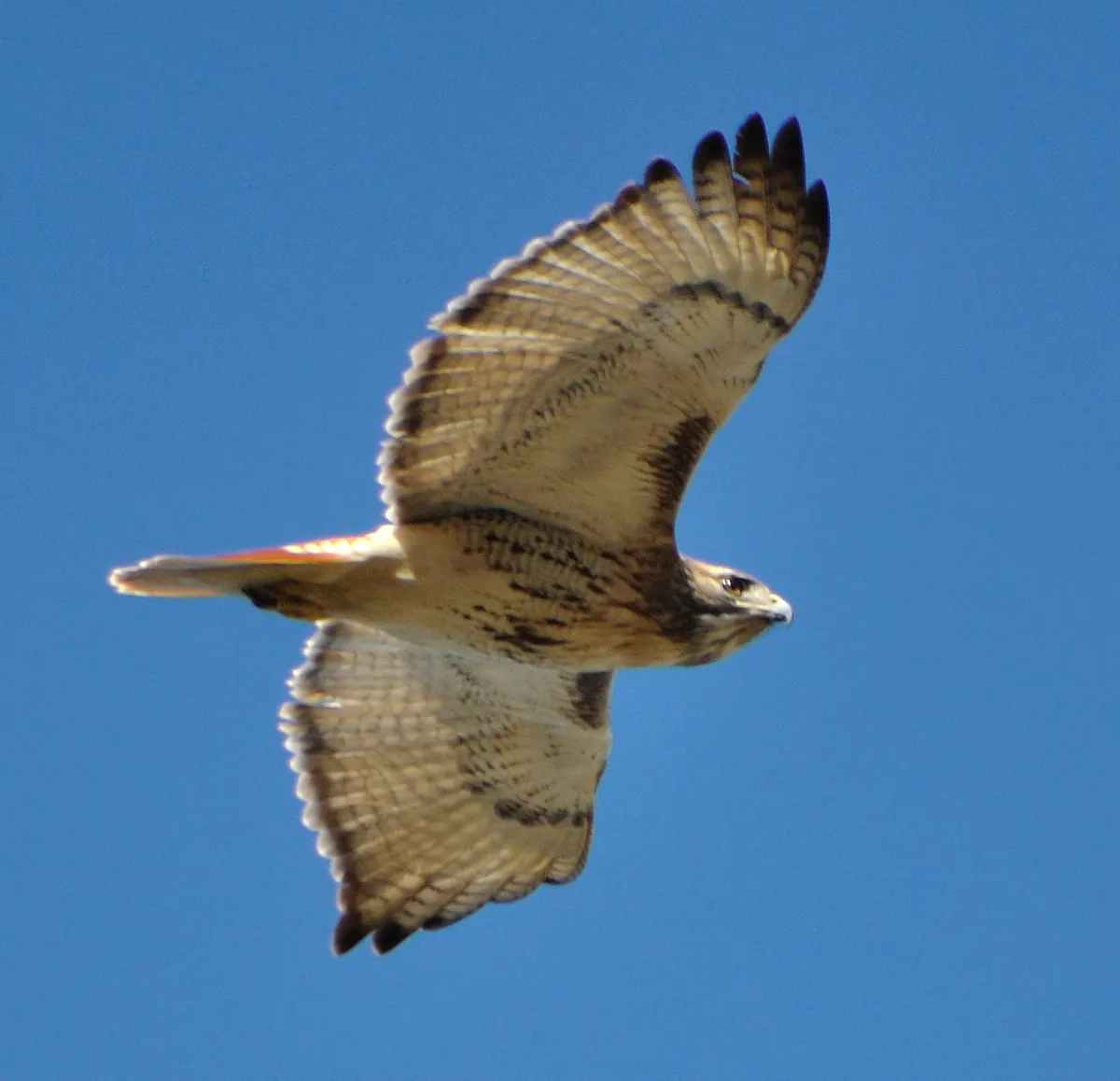
Red-tailed and red-shouldered hawks
November, especially the day after a cold front · Pack Monadnock, and any open summit or ridge in the southern half of the state
The Harris Center’s 2025 report counted 264 red-tailed hawks for the season, with the single best day on November 14 (39 birds) and 53 more in the final five days, November 16 to 20. Its biologists note that red-tails have been passing later for about a decade, with the biggest numbers in November rather than October, and suggest that some wait for cold weather to cut their food supply before they leave. Last year most of them moved on windy days with a strong north or west component. Red-shouldered hawks follow the same rule; seven passed during the closing days of the 2025 count.
-
Golden eagles
Mid-October to mid-November · Pack Monadnock
The prize of the late season. The observatory’s 21-year average is about eight golden eagles a fall; 2025 had five, the best days October 16 and November 1, after a 2024 total of 15, the second highest on record there. An immature bird passed close on November 8 last year. Look for a dark eagle with a small head and long, slightly upswept wings, and ask the counter; that is what they are there for.
Hours shorten in November: last year the platform was staffed from 9 a.m. to 3 p.m. after the clocks fell back, and the late count still turned up evening grosbeaks and loons bound for the coast. Miller State Park’s summit road is open only in season, so check with the park before counting on a drive up; trails from the base lot run about a mile and a half.
What winter birds arrive on the New Hampshire coast in November?
New Hampshire’s ocean shore is short, but in November it fills with birds that spend the summer in the Arctic. A cold, clear morning with a light wind at Odiorne Point, Rye Harbor, Great Boars Head or the Hampton Harbor jetty can show more northern species in an hour than the rest of the state does all winter.
-
Sea ducks
Arriving through November, staying until spring · Off Rye, Little Boars Head, North Hampton and Hampton Harbor
NH Audubon describes the long-tailed duck as a winter visitor from arctic Canada and Alaska; it dives as deep as 200 feet, flapping its wings underwater. Common eiders are here all year, since they nest on the Isles of Shoals, but their rafts along the mainland grow in winter. Look among them for surf, white-winged and black scoters, red-throated loons and horned grebes.
-
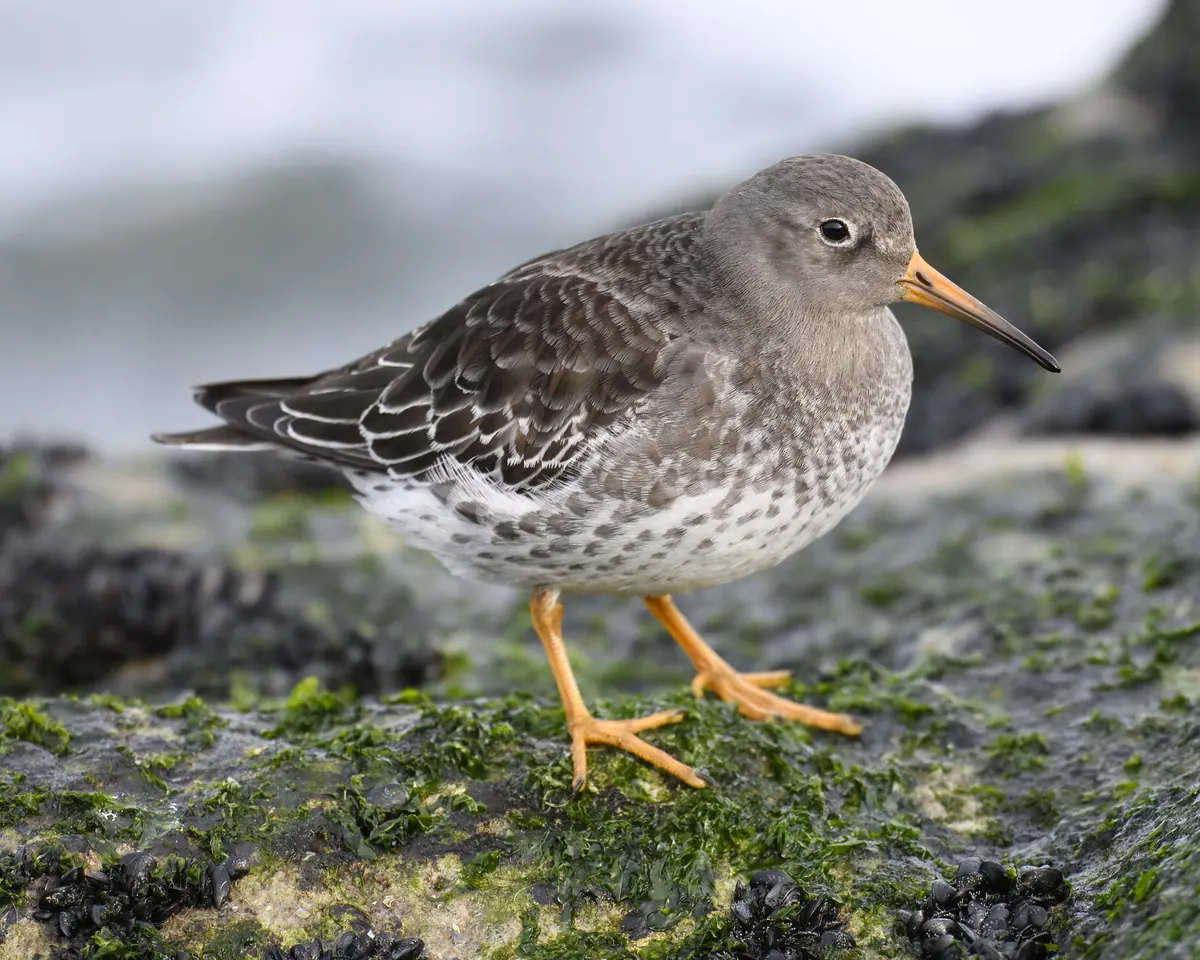
Purple sandpipers
November through April · Seaweed-covered rocks at Rye and the Hampton Harbor jetty, best near high tide
Almost every other shorebird has gone south by November; this one arrives. NH Audubon says a handful winter on the coast from November to April, feeding on seaweed-covered rocks just above the waterline and dodging the waves. They are chunky and slate gray, and the giveaway is their bright yellow-orange legs against dark rock. Their numbers are showing signs of decline, so any count you submit to eBird is useful.
-
Snow buntings
From November until March · Beaches, dunes, gravel lots and open fields on the coast and in the river valleys
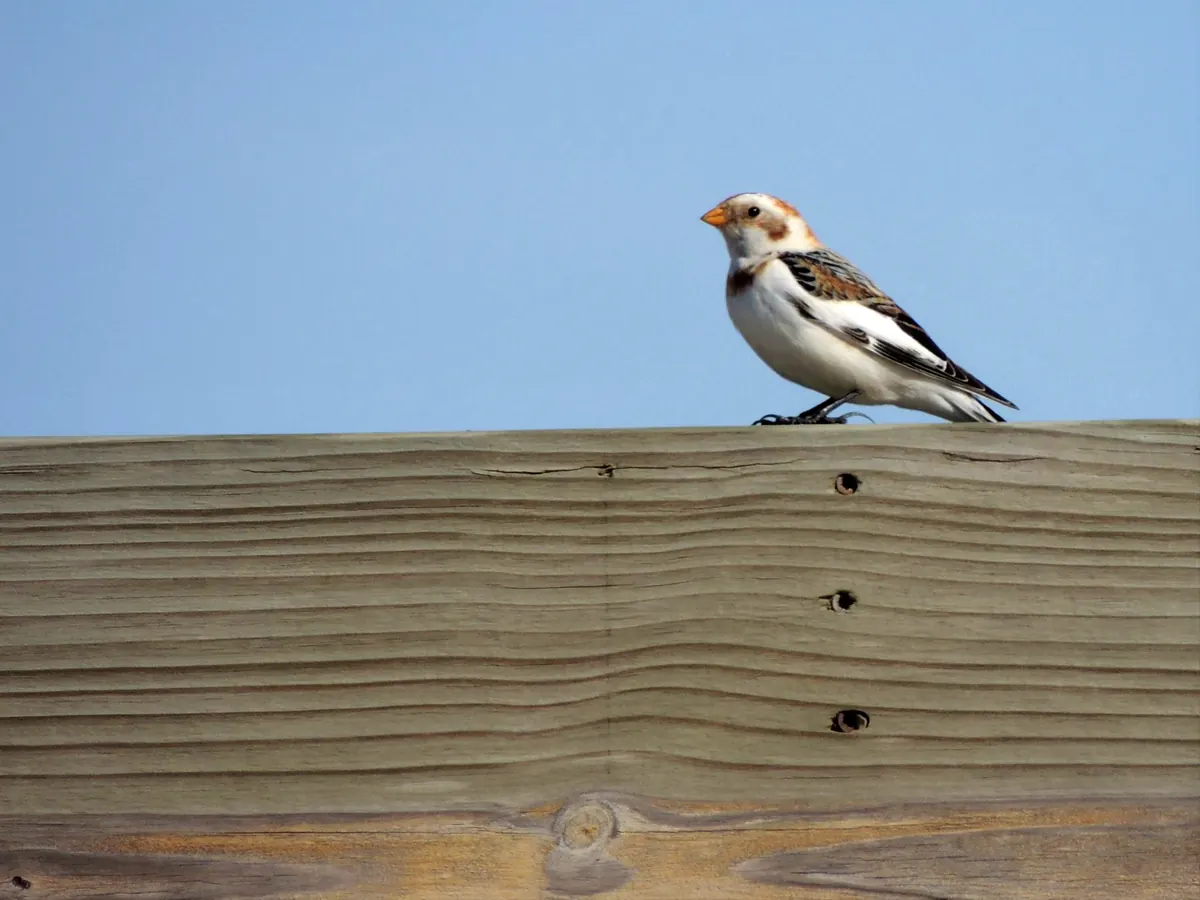
Called snowflakes for the way a flock wheels and settles, snow buntings usually don’t reach New Hampshire until November, NH Audubon notes. They mix with horned larks and pipits on beaches, grassy parking lots and airfields. Walk slowly along the upper beach at Hampton or Seabrook and watch for a white flash of wings as the flock lifts and drops a few yards ahead of you.
-
Snowy owls
Sometimes from late November; numbers vary a great deal by year · Hampton Beach and Rye Harbor state parks; inland at airports and large fields
NH Audubon calls the coast the best place to see one, at open sites like Hampton Beach and Rye Harbor state parks. Most here are young birds, and most of those are heavily barred females. Arrivals follow lemming years in the Arctic, so some winters bring several and others none. Should you spot one, stay well back and let it rest.
Will winter finches come to New Hampshire this year, and when can bird feeders go back up?
Published in late September, this season’s forecast from the Finch Research Network promises a busy Northeast winter for some species and a quiet one for others. Most of the action will be in the woods rather than at feeders, which is just as well, because New Hampshire asks people to keep feeders down until December.
-
Pine siskins and red crossbills
Building through November · White pine and northern white cedar stands; spruce in the north
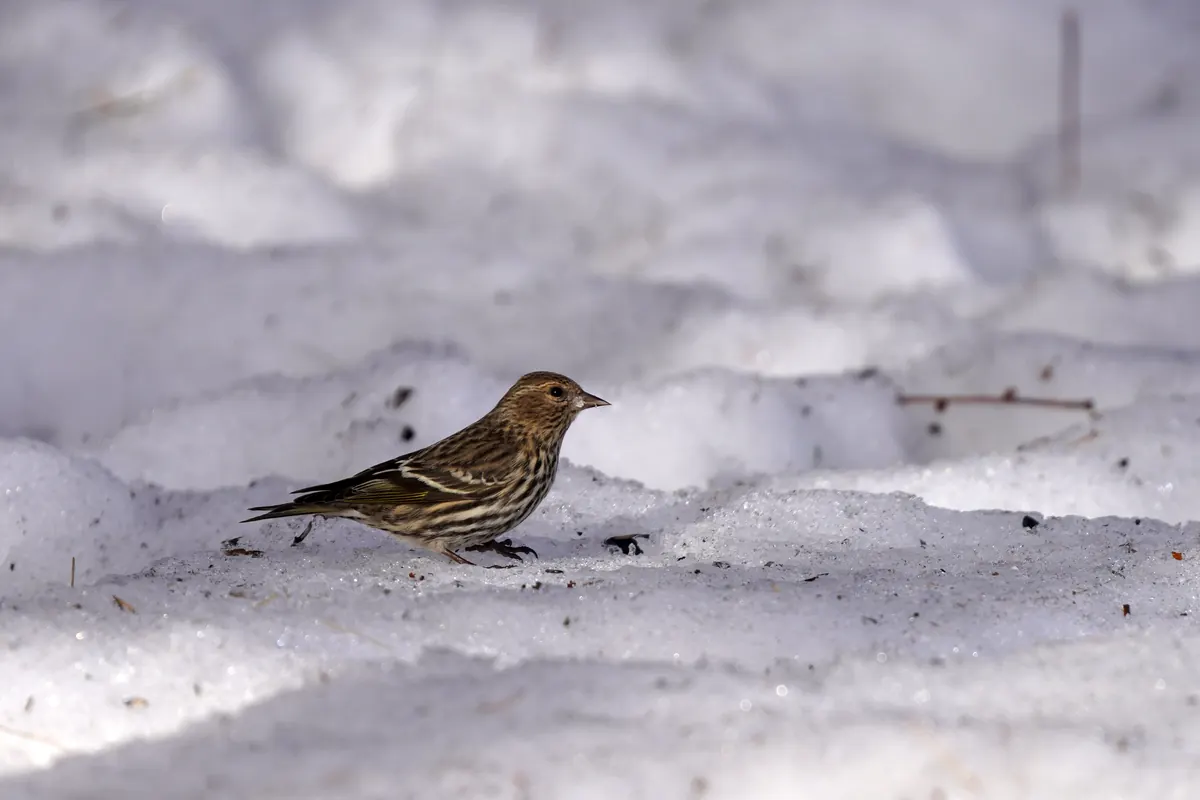
A very good northern white cedar crop and a great eastern white pine crop set up what the forecast calls a sizable irruption of pine siskins in the Northeastern states. Red crossbills are expected in good numbers too, including Type 2 birds that have moved east across the continent after cone failures in the West. Listen for the siskin’s rising, wheezy zreeee from the tops of pines, and for the hard kip-kip of crossbills flying over.
-
Evening grosbeaks and purple finches
Late fall into winter, if they come · The North Country first; possibly farther south
The forecast expects a modest evening grosbeak movement, with birds possibly reaching as far south as Massachusetts, while any purple finch flight is likely to be small and late. Pine grosbeaks and bohemian waxwings are likely to stay in Canada on a heavy mountain-ash crop, and redpolls should be scarce.
-
When the feeders can go back up
December 1 at the earliest, and only once it is truly cold · Every backyard in the state
New Hampshire Fish and Game recommends feeding birds only from December 1 to April 1, so that feeders do not draw black bears. NH Audubon adds a caution: wait until the weather is genuinely wintry before you hang them. That matters this year. Fish and Game noted in March that bears denned late last fall because natural food was so plentiful, and the finch forecast describes another strong beechnut and acorn year. A bear still fattening in early December will find a feeder fast.
The Cornell Lab and Birds Canada start the Project FeederWatch season on November 1, and a feeder is optional: birds drawn to plantings or water in your yard count too. A November of feeder-free counts is a useful record in its own right.
Why do some loons get trapped by ice on New Hampshire lakes?
Most of New Hampshire’s loons are on the ocean by now, but every year a few adults and late chicks linger on inland lakes into November and December. On a big lake that is fine. On a small pond it can be fatal, because a loon cannot take off from a small patch of water.
-
The runway problem
Late November and December, during the first hard cold snaps · Small lakes and ponds that freeze before the large ones
The Loon Preservation Committee, based in Moultonborough, explains that a loon needs a long runway, generally at least 100 yards and sometimes up to a quarter of a mile, to get airborne. Heavy bones and small wings for their weight make loons superb divers and labored fliers. As ice closes in from the shore, the open water shrinks below that length, and the bird is stuck until the pond freezes over completely.
-
What to do if you see one
As soon as the ice starts to form around a loon · Report to the Loon Preservation Committee, (603) 476-5666, or its online form
Stay off new ice. The committee’s biologists say a rescue rarely works until the loon is confined to a hole 15 feet or less across, and they have the gear and training for it. What they need from you is an early report: where the bird is and how fast its open water is shrinking. In early December 2025, the Laconia Daily Sun reported, they rescued two loons trapped on Big Diamond Pond in Stewartstown and Deering Reservoir in Deering.
What are deer, bears and snowshoe hares doing in New Hampshire in November?
November is the busiest month of the year for white-tailed deer and one of the quietest for black bears. In the north woods, snowshoe hares are halfway through changing into their winter coats.
-
The deer rut
Building in early November; peak breeding mid to late November · Woodlots, orchards and field edges statewide
New Hampshire Fish and Game places the peak of breeding in mid to late November, which is why hunters prize the end of the muzzleloader season, when bucks are most active. Look for signs before you see the deer: saplings with the bark scraped raw by antlers at knee to waist height, and bare oval patches of pawed-up ground under a low branch, where a buck has left scent. Hunters took a record 14,387 deer in 2025, the most since 1922, a measure of how many the state now carries. Rutting deer also cross roads at odd hours, so drive carefully at dawn and dusk.
-
Bears heading for dens
Most den in November and December; later when food is abundant · Statewide, densest in the north and the hills
Black bears spend the fall fattening on beechnuts and acorns and go to their dens as that food gives out and the weather turns. With good mast crops reported again, some may stay active into December. Hunters took 1,097 bears in 2025, the fourth-highest harvest on record.
-
Snowshoe hares turning white
Molt under way from mid-autumn; mostly white by late November or December · Spruce and fir forests, most common in the three northern counties
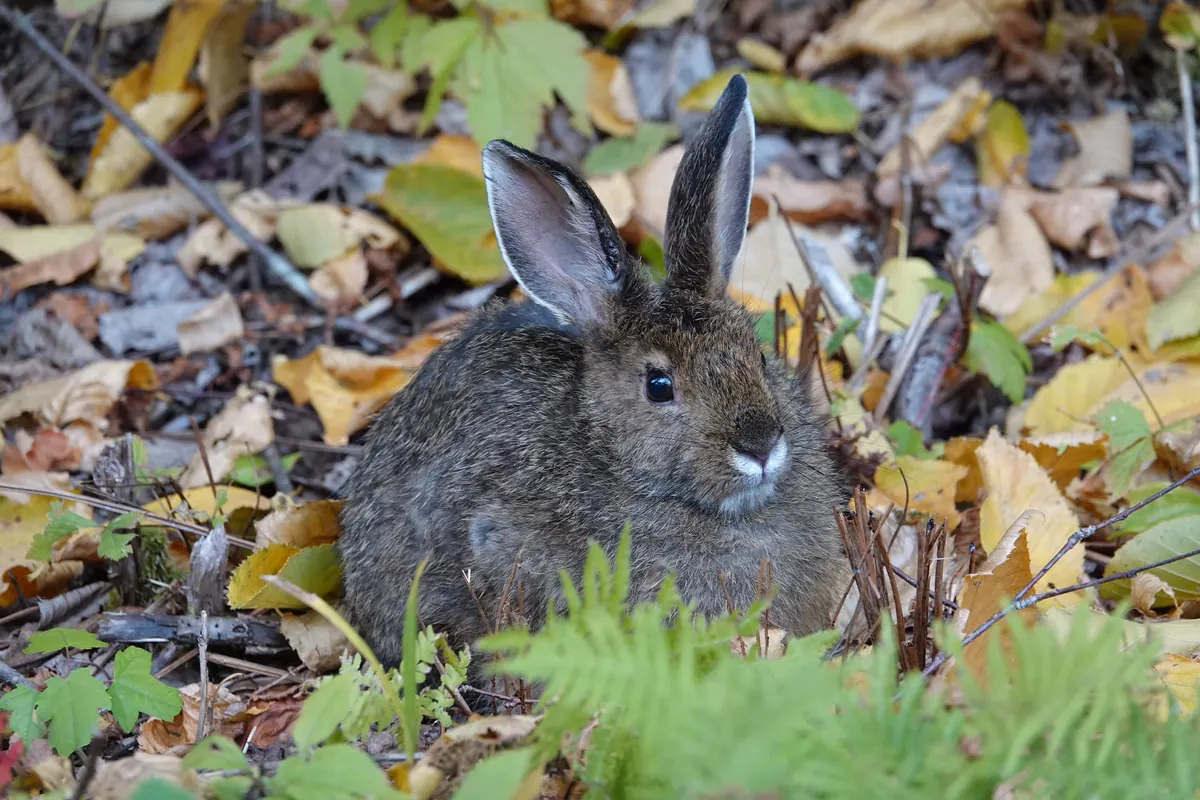
The Harris Center notes that the fall molt in New England takes about ten weeks from mid-October and is triggered by day length, not by temperature or snow, so in a year with a late first snowfall a white hare can sit on brown ground for weeks. University of New Hampshire wildlife biologist Alexej Siren told NHPR in 2025 that hares mismatched like this are killed by predators at higher rates. If you see a hare, white or brown, NH Rabbit Reports, a project of Fish and Game and UNH Cooperative Extension, takes sightings from anyone.
Which trees still have leaves in New Hampshire in November?
Once the maples and birches are bare, the woods show their structure, and a few trees stand out because they have not finished. These are the ones to learn this month.
-
Beech and oak that hold on
November into spring · Young American beech in hardwood stands; red and white oaks, especially in the south
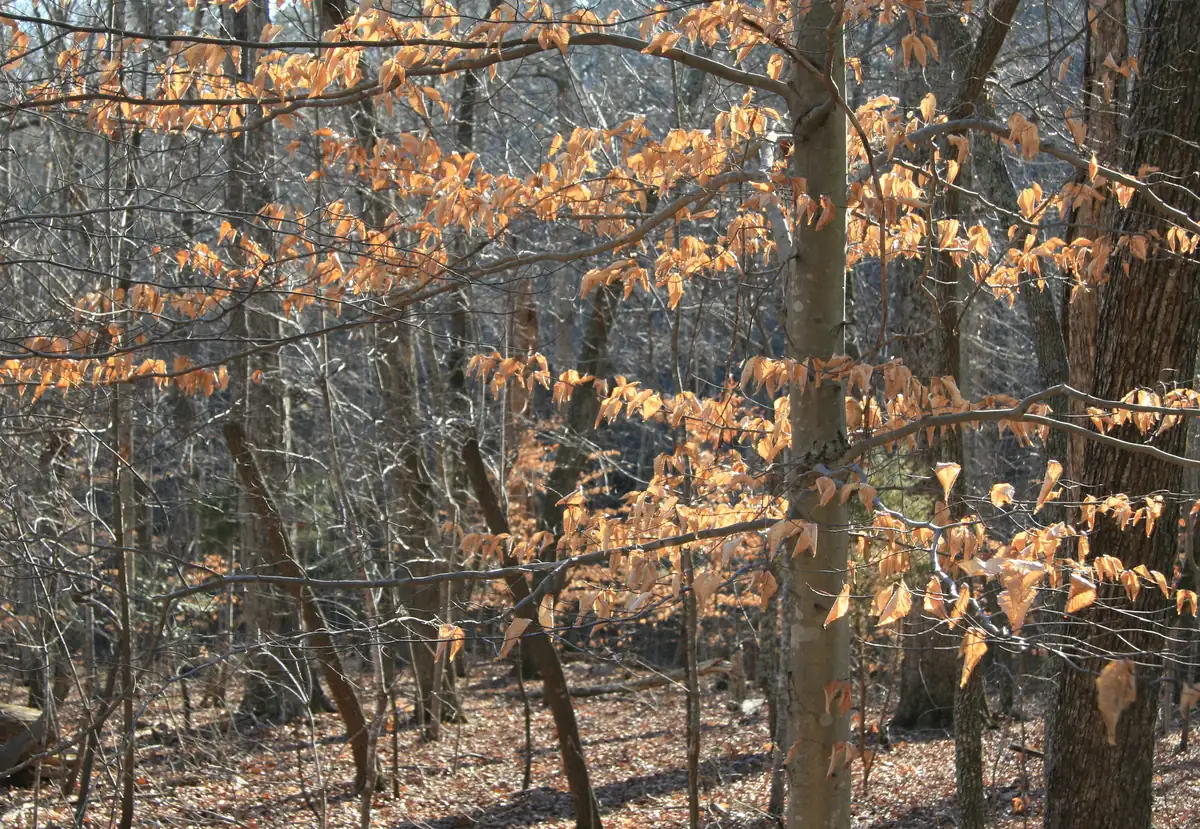
Pale, papery beech leaves rattling in the understory all winter are one of the sounds of a New Hampshire woods. The habit has a name, marcescence, and Northern Woodlands magazine notes it is most common on young trees and lower branches. Ideas for why include protecting buds from frost and from browsing deer and moose, trapping snow at the base of the tree, or simply that beech and oak, whose relatives include many evergreens, have not fully become deciduous.
-
Tamarack, the gold that falls
Gold into early November, then bare · Bogs and peatlands, such as Philbrick-Cricenti Bog in New London and the wet lowlands of the north
UNH Cooperative Extension calls tamarack the only native conifer in New England that sheds all its needles in fall. Its needles go golden after the hardwoods have dropped and then fall in late fall and early winter, Coös County forester Ray Berthiaume writes. A bare tamarack in December looks dead; check the knobby short shoots along each twig, where next spring’s tufts of needles will grow.
Has New Hampshire had its first freeze, and when does the first snow come?
By the start of November nearly the whole state has frozen in a typical year. In the NOAA 1991–2020 normals below, every station’s median first freeze falls before October 20, and only two places, Lakeport on Lake Winnipesaukee and Manchester Airport on the Merrimack, have a nine-years-in-ten date that reaches into November (November 3 and November 4). In other words, only in the mildest falls are the big lake and the lower Merrimack Valley still waiting for 32 °F when November begins. In the Great North Woods and the Androscoggin valley the first freeze is usually seven weeks in the past.
-
First snow in the valleys
Usually some time in November · Concord and the southern lowlands
NOAA’s 1991–2020 normals give Concord an average of 2.5 inches of snow in November, after less than an inch in October, and 14.3 inches in December. A first measurable snow in the capital in November is normal; a deep one is not. Weather that would be rain on the coast often falls as snow on the hills west of the Merrimack.
-
Deep winter on Mount Washington
All month · The Presidential Range above treeline
On the summit, the same normals give November an average high of 28.4 °F and low of 13.1 °F, with 35.6 inches of snow, nearly twice October’s amount, and 47.7 inches more expected in December. The summit building has closed for the season, and the Cog Railway’s summit trips end in late October; in the cold months its trains stop partway up, at Waumbek Station, about 4,000 feet. Anything above treeline in November is a winter climb.
| Station | One year in ten | Median | Nine years in ten |
|---|---|---|---|
| First Connecticut Lake (Great North Woods) | Sep 9 | Sep 24 | Oct 7 |
| Berlin Municipal Airport (Androscoggin valley) | Sep 5 | Sep 19 | Oct 3 |
| Pinkham Notch (White Mountains) | Sep 15 | Oct 1 | Oct 14 |
| Hanover (Upper Valley) | Oct 1 | Oct 13 | Oct 29 |
| Lakeport 2 (Laconia, Lakes Region) | Oct 4 | Oct 18 | Nov 3 |
| Keene (Monadnock Region) | Sep 18 | Oct 1 | Oct 14 |
| Concord Municipal Airport | Sep 21 | Oct 3 | Oct 16 |
| Manchester Airport | Oct 4 | Oct 19 | Nov 4 |
| Greenland (Seacoast) | Sep 27 | Oct 8 | Oct 24 |
Look up your own town, and the last spring freeze too, on our New Hampshire frost page, which covers more than fifty stations. November’s job in the garden is mulching perennials once the ground starts to freeze, not before.
How early does it get dark in New Hampshire in November?
Suddenly early. Granite Staters lose an hour of evening light at a stroke on Sunday, November 1, when the clocks are set back at 2 a.m. In Concord the sun sets at 4:38 p.m. that first evening and at 4:12 p.m. on November 30; Colebrook and Berlin are down to 4:07. Over the month every town in the table loses at least an hour of daylight, from 61 minutes in Nashua to 66 in Colebrook, a little over two minutes a day.
| City | Nov 1 | Nov 30 | Lost | Per day |
|---|---|---|---|---|
| Colebrook | 10 h 10 m | 9 h 04 m | 66 min | 2.3 min |
| Berlin | 10 h 12 m | 9 h 07 m | 65 min | 2.2 min |
| Littleton | 10 h 12 m | 9 h 08 m | 64 min | 2.2 min |
| North Conway | 10 h 13 m | 9 h 10 m | 63 min | 2.2 min |
| Hanover | 10 h 15 m | 9 h 12 m | 63 min | 2.2 min |
| Concord | 10 h 17 m | 9 h 15 m | 62 min | 2.1 min |
| Portsmouth | 10 h 17 m | 9 h 15 m | 62 min | 2.1 min |
| Nashua | 10 h 18 m | 9 h 17 m | 61 min | 2.1 min |
The earliest sunsets of all come in early December, before the solstice. For sunrise, sunset and twilight on your own street, try the Field almanac.
What is November weather like in New Hampshire, and what could El Niño mean for the winter?
November is gray, damp and getting colder by the week. In NOAA’s 1991–2020 normals, Concord averages a high of 48.4 °F and a low of 28.7 °F with 3.44 inches of precipitation; Manchester is a little milder at 50.0 °F and 32.9 °F, and Whitefield, near the White Mountains, colder at 44.7 °F and 25.1 °F.
November starts on the dry side. As of September 29, federal drought maps showed roughly 53 percent of New Hampshire in moderate drought and nearly all the rest abnormally dry. Soaking rain before the ground freezes would help wells most.
Beyond November, the Pacific is doing something unusual. In its El Niño diagnostic discussion of September 10, NOAA’s Climate Prediction Center judged that a very strong El Niño would very likely (over 90 percent) persist into New Hampshire’s cold season. State Climatologist Mary Stampone, speaking to the Granite State News Collaborative in June, said El Niño winters tend to run warmer than average across the northern United States, and that very strong ones line up with some of New Hampshire’s warmest winters on record. Snow is the harder call: she noted that the storm track sometimes stays south, giving the Mid-Atlantic the snow, but can also steer more nor’easters into New England, and how much falls as snow depends on the temperature during each storm. In September she told NHPR this El Niño could mean a warmer, wetter winter along the Atlantic seaboard. NOAA’s climate.gov composites agree on the warm lean for the Northeast but call the El Niño signal there weak.
Mid-October (the 15th) brings NOAA’s official winter outlook; its December to February temperature and precipitation maps will appear among the 90-day outlooks. For this week, see Weather now.
What can you see in the New Hampshire night sky in November 2026?
Long nights and a new moon early in the month make November a good stargazing month, if the clouds allow. All times below are Eastern Standard Time.
-
Taurid fireballs and a dark first half
Southern Taurids peak November 5; Northern Taurids November 12; new moon November 9 · The radiant is in Taurus, high in the east by mid-evening
The Taurids are slow and sparse, perhaps five to ten an hour, yet known for the occasional brilliant fireball; both branches are debris from Comet Encke. The International Meteor Organization notes that the November 9 new moon leaves both peaks free of moonlight, so the week around it is also the darkest of the month for the Milky Way over the White Mountains.
-
Venus, the moon, and Mars beside Jupiter
Moon near Venus at dawn November 7; Mars and Jupiter closest before dawn November 15 and 16 · Venus low in the east-southeast before sunrise; Mars and Jupiter higher, in Leo
Fresh from its late-October swing between us and the sun, Venus rises earlier every morning and peaks in brightness around November 24 to 27. A 4-percent sliver of moon hangs beside it at dawn on Saturday the 7th; you need a flat eastern horizon, such as the beach at Rye. Mars and Jupiter meet in Leo a week later, roughly 1.2 degrees apart, a pairing to catch before first light on Sunday the 15th or Monday the 16th. Mercury joins the dawn lineup, hugging the horizon, between about November 18 and 25. After dark, Saturn is alone among the bright planets.
-
The Leonids
Best before dawn on Wednesday, November 18 · Leo rises in the east around midnight and is highest just before dawn
The International Meteor Organization predicts the Leonid peak for the evening of November 17 Eastern time, at a modest rate of around 15 an hour under a perfect sky, with no outburst expected. Wait for the half-lit moon to drop below the western hills, near midnight, then watch until dawn on the 18th. Leonids are very fast and sometimes leave a glowing trail.
-
The Beaver Moon, a supermoon
Full at 9:53 a.m. on Tuesday, November 24; looks full on the evenings of November 23 and 24 · Rising in the east-northeast near sunset
Full moon falls some 30 hours ahead of the moon’s nearest point to Earth this month, enough to count as a supermoon, though a mild one; December’s Cold Moon will be closer and larger. Overnight on the 23rd into the 24th the moon slides over the Pleiades, but moonlight will drown the cluster. Uranus reaches opposition nearby in Taurus on November 25, a faint green-gray dot for binoculars if you know where to look.
| Phase | Date | Time |
|---|---|---|
| Last quarter | Sunday, Nov 1 | 3:28 p.m. |
| New moon | Monday, Nov 9 | 2:02 a.m. |
| First quarter | Tuesday, Nov 17 | 6:48 a.m. |
| Full moon (Beaver Moon) | Tuesday, Nov 24 | 9:53 a.m.; looks full on the evenings of Nov 23 and Nov 24 |
| Last quarter | Tuesday, Dec 1 | 1:08 a.m. |
Before you set an alarm, check cloud cover on Today’s sky; rise and set times for the moon in your own town are on our moon phases page.
What can New Hampshire families do outdoors in November 2026?
- Sunday, November 1: start a FeederWatch count. Project FeederWatch opens its season today and runs to April 30. No feeder is needed until December; count what visits your shrubs, seed heads and birdbath. It is also closing day for the live animal trail at Squam Lakes Natural Science Center in Holderness; last admission is 3:30 p.m.
- Any day through Friday, November 20: the Pack Monadnock hawk watch at Miller State Park in Peterborough, staffed daily when the weather allows (last year from 9 a.m. to 3 p.m. in November). Pick a blustery day after a cold front for red-tails, and dress for the summit, not the parking lot.
- Saturdays, November 7 and November 21: UNH Observatory public nights in Durham, 8 to 10 p.m., free and open to all ages. Sessions are cancelled for cloud, rain or snowy roads; the observatory posts a notice on its Facebook page each afternoon.
- Thursday, November 19, or Saturday, November 21: a holiday wreath workshop at NH Audubon’s McLane Center in Concord (5 to 7 p.m. Thursday, 10 a.m. to noon Saturday; ticketed), decorating balsam wreaths with natural materials.
- Wednesday, November 18, before dawn: the Leonids. A blanket, a thermos and thirty minutes in a dark yard after moonset is plenty for older kids.
- Friday, November 27: take the day after Thanksgiving outside. New Hampshire state park lands stay open for recreation all year, though many facilities are closed and you carry out your own trash. A walk at Odiorne Point for snow buntings and sea ducks, or a short climb with a view, beats a store. Wear orange; it is deer season.
- Science from the backyard, all month. Send snowshoe hare and cottontail sightings to NH Rabbit Reports, enter coastal birds and siskin flocks in eBird, and report any loon that seems stuck on a freezing pond to the Loon Preservation Committee.
Other states’ months are collected on the nature hub, and there is a page for each of these outings in the Naturalist’s Field Journal. Last month’s page, New Hampshire in October, covers the hawk watch’s peak season and the foliage.
Safety notes for November in New Hampshire
- This is the heart of deer season. Muzzleloader deer season runs October 31 to November 10. The regular firearms season follows from November 11 to December 6 (ending November 29 in Wildlife Management Unit A, in the far north). Archery deer and archery fall turkey continue to December 15 (December 8 in Unit A), ruffed grouse to December 31, and snowshoe hare and gray squirrel well into the new year. Shooting hours for most game begin half an hour ahead of sunrise and end half an hour past sunset, so dawn and dusk are busiest.
- Waterfowl seasons reopen. Duck hunting in the Northern Zone continues through November 30. In the Inland and Connecticut River zone it pauses after November 11 and reopens November 25 to December 24, and on the coast it reopens November 26 and runs to January 17, 2027.
- Orange is recommended, not required. Under RSA 207:38-b, anyone hunting with a gun or bow (waterfowl hunters excepted) “should” wear an orange hat, vest or similar garment that can be seen from every side at 200 feet; the statute advises rather than requires. Fish and Game tells hikers that an orange hat, vest or shirt is a must this time of year, and suggests orange for the dog, a bell on its collar, staying on established trails, and hiking in the middle of the day and on weekdays.
- Thin ice. Ponds start to freeze in November, but first ice is rarely safe. Fish and Game, citing the Army’s Cold Regions Research and Engineering Laboratory in Hanover, wants at least 6 inches of hard ice before anyone walks on it and 8 to 10 inches before groups gather. Inlets, outlets and spring holes stay thin longest. Keep children and dogs off early ice entirely.
- Short days and winter summits. With the sun down by about 4:10 p.m. at the end of the month, a hike that starts after lunch ends in the dark. Carry a headlamp, spare layers and traction for icy trails, and treat anything above treeline as winter mountaineering.
- Bears and feeders. Keep bird feeders, trash and pet food secured until bears have denned; December 1 is the earliest date Fish and Game suggests for feeders.
- Ticks. Adult blacklegged ticks keep looking for hosts on any day warmer than freezing, so a mild November afternoon still calls for a tick check.
Sources
- Harris Center: visiting the Pack Monadnock Raptor Observatory (staffed daily September 1 to November 20)
- Harris Center: Pack Monadnock Raptor Observatory final report, 2025 season
- Harris Center: Pack Monadnock hawk migration field reports, 2026
- New Hampshire State Parks: Miller State Park
- NH Audubon State of the Birds: long-tailed duck
- NH Audubon State of the Birds: common eider
- NH Audubon State of the Birds: purple sandpiper
- NH Audubon State of the Birds: snow bunting
- NH Audubon State of the Birds: snowy owl
- eBird (Cornell Lab of Ornithology)
- Finch Research Network: winter finch forecast 2026–2027 (September 25, 2026)
- UNH Cooperative Extension: winter bird feeding fact sheet (feeders December 1 to April 1)
- NH Audubon: bird feeding basics
- NH Fish and Game: be responsible with bear attractants this spring (March 24, 2026)
- Project FeederWatch: how to participate (November 1 to April 30)
- Loon Preservation Committee: late-fall and iced-in loons
- Loon Preservation Committee: report a loon in distress
- Laconia Daily Sun: two loons rescued from lakes as cold snap hits NH (December 2025)
- Harris Center: my, what big feet you have (snowshoe hare molt)
- NH Fish and Game: hunters prepare for the 2025 muzzleloader season (rut timing)
- NH Fish and Game: 2025 New Hampshire wildlife harvest summary (May 11, 2026)
- NHPR: New England’s snowshoe hares have a camouflage problem (April 25, 2025)
- NH Rabbit Reports (NH Fish and Game and UNH Cooperative Extension): snowshoe hare
- Northern Woodlands: why do some leaves persist on beech and oak trees well into winter?
- UNH Cooperative Extension: the tamarack (November 28, 2023)
- UNH Cooperative Extension: autumn gold, tamarack
- NOAA NCEI: 1991–2020 monthly normals for Mount Washington, Concord, Manchester and Whitefield (data API)
- Mount Washington Cog Railway: late-season trips to Waumbek Station
- Drought.gov (U.S. Drought Monitor): New Hampshire drought conditions, map valid September 29, 2026
- Granite State News Collaborative: El Niño 2026, what are New Hampshire’s weather conditions to come? (June 29, 2026)
- Climate Prediction Center: ENSO diagnostic discussion, September 10, 2026
- Climate Prediction Center: seasonal outlooks (winter outlook issued October 15, 2026)
- NOAA Climate.gov: United States El Niño impacts
- U.S. Naval Observatory: moon phases, November 2026 (data API)
- International Meteor Organization: 2026 meteor shower calendar
- EarthSky: what is a supermoon? (2026 full supermoons)
- EarthSky: Uranus at opposition
- NOAA Space Weather Prediction Center: solar cycle progression
- University of New Hampshire: UNH Observatory public observing nights
- NH Audubon: events calendar, November 2026
- Squam Lakes Natural Science Center: live animal trail season
- New Hampshire State Parks: operating schedules
- NH Fish and Game: New Hampshire hunting seasons open September 1 (2026 dates)
- NH Fish and Game: 2026–2027 migratory waterfowl hunting seasons
- NH Fish and Game: share the forest, hiking during hunting season (September 11, 2026)
- New Hampshire RSA 207:38-b: hunter orange recommendation
- NH Fish and Game: exercise caution around all forms of ice (February 5, 2026)
- CDC: where ticks live
- Photos via Wikimedia Commons; licenses and photographers are credited under each picture
