What to look for in nature in New Hampshire this May
May is when New Hampshire fills in. Warblers, orioles and hummingbirds arrive, bobolinks return to the hayfields, fawns and eaglets appear, toads and tree frogs take over from the peepers, and the woods turn from brown to green. The days stretch toward the longest of the year, black flies come out in the south, and the north still has frost. Every date below has a source.
Other months in New Hampshire: October, November, December, January, February, March, April.
Start here
- Take a dawn walk. Go out at first light in the second week of May and write down each new bird voice you can name.
- Watch a hayfield. Stand at a field edge in the evening and look for a black-and-white bobolink singing in flight; keep out of the grass.
- Listen at a pond. Visit the same pond on three evenings and note which frogs and toads you hear.
For May, try these Naturalist’s Field Journal plates: birds I have seen for each new warbler, map of sounds for the toad and frog chorus, the same place twice for a woodland patch before and after leaf-out, nest observed for turkeys and eagles from a distance, and dusk and dawn watch for nighthawks and meteors.
Regions used below: Great North Woods; White Mountains; Lakes Region; Dartmouth–Lake Sunapee and the Upper Valley; Monadnock Region; Merrimack Valley; Seacoast.
Which birds arrive in New Hampshire in May?
May is the month New Hampshire’s birdsong changes almost daily. NH Audubon’s monthly birding guide says the main warbler push comes now and can be spectacular, and that south winds can carry in a flood of birds overnight. Everything below is a typical window rather than a promise, because a cold front or a week of north wind can stall a whole wave. Before heading out, look on eBird for reports from farther south or west of you.
-
The warbler wave
All month, with the northernmost species later · Woodland edges, wet thickets, orchards and any tree with new leaves
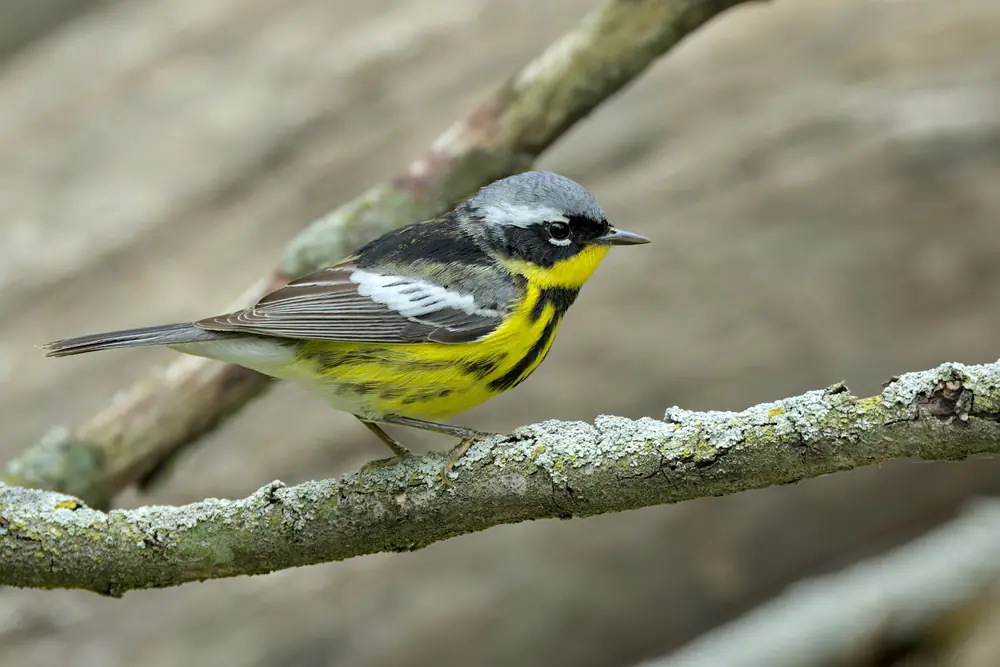
The late April arrivals (black-and-white, northern parula and black-throated green warblers) are followed through early and mid-May by the rest of the wave. NH Audubon notes that the species that breed farthest north, blackpoll, Wilson’s and Tennessee warblers, peak later in the month than the rest. Common yellowthroats are back at the start of May, and veeries and other thrushes usually come in during the month. Go out at first light, when singing is at its best and the leaves are still small enough to see through.
-
Hummingbirds, grosbeaks, buntings and orioles
First week of May for hummingbirds; about May 5 to 10 for the others · Feeders, gardens, shrubby edges
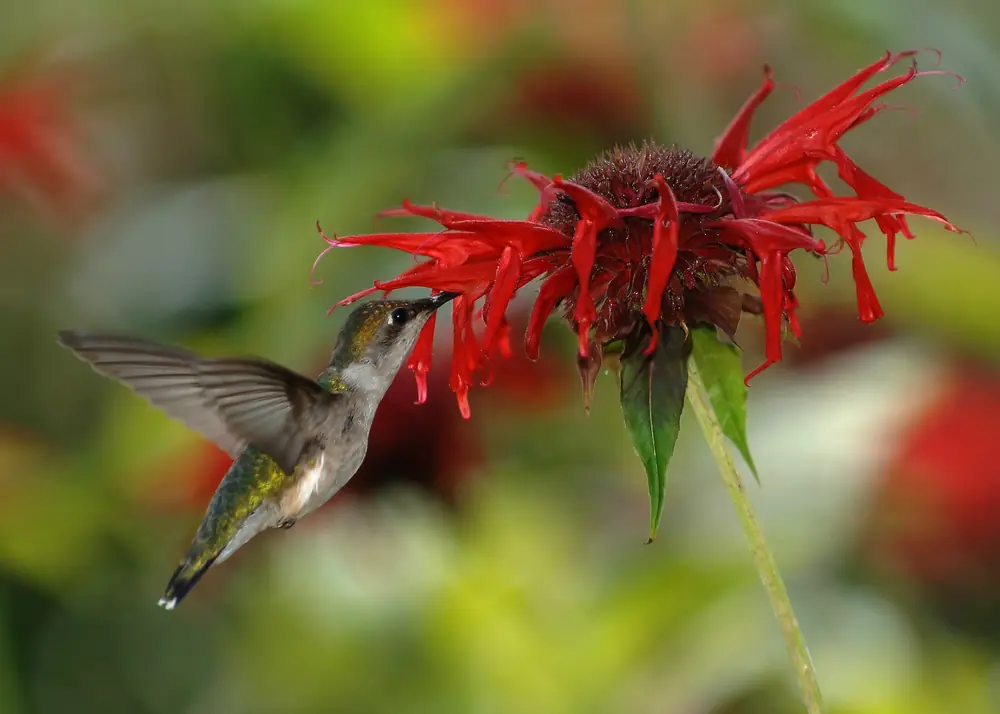
NH Audubon says ruby-throated hummingbirds start showing up reliably in the first week of May, and rose-breasted grosbeaks, indigo buntings and Baltimore orioles arrive around May 5 to 10. The last three often visit feeders when they first land, then vanish into the woods as the weather warms. Journey North collects volunteer sightings of hummingbirds on a map, so you can watch the front move north and add your own first sighting.
-
Flycatchers, terns and shorebirds
Early to late May · Flycatchers in woods and wet thickets; terns and shorebirds mostly on the coast
Least flycatchers arrive first, in early May. Alder, willow and yellow-bellied flycatchers follow in the middle and end of the month, and most are in by late May. Shorebirds peak around the middle of May, mostly right on the coast, though a rainy night can drop a few inland. Mid-May is also the best time to look for terns migrating over lakes and rivers, and short-billed dowitchers are expected inland around May 20.
-
Watching migration by radar
Spring migration, as the maps run March 1 to June 15 · Online, then out your back door
Cornell’s BirdCast uses weather radar to forecast how many birds will fly on coming nights, and its live maps run from March 1 to June 15. It also sends migration alerts for cities across the lower 48 and asks people to turn off unneeded lights and make glass visible, since lit windows and towers are dangerous to birds flying at night. A heavy night on the forecast is a good reason to walk out early the next morning.
The Naturalist’s Field Journal has a birds-I-have-seen plate that fits this month well: write down the date you first hear each new voice.
Where can you see bobolinks, peregrine falcons and nighthawks in May?
Three of New Hampshire’s more fragile birds are easy to look for in spring if you know where to stand: a hayfield, a cliff or city tower, and a dusk sky over a town.
-
Bobolinks in the hayfields
Arriving in May, nesting into summer · Open hayfields and meadows
Bobolinks winter in southern South America and reach the Northeast in May. The male’s song is a bubbling, robotic jumble, and he sings in flight over the grass. The female builds a cup nest on the ground and lays three to seven eggs, which hatch after about 13 days, and the chicks leave the nest at 10 or 11 days old, before they can fly. NH Audubon says the bobolink is still common but declining, and that mowing in the breeding season is a sure way to destroy nests. The Bobolink Project, which NH Audubon supports, pays farmers to delay their first cut. If you own a field, wait until the young have fledged. The state-threatened eastern meadowlark is far scarcer: NH Audubon’s estimate from a 2021 survey was fewer than 30 pairs at about 25 sites.
-
Peregrine falcons on cliffs and towers
Nesting season; chicks have been banded in late May · Cliffs in the White Mountains; the Brady Sullivan Tower in Manchester
The first cliff-nesting pair in New England returned to Franconia Notch in 1981, and NH Audubon reports a record 37 territorial pairs statewide in 2025. Staff band chicks at the Brady Sullivan Tower in Manchester, where in 2024 two chicks were banded on May 23, and about 400 chicks have been banded in all. The Manchester Peregrine Cam is the easy way to watch. Climbing closures have protected nest cliffs at times, so check the current status before climbing on any cliff in spring.
-
Common nighthawks over town
Dusk, once they are back · Over lit streets and flat rooftops
NH Audubon lists the common nighthawk as state-threatened. It once nested on gravel rooftops in towns across the state, and the shift to rubber and PVC roofing is a major reason it has gone from many of them. Since 2007 the Project Nighthawk team has laid gravel nest patches on flat roofs in Keene and Concord. The page does not give an arrival date, so begin listening at dusk in the last days of May for the nasal “peent” call and the swooping, insect-hunting flight over bright lights.
What young animals are being born in New Hampshire in May?
This is the month the woods and fields fill with babies, and the most useful thing a person can do for nearly all of them is leave them alone.
-
Deer fawns
Most are born in May and June · Fields, brush, lawn edges
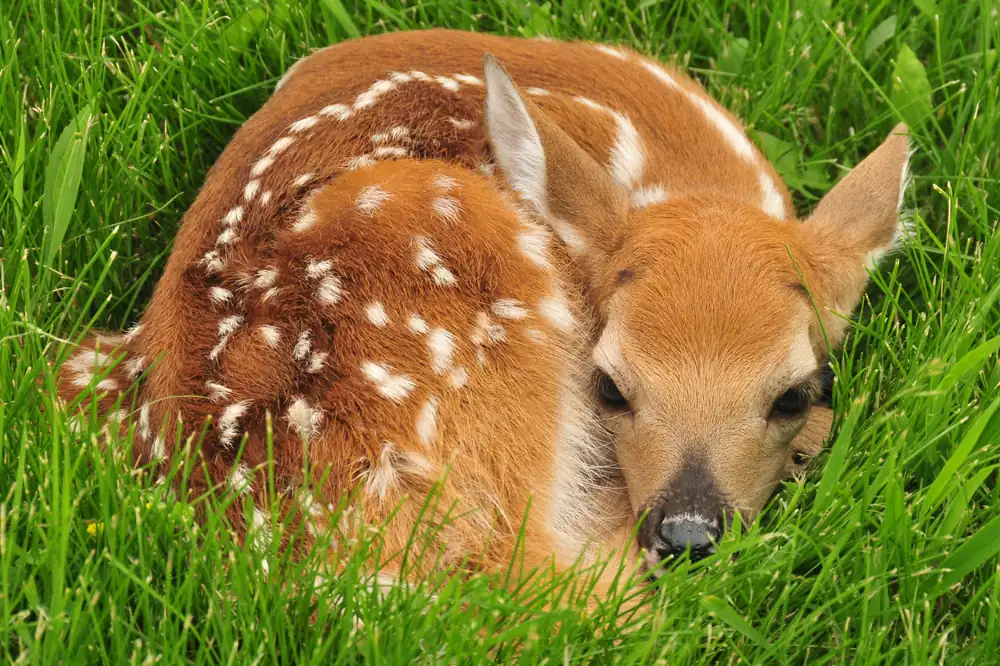
NH Fish and Game says most fawns arrive in May and June. A doe leaves her fawn alone for long stretches so that predators do not pick up its scent, and for the first month she visits only a few times a day. Finding one curled up alone in the grass is normal. The department’s advice is to leave it there, and if you think it is hurt or orphaned, to call Fish and Game at (603) 271-2461 instead of moving it. Do not offer it milk or formula, which can cause severe diarrhea.
-
Moose on the roads
May through October is the risky stretch · Roads near wetlands and through the North Country
Fish and Game’s annual reminder says New Hampshire averages 64 moose-vehicle collisions a year, based on the last five years it counted, and that May to October is the high-risk period. Moose step onto pavement to lick road salt left from winter, and a dark brown animal against dark asphalt is almost invisible at night. Collisions are most frequent at dusk and after dark. Slow down in moose country, scan the shoulders and keep your stopping distance within your headlights.
-
Eaglets in the nest
May, when chicks are large enough to band · Lakes, rivers and the coast
In 2024 NH Audubon counted 115 territorial bald eagle pairs, a record, and 81 young fledged. In May 2024 biologists from NH Audubon and Maine’s Biodiversity Research Institute took blood and feather samples from 10 eaglets at five nests to test for PFAS and other contaminants, and fitted them with coded bands. Eagles are sensitive to disturbance near the nest, so watch through binoculars from far away.
-
Turkey hens on nests
May · Dry ground under logs and dense cover
Northern Woodlands describes a hen laying about one egg a day for up to two weeks, then incubating only once the clutch is complete, so the eggs hatch together. A typical nest has 10 to 12 eggs. Cold snaps and heavy rain take a toll, and a hen that loses her nest can try a second time before May ends. If you flush a turkey from the ground, step away from that spot.
Which frogs and toads are calling in New Hampshire in May?
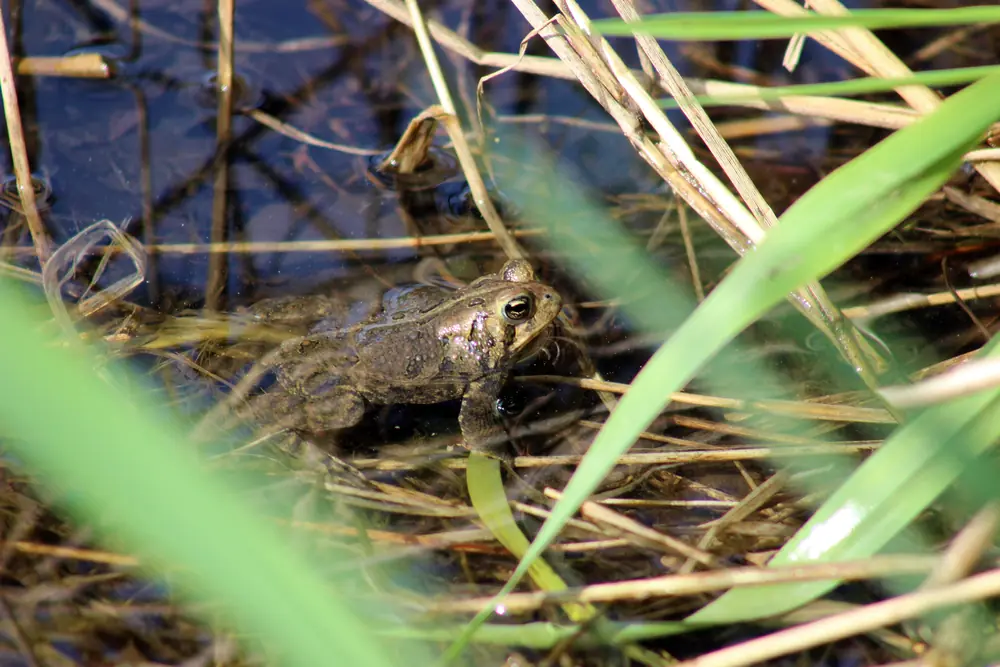
The spring peeper chorus is a few weeks long and then done: The Forest Society notes that breeding wraps up quickly and the peepers go back to the forest. Other voices take over, and the mix changes from pond to pond.
-
Toads and tree frogs take over
May and June · Shallow ponds, roadside pools and wet meadows
Fish and Game says spring peepers, American toads, Fowler’s toads, pickerel frogs and gray tree frogs are all still calling into May and June, and that mink frogs, green frogs and bullfrogs carry the chorus into July. Visit the same pond on three evenings in May and see who joins.
-
Rare amphibians worth reporting
Wet spring evenings · Roads, ponds and wetlands
Fish and Game asks to hear about marbled salamanders, Fowler’s toads and northern leopard frogs in particular, since they are rare or listed in the state. A photo with the date and location helps. The big rainy-night road crossings are mostly an April story, covered on the April page.
Put a frog or toad on the map of sounds plate: sketch your pond and mark where each call comes from.
What is blooming in New Hampshire in May, and what is the state flower?
The forest floor gets a short show before the canopy closes. Northern Woodlands, a nonprofit that covers the forests of the region, names April and May as the best time to find ephemerals, the flowers that bloom for only a few weeks before the leaves cast deep shade.
-
Trout lily and the trilliums
Late April through May, later in the cold hills · Rich hardwood woods, streambanks
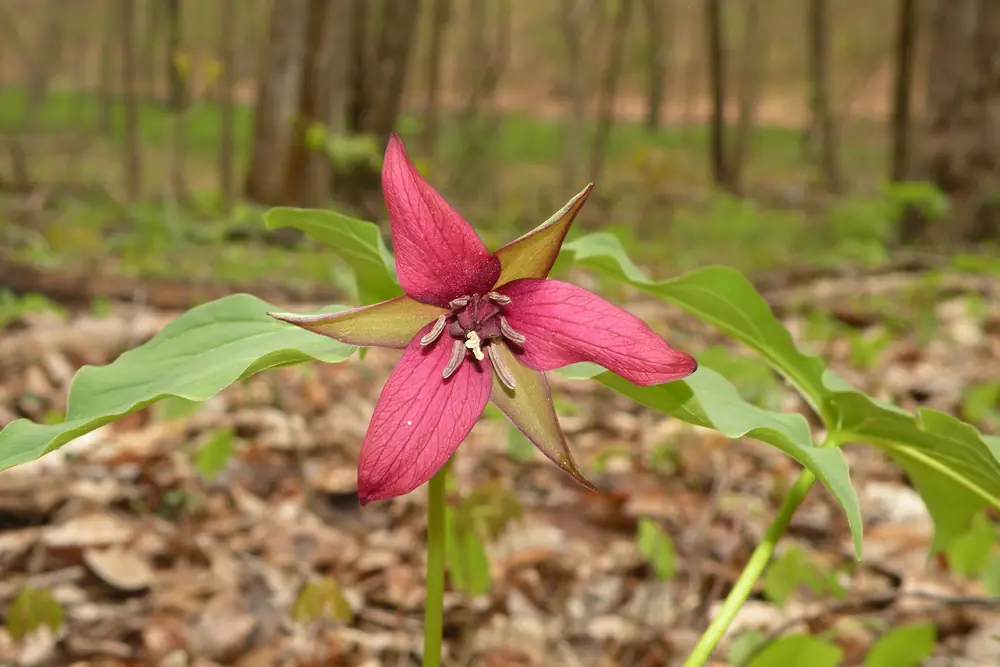
Trout lily’s lemon-yellow bells, red trillium (also called wake-robin) and the white, pink-striped painted trillium are the classics. By midsummer many of them have sunk back into their roots. Pink lady’s slipper blooms in the White Mountains, and in colder, higher places the spring show can last into early June.
-
The purple lilac
Varies by town and year · Old dooryards and farmsteads
State law names the purple lilac as New Hampshire’s state flower. No agency gives a statewide bloom date, because it depends on the weather in each town, so track the lilac nearest you from first buds to first scent and write the date down.
-
Wild lupine and the Karner blue
Caterpillars pupate in mid-May; adults fly in late May and early June · The Ossipee Pine Barrens and other sandy, open sites
According to the federal wildlife agency, the Karner blue butterfly depends on wild lupine and is found in parts of New Hampshire. Its caterpillars hatch in April, pupate in mid-May, and the adults emerge from late May to early June, though timing shifts a little by location. Northern Woodlands writes that the Ossipee barrens, between Silver and Ossipee Lakes, hold pitch pine, scrub oak, lupine and threatened species. The butterfly is rare and the habitat needs fire or other clearing to stay open, so go with a guide or a conservation group instead of wandering alone.
What is happening on the New Hampshire coast in May?
The short seacoast gets shorebirds and sea birds that rarely reach the inland lakes.
-
Shorebirds and terns passing through
Peak around mid-May · Hampton Harbor, the beaches and the Piscataqua River
NH Audubon says shorebirds peak in mid-May, mostly right on the coast, and that spring numbers are generally lower than in fall. Common and roseate terns nest on the Isles of Shoals and feed along the coast, especially at Hampton Harbor and off New Castle.
-
Eider chicks and the Isles of Shoals
Late May and early June · Offshore islands, with chicks near shore
The same guide says common eider chicks appear in numbers at the coast in late May and early June, and that eiders breed in New Hampshire only at the Isles of Shoals. American oystercatchers have recently begun nesting there too.
-
Piping plover nesting areas
The nesting season · Hampton and Seabrook beaches
Parts of the beaches are roped off for the endangered birds. The Fish and Game biologist told NHPR that New Hampshire-hatched birds have a good chance of returning to their home beaches. Keep outside the rope and keep dogs on a leash.
How much daylight does New Hampshire gain in May?
| City | May 1 | May 31 | Gained | Per day |
|---|---|---|---|---|
| Colebrook | 14 h 15 m | 15 h 20 m | 65 min | 2.2 min |
| Berlin | 14 h 13 m | 15 h 17 m | 64 min | 2.1 min |
| Littleton | 14 h 13 m | 15 h 16 m | 63 min | 2.1 min |
| North Conway | 14 h 12 m | 15 h 15 m | 63 min | 2.1 min |
| Hanover | 14 h 10 m | 15 h 12 m | 62 min | 2.1 min |
| Concord | 14 h 07 m | 15 h 08 m | 61 min | 2.0 min |
| Portsmouth | 14 h 07 m | 15 h 08 m | 61 min | 2.0 min |
| Nashua | 14 h 06 m | 15 h 06 m | 60 min | 2.0 min |
Towns not listed are on our daylight page.
What is May weather in New Hampshire, and what are the hazards?
May is mild at last: NOAA’s 1991–2020 normals give average highs from the mid-60s to 71 °F at the valley and seacoast stations, with lows of about 39 to 46 °F, while the high country stays cooler. Snow is nearly gone at the valley stations but not on the high summit. The Gray, Maine forecast office keeps May temperature, rain and snow charts for Concord on its climate page. The newest seasonal outlook is on NOAA’s 90-day outlook page, which is refreshed monthly.
-
Black flies
Early to mid-May in the south; late May to early June in the north · Streams, trails and shaded yards
UNH Extension says the main biting species, the white-stockinged black fly, comes out in the first half of May in the state’s south and bothers people until the month ends. In the north it comes later. Flies bite most from 9 to 11 a.m. and 4 to 7 p.m., and on humid, cloudy days and just before storms. Long sleeves, light colors, head nets and repellent on cuffs and wrists help.
-
Late freezes and fruit bloom
First half of the month · Valleys and hollows
The freeze table below shows Hanover clear of frost by about May 15 in nine years out of ten, while the north can see it into early June. Cover tender seedlings when the forecast calls for the thirties.
-
Wildfire and burn permits
Dry spells before and during green-up · Statewide
NHPR reported in April 2026 that drought was driving more wildfires and deep-burning fires, and that equipment, vehicles and target shooting can start them. Get a burn permit before any open fire when snow is not on the ground, and fully extinguish it.
-
Winter, still, on the mountain
Any day in May · Mount Washington and the Presidential Range
The Mount Washington summit has recorded snow in every month, and its May normal is 12.9 inches. The Mount Washington Avalanche Center describes spring hazards in Tuckerman Ravine, including icefall, glide cracks, undermined snow over streams and wet avalanches. Treat the high peaks as a winter place and pack accordingly.
| Station | Average high | Average low | Precipitation | Snowfall |
|---|---|---|---|---|
| First Connecticut Lake (Great North Woods) | 61.5 °F | 38.3 °F | 4.47 in | 1.0 in |
| Lancaster (upper Connecticut valley) | 66.3 °F | 39.3 °F | 3.76 in | 0.1 in |
| Berlin (Androscoggin valley) | 65.5 °F | 40.6 °F | 3.55 in | 0.2 in |
| York Pond (White Mountains) | 62.9 °F | 39.0 °F | 4.39 in | 0.4 in |
| Pinkham Notch (White Mountains) | 61.9 °F | 38.5 °F | 5.48 in | 0.6 in |
| Mount Washington summit | 42.5 °F | 30.2 °F | 7.68 in | 12.9 in |
| Hanover (Upper Valley) | 70.9 °F | 46.2 °F | 3.34 in | 0.0 in |
| Lakeport 2 (Laconia, Lakes Region) | 68.0 °F | 44.5 °F | 3.47 in | 0.0 in |
| Concord Municipal Airport | 69.3 °F | 44.1 °F | 3.47 in | 0.0 in |
| Keene (Monadnock Region) | 68.6 °F | 41.0 °F | 3.77 in | 0.0 in |
| Durham (Seacoast) | 68.4 °F | 43.9 °F | 3.63 in | 0.0 in |
| Greenland (Seacoast) | 66.1 °F | 44.8 °F | 3.95 in | 0.0 in |
When is the last spring freeze in New Hampshire?
For most of the south it is behind you by early May, and for the north it is not. By NOAA’s 1991–2020 normals, the median final 32 °F night is April 21 at Manchester Airport, May 8 at Concord and May 25 in the Great North Woods. In nine years out of ten, Hanover’s frosts are over by May 15 and Keene’s by May 28. Gardeners should check their own station before setting out tomatoes or basil.
| Station | One year in ten | Median | Nine years in ten |
|---|---|---|---|
| First Connecticut Lake (Great North Woods) | May 9 | May 25 | Jun 8 |
| Berlin Municipal Airport (Androscoggin valley) | May 15 | May 30 | Jun 11 |
| Pinkham Notch (White Mountains) | May 3 | May 18 | Jun 1 |
| Hanover (Upper Valley) | Apr 21 | May 1 | May 15 |
| Lakeport 2 (Laconia, Lakes Region) | Apr 19 | Apr 30 | May 13 |
| Keene (Monadnock Region) | Apr 30 | May 14 | May 28 |
| Concord Municipal Airport | Apr 27 | May 8 | May 22 |
| Manchester Airport | Apr 8 | Apr 21 | May 6 |
| Greenland (Seacoast) | Apr 23 | May 4 | May 18 |
Look up your own station on the state frost page.
What can you see in the New Hampshire night sky in May 2027?
All times are EDT, and the phase times below are from the Naval Observatory.
-
The Flower Moon, and a seasonal Blue Moon
Full at 6:59 a.m. EDT, Thursday, May 20 · Rising in the east on the evenings of May 19 and 20
The full moon rises as the sun sets on the 19th, at about 7:45 p.m. in Boston by our calculation, and is full at dawn the next morning. This is also a seasonal Blue Moon. The astronomical spring season holds four full moons, and SeaSky calls the third of those the Blue Moon. Using the calendar-month definition, none falls in 2027. Call it the Flower Moon first.
-
The Eta Aquariids, in an excellent year
Best mornings May 5, 6 and 7, before dawn · Toward the east, in the last hours before dawn
With the new moon on May 6, the sky stays moonless all night, which SeaSky says gives skies dark all night. SeaSky puts the best rate near 60 an hour south of the equator and near 30 in northern latitudes. Counts run lower here, because Aquarius, the shower’s starting point, climbs into view for only a short spell before sunrise. Recline before dawn and watch the whole eastern sky.
-
Mercury in the evening
Best May 12 to June 5; greatest elongation May 28 · Low in the west-northwest after sunset
Mercury’s widest separation from the sun in this evening showing, 22.8 degrees, arrives at 9:14 a.m. EDT on Friday, May 28, so the prime evenings are May 27 and May 28. By our calculation for the central U.S., it sets roughly 97 minutes after the sun in mid-May, and it fades fast in June. Your best odds are a clear western horizon and a start 45 to 90 minutes past sunset.
-
Jupiter, Venus and Saturn
Moon beside Jupiter on May 12; Venus and Saturn close on May 7 · Jupiter in the evening sky; Venus and Saturn low in the east before sunrise
By our calculation the moon is 1.2 degrees from Jupiter at closest, at 5:52 p.m. EDT on May 12, while it is still light. After dark that evening the pair is easy to find. Early on May 7, Venus and Saturn pass only 0.6 degrees apart in Pisces, but they hug the eastern horizon in twilight, and binoculars help.
-
The Milky Way core
About May 1 to 12 and May 25 to 31 · Low in the south, away from town lights
Computed for the central U.S., the windows when the galactic core is up and the moon is down run from May 1 to about May 12 and from about May 25 to 31, and they shrink a little at New Hampshire’s northern latitude. A clear, moonless night and an open view south, away from town lights, are what matter.
| Phase | Date | Time |
|---|---|---|
| New moon | Thursday, May 6 | 6:58 a.m. EDT |
| First quarter | Thursday, May 13 | 12:44 a.m. EDT |
| Full moon (Flower Moon) | Thursday, May 20 | 6:59 a.m. EDT, so the moon rises full on the evenings of May 19 and May 20 |
| Last quarter | Friday, May 28 | 9:58 a.m. EDT |
The moon page lists other months, and the cloud guide helps by day.
What can New Hampshire families do outdoors in May 2027?
- Early May: set out a hummingbird feeder. NH Audubon says they arrive reliably in the first week; log your first sighting at Journey North.
- Early to mid-May: take a dawn walk. Count the new warbler voices and write them down.
- Check the forecast on BirdCast. A heavy night of migration is the cue for a morning walk, and the site shows how to make your windows safer.
- Wednesday to Friday, May 5 to 7: Eta Aquariids. Wake before dawn and face east.
- World Migratory Bird Day. Look to the organizers’ site for the 2027 date of the spring celebration, which they had not posted in October 2026.
- Thursday, May 20: Flower Moon. Watch it rise on the evening of the 19th.
- Monday, May 31: Memorial Day. OPM lists the federal holiday for May 31, 2027. Expect trails and roads to be busy and black flies to be out.
- All month: leave fawns and fledglings alone. Take only photographs.
- Join the loon census. The Loon Preservation Committee invites people to join its annual loon census; check loon.org for the 2027 date.
Plates from the Naturalist’s Field Journal are a good home for your finds, and the nature index has more places and months.
Safety notes for May in New Hampshire
- Spring turkey season. The 2027 dates are not yet posted. The 2026 schedule, for comparison, ran May 1 to 31 and was preceded by a youth weekend (April 25 and 26) for hunters 15 or under with a licensed adult. The limit was two bearded birds, the second only in certain management units. Check Fish and Game for 2027 rules.
- Hunter orange. RSA 207:38-b only recommends hunter orange: a hat, vest or similar garment that shows from all sides at 200 feet. Anyone walking a trail during turkey season would do well to wear some.
- Black flies. Worst in the south in the middle of May and in the north from late May.
- Ticks. UNH Extension says nymph blacklegged ticks are most active from May 15 to early or mid-July, adults of the blacklegged tick are out from late March through May, and American dog ticks are most active May through July. Check yourself daily and remove a tick with fine tweezers.
- Moose and deer on the road. May to October is the high-risk stretch, especially at dusk.
- Fawns and fledglings. Leave them alone and call Fish and Game if unsure.
- Cold water. Lakes and streams are still very cold after ice-out; wear a life jacket.
- Mountains. The summit and Tuckerman Ravine are still winter places.
- Wildfire. Get a permit before open burning.
Sources (38)
- NH Audubon, Joy of Birding: May
- NH Audubon, What to Watch for in May
- NH Audubon, Joy of Birding: April
- NH Audubon, Joy of Birding: June
- NH Fish and Game, 2026 spring turkey season
- NH Fish and Game, Brake for Moose
- NH Fish and Game, Leave Fawns Alone
- NH Audubon, Peregrine Falcon
- NH Audubon, Grassland Birds
- Northern Woodlands, Bobolink
- NH Audubon, Common Nighthawk
- NH Audubon, 2024 bald eagle breeding season
- Northern Woodlands, Spring wildflowers
- Loon Preservation Committee, Counting loons
- Journey North, Hummingbirds
- Northern Woodlands, Wild turkey mating season
- NH Fish and Game, Amphibians crossing roads
- Forest Society, Why are spring peepers so loud
- New Hampshire RSA 3:5, state flower
- National Weather Service Gray, Climate
- NH Fish and Game, Trout pond openers
- UNH Extension, Black flies
- UNH Extension, Ticks in New Hampshire
- NHPR, Drought and wildfire risk
- New Hampshire RSA 207:38-b, hunter orange
- U.S. Fish and Wildlife Service, Karner blue butterfly
- Northern Woodlands, Exploring pine barrens
- Cornell Lab, BirdCast
- U.S. Office of Personnel Management, Federal holidays
- World Migratory Bird Day
- U.S. Naval Observatory, Moon phases
- SeaSky, Astronomy calendar 2027
- NOAA Climate Prediction Center, 90-day outlooks
- NOAA NCEI, 1991-2020 monthly normals
- Mount Washington Avalanche Center, Springtime hazards
- Mount Washington Observatory, Winter weather in April
- NHPR, Piping plovers
- Photos via Wikimedia Commons; licenses and photographers are credited under each picture
