What to look for in nature in New Hampshire this February
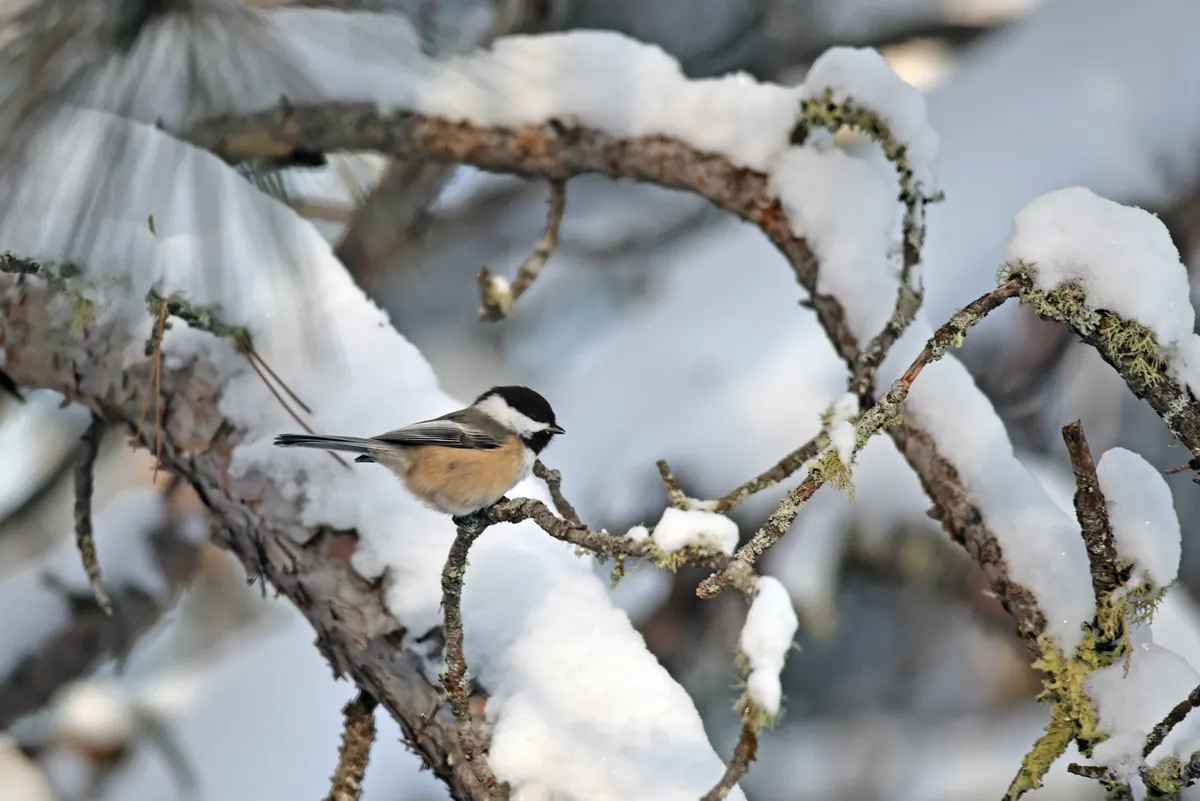
February is the last month of meteorological winter in New Hampshire, and the snow in the north can be deep, but the season is visibly turning. Days lengthen by more than an hour, sugarmakers start tapping, and chickadees begin to sing. Black bear cubs born in January are nursing in their dens, coyotes are pairing up, and eagles are carrying sticks to nests they will soon sit on. On the Seacoast, young harp and hooded seals from the Arctic haul out on the sand. On the middle weekend, thousands of people count the birds in their yards while anglers crowd the ice for the Meredith derby. In the night sky, Jupiter and Mars both reach opposition. Every date below has a source.
Other months in New Hampshire: October, November, December, January.
Start here
- Count the birds in your yard. NH Audubon’s 40th Backyard Winter Bird Survey is Saturday and Sunday, February 13 and 14, 2027, right in the middle of the worldwide Great Backyard Bird Count, which runs Friday through Monday. Watch your feeder for as long as you like and report what you see.
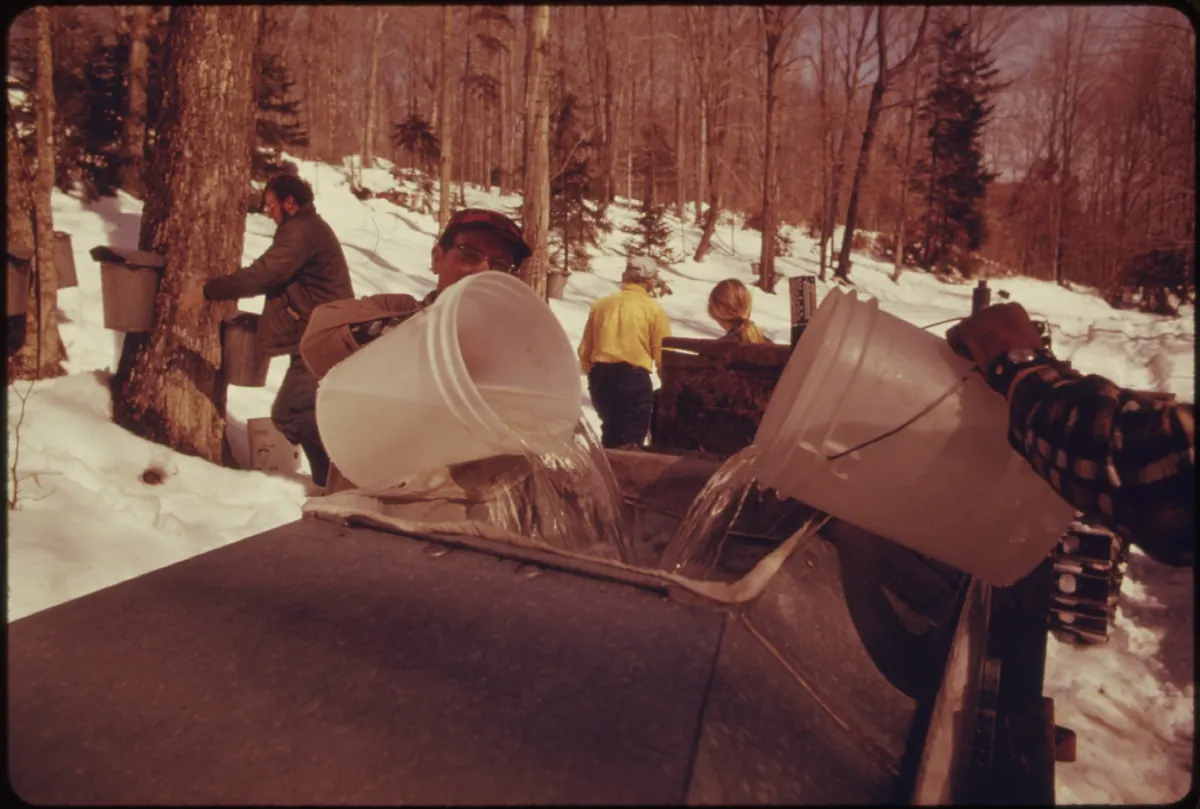
- Watch for the first sap run. When a freezing night is followed by a day in the 40s, sap starts to drip. In the southern half of the state that usually begins late in the month; look for buckets and blue tubing in roadside sugarbushes and steam from sugarhouse vents.
- Find Jupiter and Mars. Jupiter’s opposition comes at 7:21 p.m. on Wednesday, February 10, and Mars has its own on the 19th. Look east as darkness falls: the two bright planets climb together through Leo, and the full moon sits close by on the 20th.
Keep it in the Naturalist’s Field Journal: add the birds from survey weekend to birds I have seen, track a pair of coyotes across the snow on the tracks-to-know plate, keep the dusk-and-dawn page for the evening Mercury and the moon rise on the 20th, note the first sap run and the first fee-bee in the daily field log, and record the drumming woodpeckers and calling coyotes on a map of sounds.
Regions used below: Great North Woods; White Mountains; Lakes Region; Dartmouth–Lake Sunapee and the Upper Valley; Monadnock Region; Merrimack Valley; Seacoast.
When is New Hampshire’s Backyard Winter Bird Survey in 2027?
Saturday and Sunday, February 13 and 14, 2027. NH Audubon has run this count of feeder and yard birds every February since the 1980s, and 2027 will be the 40th. Because the method has stayed simple and the date has stayed in midwinter, the results now show how the state’s winter birds have changed over four decades.
-
How to take part
Any time on February 13 or 14, 2027 · Your own yard, statewide
Watch the birds around your house for as long as you like that weekend, fifteen minutes or a whole morning, write down each species and how many you see, and send the list in through NH Audubon’s online form. No experience is needed, and the survey’s quick identification guides cover the usual feeder birds.
-
What the counts have shown
Trends since 1987 · Statewide
In her report on the 2025 survey, NH Audubon conservation biologist Pamela Hunt wrote that Carolina wrens passed 1,000 for the first time, red-bellied woodpeckers set a record of 1,389, and eastern bluebirds were closing in on 5,000. All three are birds that were scarce or absent in a New Hampshire winter a generation ago. Hunt also counts a growing list of "half-hardies," birds that usually winter farther south but now linger: 42 yellow-bellied sapsuckers in 2025 were more than five times the old record. Going the other way, black-capped chickadees per observer are about half what they were 40 years ago.
-
A goldfinch winter
February 14 and 15, 2026 · Statewide
The 2026 survey drew 2,256 participants, a new high, who reported 82 species. American goldfinches led with 21,615, more than twice the 2025 total, and the list included a few real surprises for February: a chipping sparrow, a rose-breasted grosbeak and a dickcissel.
-
The Great Backyard Bird Count, the same weekend
Friday, February 12, to Monday, February 15, 2027 · Anywhere in the world
Audubon, Birds Canada and Cornell’s bird lab hold their 30th global count over Presidents’ Day weekend. Their minimum is 15 minutes on any day of the four; lists go in through birdcount.org, eBird or Merlin, and a single Saturday tally can serve NH Audubon as well.
| Species | 2025 (Feb 8 and 9) | 2026 (Feb 14 and 15) |
|---|---|---|
| American goldfinch | 9,160 | 21,615 |
| Dark-eyed junco | 10,490 | 13,198 |
| Black-capped chickadee | 8,490 | 8,904 |
| Mourning dove | 7,633 | 7,387 |
| Blue jay | 7,138 | 7,195 |
| Participants | 1,953 | 2,256 |
| Species reported | 78 | 82 |
The survey’s eagle tallies now stand in for the old midwinter eagle count described on the January page for New Hampshire.
When does maple sugaring season start in New Hampshire?
When the weather swings above and below freezing every day, which in the southern half of the state can begin in the second half of February. UNH Extension’s rule of thumb for a good run is nights in the 20s and days in the 40s: the freeze and thaw change the pressure inside a maple and push sap out through any wound, including a tap hole. NOAA’s daily normals for Concord show how February sets this up. The normal high is 32.0 °F on February 1 and 38.2 °F by February 28, while the normal low climbs from 12.1 °F to 18.3 °F.
-
Tapping into deep snow
Late February in many years · Sugarbushes from the Monadnock Region to the Lakes Region
UNH Extension notes that serious sugarmakers tap in January or February so the holes are ready for the first thaw, and that a season can open in late February and carry into early April with several stops and starts. In 2026, producers began tapping around February 17 with the woods still deep in snow; Mike Moore of Sunnyside Maples in Loudon told the Concord Monitor that frozen trees with snow packed around the base were slow to give sap, and he expected the cold to stretch the season into April. The state’s producers made about 152,000 gallons of syrup in 2025, the paper reported.
-
Tapping a tree at home
When the forecast shows freezing nights and thawing days · A healthy sugar or red maple in the yard
UNH Extension’s beginner tips: tap only trees at least 12 inches across at chest height, with one tap below 18 inches and two above. One tap gives roughly a gallon of sap per run, and a season brings 8 to 10 runs. Most sap is about 2 percent sugar, so by the Jones Rule of 86 it takes some 43 gallons to boil down to one gallon of syrup. Keep collected sap below 40 °F, as you would milk, because it spoils fast above 50 °F.
The NH Maple Producers Association’s statewide sugarhouse open house, NH Maple Weekend, is set for March 20 and 21, 2027.
When are bear cubs born in New Hampshire, and why are coyotes howling in February?
Two of the state’s larger mammals start their families in deep winter, in very different ways. Black bear cubs are already in the den, and eastern coyotes are pairing and mating.
-
Cubs the size of a chipmunk
Born in January; nursing in the den through February · Dens statewide, from brush piles to hollow trees
Fish and Game says New Hampshire’s black bears give birth in their winter dens in January, after a pregnancy of about eight months. A newborn is hairless, blind, 6 to 8 inches long and under a pound. In the den a bear’s body temperature falls by 7 to 8 °C, its metabolism by about half, and its heart rate from 40 to 50 beats a minute to between 8 and 19, and over the winter it loses roughly a quarter of its weight. Bears here usually den from between mid-October and late November until late March or early April; males sometimes rouse and wander in a winter thaw. The state holds an estimated 4,800 to 5,000 bears.
-
Coyotes calling
Breeding season January to March, with pups born in early May · Every county, in fields, swamps and river valleys
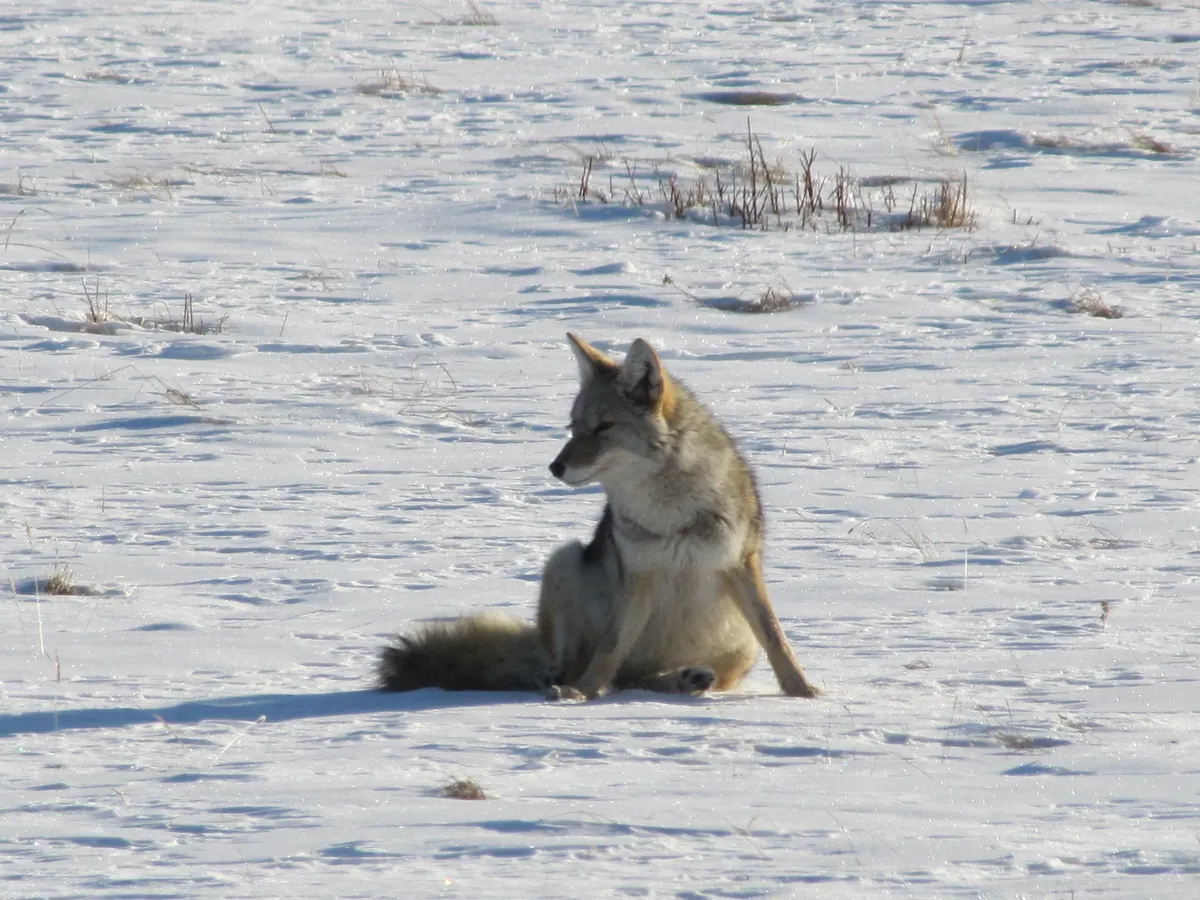
Fish and Game describes the eastern coyote as a 30- to 50-pound animal that usually keeps one mate for life and is "quite vocal" during its January to March breeding season. February nights are when you are most likely to hear a group yip-howl. Pairs defend territories of 5 to 25 square miles, and both parents raise the pups, sometimes with help from a yearling. The first verified coyote in New Hampshire was in Grafton County in 1944; between 1972 and 1980 they spread across the state, from Colebrook to Seabrook. Watch the snow for two sets of tracks traveling together, a sign of a mated pair.
When do bald eagles start nesting in New Hampshire?
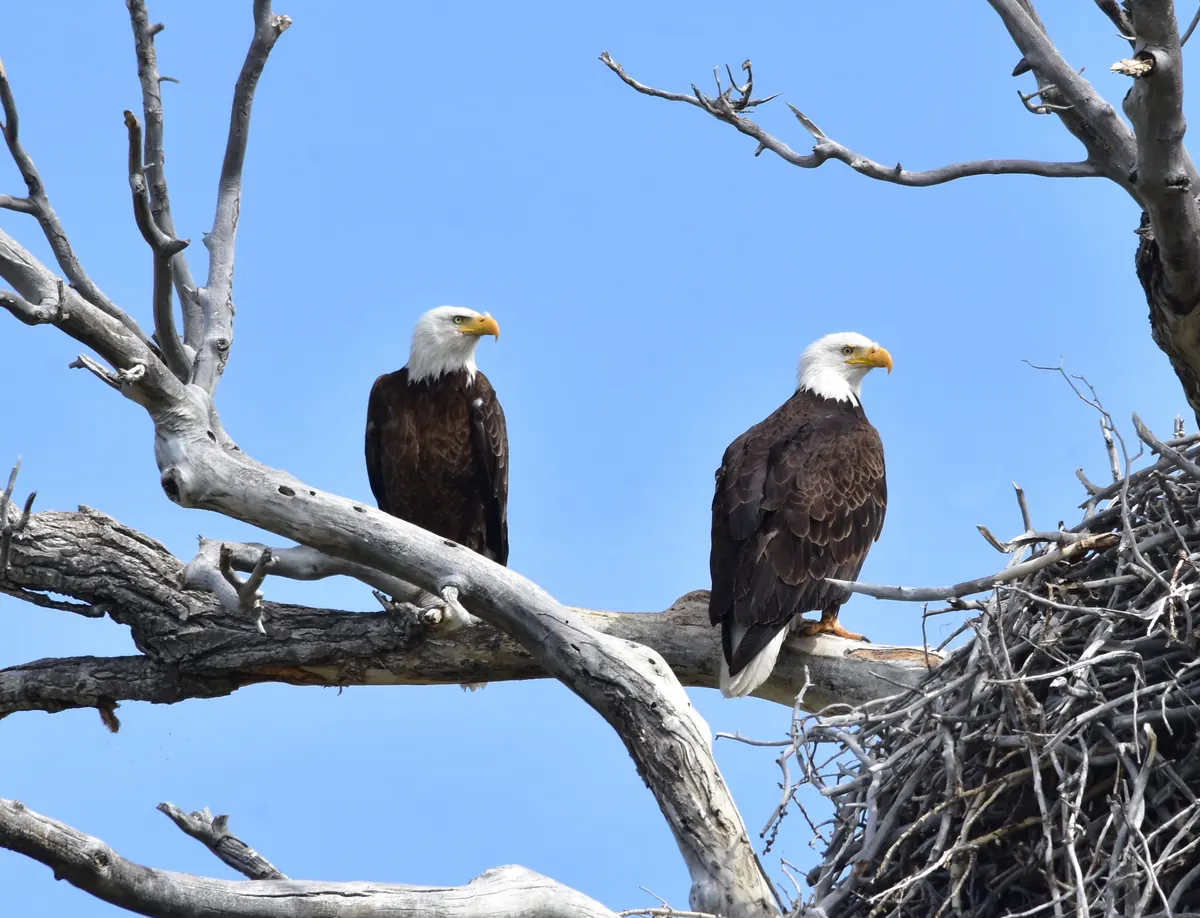
Now, for the earliest pairs. Fish and Game gives March to May as the usual window for eggs, but NH Audubon says some New Hampshire pairs are already incubating before February is out, and many more are at their nests, courting and building.
-
Sticks, grass and courtship
From January; most visible in February · Big pines and other tall trees beside lakes and rivers
Volunteer nest watchers report pairs flying in with sticks and grasses to build up their nests. Fish and Game notes that eagles often keep the same mate for years and reuse the same nest, adding to it each season, and that the female lays 1 to 3 eggs, which both parents incubate for about five weeks. Two adults perched side by side near a big stick nest in February are very likely a breeding pair.
-
How to watch and report
All season · From a distance
If an eagle turns to stare at you or flushes, you are too close; back away. NH Audubon asks people to report new nests or pairs to its raptor biologist, or to enter them in eBird.
The record 2026 nesting season and the winter eagles on the Merrimack are covered on the December page for New Hampshire.
When is the Meredith ice fishing derby in 2027?
Saturday and Sunday, February 13 and 14, 2027, for the 48th Great Meredith Rotary Ice Fishing Derby. The derby trailer opens at Hesky Park on the Meredith docks on Thursday, February 11.
-
How the derby works
February 13 and 14, 2027 · Any public freshwater in New Hampshire; headquarters on Meredith Bay, Lake Winnipesaukee
Ticket holders may enter fish caught through the ice on either day from any public fresh water in the state, under all of Fish and Game’s regular rules, and the heaviest fish win. The 2026 rules set minimum lengths: 22 inches for lake trout, cusk and pickerel, 17 for rainbow trout, 14 for white perch, 13 for black crappie and 12 for yellow perch. Salmon, bass and brown trout are not accepted; the derby reminds anglers that salmon are out of season in February. Prizes total more than $80,000, and you do not need to be present to win. Anglers 16 and older need a New Hampshire fishing license.
-
Where the fish go
Sunday afternoon of derby weekend · Squam Lakes Natural Science Center, Holderness
Fish nobody claims go, frozen, to the science center in Holderness, which feeds them to its otters, bears, eagles and other animals through the rest of the winter. The derby notes that the otters are especially fond of frozen trout.
-
A first try for children
Derby Saturday in recent years · On the ice near Hesky Park
In 2025 the derby and Fish and Game’s Let’s Go Fishing program ran a free children’s clinic on the Saturday, gear included and no license needed; check the derby’s website for any 2027 sessions.
Fish and Game’s late-season advice is short: stay off the ice during thaws. The safety notes below give its thickness guidelines.
Why are there seals on New Hampshire beaches in winter?
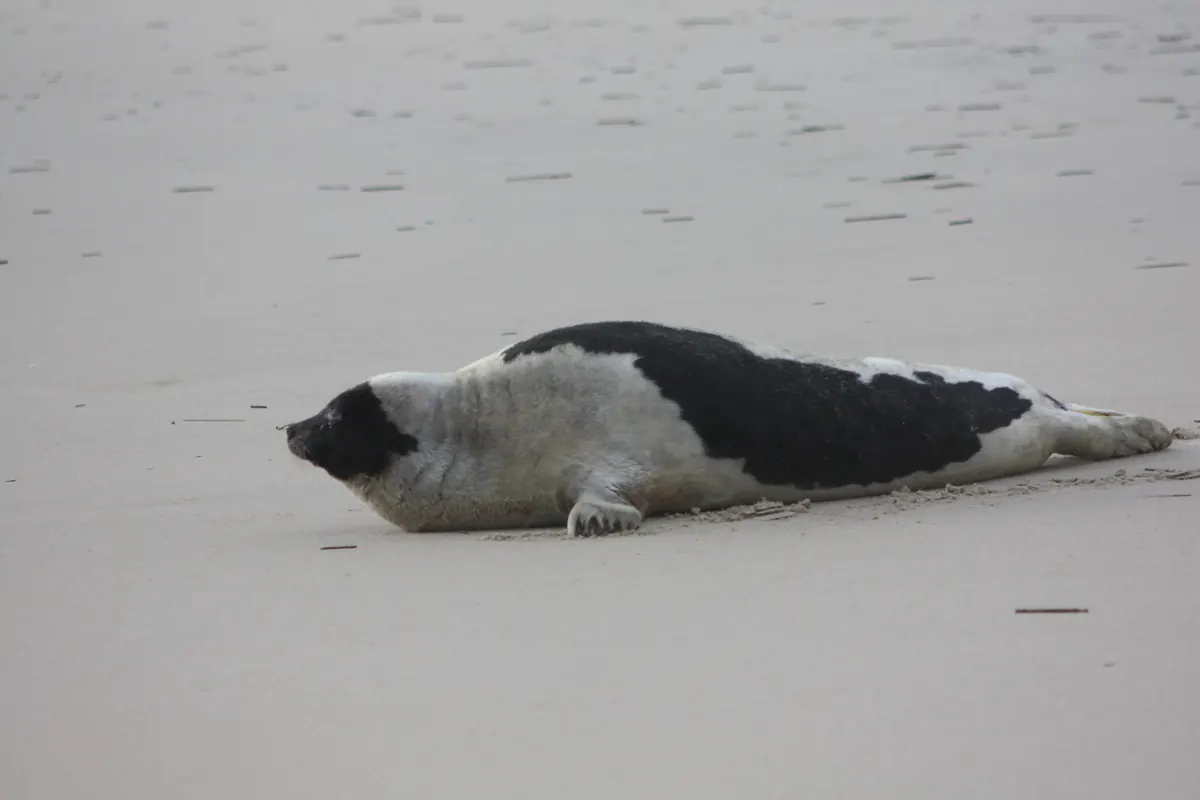
Harbor seals and the larger gray seals use the state’s coast all year, but winter adds visitors from the far north. The Seacoast Science Center, which runs the marine mammal rescue program for the New Hampshire coast, has noted that the first of these "ice seals" are usually reported in mid to late January, so February is the month to watch for them.
-
Harp and hooded seals
Mid-January into spring · Sandy beaches and rocky shores from Seabrook to New Castle
Both species are born on pack ice in the Arctic and off eastern Canada, and the ones that reach New Hampshire are mostly young. A young harp seal, called a beater, is cream with scattered brown spots; adults are light gray with a black face and a dark curved band on the back that gives the species its name. A young hooded seal, or blueback, has a dark, silvery gray back and a pale belly. NOAA Fisheries notes that adult harp seals also turn up on New England beaches now and then in late winter.
-
Why a seal on the sand is not in trouble
Any time · The beach
Seals haul out to rest, and a seal lying still above the tide line is usually doing just that. The risk comes from people. Harp and hooded seals eat snow and ice for water, and when stressed or unwell they may swallow sand and pebbles instead, which can block the gut and kill them. That is why distance matters so much with these two.
-
What to do
If you find any seal out of the water · The Seacoast, Great Bay and tidal rivers
Stay at least 150 feet back, the distance federal law sets, and keep dogs leashed and away. Do not offer food or water, pour water on it, cover it or try to push it back into the sea. Report it to the Seacoast Science Center’s 24-hour marine mammal hotline, 603-997-9448, so trained responders can check on it.
The winter sea ducks and snowy owls of the same shoreline are on the November page for New Hampshire.
What are the first signs of spring in New Hampshire in February?
Small ones, mostly heard rather than seen. Longer days start breeding behavior in resident birds well before the snow goes, and one group of insects does its living in the cold on purpose.
-
Winter stoneflies on the snow
Emerging from January, most in February, tapering off in March · Snow and rocks beside clean, fast brooks
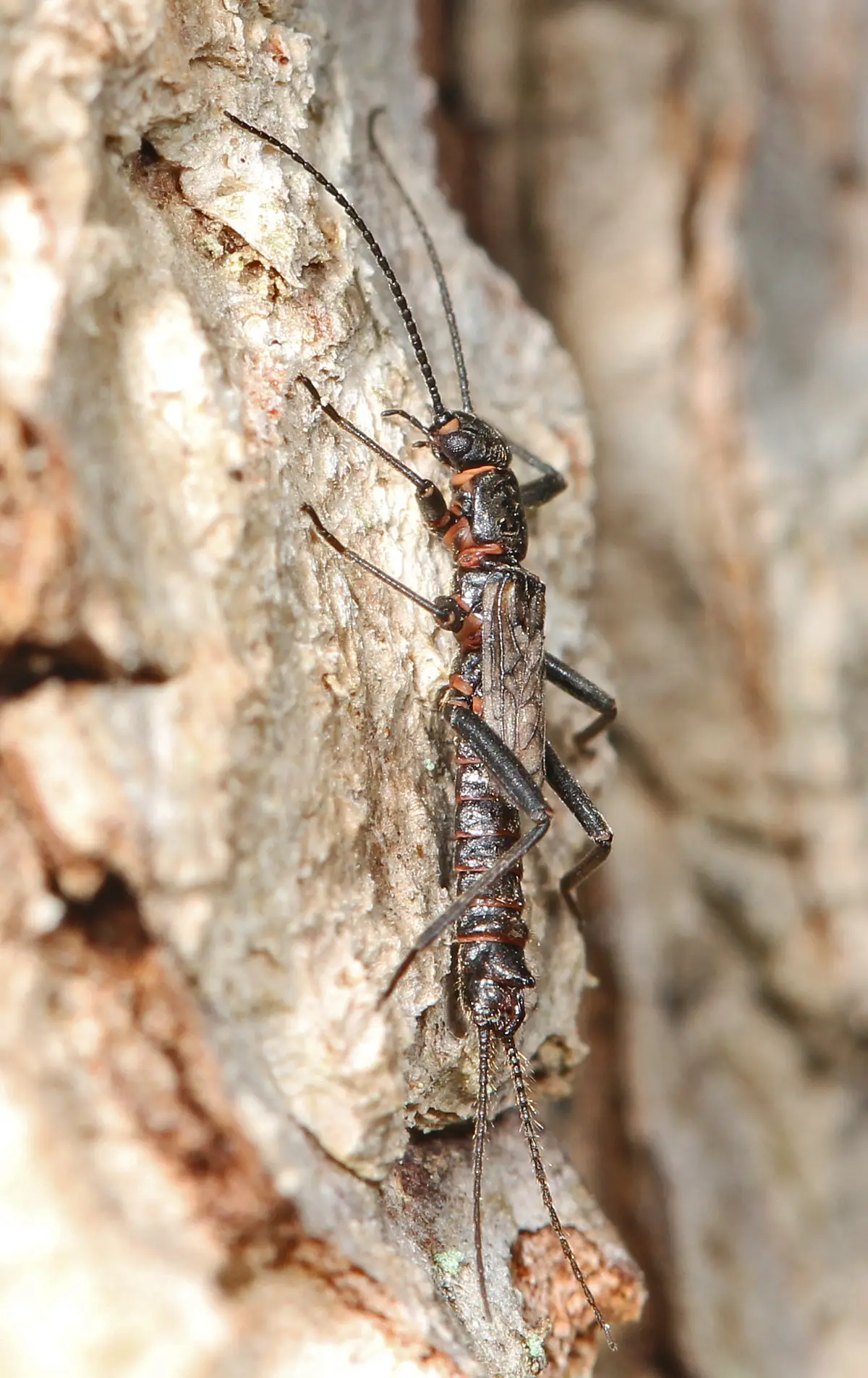
On a sunny midday near a stream, look for small dark insects with long wings folded flat over the back, walking across the snow. These are winter stoneflies. In The Outside Story, the late biologist Bill Amos described how their nymphs feed among the rocks of icy brooks all winter, then crawl out onto sun-warmed stones to shed their skins as adults. Their dark bodies soak up the sun’s warmth. A hand lens shows the long antennae and two short tails.
-
The chickadee’s spring song
Late winter into spring · Yards, town forests and feeders
The black-capped chickadee’s clear, two-note fee-bee, the second note lower, can be heard any month, but it becomes common in late winter. Naturalist Mary Holland explains it as the male staking out a territory and advertising for a mate.
-
Woodpeckers drumming
Starting in late winter on mild mornings · Dead limbs, hollow snags and the occasional gutter
Drumming is not feeding. It is a woodpecker’s version of song, a claim to territory and a signal to a mate, and each species has its own rhythm. In The Outside Story, naturalist Bryan Pfeiffer gives the numbers: a downy woodpecker’s roll lasts about three-quarters of a second with around 13 beats, a hairy’s about a second with roughly twice as many, and a pileated’s a deep, resonant roll of three seconds or so. A yellow-bellied sapsucker drums like no other, more like Morse code: a stuttering start, then taps that slow and trail off.
Snow fleas, the other insect of the thaw, are on the January page.
How much daylight does New Hampshire gain in February?
More than an hour everywhere in the state. Colebrook, in the far north, grows from 9 h 48 m on February 1 to 11 h 06 m by February 28, a gain of 78 minutes, while Nashua, on the Massachusetts line, adds 72 minutes, from 9 h 58 m to 11 h 10 m. Concord starts at 9 h 56 m and crosses ten hours within the month’s first few days; by the 28th, every town listed is over eleven. The gains grow larger day by day and keep accelerating into March. The sun reaches the point midway between solstice and equinox on February 3 or 4, depending on how you measure, which leaves Groundhog Day (Tuesday, February 2) slightly ahead of the true middle of winter.
| City | Feb 1 | Feb 28 | Gained | Per day |
|---|---|---|---|---|
| Colebrook | 9 h 48 m | 11 h 06 m | 78 min | 2.9 min |
| Berlin | 9 h 51 m | 11 h 07 m | 76 min | 2.8 min |
| Littleton | 9 h 51 m | 11 h 08 m | 77 min | 2.9 min |
| North Conway | 9 h 53 m | 11 h 08 m | 75 min | 2.8 min |
| Hanover | 9 h 54 m | 11 h 08 m | 74 min | 2.7 min |
| Concord | 9 h 56 m | 11 h 10 m | 74 min | 2.7 min |
| Portsmouth | 9 h 57 m | 11 h 10 m | 73 min | 2.7 min |
| Nashua | 9 h 58 m | 11 h 10 m | 72 min | 2.7 min |
Find the sunset for your own road on our daylight calculator.
Is February New Hampshire’s snowiest month, and what might El Niño do?
In some places it is. NOAA’s 1991–2020 normals give Berlin 21.0 inches of February snow against 18.2 in January, and York Pond in the White Mountains 24.0 against 21.4. Farther south February usually brings a little less snow than January, though not by much: Concord’s normal is 16.9 inches. The summit of Mount Washington normally gets 43.3 inches in February, with an average high of 14.8 °F. It was there, on February 4, 2023, that the air fell to -47 °F, tying the observatory’s all-time low, while gusts reached 127 mph; the wind chill readings below -100 °F that night are, by the observatory’s own account, arguably the lowest ever reported in the United States.
| Station | Average high | Average low | Precipitation | Snowfall |
|---|---|---|---|---|
| First Connecticut Lake (Great North Woods) | 25.2 °F | 0.4 °F | 2.37 in | 28.4 in |
| Lancaster (upper Connecticut valley) | 28.7 °F | 3.7 °F | 2.03 in | 17.8 in |
| Berlin (Androscoggin valley) | 29.7 °F | 6.3 °F | 2.44 in | 21.0 in |
| York Pond (White Mountains) | 27.9 °F | 5.1 °F | 2.86 in | 24.0 in |
| Pinkham Notch (White Mountains) | 28.4 °F | 7.3 °F | 4.28 in | 27.6 in |
| Mount Washington summit | 14.8 °F | -3.0 °F | 5.45 in | 43.3 in |
| Hanover (Upper Valley) | 34.3 °F | 14.4 °F | 2.38 in | 13.1 in |
| Lakeport 2 (Laconia, Lakes Region) | 33.7 °F | 12.5 °F | 2.88 in | 16.9 in |
| Concord Municipal Airport | 34.8 °F | 14.7 °F | 2.75 in | 16.9 in |
| Keene (Monadnock Region) | 34.3 °F | 11.4 °F | 2.77 in | 14.4 in |
| Durham (Seacoast) | 36.1 °F | 16.2 °F | 3.04 in | 9.1 in |
| Greenland (Seacoast) | 35.6 °F | 17.6 °F | 3.57 in | 15.8 in |
This February arrives at the end of what forecasters expect to be a very strong El Niño winter: in its September 10, 2026 update, federal forecasters gave a very strong event more than nine chances in ten of carrying on through the heart of the season. New Hampshire’s state climatologist, Mary Stampone of UNH, told the Granite State News Collaborative in June 2026 that winters during El Niño usually come in warmer than average across the northern tier, and that 2015–16, during the last very strong event, was the state’s second-warmest winter on record. Where the storms go is less certain, she said: the track can stay south and hand the snow to the Mid-Atlantic, or it can bring more nor’easters up the coast. She also cautioned that real Arctic cold can still arrive, especially in January and February. The most recent strong El Niño, in 2023–24, produced New Hampshire’s warmest winter on record, NHPR reported, with a December to February average of 28 °F; Concord never fell below zero, and rain on snow flooded parts of the North Country. For maple producers and ice anglers, that is the risk to watch: thaws that come too early or too often.
NOAA’s seasonal outlook for winter is issued October 15 and updated each month; current maps live on NOAA’s 90-day outlook page. For this week’s forecast, try our weather page; New Hampshire frost dates show when planting can start.
What can you see in the New Hampshire night sky in February 2027?
A planet-watcher’s month: Mercury at its best in the evening, then Jupiter and Mars each reaching opposition in Leo, a week and a bit apart, followed by a full moon that slips through the edge of Earth’s shadow. All times are Eastern Standard Time.
-
Mercury after sunset
Late January to about February 10; farthest from the sun on February 3 · Low in the west-southwest, half an hour to 45 minutes after sunset
On the 3rd the little planet reaches 18 degrees east of the sun, its best evening showing of the winter. Pick a spot with no hills or trees to the west-southwest, such as a frozen lake. On Sunday, February 7, a crescent moon only a day past new sits right beside it; binoculars help.
-
Jupiter at opposition
Wednesday, February 10, at 7:21 p.m. · Rising in the east as the sun sets; due south around midnight
Facing us squarely across from the sun, Jupiter is at its nearest for the year, roughly 405 million miles away, and at magnitude -2.5 it outshines every star from dusk until dawn. Steady binoculars on a fence rail show up to four of its large moons as tiny points in a line, rearranged each night.
-
Mars at opposition
Friday, February 19; closest to Earth on the 20th · In the east after dark, in Leo, not far from Jupiter and the star Regulus
Mars glows orange at magnitude -1.2. Its least distance, about 63 million miles, is large for an opposition, because the red planet is nearly at its farthest from the sun; telescopes show only a small disk. Through the night of the 19th the swollen, nearly full moon creeps up beside Jupiter and passes very close to it.
-
The Snow Moon, with a faint eclipse at moonrise
Saturday, February 20; full at 6:23 p.m.; eclipse at its deepest at 6:13 p.m. and over by 8:13 p.m. · Low in the east at dusk
The full moon rises around sunset already inside the pale outer part of Earth’s shadow, the penumbra. Even at its deepest this eclipse dims the moon only slightly, perhaps a faint gray shading along one edge, and with the moon low in bright twilight, it is easy to miss altogether. Calling it a supermoon depends on which almanac you read. The ring-shaped solar eclipse of February 6 belongs to Chile, Argentina and the ocean beyond; no part of it, partial or annular, can be seen from New Hampshire or any other state.
| Phase | Date | Time |
|---|---|---|
| New moon | Saturday, Feb 6 | 10:56 a.m. |
| First quarter | Sunday, Feb 14 | 2:58 a.m. |
| Full moon (Snow Moon) | Saturday, Feb 20 | 6:23 p.m.; a faint penumbral eclipse is under way at moonrise |
| Last quarter | Sunday, Feb 28 | 12:16 a.m. |
Evenings are moonless from about the 2nd to the 11th, the window for faint stars or northern lights. The sunspot cycle peaked in 2024 and is winding down, yet a strong geomagnetic storm remains possible; NOAA’s aurora forecast is the place to check. See how cloudy tonight will be on Today’s sky, and check any night’s phase on the moon phase calendar.
What can New Hampshire families do outdoors in February 2027?
- Tuesday, February 2: Groundhog Day. Look for your own shadow at noon, then mark February 3 and 4, the true halfway point of winter, on the calendar.
- Presidents’ Day weekend, Friday the 12th to Monday the 15th: the Great Backyard Bird Count. Fifteen minutes on one day counts; longer is welcome.
- Saturday and Sunday, February 13 and 14: NH Audubon’s Backyard Winter Bird Survey. The 40th annual count; children can keep the tally of juncos and chickadees, and the same list can go to both counts.
- Saturday and Sunday, February 13 and 14: the Great Meredith Rotary Ice Fishing Derby. Even without a ticket, the bob houses and the weigh-in at Meredith Bay are worth a walk; check the derby site for a children’s clinic.
- All month: Wild Winter Walks. In past winters, Holderness’s Squam Lakes Natural Science Center has led naturalist walks on its live-animal trail, from mid-January into March and during school vacation week, with snowshoes lent free; check nhnature.org for 2027 dates.
- Telescope nights at the UNH Observatory in Durham. The observatory holds free public observing sessions, 8 to 10 p.m. in the cold months, twice a month, on the first Saturday and again on the third, according to its own schedule. Its February 2027 dates are not posted yet; check with the organizer before you go, and watch its Facebook page for weather cancellations.
- Coming up: NH Maple Weekend, March 20 and 21, 2027. Sugarhouses across the state open their doors.
Jot each find in the Naturalist’s Field Journal, and browse other states and seasons in our nature guides.
Safety notes for February in New Hampshire
- Hunting and trapping that overlap February. Under Fish and Game’s 2026–27 seasons, snowshoe hare stays open through March 31 (limits vary by unit) and cottontail through March 15 in units H2, K, L and M. Coyote has no closed season, and night hunting for coyote is allowed January 1 to March 31; coyote trapping runs through March 31. Fox, raccoon and opossum may be hunted through March 31. In units G through M, trapping for beaver, mink, muskrat, otter and weasel stays open until April 10. Gray squirrel and fisher seasons closed on January 31, and bobcat, lynx and pine marten are closed all year.
- Hunter orange. State law (RSA 207:38-b) only recommends it: hunters with guns or bows should wear an orange hat or vest that can be seen from every direction at 200 feet. Hikers on woods roads this month are wise to add some orange too, and to dress dogs in it.
- Late-season ice. Fish and Game’s minimums are 6 inches of hard ice for walking and 8 to 10 inches for snowmobiles and OHRVs, and its advice is to stay off any ice during a thaw. Ice that melts and refreezes is weak, and inlets, outlets, spring holes and cracked or slushy shore ice are danger spots. Carry ice picks, a rope and a float coat.
- Avalanches. Steep snow in the ravines and gullies of the Presidential Range can slide. The Mount Washington Avalanche Center, a partnership with the U.S. Forest Service based in Gorham, posts snow and avalanche forecasts through the winter; read it before any trip above treeline, and carry and know how to use a beacon, shovel and probe.
- Wind chill. With an average February low of -3.0 °F before the wind is counted, the summit of Mount Washington is for experienced, fully equipped parties only. In the valleys, too, cover skin when the wind chill drops below zero.
- Wildlife. Keep 150 feet from seals on the beach, and give dens and eagle nests a wide berth.
- Sugaring. Boil sap outdoors, keep children back from the pan, and wear gloves when handling hot syrup.
- Storms and thaws. A nor’easter can still bring the biggest snow of the year in February, and rain on deep snow can cause flooding; keep emergency supplies in the car and watch National Weather Service warnings.
Sources
- NH Audubon: Backyard Winter Bird Survey 2027
- NH Audubon: Backyard Winter Bird Survey report, 2025 (Pamela Hunt)
- NH Audubon: Thank you, 2026 Backyard Winter Bird Survey participants
- NH Audubon: Backyard Winter Bird Survey
- National Audubon Society: Great Backyard Bird Count (30th count, February 12–15, 2027)
- Birds Canada: Great Backyard Bird Count
- UNH Extension: Maple sugaring tips for beginners and backyard producers
- UNH Extension: Maple products and management
- Concord Monitor: Warming days, cold nights mean it’s almost maple syrup time (February 17, 2026)
- NH Maple Producers Association: NH Maple Weekend, March 20–21, 2027
- NOAA NCEI: Daily climate normals 1991–2020, Concord Municipal Airport
- NH Fish and Game: Bears, frequently asked questions
- NH Fish and Game: Eastern coyote
- NH Audubon: Bald eagle nesting season
- NH Audubon: It’s raptor spring!
- NH Audubon: NH bald eagle 2026 breeding season results
- NH Fish and Game: Bald eagle
- Great Meredith Rotary Ice Fishing Derby: 48th annual derby, February 13–14, 2027
- Great Meredith Rotary Ice Fishing Derby: Fishing derby rules
- Great Meredith Rotary Ice Fishing Derby: Where do all the fish go?
- Great Meredith Rotary Ice Fishing Derby: Kids ice fishing clinic
- Great Meredith Rotary Ice Fishing Derby: Derby FAQs
- NH Rules and Regulations Digest 2026: Ice fishing
- Seacoast Science Center: Winter seal visitors along NH’s coast
- Seacoast Science Center: Marine mammal rescue (hotline and viewing distance)
- NOAA Fisheries: Rare visitors, harp seals in New England
- Northern Woodlands, The Outside Story: Winter’s bug season (Bill Amos)
- Naturally Curious with Mary Holland: Black-capped chickadees singing their spring song
- Northern Woodlands, The Outside Story: Chickadees, what they say and why they say it
- NH Charitable Foundation, The Outside Story: Drumroll, please (Bryan Pfeiffer)
- NOAA NCEI: Monthly climate normals 1991–2020 for twelve New Hampshire stations
- Mount Washington Observatory: Re-tracing February’s Arctic air mass and record cold
- Mount Washington Observatory: February newsletter, a storm for the record books (2023)
- NOAA Climate Prediction Center: ENSO diagnostic discussion, September 10, 2026
- NOAA Climate Prediction Center: 90-day outlooks
- Granite State News Collaborative: El Niño 2026, what are New Hampshire’s weather conditions to come? (June 29, 2026)
- NHPR via NEPM: This winter was the warmest on record for New Hampshire (March 12, 2024)
- U.S. Naval Observatory: Moon phases
- U.S. Naval Observatory: Earth’s seasons and apsides, 2027
- Fred Espenak: Sky Event Almanac 2027
- NASA Goddard: Lunar eclipses, 2021–2030
- NASA Goddard: Solar eclipses, 2021–2030
- EarthSky: Jupiter at opposition
- Old Farmer’s Almanac: Eclipses
- NOAA Space Weather Prediction Center: Aurora 30-minute forecast
- Squam Lakes Natural Science Center
- Andover Beacon: Squam Lakes Natural Science Center hosts Wild Winter Walks
- UNH Observatory: Public observing sessions
- NH Hunting Digest 2026–27: Small game hunting seasons
- NH Hunting Digest 2026–27: Furbearer hunting and trapping seasons
- New Hampshire RSA 207:38-b, hunter orange recommendation
- NH Fish and Game: Exercise caution around all forms of ice this winter
- Mount Washington Avalanche Center
- Photos via Wikimedia Commons; licenses and photographers are credited under each picture
