What to look for in nature in North Carolina this April
April is the month North Carolina turns green from the coast to the crest of the Blue Ridge. Dogwoods open in the Piedmont, wildflowers peak in the lower Smokies, and the woods fill with the songs of birds back from the tropics: wood thrushes, indigo buntings, rose-breasted grosbeaks and, toward the end of the month, scarlet tanagers. On the coast the first painted buntings sing from the shrub thickets, American oystercatchers scrape out nests on the Outer Banks, and in the Albemarle Peninsula red wolf pups are born. Frogs that began calling in March are joined by gopher frogs in the Sandhills and gray treefrogs almost everywhere. Hatchery-supported trout streams open on Saturday, April 3. Severe storms are part of the season too, and so is a late freeze in the mountains. Usual timing and a source are given for each.
Other months in North Carolina: October, November, December, January, February, March.
Start here
- Listen for a wood thrush at dawn or dusk. Walk a wooded neighborhood path or greenway in the first hour after sunrise. The wood thrush sings a flute-like phrase from the understory, and many people hear it long before they see it. Return at the same time each day to catch the week it arrives.
- Walk a woodland trail for spring wildflowers and dogwood. Pick one trail and go twice, two weeks apart. In the Piedmont you may see dogwoods in bloom on the first visit; in the lower Smokies the wildflower peak usually falls in the middle to end of April. Photograph rather than pick.
- Stand at the edge of a pond at dusk and count the calls. Cope’s gray treefrogs trill from trees and shrubs near water after dark, and on mild nights several kinds of frogs may overlap. See how many separate voices you can tell apart, and write the temperature and the time beside each.
Journal plates for April: log the first wood thrush, indigo bunting and tanager on birds I have seen, and list every flower you find on one trail for the daily field log. A dogwood branch followed from bud to bract suits a tree through the seasons. The gopher frog’s snore and the treefrog’s trill belong on a map of sounds; an oystercatcher scrape on the beach or a thrush nest goes under nest observed; the Pink Moon on April 20 and the Lyrids on the 22nd fit dusk and dawn watch. Walk one trail early in April and again late in the month: the same place twice.
Regions used below: Mountains; Foothills; Piedmont; Sandhills; Coastal Plain; Outer Banks and the coast.
Which songbirds return to North Carolina in April?
The peak weeks of songbird migration come in April and May. The hummingbirds that reached the state in March (see our March guide) are now joined by thrushes, buntings, grosbeaks and tanagers. The dates below come from the Carolina Bird Club’s hosted copy of Birds of the Central Carolinas, which covers the Charlotte area and the nearby Piedmont. Expect the mountains to run later and the coast a little earlier, and expect every year to differ.
-
Wood thrush
Most pass through in April; breeders have often built nests by the third week of April · Deciduous forests with a thick understory, including wooded neighborhoods in the Piedmont
The book calls the wood thrush the only one of the five spot-breasted thrushes that nests in the Carolina Piedmont, and says most of them move through in April and in September. The birds that stay to breed have generally paired up and built nests by the third week of April. The earliest spring arrival on record there was a bird singing on March 30, 2012. Weary migrants do not sing right away, so the first song you hear usually means the bird landed a day earlier. Listen in deep shade at dawn and dusk; the bird is far easier to hear than to find.
-
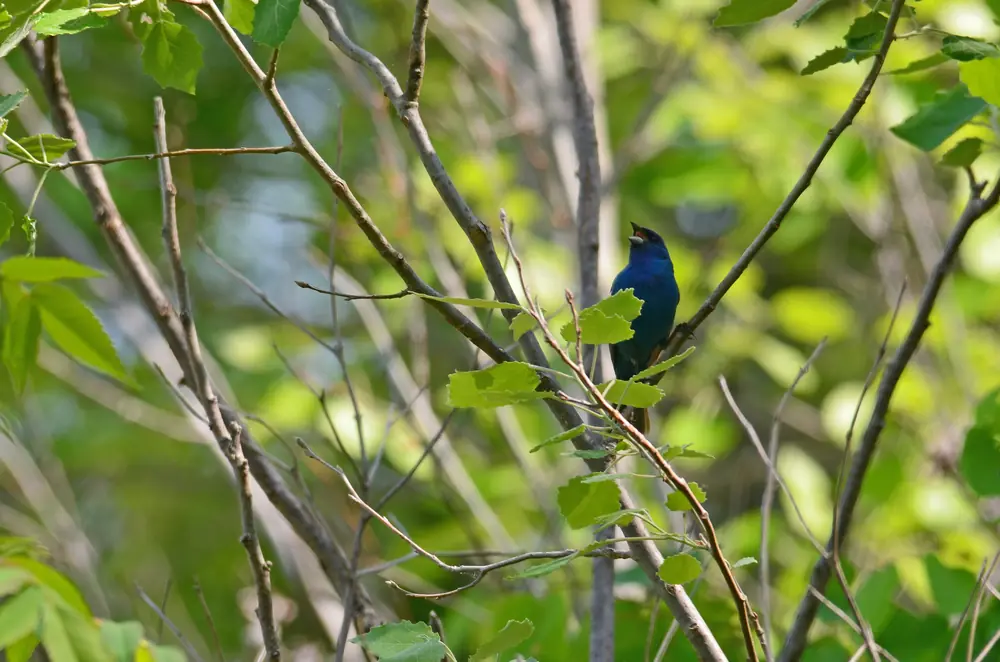
Indigo bunting
Generally early April; a few turn up in the last week of March · Overgrown fields, forest edges and clearings, statewide
The book rates it very common. A male in breeding plumage is a deep blue all over and sings from the tops of trees and wires, often through midsummer. Indigo buntings generally arrive in early April and leave for the northern tropics by mid to late October, according to the same source. Brushy field edges and power-line cuts are the easiest places to look.
-
Rose-breasted grosbeak
Most pass through from mid-April to mid-May · Hardwood forests and wooded yards; breeds in the mountains between about 3,500 and 5,000 feet
This black-and-white bird with a triangle of red on its breast breeds in the high mountains but passes through the Piedmont in spring. Males usually arrive a few days ahead of the females, and the species is rated uncommon to fairly common as a migrant, less common toward the east. The call is a sharp “eek.” The Central Carolinas book lists April 6 to May 24 as the extreme spring dates, and a birder in Catawba County once counted 15 at one park on April 25, 2004.
-
Scarlet tanager
Most arrive in late April or early May; the earliest on record there was April 9 · Mature deciduous forest in the Mountains and Piedmont, with a few on the inner Coastal Plain
The smallest of the state’s three tanagers is a flame-red bird with black wings. The book describes it as a long-distance migrant returning from South America, Central America and southern Mexico. Look high in mature hardwoods. Most arrive in the last days of April or in early May, so the best odds come in May.
If you keep a feeder, change the sugar water often; a report of your first ruby-throat to Journey North adds a dot to the migration map, which tracks the species’ progress north each spring.
Where do painted buntings and beach-nesting birds appear on the coast in April?
Along the coast April belongs to the birds that nest in shrubs and on bare sand. The Outer Banks beaches are posted with string and signs well before many nests exist, and the shrub thickets near the marshes echo with a bird that looks as if a child painted it.
-
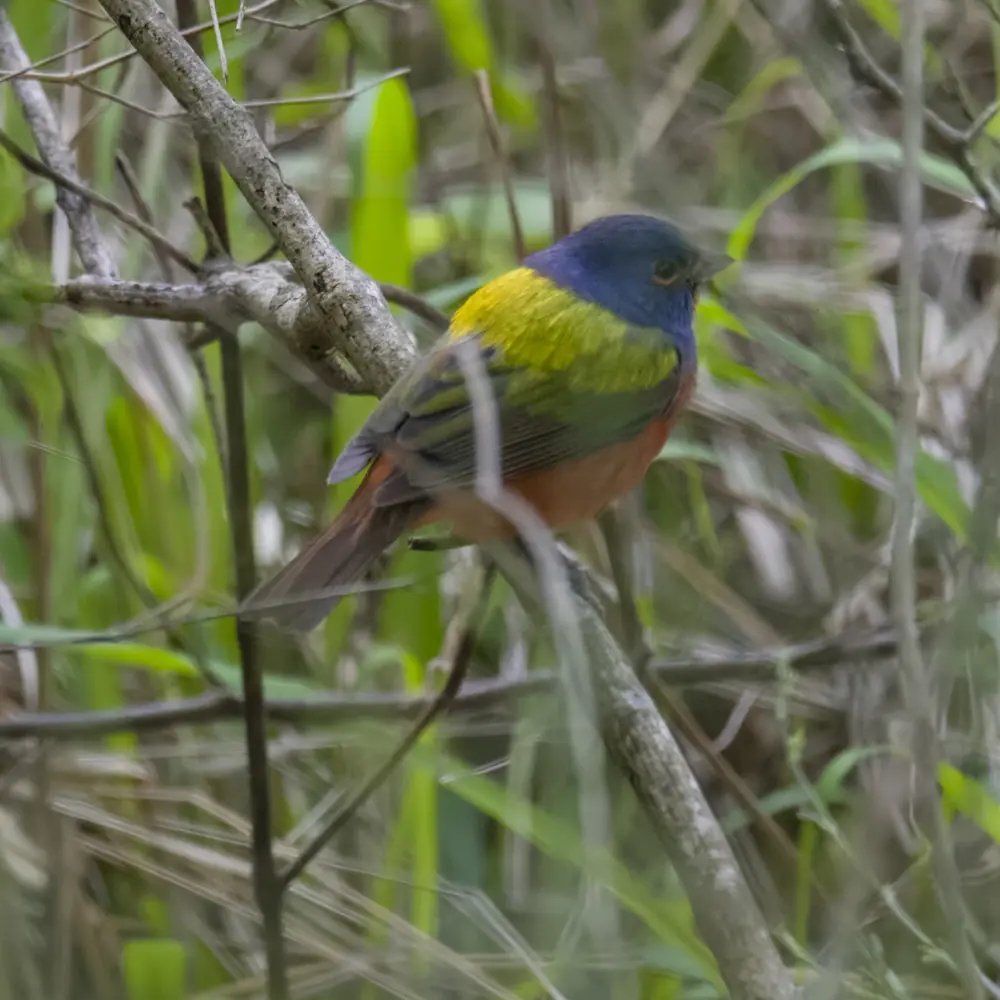
Painted buntings in the shrub thickets
Males arrive in mid-April; females about a week later · Maritime shrub thickets and salt-marsh edges along the southern and central coast, north to Morehead City; Fort Fisher, Hammocks Beach and Bald Head Island are named locations
A naturalist’s column in the Coastal Review says male painted buntings reach the coast in mid-April to claim territories, each about three acres, and that females follow roughly a week later; treat the dates as typical, not exact. They favor thickets of wax myrtle and yaupon near salty water, a habitat that is shrinking with coastal development. Brian O’Shea of the North Carolina Museum of Natural Sciences told Our State that the birds begin arriving in April from Florida and probably farther south, and the species ranges from northeast Florida to Morehead City along this coast. Males wear their full rainbow only from their second fall; females and young are a bright lime green. Inland, a lone male has returned to Dorothea Dix Park in Raleigh in several recent springs. An N.C. State professor told WUNC the species arrives in mid to late April and is most easily seen in the first few hours after sunrise.
-
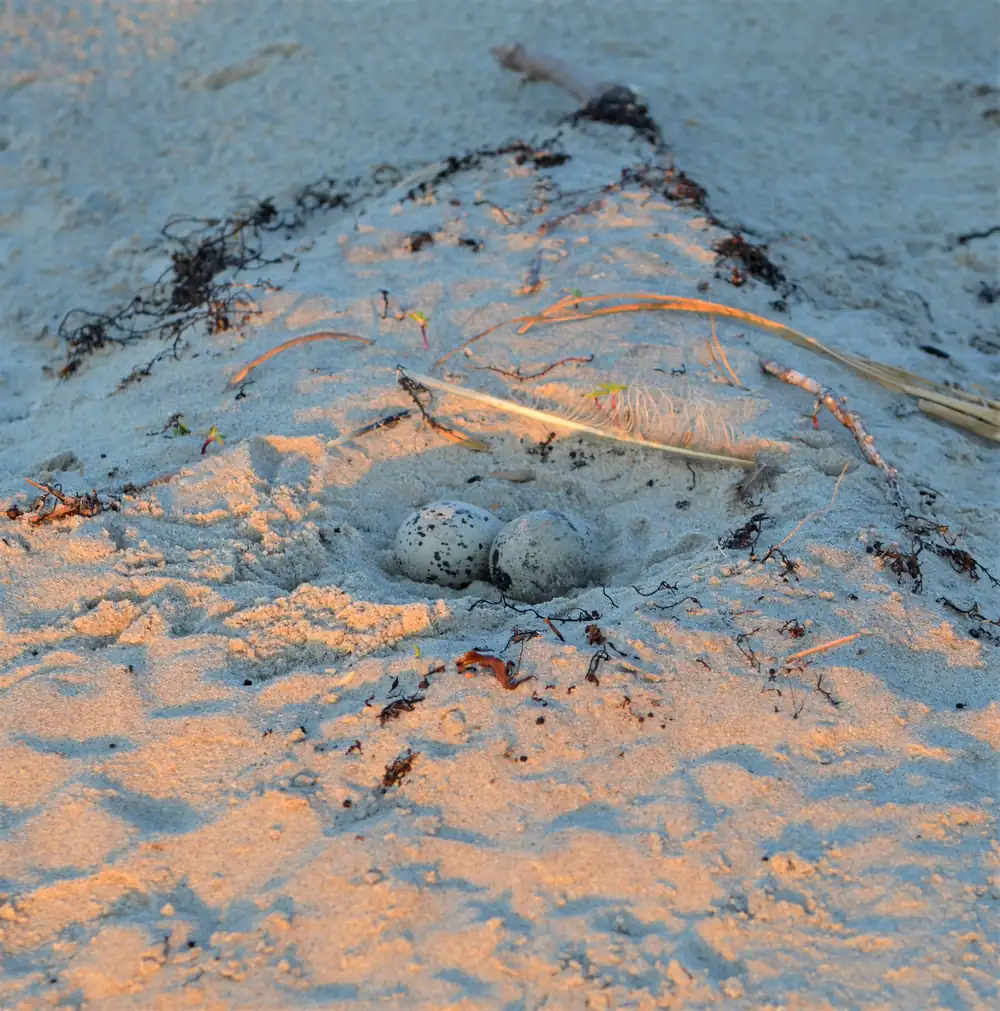
American oystercatchers on the Outer Banks
In 2016 the first nest was found on April 4; nests were found through June 6 · Cape Hatteras National Seashore: Bodie Island, Hatteras Island and Ocracoke Island
The Park Service’s 2016 monitoring report counted 26 pairs of American oystercatchers nesting at Cape Hatteras National Seashore, with 41 nests including re-nests after failures. Incubation averaged 31 days, and chicks that fledged were about 41 days old on average. Most pairs held territories inside the pre-nesting areas the Seashore marks off in spring.
-
Least terns and the spring closures
Pre-nesting closures were in place by April 15 in 2015; nesting runs into summer · Cape Hatteras National Seashore
According to the Park Service’s 2015 colonial waterbird report, least terns, common terns, gull-billed terns, Forster’s terns and black skimmers all nested at the Seashore that year. Closures for colonies required a 100-meter buffer around least tern breeding behavior and 200 meters once chicks could not yet fly. Pea Island National Wildlife Refuge also posts sensitive areas to protect nesting birds and sea turtles. Obey the signs; a bird that flushes from a nest on a hot day can lose its eggs in minutes.
-
Sea turtles are just ahead
In 2016 the first nest at Cape Hatteras was recorded on May 18 · Ocean beaches, Cape Lookout and Cape Hatteras National Seashores and Pea Island
Sea turtle season has not started in April. The 2016 Seashore report put the first nesting activity on May 18 and the last on September 24, with 313 loggerhead nests among 325 in all. Use April to read the beach rules each park posts for lights at night and for leveling holes in the sand.
Leash your dog, give any fenced area a wide berth, and check the Seashore’s and refuge’s own pages for current closures.
Which frogs call in North Carolina in April?
March’s peepers and toads are still going in many places, so April adds new voices rather than replacing old ones. Warm, humid nights are best, and a cold snap can silence everyone for a few days.
-
Carolina gopher frog
Breeds from mid-February to mid-April · Fishless temporary ponds in longleaf pine country in the Sandhills and southeastern Coastal Plain
This is one of the state’s rarest frogs and it is listed as endangered by North Carolina. The Wildlife Resources Commission describes its call as a low snore or growl, sometimes given underwater. Between breeding bouts it hides in stump holes, root tunnels and burrows dug by mammals and crayfish in the pine savannas. It breeds in ponds that dry up regularly, so it is not a frog you will find at an ordinary lake. You cannot collect one without a special permit, and the best way to help is to learn where the ponds are and keep out of them.
-
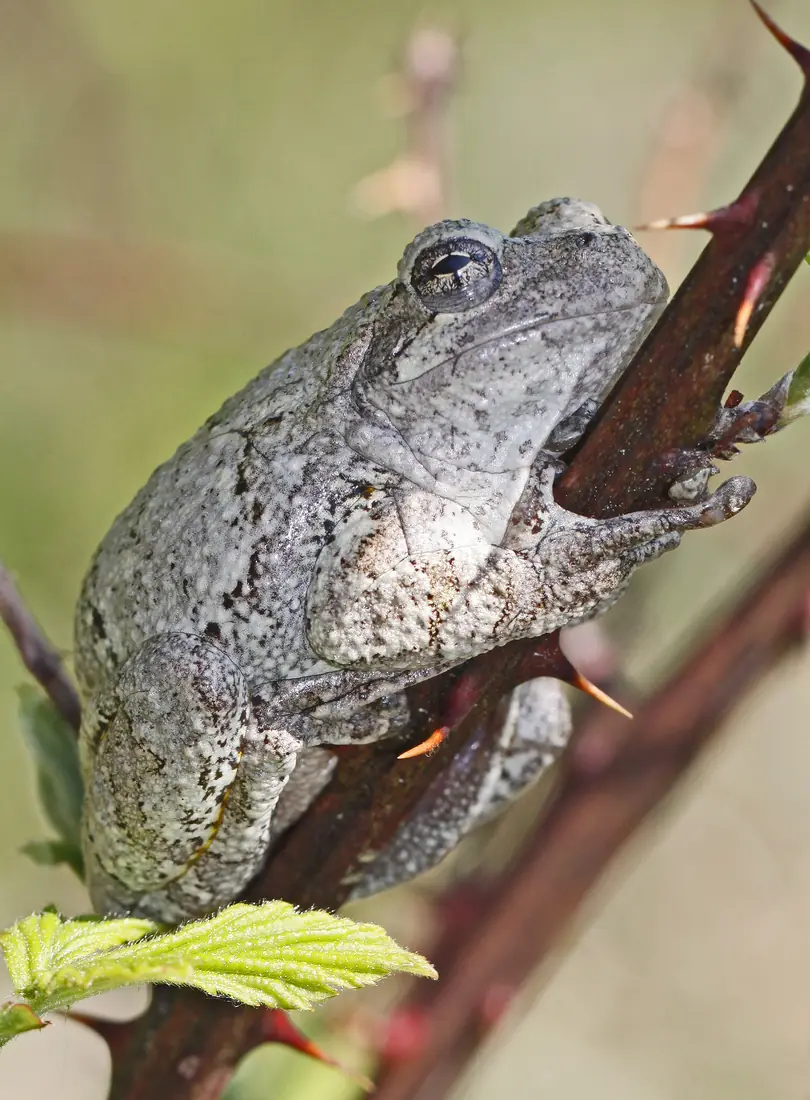
Cope’s gray treefrog
Calls from April to August · Abundant across most of the state, in trees and shrubs near ephemeral and permanent water
The Commission says both gray treefrogs breed from April to August. Cope’s has a harsh, rapid trill, while the common gray treefrog’s trill is often slower and more melodic; the northern gray treefrog is extremely rare and documented only in Warren and Caswell counties. Females lay clusters of 30 to 40 eggs on the water’s surface, and tadpoles take six to nine weeks to transform. Listen first, then look with a flashlight.
Treefrogs and gopher frogs share the night with the earlier callers from our March guide. Jot down the temperature at each call for your field journal, because the first night each species calls tells you more about the weather than the date.
What blooms in North Carolina in April, and when is the last spring freeze?
The lower slopes of the Great Smoky Mountains National Park are one of the best wildflower places in the East, and the North Carolina side has trails as good as any in Tennessee. Below is the last-freeze table for eight main stations, showing when 32 °F nights usually stop. Plan around the median, and remember that mountain frost can hit buds that opened in a warm week.
-
Smokies spring wildflowers
The peak is usually in the middle to end of April at lower elevations, and a few weeks later higher up · Great Smoky Mountains National Park: Oconaluftee River Trail near Cherokee (about three miles round trip), Cove Hardwood Nature Trail from Chimneys Picnic Area, Porters Creek Trail
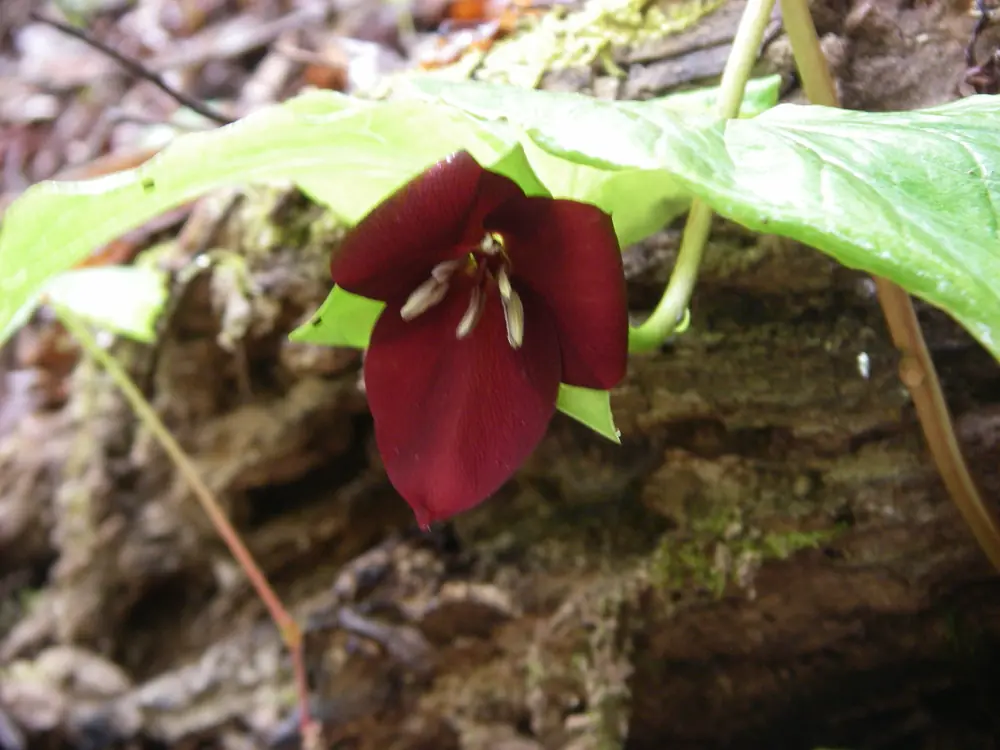
The Park Service says the park holds more than 1,500 kinds of flowering plants, and that its spring ephemerals show up from February to April and finish flowering, setting fruit and dying back in about two months, before the canopy closes. Its list of common spring flowers includes spring beauty, bloodroot, hepatica, trout lily, foamflower, wild geranium, fire pink, crested dwarf iris, showy orchis, bleeding heart and five trillium species by name; ten trilliums grow in the park in all. The Park Service singles out Porters Creek for its late March through April displays, and the short Cove Hardwood loop for some of the best wildflowers in the park. On the North Carolina side it suggests the easy Oconaluftee River Trail beside the Oconaluftee River.
-
Spring Wildflower Pilgrimage
April 7 to 10, 2027, according to the organizer · Programs based in Gatlinburg, Tennessee, with walks in the national park
The nonprofit that runs the Spring Wildflower Pilgrimage lists the 77th annual event for April 7 to 10, 2027, and describes expert-led walks, displays and talks on wildflowers, fungi, trees, birds, salamanders and insects. Check the organizer’s site for registration and program details, which have not been published for 2027.
-
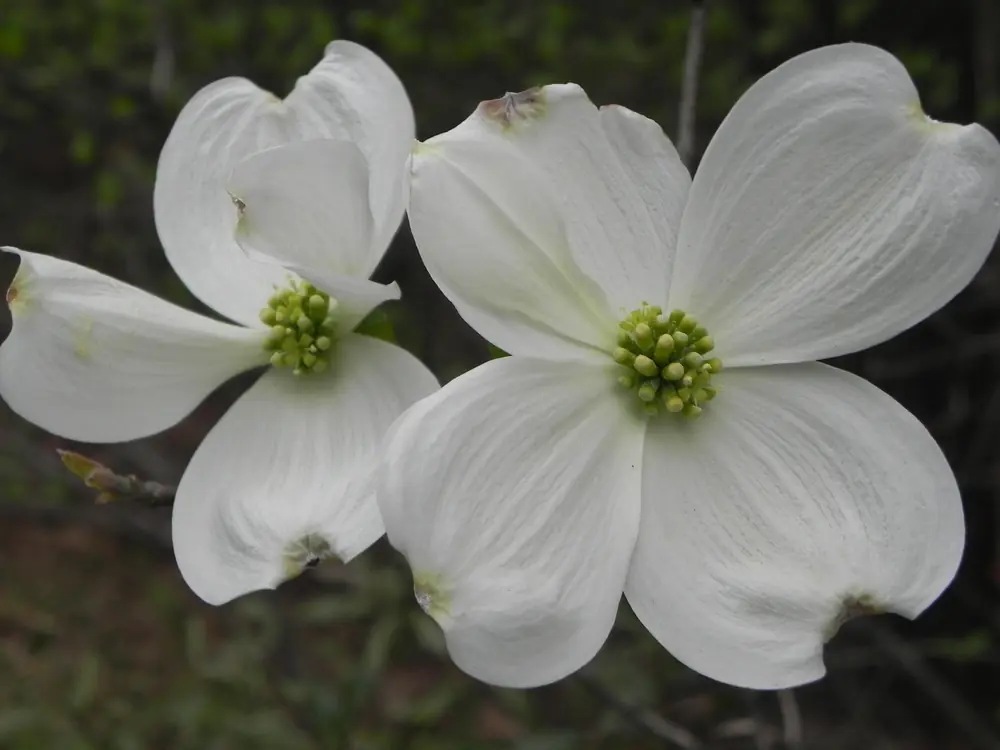
Flowering dogwood
March to May; April is the usual peak in the Piedmont · Woodland edges and understories throughout the state
N.C. Cooperative Extension’s plant toolbox says the tree blooms from March to May, before it leafs out. The showy white “petals” are four bracts, not the true flowers, and the small tree’s red fruit feeds songbirds, wild turkeys and mammals from fall through winter. Dogwood anthracnose is not common, the toolbox adds, and occurs mostly at 1,800 feet or higher.
-
Flame azalea
April at low elevations; sources differ on the rest · Woodland slopes and balds in the Appalachians
The Park Service says flame azalea blooms in April at low elevations and in June and July high in the park, while the Extension toolbox lists a May-to-July bloom. Where the two disagree, elevation is the reason; ask a ranger or a Blue Ridge Parkway visitor center before you plan a trip around it.
| Station | One year in ten | Median | Nine years in ten |
|---|---|---|---|
| Murphy | Apr 7 | Apr 22 | May 7 |
| Asheville | Mar 20 | Apr 6 | Apr 24 |
| Boone | Apr 17 | May 2 | May 19 |
| Charlotte | Mar 12 | Mar 30 | Apr 14 |
| Raleigh | Mar 15 | Mar 31 | Apr 16 |
| Wilmington | Feb 26 | Mar 19 | Apr 4 |
| Elizabeth City | Mar 7 | Mar 27 | Apr 18 |
| Cape Hatteras | Feb 4 | Mar 4 | Mar 25 |
Venus flytraps are in leaf in April but do not flower until May and June, according to The Nature Conservancy’s Green Swamp Preserve page. Find your own town on our North Carolina frost dates page.
What happens to North Carolina’s wild red wolves in April?
Pups are born in spring in the wild population that lives on the Albemarle Peninsula, the wild red wolf population. Nobody should expect to see one, and the program asks the public to keep a long distance.
-
Red wolf pups
In 2026, litters were born in early and mid-April · Alligator River National Wildlife Refuge and nearby private land; wild wolves range across Beaufort, Dare, Hyde, Tyrrell and Washington counties
The Fish and Wildlife Service’s red wolf program reported four litters in April 2026: two on Alligator River National Wildlife Refuge in early April, with six and seven pups, and others on private land in early and mid-April. In August 2026 it counted 21 collared adults and subadults, with an estimated 22 to 23 adults and subadults plus 14 to 15 pups in the wild population. The program asks visitors to stay at least 100 yards away, and farther if the animals change their behavior.
The numbers change as pups are monitored through the year, so read the program’s page for the latest. Our February guide also covers red wolves.
When does mountain trout season open in North Carolina?
Anglers mark a spring date on the calendar for the first Saturday in April. In 2027 that is April 3, and the Wildlife Resources Commission says Hatchery Supported waters open at 7 a.m.
-
The Hatchery Supported opener
7 a.m. on the first Saturday in April (April 3, 2027); closed March 1 through the first Friday in April · Mountain streams listed as Hatchery Supported Trout Waters
The Commission’s trout page says these waters stay open until the end of February, with a creel limit of seven trout a day and no minimum length. Some stretches carry special rules, so read the posted signs and the current regulations digest for each water before you fish.
-
Delayed Harvest waters
October 1 through the Friday before the first Saturday in June · Designated Delayed Harvest waters
During this period no trout may be harvested or possessed, only artificial lures with single hooks are allowed, and possessing natural bait while fishing is prohibited.
-
Fewer fish in the truck
2026, 2027 and possibly 2028 stocking seasons · Mountain counties
The Bobby N. Setzer State Fish Hatchery, which the Commission says produces more than 75 percent of the state’s stocked trout, is being renovated, and the Commission has said stocking will be reduced in 2026, 2027 and possibly 2028. A September 2026 release adds that Hurricane Helene damaged the Armstrong hatchery, that stocking will run at only about 35 percent of normal during the Setzer closure, and that Setzer is expected to reopen at the end of 2027. Expect lighter stocking and check the Commission’s stocking updates.
Wade carefully in April; rain can make mountain streams cold and fast.
Is April still wildfire season in North Carolina?
Yes. Fire danger does not end when the trees leaf out. A dry, warm April with low humidity and wind can be as risky as March, and the state’s open-burning rules change quickly.
-
What the Forest Service did in 2026
Ban began March 28, 2026; lifted for 81 counties on May 3, 2026 · Statewide in 2026; 19 counties kept restrictions
WFAE reported that the N.C. Forest Service banned open burning statewide on March 28, 2026, cancelling nearly 18,000 permits, and lifted the ban in 81 counties on May 3, but not in 19 others. The commissioner said then that the state was still in the thick of spring wildfire season. New permits had to be obtained after the ban, and local fire marshals control burns near buildings. A ban can arrive and end on short notice, so check before you burn.
-
One recent April as a reminder
April 2026 · Statewide
The State Climate Office called April 2026 the second warmest April since 1895, with a statewide average of 63.6 °F, and the fifth driest in 132 years at 1.31 inches. Raleigh, Charlotte and Wilson all went 19 days in a row, April 6 to 24, with no measurable rain, and Asheville reached 90 °F on April 15, its first April 90-degree day on record. Raleigh also had a 32 °F night on April 9. Not every April looks like this one, but it shows how fast warmth, dry air and a late frost can arrive together.
Never leave a fire unattended, and drown and stir ashes until cold.
How warm is April in North Carolina, and what are the hazards?
April warms quickly. Charlotte’s normal high is 73.2 °F and Raleigh’s 72.7 °F, while Boone’s is only 61.7 °F with a normal of 8.5 freezing nights. Asheville gets 0.2 inch of snow and Boone one inch, while Cape Hatteras has no freezing nights at all.
| Station | Average high | Average low | Freezing nights | Rain and melted snow | Snowfall |
|---|---|---|---|---|---|
| Boone | 61.7 °F | 36.9 °F | 8.5 | 5.52 in | 1.0 in |
| Asheville | 69.4 °F | 44.6 °F | 2.3 | 4.17 in | 0.2 in |
| Greensboro | 71.0 °F | 47.9 °F | 1.1 | 3.78 in | 0.0 in |
| Charlotte | 73.2 °F | 49.1 °F | 0.7 | 3.84 in | 0.0 in |
| Raleigh | 72.7 °F | 48.9 °F | 1.1 | 3.53 in | 0.0 in |
| Wilmington | 74.6 °F | 52.6 °F | 0.2 | 3.07 in | 0.0 in |
| Cape Hatteras | 69.4 °F | 54.1 °F | 0.0 | 3.92 in | – |
Severe weather is the main April hazard. The State Climate Office’s review of April 16, 2011, which it describes as the most numerous and possibly most widespread tornado outbreak in the state’s history, counts 32 confirmed tornadoes in one day, 24 deaths, 304 injuries and about $328 million in damage. The previous one-day record was 20 tornadoes in May 1998. That is an extreme case, not a forecast, but it is the reason to know where you would shelter and how you would get a warning. Late freezes are the other threat: Boone’s median last freeze falls on May 2.
A fresh three-month outlook comes out near mid-month, and the newest one is posted at the Climate Prediction Center. The weather page is the place for the next few days, and the cloud guide describes how a squall line looks as it approaches.
How much daylight does North Carolina gain in April?
Between April 1 and April 30, 2027, Wilmington gains 58 minutes of daylight, Charlotte and Cape Hatteras 60, Raleigh 61, and Elizabeth City 63, roughly two minutes a day. By the 30th Wilmington has 13 hours and 32 minutes from sunrise to sunset and Elizabeth City 13 hours and 39 minutes.
| City | Apr 1 | Apr 30 | Gained | Per day |
|---|---|---|---|---|
| Murphy | 12 h 34 m | 13 h 35 m | 61 min | 2.1 min |
| Asheville | 12 h 35 m | 13 h 36 m | 61 min | 2.1 min |
| Boone | 12 h 36 m | 13 h 38 m | 62 min | 2.1 min |
| Charlotte | 12 h 35 m | 13 h 35 m | 60 min | 2.1 min |
| Raleigh | 12 h 35 m | 13 h 36 m | 61 min | 2.1 min |
| Wilmington | 12 h 34 m | 13 h 32 m | 58 min | 2.0 min |
| Elizabeth City | 12 h 36 m | 13 h 39 m | 63 min | 2.2 min |
| Cape Hatteras | 12 h 35 m | 13 h 35 m | 60 min | 2.1 min |
Clocks have read daylight time since March 14, so nothing changes in April; the table counts hours of daylight, not clock times. To find your own town’s sunrise and sunset, open the daylight calculator.
What is in North Carolina’s night sky in April 2027?
Times here are Eastern Daylight Time. The Moon is new on April 6, so the nights around it are good for faint objects, and the middle of the month belongs to the Pink Moon.
-
The Pink Moon
Full at 6:27 p.m. EDT on Tuesday, April 20 · Rising in the east after sunset
The U.S. Naval Observatory times the full Moon at 22:27 Universal Time on April 20, which is 6:27 in the evening in North Carolina. Because the full instant arrives before moonrise, the 20th is the best evening, with a round Moon lifting above the eastern horizon shortly after dark falls; the 19th and 21st are close seconds. SeaSky explains the name by the moss pink, also called wild ground phlox, a flower of this season.
-
A poor year for the Lyrids
Our calculation puts the peak between about 9:40 and 10 p.m. EDT on Thursday, April 22; SeaSky lists the nights of April 22 and 23 · Look northeast to east, away from lights
The Lyrids usually give about 20 meteors an hour under dark skies, SeaSky says, but this year the nearly full Moon will hide most of the faint ones. Moonlight arrives late that night, around 10 p.m. or after, since the Moon is just past full. Try the dark early evening, remembering that Lyra, where the streaks seem to originate, hangs low in the northeast. Expect a few an hour, with the occasional bright streak.
-
The Moon beside Jupiter
Evenings of Wednesday, April 14, and Thursday, April 15 · High in the southern sky after dusk
Our own calculation puts the Moon just under a degree from Jupiter on the 15th, when the Moon is about 68 percent lit. The pair is tightest at about 10:19 a.m., in daylight, so watch the evenings on either side.
| Phase | Date | Time |
|---|---|---|
| New moon | Tuesday, Apr 6 | 7:51 p.m. |
| First quarter | Tuesday, Apr 13 | 6:56 p.m. |
| Full moon, the Pink Moon | Tuesday, Apr 20 | 6:27 p.m. |
| Last quarter | Wednesday, Apr 28 | 4:18 p.m. |
Any other date can be checked on the moon phases page. May brings the Eta Aquarids, and SeaSky expects a great show in early May because the Moon is nearly absent and skies stay dark all night.
What can families do outside in North Carolina in April 2027?
- Take a dawn walk for the wood thrush. Go to a wooded path in the first hour after sunrise and note the day you hear one. Compare it with last year’s notes if you kept any.
- Make a dogwood record. Choose a tree, photograph it once a week and count the days from bud to full bracts.
- Visit the Smokies for wildflowers. Take the Oconaluftee River Trail near Cherokee or the Cove Hardwood loop and keep a checklist of every flower you find. The Spring Wildflower Pilgrimage runs April 7 to 10, according to its organizer.
- Mark Earth Day on Thursday, April 22. Earthday.org lists “Food for our planet” as its 2027 theme. Put in a native shrub, or clear litter from a creek bank.
- Join the City Nature Challenge, a worldwide photo count of wildlife. Photos are collected April 30 to May 3, 2027; identifications wrap up May 16 and results follow on May 20. Look on the organizers’ site to see which North Carolina areas take part.
- Go for a night walk in a mild week. Bring a flashlight and listen for gray treefrogs.
- See the Pink Moon on the evening of April 20. Look east after sunset.
State parks and nature centers post spring programs, but none are listed for 2027 yet; check the state events calendar or phone ahead. Keep notes from each outing in your Naturalist’s Field Journal; the guides for May continue the story.
Safety notes for April in North Carolina
- Turkey season. The Wildlife Resources Commission’s 2026–27 dates list a youth turkey season on April 10 and 11, 2027, and the statewide spring season from April 17 to May 15, for male or bearded turkeys only. North Carolina’s hunter orange law exempts wild turkey hunters, so wear a bright hat on game lands anyway and keep clear of anyone calling in the woods. Gray squirrel season reopens May 17.
- Trout waters. Hatchery Supported waters open at 7 a.m. on Saturday, April 3. The creel limit is seven a day. Delayed Harvest waters remain catch-and-release until the Friday before the first Saturday in June.
- Storms and floods. Decide where you would shelter before any tornado watch is issued, and turn around at a flooded road.
- Wildfire. Check for a burn ban before you light a pile and get a permit when one is required.
- Frost. A late freeze can nip early plantings in the mountains; the median last freeze at Boone is May 2.
- Black bears. The Commission says most bears emerge in March or early April, and that they now live across roughly 60 percent of North Carolina’s land. Lock up trash, pet food and bird seed; the Commission points to Bearwise.org.
- Ticks. American dog ticks and lone star ticks are active in spring. Wear repellent, pull socks over pant legs, and look yourself over after each walk. Seek medical care if flu-like symptoms appear within about 2 to 21 days after a bite.
- Red wolves. Stay 100 yards or more away and follow refuge closures.
- Beaches. Leash your dog and skip any fenced stretch of beach.
- Blue Ridge Parkway. As of October 7, 2026, the Park Service listed the section from milepost 344.2 to 355.3 near Mount Mitchell as closed for Hurricane Helene damage, with recreation of any kind prohibited, and the Linville Falls campground and picnic area closed. Check the closures page before you go.
Sources (40)
- N.C. Wildlife Resources Commission: hunting and trapping season dates, July 1, 2026 to June 30, 2027 (PDF)
- N.C. General Statute 113-291.8: hunter orange
- Birds of the Central Carolinas (Seriff), via the Carolina Bird Club: wood thrush (PDF)
- Birds of the Central Carolinas (Seriff), via the Carolina Bird Club: indigo bunting (PDF)
- Birds of the Central Carolinas (Seriff), via the Carolina Bird Club: rose-breasted grosbeak (PDF)
- Birds of the Central Carolinas (Seriff), via the Carolina Bird Club: scarlet tanager (PDF)
- Journey North: hummingbird program and migration maps
- Coastal Review: Sam’s field notes, painted bunting (2016)
- Our State: painted buntings, winged rainbows
- WUNC: the painted bunting at Dix Park (2026)
- National Park Service: Cape Hatteras National Seashore 2016 natural resources annual reports (PDF)
- National Park Service: 2015 colonial waterbirds annual report, Cape Hatteras
- U.S. Fish and Wildlife Service: Pea Island National Wildlife Refuge
- N.C. Wildlife Resources Commission: Carolina gopher frog species page
- N.C. Wildlife Resources Commission: Cope’s and northern gray treefrogs
- National Park Service: wildflowers of Great Smoky Mountains National Park
- National Park Service: common spring wildflowers in the Smokies
- National Park Service: wildflower hikes in the Smokies
- Spring Wildflower Pilgrimage (organizer): 77th annual, April 7 to 10, 2027
- N.C. Cooperative Extension plant toolbox: flowering dogwood
- N.C. Cooperative Extension plant toolbox: flame azalea
- The Nature Conservancy: Green Swamp Preserve
- U.S. Fish and Wildlife Service: Red Wolf Recovery Program
- North Carolina Wildlife Federation: red wolf pup season update
- N.C. Wildlife Resources Commission: trout fishing in North Carolina
- N.C. Wildlife Resources Commission: adjusting fall 2026 mountain trout stockings
- WFAE: burn ban lifted for western North Carolina, but drought is far from over (May 4, 2026)
- N.C. State Climate Office: April 2026 climate summary
- N.C. State Climate Office: April 2011 tornado outbreak, one for the records
- NOAA NCEI: 1991–2020 monthly normals for seven North Carolina stations, April (data API)
- Climate Prediction Center: seasonal (90-day) outlooks
- U.S. Naval Observatory: moon phases for 2027 (data API)
- SeaSky: astronomy calendar 2027
- EARTHDAY.ORG
- City Nature Challenge: 2027 dates
- N.C. Wildlife Resources Commission: black bear species page
- N.C. Cooperative Extension, Lee County: tick season
- National Park Service: Blue Ridge Parkway road closures
- N.C. Department of Natural and Cultural Resources: events calendar
- Photos via Wikimedia Commons; licenses and photographers are credited under each picture