What to look for in nature in North Carolina this February
February is the hinge of North Carolina’s year. The calendar still says winter, and Mount Mitchell still averages more than eighteen inches of snow in these four weeks, but the first signs of the new season come in from the south and up from the ground. On the Albemarle Peninsula the last wild red wolves on Earth choose this month to mate. Eaglets hatch in pine-top nests beside the big reservoirs, and the first purple martin scouts and returning ospreys reach the southern Coastal Plain. Red maples color the swamps with tiny scarlet flowers, trout lilies push up through the leaf litter, and in mountain pools wood frogs gather and quack like a flock of ducks. In the night sky Leo hosts two planetary oppositions, Jupiter’s on the 10th and Mars’s on the 19th, and on the 20th the Snow Moon rises in the faint shadow of a penumbral eclipse. Below, each event has its usual timing, region by region, and the source behind it.
Other months in North Carolina: October, November, December, January.
Start here
- Count birds for four days in mid-February. From Friday, February 12, to Presidents’ Day, Monday the 15th, birders everywhere tally what they see for the Great Backyard Bird Count. Watch for fifteen minutes or more, anywhere in the state, and enter what you see in the Merlin or eBird app.
- Listen for quacking from a woodland pool. On the first mild, rainy evenings of the month in the Mountains and western Piedmont, wood frogs gather to breed in temporary pools. Their chorus sounds like distant ducks. Listen from the trail and leave the egg masses where they lie.
- Find Jupiter opposite the setting sun. On Wednesday evening, February 10, Jupiter clears the eastern treeline around sundown and is still up at dawn. Nothing in that part of the sky outshines it, and a pair of binoculars held steady reveals its largest moons as tiny sparks.
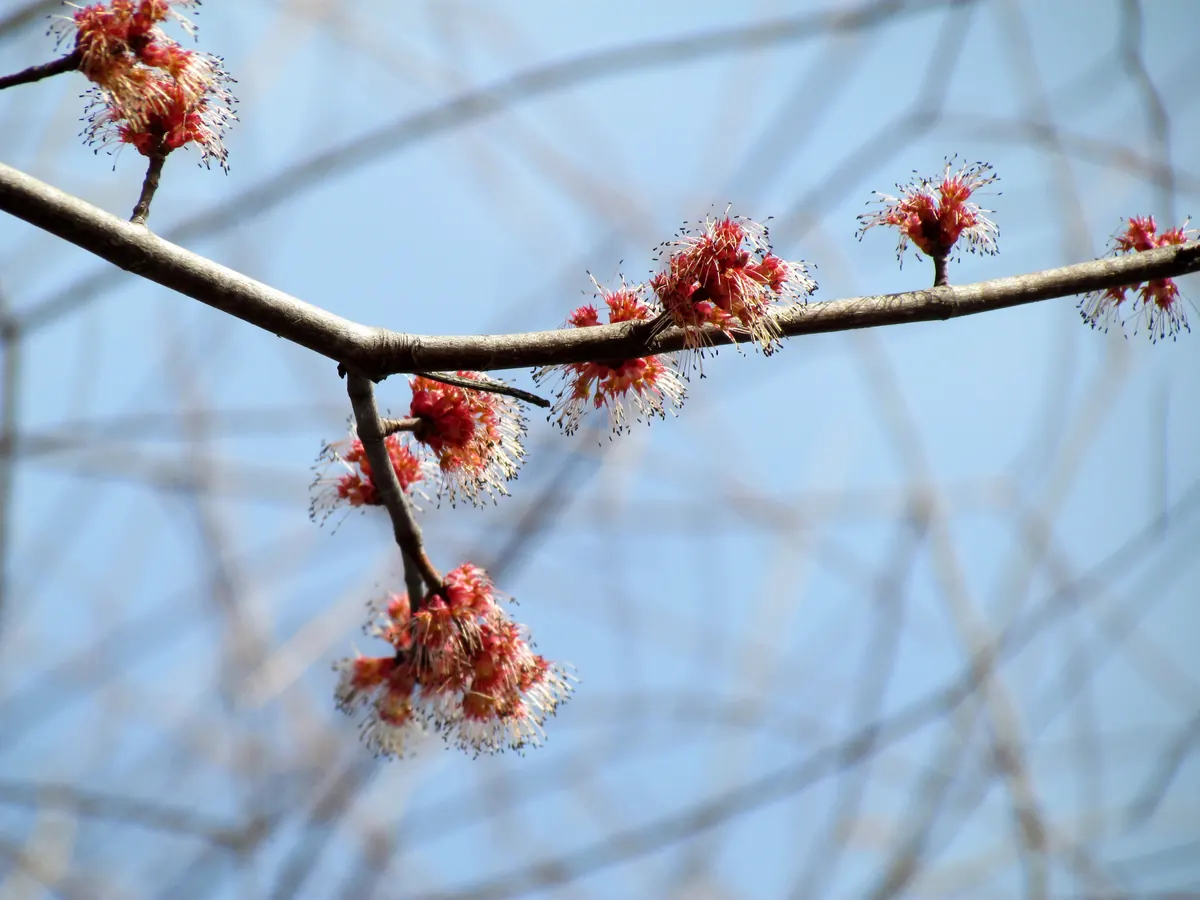
For the Naturalist’s Field Journal: write the first purple martin, the first osprey and the first trout lily of 2027 on the daily field log, and check the same eagle nest every week for the same place twice. A red maple twig in flower, sketched close up, suits a tree through the seasons; the wood frogs’ quacking and the spring peepers’ bells belong on a map of sounds; the four-day bird count tally fills the birds I have seen plate; and Jupiter, Mars and the Snow Moon earn a page of their own under dusk and dawn watch.
Regions used below: Mountains; Foothills; Piedmont; Sandhills; Coastal Plain; Outer Banks and the coast.
When do red wolves breed in North Carolina, and where can you see one?
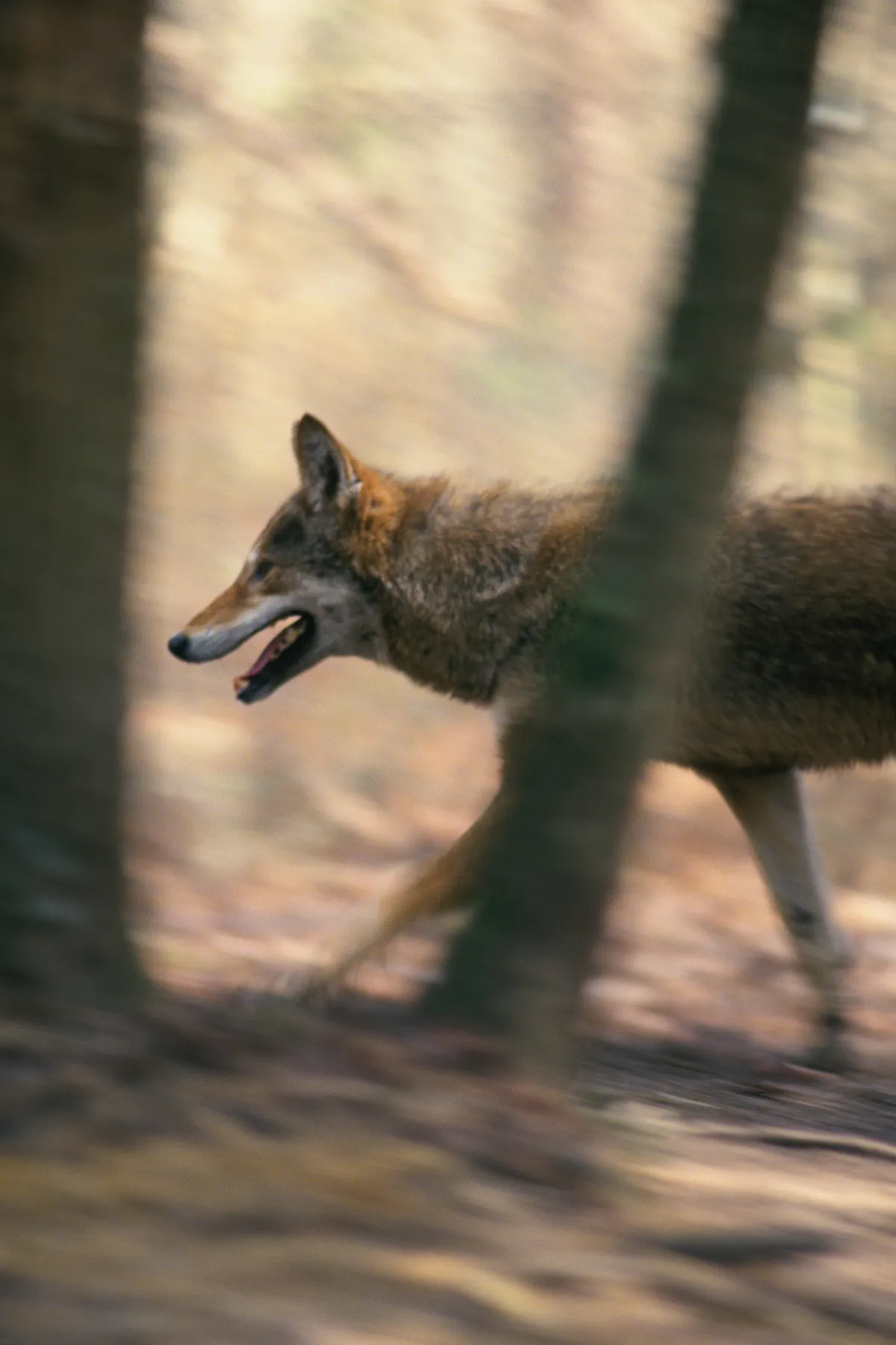
The only wild red wolves in the world live in five counties of northeastern North Carolina: Beaufort, Dare, Hyde, Tyrrell and Washington, on the low, wet Albemarle Peninsula between the sounds. The species was gone from the wild by 1980, and the U.S. Fish and Wildlife Service brought captive-bred wolves back to Alligator River National Wildlife Refuge in 1987. February is the most important month in their calendar, because it is the one month of the year when they mate.
-
The mating season
February; pups follow in April or May · Alligator River and Pocosin Lakes national wildlife refuges and nearby farms and forests on the Albemarle Peninsula
The Service describes red wolves as pairing for life and breeding once a year, in February, with the pups born in April or May. A pack is usually a breeding pair and their young of one or two years, five to eight animals in all, and in North Carolina a pack may range over 20 to 80 square miles depending on how much prey it can find. Deer, raccoons, rabbits, rodents and nutria make up most meals. A red wolf is a lanky, long-legged animal of 45 to 80 pounds, brown and buff with a dark saddle and a reddish wash on the ears, head and legs.
-
Why this February matters
The 2027 breeding season · The five-county recovery area
The 2026 season was the best in years. In its June 2026 update, the Red Wolf Recovery Program reported four wild litters with 23 pups born, of which at least 12 and perhaps as many as 16 were still alive, alongside an estimated 22 or 23 adults and subadults. That means more breeding pairs than in many years may be bonding this February. Collisions with cars are the leading known cause of death, so drive slowly at dusk on US 64 and the refuge roads.
-
Watching without disturbing
Dawn and dusk · Wildlife Drive at Alligator River; the Pungo Unit at Pocosin Lakes; the Red Wolf Center near Columbia
Alligator River calls itself one of the very few places on Earth where you might see a wild red wolf, though most visitors will not. If you do, stay well back, keep to your car or the road, and never feed or call to it. The surest look is at the Red Wolf Center on Pocosin Lakes refuge near Columbia, run with the North Carolina Wildlife Federation, where a captive pair lives in a large enclosure; ask the refuge for the current program days before you drive out.
If you think you saw a wild red wolf, note the place and time and report it to the Red Wolf Recovery Program. Photos from a distance help biologists tell wolves from coyotes.
When do bald eagle chicks hatch in North Carolina?
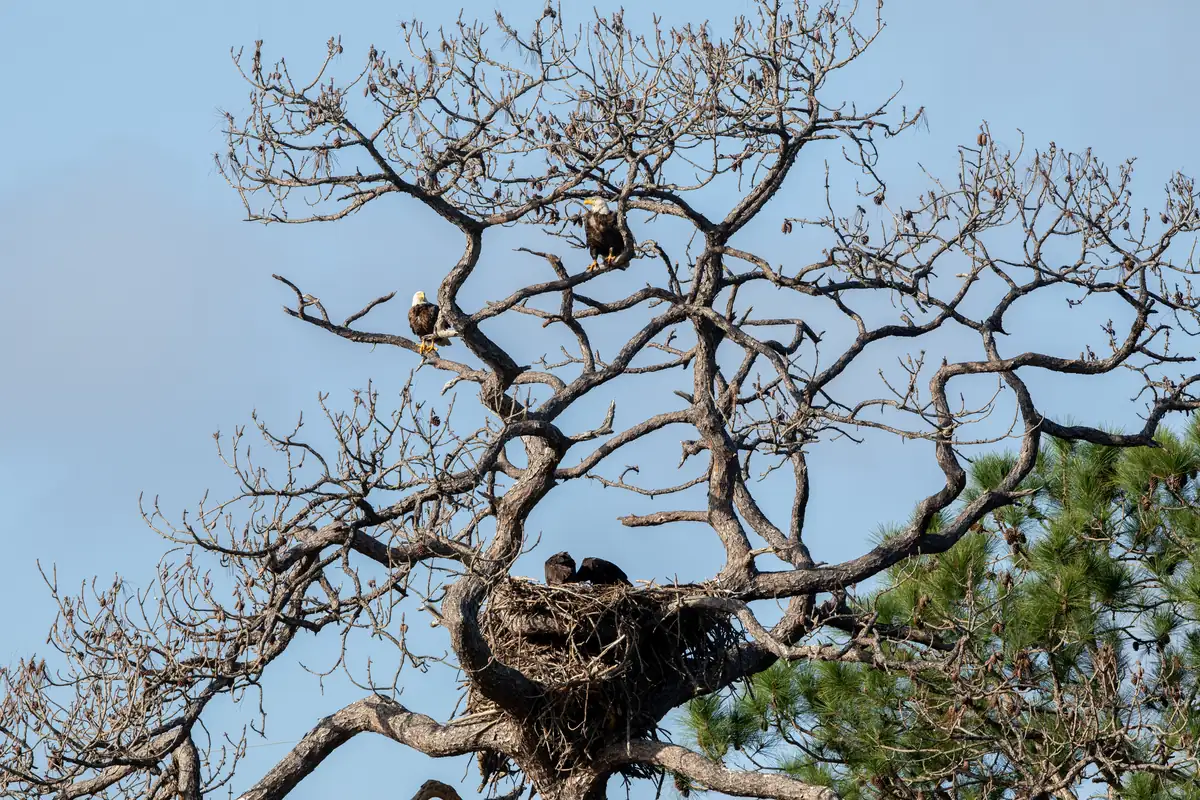
In January the state’s eagles and great horned owls settled onto eggs. In February many of those eggs hatch, and the adults change from sitting still to flying back and forth with food.
-
Eaglets in the nest
Many hatch in February and March · Big lakes and rivers: Jordan and Falls lakes and the reservoirs of the western Piedmont in the Piedmont; Mattamuskeet and the sounds in the east; a few lakes in the southwestern mountains
The Wildlife Resources Commission’s profile gives the arithmetic: nesting starts in January, the eggs take 30 to 40 days to hatch, and the chicks stay on the nest for roughly eleven weeks before flying. So a nest that was quiet in January holds hungry chicks by February, and the first flights come in late spring. By the Carolina Bird Club’s reckoning, more than 100 nests are spread over most of North Carolina, usually in a tall living pine or cypress near water. Adults tearing at a fish on the rim of the nest are the giveaway; the downy chicks themselves stay low in the bowl for their first weeks.
-
Quieter owls
Through February · Woodlots and farm edges in every county
Great horned owls are the loudest in late fall. The Commission notes that their calling drops off once eggs are in the nest, and falls further once the young have hatched. If a pair you heard all December has gone quiet, they may be busy feeding owlets in an old hawk nest. Look for whitewash and pellets under big pines.
Keep well back from any nest, use binoculars or a scope, and back away the moment a parent begins circling or calling. Both species are protected under state and federal law.
When do purple martins, ospreys and bluebirds come back to North Carolina?
The first returning birds of the year reach North Carolina in February, weeks before most of the spring migrants. They come early to claim the best nest sites.
-
Purple martin scouts
Late February in a good year; often March now · Martin houses and gourd racks, mostly in the Coastal Plain and Piedmont
The Carolina Bird Club account says martins often reached the state by late February, well ahead of the last hard frosts, but adds that the species has declined here, especially as a breeder, and the birds often do not come until March these days. Almost every martin in North Carolina nests in a house or gourd that people put up, so if you have one, clean out last year’s nests before the first scouts show up.
-
Ospreys back on the coast
Late February or early March · Sounds, estuaries and coastal rivers; Jordan and Falls lakes and other Piedmont reservoirs a little later
According to the bird club, ospreys are mostly present in the Coastal Plain from late February or early March until November, and a few now linger all winter along the southern coast. Watch the big stick nests on channel markers and dead trees for the first pair to come back. Inland, the Piedmont birds follow the same timing; the bird club calls ospreys very rare there in January and February.
-
Bluebirds claiming boxes
From mid-February · Fields, golf courses, cemeteries and big yards with nest boxes; statewide except the barrier islands and the highest mountains
Eastern bluebirds live here year round, but they spend the winter in small roving flocks eating berries. The Commission says they start heading back to breeding sites around mid-February, and males stake out a cavity or box as early as March. It is a good week to put up a new box or clean an old one; the first eggs usually wait until spring.
Note your first martin, osprey and bluebird at a box in eBird, so the arrival dates help track how spring is shifting.
Which frogs and salamanders breed in North Carolina in February?
Cold-water breeders get started now. A mild rain after a cold snap can bring dozens of frogs and salamanders to a single temporary pool in one night.
-
Wood frogs, the quackers
Most often in February · Much of the Mountains and western Piedmont; an isolated population in Hyde and Tyrrell counties
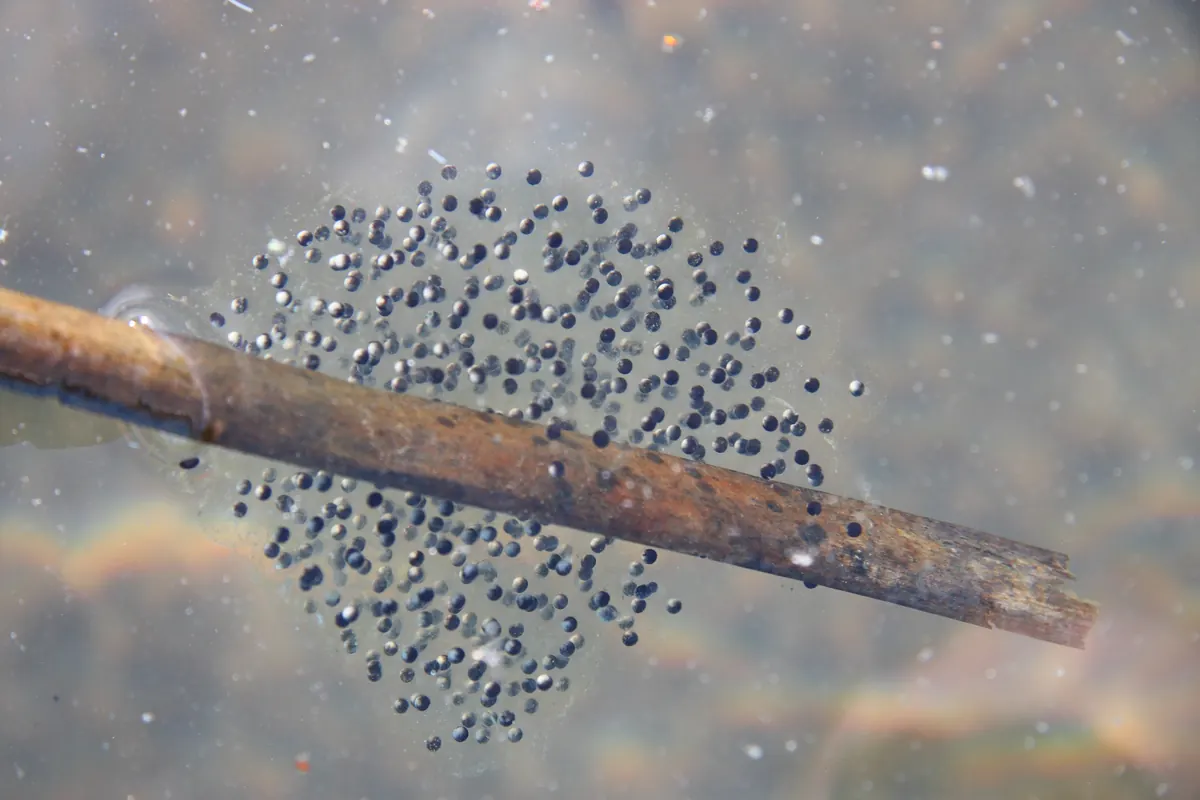
Amphibians and Reptiles of North Carolina, the state’s herp atlas, says wood frogs breed in winter and most often in February. They are explosive breeders: the whole local population can arrive, call, mate and leave a pool within a few nights. The call is a raspy, clucking “caw-aw-awk,” and a full chorus sounds like a raft of ducks. The frogs leave big, round egg masses on sticks and plants, often clustered together, which may help keep them from freezing. Look for a tan to dark brown frog with a dark mask through the eye; the atlas calls the species extremely cold-tolerant, which explains how it can breed while other frogs wait.
-
Spotted salamanders right behind them
Late winter; in the mountains, soon after the wood frogs · Vernal pools in hardwood forest, including along the Blue Ridge Parkway
On the Parkway, the Park Service says, wood frogs are the first out in February and spotted salamanders follow soon after. The salamanders live as adults mostly underground. Their pools hold no fish because they dry each summer, which is exactly why these animals use them.
-
Spring peepers and upland chorus frogs
Peepers mostly November to April; chorus frogs winter and early spring · Peepers throughout the state except the Outer Banks; upland chorus frogs mainly in the Piedmont
By February these two make the sound of late winter in the Piedmont. A peeper chorus, the herp atlas says, can carry about a mile and sounds like sleigh bells. Upland chorus frogs make a rising “crrreek,” the sound of a fingertip dragged across a comb’s teeth, and they often breed in roadside ditches and flooded fields.
Watch from the edge, and if you lift a log to look, put it back the way it was. On rainy nights, stay off busy roads, where many are killed.
What is flowering in North Carolina in February?
The first flowers of the year in North Carolina come mostly from trees and vines, not from the garden. Look up in the swamps and along the roads, and down in rich bottomland woods.
-
Red maple in flower
January to March · Swamps, river bottoms and roadsides in every region
Before any leaves appear, red maples hang out small drooping clusters of red flowers, and a swamp full of them takes on a rusty red haze. N.C. Cooperative Extension notes that bees visit the early flowers for nectar, and that the buds and seeds are a main food for gray squirrels at the end of winter. A warm spell in February can bring them on all at once.
-
Dimpled trout lily
February to April · Moist bottomland and slope forests, and some drier uplands, in all three regions
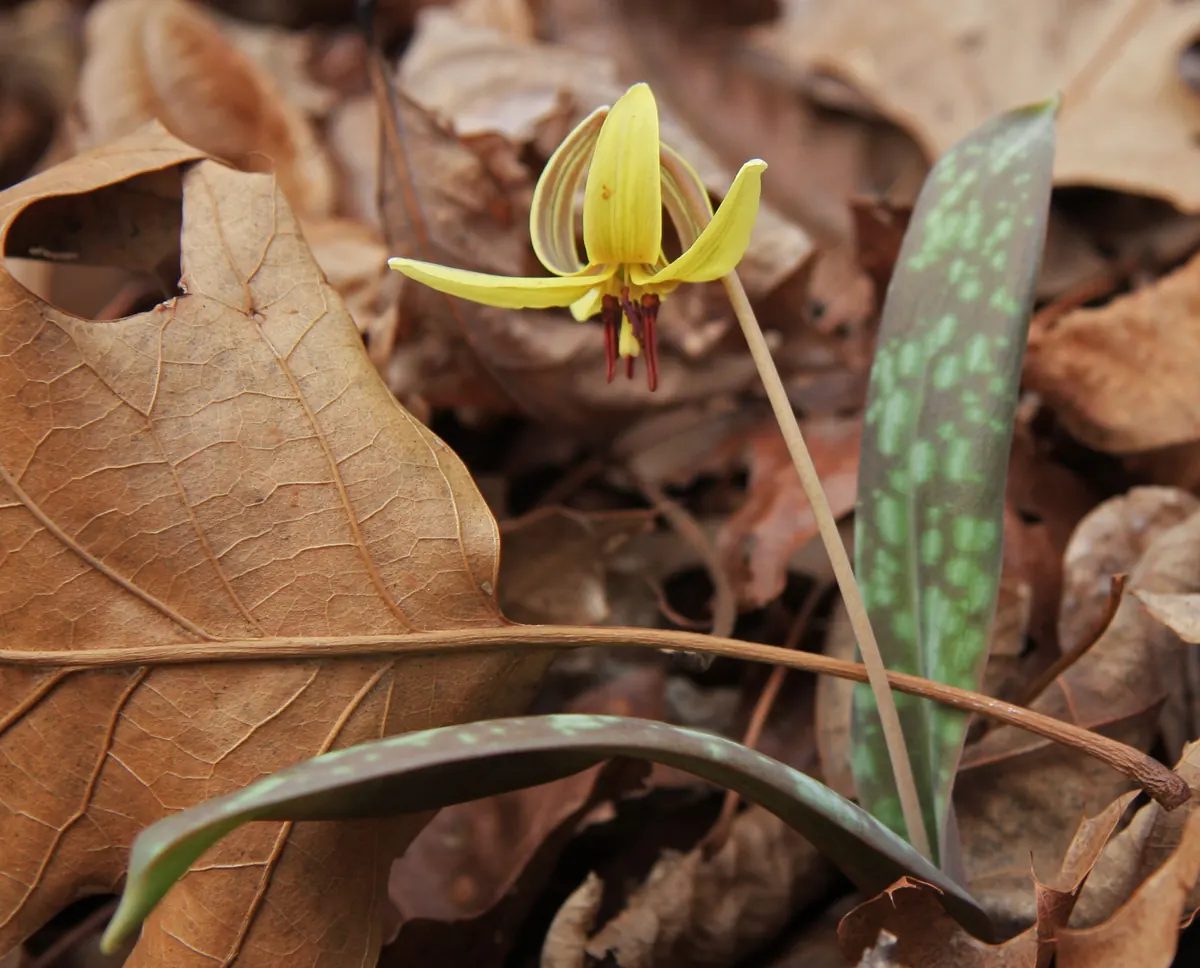
Look first for the leaves: two fleshy, oval leaves three to five inches long, mottled green, brown and purple like the side of a trout. Extension describes one nodding yellow flower on a short stalk, streaked brownish purple on the back of each petal. A colony can spread across a whole slope, so once you find one leaf, look around.
-
Carolina jessamine
February to May · Climbing pines and fences in the Coastal Plain and southern Piedmont
The first yellow trumpets of jessamine open in the warmest parts of the state in February. Extension describes them as fragrant, funnel-shaped and up to an inch and a half long. Enjoy them with your eyes: every part of the plant is highly poisonous, and even its pollen can harm honeybee colonies.
Hepatica and bloodroot are close behind; Extension gives mid-March for the first and March for the second. Until then, look for hepatica’s three-lobed winter leaves, now maroon or nearly purple, in rich woods.
When do tundra swans leave North Carolina?
The great swan flocks of the northeast stay through February, but the season is turning. In the Piedmont the birds are mostly gone by its end, and in the east they begin to thin out over the following weeks.
-
The last weeks in the Coastal Plain
Mainly until late March · Pungo Lake, Lake Mattamuskeet and the farm country of Hyde, Washington, Tyrrell and the northeastern counties
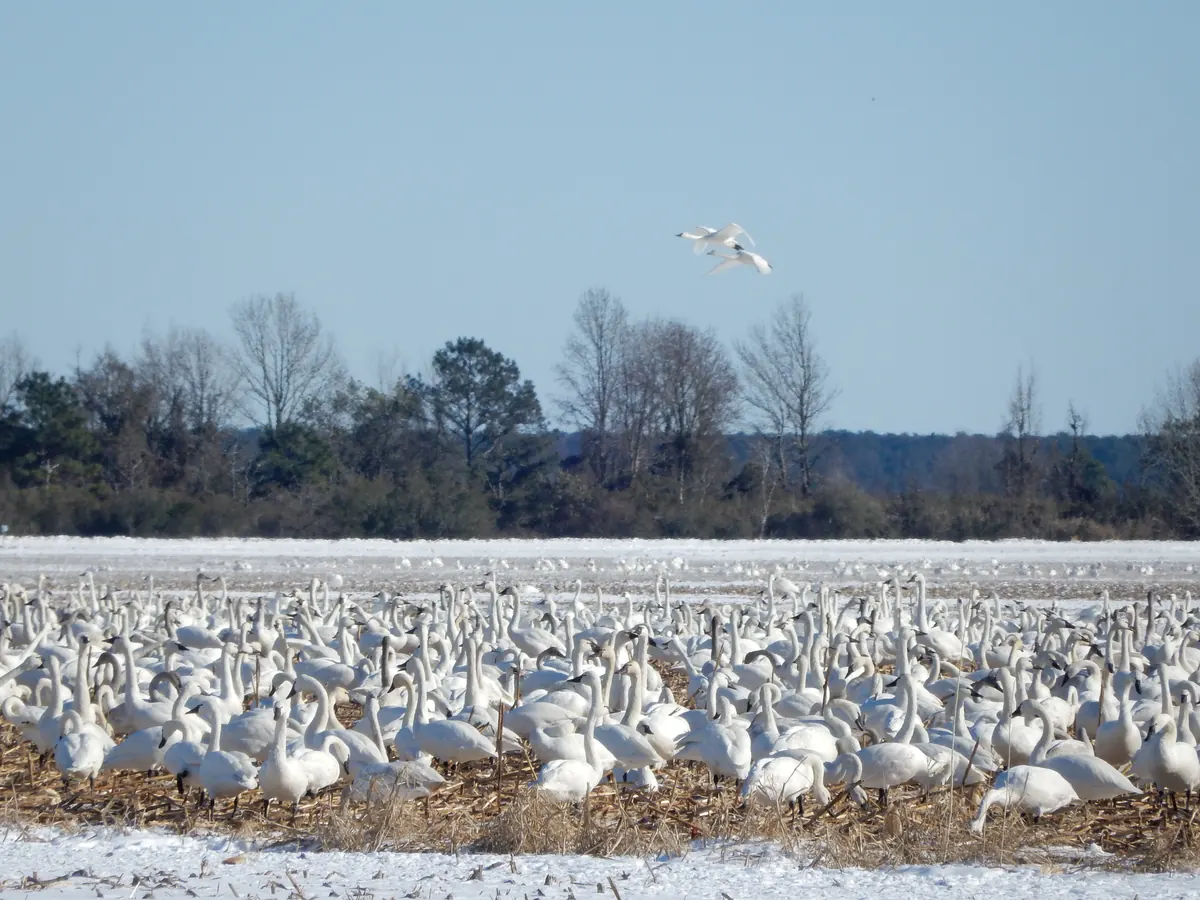
The Carolina Bird Club gives the swans’ season in the Coastal Plain as mainly late October to late March. A big inland flock can turn up in late winter too: the club records 7,000 swans in southeastern Edgecombe County on February 5, 2023. Large flocks can appear in new places at this season, so check fields away from the usual lakes too.
-
Piedmont swans
Late October to late February · Lakes and big ponds, irregularly
In the Piedmont swans are a rare treat, usually seen in flight. The bird club gives their typical span there as late October to late February, with very rare records into April. A line of white birds with long necks heading northeast is worth reporting.
-
Snow geese and the light goose season
Season open to March 10 · Refuges and farm fields of the northeastern Coastal Plain
Snow geese are the last waterfowl still in season: their hunting season runs to March 10, and after the other waterfowl seasons close on February 6, the Commission allows unplugged shotguns and electronic calls for these geese, so expect shooting near some fields.
For how the swan flocks spend the depth of winter, and how biologists count them, see the January page.
When is the Great Backyard Bird Count in 2027?
The Great Backyard Bird Count is a four-day snapshot of where birds are in mid-February, run by the Cornell Lab of Ornithology, the National Audubon Society and Birds Canada. The 2027 count, its 30th, is set by Audubon and Birds Canada for Friday, February 12, through Monday, February 15, 2027; confirm on birdcount.org closer to the time.
-
How to take part
February 12 to 15, 2027 · Anywhere: a yard, a park, a schoolyard, a pier
Watch birds for at least fifteen minutes on one or more days of the count, then enter what you saw. Beginners can use the Merlin app to identify birds and submit the list; more experienced birders can use eBird. Every list counts, even a short one with only cardinals and crows.
-
What North Carolina usually reports
Mid-February · Feeders and woods statewide
Expect the winter regulars: white-throated sparrows, juncos, yellow-rumped warblers, Carolina wrens and chickadees, northern cardinals, and, on the coast, ducks, loons and gulls. The Finch Research Network does not expect many northern finches in the Southeast this winter, so a pine siskin or purple finch would be a good find.
Project FeederWatch also runs until the end of April, for anyone who wants to keep counting at a feeder.
How cold and snowy is February in North Carolina, and what could El Niño bring?
February is a step warmer than January almost everywhere in the state, but not in the high country. Raleigh’s normal high climbs to 55.8 °F and Charlotte’s to 56.6 °F, while freezing nights fall to about 14 and 12. In NOAA’s 1991–2020 normals, Boone actually averages slightly more snow in February (6.7 inches) than in January, and Mount Mitchell still gets 18.6 inches and almost 24 freezing nights in a short month. Down east, Wilmington averages barely a fifth of an inch of snow.
| Station | Average high | Average low | Freezing nights | Rain and melted snow | Snowfall |
|---|---|---|---|---|---|
| Mount Mitchell | 35.5 °F | 18.5 °F | 23.5 | 5.62 in | 18.6 in |
| Boone | 44.7 °F | 23.8 °F | 22.8 | 3.64 in | 6.7 in |
| Asheville | 52.9 °F | 31.2 °F | 17.5 | 3.46 in | 1.9 in |
| Greensboro | 53.3 °F | 32.7 °F | 15.1 | 2.81 in | 2.0 in |
| Charlotte | 56.6 °F | 34.9 °F | 12.0 | 3.13 in | 1.1 in |
| Raleigh | 55.8 °F | 34.2 °F | 13.8 | 2.78 in | 1.4 in |
| Wilmington | 60.3 °F | 38.4 °F | 8.4 | 3.47 in | 0.2 in |
| Cape Hatteras | 56.7 °F | 41.5 °F | 4.7 | 4.34 in | – |
This winter comes with a strong signal from the Pacific. Tar Heel gardeners and skiers alike should know the backdrop: forecasters at the Climate Prediction Center judged in September that a very strong El Niño holding through winter was at least 90 percent certain (ENSO discussion). The N.C. State Climate Office has looked back at a dozen El Niño winters of moderate or greater strength, and February stands out: ten of the twelve were wetter than normal and nine were cooler. It adds that the three latest such winters, 1997–98, 2009–10 and 2015–16, each rank among the state’s ten wettest. Strength cuts both ways, though: across the six strongest events, the Mountains and Piedmont actually saw less snow, so a soggy, chilly February is a better bet than a snowy one. And the wet spell does not always last; only five of the twelve were followed by a wet March.
NOAA refreshes its three-month outlook maps each month, and the latest version there is the one to trust for February. For the days just ahead, our local forecast page has the details, and gardeners itching to plant can check the North Carolina frost dates for the average last spring freeze.
How much daylight does North Carolina gain in February?
February brings the first real jump in daylight. In Raleigh the sun rises at 7:15 a.m. on February 1 and at 6:46 a.m. on February 28, while sunset moves from 5:42 to 6:09 p.m.; the first 6 p.m. sunset of the year there comes on February 19. Charlotte reaches that mark on the 9th. Murphy, at the far western end of the Eastern time zone, already sees the sun set at 6:05 p.m. on the 1st and at 6:31 p.m. by month’s end. The groundhogs get their say on Tuesday, February 2, yet the sun reaches the real halfway mark of winter on February 3 or 4.
| City | Feb 1 | Feb 28 | Gained | Per day |
|---|---|---|---|---|
| Murphy | 10 h 30 m | 11 h 24 m | 54 min | 2.0 min |
| Asheville | 10 h 28 m | 11 h 22 m | 54 min | 2.0 min |
| Boone | 10 h 25 m | 11 h 21 m | 56 min | 2.1 min |
| Charlotte | 10 h 29 m | 11 h 24 m | 55 min | 2.0 min |
| Raleigh | 10 h 27 m | 11 h 23 m | 56 min | 2.1 min |
| Wilmington | 10 h 33 m | 11 h 25 m | 52 min | 1.9 min |
| Elizabeth City | 10 h 25 m | 11 h 22 m | 57 min | 2.1 min |
| Cape Hatteras | 10 h 28 m | 11 h 24 m | 56 min | 2.1 min |
Each week of February adds more light than the one before; that acceleration continues right up to the March equinox. Punch your own town into the daylight calculator for its sunrise, sunset and twilight.
What is in North Carolina’s night sky in February 2027?
-
Mercury in the evening twilight
About the last days of January to February 10; widest on February 3 · Low in the west-southwest, 30 to 45 minutes after sunset
This is the best evening appearance of Mercury this winter. Mercury swings farthest from the solar glare, by about 18 degrees, while North Carolina sleeps early on February 3. Then on Sunday evening, February 7, Mercury has company: a hairline crescent moon, about one day old, hangs nearby in the glow; you need a clear, flat western horizon and binoculars.
-
Jupiter at opposition
Wednesday, February 10, at 7:21 p.m. · Rising in the east at sunset, highest around midnight
Opposition puts our planet squarely between Jupiter and the sun; that keeps Jupiter in view through the whole night and at its brightest of the year, shining in Leo. Brace binoculars against a post to pick out its four large moons, strung in a line that rearranges itself nightly; a small telescope adds the dark cloud belts.
-
Mars at opposition
Friday, February 19 (closest to Earth on the 20th) · East after dark, near Jupiter in Leo
Mars reaches opposition about nine days after Jupiter, also in Leo. This is a small, distant opposition, with Mars about 63 million miles away, because Mars is close to aphelion, its farthest point from the sun. Even so, it is a bright orange-red light all night, and it will not be this close again until 2029.
-
The Snow Moon and a faint eclipse
Full at 6:23 p.m. Saturday, February 20; eclipse from 4:12 to 8:13 p.m., deepest at 6:13 p.m. · Rising in the east around sunset
February’s full moon comes up already inside the outer, pale part of Earth’s shadow. The U.S. Naval Observatory gives moonrise on the 20th at 5:47 p.m. in Elizabeth City, 5:58 p.m. in Raleigh and 6:14 p.m. in Asheville, right around the deepest point of the eclipse. This is a penumbral eclipse that misses the dark central shadow, so sharp eyes might catch a smudge of gray on one limb of a moon hanging low in pale twilight, and most watchers will notice no change at all. Almanacs split on whether this full moon qualifies as a supermoon. A night earlier, from the 19th into the 20th, Jupiter and the almost-full moon sit tightly together.
-
Venus and Saturn
All month · Venus in the southeast before dawn; Saturn low in the west after sunset
Venus remains a brilliant morning star. Saturn sinks lower into the evening twilight each week and will soon be lost in the sun’s glare. For faint stars, the moonless evenings bracketing the February 6 new moon are the darkest of the month.
| Phase | Date | Time |
|---|---|---|
| New moon | Saturday, Feb 6 | 10:56 a.m. |
| First quarter | Sunday, Feb 14 | 2:58 a.m. |
| Full moon, the Snow Moon | Saturday, Feb 20 | 6:23 p.m. |
| Last quarter | Sunday, Feb 28 | 12:16 a.m. |
Skywatchers in Chile and Argentina get a ring of fire on the 6th, when the new moon slides across the sun, its path crossing South America and the Atlantic to Africa; no part of it reaches North Carolina. Our cloud map tells you whether a drive to the country is worth it, and the moon phase calendar has local moonrise times.
What can families do outside in North Carolina in February 2027?
- Count birds together, February 12 to 15. A single backyard count needs only fifteen minutes. Let children keep the tally and use the Merlin app to check tricky birds.
- Visit the red wolves. At the Red Wolf Center on Pocosin Lakes refuge near Columbia, a captive pair can be seen in a big woodland enclosure. Program days change by season, so check with the refuge or the North Carolina Wildlife Federation before you go, and combine the trip with the swans at Pungo Lake.
- Go on a frog walk. On a mild, wet evening, take flashlights to a park pond or ditch and listen for peepers and chorus frogs; in the mountains, listen for wood frogs. State parks and nature centers often hold amphibian programs in late winter; check the state events calendar for 2027 listings.
- Put up a bluebird box before the middle of the month, in an open, grassy spot, and keep a simple log of who moves in.
- Look at Jupiter on the evening of February 10 with binoculars, and sketch where its moons sit on two nights running.
- Hunt for a trout lily colony in a creekside woods and count how many leaves have flowers.
Winter weather can still cancel mountain programs, so call ahead. Children can log each outing in their copy of the Naturalist’s Field Journal, and our month-by-month nature guides will carry you into March.
Safety notes for February in North Carolina
- Hunting seasons still open in February. Under the Wildlife Resources Commission’s 2026–27 dates, raccoon and opossum, gray and red squirrel, rabbit, quail, grouse, bobcat and pheasant all stay open to February 28, and the statewide trapping season also ends February 28. Crows may be hunted on Wednesdays, Fridays and Saturdays until February 27. Among migratory birds, Canada geese in the resident zone close on Saturday, February 6, which is also a statewide youth and veterans waterfowl day; snipe run to February 27; and snow and Ross’s geese stay open until March 10. Sundays stay closed to all migratory bird hunting. Deer, bear and duck seasons are closed.
- Hunter orange. North Carolina requires firearm hunters of most game to wear a hunter orange hat or an outer garment of hunter orange visible from all sides; small-game hunters after fox, bobcat, raccoon or opossum are exempt, as are landholders and their families on their own land. Walkers on game lands are not required to wear orange, but a bright hat is a sensible choice until March.
- Ice and snow. February ice storms and wet snow can still close roads, especially in the Piedmont and the high country. Look at DriveNC and at the Parkway’s closure map before setting out; long stretches of the Parkway stay gated after any snow or ice.
- Mountain cold. Mount Mitchell’s normal February high is 35.5 °F, and wind on open summits makes it feel much colder. Pack layers, gloves and a hat, and tell someone your route.
- High water. If El Niño delivers a soggy month, creeks and rivers can rise fast after heavy rain. Never drive or walk into flooded roads.
- Wolf and bear country. The Albemarle Peninsula has large numbers of black bears as well as red wolves. Keep your distance from all wildlife, keep dogs leashed in wolf country, and never leave food out.
- Ticks become active on warm February afternoons; check yourself and your dog after a walk.
Sources
- U.S. Fish and Wildlife Service: red wolf species profile
- U.S. Fish and Wildlife Service: Red Wolf Recovery Program (June 2026 population update)
- U.S. Fish and Wildlife Service: Alligator River National Wildlife Refuge
- U.S. Fish and Wildlife Service: Pocosin Lakes National Wildlife Refuge
- North Carolina Wildlife Federation: red wolves and the Red Wolf Center
- WUNC: four litters of red wolf pups born in the wild (July 2026)
- N.C. Wildlife Resources Commission: Bald Eagle wildlife profile (PDF)
- Carolina Bird Club, Birds of North Carolina: bald eagle
- N.C. Wildlife Resources Commission: great horned owl
- Carolina Bird Club, Birds of North Carolina: purple martin
- Carolina Bird Club, Birds of North Carolina: osprey
- N.C. Wildlife Resources Commission: Eastern Bluebird wildlife profile (PDF)
- Amphibians and Reptiles of North Carolina: wood frog
- Amphibians and Reptiles of North Carolina: spring peeper
- Amphibians and Reptiles of North Carolina: upland chorus frog
- Amphibians and Reptiles of North Carolina: spotted salamander
- National Park Service, Blue Ridge Parkway: amphibians
- N.C. Cooperative Extension plant toolbox: red maple
- N.C. Cooperative Extension plant toolbox: dimpled trout lily
- N.C. Cooperative Extension plant toolbox: Carolina jessamine
- N.C. Cooperative Extension plant toolbox: hepatica
- N.C. Cooperative Extension plant toolbox: bloodroot
- Carolina Bird Club, Birds of North Carolina: tundra swan
- N.C. Wildlife Resources Commission: 2026–27 migratory game bird seasons announced
- National Audubon Society: about the Great Backyard Bird Count (2027 dates)
- Birds Canada: Great Backyard Bird Count (2027 dates)
- Finch Research Network: Winter Finch Forecast 2026–2027
- Project FeederWatch: how to participate
- eBird: submit your sightings
- NOAA NCEI: 1991–2020 monthly normals for eight North Carolina stations (data API)
- N.C. State Climate Office: winter outlook 2023–24 (moderate and strong El Niño winters, month by month)
- N.C. State Climate Office: wintry precipitation (snow, sleet and freezing rain)
- Climate Prediction Center: ENSO diagnostic discussion, September 10, 2026
- Climate Prediction Center: seasonal (90-day) outlooks
- U.S. Naval Observatory: moon phases from December 30, 2026 (data API)
- U.S. Naval Observatory: rise, set and transit times for Raleigh, February 20, 2027 (data API)
- U.S. Naval Observatory: 2027 seasons (solstice and equinox)
- Fred Espenak, Sky Event Almanac 2027
- NASA Goddard: lunar eclipses 2021–2030
- NASA Goddard: solar eclipses 2021–2030
- EarthSky: Jupiter at opposition
- Old Farmer’s Almanac: eclipses
- N.C. Department of Natural and Cultural Resources: events calendar
- N.C. Wildlife Resources Commission: 2026–27 hunting and trapping season dates (PDF)
- N.C. Wildlife Resources Commission: proclamation on 2026–27 migratory game bird hunting seasons, April 21, 2026 (PDF)
- N.C. General Statute 113-291.8: hunter orange
- National Park Service: Blue Ridge Parkway road closures
- N.C. Department of Transportation: DriveNC road conditions
- N.C. Department of Health and Human Services: tick-borne diseases
- Photos via Wikimedia Commons; licenses and photographers are credited under each picture
