What to look for in nature in North Carolina this December
For climatologists, winter starts on December 1, because the trio of months it opens is the coldest part of the year, and by then North Carolina’s wintering birds have fully settled in. Ducks crowd Lake Mattamuskeet, bald eagles patrol the ice edges, loons and razorbills ride the swells off Cape Hatteras, and great horned owls are at their noisiest. Up high, Mount Mitchell averages close to 20 inches of snow this month; out on the Outer Banks a freeze is still a rarity. Raleigh’s sunset stalls at 5:01 from November 29 to December 12, the solstice arrives on the afternoon of the 21st, and from mid-December into early January volunteers fan out for the Christmas Bird Count. Below are the usual timings, region by region, each tied to its source.
Other months in North Carolina: October, November.
Start here
- Sign up for a Christmas Bird Count. North Carolina’s counts run from Monday, December 14, at Haw River State Park and Mount Jefferson, to Tuesday, January 5, at Kerr Lake and the Upper Yadkin. Pick a circle on the Carolina Bird Club’s list and email its organizer now; beginners and feeder watchers are welcome.
- The Geminids, then the Cold Moon. Sunday night, December 13, give the Geminids the dark hours after the crescent sets; the year’s richest shower peaks by Monday morning. Ten nights later, on Wednesday the 23rd, the closest full moon of 2026 comes up at dusk.
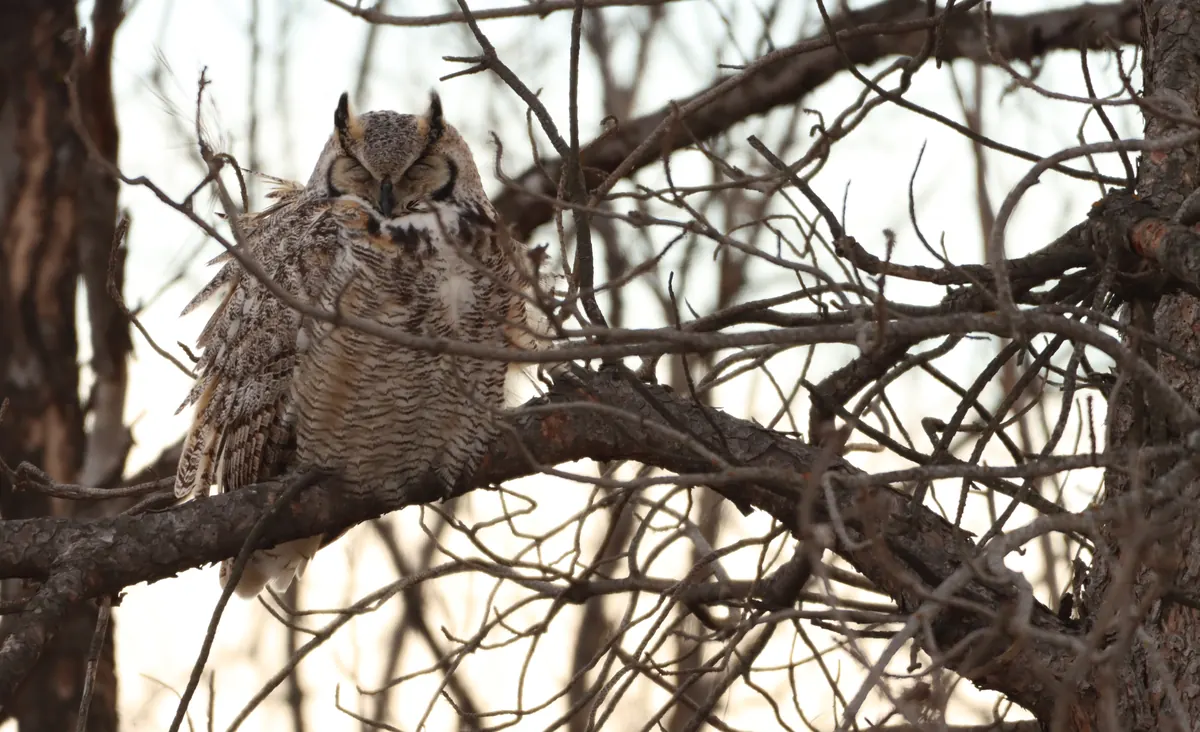
- Listen for owls at dusk. Great horned owls call most in November and December, often as a pair trading hoots, the female’s voice higher than the male’s. Step outside in the last light near open fields and pine woods, and listen for five deep, measured notes.
For the Naturalist’s Field Journal: a Christmas Bird Count tally and the first razorbill you pick out from a pier go on the “birds I have seen” plate, and an owl duet heard at twilight fits the dusk and dawn watch. A holly or a Fraser fir makes a good subject for a tree through the seasons; frogs calling from a flooded ditch in December rain go on a map of sounds; and deer or raccoon prints pressed into creek mud, or into the rare Piedmont snow, belong on tracks to know.
Regions used below: Mountains; Foothills; Piedmont; Sandhills; Coastal Plain; Outer Banks and the coast.
How do you join a Christmas Bird Count in North Carolina?
Audubon’s Christmas Bird Count has run every winter since 1900, and the 2026–27 edition, the 127th, falls in a window that opens December 14 and shuts January 5. Each count has a fixed circle, fifteen miles in diameter, and one day in which teams record each bird they find; a few go owling before dawn. Beginners are welcome and are usually teamed with veterans, and anyone living within a circle can report their own feeder for the day. There is no fee.
The Carolina Bird Club keeps the statewide list, with each count’s organizer and the email address to write to. Dates arrive through the fall, so a circle near you may not show a date yet; check again in November. Several coastal counts keep a fixed date every year: Cape Hatteras on December 27, Bodie–Pea Island on the 28th and Mattamuskeet on the 29th.
| Count | Region | Date |
|---|---|---|
| Haw River State Park | Piedmont | Monday, Dec 14 |
| Mount Jefferson | Mountains | Monday, Dec 14 |
| Pilot Mountain | Foothills | Tuesday, Dec 15 |
| Cumberland County | Sandhills and Coastal Plain | Thursday, Dec 17 |
| Rocky Mount | Coastal Plain | Friday, Dec 18 |
| Winston-Salem | Piedmont | Saturday, Dec 19 |
| Stone Mountain | Foothills | Sunday, Dec 20 |
| Cape Hatteras | Outer Banks | Sunday, Dec 27 (always Dec 27) |
| Bodie–Pea Island | Outer Banks | Monday, Dec 28 (always Dec 28) |
| Mattamuskeet National Wildlife Refuge | Coastal Plain | Tuesday, Dec 29 (always Dec 29) |
| Pettigrew State Park | Coastal Plain | Wednesday, Dec 30 |
| Jordan Lake; Roanoke Rapids; Southport–Bald Head–Oak Islands | Piedmont; Coastal Plain; southern coast | Sunday, Jan 3, 2027 |
| Falls Lake | Piedmont | Monday, Jan 4, 2027 |
| Kerr Lake; Upper Yadkin River Valley | Piedmont; Foothills | Tuesday, Jan 5, 2027 |
The counts have produced some of the state’s most remarkable winter tallies. The Carolina Bird Club’s species accounts list 3,751 red-throated loons on the Kitty Hawk count in December 2015, 3,443 common loons on the Wilmington count at the end of 2016, 2,815 black scoters on the Cape Hatteras count in 2002, and 34 great horned owls on the Roanoke Rapids count of January 1, 1984. The Mount Jefferson and Stone Mountain organizers say their counts are always short of people, so a newcomer counts double there.
Where can you see ducks, geese and swans in North Carolina in December?
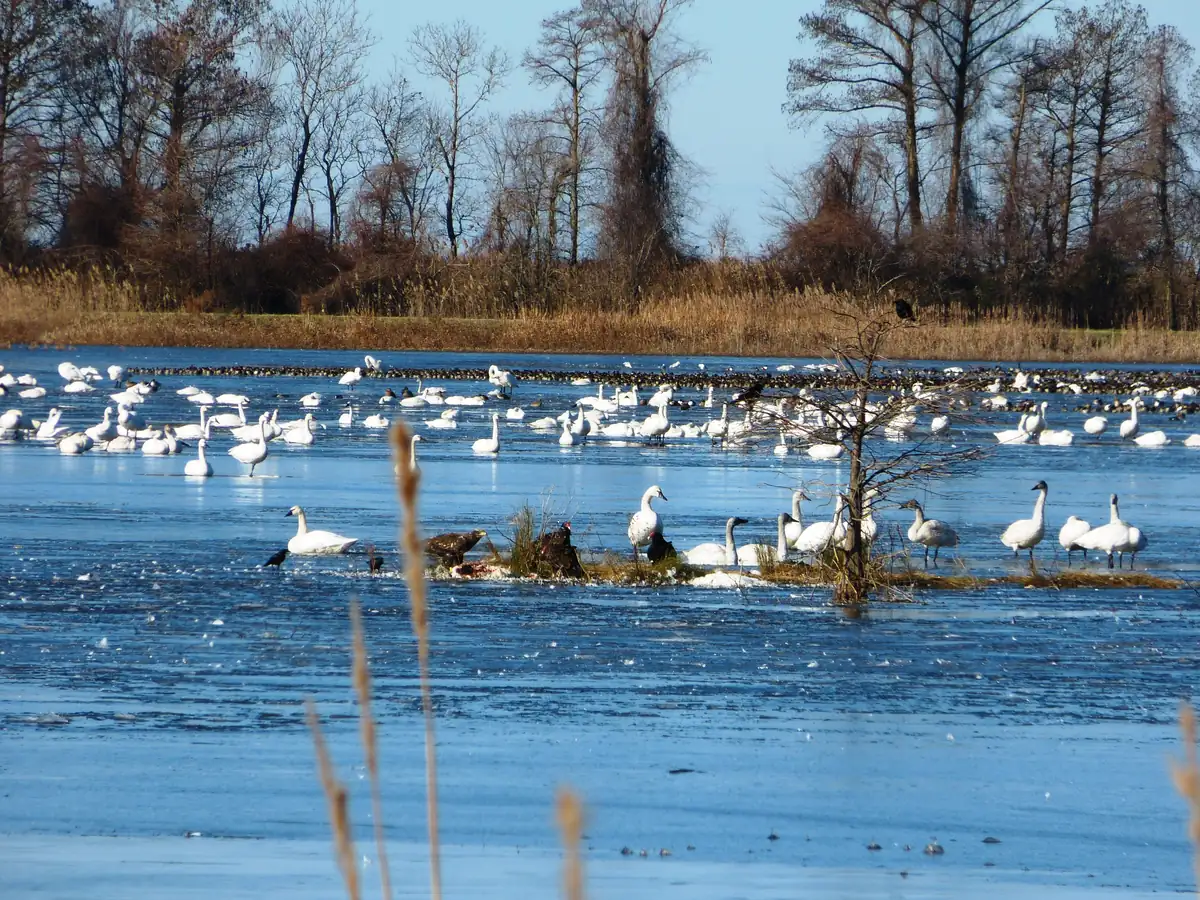
By December the eastern lakes hold the full winter crowd. The swans and snow geese that arrived in November are joined by thousands of dabbling ducks, and the refuges of the northeast are as busy as they get. The November page covers the swans’ arrival and the best evening roads; this month the ducks and the birds that hunt them are the story.
-
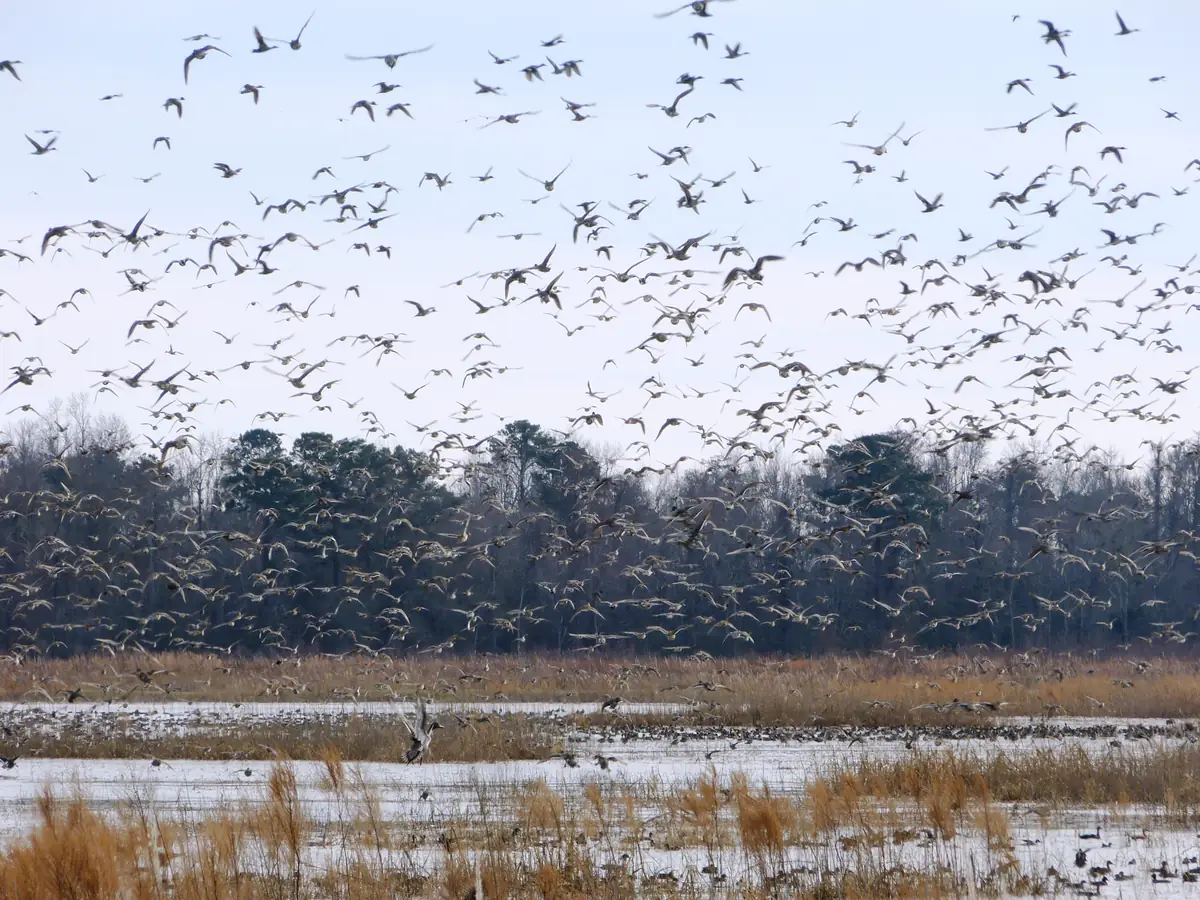
Pintails, teal and shovelers on Mattamuskeet
All month; best on calm, clear mornings · Mattamuskeet National Wildlife Refuge, Hyde County; the NC 94 causeway and the refuge roads east of it
Lake Mattamuskeet is the largest natural lake in North Carolina, and its impoundments fill with northern pintails, green-winged teal and northern shovelers in winter. Birders look through them each year for a Eurasian wigeon, a rare visitor, and for the white form of the great blue heron. Some parts of the refuge close to people in winter, so read the map and the signs before you walk out.
-
Wings Over Water’s December encore
Friday, December 4, to Sunday, December 6 · Pea Island, Alligator River, Pocosin Lakes and Mattamuskeet refuges; Oregon Inlet
The refuge festival’s winter weekend runs guided trips at the season’s peak: Mattamuskeet in the morning and afternoon of the 4th, Pea Island’s ponds and beach, the jetty at Oregon Inlet for purple sandpipers and “Ipswich” savannah sparrows, and a daylong Pocosin Lakes tour on the 5th that looks for Ross’s and greater white-fronted geese among the snow geese. Most trips cost $25 (the Pocosin day is $30); register through the festival site, and note that each listing warns the date is in December.
-
Hunting days on the lakes
From December 17 on the coast and December 18 inland, to January 30 · Sounds, lakes and impoundments open to hunting
The last duck season segment opens December 17 in the coastal zone and December 18 inland and runs to January 30; Saturday, December 5, is a statewide youth and veterans waterfowl day. Migratory birds may not be hunted on Sundays, which makes a Sunday the quietest day to watch from a public dike. On weekdays, expect shots at first light near open water and stay on the refuges’ posted wildlife routes.
Ducks tolerate a parked car far better than a walker on the dike, so scan from the vehicle first. The wind off the open lake bites on a clear December morning even when the forecast sounds mild.
When do bald eagles and owls nest in North Carolina?
Earlier than most people expect: for the big raptors, December is the start of the breeding year, not the end of it.
-
Bald eagles at the big lakes
Year-round; Coastal Plain numbers peak in winter · Lake Mattamuskeet’s NC 94 causeway; Jordan Lake and Falls Lake in the Piedmont; lakes along the Yadkin
North Carolina’s eagles disappeared as nesters after DDT thinned their eggshells, and the Wildlife Resources Commission brought them back by raising young eagles near Lake Mattamuskeet from 1982; the first wild nest in the post-DDT era turned up in 1984, seven miles from the lake. The Carolina Bird Club now counts well over a hundred nests across most of the state. On the Coastal Plain eagles are most numerous in winter (102 were counted at the Roper catfish ponds in November 2007), while in the Piedmont the highest numbers come in late summer. Pairs build in tall living pines and cypresses near water, and a nest can grow to 8 feet across as new sticks are added each year. The species is listed as threatened in North Carolina, so watch from a distance and never approach a nest.
-
Great horned owls hooting
Calling peaks in November and December · Statewide, all 100 counties; field edges and pine woods
The Wildlife Commission notes that courtship begins in October and calling peaks in November and December, mostly at dusk and after dark. The calling tapers once eggs are in the nest, so December is the peak. The bird club advises looking at twilight around fields and clearcuts, where an owl may sit on a dead snag or a utility pole; listen for the pair calling back and forth just before dawn, too.
-
Barred owls in the bottomlands
Courtship builds through late winter · Swamps, river bottoms and beaver ponds; scarce in the mountains
The barred owl is the wetland partner of the great horned owl: it hunts swamps and bottomland forests while the horned owl takes the drier ridges. Its rhythmic “who cooks for you” carries far on a cold, still night, and the Commission says nesting begins in late winter after a very vocal courtship, so the hooting grows louder as December goes on.
-
A snowy owl? Almost certainly not, but watch the news
Only in irruption winters · Outer Banks beaches and dunes
The bird club counts only about a dozen coastal records before the 2013–14 invasion, which added roughly ten more between December and February. If one turns up, keep well back.
All owls and eagles are protected by state and federal law, including their nests. For a winter evening, the journal’s dusk and dawn watch page is made for this: the time of the first call, the temperature, and whether a second owl answered.
What winter seabirds can you see from the North Carolina coast?
Few shores in the East beat the Outer Banks for watching winter seabirds without a boat. Take a scope or good binoculars to a pier or to Cape Hatteras Point and give it an hour on a calm morning.
-
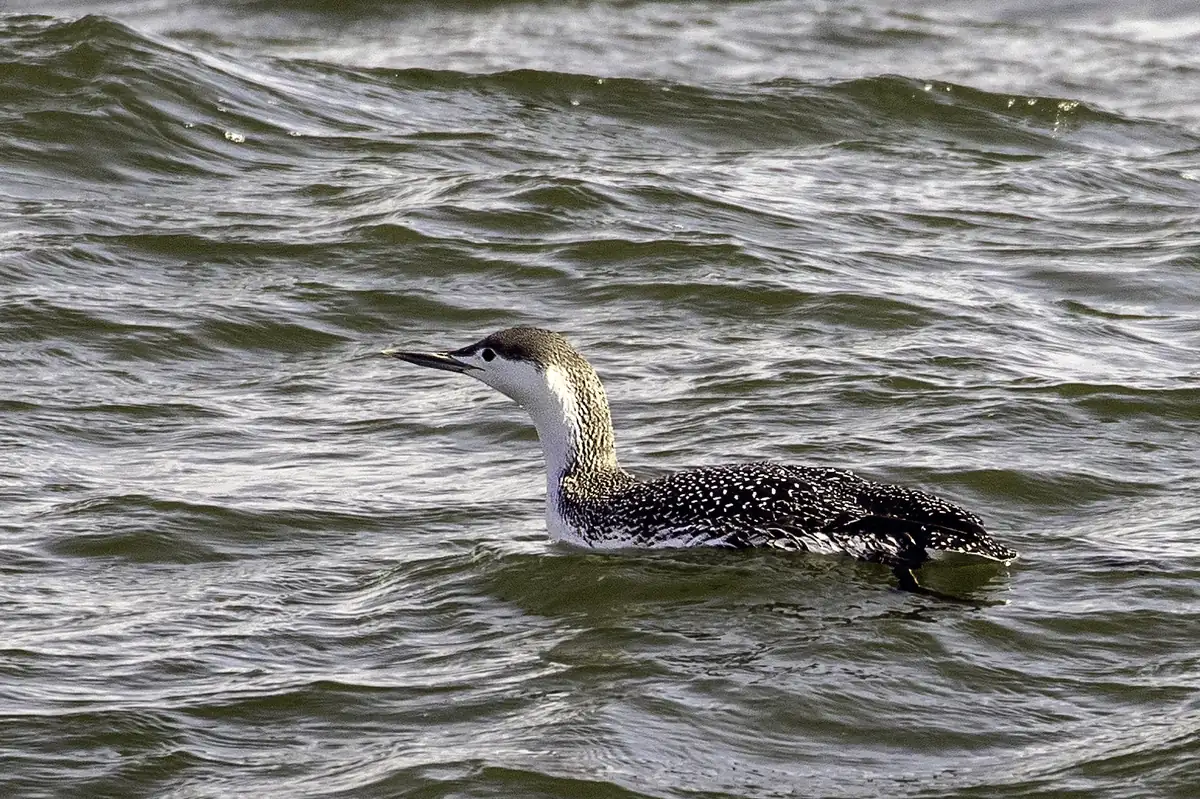
Red-throated and common loons
Early November into April · Inshore ocean along the whole coast; Pamlico Sound; the Swan Quarter–Ocracoke ferry
The Carolina Bird Club calls the red-throated loon one of the commonest birds on the ocean here in winter, and says more than a thousand can be seen on a single Swan Quarter to Ocracoke ferry crossing. Oddly, the two loons split the beaches: red-throats dominate the east-facing Outer Banks north of Cape Hatteras, while common loons often outnumber them along the south-facing beaches such as Bogue Banks. In winter plumage both are gray above and white below; the red-throat is slimmer, paler and holds its thin bill tilted up.
-
Razorbills from the point
Mostly mid-December to late March · Cape Hatteras point and northward; Jennette’s Pier at Nags Head; Johnnie Mercer’s Pier at Wrightsville Beach
Razorbills were rare along this coast before 1995. Now they can be common to abundant off the northern half of it, with a top count of 12,000 flying past Cape Hatteras Point on January 30, 2018. Most feed within about ten miles of the beach. From shore they are small black-and-white “specks” low over the waves or diving constantly, so a scope helps; December is the start of their season, and numbers usually build into January and February.
Gannets keep diving offshore all winter, and black and surf scoters raft on Pamlico Sound, where the ferries pass them. Keep the sun behind you when you scan the water.
What stays green in North Carolina’s winter woods?
Once the oaks drop, the evergreens take over the view, and December is the month to learn them. In the mountains that means fir, spruce, hemlock and rhododendron; in the Piedmont and on the coast, pines, cedars, hollies and the bright clumps of mistletoe high in bare oaks.
-
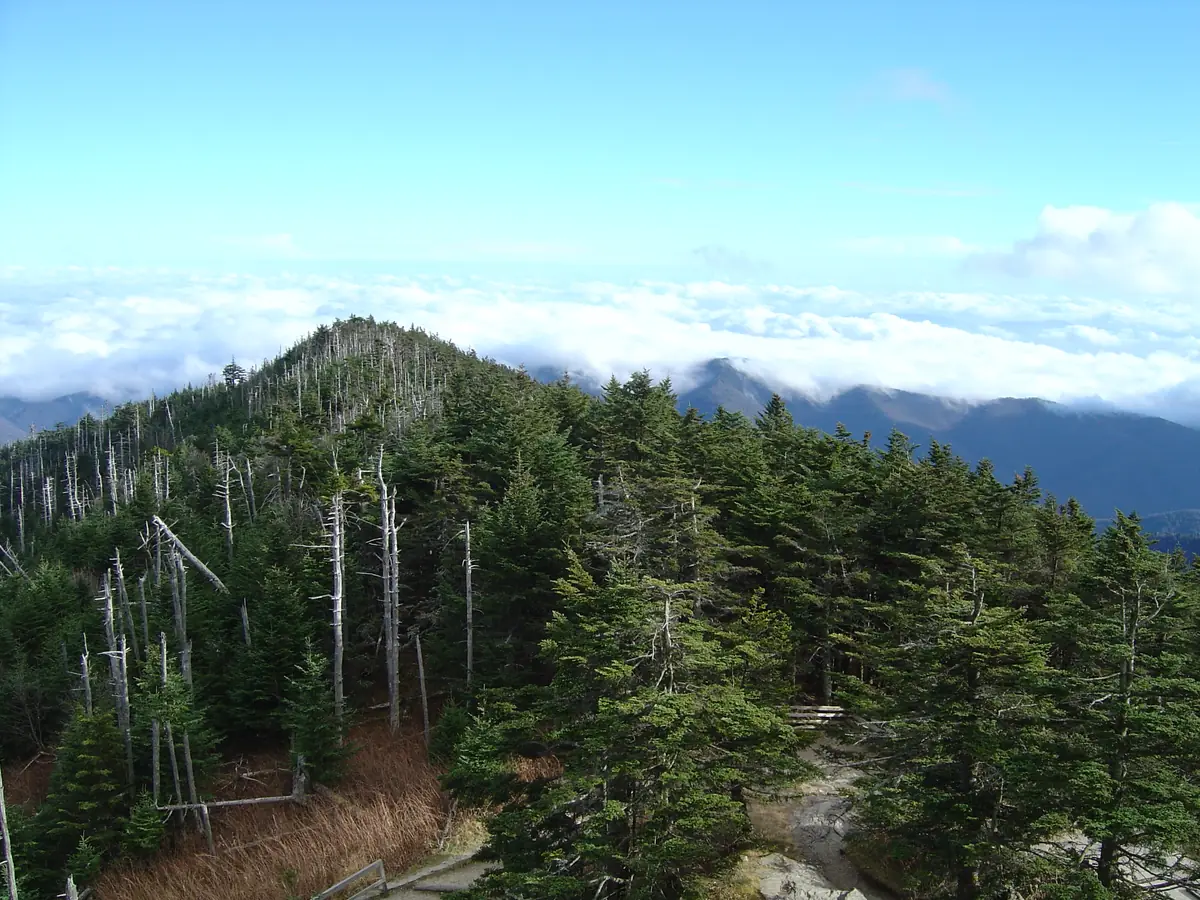
Fraser fir, the high-peak native
All winter · Above about 4,000 feet: Mount Mitchell, Clingmans Dome, Grandfather, Roan; Christmas tree farms in the High Country
Fraser fir grows wild only in the southern Appalachians, between about 4,000 and 6,700 feet and often alongside red spruce. N.C. Cooperative Extension notes that the same tree, farmed in the mountains, is the Christmas tree industry’s favorite species. The wild stands have suffered from the balsam woolly adelgid, an introduced insect; the silver skeletons on the summit of Mount Mitchell are its work, with young firs growing back between them. On the high peaks, firs carry flat needles that are dark green above with two silvery stripes beneath, and their cones stand upright on the branches.
-
Rhododendron leaves that curl in the cold
On freezing days · Mountain stream banks and coves; the rosebay or great laurel thickets
On a frigid morning by a mountain creek, great laurel looks wilted, its long leathery leaves drooping and rolled tight. The Forest Service’s plant database notes that the leaves roll up in cold and in drought, and that each can stay on the shrub for up to eight years. Write the temperature beside a sketch of the curl, then look again when the afternoon warms.
-
American holly in fruit
Berries through winter · Woods statewide, especially bottomlands and coastal maritime forests
Only female hollies carry the red fruit, which is why one tree is loaded and its neighbor is bare. Extension notes that the fruit is a food source for wildlife and that holly branches have long gone into Christmas wreaths. Watch a fruiting holly for a morning in late winter and the robins, mockingbirds and cedar waxwings will tell you when the berries are finally ready.
-
American mistletoe
Easiest to see once the leaves are down · High in oaks and maples, most often in the east
The green clumps in bare treetops are mistletoe, which takes water and nutrients from its host tree but makes its own food. Birds spread its sticky white berries; the plant is poisonous to people.
To tell winter evergreens apart, start with the foliage: needles in bundles mean pine, single flat needles fir or hemlock, tiny scales cedar.
Why are frogs calling in North Carolina in December, and what are other animals doing?
A warm, rainy December night in the Piedmont or the Coastal Plain can sound like spring. Several of North Carolina’s frogs breed in the cold months, when temporary pools fill and the fish and insects that eat their eggs are scarce.
-
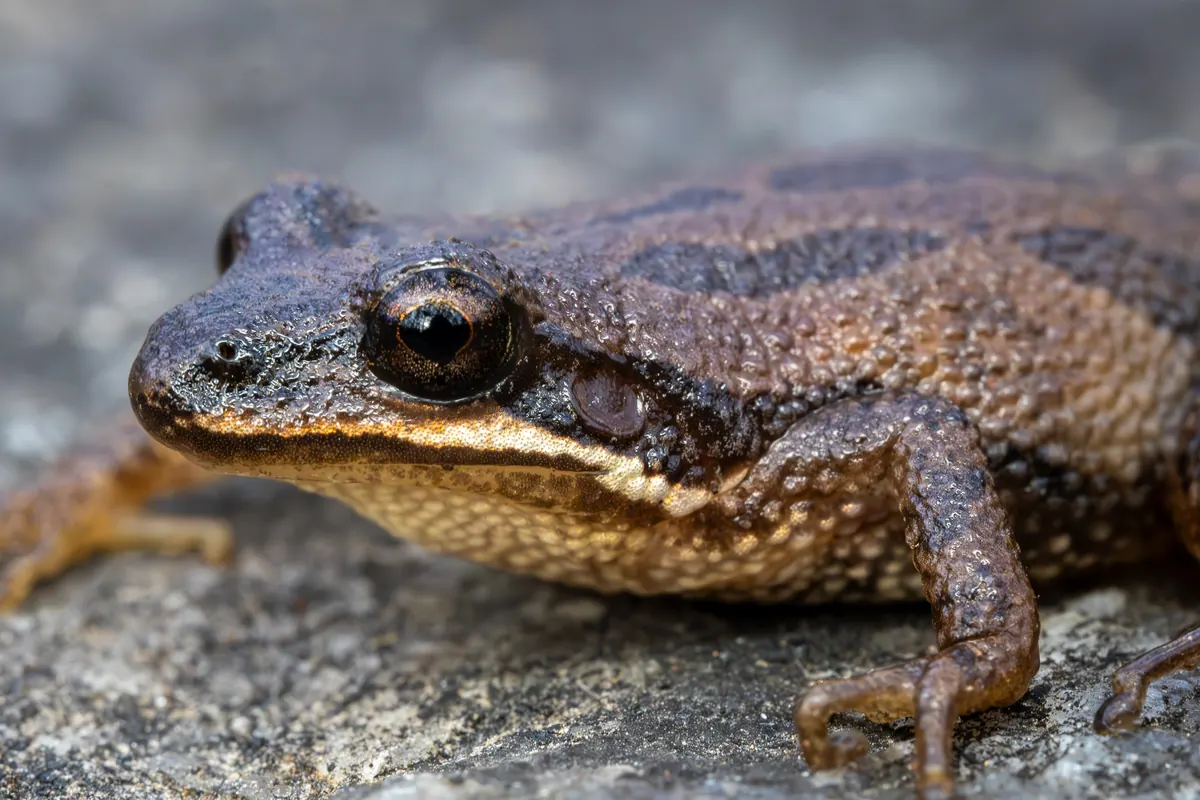
Upland chorus frogs
Winter and early spring, on wet nights · Grassy ditches, flooded fields and temporary pools, mostly in the Piedmont
The Amphibians and Reptiles of North Carolina project says upland chorus frogs call in winter and early spring and often breed in roadside ditches. Listen for a short rising rattle, repeated over and over; outside the breeding season the frogs are hard to find, so the sound is the surest sign.
-
Spring peepers out of season
Most often November through April · Wooded wetlands statewide
Despite the name, peepers call here “most frequently from November to April,” in the words of the same project, on warm, rainy nights and overcast days. A single high peep from the woods on a mild December evening is normal, not a sign that the season has gone wrong.
-
Bears, mostly asleep
Denning from November into January · Mountains and Coastal Plain
Most bears are denned or about to be, in hollow trees, under rock ledges or in a nest of leaves in a thicket. The Wildlife Commission notes that males on the Coastal Plain may stay active right through the winter, so fresh tracks along a refuge road in December are possible.
-
Tracks in mud and snow
After rain or a dusting · Creek banks, farm-pond edges, dirt roads
Below the mountains snow rarely lasts, but creek mud holds prints well: a raccoon’s little hands, the split hearts of deer hooves, a fox’s neat single file. Sketch one beside a coin for scale.
When a chorus starts, write down the date, the temperature and the rain. A few winters of notes will show how mild a December night must be to set them off.
When is North Carolina’s earliest sunset, and how short is the shortest day?
The darkest evenings arrive weeks before the shortest day. Raleigh’s sunset holds at 5:01 p.m. from November 29 to December 12, a plateau centered on December 6, then creeps to 5:05 at the solstice and 5:11 on New Year’s Eve, while the days themselves keep shortening until December 21. Mornings do the opposite: sunrise keeps sliding later, to 7:21 at the solstice and 7:25 in early January. The solstice falls at 3:50 in the afternoon of Monday the 21st; on that day Raleigh gets 9 hours 44 minutes of daylight, Elizabeth City 9 hours 41 minutes and Wilmington 9 hours 52 minutes. Because the whole state shares one time zone, the west keeps its light longest: Murphy’s earliest sunset is 5:24, while Elizabeth City and Cape Hatteras see the sun go down at 4:50.
| City | Dec 1 | Dec 21 | Dec 31 | Earliest sunset |
|---|---|---|---|---|
| Murphy | 9 h 58 m | 9 h 47 m | 9 h 50 m | 5:24 p.m., Dec 5 |
| Asheville | 9 h 56 m | 9 h 45 m | 9 h 47 m | 5:17 p.m., Dec 5 |
| Boone | 9 h 53 m | 9 h 42 m | 9 h 44 m | 5:12 p.m., Dec 6 |
| Charlotte | 9 h 57 m | 9 h 47 m | 9 h 49 m | 5:11 p.m., Dec 5 |
| Raleigh | 9 h 55 m | 9 h 44 m | 9 h 47 m | 5:01 p.m., Dec 6 |
| Wilmington | 10 h 02 m | 9 h 52 m | 9 h 54 m | 5:02 p.m., Dec 5 |
| Elizabeth City | 9 h 52 m | 9 h 41 m | 9 h 44 m | 4:50 p.m., Dec 5 |
| Cape Hatteras | 9 h 58 m | 9 h 47 m | 9 h 49 m | 4:50 p.m., Dec 5 |
Days lengthen again from December 22, by seconds at first. Our Field almanac works out the numbers, twilight included, for wherever you live.
How cold and snowy is December in North Carolina, and what might El Niño bring?
Across most of the state December is cool and gray rather than snowy. NOAA’s 1991–2020 normals give Raleigh a December high near 55 °F and a low near 34 °F, with about 15 nights at or below freezing; Asheville gets 19, Boone 24, and Cape Hatteras, warmed by the sea, fewer than three. The difference is elevation. Mount Mitchell averages 19.7 inches of snow in December alone and a high below 38 °F, while Wilmington’s normal December snowfall rounds to zero.
| Station | Average high | Average low | Freezing nights | Rain and melted snow | Snowfall |
|---|---|---|---|---|---|
| Mount Mitchell | 37.7 °F | 21.4 °F | 23.9 | 6.89 in | 19.7 in |
| Boone | 45.0 °F | 24.7 °F | 24.2 | 4.23 in | 5.2 in |
| Asheville | 51.5 °F | 31.3 °F | 19.2 | 4.18 in | 2.5 in |
| Greensboro | 52.0 °F | 33.0 °F | 16.6 | 3.17 in | 1.2 in |
| Charlotte | 54.9 °F | 34.5 °F | 14.4 | 3.57 in | 0.4 in |
| Raleigh | 54.7 °F | 34.4 °F | 15.4 | 3.39 in | 0.8 in |
| Wilmington | 60.3 °F | 39.1 °F | 9.2 | 3.69 in | 0.0 in |
| Cape Hatteras | 59.3 °F | 44.9 °F | 2.8 | 4.73 in | – |
Ice is the Piedmont’s particular hazard. The State Climate Office explains that cold air trapped near the ground, under warmer air aloft, turns falling snow into sleet or freezing rain, and that a quarter-inch of ice is often enough to bring down limbs and power lines. A study it cites found the western Piedmont to be the iciest part of the Southeast, with some places averaging about four freezing-rain days a year.
El Niño matters most this year. The Climate Prediction Center’s September 10 discussion put the chance of a very strong event lasting through the cool season above 90 percent. For December in particular, the State Climate Office’s review of twelve moderate-to-strong El Niño winters is worth reading: December came out wetter than average in seven of them but cooler than average in only three, and the strong 2015–16 event opened with the warmest December in the state’s records. It also found that the very strongest events ran more than a degree warmer than the group as a whole, with less snow in the Mountains and Piedmont. So the leaning is toward a damp, mild December, with any cold turn more likely in January or February. That is a tendency from a dozen past winters, not a forecast.
Mid-October brings NOAA’s formal winter maps (due the 15th), posted once released among that same prediction center’s seasonal outlooks. Closer in, use our weather page, and for the date the coast usually gets its first freeze, which can be as late as Christmas week at Hatteras, see the North Carolina frost dates.
What is in North Carolina’s night sky in December 2026?
-
The Geminids
Night of Sunday, December 13, into Monday the 14th · Anywhere dark; the radiant is high in the south by 2 a.m.
The International Meteor Organization puts the 2026 Geminid maximum on December 14, at a theoretical 150 or so per hour, and the Moon is no problem: a slim crescent, it is gone by mid-evening. Meteors begin once Gemini clears the eastern trees and are thickest near 2 a.m., with Gemini nearly overhead. Real skies give fewer, perhaps one a minute from the country. Wrap up and lie back in a reclining chair.
-
The Cold Moon, the closest full moon of 2026
Full at 8:28 p.m. on Wednesday, December 23; nearly as full on Christmas Eve · Rising in the east-northeast around sunset
This month the Moon is full only about seven hours from perigee, its closest point to Earth, so the Cold Moon is 2026’s biggest. Nobody can spot the size gain by eye, yet a moonrise over the sound or behind a ridge repays the effort. On the 21st, two evenings before, the Moon slides by the Pleiades.
-
Venus in the morning, Saturn at dusk
All month · Southeast before dawn; south and southwest after dark
Brilliant Venus rules the southeast before sunrise and swings farthest from the Sun in our sky on January 3. Look for a slim waning crescent near Venus before sunrise that Friday and Saturday, December 4–5, with blue-white Spica between them. Jupiter and Mars are morning planets too; by late month Jupiter is up by mid-evening. In the evening, Saturn alone shines in the south, setting a little earlier each week.
-
Next: the Quadrantids and Comet Encke
Quadrantids peak late on January 3, 2027 · Northeast after midnight
The Quadrantids peak near 10:30 p.m. EST on January 3, close to new moon. Comet Encke starts brightening in December and may become a binocular object in evening twilight by late January.
| Phase | Date | Time |
|---|---|---|
| Last quarter | Tuesday, Dec 1 | 1:08 a.m. |
| New moon | Tuesday, Dec 8 | 7:52 p.m. |
| First quarter | Thursday, Dec 17 | 12:42 a.m. (late Wednesday night) |
| Full moon, the Cold Moon | Wednesday, Dec 23 | 8:28 p.m. |
| Last quarter | Wednesday, Dec 30 | 1:59 p.m. |
A clear sky matters more than anything on a Geminid night, so check Today’s sky for the cloud forecast first. Times for moonrise and moonset in your town are on the moon phases page.
What can families do outside in North Carolina in December 2026?
- Look through telescopes at Fort Macon State Park, Friday, December 4, 6 to 8 p.m. The Crystal Coast Stargazers set up at the beach access and bathhouse lot in Atlantic Beach; the program depends on clear weather, and anyone with a telescope may bring it.
- Join a Wings Over Water encore trip, December 4 to 6. Guided birding at Pea Island, Alligator River, Mattamuskeet, Oregon Inlet and Pocosin Lakes, $25 to $30; register ahead.
- Walk with a ranger at Fort Macon, Monday, December 7, 9 to 10 a.m., on a bird hike from the visitor center, or on Thursday, December 17, 10 to 11 a.m., for “The Natural Side of Fort Macon,” which covers trail and beach.
- Bird Carolina Beach State Park, Wednesday, December 16, 8 to 10 a.m. Rangers lead this monthly walk from the marina lot.
- Learn about black bears in Seven Devils, Wednesday, December 16, 2 to 3:30 p.m. A state parks ranger workshop at the Seven Devils Community Center covers bear behavior and what to do if you meet one.
- Count birds on the first day of winter, Monday, December 21, 7 a.m. A ranger leads a one-hour bird count on the Alder Trail at Lake Norman State Park; bring binoculars and dress warmly.
- Take part in a Christmas Bird Count, in the field or at your feeder, between December 14 and January 5 (see the dates above).
- Start the new year on a trail. America’s State Parks promotes First Day Hikes on January 1; look on the state parks events calendar late in December for a New Year’s Day walk near you.
These listings were checked on October 2 on the state events calendar and the festival and bird club sites; weather can cancel a program, so confirm before you go. The Naturalist’s Field Journal is built for days like these, and the nature by month index has the other states and seasons.
Safety notes for December in North Carolina
- Hunting seasons are open everywhere. Deer gun season runs through January 1, 2027, in every zone of the state. Bear season reopens December 12 in the Mountain unit and runs to January 1; the Piedmont unit’s seasons also run to January 1; in the coastal zones bear hunting runs December 12 to 27 in the northeast counties, to December 20 in Edgecombe, Pitt, Wayne and their neighbors, and to January 1 in the southeastern counties. Duck season resumes December 17 on the coast and December 18 inland, doves on December 16, and squirrel, rabbit, grouse and quail stay open all month. (Season dates: Wildlife Resources Commission, 2026–27.)
- Hunter orange. North Carolina law requires deer hunters in any firearms season, and most others hunting game with a firearm, to put on blaze orange, either a cap or an outer garment that can be seen all the way around; people hunting their own land, and their families, are exempt. The rule does not reach hikers, yet an orange hat for you plus a bright vest on the dog cost little on game lands and national forests.
- Ice on roads and trails. Freezing rain and black ice are the Piedmont’s winter danger, and Parkway sections are gated whenever they ice up. Check the Parkway’s closure map and DriveNC before a mountain trip.
- Don’t trust pond ice. Ice on ponds here is usually thin and uneven, and moving water hides weak spots. Stay off it, and keep dogs off too.
- Cold and wet together. A 40 °F rain with wind chills faster than a dry freeze. Pack a dry layer, a hat and gloves, and turn back if anyone starts to shiver hard.
- Short days. The sun sets around 5 p.m. in the Piedmont and earlier on the coast; carry a headlamp on any afternoon hike.
- Ticks come out on warm winter days; check after walks in brushy ground.
Sources
- Carolina Bird Club: North Carolina and South Carolina Christmas Bird Counts (2026–27 dates and organizers)
- National Audubon Society: join the Christmas Bird Count
- Carolina Bird Club, Birds of North Carolina: red-throated loon
- Carolina Bird Club, Birds of North Carolina: common loon
- Carolina Bird Club, Birds of North Carolina: black scoter
- Carolina Bird Club, Birds of North Carolina: razorbill
- Carolina Bird Club, Birds of North Carolina: bald eagle
- Carolina Bird Club, Birds of North Carolina: golden eagle
- Carolina Bird Club, Birds of North Carolina: great horned owl
- Carolina Bird Club, Birds of North Carolina: snowy owl
- N.C. Wildlife Resources Commission: bald eagle
- N.C. Wildlife Resources Commission: great horned owl
- N.C. Wildlife Resources Commission: barred owl
- N.C. Wildlife Resources Commission: black bear (denning)
- U.S. Fish and Wildlife Service: Mattamuskeet National Wildlife Refuge
- U.S. Fish and Wildlife Service: Mattamuskeet National Wildlife Refuge, visit us
- Wings Over Water Wildlife Festival: 2026 schedule and December 4–6 encore
- N.C. State Parks: Jordan Lake State Recreation Area (bald eagles)
- N.C. Cooperative Extension plant toolbox: Fraser fir
- USDA Forest Service, Fire Effects Information System: great laurel (Rhododendron maximum)
- N.C. Cooperative Extension plant toolbox: American holly
- N.C. Cooperative Extension plant toolbox: American mistletoe
- Amphibians and Reptiles of North Carolina: upland chorus frog
- Amphibians and Reptiles of North Carolina: spring peeper
- Amphibians and Reptiles of North Carolina: wood frog
- NOAA NCEI: 1991–2020 monthly normals for eight North Carolina stations (data API)
- N.C. State Climate Office: wintry precipitation (snow, sleet and freezing rain)
- Climate Prediction Center: ENSO diagnostic discussion, September 10, 2026
- Climate Prediction Center: seasonal (90-day) outlooks
- N.C. State Climate Office: El Niño check-up, September 2026
- N.C. State Climate Office: winter outlook 2023–24 (moderate and strong El Niño winters, month by month)
- U.S. Naval Observatory: moon phases from November 1, 2026 (data API)
- U.S. Naval Observatory: 2026 seasons (December solstice)
- International Meteor Organization: 2026 meteor shower calendar (archived copy)
- EarthSky: what is a supermoon? (the December 2026 full moon)
- EarthSky: Venus at greatest western elongation
- In-The-Sky.org: Comet 2P/Encke in 2027
- N.C. Department of Natural and Cultural Resources: events calendar (state parks programs)
- N.C. State Parks events: Astronomy, Fort Macon State Park, December 4, 2026
- N.C. State Parks events: Bird Hike, Fort Macon State Park, December 7, 2026
- N.C. State Parks events: Bird Hike, Carolina Beach State Park, December 16, 2026
- N.C. State Parks events: Ranger Workshop, Black Bears, Seven Devils, December 16, 2026
- N.C. State Parks events: Natural Side of Fort Macon, December 17, 2026
- N.C. State Parks events: First Day of Winter Bird Count, Lake Norman State Park, December 21, 2026
- America’s State Parks: First Day Hikes
- Project FeederWatch: how to participate
- eBird: submit your sightings
- N.C. Wildlife Resources Commission: 2026–27 hunting and trapping season dates (PDF)
- N.C. Wildlife Resources Commission (eRegulations): 2026–27 migratory game bird seasons
- N.C. General Statute 113-291.8: hunter orange
- National Park Service: Blue Ridge Parkway road closures
- N.C. Department of Transportation: DriveNC road conditions
- N.C. Department of Health and Human Services: tick-borne diseases
- Photos via Wikimedia Commons; licenses and photographers are credited under each picture
