What to look for in nature in North Carolina this January
January is the floor of North Carolina’s year: in NOAA’s 1991–2020 normals it is the coldest month across most of the state, and Mount Mitchell averages more than nineteen inches of snow in these four weeks. Yet this is when the breeding year quietly starts. Bald eagles settle onto eggs beside Jordan Lake and Mattamuskeet, great horned owls brood in borrowed hawk nests, and male woodcock begin twittering into the dusk over damp fields. Wildlife biologists fly low over the northeastern farm country to count tens of thousands of tundra swans, razorbills stream past Cape Hatteras, and right whale mothers swim the coast with new calves. After dark there are Quadrantid meteors on the night of the 3rd, and on the 22nd the Wolf Moon, which swings in closer than 2027’s other eleven full moons. What follows gives each one its usual timing, region by region, with the source behind every date.
Other months in North Carolina: October, November, December, February.
Start here
- Catch the Quadrantids before dawn on the 4th. The meteor peak arrives overnight from Sunday the 3rd to Monday the 4th, and the waning crescent rises late. Go out in the last dark hours before Monday’s sunrise, face northeast, and give it forty minutes.
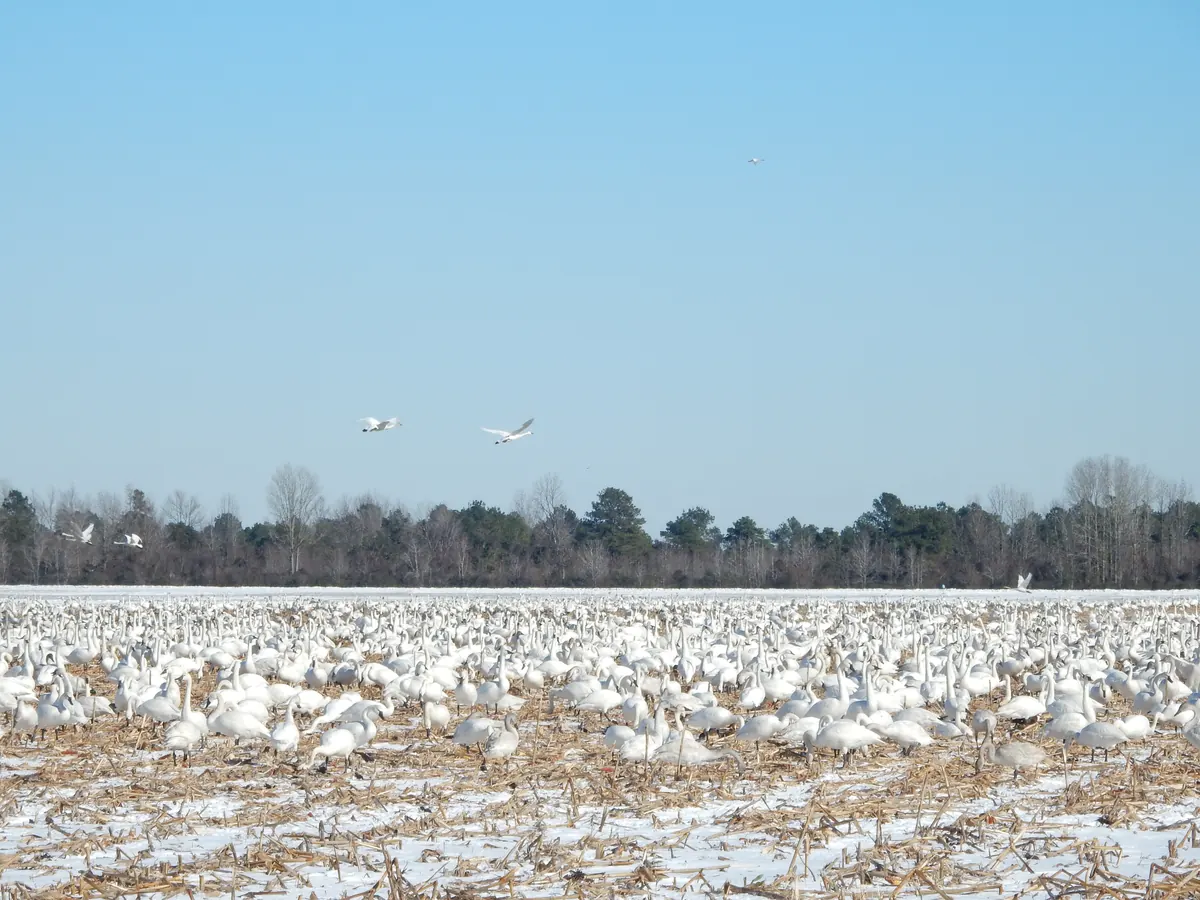
- Watch the swans leave their roost. At Pungo Lake on Pocosin Lakes refuge, thousands of tundra swans and snow geese lift off at first light to feed in the fields and come back at dusk. Be there before sunrise, stay in your car, and listen.
- Stand at a field edge at dusk for woodcock. On a mild, still January evening in the Coastal Plain, a male woodcock may call a buzzy “peent” from the ground, then spiral up into the dark on twittering wings. Listen beside wet woods next to an open field.
For the Naturalist’s Field Journal: an eagle pair carrying sticks to a lakeshore pine belongs on the nest observed plate, and a return visit each week makes a fine same place twice. Swans and razorbills go on birds I have seen; the woodcock’s twittering flight and an owl duet at dusk suit the dusk and dawn watch. A galax leaf turned bronze, or the purple underside of a cranefly orchid leaf, fits reading the signs, and a chorus of ornate chorus frogs from a Sandhills pond after rain goes on a map of sounds.
Regions used below: Mountains; Foothills; Piedmont; Sandhills; Coastal Plain; Outer Banks and the coast.
When do bald eagles and great horned owls lay eggs in North Carolina?
Both of the state’s biggest predatory birds raise their young in the coldest part of the year, so the owlets and eaglets can learn to hunt in spring when prey is plentiful. In January, a nest that looked idle in the fall suddenly has a bird sitting low in it all day.
-
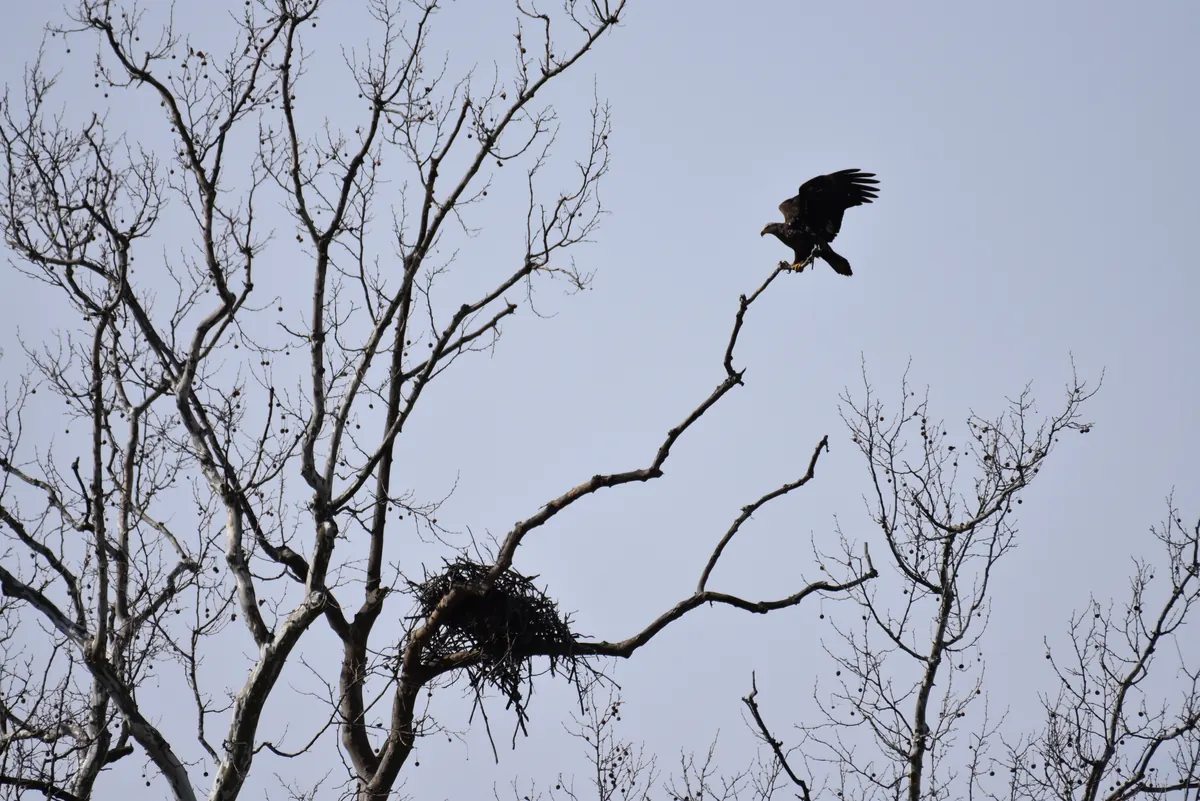
Bald eagles begin nesting
Nesting begins in January; eggs hatch after 30 to 40 days · Jordan Lake and Falls Lake in the Piedmont; Lake Mattamuskeet and the northeastern sounds; big reservoirs along the Yadkin and Catawba
The Wildlife Resources Commission’s profile of the species says plainly that nesting in North Carolina begins in January. A pair lays one to three eggs and the two adults trade incubation shifts for 30 to 40 days, so a nest with eggs in mid-January can have downy chicks by late February; the young first fly at about eleven weeks. Audubon North Carolina counts at least 25 pairs that come back to Jordan Lake each year, which makes the lake near Pittsboro the easiest place in the state to watch a nest from a boat ramp or picnic area. Look for a bulky stick platform high in a living pine near the water, and for a white head that barely shows above its rim. An adult that rises, calls or flushes is telling you to retreat; give it room and use binoculars.
-
Great horned owls on eggs
Eggs as early as December; most clutches from December into March · Woodlots, farm country and suburbs in all 100 counties
Great horned owls do not build their own nests. According to the Commission’s wildlife profile, they usually move into an old hawk nest and lay two large white eggs, sometimes as early as December, and the female does the month-long incubation alone. The Carolina Bird Club notes that they keep calling into March, most often at twilight and especially toward dawn, with the female’s voice pitched higher than her mate’s. The Commission adds that the hooting slows a little once there are eggs to tend.
Eagles and owls, and their nests, are protected under state and federal law. Disturbance during incubation can make a pair abandon eggs, so keep visits short and distant, and leave the location off social media if the nest is on private land.
How many tundra swans spend January in North Carolina, and how are they counted?
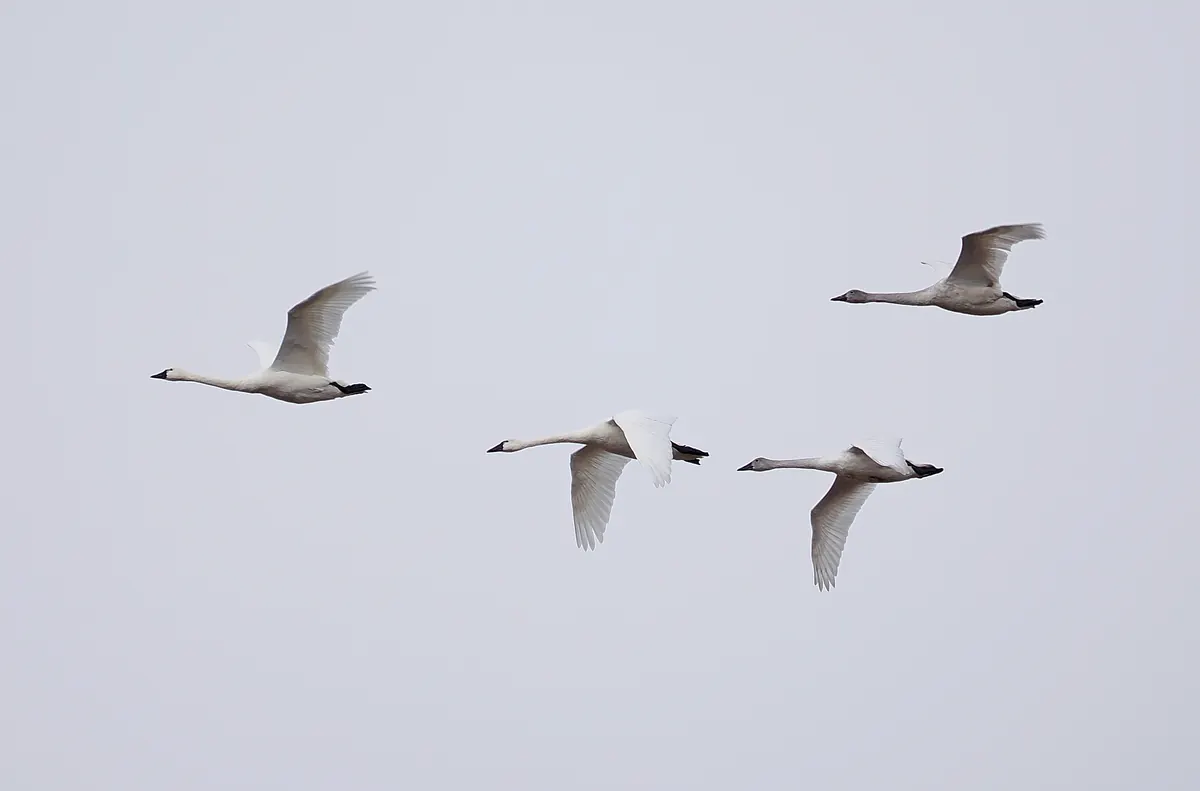
No East Coast state hosts more tundra swans than North Carolina. The Wildlife Resources Commission estimates that about 65,000 to 75,000 come to the northeastern counties each fall, and by January they have settled into a daily routine: a night roost on open water, a morning flight out to feed on the lakes, sounds and farms, and a return toward sunset.
Early January is also counting time. Each year, every Atlantic Coast state flies the Midwinter Waterfowl Survey, and in North Carolina Commission biologists and a U.S. Fish and Wildlife Service pilot fly a fixed-wing plane low over survey units first drawn up in the early 1960s. The swan total feeds into a flyway-wide figure that sets how many hunting permits each state can issue. Most of the birds are always in three units: Mattamuskeet and the surrounding Hyde County fields, Pungo Lake and its fields, and a block of Bertie, Hertford, Edgecombe, Halifax and Northampton counties whose boundaries have been redrawn as swans spread inland.
-
Pungo Lake at sunrise and sunset
All month; the first and last hour of light · Pungo Unit, Pocosin Lakes National Wildlife Refuge, near Plymouth (Washington and Hyde counties)
By the refuge’s count, upward of 100,000 waterfowl winter on Pocosin Lakes, and it singles out the dawn and dusk roosting flights at the Pungo Unit as a must-see. The roads are mostly dirt and turn to mud after rain, so call the refuge office before you drive out after a wet spell. The refuge also points winter visitors to the Pungo Unit for black bears.
-
Mattamuskeet’s fields and causeway
All month · NC 94 across Lake Mattamuskeet; Wildlife Drive; farm roads around Swan Quarter and Fairfield
Swans on the open lake can be far out, so bring a scope, and scan the fields along the county roads as well, watching from a safe pull-off. Their calls are higher and softer than a goose’s honk.
| January survey | Tundra swans counted | Commission’s note |
|---|---|---|
| 1982 | 42,200 | The low point of the modern series |
| 2019 | 56,681 | 28% below 2018 |
| 2020 | 42,778 | Lowest since 1982 |
| 2021 | 61,295 | 43% above 2020 |
The swan hunt runs by permit until January 30, and no migratory birds may be hunted on Sundays, so a Sunday is the calmest day for watching the fields. The November page covers how the flocks arrive.
When do razorbills peak off North Carolina, and are right whales passing the coast?
The middle of winter is the best season for the ocean off the Outer Banks. Cold water draws seabirds south from New England and Canada, and the whales that calve off the Southeast pass along this coast.
-
Razorbills in the thousands
Mostly mid-December to late March; big flights in January and February · Cape Hatteras Point; Jennette’s Pier at Nags Head; any ocean pier from Cape Hatteras north
Before the mid-1990s a razorbill off North Carolina was a rarity. The Carolina Bird Club’s species account now lists some astonishing tallies from shore: an estimated 12,000 streaming by the Point at Cape Hatteras in a single day at the end of January 2018, and 9,000 there in mid-February 2005. Their main feeding grounds lie no more than about ten miles out. They are chunky black-and-white seabirds about the size of a small duck, flying fast and straight just over the swells, and a spotting scope turns specks into birds. Northern gannets plunge-diving farther out are an easy bonus.
-
Right whale mothers and calves
Calving season runs from mid-November to mid-April · Coastal waters, especially from Cape Lookout south to Cape Fear and beyond
North Atlantic right whales are among the rarest large animals on Earth; NOAA Fisheries puts the population at roughly 380. Pregnant females travel south each fall, over a thousand miles from northern feeding grounds, to calve in shallow water off the Carolinas, Georgia and Florida; the federally designated calving habitat starts at Cape Fear. Researchers counted 23 newborns in the 2026 season, a 17-year high, and one first-time mother was photographed with her first calf about ten miles south of Cape Lookout on January 8, 2026. From a beach you would see a dark back with no fin on top and, if you are lucky, a V-shaped blow. Anyone on the water must stay at least 500 yards away, and sightings from North Carolina south go to NOAA’s hotline at 877-942-5343.
Gloves and a windproof shell make a long pier watch bearable.
When do American woodcock start their sky dance in North Carolina?
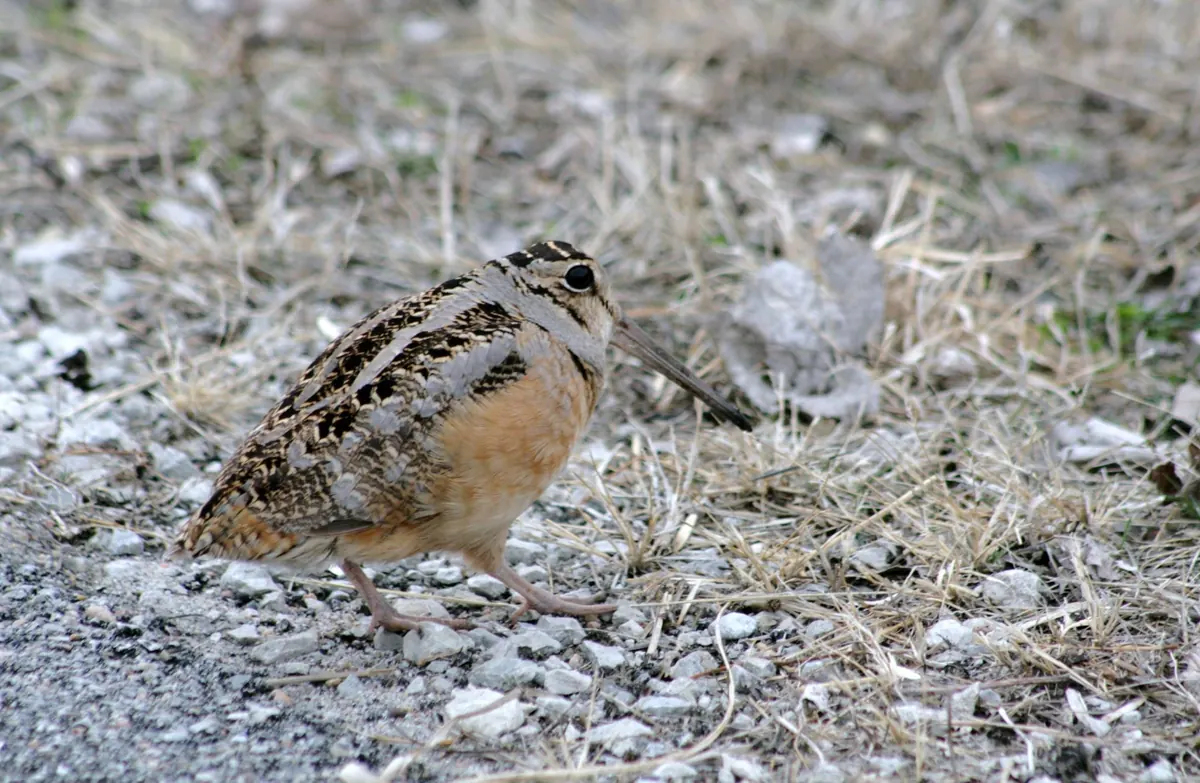
The woodcock is a plump, short-legged shorebird that lives in damp woods and probes the mud for earthworms with a long bill. North Carolina is part of its winter range, and the males do not wait for spring to show off.
-
Display flights at dusk
Winter into early spring, starting about half an hour after sunset · Field edges beside moist woods, mostly in the Coastal Plain, the Tidewater and the eastern Piedmont
The Carolina Bird Club says the males give their courtship flight songs at dusk and in early evening through winter and early spring. A displaying bird sits on bare ground and gives a nasal “peent,” then climbs in wide circles until it is a speck, its wing feathers twittering, and tumbles back down with liquid chirps to land almost where it began. The Commission’s profile describes the show as a springtime one so treat any January performance as an early start. The bird club calls the woodcock a very early breeder, with eggs or young often found in March.
-
Cold-snap concentrations
During hard freezes · The immediate coast, even yards and roadsides
When the ground freezes inland, woodcock cannot feed and some move to the coast. After severe cold in late January 2014, more than 200 were noted at Oak Island on January 31, and 46 or more turned up around Oriental on January 6, 2018. If a deep freeze hits, watch for them on lawns and road shoulders, and drive slowly.
Woodcock season, open since December 10, runs to January 30, so wear something bright if you are listening on game lands. The journal’s dusk and dawn watch page has room for the time of the first peent and the temperature.
Will pine siskins and other winter finches come to North Carolina this year?
Every few winters, northern finches pour south when the cone and seed crops of Canada fail. The Finch Research Network’s 2026–27 forecast suggests this will not be one of those winters for the Southeast: the boreal forest from Ontario east to the Maritimes, plus New England and New York, has plenty of seed this year, and the forecast expects no big irruption of any finch into the southeastern states.
-
Pine siskins
Possible all winter · Thistle (nyjer) feeders and sweetgum trees
The best bet. The network allows for a small to moderate flight of siskins reaching the Southeast. Look for a streaky, sparrow-sized finch with a sharp bill and a flash of yellow in the wings, often in a noisy flock at a tube feeder.
-
Purple finches and red-breasted nuthatches
Late winter, if at all · Feeders near pines and hardwoods
For purple finches the forecast predicts a late, small flight at best, and it expects the good eastern cone crops to keep most red-breasted nuthatches in the north. A raspberry-washed finch at your feeder in January is more likely a house finch; check for the purple finch’s crisp face pattern and notched tail.
-
The everyday winter flock
All month · Backyards statewide
A slow finch winter still leaves North Carolina feeders crowded with white-throated sparrows, dark-eyed juncos, yellow-rumped warblers, chipping sparrows, American goldfinches in their drab winter feathers, and the resident Carolina chickadees, titmice and wrens. Count them for Project FeederWatch, which runs into April.
Report anything unusual to eBird.
Which frogs and salamanders breed in North Carolina’s January rains?
Cold, wet nights are breeding nights for several of the state’s amphibians. Temporary pools fill in winter and dry by summer, so their eggs and tadpoles are safe from fish, and the warmest rain of the month can set off a rush toward the water.
-
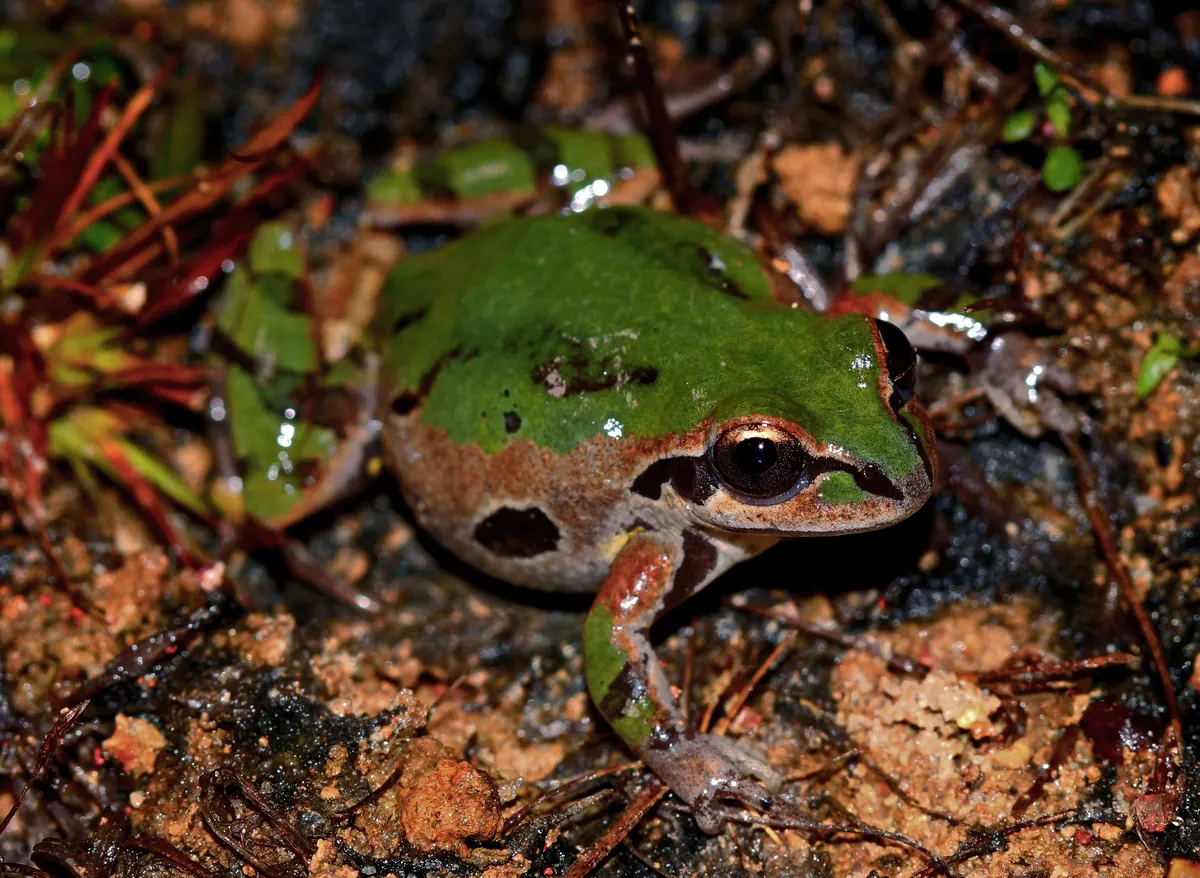
Ornate chorus frogs
Calling from December to March · Longleaf pine savannas, Carolina bays and ditches in the southern Coastal Plain and the Sandhills
This small, boldly patterned frog is a specialty of the longleaf country. The state’s herp atlas, Amphibians and Reptiles of North Carolina, describes its voice as a shrill, birdlike peep, faster and more metallic than a spring peeper’s, and notes that the frogs are rarely seen outside the breeding season. A chorus from a flooded pine flat on a rainy January night is one of the state’s wilder winter sounds.
-
Southern leopard frogs
Mostly late winter and early spring · Ponds and marshes across most of the Coastal Plain and parts of the Piedmont
Their call, the herp project says, sounds like someone rubbing an inflated balloon: a chuckling, squeaky croak. They breed whenever conditions suit, so a mild spell in January can bring them out.
-
Spotted salamanders on the move
Rainy nights in late winter, sometimes from January in the Piedmont; February and March in the mountains · Hardwood forests around vernal pools
Black with two rows of yellow spots, spotted salamanders spend most of the year underground and appear only to breed. A longtime Piedmont naturalist writing in WALTER magazine says they may gather in pools on any wet night from January through March; along the Blue Ridge Parkway, the Park Service says wood frogs come first in February, followed soon after by spotted salamanders. Their egg masses can hold up to 250 eggs and often turn green from algae living inside the jelly.
On a rainy night, use a headlamp and a quiet preserve trail, never a busy road.
What is green on the North Carolina forest floor in January?
With the canopy bare and the leaf litter flattened by rain, January is when the small evergreen plants of the forest floor stand out. Three are worth learning this month.
-
Galax, turned bronze
Winter color from late fall to spring · Shady, moist slopes in the Mountains and the Piedmont; uncommon on the coast
Galax has round, glossy, heart-shaped leaves with scalloped edges, and N.C. Cooperative Extension notes that their bright summer green becomes bronzed to reddish in winter. On a north-facing mountain slope in January, whole carpets of it glow wine red under the rhododendrons. It spreads slowly in clumps and flowers in late spring and summer on tall white spikes.
-
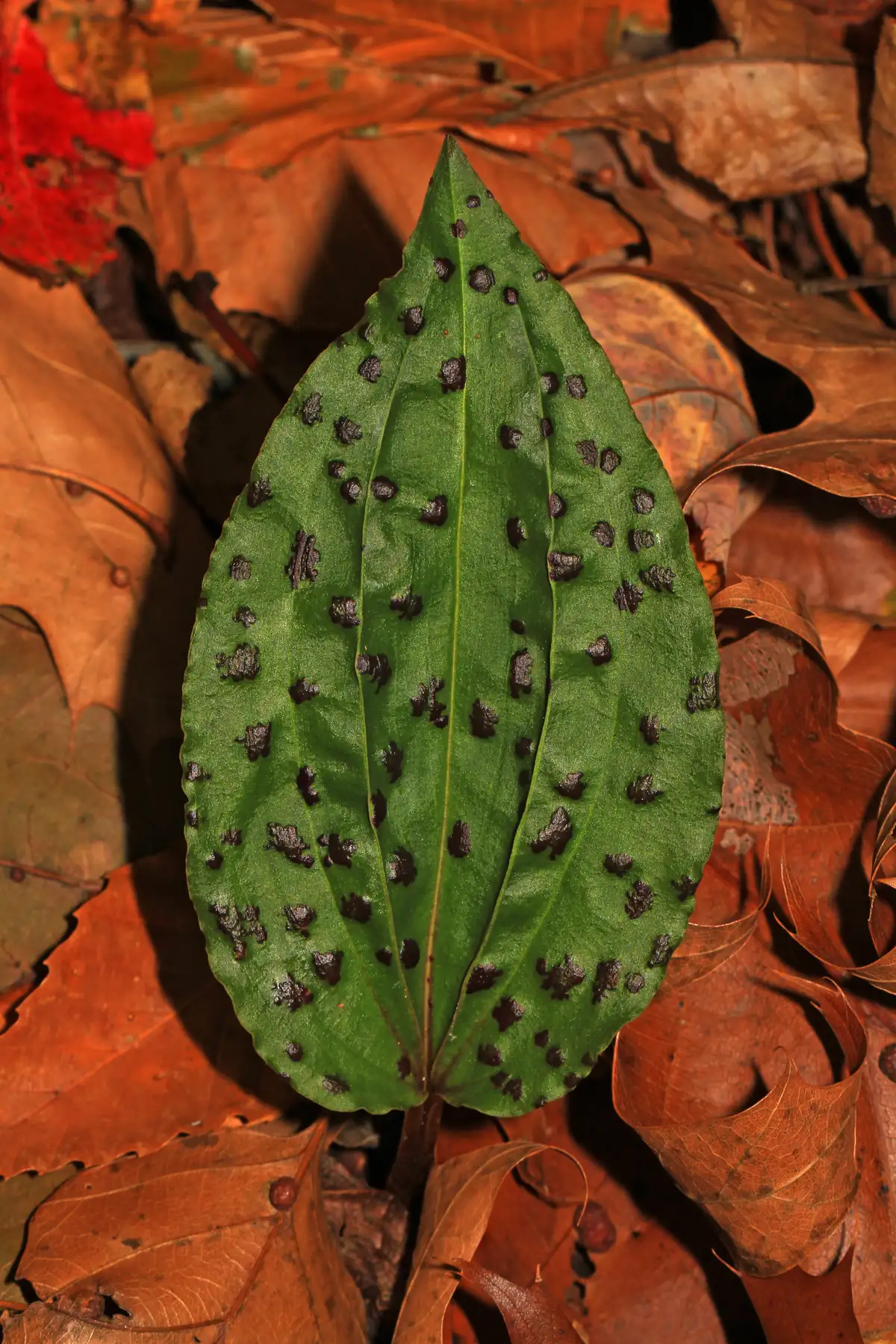
Cranefly orchid leaves
Leaf up from autumn through spring · Hardwood and mixed forests in every region of the state
This orchid grows a single oval leaf in the fall, keeps it all winter, and lets it wither before it flowers in late summer. The leaf is green above, sometimes with raised purple spots, and purple underneath; turn one gently and the color is startling. Count how many you find on a short walk.
-
Partridgeberry
Red berries often last all winter · Shaded woods statewide
A trailing evergreen with small round leaves marked by pale veins. Extension notes that each berry comes from a pair of flowers, and you can see the two tiny scars on its tip. Grouse, wild turkeys, quail and songbirds eat the berries, so by late winter few remain.
For the trees overhead, winter ID means bark and buds: the smooth gray of beech, the patchy white of sycamore along creeks, the duck-bill buds of tulip poplar.
How cold and snowy is January in North Carolina, and what could El Niño bring?
January is the coldest month nearly everywhere in the state. In NOAA’s 1991–2020 normals, Raleigh averages a high of 51.9 °F and a low of 31.8 °F, with 18 nights at or below freezing, a little colder than December; Asheville drops below freezing on 21 or 22 nights. Snowfall is still modest below the mountains, about 2.6 inches at Raleigh and 1.6 at Charlotte, more than either city’s December normal. The weather station on Mount Mitchell is a different world: a normal January there has a high of 33.5 °F, 19.2 inches of snow and more than 25 freezing nights.
| Station | Average high | Average low | Freezing nights | Rain and melted snow | Snowfall |
|---|---|---|---|---|---|
| Mount Mitchell | 33.5 °F | 16.7 °F | 25.5 | 7.47 in | 19.2 in |
| Boone | 41.4 °F | 21.6 °F | 25.1 | 4.39 in | 6.6 in |
| Asheville | 48.9 °F | 28.6 °F | 21.6 | 4.13 in | 3.6 in |
| Greensboro | 49.3 °F | 30.1 °F | 19.5 | 3.39 in | 2.9 in |
| Charlotte | 52.3 °F | 31.8 °F | 16.6 | 3.49 in | 1.6 in |
| Raleigh | 51.9 °F | 31.8 °F | 18.0 | 3.43 in | 2.6 in |
| Wilmington | 57.2 °F | 36.3 °F | 12.6 | 3.81 in | 0.7 in |
| Cape Hatteras | 55.4 °F | 40.6 °F | 7.1 | 4.91 in | – |
Whether a winter storm brings snow, sleet or freezing rain depends on a shallow layer of cold air near the ground and a warm layer above it. The State Climate Office explains how that layering melts and refreezes falling snow, and how a quarter inch of glaze can bring down limbs and power lines.
This winter has an unusual backdrop. Nine-in-ten odds, or better, of a very strong El Niño lingering through the winter: that was the federal forecasters’ verdict in early September (see their ENSO discussion). The State Climate Office looked back at twelve moderate and strong El Niño winters and found that January came out cooler than normal in nine of them and wetter than normal in seven; February leaned wet even more often, in ten of the twelve. Snow totals for those winters ran a little above average in Greensboro, Charlotte and Raleigh. The catch is strength: in the six strongest events the office saw warmer conditions and less snow across the Mountains and Piedmont, even with plenty of rain. Read that as a nudge toward a damp, stormy January rather than a promise of snow.
NOAA updates its official three-month maps each month among the seasonal outlooks, and that is the place to see the latest view for January. For the coming week, check our weather forecast page; for the last spring freeze to expect where you garden, see frost dates for North Carolina.
How much daylight does North Carolina gain in January?
Evenings brighten first. In Raleigh the sun sets at 5:12 p.m. on New Year’s Day and at 5:41 p.m. by January 31, while sunrise stays parked at 7:25 a.m. from January 1 through the 12th before it starts to come earlier. Because the whole state keeps Eastern time, the west enjoys the latest light: Murphy’s sunset moves from 5:35 to 6:04 p.m. over the month, while Elizabeth City goes from 5:01 to 5:30 p.m.
| City | Jan 1 | Jan 31 | Gained | Per day |
|---|---|---|---|---|
| Murphy | 9 h 51 m | 10 h 28 m | 37 min | 1.2 min |
| Asheville | 9 h 48 m | 10 h 26 m | 38 min | 1.3 min |
| Boone | 9 h 45 m | 10 h 23 m | 38 min | 1.3 min |
| Charlotte | 9 h 50 m | 10 h 28 m | 38 min | 1.3 min |
| Raleigh | 9 h 47 m | 10 h 25 m | 38 min | 1.3 min |
| Wilmington | 9 h 55 m | 10 h 31 m | 36 min | 1.2 min |
| Elizabeth City | 9 h 45 m | 10 h 23 m | 38 min | 1.3 min |
| Cape Hatteras | 9 h 50 m | 10 h 27 m | 37 min | 1.2 min |
The daily gain grows all through January and February and does not peak until the March equinox. Our daylight calculator gives the times, twilight included, for any town.
What is in North Carolina’s night sky in January 2027?
-
The Quadrantids
Night of Sunday, January 3, into Monday, January 4 · Anywhere dark; face northeast, high radiant before dawn
This year’s Quadrantids are well placed. Predictions for the short maximum differ, near 10:30 p.m. Sunday the 3rd or near 12:47 a.m. Monday the 4th, but either way it falls in darkness here, and moonlight is no problem: the old crescent Moon, under a fifth lit, stays below the horizon until the last few hours of night. The radiant, in the Boötes and Draco region of the northern sky, starts out low after dusk and stands high by the small hours, so Monday’s predawn is the prime time. Out past the streetlights, several dozen per hour is a realistic best for a patient observer, and the strong part of the shower fades within about six hours.
-
Earth’s closest point to the Sun
Saturday, January 2, at 9:33 p.m. · Everywhere
At perihelion our planet passes within roughly 91.4 million miles of the Sun. Cold weather has nothing to do with it; North Carolina is chilly because the axis tilts our hemisphere away, so the noon Sun rides low even at the closest approach.
-
Venus at its greatest distance from the Sun
Sunday, January 3, and all month before dawn · Southeast before sunrise
On the 3rd Venus hits greatest western elongation, a 47-degree gap from the Sun and its widest of this appearance, and outshines everything but the Moon in the southeastern dawn. A modest telescope reveals a half-lit disk.
-
The Wolf Moon, the nearest full moon of 2027
Full at 7:17 a.m. Friday, January 22; best the night of Thursday the 21st · Rising in the east-northeast at dusk on the 21st
The January full moon comes about fourteen and a half hours after perigee, at about 222,229 miles from Earth, making it the year’s biggest supermoon. Because it is officially full just after sunrise on Friday, the best view is the night before, from moonrise Thursday evening to moonset Friday morning. Friday evening’s rising moon will look just as round.
-
Moon, Jupiter and Regulus
Evening of Saturday, January 23 · East after dark
The day-past-full Moon sits about a degree and a half from Jupiter at around 7:24 p.m., with the bright star Regulus close by later in the night. Jupiter is heading for its opposition on February 10 and rises in early evening.
-
Mercury and Saturn in the evening
Mercury from the last week of January; Saturn all month · Low west-southwest after sunset (Mercury); southwest after dark (Saturn)
Mercury emerges low in the dusk during the final days of January, heading toward its greatest elongation on February 3. Saturn is the steady yellowish light in the southwest once darkness falls, sinking a bit earlier every evening.
| Phase | Date | Time |
|---|---|---|
| New moon | Thursday, Jan 7 | 3:24 p.m. |
| First quarter | Friday, Jan 15 | 3:34 p.m. |
| Full moon, the Wolf Moon | Friday, Jan 22 | 7:17 a.m. |
| Last quarter | Friday, Jan 29 | 5:55 a.m. |
Before you drive anywhere dark for the meteors, look at Today’s sky for the cloud cover. Moonrise in Asheville or Wilmington, or anywhere between, is on our moon calendar.
What can families do outside in North Carolina in January 2027?
- Walk into 2027 on New Year’s Day, Friday, January 1. Every New Year’s Day, rangers across North Carolina’s state parks lead walks under the national First Day Hikes banner, from easy loops to long climbs. The 2027 list was not posted when this page was written; check the state events calendar in late December.
- Join one of the last Christmas Bird Counts. The Carolina Bird Club lists Jordan Lake, Roanoke Rapids and Southport–Bald Head–Oak Islands on Sunday, January 3, Falls Lake on Monday, January 4, and Kerr Lake and the Upper Yadkin River Valley on Tuesday, January 5. Email the organizer ahead; Roanoke Rapids welcomes feeder watchers and kayakers too.
- See the swans fly at Pocosin Lakes. Arrive at the Pungo Unit before sunrise or stay until dusk. The refuge also offers red wolf programs at the Red Wolf Center; call the refuge for the current schedule.
- Go owling at twilight. Wait quietly beside an open field as the light fades and tally the hoots. Woodcock may start up at the same spot.
- Count your feeder birds for Project FeederWatch, any two days a week, or enter a backyard list on eBird.
- Get ready for February’s Great Backyard Bird Count. Audubon and Birds Canada, two of its organizers, give February 12 to 15, 2027, as the dates.
Snow and ice can cancel winter programs, mountain ones above all, so call ahead. Note what the children spot in the Naturalist’s Field Journal; when February comes, the seasonal nature index has the next month. For the season’s start, see the December page.
Safety notes for January in North Carolina
- Hunting seasons still open. Deer gun season ends on Friday, January 1, 2027, in every zone, and so do the Mountain and Piedmont bear seasons and the southeastern coastal bear zone. Duck, merganser and coot seasons run to January 30 in both zones; Atlantic brant and the Northeast zone’s Canada geese, December 28 to January 30; Canada geese in the resident zone, to February 6; light geese, to March 10; tundra swans by permit, to January 30; woodcock, to January 30; snipe, to February 27; doves, to January 30. Squirrel, rabbit, quail, grouse, raccoon, opossum and bobcat stay open to February 28 (fox squirrel to January 31), and trapping runs to February 28. Crows may be hunted Wednesdays, Fridays and Saturdays, plus New Year’s Day and Martin Luther King Jr. Day. No migratory birds may be hunted on Sundays. (Wildlife Resources Commission, 2026–27 season dates.)
- Hunter orange. State law requires most people hunting game with a firearm, and every deer hunter in a firearms season, to wear a hunter orange cap or an outer garment visible from all sides; landholders hunting their own land are exempt. The law covers hunters only, yet walkers on game lands through February are wise to add an orange hat, and a bright vest for the dog.
- Ice storms and black ice. Freezing rain is the Piedmont’s most dangerous winter weather; it glazes roads, bridges and trails and drops limbs onto power lines. Check DriveNC before a trip, and the Blue Ridge Parkway’s closure map, since the Parkway gates sections whenever ice or snow covers them.
- Stay off frozen ponds. Ice here rarely gets thick enough to trust, and it is thinnest near inlets, docks and stumps. Keep children and dogs off it.
- Mountain cold. A normal January day on Mount Mitchell never gets above freezing, and wind on the open balds makes it feel far colder. Carry extra layers, a hat and gloves, and turn back early if anyone starts shivering hard.
- Short afternoons. Even on January 31, Raleigh’s sunset is 5:41 p.m. and Elizabeth City’s 5:30 p.m., so plan hikes to finish early and pack a headlamp.
- Ticks stay active on warm days even in winter; check after brushy walks.
Sources
- N.C. Wildlife Resources Commission: Bald Eagle wildlife profile (PDF)
- Audubon North Carolina: Get to know our national bird (Jordan Lake pairs, breeding season)
- N.C. Wildlife Resources Commission: Great Horned Owl wildlife profile (PDF)
- N.C. Wildlife Resources Commission: great horned owl
- Carolina Bird Club, Birds of North Carolina: great horned owl
- Carolina Bird Club, Birds of North Carolina: bald eagle
- N.C. Wildlife Resources Commission: tundra swan
- N.C. Wildlife Resources Commission: 2021 Game and Furbearer Program Summary Report (midwinter waterfowl survey)
- N.C. Wildlife Resources Commission: 2020 Surveys and Research Program Summary Report
- N.C. Wildlife Resources Commission: 2019 Surveys and Research Program Summary Report
- N.C. Wildlife Resources Commission: tundra swan harvest management FAQ
- U.S. Fish and Wildlife Service: Pocosin Lakes National Wildlife Refuge
- U.S. Fish and Wildlife Service: Mattamuskeet National Wildlife Refuge
- Carolina Bird Club, Birds of North Carolina: razorbill
- NOAA Fisheries: North Atlantic right whale
- NOAA Fisheries: North Atlantic right whale calving season 2026
- Carolina Bird Club, Birds of North Carolina: American woodcock
- N.C. Wildlife Resources Commission: American woodcock
- Finch Research Network: Winter Finch Forecast 2026–2027
- Project FeederWatch: how to participate
- eBird: submit your sightings
- Amphibians and Reptiles of North Carolina: ornate chorus frog
- Amphibians and Reptiles of North Carolina: southern leopard frog
- Amphibians and Reptiles of North Carolina: spotted salamander
- Amphibians and Reptiles of North Carolina: wood frog
- National Park Service, Blue Ridge Parkway: amphibians
- WALTER magazine: Love in the rain, a salamander congress
- N.C. Cooperative Extension plant toolbox: galax
- N.C. Cooperative Extension plant toolbox: cranefly orchid
- N.C. Cooperative Extension plant toolbox: partridgeberry
- NOAA NCEI: 1991–2020 monthly normals for eight North Carolina stations (data API)
- N.C. State Climate Office: wintry precipitation (snow, sleet and freezing rain)
- N.C. State Climate Office: winter outlook 2023–24 (moderate and strong El Niño winters, month by month)
- Climate Prediction Center: ENSO diagnostic discussion, September 10, 2026
- Climate Prediction Center: seasonal (90-day) outlooks
- U.S. Naval Observatory: moon phases from December 30, 2026 (data API)
- U.S. Naval Observatory: 2027 seasons and perihelion
- Fred Espenak, Sky Event Almanac 2027
- American Meteor Society: meteor shower calendar
- EarthSky: Quadrantid meteor shower
- EarthSky: what is a supermoon?
- Carolina Bird Club: North Carolina and South Carolina Christmas Bird Counts (2026–27 dates)
- America’s State Parks: First Day Hikes
- N.C. Department of Natural and Cultural Resources: events calendar
- N.C. Wildlife Resources Commission: 2026–27 hunting and trapping season dates (PDF)
- N.C. Wildlife Resources Commission (eRegulations): 2026–27 migratory game bird seasons
- N.C. General Statute 113-291.8: hunter orange
- National Park Service: Blue Ridge Parkway road closures
- N.C. Department of Transportation: DriveNC road conditions
- N.C. Department of Health and Human Services: tick-borne diseases
- National Audubon Society: Great Backyard Bird Count (2027 dates)
- Birds Canada: Great Backyard Bird Count, February 12–15, 2027
- Photos via Wikimedia Commons; licenses and photographers are credited under each picture
