What to look for in nature in North Dakota this April
April is when North Dakota finally switches from thaw to arrival. The snow cover that held the state in March is mostly gone by the middle of the month, the lakes open, and the Central Flyway fills with birds hurrying to their breeding grounds. Game and Fish says the sandhill cranes move through in a short, fast burst that is largely over by the end of April, and the white pelicans of Chase Lake, the largest nesting colony in North America, start to appear in the first days of the month. Piping plovers, long-billed curlews and American bitterns follow from mid-April, bison calves are born in the badlands, and pike and walleyes crowd the culverts as the ice leaves Devils Lake. Nights still freeze at every station on average, a late snow is not unusual, and grass fires and wind are the working hazards of the month. Daylight grows by roughly 95 minutes across the month, the full Moon rises on the 20th, and bright moonlight spoils the Lyrid shower. What follows says where and when to look.
Other months in North Dakota: October, November, December, January, February, March.
Start here
- Look up for cranes. On a mild afternoon in the first three weeks of the month, stand near a shallow wetland or a stubble field and listen for the rolling, rattling call before you see the birds. Write down the date, the time and how many.
- Watch pelicans from a county road. The Chase Lake colony is closed to visitors, but the adults fly out to feed on nearby wetlands, and the county and township roads around the refuge give a view of them in flight.
- Sit by a culvert at dusk. Where a creek or drain runs under a gravel road, the first open water of the season draws frogs, ducks, shorebirds and fish. Pick one spot and visit it each week of the month.
In your Naturalist’s Field Journal for April, enter every arrival under “birds I have seen” (cranes, pelicans, plovers, curlews, bitterns), use “nest observed” for any bird on a nest that is visible from the roadside, and keep “mammal watch” for the first calf, pup or lamb. Use “a map of sounds” for the crowing pheasant and the drumming grouse, “the same place twice” for a pothole photographed on April 1 and April 30, “tracks to know” for prints in thawing mud, and “reading the signs” for the wind and the front that brings it.
Regions used below: Red River Valley; Devils Lake and the Turtle Mountains; Drift Prairie and the James River valley; Missouri Coteau and Bismarck–Mandan; Lake Sakakawea and the northwest; Badlands and the southwest (Mountain time).
When do sandhill cranes and whooping cranes pass through North Dakota in April?
Cranes are the signature of an April sky here. Their rolling call often reaches you before the birds are in view. North Dakota lies on the northern leg of their route, and what the state sees is a short, rapid passage rather than a long stay.
-
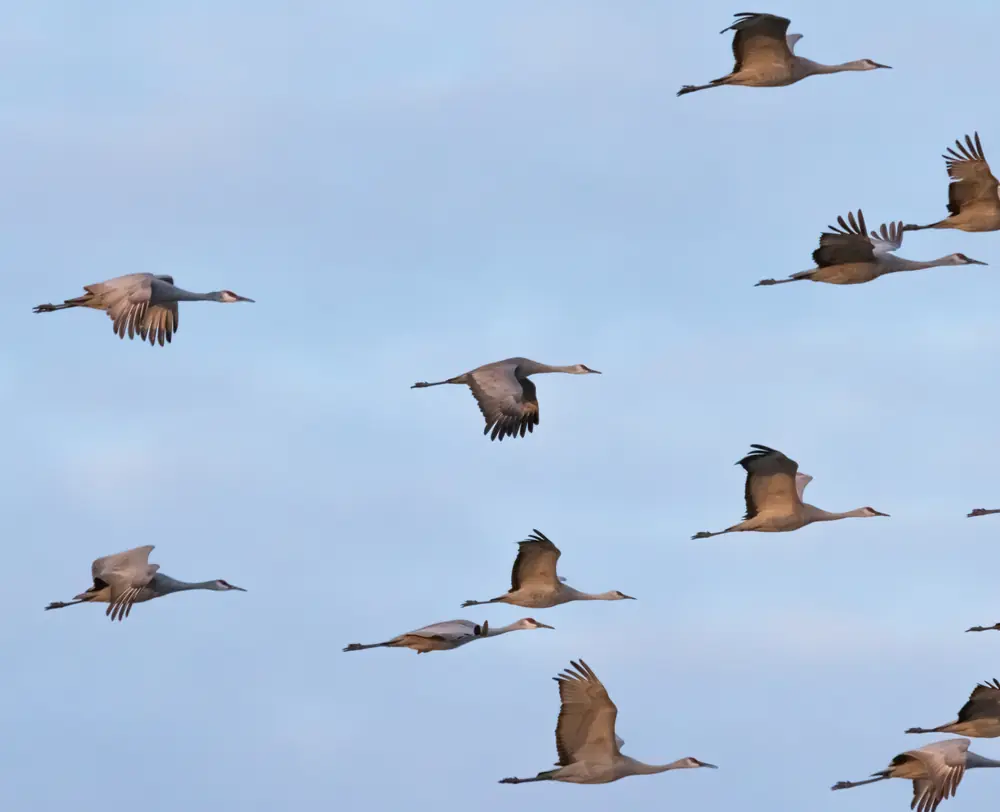
Sandhill cranes
The leading flocks come in early April; the main body is gone by the last week · Shallow wetlands and stubble fields statewide, especially the Prairie Pothole country of the east and center
A Game and Fish magazine feature reports that the first sandhill cranes reach North Dakota in early April and that the bulk of the migration is over by the close of the month. The department’s biologist John Palarski describes the birds as hustling to reach the breeding grounds and get nesting started, which is why the spring passage is much quicker than the fall one. The same article reports that a late-March survey of the mid-continent population pointed to a stable to increasing trend. The department’s article points watchers to shallow wetlands, so scan the edges of sloughs and nearby stubble, and view from the car so the birds can feed.
-
Whooping cranes, a rare passing guest
Spring migration; no fixed window is published, so sightings are reported as they happen · Wetlands and fields, often with sandhill cranes
Game and Fish says about 500 whooping cranes migrate through North Dakota each spring on the 2,500-mile journey from Aransas National Wildlife Refuge in Texas to Wood Buffalo National Park in Canada. A whooper is roughly five feet tall, spans about seven feet with its wings open, has white plumage except for black wingtips, and in flight holds its neck straight out in front with its legs trailing behind. Typically they move alone or as a pair or trio, sometimes in company with sandhill cranes. If you see one, do not approach. Note the date, time, location, what the bird was doing, and any colored leg bands, then report it to the Lostwood refuge at 701-848-2466, the Audubon refuge at 701-442-5474 or Game and Fish at 701-328-6300. The department says reports help biologists find habitat and track marked birds.
-
Tracking the flight online
Spring migration season · Your own screen, before you go out
The Cornell Lab’s BirdCast posts live migration maps, forecast maps and local alerts for 216 U.S. cities, and Prairie Public’s migration notes recommend it along with Journey North for following arrivals.
For help with timing, the Cornell Lab’s BirdCast offers live migration maps and forecasts through the spring season, which it says runs from March 1 to June 15. Log your first crane in Journey North to add to the picture.
Which pelicans, shorebirds and marsh birds return to North Dakota in April?
The wetlands are where April shows most clearly. Game and Fish’s species pages give mid-April as the start of the presence window for the plover, curlew and bittern below, while the pelicans come a little earlier. Watch the first half of the month for the pelican arrival and the early migrants, and the second half for the specialists.
-
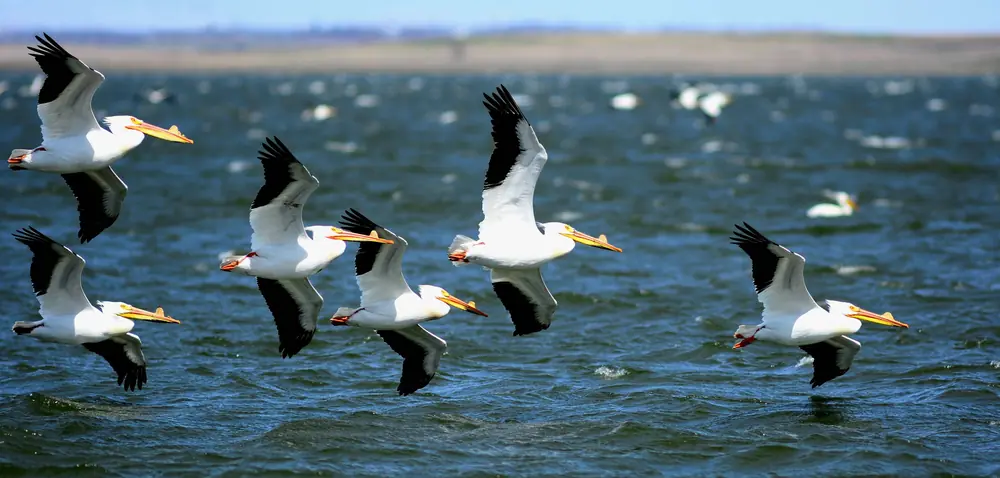
American white pelicans at Chase Lake
Early April for first arrivals; egg-laying from mid-April through May · Chase Lake National Wildlife Refuge near Medina; the adults feed on nearby wetlands and can be seen from county and township roads
The Fish and Wildlife Service calls Chase Lake the home of one of the largest white pelican colonies in North America, with about a third of the continental population, and says numbers vary from about 4,000 to 35,000 birds. A U.S. Geological Survey study of the Chase Lake and other northern Plains colonies found that the pelicans typically arrived in early April, with eggs laid from mid-April and new nests started through May. The study counted about 17,300 nests at Chase Lake in its peak year, 2006, and found tagged birds feeding 30 to more than 90 kilometers from the colony. The refuge was set aside by Theodore Roosevelt in 1908. Nearly all of it, 4,155 of 4,385 acres, is Wilderness, and access is limited, so the way to see the birds is from the roads around it, watching adults fly out to feed and return. In the USGS study the Chase Lake birds typically came back around 3 p.m. When this page was written the refuge’s own page said the road to the refuge was closed because of unsafe conditions, so check there before you drive.
-
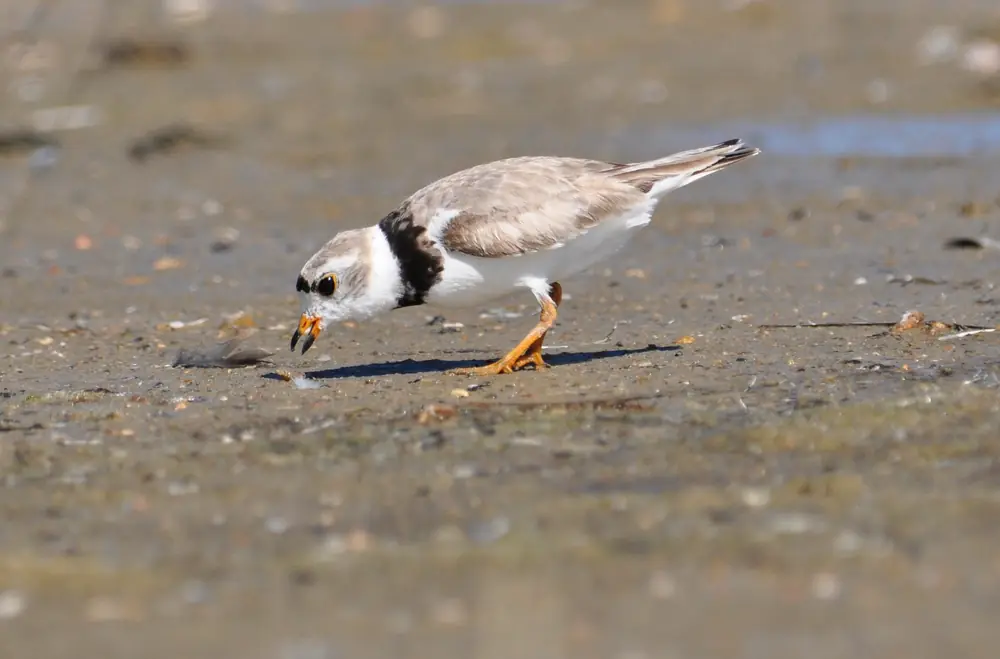
Piping plovers
Arrive from mid-April; nesting peaks from late May to mid-July · Exposed, sparsely vegetated shores and islands of alkali lakes and rivers
Game and Fish lists the piping plover as threatened in North Dakota and says the state holds about 9.7 percent of the breeding population, third among the 20 states that hold any. They arrive from mid-April and nest in shallow scrapes on sandy or gravelly shores. The department asks visitors to keep dogs leashed in plover habitat and to avoid walking toward nests on sandbars and shorelines.
-
Long-billed curlews
Return in mid to late April; nesting peaks late April to late June · Short-grass pastures in the Badlands and Missouri Slope regions
The curlew is the largest shorebird on the plains, 23 inches long with a 35-inch wingspan, and its long, downcurved bill is the giveaway. Game and Fish places most of the state’s curlews in the Badlands and Missouri Slope, notes that the breeding range in North Dakota has contracted substantially, and ranks the state 13th of 17 for its share of the world’s breeding population. The department says they favor open, gently rolling grassland with vegetation shorter than 10 centimeters, and also use cropland and hayland for nesting. If you find a pair, stay on the road.
-
American bitterns
Return from mid-April to mid-May; breeding peaks early June to late July · Wetlands of seven acres or more with tall cattails, rushes and sedges
The bittern uses cryptic coloring to blend into the cattails and hunts insects, amphibians, small fish and other prey there. Game and Fish says North Dakota ranks first of 26 states for its share of the global breeding population, about 9.6 percent. The same page warns that wetland loss and a changing climate are shrinking its range. April is early, so look at the very end of the month, or plan a visit for May and June.
-
The early mix
Early to mid-April · Fields, shelterbelts and thawed ponds
A Grand Forks Herald column from April 2023 lists the birds of an early-April flood: horned larks, bald eagles, red-tailed hawks, harriers, merlins, yellow-rumped warblers, fox sparrows and a herring gull, all pressing north to the edge of the snow. Prairie Public’s migration notes add red-winged blackbirds, house wrens, bobolinks and hummingbirds to the list of the season’s travelers. The Datebook segment on the Central Flyway says North Dakota has more national wildlife refuges than any other state.
Which North Dakota birds are drumming, crowing and gobbling in April?
April is loud. Game and Fish’s natural history calendar lists several spring performances in the same few weeks, and each one is easier to hear than to find.
-
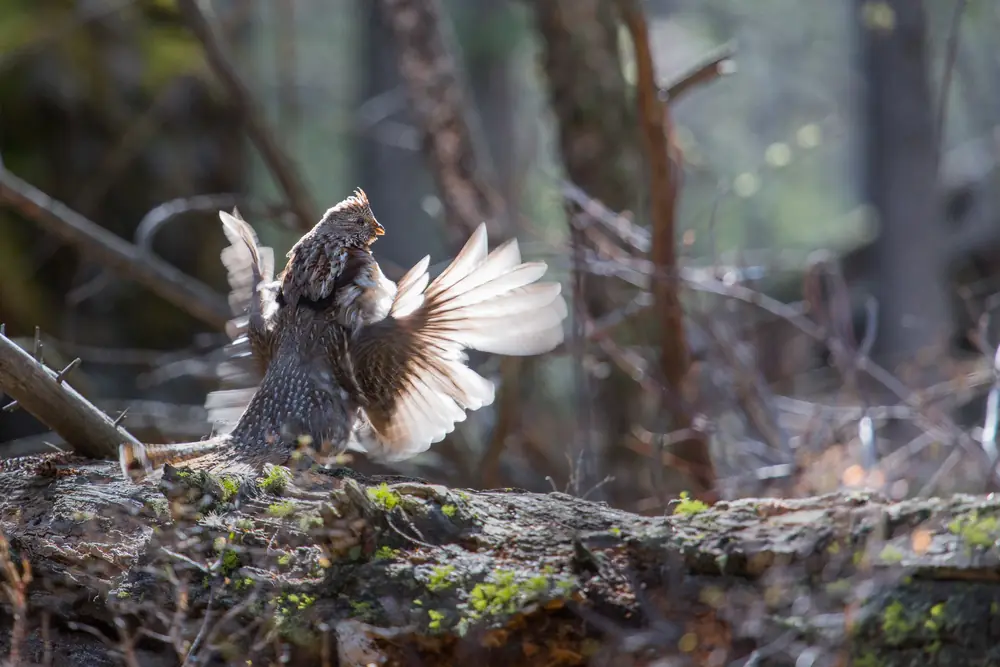
Ruffed grouse drumming
Early April through late May, best at dawn · Wooded areas
The male ruffed grouse beats his wings against the air to make a deep, accelerating drumming sound that advertises his territory. The calendar gives early April to late May for drumming. You will hear the sound far more often than you see the bird, so stand quietly at the edge of a wood on a still morning and let it come to you.
-
Ring-necked pheasant crowing
Early April through early June, according to the calendar · Grain fields, shelterbelts and roadside cover
The male pheasant’s crow is the farm-country sound of the month. Sources differ on when it starts: the Game and Fish calendar lists early April, while other listings place the beginning in late March, so treat the start as a range.
-
Wild turkeys
Breeding mid-April through late May; the 2027 hunting season has not been posted · Woodland and river-bottom habitat; the department’s turkey page has the details
The calendar lists the turkey breeding season from mid-April through late May. Game and Fish’s turkey page shows a 2026 spring season from April 11 through May 17, awarded by lottery, with applications due September 2, 2026. The 2027 license information will be posted after the proclamation is signed, so check the department’s turkey page. First-time youth hunters aged 15 and under can apply for a guaranteed license before or during the season.
-
Sharp-tailed grouse, still dancing
Dawn at leks through spring · Native prairie hilltops
The dancing-ground story from March carries into April: Game and Fish’s calendar puts the breeding season at mid-March through mid-May. Upper Souris takes blind reservations by phone, and its 2027 dates had not been posted in October, so ask the refuge. See March in North Dakota for the full account.
Which North Dakota animals give birth in April, and where can you see bison calves?
Spring births arrive in a staggered order across the state. The natural history calendar lists the following for April and May, and nearly all of it happens out of sight.
-
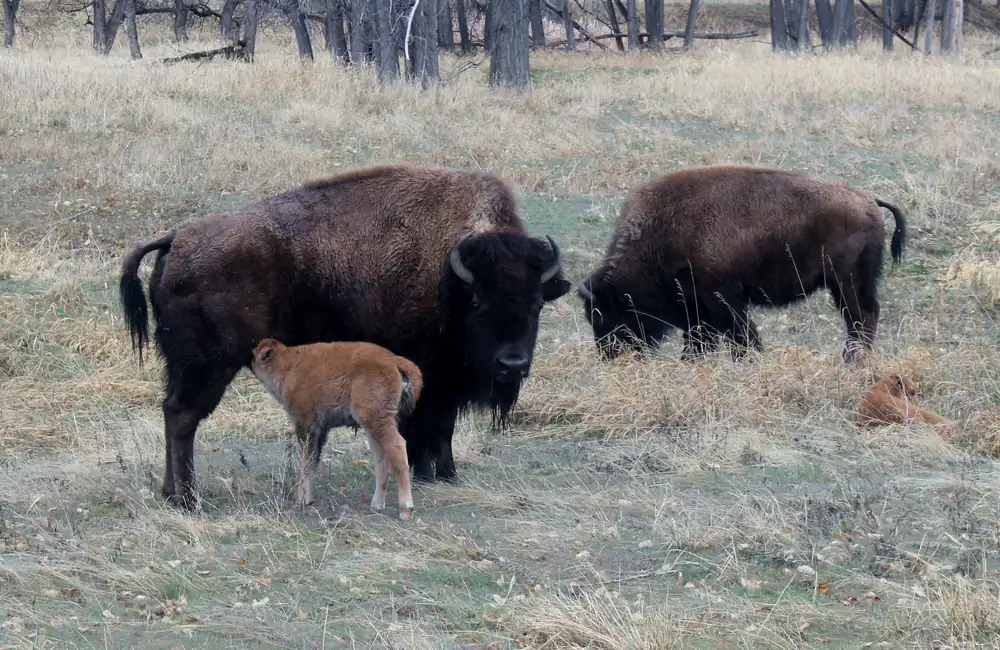
Bison calves in the badlands
Mid-April through late May, according to the calendar · Theodore Roosevelt National Park, Cross Ranch Nature Preserve and a few other herds
Game and Fish says free-ranging bison survive in North Dakota in small herds at Theodore Roosevelt National Park, at Cross Ranch Nature Preserve and on a few other public and private lands. Calves weigh about 44 pounds at birth, begin trying to graze at about five days, and nurse for seven to eight months. Cows weigh around 1,200 pounds and bulls up to 2,000, so keep well back. The Park Service asks visitors to stay at least 25 yards from all wildlife, a distance that applies with extra force to cows with calves, and says bison, feral horses and prairie dogs can gore, trample or bite. Dawn and dusk are the best times, and the South Unit’s road, with prairie dog towns beside it, and the North Unit are both on the park’s list of wildlife-viewing places.
-
Coyote pups, mink and raccoon
Coyote pups emerge early April through early June; mink breeding and raccoon young mid-April to late May; river otter breeding in April · Dens in banks and coulees, wooded streams
The calendar gives early April for coyote pups to begin emerging, mid-April for mink breeding and raccoon young, and April for river otter breeding. You are unlikely to see any of this, but a worn den entrance beside a coulee is a sign: watch from far off and keep dogs leashed.
-
Bighorn lambs
Late April through early June, according to the calendar · Rugged country where bighorn sheep live
The Game and Fish calendar lists bighorn lambs as born from late April through early June, so the last week of the month is the earliest anyone could see a new one. If you spot ewes on a ledge, watch through binoculars and do not climb toward them.
-
Prairie dog pups are still underground
Young appear above ground roughly six weeks after birth · Prairie dog towns at Theodore Roosevelt National Park
The Park Service says newborns stay below for about six weeks. The mating in March means few if any appear in April, so for this month the interest is in the adults: watch the sentries and the greeting “kisses” that identify coterie members. Do not feed them. The Park Service warns that fleas on prairie dogs can transmit plague.
When does the ice go out on North Dakota lakes, and when do pike and walleyes run?
The last ice is the big April event on the lakes. The fish respond when it goes. Dates vary by lake and year, so use the following as a guide, not a calendar.
-
Devils Lake and the culvert bite
Pike and walleyes move toward shore around mid-April as the ice retreats · Bridges and culverts where current flows, and shoreline bays
A guide article on Devils Lake says pike and walleyes move toward shore around mid-April when the sun forces the ice to retreat, and that shore fishing has the edge for two to three weeks. A game warden quoted there says that wherever current flows under a bridge or through a culvert, fishermen gather, and parked vehicles crowd the remote gravel roads. For a nature watcher, the same culverts are good places to watch for birds in the first open water. Watch your step and park fully off the road.
-
Paddlefish snagging on the Yellowstone and Missouri
Opened May 1 in 2026; 2027 rules not yet published · The Yellowstone River and the Missouri River west of the U.S. Highway 85 bridge
Just after April ends, snaggers gather at the confluence near Williston. In 2026 Game and Fish listed snagging as legal from May 1 through May 21, from 7 a.m. to 7 p.m. Central, with select days set aside for harvest and release only and a valid tag required. Harvest closed early on May 8 that year, followed by a snag-and-release extension. The 2027 season will be set by Game and Fish: check its fishing pages in April.
-
Thin ice and open water
Through April · Lakes, ponds and rivers
By April, ice near inflows, bridges and culverts is the first to go, and it can look solid from shore while being unsafe. Stay off it. For flood watchers, the National Weather Service in Grand Forks keeps its Red River and Devils Lake outlooks at weather.gov/fgf; the page for spring 2026 listed outlooks for January, February and March, so look there for 2027 issue dates.
What blooms and leafs out in North Dakota in April?
Green comes slowly. The first plants to show are hardy natives that bloom before the grass grows, and the first trees to bud are the small ones.
-
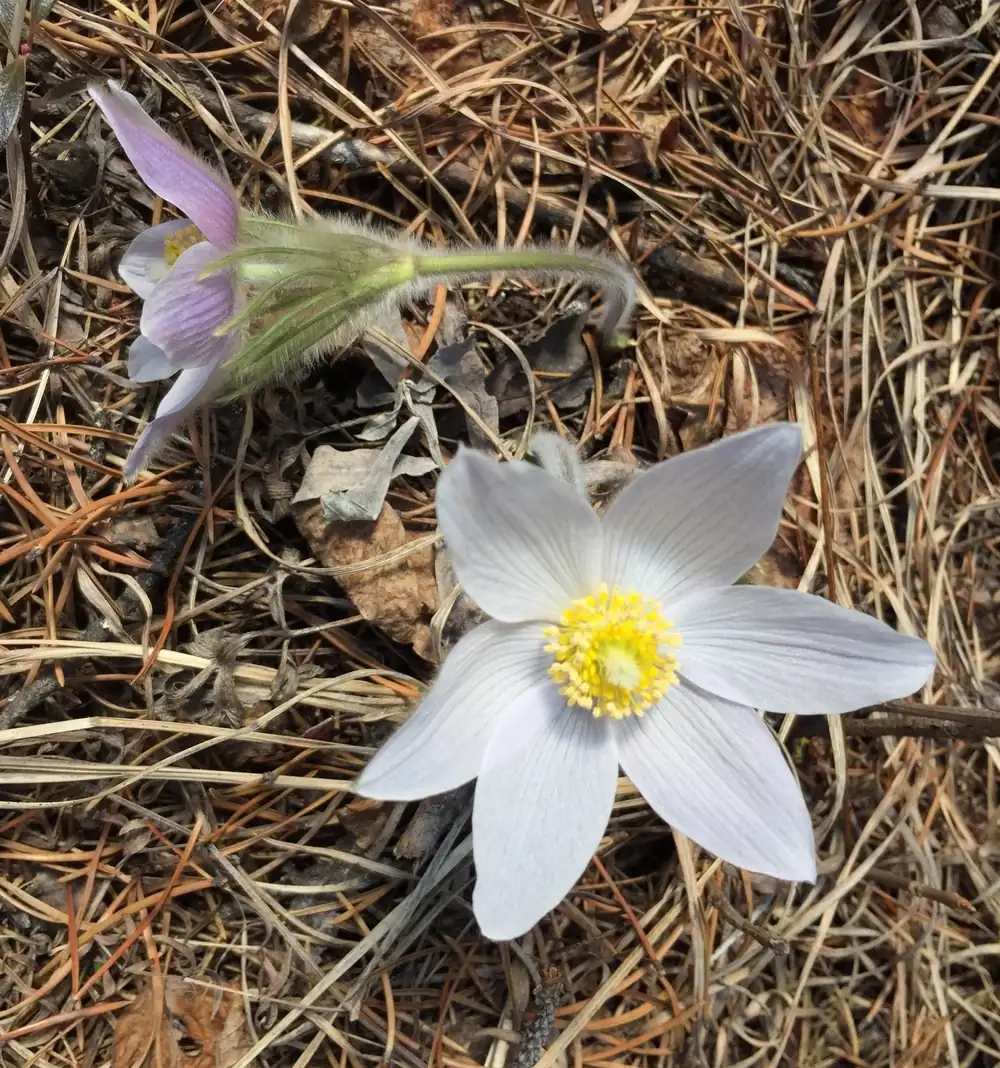
Prairie crocus at its peak
April, per the natural history calendar · South-facing prairie slopes with the snow gone
Game and Fish lists April as the month the prairie crocus, or pasqueflower, blooms. Look low on dry, sunny slopes where the snow has gone. A warm spell in March can bring the first flowers early, but April is the plant’s normal month. Leave the flowers where they are and photograph them from a few feet away.
-
Buds on the shrubs
Through the month · Shelterbelts, yards and town parks
NDSU Extension’s Tree Selector sheet for juneberry, also called saskatoon or serviceberry (Amelanchier alnifolia), lists it as a slow-growing shrub over seven feet tall, hardy to Zone 2, with white flowers and purple to black fruit. It is a good shrub for a weekly record: tag one branch on April 1 and photograph it each week to catch when the buds swell and open.
-
Arbor Day and Earth Day
Earth Day is Thursday, April 22; the national observance falls on April 30, 2027; North Dakota keeps its own date, May 7, 2027 · Schools, parks and town tree boards
Prairie Public’s Dakota Datebook says that North Dakota observes Arbor Day on the first Friday in May, the date the state chose for planting conditions. The first state Arbor Day was proclaimed by Governor John Burk on April 24, 1908. The state counts 53 Tree City USA communities, and the shelterbelts planted on the plains cut blizzard losses, erosion and flooding while giving homes to wildlife. In 2027 the state date falls on May 7, a week after the national one.
How warm is April in North Dakota, and what weather should you watch?
The 1991 to 2020 NOAA normals say April gets mild by day and stays cold at night: highs from the low 50s to the mid 50s, lows around 28 to 32 °F, and a night at or below freezing on roughly half to two-thirds of its days. The averages hide a lot of motion. The North Dakota State Climate Office’s spring 2024 bulletin recorded a March about 2 °F cooler than normal followed by an April more than 2.5 °F above normal, and a final snowfall on May 24 of about 8 inches at the Peace Garden station.
| Station | Average high / low | Average precipitation | Days with a low at or below 32 °F |
|---|---|---|---|
| Grand Forks (Red River Valley) | 52.0 / 29.3 °F | 1.21 in | 18.6 |
| Fargo (Red River Valley) | 54.1 / 31.9 °F | 1.54 in | 15.6 |
| Jamestown (James River valley) | 52.9 / 29.9 °F | 1.24 in | 17.3 |
| Bismarck (Missouri River) | 56.0 / 30.4 °F | 1.34 in | 17.5 |
| Theodore Roosevelt Airport (Dickinson) | 54.7 / 28.4 °F | 1.37 in | 19.9 |
Hazards. Tornadoes are rare in April. The National Weather Service in Grand Forks counted just four in April (three EF0 and one EF1) in the modernized record from 1996 to 2019 for eastern North Dakota and northwest Minnesota, and calls May through mid-September the tornado season. Late April is when the National Weather Service turns to severe storms: its Severe Summer Weather Awareness Week ran from April 27 to May 1 in 2026 (a severe thunderstorm means wind gusts of 58 mph or more or hail an inch or larger), and the 2027 dates are still to come. The more frequent April dangers are wind and fire. The State Climate Office noted that major cities averaged about 50 days with wind gusts above 30 mph in spring 2024, among the windiest springs in 30 years. The state’s emergency-response page says dry grass left standing, low humidity and strong wind are the ingredients of grass fires, and recommends checking ndresponse.gov/burn before burning, keeping vehicles off dry grass, and watching burned brush piles that can rekindle. The Climate Prediction Center updates its outlooks monthly at its 90-day outlook page. Our weather page covers local stations, and the cloud-spotting page helps with reading a front coming in.
How much daylight does North Dakota gain in April?
Day length climbs fast, and the daylight-time clocks started on March 14, so sunrise and sunset already read an hour later than in early March. Day lengths in the table are untouched by the clock change. Central time covers most of North Dakota, and Mountain time covers the southwest, Dickinson among its towns. Our daylight page has more.
| City | Apr 1 | Apr 30 | Gained | Per day |
|---|---|---|---|---|
| Fargo | 12 h 49 m | 14 h 22 m | 93 min | 3.2 min |
| Grand Forks | 12 h 51 m | 14 h 28 m | 97 min | 3.3 min |
| Jamestown | 12 h 50 m | 14 h 23 m | 93 min | 3.2 min |
| Devils Lake | 12 h 52 m | 14 h 28 m | 96 min | 3.3 min |
| Bismarck | 12 h 49 m | 14 h 22 m | 93 min | 3.2 min |
| Minot | 12 h 51 m | 14 h 29 m | 98 min | 3.4 min |
| Williston | 12 h 52 m | 14 h 29 m | 97 min | 3.3 min |
| Dickinson | 12 h 49 m | 14 h 22 m | 93 min | 3.2 min |
When is the last spring freeze in North Dakota?
This is the question behind every garden. Every station below has a median last freeze in May, and nine springs in ten are done with freezing only in late May or early June. Do not set out tender plants because April was warm. Look up the frost dates for your own town, and plan on a covering for any night that is forecast near freezing through mid-May.
| Station | One year in ten | Median | Nine years in ten |
|---|---|---|---|
| Fargo Hector International Airport | Apr 27 | May 10 | May 23 |
| Grand Forks International Airport | May 3 | May 16 | May 31 |
| Jamestown Municipal Airport (James River valley) | Apr 28 | May 11 | May 24 |
| Bismarck | May 1 | May 14 | May 27 |
| Minot International Airport | Apr 27 | May 10 | May 22 |
| Williston Sloulin International Airport | May 8 | May 21 | Jun 3 |
| Theodore Roosevelt Airport (Dickinson) | May 6 | May 18 | May 31 |
What can you see in the North Dakota night sky in April?
Times are Central daylight time unless marked Mountain; the southwest corner of the state is an hour earlier. Clocks went ahead on March 14 and stay that way all month.
-
The Pink Moon
Full late Tuesday afternoon, April 20, at 5:27 p.m. Central (4:27 p.m. Mountain) · Low in the east after sunset
The April full moon is the Pink Moon. The full moment comes in the late afternoon, before the Moon has risen, so the best evening is Tuesday, April 20. At Minneapolis, the nearest city on the verified list, moonrise that evening is at 8:21 p.m.; in North Dakota check your own town’s time and expect it to be the same general hour. The Moon also looks full the evening before and after.
-
Lyrid meteors, hurt by moonlight
Maximum about 8:40 p.m. Central (7:40 p.m. Mountain) on Thursday, April 22 (another calculation puts it about 15 minutes later) · Northeast sky, away from town lights
This shower is active between roughly April 14 and April 30, with the peak coming on April 22. Three nights past full, the Moon is nearly round (95 percent lit) and comes up late: 10:44 p.m. at Minneapolis, the closest city on the verified list. That leaves only the early evening dark, while Lyra is still low. The International Meteor Organization’s forecast calls it poor, so count on a handful of meteors per hour at most.
-
Planets and the Moon
Moon beside Jupiter on April 14 and 15; thin crescent beside Venus on April 3 and 4 · Jupiter after dark; Venus in the east before sunrise
Jupiter shines after dark through the spring. On April 14 and 15 a gibbous Moon (68 percent lit) passes it, within a degree on the 15th, and Mars is about three degrees from the Moon that same night. Venus, the brilliant morning star, is sinking toward the Sun: its head start on sunrise shrinks from about 75 minutes on the first of April to roughly 60 on May 1. A thin lit sliver of Moon (9 percent) is close beside it in the dawn sky of April 3 and 4. Saturn is hidden by the Sun’s glare all month.
-
Aurora
Any clear, dark night · Northern horizon from a dark site
No agency forecasts geomagnetic storms months ahead. On any clear, dark night, check the Space Weather Prediction Center’s 30-minute aurora forecast, and look north from a spot away from town lights.
| Phase | Date | Time |
|---|---|---|
| New moon | Tuesday, Apr 6 | 6:51 p.m. CDT (5:51 p.m. MDT) |
| First quarter | Tuesday, Apr 13 | 5:56 p.m. CDT (4:56 p.m. MDT) |
| Full moon, the Pink Moon | Tuesday, Apr 20 | 5:27 p.m. CDT (4:27 p.m. MDT) |
| Last quarter | Wednesday, Apr 28 | 3:18 p.m. CDT (2:18 p.m. MDT) |
| New moon | Thursday, May 6 | 5:58 a.m. CDT (4:58 a.m. MDT) |
For phases and times see our moon phases page.
What can North Dakota families do outdoors in April 2027?
Written in early October 2026, when the state parks events page listed nothing beyond January 2027. No recurring April event is dated here, so confirm with the organizer.
- Crane count. Pick an afternoon in the first three weeks and tally the cranes you hear and see. Record the date and wind direction.
- Culvert watch. Choose one culvert or bridge and visit it weekly. Note the ice, the first ducks, the first frogs and who is fishing.
- Thursday, April 22: Earth Day. Take gloves and a bag for a roadside cleanup, and stay out of ditches with standing water.
- Thursday, April 22: Lyrids and moonlight. A poor shower, so make it a Moon watch instead.
- Tuesday, April 20: the full Pink Moon. Step outside once it has cleared the horizon.
- Friday, April 30, and Friday, May 7: Arbor Days. The national date is April 30; North Dakota’s is May 7. Plant a tree or tag one to watch.
- Join a count. NestWatch from the Cornell Lab lets you log nests as birds start building, and Journey North collects sightings of hummingbirds, monarchs and other migrants.
- Refuge visits. Upper Souris, Lostwood, Tewaukon and Long Lake offer wildlife drives and trails; check with each refuge for current access and any closure around peak migration.
The nature hub lists the other states, and the earlier page for this one is March in North Dakota. Keep your dates in a Naturalist’s Field Journal.
Safety notes for April in North Dakota
- Spring turkey. No 2027 dates were posted in October. The department’s turkey page carried no orange rule when I read it, so check the proclamation once it is signed, and put on something bright when you walk woods where hunters may be calling.
- Spring light goose season. The 2026 order covered February 21 through May 10, and the 2027 window was still unannounced, so look at the Game and Fish regulations. Expect gunfire near big flocks.
- Ticks. The Health and Human Services department says ticks become active once temperatures rise above freezing, and recorded 616 American dog ticks (and one deer tick) between April and July 2025 in its surveillance. Walk in the center of trails, use an EPA-registered repellent, check yourself and pets, and send photos to NDTicks@nd.gov.
- Wildlife with young. Stay 25 yards or more from bison, horses and prairie dogs, and farther from cows with calves. Do not feed prairie dogs. Keep dogs leashed near plover shores, curlew pastures and bison.
- Ice and water. Stay off thin or snow-covered ice, ice near culverts and bridges, and floodwater. Never drive across a flooded road.
- Fire. Check ndresponse.gov/burn, do not park on dry grass, and report smoke early.
- Late snow and wind. A spring blizzard is still possible. Carry a shovel, blankets and food on long drives, and watch the forecast for high winds.
- Nesting birds. Do not approach pelican colonies, plover shores or eagle nests. Respect closures at refuges.
Sources (40)
- North Dakota Game and Fish: natural history calendar, April
- North Dakota Game and Fish magazine: Stopover State (sandhill cranes)
- North Dakota Game and Fish: whooping crane migration
- North Dakota Game and Fish: piping plover
- North Dakota Game and Fish: long-billed curlew
- North Dakota Game and Fish: American bittern
- North Dakota Game and Fish: bison
- North Dakota Game and Fish: spring turkey
- North Dakota Game and Fish: spring light goose season, 2026
- U.S. Fish and Wildlife Service: Chase Lake National Wildlife Refuge
- U.S. Fish and Wildlife Service: Partners prepare for return of white pelicans to Chase Lake
- U.S. Geological Survey: American white pelicans breeding in the northern plains
- U.S. Fish and Wildlife Service: Lostwood National Wildlife Refuge, about us
- U.S. Fish and Wildlife Service: Upper Souris National Wildlife Refuge
- U.S. Fish and Wildlife Service: Tewaukon National Wildlife Refuge
- National Park Service, Theodore Roosevelt National Park: wildlife viewing
- National Park Service, Theodore Roosevelt National Park: prairie dogs
- National Park Service, Theodore Roosevelt National Park: current conditions
- Prairie Public, Natural North Dakota: Look up! Spring bird migration is back
- Prairie Public, Dakota Datebook: The Central Flyway
- Prairie Public, Dakota Datebook: Arbor Day in North Dakota
- Grand Forks Herald: Mike Jacobs on early April migrants
- Devils Lake tourism: early Devils Lake open water
- North Dakota Game and Fish: paddlefish snagging (2026 season)
- North Dakota Health and Human Services: preventing ticks and tickborne diseases
- North Dakota Response: earlier and longer spring fire season
- NWS Grand Forks: miscellaneous severe weather statistics
- NWS Bismarck: North Dakota severe summer weather awareness week
- NWS Grand Forks: current flood outlook
- North Dakota State Climate Office: North Dakota Climate Bulletin, spring 2024
- NDSU Extension: serviceberry (juneberry) tree and shrub pages
- NOAA NCEI: U.S. climate normals 1991–2020
- NOAA Climate Prediction Center: 90-day outlooks
- North Dakota Parks and Recreation: events
- Cornell Lab of Ornithology: BirdCast
- Cornell Lab of Ornithology: NestWatch
- Journey North
- NOAA Space Weather Prediction Center: aurora 30-minute forecast
- U.S. Naval Observatory: moon phases
- Photos via Wikimedia Commons; licenses and photographers are listed with each file
.jpg)