What to look for in nature in North Dakota this December
Meteorological winter opens on December 1. Weather records group December with January and February because those three months run coldest, and North Dakota rarely argues the point. Snow covers the ground for most of the month, the sun sets before five almost everywhere, and the animals that stay have settled into their winter routines. Gray partridge and sharp-tailed grouse spend the coldest nights buried in drifts. Moose drift out of the Turtle Mountains and the northern river bottoms into farm country, and hawks and falcons from the Arctic hunt the open fields. Mid-month brings the Geminids, and Christmas week brings 2026’s nearest full moon and a weekend of free ice fishing. Below is where and when to look.
Other months in North Dakota: October, November.
Start here
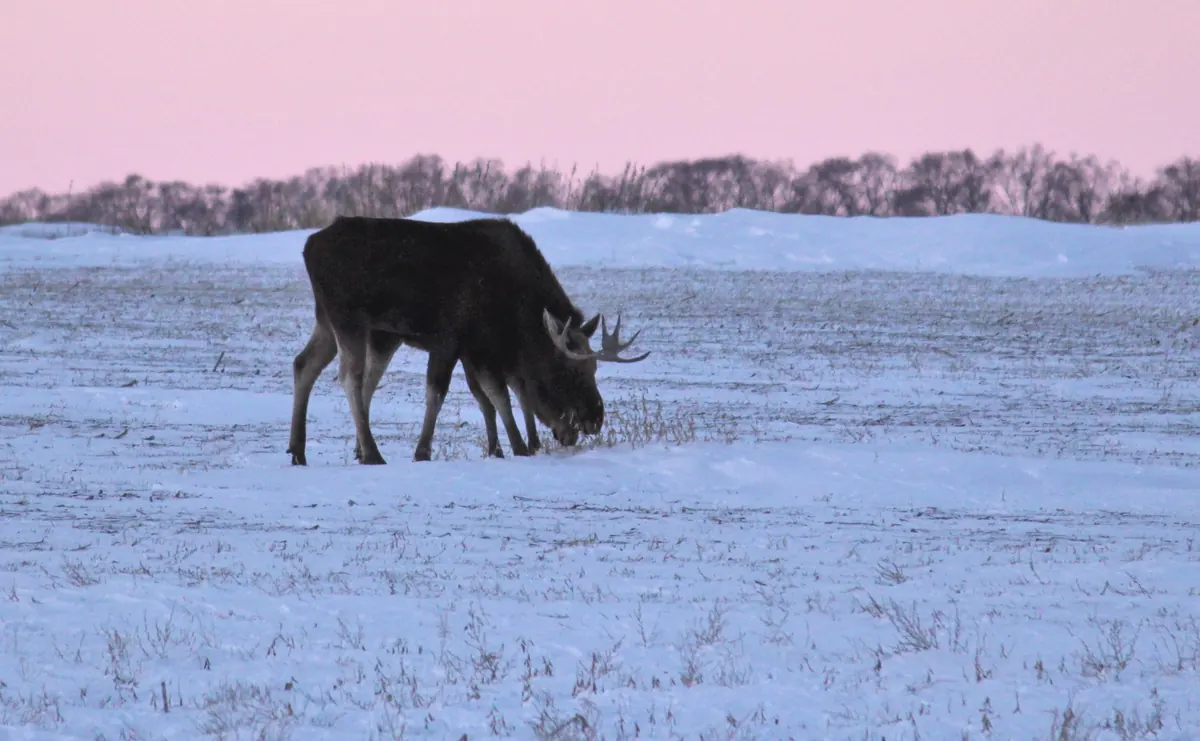
- A moose in farm country. North Dakota Game and Fish says moose have spread from the Turtle Mountains and the wooded rivers of the north into farmland all along the northern tier, from Walhalla to Williston, and that in winter some turn up in farmyards and towns. Scan willow-lined creeks and shelterbelts at first and last light, and drive slowly after dark.
- Join a Christmas Bird Count. Between December 14 and January 5, volunteers survey fixed count circles for Audubon’s 127th count, each on a single day. Beginners can join a field party or count their own feeder if they live inside a circle; Audubon’s online circle finder lists organizers.
- Geminids, then the Cold Moon. Watch for Geminid meteors through the night of Sunday the 13th into Monday morning; the young crescent moon is down early. The Cold Moon turns full at 7:28 p.m. Central on Wednesday the 23rd, the year’s nearest full moon.
This month in the Naturalist’s Field Journal, record the winter’s first rough-legged hawk, snow bunting or gyrfalcon on “birds I have seen,” draw a grouse roost hole and the wing marks around it on “tracks to know,” and enter any moose on the mammal watch with the field or creek where it stood. Pick one Rocky Mountain juniper or shelterbelt spruce for “a tree through the seasons,” glue a juniper berry onto “seeds, pods and cones,” and time the earliest sunset of the year for the dusk and dawn watch.
Regions used below: Red River Valley; Devils Lake and the Turtle Mountains; Drift Prairie and the James River valley; Missouri Coteau and Bismarck–Mandan; Lake Sakakawea and the northwest; Badlands and the southwest (Mountain time).
Where can you see moose in North Dakota in winter?
A moose on open prairie sounds unlikely, yet in North Dakota it happens more often than you might think. Game and Fish says the state probably has more moose today than when Lewis and Clark passed through in 1804–06, and that the animals have moved well beyond their old strongholds.
-
Moose leaving the woods
All winter; most active around dawn and dusk · Turtle Mountains, Pembina Gorge, wooded rivers of the northern third of the state, and farm country along the whole northern tier
Moose once kept to the Turtle Mountains and the forested river valleys. The department says they have since spread onto the prairie wherever wooded bottoms and tree rows offer browse, and in winter some wander into farmyards and towns, with vehicle collisions most common then. A bull averages about 950 pounds, so slow down near any wooded creek crossing. They turn up outside their range, too. On December 22, 2016, a Fish and Wildlife Service photographer found a pair eating unharvested soybeans south of Flood Lake, near Kulm in the southeast, where the agency says moose are not common.
-
Ghost moose and winter ticks
Ticks attach in fall, feed all winter and drop off in spring, usually April · Wherever moose live
Winter is also when a tiny parasite does its damage. Game and Fish explains that winter ticks climb onto moose in fall and feed through the winter, and that in mild years a single moose can carry 75,000 to 150,000 of them. Badly infested moose rub away much of their hair trying to get relief, leaving gray, ragged “ghost moose.” Snow is the moose’s ally here: an engorged tick that drops onto snow dies, so it is a run of mild winters with bare ground in spring that lets the ticks boom. If you see a moose with pale, patchy flanks in late winter, that is the likely reason.
Hunters wait years for a tag (Game and Fish had 27,279 applicants for 288 moose licenses in 2025), but watching one is free. Write down the place, the date and what it was eating.
How do grouse, partridge and pheasants survive a North Dakota winter?
North Dakota’s upland birds stay put all winter, through blizzards and 30-below nights, and they do it with shelter, fat and food rather than by leaving. Two of them use the snow itself.
-
Sharp-tailed grouse under the snow
Early December through late February · Native grassland and brushy coulees statewide; buffaloberry, rose and chokecherry thickets
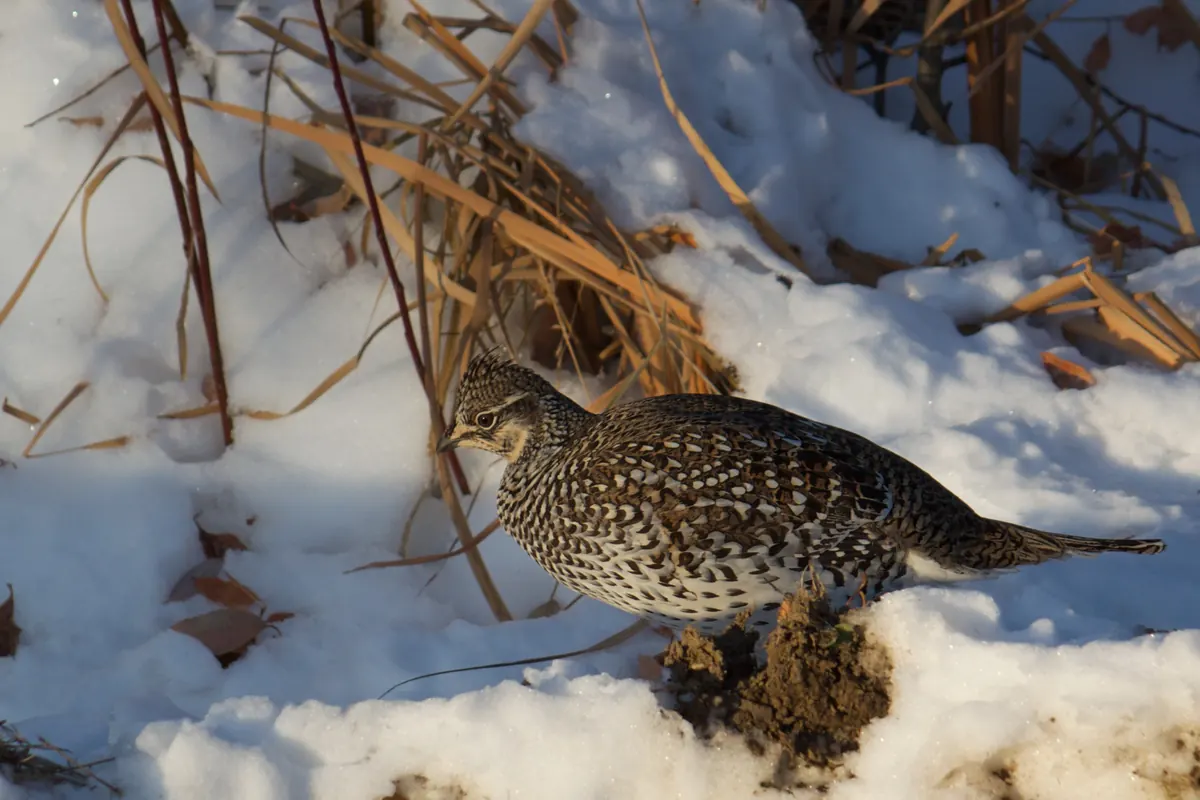
Game and Fish’s natural history calendar has sharp-tailed grouse turning to a winter diet made up mostly of berries and buds from early December, and burrowing into the snow to roost through late February. Snow insulates, and a bird tucked beneath it is out of the wind. On a calm morning after fresh snow, a group may explode out of a drift almost under your boots. If that happens, look back at the holes they left; each one is a roost, and the marks around it show where wings struck the snow.
-
Gray partridge in family coveys
All winter; coveys break up in late winter · Grain and sunflower stubble, road ditches and farmsteads, mostly in agricultural country
The gray or Hungarian partridge, the “Hun” of North Dakota hunters, survives on extra fat, dense feathers and thick pads on its feet, according to the department, and it will tunnel through snow to reach food while staying out of the wind. Families stay together as coveys through fall and winter, sometimes mixing with other coveys, and split up only when nesting season approaches. In winter the birds lean on stubble fields, roadsides and farmyards, where waste grain, weed seeds and grit are exposed. A covey of small, round, gray-brown birds whirring off a gravel shoulder is a classic December sight.
-
Pheasants in the cattails
October through March · Cattail sloughs, tall grass, food plots, and wide shelterbelts in the worst storms
Game and Fish’s habitat guide says pheasants need stiff-stemmed cover that stays upright under heavy snow, with food within about a mile. A South Dakota study it cites found hens moved into trees mainly late in a severe, once-in-ten-years winter; in ordinary winters they stayed in cattails, tall grass and food plots. Narrow tree belts of one to four rows can turn deadly, filling with drifts that smother the birds sheltering there.
Snow buntings work the same gravel shoulders as the partridge in winter. Drive a section line slowly after a storm and count what flushes ahead of the car.
Which hawks, falcons and owls hunt North Dakota in winter?
The summer hawks are gone, replaced by hunters from the Arctic and the boreal forest. Seasons below come from Game and Fish’s guide Raptors of North Dakota.
-
Rough-legged hawks
Mid-October until April · Open, treeless country: prairie, marshes, stubble fields, utility poles
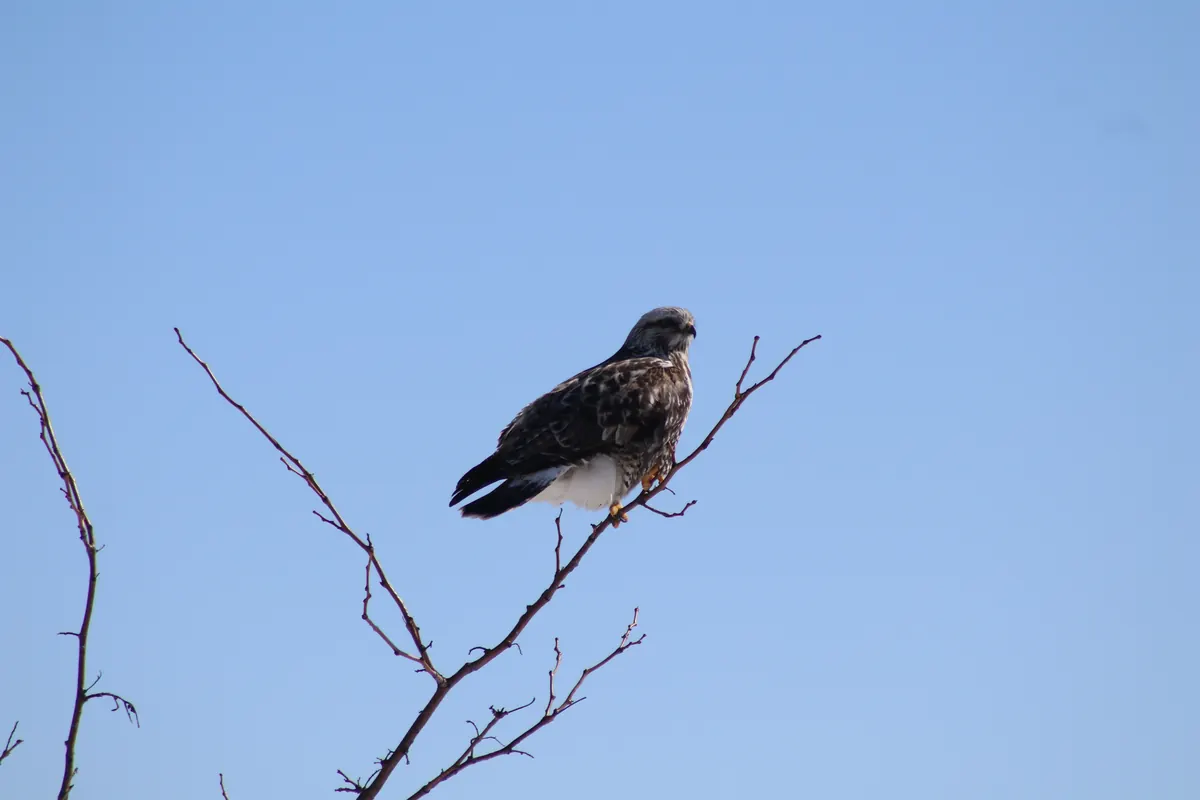
By December rough-legged hawks have settled in across North Dakota’s open land. It nests on the Arctic tundra of Alaska and Canada and spends the winter here, hunting mice and voles by hovering in place or watching from a perch. Field marks: a dark band across the belly, a black wrist patch under each wing, and a white tail with one broad dark band. The guide calls it a fairly tame hawk that often lets people approach closely, so a slow drive along a section road is the best way to find one.
-
Gyrfalcons, the rare one
About November through March · Open country statewide
The guide calls the gyrfalcon the largest of our falcons. It nests on Arctic and alpine tundra, and most stay there all year; some winter in southern Canada, and the guide says few go any farther south than North Dakota, so the state sits right at the edge of where you can hope for one. Gyrs range from gray to nearly white or nearly black, with females almost twice the weight of males. Any big, heavy-bodied falcon flying low and fast over a December field deserves a second look and an eBird report.
-
Northern goshawks and golden eagles
Goshawks October through March; golden eagles statewide in winter · Goshawks in woodlands and river bottoms; golden eagles in the badlands and over open prairie
Goshawks winter here without nesting, in larger numbers when food fails farther north, and individuals tend to return to the same winter haunts. Golden eagles, at home in the badlands and along the upper Missouri, wander the whole state in winter and will feed on deer and pronghorn carcasses. The guide says pairs start tending their nests in January.
-
Great horned owls getting ready to nest
Year-round; nests started as early as February · Tree rows, farmstead groves and river woods across the state
The great horned owl lives in every part of North Dakota all year, and the raptor guide says it starts nesting here as early as February, usually in an old nest built by a hawk, eagle, crow, heron or squirrel. So by December the nesting season is close, and the leafless trees make the big stick nests easy to spot. Note promising nests in a tree row now, then check them from a distance in late winter for a pair of ear tufts above the rim.
Snowy owls, northern hawk owls and the eagles at Garrison Dam are covered on the North Dakota November page; all of them stay through December.
When is the Christmas Bird Count in North Dakota, and how can you join?
The first counters went out on Christmas Day in 1900, counting birds in place of the holiday side hunts of the day, and Audubon has kept the results ever since. This winter’s season, the 127th, starts on Monday the 14th and ends on Tuesday, January 5. Every count is a one-day survey of a fixed circle, on a date its organizer chooses.
-
How to take part
Sign up in early December; count days fall between December 14 and January 5 · Any count circle; Audubon’s circle finder lists them
Audubon offers two ways in, both free and open to beginners. Field counters spend the daylight hours on a share of the circle, logging every bird seen or heard. Feeder counters who live inside a circle tally the birds at home. Audubon’s circle finder shows the circles near you and how to reach each organizer, who sets the date and meeting place.
-
What the old counts show
The 1969 and 1970 counts · As reported in the Bismarck Tribune
Prairie Public’s Dakota Datebook dug up the state’s 1969 count results, announced by the Bismarck Tribune in January 1970: 37 species, including just one pheasant and one lone merganser. The next winter’s count found 25 pheasants and a flock of 23 Canada geese, and the coverage noted that the geese then usually left by early December. Today Canada geese winter on the Missouri by the tens of thousands, a change these old tallies make plain.
If no count is near you, Project FeederWatch, which opened on November 1, keeps going through April 30, and every species you add goes into the journal’s bird list with the date.
How do small North Dakota animals get through the winter?
Some animals sleep, some change color, and some simply keep working. December is a good month to find the workers, because snow records their every move and the bare trees hide nothing.
-
Red squirrels and their middens
All winter, active by day · Spruce and pine plantings, the Turtle Mountains, and hardwoods and thickets even on the northern prairie
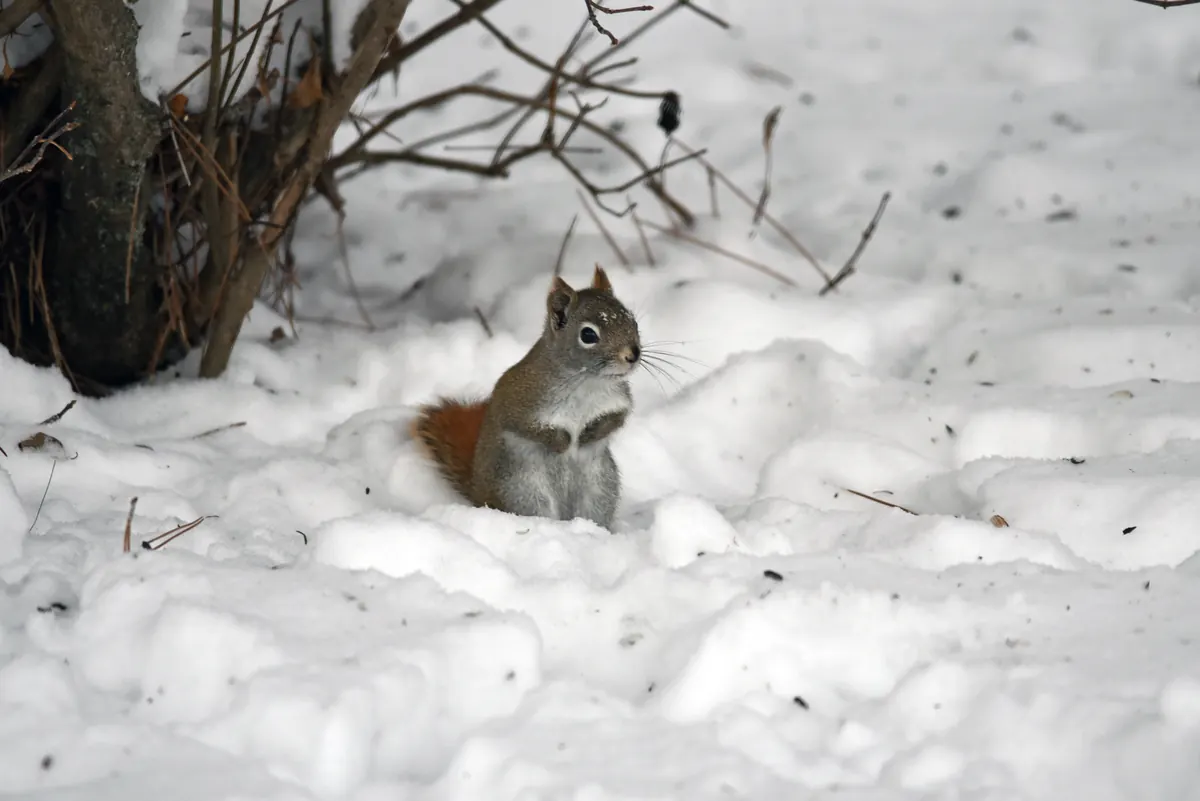
The red squirrel is a hoarder. Game and Fish says it buries nuts and seeds one at a time or in small piles to eat on winter days, and that its feeding spots pile up with shredded cones, husks and hulls, sometimes more than a foot high. Look for those heaps, called middens, under spruces. In winter its coat turns orange-red and its ears grow small tufts.
-
Flying squirrels at the feeder, after dark
All winter, at night · Wooded areas with old trees, including towns
North Dakota’s flying squirrels are its only nocturnal squirrels, so most people never see one. They don’t truly fly; a fold of skin between the legs lets them glide from tree to tree, usually 20 to 30 feet and sometimes as far as 150. The department notes they are frequent visitors at bird feeders. Watch a feeder near big trees on a December night with a dim light, and you may see one land with a soft thump.
-
Deer in the shelterbelts
From the first deep snow until spring · Shelterbelts, wooded draws and cattail sloughs next to food
In bitter weather deer lean on thermal cover, the dense trees and cattails that cut the wind, and Game and Fish warns that pushing them out of it in harsh conditions makes them spend energy they need. So read their story from the road instead: packed trails in the snow between a tree row and a field show where they travel to feed, and beds melted into the snow show where they rest.
What is it like in Theodore Roosevelt National Park in December?
The park stays open around the clock all year, and in December you may have it nearly to yourself. The National Park Service warns that parts of the South Unit Scenic Loop Drive and the North Unit Scenic Road may close for snow and ice, so check road status before you set out, and remember that Medora and the South Unit keep Mountain time while the North Unit keeps Central.
-
Wild horses on the snowy buttes
All year; easiest to see against snow · South Unit: the Talkington trailhead off I-94 exit 36, and the Painted Canyon, Buck Hill and Wind Canyon overlooks
The South Unit is home to roughly 200 free-roaming horses. The Park Service’s collar studies show they travel in bands of about 5 to 15, and the park suggests looking near the Talkington trailhead in the southeast corner or from the Painted Canyon, Buck Hill and Wind Canyon overlooks. Against snow, a dark band of horses stands out from a long way off. Give them the same 25 yards you give bison.
-
Rocky Mountain juniper on the north slopes
Evergreen all year; berry-like cones on female trees · North-facing slopes and draws of the badlands
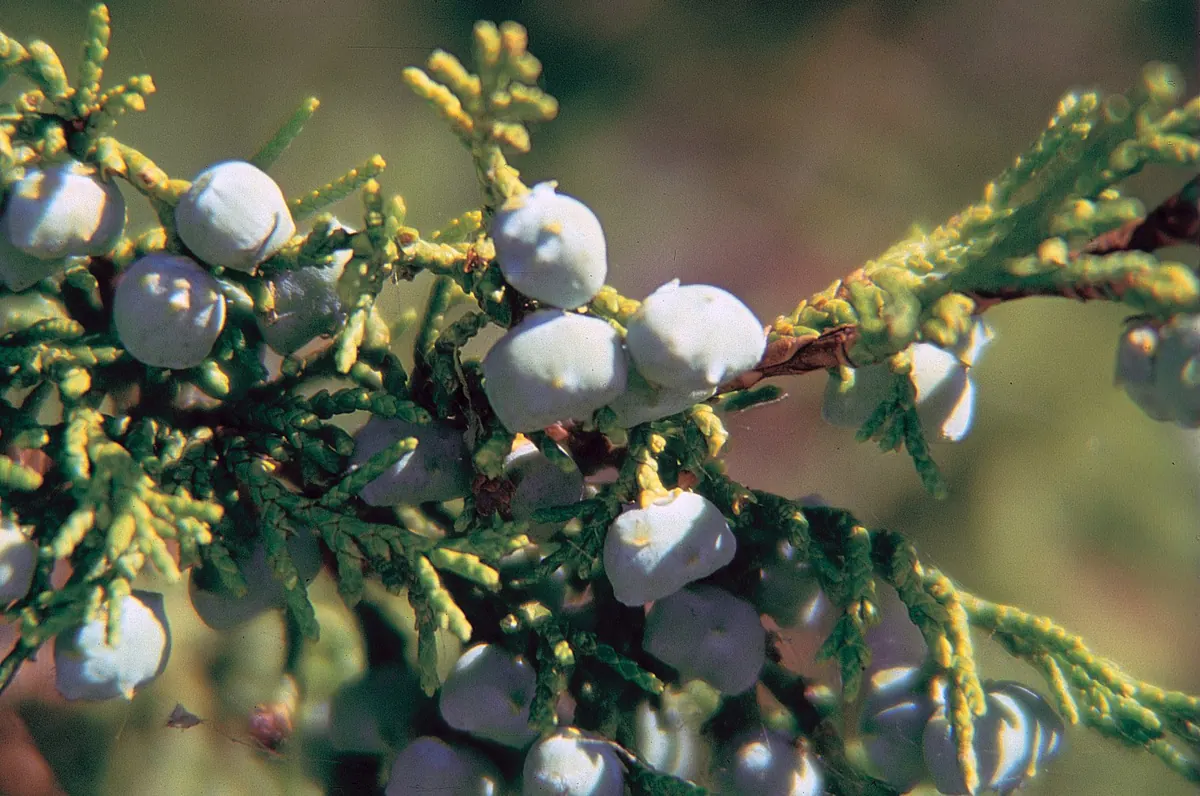
The park’s plant notes describe trees on the cooler, north-facing sides of the buttes and bare, dry south faces, and in winter that contrast turns obvious: dark green juniper on one side, snow and clay on the other. Rocky Mountain juniper is the badlands’ evergreen. The USDA plant guide says male and female cones grow on separate trees, so only some junipers carry the dark blue, waxy “berries,” which are really small cones. The guide names the cedar waxwing as a principal eater of them, and says juncos, sparrows and other small birds roost in the thick foliage, shelter that matters most in winter. Find a berry tree near an overlook and wait a few minutes for the birds.
-
Falcons and eagles over the river
All year · Cliffs and buttes along the Little Missouri
Prairie falcons live in the badlands year-round, and Game and Fish’s raptor guide says most of the state’s nesting pairs are along the Little Missouri valley. Golden eagles share the same skies. On a still winter day, watch the skyline of the buttes rather than the road.
When is the ice safe in North Dakota, and when can you fish for free?
Small ponds and sloughs freeze first, the big lakes later, and moving water such as the Missouri River last of all. Early December ice is often thin and uneven, so the first ice fishing of the season is also the most dangerous.
-
How thick is thick enough
Check every trip, all winter · Every lake and pond
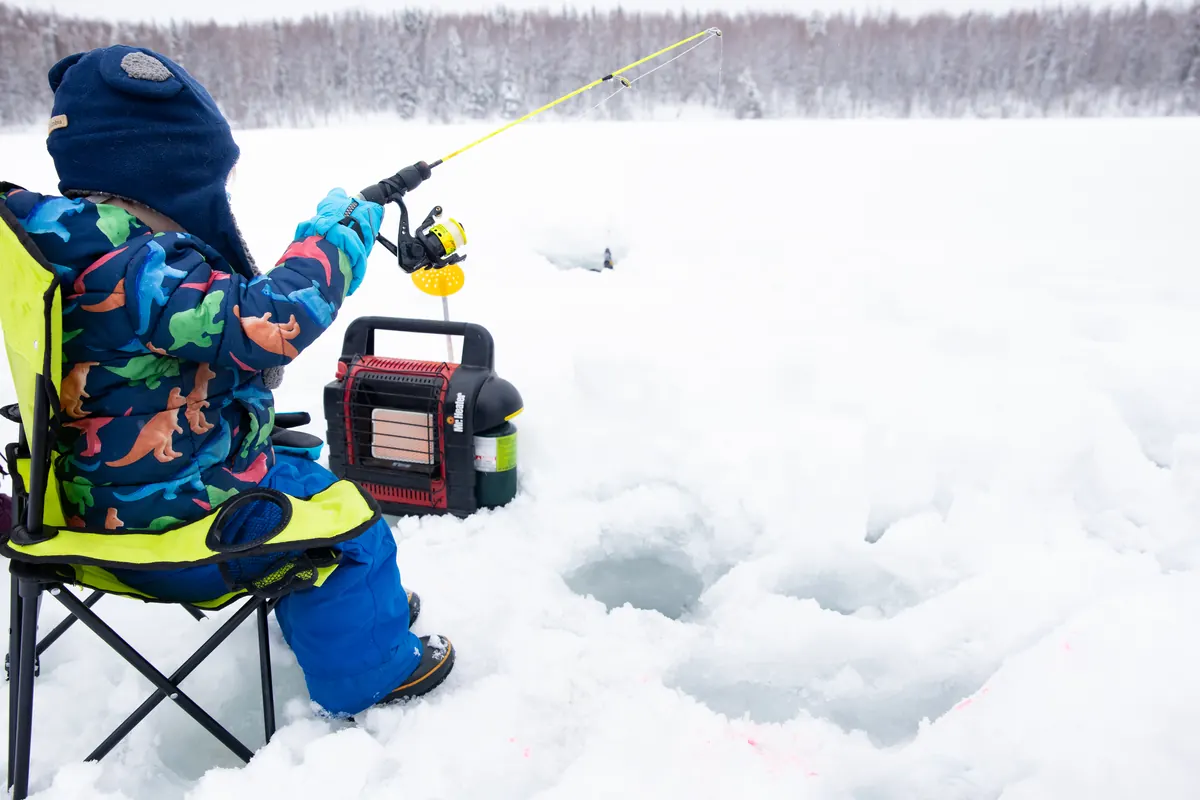
Game and Fish’s guidelines are simple: stay off anything under 2 inches. It takes 4 inches for someone on foot, 6 with a sled or ATV, 8 to 12 under a car or light pickup, and 12 to 15 under a mid-size pickup. The department calls driving onto the ice early or late in the season “an accident waiting to happen,” and advises against driving on it at night or while it is snowing. Clear blue ice is the strongest; drill test holes as you go.
-
If someone goes through
Any time · Carry picks and a rope
Game and Fish’s advice if you go in: turn toward the way you came, since that ice held you, use ice picks to haul yourself out, and roll away instead of standing up. To rescue someone, reach, throw a line or a float, or make a human chain, and never run to the edge of the hole.
-
Free ice fishing weekend
Saturday and Sunday, December 26–27 · Any public water with safe ice
Game and Fish lists December 26 and 27 as its 2026 ice fishing free fishing days: North Dakota residents may fish without a fishing license, while every other regulation still applies. It is a good weekend to introduce children to ice fishing, provided the ice near you is thick enough by then. In a mild El Niño December it may not be. And pack everything out: the department reminds anglers that leaving fish or trash on the ice is a violation.
How cold and snowy is December in North Dakota, and what could El Niño change?
December is the month when highs stay below freezing for good. NOAA’s 1991–2020 normals put the average December afternoon at 21.4 °F in Grand Forks, 24 °F in Fargo, 26.1 °F in Williston, 27.2 °F in Minot and 27.7 °F in Bismarck, with nights averaging 4 to 9 °F. Melted down, December’s precipitation is small, from about a third of an inch at Minot to nine-tenths at Fargo, but it falls almost entirely as snow, and it stays: in a normal December the ground is white for about three weeks.
| Station | Average high / low | Average snowfall | Median snowfall | Days with 1 inch or more on the ground |
|---|---|---|---|---|
| Grand Forks (Red River Valley) | 21.4 / 4.2 °F | 12.3 in | 9.4 in | 24.8 |
| Fargo (Red River Valley) | 24.0 / 7.5 °F | 11.7 in | 9.2 in | 21.5 |
| Minot (north central) | 27.2 / 9.3 °F | 8.1 in | 5.5 in | 24.4 |
| Bismarck (Missouri River) | 27.7 / 8.1 °F | 10.1 in | 8.3 in | 19.3 |
| Williston (northwest) | 26.1 / 6.1 °F | 10.4 in | 7.1 in | 20.0 |
Grand Forks, the coldest and snowiest of the five, usually keeps snow cover nearly all month. Medians trail averages everywhere because a few huge Decembers inflate the mean. Spring and fall freeze dates for every station are on our North Dakota frost dates page.
Then there is the ocean. A possibly record-breaking El Niño is under way near the equator, and the CPC update dated September 10 rated a very strong event persisting all winter as better than 90 percent likely, with 75 percent odds of a record October-to-December reading. Asked about it in late September, the state climatologist told the Jamestown Sun that the odds lean warm while stressing, “Every winter is unique.” Warm does not mean easy. During the last El Niño, the State Climate Office’s winter bulletin notes, cold below zero still had not set in by the end of 2023, and freezing rain from Christmas Day to December 27 glazed southeastern North Dakota in one of its worst ice storms: up to an inch of ice near Valley City, outages lasting days, and record December wetness in Cass and Richland counties. The official December-to-February outlook appears October 15, with monthly updates, among the CPC’s 90-day outlook maps. Before any winter drive, a look at Weather now is worth the minute.
When is the earliest sunset in North Dakota?
Before the solstice. The shortest day comes on Monday, December 21, when the solstice arrives at 2:50 p.m. Central (1:50 p.m. Mountain), and Minot, Devils Lake and Williston get just 8 hours 21 minutes of daylight. The earliest sunsets fall in the second week of December, and the latest sunrises hold off until the turn of the year. Around the solstice the sun reaches its high point a little later each day by the clock, so sunset and sunrise both drift later even while the day is still shrinking.
| City | Dec 1 | Dec 21 | Dec 31 | Earliest sunset |
|---|---|---|---|---|
| Fargo | 8 h 48 m | 8 h 31 m | 8 h 36 m | 4:38 p.m., Dec 11 |
| Grand Forks | 8 h 40 m | 8 h 23 m | 8 h 27 m | 4:35 p.m., Dec 11 |
| Jamestown | 8 h 48 m | 8 h 32 m | 8 h 36 m | 4:46 p.m., Dec 11 |
| Devils Lake | 8 h 39 m | 8 h 21 m | 8 h 26 m | 4:42 p.m., Dec 11 |
| Bismarck | 8 h 49 m | 8 h 32 m | 8 h 36 m | 4:55 p.m., Dec 11 |
| Minot | 8 h 38 m | 8 h 21 m | 8 h 25 m | 4:51 p.m., Dec 11 |
| Williston | 8 h 39 m | 8 h 21 m | 8 h 25 m | 5:01 p.m., Dec 11 |
| Dickinson | 8 h 48 m | 8 h 31 m | 8 h 36 m | 4:02 p.m., Dec 11 |
Most of North Dakota is near the western limit of Central time, so its winter sun keeps late hours. Even at its earliest, Williston’s sunset is 5:01 p.m., while Grand Forks, on the same clock, gets 4:35 p.m. Mornings pay for it: on New Year’s Eve the sun rises at 8:12 a.m. in Fargo, 8:28 in Bismarck and 8:45 in Williston. Dickinson, on Mountain time, has the earliest sunset in the table, 4:02 p.m. From the solstice to New Year’s Eve the state gains back only four or five minutes of daylight, and all of the gain is in the evening, since sunrise is still getting later. Your own town’s numbers, twilight included, are one search away in the Field almanac.
What can you see in the North Dakota night sky in December?
December nights in North Dakota last more than 15 hours, and clear, dry air behind an Arctic front makes the stars sharp. Times below are Central Standard Time; subtract an hour for the Mountain time corner around Dickinson, Medora and Bowman.
-
The Geminids
Active December 4–20; best on the night of Sunday, December 13, into Monday · Anywhere dark; the radiant in Gemini climbs in the east through the evening
Most years no shower beats the Geminids. The IMO’s 2026 calendar times the maximum near 8 a.m. CST Monday, December 14, with a theoretical 150 meteors per hour in an ideal sky; some forecasters say a few hours earlier, which still points to Sunday night. A crescent about a fifth lit drops below the horizon by mid-evening, and Gemini climbs highest around 2 a.m., the best hour. Real numbers from a dark farm road will be lower than the ideal rate, but still impressive.
-
The Cold Moon, the nearest full moon of 2026
Full at 7:28 p.m. CST on Wednesday, December 23 · Rising in the northeast around sunset and up all night
Perigee, when the moon is nearest Earth, falls just seven hours or so after full, so this is 2026’s largest-looking full moon and its final supermoon. Go out on the 23rd, or on Christmas Eve, when it still looks round. Over snow, its light is bright enough to throw sharp shadows and to read the tracks of whatever crossed the yard that night. On the 21st, solstice night, a fat gibbous moon drifts by the Pleiades.
-
Venus at dawn, Saturn at dusk
All month · Venus low in the southeast before sunrise; Saturn in the south and southwest after dark
Look southeast before sunrise for Venus, blazing as the morning star and a little higher each week. December 4 and 5 bring a waning crescent close by at dawn, Spica shining between the two. Jupiter and Mars also belong to the morning sky, and by Christmas week Jupiter is rising well before midnight. After dark, look for Saturn, the lone bright evening planet, which by New Year’s sets roughly four hours after sunset.
-
Northern lights and a New Year’s shower
Any clear night; Quadrantids peak about 9:25 p.m. CST on Sunday, January 3 · Low in the north for the aurora; the Quadrantids are best after midnight
The sunspot cycle has peaked, but strong storms can still light up the north, and a state on the Canadian border with 15-hour nights is well placed to catch them; check NOAA’s Space Weather Prediction Center before bed. Just after New Year, the Quadrantids offer a short, sharp maximum, about 80 per hour when it performs, with the moon nearly new. Watch Sunday evening, January 3, and the dark hours before Monday’s sunrise.
| Phase | Date | Time |
|---|---|---|
| Last quarter | Tuesday, Dec 1 (Monday, Nov 30 in Mountain time) | 12:08 a.m. CST (11:08 p.m. MST on Nov 30) |
| New moon | Tuesday, Dec 8 | 6:52 p.m. CST (5:52 p.m. MST) |
| First quarter | Wednesday, Dec 16 | 11:42 p.m. CST (10:42 p.m. MST) |
| Full moon, the Cold Moon | Wednesday, Dec 23 | 7:28 p.m. CST (6:28 p.m. MST) |
| Last quarter | Wednesday, Dec 30 | 12:59 p.m. CST (11:59 a.m. MST) |
| New moon | Thursday, Jan 7, 2027 | 2:24 p.m. CST (1:24 p.m. MST) |
Before a meteor night, check Today’s sky in the afternoon. Moonrise and moonset for any town are on our moon phases calendar.
What can North Dakota families do outdoors in December 2026?
We checked these dates in early October; winter weather cancels plans, so confirm before driving.
- Weekends of December 5–6, 12–13 and 19–20: Story Time with Santa at the Dakota Zoo in Bismarck, 1:15 to 1:45 p.m., with pictures from 2 to 4 p.m. The zoo’s winter hours are Friday through Sunday, 1 to 5 p.m., weather permitting; it is closed on Christmas Day.
- Thursday, December 10: Toddler Time, Dakota Zoo. The session runs from 10 to 11:30 a.m.; sign up online beforehand.
- Sunday night, December 13: Geminid watch. After the crescent moon sets, lie back on a sled in the snow, well bundled, and count meteors for half an hour before bed.
- From December 14: Christmas Bird Count season. Many counts welcome families, and feeder counting lets children take part from the kitchen window.
- Wednesday, December 23: a Cold Moon walk. Moonrise comes near sunset; go out after supper and look for your own moon shadow on the snow.
- Saturday and Sunday, December 26–27: free ice fishing days. Residents fish without a license, but only on ice that meets the thickness guidelines above.
- Thursday, December 31: Last Day Hikes. Lewis and Clark State Park hosts one from noon to 2 p.m.; Cross Ranch State Park offers a 1-mile or 3-mile route from 4 to 6 p.m., followed by a campfire and warm drinks. The same day is the last chance to finish the state parks’ 2026 Hiking Challenge.
- Friday, January 1, 2027: First Day Hikes. State parks across the country lead New Year’s Day walks under the America’s State Parks banner; North Dakota’s listings had not been posted when we checked, so watch the state parks’ events page in late December.
- Citizen science. Stay with your FeederWatch counts, report any moose or gyrfalcon on eBird or iNaturalist, and keep a list of the first day each nearby lake holds ice from shore to shore.
Find every state and month on our nature hub. For a place to write all of it down, see the Naturalist’s Field Journal.
Safety notes for December in North Dakota
- Seasons still open. Deer muzzleloader season runs until December 13, and deer bow season until January 3. Pheasant, sharp-tailed grouse, ruffed grouse, Hungarian partridge, light geese and fall turkey all stay open until January 3. Duck season closes December 6 in the Low Plains unit, while the second split of the High Plains unit runs December 12 to January 3. Canada goose seasons end between December 19 and January 1 depending on the zone, elk seasons in several units stay open through January 3, the late bighorn sheep season through December 31, and most furbearer seasons, opened in late October or November, run into March.
- Who must wear orange. The 2026 deer regulations require orange of muzzleloader hunters, and of anyone accompanying an apprentice hunter, during the muzzleloader season. The bowhunters’ orange rule applies only during the regular deer gun season, which ended November 22, so as we read the deer regulations, after December 13 deer hunters are not required to wear it. To count as legal, Game and Fish says, the orange must be solid daylight fluorescent (orange camouflage patterns do not qualify), on a hat plus a jacket or vest over the upper body, with a minimum of 400 square inches between them. Walkers on public land, wildlife management areas and road ditches should wear blaze orange anyway, along with their dogs.
- Ice. Follow the thickness guide above, test as you go, carry picks, and stay off river ice and anything near inlets, springs or pressure ridges.
- Cold, wind and blizzards. With average lows in the single digits, frostbite can set in quickly on exposed skin in a strong wind. Pack the car for being stranded (warm boots, blankets, a shovel, food, water, a charger), tell someone your route, and stay with the vehicle if you get stuck.
- Short days. With sunset before 5 p.m. almost everywhere, plan walks to end by mid-afternoon and carry a headlamp.
- Moose and deer on the road. Both cross roads near wooded creeks and shelterbelts, and in December most driving home happens after dark. Slow down, and use high beams when you can.
- The badlands. Look up road status before setting out on a scenic drive, stay 25 yards or more from bison and the wild horses, and note that the two units keep different clocks.
Sources
- North Dakota Game and Fish: moose
- U.S. Fish and Wildlife Service: two moose near Kulm, Kulm Wetland Management District (December 22, 2016)
- North Dakota Game and Fish: winter ticks and moose
- North Dakota Game and Fish, North Dakota Outdoors: Buffaloberry Patch, February 2026 (winter wildlife from afar, 2025 lottery, packing out trash on the ice)
- North Dakota Game and Fish: natural history calendar, December
- North Dakota Game and Fish: gray partridge habitat guide
- North Dakota Game and Fish: pheasant habitat, farm and ranch guide
- North Dakota Game and Fish: Raptors of North Dakota (PDF)
- North Dakota Game and Fish: red squirrel
- North Dakota Game and Fish: flying squirrel
- North Dakota Game and Fish: ice safety
- North Dakota Game and Fish: 2026 ice fishing free fishing days, December 26–27
- North Dakota Game and Fish: calendar of season dates
- North Dakota Game and Fish: 2026 deer proclamation and hunting regulations (season dates and orange clothing)
- North Dakota Game and Fish: Is camouflage blaze orange acceptable for the deer gun season? (400 square inches, hat and outer garment)
- North Dakota Game and Fish: 2026–27 small game, waterfowl and furbearer regulations
- National Audubon Society: Christmas Bird Count (127th count, December 14 to January 5)
- National Audubon Society: join the Christmas Bird Count (field and feeder counts, circle finder)
- Prairie Public, Dakota Datebook: The Christmas Count (Bismarck counts of 1969 and 1970)
- Project FeederWatch: how to participate
- National Park Service: Theodore Roosevelt National Park, operating hours and seasons
- National Park Service: Theodore Roosevelt National Park, wild horses
- National Park Service: Theodore Roosevelt National Park, plants
- National Park Service: Theodore Roosevelt National Park, safety
- USDA NRCS plant guide: Rocky Mountain juniper (PDF)
- NOAA National Centers for Environmental Information: U.S. climate normals 1991–2020, monthly (Grand Forks, Fargo, Minot, Bismarck, Williston)
- North Dakota frost dates (NOAA 1991–2020 normals)
- Climate Prediction Center: ENSO diagnostic discussion, September 10, 2026
- Climate Prediction Center: seasonal outlooks (winter outlook issued October 15, 2026)
- Climate Prediction Center: El Niño winter temperature and precipitation in North Dakota
- Jamestown Sun: Super El Niño could bring warmer winter to North Dakota (September 26, 2026)
- North Dakota State Climate Office: North Dakota Climate Bulletin, winter 2023–2024 (PDF; Christmas 2023 ice storm)
- National Weather Service Bismarck: El Niño and La Niña
- U.S. Naval Observatory: phases of the moon
- U.S. Naval Observatory: Earth’s seasons, 2026 (December solstice)
- U.S. Naval Observatory: sun and moon rise and set data
- International Meteor Organization: 2026 meteor shower calendar (PDF)
- EarthSky: What is a supermoon? (2026 full supermoons)
- BBC Sky at Night Magazine: Supermoons 2026
- NOAA Space Weather Prediction Center: aurora 30-minute forecast
- NOAA Space Weather Prediction Center: solar cycle progression
- Dakota Zoo: schedule of events, 2026
- North Dakota Parks and Recreation: upcoming events (Last Day Hikes, December 31)
- North Dakota Parks and Recreation: 2026 Hiking Challenge
- America’s State Parks: First Day Hikes
- eBird: submit sightings
- Photos via Wikimedia Commons; licenses and photographers are credited under each picture
.jpg)
