What to look for in nature in North Dakota this October
North Dakota’s October belongs to the birds passing over it. Snow geese pour into the Des Lacs valley, sandhill cranes gather by the thousands on the Missouri Coteau, and a few whooping cranes, from the roughly 550 in the only wild flock that still migrates on its own, rest in stubble fields on their way to Texas. In the badlands the cottonwoods go gold and elk still bugle, crews strip eggs from salmon at Garrison Dam, and in most towns the first freeze has already come and gone. Below, place by place, is what to look for and when.
Start here

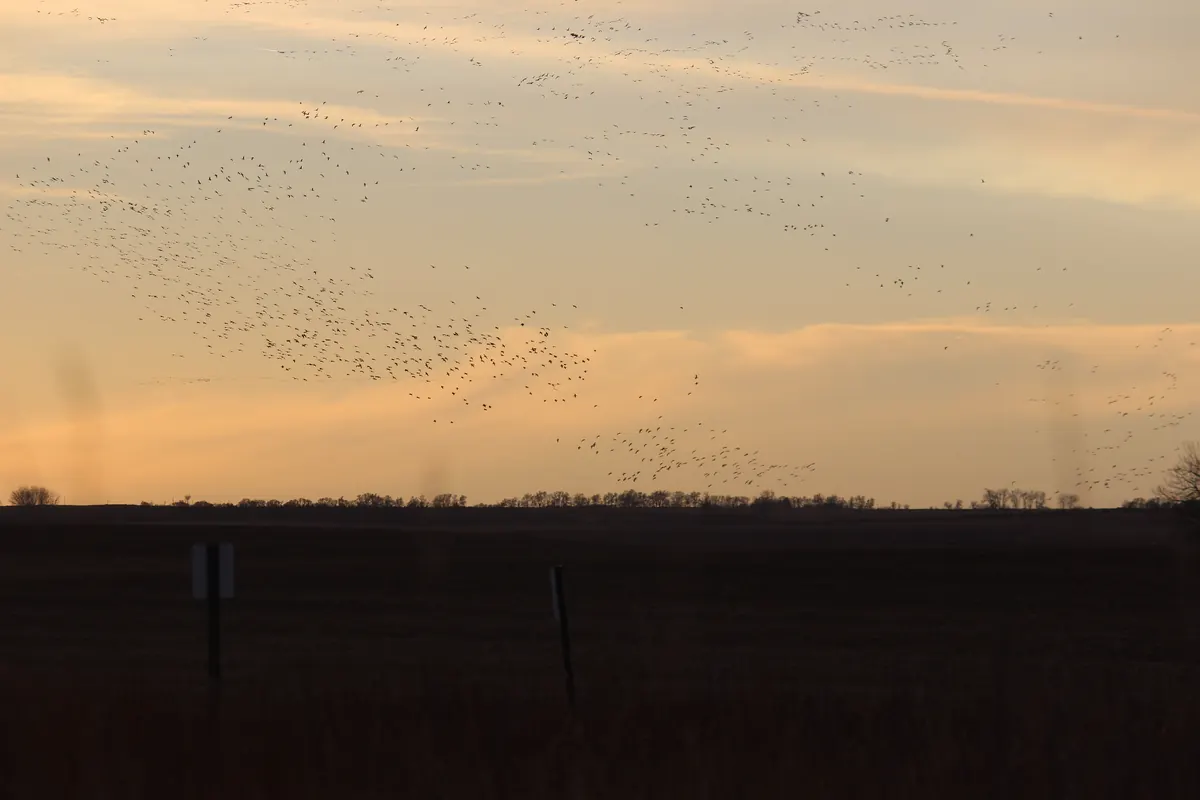
- Snow geese over the Des Lacs valley. Kenmare calls itself the snow goose capital of North Dakota, and its GooseFest, October 24–31, is timed to the late-October peak. Drive the Refuge Backway at Des Lacs National Wildlife Refuge at sunrise or sunset, when the flocks lift off the water or come back in from the fields.
- Elk, bison and gold cottonwoods in the badlands. In Theodore Roosevelt National Park the elk rut runs from September on, bulls still bugle at dawn and dusk, and the cottonwoods along the Little Missouri turn yellow against the gray buttes. Stay at least 25 yards from bison and wild horses, and remember the South Unit keeps Mountain time.
- The moon covers Jupiter before dawn, October 6. Around 3:40 a.m. Central time on October 6, a Tuesday, the crescent moon, sitting just a few degrees up in the east moves in front of Jupiter for about half an hour. Find a flat, open view east; North Dakota has plenty.
This month, in the Naturalist’s Field Journal, add the first snow geese, tundra swan and rough-legged hawk of the fall to your “birds I have seen” pages, sketch a crane or goose flight at dusk on the map of sounds, log an elk bugle on the dusk and dawn watch, and press a sprig of buffaloberry onto the seeds, pods and cones plate. Note the wind direction next to every date.
Regions used below: Red River Valley; Devils Lake and the Turtle Mountains; Drift Prairie and the James River valley; Missouri Coteau and Bismarck–Mandan; Lake Sakakawea and the northwest; Badlands and the southwest (Mountain time).
Where can you see snow geese, sandhill cranes and swans in North Dakota in October?
North Dakota sits in the middle of the Central Flyway, and in October the waterbirds raised on the Arctic tundra and in the Canadian parklands come down through it. Prairie potholes and refuge marshes give them water to roost on; harvested fields give them waste grain. The show is at sunrise and sunset, when the flocks leave the water to feed and return to it.
-
Snow geese around Kenmare and Des Lacs
Building through October; the peak usually in the last third of the month · Des Lacs National Wildlife Refuge at Kenmare, Upper Souris and Lostwood refuges, and the fields between them
Prairie Public’s Dakota Datebook puts the fall count around the Kenmare refuges at more than 400,000 snow geese in a good year, plus 25,000 to 30,000 Canada geese that linger into November or until the water freezes. Kenmare built its GooseFest around the peak; the 2026 festival runs October 24–31. The Fish and Wildlife Service recommends the 19-mile Refuge Backway, over upland prairie above the wooded draws of the Des Lacs valley. Look for “blue” geese in the flocks, a dark color form of the same species with a white head. You will hear a big flock long before you see it.
-
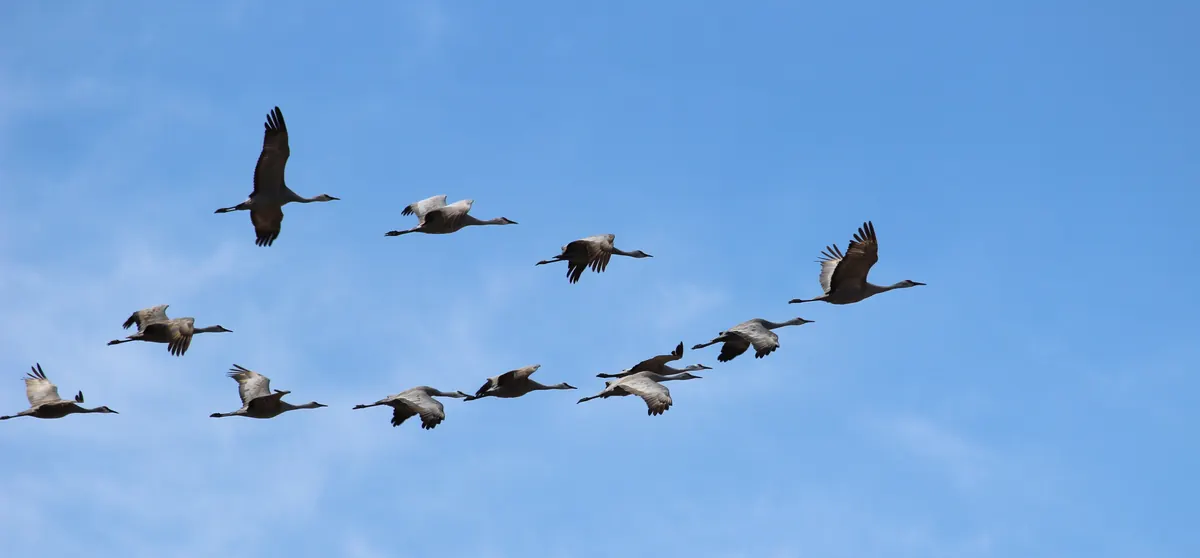
Sandhill cranes at Long Lake and on the Coteau
September into early November; numbers build through October · Long Lake National Wildlife Refuge near Moffit and the fields of Burleigh and Kidder counties; statewide west of the Red River Valley
The refuge’s bird list describes fall gatherings of ducks and geese joined by thousands of sandhill cranes gleaning waste grain, and a widely repeated description of the refuge puts fall concentrations above 10,000 birds. Game and Fish says the mid-continent population is at a record high, with a three-year average above a million. Watch the evening flight back to the roosting water: long, ragged lines of cranes, bugling a rolling call that carries for miles.
-
Whooping cranes: rare, and worth reporting
Usually from early October until wetlands freeze; peak late October into early November · Wetlands and harvested fields across the central part of the state, especially along the Missouri River south of Bismarck
Game and Fish says whooping cranes start turning up sometime in October and stay as long as open water and food allow. More than 500 pass through each year on the way to the Aransas refuge on the Texas coast; the 2024 winter survey there counted a record 557. A whooper stands about five feet tall, pure white, with black wingtips you see only when it flies, and it flies with its neck straight out. Keep your distance, note the date, time, place and any colored leg bands, and call Game and Fish at 701-328-6300 or the Lostwood (701-848-2466) or Audubon (701-442-5474) refuge offices. Sandhill crane hunting is open through November 15, so hunters are asked to be sure of every bird.
-
Tundra swans and the late ducks
October into November · Big open marshes and lakes across the state
Tundra swans, all white with a black bill and a small yellow spot in front of the eye, are common in fall migration but never nest in the state. Ducks should be plentiful: Game and Fish counted mid-July duck broods up 55 percent from 2024, and the redhead brood count was the highest the survey has recorded.
-
Rough-legged hawks arrive from the Arctic
From October · Open prairie and stubble fields; often hovering over one spot
J. Clark Salyer refuge notes that rough-legged hawks usually reach North Dakota in October from their breeding grounds in Canada and Alaska. Look for a long-winged hawk hanging in the wind over a field, wings beating, with a dark patch at each wrist.
Two counts share one weekend. The global October Big Day for eBird falls on Saturday the 10th, and The Big Sit covers both the 10th and 11th; it asks how many species you can tally from a single 17-foot circle. A refuge overlook at dusk makes a fine circle.
What is happening in Theodore Roosevelt National Park and the badlands in October?
The badlands of the Little Missouri are quieter in October than at any time since spring, and the animals are easier to find. Mind the clocks: the Park Service notes that the South Unit at Medora runs on Mountain time and the North Unit near Watford City on Central.
-
Elk bugling in the South Unit
Rut from September into the winter; dawn and dusk · South Unit; Wind Canyon overlook and the butte tops west of it
Elk were returned to the North Dakota badlands on March 13, 1985, and with good forage and no large predators the herd has grown fast. The Park Service puts the rut from September into winter, when bulls gather cows and bugle, and suggests scanning the butte tops west of Wind Canyon at sunrise or sunset. At midday they lie up in the wooded draws.
-
Bison, and the October roundup years
All month; roundups every two to three years in October · Scenic drives in both units
The park keeps roughly 200 to 500 bison in the South Unit and 100 to 300 in the North Unit, and holds those numbers with a quiet, low-stress roundup every two to three years, always in October after the breeding season. We found no announcement of a 2026 roundup; check the park’s news page. Give bison and the park’s wild horses at least 25 yards: if your outstretched thumb doesn’t hide the animal, you are too close.
-
Pronghorn and bighorn sheep
Pronghorn rut mid-September into October; bighorn battles in November · Open grassland for pronghorn; the steep badlands for bighorns
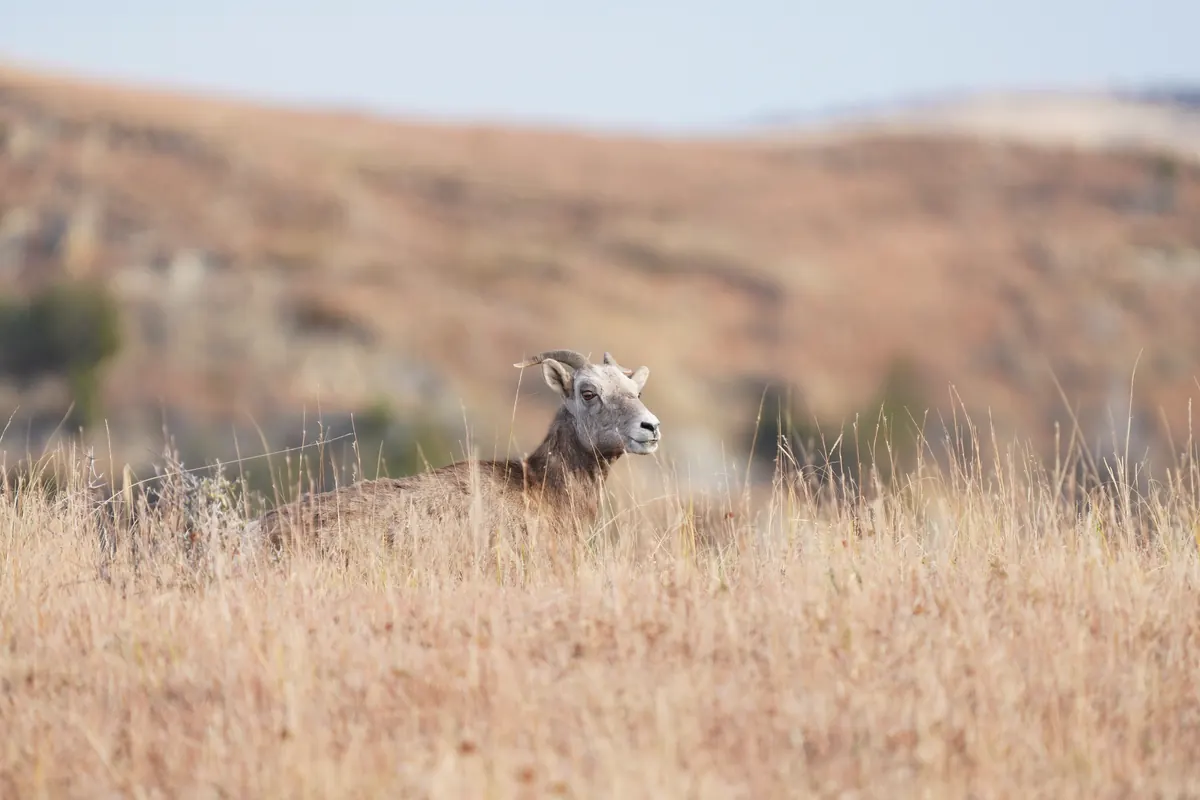
The Nature Conservancy’s North Dakota notes put the pronghorn rut from mid-September well into October, with bucks holding territories and clashing horns over groups of does. Bighorn rams wait until November to fight; the crack of their horns can carry a mile. Game and Fish issued just five bighorn licenses for 2026.
-
Gold along the Little Missouri
Late September to mid-October · River bottoms and sheltered draws
Cottonwoods and green ash along the river and in the draws turn yellow during the first two weeks, and the grass on the benches fades to straw and russet. After rain, the Park Service warns, the gray bentonite clay turns extremely slippery and can stay that way for days.
When do the leaves turn in North Dakota, and where is the best color?
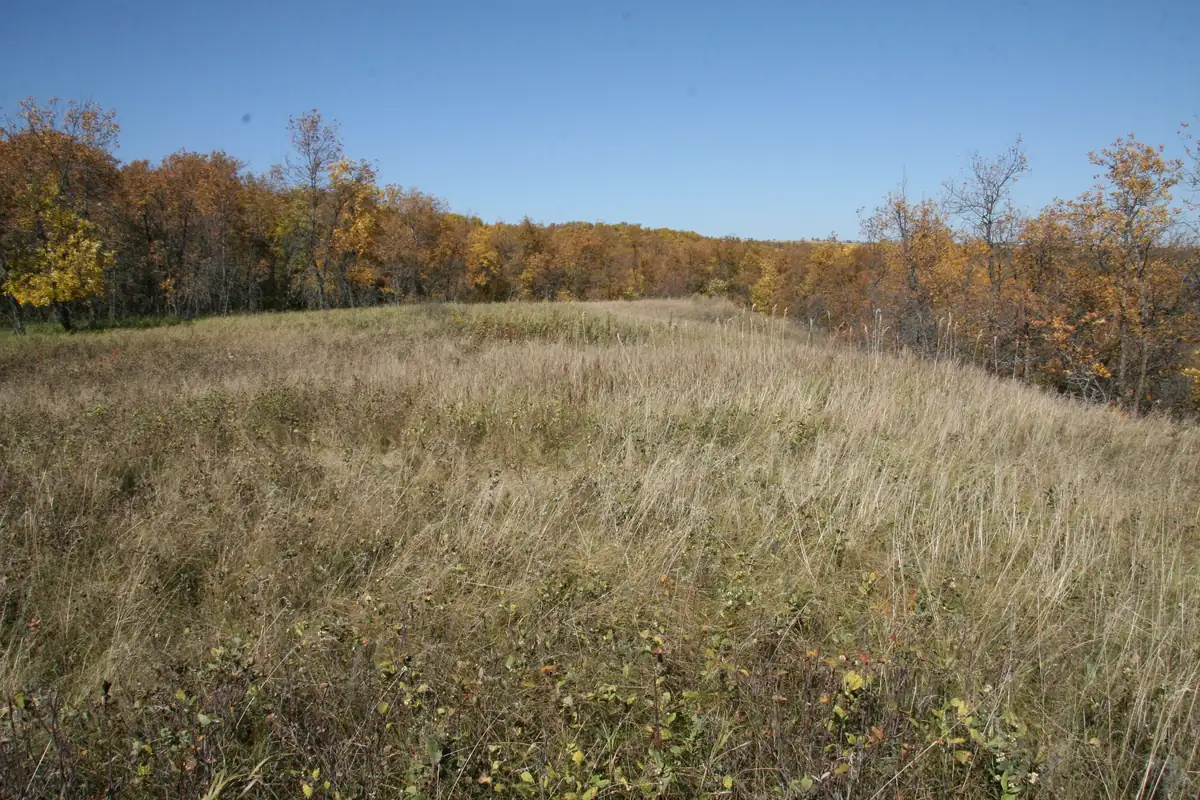
North Dakota’s color is concentrated where there are trees: river valleys, the Turtle Mountains and the Pembina Gorge. The state’s fall release this year puts the change from mid-September to a peak by mid-October, varying with place and weather, and an early hard freeze can cut it short. Northern and higher places go first; the southern river valleys hold on longest.
| Region | Where to go | What turns | Typical timing |
|---|---|---|---|
| Turtle Mountains | Lake Metigoshe State Park, Bottineau County | Quaking aspen and paper birch, yellow to gold | Late September to early October |
| Pembina Gorge | Pembina Gorge State Recreation Area near Walhalla | Aspen on the gorge walls | Late September to early October |
| Sheyenne River valley | Fort Ransom State Park, Sheyenne River Valley National Scenic Byway | Hardwoods on the forested valley slopes | Early to mid-October |
| Missouri River | Fort Abraham Lincoln State Park, Mandan; Cross Ranch | Cottonwood, green ash, bur oak | Early to mid-October |
| Badlands | Theodore Roosevelt National Park, Little Missouri River | Cottonwood and green ash in the draws | Late September to mid-October |
Quaking aspen, the tree of the Turtle Mountains, turns “bright yellow, yellow-orange, gold, or reddish after the first frosts,” in the words of the USDA plant guide. Aspens grow as clones, and clones keep their own schedules, so one patch can be gold while the next is still green. On open prairie the color is in the grass, where little bluestem ripens to a reddish gold. The Field almanac estimates from satellite records when trees near you usually go bare; choose a tree by your house, take its picture from one spot each Saturday, and note the day the last leaf goes.
What is the October salmon spawn on Lake Sakakawea?
Chinook salmon cannot reproduce naturally in Lake Sakakawea, so Game and Fish keeps the fishery going by hand. Each October, as the salmon ripen and move toward shore, fisheries crews work bays near Garrison Dam, among them Government, Rodeo and Scoria bays, with electrofishing boats and carry the fish to Garrison Dam National Fish Hatchery, where the eggs are taken.
-
The egg take
October · Bays near Garrison Dam; Garrison Dam National Fish Hatchery
The goal is about 1.2 million eggs, enough for just over 300,000 young salmon, which spend about six months in the hatchery and are stocked in late April. In 2024 crews collected 1.9 million eggs and sent more than 715,000 to South Dakota; in 2025 they took 1.2 million, from fish averaging 9 to 10 pounds, well above the usual 5 or 6. A Game and Fish biologist told KFYR that three years without the spawn would leave the lake without salmon.
-
Visiting the hatchery
Year-round; call ahead for tours · Below Garrison Dam, Riverdale
The hatchery visitor center has five 400-gallon aquariums of North Dakota fish, and free one-hour tours run by reservation at 701-654-7451. The hatchery also raises walleye, northern pike and the endangered pallid sturgeon. We could not confirm public viewing of the salmon work itself, so ask when you call.
If you fish or just watch the water, log the water temperature and wind beside each visit; a few Octobers of notes will show when the salmon come close on your stretch of shore.
When is the first frost and freeze in North Dakota?
For most of North Dakota, October comes after the first freeze, not before it. At most stations the median first 32 °F night falls between September 20 and October 1: September 21 at Williston, September 25 at Dickinson, September 30 at Bismarck and Fargo, October 1 at Minot. The few places still waiting are along the Red River and at Devils Lake: the Devils Lake station has a median of October 5, and Hillsboro, in the valley north of Fargo, holds out to October 9 in a typical year. In the far northwest, Fortuna and Powers Lake have a median of September 17. By October 18, every station in the table has frozen in nine years out of ten.
| Station | One year in ten | Median | Nine years in ten |
|---|---|---|---|
| Fargo Hector International Airport | Sep 18 | Sep 30 | Oct 15 |
| Grand Forks International Airport | Sep 15 | Sep 27 | Oct 8 |
| Devils Lake Kdlr (Lake Region) | Sep 26 | Oct 5 | Oct 18 |
| Jamestown Municipal Airport (James River valley) | Sep 15 | Sep 28 | Oct 9 |
| Bismarck | Sep 18 | Sep 30 | Oct 13 |
| Minot International Airport | Sep 19 | Oct 1 | Oct 14 |
| Williston Sloulin International Airport | Sep 9 | Sep 21 | Oct 2 |
| Theodore Roosevelt Airport (Dickinson) | Sep 12 | Sep 25 | Oct 7 |
| Hettinger Experiment Station (southwest) | Sep 5 | Sep 21 | Oct 2 |
Every other station, from Pembina to Bowman, is on our North Dakota frost dates page. If the garden is still alive, the next clear, calm night after a dry northwest wind will probably end it. Then note a second, later date: the first morning the birdbath or stock tank skins over with ice.
How much daylight does North Dakota lose in October?
About as much as anywhere in the lower 48: 96 to 100 minutes over the month, a little over three minutes a day. Grand Forks, Devils Lake, Minot and Williston lose 100 minutes, and by Halloween Grand Forks is down to 9 hours 59 minutes. Sitting at the western edge of the Central zone, the state has very late mornings. In Bismarck sunrise slides from 7:42 to 8:24 a.m. and sunset from 7:23 to 6:29 p.m.; Williston’s sun is not up until 8:38 a.m. on October 31. When daylight time ends early on the morning of Sunday, November 1 (2 a.m.), sunrise comes an hour earlier and Fargo’s sunset lands near a quarter past five.
| City | Oct 1 | Oct 31 | Lost | Per day |
|---|---|---|---|---|
| Fargo | 11 h 41 m | 10 h 05 m | 96 min | 3.2 min |
| Grand Forks | 11 h 39 m | 9 h 59 m | 100 min | 3.3 min |
| Jamestown | 11 h 40 m | 10 h 04 m | 96 min | 3.2 min |
| Devils Lake | 11 h 39 m | 9 h 59 m | 100 min | 3.3 min |
| Bismarck | 11 h 41 m | 10 h 05 m | 96 min | 3.2 min |
| Minot | 11 h 39 m | 9 h 59 m | 100 min | 3.3 min |
| Williston | 11 h 39 m | 9 h 59 m | 100 min | 3.3 min |
| Dickinson | 11 h 41 m | 10 h 05 m | 96 min | 3.2 min |
Type any farm or town into the Field almanac for its own sunrise, sunset and twilight.
What is October weather like in North Dakota, and what could El Niño mean this winter?
October in North Dakota starts as fall and can end as winter. Averaged over 1991–2020 station records, the October high is about 57 °F at Bismarck, 56 °F at Fargo and Williston and 54 °F at Grand Forks, with lows from 31 °F at Williston to 36 °F at Fargo. Rain is light: about an inch at Williston, 1.4 inches at Bismarck, 1.8 at Grand Forks and 2.2 at Fargo. October snow averages one to two and a half inches, often from one storm, but Bismarck got 23.7 inches in October 1991 and 17.1 in October 2019. November averages six to eight inches.
Then there is the winter. The Climate Prediction Center’s update of September 10 says a very strong El Niño is better than 90 percent likely to hold through the fall and winter, and that the October–December index has a 75 percent chance of breaking the record. We checked ten strong El Niño winters since 1957 in the station records. Fargo’s seasonal snow fell short of its 50.4-inch average in all ten, Bismarck’s short of 49.6 inches in eight, and December–February was warmer than average in six of ten at both. The extreme was 2023–24: Fargo’s winter almost 14 °F above normal, with 17.5 inches of snow all season. Yet 1965–66 and 2009–10 were strong El Niño winters that ran roughly 3 to 7 °F cold, and 2009–10 was snowy at Bismarck. The odds lean mild and light on snow; they do not guarantee it. October’s own cold snaps come down from Canada with little regard for the Pacific. NOAA issues its winter outlook in mid-October.
What can you see in the North Dakota night sky in October?
Long, dark nights and flat horizons make October a good sky month. Most of the state is on Central time; the southwest corner, including Dickinson, Medora and Bowman, keeps Mountain time, so its times below run an hour earlier.
-
The moon passes in front of Jupiter
Tuesday, October 6, about 3:37 to 4:08 a.m. CDT · Very low in the east; the moon only 4 to 12 degrees up
The crescent, 17 percent lit, rises about 2:45 a.m. in Fargo and just after 3 in Bismarck and Williston, with Jupiter alongside. According to the International Occultation Timing Association, the planet slips behind the bright edge at 3:37 a.m. CDT at Grand Forks, 3:41 at Pembina, 3:42 at Minot and 3:43 at Williston, and comes back out of the dark edge between 4:04 and 4:08. The state lies near the northern edge of the track, so Jupiter is hidden only 21 to 31 minutes, with the moon 4 to 8 degrees up at the start and 7 to 12 at the end: find a hilltop or an open section road. Fargo and Bismarck aren’t on IOTA’s list; expect times within a few minutes of Grand Forks and Minot, with some margin. The nearest listed site to the southwest is Rapid City, where the moon has barely risen at the disappearance and Jupiter returns at 3:10 a.m. MDT.
-
The Hunter’s Moon
Sunday, October 25 and Monday, October 26, at dusk · Low in the east-northeast
Full moon comes at 11:12 p.m. CDT on Sunday, October 25, and it looks round on Sunday and Monday evenings alike. Bismarck’s moonrise is 6:02 p.m. on the 25th, 36 minutes ahead of sunset, and 6:29 p.m. on the 26th, eight minutes ahead of it; Fargo’s is 5:45 p.m. on the 25th and Dickinson’s 5:10 p.m. MDT. The name fits: pheasant season is open, the fields are cut, and the moon comes up with the dusk. It is not a supermoon.
-
Orionid meteors
Active October 2 to November 7; broad peak before dawn October 21 and 22 · Anywhere dark; look high in the south and east
With a bright gibbous moon in the evening sky, this is a shower for early risers. On the morning of the 22nd the moon sets at 3:42 a.m. in Fargo, 3:59 in Bismarck and 4:09 in Williston (3:07 a.m. MDT in Dickinson), and the sky stays properly dark until a little after 6. That leaves two dark hours or more for swift, often bright meteors from dust shed by Halley’s Comet; the American Meteor Society puts typical rates near 20 an hour.
-
Draconids, and a dark weekend
Evening of Thursday, October 8; new moon October 10 · Look north-northwest after dark
The Draconids are a slow, usually thin shower that comes in the evening, so children can watch without an alarm clock. This year the moon is a thin crescent that sets before dark, and the nights stay moonless through the new moon on Saturday the 10th. North Dakota is far enough north that a strong geomagnetic storm can also put the northern lights overhead on any of those dark nights; NOAA’s Space Weather Prediction Center posts a 30-minute aurora forecast.
-
Saturn, Venus, Jupiter and Mars
Saturn at opposition October 4; Venus only in the first days; Mars in the Beehive October 11 · Saturn east at dusk; Jupiter and Mars east before dawn
Saturn reaches opposition on October 4 and stays up from dusk to dawn, rings plain in a small telescope. The moon passes it on the 23rd and 24th. Venus hangs very low in the evening twilight for only the first few days, then reaches inferior conjunction on October 23. In the predawn east, Jupiter outshines everything, and on the morning of the 11th Mars stands inside the Beehive star cluster, a pretty binocular view.
| Phase | Date | Central time | Mountain time (southwest) |
|---|---|---|---|
| Last quarter | Saturday, Oct 3 | 8:25 a.m. CDT | 7:25 a.m. MDT |
| New moon | Saturday, Oct 10 | 10:50 a.m. CDT | 9:50 a.m. MDT |
| First quarter | Sunday, Oct 18 | 11:12 a.m. CDT | 10:12 a.m. MDT |
| Full moon, the Hunter’s Moon | Sunday, Oct 25 | 11:12 p.m. CDT (looks full the evenings of Oct 25 and 26) | 10:12 p.m. MDT |
| Last quarter | Sunday, Nov 1 | 2:28 p.m. CST | 1:28 p.m. MST |
See whether tonight will be clear on Today’s sky; the moon phases page lists when the moon rises and sets where you live.
What is ripening, turning and going to seed on the North Dakota prairie in October?
-
Silver buffaloberry
Fruit ripe from late summer and holding all winter · Coulees, stream banks, shelterbelt edges; common in the west
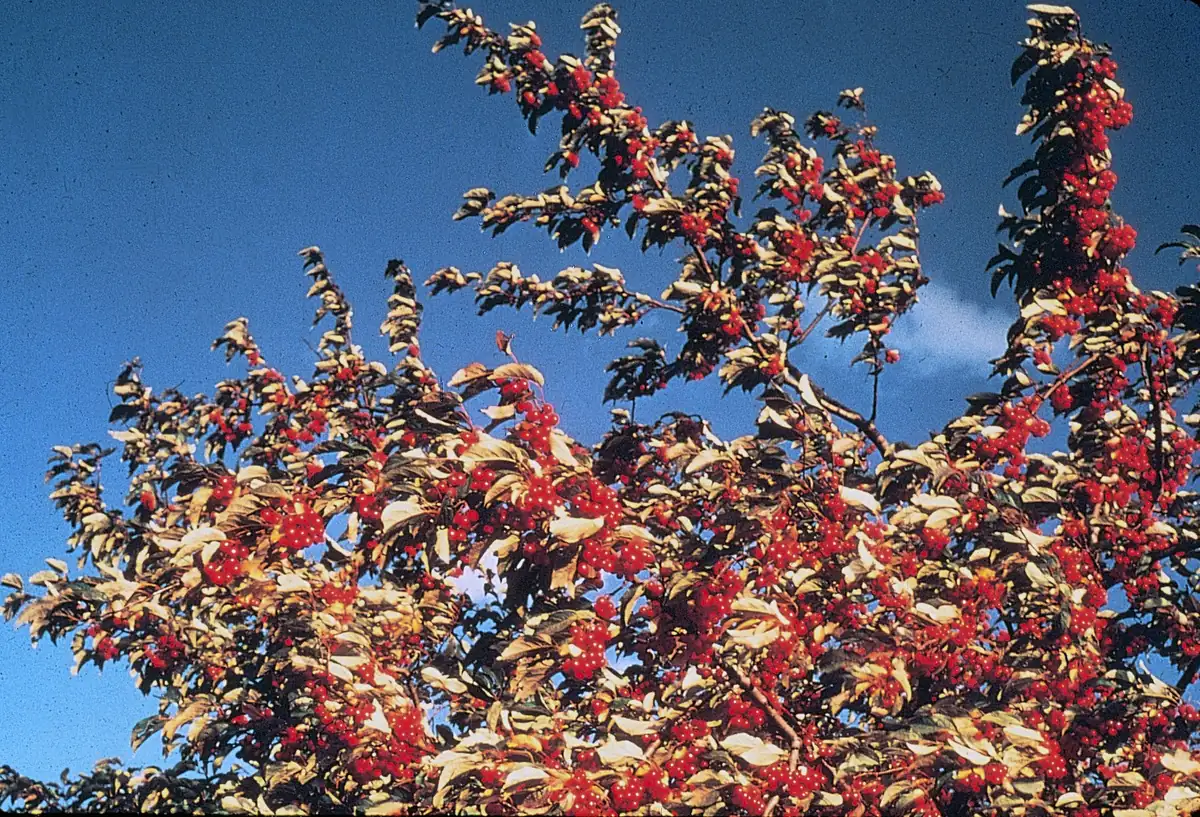
A thorny, silvery-leaved shrub with clusters of small red-orange berries, native to the northern Great Plains. The USDA’s Bismarck Plant Materials Center notes that sharp-tailed grouse and many songbirds eat the fruit and that unpicked berries can still be on the branches the next spring. On a gray October day in a draw, the bright red against silver leaves is often the only color left.
-
Little bluestem and the prairie grasses
All month · Native prairie: Sheyenne National Grassland, Cross Ranch, the badlands benches, road ditches
Little bluestem, a main grass of the mixed-grass prairie, ripens from bluish green to reddish gold, with fluffy silver-white seed heads. Walk into unplowed prairie late on a sunny afternoon and look back toward the sun; the whole slope glows.
What are deer, pheasants and other North Dakota animals doing in October?
-
White-tailed deer moving toward the rut
Rubs and scrapes through October; breeding peaks in mid-November · River bottoms, shelterbelts, every rural road at dusk
Game and Fish puts the peak of breeding in mid-November, so October is the build-up: saplings rubbed raw at knee height, pawed scrapes under low branches, and bucks moving in daylight. Deer cross roads mostly at dusk and dawn, and by the end of the month dusk comes close to the drive home.
-
Pheasants and sharp-tailed grouse
Pheasant season opens October 10 · Southwest and west-central for pheasants; grassland statewide for sharptails
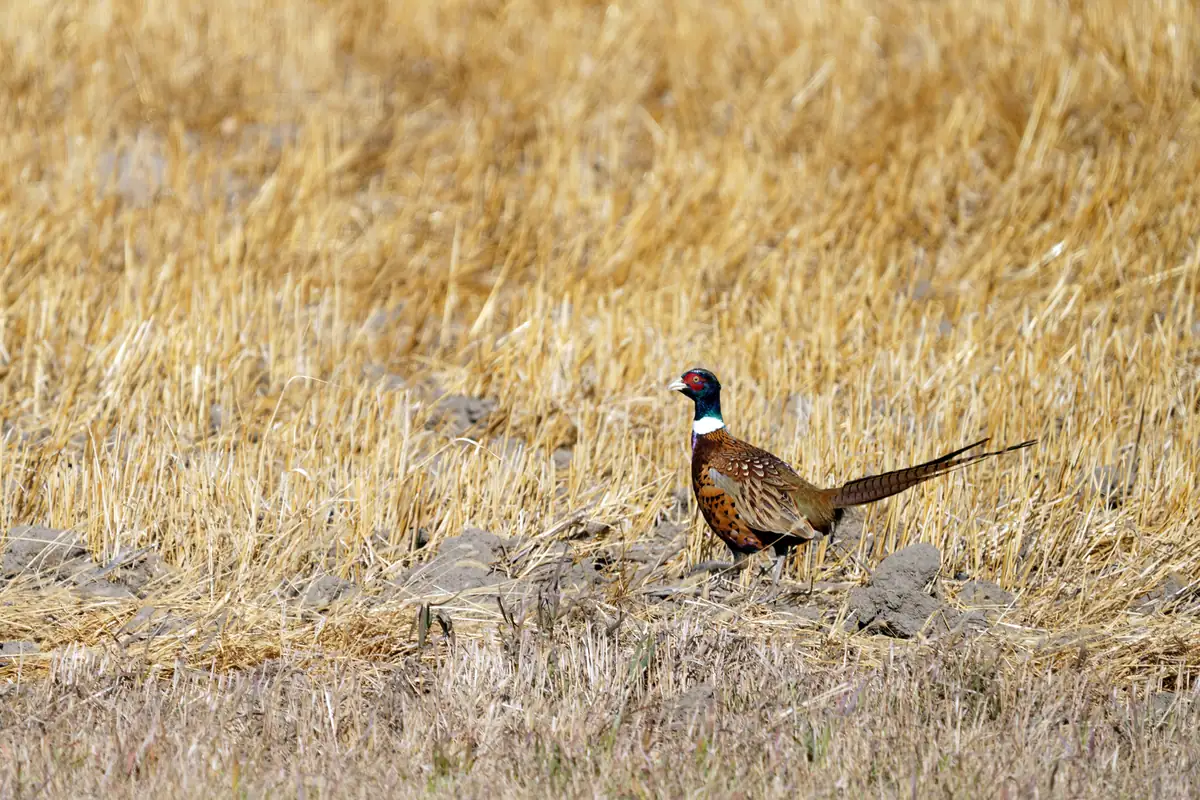
Game and Fish’s late-summer roadside survey found pheasants up 3.8 percent from 2025, while sharp-tailed grouse had a poor hatch, and the department expects the west-central counties to be best. Hunter or not, drive a gravel road beside a cattail slough at first light and you may see roosters picking grit from the shoulder.
-
Monarchs: an honest note
Mostly gone by October · A late straggler on a warm south-wind day
North Dakota’s monarchs leave early. Monarch Watch puts the peak of the fall flight at 49° N, along the Canadian border, on August 18–30, and at 47° N, near Jamestown and Bismarck, on August 24 to September 5. An October monarch is worth reporting to Journey North and writing on the pollinator watch page as the year’s last.
What can North Dakota families do outside in October 2026?
- Friday and Saturday, October 2–3: Spookless Nights at Fort Abraham Lincoln State Park, 7 to 10 p.m., the scare-free version of the Haunted Fort, which runs on select weekends through October 31.
- Saturday, October 3: Fall Luminary Walk at Turtle River State Park, 7 to 9 p.m., on lantern-lit trails, with a fire at the Woodland Lodge.
- October 3–4: youth pheasant weekend. An adult must go along but cannot carry a gun.
- October 8–11: moonless nights and bird counts. Watch for Draconids after dark on the 8th, then log birds for eBird on Saturday the 10th or sit in a Big Sit circle that weekend.
- Thursday, October 15: the Larks birding meetup in Fargo, 8:30 to 9:30 a.m., free, listed by Audubon Great Plains; check its events page for the meeting spot.
- Sunday, October 18: Halloween Kids Bash and Little Monsters Hike, Fort Abraham Lincoln State Park, 1 to 5 p.m.
- October 24–31: GooseFest in Kenmare, with a sunrise or sunset drive on the Des Lacs Refuge Backway.
- October through December: the state parks’ fall Hiking Challenge. Three different trails and a landmark photo, logged in the OuterSpatial app, enter a drawing for free camping or a park pass.
- Pumpkin patches and mazes from the state’s fall list: Papa’s Pumpkin Patch in Bismarck through October 25, Berry Acres in Minot through October 31, The Great Maze in Fargo through November 2.
- Citizen science. Report any whooping crane to Game and Fish, and enroll in Project FeederWatch, whose count season opens November 1 and ends April 30.
More months and places are collected on the nature hub. For writing up the outings, see the Naturalist’s Field Journal.
Safety notes for October in North Dakota
- Hunting seasons are open everywhere. Deer bow season opened September 4; waterfowl opened September 26 for residents and October 5 for nonresidents; tundra swan (by license) opens October 3; pronghorn runs October 2–18; moose opens October 9; pheasant and fall turkey open October 10 and run to January 3; sandhill cranes close November 15. Deer gun season opens at noon on Friday, November 6, and runs through November 22, with muzzleloader from November 27.
- Orange. North Dakota ties its orange rule to the deer seasons. During the deer gun season, gun hunters and bowhunters alike must wear it; Game and Fish’s standing guidance is a hat plus an outer garment above the waist adding up to at least 400 square inches of solid daylight fluorescent orange, and camouflage orange doesn’t count. We found no orange requirement in the 2026 small game and waterfowl regulations for October’s bird seasons, though many upland hunters wear it anyway. Hikers on wildlife management areas, waterfowl production areas and national grassland should wear it too, and so should the dog.
- Whooping cranes mix with sandhills in the same fields; stay back and report them.
- The badlands. Keep 25 yards from bison and horses; rattlesnakes use prairie dog burrows and don’t always rattle; wet bentonite turns trails and roads to grease. Check which time zone you are in before a sunrise plan.
- Early snow and wind. An October storm can close roads with little warning, so carry a winter kit from mid-month, and watch for deer at dusk. Before a long drive, look at Weather now.
Sources
- Prairie Public, Dakota Datebook: Kenmare GooseFest (snow goose numbers around the Kenmare refuges)
- Kenmare, N.D.: GooseFest 2026, October 24–31
- Visit Minot: Kenmare GooseFest
- U.S. Fish and Wildlife Service: Des Lacs National Wildlife Refuge
- U.S. Fish and Wildlife Service: great scenic drives on national wildlife refuges (Des Lacs Refuge Backway)
- U.S. Fish and Wildlife Service: Long Lake National Wildlife Refuge
- U.S. Fish and Wildlife Service: Long Lake National Wildlife Refuge bird list (PDF)
- StateParks.com: Long Lake National Wildlife Refuge (fall crane concentrations)
- U.S. Fish and Wildlife Service: J. Clark Salyer National Wildlife Refuge species (rough-legged hawk arrival)
- North Dakota Game and Fish: sandhill crane season 2026
- North Dakota Game and Fish, North Dakota Outdoors: resting and refueling in North Dakota (whooping crane migration, October 2025)
- North Dakota Game and Fish: whooping crane migration and how to report sightings
- North Dakota Game and Fish: tundra swan
- North Dakota Game and Fish: lesser snow goose
- North Dakota Game and Fish: 2026 hunting season outlook (August–September 2026)
- North Dakota Game and Fish: news releases, September 2026 (upland brood survey, youth pheasant weekend, bighorn licenses)
- North Dakota Game and Fish: 2026 waterfowl season (September 14, 2026)
- North Dakota Game and Fish: 2026 small game, waterfowl and furbearer regulations
- North Dakota Game and Fish: 2026 deer regulations and orange clothing
- North Dakota Game and Fish: calendar of season dates
- Grand Forks Herald (Doug Leier, Game and Fish): common deer hunting questions, including the 400-square-inch orange rule (November 12, 2024)
- North Dakota Game and Fish: white-tailed deer
- eBird: October Big Day, October 10, 2026
- BirdsCaribbean: October Big Day 2026 (Saturday, October 10)
- The Big Sit! 2026, October 10–11
- National Park Service: Theodore Roosevelt National Park, elk
- National Park Service: Theodore Roosevelt National Park, bison management
- National Park Service: Theodore Roosevelt National Park, safety
- National Park Service: Theodore Roosevelt National Park, operating hours and time zones
- National Park Service: Theodore Roosevelt National Park, news releases
- The Nature Conservancy: North Dakota nature notes (pronghorn and bighorn ruts, fall migration)
- State of North Dakota: take the scenic route through North Dakota this fall (September 24, 2026)
- North Dakota Tourism: best places to view fall foliage
- USDA NRCS plant guide: quaking aspen (PDF)
- USDA NRCS plant guide: little bluestem (PDF)
- USDA NRCS Bismarck Plant Materials Center: silver buffaloberry plant guide (PDF)
- KFYR: salmon spawning at Lake Sakakawea (November 22, 2025)
- KX News: North Dakota Game and Fish completes yearly salmon spawn
- North Dakota Game and Fish: 2025 year in review (salmon eggs collected)
- U.S. Fish and Wildlife Service: Garrison Dam National Fish Hatchery
- North Dakota frost dates (NOAA 1991–2020 normals)
- U.S. Naval Observatory: sun and moon rise and set data (one-day API)
- U.S. Naval Observatory: phases of the moon
- International Occultation Timing Association: occultation of Jupiter, October 6, 2026
- American Meteor Society: meteor shower calendar
- NOAA Space Weather Prediction Center: aurora 30-minute forecast
- NOAA Regional Climate Centers, Applied Climate Information System: station data for Bismarck, Fargo, Grand Forks and Williston (October averages, snowiest Octobers, El Niño winter tallies)
- Climate Prediction Center: ENSO diagnostic discussion, September 10, 2026
- Climate Prediction Center: El Niño winter temperature and precipitation in North Dakota
- Climate Prediction Center: Oceanic Niño Index (strength of past El Niño events)
- National Weather Service Bismarck: El Niño and La Niña
- North Dakota State Climate Office: ENSO data for North Dakota climate divisions
- Monarch Watch: peak migration dates by latitude
- Journey North: monarch sightings
- North Dakota Parks and Recreation: upcoming events (Haunted Fort, Spookless Nights, Fall Luminary Walk, Halloween Kids Bash)
- North Dakota Parks and Recreation: 2026 Hiking Challenge
- Audubon Great Plains: programs and events (Larks Birding, Fargo, October 15, 2026)
- Project FeederWatch: how to participate
- Photos via Wikimedia Commons; licenses and photographers are credited under each picture
