What to look for in nature in North Dakota this February
February closes out meteorological winter, and in North Dakota it rarely closes it gently. Snow still lies on the fields for most of the month, and a February blizzard can follow a day in the sixties. Underneath the weather, though, the year has turned. Great horned owls start incubating this month, skunks and raccoons leave their dens to look for mates, and by the last week red fox kits and river otter pups are being born out of sight. Along the gravel roads the first horned larks hunt for bare ground, while forecasters at the Weather Service measure the water locked in the snowpack to judge the spring floods. Days lengthen by more than an hour and a quarter over the month, and Jupiter and Mars both reach opposition. Here is where and when to look.
Other months in North Dakota: October, November, December, January.
Start here

- Find an owl sitting tight. Great horned owls begin nesting in February. Scan last year’s stick nests in tree rows and riverside cottonwoods for two feathered tufts poking above the edge, and keep your distance.
- Count birds for the Great Backyard Bird Count. This year’s four-day count is set for February 12 to 15, Friday through Presidents’ Day. Fifteen minutes of looking, from the kitchen or a roadside, yields one checklist.
- Jupiter, then Mars. Jupiter reaches opposition on Wednesday evening, the 10th, and then shines from dusk to dawn. Mars takes its turn on Friday the 19th, and on Saturday the 20th the Snow Moon sits close to both.
Inside your Naturalist’s Field Journal for February, fill in “nest observed” for any owl or eagle nest visible from a public road, noting the first day a bird was sitting tight. Add the first horned lark of the year to “birds I have seen,” sketch skunk and raccoon trails crossing a snowy road on “tracks to know,” and keep the mammal watch going for prairie dogs on a mild badlands afternoon. On “the same place twice,” photograph one snowy field early and late in the month to see how fast it goes bare.
Regions used below: Red River Valley; Devils Lake and the Turtle Mountains; Drift Prairie and the James River valley; Missouri Coteau and Bismarck–Mandan; Lake Sakakawea and the northwest; Badlands and the southwest (Mountain time).
When do great horned owls and bald eagles lay eggs in North Dakota?
The two biggest birds that nest in North Dakota trees both lay their eggs before winter is over. Game and Fish’s natural history calendar lists great horned owls beginning to nest in February and bald eagles laying eggs from late February through mid-March, so the incubating starts while the snow is still deep.
-
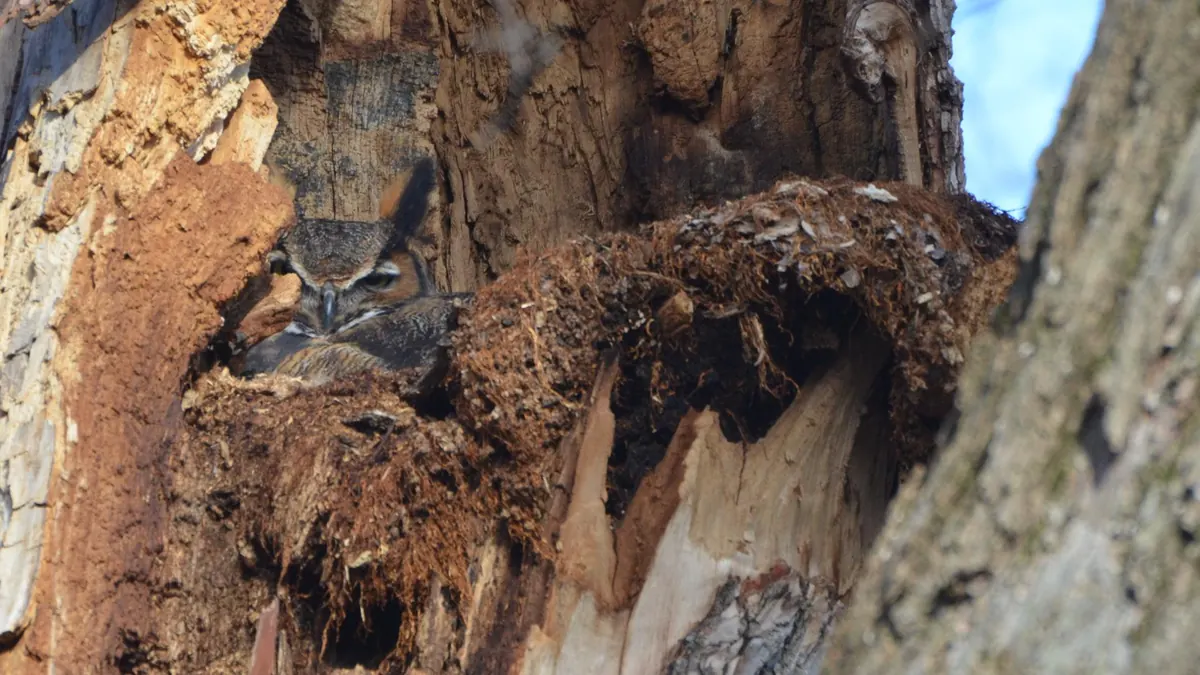
Great horned owls on eggs
Nesting begins in February; the female incubates through late winter cold · Old hawk, crow and magpie nests in shelterbelts, farmstead groves, river woods and town parks statewide
These owls borrow other birds’ stick nests rather than building. A Game and Fish magazine story followed a female that settled on February 8 into a stick nest about 30 feet up a tree at the department’s Bismarck headquarters, a nest Swainson’s hawks had built two or three years earlier. The day began below zero and climbed only into the single digits, and the writer noted that without her body heat the eggs would have frozen. Her mate hunted voles, cottontails and birds and brought them to the nest, and two owlets hatched and later flew. To find one, look in late February for a nest with what seems to be a lump of bark or a pair of ear tufts showing above the rim. After a snowfall an incubating owl may have a cap of snow on her back, because she will not leave the eggs to shake it off.
-
Bald eagles start laying
Eggs from late February to mid-March · Big cottonwoods along the Missouri, Red, Sheyenne and James rivers and around Devils Lake, and in shelterbelts far from water
The eagle pairs that were carrying sticks in January are close to laying by the end of February. Once the first egg is down, one adult stays low in the nest almost constantly, so a nest that suddenly looks empty except for a white head at the rim is probably being incubated. This is the stage when disturbance does the most harm: a bird flushed from its eggs in subzero wind can lose the clutch to the cold. Watch with binoculars or a spotting scope from the road, keep well back, and report new nests to Game and Fish.
Which North Dakota animals start breeding or having young in February?
For several mammals February is the hinge of the year. The same Game and Fish calendar has striped skunk males leaving their winter dens to look for mates in early to mid-February, raccoons entering their breeding season by mid-month, mink breeding from late February, and both red fox kits and river otter pups born from late February. Most of this happens out of sight, but the tracks and the smell do not.
-
Skunks on the move
Males leave their dens early to mid-February; breeding from late February into April · Farmsteads, field edges, road ditches and town edges statewide
Skunks sleep through the worst of winter in dens but do not truly hibernate, and the first wanderers are males searching for females. That is why a February thaw so often brings the smell of skunk along highways and into towns. In snow, look for a short, waddling trail with the front and hind prints close together, often running from a culvert, a granary or the space under a deck. Give any skunk you meet plenty of room, and keep dogs leashed at dusk.
-
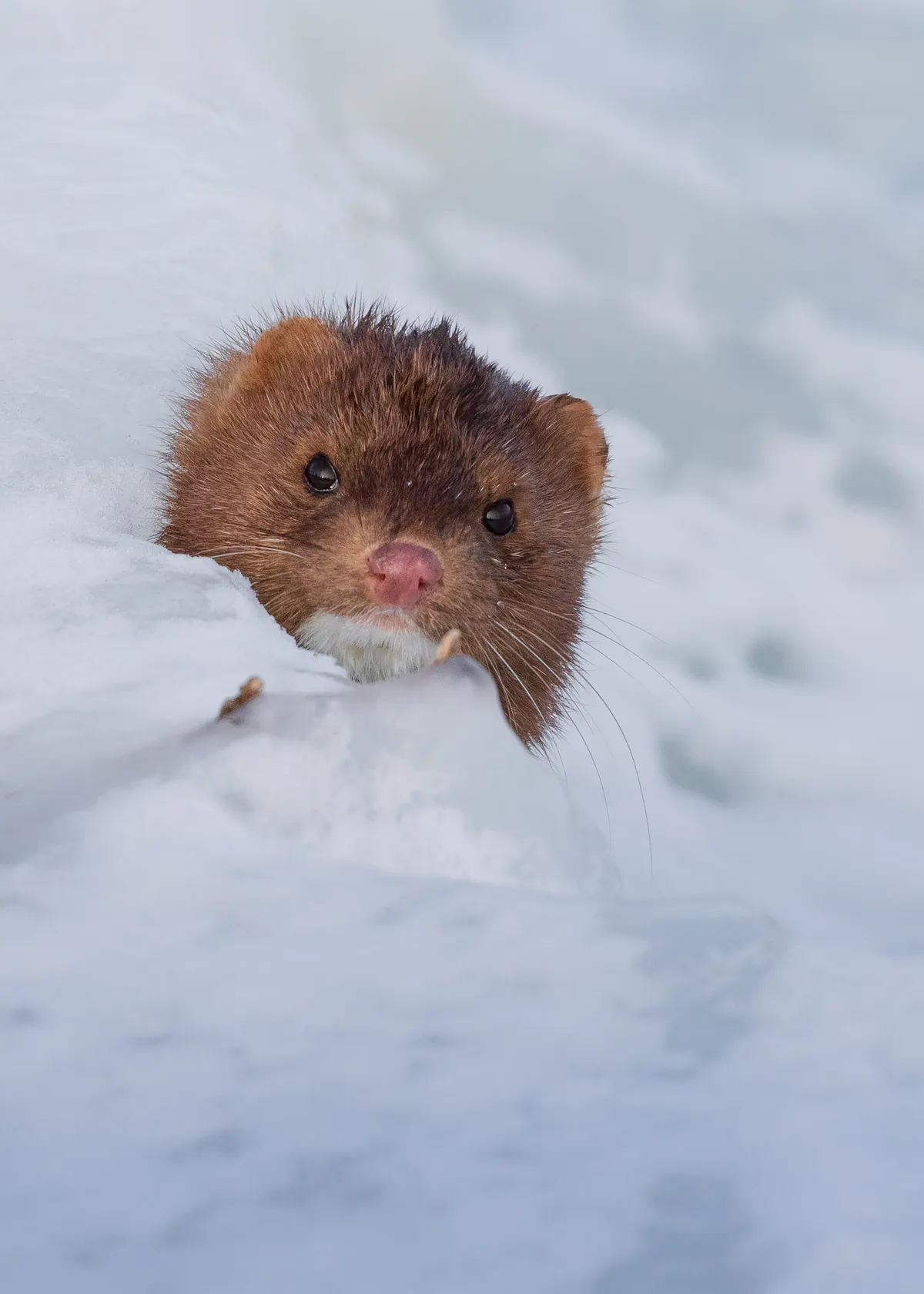
Raccoons and mink
Raccoon breeding mid-February to late March; mink from late February · Wooded creeks, river bottoms, cattail sloughs and farm buildings
Raccoons hole up in cold snaps and travel on milder nights, and in February they travel to find mates. Their tracks look like small handprints, often along a creek edge or between farm buildings. Mink follow open water, so the edges of springs, spillways and fast riffles that stay unfrozen are the places to look for their bounding pairs of prints, sometimes ending at a hole in the snow by the bank.
-
Fox kits and otter pups, unseen
Both born from late February · Fox dens in pasture banks, coulees and shelterbelts; otters along the Red River and its tributaries
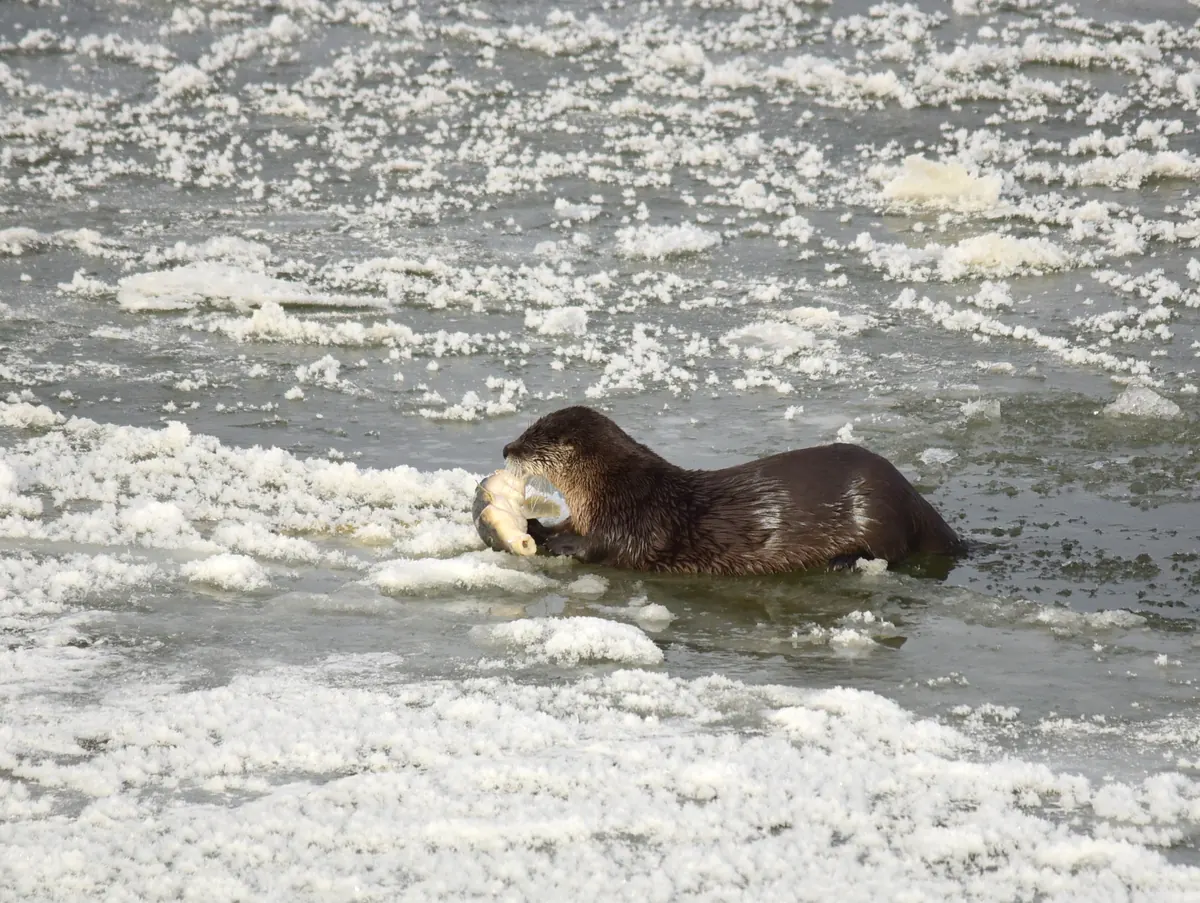
The foxes that paired up in January give birth in dens from late February into March, so a well-used hole in a sunny bank with fresh tracks around it is worth noting and leaving alone. River otters are less familiar. Game and Fish describes them as uncommon year-round residents whose established population lies along the Red River of the North and its tributaries, with occasional sightings on the Missouri. Open water matters to them in winter for feeding, and their sign is easiest to find there: slides down snowy banks, and trails between holes in the ice.
What are the first spring birds to return to North Dakota?
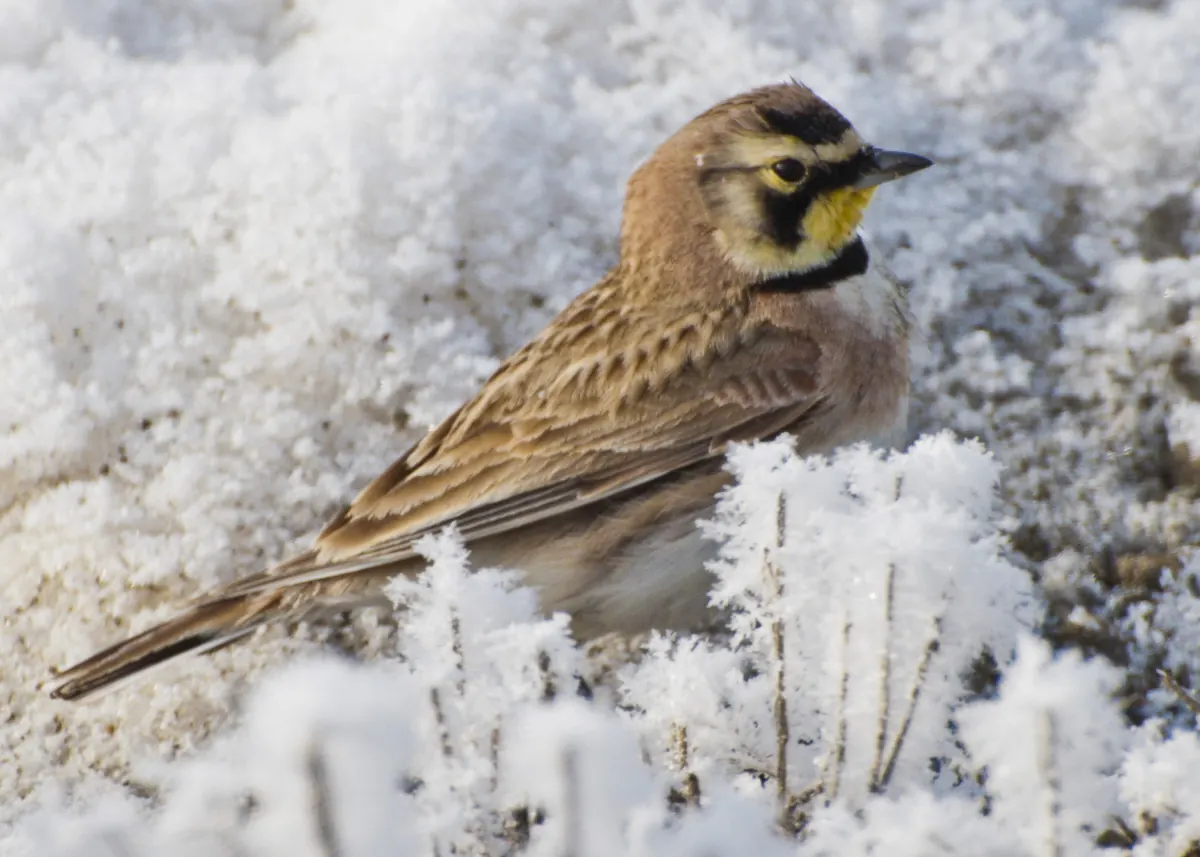
The earliest sign of spring migration in North Dakota is a small brown bird on a gravel shoulder. Horned larks live in the state all year, but Game and Fish notes that some are migratory, and when bare ground opens in late winter the roadsides fill with them.
-
Horned larks on the first bare ground
Some all winter; more as soon as fields and road shoulders start to go bare, in February in a mild year and March in a snowy one · Gravel roads, summer fallow, stubble and overgrazed pasture, especially in the southwestern half of the state
In a Natural North Dakota segment for Prairie Public, Chuck Lura notes that horned larks feed on seeds and insects in open country where plants are short and sparse, and that in winter you often flush them from the edges of highways and gravel roads. Naturalists in the Red River Valley, among them the Grand Forks Herald columnist Mike Jacobs, watch for the first larks as soon as bare ground appears, usually on rural roads and summer-fallowed fields, which tend to shed snow sooner than grassland. The field marks are a black mask, a dark bar across the breast and a yellow-tinged face on a bird a bit bigger than a sparrow; the tiny feather horns are hard to see unless it raises them. The same birds are among the earliest nesters in the state, with Game and Fish putting peak breeding from late March into July.
-
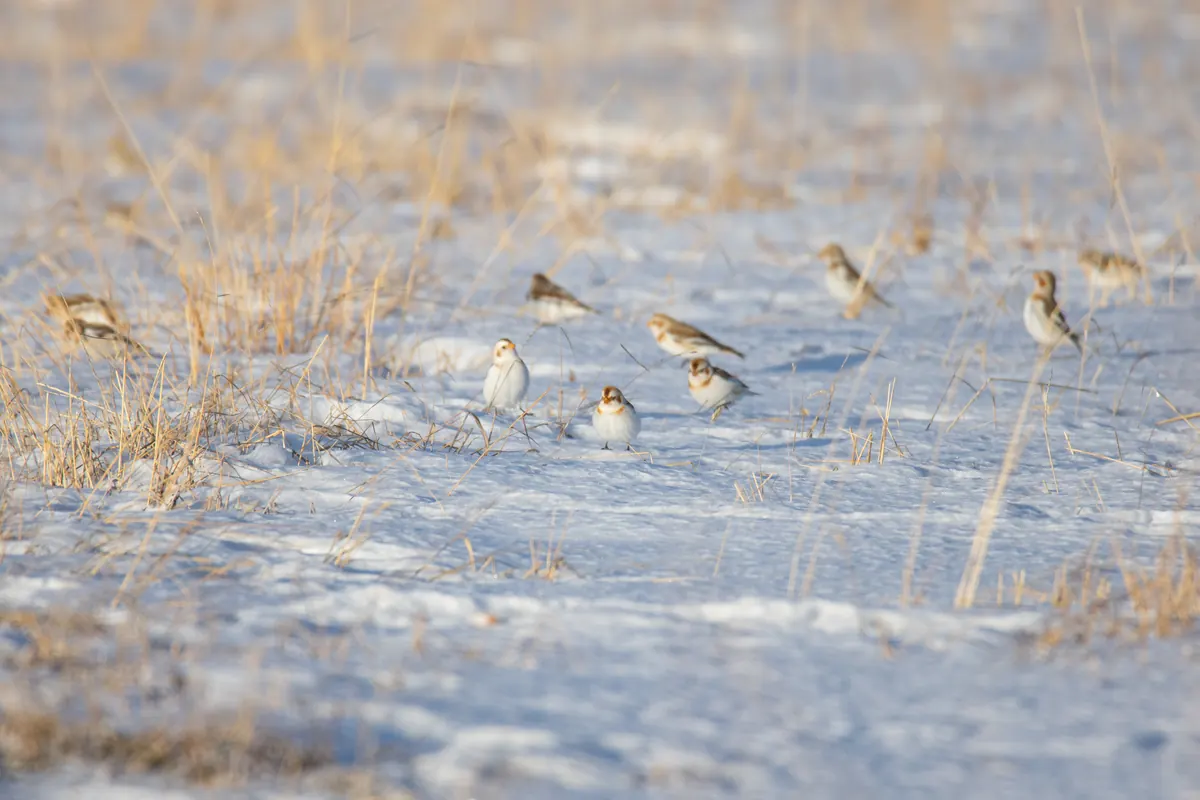
Snow buntings in their last weeks
Flocks through February, thinning by early spring · Open farmland, often with horned larks
Lura also describes snow buntings rising from the road in front of cars, a swirl of white wings with black tips. They are Arctic nesters, and the mixed flocks of buntings and larks along a country road are one of the best late-winter sights in the state. Count them, note which species outnumbers the other, and see which way the balance tips as the month goes on.
Will North Dakota rivers flood this spring, and how do the February flood outlooks work?
Spring floods in North Dakota are written in the February snow. The National Weather Service offices in Grand Forks and Bismarck issue spring flood outlooks every winter, and February is when the estimate takes shape. The Grand Forks office’s archive shows a first Red River and Devils Lake outlook in late January and two more in February in each recent year (February 9 and 23 in 2023, February 15 and 29 in 2024, February 13 and 27 in 2025, February 12 and 26 in 2026), followed by more in March.
-
What the forecasters measure
Outlooks usually every other Thursday from late January to late March · Red River and Devils Lake basins (Grand Forks office); Missouri, James, Souris and other western and central basins (Bismarck office)
The outlook is not a guess about one storm. It weighs the water held in the snowpack (the snow water equivalent), how wet the soil was going into winter, how deep the frost runs, the condition of river ice, and the long-range outlooks for temperature and precipitation. In its February 27, 2025 outlook for western and central North Dakota, the Bismarck office explained that snow water was below normal everywhere and that very dry soils were soaking up much of the meltwater, which kept the flood risk low. A deep, wet snowpack over frozen, saturated ground gives the opposite answer. The current outlooks and briefing slides are posted on each office’s flood page.
-
Read the snow yourself
Any time after a big snow; melt usually starts in March · Your own yard or a flat, open spot away from drifts
You can do a kitchen version of the forecasters’ measurement. Push a straight-sided can down through the snow to the ground, slide a piece of cardboard under it, let the snow melt indoors and measure the water. Divide the snow depth by the water depth. Fresh, fluffy snow gives a big number; old snow that the wind has packed for weeks gives a much smaller one, because it holds more water in every inch. Record the date and the numbers, and compare them with the Weather Service’s snow maps.
What is darkhouse spearfishing, and how long does North Dakota’s ice season last?
Under North Dakota’s 2026–28 fishing regulations, darkhouse spearing and bow fishing are legal from November 15 through March 15, so February is the heart of the season. A spearer sits in a dark shelter over a large hole, watching a lit window of water and a decoy hung a few feet down, and waits for a northern pike to glide in.
-
Watching the window
Through March 15, wherever the ice is safe · Lakes across the state; walleye may also be speared in the Devils Lake complex south of US Highway 2, Stump Lake, and Lakes Sakakawea and Oahe
Northern pike and nongame fish are the legal targets, and the regulations allow walleye only on the waters listed here and channel catfish only on the Missouri River system, a new addition this cycle. Game and Fish also dropped the old registration requirement: after 25 years of records, and with fewer spearers answering its surveys, the department decided registration was no longer needed to keep pike populations healthy. Even if you never hold a spear, a darkhouse is a remarkable way to see a lake from inside. With the light shut out, the water below glows green, and perch, pike and the occasional minnow school drift across the opening as if on a stage.
-
The March 15 house deadline
Plan for it in late February · All waters
From midnight on March 15 until ice-out, every unoccupied ice house must be off the ice, and fish houses cannot stay on state-owned or managed land after that date either. Abandoned holes wider than 10 inches must be marked. By late February, snow-covered lake ice can still be thick yet weakening, so it pays to plan the haul before a warm spell softens the shoreline.
What can you see in Theodore Roosevelt National Park in February?
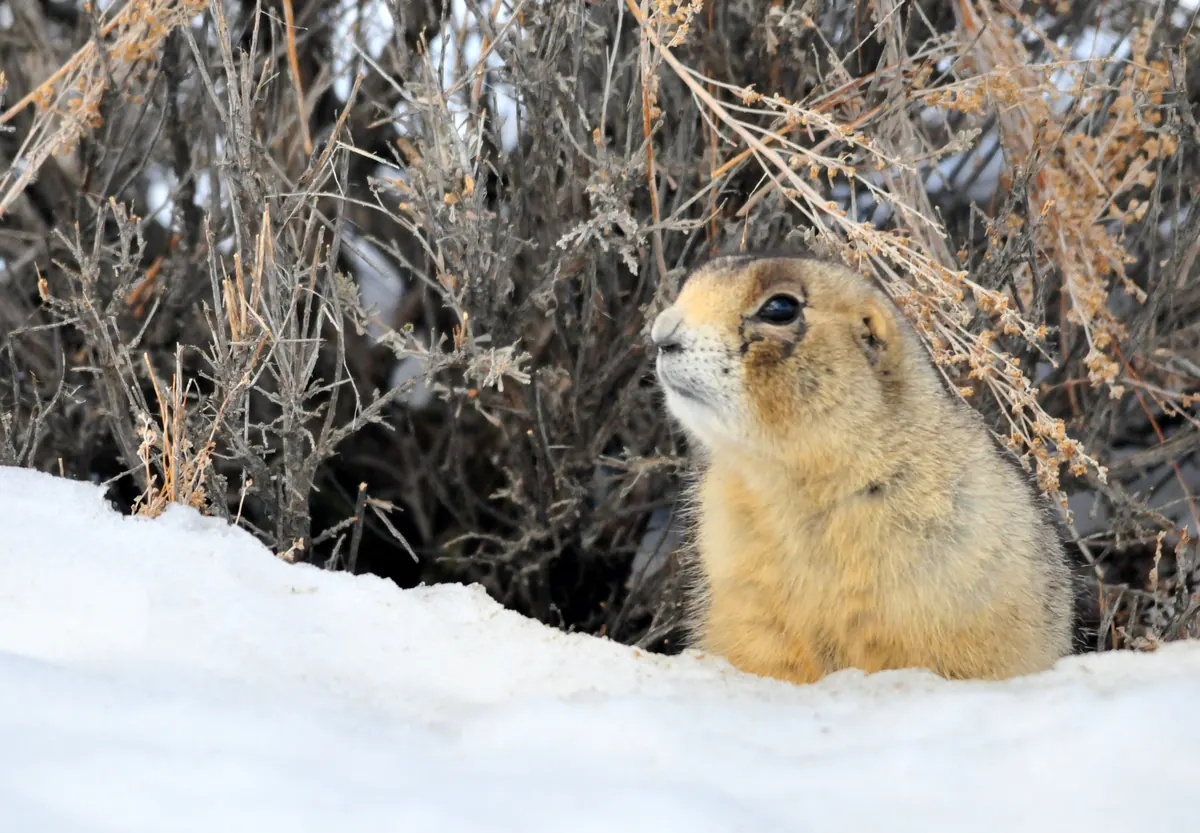
The badlands are quiet in late winter, but not empty. Check the park’s road conditions before driving out, then stop at a pullout beside a prairie dog town on a calm, sunny afternoon; you may find the first animals of the year above ground.
-
Prairie dogs on a mild day
Above ground on calm, sunny days; underground through harsh spells · Prairie dog towns beside the park roads in the South Unit and North Unit
The black-tailed prairie dog, the only prairie dog species in the park, does not hibernate. The National Park Service says the animals store body fat in fall, may stay below ground for several days in severe weather, and drop into periods of torpor during the coldest stretches, but on milder days they come up to forage. Mating follows in March and early April. In February, then, a town can look abandoned one morning and busy the next, with sentries sitting upright on the mounds and the sharp, squeaky bark passing from burrow to burrow when a hawk or coyote shows up.
-
Golden eagles near their cliffs
Near nest sites from February; peak breeding early April to July · Cliffs and big trees in the badlands and along the Missouri Slope
Game and Fish says golden eagles in North Dakota nest mostly in the badlands and on the Missouri Slope, usually on cliffs that often face south, sometimes in cottonwood or green ash. Its management guidance asks people to keep activity at least half a mile from active nests from February to mid-September, which tells you the birds are back at their territories this month. Along the Little Missouri, scan the ridgelines for a very large, all-dark eagle whose head and neck glint gold in low sun, and enjoy it from the road.
How cold and snowy is February in North Dakota, and what has El Niño done to it before?
Compared with January, February is a few degrees warmer and a touch less snowy, yet nobody here mistakes it for spring. The 1991–2020 NOAA averages put February highs near 20 °F in Grand Forks and the upper 20s in Bismarck, Minot and Williston, and the ground at every airport below keeps an inch or more of snow on most days of the month. Often the bigger problem is not new snow but wind, which can lift old snow into a ground blizzard under a blue sky.
| Station | Average high / low | Average snowfall | Days with a low below 0 °F | Days with 1 inch or more on the ground |
|---|---|---|---|---|
| Grand Forks (Red River Valley) | 20.5 / 0.7 °F | 7.1 in | 14.2 | 24.8 |
| Fargo (Red River Valley) | 22.7 / 4.1 °F | 8.1 in | 11.5 | 24.7 |
| Williston (northwest) | 26.7 / 5.5 °F | 6.7 in | 10.6 | 20.9 |
| Minot (north central) | 27.0 / 7.7 °F | 5.4 in | 10.3 | 23.8 |
| Bismarck (Missouri River) | 27.8 / 7.2 °F | 7.5 in | 9.6 | 20.5 |
This winter the tropical Pacific has a say. On September 10, 2026, NOAA’s ENSO team judged the odds above 90 percent that an unusually strong El Niño would last through fall and winter. The two most recent strong El Niño Februaries show what that can look like here. February 2016 ranked as the state’s sixth-warmest February in 122 years, according to the State Climate Office, with temperatures 5 to 8 degrees above average and a reading of 73 °F at Bismarck on the 27th that the office called the most notable record of the season. February 2024 ran more than 10 degrees above average, and NDAWN stations at Fort Yates and Carson reached 66 °F. Then, between February 26 and 27, a cold front dropped temperatures by almost 60 degrees in a day, and blizzard warnings went up for eight counties. That is the lesson for 2027: a warm month can still end in a whiteout. NOAA’s official forecast for December through February is scheduled for October 15 and is refreshed monthly; find the current one among the CPC seasonal outlook maps. The NWS Bismarck office keeps an ENSO page with North Dakota’s own El Niño history, and our Weather now page has today’s conditions. Gardeners counting the weeks can look up typical last spring freezes on the North Dakota frost dates page.
How much daylight does North Dakota gain in February?
By February the lengthening daylight is obvious morning and evening alike. Mornings brighten earlier and evenings stay light later, and the daily increase itself keeps growing until the March equinox. Groundhog Day, Tuesday, February 2, falls just before the true midpoint of winter, which comes on February 3–4, halfway between the solstice and the equinox.
| City | Feb 1 | Feb 28 | Gained | Per day |
|---|---|---|---|---|
| Fargo | 9 h 38 m | 11 h 02 m | 84 min | 3.1 min |
| Grand Forks | 9 h 32 m | 11 h 00 m | 88 min | 3.3 min |
| Jamestown | 9 h 38 m | 11 h 02 m | 84 min | 3.1 min |
| Devils Lake | 9 h 31 m | 10 h 59 m | 88 min | 3.3 min |
| Bismarck | 9 h 38 m | 11 h 02 m | 84 min | 3.1 min |
| Minot | 9 h 31 m | 11 h 00 m | 89 min | 3.3 min |
| Williston | 9 h 31 m | 10 h 59 m | 88 min | 3.3 min |
| Dickinson | 9 h 38 m | 11 h 02 m | 84 min | 3.1 min |
The northern cities start the month with the least daylight and gain the most, so by late February the difference across the state has almost disappeared. The gain is noticeable on any drive home from work, and it keeps the snow on south-facing slopes melting a little earlier each week. Look up any town’s sunrise, sunset and twilight in our daylight tool.
What can you see in the North Dakota night sky in February?
February belongs to Jupiter and Mars. In a span of less than nine days Earth overtakes each of them on the inside track, lining up planet, Earth and sun, which astronomers call opposition. We give Central Standard Time; on Mountain time in the southwest (Dickinson, Medora, Beach, Bowman), it is an hour earlier.
-
Jupiter at opposition
Evening of Wednesday, February 10 · Rising in the east at sunset, high in the south around midnight, in Leo
Jupiter’s opposition falls at 6:21 in the evening, Central time. Glowing at magnitude −2.5, Jupiter beats Sirius for brightness, and since it rises around sunset, you can find it at any hour of a clear February night. Steady binoculars braced on a fence post reveal up to four of its moons as pinpoints in a line.
-
Mars at opposition, small but bright
Friday, February 19; closest to Earth February 20 · In Leo, east of Jupiter in the evening, up all night
Mars has its turn on the 19th and makes its nearest pass on the 20th, roughly 63 million miles off. Because the red planet is close to its outermost point from the sun, this year’s opposition is a small one, but at magnitude −1.2 it is still an obvious orange light. Compare its steady color with the bluish-white star Regulus nearby.
-
The Snow Moon and a faint eclipse
Full at 5:23 p.m. CST on Saturday, February 20 · Rising in the east around sunset, beside Jupiter, Mars and Regulus
February’s full moon is a near-supermoon, counted as one by some almanacs but not by others. That evening also has a penumbral lunar eclipse: the moon slides only through the pale fringe of Earth’s shadow. Its deepest point comes at 5:13 p.m. CST, while the moon is still below the North Dakota horizon, so Central time observers get only the tail end, which finishes at 7:13 p.m. If anything shows, it will be a barely darker smudge on part of the moon’s face while it hangs low in the dusk; few people will see any difference. In the Mountain time corner there is effectively nothing left to see by moonrise. Far better is the company the moon keeps: Jupiter, Mars and the star Regulus all sit within the same patch of Leo. A night earlier, Friday into Saturday, the swelling moon slips very close by Jupiter.
-
Mercury low in the west
Best around the night of February 2–3; with a thin crescent moon on Sunday, February 7 · Low in the west-southwest, 30 to 45 minutes after sunset
Mercury swings farthest east of the sun, as seen from Earth, overnight on February 2–3 and stays catchable for about a week on either side. An open view to the west, with no trees or buildings, is essential. On Sunday the 7th, a sliver of moon only about a day old hangs near the planet, a fine challenge for binoculars. Saturn is sliding down into that glow too, while Venus remains the dazzling morning star low in the southeast.
-
Northern lights
Any clear night; darkest evenings about February 2–11 · Low in the north, away from town lights
NASA and NOAA announced in October 2024 that the solar maximum had arrived, and activity has since begun to ease, but big storms on the sun can still light up the northern sky, and North Dakota’s latitude puts many of them in view. With the moon out of the way from about February 2 to 11, faint glows are easier to catch. For a short-range heads-up, check the aurora outlook from NOAA’s space weather forecasters.
| Phase | Date | Time |
|---|---|---|
| New moon | Saturday, Feb 6 | 9:56 a.m. CST (8:56 a.m. MST) |
| First quarter | Sunday, Feb 14 | 1:58 a.m. CST (12:58 a.m. MST) |
| Full moon, the Snow Moon | Saturday, Feb 20 | 5:23 p.m. CST (4:23 p.m. MST) |
| Last quarter | Saturday, Feb 27 | 11:16 p.m. CST (10:16 p.m. MST) |
| New moon | Monday, Mar 8 | 3:29 a.m. CST (2:29 a.m. MST) |
To time moonrise in your town, use the moon phase calendar. On the afternoon of the 10th or the 20th, a glance at Today’s sky will tell you whether the clouds will let you see the planets.
What can North Dakota families do outdoors in February 2027?
This list dates from the first days of October 2026, when park staff had not yet set their February 2027 calendars, so the recurring events below have no dates; look them up in January, and check the forecast before any drive.
- Tuesday, February 2: Groundhog Day. Skip the forecast from Pennsylvania and make your own: at noon, measure a child’s shadow on the snow, then measure it again on March 2 to see how much higher the sun has climbed.
- Wednesday evening, February 10: Jupiter night. Rest binoculars on a fence rail and see how many of Jupiter’s moons you can find.
- Friday through Presidents’ Day: a backyard bird tally. Audubon and Birds Canada schedule the Great Backyard Bird Count, now in its 30th year, for February 12 to 15 (double-check at birdcount.org). Count for at least 15 minutes and submit what you saw through eBird or Merlin. A feeder, a town park or a slow drive past stubble fields with horned larks all count.
- A Snow Moon candlelight walk. Fort Stevenson State Park near Garrison has held a candlelit Snow Moon hike, ski or snowshoe on a February Saturday in past years (2019 and 2025), and Turtle River State Park near Grand Forks held a free luminary walk on February 21, 2026. Watch the Parks and Recreation events page for the 2027 schedule.
- Saturday evening, February 20: the Snow Moon gathering. Find the full moon, Jupiter and Mars in the east after supper, then walk the snow by moonlight.
- Any thaw: a snow-water test. Melt a can of snow, as in the flood section above, and keep a chart on the fridge until the snow is gone.
- Citizen science. FeederWatch counts continue until April 30; log owl nests and your first horned larks in eBird, and add skunk, raccoon and prairie dog sightings to iNaturalist.
Every state and every month is on our nature hub, and this state’s winter is covered in January in North Dakota. Keep owl dates, lark tallies and snow-water readings together in a Naturalist’s Field Journal.
Safety notes for February in North Dakota
- Open seasons. In the 2026–27 regulations, tree squirrel season runs to Sunday, February 28. Weasel and bobcat seasons end Monday, March 15, along with the cable-device season for coyote and fox, while badger and mountain lion stay open to March 31; and mink, muskrat and land-set cable devices for beaver and raccoon continue to May 10. Daytime coyote and fox hunting never closes, and night hunting for both lasts until May 31.
- Spring light geese. The spring conservation order for snow, blue and Ross’s geese opened on February 21 in 2026. No 2027 dates were out in early October, so watch the Game and Fish news page; expect shotguns in stubble fields and around open water once it opens.
- Orange. North Dakota requires big game hunters (outside the bow seasons) to wear a solid daylight fluorescent orange head covering and outer garment above the waist, at least 400 square inches in all. No big game season is open in February, and the small game and furbearer rules carry no orange requirement, so hunters you meet may not be wearing any. Wear something bright yourself if you walk in hunting country.
- Warm days, then whiteouts. February can swing from the sixties to a blizzard within a day, as in 2024. Look at the state road map before leaving, carry blankets, food and a shovel, and if the car leaves the road, remain inside it until help comes.
- Late-season ice. Snow insulates thin ice and hides cracks, and daily temperature swings open pressure ridges. Game and Fish says to keep vehicles off the ice early and late in the season; carry ice picks, drill test holes, and stay away from inflows, spillways and the Missouri River.
- Wind chill. The airports in the table above average roughly 10 to 14 mornings below zero in February. In wind, cover all skin and turn back at the first sign of numb, white patches.
- Skunks and pets. With males roaming in February, dogs meet skunks more often. Never handle a skunk, keep pets’ rabies shots current, and report one acting strangely to local authorities.
Sources
- North Dakota Game and Fish: natural history calendar, February
- North Dakota Game and Fish magazine: Empty Nest (great horned owls at headquarters)
- North Dakota Game and Fish: Raptors of North Dakota
- North Dakota Game and Fish magazine: Soaring Out of Obscurity (bald eagles)
- North Dakota Game and Fish: river otter
- North Dakota Game and Fish: river otter season considered
- North Dakota Game and Fish: tracks and signs of North Dakota wildlife
- North Dakota Game and Fish: horned lark
- Prairie Public, Natural North Dakota: Horned Larks and Snow Buntings
- Grand Forks Herald: Horned larks usher in the spring (Mike Jacobs)
- North Dakota Game and Fish: golden eagle
- National Park Service, Theodore Roosevelt National Park: prairie dogs
- National Park Service: black-tailed prairie dogs
- NWS Grand Forks: flood outlook archive
- NWS Grand Forks: current spring flood outlook
- NWS Bismarck: probabilistic hydrologic outlook, February 27, 2025
- NWS Bismarck: spring flood and water resources outlook
- NOAA National Operational Hydrologic Remote Sensing Center: snow analyses
- North Dakota Game and Fish: 2026–28 fishing regulations
- North Dakota Game and Fish magazine: New Fishing Season, A Few Regulations Changes
- North Dakota Game and Fish: ice safety
- NOAA NCEI: U.S. climate normals 1991–2020
- NDSU, North Dakota State Climate Office: Climate Bulletin, Winter 2015–2016
- NDSU, North Dakota State Climate Office: Climate Bulletin, Winter 2023–2024
- NOAA Climate Prediction Center: ENSO diagnostic discussion, September 10, 2026
- NOAA Climate Prediction Center: 90-day outlooks
- NWS Bismarck: El Niño and La Niña in North Dakota
- NWS: wind chill chart
- U.S. Naval Observatory: moon phases
- U.S. Naval Observatory: Earth’s seasons
- U.S. Naval Observatory: sun and moon rise and set
- Fred Espenak, Sky Event Almanac 2027
- NASA: lunar eclipses 2021–2030
- EarthSky: what is a supermoon
- Sea and Sky: astronomy calendar 2027
- Old Farmer’s Almanac: eclipses
- NOAA Space Weather Prediction Center: aurora 30-minute forecast
- NOAA Space Weather Prediction Center: solar cycle progression
- North Dakota Game and Fish: hunting season dates
- North Dakota Game and Fish: 2026 small game, waterfowl and furbearer regulations
- North Dakota Game and Fish: 2026 bighorn sheep, elk and moose regulations
- North Dakota Game and Fish: spring light goose conservation order, 2026
- North Dakota Game and Fish: 2026 spring light goose amendment
- Audubon: Great Backyard Bird Count
- Birds Canada: Great Backyard Bird Count
- North Dakota Parks and Recreation: Full Snow Moon Candlelight Hike, Fort Stevenson State Park (2025)
- North Dakota Parks and Recreation: Full Snow Moon Candlelight Hike, Fort Stevenson State Park (2019)
- North Dakota Parks and Recreation: Winter Wonderland Luminary Walk, Turtle River State Park
- North Dakota Parks and Recreation: events
- Project FeederWatch: how to participate
- eBird
- iNaturalist
- Photos via Wikimedia Commons; licenses and photographers are credited under each picture
