What to look for in nature in North Dakota this November
November is when North Dakota closes up. The potholes skin over one by one, and the ducks and geese that stay late pull back to the big water that stays open longest: the Missouri River, Lake Sakakawea below Garrison Dam, a few other large lakes. Bald eagles follow them. On the prairie the white-tailed jackrabbit and three kinds of weasel trade brown fur for white, ready or not for snow, while snowy owls drift down from the Arctic to sit on fence posts. Whitetail bucks are at the height of the rut, rams crack horns in the badlands, and by month’s end the sun sets before five almost everywhere. Below, region by region, is what is worth watching for.
Other months in North Dakota: October, December.
Start here
- Eagles and geese on the open Missouri. Below Garrison Dam the hatchery’s warmed water keeps a wetland open after everything else freezes, and ducks, Canada geese and the bald eagles that hunt them gather there. Walk the Wetlands Trail at Riverdale late in the month, or scan the river between the dam and Bismarck from any public access.
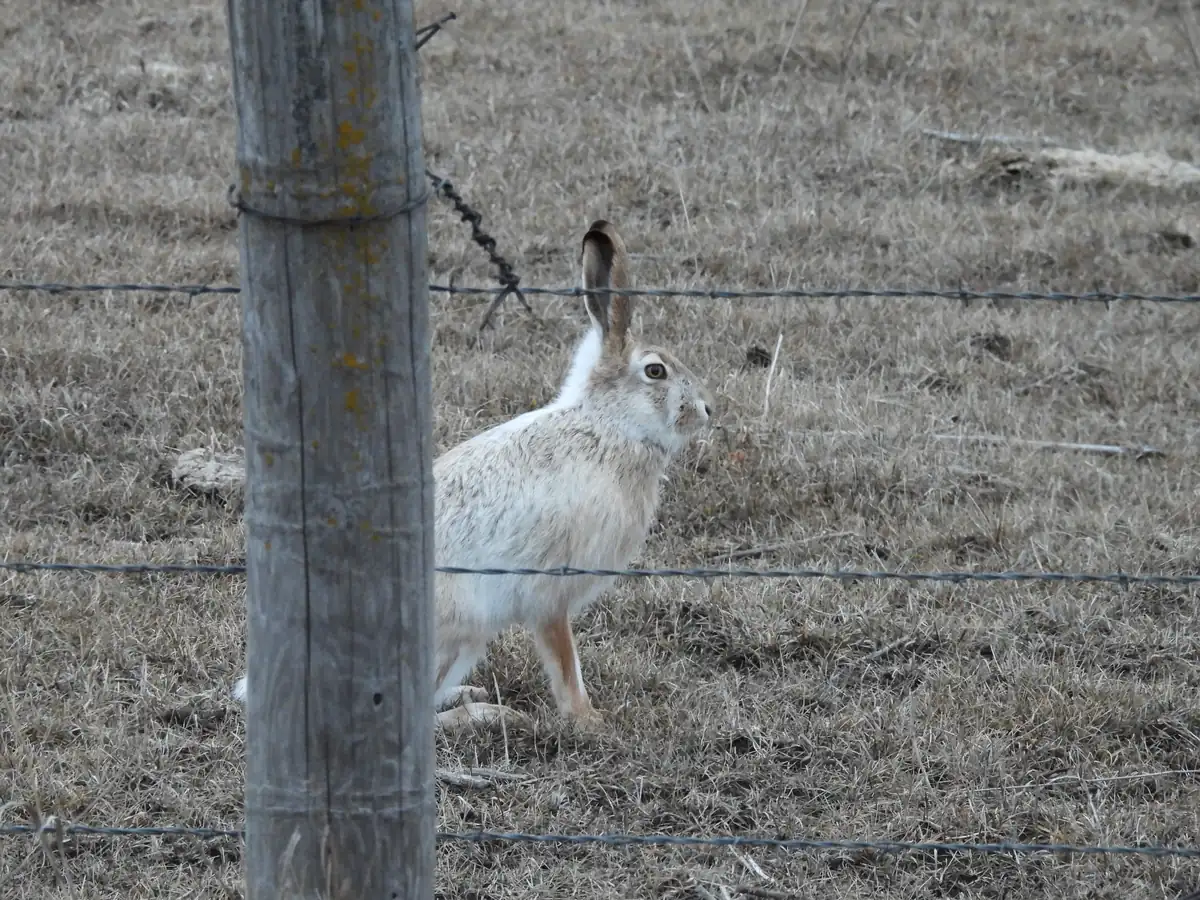
- A white jackrabbit on brown ground. Game and Fish says the state’s two hares and three weasels all turn white for winter, a change set off by shortening days rather than snow. In a snowless November a white-tailed jackrabbit in a stubble field is easy to spot from a gravel road at dusk.
- Leonids before dawn on the 18th. The Leonid peak comes in the early evening of Tuesday, November 17, Central time, so the best hours are after the half-lit moon goes down around midnight and before twilight on Wednesday the 18th. Dress for single digits.
In the Naturalist’s Field Journal, enter every jackrabbit and weasel you see on the mammal watch plate with a note on how white it looked, sketch the first clean prints after a snowfall on tracks to know, and log the Leonid morning on the dusk and dawn watch. Choose one slough or stock dam for the same place twice, once open and once iced, and add the first snowy owl or snow bunting to birds I have seen.
Regions used below: Red River Valley; Devils Lake and the Turtle Mountains; Drift Prairie and the James River valley; Missouri Coteau and Bismarck–Mandan; Lake Sakakawea and the northwest; Badlands and the southwest (Mountain time).
Where do ducks, geese and bald eagles spend November in North Dakota?
The birds that leave late are the ones that need open water, and in November open water shrinks by the night. Shallow prairie potholes freeze first, then the bigger lakes, and the late flocks fall back on the Missouri River system, where moving water and the outflow from Garrison Dam stay open longest. Game and Fish’s January counts find the great majority of the state’s wintering Canada geese on that river and its reservoirs, and November is when the gathering begins.
-
Canada geese and mallards on the Missouri River
Building through November as smaller waters freeze; some stay all winter · The Missouri from Garrison Dam to south of Bismarck, Lake Sakakawea near the dam, Nelson Lake in Oliver County
The department’s January 2026 count, a midwinter snapshot rather than a November one, found about 135,000 Canada geese in the state: more than 109,000 on the Missouri River, over 39,000 on Lake Sakakawea and nearly 17,000 on Nelson Lake, with about 9,500 mallards. Part of Sakakawea stayed ice-free that winter from the dam to the mouth of the Little Missouri. A year earlier the lake froze over on January 4 and the river held fewer than 69,000 geese; biologists blamed cold snaps in November and early January that sealed off open water and sent birds south. So whether your local river has geese at Thanksgiving depends largely on how hard November freezes.
-
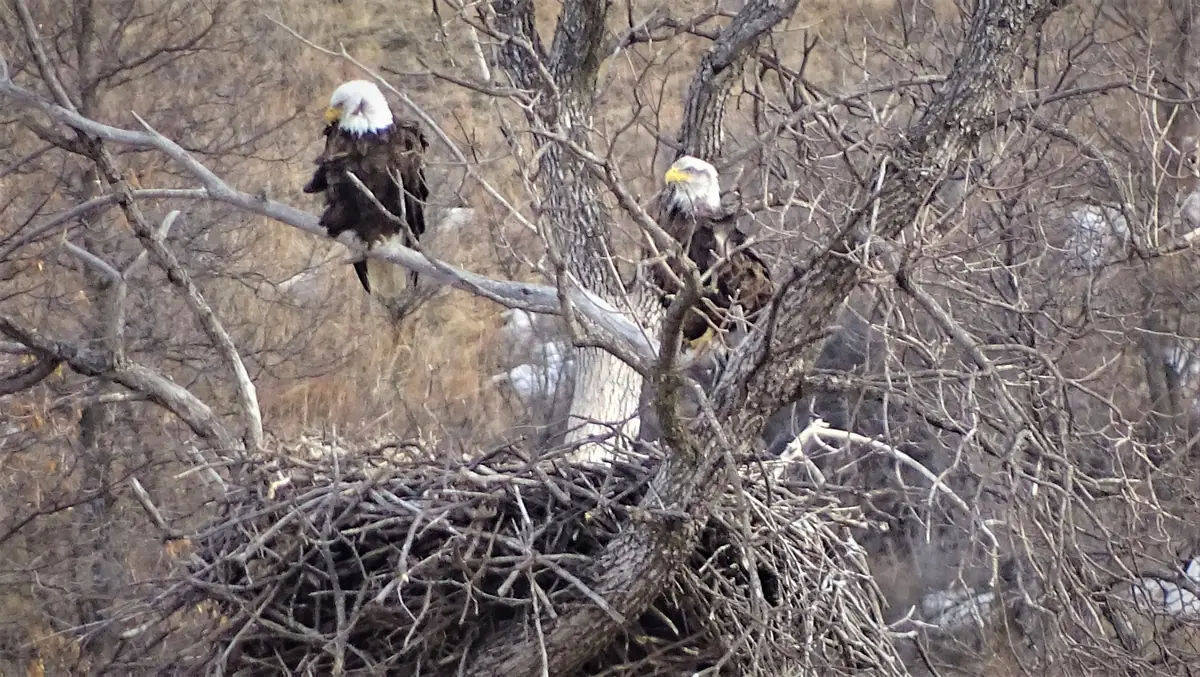
Bald eagles at the Garrison Dam hatchery
Through migration in October and November, then all winter where water stays open · Garrison Dam National Fish Hatchery wetlands and the river below the dam at Riverdale; cottonwood bottoms downstream
Game and Fish’s guide to the state’s raptors says large numbers of adult and young bald eagles migrate through in October and November, and that eagles winter here, especially around Garrison Dam. The reason is practical: the Fish and Wildlife Service says the hatchery’s wetland stays open in winter on water warmed for fish rearing, which holds ducks and geese, which draw eagles. Look in the big cottonwoods along the trail loops. Brown, mottled birds are young eagles; the white head and tail take about four years to come in.
-
The last whooping cranes
Whooping cranes peak late October into early November and leave at freeze-up · Wetlands and stubble fields in the central counties
Game and Fish says whoopers stay as long as wetlands stay open and leave once it turns really cold and the water starts freezing, so the first week or two of November is the last real chance. A crane that is all white, five feet tall, with black wingtips and its neck held straight in flight is worth a phone call: report the date, place and any leg bands to the Fish and Wildlife Service at Lostwood (701-848-2466) or Audubon (701-442-5474), or to Game and Fish (701-328-6300).
Log two dates for your nearest slough: the first day it holds ice from dawn to dusk, and the last day geese sit on it.
Which winter birds arrive in North Dakota in November?
As the summer birds finish leaving, a short list of northern ones takes their place. They come for the same reason the eagles do: food that is easier to reach here than on the tundra or in the boreal forest once winter sets in.
-
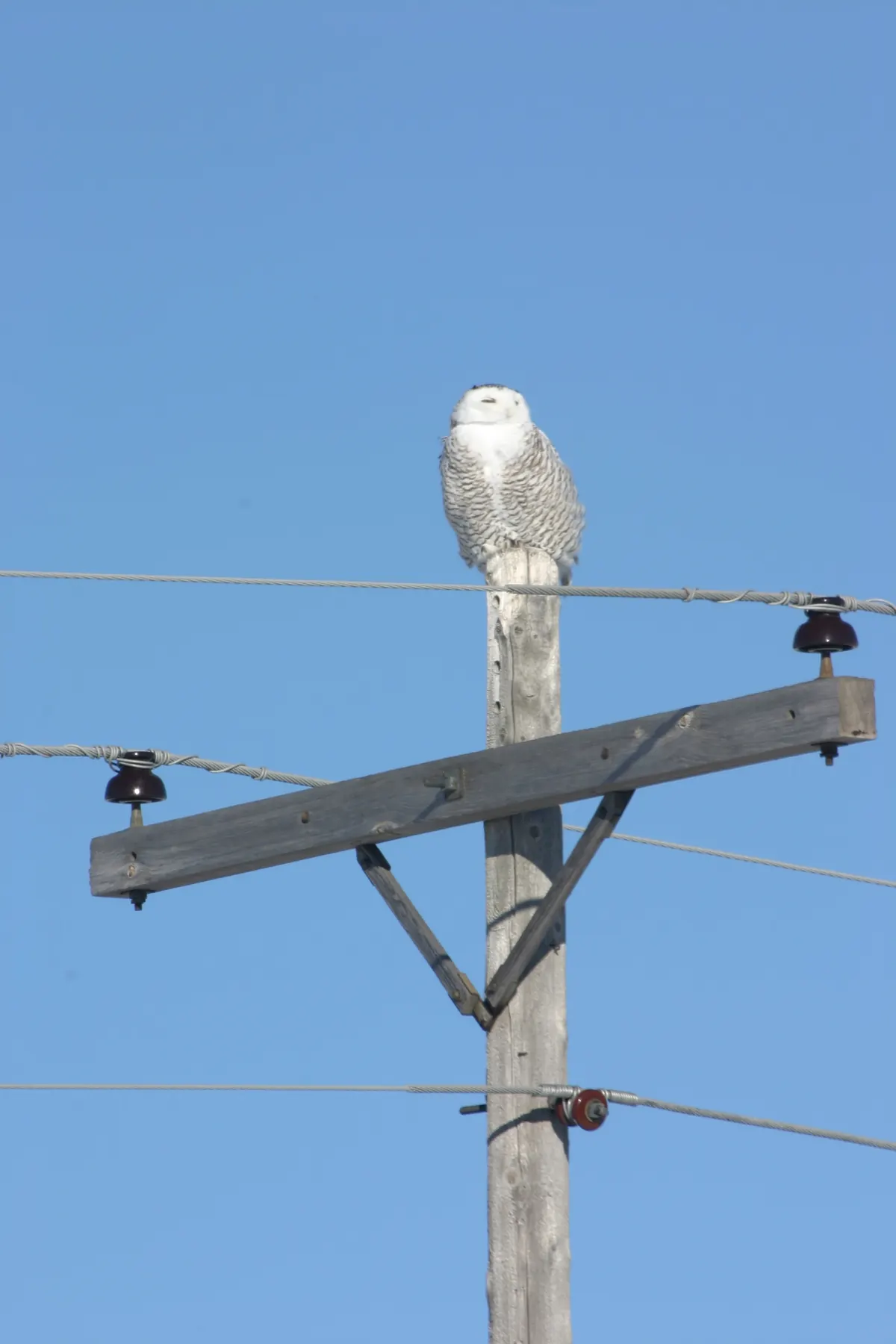
Snowy owls
Possible from late October through early May; numbers vary a lot from year to year · Open farmland and prairie, often on fence posts, utility poles, haystacks or bare ground
Game and Fish counts the snowy owl as a regular winter bird in North Dakota and lists it from late October to early May. How many come south depends on lemmings, their main food in the Arctic, so some winters bring a handful and others many. Because snowies hunt in daylight, they are far easier to spot than other owls. Older males can be almost pure white; young birds carry heavy dark barring. Give a perched owl plenty of room and watch from the car.
-
Snow buntings and the last meadowlarks
Buntings mid-October to early April; meadowlarks mostly gone by early November · Gravel road shoulders, plowed fields, farmyards
Game and Fish’s natural history calendar has western meadowlarks heading south from mid-October into early November and snow buntings arriving at the same time to spend the winter. Buntings travel in tight, swirling flocks that flash white wing patches as they land on a field edge. If you still hear the state bird singing in the second week of November, write it down; it is close to the late edge.
-
A rare owl from the north woods
Late November to late March · Treetops at the edge of woods and shelterbelts
The northern hawk owl is the one to hope for: Game and Fish calls it an uncommon visitor that may turn up from late November. It hunts by day from the very top of a tree, with a long tail that makes it look more like a hawk. Report one on eBird.
-
A quiet finch winter, probably
November through March · Feeders, birch and spruce plantings, shelterbelts
The Finch Research Network’s 2026–27 forecast, published September 25, describes poor seed crops from western Manitoba across to Alberta. Birds facing that tend to move southeast toward better food in the eastern boreal and Great Lakes, which means past North Dakota rather than into it. Redpolls are not expected in large numbers, and good mountain-ash crops should hold pine grosbeaks and Bohemian waxwings farther north. Pine siskins and Type 2 red crossbills were already on the move in late summer, so they are the ones to watch for at feeders and in conifer plantings.
Which North Dakota animals turn white in winter, and when?
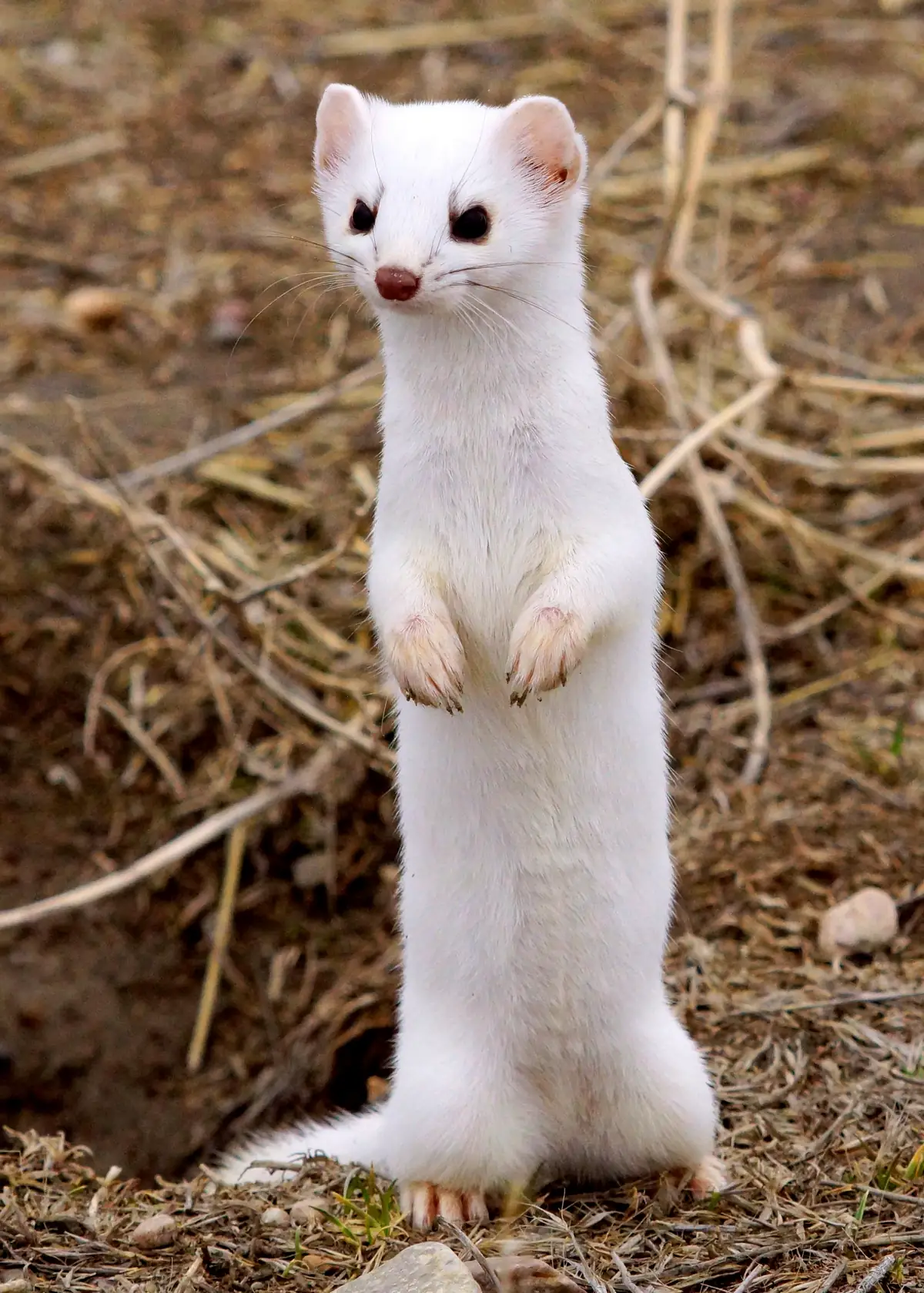
Five North Dakota mammals change color for winter. Game and Fish names them: the white-tailed jackrabbit and the snowshoe hare, and three weasels, the long-tailed, short-tailed and least. For the hares a white coat hides them from predators; for weasels it also hides them from the mice and voles they hunt.
-
Long-tailed weasels going white
Molting mid-October through mid-November · Field edges, rock piles, shelterbelts, farmyards with mice
The long-tailed weasel is the most common of the three. Game and Fish’s calendar puts its molt from mid-October to mid-November, when the tan summer coat gives way to white. The department says the change in all three species is triggered by day length, which is why it happens on schedule whether or not snow has fallen. You are most likely to glimpse one crossing a road or bounding along a fencerow in the afternoon.
-
White-tailed jackrabbits
Fall molt into a white winter coat; white through winter · Open grassland, pastures and stubble statewide
The jackrabbit is a hare of the open plains, with long black-tipped ears and big hind feet. Game and Fish counts it among the animals that go white for winter. Since the timing follows the calendar rather than the weather, a mild, brown November leaves white jackrabbits sitting in plain sight on dark fields. That mismatch is worth noting in a journal: the date you first see a white one, and the date the first snow stays.
When is the deer rut in North Dakota?
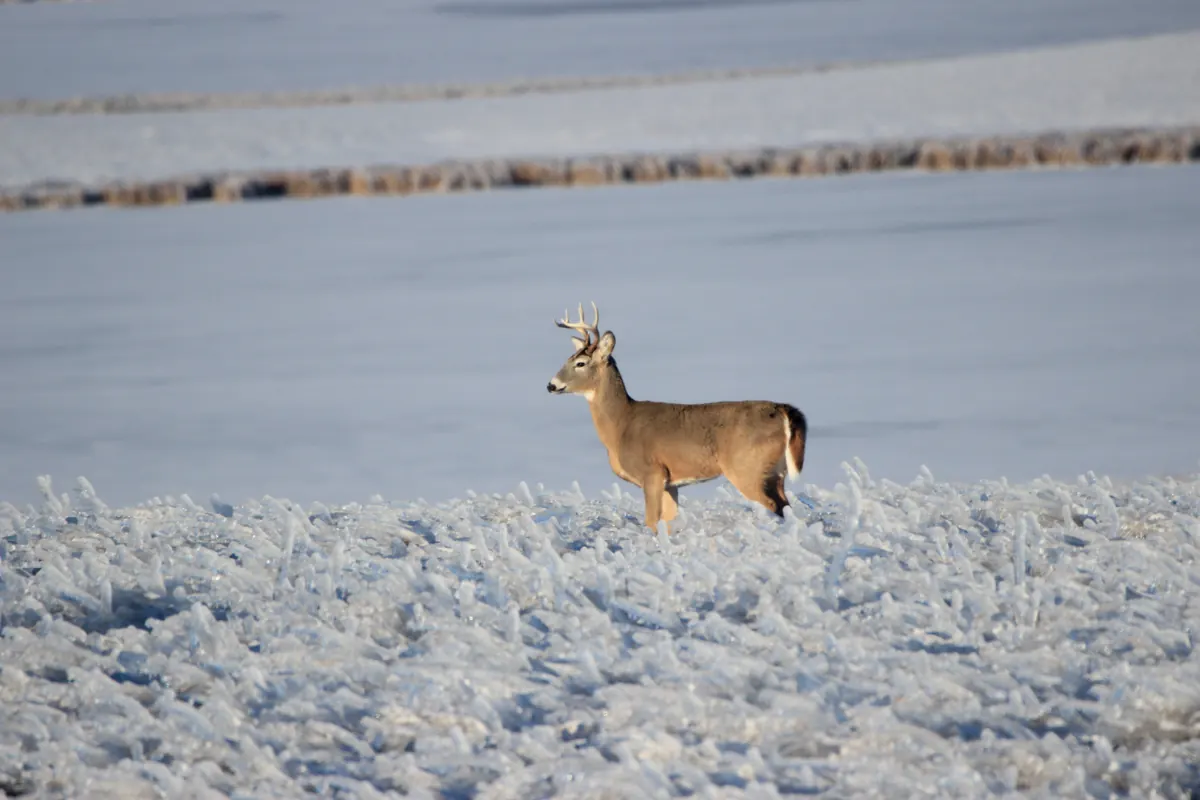
November is breeding month for the state’s deer. Game and Fish’s calendar runs the rut for both white-tailed and mule deer from late October to late November, and its white-tailed deer page puts the peak in mid-November, with a buck tending one doe at a time and no lasting pair bonds.
-
Whitetails on the move
Peak around mid-November; dawn and dusk · River bottoms, shelterbelts, cattail sloughs and the fields beside them
Bucks that kept to cover all fall travel in daylight now, nose down on a doe’s trail, neck swollen. Watch field edges in the last half hour before dark. Gun hunters are out in the same places from noon on Friday the 6th through Sunday the 22nd, so wear orange on any walk outside town.
-
Deer on the road
October into early December; dawn and dusk · Every rural highway, especially near river bottoms and shelterbelts
Game and Fish names October through early December as the peak period for deer-vehicle crashes, mostly at dawn and dusk. After the clocks change on November 1, the evening drive home lands right in that window. The department’s advice: slow down and honk when you see deer, expect a second and third to follow the first, and do not swerve into the ditch; braking and staying on the road is safer than missing the deer. You need a free permit from a game warden or local law enforcement before keeping a roadkill deer.
What is happening in Theodore Roosevelt National Park and the badlands in November?
The park is close to empty in November, the light is low all day, and the animals are easy to find on the bare slopes. Visitor centers keep reduced winter hours, so check them before you drive, and keep the clocks straight: Medora and the South Unit are an hour behind the North Unit near Watford City. Parts of the scenic drives in both units can close for snow and ice, so check the road status before you go. Entrance is free for U.S. residents on Veterans Day, Wednesday, November 11.
-
Bighorn rams in the North Unit
Breeding peaks early November to early December · Steep badlands of the North Unit; none have been seen in the South Unit for years
Bighorns were wiped out of the area by the early 1900s and brought back starting in 1956. The Park Service puts the population at about 490 animals in the region, and says the South Unit’s terrain is not steep enough for them, so plan on the North Unit. In the rut, rams join the ewe groups and fight for them, rearing back and slamming horns head-on. Scan the tops of the steepest buttes with binoculars, and listen; on a still morning the crack carries a long way.
-
Bison in winter wool
All month · Scenic drives in both units; wild horses in the South Unit
Bison wear their full winter wool now. Stay at least 25 yards away, however sleepy they look.
-
Who sleeps through the winter
From early November · Statewide
Game and Fish’s calendar lists black bears, rare in North Dakota, as hibernating from early November to mid-March, and striped skunks gathering in shared dens from early November through December. Because a skunk only sleeps deeply rather than truly hibernating, a warm spell brings it out to forage, and fresh snow records where it went.
What fruits and seeds are left on North Dakota’s trees and shrubs in November?
With the leaves down, what is left on the branches is winter food, and much of it hangs on until spring.
-
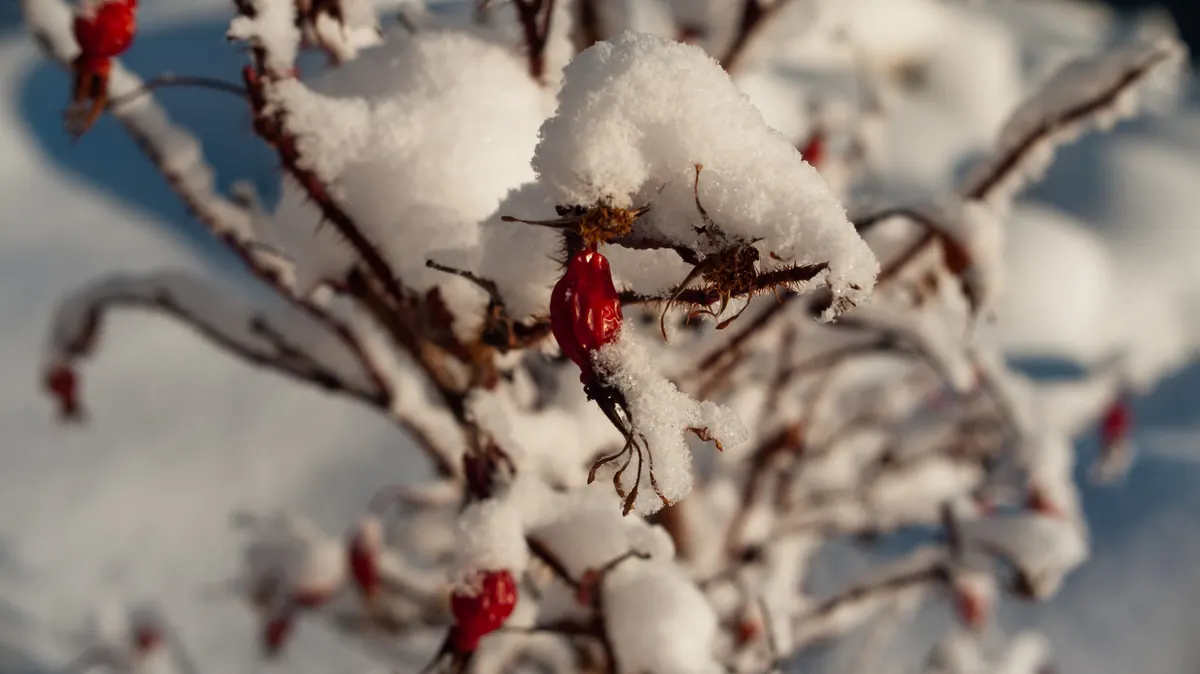
Rose hips
Ripe from late summer; hang on all winter · Coulees, ditches, riverbanks, prairie edges
Woods’ rose forms thickets along streams and road cuts across the northern plains. The USDA plant guide says its dry red hips stay on the plant through the winter and that many birds and mammals live on them once snow covers the ground. Pick a patch near home and count the hips each week until spring to see who is eating them.
-
Hackberry fruit
Ripe in September and October; on the tree all winter · River bottoms and wooded slopes; also planted in towns
The USDA lists North Dakota at the western edge of common hackberry’s native range, and in the state it belongs to the cottonwood bottomlands. Its small fruits turn dark red to nearly black, and the USDA says they persist through the winter and feed turkeys, pheasants, grouse, cedar waxwings and robins. The bark is the giveaway in winter: gray, with corky warts and ridges.
-
Bur oak acorns
Acorns fall from late summer into November · River valleys, the Turtle Mountains, Pembina Gorge, town parks
Bur oak is the state’s native oak, and its acorns sit in a deep, fringed cup that gives the tree its name. The USDA notes that heavy crops come every two or three years and that blue jays and rodents bury acorns to eat later, planting some of the next generation by forgetting them. Collect a few caps for the seeds, pods and cones plate.
Has North Dakota had its first freeze by November?
Yes, almost everywhere. The table below gives the official first-freeze dates for nine stations. At every one of them, the first 32 °F night has come by October 18 in nine years out of ten, and the medians run from September 21 at Williston and Hettinger to October 5 at Devils Lake. No region is still waiting in a normal November; even the Red River Valley and the Devils Lake country, the last places to freeze, are usually well past it.
| Station | One year in ten | Median | Nine years in ten |
|---|---|---|---|
| Fargo Hector International Airport | Sep 18 | Sep 30 | Oct 15 |
| Grand Forks International Airport | Sep 15 | Sep 27 | Oct 8 |
| Devils Lake Kdlr (Lake Region) | Sep 26 | Oct 5 | Oct 18 |
| Jamestown Municipal Airport (James River valley) | Sep 15 | Sep 28 | Oct 9 |
| Bismarck | Sep 18 | Sep 30 | Oct 13 |
| Minot International Airport | Sep 19 | Oct 1 | Oct 14 |
| Williston Sloulin International Airport | Sep 9 | Sep 21 | Oct 2 |
| Theodore Roosevelt Airport (Dickinson) | Sep 12 | Sep 25 | Oct 7 |
| Hettinger Experiment Station (southwest) | Sep 5 | Sep 21 | Oct 2 |
So November’s question is not frost but ice: when the ground freezes hard, when stock tanks need a heater, when the first lake can be walked on. Look up any town on the North Dakota frost dates page, then start a second column in your notebook for the first morning a pond holds ice from shore to shore.
Does it snow in North Dakota in November, and what might El Niño do to this winter?
November is the month North Dakota’s weather turns to winter for good. Under NOAA’s current normals (1991–2020), a typical November afternoon reaches about 41 °F in Bismarck, 38 °F in Fargo and Williston and 36 °F in Grand Forks, and nights average 17 to 21 °F. Normal November snowfall is 6.3 inches at Williston, 6.6 at Grand Forks, 6.8 at Fargo, 8.0 at Bismarck and 9.2 at Minot. Precipitation is light, under an inch at most of those stations, but at these temperatures nearly all of it can come as snow, and the wind does the rest.
Then there is the season ahead. Out in the Pacific a very strong El Niño has taken hold; NOAA’s September 10 discussion gave it over a 90 percent chance of lasting through the winter. The state climatologist, Daryl Ritchison, told the Jamestown Sun in late September that the odds favor a warmer-than-average winter but that El Niño accounts for only about a quarter of what drives winter weather here, and that it will still get below zero at times. He also pointed out that one storm leaving snow cover that lasts all season can shift a winter’s average temperature by about 5 degrees.
The most recent El Niño winter shows both sides. The North Dakota State Climate Office ranked 2023–24 the second warmest winter in 130 years of records, 8.5 °F above normal with little or no snowpack, yet the same mild winter brought a damaging ice storm in late December and a major cold snap in mid-January. The government’s formal outlook for December through February is due October 15; North Dakotans can read it with the rest of the three-month outlook maps. The Climate Prediction Center also publishes bar charts of past El Niño winters for North Dakota, linked in the sources below.
For current temperatures, wind chill and road weather on any day this month, open Weather now before heading out.
How much daylight does North Dakota lose in November?
Between 70 and 75 minutes over the month, roughly 2.4 to 2.6 minutes each day. The northern towns lose the most: Minot and Williston end November with 8 hours 40 minutes of daylight, Devils Lake with 8 hours 41 and Grand Forks with 8 hours 42, while Bismarck keeps 8 hours 51. The change you notice, though, arrives in one jump on Sunday, November 1, when standard time resumes. Fargo’s sunset that evening is 5:11 p.m., and by the 30th it is 4:41, with Grand Forks at 4:38. Because the state lies at the far western side of the Central zone, mornings stay dark late: on November 30 the sun rises at 8:06 a.m. in Bismarck and 8:23 in Williston. Dickinson, on Mountain time, has its sunset at 4:05 p.m. that day.
| City | Nov 1 | Nov 30 | Lost | Per day |
|---|---|---|---|---|
| Fargo | 10 h 01 m | 8 h 50 m | 71 min | 2.4 min |
| Grand Forks | 9 h 57 m | 8 h 42 m | 75 min | 2.6 min |
| Jamestown | 10 h 01 m | 8 h 50 m | 71 min | 2.4 min |
| Devils Lake | 9 h 55 m | 8 h 41 m | 74 min | 2.6 min |
| Bismarck | 10 h 01 m | 8 h 51 m | 70 min | 2.4 min |
| Minot | 9 h 55 m | 8 h 40 m | 75 min | 2.6 min |
| Williston | 9 h 55 m | 8 h 40 m | 75 min | 2.6 min |
| Dickinson | 10 h 01 m | 8 h 50 m | 71 min | 2.4 min |
Look up your own sunrise and sunset, plus the length of twilight, on the Field almanac.
What can you see in the North Dakota night sky in November?
With nights of fifteen hours or more by late November and standard time back, the sky is dark by supper. All times below are Central Standard Time; the southwest corner, from Dickinson and Medora to Bowman, is on Mountain time, an hour earlier.
-
The Leonid meteor shower
Active November 6 to 30; best before dawn on Wednesday, November 18 · Anywhere dark, facing east or overhead after midnight
The International Meteor Organization predicts the peak at about 5:45 p.m. CST on Tuesday, November 17, and rates near 15 per hour for a watcher under truly dark skies; no outburst is forecast this year. Leo, where the meteors seem to start, clears the eastern horizon near midnight and keeps climbing toward dawn, while the half-lit moon goes down about the same time. That makes 1 a.m. until first light on Wednesday the 18th the window, with the mornings either side as backups. These are swift meteors, and the brighter ones can leave a faint smoky streak behind them.
-
The Taurids around a moonless week
Southern Taurids peak November 5; Northern Taurids November 12; new moon November 9 · High in the east and south through the evening and overnight
The two Taurid streams, both shed by Comet Encke, deliver just a handful of meteors per hour, yet now and then one of them is a slow, startling fireball. New moon falls on the 9th, right between the peaks, so that whole week has dark evenings; in a North Dakota November the sky is fully dark by about seven, so children can watch before bedtime.
-
The Beaver Moon, a small supermoon
Full at 8:53 a.m. CST Tuesday, November 24; looks full the evenings of the 23rd and 24th · Rising in the east-northeast at dusk
EarthSky and the Farmers’ Almanac both count this full moon as a supermoon, but only just: perigee, the moon’s nearest point, follows full moon by roughly thirty hours. Late on Monday the 23rd and into Tuesday morning the moon sits almost on top of the Pleiades star cluster, though moonlight washes most of those stars out. (December’s full moon will be the closer one.)
-
Planets before dawn: Venus, Mars, Jupiter and Mercury
All month; Mars and Jupiter closest on the mornings of November 15 and 16 · East and south before sunrise
Go out before sunrise for planets. Venus, now a morning star, rises higher each day and shines brightest of all around Thanksgiving week, the 24th to the 27th. Mars and Jupiter share the constellation Leo, and on the 15th and 16th before dawn the gap between them shrinks to roughly 1.2 degrees, so both fit inside one binocular view. Mercury makes a low appearance in the southeast between roughly the 18th and 25th. Evenings belong to Saturn alone, due south once it gets dark.
-
Northern lights
Any dark, clear night · The northern horizon, best away from towns
Solar Cycle 25 topped out in October 2024, by NOAA’s reckoning, and has been winding down since, yet big geomagnetic storms still erupt in a cycle’s declining years. Sitting near the Canadian line, North Dakota sees them more often than most states, and the long November nights add hours of watching. On a clear night near the new moon, look at the short-range aurora forecast from NOAA’s Space Weather Prediction Center before you go to bed.
| Phase | Date | Time |
|---|---|---|
| Last quarter | Sunday, Nov 1 | 2:28 p.m. CST (1:28 p.m. MST) |
| New moon | Monday, Nov 9 | 1:02 a.m. CST (12:02 a.m. MST) |
| First quarter | Tuesday, Nov 17 | 5:48 a.m. CST (4:48 a.m. MST) |
| Full moon, the Beaver Moon | Tuesday, Nov 24 | 8:53 a.m. CST (7:53 a.m. MST) |
| Last quarter | Tuesday, Dec 1 (Monday, Nov 30 in Mountain time) | 12:08 a.m. CST (11:08 p.m. MST on Nov 30) |
Before a meteor night, check cloud cover on Today’s sky; for when the moon will be up over your own farm or town, use our moon phases calendar.
What can North Dakota families do outdoors in November 2026?
The state parks and Audubon Great Plains had not posted any November programs when we checked in early October, so this list leans on events with fixed dates and on things you can do on your own. Check the North Dakota Parks and Recreation events page later in the month for additions.
- Sunday, November 1: start a FeederWatch season. The Cornell Lab’s Project FeederWatch season opens November 1 and closes April 30: pick two consecutive days, tally the most birds of each species seen at once, and repeat weekly or whenever you can. Standard time returns overnight, so the afternoon count ends earlier than you expect.
- Saturday, November 7: Tremendous Tigers Camp at the Dakota Zoo in Bismarck, 1 to 2:30 p.m. for ages 5 to 7 and 3 to 4:30 p.m. for ages 3 and 4 with a parent. Register at least seven days ahead. The zoo is open Friday to Sunday afternoons, weather permitting.
- Wednesday, November 11: free entrance to Theodore Roosevelt National Park for U.S. citizens and residents, a good day to look for bighorns in the North Unit.
- Thursday, November 19: Toddler Time at the Dakota Zoo, 10 to 11:30 a.m., with online registration.
- Saturday, November 21: Family Zookeeper Camp at the Dakota Zoo, 1 to 4:30 p.m., for parents with children 5 to 18.
- Friday, November 27: the day after Thanksgiving outside. Choose a short trail in a state park or a refuge and count the animal tracks you find. Muzzleloader deer season opens at noon that day, so everyone wears orange.
- Through December 31: the state parks’ fall Hiking Challenge. Hike three different trails, photograph a feature that makes each one memorable, and check in on the OuterSpatial app to be entered in a prize drawing for free camping and annual park permits.
- Looking ahead to Thursday, December 31: Last Day Hikes are listed at Lewis and Clark and Cross Ranch state parks.
- Citizen science. Report a late whooping crane or a white weasel on eBird or iNaturalist, and keep the family’s freeze and first-snow dates in one notebook.
Our nature hub collects the other state guides, and October’s page covers the snow goose and crane peak. Children who want their own record can start with the Naturalist’s Field Journal.
Safety notes for November in North Dakota
- Deer gun season, November 6 to 22. It opens at noon Central time on Friday the 6th (11 a.m. in the Mountain corner) and is the busiest hunting stretch of the year. Bow season runs through January 3, and muzzleloader season runs from noon on November 27 to December 13. Other seasons running this month: pheasant, sharp-tailed grouse, ruffed grouse and Hungarian partridge through January 3; ducks through December 6 in the Low Plains unit, with the High Plains unit closing December 6 and reopening December 12; sandhill cranes until November 15; Canada geese to December 19 in the eastern zone, December 24 in the western zone and January 1 on the Missouri River, white-fronted geese to December 6 and light geese to January 3. Furbearer trapping has been open since late October, bobcat season opens November 7 in part of the state, and snares, night hunting of foxes and coyotes and a one-week fisher and marten trapping season (November 23–29) all start November 23. Keep dogs leashed near trails where traps may be set.
- The orange rule. The 2026 deer regulations require all big game hunters, bowhunters included, to wear orange while the regular deer gun season is in progress, and all muzzleloader hunters to wear it during their season. To be legal, the hat and the top layer worn above the waistline must both be solid daylight fluorescent orange, with a combined minimum of 400 square inches; camouflage patterns in orange do not qualify. The rule binds hunters, not hikers, but anyone walking public land, a wildlife management area or a road ditch this month should wear the same.
- New ice. Game and Fish says 2 inches of ice means stay off and 4 inches of good ice will hold a person on foot. Early ice is uneven, can form overnight, and snow on top both insulates it from thickening and hides cracks and open spots. Test as you go with a chisel, carry ice picks or two screwdrivers to pull yourself out, and keep a phone in a waterproof pocket.
- Cold and wind. Average lows sit near 20 °F, and a blizzard can close highways with little warning. Carry blankets, spare boots, water, a shovel and a phone charger in the car from now until April. Plan walks to end before sunset, which comes around 5 p.m. by mid-month and before 4:45 in Fargo and Grand Forks by the 30th.
- Deer and dark roads. The rut, the hunt and the early dark all fall in the same weeks. Slow down at dusk, and expect more than one deer.
- The badlands in winter. Roads can close for snow and ice; check the park’s road status, keep 25 yards from bison and horses, and remember which time zone your sunset is in.
Sources
- North Dakota Game and Fish: Midwinter waterfowl survey numbers (January 22, 2026)
- North Dakota Game and Fish, North Dakota Outdoors: Buffaloberry Patch, February 2025 (2025 midwinter survey, Lake Sakakawea freeze-up)
- North Dakota Game and Fish: Raptors of North Dakota (PDF)
- U.S. Fish and Wildlife Service: Garrison Dam National Fish Hatchery trails (open winter wetland, ducks, geese and bald eagles)
- U.S. Fish and Wildlife Service: Garrison Dam National Fish Hatchery
- North Dakota Game and Fish, North Dakota Outdoors: Resting and refueling in North Dakota (whooping crane fall migration)
- North Dakota Game and Fish: Whooping crane migration and reporting sightings
- North Dakota Game and Fish: Natural history calendar, November
- Prairie Public, Natural North Dakota: Where to spot snowy owls this winter (November 15, 2025)
- Finch Research Network: Winter finch forecast 2026–2027 (September 25, 2026)
- eBird: submit sightings
- North Dakota Game and Fish: Winter camouflage
- North Dakota Game and Fish: Weasels
- North Dakota Game and Fish: White-tailed deer
- North Dakota Game and Fish, North Dakota Outdoors: Buffaloberry Patch, November 2025 (deer-vehicle collisions)
- North Dakota Game and Fish: 2026 deer proclamation and hunting regulations
- North Dakota Game and Fish: 2026 North Dakota deer hunting guide (PDF; orange clothing requirements)
- North Dakota Game and Fish: Is camouflage blaze orange acceptable for the deer gun season?
- North Dakota Game and Fish: 2026–27 small game, waterfowl and furbearer regulations
- North Dakota Game and Fish: Calendar of season dates
- North Dakota Game and Fish: Ice safety
- North Dakota Game and Fish: Early ice awareness
- National Park Service: Theodore Roosevelt National Park, bighorn sheep
- National Park Service: Theodore Roosevelt National Park, operating hours and seasons
- National Park Service: Theodore Roosevelt National Park, safety
- National Park Service: Entrance passes and 2026 fee-free days
- USDA NRCS plant guide: Woods’ rose (PDF)
- USDA NRCS plant guide: common hackberry (PDF)
- USDA NRCS plant guide: bur oak (PDF)
- North Dakota frost dates (NOAA 1991–2020 normals)
- NOAA National Centers for Environmental Information: U.S. climate normals 1991–2020, monthly (Bismarck, Fargo, Grand Forks, Minot, Williston)
- Climate Prediction Center: ENSO diagnostic discussion, September 10, 2026
- Climate Prediction Center: seasonal outlooks (winter outlook issued October 15, 2026)
- Climate Prediction Center: El Niño winter temperature and precipitation in North Dakota
- Jamestown Sun: Super El Niño could bring warmer winter to North Dakota (September 26, 2026)
- Prairie Public: What a powerful El Niño could mean for North Dakota’s winter (September 23, 2026)
- North Dakota State Climate Office: North Dakota Climate Bulletin, winter 2023–2024 (PDF)
- National Weather Service Bismarck: El Niño and La Niña
- U.S. Naval Observatory: phases of the moon
- U.S. Naval Observatory: sun and moon rise and set data
- International Meteor Organization: 2026 meteor shower calendar (PDF)
- EarthSky: What is a supermoon? (2026 full supermoons)
- BBC Sky at Night Magazine: Supermoons 2026
- EarthSky: Best stargazing of 2026 (Mars and Jupiter conjunction)
- In-The-Sky.org: Venus at greatest brightness, November 2026
- NOAA Space Weather Prediction Center: solar cycle progression
- NOAA Space Weather Prediction Center: aurora 30-minute forecast
- Project FeederWatch: how to participate
- Dakota Zoo: schedule of events, 2026
- North Dakota Parks and Recreation: upcoming events (Last Day Hikes, December 31)
- North Dakota Parks and Recreation: 2026 Hiking Challenge
- Audubon Great Plains: programs and events
- U.S. Fish and Wildlife Service: Audubon National Wildlife Refuge, visit
- Photos via Wikimedia Commons; licenses and photographers are credited under each picture
