What to look for in nature in North Dakota this January
January is the bottom of the North Dakota year. NOAA’s 1991–2020 normals make it the coldest month at Fargo, Grand Forks, Bismarck, Minot and Williston, and the five main airports average 14 to 18 nights at zero or colder. Yet the month is busier than it looks. Biologists fly the Missouri River in the first week to count wintering geese, bald eagles start carrying sticks to their nests, coyotes howl most on these long nights, and in the cold dark water below Garrison Dam the burbot spawn. Above it all, ice crystals paint sundogs beside the low sun. The afternoons are already stretching, and Fargo gets its first 5 p.m. sunset of the winter on January 11. Here is what to watch for, and where.
Other months in North Dakota: October, November, December, February.
Start here
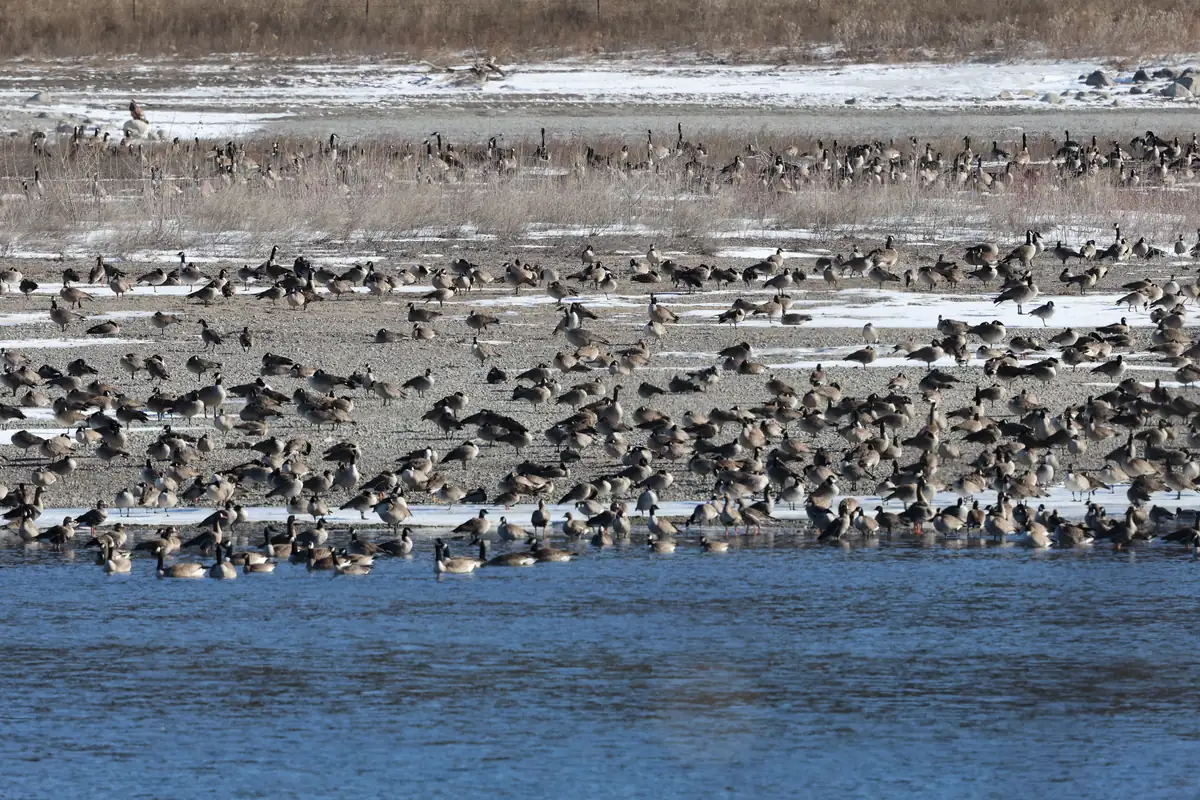
- Scan the open water for geese. Where the Missouri below Garrison Dam or Nelson Lake near Center is open, thousands of Canada geese may be resting. Go on a calm morning and watch them lift off to feed in the stubble.
- Listen for coyotes after supper. Coyote howling peaks as their breeding season opens in January. Step out on a still evening away from traffic and give it ten minutes.
- Catch the Wolf Moon before dawn. The year’s nearest full moon is exact at 6:17 a.m. Central on Friday the 22nd, before sunrise. Thursday night is the night to be out.
This month in the Naturalist’s Field Journal, draw a coyote trail and a fox trail side by side on “tracks to know,” with stride lengths. Add the river geese and any eagle carrying a stick to “birds I have seen,” log an owl duet or coyote chorus on “a map of sounds,” and on a sundog morning use “colours of the day” to note the order of the colors.
Regions used below: Red River Valley; Devils Lake and the Turtle Mountains; Drift Prairie and the James River valley; Missouri Coteau and Bismarck–Mandan; Lake Sakakawea and the northwest; Badlands and the southwest (Mountain time).
How many geese spend the winter in North Dakota, and where?
Every January, in the first days of the month, North Dakota Game and Fish biologists and Fish and Wildlife Service partners fly the Missouri River system and count the ducks and geese still wintering in the state. It is part of the Central Flyway midwinter survey, run in all ten flyway states over the same few days so that no bird is counted twice. In 2024 the flyway crews finished most of their routes between January 2 and 8. The answer each year depends almost entirely on one thing: how much water is still open.
-
Canada geese on the Missouri and Lake Sakakawea
All winter where water stays open; the survey is flown in early January · The Missouri River below Garrison Dam through Bismarck–Mandan, and the lower end of Lake Sakakawea when it is unfrozen
Most of North Dakota’s wintering waterfowl sit on the Missouri system, and the counts swing wildly with the ice. In January 2024, following a December that ran nearly 10 degrees above average across much of the state, Lake Sakakawea was still open from about the Van Hook Arm down to the dam and the U.S. Highway 83 causeway. Crews tallied more than 300,000 Canada geese, smashing the old record of about 222,000, and found over 9,000 snow geese, a species that is usually absent at that date. A year later the lake froze over on January 4, two days before the count, and the total fell to about 88,000.
-
Nelson Lake, the lake that will not freeze
All winter · Nelson Lake, Oliver County, near Center
The Milton R. Young Station, a coal-fired power plant beside Nelson Lake, releases warm water that keeps the reservoir open all year, Game and Fish explains, which also gives its largemouth bass the longest growing season in the state. Geese know it too: the 2026 survey counted 16,894 Canada geese there.
-
Mallards and a few diving ducks
All winter on open water · Below Garrison Dam and along the Missouri at Bismarck
Crews usually find only 5,000 to 10,000 mallards in January, Game and Fish says, so even the 2024 jump to 43,000 was small by continental standards. The federal flyway report for that year adds a few hundred goldeneyes, buffleheads and mergansers; look for them wherever current keeps the water open.
| January | Canada and cackling geese | Mallards |
|---|---|---|
| 2014 | 52,771 | 18,721 |
| 2015 | 119,006 | 26,558 |
| 2016 | 222,846 | 15,444 |
| 2017 | 26,362 | 3,164 |
| 2018 | 134,793 | 16,387 |
| 2019 | 99,119 | 5,313 |
| 2020 | 93,938 | 6,823 |
| 2021 | 164,940 | 34,210 |
| 2022 | 81,154 | 6,985 |
| 2023 | 28,847 | 5,885 |
| 2024 | 309,305 | 43,807 |
Game and Fish’s own releases round the two latest counts to about 88,000 geese and 3,225 mallards in 2025 and about 135,000 geese and 9,500 mallards in 2026. The record 2024 count followed a December that ran far warmer than average, a reminder that open water, more than the calendar, sets each year’s total. Results usually appear on the department’s news page late in the month.
When do bald eagles start nesting in North Dakota?
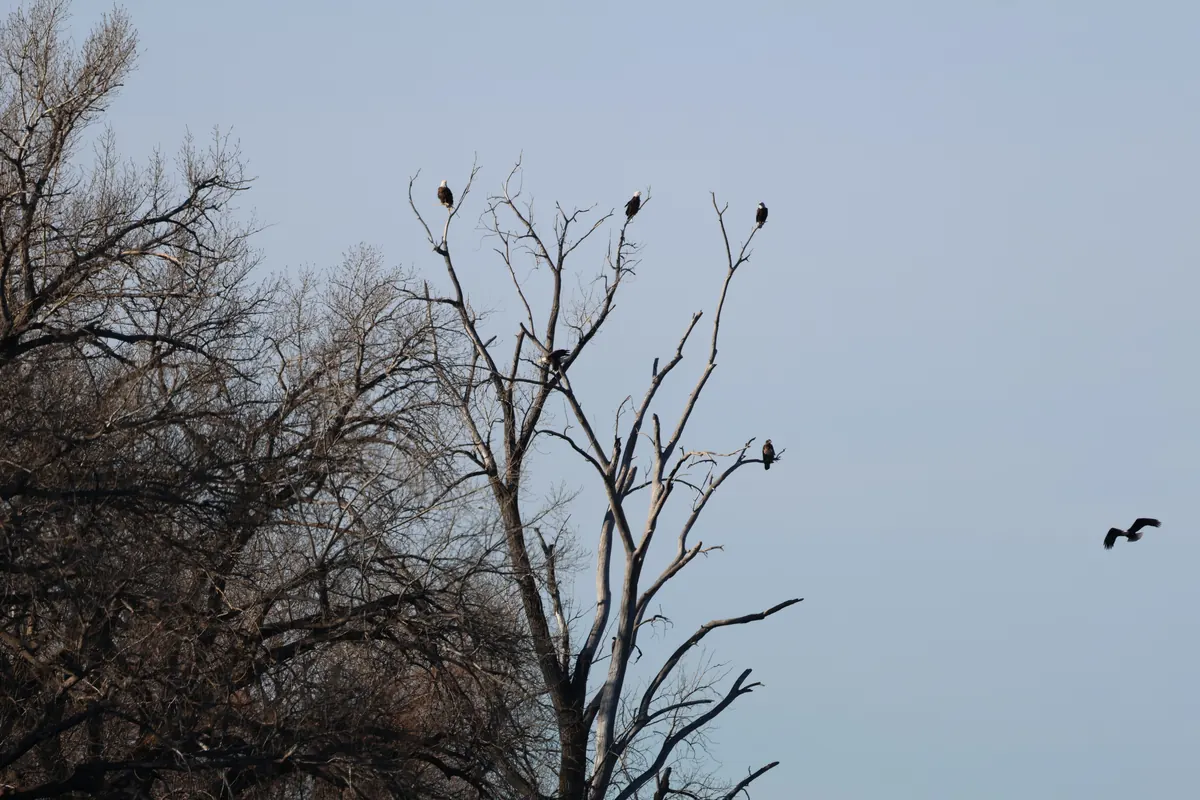
Bald eagles in North Dakota do not wait for spring. Game and Fish’s natural history calendar has them building or repairing nests from early January to late February, so the coldest weeks of the year are nest-building time.
-
Pairs at the nest in midwinter
Nest building early January to late February; eggs late February to mid-March · Big cottonwoods along the Missouri, Red, Sheyenne and James rivers, around Devils Lake and the Turtle Mountains, and more and more in lone trees out on the prairie
According to Game and Fish’s 2024 profile of the species, mated pairs begin courting and building in January and February, lay two or three eggs from late February to mid-March, and share 30 to 35 days of incubation. In the 1970s and 1980s the state had perhaps fewer than three active nests. There were close to 100 by 2010 and about 300 by 2020, and the department now knows of active nests in 47 of the 53 counties, some more than 9 miles from any water.
-
Where to watch the wintering birds
All month where water is open · Garrison Dam National Fish Hatchery trails at Riverdale, the river bottoms downstream toward Washburn and Bismarck
Eagles that are not yet nesting stay near open water and the geese and fish it holds. Watch from a parked car or a trail. Game and Fish wants to hear about nests, but asks observers to report them from a distance that leaves the birds undisturbed.
Why are coyotes and owls so noisy on North Dakota winter nights?
Midwinter is mating season for several North Dakota hunters, and courtship is noisy. On a calm night with fresh snow, sound carries a long way across open country, so January is the best month of the year to hear what lives near you.
-
Coyote choruses
Breeding from early January through late March; howling peaks in January · Statewide, on the edges of pasture, coulees, river bottoms and shelterbelts
Game and Fish’s calendar says coyotes start breeding in early January and that their howling is at its peak now. Listen for a few rising yips that build into a wavering, many-voiced howl and then stop as suddenly as they began.
-
Red foxes pairing up
Mid-January to mid-February · Farmsteads, shelterbelts and town edges, often near rodent-rich grassland
Red foxes breed from mid-January into mid-February, according to the department.
-
Bobcats and beavers, quietly
Both from late January · Bobcats in the badlands and wooded river corridors; beavers in lodges along rivers and creeks
The same calendar has bobcats breeding from late January to mid-March, as last year’s kittens disperse, and beavers breeding from late January to late March. You will not see the beavers; a snow-covered lodge beside a stick cache is the clue.
-
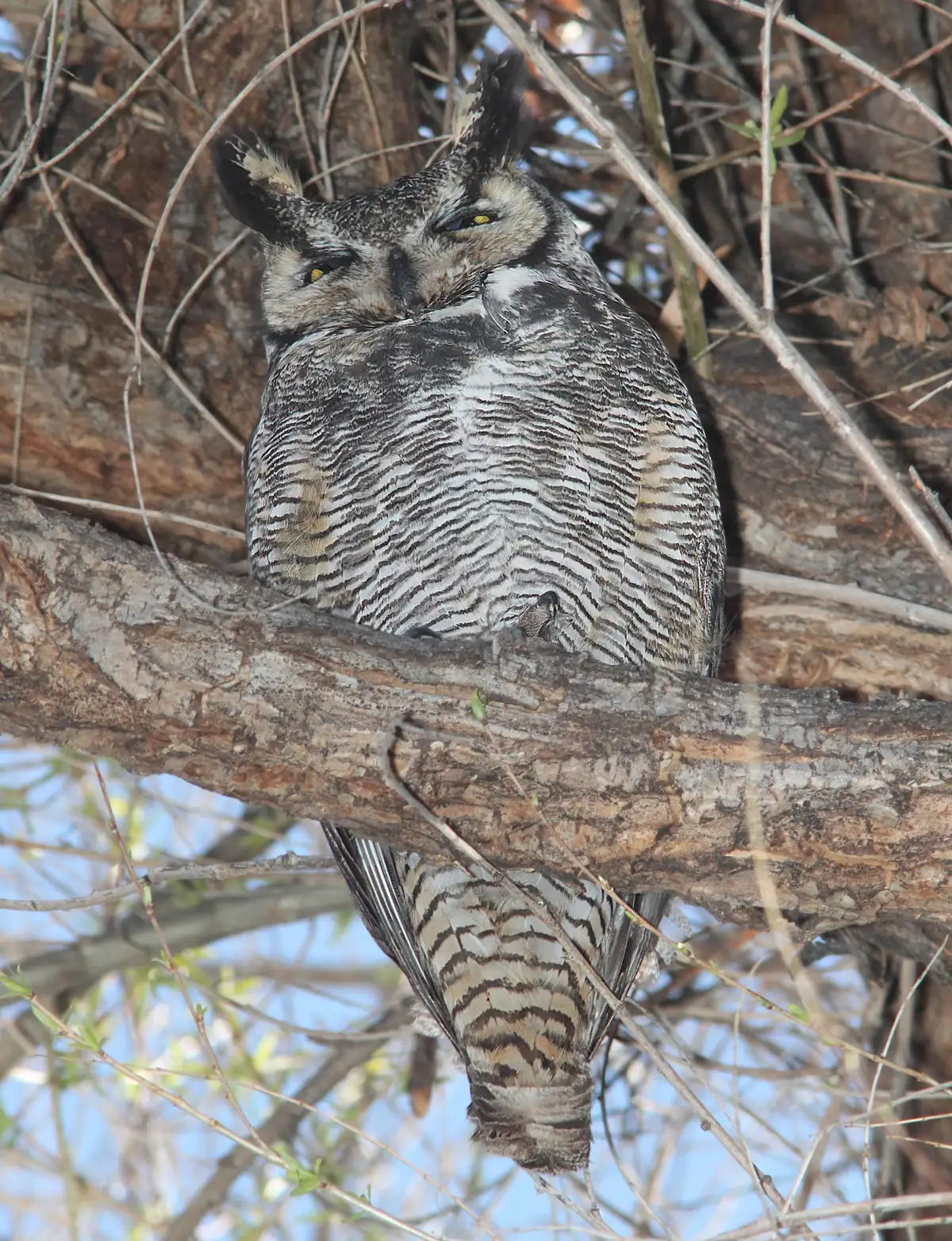
Great horned owls in duet
Calling all winter; eggs from late February · Tree rows, farmstead groves, river woods and town parks
Chuck Lura of Prairie Public’s Natural North Dakota writes that great horned owl hooting serves both territory and courtship, and that territories are being announced and contested as winter turns toward February, ahead of eggs in late February. At dusk, listen for two owls trading hoots, then return in daylight to look for a borrowed hawk or crow nest in that grove.
What happens to fish under the ice in a North Dakota winter?
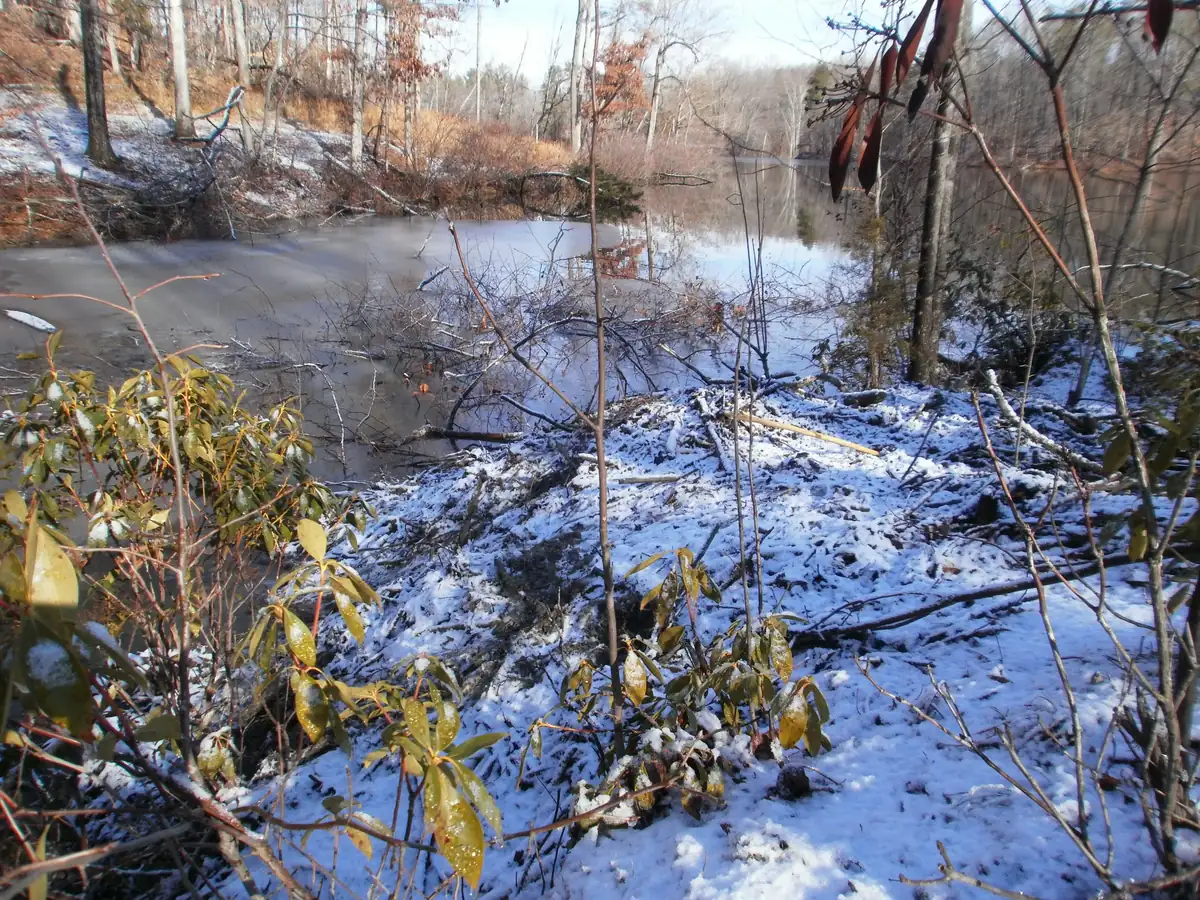
Once the lakes lock up, fish live in the dark under a roof of ice and snow. Most slow down to wait out the cold. One native fish does the opposite.
-
Burbot spawning in the coldest water
Midwinter, under the ice · The Missouri River below Garrison Dam, Lake Sakakawea and the larger rivers
The burbot, also called ling or eelpout, is the only freshwater member of the cod family, a mottled fish with a single chin barbel and an eel-like tail. Game and Fish includes it in the State Wildlife Action Plan, its list of species needing attention, because dams on the Missouri and Red rivers have cut its populations apart. Its spawning season defies the calendar: the Fish and Wildlife Service notes that burbot spawn in winter, under the ice, in writhing masses, and Garrison Dam National Fish Hatchery staff have described catching spawning adults just below the dam’s powerhouse in midwinter for their propagation work. Game and Fish calls burbot excellent eating and regrets that anglers have long discarded them for their snakelike looks.
-
Winterkill under deep snow
Builds from midwinter; worst after long, snowy winters · Shallow lakes, sloughs and small reservoirs, especially in the east and north
Ice cuts the water off from the air, and snow on the ice blocks the light that underwater plants need to keep making oxygen. After the snowy winter of 2022–23, Game and Fish said heavy snow that came early and stayed late had shut out the sunlight, and its crews tested many lakes in February and listed 80 or 90 with worrying oxygen levels. Some were already dead when tested. As the department’s fisheries management section leader put it, winterkill is something they deal with every winter.
If you fish this month, the safe-ice numbers are on our North Dakota December page and in Game and Fish’s ice safety guidance. They matter even more at the warm-water outlets and inflows, where ice is often thinnest.
What tracks can you find in the snow in North Dakota in January?
A night of light snow followed by a calm morning turns every field and shelterbelt into a record of who was out. Game and Fish’s free guide, Tracks and Signs of North Dakota Wildlife, has drawings and measurements for dozens of animals; these are the common January ones.
-
Coyote or fox?
All winter · Field edges, section lines, frozen creeks
Both leave neat four-toed prints with claw marks in nearly a straight line. Game and Fish gives a coyote’s front track as about 2½ inches long with a walking stride of 13½ to 17 inches, and a red fox’s as about 2¼ inches with an 8- to 12-inch stride, its toes often blurred by fur.
-
Rabbits, jackrabbits and gnawed bark
All winter, most obvious in deep snow · Shelterbelts, gardens and brushy draws
Cottontails and white-tailed jackrabbits both hop, so each set shows two big hind prints landing in front of two small fore prints. The guide gives a cottontail hind print of about 2½ inches and a jackrabbit’s of about 5, with bounds up to 6 feet. When snow covers their food, the department says, bark becomes a mainstay, and bark stripped at or just above the snow line, or twigs clipped at a clean 45-degree angle, tells you rabbits are about.
-
Life under the snow
Whenever snow is deep enough to insulate the ground · Grassland, road ditches, lawns and gardens
Prairie Public’s Natural North Dakota describes the subnivean zone, the space between the ground and the snow, as home all winter to mice, voles, shrews and pocket gophers, which stay active down there and some of which even breed. They are most exposed when they come up. Game and Fish adds that voles feed on bark beneath the snow and that pocket gophers pack soil into snow tunnels, which appear in spring as long ropes of black earth on the ground. Wing marks around a small hole in the snow mean an owl or hawk struck there.
-
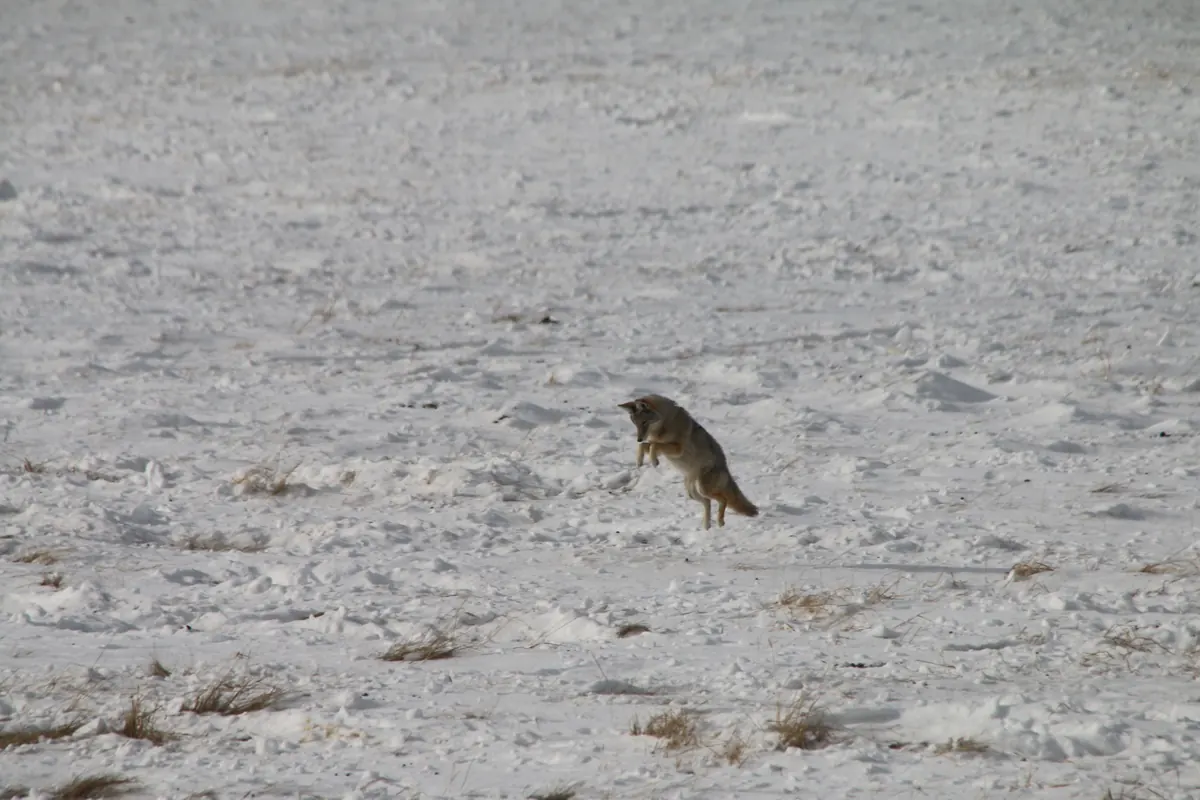
Mouse-pouncing
Calm days, especially after fresh snow · Open grassland and field edges
Coyotes and foxes hunt these rodents by ear: a pause, a cocked head, then a high leap and a face-first dive. What remains is a crater in the snow with a trail leading in and, after a miss, leading out again.
Photograph each track beside a glove for scale.
What makes sundogs and light pillars in a North Dakota winter sky?
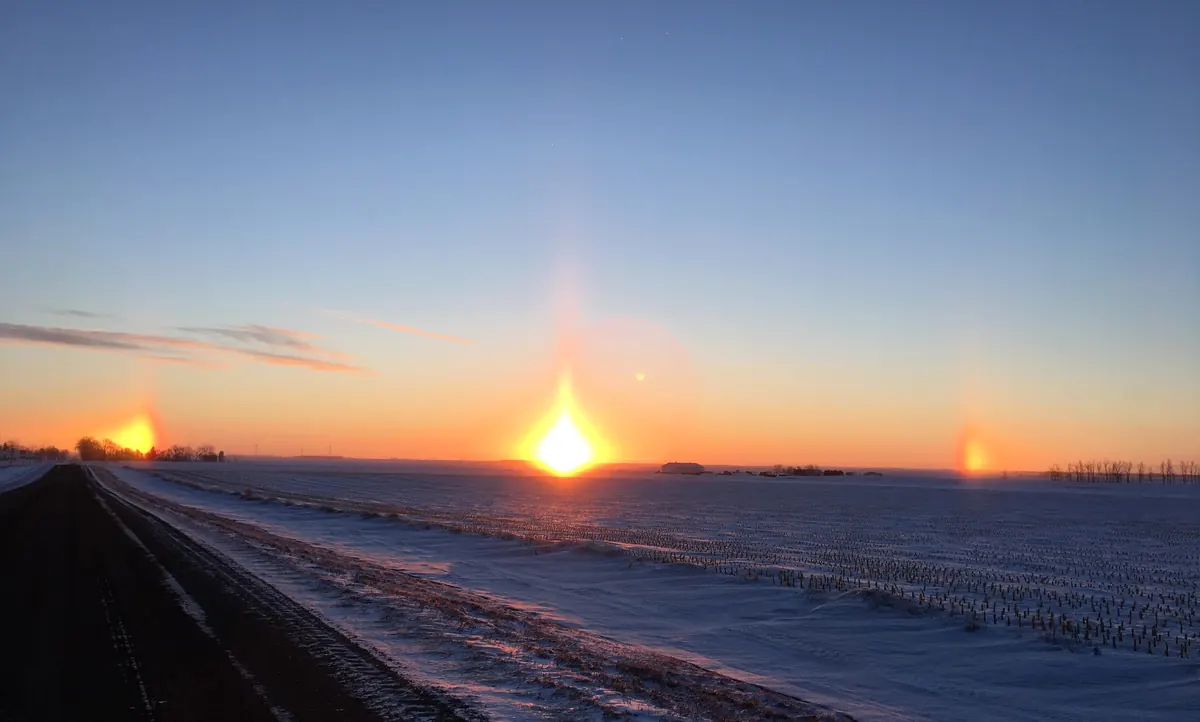
Cold air full of ice crystals turns the low winter sun into a light show. Natural North Dakota notes that sundogs favor cold winter days with plenty of crystals and a low sun, a fair description of most North Dakota Januaries.
-
Sundogs
Most often in the hour after sunrise and before sunset on cold days · Either side of the sun, at the same height
A sundog, or parhelion, is a bright, often rainbow-tinged spot about 22 degrees to the left or right of the sun, roughly a spread hand at arm’s length. The National Weather Service explains it as sunlight refracted through ice crystals, red on the side nearest the sun. Natural North Dakota adds that it takes crystals shaped like flat hexagonal plates, lying nearly level; the more they wobble, the taller and more colorful the sundog.
-
Sun pillars and light pillars
Sunrise and sunset; at night over towns on very cold, calm evenings · Above the rising or setting sun, or above streetlights and yard lights
A sun pillar is a shaft of light standing straight up from the sun near sunrise or sunset. The Weather Service traces it to ice crystals drifting slowly down and reflecting sunlight. On a still, frigid night, falling crystals can raise similar columns above yard lights and streetlamps.
-
Hoarfrost and ice fog
Clear, calm, very cold nights and the mornings after · Shelterbelts, fences, weeds and wires, especially in the Red River Valley and near open water
The Weather Service glossary defines hoarfrost as interlocking crystals deposited straight from vapor onto cold, thin objects such as twigs, wires and weed stems. Ice fog, a haze of tiny ice particles, is rare above about −22 °F (−30 °C) and needs a moisture source such as open water or a town. The State Climate Office pictured a Red River Valley weather station furred with hoarfrost and rime after fog on January 9, 2024. Go out early on such a morning: the glitter rarely survives the first breeze.
Never look straight at the sun while hunting for sundogs; hide it behind a building or a pole.
How cold is January in North Dakota, and what has El Niño done to it before?
January is the floor of the year. NOAA’s 1991–2020 normals put the average afternoon high at 15.8 °F in Grand Forks and 18.2 °F in Fargo, and only about 22 to 23 °F in Bismarck, Minot and Williston. The average overnight low at Grand Forks is below zero for the month as a whole. Snow, by contrast, is modest. The State Climate Office ranks January as North Dakota’s second-driest month, and a typical one leaves 9 to 11 inches at the five main airports, which the wind piles into drifts and scours from open fields.
| Station | Average high / low | Average snowfall | Precipitation (melted) | Days with a low of 0 °F or colder |
|---|---|---|---|---|
| Grand Forks (Red River Valley) | 15.8 / −3.1 °F | 9.9 in | 0.49 in | 17.5 |
| Fargo (Red River Valley) | 18.2 / 0.2 °F | 10.3 in | 0.71 in | 15.9 |
| Williston (northwest) | 22.1 / 1.0 °F | 11.2 in | 0.56 in | 14.3 |
| Bismarck (Missouri River) | 23.2 / 2.4 °F | 8.9 in | 0.48 in | 13.7 |
| Minot (north central) | 23.3 / 4.4 °F | 9.8 in | 0.28 in | 13.9 |
The wind turns these numbers into something harder. The Weather Service’s example: at 0 °F with a 15 mph wind, the wind chill is −19 °F, and exposed skin can freeze in 30 minutes. Our North Dakota frost dates page lists each station’s last spring and first fall freeze if you are already planning a garden.
Out in the equatorial Pacific, El Niño is building toward what forecasters think could be a very strong event: NOAA’s ENSO team, writing on September 10, rated that outcome, persisting through fall and winter, as better than 90 percent likely. North Dakota’s two most recent strong El Niño Januaries are a useful warning. In 2016, the State Climate Office reported, a narrow band left over a foot of snow near Fargo on January 6 and 7, about two weeks of Arctic air followed, and Leonard fell to −32 °F on the 10th, yet a mild final week lifted the month 2 to 5 degrees above normal. In 2024 a cold snap peaked on January 13 with readings in the −30s and 25 to 35 mph winds, Grenora hit −36 °F, and January still ended about 6 degrees above normal. In short, the odds lean mild, but a dangerous week can hide inside a warm month. The official December-to-February outlook is due October 15 and gets a fresh version each month; find the latest on the Climate Prediction Center outlook page, and check Weather now on the day you head out.
How much daylight does North Dakota gain in January?
The shortest day is behind us, but at first it hardly shows. The latest sunrises of the year come around New Year’s Day, so mornings stay dark for the first week, while the afternoons have been stretching since mid-December. Over the month each city below adds roughly 58 to 63 minutes, about two minutes a day on average, with the gains quickening as February nears.
| City | Jan 1 | Jan 31 | Gained | Per day |
|---|---|---|---|---|
| Fargo | 8 h 37 m | 9 h 36 m | 59 min | 2.0 min |
| Grand Forks | 8 h 28 m | 9 h 30 m | 62 min | 2.1 min |
| Jamestown | 8 h 37 m | 9 h 35 m | 58 min | 1.9 min |
| Devils Lake | 8 h 26 m | 9 h 29 m | 63 min | 2.1 min |
| Bismarck | 8 h 37 m | 9 h 36 m | 59 min | 2.0 min |
| Minot | 8 h 26 m | 9 h 28 m | 62 min | 2.1 min |
| Williston | 8 h 26 m | 9 h 28 m | 62 min | 2.1 min |
| Dickinson | 8 h 36 m | 9 h 36 m | 60 min | 2.0 min |
Clock time tells a different story across the state. Williston sits near the western edge of Central time, so on New Year’s Day its sun sets at 5:11 p.m. and Bismarck’s at 5:05, while Dickinson, an hour behind on Mountain time, sees sunset at 4:13. In the east, Fargo’s first sunset at 5:00 p.m. or later comes on Monday, January 11. Sunrise and sunset for any town are on our daylight calculator.
What can you see in the North Dakota night sky in January?
At the start of the month North Dakota’s nights last about 15½ hours, and dry Arctic air makes them some of the clearest of the year. All times here are Central Standard Time. Readers in Dickinson, Medora, Bowman and the rest of the southwest corner, which keeps Mountain time, should take off an hour.
-
The Quadrantid meteor shower
Active December 28 to January 12; peak the night of Sunday, January 3, into Monday · Anywhere dark; the radiant rises in the northeast through the night
The Quadrantid peak is brief, only a few hours wide. The American Meteor Society times the 2027 maximum near 9:30 p.m. CST on Sunday the 3rd, and EarthSky closer to 11:45 p.m. The radiant, below the Big Dipper’s handle, sits low in the north at that hour and climbs through the night, so stay out, or set an alarm, for the dark hours before Monday’s dawn. Only a slim crescent moon rises before sunrise. Away from town, twenty or thirty meteors in an hour would be a fine result; lie in a sleeping bag on a sled facing northeast.
-
Earth closest to the sun
Saturday, January 2, at 8:33 p.m. CST · No viewing needed
At 8:33 p.m. CST on Saturday the 2nd, our planet reaches perihelion, 91.4 million miles from the sun and roughly three million miles closer than in early July. Try that on a child who thinks winter happens because the sun is far away: here the cold comes from a low sun and short days.
-
The Wolf Moon, 2027’s nearest full moon
Full at 6:17 a.m. CST on Friday, January 22 · Setting in the west-northwest before dawn on the 22nd; rising in the east-northeast after sunset that evening
The January full moon is the closest of the year, about 222,229 miles away, which makes it a supermoon by every common definition. Because it turns full before sunrise in North Dakota, the best views are on the night of Thursday the 21st into Friday morning, when a bright, nearly perfect moon rides high all night, and again on Friday evening. On snow it throws shadows sharp enough to read tracks by.
-
Venus at dawn, Jupiter and Saturn after dark
All month · Venus in the southeast before sunrise; Jupiter rising in the east in the evening; Saturn in the southwest after dusk
Before dawn, Venus is the brilliant point low in the southeast, standing farthest out from the sun’s glare on Sunday, January 3. Jupiter, heading for opposition in February, rises a little earlier each night, and on the evening of Saturday the 23rd the moon, just past full, keeps it close company. Saturn slides lower in the southwest. Late in the month, a clear western horizon may show Mercury low in the dusk, about half an hour after sundown.
-
Northern lights
Any clear night; darkest skies January 3–12 · Low in the northern sky, best away from town lights
NASA and NOAA declared the solar maximum in October 2024, and solar activity is now declining, yet strong geomagnetic storms remain possible and North Dakota’s northern latitude helps. Faint displays are easiest to catch on the moonless nights around January 7, and NOAA’s space weather forecasters post a 30-minute aurora outlook online.
| Phase | Date | Time |
|---|---|---|
| New moon | Thursday, Jan 7 | 2:24 p.m. CST (1:24 p.m. MST) |
| First quarter | Friday, Jan 15 | 2:34 p.m. CST (1:34 p.m. MST) |
| Full moon, the Wolf Moon | Friday, Jan 22 | 6:17 a.m. CST (5:17 a.m. MST) |
| Last quarter | Friday, Jan 29 | 4:55 a.m. CST (3:55 a.m. MST) |
| New moon | Saturday, Feb 6 | 9:56 a.m. CST (8:56 a.m. MST) |
Our moon phases page gives moonrise for any town. Look at Today’s sky on the afternoon of the 3rd to see whether the meteor night will be clear.
What can North Dakota families do outdoors in January 2027?
We checked these in early October 2026. Most January 2027 programs had not been posted yet, so treat anything without a date as something to look up later in December, and check the weather before any drive.
- Friday, January 1: a First Day Hike. New Year’s Day walks are an annual tradition in North Dakota’s state parks. For January 1, 2026, Fort Abraham Lincoln State Park led an afternoon winter hike and Fort Stevenson State Park lit about a mile of trail with candle luminaries for an evening walk, ski or snowshoe. The 2027 listings were not up when we checked, so watch the Parks and Recreation events page in late December.
- Until January 5: Christmas Bird Count stragglers. Audubon’s 127th count season closes on Tuesday the 5th, and a few circles schedule their day after New Year’s; feeder watchers inside a circle can still help.
- Sunday night, January 3: Quadrantid watch. Even a half hour in a sleeping bag on the deck after the evening peak can produce a few bright meteors.
- Weekends: the Dakota Zoo in Bismarck. Winter hours are Friday to Sunday afternoons, weather permitting.
- Any snowy morning: a track hunt. Print the Game and Fish track guide, take a ruler, and follow one trail as far as it goes.
- Thursday night, January 21: the Wolf Moon. Go out after supper, find your moon shadow on the snow, and try to spot the brightest stars that still show through the glare.
- Citizen science. Keep counting for Project FeederWatch through April 30, enter sundog or eagle-nest sightings on iNaturalist, and report eagles, owls and winter waterfowl to eBird with the number you saw.
Every state and month is collected on our nature hub. For a single home for the tracks, counts and sky notes, try the Naturalist’s Field Journal.
Safety notes for January in North Dakota
- Seasons that close early in the month. In 2026–27, deer bow season, pheasant, ruffed and sharp-tailed grouse, Hungarian partridge, fall turkey, High Plains ducks, light geese and the regular elk seasons all close on Sunday, January 3, and the Missouri River zone Canada goose season ends on New Year’s Day.
- Seasons open through January. A nine-day antlerless elk season for eligible license holders runs January 9–17 in units E1E, E1W, E2, E3, E4, E6 and E7. Tree squirrel stays open to February 28; bobcat and weasel seasons and cable devices for coyote and fox run to mid-March, and badger to March 31; mountain lion to March 31; and beaver, mink, muskrat and raccoon trapping into May. Coyotes and foxes may be hunted by day all year, and at night from late November through May.
- Orange. Under the 2026 elk regulations, every big game hunter outside the bow seasons must wear solid daylight fluorescent orange on the head and on an outer garment worn above the waistline, 400 square inches or more in total, so the rule covers the January elk hunt. Anyone else afoot in hunting country, dogs included, is safer in orange too.
- Cold and wind. Average lows are near or below zero, and any wind drives the wind chill far below the thermometer reading. Cover every bit of skin in wind, watch companions’ faces for white patches, and come inside early.
- Blizzards and stranded cars. In open country, blowing snow can drop visibility to nothing on a sunny day. Check the state’s road reports first, keep boots, blankets, a shovel, food, water and a charger in the car, leave word of your route, and if you slide off the road, wait with the vehicle.
- Ice. Even in a cold January, ice is thin near warm-water outlets, inflows, springs and pressure ridges. Drill test holes, keep picks around your neck, and leave the Missouri’s ice alone.
- Short days. Even by January 31 no North Dakota city has ten hours of daylight. Pack a headlamp and turn back early.
Sources
- North Dakota Game and Fish: Midwinter Waterfowl Survey Numbers (January 22, 2026)
- North Dakota Game and Fish: Waterfowl Survey Numbers Not a Surprise (January 23, 2025)
- North Dakota Game and Fish: Record Number of Geese Tallied in Survey (January 18, 2024)
- U.S. Fish and Wildlife Service: Central Flyway Mid-Winter Survey Results 2024
- North Dakota Game and Fish: Shocking Bass for Science (Nelson Lake)
- North Dakota Game and Fish: Natural History Calendar, January
- North Dakota Game and Fish: Soaring Out of Obscurity (bald eagles)
- U.S. Fish and Wildlife Service: Garrison Dam National Fish Hatchery
- North Dakota Game and Fish: Raptors of North Dakota
- Prairie Public, Natural North Dakota: Great Horned Owls Nesting
- North Dakota Game and Fish: Burbot species profile
- North Dakota Game and Fish: North Dakota Fish Species
- Minot Daily News: Burbot program developed at Garrison Dam National Fish Hatchery (2019)
- U.S. Fish and Wildlife Service: Burbot, the Singsong Gadoid
- North Dakota Game and Fish: Rebounding from Winter (winterkill, 2023)
- North Dakota Game and Fish: Fallout of a Tough Winter (winterkill, 2019)
- North Dakota Game and Fish: Ice safety
- North Dakota Game and Fish: Tracks and Signs of North Dakota Wildlife
- North Dakota Game and Fish: Walking in Winter, The Power of Attention
- Prairie Public, Natural North Dakota: Animals in Winter
- Prairie Public, Natural North Dakota: Sundogs
- National Weather Service La Crosse: What Causes Halos, Sundogs and Sun Pillars?
- National Weather Service Glossary: hoar frost
- National Weather Service Glossary: ice fog
- National Weather Service: Wind Chill Chart
- NOAA NCEI: U.S. Climate Normals 1991–2020
- North Dakota State Climate Office: Climate Bulletin, Winter 2015–2016
- North Dakota State Climate Office: Climate Bulletin, Winter 2023–2024
- NOAA Climate Prediction Center: ENSO Diagnostic Discussion, September 10, 2026
- NOAA Climate Prediction Center: 90-day outlooks
- National Weather Service Bismarck: El Niño and La Niña information
- U.S. Naval Observatory: Moon phases
- U.S. Naval Observatory: Earth’s seasons and apsides
- U.S. Naval Observatory: Sun and moon rise and set for one day
- American Meteor Society: Meteor shower calendar
- EarthSky: Quadrantid meteor shower
- EarthSky: What is a supermoon?
- Fred Espenak: Sky Event Almanac 2027
- NOAA Space Weather Prediction Center: Aurora 30-minute forecast
- NOAA Space Weather Prediction Center: Solar cycle progression
- North Dakota Game and Fish: Hunting season dates
- North Dakota Game and Fish: 2026 Bighorn Sheep, Elk, Moose Proclamation and Hunting Regulations
- North Dakota Game and Fish: Small game and furbearer regulations
- North Dakota Game and Fish: Blaze orange question
- North Dakota Parks and Recreation: New year hikes and the 2026 Hiking Challenge
- North Dakota Parks and Recreation: Events
- America’s State Parks: First Day Hikes
- National Audubon Society: Christmas Bird Count
- Project FeederWatch: How to participate
- Dakota Zoo: Schedule of events
- eBird
- iNaturalist
- Photos via Wikimedia Commons; licenses and photographers are credited under each picture
