What to look for in nature in North Dakota this March
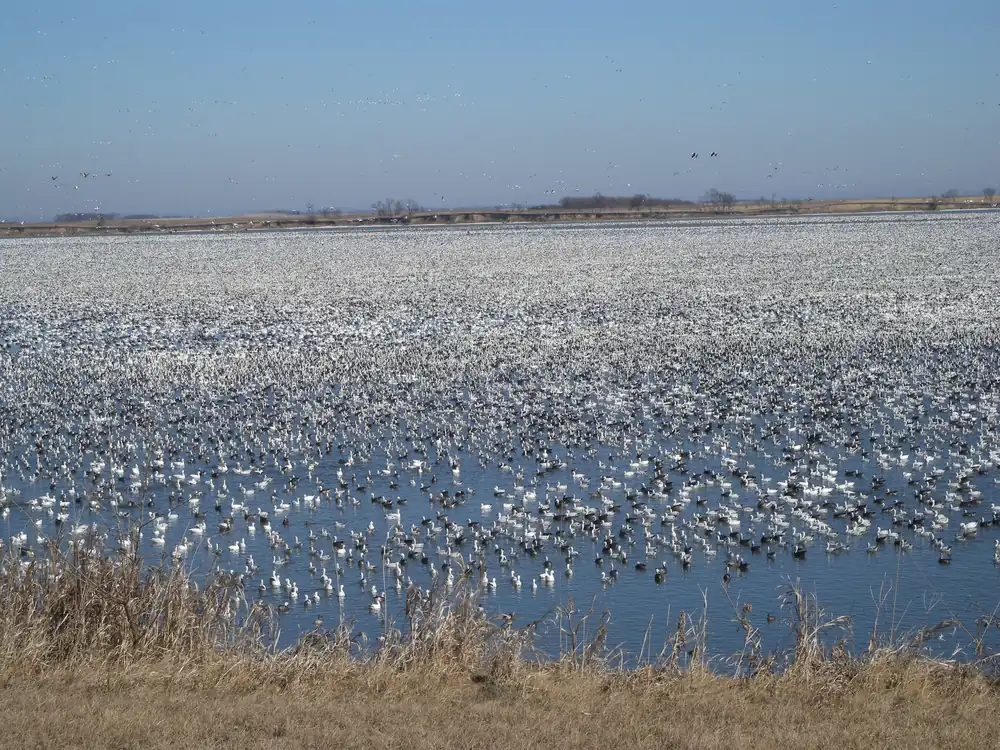
March is the month the North Dakota winter loosens its grip without ever quite letting go. Snow still lies over most of the state in the first week, and a blizzard in the last is not unusual, yet the signs of turning come one after another: the first Canada geese on open water, snow geese by the hundreds of thousands on the lakes of the southeast, western meadowlarks singing from fence posts, ground squirrels poking up from the short grass, and bald eagle eggs about to hatch. Sharp-tailed grouse begin to gather on their hilltop dancing grounds, prairie dogs mate in the badlands, and forecasters watch the snowpack and the Red River. Daylight grows by about 100 minutes between the first and last day of the month, the clocks move ahead on the 14th, the equinox arrives on the 20th, and the Worm Moon climbs into the eastern sky on the 21st. Here is where and when to look.
Other months in North Dakota: October, November, December, January, February, April.
Start here
- Count the first geese. Pick a gravel road near a refuge or lake and count the geese on your first warm afternoon of the second half of the month; write down the date, the species and the temperature.
- Listen for a meadowlark. The state bird returns between mid-March and early April. Stop where a fence post stands in open pasture and wait for the first song of the year.
- Watch the Worm Moon rise. Be outside after supper on Sunday, March 21, with a clear eastern horizon. The Moon rises nearly full that evening, and the exact full moment comes at 5:44 a.m. Central time on Monday.
In your Naturalist’s Field Journal for March, enter the first goose and meadowlark under “birds I have seen”, the first ground squirrel under “mammal watch”, and keep “nest observed” for any eagle nest you can see from a public road, with the date a bird is sitting low. Use “the same place twice” for a snowy pasture photographed on March 1 and March 31, “tracks to know” for prints in the melting snow, “a map of sounds” for the first grouse booming at dawn, and “dusk and dawn watch” for the hour around sunrise.
Regions used below: Red River Valley; Devils Lake and the Turtle Mountains; Drift Prairie and the James River valley; Missouri Coteau and Bismarck–Mandan; Lake Sakakawea and the northwest; Badlands and the southwest (Mountain time).
When do snow geese, Canada geese and ducks arrive in North Dakota in March?
March is when the sky over the eastern half of the state starts to fill. Game and Fish’s natural history calendar puts the spring flight of Canada geese and ducks from mid-March to mid-May, and snow geese from mid-March to mid-April. The timing is set by water, not by the date on the wall: the birds need open water to roost on and bare or thawing fields to eat from, so a cold, late spring holds them back and a quick melt brings them all at once.
-
Snow geese at Tewaukon and across the southeast
Mid-March to mid-April, depending on the thaw · Tewaukon National Wildlife Refuge in the southeast, and the wetlands and stubble fields of the Prairie Pothole country
A Prairie Public Dakota Datebook piece by Jack Dura describes snow geese reaching Lake Tewaukon in mid-March after a journey of more than 3,000 miles from Texas toward Nunavut, with flocks at times totaling over seven hundred thousand birds, a cloud of white swirling and swimming on the water. The Fish and Wildlife Service has photographed the same event: in 2016 the geese began arriving at the refuge on March 10 and built to a peak above 750,000. Those are big years, not promises, so treat them as the top of the range. A Grand Forks Herald column by a Game and Fish biologist adds that snow geese seldom move into the state before mid-March, and that Canada geese beat them by several weeks. Snow geese do not nest in North Dakota; the state is a corridor, and Game and Fish calls them abundant during migration. Look for the dark “blue” morph with its white head among the white birds, and for smaller Ross’s geese with stubbier bills.
The Fish and Wildlife Service says Tewaukon restricts visitor access during peak migration to protect the birds, so check with the refuge before driving out and watch from a pullout rather than walking toward a flock.
-
Canada geese and the first ducks
Mid-March through mid-May · Open water at river bends, spillways, sewage lagoons and the first thawed corners of sloughs
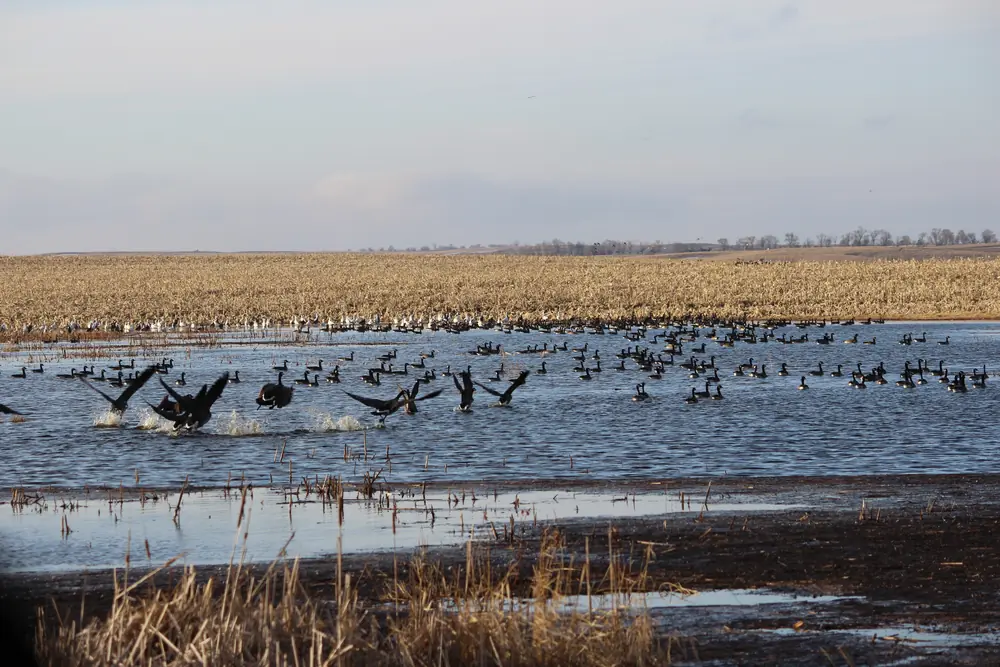
Canada geese come first. The same Herald column describes a Canada goose seen on February 7 in a recent year, weeks ahead of the snow geese, and the calendar puts the main spring flight of Canada geese and ducks from mid-March. Look for them wherever water is open: river stretches, spillways and the first thawed edge of a pothole. Each new pair is one more sign that the ice is giving way. Write down the date and the air temperature beside each first, and you will see how closely arrivals follow the thaw.
-
What comes next: swans and cranes
Tundra swans are common in spring; sandhill cranes begin in early April, with most through by the end of the month · Shallow wetlands, stubble fields and refuges such as Long Lake National Wildlife Refuge
Game and Fish describes the tundra swan as common in spring and fall migration and a non-breeder in North Dakota, a white bird with a black bill and a yellow spot before the eye, up to 85 inches across the wings. For sandhill cranes, a Game and Fish magazine story says the first wave arrives in early April and the bulk have passed through by the end of April. Hearing the rolling trill overhead is often the first sign. The Fish and Wildlife Service says Long Lake refuge is known for the calls of cranes carrying across its rolling prairie. If you see either bird in March, report it to eBird, because an early record is useful.
For when and where, the best habit is to watch the weather map. A run of days above freezing, with a south wind, is the signal. Compare your first-goose date with the frost table below, and keep the dates in your Naturalist’s Field Journal.
Where can you watch sharp-tailed grouse dance in North Dakota?
The grouse do not wait for April. Game and Fish’s calendar lists the sharp-tailed grouse breeding season as beginning in mid-March and running through mid-May, and the species pages describe the busiest stretch as lasting from late April into summer. In March, then, expect early, patchy displays on the hilltops where males gather year after year.
-
The lek on the hilltop
Dawn and dusk, from mid-March; busiest later in spring · Elevated, short-grass hilltops in native prairie, including refuge lands such as Upper Souris
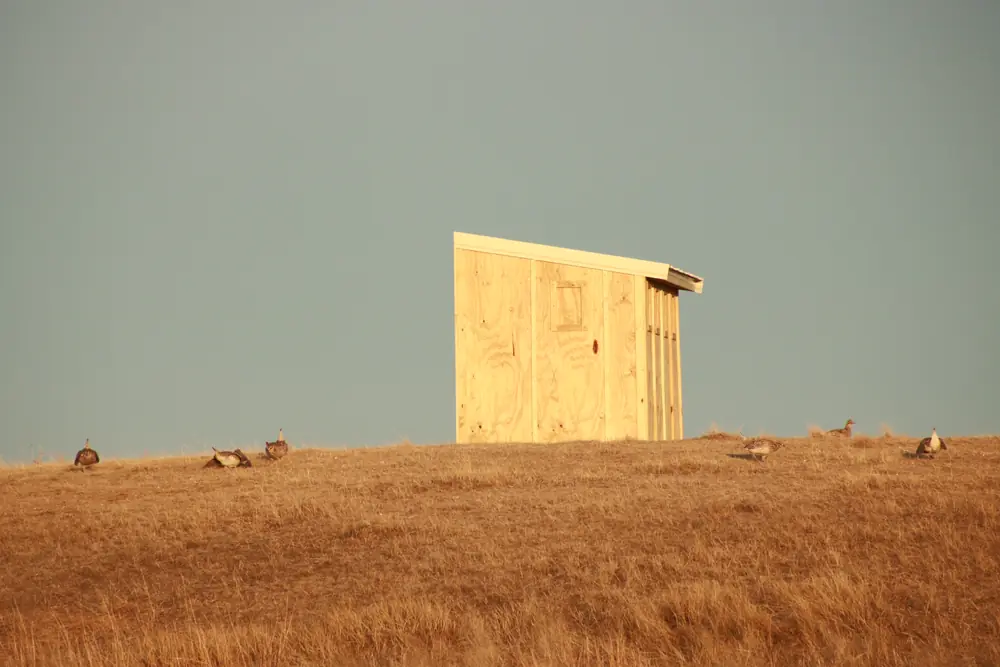
Game and Fish explains that a lek is a dancing ground, generally used year after year, and that the males choose places with low grass and an easy view of the surroundings so they can spot predators. The display marks territory and advertises the site to females. At Upper Souris National Wildlife Refuge, the refuge describes males with tails erect, wings spread and neck air sacs inflated, twisting and beating a rhythm on cold bare hilltops.
-
Using a blind
Refuge reservations by phone or email; dates and fees not yet posted for 2027 · Upper Souris National Wildlife Refuge, near Foxholm in north-central North Dakota
The refuge sets up viewing blinds near its leks and takes reservations on weekdays by phone at 701-468-5467 or by email to uppersouris@fws.gov. Each blind takes up to four people, fewer with a lot of camera gear. Arrive in the dark, stay quiet, and do not get out of the blind until the birds have left. No 2027 season window was posted when this page was written in October, so ask the refuge when blinds will open.
-
Greater prairie-chickens in the east
Peak display later, late April to June · The Red River Valley and the Sheyenne National Grassland
Game and Fish places the greater prairie-chicken’s main range in the Red River Valley and notes that it counts birds on leks in Grand Forks County and the Sheyenne National Grassland. Its hunting season is closed indefinitely and the population has fallen by more than half since 1970. March is early for the show, but this is the month to ask local birders where leks have been and to plan an April or May morning.
The ground the grouse use matters outside the season. Game and Fish’s grassland-bird guidance asks landowners not to mow or hay from April 15 to August 1, which protects hens on nests; if you walk pasture near a lek in spring, stay on the road.
Which birds are arriving or leaving North Dakota in March?
The turnover is quiet but quick. By the last week, the birds of the northern winter are going and the first singers of the plains are in the fence rows.
-
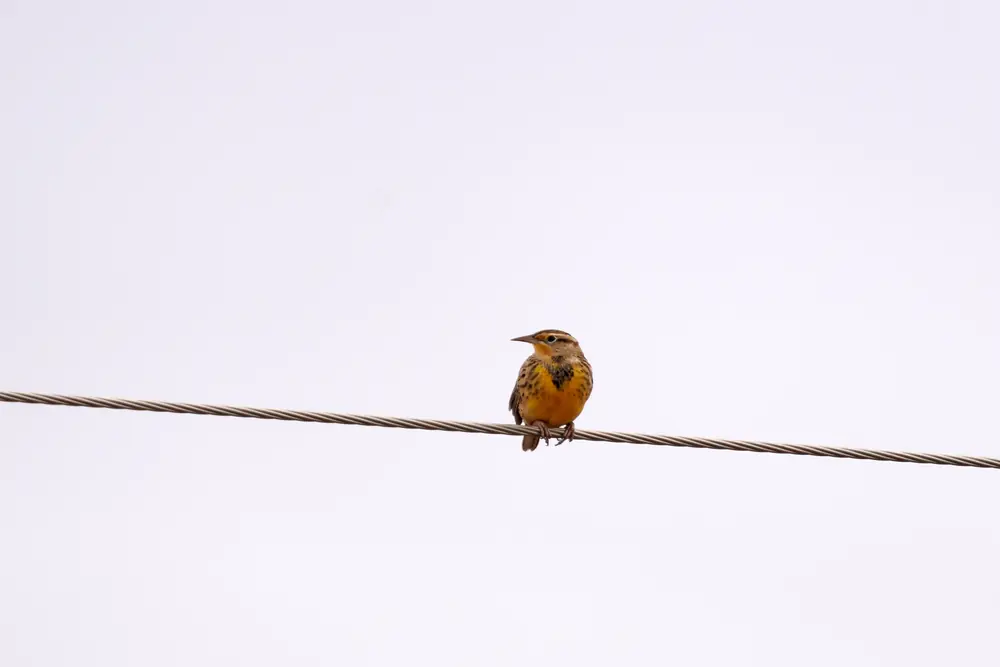
Western meadowlarks
Return from mid-March to early April · Fence lines, pastures and roadsides statewide
Game and Fish describes the western meadowlark, the state bird, as present in North Dakota mainly from March to early November, and its natural history calendar says meadowlarks return from mid-March to early April. The first one sings from a fence post, often on a day with snow still in the ditches. The bird is also in trouble: Game and Fish reports the population has dropped 42 percent since 1970, though North Dakota still holds 7.3 percent of the world’s breeding birds. Log your first song in eBird or Journey North.
-
Snow buntings heading north
Leaving from early March to early April · Open farm fields and gravel roads
The flocks that swirled up from the roadsides in winter thin out through the month. The calendar lists their departure as early March to early April, and Prairie Public reports that males go first and return to the breeding grounds around April, with females following. The same source says their numbers have fallen about 40 percent between 1970 and 2014. See how many flocks you can still find on March 1 and on March 31.
-
Bald eagles on eggs
Eggs are laid through mid-March; hatching late March to mid-April · Nests in big cottonwoods, shelterbelts and trees out in pastures, often miles from water
A Game and Fish magazine article counts nearly 350 active bald eagle nests in 47 of North Dakota’s 53 counties, up from a handful in the 1970s and 1980s. Eggs are laid from late February to mid-March and incubation lasts 30 to 35 days, so young hatch from late March into April. Some nests that have been used for more than fifteen years reach nine feet across, and a bird sitting low in one is incubating. The department advises staying far back, since a walker can make an eagle leave the eggs. Report nests with a bird present on the Game and Fish website.
-
Snowy owls on their way out
May be found until early May · Open fields, grain bins and fence posts in the north and east
Snowy owls overwinter in North Dakota, according to the calendar, and linger until early May. A pale bird on a power pole in March may be one of the last. Treat it as a guest: do not approach, and look from the car.
Which North Dakota animals wake up or have young in March?
Under the snow and beside the road, the small animals of the prairie return to the surface in March, males first.
-
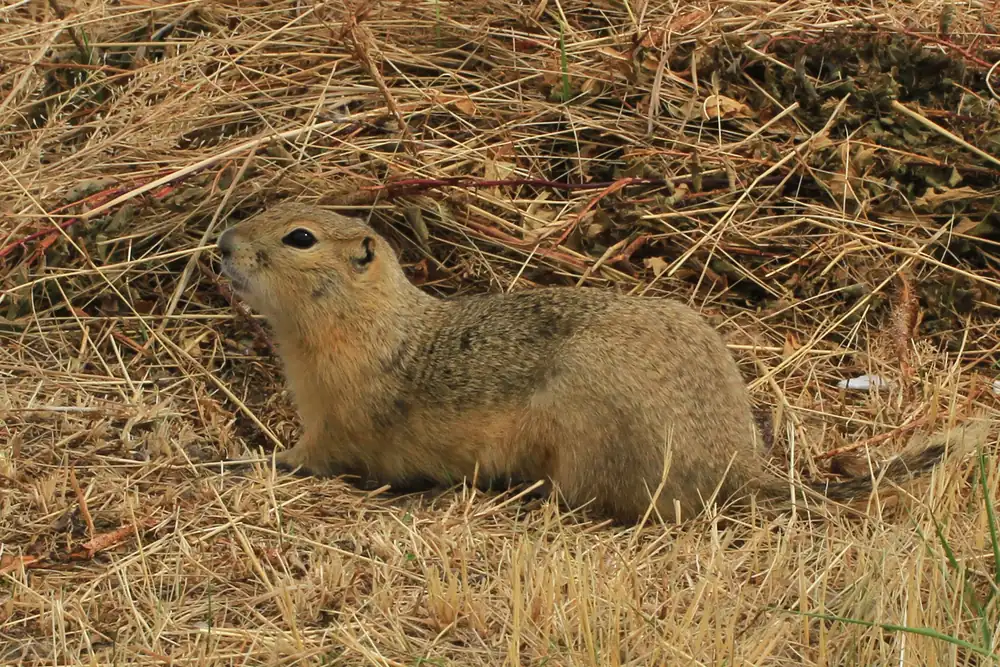
Richardson’s ground squirrels
Late March through early April, males first · Pastures, road edges and short-grass fields, mainly in the eastern half of the state
The Game and Fish natural history calendar lists the late-March emergence of Richardson’s ground squirrels, small ground-dwelling squirrels of short grass. The first ones to appear are males, and a lone squirrel on a patch of bare ground with snow all around can look like a mistake. Look in pastures and road edges, and stay on the road: burrow entrances are easy to step into.
-
Prairie dogs in Theodore Roosevelt National Park
Mating March through early April; pups emerge about six weeks after birth · Prairie dog towns beside the roads in the South Unit and North Unit
The National Park Service says black-tailed prairie dogs mate from March into early April, with a gestation of about a month and litters of one to six pups. The pups stay below until about six weeks of age, so the first youngsters are not seen until May. The park asks visitors not to feed prairie dogs, which can bite and may carry fleas that transmit plague, so watch from the pullout. Check road and weather conditions at the park before driving the Scenic Loop.
-
Young born underground
Badgers early March to late April; coyote pups early March to late May; red fox pups late February to late March · Dens in banks, coulees, and old burrows
The Game and Fish calendar lists badger young born from early March, coyote pups from early March, red fox pups through late March, and river otter young into early April. You are unlikely to see any of them. What you may find is a freshly dug mound, a well-worn den entrance, and tracks in the mud. If a den is near a trail, leave it undisturbed and keep dogs on a leash.
-
Frogs when the ice goes out
As soon as ponds open, usually April; rarely a warm spell in late March · Ponds, ditches and wooded pools; wood frogs only north and east of the Missouri River
A Prairie Public segment says frogs and toads call once the ice comes off ponds and marshes. The boreal chorus frog, statewide, sounds like a fingernail run down a comb; the wood frog, north and east of the Missouri, gives several repeated quacks; the northern leopard frog snores. Roads next to thawing ponds can be crossed by frogs and toads at night, so slow down.
What is the first wildflower to bloom in North Dakota?
The pasqueflower, called the prairie crocus, is the old answer. A Prairie Public Plains Folk essay quotes newspapers calling it the first flower of spring on the prairie, and reports it open in mid-April. Expect it on bare, south-facing slopes when the snow is gone, sometimes at the very end of March after a warm spell, and later in a cold year.
-
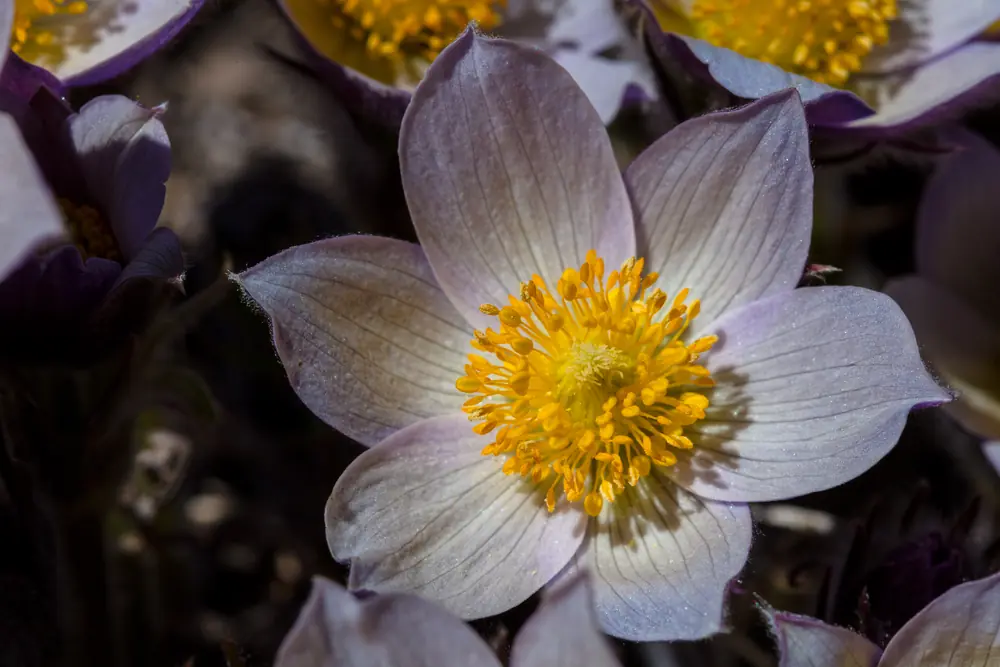
Pasqueflower
Usually April; a few early blooms are possible at the end of March · Dry, well-drained native prairie, hillsides and ridge tops with the snow gone
The pasqueflower is an anemone in the buttercup family, not a true crocus. NDSU Extension’s Dakota Gardener column notes that it spreads by rhizomes, where garden crocuses grow from corms. The flowers are purple with a yellow center. The name “pasque” links it to Easter, which falls on March 28 in 2027; in a cold spring the flowers can come well after the holiday. In Dakota the flower was hoksni cekpa, and the essay says elders stopped to reflect on finding the first one. Leave them where they grow, and photograph them instead.
-
Other signs of the thaw
Late March into April · Yards, town parks and shelterbelts
The Dakota Gardener column lists birds returning and singing, buds swelling on trees, the smell of thawed soil, bulbs coming up and the first crocuses. A tree or shrub is the better test for a backyard: pick one branch, tag it, and photograph it each week.
When does the snow melt, and will the Red River flood?
March is when winter’s snow either leaves gradually or leaves all at once. The National Weather Service in Grand Forks and Bismarck publish flood outlooks, and the Grand Forks office’s page for 2026 showed outlooks on January 22, February 12 and 26, and March 12. Dates for 2027 had not appeared yet, so look at weather.gov/fgf in January. The outlooks weigh snow water, soil moisture, frost depth and river ice.
-
Why a snowy March matters
Snowfall and the pace of melt through March and April · The Red River Valley and the Devils Lake basin
The Red River Valley is flat and drains slowly, so the pace of melt matters as much as the depth of snow. A 2023 news report, not an official climate summary, noted that Fargo’s March snowfall, 21.1 inches by March 23, was then the third highest on record, behind 1997 (26.2 inches) and 2009 (28.1 inches). The 2009 flood crested at a record 40.84 feet at Fargo and 1997 at 39.72, and the same article gives 30 feet as the start of major flooding. The 2023 snow, though, held only 1.7 inches of precipitation, light beside the 4.62 inches of March 2009, the wettest March on record. These are examples, not forecasts: some Marches bring floods and others do not.
-
Ice jams and the Missouri side
Break-up in March or April · Little Missouri, Yellowstone and Missouri rivers, and the James River
The Bismarck office issues outlooks for the Missouri and James basins too; the 2025 edition covered March 15 to June 13. That year the Little Missouri was running enough to raise the risk of ice jams, while snow was below normal and dry soils soaked up the melt, putting the chance of minor flooding on the Missouri at Williston at 6 percent, against a historical 42 percent. Water backing up behind a jam can rise quickly, so stay off river ice and out of floodwater.
-
When the lakes open
Ice weakens fast from late March; ice-out dates vary by lake and year · Devils Lake, Lake Sakakawea and small prairie lakes
Game and Fish warns that snow acts like a blanket on ice, hiding cracks and weak spots, and that daily swings in temperature open cracks and pressure ridges. Late March has a following: a Grand Forks Herald story about Devils Lake notes that mild afternoons make late-March ice fishing easier and that anglers are told to check the ice near bridges and culverts. Game and Fish’s published thicknesses: four inches to walk, six for a snowmobile or ATV, eight to twelve for a car or small pickup. The 2026 to 2028 fishing regulations ask anglers to take their shelters off the water before midnight on March 15 (an empty one may not stay until ice-out), and darkhouse spearing ends the same day.
How cold and snowy is March in North Dakota?
March here is a month of swings. The 1991 to 2020 NOAA normals put average highs in the 30s and low 40s, but the average low is still near or below 20, and each airport below still has an inch or more of snow on the ground for roughly two weeks or more of the month. A mild afternoon can be followed by a blizzard; the same wind that melts south-facing drifts can drive fires across dry grass.
| Station | Average high / low | Average snowfall | Days with a low below 0 °F | Days with 1 inch or more on the ground |
|---|---|---|---|---|
| Grand Forks (Red River Valley) | 33.9 / 15.0 °F | 7.4 in | 5.0 | 19.0 |
| Fargo (Red River Valley) | 36.3 / 18.1 °F | 9.2 in | 3.5 | 17.9 |
| Williston (northwest) | 40.1 / 17.5 °F | 6.4 in | 4.1 | 14.5 |
| Minot (north central) | 39.5 / 19.0 °F | 6.1 in | 3.6 | 15.5 |
| Bismarck (Missouri River) | 41.0 / 19.1 °F | 8.5 in | 3.0 | 12.7 |
Hazards. Late-season blizzards, ground blizzards, flooding from fast melt, and grass fires on days with dry fuel, low humidity and strong wind are the main ones. The state’s fire-danger and burn-restriction map is at burnrestrictions.nd.gov, and the state asks people to check it before burning or doing outdoor work that could throw sparks. Spring load restrictions on highways usually start in the southwest and spread east as the ground thaws, according to the Department of Transportation, which posts them on its travel map and by calling 511. The Climate Prediction Center issues the 90-day outlook once a month near mid-month, so see its outlook page for the latest. For local stations, see our weather page.
How much daylight does North Dakota gain in March, and when do the clocks change?
The clocks go forward at 2 a.m. local time on Sunday, March 14, and from that morning sunrise and sunset read an hour later on the dial. The table gives day lengths, which the clock change does not touch. The state is mostly on Central time, with the southwest corner, Dickinson included, on Mountain time; the equinox, the Sun over the equator, falls on Saturday, March 20, at 3:25 p.m. Central (2:25 p.m. Mountain) daylight time. See also our daylight page.
| City | Mar 1 | Mar 31 | Gained | Per day |
|---|---|---|---|---|
| Fargo | 11 h 06 m | 12 h 46 m | 100 min | 3.3 min |
| Grand Forks | 11 h 03 m | 12 h 48 m | 105 min | 3.5 min |
| Jamestown | 11 h 05 m | 12 h 47 m | 102 min | 3.4 min |
| Devils Lake | 11 h 03 m | 12 h 48 m | 105 min | 3.5 min |
| Bismarck | 11 h 06 m | 12 h 46 m | 100 min | 3.3 min |
| Minot | 11 h 02 m | 12 h 48 m | 106 min | 3.5 min |
| Williston | 11 h 03 m | 12 h 48 m | 105 min | 3.5 min |
| Dickinson | 11 h 06 m | 12 h 46 m | 100 min | 3.3 min |
When is the last spring freeze in North Dakota?
Gardeners and early planters want to know when the last 32 °F night will come. The table below uses NOAA’s 1991 to 2020 normals, one main station per place. It shows how far off spring still is: at every station listed, the median last freeze falls in May, and at the coolest it comes after the middle of the month. Check the frost dates for your town, and treat any warm March stretch with suspicion.
| Station | One year in ten | Median | Nine years in ten |
|---|---|---|---|
| Fargo Hector International Airport | Apr 27 | May 10 | May 23 |
| Grand Forks International Airport | May 3 | May 16 | May 31 |
| Devils Lake Kdlr (Lake Region) | Apr 23 | May 6 | May 19 |
| Jamestown Municipal Airport (James River valley) | Apr 28 | May 11 | May 24 |
| Bismarck | May 1 | May 14 | May 27 |
| Minot International Airport | Apr 27 | May 10 | May 22 |
| Williston Sloulin International Airport | May 8 | May 21 | Jun 3 |
| Theodore Roosevelt Airport (Dickinson) | May 6 | May 18 | May 31 |
| Hettinger Experiment Station (southwest) | May 10 | May 21 | Jun 5 |
What can you see in the North Dakota night sky in March?
Times below are Central unless stated. Daylight time starts March 14, so the new moon on March 8 is in standard time and the later phases in daylight time. For the southwest corner, Mountain time is an hour earlier.
-
The Worm Moon
Full at 5:44 a.m. CDT on Monday, March 22 · Anywhere with an open eastern horizon
The Worm Moon is the full moon of March, named for ground that softens and earthworms that surface in the thaw. Because the full moment falls before sunrise, the best view is the evening of Sunday, March 21, as the Moon rises in the east around sunset, and again on the 22nd.
-
Venus and Mercury before dawn
Mercury is best from about March 8 to 25; greatest elongation comes late on March 16 Central time · Low in the east-southeast before sunrise
Venus is a brilliant morning star in March. Mercury is at its greatest western elongation, about 28 degrees from the Sun, late on March 16 Central time, but in spring mornings the angle to the horizon is shallow. Look low in the east-southeast, well below Venus, in the hour before sunrise, from a spot with a flat horizon. A slim waning crescent Moon hangs near Venus on March 4 and 5 before dawn.
-
Jupiter and Mars in the evening
Moon beside Jupiter on March 18 and 19; Mars and Jupiter 4 degrees apart on March 30 · High in the south and southeast after dark
Jupiter and Mars are both up for most of the night in March, and high in the south by mid-evening. The Moon passes about one degree from Jupiter around March 19, when it is 88 percent lit, and our own figures put Mars about 4.3 degrees from Jupiter that evening, a gap an outstretched fist can cover.
-
Aurora near the equinox
Any clear, dark night; statistically active around the equinoxes · Northern horizon from dark sites away from town lights
The Sun is past its peak but strong storms are still possible, and geomagnetic storms are statistically more common around the March and September equinoxes. No agency forecasts them months ahead. Check NOAA’s Space Weather Prediction Center aurora forecast on any clear night; North Dakota’s northern latitude gives it a good chance.
| Phase | Date | Time |
|---|---|---|
| New moon | Monday, Mar 8 | 3:29 a.m. CST (2:29 a.m. MST) |
| First quarter | Monday, Mar 15 | 11:25 a.m. CDT (10:25 a.m. MDT) |
| Full moon, the Worm Moon | Monday, Mar 22 | 5:44 a.m. CDT (4:44 a.m. MDT) |
| Last quarter | Monday, Mar 29 | 7:54 p.m. CDT (6:54 p.m. MDT) |
| New moon | Tuesday, Apr 6 | 6:51 p.m. CDT (5:51 p.m. MDT) |
For the phases and sunrise tables, see our moon phases page and the cloud-spotting page for judging tomorrow’s weather from the sky.
What can North Dakota families do outdoors in March 2027?
This list dates from early October 2026. State Parks and Recreation’s events page showed nothing past January 2027 then, so none of the recurring events below has a date; check with the organizer.
- Sunday, March 14: set the clocks ahead and take the extra evening light for a walk to the nearest pond to look for the first open water.
- Saturday, March 20: equinox day. Measure the length of a shadow at noon, and again on June 21.
- Sunday, March 21: Worm Moon evening. Watch the Moon rise in the east after supper.
- Goose watch. Late in March, choose a warm afternoon, cruise a gravel road beside a refuge or large lake, and tally the flocks with their dates.
- Join a count. Project FeederWatch continues until April 30. NestWatch, from the Cornell Lab, is the place to log nests once birds start building. Journey North collects spring sightings, and iNaturalist or eBird can hold your first meadowlark, goose, frog and flower.
- Grouse blinds. If a morning at Upper Souris appeals, call the refuge about its 2027 blind season well ahead; it fills quickly.
Every state is on our nature hub, and last month’s page is February in North Dakota. Keep dates in a Naturalist’s Field Journal.
Safety notes for March in North Dakota
- Open seasons. Under the 2026–27 proclamation, the bobcat and weasel seasons and the cable-device season for coyote and fox close on March 15, 2027. The late mountain lion season in Zone 1 lasts to March 31. Mink and muskrat seasons continue to May 10, and night hunting for fox and coyote to May 31, while daytime hunting of both is open all year.
- Spring light geese. The 2026 conservation order ran February 21 to May 10. The 2027 dates had not been announced, so check the Game and Fish regulations page. Expect shotguns near flocks and fields.
- Spring turkey. The 2026 season ran April 11 to May 17 and was a lottery. The 2027 season had not been announced; read the Game and Fish turkey page.
- Orange. North Dakota’s fluorescent orange rules are tied to the deer and other big game seasons, none of which is open in March, and the small game and furbearer rules list no orange requirement. Hunters you meet in March may therefore be in camouflage, so wear something bright and check the current proclamation for the season you are near.
- Ice. Stay off ice that is under four inches, snow-covered or cracked, near inflows and bridges, or in a vehicle. Empty shelters must be gone by midnight March 15.
- Water. Never drive through floodwater, and stay away from swollen creeks and ice jams.
- Fire. Check burnrestrictions.nd.gov before burning and keep vehicles off dry grass.
- Roads. Blizzards can follow a mild day. Look at the state travel map, carry blankets, food and a shovel, and stay in the car if stuck.
- Wildlife. Do not feed prairie dogs, approach eagle nests or dens, or move geese off a roost.
Sources (46)
- North Dakota Game and Fish: natural history calendar, March
- North Dakota Game and Fish: lesser snow goose and Ross’s goose
- North Dakota Game and Fish: tundra swan
- North Dakota Game and Fish magazine: Stopover State (sandhill cranes)
- North Dakota Game and Fish: sharp-tailed grouse dancing grounds
- North Dakota Game and Fish: sharp-tailed grouse
- North Dakota Game and Fish: greater prairie-chicken
- North Dakota Game and Fish: western meadowlark
- North Dakota Game and Fish magazine: Soaring Out of Obscurity (bald eagles)
- Prairie Public, Natural North Dakota: Snow buntings, winter visitors from the far north
- Prairie Public, Natural North Dakota: Frog and toad spring concerts
- Prairie Public, Plains Folk: The Pasque
- Prairie Public, Dakota Datebook: Snow geese at Tewaukon
- Grand Forks Herald: Doug Leier on North Dakota’s spring snow goose season (2023)
- Grand Forks Herald: Late March traditionally ushers in good fishing on Devils Lake
- NDSU Extension, Dakota Gardener: Signs of spring
- U.S. Fish and Wildlife Service: Tewaukon National Wildlife Refuge
- U.S. Fish and Wildlife Service: Upper Souris National Wildlife Refuge
- U.S. Fish and Wildlife Service: Upper Souris, dancing sharp-tailed grouse
- U.S. Fish and Wildlife Service: Long Lake National Wildlife Refuge
- National Park Service, Theodore Roosevelt National Park: prairie dogs
- National Park Service, Theodore Roosevelt National Park: current conditions
- NWS Grand Forks: current flood outlook
- NWS Grand Forks: flood outlook archive
- NWS Bismarck: spring flood and water resources outlook, Missouri River basin
- NWS Bismarck: probabilistic hydrologic outlook, February 27, 2025
- Forum News Service (InForum): a snowy March, the third highest on record in Fargo
- NOAA NCEI: U.S. climate normals 1991–2020
- NOAA Climate Prediction Center: 90-day outlooks
- North Dakota Department of Transportation: seasonal load restrictions
- North Dakota Response: burn restrictions and fire danger
- North Dakota Game and Fish: ice safety
- North Dakota Game and Fish: 2026–28 fishing regulations
- North Dakota Game and Fish: hunting season dates
- North Dakota Game and Fish: small game, waterfowl and furbearer regulations
- North Dakota Game and Fish: spring light goose season, 2026
- North Dakota Game and Fish: spring turkey
- North Dakota Parks and Recreation: events
- Project FeederWatch: how to participate
- Cornell Lab of Ornithology: NestWatch
- Journey North
- iNaturalist
- NOAA Space Weather Prediction Center: aurora 30-minute forecast
- U.S. Naval Observatory: moon phases
- U.S. Naval Observatory: Earth’s seasons
- Photos via Wikimedia Commons; licenses and photographers are listed with each file
.jpg)