What to look for in nature in Ohio this April
April is the month Ohio changes fastest. Hawks and ospreys ride southwest winds along Lake Erie, the first warblers reach the pines and sycamores, ruby-throated hummingbirds and tree swallows return, and woodland floors from Hocking Hills to Cuyahoga Valley fill with bluebells, trilliums and bloodroot. American toads trill from every shallow pond, gray treefrogs begin near the end of the month, and white bass follow the walleye up the Maumee. The sky adds the Pink Moon on Tuesday the 20th and a Lyrid shower muddied by moonlight on the night of the 22nd, and Arbor Day falls on Friday the 30th. It is also a month of sudden swings, with hail, wind and flooding rain, and frost that can still catch early blooms.
Other months in Ohio: October, November, December, January, February, March.
Start here
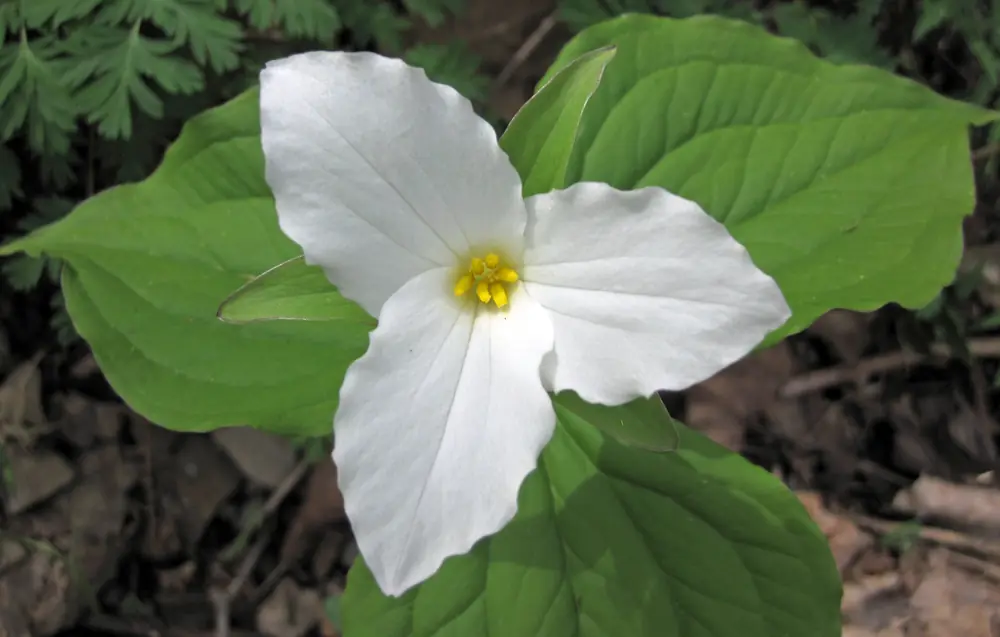
- Walk a floodplain trail for bluebells. Pick a sunny day late in the month and follow a river or creek path in a metropark or Cuyahoga Valley National Park and look for blue-pink bells over broad green leaves, with spring beauty, bloodroot and trout lily beside them. Keep to the path and leave the blooms in the ground.
- Count hawks on a southwest-wind day. Climb the lookout hill at Maumee Bay State Park, or any open rise near Lake Erie, when the wind blows from the southwest. Late in the month the lake shore fills with broad-winged hawks, ospreys and small hawks that hunt songbirds.
- Listen after a warm rain. Walk a wetland edge at dusk and learn two sounds: the long, even trill of the American toad and, in the last week or so, the short musical trill of the gray treefrog. Add each date to your own record.
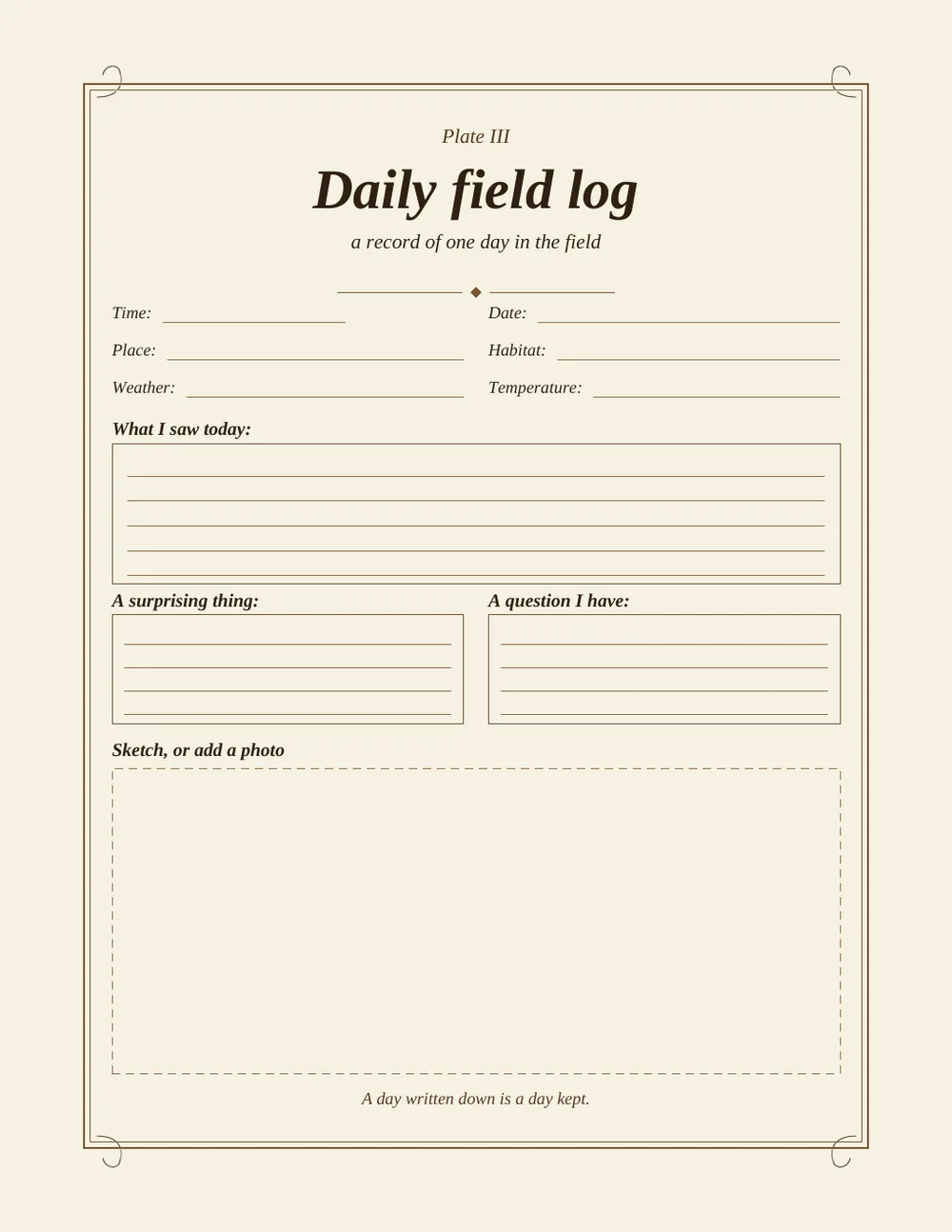
Plates for April in the Naturalist’s Field Journal: the first warblers and swallows on birds I have seen, toad and treefrog trills on a map of sounds, a redbud or buckeye from bud to leaf for the tree through the seasons, plus a hawk count from a lookout on the daily field log. A creek-side bluebell patch visited in March and again now suits the same place twice plate.
Regions used below: Northwest and Lake Erie; Northeast and Cleveland; Central Ohio; Southwest and Cincinnati; Southeast and the Hocking Hills.
Which birds arrive in Ohio in April, and what comes first?
The Black Swamp Bird Observatory’s timeline for the Lake Erie shore describes two halves. Early in the month waterfowl migration is still heavy but fading, raptors keep moving, and flickers, thrushes and sparrows pass north with a few early warblers. From about the 16th the big arrivals begin, and by month’s end Palm, Black-and-white, Nashville and Black-throated Green warblers are numerous. The Ohio Ornithological Society’s April almanac puts the busiest stretch of the whole spring from the last ten days of April through the first twenty of May, so April is the warm-up: a month for first-of-year birds with fewer crowds than May.
-
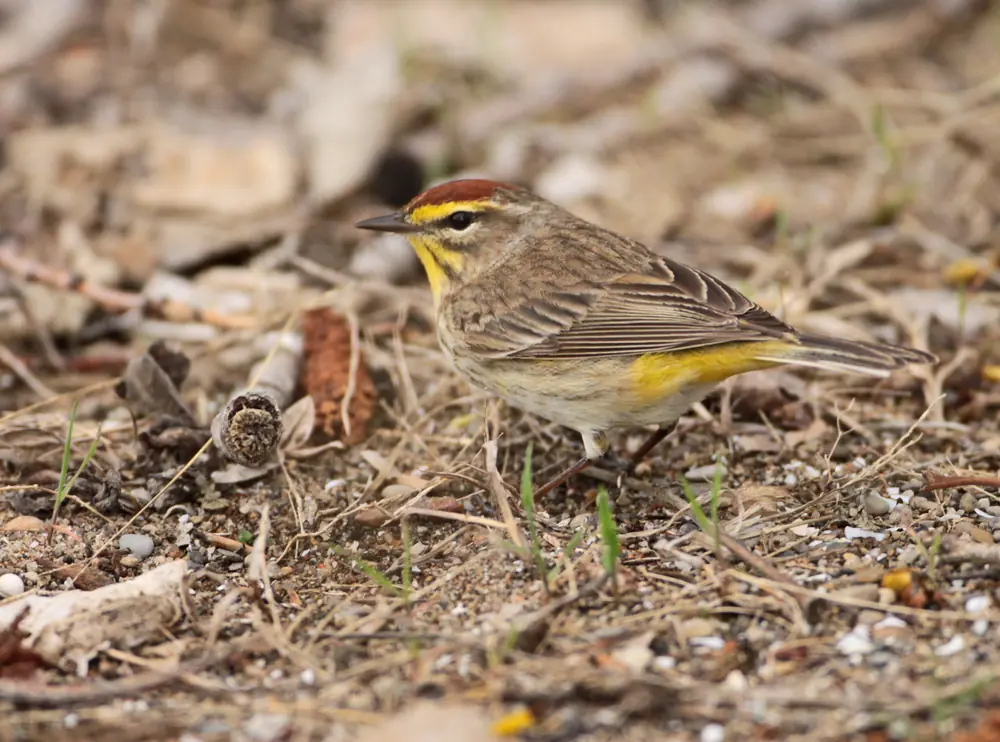
Pine warblers and the early singers
Pine warblers around the first weekend of April, according to the National Park Service; palm, black-and-white, Nashville and black-throated green warblers building through the second half · Kendall Lake in Cuyahoga Valley National Park; pines, wood edges and shoreline thickets elsewhere
The park lists the pine warbler’s return to Kendall Lake as an early-April event, well before most warblers. Pine warblers are the ones that sing a steady trill from pine tops. The Ohio Ornithological Society adds that the first warblers in decent numbers can arrive as early as mid-April, and that southern Ohio counties see them earliest.
-
Cerulean and yellow-throated warblers in the sycamores
Later in April, in the park’s calendar · High sycamores along the Towpath Trail near the Station Road Bridge
These two are canopy birds, so bring binoculars and look straight up at the white upper limbs of the riverside sycamores. Inland river valleys carry migrants too, so this is not only a lakeshore event.
-
Thrushes, kinglets, gnatcatchers and sparrows
Hermit thrushes, winter wrens and yellow-rumped warblers early; ruby-crowned kinglets, blue-gray gnatcatchers, swamp sparrows and white-throated sparrows toward the end of the month · Leaf litter, brushy edges and thickets near water
The observatory’s timeline names these as the ones that fill the gap before the warbler wave. Watch for the ruby-crowned kinglet’s flitting, nervous wing flicks and listen for the white-throated sparrow’s thin, whistled song. Late April is also when herons, egrets, rails and ospreys increase in the marshes.
Put the first date for each species on your birds-I-have-seen page, and keep an eye on the weather page: southerly winds on a warm evening tend to bring new birds the next morning.
What can you see on the Lake Erie shore and the Maumee River in April?
The Ohio Ornithological Society’s guide to Ottawa National Wildlife Refuge calls spring an excellent season there, naming ducks, snowy egrets, little blue herons, bald eagles, migrating raptors and marsh birds, and the refuge’s own page says late April through mid-May is the best stretch for migratory birds. The Biggest Week in American Birding, the observatory’s ten-day festival, is scheduled for May 7 to 16, 2027, so April is the quieter month to learn the marshes.
-
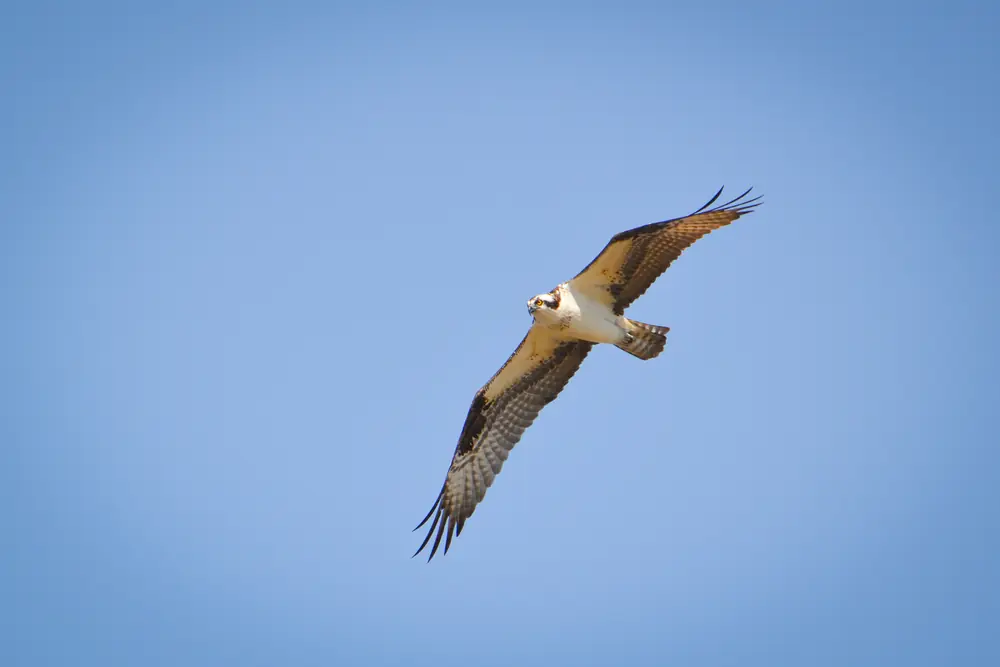
Hawks on a southwest wind at Maumee Bay
Late April for broad-winged hawks; ospreys and sharp-shinned hawks building through the month · The sledding-hill lookout, the swamp-forest boardwalk and the shrubby thickets at Maumee Bay State Park
The Ohio Ornithological Society’s guide says hawks move when the wind blows from the southwest, and that large numbers of broad-winged hawks can be seen in late April. The boardwalk runs about a mile through swamp forest, and the park can host over thirty warbler species in late April and May.
-
Ducks, egrets and eagles at Ottawa National Wildlife Refuge
April and early May, with the main songbird push from the last week of April · The Crane Creek estuary and the impoundments reached by the main trail from the parking lot
The estuary is the refuge’s best place for adult and immature bald eagles, and the main path north from the lot overlooks impoundments full of waterfowl and wading birds. The seven-mile Wildlife Drive opens on specified weekend dates in April and every Saturday and Sunday from May 1, according to the refuge; its page named only April 25 and 26 and showed no 2027 schedule yet, so confirm at fws.gov/refuge/ottawa.
-
The white bass run on the Maumee
Fish begin to show in numbers around the third week of April, stay into early June and usually peak in the first or second week of May, per a Midwest Outdoors column · The Maumee River near Perrysburg and Toledo; the Sandusky and Portage rivers draw smaller runs
A bait-shop owner quoted in the column puts a typical white bass at 12 to 14 inches, with schools of fifty or more once you find one. Walleyes spawn before the white bass and may linger early in the run. Special rules apply on the Maumee, Portage, Mahoning and Sandusky rivers, so check the current regulations for your stretch.
One date matters on Lake Erie: ODNR’s current daily limits (walleye six at 15 inches, yellow perch thirty, ten or twenty by zone) run through April 30, 2027, so look up the new limits before May 1. Mud at the water’s edge holds fresh prints, so bring the tracks to know plate.
When do hummingbirds, swallows and wild turkeys show up around Ohio yards?
Spring in the yard starts earlier than the calendar suggests, and April brings feeders, nest boxes and wood edges to life.
-
Ruby-throated hummingbirds
The first males can turn up in central and southern Ohio in the first half of April; a Cleveland television station expected them in northern Ohio by late April and early May · Feeders and flower beds
A News 5 Cleveland weather feature on one spring’s arrivals reported first sightings near Columbus and Dayton between March 31 and April 8, and advised having feeders out by May 1 in the north. Journey North maps the migration from sightings anyone can report. Its recipe is sugar and water at a ratio of one to four, with feeders cleaned and refilled about every five days in hot weather.
-
Tree swallows, ospreys and the first herons
Tree swallows arrive early; other swallows and ospreys follow from mid-month, according to the Ohio Ornithological Society’s almanac · Open water, ponds and wetlands with dead trees or nest boxes
Tree swallows are the first of the swallows to return, with barn, cliff and purple martin arrivals following. Watch for glossy blue-green backs above ponds and for the long, slow wing beats of a returning osprey over a lake.
-
Wild turkeys gobbling
Peak gobbling lines up with peak nest starts, according to Division of Wildlife research, and it varies from day to day · Woodland edges and fields at dawn, in all 88 counties
Turkeys were gone from Ohio by about 1904. The Division of Wildlife began reintroducing them in the 1950s, and by 1999 they lived in all 88 counties. Biologists recorded gobbles in eastern Ohio in 2024 and 2025 and found that daily gobbling varied considerably, with peaks matching the weeks when hens began nesting and laying. A tom displaying in a roadside field is a good reason to slow down.
Spring turkey hunters are afield at dawn on public land in the second half of April; see the safety notes below.
Which frogs and toads are calling in Ohio in April?
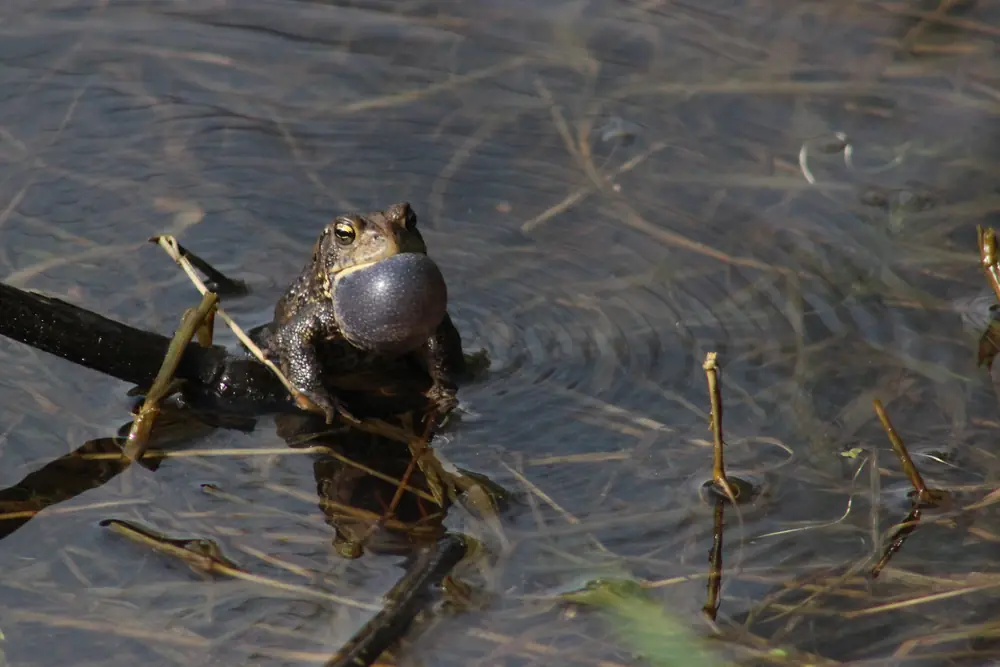
Spring peepers and wood frogs began weeks ago. April brings the long trills and the later species. A guide from Kenyon College’s Brown Family Environmental Center, partly adapted from ODNR material, gives the order: peepers first, American toads breeding from late March, leopard frogs from March through May, gray treefrogs in late April or early May, and green frogs and bullfrogs not until late May. Cuyahoga Valley has nine kinds of frogs and toads, according to the park service.
-
American toads, the long trillers
Breeding starts in late March; April is the busiest month · Shallow ponds, ditches, flooded fields and garden pools
The Kenyon guide says a female lays up to 20,000 eggs in double strands, and that pea-sized young appear along the pond edge about four weeks later. Males call at dusk and at night with a steady, high trill that lasts many seconds.
-
Northern leopard frogs
Breeding from March through May · Lake edges, marshes, wet meadows and flooded fields
The guide compares the male’s call to a thumb rubbed over a balloon, and says leopard frogs sing even while submerged. Stand still at the edge of a flooded field on a warm evening and listen for a sound unlike the toads’ steady trill.
-
Gray treefrogs, as the month ends
Late April or early May, when males begin to call and head for small ponds and wet ditches · Trees and shrubs beside small ponds and roadside ditches
These frogs change from green to gray and have round toe pads for climbing, so they are heard far more often than seen. Their tadpoles have a red or orange cast to the tail and become frogs in six to nine weeks.
If you want to give your listening a purpose, FrogWatch USA is a national program run in Ohio by the Akron Zoo’s chapter, where volunteers who complete training submit evening listening records between February and August; ask the chapter about the 2027 training schedule. Add each species to your map of sounds.
Which Ohio wildflowers peak in April, and where can you see them?
The Division of Natural Areas and Preserves posts an Ohio Spring Wildflower Bloom Report every Friday, sorted into North, Central and South. For 2026, ODNR’s advice was that by mid-April dozens of species, among them spring beauty, bloodroot, squirrel-corn, Virginia bluebells and trout lily, could be near peak, while Jack-in-the-pulpit, wild geranium and Solomon’s plume would wait until early May. North and south bloom several weeks apart, so the Friday report for your region beats any calendar. A warm spring can pull the whole show forward, and a cold one delays it.
-
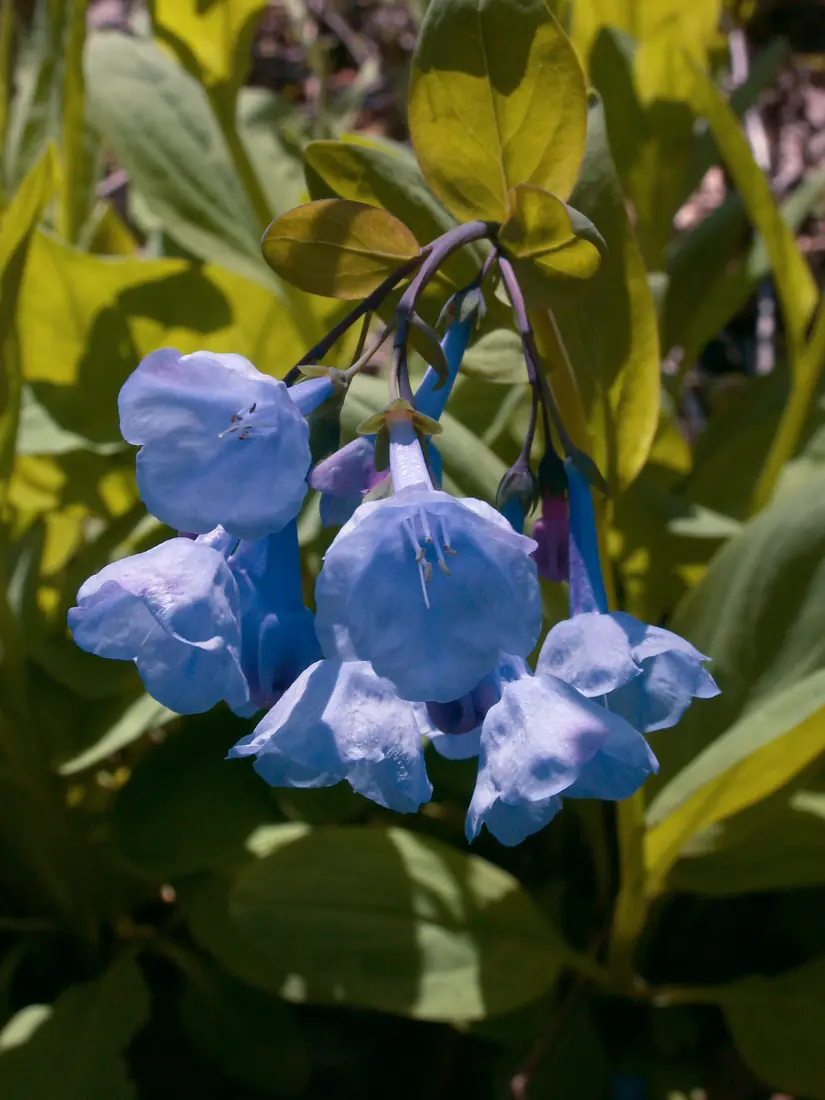
Virginia bluebells
ODNR’s 2026 guidance put the peak around mid-April; the Friday reports show when they open in your region · The Hemlock Loop Trail in Bedford Reservation, and the trail between Willow Bend and Berea Falls in Rocky River Reservation, according to Cleveland Metroparks; riverside forests in Cuyahoga Valley National Park
Cleveland Metroparks calls the Rocky River path between Willow Bend and Berea Falls a hotspot, a two-mile round trip that also reaches the falls. Bluebells are floodplain flowers, so look where a river or creek spreads over low forest.
-
Trilliums, twinleaf and trout lily
April, with northern preserves behind southern ones by several weeks, ODNR says · The Wildflower Loop Trail in Brecksville Reservation; the Scenic Loop Trail in North Chagrin Reservation; the Sulphur Springs Loop in South Chagrin Reservation
Metroparks names Brecksville for trillium, twinleaf and trout lily, North Chagrin for large-flowered trillium and hepatica, and South Chagrin for blue cohosh and sessile trillium. Southern Ohio preserves and the Hocking Hills reach the same stage earlier.
-
Marsh marigold, spring beauty and bloodroot on the Towpath
April, according to the park · Lowland forests along the Cuyahoga River; the park’s best stretches are Hunt House to Botzum and Station Road Bridge to Pinery Narrows
Cuyahoga Valley calls April a wonderful time to explore the lowland forests along the river, with marsh marigolds, spring beauty, Virginia bluebells and bloodroot. The park protects every wildflower strictly, so look and photograph but do not pick.
-
Waterfalls and wildflowers in the Hocking Hills
Waterfalls at their heaviest from April into early May; wildflowers from late April, per a local tourism guide · Cedar Falls and Ash Cave, with ODNR’s free guided Wildflowers and Waterfalls hikes during peak bloom week
The Hocking Hills guide says to go within a day or two after heavy rain for the most water, and to wear waterproof boots because the sandstone is wet. It adds that ODNR hosts free guided Wildflowers and Waterfalls hikes in peak bloom week; the 2027 dates had not been announced at the time of writing, so ask the park.
Many flowers close on gray, wet days, so choose a sunny afternoon, and sketch what you find on the reading-the-signs page instead of collecting it. Our March page covers the flowers that open before these.
How quickly do Ohio’s trees flower and leaf out in April, and what about morels?
Eastern redbud is one of the first trees to bloom each spring, an Ohio State University Extension article says, and Ohio State’s phenology calendar ties redbud first bloom to 191 growing degree days, a running tally of warmth rather than a date. That is why the same tree can flower weeks apart in different years. The State Climate Office of Ohio gave a striking example: April 2026 ran 4 to 8 °F above normal across much of the state and was the warmest April in the 132-year record. It warned that this false summer starts plants early and leaves new buds exposed to a later cold snap.
-
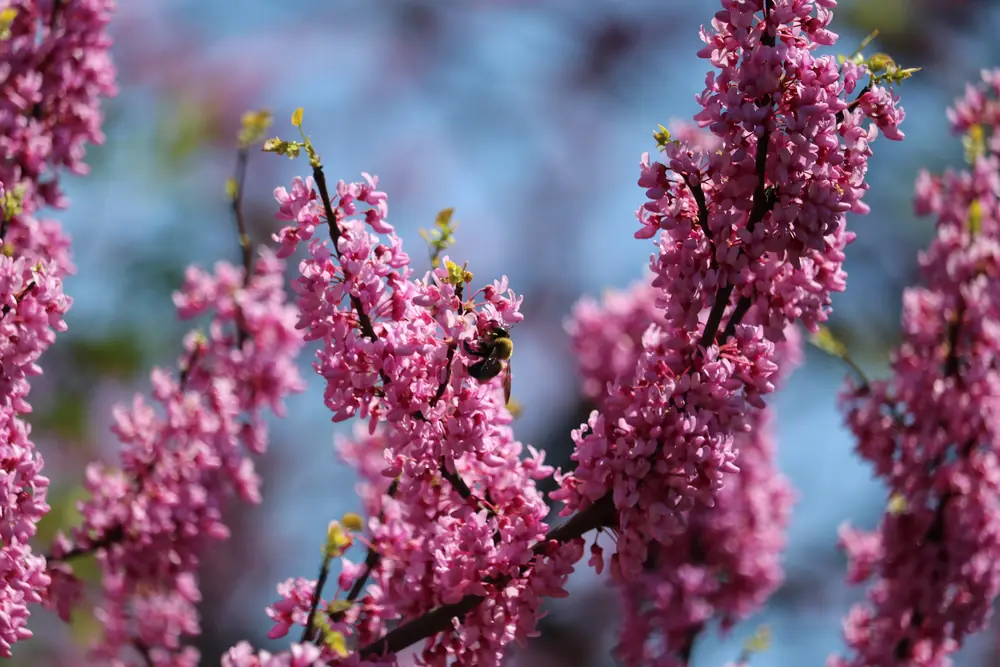
Redbud and flowering dogwood
Redbud first; dogwood follows, with timing set by the season’s warmth · Woodland edges, hillsides, yards and roadsides, from the Ohio River counties northward
OSU Extension describes redbud as growing in forest understory but blooming more densely in more sun, and recommends planting native trees from a local source. Look for the pink-purple haze before the leaves come, then for the flat white bracts of dogwood a little later. Add each tree’s first-bloom date to your own page.
-
A warm month can run ahead of the frost
Any April; check the median last-freeze dates in the freeze section · Orchards, gardens and woodland understory statewide
The climate office’s April 2026 review advised covering tender plants with cloths or sheets on a frosty night. Median last-freeze dates fall in the second half of April at most stations, so frost remains possible for most of the month, whatever the trees are doing.
-
Morel hunting: where it is allowed
Mid-April through May on public land, by one news account; no agency posts a date · State forests such as Shawnee and Harrison; some state parks; not state nature preserves
A Farm and Dairy column by a retired ODNR wildlife officer says morels turn up most often along wood edges, near sycamore, aspen, oak, ash and elm. ODNR’s rules, as reported in April 2025, require collectors in state parks to stay on designated trails and to contact the park office first, and ban collecting in state nature preserves and designated natural areas. Eat no mushroom unless you are sure what it is; Ohio State University Extension and the Ohio Mushroom Society offer identification help.
Ohio puts Arbor Day on the final Friday in April; in 2027 that is the 30th. A sapling planted that day makes a fine first entry for the tree through the seasons plate.
How warm and wet is April in Ohio, and how bad does severe weather get?
Normals for 1991–2020 give an average daytime high of about 60 °F around Lake Erie and Youngstown and 65 °F at Cincinnati, with average lows from 38 to 44 °F. Precipitation runs from about 3.5 inches at Toledo to 4.5 at Dayton and Cincinnati. Snow is mostly a leftover: the normal is 2.7 inches at Cleveland and Youngstown’s 2.6 and under an inch at Columbus, Dayton and Cincinnati. Freezing nights have not ended, with about 4 to 9 per month on average depending on the station.
-
Severe thunderstorms, hail and wind
April into summer · Statewide
The State Climate Office reviewed two storm days in April 2026: on the 14th a storm system produced 24 wind reports and 6 hail reports, with straight-line winds of 70 to 80 mph estimated in Logan County, and on the 15th a supercell dropped golf-ball-sized hail on Solon. The National Weather Service in Cleveland found a Trumbull County microburst of about 90 mph that day, and hail up to 2 inches. No tornado came with those storms, but the Cleveland office’s county list shows April tornadoes in Crawford County on April 17, 2024 (EF1) and Sandusky County on April 2, 2025 (EF0).
-
Tornado outbreaks, one night
Late evening and overnight cases are the dangerous ones · Southwest and central Ohio, in the Wilmington office’s area
The Wilmington office reported that severe thunderstorms between 9 p.m. on April 8, 2020 and 1 a.m. on April 9 produced 19 tornadoes in its county warning area. It also publishes yearly totals: 47 tornadoes in its area and 74 across Ohio in 2024. Set a weather radio or phone alert that can wake you.
-
Flooding rain, especially in the northwest
After heavy spells of rain · River valleys of northwestern Ohio, such as the Maumee and Portage
From March 31 to April 4, 2026, 3 to 6 inches of rain fell across the region, the National Weather Service in Northern Indiana reported, and an EF-1 tornado struck Defiance on April 4. The State Climate Office added that northern Ohio received 6 to 10 inches during the month, easing a long dry spell in the northwest. That was one year’s weather, not a forecast, but it shows how quickly rivers rise.
| Station | Average high | Average low | Snowfall | Precipitation | Nights at or below 32 °F |
|---|---|---|---|---|---|
| Toledo (Express Airport) | 61.5 °F | 40.3 °F | 1.3 in | 3.45 in | 6.9 |
| Cleveland | 60.1 °F | 40.8 °F | 2.7 in | 3.75 in | 6.3 |
| Akron-Canton | 61.8 °F | 39.8 °F | 1.7 in | 3.86 in | 7.8 |
| Youngstown | 60.3 °F | 37.9 °F | 2.6 in | 3.75 in | 9.3 |
| Columbus | 64.1 °F | 42.2 °F | 0.5 in | 3.85 in | 4.2 |
| Dayton | 64.5 °F | 42.9 °F | 0.4 in | 4.46 in | 5.0 |
| Cincinnati (CVG) | 65.5 °F | 43.7 °F | 0.4 in | 4.53 in | 3.6 |
Fresh three-month outlooks come from NOAA’s Climate Prediction Center in the middle of each month, on the page cpc.ncep.noaa.gov/products/predictions/90day. Before any hike, look at your county’s forecast, and to compare your town with these stations, open the weather page.
When is Ohio’s last freeze of spring?
Often not until late April, and in some years, well into May. At most stations the median last night at or below 32 °F falls between April 18 and April 25, at Youngstown it is May 1, and the latest dates, when nine springs in ten have finished with frost, run from May 5 to May 20. The State Climate Office’s April 2026 review makes the same point: warmth that starts plants early leaves the new growth exposed if a cold snap follows. For a chart for your own town, open our frost dates for Ohio page.
| Station | One year in ten | Median | Nine years in ten |
|---|---|---|---|
| Toledo (Express Airport) | Apr 6 | Apr 22 | May 7 |
| Cleveland | Apr 4 | Apr 20 | May 5 |
| Akron (Fulton Airport) | Apr 10 | Apr 24 | May 9 |
| Youngstown (Regional Airport) | Apr 16 | May 1 | May 20 |
| Columbus (WCMH) | Apr 5 | Apr 20 | May 7 |
| Dayton (MCD) | Apr 3 | Apr 18 | May 5 |
| Cincinnati | Apr 5 | Apr 19 | May 6 |
| Athens (OU) | Apr 11 | Apr 25 | May 12 |
Treat the median as a coin toss: about half of all springs have a freeze after that date.
How much daylight does Ohio gain in April?
The days keep lengthening, though a little more slowly than in March, and all of April is in daylight time. The table gives each city’s gain from the 1st to the 30th. Ohio’s cities pick up 70 to 77 minutes over the month, with the northern ones slightly ahead, at roughly 2.4 to 2.7 minutes more light per day. Toledo goes from 12 h 42 m on the 1st to 13 h 59 m on the 30th, and Columbus from 12 h 40 m to 13 h 52 m.
| City | Apr 1 | Apr 30 | Gained | Per day |
|---|---|---|---|---|
| Toledo | 12 h 42 m | 13 h 59 m | 77 min | 2.7 min |
| Cleveland | 12 h 42 m | 13 h 58 m | 76 min | 2.6 min |
| Youngstown | 12 h 41 m | 13 h 56 m | 75 min | 2.6 min |
| Akron | 12 h 41 m | 13 h 57 m | 76 min | 2.6 min |
| Columbus | 12 h 40 m | 13 h 52 m | 72 min | 2.5 min |
| Dayton | 12 h 40 m | 13 h 51 m | 71 min | 2.4 min |
| Cincinnati | 12 h 39 m | 13 h 49 m | 70 min | 2.4 min |
| Athens | 12 h 39 m | 13 h 50 m | 71 min | 2.4 min |
For a single day anywhere in the state, use the day length calculator, and record the changing light on the dusk and dawn watch plate.
What can you see in Ohio’s night sky in April 2027?
April’s sky offers the Pink Moon, two bright planets in the evening and Venus before sunrise. Saturn lines up behind the Sun on the 7th and cannot be seen, and a nearly full Moon drowns most Lyrid meteors. Clock times are Eastern Daylight Time, which Ohio keeps all month.
-
The Pink Moon
Full on Tuesday, April 20, at 6:27 p.m. EDT · Rising in the east around sunset that evening
Pink Moon is the traditional name for the April full moon. The Moon will already be full when it clears the horizon, and it also looks round on the evenings before and after.
-
The Moon, Jupiter and Mars
Evenings of Wednesday, April 14 and Thursday, April 15 · In the evening sky, with Jupiter well up by dusk
The waxing Moon, 68 percent lit, passes within 0.9 degrees of Jupiter on the 15th (the closest point comes in the morning, at about 10:19 a.m. EDT, so the two look close on both evenings). The Moon also comes within about 3 degrees of Mars at 6:44 p.m. EDT on the 15th. At the start of April Jupiter does not set until some nine hours after the Sun does, and by May 1 that gap is seven hours, so the planet is up for most of the night. Mars is dimmer, near magnitude 0.0 in mid-month.
-
The Lyrid meteors, a poor year
Active about April 14 to 30; predicted peak late Thursday evening, April 22 (about 9 to 10 p.m. EDT, as sources differ by roughly half an hour) · Lyra’s radiant, low in the northeast in the evening
Three days after full, the Moon is still about 95 percent lit and rises near 10 p.m., so the dark window is the early evening before moonrise, when Lyra, the shower’s radiant, still hangs low in the northeast. EarthSky puts the best-case rate at 10 to 15 meteors an hour from a dark sky with no Moon, and calls the 2027 conditions unfavorable. Shield the Moon with a tree or building and look away from it.
-
Venus at dawn, and Saturn’s return
Venus all month; the 9 percent crescent beside it on the mornings of April 3 and 4; Saturn back in the morning sky from late April · Low in the east before sunrise
Venus is already up a little over an hour before dawn on April 1, and the thin crescent Moon passes 2.9 degrees from it late on the 3rd (11:33 p.m. EDT), so the mornings of the 3rd and 4th both show the pair. Saturn drops out of view near April 7 and is back in the dawn sky by May 1, rising about 40 minutes before the Sun.
| Phase | Date | Time |
|---|---|---|
| New moon | Tuesday, Apr 6 | 7:51 p.m. EDT |
| First quarter | Tuesday, Apr 13 | 6:56 p.m. EDT |
| Full moon (Pink Moon) | Tuesday, Apr 20 | 6:27 p.m. EDT |
| Last quarter | Wednesday, Apr 28 | 4:18 p.m. EDT |
Clouds decide whether you see any of it, so look at the cloud outlook before heading out, and find other dates on the moon phases page.
What can Ohio families do outdoors in April 2027?
- Tuesday, April 6: new moon. Moonless evenings around now suit faint targets, such as star clusters seen through binoculars.
- Early April: hummingbird feeders. Clean the feeder, mix sugar into water at one to four, then log your first sighting with Journey North.
- Wednesday and Thursday, April 14 and 15: Moon, Jupiter and Mars. Binoculars are enough for the pair in the evening sky.
- Mid- and late April: a bluebell walk. Check ODNR’s Friday bloom report and pick a metropark or preserve near you.
- Tuesday, April 20: the full moon. It is already round as it comes up in the east at dusk.
- Thursday, April 22: Earth Day, and the Lyrids. Do a cleanup along a creek or trail, and look for meteors in the early evening before the Moon rises.
- Warm, wet evenings: toads and treefrogs. FrogWatch USA, run in Ohio by the Akron Zoo, trains volunteers to listen for them.
- Late April: hawks at the lake. Choose a day with a southwest wind and sit on the Maumee Bay lookout hill with binoculars.
- Friday, April 30: Arbor Day. The state sets it on the last Friday of April. Plant a native tree or visit a grove with children.
- April 30 through May 3: the City Nature Challenge. This worldwide photo count allows uploads through May 16; see whether your metro area has a team.
- May 7 to 16: Biggest Week in American Birding. The Black Swamp Bird Observatory’s Lake Erie festival comes straight after this month.
Safety notes for April in Ohio
- Spring turkey season. The Division of Wildlife’s 2026-27 chart lists spring turkey dates as “to be announced,” to be available by January 2027 on wildohio.gov and in the HuntFish OH app. In 2026 the youth weekends were April 18 and 19 in the south zone and April 25 and 26 in the northeast zone, with the regular seasons beginning April 25 and May 2, so expect hunters at dawn on public land in the second half of the month once the 2027 dates are posted. Only bearded turkeys may be taken. The 2026-27 regulations make hunter orange mandatory only while the deer gun and muzzleloader seasons run, and none overlaps April, but something bright on your head or back is cheap insurance on public hunting land.
- Other seasons. Coyote and woodchuck have no closed season. Crow hunting is closed in April, with the 2026-27 season ending March 7 and the next opening June 4, 2027.
- Ticks. Blacklegged tick nymphs are most active in spring and early summer, and adults peak in spring and autumn, according to a county health department using CDC guidance. Wear long pants, use repellent, check yourself afterward, and remove any tick with pointed tweezers.
- Severe weather. Pick your shelter before storms form. A tornado watch means storms could produce one; a warning means act now. Do not drive across flooded pavement, and keep children and dogs well back from swift creeks and rivers in spring runoff.
- Cold water. April water is cold. Wear a life vest when you wade or boat on the Maumee and the lake.
- Wet stone and steep steps. Hocking Hills sandstone is slippery after rain and waterfalls are strongest then, so use the marked trails.
- Nests and wildlife. At an active owl nest, Cuyahoga Valley asks for a distance of 75 yards or more. Harmless DeKay’s snakes sun themselves on the Towpath Trail in April; leave them alone.
- Mushrooms and flowers. Pick nothing in a state nature preserve or in Cuyahoga Valley National Park, and taste no fungus you cannot name for certain.
- Wet roads at night. Toads and frogs cross roads on warm, rainy nights, and deer are on the move at dusk. Drive slowly near woods and water.
Sources (42)
- National Park Service: Cuyahoga Valley natural history topics by month
- National Park Service: Wildflowers of Cuyahoga Valley
- National Park Service: Spring bird migration in Cuyahoga Valley
- National Park Service: Amphibians of Cuyahoga Valley
- Black Swamp Bird Observatory: Timing of spring migration (April timeline)
- Black Swamp Bird Observatory: Biggest Week in American Birding (2027 dates)
- Ohio Ornithological Society: Birder’s Almanac, April
- Ohio Ornithological Society: Birding at Ottawa National Wildlife Refuge
- Ohio Ornithological Society: Birding at Maumee Bay State Park
- U.S. Fish and Wildlife Service: Ottawa National Wildlife Refuge, visit us (Wildlife Drive and trails)
- Midwest Outdoors: White lightning strikes Ohio in the springtime (white bass runs)
- Ashland Source: Lake Erie daily limits announced for 2026 fishing season (ODNR release)
- Farm and Dairy: Lake Erie daily limits announced for 2026 fishing season (ODNR release)
- News 5 Cleveland: Get those feeders up, the hummingbirds are back
- Journey North: Hummingbird migration reporting and maps
- Ashland Source: Ohio’s spring wild turkey season is about to begin (ODNR release, April 2026)
- Highland County Press: Spring wild turkey season set to begin (ODNR gobbling research, 2026)
- ODNR: Ohio’s 2026-27 hunting and trapping season dates
- ODNR Division of Wildlife: 2026-27 Ohio hunting and trapping regulations
- Kenyon College Brown Family Environmental Center: Frogs of the BFEC
- Akron Zoo: FrogWatch USA
- Farm and Dairy: Ohio wildflower bloom report 2026, where to find the best spring blooms
- Cleveland Metroparks: Ten places to spot wildflowers
- Hocking Hills Tourism Association: Spring in Hocking Hills
- Ohio State University Extension: Spring beauties, native dogwoods and redbuds
- Ohio State University: Phenology calendar, eastern redbud first bloom
- Farm and Dairy: A mess of morels
- Mount Vernon News: Mushroom hunting in full swing across Ohio’s public lands (April 2025)
- Ohio Revised Code section 5.22: Arbor Day
- State Climate Office of Ohio: Monthly climate update, April 2026
- National Weather Service Cleveland: Local natural hazard risk assessment
- National Weather Service Cleveland: April 15, 2026 severe weather
- National Weather Service Northern Indiana: Early April 2026 flooding
- National Weather Service Wilmington: April 2020 regional climate summary
- National Weather Service Wilmington: Tornado climatology by year
- NOAA NCEI: U.S. climate normals 1991-2020, monthly (data service)
- NOAA Climate Prediction Center: 90-day outlooks
- U.S. Naval Observatory: Moon phases for 2027 (data service)
- EarthSky: Everything you need to know about the Lyrid meteor shower
- City Nature Challenge
- Greene County Public Health: Tick protection in Ohio
- Photos via Wikimedia Commons; licenses and photographers are credited under each picture
