What to look for in nature in Ohio this February
February is winter’s last full month in Ohio, and often a snowy one, but the year turns in it. Bald eagles settle onto eggs in big riverside sycamores, the first warm afternoons after frosty nights set maple sap dripping, and skunk cabbage pushes its mottled hoods up through the ice of spring-fed swamps. By the last week, early redwings may be singing in the cattails, woodcock land in wet thickets, and on a mild, rainy night wood frogs and salamanders walk to the woodland pools. After dark, look east: Jupiter and Mars are at their brightest of the year, and on February 20 the full moon clears the Ohio horizon with a barely-there eclipse shadow on it.
Other months in Ohio: October, November, December, January.
Start here

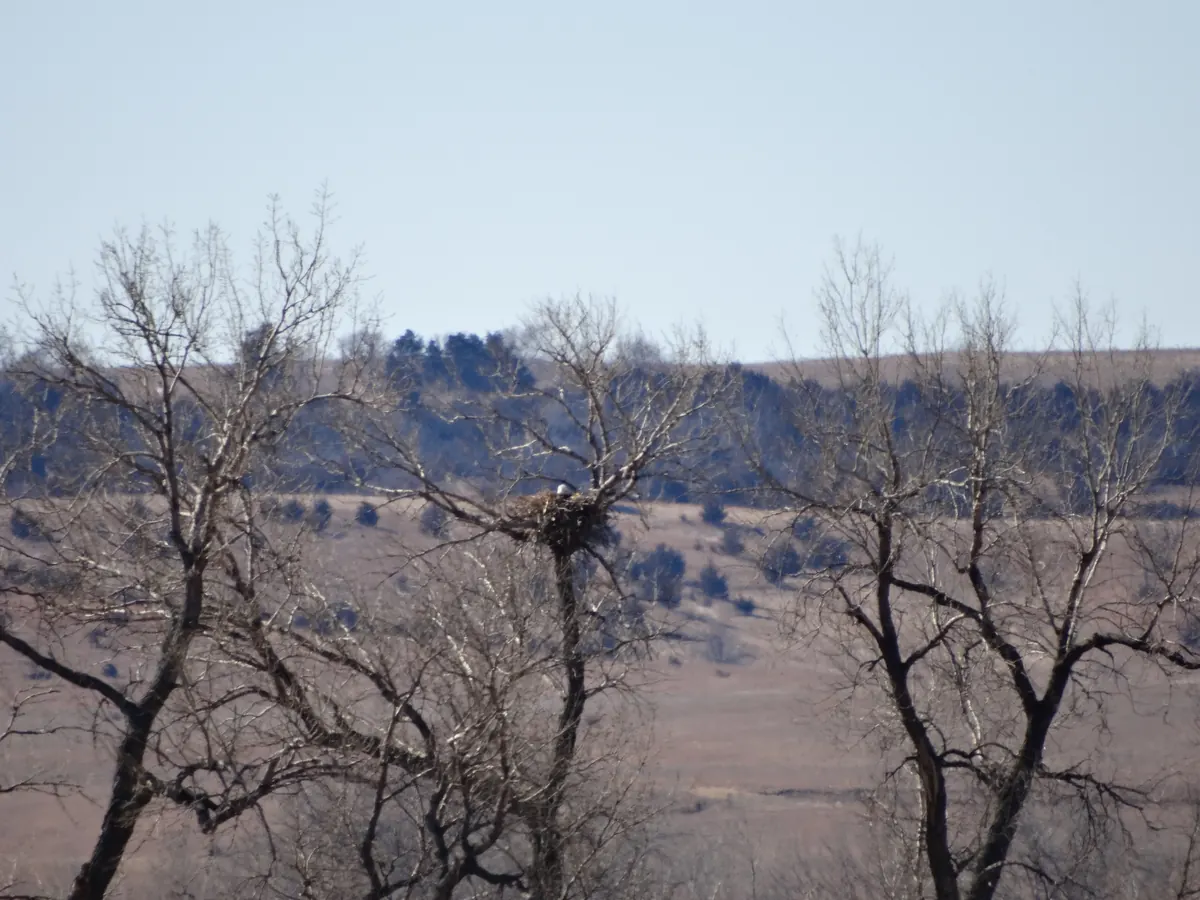
- Find an eagle sitting tight. Scan the tops of big sycamores and cottonwoods along a river or reservoir for a bulky stick nest. If only a white head shows above the rim, and stays there, the bird is probably incubating; watch from at least 100 yards away, as ODNR asks.
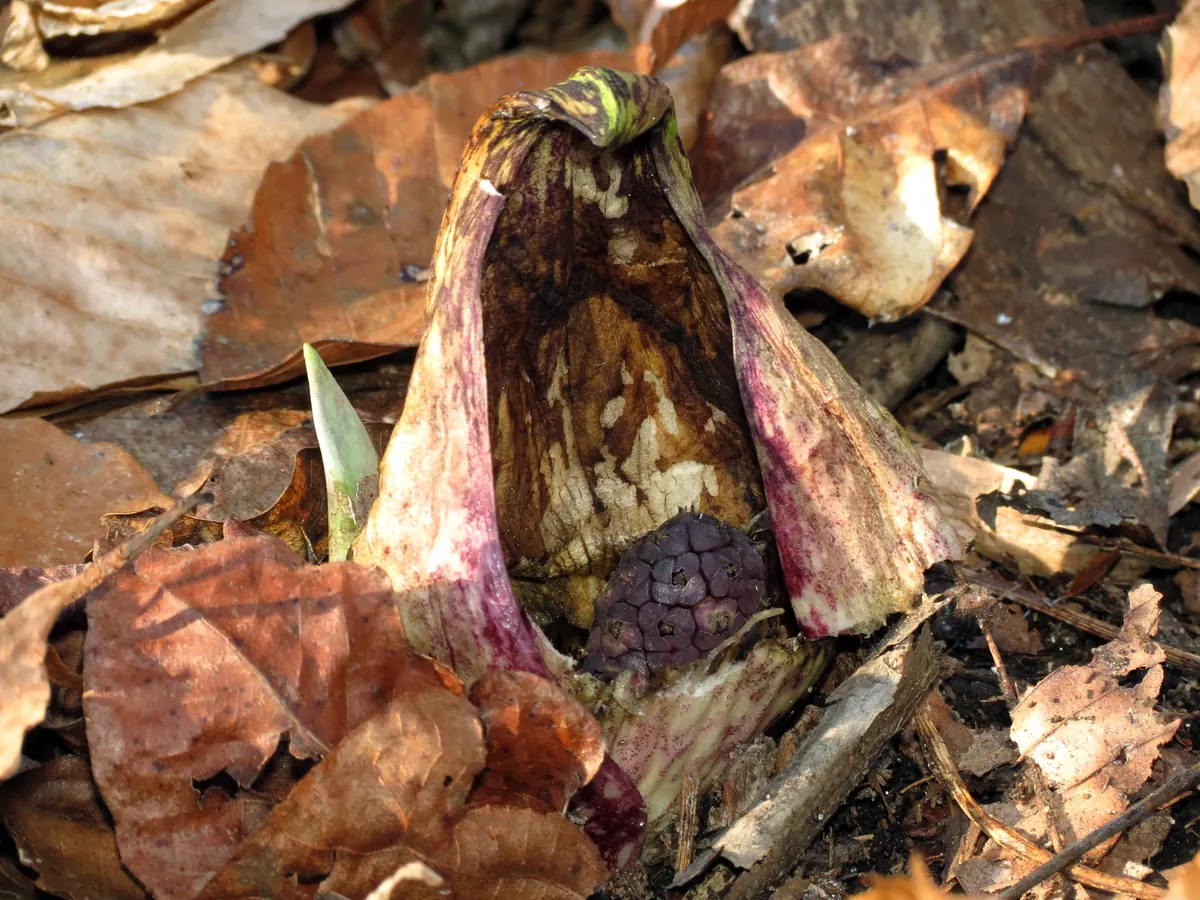
- Go looking for skunk cabbage. Walk a boardwalk through a wooded, spring-fed swamp, such as Cedar Bog, on a sunny afternoon after mid-month. Look for purple-mottled hoods poking out of the muck, often with a ring of melted snow around each one.
- Count birds for the GBBC. The Great Backyard Bird Count turns 30 in 2027 and fills the four days ending on Presidents’ Day (February 12 to 15). Even a quarter hour of watching the feeder from indoors on one of those days makes a valid checklist, and an early redwing would be a fine Ohio bonus.
February pages for the Naturalist’s Field Journal: the eagle on its nest and your first returning redwing on birds I have seen, a sketch of a skunk cabbage hood on reading the signs, the wood frog’s clucking on a map of sounds, and the nest you are watching on nest observed. Revisit the same sugar maple or swamp in late March for the same place twice.
Regions used below: Northwest and Lake Erie; Northeast and Cleveland; Central Ohio; Southwest and Cincinnati; Southeast and the Hocking Hills.
When do Ohio’s bald eagles lay their eggs?
Mostly from the middle of February into late March. According to ODNR, each clutch holds one to three eggs, laid within that span, and both parents take turns keeping them warm for about 35 days, so a pair seen repairing a nest in January may well be sitting tight by the end of February. The young stay in the nest for 10 to 13 weeks after hatching.
There are a great many nests to watch. Ohio had only four nesting pairs in 1979; in its 2025 census the Division of Wildlife confirmed 964 active nests in 87 of the state’s 88 counties, up 36 percent from the 707 found in 2020. More than 1,800 reports from the public helped track them down. The heaviest concentration is in the marsh country around Sandusky Bay and the western basin of Lake Erie, where Ottawa County alone held 112 nests.
-
Spotting an active nest
Mid-February onward, before the trees leaf out · Big sycamores, cottonwoods and oaks within a mile or two of rivers, reservoirs and marshes
Eagle nests are huge, often several feet across, and sit in the top third of a tall tree. A bird lying low in the bowl, with just a white head or the tip of a tail showing, is incubating. Every so often the pair swap places, which is the moment to have the binoculars up. Bare branches make February and March the easiest months to find a nest you might have walked under all summer.
-
Great horned owlets
Hatching from late February into early April · Old hawk, heron and squirrel nests in farm woodlots and wooded parks
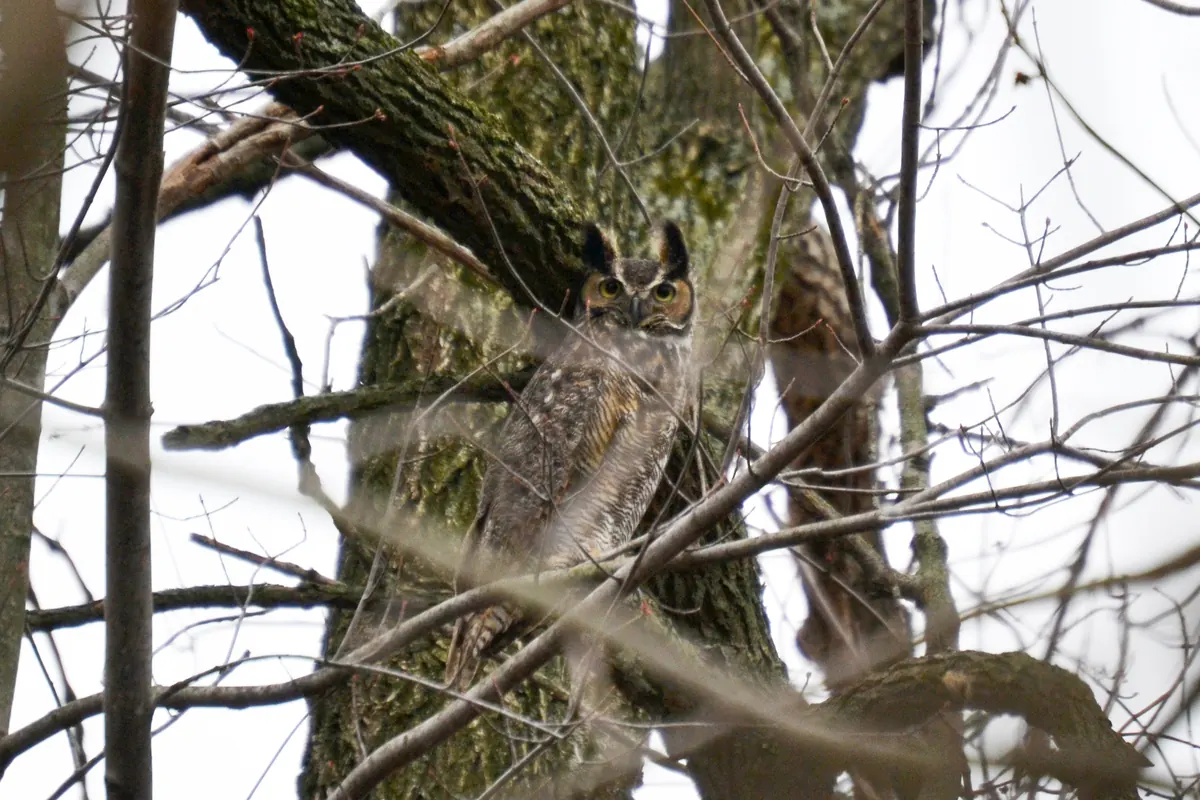
The great horned owls that started nesting in January are now well into their month of incubation, and ODNR says the first owlets hatch in late February. If you know where a pair has been hooting, look for the female’s ear tufts sticking up above an old stick nest, then check again in March for a fuzzy gray head beside her.
| County | Active nests |
|---|---|
| Ottawa | 112 |
| Sandusky | 61 |
| Erie | 40 |
| Seneca | 36 |
| Wyandot | 31 |
| Trumbull | 29 |
| Lucas | 27 |
| Huron | 21 |
| Wood | 20 |
| Coshocton | 19 |
| Knox | 19 |
| Licking | 19 |
| Mercer | 19 |
Bald eagles have the protection of Ohio law and of the federal eagle protection act. The state asks watchers to keep at least 100 yards back, since a pair disturbed at the nest can abandon its eggs. A spotting scope from a road or a parking lot is the kindest way to watch. Log what you see each visit on the journal’s nest observed page.
When is maple syrup season in Ohio?
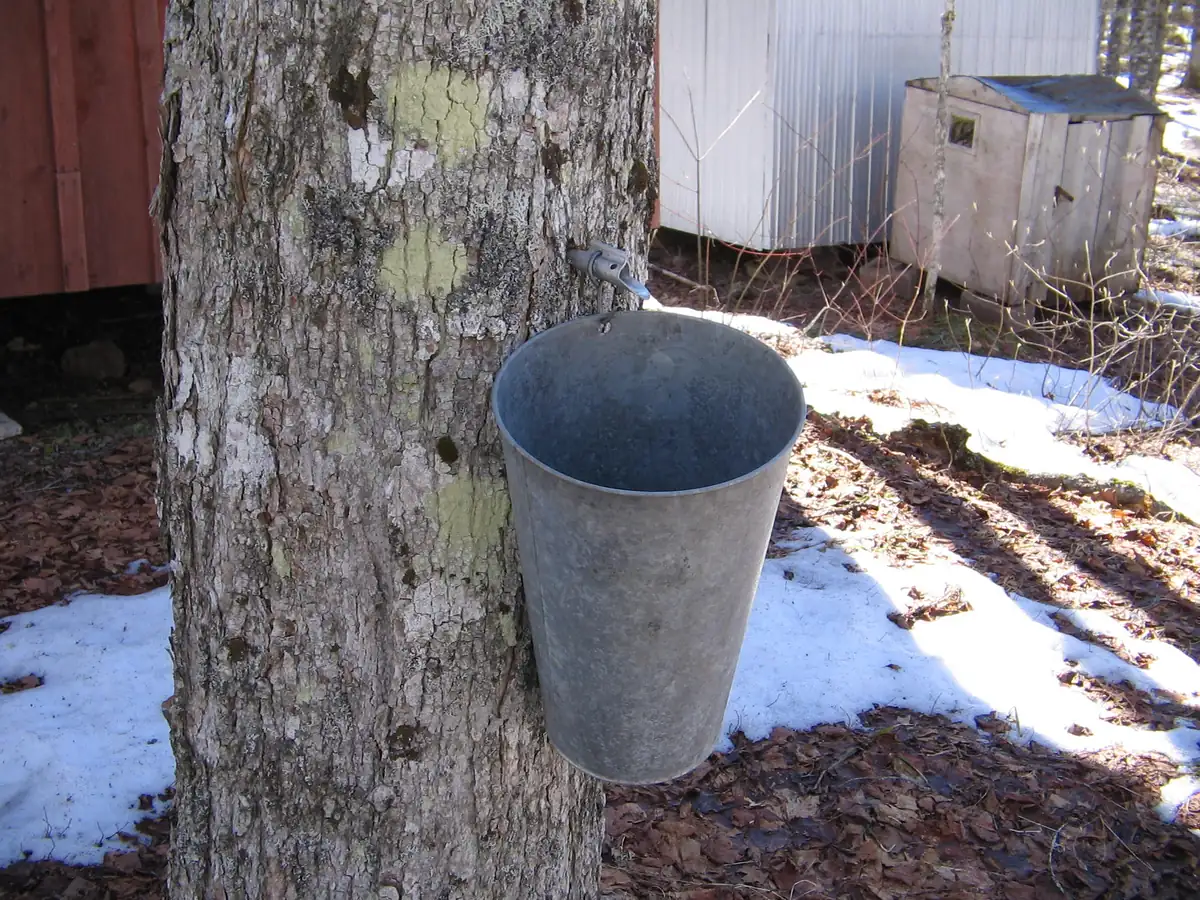
For most Ohio producers it begins in February, once the weather starts swinging above and below freezing. Ohio State University’s maple program notes that the season traditionally opened around Presidents’ Day and ran through March, but recent winters have scattered the start: in 2024 some producers tapped in January, in 2025 cold weather pushed tapping three or four weeks later than usual, and in 2026 a long run of polar cold held most tapping off until mid-February. A run that began on February 26, 2026, flowed for 36 to 48 hours without stopping in many sugarbushes.
Sap moves when cold nights in the 20s are followed by days in the 40s. Freezing at night pulls water up into the tree; thawing by day builds pressure inside the trunk that pushes sap out of any tap hole. A long spell above freezing ends the season, and so does the swelling of buds, which gives late syrup an off flavor. OSU’s maple team observes that silver maples break bud first, red maples soon after and sugar maples last.
-
Ohio’s syrup in numbers
The 2026 crop, published June 2026 · Statewide
USDA’s survey counted 410,000 taps in Ohio in 2026, producing about 96,000 gallons of syrup, or a little under a quarter gallon per tap. That placed Ohio eighth among the states, behind Vermont, New York, Maine, Wisconsin, Michigan, Pennsylvania and New Hampshire.
-
Watching a sugarbush
Sunny afternoons after a hard frost · Park sugarbushes, roadside farm stands and wooded lots with buckets or blue tubing
On a good day you can hear the drip from a bucket and see steam rising from a sugarhouse roof. A walk past tapped trees on a thawing afternoon, then again on a day that stays below freezing, shows the freeze-and-thaw rule at work better than any diagram.
| Year | Taps | Yield per tap | Syrup produced |
|---|---|---|---|
| 2024 | 400,000 | 0.240 gal | 96,000 gal |
| 2025 | 410,000 | 0.245 gal | 100,000 gal |
| 2026 | 410,000 | 0.233 gal | 96,000 gal |
Many park districts open their sugarbushes to visitors in late winter; see the families section below. To time a visit, watch the forecast on our weather page for the first stretch of frosty nights and above-freezing days.
Which birds come back to Ohio in late February?
Spring migration starts far earlier than most people expect. The Black Swamp Bird Observatory, on the Lake Erie shore near Oak Harbor, counts the season as running from mid-February to mid-June, and its calendar for the last part of February lists waterfowl starting to move, early returning woodcock and blackbirds, and flocks of crows traveling along the lakeshore. Full-scale duck, goose and swan migration follows in March.
-
Red-winged blackbirds
Males usually from March, some in the second half of February · Cattail marshes, wet ditches, roadside fences
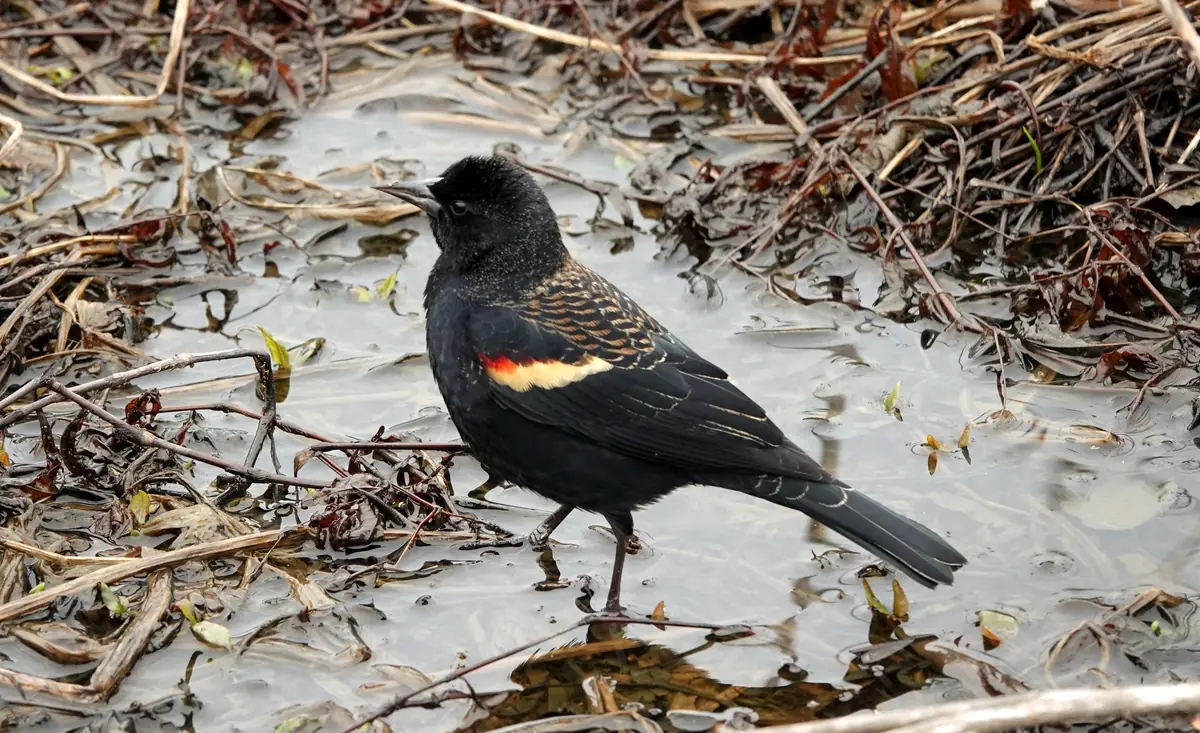
Males come first and claim territories by singing their raspy conk-la-ree from the highest reed or wire, flashing red shoulder patches edged with yellow. Brown, streaky females, which look more like big sparrows, follow a few weeks later. ODNR notes that the species is among the most visible birds along Ohio’s roadsides once it settles in.
-
American woodcock
Late February through March · Damp thickets, young woods and brushy old fields next to grassy openings
ODNR says migrating woodcock are found throughout Ohio from late February, with the most breeders in the northeast, north-central and central parts of the state. At dusk, males stand on a bare patch and give a nasal peent, then spiral high overhead on twittering wings and tumble back down. Stand quietly at the edge of a field at sunset on a calm evening to hear it.
-
Ducks, geese and swans
Beginning in late February; peaking in the second half of March · Magee Marsh, Ottawa National Wildlife Refuge and the open water of the western Lake Erie marshes
As soon as the marshes start to open, the first northbound waterfowl appear. The observatory expects huge numbers of ducks, geese and swans on Lake Erie and the nearby marshes by the latter half of March, so late February is the overture: a few flocks of tundra swans or pintails on newly open water, and long skeins of geese overhead.
Record the date of your first blackbird of the year in the journal’s daily field log and compare it next February. Black Swamp Bird Observatory’s timing page is a handy guide to what comes next along the lakeshore.
What is the first wildflower to bloom in Ohio?
Skunk cabbage, by a long way. ODNR’s wildflower notes give its blooming period as mid-February to early April and call it the first native wildflower of the year, often in flower while snow and ice are still around it. Two other tiny plants may join it before February ends, especially in the south.
-
Skunk cabbage
Mid-February to early April · Soggy, spring-fed wooded wetlands; most frequent in the northeast, scarcest along the Ohio River
The part you notice is a leathery hood, the spathe, streaked and spotted with maroon, curled around a stubby club covered in tiny flowers. The plant warms itself: ODNR notes that the flowering parts give off enough heat to melt the ice around them, which is why each hood can sit in its own little well in the snow. The famous smell, and the huge cabbage-like leaves, come later in spring. Cedar Bog, Christmas Rocks and Gallagher Fen are state nature preserves where it can be seen from the trail.
-
Harbinger-of-spring
Mid-February to mid-April; may start in late February in the southern counties · Moist, shady woods, especially on stream terraces
An inch or two tall, with lacy leaves and a cluster of white petals around dark purplish anthers, which gives it the old name pepper-and-salt. ODNR notes that a plant takes six or seven years to bloom for the first time. Get down on your knees on a sunny bank to find it.
-
Snow trillium
Mostly March to early April; occasionally in February · Open woods on limestone or dolostone in central and southwest Ohio
This small white trillium is rare in Ohio, but the state has a special tie to it: ODNR records that the first specimen ever collected came from along the Scioto River near Dublin in 1834. Late snows sometimes bury the flowers. Enjoy any you find from the path, and don’t pick or dig them.
A sketch of a skunk cabbage hood beside its melted ring of snow makes a good page for the seeds, pods and cones plate, or for colours of the day if the hood is a vivid maroon.
When do salamanders and frogs wake up in Ohio?
On the first mild, rainy nights of late winter. Ohio’s mole salamanders spend most of the year underground in the woods, then walk to vernal pools, the shallow ponds that fill each winter and dry by summer, to breed. Ohio State University Extension’s Buckeye Yard and Garden team writes that the big movements come once temperatures average about 45 °F and rain is abundant, and that small-mouthed and Jefferson salamanders can appear as early as February in some years. The researchers add that those early arrivals often signal a bigger spotted salamander movement to come.
-
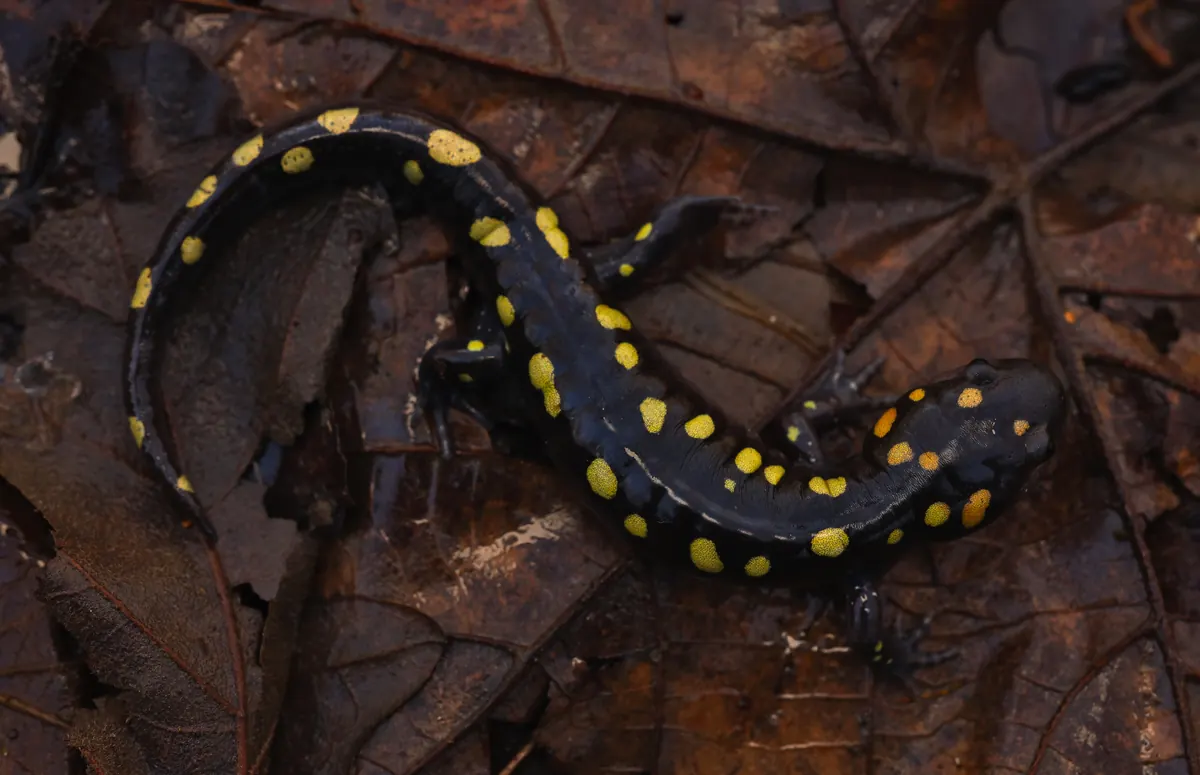
Spotted salamander, Ohio’s state amphibian
Rainy nights from late winter into spring · Low, moist woods near swamps, ponds and creeks statewide
Adopted as the state amphibian in 2010, this inky salamander, dotted down the back with two lines of yellow, is almost never seen except on breeding nights. Males reach the pools first, and females follow a few days later. ODNR describes the result: a fist-sized egg mass, swollen with jelly, attached to a stick under water.
-
Wood frogs
Late February to early March, often before the ice is fully gone · Woodland ponds and vernal pools
ODNR says wood frogs crowd into woodland ponds in late February and early March, sometimes while ice still rims the water, and leave again within a week or so. Their call is a series of five or six hoarse clucks, more like ducks than frogs. Look for the dark mask through the eye.
-
Chorus frogs and spring peepers
Calling as the ice thaws; breeding mostly from March · Flooded fields, ditches and shallow ponds
ODNR notes that both species leave hibernation as the ice thaws. Chorus frogs make a rising, rattling creak, like a fingernail drawn slowly over a pocket comb, and peepers a single high, climbing whistle. On a warm evening in late February a few may start early, especially in the south of the state.
Salamanders and frogs cross roads on their way to the pools, and ODNR and the Ohio Department of Transportation ask the public to report spots where they see amphibians crossing often, through the state’s Wildlife Reporting System. If you go out on a rainy night, wear a reflective vest, use a headlamp and look without handling.
Will Ohio’s groundhog see his shadow, and when is the real middle of winter?
This year Groundhog Day is a Tuesday, February 2. Ohio’s own forecaster is Buckeye Chuck, who makes his annual call at an early-morning event in Marion. The real midpoint of winter comes a day or two later: winter’s true halfway point, counted from the shortest day to the spring equinox, lands on February 3 by one reckoning and early on February 4 by another.
-
Real groundhogs in February
Most still asleep; males stir in late winter · Burrows along fencerows, field edges and creek banks
Wild woodchucks don’t keep the calendar. ODNR says hibernation ends with the first warm days of spring, and that a male goes looking for a mate as soon as he comes out, often visiting several burrows. Breeding runs from March to May. On a mild afternoon late this month, check fresh dirt at the mouth of a burrow.
-
Six more weeks?
Through the middle of March · Everywhere
Shadow or no shadow, the climate record agrees with the groundhog who sees one: Ohio is still a winter state until mid-March. Average highs at Columbus climb from about 38 °F on February 1 to about 45 °F by the end of the month, and NOAA’s normals for the seven stations in the weather table below still put February snowfall between about 6½ and 15 inches.
How snowy is February in Ohio, and what could El Niño change?
February is a little milder and a little less snowy than January everywhere in Ohio, but it is still winter. The table shows what the 1991–2020 normals expect: about 15 inches of snow at Cleveland and Youngstown, where Lake Erie adds lake-effect snow, and 6 to 8 inches at Columbus, Dayton and Cincinnati. Most Ohio nights still drop below freezing, and the coldest places see a night or two below zero in an average February. Lake Erie’s ice usually reaches its yearly peak this month, NOAA’s Great Lakes lab says, sometime in the second half of February.
| Station | Average high | Average low | Snowfall | Snow-cover days | Nights at or below 32 °F | Nights at or below 0 °F |
|---|---|---|---|---|---|---|
| Toledo (Express Airport) | 37.8 °F | 22.1 °F | 10.2 in | 11.8 | 24.3 | 1.6 |
| Cleveland | 38.5 °F | 23.7 °F | 15.1 in | 13.5 | 23.5 | 1.1 |
| Akron-Canton | 38.6 °F | 21.9 °F | 12.0 in | 12.8 | 24.1 | 1.3 |
| Youngstown | 37.3 °F | 20.7 °F | 15.1 in | 15.5 | 23.9 | 1.3 |
| Columbus | 40.8 °F | 24.2 °F | 7.6 in | 7.5 | 22.1 | 0.8 |
| Dayton | 41.2 °F | 24.5 °F | 6.6 in | 8.0 | 22.5 | 1.0 |
| Cincinnati (CVG) | 43.7 °F | 25.8 °F | 6.7 in | 6.4 | 20.7 | 0.6 |
This winter, El Niño is the big unknown. By the federal forecasters’ September 10, 2026, update, a very strong El Niño peaking this winter had become close to a sure thing, with a probability over ninety percent. A review of past El Niño winters by the weather service offices in Cleveland and Cincinnati found that moderate and strong events tended to bring warmer, drier winters with below-normal snow to the Ohio Valley and lower Great Lakes, but saw no such link at stations in the lake-effect snowbelt.
The last very strong El Niño shows that a mild winter can still deliver in February. The Cleveland office’s review of winter 2015–16 describes the warmest December on record and almost no snow outside the snowbelt, yet February brought cold days early, a storm on February 16 that dropped 6 to 10 inches of wet snow from Youngstown and Ravenna toward Pymatuning Lake, and more snow at Cleveland, Akron-Canton and Youngstown than any other month that winter. After February 20, the office wrote, spring got an early start.
The official NOAA outlook for the winter first appears in mid-October and is updated each month; you can see the current maps any time through the CPC 90-day outlook maps. For a given day, check our weather page, and for planting plans after the thaw, see the frost dates for Ohio towns.
How much daylight does Ohio gain in February?
A little more than an hour, the biggest monthly gain so far this year, and mornings finally share in it along with evenings. In Columbus the sun sets at 5:51 p.m. on February 1 and at 6:23 p.m. on February 28; at the other end of the day, sunup comes at 7:41 a.m. on the 1st and 7:07 a.m. by month’s end. Over the month the days stretch by roughly two and a half minutes every 24 hours, on average. The northern cities gain a few minutes more than the southern ones, and the clocks spring forward on Sunday, March 14.
| City | Feb 1 | Feb 28 | Gained | Per day |
|---|---|---|---|---|
| Toledo | 10 h 04 m | 11 h 12 m | 68 min | 2.5 min |
| Cleveland | 10 h 04 m | 11 h 13 m | 69 min | 2.6 min |
| Youngstown | 10 h 05 m | 11 h 13 m | 68 min | 2.5 min |
| Akron | 10 h 06 m | 11 h 14 m | 68 min | 2.5 min |
| Columbus | 10 h 10 m | 11 h 16 m | 66 min | 2.4 min |
| Dayton | 10 h 11 m | 11 h 16 m | 65 min | 2.4 min |
| Cincinnati | 10 h 14 m | 11 h 17 m | 63 min | 2.3 min |
| Athens | 10 h 13 m | 11 h 17 m | 64 min | 2.4 min |
Find sunrise and sunset for your own town, any day of the year, with our sunrise and day length tool. Note the time the porch light switches on each Friday on the dusk and dawn watch page.
What can you see in Ohio’s night sky in February 2027?
Two planets reach opposition, the giant one first and the red one a little over a week later, Mercury pokes into the dusk early in the month, and the Snow Moon comes up dimmed, slightly, by Earth’s outer shadow. Every time below is Eastern Standard Time, Ohio’s only zone.
-
Mercury in the evening twilight
Late January to about February 10; farthest from the sun on February 3 · Low in the west-southwest, 30 to 45 minutes after sunset
It swings farthest from the solar glare in the early hours of Wednesday, February 3, a little over 18 degrees out. Look just above the horizon in bright twilight with binoculars, then try without them. Four evenings later, on Sunday the 7th, look for a hairline moon only a day old hanging just beside Mercury above the western skyline.
-
Jupiter at opposition
Wednesday, February 10, 7:21 p.m. · Rising in the east at sunset, high in the south around midnight
Our planet slips between Jupiter and the sun that evening. For Ohio that means a brilliant cream-colored point lifting over the eastern horizon around sunset and staying in sight all night long; no star in the sky is brighter. Steady a pair of binoculars on a fence rail or the hood of the car and you may pick out up to four pinpricks lined up beside it: the Galilean moons, shifting position from night to night. Late on Friday, February 19, a moon one day short of full drifts right up beside Jupiter.
-
Mars at opposition
Friday, February 19, about 10 a.m.; closest to Earth on February 20 · In Leo, rising in the east around sunset
Mars shines orange and is brighter than most stars, but 2027 brings a lean opposition: the red planet holds off at around 63 million miles, because it is passing through the far side of its oval orbit. A telescope shows only a small disk. Watch it climb in the east beside Jupiter and the bright star Regulus.
-
The Snow Moon and a faint eclipse
Saturday, February 20; full at 6:23 p.m. · Rising in the east-northeast at sunset
The moon comes up while a penumbral lunar eclipse is under way: the moon is inside Earth’s pale outer shadow from 4:12 to 8:13 p.m., with the deepest point at 6:13 p.m. USNO gives moonrise at 6:04 p.m. in Cleveland, 6:11 p.m. in Columbus and Toledo and 6:19 p.m. in Cincinnati, so Ohio sees the moon come up right around the deepest part. At best, one edge may look slightly dusky as it clears the horizon in twilight; most people won’t notice anything. Some almanacs list this full moon as a supermoon and other sources leave it off; either way it is only a bit nearer to us than average. Jupiter, Regulus and Mars gather nearby in Leo that evening.
-
Dark skies and a distant eclipse
Moonless evenings about February 2 to 11 · State parks and dark country roads
The new moon on February 6 brings an annular solar eclipse, its narrow ring-of-fire path crossing southern South America and the open ocean on the way to the West African coast. Ohioans will see none of it, partial phase included, and neither will anyone else in the fifty states. The dark week around it is the best of the month for the Orion Nebula and the winter Milky Way. With the sunspot cycle now past its high point yet far from quiet, it is worth a look at NOAA’s aurora forecast whenever a clear night lines up with a solar storm.
-
Saturn bows out
All month, lower each week · Low in the west-southwest after dark
Saturn sinks into the evening twilight through February, and it will pass behind the sun in April. Catch it early in the month while it is still clear of the horizon haze.
| Phase | Date | Time |
|---|---|---|
| New moon | Saturday, Feb 6 | 10:56 a.m. |
| First quarter | Sunday, Feb 14 | 2:58 a.m. |
| Full moon (Snow Moon) | Saturday, Feb 20 | 6:23 p.m. |
| Last quarter | Sunday, Feb 28 | 12:16 a.m. |
Clear skies are scarce in an Ohio February, so look at tonight’s cloud outlook before you drive anywhere, and see our moon phases page for the evenings with no moon in the way.
What can Ohio families do outdoors in February 2027?
- Tuesday, February 2: Groundhog Day. Hear Buckeye Chuck’s forecast from Marion, then go out and look for real woodchuck burrows along a fencerow.
- Sunday evening, February 7: Mercury and the moon. A slender crescent sits near Mercury low in the west after sunset; binoculars help.
- Wednesday, February 10: Jupiter’s night. Hold binoculars steady against a fence post and count the moons.
- February 12 to 15, Friday to Presidents’ Day Monday: the Great Backyard Bird Count, its 30th year. Organized by Cornell’s bird lab with Audubon and Birds Canada; count for 15 minutes or more on any day and send the list through eBird or the Merlin app.
- Saturday, February 20: the Snow Moon. Be outside a few minutes after six to catch moonrise, and look for a faint smudge of shade along one edge.
- Late February: a maple sugaring walk. Cleveland Metroparks has shared maple sugaring with visitors at Rocky River Reservation’s Maple Grove for more than 40 years and plans a new sugar shack for the 2027 season, and Lake Metroparks Farmpark’s maple weekends opened on February 28 in 2026. Check each park’s calendar for 2027 dates. Ohio State Parks held its 2026 maple festivals at Hueston Woods and Malabar Farm on the first two weekends of March; watch ODNR’s events page for 2027.
- The first rainy night above about 45 °F: a vernal pool visit. Many park districts lead salamander walks in early spring; with a flashlight and boots, an older child can watch the edge of a woodland pool for spotted salamanders and listen for wood frogs.
Project FeederWatch counts continue through April. Our nature guides for every state include a printable checklist for each month, and January’s Ohio guide, with the eagle count and the Hocking Hills hike, is at Ohio in January.
Safety notes for February in Ohio
- Hunting seasons and orange. Ohio’s deer archery season runs through Sunday, February 7, 2027. Geese may be hunted to February 1 in Zone A and to February 15 in the other two zones, and cottontail rabbit until February 28. Crows may be hunted on Fridays, Saturdays and Sundays until March 7, and coyotes and woodchucks have no closed season. Ohio’s hunter-orange rule covers only the gun and muzzleloader deer seasons (youth weekend included), and every one of them closes before February, so orange is not legally required this month; wearing a bright hat or vest on public hunting land is still sensible, for you and for your dog.
- Traps along the water. Trappers may set for mink, muskrat, beaver and river otter until the last day of February, and in the Lake Erie marshes until March 15. Keep dogs leashed along creeks, ditches and marsh edges.
- Late-season ice. Thaws and rain rot ice from the inside even when it still looks thick. ODNR’s minimum for walking is 4 inches of new, clear ice, and the agency adds that ice can never be called fully safe. Stay off river ice, shoreline ice ridges and anything near inlets, and remember that Lake Erie floes can break away from shore in an offshore wind.
- Thaws, rain and high water. A warm spell with rain on frozen or snow-covered ground can raise creeks fast, and breaking river ice can jam and push water over the banks. Turn around rather than drive through flooded roads.
- Night walks and roads. If you go out on a rainy night to look for salamanders, wear reflective gear, stay on the shoulder and watch for traffic as well as amphibians.
- Nesting eagles and owls. Keep at least 100 yards from eagle nests and don’t play recorded calls; disturbance at this stage can cost a pair its eggs.
Sources
- ODNR: America’s national bird thriving in the Buckeye State, 2025 bald eagle nest census (July 3, 2025)
- ODNR: Bald eagle species account
- ODNR Division of Wildlife: Bald eagle breeding population status 2024
- ODNR: Great horned owl
- Ohio State University Extension: Ohio State Maple blog
- Ohio State Maple: Season updates, 2024 to 2026
- USDA NASS: Crop Production, June 2026, maple syrup tables (via North American Maple Syrup Council)
- ODNR: A sweet taste of spring, Ohio State Parks maple syrup festivals (Feb. 17, 2026)
- Cleveland Metroparks: Maple Grove Picnic Area improvements and maple sugaring
- Cleveland 19 News: Maple Sugaring Weekends return to Lake Metroparks Farmpark (Feb. 12, 2026)
- Black Swamp Bird Observatory: Timing of spring migration
- ODNR: Red-winged blackbird
- Ohio Cooperative Living: Spring on the wing, red-winged blackbirds (March 2024)
- ODNR: American woodcock
- U.S. Fish and Wildlife Service: Ottawa National Wildlife Refuge
- ODNR: Skunk cabbage
- ODNR: Harbinger-of-spring
- ODNR: Snow trillium
- OSU Extension, Buckeye Yard and Garden onLine: Spotting the signs of spring, a vernal pool exploration
- Lake Metroparks: Mole salamander migration
- ODNR: State symbols (spotted salamander, state amphibian)
- ODNR: Spotted salamander
- ODNR: Wood frog
- ODNR: Western chorus frog
- ODNR: Northern spring peeper
- ODNR: Report reptile and amphibian road crossing hotspots (April 20, 2026)
- ODNR: Woodchuck/groundhog
- NOAA NCEI: Monthly climate normals 1991–2020, Ohio-area stations
- NOAA NCEI: Daily climate normals 1991–2020, Columbus, Cleveland and Cincinnati (February)
- NOAA GLERL: Great Lakes ice cover data and FAQ
- NWS Cleveland: Climatological effects of El Niño in the lower Great Lakes and Ohio Valley
- NWS Cleveland: Winter 2015–16 review, a warm El Niño winter
- NOAA CPC: ENSO diagnostic discussion, September 10, 2026
- NOAA CPC: Seasonal (90-day) outlooks
- NOAA Global Monitoring Laboratory: Solar calculator
- U.S. Naval Observatory: Sun and moon rise and set, Columbus, February 2027
- U.S. Naval Observatory: Moon phases
- U.S. Naval Observatory: Earth’s seasons and apsides, 2027
- Fred Espenak: Sky Event Almanac 2027
- NASA: Lunar eclipses, 2021–2030
- NASA: Solar eclipses, 2021–2030
- Old Farmer’s Almanac: Eclipse dates
- EarthSky: Jupiter at opposition
- Sea and Sky: Astronomy calendar of celestial events 2027
- NOAA Space Weather Prediction Center: Aurora 30-minute forecast
- National Audubon Society: Great Backyard Bird Count
- Project FeederWatch: How to participate
- ODNR Division of Wildlife: 2026–27 hunting and trapping season dates
- Ohio Administrative Code 1501:31-15-11, deer hunting and hunter orange
- ODNR: Ice thickness guidelines
- ODNR Division of Wildlife: Wildlife Reporting System
- Photos via Wikimedia Commons; licenses and photographers are credited under each picture
