What to look for in nature in Ohio this January
January is the deep middle of an Ohio winter, the coldest month on average from Toledo to Cincinnati and, in most places, the snowiest. It is also a month of beginnings. Bald eagles are gathering at open water and refurbishing their nests, great horned owls are hooting from the woodlots and will soon be on eggs, and red foxes and coyotes are pairing up. Steelhead hold in the northeast rivers, Lake Erie begins to freeze, and the Hocking Hills gorges hang with ice. Overhead, a strong meteor shower opens the year and 2027’s nearest full moon rises three weeks later.
Other months in Ohio: October, November, December, February.
Start here

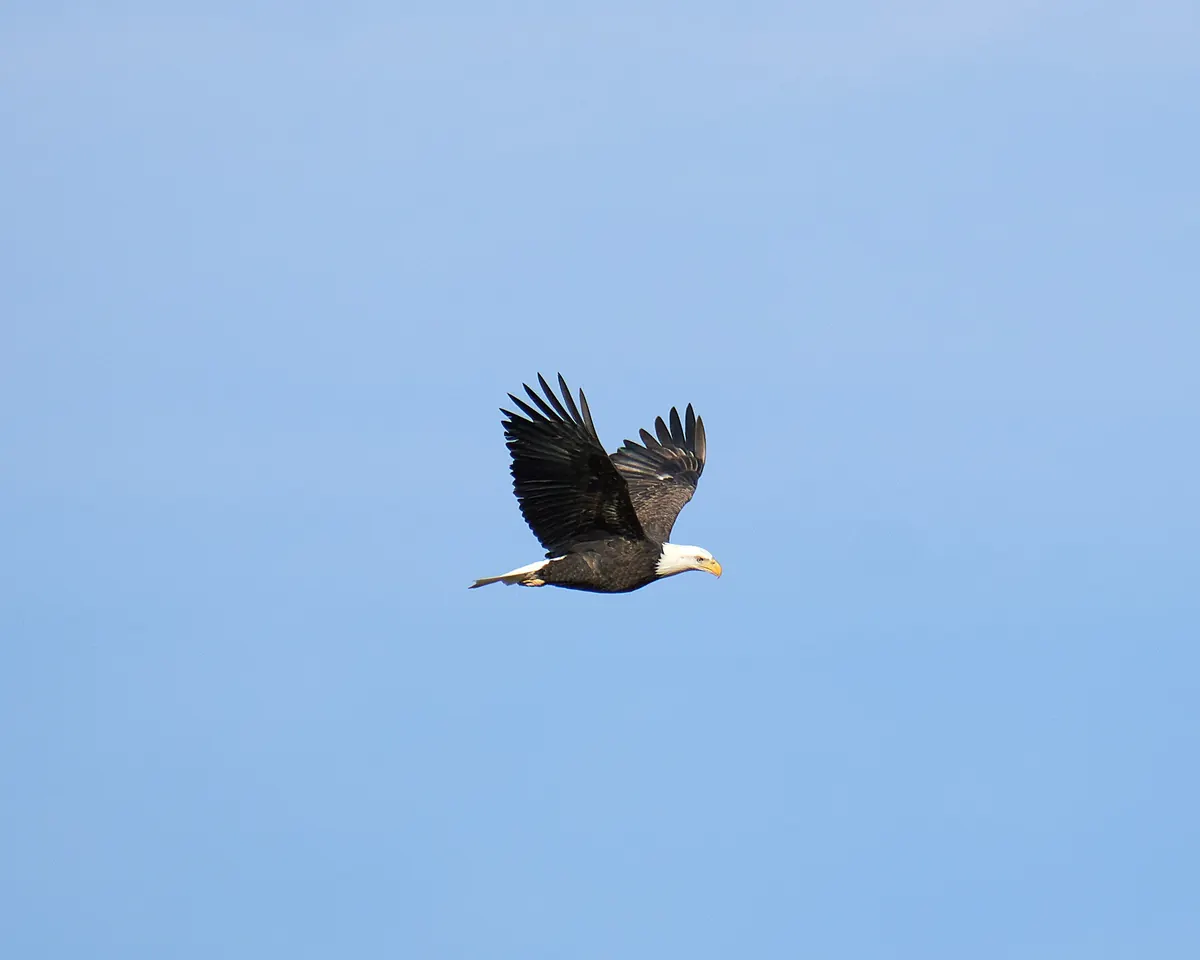
- Count eagles at open water. On a frosty morning, take binoculars to Magee Marsh, Pickerel Creek, Mosquito Creek or a big river below a dam. Look for white heads in the tallest trees along the water, then check for brown immatures beside them. Last January’s volunteer count found the most birds around the Columbus reservoirs.
- Listen for great horned owls. Step outside at dusk on a calm evening near a woodlot or wooded park. A pair hooting back and forth, one voice higher than the other, is getting ready to nest; the female may be sitting on eggs within weeks.
- Watch the Quadrantids. Ohio’s best window for January’s meteor shower is Sunday night, January 3, carrying on until Monday’s first light. A slim crescent moon won’t rise until late, so pick a dark field and give it the hours before dawn.
Make January’s entries in the Naturalist’s Field Journal: eagles, owls and any winter finches on birds I have seen, fox and rabbit prints on tracks to know, a pair of hooting owls on a map of sounds, and the frozen falls or lakeshore ice on the same place twice, with a second visit in March. On the coldest morning, try colours of the day.
Regions used below: Northwest and Lake Erie; Northeast and Cleveland; Central Ohio; Southwest and Cincinnati; Southeast and the Hocking Hills.
Where can you see bald eagles in Ohio in January?
Almost anywhere there is open water and a tall tree. In January 2026 the Ohio Division of Wildlife asked the public to help with a midwinter eagle count, run from January 7 to 21 as part of the nation’s 250th anniversary year. People sent in 391 reports adding up to 715 eagles: 592 adults with white heads and 123 brown, mottled immatures, which take four or five years to reach adult plumage. Delaware and Franklin counties, around the Columbus reservoirs and rivers, tied for the most birds, ahead of the Lake Erie counties.
Many of these birds are Ohio’s own breeders, which now nest in nearly every county. ODNR says nest building can start as early as October and that eggs are laid from mid-February to late March, so an adult flying a branch to a riverside sycamore this month may have eggs in that nest by late February.
-
The Lake Erie marshes
All month; best on cold mornings when inland water is frozen · Magee Marsh Wildlife Area (Lucas and Ottawa counties), Pickerel Creek Wildlife Area (Sandusky County), Sheldon Marsh State Nature Preserve (Erie County)
ODNR says Lake Erie and the state’s other big waters hold the most eagles, because food is easy to reach there. Check every snag along the dikes, and every dark shape out on the ice, for a big bird sitting hunched in the wind. In a hard freeze they crowd toward whatever water is still open: a channel, a river mouth, the edge of the ice.
-
Inland reservoirs and rivers
All month · Mosquito Creek Wildlife Area (Trumbull County), Killdeer Plains Wildlife Area (Wyandot and Marion counties), and the Muskingum, Hocking, Scioto and Great Miami rivers
These are the inland places ODNR singles out. Below dams and at riffles where current keeps the water open, eagles perch for hours between short fishing flights. Find the white head first, then check the same tree for brown immatures.
| County | Eagles reported |
|---|---|
| Delaware | 26 |
| Franklin | 26 |
| Erie | 24 |
| Lucas | 20 |
| Ross | 20 |
| Sandusky | 20 |
| Huron | 18 |
| Muskingum | 18 |
| Knox | 17 |
| Wood | 16 |
The 2026 count was a special anniversary project, and ODNR has not said whether it will repeat it in 2027. Sightings can be sent to the state’s Wildlife Reporting System at any time.
Which Ohio animals start nesting and mating in January?
The coldest weeks are courtship season for several of Ohio’s predators. Young born in early spring have the whole summer to grow.
-
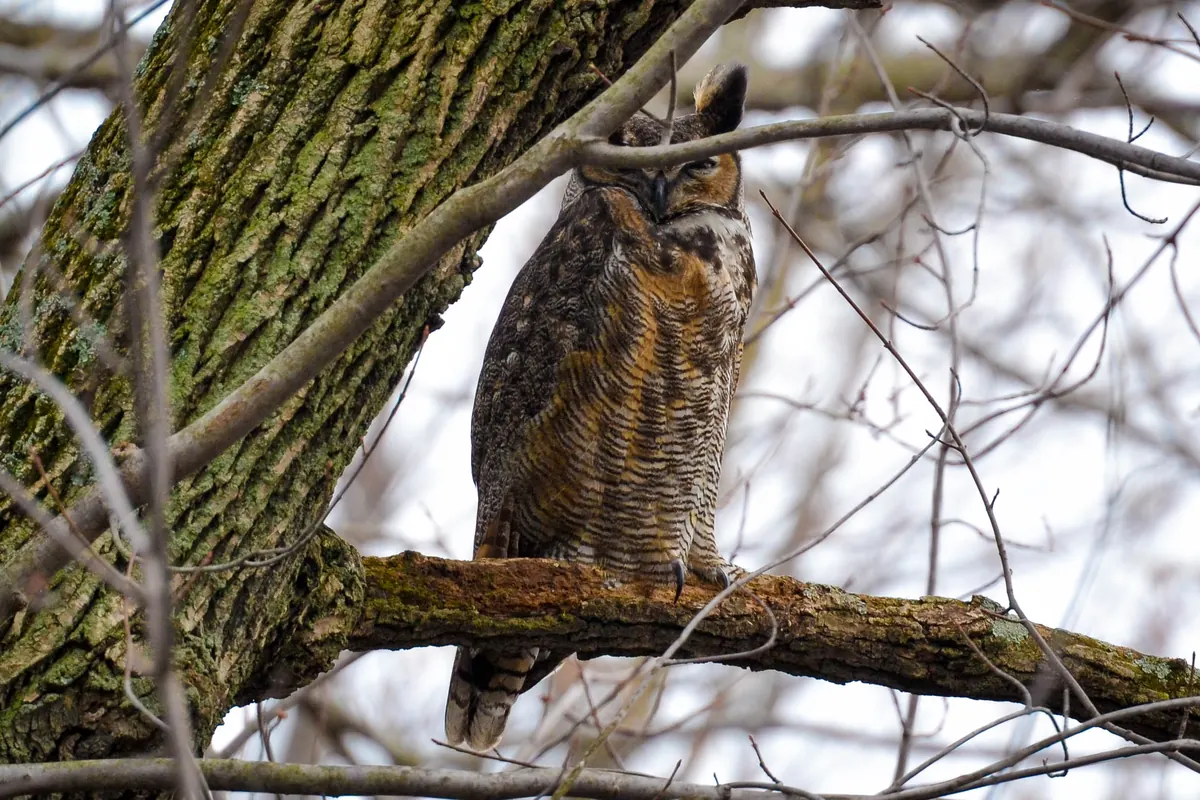
Great horned owls
Peak breeding from late January to mid-March; hooting all month · Farm woodlots, wooded parks and stream corridors statewide
ODNR calls them Ohio’s earliest nesters. They build nothing themselves, taking over an old hawk, heron, eagle or squirrel nest, a tree cavity, or even a ledge on a barn. She incubates three or four eggs for roughly a month, fed by her mate, and owlets hatch from late February into early April. At dusk a pair often duets: the male’s deep, five- or six-note hoot is higher than his larger mate’s.
-
Red foxes
Breeding peaks in January and February · Farmland, field edges and suburbs, most common in central and northwestern Ohio
Foxes live alone through the fall and pair up now. After a gestation of 51 to 53 days the kits, usually five or six, arrive between February and April, often in a den dug into loose, sandy, south-facing ground. A fox trail in snow runs nearly straight, one small print in front of the next; two trails traveling together in January are likely a pair.
-
Coyotes
Breeding from January through March · Statewide, in farm country, woodlots and city edges
Coyotes reached Ohio by the 1930s and every county by 1988. Pairs mate this winter and pups, usually around six, are born in March and April after about 63 days. Their yips and howls carry far on a still, cold night.
Please don’t play owl calls from a phone to draw birds in during nesting season; it pulls them off eggs and away from hunting. A dusk walk with the journal’s dusk and dawn watch page open is a better way to learn which pairs share your neighborhood.
When are steelhead in Ohio’s Lake Erie streams?
All winter, which surprises visitors who think of trout as summer fish. Steelhead are rainbow trout that grow up in Lake Erie and run up its streams from fall through spring. Ohio’s are all stocked: about 450,000 yearlings a year, 7 to 9 inches long, raised at the Castalia State Fish Hatchery and released into seven streams each April and May. The young fish head down to the lake within weeks and usually come back after two or three years, much larger, bright silver from feeding on shiners, smelt and gobies.
-
The seven stocked streams
Fall through spring; January fishing depends on ice and flows · Vermilion River, Rocky River, Cuyahoga River, Chagrin River, Grand River, Ashtabula River and Conneaut Creek
The Rocky, Chagrin and Grand each receive 80,000 yearlings a year, the Cuyahoga 60,000, and the Vermilion, Ashtabula and Conneaut 50,000 apiece. ODNR says anglers come from every Ohio county, 20 other states, Canada and overseas, and that steelhead fishing is worth over $5 million a year to the northeast Ohio shore economy.
-
Watching the run
After a thaw or a rain raises the water and then clears it · Riffles and pools below bridges and park trails in the northeast Ohio river valleys
You don’t need a rod to enjoy it. On a bright day after the water has dropped and cleared, stand on a high bank, wear polarized sunglasses if you have them, and look for long gray shapes holding in the current at the tail of a pool.
Shale banks along these rivers are slick with ice in January and the water is close to freezing. Stay off shelf ice at the stream edge, which is often undercut by current.
When does Lake Erie freeze, and is the ice safe to walk on?
Being so shallow, Erie loses its summer warmth quickly and, in a normal winter, carries more ice than its four sister lakes. NASA’s Earth Observatory notes that its yearly peak cover regularly passes 80 percent, and that it froze completely in 1978, 1979 and 1996. January is mostly the building phase: the shallow western basin and Sandusky Bay tend to freeze first, while NOAA’s Great Lakes lab says the lower lakes normally reach their maximum ice between mid-February and the end of the month.
Ice is also among the most changeable things in an Ohio winter. Great Lakes coverage has ranged from 95 percent to 12 percent in different years, NOAA notes, and in early 2022 wind shoved Erie’s cover from 94 percent down to about 62 and back up to 90 within days.
-
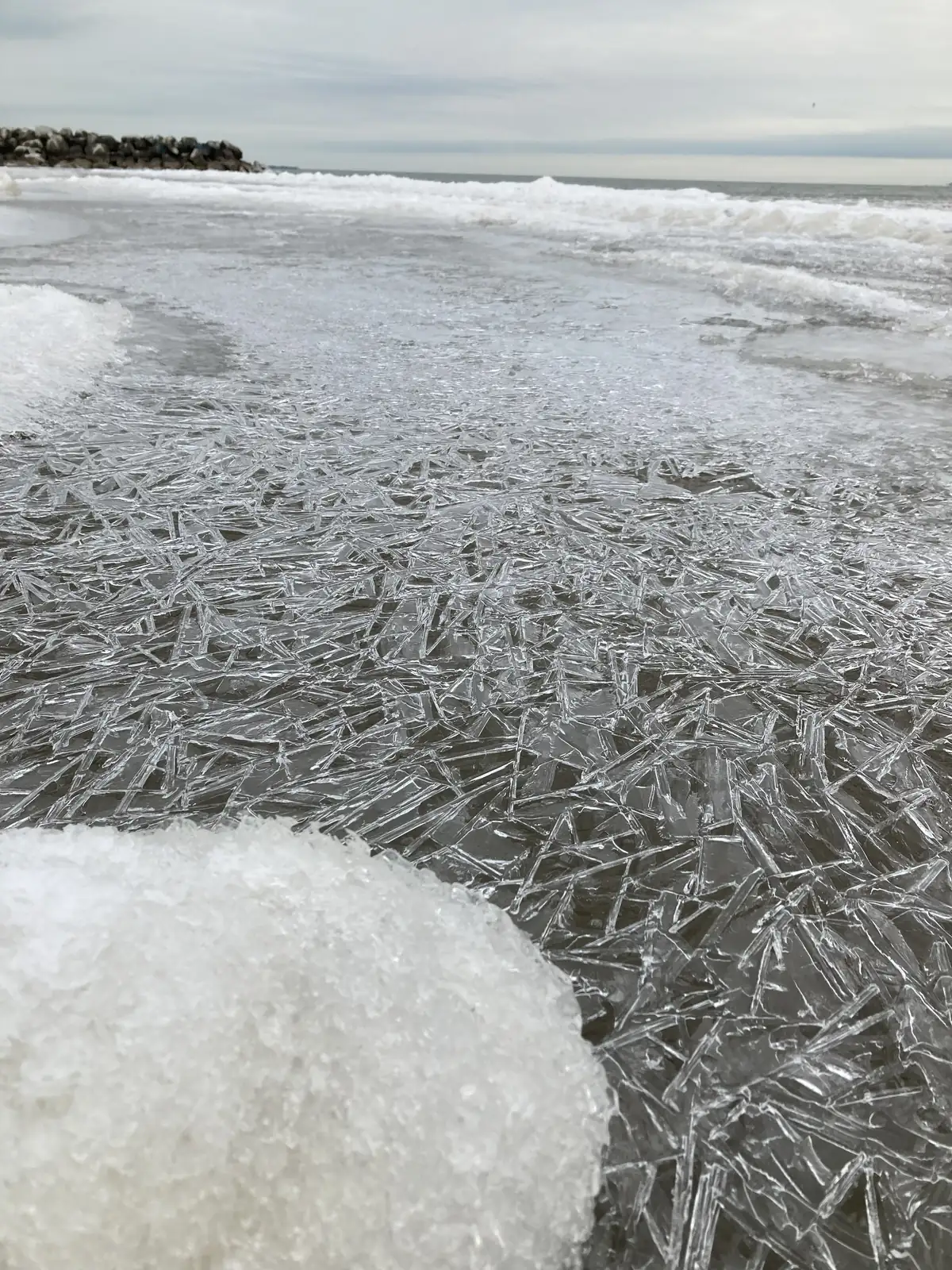
What to look for from shore
After a week or more of hard cold · Lakeshore parks, piers and breakwalls from Toledo to Conneaut
Wind piles broken floes into ridges along the beach, and spray freezes in white layers on rocks, railings and lighthouses. Watch and photograph all of it from solid ground: ridges at the shoreline are often hollow and sit over open water.
-
Ice on ponds and inland lakes
Usually not reliable until a long cold spell · Ponds, reservoirs and state park lakes
ODNR’s minimums are 4 inches of new, clear ice to walk on, 5 inches for a snowmobile or ATV, and 8 to 12 inches for a car or small truck, and the agency stresses that no ice is ever 100 percent safe. Ice by inlets, docks and springs stays thin long after the middle of a pond has thickened.
The National Weather Service office in Cleveland issues freeze-up outlooks and weekly ice forecasts for the lake, and NOAA’s Great Lakes Environmental Research Laboratory posts the day’s ice cover. Photograph one stretch of shore each week for the same place twice plate.
When is the Hocking Hills Winter Hike, and what is there to see?
The state park’s winter hike is one of Ohio’s oldest outdoor traditions; ODNR marked its 60th year on Saturday, January 17, 2026. It is a roughly six-mile walk through the gorges, from Old Man’s Cave past Lower Falls and Cedar Falls to Ash Cave, with shuttles back. In 2026 walkers started any time from 9 to 11 a.m., with bean soup and cornbread at Cedar Falls and hot chocolate at the finish, served by local service clubs.
-
The Winter Hike
An annual Saturday hike in mid-January; check with ODNR for the 2027 date · Hocking Hills State Park, near Logan; check the starting point when the details are posted
ODNR runs the hike and had not posted its 2027 announcement when this guide was written. A local tourism listing already gives a 2027 date and a different starting point (the park campground) from the one ODNR used in 2026 (the visitor center by Upper Falls), so check with ODNR for both the date and the start before you go.
-
Frozen waterfalls
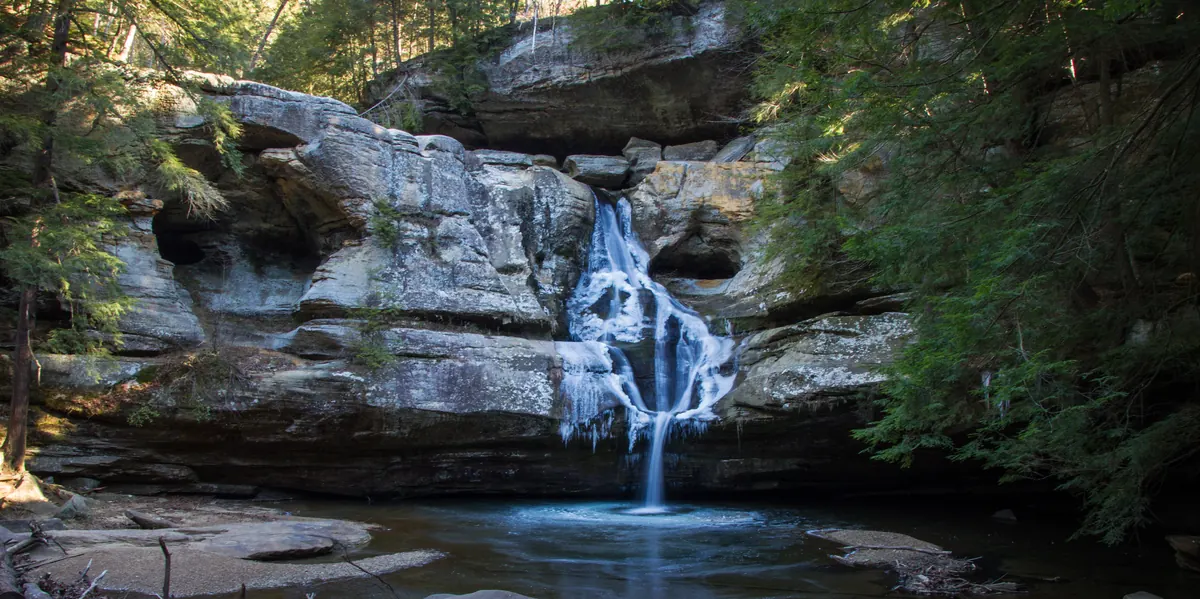
After several nights well below freezing · Cedar Falls, Ash Cave and the falls at Old Man’s Cave
In a cold January the seeps and spray in the sandstone gorges freeze into curtains and columns of ice, the scenery ODNR promises winter hikers. Admire it from the trail; ice breaks off the cliffs as the day warms.
-
Ohio buckeye twigs
All winter · Understory of woods in the western half of Ohio; scattered eastward, rare in the far northeast and southeast
The state tree is easy to learn in winter. Its twigs carry buds and leaf scars in opposite pairs, and the buds have overlapping scales that flare slightly at the edges. ODNR points out that they are small and dull next to the large, shiny, sticky buds of the planted horsechestnut. The gray to light brown bark breaks into subtle flaky ridges on older trees. Sketch one twig in the journal now, then go back to the same branch in April to watch the leaves unfold.
ODNR warns that the Hocking Hills trails are often icy in winter. Ice cleats over your boots make the steps and slopes far safer, and the short Ash Cave trail is the easiest choice for small children.
Will winter finches come to Ohio this year?
A few may, but probably more in the woods than at feeders. The Finch Research Network published its 2026–27 winter forecast, written by Tyler Hoar, on September 25, 2026. Seed crops are poor across the middle of Canada’s boreal forest but good from central Ontario east, with bumper crops of eastern white pine and northern white cedar. Birds abandoning that empty middle should drift east into the Great Lakes region and New England, then settle wherever cones are thick. Ohio sits at the southern edge of that zone, so treat everything below as a possibility rather than a promise.
-
Red crossbills
Unpredictable; from early winter on · Pine and spruce plantings, cemeteries and parks with mature conifers
The forecast’s most interesting note: a big irruption of Type 2 red crossbills has been moving west to east across the continent because pine crops failed in the interior West. Crossbills pry seeds from cones with their crossed bill tips and give loud, repeated kip notes as they fly. Their call types can only be told apart by recordings, so if you hear them, capture a short phone recording and add it to your eBird list.
-
Pine siskins
Most likely from January into spring · Conifers and birches; tube feeders with Nyjer or sunflower seed
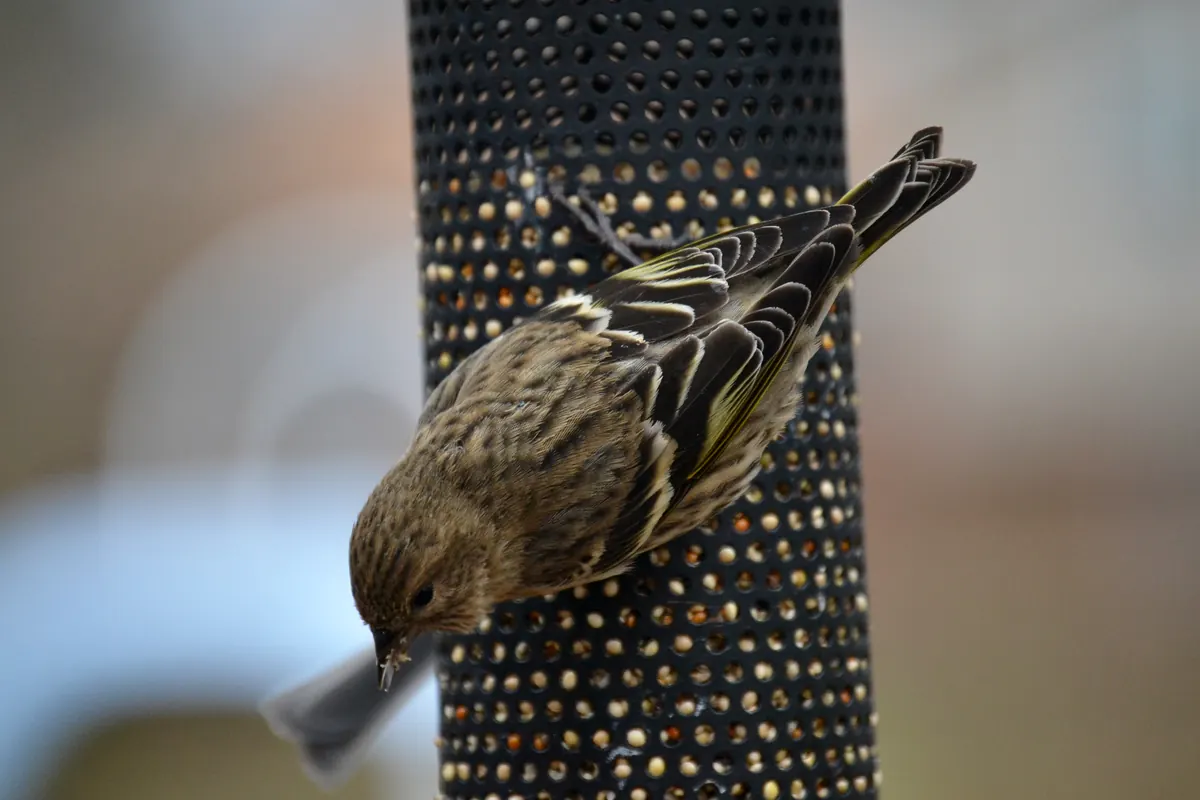
The forecast expects a sizable irruption in the northeastern states and allows for a small to moderate flight farther south. The last time the East had a great white pine crop, in 2023–24, siskins were plentiful from January into spring. Look for a little brown-streaked bird with yellow edging on the wings, usually in a busy, wheezing flock.
-
White-winged crossbills, redpolls and grosbeaks
If they come at all, midwinter · Spruces, including ornamental ones in towns; birches and weedy fields
Expect scattered flocks of white-winged crossbills roaming the Great Lakes region in search of spruce cones. Most redpolls should stay in Canada. Either would be a lucky find in Ohio, most likely in the north. Evening grosbeaks may make a small push as far as Pennsylvania, and after last winter’s big southward flight of red-breasted nuthatches, this year’s plentiful eastern cones are expected to keep most of them in Canada and the Northeast.
Feeder counts are how a forecast gets checked. Project FeederWatch runs through April, and the journal’s list of birds you have seen is the place to note the first siskin or crossbill of the winter.
How do Ohio’s animals get through the coldest weeks of winter?
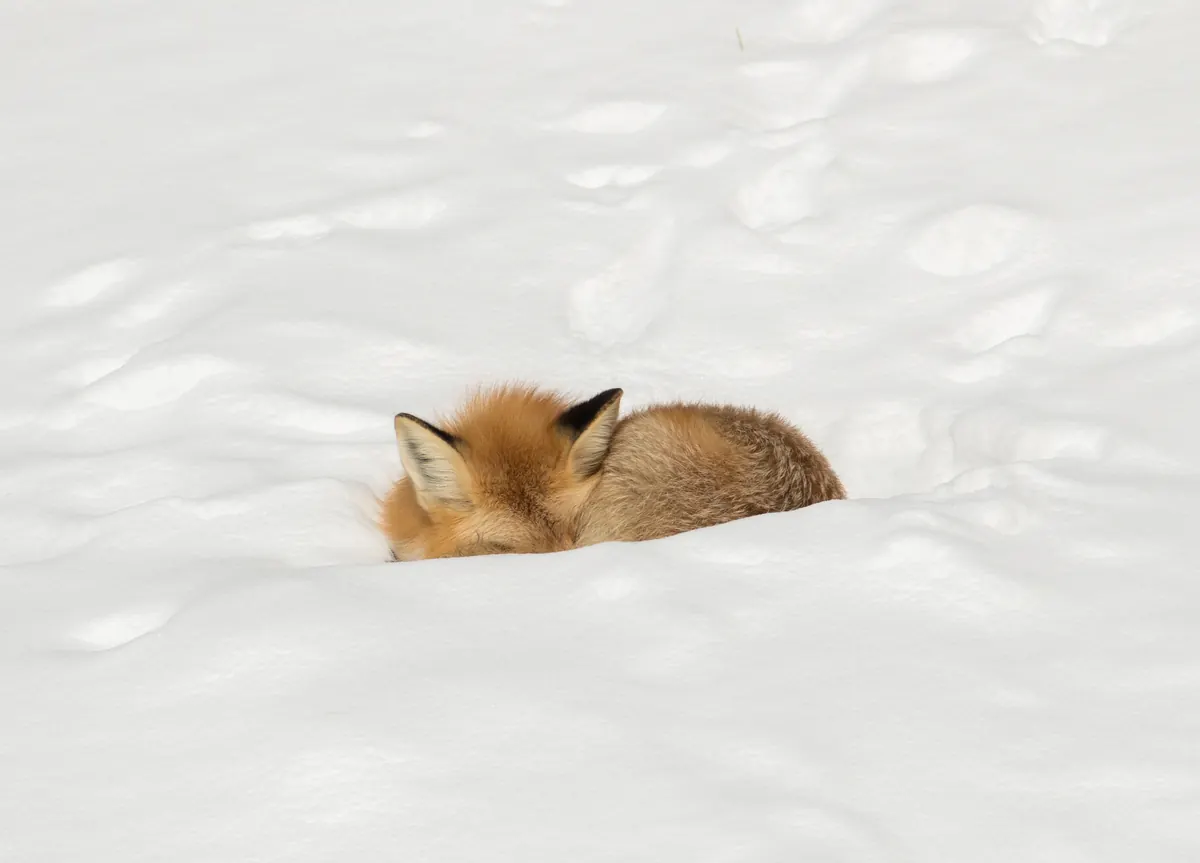
Every species has a strategy, from switching off almost completely to carrying on under the snow. Columbus’s Metro Parks naturalists describe the main ones.
-
Groundhogs: true hibernators
Asleep through midwinter; males stir in late winter · Burrows along fencerows, field edges and stream banks
In deep hibernation a groundhog’s heart drops from around 80 beats per minute to just 4 or 5, its body cools from 98 °F to 38 °F, the Metro Parks naturalists write. It lives on fat laid down by heavy eating in early fall. ODNR notes that breeding does not start until March, after the animals wake.
-
Skunks and raccoons: torpor
Out on mild nights, holed up in cold snaps · Woods, farms and neighborhoods
These animals drop into a lighter, easily broken torpor, living on stored fat and coming out to forage when the weather eases. A thaw brings their tracks out along the creek.
-
Mice and voles: life under the snow
Active all winter beneath the snowpack · Grassy fields, lawns and garden edges
Meadow voles and mice build small grass nests and run tunnels along the ground under the snow, where air caught between the flakes keeps them far warmer than the open fields above. On bitter nights a ruffed grouse may burrow into a drift for the same reason. When the snow melts, look for the winding runways and round grass nests left on the lawn. Foxes and owls hunt them by ear.
-
Reading the snow
The morning after a fresh snowfall · Creek banks, woods edges, the backyard
A cottontail’s big hind feet land in front of its small front feet; squirrels a similar pattern with the front feet side by side; deer a split heart. Photograph prints beside a glove for scale and draw them on the tracks to know plate. ODNR’s free mammal field guide includes track drawings for many Ohio species.
When are Ohio’s coldest days, and could El Niño soften this January?
In the third week of January, on average. NOAA’s 1991–2020 daily normals reach their lowest point around January 19 to 22 at Columbus and around January 17 to 22 at the Cincinnati airport, and Cleveland’s stay at their bottom from about January 19 to 26. January is the coldest month and, in most of the state, the snowiest. The table shows the split between the lake-effect country of the northeast and the rest of Ohio: a typical January brings about 18 to 20 inches of snow to Cleveland and Youngstown, against less than 10 inches at Columbus, Dayton and Cincinnati.
| Station | Average high | Average low | Snowfall | Snow-cover days | Nights at or below 32 °F | Nights at or below 0 °F |
|---|---|---|---|---|---|---|
| Toledo (Express Airport) | 34.7 °F | 20.3 °F | 12.3 in | 14.6 | 26.9 | 3.0 |
| Cleveland | 35.8 °F | 22.3 °F | 18.4 in | 17.4 | 25.8 | 1.5 |
| Akron-Canton | 35.5 °F | 20.3 °F | 13.4 in | 15.7 | 26.5 | 1.7 |
| Youngstown | 34.3 °F | 19.3 °F | 19.6 in | 19.0 | 26.7 | 1.9 |
| Columbus | 37.1 °F | 22.0 °F | 9.5 in | 10.7 | 24.9 | 1.4 |
| Dayton | 37.1 °F | 21.8 °F | 8.3 in | 10.7 | 25.9 | 2.4 |
| Cincinnati (CVG) | 39.6 °F | 23.1 °F | 7.7 in | 7.9 | 24.3 | 1.7 |
An average hides the swings. A typical Ohio January has one to three nights at or below zero, and it also has thaws that melt the snow cover back to bare ground. Log your porch thermometer’s low each morning in the daily field log. For spring planting, see our Ohio frost dates.
This winter the Pacific is the wild card: by mid-September, NOAA put the chances that the warm Pacific event peaks as a very strong El Niño at over ninety percent. In a study of El Niño winters going back to 1957 by the weather service’s Cleveland and Cincinnati forecasters, mild and dry seasons outnumbered the rest across Ohio and nearby states, the strongest events showed it most, and the lake-effect snowbelt kept its own counsel.
Lake Erie’s ice may show the effect best. A NOAA Great Lakes laboratory study of 1997–98, one of the century’s strongest El Niños and one of the mildest Great Lakes winters in two centuries of records, found that Erie’s ice topped out at just 5 percent, a record low; ice on all five lakes together peaked at 15 percent, under the old low of 25 percent from 1982–83, also a very strong El Niño winter. Storms that winter tracked farther south than usual. Two winters make no rule, and even a gentle season can throw in a frigid week. The official NOAA winter outlook, first issued in mid-October, is refreshed every month; find the latest version with the CPC seasonal outlooks, and check our current weather page for wind chill and lake-effect warnings on the day.
How much daylight does Ohio gain in January?
Roughly three-quarters of an hour, with Toledo and Cleveland gaining slightly more than Cincinnati and Athens. The change is hard to notice at first, under a minute a day around New Year’s, and builds week by week until, by late January, days are stretching by nearly two minutes at a time. Mornings are slow to share in it: sunrise is still at its most sluggish as the year begins and creeps earlier only gradually, so the gain shows up mostly in the evenings, on the drive or walk home.
| City | Jan 1 | Jan 31 | Gained | Per day |
|---|---|---|---|---|
| Toledo | 9 h 13 m | 10 h 01 m | 48 min | 1.6 min |
| Cleveland | 9 h 15 m | 10 h 01 m | 46 min | 1.5 min |
| Youngstown | 9 h 17 m | 10 h 03 m | 46 min | 1.5 min |
| Akron | 9 h 17 m | 10 h 04 m | 47 min | 1.6 min |
| Columbus | 9 h 24 m | 10 h 09 m | 45 min | 1.5 min |
| Dayton | 9 h 25 m | 10 h 09 m | 44 min | 1.5 min |
| Cincinnati | 9 h 29 m | 10 h 12 m | 43 min | 1.4 min |
| Athens | 9 h 28 m | 10 h 11 m | 43 min | 1.4 min |
To plan an outing around the light, look up your town’s exact times on our daylight calculator.
What can you see in Ohio’s night sky in January 2027?
January opens with a strong meteor shower on a nearly moonless night and closes with the biggest full moon of 2027, with Venus blazing before dawn and Jupiter climbing in the evening. Every time below is Eastern Standard Time, which covers all of Ohio.
-
Earth at perihelion
Saturday, January 2, 9:33 p.m. · Everywhere
Earth swings nearest the sun this evening, at roughly 91.4 million miles. Ohio is still cold because the low January sun spreads its light thinly, not because of distance.
-
The Quadrantid meteors
Night of Sunday, January 3, into Monday, January 4 · A dark field, facing northeast
The peak lasts only about six hours, and in 2027 it falls in the American night. The American Meteor Society’s prediction puts the peak near 10:30 p.m. on Sunday; another forecast, from EarthSky, has it closer to 12:47 a.m. Monday. The meteors seem to spring from a point below the Big Dipper’s handle that sits low in the north during the evening and rises higher after midnight, so the darkness just ahead of Monday’s sunrise should deliver the most. Only a thin crescent moon, rising a few hours ahead of the sun, interferes. Away from towns, a patient watcher could see several dozen in an hour; under suburban lights, only a handful.
-
Venus, the morning star
All month; farthest from the sun on Sunday, January 3 · Low in the southeast before sunrise
Venus is the brightest point in the sky other than the moon, rising well before the sun. On January 3 it stands 47 degrees from the sun, its widest separation of this morning appearance, and a small telescope shows a disk lit on one half, like a miniature first-quarter moon.
-
Dark evenings for stargazing
About January 3 to 12, around the new moon of January 7 · State parks and dark rural roads
Moonless evenings, good for the Orion Nebula in binoculars. Solar activity has eased since the 2024 peak of the sunspot cycle without fading out, and a big geomagnetic storm could still paint a red or green glow low over Ohio’s northern horizon; check the aurora forecast from NOAA’s space weather center.
-
The Wolf Moon, 2027’s closest full moon
Full at 7:17 a.m. Friday, January 22; watch Thursday night, January 21 · Rising in the east-northeast near sunset
The moon reaches perigee, its nearest point, late on the afternoon of January 21, under a day before it is full, so this is 2027’s closest full moon, about 222,229 miles away. It turns full just after Friday’s sunrise, so Thursday night is the one to watch, from moonrise at dusk until it sets in the morning; Friday evening’s moon looks just as round. On Saturday evening, January 23, the moon sits close beside Jupiter, with the bright star Regulus nearby.
-
Jupiter, Saturn and a glimpse of Mercury
All month · Jupiter in the east after dark; Saturn in the southwest; Mercury low in the west-southwest in the last days of January
Jupiter grows brighter through the month as it heads for opposition on the evening of February 10, after which it is visible the whole night through. Saturn, a steady pale-gold point, sits in the southwest at nightfall and sinks a little earlier every week. In the final days of January, look for Mercury close to the west-southwest horizon in bright twilight, about half an hour to 45 minutes after the sun sets; it will be easier still in early February.
| Phase | Date | Time |
|---|---|---|
| New moon | Thursday, Jan 7 | 3:24 p.m. |
| First quarter | Friday, Jan 15 | 3:34 p.m. |
| Full moon (Wolf Moon) | Friday, Jan 22 | 7:17 a.m. |
| Last quarter | Friday, Jan 29 | 5:55 a.m. |
Clouds decide most January sky plans in Ohio, so look at tonight’s cloud forecast before setting an alarm for the Quadrantids, and check local moonrise with our moon phases page.
What can Ohio families do outdoors in January 2027?
- Friday, January 1: a First Day Hike. Ohio’s state parks have joined this New Year’s Day tradition, part of America’s State Parks’ national program, for years, with naturalist-led walks at parks around the state. ODNR usually posts its list in December.
- Sunday night, January 3: the Quadrantids. A short look before bed, or an alarm before Monday’s dawn for keen watchers.
- Tuesday, January 5: the Christmas Bird Count closes. That is the last day of the official window, and some Ohio circles hold their day early in the new year; Audubon’s map lists every compiler.
- Mid-January, usually the third Saturday: the Hocking Hills Winter Hike. ODNR had not announced the 2027 date in early October; check with ODNR before you go. About six miles through the gorges with soup and cocoa along the way; younger walkers can do the short Ash Cave trail instead.
- Thursday, January 21: the Wolf Moon rises. Compare its size at moonrise with its size high overhead later.
- The morning after a snowfall: a track hunt. Park districts such as Columbus’s Metro Parks run tracking walks, or just follow the first prints in the yard.
Printable checklists for each month, and the guides for every state, are collected on our nature hub. December’s guide, with the Christmas Bird Count, is at Ohio in December.
Safety notes for January in Ohio
- Muzzleloader days and hunter orange. Ohio’s statewide deer muzzleloader season runs Saturday, January 2, through Tuesday, January 5, 2027. On those four days, Ohio’s rule is that anyone hunting anything except waterfowl at any time between a half hour before sunup and a half hour after sundown must have on a coat, vest or coveralls of solid hunter orange or orange camouflage. Anyone else on public hunting ground, from the state wildlife areas to the Wayne National Forest, is wise to add a bright orange hat or vest, and a vest for the dog as well.
- Seasons still open. Deer archery runs until February 7; squirrel and the fox, raccoon, skunk, opossum and weasel seasons until January 31; rooster pheasant and chukar until January 10; cottontail until February 28. Duck season closes January 10 in Zone B and January 31 in Zone C; goose season continues to February 1 in Zone A and February 15 in Zones B and C. Beaver, river otter, mink and muskrat trapping run through February 28, and Lake Erie marsh trapping until March 15, so watch for traps along marsh and stream edges and keep dogs leashed there.
- Ice. Follow ODNR’s minimum of 4 inches of new, clear ice for walking, test it yourself, and remember that snow-covered and refrozen ice is weaker. On Lake Erie, wind can open cracks and push floes offshore within hours; never walk on the shoreline ice ridges or the ice along breakwalls.
- Cold, wind and short days. A lakeshore wind turns an ordinary January day dangerous for exposed skin. Layer children up with hats and mittens, carry dry socks, end walks before sunset and pack a headlamp.
- Icy gorges and stream banks. Wear cleats on the Hocking Hills trails and along the steelhead rivers, stay back from cliff edges and icicles, and keep children off frozen streams, where current can leave thin ice over open water.
Sources
- ODNR: 715 bald eagles reported in Ohio during January count (Jan. 23, 2026)
- ODNR: Bald eagle species account
- ODNR Division of Wildlife: Wildlife Reporting System
- ODNR: Bald eagle breeding population status 2024
- ODNR: Great horned owl
- ODNR: Red fox
- ODNR: Coyote
- ODNR: Eastern chipmunk
- ODNR: Woodchuck/groundhog
- ODNR Division of Wildlife: Ohio’s steelhead program (fact sheet 024FH)
- ODNR: Ice thickness guidelines
- NASA Earth Observatory: A lake in winter (Lake Erie ice, Feb. 2022)
- NOAA GLERL: Great Lakes ice cover data and FAQ
- NWS: NOAA’s Great Lakes ice products and the low ice of winter 2023–24
- NWS Cleveland forecast office (lake ice outlooks, forecasts)
- Assel et al., Laurentian Great Lakes ice and weather conditions for the 1998 El Niño winter, BAMS (NOAA GLERL)
- ODNR: Step into winter, Hocking Hills 60th annual hike (Dec. 29, 2025)
- Hocking Hills Tourism Association: Annual Winter Hike
- ODNR: Hocking Hills State Park
- ODNR: Ohio buckeye
- Finch Research Network: Winter finch forecast 2026–2027
- eBird
- Project FeederWatch: How to participate
- Metro Parks (Columbus): Snow story 1, animals and snow
- Metro Parks (Columbus): Winter mammal tracks program
- ODNR Division of Wildlife: Mammals of Ohio field guide
- NOAA NCEI: Monthly climate normals 1991–2020, Ohio-area stations
- NOAA NCEI: Daily climate normals 1991–2020, Columbus, Cleveland and Cincinnati
- NOAA NCEI: U.S. climate normals
- NWS Cleveland: Climatological effects of El Niño in the lower Great Lakes and Ohio Valley
- NOAA CPC: ENSO diagnostic discussion, September 10, 2026
- NOAA CPC: Seasonal (90-day) outlooks
- NOAA Global Monitoring Laboratory: Solar calculator
- U.S. Naval Observatory: Moon phases
- U.S. Naval Observatory: Earth’s seasons and apsides, 2027
- Fred Espenak: Sky Event Almanac 2027
- American Meteor Society: Meteor shower calendar
- EarthSky: Quadrantid meteor shower
- EarthSky: What is a supermoon?
- NOAA Space Weather Prediction Center: Aurora 30-minute forecast
- America’s State Parks: First Day Hikes
- National Audubon Society: Christmas Bird Count
- ODNR Division of Wildlife: 2026–27 hunting and trapping season dates
- ODNR: Ohio hunting and trapping regulations
- Ohio Administrative Code 1501:31-15-11, deer hunting and hunter orange
- Photos via Wikimedia Commons; licenses and photographers are credited under each picture
