What to look for in nature in Ohio this December
Climatologists count winter from December 1, the start of Ohio’s coldest quarter of the year; the sky’s own start, the solstice, follows on the 21st. The songbird traffic is long gone, but the lake is not empty: goldeneye and mergansers raft off Cleveland by the thousands, late sandhill cranes ride the first hard cold fronts south, and owls hunt the marsh edges at dusk. Bears are already denned in the eastern hills, bats hang in caves and old mines, and the gorges of the Hocking Hills start to grow their ice. Here is what to look for, with dates.
Other months in Ohio: October, November.
Start here
- Join a Christmas Bird Count. Ohio had 69 count circles in the most recent Audubon compiler list, from Toledo and Ottawa National Wildlife Refuge to Portsmouth and the Hocking Hills. Each circle is counted on one day in the official window, December 14 to January 5; newcomers join experienced parties, and a feeder count at home also helps.
- Ducks, gulls and eagles on Lake Erie. Common goldeneye and the rarer northern gulls often do not reach full numbers until December. The Ottawa refuge opens its Wildlife Drive on Sunday, December 6, and the weekend of December 12–13.
- Geminids, solstice, Cold Moon. The best Geminid night is Sunday, December 13, into Monday morning, with no moon in the way after mid-evening. Winter begins astronomically at 3:50 p.m. EST on Monday, December 21, and the Cold Moon, the closest full moon of 2026, turns full on the evening of Wednesday, December 23.
Write it down: the Naturalist’s Field Journal has a “birds I have seen” list for your Christmas Bird Count tally, “tracks to know” for whatever crossed the first snow, a “mammal watch” page for the fox crossing the yard, and a “dusk and dawn watch” page for the owl hour and the earliest sunset. Date every entry.
Regions used below: Northwest and Lake Erie; Northeast and Cleveland; Central Ohio; Southwest and Cincinnati; Southeast and the Hocking Hills.
When is the Christmas Bird Count in Ohio, and how can you join?
The count began on Christmas Day, 1900, as a way to count birds rather than shoot them, and it has run every winter since. Every count fits inside a fixed circle 15 miles across, and its compiler picks one count day inside the official window. Audubon’s compiler list for the 125th count shows 69 circles in Ohio, among them Toledo, Ottawa N.W.R., Lake Erie, Cleveland, Mentor, Youngstown, Columbus, Hoover Reservoir, Dayton, Cincinnati, Athens, Hocking Hills, Killdeer Plains, Millersburg and Portsmouth. The 127th count runs from December 14, 2026, to January 5, 2027. Compilers post their dates in the fall, so use Audubon’s map to find the nearest circle and write to its compiler; experience is optional, since new counters are paired with a party leader who knows the birds.
-
The Cleveland count
The club usually counts on the Saturday before Christmas; the 2026 date is not yet posted · A circle on Cleveland’s east side, from the Cleveland Lakefront Nature Preserve to Eastlake and inland to North Chagrin and the Shaker Lakes
The Kirtland Bird Club, founded in 1940, runs this count and posts a full report every year. On December 20, 2025, a record 89 field observers walked 65 miles and drove 40 more, tallying 74 species and 38,236 birds. Lake Erie made the difference: at least 25,000 red-breasted mergansers, the second-highest total in the count’s history, plus record counts of 1,221 common goldeneye, 478 common mergansers and 24 bald eagles, up from a previous high of 16. The club notes that gull numbers have fallen steeply since the 1970s and 1980s and suggests less lake ice, or changes at the warm-water outlets along the shore, as possible reasons. Confirm the 2026 date with the club before you plan the day.
-
Counting from the kitchen window
On your circle’s count day · Any home inside a count circle
Most circles take feeder counts. If you live inside one, the compiler can add your tally for the day: the peak count of each species in view together, plus the hours you watched. In 2025 one Cleveland feeder watcher turned up the circle’s first trumpeter swan.
Copy the count-day list into the journal’s bird list, adding the weather and the hours you counted. The same circle, counted every December, is how the Cleveland club can show bald eagles climbing since the mid-1990s and red-bellied woodpeckers since about 1960.
What is on Lake Erie in December?
By December nearly every migrant has passed its peak, Black Swamp Bird Observatory says, yet stragglers keep moving all month, and some of the lake’s winter birds are only now arriving in full. The diving ducks move from late October into early December, so the big rafts are still building offshore. The Friends of the Ottawa refuge point out a quieter bonus: with the leaves gone, woodpeckers and resident songbirds are easier to see than at any time since March.
-
Common goldeneye and the merganser rafts
Building through December; goldeneye in full numbers by mid-month or later · Off the Cleveland lakefront, Eastlake, Lorain, Huron and the western basin harbors
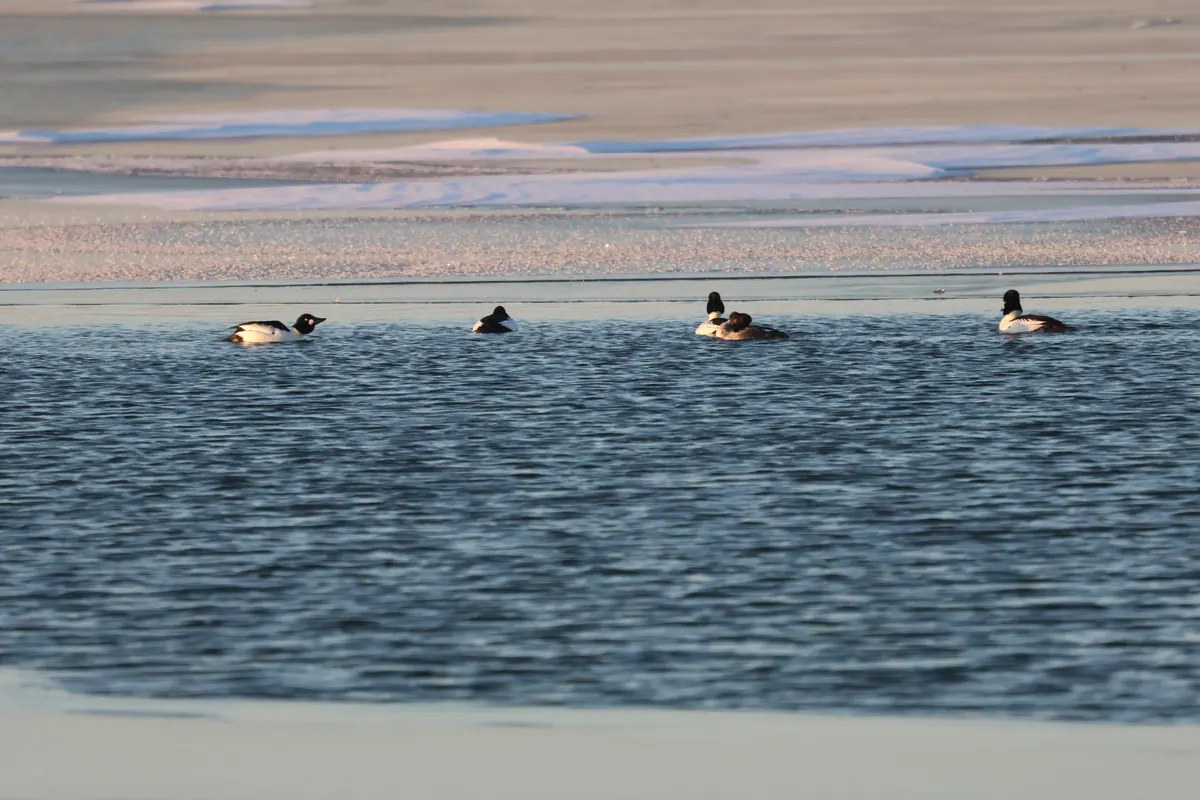
A drake goldeneye is a crisp black-and-white diving duck with a round white spot in front of the yellow eye; flocks fly with a whistle of wings you can hear from the breakwall. BSBO lists goldeneye among the winter ducks that may not be present in full numbers until December, and the Cleveland count’s record of 1,221 continues a rise that began about ten years ago. Red-breasted mergansers are the shaggy-crested ducks streaming past in long lines; on a good day they number in the tens of thousands. A spotting scope and a calm, gray morning are the right tools.
-
Rare northern gulls
Mostly late December into winter · Harbors, river mouths and warm-water outlets along the shore
BSBO notes that some rare northern gulls may not turn up until December. Look for a pale gull with no black at all in the wingtips among the herring gulls; that is the field mark that starts every argument about Iceland and glaucous gulls.
-
Eagles over open water
All month; more birds gather as inland ponds freeze · The lakeshore, the Ottawa refuge and big rivers
The Ottawa refuge’s Friends list bald eagles, red-tailed hawks, kestrels and the state-threatened northern harrier among the raptors hunting its open land in December. The Cleveland count’s 24 eagles show how far the recovery has come along the city shore itself. An adult with a fish on the ice edge, harassed by gulls, is a scene to sketch in the daily field log.
The Ottawa National Wildlife Refuge opens its Wildlife Drive on Sunday, December 6, and on Saturday and Sunday, December 12 and 13, with the gates opening at sunrise; the visitor center keeps Thursday-to-Sunday hours. Duck season stays open in parts of the lake country this month, so some marsh roads and dikes are busy with hunters on hunt days.
Why are sandhill cranes still flying over Ohio in December?
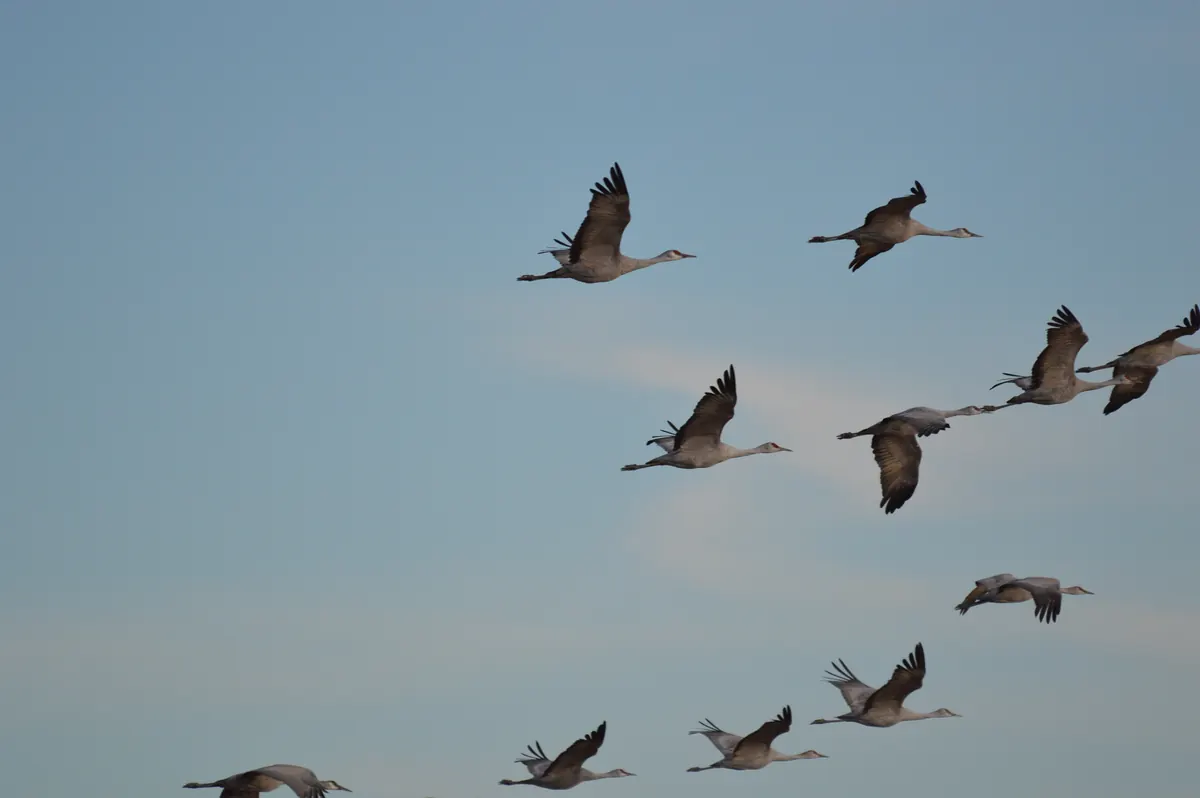
These are mostly not Ohio’s own cranes. The state’s small breeding population leaves for Florida in late fall, but the big flocks that stage north and west of Ohio have been staying later and later. Black Swamp Bird Observatory says they now wait in those staging areas until the weather forces them out, so their peak passage through Ohio is often in December. A strong cold front with a north or northwest wind behind it is the day to look up.
-
How to find them
The day after a strong December cold front, late morning to mid-afternoon · Statewide, especially the western half; listen first
Migrating cranes fly high, often in long, wavering lines or loose V’s, and you will usually hear the rolling, trumpeting calls before you find the birds. Unlike geese, they glide and circle on rising air between bouts of flapping, so a flock can hang over one spot for several minutes. Count them in tens, note the time and wind direction, and report the flight to eBird.
Sandhill cranes are listed as threatened in Ohio. If a flock lands in a field to rest, watch from the road and let them go on their way when they are ready.
Where can you see owls and winter hawks in Ohio in December?
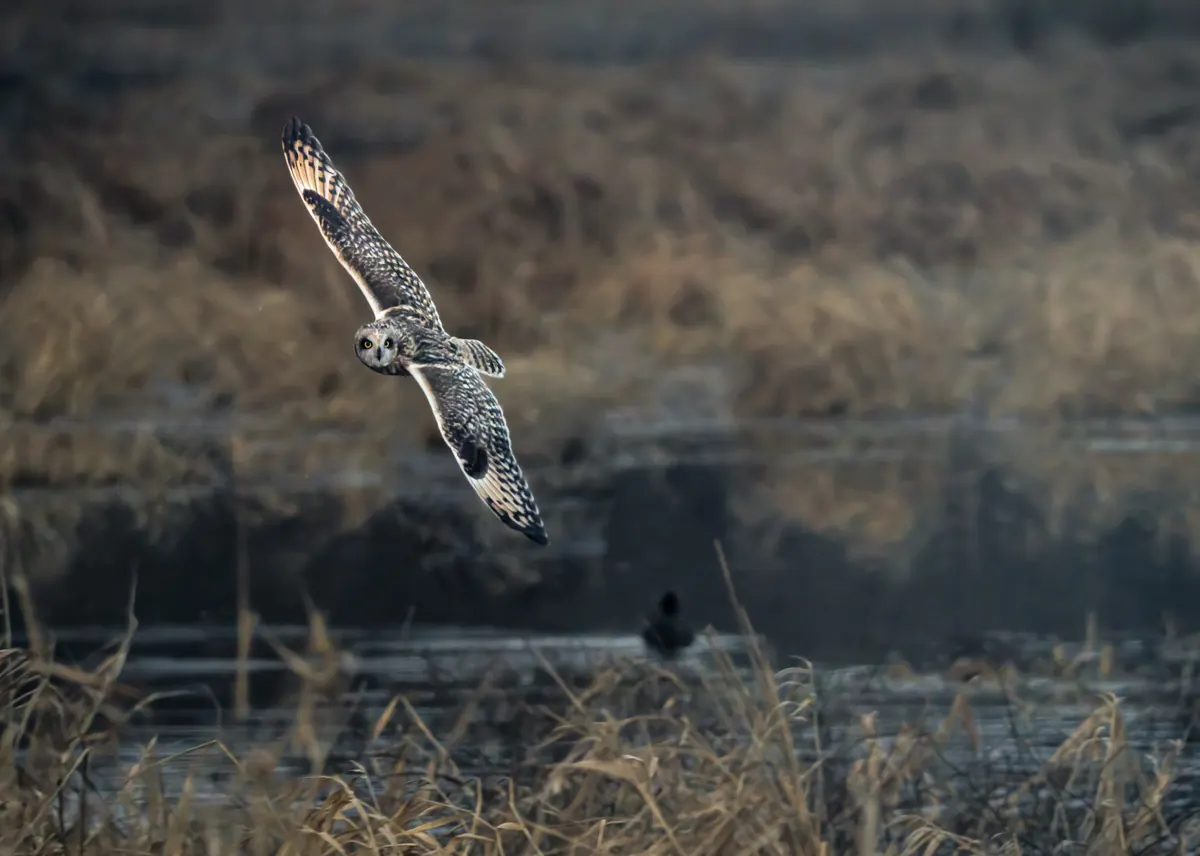
Open country is the place in December: marsh edges, wide hayfields and grassy reclaimed land, at the end of the afternoon. Bring binoculars, stay in or beside the car, and give every bird room.
-
Short-eared owls at dusk
Late afternoon into dusk, through the winter · Grasslands, cattail marshes and the Lake Erie marshes
ODNR calls the short-eared owl an occasional winter visitor and notes that, unlike most owls, it starts hunting in the late afternoon. It is a crow-sized, tawny, streaky bird with ear tufts so short you rarely see them, best known by its flight: low, floppy and moth-like over the grass, hunting meadow voles. Look for them in the half hour before dark, when harriers hand the field over to the owls.
-
Northern harriers
All winter, daylight hours · Marshes, fields and grasslands statewide
ODNR describes the harrier, once called the marsh hawk, as a common migrant and winter species that quarters the ground in low, tilting flight, wings held up in a shallow V. The white patch above the tail gives it away at any distance; gray adult males and brown females look like different birds. Winter harriers sometimes give a low, gruff bark.
-
Snowy owls
Possible from November through April; numbers vary hugely from year to year · Open shoreline, breakwalls, airports and flat farmland near the lake
The Ottawa refuge lists snowy owls as possible from November through April, and some winters bring several to the lakeshore while others bring almost none. Black Swamp Bird Observatory has helped Project SNOWstorm track them: an owl named Buckeye, caught at Detroit Metropolitan Airport and released with a transmitter north of Oak Harbor in February 2015, spent that summer on the Boothia Peninsula in Nunavut and came back to western Lake Erie the next winter. A second owl, Wolverine, was tagged at the observatory on January 3, 2020. If you find a snowy owl, keep well back and let it rest.
Report owls to eBird without the exact spot of any roost, and skip recorded calls and flash. Log the owl hour on the journal’s dusk and dawn plate.
How do Ohio’s bears, bats and frogs get through the winter?
By December most of Ohio’s cold-blooded animals and several of its mammals are out of sight. Each has its own strategy, and a few are surprising.
-
Black bears: denned, and the pregnancy begins
Dens from early November; implantation in early December · Forests of the northeast (Ashtabula, Geauga, Lake, Trumbull, Mahoning counties) and southeast (Washington, Athens, Hocking, Vinton counties)
ODNR says a sow goes into the winter den in early November with her cubs of the year, which may weigh 70 to 80 pounds by then. Bears mate in June and July, but the fertilized egg does not attach until early December, followed by about six weeks of gestation, so cubs weighing about half a pound are born in the den in midwinter. Black bears are a state-endangered species in Ohio. Most bears reported here are young males wandering in from Pennsylvania and West Virginia, although ODNR has documented females with cubs in several northeast counties near the Pennsylvania line.
-
Bats in caves, mines and attics
Hibernating from November to March · Caves and mines in southern Ohio; buildings statewide
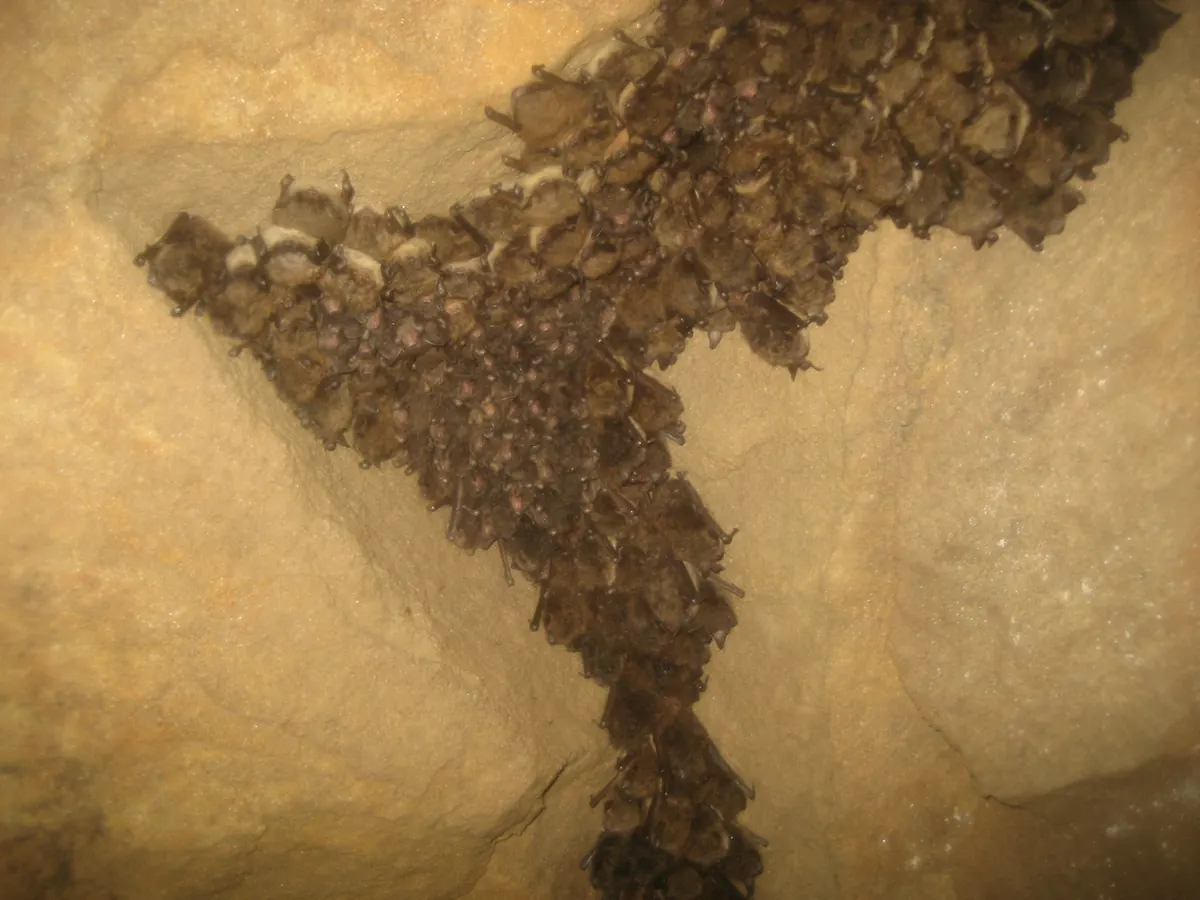
Little brown bats hibernate in caves, mines and rock crevices from November to March, ODNR says, while big brown bats spend the same months alone or in small groups, usually in buildings. The federally endangered Indiana bat travels to caves in southern Ohio and nearby states, where it hangs in tight clusters, often of 400 or more, on ceilings and walls. Ohio’s Cave Protection Act covers those hibernating bats. Every waking costs a hibernating bat fat it cannot replace, so stay out of caves and mines in winter, and if a bat turns up in the attic in December, call a wildlife professional rather than putting it outside in the cold.
-
Wood frogs under the leaves
Through the winter, until late February or early March · Moist woods statewide
ODNR calls the wood frog Ohio’s most terrestrial frog; it even hibernates on land, under leaf litter rather than in a pond. Its range reaches farther north than that of any other North American amphibian, all the way to the tundra in Labrador and Alaska. By late February or early March it will be clucking from woodland ponds that still have ice around the edges.
-
Tracks in the first snow
The morning after any snowfall · Woods edges, creek banks, the backyard
Gray squirrels, cottontails, deer, foxes and raccoons stay active all winter, and the first good snow writes their nights down for you. A fox walks in a near-straight line of single prints; a rabbit leaves two long pair of long hind feet that land in front of the two small front feet; a raccoon’s hand-like prints head for water. Sketch one trail on the “tracks to know” page and follow it backward to where it started.
What do the Hocking Hills and Ohio’s evergreens look like in December?
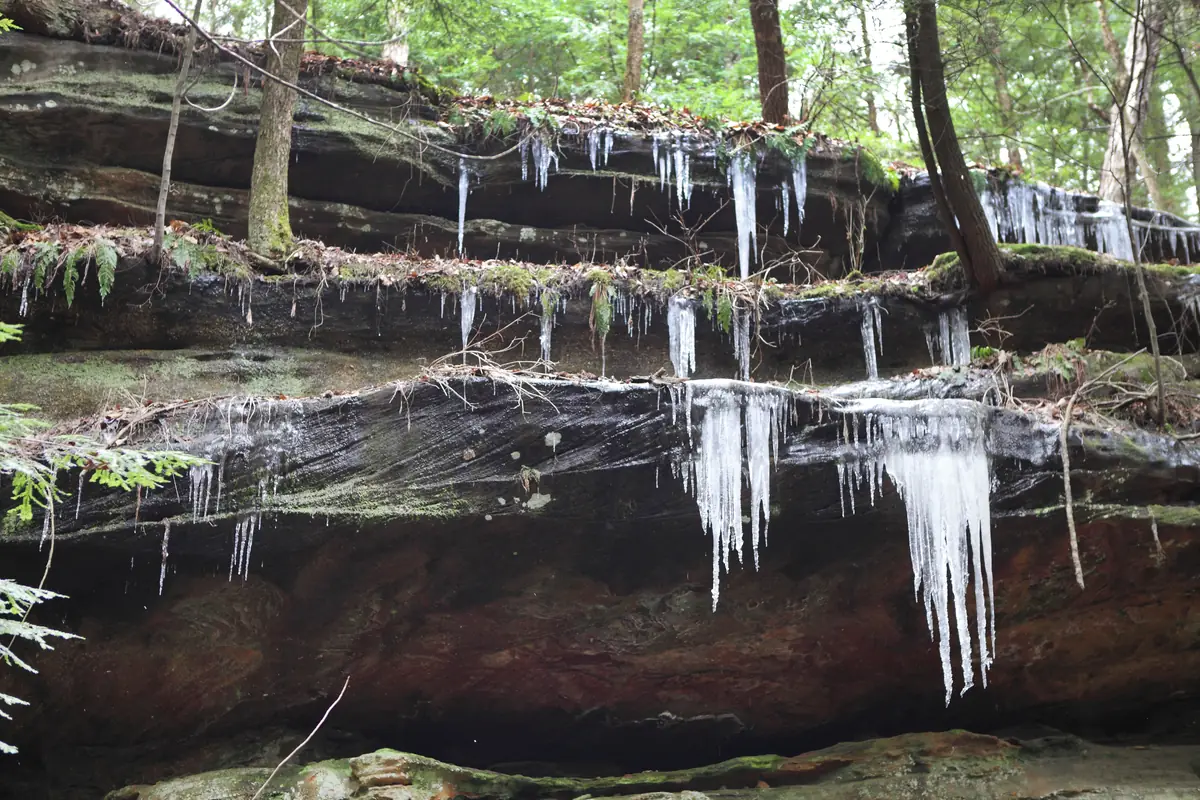
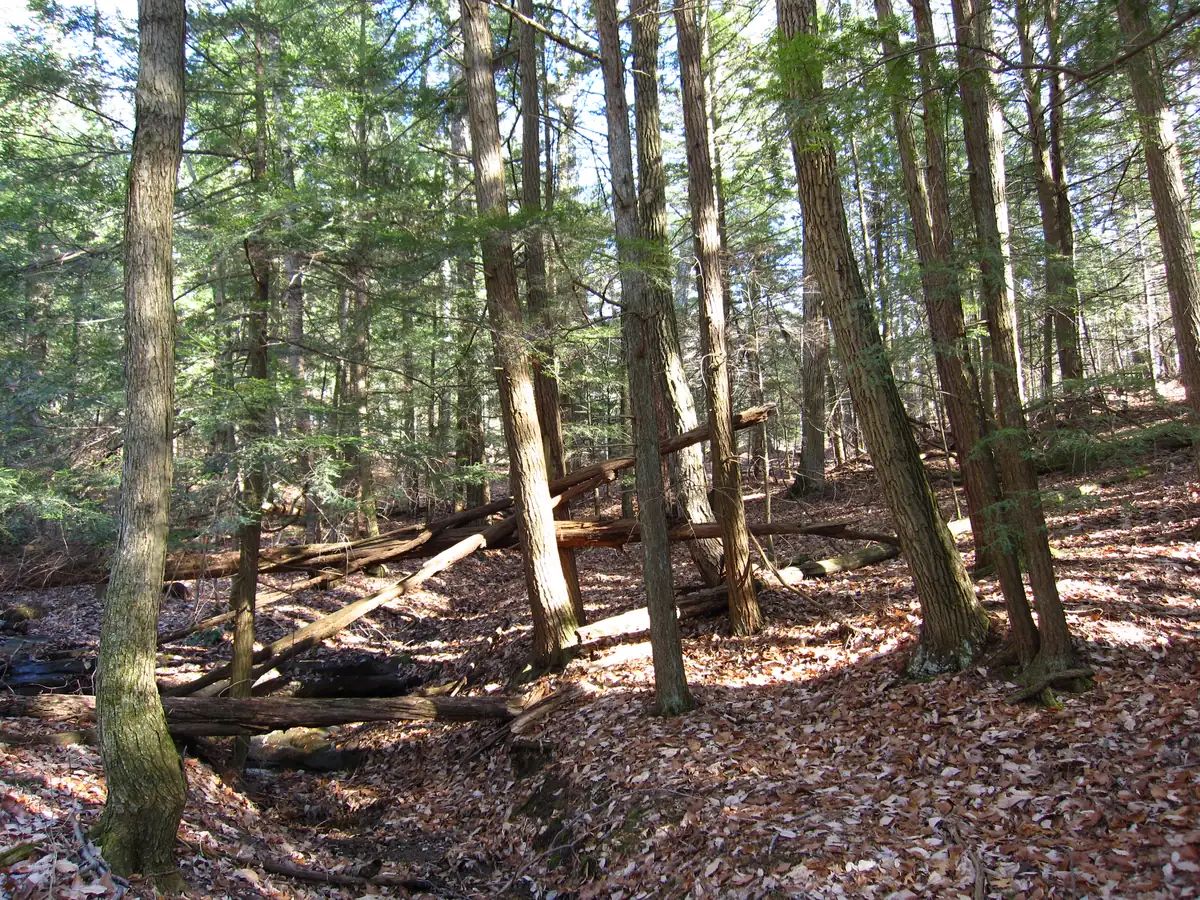
ODNR describes Hocking Hills State Park as a place of towering cliffs, waterfalls and deep gorges shaded by hemlocks, known for stunning ice formations in winter. In December the first ice starts to build as spray and seeps freeze on the Black Hand sandstone, and the hemlocks are the darkest green in the woods. Conkles Hollow, nearby, has cliffs nearly 200 feet high and a gorge some call the deepest in Ohio, only 100 feet wide in places.
-
Eastern hemlock
Evergreen all year; easiest to pick out in the bare December woods · Cool, shaded gorges and north-facing slopes, above all in the Hocking Hills
Hemlock needles are short, a third to two-thirds of an inch, flat and blunt, and they sit in two flat rows along the twig. The cones are tiny, under an inch, hanging from the twig tips, and the tree tolerates deep shade. Collect a fallen sprig and a cone for the seeds-pods-and-cones page.
-
Eastern white pine
All year · Native in northeast Ohio; widely planted elsewhere
White pine carries its soft, bluish-green needles in bundles of five; count them, one for each letter of “white.” The long cones, six to eight inches, lie under the tree all winter. Birds and mammals use the tree for food and shelter.
-
Eastern red cedar and its blue “berries”
Fruit through winter · Fencerows, old fields and rocky limestone ground
Red cedar is a juniper, and its bluish “berries” are really small, fleshy cones. Many birds and small mammals eat them, according to the Wildflower Center, the cedar waxwing among them; the bird is named for this tree. A cedar thick with fruit is a good place to wait for waxwings, robins and bluebirds on a cold morning.
The Hocking Hills trails open half an hour before sunrise and close half an hour after sunset, and ODNR warns that in winter they are typically covered in ice; wear ice cleats and good boots. The quarter-mile Ash Cave Gorge trail is easy and wheelchair accessible, a good choice for a short December walk. The Hocking Hills calendar lists Christmas in Ash Cave on Saturday, December 12, from 3 to 5 p.m., free, with crafts, music, cocoa and Santa. Last month’s guide, with the tamaracks of Kent Bog, is at Ohio in November.
How much snow does Ohio get in December?
December is when snow starts to stick. NOAA’s 1991–2020 normals give December highs in the upper 30s to low 40s and lows in the mid-to-upper 20s across the state, and the snowfall divides along the lake and the plateau: about 15 inches at Youngstown and 12 at Cleveland, against 4 to 5 inches at Columbus, Dayton and Cincinnati. The last column is the one children care about, how many December days, on average, have an inch or more of snow lying on the ground.
| Station | Average high | Average low | Precipitation | Snowfall | Snow-cover days |
|---|---|---|---|---|---|
| Toledo (Express Airport) | 39.4 °F | 26.1 °F | 2.44 in | 6.5 in | 7.7 |
| Cleveland | 40.4 °F | 28.2 °F | 2.99 in | 12.2 in | 10.1 |
| Akron-Canton | 39.9 °F | 26.1 °F | 2.89 in | 8.9 in | 8.8 |
| Youngstown | 38.7 °F | 25.5 °F | 3.17 in | 14.8 in | 12.0 |
| Columbus | 41.5 °F | 27.4 °F | 3.13 in | 5.1 in | 5.1 |
| Dayton | 41.5 °F | 27.1 °F | 3.05 in | 4.8 in | 5.6 |
| Cincinnati (CVG) | 43.3 °F | 27.9 °F | 3.73 in | 4.1 in | 4.2 |
Those snowfall figures are for the airports. East of Cleveland, in the Geauga and Ashtabula snowbelt, a lake-effect band can bury one township while the next one over sees only flurries, so long as the lake stays open and the wind is right. For the first snow at your house, start a line in the daily field log: date, depth, and how long it lasted. Our Ohio frost and freeze page has the last-spring and first-fall dates for every station, if you are already planning next year’s garden.
Will El Niño make this a mild, dry December in Ohio?
It tilts the odds, without settling anything. The federal Climate Prediction Center’s September 10, 2026, update says this El Niño has a better than 90 percent chance of growing very strong before spring. The best Ohio-specific study comes from the Cleveland and Cincinnati weather offices, which compared the November-to-March weather of eight El Niño winters, starting in 1957, at 17 airport stations across Ohio and its neighbors against the 1951–1980 averages. Five of the eight ran warmer than normal, and across all eight the region averaged 0.45 °F above normal; seven of the eight came out dry, short by an average of 1.82 inches of precipitation. Snow ran below normal at many stations, most clearly away from the lake, while the lake-effect and hill stations showed no El Niño signal at all.
The authors added that strong events are the ones most likely to affect Ohio’s winter, and that warmer, drier winters during moderate and strong El Niños usually mean less snow outside the lake-effect areas. They also flagged a less obvious risk: a dry winter without an insulating snow cover can hurt winter wheat, and some Ohio Valley droughts have started in a dry El Niño winter. None of that predicts a single storm, and a mild season can still bring a sharp cold week. NOAA’s official winter outlook is published on October 15; once it is out, the winter maps will be posted with the other CPC 90-day outlooks.
For radar, current conditions and any lake-effect snow warning, open Weather now before you set out.
When is the earliest sunset in Ohio?
Not on the solstice. The shortest day is Monday, December 21, when Columbus gets 9 hours 20 minutes of daylight and Cleveland 9 hours 10, yet the sun sets earliest in the first part of December and the latest sunrises not until early January, because solar noon drifts later through the month. Youngstown’s sun goes down earliest of these cities, at 4:54 p.m.; Cleveland’s at 4:57, Columbus’s at 5:07 and Cincinnati’s at 5:15. The minimum is so shallow that each city’s sunset stays within that same minute for several days running; the table gives the middle of that stretch, December 7 or 8. By December 31 the evenings have gained a few minutes back, even while the mornings keep getting darker into the new year.
| City | Dec 1 | Dec 21 | Dec 31 | Earliest sunset |
|---|---|---|---|---|
| Toledo | 9 h 23 m | 9 h 09 m | 9 h 13 m | 5:04 p.m., Dec 8 |
| Cleveland | 9 h 24 m | 9 h 10 m | 9 h 14 m | 4:57 p.m., Dec 8 |
| Youngstown | 9 h 27 m | 9 h 13 m | 9 h 16 m | 4:54 p.m., Dec 8 |
| Akron | 9 h 26 m | 9 h 13 m | 9 h 16 m | 4:57 p.m., Dec 8 |
| Columbus | 9 h 32 m | 9 h 20 m | 9 h 23 m | 5:07 p.m., Dec 7 |
| Dayton | 9 h 34 m | 9 h 22 m | 9 h 24 m | 5:12 p.m., Dec 7 |
| Cincinnati | 9 h 38 m | 9 h 25 m | 9 h 28 m | 5:15 p.m., Dec 7 |
| Athens | 9 h 37 m | 9 h 23 m | 9 h 27 m | 5:05 p.m., Dec 7 |
To plan a walk that ends before dark, look up your own town on the Field almanac.
What can you see in Ohio’s night sky in December?
The longest nights of the year bring one of the best meteor showers, a solstice and the biggest-looking full moon of 2026. Saturn is the lone evening planet, south to southwest after dusk, and by the last week of the month it sets about four hours behind the sun. Before dawn, brilliant Venus rules the southeast, with Jupiter and a slowly brightening Mars higher up. All times are Eastern Standard Time.
-
The Geminid meteors
Night of Sunday, December 13, into Monday, December 14; best around 2 a.m. · Anywhere dark, away from town lights
Under a perfect sky the Geminids can reach about 150 an hour, by the International Meteor Organization’s figures, and the IMO calls this year’s maximum moon-free, since the slim crescent drops below the horizon by mid-evening. From a dark rural site you will see a fraction of that number, which is still more than any other shower gives. The radiant in Gemini climbs highest around 2 a.m., which is why the hours after midnight are best. Dress for a long, cold wait and lie back on a reclining chair with blankets.
-
The winter solstice
Monday, December 21, 3:50 p.m. EST · Everywhere
Then the sun turns back north, and at midday Ohio’s sun stands at its lowest of the whole year. Measure your shadow at midday and compare it with the same measurement in June. That evening the waxing moon passes near the Pleiades star cluster, closest around 6 p.m.
-
The Cold Moon, the closest full moon of 2026
Full at 8:28 p.m. Wednesday, December 23; Christmas Eve nearly as full · Rising in the east around sunset
Only about seven hours separate the full phase from perigee, when the moon swings nearest to Earth, which makes it 2026’s closest full moon and a genuine supermoon. Seen rising behind bare trees it looks enormous, though the extra size over an average full moon is too slight for the eye to judge.
-
Moon, Venus and Spica at dawn
Before sunrise, December 4 and 5 · Low in the southeast
A waning crescent moon sits about four degrees from the star Spica on the 4th, with Venus farther along; by the 5th the moon has moved closer to Venus. Venus is far brighter than anything else in the morning sky now; binoculars show the earthshine on the dark part of the moon.
-
The Ursids, and a preview of January
Ursids before dawn December 22 and 23; Quadrantids peak the evening of January 3 · North, near the Little Dipper
The Ursids are a minor shower, around ten meteors an hour at best, and a moon that is 96 to 98 percent lit will hide most of them this year. The Quadrantids are the better bet: the IMO times their maximum for the evening of January 3, 2027, around 10:30 p.m. EST, a few days before new moon, so the moon will not get in the way.
| Phase | Date | Time |
|---|---|---|
| Last quarter | Tuesday, Dec 1 | 1:08 a.m. |
| New moon | Tuesday, Dec 8 | 7:52 p.m. |
| First quarter | Thursday, Dec 17 | 12:42 a.m. |
| Full moon, the Cold Moon | Wednesday, Dec 23 | 8:28 p.m. |
| Last quarter | Wednesday, Dec 30 | 1:59 p.m. |
Clouds ruin more Geminid nights than moonlight does, so check Today’s sky first. For the Cold Moon’s rising time in your town, open our moon phases page.
What can Ohio families do outdoors in December 2026?
- Sunday, December 6, or Saturday and Sunday, December 12–13: the Ottawa refuge Wildlife Drive. A slow drive through the marsh from sunrise, looking for eagles, harriers and swans; bring binoculars and a thermos.
- Saturday, December 12, 3 to 5 p.m.: Christmas in Ash Cave. Free, with crafts, music, cookies and cocoa at Ash Cave; the short gorge trail to it is accessible.
- Sunday night, December 13: the Geminids. Count meteors for 15 minutes after the moon sets, then go to bed; older children can try the 2 a.m. peak on a non-school night.
- Mid-December to early January: a Christmas Bird Count. Write to your nearest circle’s compiler now. The Kirtland Bird Club usually holds the Cleveland count on the Saturday before Christmas; check with the club for this year’s date.
- Monday, December 21: the solstice. Mark your noon shadow with chalk on the driveway, and note the sunset time; it is already a little later than it was in early December.
- Wednesday, December 23: the Cold Moon. Go out at moonrise and sketch it against the bare trees.
- Friday, January 1, 2027: First Day Hikes. Guided walks on New Year’s Day are a national tradition coordinated by America’s State Parks, and Ohio’s parks usually join in; look for Ohio’s 2027 list on the ODNR events calendar in December.
- All winter: a feeder count. Project FeederWatch runs until April 30; a two-day count every week or two adds Ohio data, and the bird list in the journal will fill quickly.
A printable December checklist for the fridge, and the guides for other states, live on our nature hub.
Safety notes for December in Ohio
- Deer gun days and hunter orange. Deer gun season runs Monday, November 30, through Sunday, December 6, and again Saturday and Sunday, December 19 and 20; muzzleloader season follows January 2–5, and archery stays open until February 7. On those gun and muzzleloader days, ODNR’s regulations require anyone hunting any wild animal other than waterfowl to show solid or camouflage hunter orange on a vest, coat, jacket or coveralls during legal hours, which begin 30 minutes before sunrise and end 30 minutes after sunset, on private land as much as public. Coyote and furbearer hunters must wear orange whenever they hunt in deer-season hours. On those days birders, count parties and anyone walking public hunting land, including the Wayne National Forest, should put on orange too, and dress the dog in it.
- Other seasons open this month. Squirrel and furbearers such as fox and raccoon run through January 31, cottontail through February 28, and rooster pheasant through January 10. Duck season closes December 27 in Zone A, runs to January 10 in Zone B, and reopens December 12 in Zone C through January 31; dove and snipe reopen December 12 through January 1; beaver and river otter trapping open December 26.
- No safe ice yet. December ice on ponds and reservoirs is thin, uneven and often weakest where springs or currents flow; keep children and dogs off it, and never go onto Lake Erie shore ice or the ice shelves on the breakwalls.
- Icy trails and short days. Gorge trails in the Hocking Hills are typically iced over in winter; wear cleats and turn back at any sheet of ice on a slope. With the sun setting around 5 p.m. or earlier, start afternoon hikes by 2 or 2:30 and carry a headlamp.
- Cold and wind. On the lakeshore a 20-mile-an-hour wind makes a 25 °F morning feel far colder. Dress children in layers with a hat and mittens, keep a dry pair of socks in the car, and come in when fingers go numb rather than when they hurt.
Sources
- National Audubon Society: Christmas Bird Count (December 14 to January 5)
- National Audubon Society: join or start a Christmas Bird Count
- National Audubon Society: count circles, codes and compilers in the 125th Christmas Bird Count (PDF)
- Kirtland Bird Club: past Cleveland Christmas Bird Count reports (2025 count, December 20, 2025)
- Kirtland Bird Club: about Christmas Bird Counts and the Cleveland circle
- Black Swamp Bird Observatory: timing of fall migration (December, waterfowl, sandhill cranes)
- Friends of Ottawa National Wildlife Refuge: timing of bird migration (December raptors, snowy owls)
- Friends of Ottawa National Wildlife Refuge: 2026 Wildlife Drive schedule and visitor center hours
- U.S. Fish and Wildlife Service: Ottawa National Wildlife Refuge, species and seasons
- ODNR Division of Wildlife: sandhill crane (state status)
- eBird: report sightings
- ODNR Division of Wildlife: short-eared owl
- ODNR Division of Wildlife: northern harrier
- Black Swamp Bird Observatory: BSBO and Project SNOWstorm (Buckeye and Wolverine)
- Black Swamp Bird Observatory: meet Buckeye
- ODNR Division of Wildlife: black bear (denning, delayed implantation, 2023 update)
- ODNR Division of Wildlife: Indiana bat
- ODNR Division of Wildlife: little brown bat
- ODNR Division of Wildlife: big brown bat
- ODNR Division of Wildlife: wood frog
- ODNR: Hocking Hills State Park (hemlock gorges, winter ice, trails)
- ODNR: Conkles Hollow State Nature Preserve
- Hocking Hills calendar of events, December 2026 (Christmas in Ash Cave)
- Minnesota DNR: eastern hemlock (needles, cones, shade tolerance)
- Lady Bird Johnson Wildflower Center: eastern white pine
- Lady Bird Johnson Wildflower Center: eastern red cedar
- NOAA NCEI: 1991–2020 monthly normals for Ohio-area stations, December (data API)
- NOAA NCEI: U.S. climate normals
- NWS Cleveland and Cincinnati: climatological effects of ENSO in the lower Great Lakes and Ohio Valley
- Climate Prediction Center: ENSO diagnostic discussion, September 10, 2026
- Climate Prediction Center: seasonal outlooks (winter outlook due October 15, 2026)
- NOAA Global Monitoring Laboratory: solar calculator (sunrise, sunset, solar noon)
- U.S. Naval Observatory: Earth’s seasons, 2026 (solstice time)
- U.S. Naval Observatory: moon phases from November 2026 (data API)
- International Meteor Organization: 2026 meteor shower calendar (PDF)
- EarthSky: what is a supermoon? (2026 full supermoons)
- BBC Sky at Night Magazine: supermoons of 2026
- RASC Observer’s Handbook 2026: lunar occultations (Pleiades, December 21)
- NASA JPL Horizons: planetary and lunar ephemerides
- International Meteor Organization: 2027 meteor shower calendar (Quadrantids)
- America’s State Parks: First Day Hikes
- Project FeederWatch: how to participate
- ODNR Division of Wildlife: Ohio’s 2026–27 hunting and trapping season dates (PDF)
- ODNR Division of Wildlife: Ohio hunting and trapping regulations 2026–27 (PDF; hunter orange, coyote and furbearer rules)
- Ohio Administrative Code 1501:31-15-11: hunter orange requirement
- Photos via Wikimedia Commons; licenses and photographers are credited under each picture
