What to look for in nature in Ohio this November
November in Ohio belongs to the big birds and the cold water. Tundra swans come down out of Canada in noisy family flocks, bald eagles tidy up their nests for a February clutch, steelhead nose up the rivers from the Vermilion to Conneaut Creek after every soaking rain, and the bucks lose their caution. The snowbelt gets its first lake-effect bands while the last gold hangs on in the southern hills and in one Ice Age bog near Kent. What follows goes region by region, each with its dates.
Other months in Ohio: October, December.
Start here
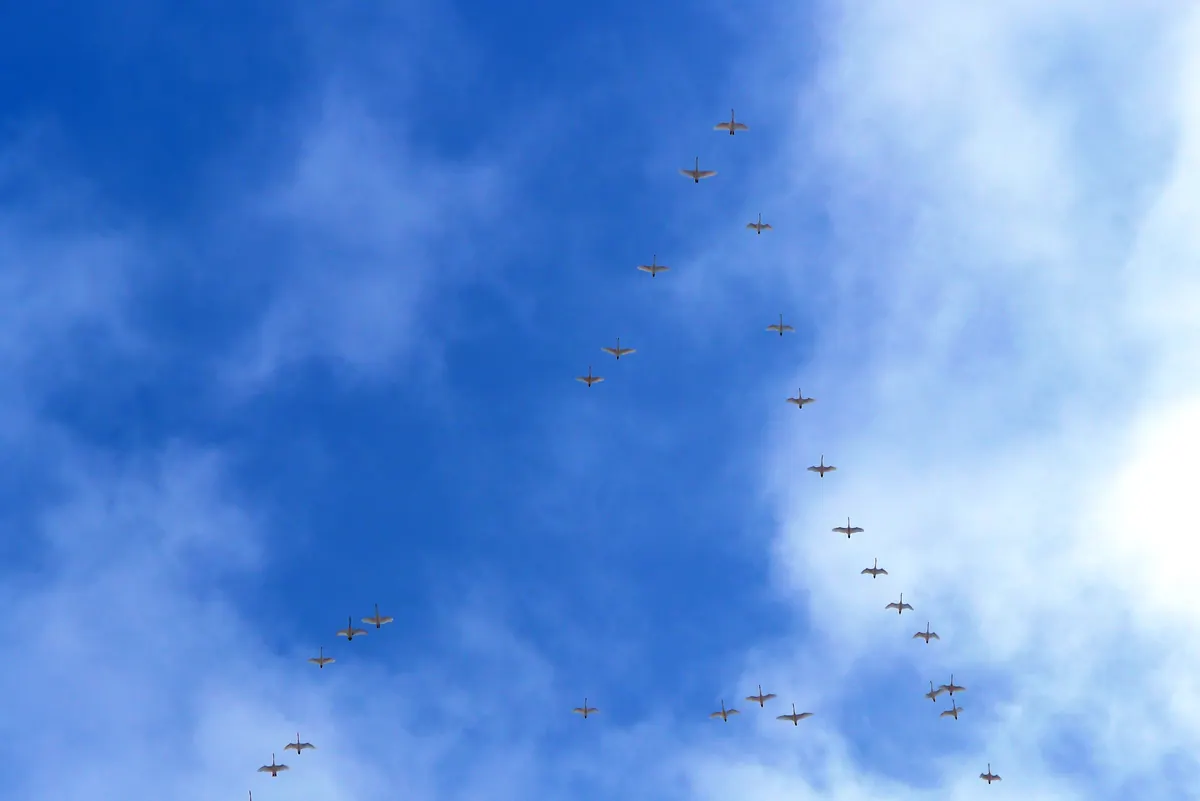
- Tundra swans on the move. The swans reach the western Lake Erie marshes in mid-November, and Black Swamp Bird Observatory counts November as their peak month. Listen for high, yelping flocks overhead, then drive the Ottawa refuge’s Wildlife Drive over Thanksgiving weekend, November 26–29, when the gates open at sunrise.
- Steelhead after the rain. Each spring ODNR releases 450,000 young steelhead into seven rivers and creeks between the Vermilion and Conneaut Creek, and the fall-to-spring river fishery opens in November. The first high water of the month sends silver fish up the Rocky, the Chagrin and the Grand; a bridge over a riffle is the best seat.
- Planets before dawn, then the Beaver Moon. Mars and Jupiter meet low in Leo before sunrise on November 15 and 16, with brilliant Venus climbing below them. Leonid meteors fly best once the moon has set, in the small hours of November 18. Tuesday morning, November 24, brings the Beaver Moon to full at 9:53 a.m. EST, and it qualifies as a small supermoon.
Things to write down in the Naturalist’s Field Journal this month: the season’s first swans for the “birds I have seen” list; the bare oak that still rattles its brown leaves on “a tree through the seasons”; a buck scrape on the “reading the signs” plate; the deer that now cross your road at 5 p.m. on the dusk and dawn watch. Date every entry.
Regions used below: Northwest and Lake Erie; Northeast and Cleveland; Central Ohio; Southwest and Cincinnati; Southeast and the Hocking Hills.
When do tundra swans arrive in Ohio, and where can you see them?
On Lake Erie, November is the peak for swans, geese and most ducks. Black Swamp Bird Observatory says all three reach their highest numbers this month, with common loons and horned grebes peaking at the same time. The songbird rush is over; the big birds have taken its place.
-
Tundra swans
Arriving mid-November; peak numbers November into December; some stay through winter · Ottawa National Wildlife Refuge, Magee Marsh and the farm fields south of them; inland at Killdeer Plains and Big Island wildlife areas
The Friends of Ottawa refuge date the arrival to mid-November, and the refuge describes thousands of swans shuttling between its marshes and the farm fields to the south once the flocks build. Columbus Audubon calls their brassy calls, dropping from high flocks in November and December, “one of the real treats of late fall birding here.” Families travel together, so flocks are big and talkative, with gray first-year birds among the white adults. ODNR has brought trumpeter swans back to the same marshes; a trumpeter is nearly half again as large, with a long, straight “Roman nose” of a bill and a soft, toy-horn toot.
-
Rafts of diving ducks, loons and gulls on the lake
Building through November; goldeneye and the rarer northern gulls more in December · Offshore from Huron to Conneaut; Sandusky Bay; Cleveland lakefront parks and harbors
The Ottawa refuge’s migration notes describe thousands of red-breasted mergansers and other diving ducks rafting offshore in November, while gull numbers climb; Black Swamp Bird Observatory adds very large gatherings of Bonaparte’s gulls, small and tern-like with a dark ear spot. A spotting scope on a breakwall at Huron, Lorain or Edgewater on a calm morning shows lines of ducks invisible from the beach.
-
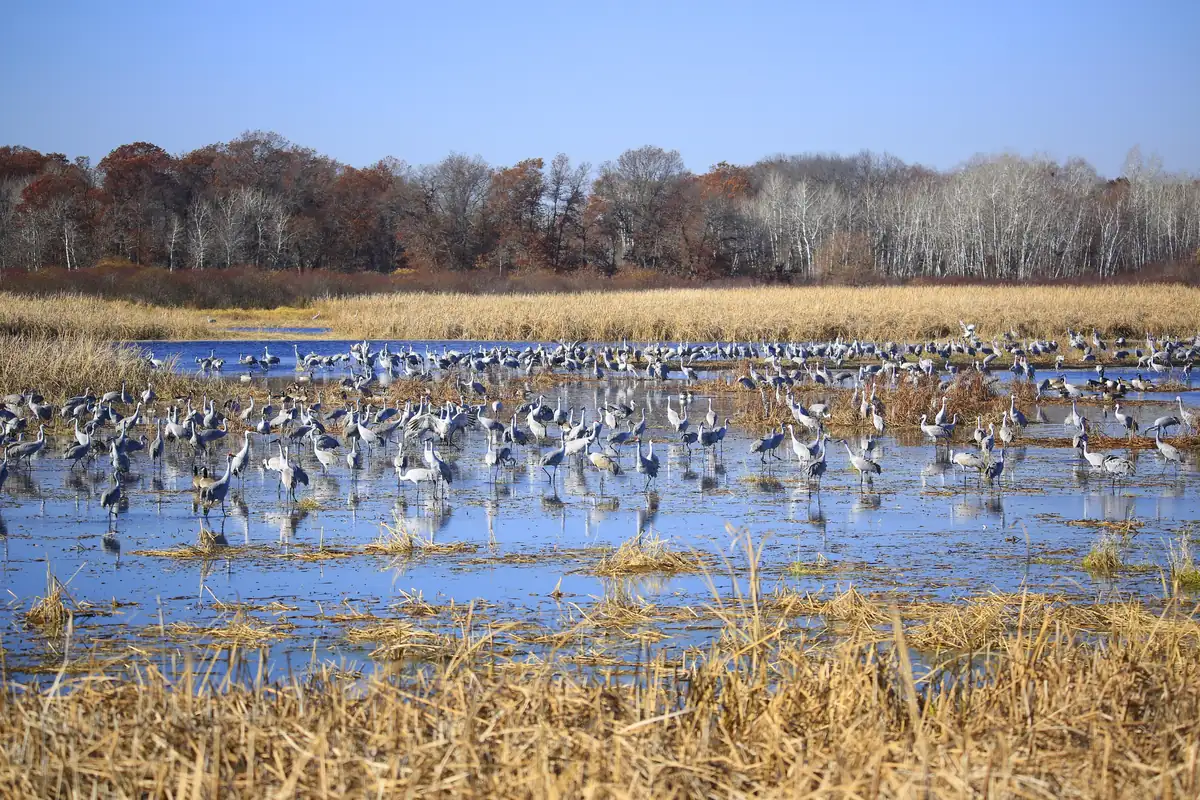
The last sandhill cranes
Flocks staging into late November; most gone by December · Funk Bottoms and Killbuck Marsh wildlife areas (Wayne, Holmes and Ashland counties); also Killdeer Plains, Mosquito Creek and the Lake Erie marshes
ODNR’s fall aerial waterfowl surveys, flown from October to December, have found up to 150 cranes together around Funk Bottoms and Killbuck. Ohio’s breeding cranes, a state-threatened species that returned to nest in Wayne County in 1987, spend the winter in Florida, so mid-November is one of the last good chances to hear that rolling bugle over the flooded fields. Report counts to eBird.
The Ottawa refuge opens its Wildlife Drive Thursday, November 26, through Sunday, November 29, from sunrise until an hour before sunset, weather permitting; the visitor center is open Thursday to Sunday, 10 a.m. to 4 p.m. Waterfowl hunting reopens in the northwest on November 14 and in the northeast on November 21, so some marsh dikes and roads close on hunt days; check with the refuge or Magee Marsh before a long drive.
Where can you see bald eagles in Ohio in November?
Nearly anywhere with big water, and November is a good month to look, because the trees are bare and the pairs are busy. ODNR notes that pair bonding starts in the fall and that “courtship behavior and nest building can occur anytime between October and early December,” months before the female lays one to three eggs between mid-February and late March. Fresh sticks piled on an old nest are the sign. The 2025 statewide census, built on more than 1,800 reports from the public, confirmed 964 active nests in 87 of Ohio’s 88 counties, up 36 percent from 707 in 2020; Ohio had four nesting pairs in 1979.
-
The Lake Erie marsh counties
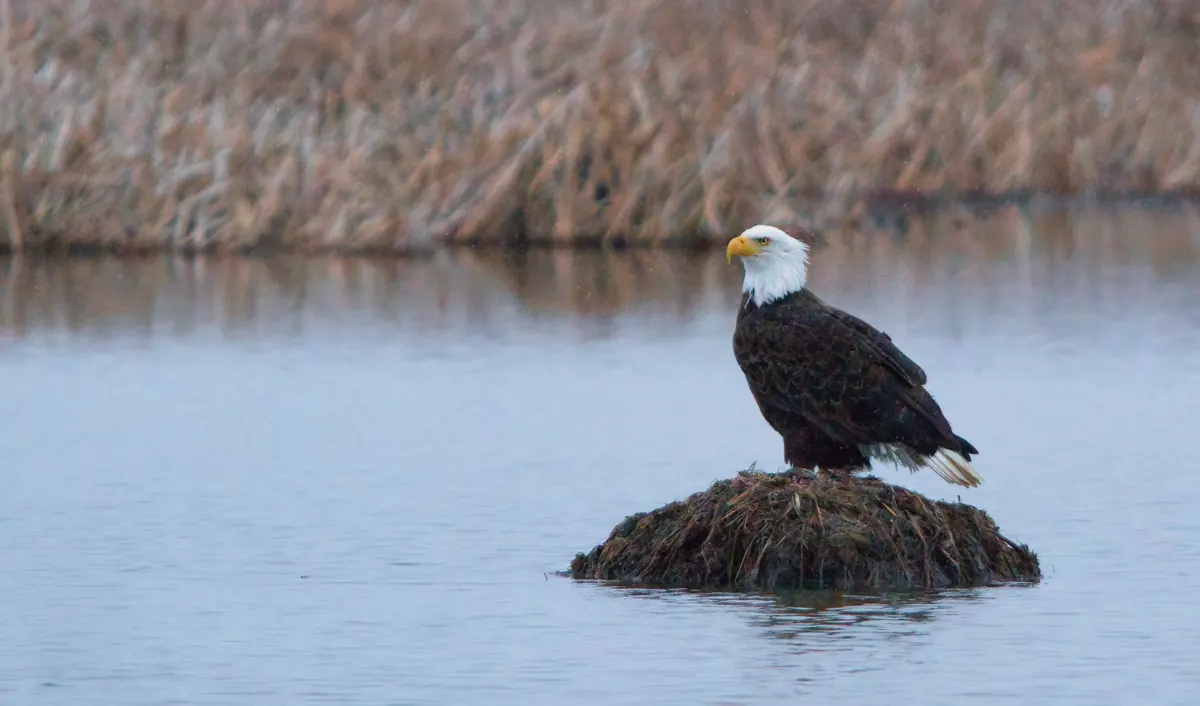
All month, best early morning · Ottawa (112 nests), Sandusky (61) and Erie (40) counties; Ottawa refuge, Magee Marsh, Sandusky Bay
ODNR calls the western Lake Erie marshes the eagle’s stronghold in Ohio, and the 2025 census bears it out: Ottawa County alone had 112 nests. Adults here are mostly year-round residents, so look for pairs perched together on a dead snag above the marsh or sitting on the nest in the cold.
-
Inland rivers and reservoirs
All month; more birds roam as ponds freeze · Wyandot (31 nests), Seneca (36), Trumbull (29), Coshocton, Knox and Licking (19 each), Mercer (19)
The nests now reach well south of the lake, following big rivers and reservoirs; ODNR says counties with many nests have abundant wetlands, large rivers and big lakes or reservoirs. In 2025 the census found nests in every county but Meigs. Scan the tall trees along a big river or the shoreline of a large lake; against bare November branches an adult’s white head stands out at a surprising distance.
Bald eagles are no longer endangered, but they are protected by state law and the federal Bald and Golden Eagle Protection Act. ODNR asks people to stay at least 100 yards from any nest, and disturbing a pair can lead them to abandon it. Note your eagle sightings in the daily field log, nest by nest, and you will know your local pair’s routine before the eggs come.
When do steelhead run up Ohio’s Lake Erie rivers?
November is when the fall run moves off the breakwalls and into the rivers. ODNR’s Lake Erie guide dates the fall-through-spring steelhead fishery from November to May, on the piers and beaches “from Avon east” and up the Vermilion, Rocky, Chagrin, Grand and Ashtabula rivers and Conneaut Creek. Steelhead are rainbow trout that spend two or three years in the lake before returning to the stream where they were stocked, and they want water colder than 60 °F, so the run waits for fall.
-
Watching the run
After each November high-water event; best as the river clears · Public stretches of the Vermilion, Rocky, Chagrin and Grand rivers, Conneaut Creek; Cleveland Metroparks’ Rocky River Reservation
A good rain raises the rivers and fish push upstream in a pulse; when the water drops and turns from chocolate to green, they settle into the deeper pools and runs, where ODNR says fall fish are caught. Polarized sunglasses help. In the shallow riffles you may see a dark back and a flash of pink side holding against the current. Cleveland Metroparks’ Rocky River Nature Center makes a good base for a family walk along the river.
-
Fishing it
November through spring · Stocked tributaries and their mouths; smaller creeks during high water
The guide lists spoons, spinners, small jigs, spawn sacs, minnows and nightcrawlers in the rivers, and egg patterns, nymphs and streamers for fly anglers. ODNR’s program sheet says the fishery draws anglers from every Ohio county, 20 states and overseas, and brings more than $5 million a year to lakeshore towns.
| Tributary | County | Stocked each year |
|---|---|---|
| Vermilion River | Erie | 50,000 |
| Rocky River | Cuyahoga | 80,000 |
| Cuyahoga River | Cuyahoga | 60,000 |
| Chagrin River | Lake | 80,000 |
| Grand River | Lake | 80,000 |
| Ashtabula River | Ashtabula | 50,000 |
| Conneaut Creek | Ashtabula | 50,000 |
A line in the daily field log on the river’s color, the date of the rain and the first fish you see will, after a few Novembers, tell you more about your stream than any report.
When is the deer rut in Ohio?
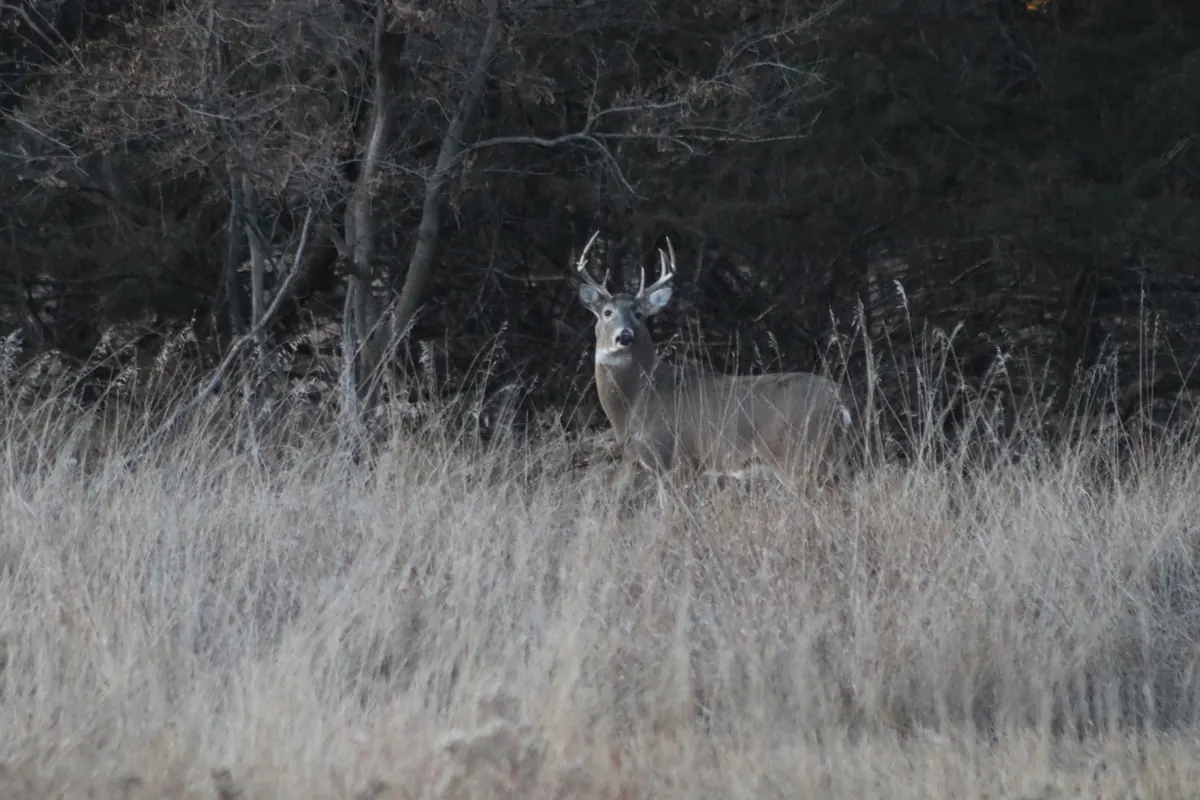
Right now. ODNR puts the peak of breeding in the first half of November, after courtship begins in mid-October and before it tails off into January. A buck will chase a doe for five or six days before she is ready, stay with her a few days to keep rivals away, and then move on to the next. The result is a month when bucks travel far, cross roads in daylight and pay little attention to people or cars.
-
Signs of the rut
Early to mid-November · Woodland edges, fencerows, park trails
Look for small trees with the bark scraped raw at knee height, and for scrapes: oval patches of pawed bare ground, usually beneath an overhanging twig that the buck marks with scent from his face. Deer are on the move at dawn and dusk, and their coats have now turned from summer’s red-tan to the grayer, thicker winter coat, with long guard hairs over a dense undercoat. Fawns from this month’s breeding will be born from mid-May into July.
-
Deer on the road
Worst at dusk and dawn, and in the first weeks after the time change · Statewide; Allen County alone had 467 in 2025
The Ohio State Highway Patrol counted more than 21,000 deer-related crashes in 2025, most of them in October and November. The clocks fall back on November 1, and the evening rush hour suddenly lands at dusk, the hour deer move most. ODNR asks drivers to take particular care from October through December wherever deer-crossing signs are posted. If one crosses, slow down and watch for the second and third.
Youth deer gun season is November 21–22 and the statewide gun week starts Monday, November 30; see the safety notes below for the orange rule that comes with them.
Which trees still have leaves in Ohio in November?
ODNR’s foresters put southern Ohio’s peak at the end of October running into November, which leaves the Hocking Hills, Shawnee and the Wayne National Forest with some color in the opening days of this month. Farther north the maples and ashes are mostly bare by now, and the color that is left belongs to a few late or stubborn trees.
-
Golden tamaracks at Kent Bog
Late October into mid-November; trees turn at different times · Cooperrider-Kent Bog State Nature Preserve, Portage County
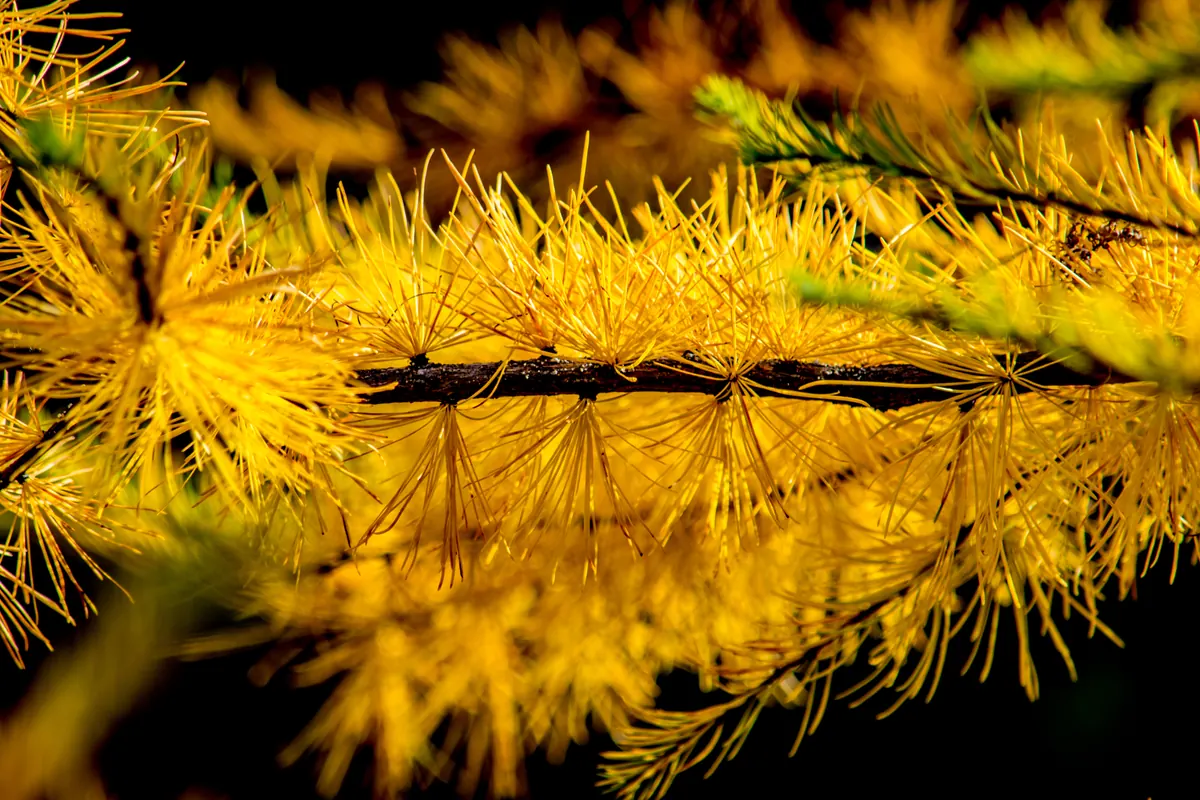
The tamarack is a cone-bearing tree that goes bare every fall, and ODNR says Kent Bog holds the largest and most southerly stand of it in the continental United States, more than 3,500 trees left over from the Ice Age. The needles turn a soft gold after the hardwoods finish, and the trees do not all turn together, so the show can stretch over a few weeks, with bare, yellow and still-green trees side by side. A half-mile boardwalk crosses the bog; pets are not allowed.
-
Oaks and young beeches that keep their leaves
All winter, until spring growth pushes the old leaves off · Pin oaks in yards and wet woods; young beeches in the understory of almost any forest
Metroparks Toledo explains the habit, called marcescence: some oaks, the pin oak especially, and young American beech never fully grow the layer of cells that lets a leaf drop, so the dead leaves hang on all winter. The reason is still argued over; rustling, dry leaves may discourage browsing deer, or leaves shed in spring may feed the soil just when the tree needs it.
-
The green that should not be there
Through November, sometimes into December · Woodland edges, ravines, old fields, especially around towns
When every native shrub is bare, the green understory in an Ohio woods is usually Amur and other bush honeysuckles. Ohio State’s forestry fact sheet notes that they leaf out earlier and hold their leaves later than most native trees and shrubs, and ODNR says Amur honeysuckle often keeps its leaves until November. That makes this the easiest month to see how much of a woodlot they have taken over; the bright red berries often hang on into winter, and birds spread the seeds.
Collect one fallen oak leaf, one beech leaf and one honeysuckle leaf and press them on the same page; the comparison teaches more than a field guide. The “seeds, pods and cones” plate takes the tamarack’s tiny cones, which stay on the branches after the needles fall.
What birds come to Ohio feeders in November, and will winter finches show up?
November is when the winter crowd arrives. The Ottawa refuge’s Friends group says dark-eyed juncos, tree sparrows and pine siskins return to feeders this month, and Black Swamp Bird Observatory names American tree sparrow, snow bunting and Lapland longspur as the species whose main arrival comes in November.
-
Juncos and tree sparrows
From early November through March · Under feeders with brush or shrubs nearby; weedy field edges
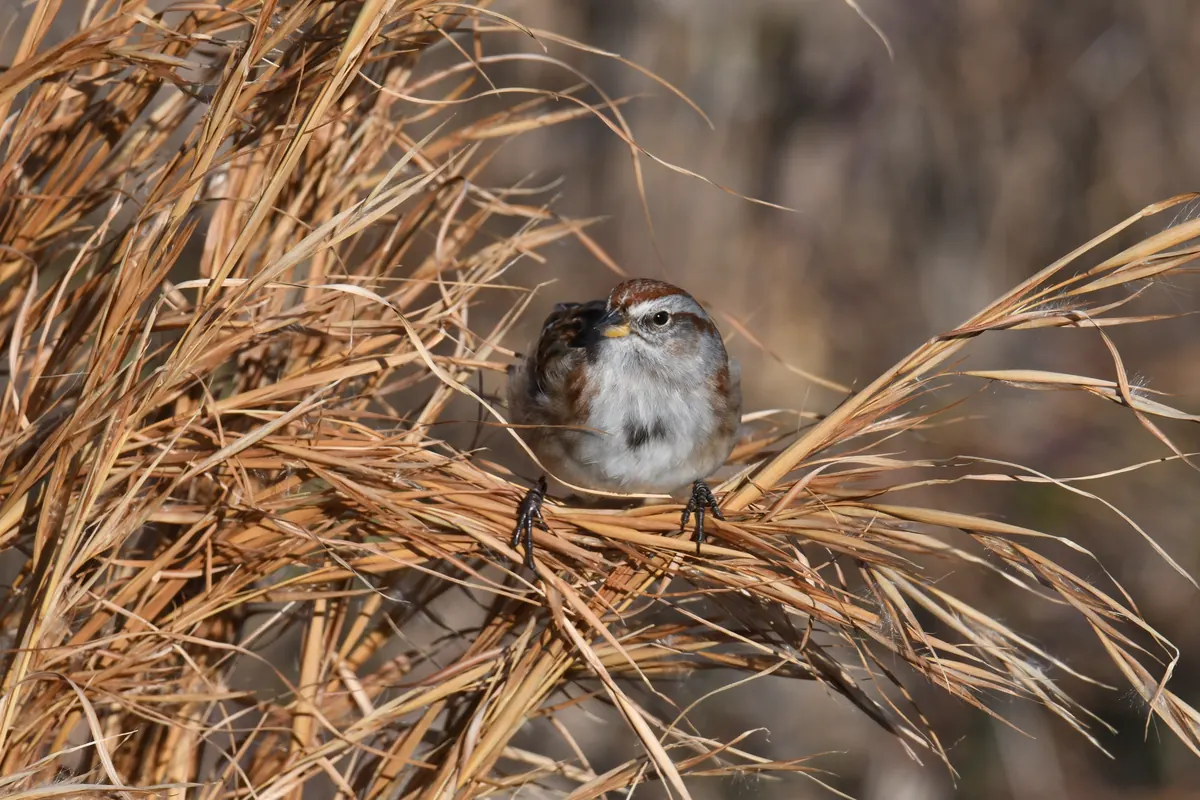
Juncos are slate-gray birds with white bellies and a flash of white at the tail edges, feeding on the ground under the feeder. ODNR notes that they favor yards where feeders sit near shrubs or brush piles, and that only a few nest in Ohio, in hemlock gorges in the far northeast. The American tree sparrow, which nests on the tundra, wears a rusty cap and a single dark smudge on its gray breast.
-
Winter finches: a mixed forecast
November into winter · Conifers and birches first; feeders when wild seed runs out
The Finch Research Network’s 2026–2027 forecast, written by Tyler Hoar, expects purple finches to come south in good numbers into the Great Lakes states, following strong spruce, white pine and mountain-ash crops, plus evening grosbeaks in modest flocks around the Great Lakes. Siskins should irrupt mainly into the Northeastern states, while red-breasted nuthatches, with plenty of cones at home, mostly stay put. Redpolls, it admits, have become “increasingly harder to predict.” A male purple finch is rosier all over than a house finch, without brown streaks on the flanks.
-
Snow buntings and longspurs
Arriving in November · Lake Erie beaches and breakwalls; plowed and stubble fields in the flat northwest
Snow buntings travel in tight, wheeling flocks that flash white wings over bare ground, and Lapland longspurs often mix in, darker and streakier. Walk a quiet beach along the lake, or scan a manured field after the first snow.
-
Owls on the marsh edge
Late fall and winter; snowy owls possible from November · Ottawa refuge and nearby fields; lakeshore breakwalls for snowy owls
The Ottawa refuge lists long-eared and short-eared owls roosting there in winter, and its Friends group notes that snowy owls are possible from November through April. Short-eared owls hunt low over open grassland at dusk, moth-like. Watch from the road and keep your distance from any roost.
Project FeederWatch counts start November 1 and end April 30. Choose any two consecutive days, note the largest number of each species in view at once, and send in counts weekly or just once in the season; a participation fee pays for the project. The journal’s “birds I have seen” list makes a good home for your own winter feeder tally.
Has Ohio had its first freeze yet?
Almost certainly, except right along the lake. At every inland station in the table, half of all years have frozen by October 28, and even the latest tenth of years have frozen by November 8. The holdout is Cleveland, where the lake keeps the shore mild: its median first freeze is November 3, and the latest tenth of years hold out until November 17. So by mid-November the plateau, the farm country and the southern hills have nearly always had their first freeze, while a few gardens right on the lakeshore may still be hanging on.
| Station | One year in ten | Median | Nine years in ten |
|---|---|---|---|
| Toledo (Express Airport) | Oct 11 | Oct 24 | Nov 8 |
| Cleveland | Oct 21 | Nov 3 | Nov 17 |
| Akron (Fulton Airport) | Oct 12 | Oct 28 | Nov 8 |
| Youngstown (Regional Airport) | Oct 1 | Oct 17 | Nov 1 |
| Columbus (WCMH) | Oct 13 | Oct 24 | Nov 4 |
| Dayton (MCD) | Oct 13 | Oct 25 | Nov 7 |
| Cincinnati | Oct 8 | Oct 22 | Nov 3 |
| Athens (OU) | Oct 8 | Oct 23 | Nov 3 |
The full station list, with spring dates too, is on the Ohio frost dates page. If your garden escaped so far, one still, starry night behind a cold front will finish it; this is the month to dig the dahlias, drain the hose and write down the date the birdbath first freezes solid.
How much daylight does Ohio lose in November?
Close to another hour, spread over the month, but the change you notice is the clock. With the clocks set back overnight into Sunday, November 1, Columbus goes from a 6:31 p.m. sunset on Halloween to 5:29 p.m. the next day, and by November 30 the sun sets at 5:08 p.m. and rises at 7:34 a.m. Cleveland’s sunset is down to 4:58 p.m. by the end of the month, Cincinnati’s to 5:16. Northern cities lose a few more minutes than southern ones.
| City | Nov 1 | Nov 30 | Lost | Per day |
|---|---|---|---|---|
| Toledo | 10 h 23 m | 9 h 24 m | 59 min | 2.0 min |
| Cleveland | 10 h 22 m | 9 h 25 m | 57 min | 2.0 min |
| Youngstown | 10 h 24 m | 9 h 28 m | 56 min | 1.9 min |
| Akron | 10 h 25 m | 9 h 28 m | 57 min | 2.0 min |
| Columbus | 10 h 28 m | 9 h 34 m | 54 min | 1.9 min |
| Dayton | 10 h 29 m | 9 h 35 m | 54 min | 1.9 min |
| Cincinnati | 10 h 31 m | 9 h 39 m | 52 min | 1.8 min |
| Athens | 10 h 31 m | 9 h 38 m | 53 min | 1.8 min |
The days keep shortening until the December 21 solstice, but the earliest sunsets of the year come a couple of weeks before it. Type in your own town on the Field almanac to see sunrise, sunset and twilight for any date.
When does it first snow in Ohio, and what will El Niño mean this winter?
November is the month Ohio weather turns gray. NOAA’s 1991–2020 normals give average highs from 49.6 °F at Youngstown to 53.8 °F at Cincinnati and lows of 33 to 37 °F, with about three inches of rain or melted snow almost everywhere. Normal November snowfall shows the lake’s hand: 4.5 inches at Cleveland and Youngstown and 3.3 at Akron-Canton, but 1.7 at Toledo, 1.2 at Columbus and only 0.8 at Dayton and Cincinnati.
The first measurable snow follows the same pattern. National Weather Service climatology puts the average first date at November 9 for Akron and November 10 for Cleveland; the Wilmington office’s 1981–2010 figures give November 20 for Columbus, November 24 for Dayton and November 29 for Cincinnati. East of Cleveland the first lake-effect bands often come this month, when cold air crosses a lake that is still warm; the Cleveland weather office puts normal seasonal snowfall in the snowbelt counties at about 70 to more than 100 inches. On November 16–17, 2022, one band parked along the Ashtabula shore and left more than 18 inches in Monroe Township.
This winter has a very strong El Niño behind it: the Climate Prediction Center’s September 10 assessment said odds of the event reaching very strong strength over the cool season exceed 90 percent. When the Cleveland and Cincinnati weather offices studied the El Niño winters from 1957 onward, eight in all, they found the region averaged a bit warmer than normal, came up short on precipitation in seven of the eight, and had less snow at most stations away from the lake; at lake-effect stations such as Cleveland and Youngstown, no El Niño link showed. Kent State climatologist Cameron Lee told Ideastream in August that a mild winter could leave more of Lake Erie open and feed “more of those powerful lake effect snow events,” and state climatologist Aaron Wilson told Brownfield in September he expects a volatile season and “a very warm start” in December would not surprise him. The official NOAA winter outlook arrives October 15 on the Climate Prediction Center’s 90-day outlook maps.
For this week’s weather, including radar and any lake-effect warnings, see Weather now.
What can you see in Ohio’s night sky in November?
Long nights and early dark make November a good month for children to see stars before bedtime. After dusk only Saturn shines among the planets, low in the south and southwest; by contrast the hour before sunrise holds four. Times below are Eastern Standard Time.
-
Mars meets Jupiter, with Venus below
Before dawn, November 15 and 16; Venus all month · Southeast to south before sunrise, in Leo
The two planets pass 1.2 degrees apart, about a little finger’s width at arm’s length, closest on the evening of November 15 in the United States, so the mornings of the 15th and 16th show them nearest. Jupiter is the brighter; Mars is smaller and orange, with the star Regulus nearby. Below them Venus climbs higher every day and is brightest around November 24 to 27; it slides just over a degree past the star Spica on November 9. Mercury joins in mid-month, lowest of all, best on mornings from roughly November 18 to 25.
-
The Leonid meteors
After moonset until dawn, mornings of November 17 to 19; best on November 18 · Anywhere dark; Leo rises in the east around midnight
The International Meteor Organization expects a modest year, perhaps 15 meteors an hour for an observer far from town, and nothing like a storm this year. With the moon at first quarter on the 17th, it sets around midnight; the moonless hours after that are the same ones in which Leo climbs highest. Leonids are very fast and often leave a glowing trail.
-
Taurid fireballs and a dark new moon
Southern Taurids peak November 5; Northern Taurids November 12; new moon November 9 · Most of the night, Taurus high in the east by late evening
Taurid meteors are few and unhurried, but every so often one blazes as a fireball; they are crumbs shed by Comet Encke. Ohio’s darkest nights of the month bracket the November 9 new moon, right between the two Taurid peaks.
-
The Beaver Moon
Full at 9:53 a.m. Tuesday, November 24; looks full the evenings of the 23rd and 24th · Rising in the east around sunset
The moon swings closest to Earth a day and a quarter after it is full, which is near enough for EarthSky and others to call this a supermoon, if a modest one; December’s Cold Moon will be the closest of 2026. On the night of November 23 the moon passes over or near the Pleiades, drowning the cluster in its light. Uranus reaches opposition near the Pleiades on November 25, a binocular target with a star chart.
| Phase | Date | Time |
|---|---|---|
| Last quarter | Sunday, Nov 1 | 3:28 p.m. EST |
| New moon | Monday, Nov 9 | 2:02 a.m. EST |
| First quarter | Tuesday, Nov 17 | 6:48 a.m. EST |
| Full moon, the Beaver Moon | Tuesday, Nov 24 | 9:53 a.m. EST (looks full on the evenings of Nov 23 and 24) |
| Last quarter | Tuesday, Dec 1 | 1:08 a.m. EST |
John Glenn Astronomy Park in the Hocking Hills runs its last free public programs of the year on clear November weekends; see the families list. For a cloud forecast before the drive, open Today’s sky; our moon phases page has moonrise for your town.
What are good outdoor outings for Ohio families in November?
- Sunday, November 1: start counting birds. Project FeederWatch opens its season; one count at the kitchen window on the first weekend is a fine start.
- Fridays and Saturdays, November 6–7, 13–14 and 20–21: stars in the Hocking Hills. John Glenn Astronomy Park’s free programs are “The Goat and the Water Carrier” (5:30 p.m.), “Earthshine” (5:15 p.m.) and “Rugged Moon, Ringed Saturn” (5:15 p.m.). Reserve a free parking pass online, and check the park’s post by noon on the day to see whether the sky is clear enough to go ahead.
- Saturday, November 7: the Ohio Young Birders Club conference, held in Columbus at the Grange Insurance Audubon Center for young birders from around the state, marking the club’s 20th anniversary; registration is open on the club’s site.
- Sunday, November 8: Intro Birding with ODNR naturalists in the Hocking Hills, 8 to 9 a.m., free; the calendar listing gives the meeting spot. On Wednesdays, November 4, 11, 18 and 25, the free “Creature Feature” wildlife program runs 2 to 3 p.m. on the visitor center’s second floor.
- A weekend morning at Kent Bog while the tamaracks are gold; the boardwalk is short and flat, but dogs stay home.
- Thursday to Sunday, November 26–29: swans from the car. The Ottawa refuge’s Wildlife Drive is open over Thanksgiving weekend, so the day after Thanksgiving, Friday, November 27, can be spent on the marsh. Bring binoculars and something hot to drink.
- By Monday, November 30: finish the Fall Hiking Spree. Summit Metro Parks awards a hiking staff and shield for eight designated trails hiked between September 1 and November 30; rewards are free for Summit County residents and $10 for first-year hikers from elsewhere ($5 for returning hikers).
- Citizen science. Enter swan, crane and eagle sightings in eBird, and log the date of your first junco.
A one-page November checklist for the fridge is on the nature hub, along with every other state; last month’s Ohio guide is at Ohio in October.
Safety notes for November in Ohio
- Hunting seasons and blaze orange. Deer archery runs statewide through February 7. Youth deer gun season is November 21–22, and deer gun season runs November 30 to December 6, with two more days December 19–20. Rabbit, rooster pheasant and chukar open November 6; quail runs November 6–29 in 16 counties; furbearers such as fox and raccoon open November 10; woodcock closes November 29; squirrel is open all month. Under the new waterfowl zones, ducks and geese reopen November 14 in Zone A (the northwest) and November 21 in Zone B (the northeast, Lake Erie’s waters and parts of the northwest); Zone C, the south, reopens for geese November 21 and for ducks December 12. ODNR’s rule: during the youth deer gun, deer gun and muzzleloader seasons, anyone hunting any wild animal except waterfowl, between half an hour before sunrise and half an hour after sunset, must visibly wear a vest, jacket or coveralls in solid or camouflage hunter orange, on public and private land alike. Hikers on wildlife areas, state forests and the Wayne National Forest should wear orange too, and dogs deserve an orange collar or vest of their own.
- Dark evenings and deer. After November 1 the drive home is in twilight. Ease off the gas in the deer hours around sunrise and sunset; if one jumps out, stay in your lane and brake hard.
- Cold water and the first lake-effect snow. Anyone who slips off a pier or tips out of a kayak into Lake Erie now is in trouble within minutes; paddlers should wear a life jacket, and children should stay off wet breakwalls on windy days. Lake-effect bands can whiten a narrow strip of road east of Cleveland while it is sunny a few miles away. No pond or marsh ice is safe in November.
- Ticks are still out. Ohio State’s tick fact sheet notes that adult blacklegged ticks are active in fall and winter, so look everyone over, the dog included, after a walk in leaf litter.
- Short days on the trail. Sunset comes before 5:40 p.m. everywhere in Ohio all month, and before 5 p.m. in Cleveland by the end of it; the Hocking Hills gorges darken sooner. Set out by early afternoon and pack a headlamp.
Sources
- Black Swamp Bird Observatory: timing of fall migration
- Friends of Ottawa National Wildlife Refuge: timing of bird migration
- Friends of Ottawa National Wildlife Refuge: 2026 Wildlife Drive dates and visitor center hours
- U.S. Fish and Wildlife Service: Ottawa National Wildlife Refuge, species and seasons
- Columbus Audubon: swans of December (tundra, trumpeter and mute swans in Ohio)
- ODNR Division of Wildlife: tundra swan
- ODNR Division of Wildlife: sandhill crane (fall surveys, viewing areas)
- ODNR Division of Wildlife: bald eagle (courtship and nesting timing, viewing distance)
- ODNR news release: America’s national bird thriving in the Buckeye State (2025 nest census, July 3, 2025)
- ODNR Division of Wildlife: Ohio’s steelhead program (PDF)
- ODNR Division of Wildlife: Lake Erie fishing guide (PDF)
- Cleveland Metroparks: Rocky River Nature Center
- ODNR Division of Wildlife: white-tailed deer
- ODNR Division of Wildlife: white-tailed deer life history notes (PDF)
- Hometown Stations (Lima): deer-related crashes increase as Ohio enters peak season, Ohio State Highway Patrol figures (September 29, 2026)
- Spectrum News: ODNR expects a vibrant fall (regional peak timing, September 25, 2026)
- ODNR: Cooperrider-Kent Bog State Nature Preserve
- Metroparks Toledo: the essence of marcescence
- Ohio State University Extension: controlling bush honeysuckle in Ohio forests (F-68)
- ODNR Division of Wildlife: dark-eyed junco
- ODNR Division of Wildlife: American tree sparrow
- Finch Research Network: winter finch forecast 2026–2027
- Project FeederWatch: how to participate (November 1 to April 30)
- NOAA NCEI: 1991–2020 monthly normals, Ohio stations (data API)
- NWS Wilmington: first snowfall climatology for Cincinnati, Columbus and Dayton
- News 5 Cleveland: typical first frost, freeze and snowfall in northeast Ohio (NWS climatology)
- NWS Cleveland: winter 2022–2023 snowfall review (November 16–17 lake-effect band, snowbelt normals)
- NWS Cleveland: climatological effects of ENSO in the lower Great Lakes and Ohio Valley
- Climate Prediction Center: ENSO diagnostic discussion, September 10, 2026
- Climate Prediction Center: seasonal outlooks (winter outlook due October 15, 2026)
- Ideastream Public Media: a super El Niño could mean a warm, snowy winter in Northeast Ohio (August 26, 2026)
- Brownfield Ag News: could El Niño contribute to another Ohio drought year in 2027? (state climatologist Aaron Wilson, September 24, 2026)
- U.S. Naval Observatory: moon phases, November 2026 (data API)
- International Meteor Organization: 2026 meteor shower calendar (PDF)
- EarthSky: what is a supermoon? (2026 full supermoons)
- Star Walk: planetary conjunctions (Mars and Jupiter, November 2026)
- EarthSky: Mercury before sunrise, greatest western elongation
- In-The-Sky.org: Venus at greatest brightness, November 27, 2026
- EarthSky: Uranus at opposition
- John Glenn Astronomy Park: public programs, November 2026
- Ohio Young Birders Club: 2026 conference, November 7
- Hocking Hills calendar of events, November 2026 (ODNR Intro Birding, Creature Feature)
- Summit Metro Parks: 63rd annual Fall Hiking Spree
- Summit Metro Parks: 63rd annual Fall Hiking Spree kicks off (rewards for eight trails hiked September 1 to November 30)
- ODNR Division of Wildlife: Ohio’s 2026–27 hunting and trapping season dates (PDF)
- ODNR Division of Wildlife: Ohio hunting and trapping regulations 2026–27 (PDF; waterfowl zones, hunter orange)
- Buckeye Firearms Association, reporting ODNR’s release: new waterfowl zone map approved
- Ohio Administrative Code 1501:31-15-11: hunter orange requirement
- OSU Extension: ticks and tick-borne diseases in Ohio (HYG-2073)
- Photos via Wikimedia Commons; licenses and photographers are credited under each picture
