What to look for in nature in Oklahoma this April
April is when Oklahoma finishes changing from a winter state to a summer one. The black-capped vireo, an endangered songbird until 2018, comes back to the scrub oaks of the Wichita Mountains in the middle of the month. Scissor-tailed flycatchers, the state bird, are back on the fence wires by the first week. Warblers pass through the eastern woods, and the sky over Osage County is hazy with ranchers’ prairie fires. White bass crowd the mouths of creeks when the redbuds bloom, wild turkeys gobble before sunrise, and the first Texas horned lizards crawl out of winter burrows around the time May begins. April also opens the heart of tornado and flood season, so every outing needs a weather plan. The April full Moon comes on the 20th, and a meteor shower peaks two nights later in bright moonlight. Use the sections below as a checklist for the whole month.
Other months in Oklahoma: October, November, December, January, February, March.
Start here
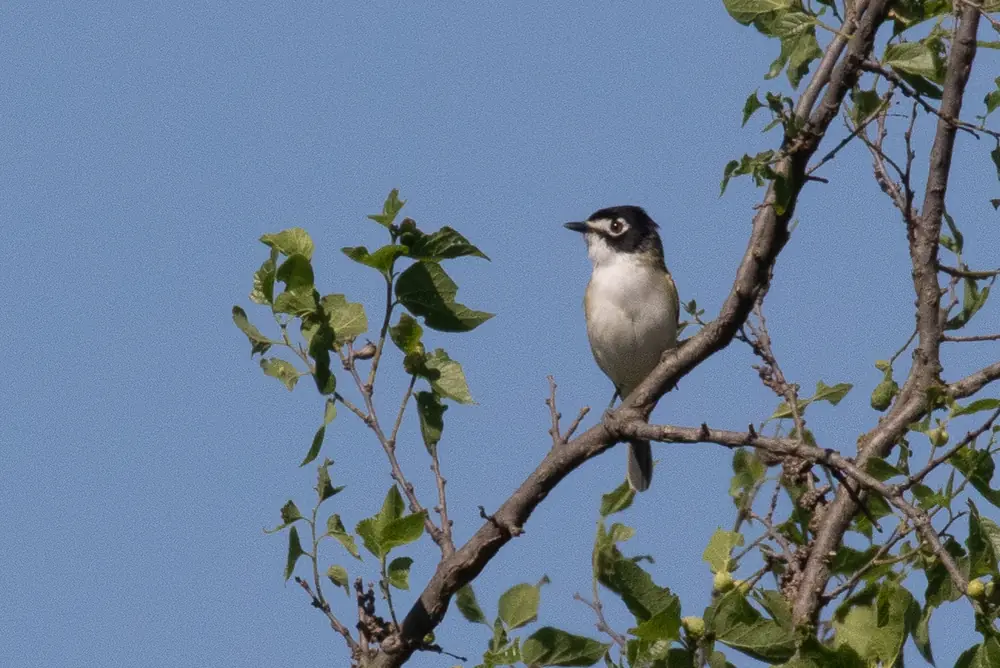
- Find a black-capped vireo. Walk the Elk Mountain trail or the Quanah Parker Lake dam area at Wichita Mountains Wildlife Refuge after mid-April and listen in the low oak thickets for a small olive bird with a black cap and white spectacles.
- Watch the redbuds and the creek mouths. Anglers say the white bass run starts when redbuds bloom. Note the date your redbud opens, then visit a creek that feeds a nearby lake and watch for fish and for people lining the bank.
- Count a treefrog chorus. After a warm rain in the eastern half of the state, stand quietly beside a farm pond at dusk and write down every trill, whistle and snore you can tell apart.
In the Naturalist’s Field Journal this April, put the vireo, the first scissor-tailed flycatcher and each warbler on the birds I have seen plates. Use the nest observed plates for a bird you can watch from far away, a map of sounds for frog nights and turkey gobbles, and the tracks to know plates for the mud along a creek. Put storms and rainfall on the daily field log plates, and follow one burned pasture on a same place twice page, black at the start of the month and green by the end.
Regions used below: Panhandle and High Plains; Northwest and the Salt Plains; Central Oklahoma and the Oklahoma City metro; Northeast and Green Country; Southwest and the Wichita Mountains; Southeast and the Ouachita Mountains.
Which summer birds come back to Oklahoma in April?
By the first week of April the winter flocks are gone and the state’s summer residents are arriving from Mexico and Central America. Some are famous, like the state bird. Others are small and easy to miss, but their return is one of the best recovery stories in the Wildlife Department’s files.
-
Black-capped vireo
Usually arrives in mid-April and stays until mid-September · Wichita Mountains Wildlife Refuge and Fort Sill in Comanche and Kiowa counties; smaller numbers at Quartz Mountain and in Blaine County
The Wildlife Department says vireos nest in low, brushy, scattered thickets of deciduous trees, especially blackjack oak, with the nest set four to eight feet up in a short, scrubby tree. Males have a black cap that covers almost the whole head except around the eyes, which gives them a spectacled look. When the species was listed as endangered in 1987, fewer than 50 birds were known in Oklahoma. The Department reported more than 4,000 by 2018, the year the federal listing ended, though one of its field-guide pages counts about 4,000 pairs, so treat the number as roughly four thousand. The Department credits managed habitat, and it lists the brown-headed cowbird, which lays its eggs in other birds’ nests, as a threat to the species. An Audubon guide to the state gives April through August as the time the vireo is present at the refuge, and names the Elk Mountain trail and the Quanah Parker Lake dam area as places to try. Stay on the trail: the birds nest close to the ground.
-
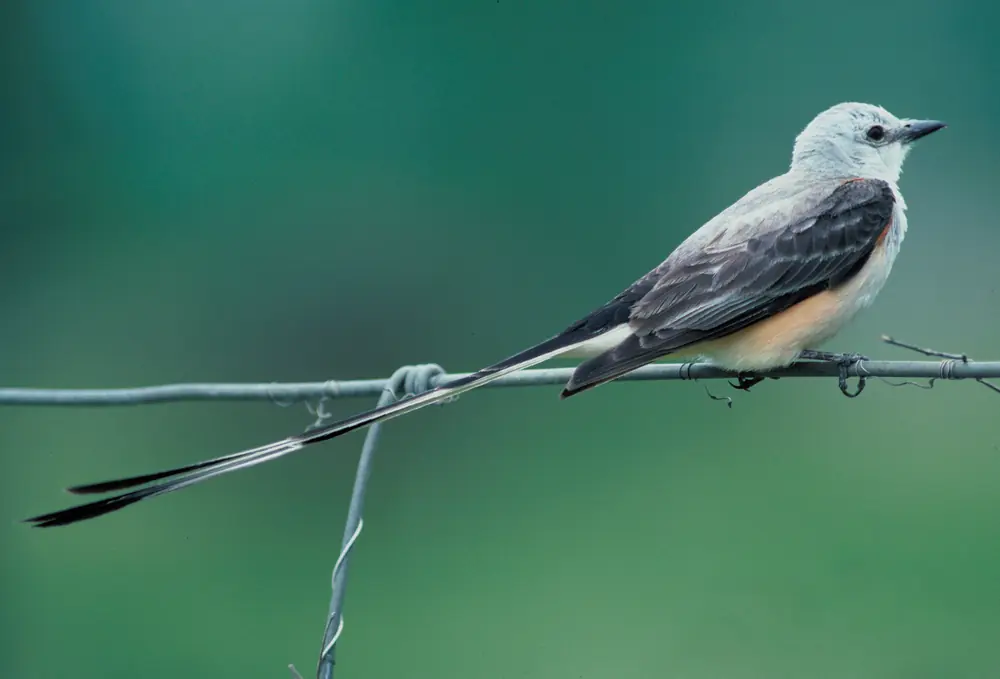
Scissor-tailed flycatcher
Seen from early April to late October; a few show up in late March · Fence lines, utility wires and open country statewide
Oklahoma’s state bird is easy to spot because of a tail that can reach nine inches. Males put on a courtship display in which they climb about 100 feet and then tumble in a V-shaped dive while calling. The Department says grasshoppers can make up more than half of what a flycatcher eats, which explains why the birds arrive when insects begin to stir. Females build the nest 7 to 30 feet up on a horizontal limb or fork, and typically raise two broods. Jot down the date of your first one on a birds I have seen page.
-
Wild turkeys on the display grounds
Gobbling is at its peak in the early morning; hens begin nesting in April and May · Rio Grande turkeys in western Oklahoma; Eastern turkeys in the east and southeast
The Department’s 2026 Gobbler Report said turkey numbers were rising in the northwest and the northeast, with a slight increase in the central region, and that hens were already choosing nest sites. The gobble is used mainly in spring to tell hens where a male is. Males strut in open ground, and their wingtips leave two parallel lines in the dirt. The Department describes Rio Grande turkeys of the west as birds of open ground, and Eastern turkeys as cautious. Because hens are nesting, a walk in April is a good time to keep dogs leashed and stay on the trail. The spring hunting seasons are listed in the safety notes below.
Record the date you first see or hear each bird, with the place and the weather. Over a few springs your own list will tell you more about your yard than any chart. For the earlier part of spring, see our March page for Oklahoma.
Where do warblers and other migrants stop in Oklahoma in April?
The Oklahoma Ornithological Society’s checklist has 488 species on it, and many of the colorful ones pass through in spring. The Wildlife Department notes that migrants time their trips by day length and arrive to feed on caterpillars, flying insects, fruit and nectar. April is when the northward trickle becomes a flow.
-
Warblers in the eastern woods
Builds through April; migration at Red Slough peaks in May · Red Slough, Cookson and Blue River wildlife management areas; wooded creeks in the east
The Department counts 42 warbler species in Oklahoma. Some settle in the eastern half of the state for the summer and others stop only for a few days or weeks on the way north. Its advice is to search trees and shrubs near creeks and small rivers, and flowering trees that draw small insects. Expect to identify many birds by facial pattern or the amount of streaking, and expect a sore neck. Red Slough, a 5,814-acre wetland complex in McCurtain County, has recorded more than 300 bird species. The Department says migration there peaks in May, when visitors often see 100 or more species, and an Audubon guide names prothonotary, yellow-throated and prairie warblers among its birds. Wildlife management areas can have hunting and area-specific rules, so check the Department’s page for each before you go.
-
Where to watch the migration forecast
BirdCast’s forecast season runs March 1 to June 15 · Any clear night; look at the forecast map for Oklahoma
BirdCast, from the Cornell Lab of Ornithology, posts live migration maps, forecast maps and a county-level dashboard for the contiguous United States. It says more than 80 percent of migratory species travel at night. On a night with a strong southerly flow and a forecast of heavy migration, expect new birds in parks and thickets at dawn. The project also asks people to turn off unneeded outdoor lights and make glass visible, since lights and windows are hazards for night migrants.
-
Birds of the far west
Spring passage in the Panhandle · Black Mesa area in the western Panhandle, and Salt Plains National Wildlife Refuge
An Audubon guide to the state lists black-chinned hummingbird, vermilion flycatcher and Say’s phoebe at Black Mesa, with Sprague’s pipit passing through in spring. At Salt Plains, the refuge says white pelicans stop over in spring and fall, and its salt flats hold nesting snowy plovers and avocets. The Department places least tern nests later, from late May into mid-July.
A small notebook beside the window or on the dashboard is all you need. Write the date and the first bird you identify each morning on a daily field log page, and add a line when something new arrives.
Why is the Oklahoma prairie burning in April, and what grows back?
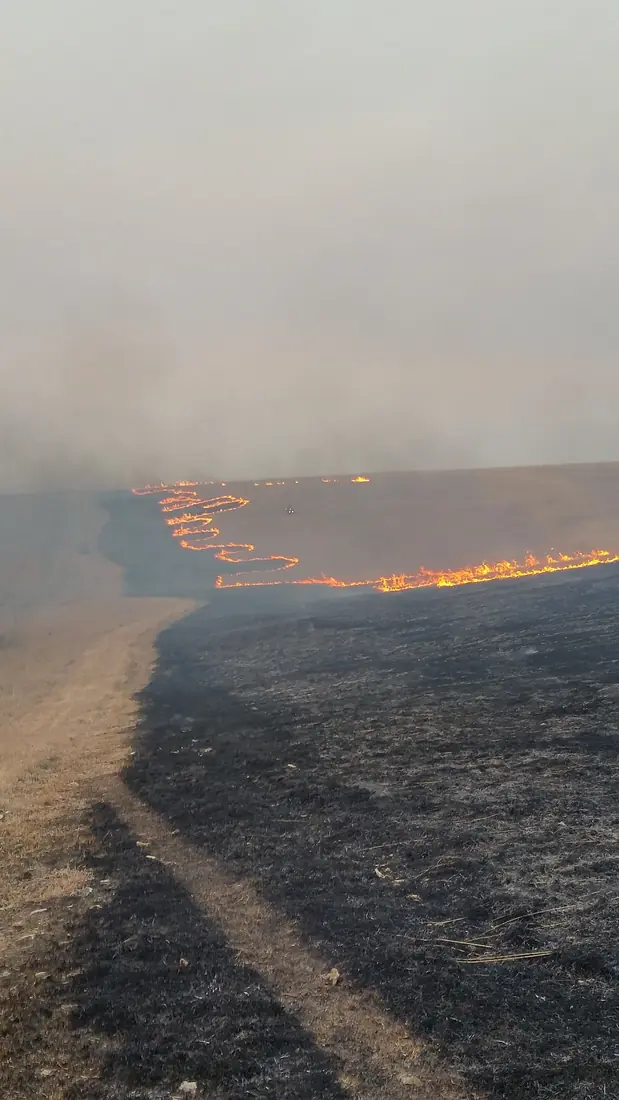
Smoke on the horizon in April is usually a rancher or land manager at work. Oklahoma’s fire season runs from early March to the end of April on average, and the work is old as the prairie itself: fire clears dead grass, recycles nutrients and gives cattle and wildlife fresh green growth. The same dry, windy afternoons also start accidental wildfires, so a burn is not a casual thing.
-
Osage County burns
Early March to late April on average · Tallgrass prairie in Osage County, around Pawhuska
A Tulsa television report from April 2021 quoted Osage County firefighters who said smoke is a weekly occurrence in spring and that most plumes are prescribed burns on ranches. A rancher said the aim is more pounds of grass per acre, and that burning also removes old growth and invasive plants. The same report warned that conditions can turn quickly if the wind shifts, and advised anyone planning to burn, large or small, to call the local fire department first.
-
A preserve that burns in patches
Booming continues at sunrise through early May; in April the big bluestem and switchgrass are growing · Joseph H. Williams Tallgrass Prairie Preserve near Pawhuska
The Nature Conservancy says the preserve has used prescribed fire as a conservation tool since 1993. The page describes April as the month when signature grasses such as big bluestem and switchgrass are thriving, and says the greater prairie-chickens keep booming at dawn until early May. Wildflowers cover the fields from mid-May through mid-June, so in April the color is mostly green and the movement is bison and birds. The preserve is open in daylight hours every day and has three self-guided trails from half a mile to two miles.
Never drive into smoke. Slow down, turn on your lights and turn around if you cannot see. If you live nearby, ask the county or Oklahoma Forestry Services about burn bans before you light anything yourself.
What blooms and leafs out in Oklahoma in April?
March belongs to plum and redbud. In April the meadows, roadsides and oak woods take over. The best written record is still the 1934 Bebb Herbarium report by Ben Osborn, published again in the Oklahoma Native Plant Record in 2015, which lists average first flowering dates seen mainly around Norman between about 1927 and 1934. Those numbers are nearly a century old and from one place, so treat them as the order of events and keep your own dates. A season can run a week or two ahead or behind.
-
Purple poppy-mallow, or winecup
Average first flowers April 13 in the old Norman records · Pastures, roadsides and prairie
A low prairie plant with showy flowers, often called winecup. It is one of the first native flowers of April on open ground, and a good one to watch in a patch you pass every day.
-
Wild blue indigo, spiderwort and loco-weed
Western spiderwort and stemless loco-weed average April 24; blue false-indigo averages April 27, with the earliest record April 25 · Prairie, open woods and rocky hillsides
The old records shift the palette toward blue and purple late in April. The same report lists black locust at an April 20 average, southern black-haw at April 19 and wild columbine with a first record on April 8, so a good walk in the second half of the month can include a dozen flowers.
-
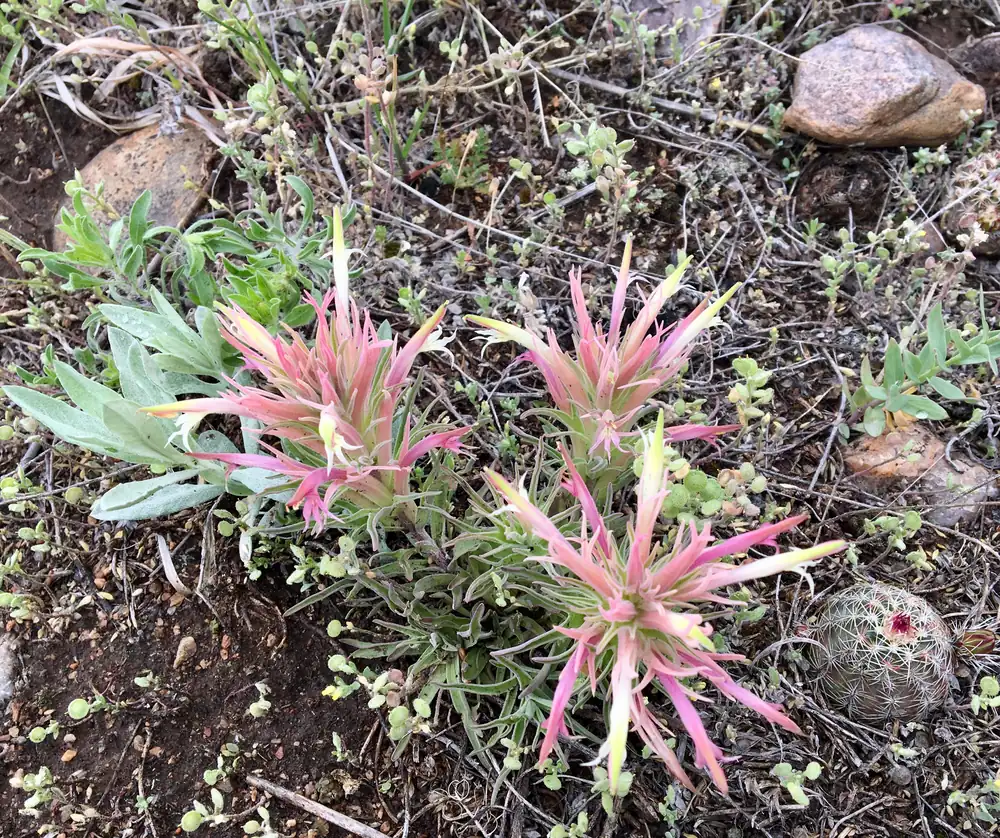
Indian paintbrush and the refuge meadows
The show builds into May; a May 2016 refuge tour article was already seeing coreopsis fields coming · Wichita Mountains Wildlife Refuge and the prairies around it
The Army’s write-up of a May 2016 wildflower tour at the refuge named least daisies, Indian paintbrush, Bailey’s barrel cactus, penstemon, yellow coreopsis, threadleaf thelesperma and prickly pear. April is the early act, so expect scattered paintbrush bracts rather than wall-to-wall color, and rainfall decides how big the later show becomes.
-
Oaks, pecan and black walnut
Blackjack oak averages April 4, post oak April 17, burr oak April 23, pecan April 27 and black walnut April 30 · Cross Timbers woods, river bottoms and town yards
Osborn counted a plant as in bloom when its flowers opened, and for trees such as oaks the flowers are small catkins that open while the leaves are unfolding. Watch the post-oak and blackjack hills turn from bare gray to fuzzy green over about two weeks, with pecans and walnuts coming last. A late freeze at this stage can cost the tender growth, so check the frost table below.
Pick six plants and watch them through the month on a tree through the seasons page. Look, photograph and leave the flowers where they are. Native wildflowers are not for picking, and many roadside patches are seeds for next year.
Which frogs, toads and lizards are active in Oklahoma in April?
The earliest frog choruses of winter have faded, but April brings a new group of voices. The sound changes from whistles and snores to trills, and the first big reptiles emerge from underground.
-
Gray treefrogs and Cope’s gray treefrogs
Begin with the first warm rains; the largest choruses are in late April and May · Farm ponds, roadside ditches, temporary ponds and forested swamps in the eastern half of the state and some adjacent southwestern counties
The Wildlife Department says the two species look nearly alike and breed in the same ponds on the same nights. Their calls differ: the gray treefrog gives a melodic trill at about 22 pulses a second, while Cope’s gray treefrog trills faster, about 35.7 pulses a second, with a harsher sound. Both are small and well camouflaged, so the sound is usually the only clue.
-
Great Plains toad
Explosive breeding after heavy spring rain; calls are heard in late spring and early summer · Sandy prairie, flooded fields and buffalo wallows in the plains
The Department’s page describes a long, loud trill that carries a long way, and says the toads breed in temporary pools. They appear after the first heavy storms. A pasture that was dry on Tuesday can sound like a machine on Thursday night.
-
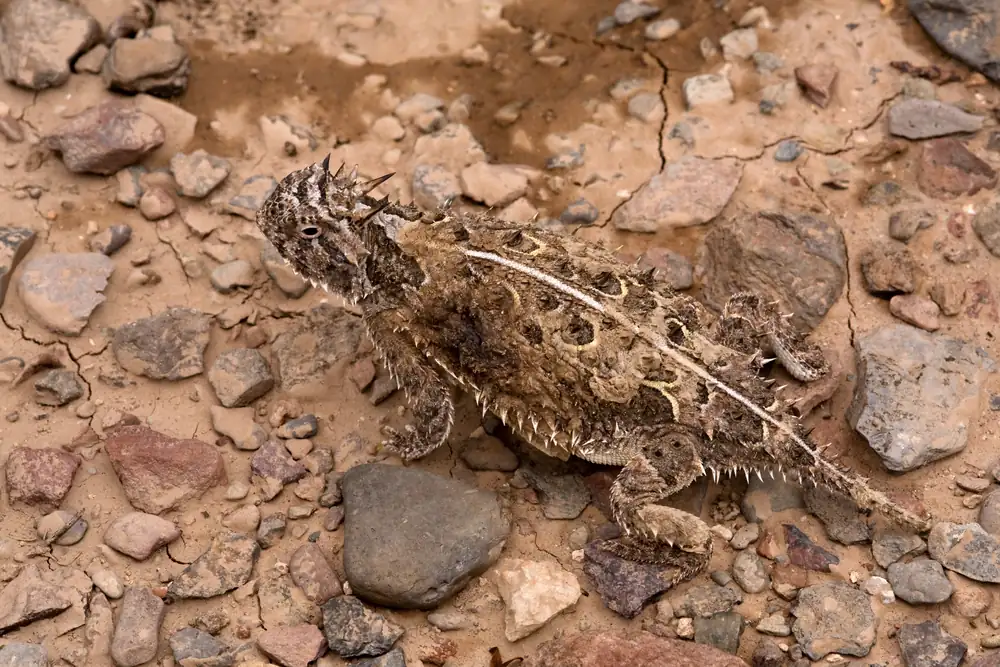
Texas horned lizard
Adults emerge in late April and early May, according to an Oklahoma study · Open ground with harvester ants; check the Department’s sightings page
A U.S. Geological Survey record of a study in Payne County says adults leave hibernation in late April and early May, and that males travel more than females in May while searching for mates. The Department says harvester ants make up most of the diet, up to about 70 ants a day, and recommends searching slowly on paved and unpaved roads in mid- to late morning in spring. The species is of greatest conservation need, and the Department runs a sightings form: biologists said in 2025 that the project had gathered just under 1,100 sightings in about six years. Photograph from a distance, do not pick one up, and send the place and date to the Department.
Make a map of sounds page for the night and note the temperature, the wind and the last rain. Keep your light low, and do not collect or move animals: it is against the law to keep some species and harmful to move any of them.
When do white bass, crappie and paddlefish run in Oklahoma in April?
Spring rain and warming water draw fish to the shallows and up creeks. The folk rule is easy to remember: when the redbuds bloom, the white bass are on the move.
-
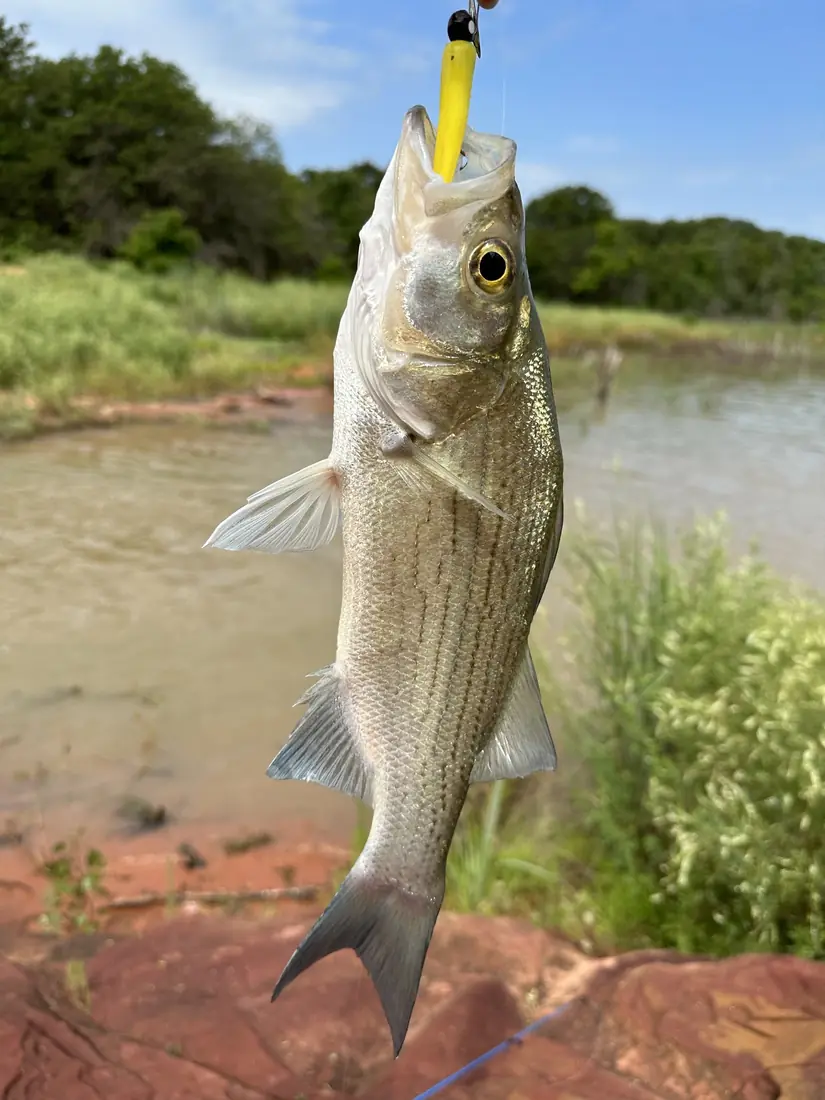
White bass runs
Mid-March through early May, with a one-to-three-week window on any one lake · Tributaries such as Medicine and Canyon creeks at Lake Lawtonka, the North Canadian above Canton Lake, Wolf Creek at Fort Supply, the Spring River above Grand Lake, and the Mountain Fork above Broken Bow
The Wildlife Department’s guide says the urge to spawn begins at a water temperature of 50 °F and peaks near 55 °F, and that moderate rain and temperatures from 55 to 60 °F make for a big run. Longtime anglers use blooming redbuds as the signal. Small creeks need some rain to carry fish upstream, which is why a week of dry weather can end a run in a day.
-
Crappie and sunfish on the nest
Black crappie spawn near 52 °F and white crappie near 56 °F; sunfish fishing improves in April and May · Brushy shallows and docks at lakes statewide
The Department notes that male crappie guard the eggs and fry and stay aggressive, which gives anglers an extra week or so of heavy bites. It adds that a worm and bobber along riprap works for channel catfish from late April into May.
-
Paddlefish season
Spawning runs from March through June; snagging usually begins in March and ends in late April · Grand, Hudson, Fort Gibson, Keystone and Oologah lakes and the Kaw Lake tailwaters; the Arkansas, Neosho, Verdigris, Canadian, Kiamichi and Red river systems
A free paddlefish permit is required in addition to a fishing license. The Department says any fish that is kept must be tagged at once, cannot be released afterward, ends the angler’s snagging for the day, and must be checked in electronically within 24 hours. Catch and release is allowed and encouraged. Exact 2027 dates and area rules were not yet posted when this page was written, so read the current regulations on the Department’s fishing pages.
Water on the rise is dangerous for waders and small boats. Check flows, wear a life jacket and stay off flooded roads. A cheap stream thermometer is a handy addition to your notes.
How warm, wet and stormy is April in Oklahoma?
April is the month the Gulf of Mexico takes over. Warm, humid air streams north under cold air aloft, and the result is the first full season of thunderstorms, hail and tornadoes. The 1991–2020 normals below show what an average April looks like at nine stations. A given April can be far from average.
| Station | Average high | Average low | Precipitation |
|---|---|---|---|
| Boise City 2 E (western Panhandle) | 71.5 °F | 37.6 °F | 1.40 in |
| Beaver (eastern Panhandle) | 70.5 °F | 39.2 °F | 1.70 in |
| Great Salt Plains Dam (north central) | 70.6 °F | 45.3 °F | 3.09 in |
| Enid (north central) | 70.1 °F | 45.9 °F | 3.42 in |
| Oklahoma City Will Rogers Airport | 71.1 °F | 47.5 °F | 3.60 in |
| Tulsa International Airport (northeast) | 72.1 °F | 49.5 °F | 4.37 in |
| Wichita Mountains Wildlife Refuge (southwest) | 73.2 °F | 49.6 °F | 3.15 in |
| Broken Bow 1 N (southeast) | 74.2 °F | 48.0 °F | 5.34 in |
| Idabel (southeast) | 74.9 °F | 48.0 °F | 5.37 in |
Highs are in the 70s everywhere, and precipitation rises from west to east, from 1.40 inches at Boise City to 5.37 inches at Idabel. Boise City still has a normal 2.3 inches of April snow, and Beaver 0.3 inch. The Oklahoma Mesonet showed how wide the range can be. In April 2024 it reported a statewide average of 62.2 °F and 3.94 inches of rain, and an outbreak of at least 22 tornadoes on April 27 alone, including an EF4 at Marietta and EF3 tornadoes at Sulphur and near Holdenville, that killed at least four people and injured nearly 300. A year later, April 2025 was the wettest April since statewide records began in 1895, at 8.74 inches against the earlier record of 8.32 inches in 1942. Oklahoma City collected 12.55 inches, Lawton 14.25 and Duncan 19.63, at least seven people died in flooding, and the Mesonet counted at least 16 tornadoes. Neither month is a forecast. They show why April calls for a plan.
Learn your shelter before the sky does the talking. The Weather Service’s advice is to get to a basement, a safe room or an interior space without windows. A mobile home or tent is not safe, and a vehicle is not either: drive to the closest sturdy shelter if you can, and as a last resort get down and cover your head or find a low spot away from the car. Cloud signs help, and our guide to clouds explains the ones that come before storms. Our weather page has current conditions, and NOAA’s Climate Prediction Center posts new 90-day outlooks once a month, near mid-month.
Is a freeze still possible in Oklahoma in April?
Yes, in the north and west. A warm March tempts gardeners and fools the fruit trees, but the table shows that the median last freeze falls in April at several stations, and that Guymon still sees a freeze after May 1 in about one spring out of ten. The figures are NOAA’s normals, with three dates for the last 32 °F night at each main station: an early one, the middle one and a late one.
| Station | One year in ten | Median | Nine years in ten |
|---|---|---|---|
| Guymon | Apr 4 | Apr 18 | May 1 |
| Woodward | Mar 19 | Apr 5 | Apr 23 |
| Enid | Mar 20 | Apr 6 | Apr 21 |
| Tulsa | Mar 11 | Mar 31 | Apr 15 |
| Oklahoma City | Mar 16 | Apr 4 | Apr 20 |
| McAlester | Mar 11 | Mar 31 | Apr 18 |
| Lawton | Mar 12 | Apr 1 | Apr 19 |
| Idabel | Mar 9 | Mar 31 | Apr 18 |
Guymon is the late end, with a median of April 18 and a late date of May 1, while Tulsa, McAlester and Idabel have a median of March 31. Cover tomato and pepper plants on any clear, still night, and delay planting warm-season crops until the late date has passed. For any other town, see the frost dates page for Oklahoma.
How much daylight does Oklahoma gain in April?
Days keep stretching in April, though more slowly than around the equinox. Since March 14 the clock has read an hour later at every sunrise and sunset than it did before the change.
| City | Apr 1 | Apr 30 | Gained | Per day |
|---|---|---|---|---|
| Guymon | 12 h 36 m | 13 h 40 m | 64 min | 2.2 min |
| Woodward | 12 h 36 m | 13 h 40 m | 64 min | 2.2 min |
| Enid | 12 h 36 m | 13 h 39 m | 63 min | 2.2 min |
| Tulsa | 12 h 36 m | 13 h 39 m | 63 min | 2.2 min |
| Oklahoma City | 12 h 35 m | 13 h 35 m | 60 min | 2.1 min |
| McAlester | 12 h 34 m | 13 h 34 m | 60 min | 2.1 min |
| Lawton | 12 h 34 m | 13 h 33 m | 59 min | 2.0 min |
| Idabel | 12 h 33 m | 13 h 31 m | 58 min | 2.0 min |
In Oklahoma City the day lengthens by exactly an hour over the month, from 12 h 35 m to 13 h 35 m. Guymon in the Panhandle gains the most, 64 minutes, and Idabel in the far southeast the least, 58. Longer days are the main signal that pulls warblers, hummingbirds and flycatchers north. Times for your own town are on the daylight page.
What is in the Oklahoma night sky in April 2027?
Oklahoma keeps Central Daylight Time (CDT) all month, and every clock time below uses it. The Moon shapes the month: dark at the start, a bright full Moon on the 20th and only a thin sliver at the end. The U.S. Naval Observatory supplies the phase times.
-
Dark skies and the Milky Way
Early in the month, around the April 6 new moon; our calculation puts good pre-dawn nights at April 1 to 14, and again at the end of the month · Dark country away from town lights, such as the Panhandle, the Ouachitas and the Wichita Mountains
This is the season when the bright center of the Milky Way starts to rise before dawn. For central latitudes, our calculation gives up to about two hours of dark sky with the galactic core above the horizon in the pre-dawn hours, with the best nights April 1 to 14 and April 27 to 30. It is a faint, low band in the south-southeast, so you need a flat horizon and twenty minutes for your eyes to adapt.
-
The Moon visits the Pleiades, then Jupiter
Around April 10 for the Pleiades; evenings of Wednesday and Thursday, April 14 and 15, for Jupiter · Western sky after dark for the Pleiades; high in the south for Jupiter
By our calculation the young crescent sits right by the Pleiades on the 10th, and binoculars fill the view with stars. Jupiter takes over on April 14 and 15, when the brilliant planet lies less than a degree from the Moon, which is roughly 68 percent lit. Mars, a dim reddish dot, sits not far off on the 15th. Jupiter is out most of the night all month and does not set until the small hours.
-
The Pink Moon
Full on Tuesday, April 20, at 5:27 p.m. CDT · Anywhere with an open eastern horizon
Pink Moon is simply the traditional name for April’s full Moon. The instant of fullness comes at 5:27 p.m., before moonrise, so the disk looks round on the evenings of April 19 and again on the 20th. Watch for it climbing out of the horizon haze near sunset.
-
The Lyrid meteors, in a poor year
Peak about 8:41 p.m. CDT on Thursday, April 22; active about April 14 to 30 · A dark field with a wide view of the northeast
The shower’s maximum is predicted for 01:41 UT on April 23, which is 8:41 p.m. on April 22 in Oklahoma (our own calculation puts it about 14 minutes later). The Moon, still 95 percent illuminated just after full, does not clear the horizon until about 10 p.m. That leaves only the early evening for dark-sky viewing, while the constellation Lyra sits low in the northeast. The International Meteor Organization’s excerpt calls the conditions poor. Expect a few meteors an hour. The Lyrids sometimes surprise with a short burst, but no one can predict that.
| Phase | Date | Time |
|---|---|---|
| New moon | Tuesday, Apr 6 | 6:51 p.m. CDT |
| First quarter | Tuesday, Apr 13 | 5:56 p.m. CDT |
| Full moon, the Pink Moon | Tuesday, Apr 20 | 5:27 p.m. CDT |
| Last quarter | Wednesday, Apr 28 | 3:18 p.m. CDT |
April brings no eclipse that Oklahomans can see. For other dates, open the Moon calendar.
Which nature programs and citizen science projects can you join in Oklahoma in April 2027?
- Thursday, April 22: Earth Day. Earth Day’s 2027 theme, “Food for Our Planet,” can be honored with a native wildflower bed, a milkweed plant or a creek cleanup.
- City Nature Challenge, starting Friday, April 30. The organizers post May 3 as the last observation day and May 16 as the end of the identifying period. Look for your city on the challenge site to see whether it joins.
- Report a monarch. In spring 2025, Journey North’s reports showed monarchs held at the Oklahoma border while milkweed was too small to feed caterpillars further north, with Tulsa and Stillwater among the northernmost sightings on March 29. Report your first monarch and your first hummingbird to Journey North.
- Report a horned lizard or a whooping crane. The Wildlife Department has sightings forms for both. Whooping cranes are expected in early April on their trip to Canada, usually for one to three days, and rarely in groups bigger than eight.
- Join a club. The Oklahoma Native Plant Society’s northeast chapter meets on the first Monday of each month at the Tulsa Garden Center, and its central chapter meets on the first Thursday at Oklahoma City University. Oklahoma City Audubon meets on the third Monday, September through June, and Tulsa Audubon lists its field trips and annual events online. Confirm each date with the organizer.
- Watch a nest. NestWatch is free to join and has a mobile app for recording nests you can see from far away.
Print the one-page April checklist from our nature pages and keep the first dates of the season in the Naturalist’s Field Journal. We do not list single-day festival dates here because most organizers have not yet posted April 2027 schedules; check with each one.
Safety notes for April in Oklahoma
- Spring turkey seasons. The Wildlife Department’s 2026–27 seasons list the youth spring turkey season as April 10 to 11, 2027 (hunters 17 and younger, with adult supervision) and the regular season as April 16 to May 16. The limit is one tom, meaning a bearded turkey, and the legal methods are archery equipment or a shotgun with shot no larger than BB. Legal shooting hours start 30 minutes before official sunrise and end at official sunset. Check the current regulations for any public hunting area before an outing.
- Colors in the turkey woods. Oklahoma’s hunter orange rule applies to antelope, bear, deer and elk seasons and does not list turkey. The Department advises turkey hunters to avoid red, white and blue clothing, which can look like a tom’s head, and not to imitate gobbling in busy areas. Walkers and birders in turkey country should wear a bright color such as a hat or vest and make themselves heard.
- Severe weather. Tornadoes, large hail and flash floods are all possible. Know your shelter and keep weather alerts on. Never drive through water over a road.
- Fire. Wildfire danger is highest on dry, windy afternoons through the end of the month. Burn bans change by county, and Oklahoma Forestry Services posts fire information.
- Snakes. Snakes are active as the days warm. The Department counts eight venomous species in Oklahoma, all pit vipers: rattlesnakes, copperheads and the cottonmouth. It advises watching where you step, checking a five-foot circle before you sit, backing away from any snake and seeking medical attention after a bite.
- Ticks. Per the CDC, tick season starts in April and runs through September. EPA-registered repellent, permethrin-treated clothing, a head-to-toe check and a prompt shower after coming indoors all cut the risk.
- Young wildlife. The Department’s advice is to keep young wildlife wild. A fledgling out of the nest is usually still cared for by its parents, young rabbits with open eyes and fur can look after themselves, and a fawn lying still is normal, since the doe is likely feeding nearby. Many species are protected by law from being handled or kept. For a truly injured or orphaned animal, the Department lists licensed rehabilitators on its website.
- Bison and elk. Keep far back from bison and elk, especially cows with calves.
Sources (51)
- Oklahoma Department of Wildlife Conservation: black-capped vireo
- Oklahoma Department of Wildlife Conservation: songbird recovers after three decades of conservation
- Oklahoma Department of Wildlife Conservation: scissor-tailed flycatcher
- Oklahoma Department of Wildlife Conservation: interior least tern
- Oklahoma Department of Wildlife Conservation: Gobbler Report 2026
- Oklahoma Department of Wildlife Conservation: know these basics to help you take a springtime tom
- Oklahoma Department of Wildlife Conservation: spring turkey regulations
- Oklahoma Department of Wildlife Conservation: turkey regulations
- Oklahoma Department of Wildlife Conservation: 2026–27 hunting seasons
- Oklahoma Department of Wildlife Conservation: big game regulations (hunter orange)
- Oklahoma Department of Wildlife Conservation: birding season (spring warblers)
- Oklahoma Department of Wildlife Conservation: Oklahoma’s bird life
- Oklahoma Department of Wildlife Conservation: Red Slough WMA nature watching
- Audubon: birding in Oklahoma
- Cornell Lab of Ornithology: BirdCast
- U.S. Fish and Wildlife Service: Salt Plains National Wildlife Refuge
- U.S. Fish and Wildlife Service: Salt Plains seasons of wildlife
- U.S. Fish and Wildlife Service: Wichita Mountains Wildlife Refuge
- The Nature Conservancy: Joseph H. Williams Tallgrass Prairie Preserve
- News On 6: Osage County ranchers conduct controlled burns (April 2021)
- Oklahoma Native Plant Record, vol. 15: first flowering dates for central Oklahoma (Ben Osborn, 1934 report)
- Oklahoma Native Plant Society
- U.S. Army: wildflowers at Wichita Mountains Wildlife Refuge (2016)
- Oklahoma Department of Wildlife Conservation: gray treefrog and Cope’s gray treefrog
- Oklahoma Department of Wildlife Conservation: Great Plains toad
- Oklahoma Department of Wildlife Conservation: Texas horned lizard
- High Plains Public Radio: Oklahoma wants horned lizard sightings (2025)
- U.S. Geological Survey: male Texas horned lizards in spring (Payne County study)
- Oklahoma Department of Wildlife Conservation: white bass angler guide
- Oklahoma Department of Wildlife Conservation: spring fishing tips
- Oklahoma Department of Wildlife Conservation: paddlefish field guide
- Oklahoma Department of Wildlife Conservation: paddlefish fishing information
- Oklahoma Mesonet: April tornado outbreak scars Oklahoma (2024)
- Oklahoma Mesonet: April deluges shatter records (2025)
- NOAA NCEI: 1991–2020 April normals for the Oklahoma stations in the table
- Climate Prediction Center: 90-day seasonal outlooks
- National Weather Service: tornado safety during a tornado
- U.S. Naval Observatory: moon phases 2027
- Earth Day organization: Earth Day 2027
- City Nature Challenge
- Journey North: monarchs held at the Oklahoma border, spring 2025
- Journey North: hummingbirds
- Oklahoma Department of Wildlife Conservation: migrating whooping cranes expected to make spring stops
- Oklahoma Department of Wildlife Conservation: keep young wildlife wild
- NestWatch (Cornell Lab of Ornithology)
- Oklahoma City Audubon Society
- Tulsa Audubon Society
- Oklahoma Forestry Services: fire information and burn bans
- Oklahoma Department of Wildlife Conservation: how to avoid unwanted snake encounters
- Centers for Disease Control and Prevention: tick bite prevention
- Photos via Wikimedia Commons; licenses and photographers are credited under each picture
