What to look for in nature in Oregon this April
April is when Oregon's shoreline and its sagebrush basins fill with arrivals. Tufted puffins return to the burrows on Haystack Rock, northbound gray whales are still passing the headlands, and Malheur's refuge records show swallows, terns, ibis and shorebirds coming back on average through the month. In the Columbia Gorge and the Willamette Valley, the wildflower season opens, while the Cascades keep their snow. Every entry names a place, a usual timing and a source, and an event date appears only when its organizer has published one.
Other months in Oregon: October, November, December, January, February, March.
Start here
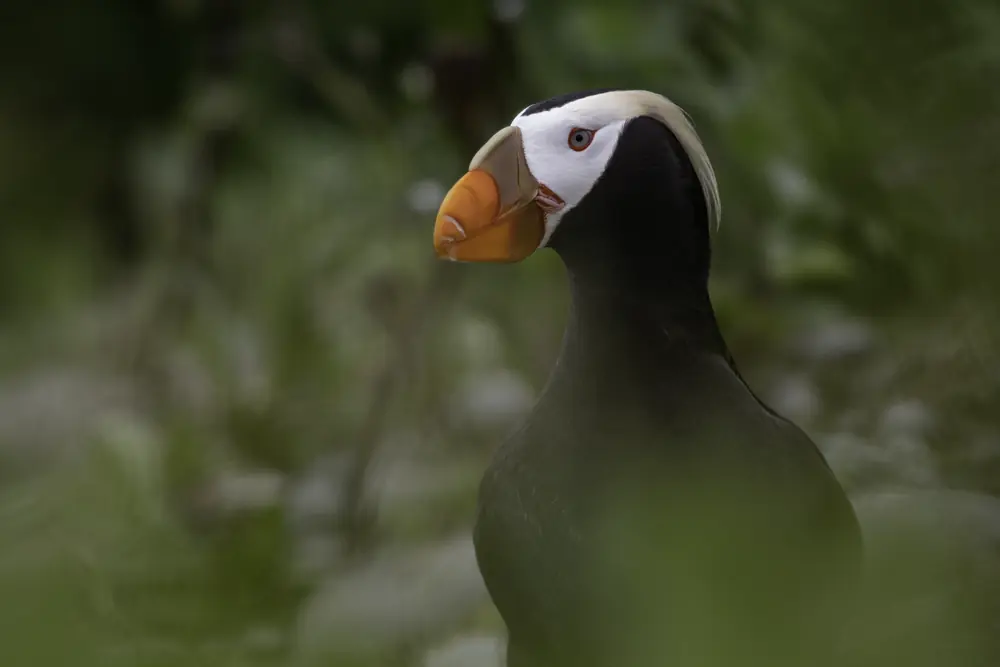
- Puffins on the rock. On a calm morning in the first half of the month, stand on the beach at Cannon Beach and look at the grassy slope of Haystack Rock for small black birds with orange bills. Program volunteers are usually on the sand with scopes through the morning, and the birds typically show up in early April.
- A camas meadow. Camas blooms in April and early May at Camassia Natural Area in West Linn, according to the Nature Conservancy. Go early or late in the day, stay on the boardwalk and leave the dog at home.
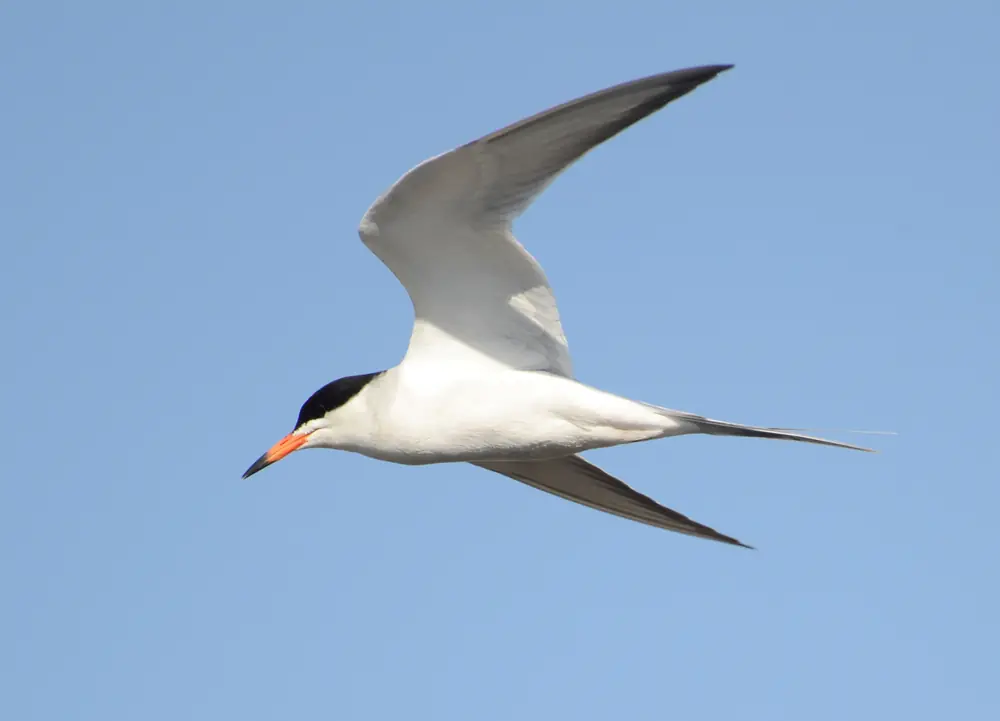
- The first swallows and terns. At wetlands and refuges, watch for barn and cliff swallows, then Forster's terns and western kingbirds. Malheur's records give average arrival dates from April 5 to April 23 for these species.
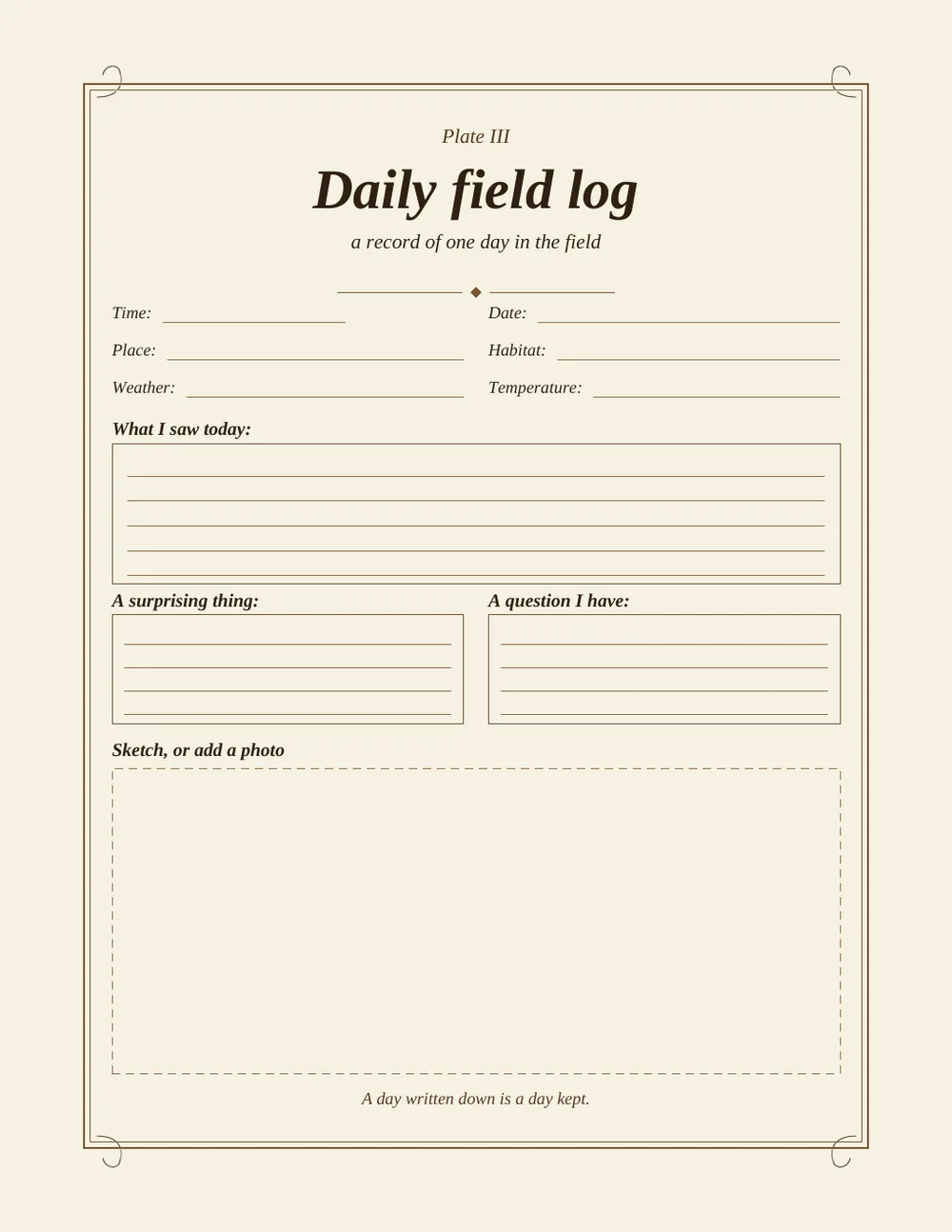
Record it: log each puffin count on the daily field log, with the hour and the tide. Put every dated arrival on birds I have seen, and give camas and trillium their own lines on the same place twice, so next April you can compare. The Pink Moon fits dusk and dawn watch, and a treefrog chorus after dark belongs on a map of sounds.
Regions used below: Portland and the Columbia River Gorge; Willamette Valley; Oregon Coast; Southern Oregon: the Rogue and Umpqua valleys; Central Oregon and the Cascades; Eastern Oregon: the Blue Mountains, the Wallowas and the high desert.
What returns to the Oregon coast in April: puffins, plovers and seal pups?
The offshore rocks wake up first. Tufted puffins fly back to their burrows on Haystack Rock, the plover beaches are in their second month of nesting rules, and harbor seal pups are on the sand. Every one of these comes with a rule about distance, so this section pairs each sight with how to watch it well.
-
Tufted puffins at Haystack Rock
Early April onward; the birds stay visible through August · Haystack Rock, Cannon Beach
Visit the Oregon Coast, a regional tourism site, says puffins return to Haystack Rock in early April and that it holds the largest colony of tufted puffins on the Oregon coast, roughly 60 nesting pairs in the figure it gives, an estimate rather than a survey count. The Haystack Rock Awareness Program reported its first puffins of 2024 on April 6, three birds floating with common murres beyond the waves. Burrows show in the grassy slope on the north and west faces. Program staff and volunteers are usually on the beach from about 8 a.m. until mid-afternoon with scopes. The rock is a marine garden and part of the Oregon Islands National Wildlife Refuge, so climbing it or disturbing wildlife is illegal. First sightings move around from year to year, so no one can promise a date.
-
Other puffin lookouts
April through August · Face Rock at Bandon, Coquille Point, Simpson Reef near Coos Bay
The same coast report names these sites as additional places to try. Bring binoculars and a scope if you have one, and watch the water just beyond the surf as well as the rock face.
-
Western snowy plovers
Nesting-season rules continue until mid-September · Marked plover beaches, north and south
Oregon State Parks lists the restricted period as March 15 through September 15. Dogs are not allowed on plover beaches at all, even leashed, and neither are bikes, vehicles, kites or drones. Walkers stay on the wet, hard sand. The bird is about the size of a sparrow, with a short dark bill and incomplete neck bands. The state credits visitors for the rebound in plover numbers.
-
Harbor seal pups
Late March through April, per ODFW; Oregon State University gives March to June · Beaches and haul-outs
ODFW puts pupping in late March through April, while the university's marine mammal stranding network describes a longer season with a peak in mid-May. A pup resting alone is normally waiting for its mother to return from feeding. Stay at least 50 yards back and keep dogs leashed. Federal law bars people from handling marine mammals, and the Oregon State Police take reports of harassment at 1-800-452-7888.
-
Low tides for tide pools
April 8 to 11 and April 20 to 23 have the lowest daytime lows · Yaquina Bay entrance, near Newport
The table below lists the month's deepest predicted lows from NOAA for South Beach. Tide times shift along the coast, so look up your own beach before you go. Negative heights mean the water falls below the usual zero for tide charts, which uncovers the lower pools. The lows on the 21st and 22nd are the deepest of the month.
| Day | Low tide (PDT) | Predicted height (ft) |
|---|---|---|
| Thursday, April 8 | 8:03 a.m. | -0.7 |
| Friday, April 9 | 8:45 a.m. | -1.0 |
| Saturday, April 10 | 9:30 a.m. | -0.9 |
| Sunday, April 11 | 10:22 a.m. | -0.7 |
| Tuesday, April 20 | 6:44 a.m. | -0.8 |
| Wednesday, April 21 | 7:25 a.m. | -1.2 |
| Thursday, April 22 | 8:05 a.m. | -1.2 |
| Friday, April 23 | 8:44 a.m. | -1.0 |
Pools are crowded with living things, so step on bare rock, return rocks as you found them, and keep an eye on the surf behind you. The moon phase calendar shows the new and full moons that drive the biggest tides.
Are gray whales still passing Oregon in April?
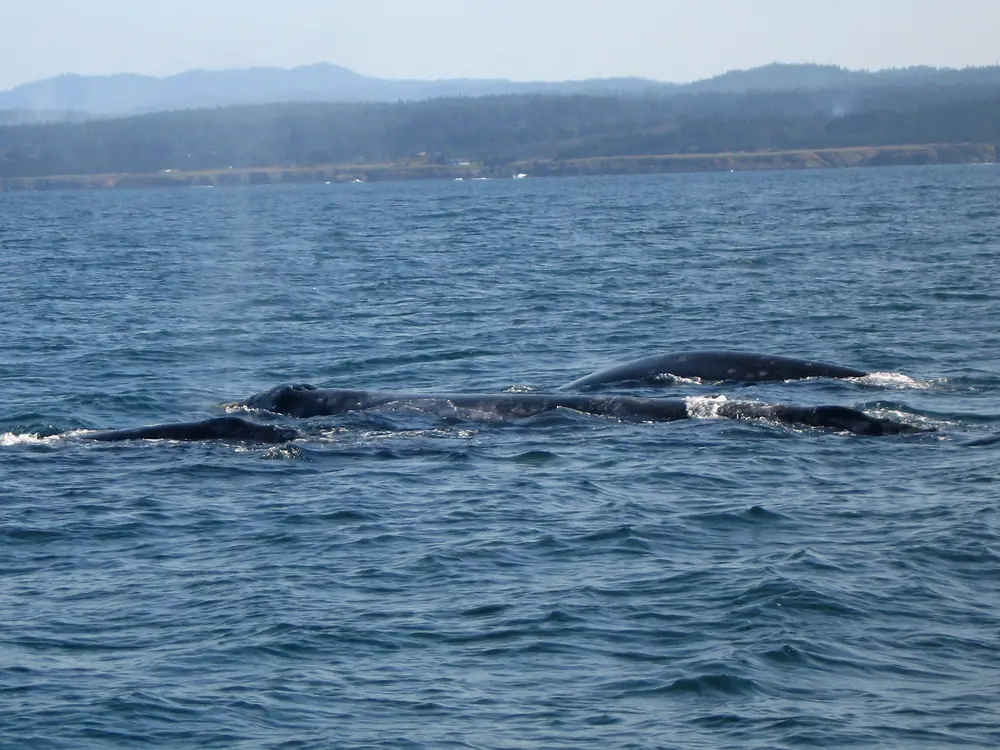
Yes, though the busiest stretch is behind you. NOAA Fisheries says eastern North Pacific gray whales travel north along the West Coast from mid-February to May. Oregon State Parks describes a first surge past the state near the end of March and says visitors can keep watching the northbound whales all the way until June.
-
Northbound whales, quieter water
April, with stragglers into June · Any headland with a long view
Calves are born during the journey or in the Mexican lagoons between early January and mid-February, NOAA says, so a mother with a young whale at her side is a plausible April sight close to shore. Look for the blow first, then the dark back that follows.
-
Resident whales
Summer, but a few may linger · The central coast especially
The parks agency says about 200 whales stay in Oregon's coastal waters for the summer, with the central coast the best bet from June to mid-November. A whale you spot in late April could be a late migrant or an early local.
-
The Whale Watching Center
Check Oregon State Parks for current hours · Depoe Bay seawall
The center sits on the seawall at Depoe Bay and has park staff who answer questions. The agency lists its spring and winter volunteer weeks as late March and late December, so April is a time to go on your own.
Choose a calm, bright morning, sweep the horizon with your eyes before lifting glasses, and tally the blows in fixed fifteen-minute blocks. Repeating that count at one spot each week says more than a single lucky sighting. Our March page for Oregon covers the whale week and the tide-table basics.
What arrives at Malheur and the Klamath Basin in April?
Shorebirds, terns, hawks and the first songbirds. Federal refuge staff describe Malheur's spring as a time when large flocks fill the newly wet meadows and the birds wear fresh plumage, with waterfowl and shorebirds arriving in late winter and songbirds waiting until later. The refuge's own arrival records, printed in a long table below, show how many species arrive on average in April.
-
Harney County Migratory Bird Festival
Annual, held in April; the organizer had not listed 2027 dates yet · Burns
Its website shows the 2026 festival ran from April 16 through 19 and carries nothing for 2027. The festival offers guided tours, a bird crawl with a passport, art, and talks, and it honors the refuge manager John Scharff. Ask the organizer for this year's dates and book lodging early.
-
Klamath Basin grebes and hummingbirds
Waterfowl crest in late March or early April; grebe display late April and May; rufous hummingbirds about mid-April · Klamath Basin refuges and Upper Klamath Lake
According to the Klamath Basin Birding Trails guide, spring migrant waterfowl usually crest in late March or early April, while the courtship dance of western and Clark's grebes is probably best from late April through May. The guide puts the rufous hummingbirds' arrival at about mid-April.
-
Sandhill cranes and sage country
Spring displays through the month · Harney Basin meadows
Greater and lesser sandhill cranes dance in the meadows, as the refuge's species page puts it. Check road and refuge conditions before driving gravel after rain.
| Species | Average arrival | Earliest on record | Latest on record |
|---|---|---|---|
| Swainson's hawk | Apr 5 | Mar 5, 1990 | Apr 27, 1976 |
| Barn swallow | Apr 5 | Feb 27, 1967 | Apr 19, 1962 |
| Cliff swallow | Apr 7 | Feb 28, 1982 | Apr 28, 1965 |
| Willet | Apr 10 | Mar 21, 1958 | Apr 21 (1965 and 1967) |
| Franklin's gull | Apr 13 | Mar 11, 1988 | May 3 (1958 and 1964) |
| Osprey | Apr 15 | Mar 15, 1956 | May 25, 1962 |
| Black-necked stilt | Apr 16 | Mar 20, 1984 | Jun 18, 1957 |
| Western sandpiper | Apr 21 | Apr 2, 1966 | May 5 (1973 and 1998) |
| Forster's tern | Apr 23 | Mar 9, 1983 | May 4, 1963 |
| Western kingbird | Apr 23 | Mar 13, 1998 | May 3, 1967 |
| Wilson's phalarope | Apr 25 | Apr 2, 1964 | May 7, 1960 |
| Yellow warbler | Apr 26 | Apr 16 (1971 and 1989) | May 8, 1964 |
| White-faced ibis | Apr 28 | Apr 7, 1995 | May 24, 1967 |
Read each average as a midpoint rather than a promise, since the earliest and latest records can sit weeks or even months apart. Start a dated list of your own on the bird plate of the Naturalist's Field Journal.
Where do Oregon's April wildflowers bloom?
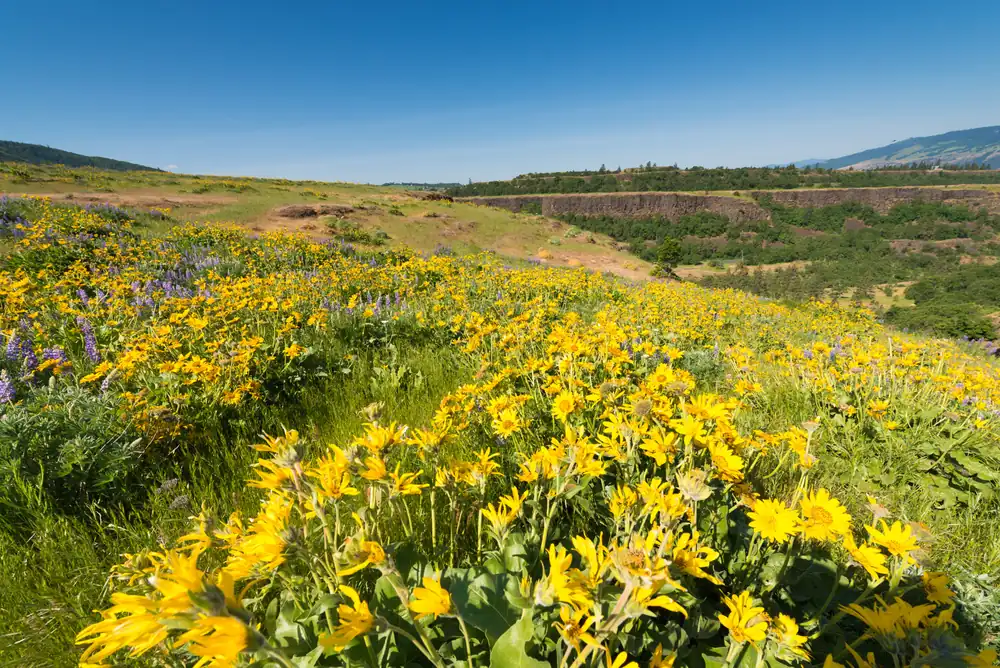
The Columbia Gorge grasslands, the Willamette Valley prairies and the damp forests of Silver Falls all peak at different times, which is why April is the best month to compare them. Nature Conservancy pages for two preserves put the display in April and May, and the farm tulips at Woodburn fill the first weeks.
-
Tom McCall Preserve at Rowena
Wildflowers are most abundant in April and May; trail open through October 31 · Rowena Crest, Columbia River Gorge
The Conservancy lists more than 300 plant species here, among them grass widows, prairie stars, shooting stars, balsamroot, lupine and Indian paintbrush, plus four plants found only in the Gorge: Thompson's broadleaf lupine, Columbia desert parsley, Thompson's waterleaf and Hood River milkvetch. Visit early or late in the day and avoid weekends. No dogs, no drones, no bikes and no leaving the trail. The site warns of ticks, rattlesnakes, poison oak, steep drop-offs and frequent wind.
-
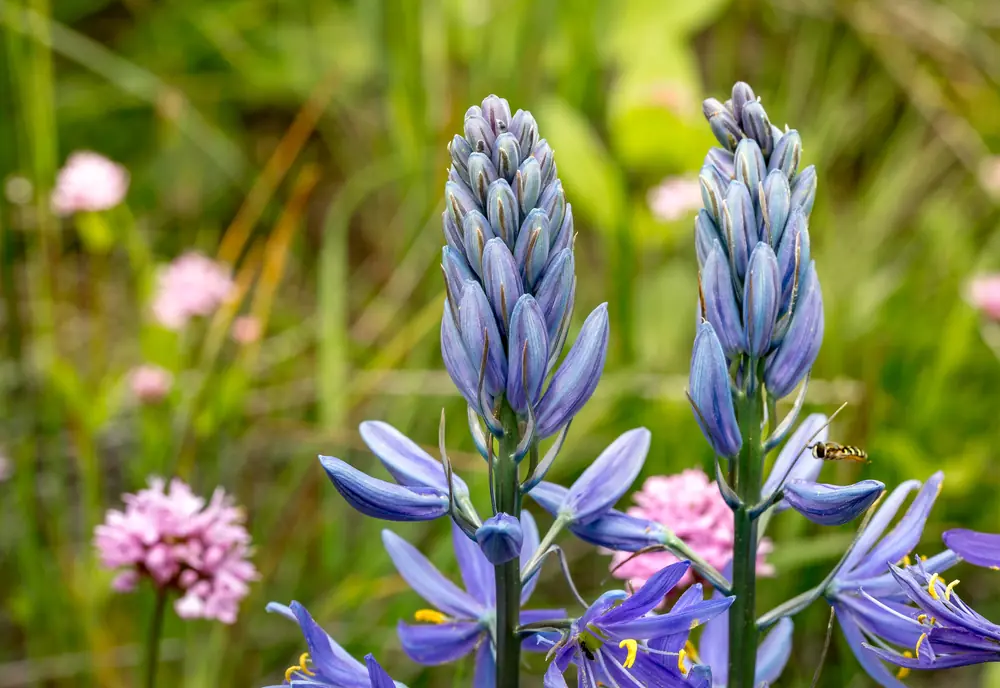
Camassia Natural Area
Common camas blooms April and early May · West Linn
The preserve is open every day of the year, and its spring display is the camas lily. Trails are muddy in spring, the boardwalk can be very slippery, and poison oak grows beside the path. Dogs are not allowed, because ground-nesting birds use the site. Groups of ten or more should call the Conservancy first.
-
Silver Falls State Park
Log your own first-bloom dates · Near Silverton, in the western Cascade foothills
Oregon State Parks' wildflower leaflet lists more than sixty common flowers without bloom dates. Among them are western trillium, Oregon fawn lily, skunk cabbage, red columbine, vanilla leaf, wood sorrel, Pacific bleeding heart, salmonberry, red-flowering currant, osoberry, Pacific dogwood and common camas. Use it as a checklist and record the day each one opens.
-
The Wooden Shoe Tulip Festival
Tentatively March 19 through April 25, 2027, as the farm lists it · Woodburn, in the Willamette Valley
The farm's own page calls the dates tentative, so confirm before you drive. Tulips are a planted crop, not wild, but weather and bulbs decide the peak.
-
Prairie at Finley refuge
Spring and early summer · Finley refuge near Corvallis
The refuge says its restored native prairies hold golden paintbrush, camas, rose checker-mallow and Oregon grape, and that neotropical migrants and shorebirds stop to feed in spring as the winter waterfowl move north.
Photograph the flowers instead of picking them, and keep to the trail so the seed bank under your boots survives. Our field journal has plates for seeds, pods and cones that suit the seasons of these flowers as the year goes on.
When do hummingbirds and spring songbirds reach western Oregon?
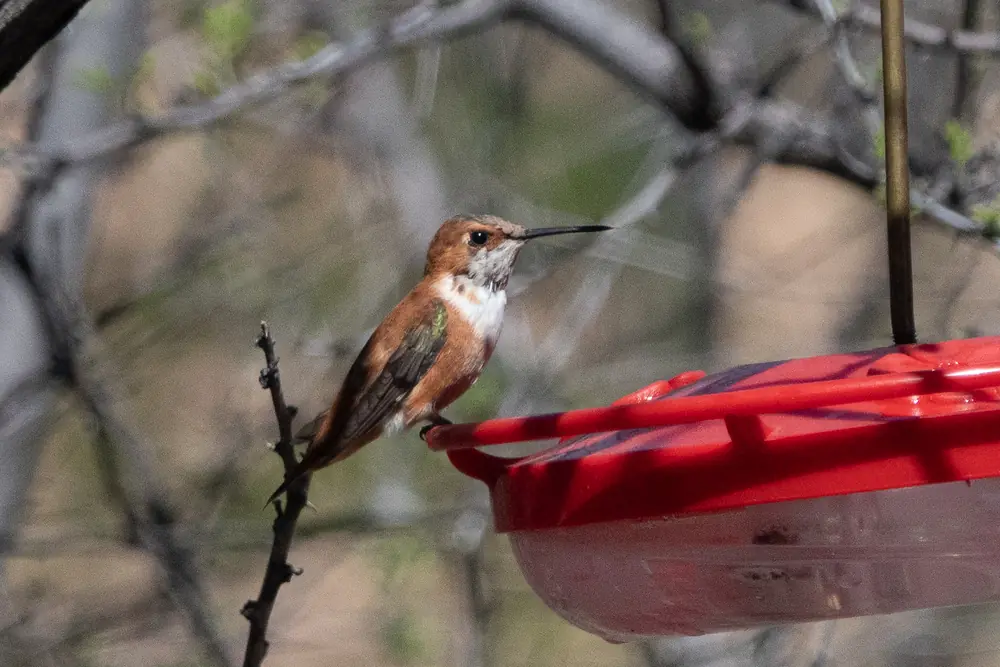
Rufous hummingbirds lead, and a long line of warblers, flycatchers and tanagers follows through May. Oregon State University Extension says rufous hummingbirds travel from Mexico between February and May, almost always along the West Coast, timed with manzanita bloom.
-
Rufous hummingbirds
February through May along the coast; mid-April in the Klamath Basin · Gardens, edges and flowering shrubs
The extension bulletin lists bleeding heart, red-flowering currant, salmonberry, columbine and orange honeysuckle among their favorite flowers. The extension's feeder recipe is one part cane sugar to four parts water, boiled for a minute and cooled before filling, with regular washing of the feeder. A stiff hummingbird in the cold may only be in torpor, so give it time before you worry. Journey North takes sightings and maps the northward spread.
-
Finley refuge stopover
Spring migration · Finley refuge, south of Corvallis
Refuge staff report that songbirds and shorebirds stop to rest and feed as the wintering geese and ducks head north. Walk the trails at first light.
-
Nest boxes and NestWatch
Nesting begins as the month warms · Your yard or a local park
NestWatch, a Cornell Lab of Ornithology project, is free to join and asks you to follow a code of conduct, find a nest, and log what you see.
Keep it simple: note the date each species first appears and the weather that morning. Over several years the notes will show a pattern no single visit can. Our cloud guide helps with the weather half of that log.
What are Oregon's frogs, toads and salamanders doing in April?
Calling, laying, and crossing the road. ODFW calls the Pacific treefrog the smallest and most often heard frog in the state, and its calls swell on warm evenings. The western toad and the Cascades frog are state-sensitive species that need quiet water.
-
Pacific treefrog choruses
Evening and night; breeding timing varies by site · Ponds, ditches, slow streams and seasonal pools
ODFW says breeding sites are used only a few weeks or months a year and that frogs often live several hundred yards from water. Males call mostly at dusk and after dark. If you build a backyard pond, put it away from bedrooms.
-
Western toads
Breeding timing varies with elevation and snowmelt · Wetlands, ponds, lakes and slow side channels across the state
Oregon's conservation strategy says the western toad favors sunny, shallow water with sparse plants for egg laying, and lists road deaths, disease, bullfrogs and lost habitat among its threats. Slow down for a toad on a wet spring road.
-
Cascades frog
Later than the lowlands, as the high lakes thaw · Bogs, ponds and slow streams above about 2,400 feet
This brown-to-olive frog with a dark face mask lives in the Cascades. The state lists it as sensitive and notes losses in the southern part of its range. Few visitors reach its pools before summer.
-
Salamanders and newts
Wet spring days and nights · Moist forests and trails
ODFW suggests rainy days from late fall through spring as the best time to look. Rough-skinned newts cross roads in spring and fall, and their skin and eggs hold a strong poison, so look and do not touch.
Keep dogs and shoes out of breeding ponds, and wash your hands after any outing near amphibians. A recording of the treefrog chorus fits a map of sounds in the field journal.
When is the last spring freeze in Oregon?
It depends enormously on where you live. Portland and the coast have usually seen their last freeze by late March or early April, the southern Willamette Valley and Rogue Valley by mid-April, and Central Oregon and the high desert not until June. April is when the lower valleys finally warm up, but frost can still kill early blooms and tender seedlings.
| Station | One year in ten | Median | Nine years in ten |
|---|---|---|---|
| Astoria Regional Airport (north coast) | Feb 27 | Mar 26 | Apr 18 |
| North Bend Regional Airport (south coast) | Dec 31 | Feb 21 | Mar 25 |
| Portland International Airport | Feb 22 | Mar 13 | Apr 1 |
| Eugene Mahlon Sweet Airport (southern Willamette Valley) | Mar 15 | Apr 11 | May 9 |
| Medford Rogue Vly Airport (Rogue Valley) | Mar 17 | Apr 8 | Apr 30 |
| The Dalles (Columbia River Gorge) | Mar 27 | Apr 14 | May 1 |
| Redmond Roberts Field (Central Oregon) | May 17 | Jun 9 | Jun 26 |
| La Grande (Grande Ronde Valley) | Apr 21 | May 6 | May 26 |
| Burns Municipal Airport (high desert) | May 21 | Jun 11 | Jun 28 |
Treat the median as a rough guide and the nine-in-ten date as the safer one for planting tomatoes. Look up your own town on our Oregon frost-date page, and wait for the late date in the Burns and Redmond column before setting out anything tender. The December 31 entry means that at North Bend the mildest tenth of springs had their final freeze before the old year ended.
How wet and cold does April get in Oregon, and what are the weather hazards?
Showery in the west, dry in the east, and still snowy up high. NOAA's 1991 to 2020 normals give Astoria 5.80 inches of precipitation in April and Government Camp on Mount Hood 7.78, against 0.79 at Bend and 0.94 at Burns. Crater Lake's park headquarters averages 48.7 inches of snow in April, the most of any station listed.
-
Rain in the west, sun breaks in the east
All month · Coast, Willamette Valley, Cascades
Portland averages 2.89 inches in April and Eugene 3.32. Pack a shell even on bright mornings.
-
Snow still falls in the mountains
All month · Cascades and high country
Government Camp's April average is 17.6 inches of snow and Crater Lake's 48.7. Roads and trailheads at elevation may be closed or icy.
-
Avalanche and surf hazards
All month · Cascade slopes and the coast
The Northwest Avalanche Center posts forecasts for mountain terrain. At the beach, the National Weather Service describes surges that reach well up the dry sand, sometimes after a lull of small waves lasting 10 to 20 minutes.
-
The outlook
Updated monthly · NOAA Climate Prediction Center
NOAA releases each new 90-day outlook around the middle of the month. The latest outlook has the maps for the coming season, and our weather page carries forecasts and radar.
| Station | Precipitation (in) | Snowfall (in) | Average high (°F) | Average low (°F) |
|---|---|---|---|---|
| Astoria Regional Airport (north coast) | 5.80 | 55.9 | 41.5 | |
| North Bend Regional Airport (south coast) | 5.40 | 0.0 | 56.7 | 44.0 |
| Portland International Airport | 2.89 | 0.0 | 62.0 | 43.7 |
| Eugene Mahlon Sweet Airport | 3.32 | 61.3 | 40.0 | |
| Medford Rogue Valley Airport | 1.51 | 0.0 | 64.6 | 41.0 |
| Government Camp (Mount Hood) | 7.78 | 17.6 | 45.1 | 30.5 |
| Crater Lake National Park headquarters | 6.16 | 48.7 | 40.3 | 23.1 |
| Bend | 0.79 | 0.7 | 57.7 | 30.5 |
| Pendleton | 1.21 | 0.0 | 61.8 | 38.3 |
| Burns Municipal Airport | 0.94 | 58.1 | 29.8 |
Layer up. A morning in the 30s can turn into an afternoon in the 60s, and a clear night east of the Cascades can still bring frost.
What happens to day length across Oregon in April?
Roughly an hour and a half more across the month. Portland's day grows from 12 hours 48 minutes on April 1 to 14 hours 16 minutes on April 30, a gain of 88 minutes, and each city in the table reaches 14 hours or more by April 30. Clocks changed on March 14, so April's sunrises and sunsets are all in daylight time.
| City | Apr 1 | Apr 30 | Gained | Per day |
|---|---|---|---|---|
| Astoria | 12 h 49 m | 14 h 20 m | 91 min | 3.1 min |
| Portland | 12 h 48 m | 14 h 16 m | 88 min | 3.0 min |
| Pendleton | 12 h 48 m | 14 h 17 m | 89 min | 3.1 min |
| Newport | 12 h 47 m | 14 h 12 m | 85 min | 2.9 min |
| Bend | 12 h 45 m | 14 h 09 m | 84 min | 2.9 min |
| Ontario | 12 h 46 m | 14 h 09 m | 83 min | 2.9 min |
| Medford | 12 h 43 m | 14 h 02 m | 79 min | 2.7 min |
| Brookings | 12 h 43 m | 14 h 01 m | 78 min | 2.7 min |
For sunrise and sunset at any Oregon address, try our day-length tool.
What can you see in the Oregon night sky in April 2027?
Moonlight dominates the month, with a full Pink Moon, weak Lyrid meteors and Jupiter high at dusk. Times are Pacific daylight time; Ontario and the Mountain-time part of Malheur County are an hour later.
-
The Pink Moon
Tuesday, April 20, at 3:27 p.m. PDT; the evening of the 20th is the one to watch · Coming up in the east near sunset
April's full moon is traditionally called the Pink Moon, and it turns full in the afternoon, so the moonrise that evening is the sight to catch. Our moon phase page keeps the calendar.
-
The Lyrid meteors
Peak near 6:41 p.m. PDT, Thursday, April 22 (the International Meteor Organization maximum, about 01:41 UT on April 23) · Northeast to east, away from the Moon
Meteors fall from about April 14 to 30, at best near 18 an hour in a dark sky. In 2027 a bright Moon, roughly 95 percent lit, climbs the sky late in the evening (about 10 to 11 p.m. in the Pacific Northwest), leaving only the early hours dark, so expect a few an hour. Treat the peak time as approximate; it is a computed value.
-
Jupiter and the Moon
The evenings of April 14 and 15 · South, after dark, in the Leo and Cancer region
A Moon about two-thirds lit slides within a degree of Jupiter, closest at 7:19 a.m. PDT on the 15th, so the pair is close on both evenings. Mars is a few degrees away from the Moon on the 15th.
-
Venus before dawn
All month · East, before sunrise
Venus shines as a brilliant morning star, rising about 75 minutes ahead of dawn on the 1st, with a slightly shorter lead by the 30th. Saturn is hidden in the sun's glare all month and only reappears before dawn in the last days.
| Phase | Date | Time |
|---|---|---|
| New moon | Tuesday, Apr 6 | 4:51 p.m. PDT (5:51 p.m. MDT) |
| First quarter | Tuesday, Apr 13 | 3:56 p.m. PDT (4:56 p.m. MDT) |
| Full moon, the Pink Moon | Tuesday, Apr 20 | 3:27 p.m. PDT (4:27 p.m. MDT) |
| Last quarter | Wednesday, Apr 28 | 1:18 p.m. PDT (2:18 p.m. MDT) |
The new moon on the 6th gives the darkest evenings of the first half of the month. Remember that planets glow steadily while stars twinkle.
Which April outings suit families in Oregon?
- Look for puffins. Check the Haystack Rock Awareness Program's volunteers at the beach in the morning and ask to look through a scope.
- Join Arbor Week. The state legislature set Oregon's Arbor Week as the first full week of April, and the Oregon Department of Forestry's factsheet suggests planting a tree, cleaning a park or a big-tree search. Ask your city about events.
- Mark Earth Day. April 22 is a Thursday this year, and the Lyrid meteors peak that evening.
- Visit a wildflower preserve. Go early or late in the day, stay on the path, and leave pets at home.
- Check the tide pools. Use the low-tide table in this page; the best lows come around April 8 to 11 and 20 to 23.
- Snowshoe at Crater Lake. The park's guided walks continue through April if snow allows, leaving at 12:30 p.m. on weekends, holidays and school-break weekdays. The tour itself costs nothing beyond the $20 vehicle entrance fee, loaner snowshoes are provided, children must be at least 8, and a reservation (541-594-3100) is required.
- Start a nest box log. NestWatch is free, and a box in the yard makes a lasting project.
Phone refuges and festival organizers ahead of time, because schedules shift. Browse the nature index for other states, keep notes in the Naturalist's Field Journal, and see our March page for the month before.
What are the main outdoor risks in Oregon in April?
- Spring turkey season. The 2026-27 game bird regulations list the general spring season as April 15 through May 31, 2027, one male turkey or a bird with a visible beard per day, up to three spring tags. A youth hunt runs April 10 and 11 for hunters 17 and younger with an adult 21 or older who does not hunt. Check ODFW for changes.
- Spring bear. Black bear hunting is by controlled hunt only. ODFW's draft 2027 list shows April 1 through May 31 for its hunts, so confirm in the final regulations.
- Hunter orange. Orange is required of hunters younger than 18 who carry a firearm for big game or upland birds, with wild turkey excepted. Adults hiking in turkey country may still want bright clothing.
- Wildlife areas open. Per the regulations, public access opens April 1 at Minam River, April 11 at Elkhorn, and April 15 at Bridge Creek and Phillip W. Schneider. Confirm before you travel.
- Sneaker waves. Surges can reach at least 150 feet up dry sand and shove driftwood. Keep facing the surf.
- Plovers and seals. No dogs on plover beaches. Stay 50 yards from any seal pup.
- Ticks. The Oregon Health Authority says western black-legged tick nymphs feed in spring and summer, mostly west of the Cascades, while the Rocky Mountain wood tick is active April through July above 4,000 feet east of the Cascades. A tick generally must stay attached for 36 to 48 hours or more to pass on Lyme disease. Check yourself after brushy walks.
- Gorge hazards. Rattlesnakes, ticks, poison oak, drop-offs and wind at Tom McCall Preserve.
- Young animals. ODFW places deer and elk births in May through July; whatever the species, a lone youngster is best left in place.
- Mountain snow. Read the avalanche forecast before steep terrain.
Look at conditions the day before and again on the morning of your trip. Our Oregon frost-date page and weather page help with planning.
Sources (45)
- Visit the Oregon Coast: the puffins are coming
- Beach Connection: puffins returned to the coast, especially Cannon Beach
- Oregon State Parks: whale watching
- NOAA Fisheries: gray whale species page
- Oregon State Parks: western snowy plover beach restrictions
- Oregon State University: public urged to refrain from approaching seal pups on Oregon beaches
- ODFW: give wildlife a chance, leave young wild animals where you found them (2024 news release)
- NOAA CO-OPS: tide predictions for South Beach, Yaquina Bay entrance (station 9435380), April 2027
- Harney County Migratory Bird Festival (organizer site)
- U.S. Fish and Wildlife Service: Malheur NWR average spring migratory bird arrival dates
- U.S. Fish and Wildlife Service: Malheur NWR seasons of wildlife
- Klamath Basin Birding Trails: frequently asked questions
- The Nature Conservancy: Tom McCall Preserve at Rowena
- The Nature Conservancy: Camassia Natural Area
- Oregon State Parks: wildflowers of Silver Falls
- Wooden Shoe Tulip Farm: tulip festival
- U.S. Fish and Wildlife Service: William L. Finley NWR seasons of wildlife
- Oregon State University Extension: rufous hummingbird (EC 1570)
- Journey North: hummingbirds
- Cornell Lab of Ornithology: NestWatch
- ODFW: Living with Wildlife, Pacific treefrog
- Oregon Conservation Strategy: western toad
- Oregon Conservation Strategy: Cascades frog
- ODFW: salamanders in Oregon
- Oregon Department of Forestry: Arbor Day and Arbor Week factsheet
- National Park Service: ranger-guided snowshoe walks at Crater Lake
- ODFW: 2026-27 Oregon game bird hunting regulations
- ODFW: 2026 spring turkey hunting forecast
- ODFW: draft 2027 spring black bear controlled hunts
- ODFW: hunting bear in Oregon
- National Weather Service: sneaker waves
- Oregon Health Authority: ticks
- Northwest Avalanche Center
- NOAA Climate Prediction Center: seasonal outlooks
- NOAA NCEI 1991-2020 monthly normals: Astoria Regional Airport
- NOAA NCEI 1991-2020 monthly normals: North Bend Regional Airport
- NOAA NCEI 1991-2020 monthly normals: Portland International Airport
- NOAA NCEI 1991-2020 monthly normals: Eugene Mahlon Sweet Airport
- NOAA NCEI 1991-2020 monthly normals: Medford Rogue Valley Airport
- NOAA NCEI 1991-2020 monthly normals: Government Camp
- NOAA NCEI 1991-2020 monthly normals: Crater Lake National Park headquarters
- NOAA NCEI 1991-2020 monthly normals: Bend
- NOAA NCEI 1991-2020 monthly normals: Pendleton
- NOAA NCEI 1991-2020 monthly normals: Burns Municipal Airport
- Photos via Wikimedia Commons; licenses and photographers are credited under each picture
