What to look for in nature in Oregon this December
December opens Oregon's winter, and the state's big wildlife shows shift with it. Gray whales start streaming south past the headlands, bald eagles settle into the Klamath Basin in large numbers, and coho finish spawning in the creeks around Coos Bay. Snow piles up on Crater Lake and Mount Hood while the valleys mostly get rain, and the season's highest tides arrive with Christmas. Below are the places, dates and sources for each.
Other months in Oregon: October, November.
Start here
- Whale Watch Week. Volunteers staff viewpoints along the coast from December 27 to 31, the stretch when ODFW says the southbound gray whale migration usually peaks. Go on a calm morning, bring binoculars and look for a bushy, short-lived spout.
- Eagles at first light. From early December, wintering bald eagles leave their night roost at Bear Valley refuge at dawn and fan out over Lower Klamath and the fields along Township Road. Arrive before sunrise and watch from the car.
- The Geminids and the Cold Moon. In Portland the crescent moon sets at 8:55 p.m. on Sunday, December 13, leaving the rest of the night dark for the Geminid meteors. Ten days later, the full Cold Moon on the evening of the 23rd is the nearest and largest-looking of 2026.
Record it: the daily field log in the Naturalist's Field Journal takes a whale-watch tally (date, place, blows counted, direction of travel), and birds I have seen is for the Christmas Bird Count list. Draw a Douglas-fir cone next to a hemlock's on the plate for seeds, pods and cones, and copy elk or deer prints from the snow or mud onto tracks to know. On the solstice, the dusk and dawn watch page can hold the times the light came and went.
Regions used below: Portland and the Columbia River Gorge; Willamette Valley; Oregon Coast; Southern Oregon: the Rogue and Umpqua valleys; Central Oregon and the Cascades; Eastern Oregon: the Blue Mountains, the Wallowas and the high desert.
When do gray whales pass the Oregon coast in December?
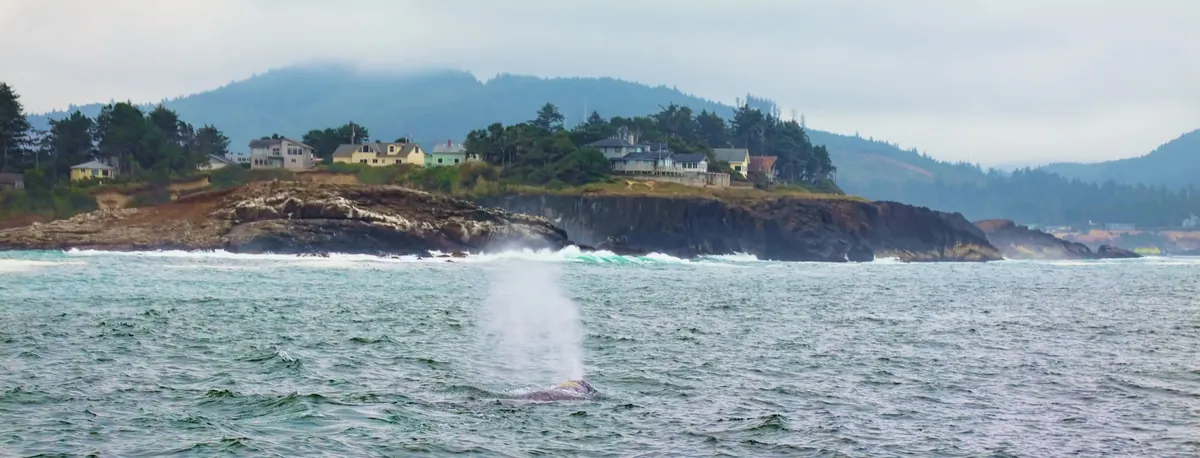
The southbound gray whale migration is the coast's great December event. Thousands of whales that spent the summer feeding in Alaskan and Arctic waters swim past Oregon on their way to the lagoons of Baja California, and Oregon State Parks puts the main stream of them between mid-December and mid-January. ODFW says the height of the passage usually falls between Christmas and New Year's Day. The migrants pass farther offshore than the summer residents did, so a high viewpoint and a calm morning make all the difference.
-
Winter Whale Watch Week
Sunday, December 27 to Thursday, December 31, 2026 · Headlands and waysides from Astoria to Brookings; the Whale Watching Center in Depoe Bay
Each winter, trained volunteers in the Whale Watching Spoken Here program stand at viewpoints along the whole coast to point out spouts and answer questions; the state parks department mentions 15 such sites. The program's own site, orwhalewatch.org, lists this year's week as December 27 to 31. Daily hours are set nearer the time, so check the list of stations before you drive. At the peak, the program says, roughly 30 whales an hour can pass the coast.
-
The Whale Watching Center
Wednesday to Sunday, 10 a.m. to 4 p.m. (current hours) · 119 S. Highway 101, Depoe Bay
The state park center sits on the seawall above the tiny harbor, with big windows, binoculars and staff who log what they see. Call ahead (541-765-3304) for holiday hours. On a busy day ODFW notes that as many as 50 southbound whales have been counted from here during the winter watch week.
-
How to find a blow
Calm mornings with the sun behind you · Any high viewpoint over open ocean
Scan the middle distance with bare eyes for a puff of white, then lift binoculars to the same spot. ODFW describes the gray whale's blow as a bushy column up to 15 feet tall that hangs for about five seconds; a whale typically breathes three to five times, half a minute or so apart, then dives for three to six minutes. In winter, a whale that keeps surfacing to your left is heading south.
Whitecaps hide spouts, so the first calm day after a storm is the one to go.
Where can you see bald eagles and owls in Oregon in winter?
Bald eagles nest in 32 of Oregon's 36 counties, ODFW reports, and outside the breeding season they turn up all over the state. In winter they gather where food comes easily: spent salmon on the west-side rivers, and the great waterfowl marshes of the Klamath Basin.
-
The Klamath Basin's eagle winter
Early December to mid-March; peak mid-February · Lower Klamath refuge, Township Road, Tule Lake, Klamath Wildlife Area at Miller Island
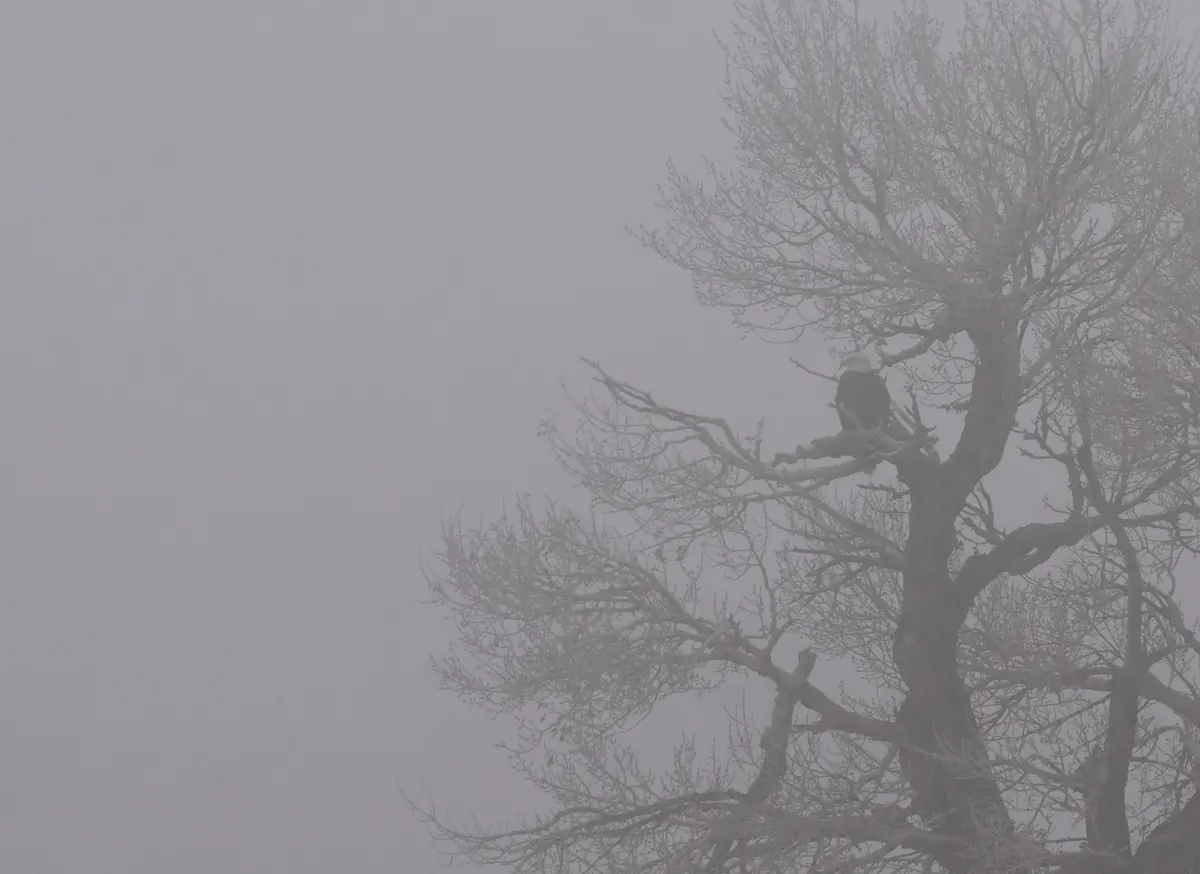
The Klamath Basin Birding Trails say wintering bald eagles are present in impressive numbers from the start of December. Many spend the night in the roost at Bear Valley National Wildlife Refuge, and at first light they fly out to hunt over Lower Klamath and the flooded fields along Township and Lower Lake roads. Be in place by sunrise and watch for birds arriving at first light.
-
Eagles on the salmon rivers
Through December, wherever coho and chinook have spawned · Coos and Coquille tributaries, the Umpqua, the lower Rogue, Cascade foothill creeks
Where spent salmon litter the gravel bars, look for adult eagles in the streamside alders and mottled brown young birds feeding on the bars below.
-
Short-eared owls at dusk
Late afternoon in open country · Marshes, wet pastures and grasslands, both sides of the Cascades
ODFW counts it among Oregon's most conspicuous owls, because it hunts in daylight's last hour, flying low and floppy over fields like a big moth. Look for the pale buff face and a tawny flash on each wing. Its numbers in a given place vary a lot from year to year, following the voles it eats.
-
Owls you hear before you see
Long December nights · Forests statewide
Oregon has 14 owl species. The northern saw-whet, only about eight inches long, is among the most common in the state's forests and the one heard most often on night surveys in the Coast Range; its call is a steady, repeated toot. A still, cold night after dark is the time to step out and listen.
How do I join a Christmas Bird Count in Oregon?
Audubon's count season opens on December 14 and runs into the new year, closing January 5. In those weeks each count circle, 15 miles across, chooses a single day, and its teams try to tally every bird inside it from first light to dark. The Oregon Birding Association calls it the longest-running citizen science survey anywhere, and most counts welcome beginners.
-
Find your circle
Dates posted through November and December · Statewide; listed by the Oregon Birding Association
The Oregon Birding Association keeps the state's count list and updates it as compilers announce their dates. Last season's counts were spread over every weekend and many weekdays of the period, from the Columbia Estuary, Florence and Burns at the start to Oakridge and Prineville on New Year's Eve and a few in early January. Sign up early, since leaders assign areas in advance.
-
The big ones
One day each, late December · Portland, Eugene, Klamath Falls
Portland's count is the largest in Oregon, and Eugene's is usually the second; Eugene also takes feeder counters who live inside its circle. On the east side, the Klamath Falls count typically leads both Oregon and Washington east of the Cascades, averaging more than 105 species.
-
Counts in the high desert
Mid-December · Burns, Malheur refuge, Hart Mountain, Summer Lake
These remote counts need people willing to drive gravel roads in the cold. The organizers in Burns warn of anything from freezing fog to wind chills far below zero, so pack layers, waterproof boots, food and water, and treat the day as a winter expedition.
If you would rather stay home, ask your local compiler whether the circle includes your street; a morning's careful feeder count, sent in the same day, goes into the total. Keep your list in the birds-I-have-seen plate of our Naturalist's Field Journal and compare it with next December's.
Are salmon still spawning in Oregon in December?
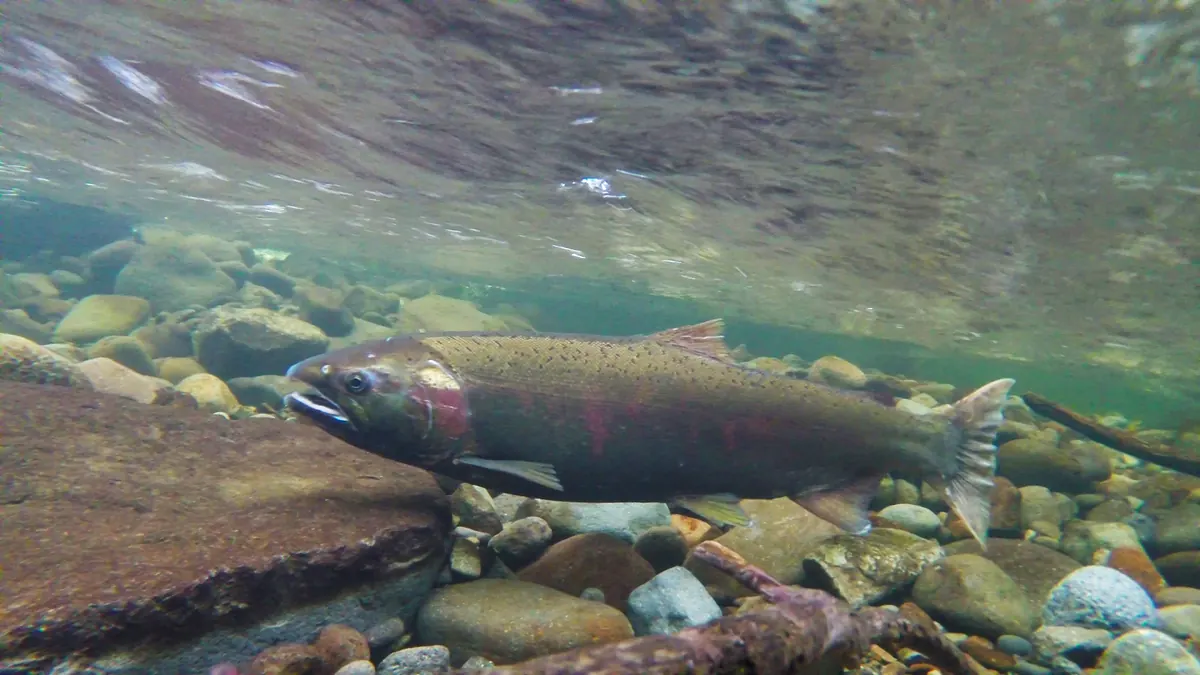
Yes, though now it is mostly coho, and mostly in the southwest. ODFW's statewide spawning season runs from mid-September into December, and the last act plays out in the small coastal rivers of Coos and Douglas counties, where coho wait for December rain to lift the creeks before they push upstream.
-
Coos River coho
Peak in December · West Fork Millicoma at the Millicoma Interpretive Center; Marlow Creek; State Forest Road 1000 above Allegany
ODFW puts the Coos system's coho peak in December. The Millicoma Interpretive Center near Allegany is the easiest stop, and beyond it fish can sometimes be watched without leaving the car.
-
Coquille River coho
Late December into early January · LaVerne Park; the East Fork above China Creek; Steel, Middle and Moon creeks near Dora
The Coquille's coho run a little later than the Coos fish. At Middle Creek, above the fish ladder about two miles upstream from the BLM's Middle Creek Recreation Site, spawning fish are visible from a vehicle; on Moon Creek they use gravel trapped behind logs that were placed to restore the stream.
-
The tail of the Umpqua and Rogue runs
Umpqua coho late November to early December; Rogue chinook to early January · Cow Creek, Deer Creek and Myrtle Creek; Bear Creek and the Rogue near Grants Pass
The first week of December is the end of the window for Douglas County coho, and a few late fall chinook are still on the gravel in the Rogue Valley, where ODFW gives the season as early October through early January.
Watch from the bank, keep dogs on a leash and out of the water, and leave the carcasses for the eagles, otters and minks.
Where can you see elk in winter, and how do Oregon's animals get through it?
Winter sorts animals into those that stay active, those that sleep through it and those that leave.
-
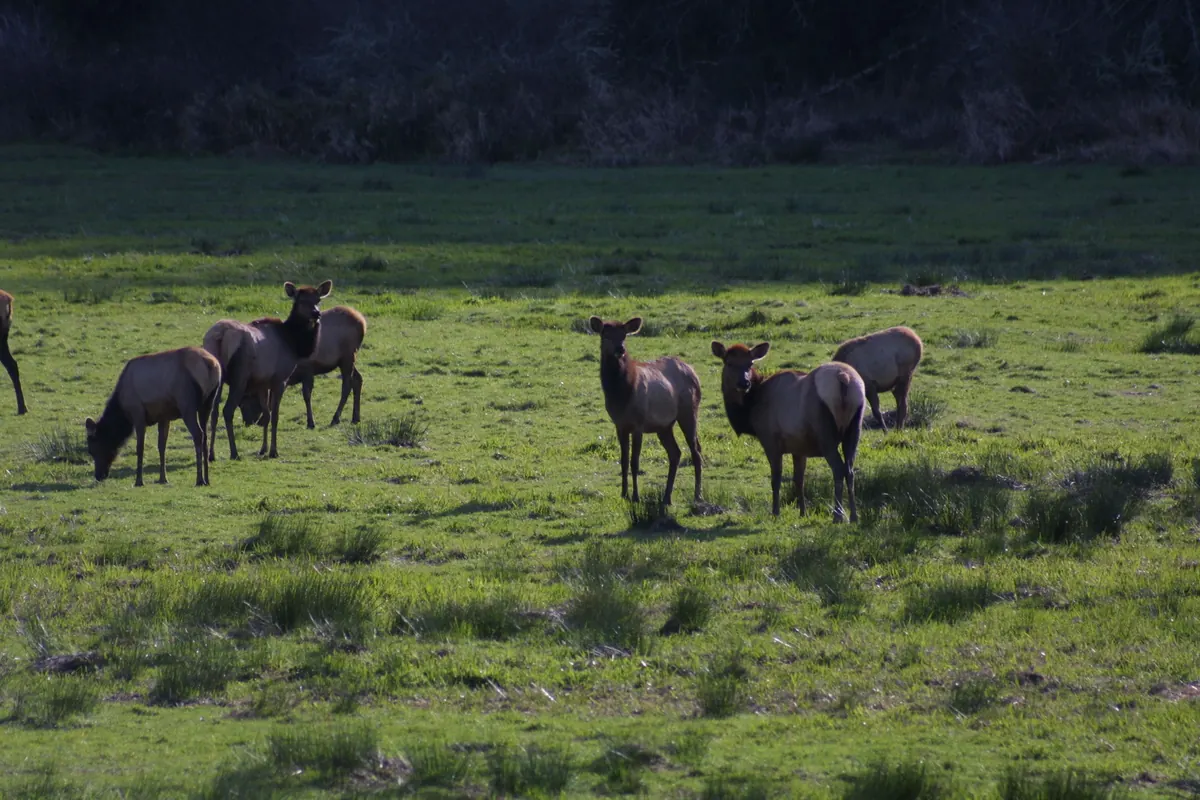
Elk feeding tours at Jewell Meadows
December through February, generally Thursday to Tuesday; reservations from December 1 at 8 a.m. · Jewell Meadows Wildlife Area, Clatsop County
ODFW's guided winter feeding tours bring visitors close to the Roosevelt elk that use these meadows, up to 200 of them through winter and spring. The tours depend on staffing, the single phone line (503-755-2264) is busy on opening morning, and a parking permit is required. The same pastures also hold bald eagles, hawks, coyotes and the occasional bobcat.
-
The Dean Creek herd
All year; winter grazing in the pastures · Highway 38, about three miles east of Reedsport
A resident herd of Roosevelt elk lives on the BLM's bottomland pastures here. The grass stays green through the mild coastal winter, and the elk are often in view from the highway pullouts.
-
Black bears in their dens
Most of the winter · Cascades west to the coast; the Blue and Wallowa mountains
ODFW explains that black bears fatten through autumn, grow sluggish, then den under stumps, logs and root wads, in hollow trees or in holes dug into hillsides, and stay inactive through the cold months. Even so, keep garbage and bird seed secured through the winter, since a bear that wakes in a mild spell will look for food.
-
Bats: migrate or hibernate
Winter · Caves, mines, attics, bridges
Oregon has 15 bat species. Some, such as the hoary bat, fly south for the winter; others stay and hibernate. The big brown bat copes with cold better than most and may fly on mild winter evenings. Never handle a grounded bat bare-handed; ODFW takes reports of sick or dead ones online.
Snow or soft mud makes everyone a tracker. Check creek banks and field edges for split hoofprints of deer and elk, the hand-like prints of raccoons, and the tidy single file a coyote leaves.
How do you tell Oregon's evergreens apart in winter?
With the maples and alders bare, December is the month the conifers have the forest to themselves, and it is a good time to learn them. Along the coast, the dominant trees at Lewis and Clark National Historical Park are Sitka spruce and western hemlock, with western redcedar and Douglas-fir mixed in. A fallen branch and a cone or two will settle most questions.
-
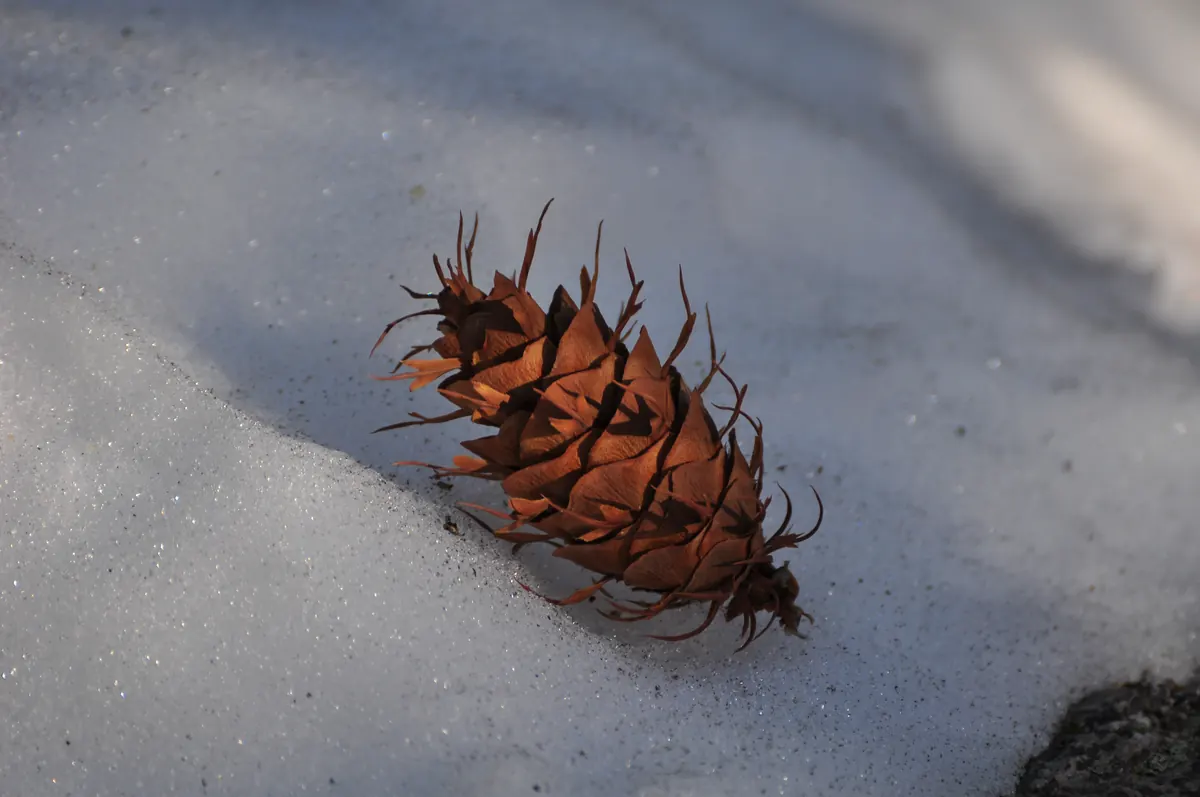
Douglas-fir
Cones on the ground all winter · Coast Range, Cascades and western valleys
Look at a cone: it hangs down, and every thin scale has a three-tipped bract sticking out past it, which children like to say looks like mice diving headfirst into the cone. The soft needles grow all around the twig.
-
Western hemlock and western redcedar
All year · Moist west-side forests
A hemlock's top leader droops over like a fishing rod, and its short, flat needles are of uneven lengths, with tiny cones. Redcedar has flat, scaly sprays rather than needles, a fruity smell when crushed and stringy, reddish bark that peels in long strips.
-
Sitka spruce
All year · The fog belt, within a few miles of the ocean
Grab a spruce twig and it hurts: the needles are stiff and sharp-pointed, and each sits on a small woody peg that stays behind when the needle falls.
-
Cutting your own tree
Mid-November through December · National forests; Mt. Hood rules shown here
The Mt. Hood National Forest sells Christmas tree permits for $5 a tree (plus a $2.50 service fee online at Recreation.gov), up to five per household. Trees may be no taller than 15 feet and must stand within 12 feet of another tree, you must cut low enough to leave no more than 6 inches of stump, and cutting is barred within 100 feet of a highway and in wilderness, recreation areas and active timber sales. Children in fourth grade can get a permit at no charge by showing their Every Kid Outdoors pass. Other Oregon national forests run similar programs; read each forest's guidelines before you go.
Oregon State University Extension calls Oregon the nation's top Christmas tree producer, so the tree in your living room may well be a noble or Douglas-fir grown a few miles away.
How much snow does Oregon get in December, and what will El Niño change?
Meteorological winter begins on December 1: for record-keeping, climatologists treat December through February as winter, since on average no other three months are colder. The solstice, astronomical winter's start, follows on the 21st. In Oregon, December is also deep in the wet season. North Bend and Astoria average more than ten inches of precipitation in the month, while Pendleton and Bend get about two inches or less. Snow belongs mostly to the mountains: Crater Lake's headquarters averages more than seven feet in December alone.
-
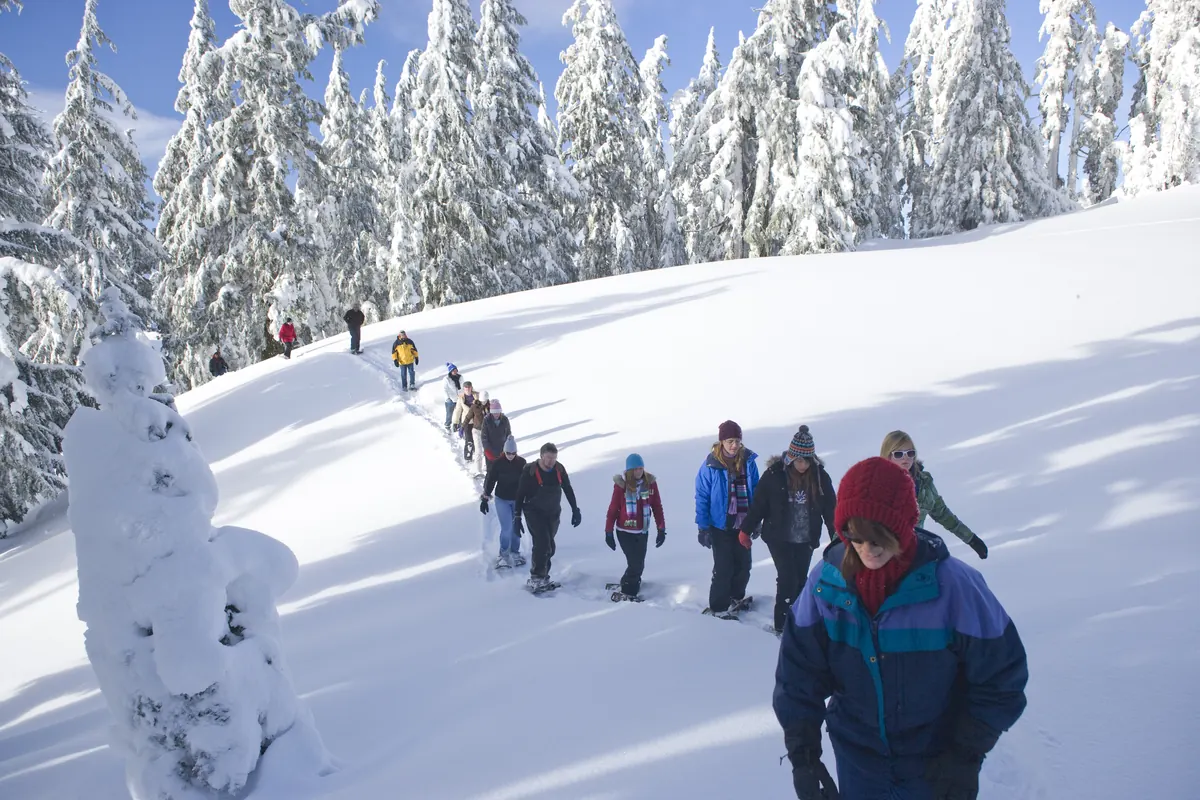
Snowshoe walks at Crater Lake
Saturdays, Sundays and holidays from late November, 12:30 p.m., about two hours · Rim Village, Crater Lake National Park
Rangers lead free walks on snowshoes, which the park lends; no experience is needed, but walkers must be at least 8 years old and must reserve a place by phone (541-594-3100). The vehicle entrance fee in winter is $20. The park says an average winter brings 42 feet of snow, and the walks are canceled in storms or when the snow is too thin.
-
This winter's very strong El Niño
Effects usually strongest December through February · Statewide
In its September 10 update, NOAA's Climate Prediction Center put the probability that this winter's El Niño turns out very strong above nine in ten. Larry O'Neill, the state climatologist at Oregon State University, has said the usual El Niño signal in Oregon is warm and dry, but the three strongest events of recent decades left the state wetter than normal and very warm, with the snow line well up the mountains. KLCC's report pointed to the risks of a rainy, warm winter: landslides west of the Cascades, warm streams that stress spawning salmon, and trouble for the Dungeness crab fishery like that of 2015 and 2016. NOAA's official December-to-February outlook, issued October 15, is posted with the Climate Prediction Center's seasonal outlooks.
| Station | Precipitation (in) | Snowfall (in) | Average high (°F) | Average low (°F) |
|---|---|---|---|---|
| North Bend (south coast) | 10.47 | 0.2 | 52.9 | 40.4 |
| Astoria (north coast) | 10.68 | 48.7 | 37.6 | |
| Portland | 5.77 | 1.2 | 46.9 | 36.2 |
| Eugene | 7.21 | 46.8 | 34.3 | |
| Medford | 3.53 | 0.9 | 46.1 | 32.6 |
| Government Camp (Mount Hood) | 14.43 | 51.6 | 35.3 | 25.7 |
| Crater Lake National Park headquarters | 11.28 | 90.6 | 32.7 | 19.1 |
| Bend | 2.07 | 5.3 | 41.0 | 23.3 |
| Pendleton | 1.50 | 5.4 | 40.8 | 27.5 |
| La Grande | 1.88 | 3.0 | 38.7 | 24.4 |
Note the spread: an average December night at Crater Lake drops to about 19 °F, while at North Bend it stays above 40. Even at North Bend, the median first freeze is December 9; dates for the station nearest you are on our Oregon frost calendar. For the next storm's track and snow level, see our Oregon weather now page.
When are the December king tides on the Oregon coast?
The second set of the winter's king tides falls on December 22 to 26, and it should be the higher of the two. The Cold Moon turns full at 5:28 p.m. on the 23rd, just after dark, and perigee follows only hours later. NOAA's predictions for Christmas Eve are two or three tenths of a foot above November's highest at both Newport and Astoria, with the high water near midday.
| Date | Newport (South Beach) | Astoria (Tongue Point) |
|---|---|---|
| Tuesday, Dec 22 | 10.1 ft at 9:56 a.m. | 10.3 ft at 10:55 a.m. |
| Wednesday, Dec 23 | 10.5 ft at 10:47 a.m. | 10.5 ft at 11:47 a.m. |
| Thursday, Dec 24 | 10.6 ft at 11:39 a.m. | 10.6 ft at 12:40 p.m. |
| Friday, Dec 25 | 10.4 ft at 12:31 p.m. | 10.5 ft at 1:32 p.m. |
| Saturday, Dec 26 | 10.0 ft at 1:24 p.m. | 10.1 ft at 2:26 p.m. |
The Oregon King Tides Project asks for photos of the high water against something fixed, a piling, a seawall, a road edge, with the place and time. Add a storm surge or a heavy swell and the water, with its drift logs, runs well past the predicted line; watch from headlands, not the sand.
When is Oregon's earliest sunset?
About a week and a half before the solstice, not on it. Oregon's sunsets reach their earliest between December 8 and 10, depending on latitude: 4:27 p.m. in Portland on the 10th, 4:39 p.m. in Medford on the 8th, and 4:11 p.m. in Pendleton, the earliest of these towns, on the 10th. From then on the evenings slowly brighten, while the sunrise goes on slipping later until the first days of January. Blame the sun's clock: local solar noon slips a little later each day this month, a result of Earth's tilt combined with its quicker orbital pace as it nears perihelion, its closest point to the sun. The solstice itself, on December 21, is still the shortest day by length: 8 h 37 m of daylight in Astoria, 8 h 42 m in Portland, and 9 h 07 m in Brookings, near the California line. By New Year's Eve each town has won back only three or four minutes.
| City | Dec 1 | Dec 21 | Dec 31 | Earliest sunset |
|---|---|---|---|---|
| Astoria | 8 h 53 m | 8 h 37 m | 8 h 41 m | 4:29 p.m., Dec 10 |
| Portland | 8 h 58 m | 8 h 42 m | 8 h 46 m | 4:27 p.m., Dec 10 |
| Pendleton | 8 h 57 m | 8 h 41 m | 8 h 45 m | 4:11 p.m., Dec 10 |
| Newport | 9 h 04 m | 8 h 49 m | 8 h 53 m | 4:36 p.m., Dec 9 |
| Bend | 9 h 08 m | 8 h 53 m | 8 h 57 m | 4:27 p.m., Dec 9 |
| Ontario | 9 h 08 m | 8 h 53 m | 8 h 56 m | 5:10 p.m., Dec 9 |
| Medford | 9 h 19 m | 9 h 05 m | 9 h 08 m | 4:39 p.m., Dec 8 |
| Brookings | 9 h 20 m | 9 h 07 m | 9 h 10 m | 4:45 p.m., Dec 8 |
To see how your own sunrise and sunset move through the holidays, enter your town in the sunrise and sunset calculator.
What is in the Oregon night sky in December?
The longest nights of the year bring the year's best meteor shower and its largest-looking full moon. All times below are Pacific Standard Time; in Ontario and most of Malheur County, on Mountain time, add an hour.
-
The Geminids
Night of Sunday, December 13, into Monday, December 14 · Anywhere dark; the radiant is high in the south after midnight
The International Meteor Organization ranks the Geminids as the year's richest shower, with a rate near 150 an hour in ideal conditions, and its predicted maximum falls around 6 a.m. Pacific time on the 14th, just before dawn here. A crescent moon, about a fifth lit, sets in Portland at 8:55 p.m. on the 13th, leaving darkness until dawn. Around 2 a.m. the radiant stands highest and the meteors come fastest. Real counts from a town will be far lower, and west of the Cascades the question is clouds, so watch the forecast and be ready to drive east or uphill.
-
The Cold Moon, the closest of 2026
Full at 5:28 p.m., Wednesday, December 23 · Rising in the northeast around sunset
No full moon in 2026 looks bigger. Perigee, the moon's closest pass, follows in the early hours of Christmas Eve, so the disk coming up on the 23rd is a little larger and brighter than usual, and it still looks round when it rises again on the 24th.
-
The solstice
12:50 p.m., Monday, December 21 · Everywhere
This is the instant the sun turns back north along the horizon; from here the days begin, very slowly, to lengthen. Go out at midday and mark the end of a fence post's shadow; repeat on the same date in June and compare.
-
Planets
All month · Venus in the southeast before dawn; Saturn in the southwest after dark
Before sunrise, Venus blazes low in the southeast and gains height week by week, heading for its widest separation from the sun in the first days of January. Higher up in Leo shine Jupiter and dimmer, ruddy Mars; by Christmas, Jupiter rises around the middle of the evening. In the evening, ringed Saturn stands alone in the southwest, sinking a little earlier each night. Two pretty pairings: a slim crescent beside Venus and Spica at dawn on December 4 and 5, and an almost-full moon brushing past the Pleiades on the night of the 21st.
| Phase | Date | Time |
|---|---|---|
| New moon | Tuesday, Dec 8 | 4:52 p.m. PST (5:52 p.m. MST) |
| First quarter | Wednesday, Dec 16 | 9:42 p.m. PST (10:42 p.m. MST) |
| Full moon, the Cold Moon | Wednesday, Dec 23 | 5:28 p.m. PST (6:28 p.m. MST) |
| Last quarter | Wednesday, Dec 30 | 10:59 a.m. PST (11:59 a.m. MST) |
| New moon | Thursday, Jan 7, 2027 | 12:24 p.m. PST (1:24 p.m. MST) |
Clear skies are never a sure thing in an Oregon December: our cloud forecast shows tonight's odds, and moonrise times for your street are on the moon calendar.
What can families do outdoors in Oregon in December?
- Watch for whales with a volunteer. During Winter Whale Watch Week, December 27 to 31, choose a staffed viewpoint near you on orwhalewatch.org, bring binoculars, and keep a tally of blows. The Depoe Bay center is open Wednesday through Sunday the rest of the month.
- Go to the Silver Falls Winter Festival. Park staff, volunteers and the Friends of Silver Falls celebrate the season's changes at the South Falls day-use area over the weekend of December 12 and 13, starting at 10 a.m. on Saturday. Details are due in November, and the park's day-use parking permit applies.
- Walk at Tryon Creek in Portland. The Friends of Tryon Creek list a Phenology Friday plant walk on December 11 from 9:30 to 11:30 a.m. and a free drop-in Open Classroom with nature crafts for all ages on Saturday, December 12, from 10 a.m. to noon.
- Try snowshoes at Crater Lake. Ranger walks run on weekends and holidays at 12:30 p.m. for anyone 8 or older; reserve by phone, and snowshoes are lent free.
- Cut a tree, and count the birds. If someone in the family is in fourth grade, their Every Kid Outdoors pass covers the tree permit, so let them do the choosing. Then sign up with a bird count circle for one day of the count period, in the field or at your feeder.
- See the lights at Shore Acres. The garden's holiday light show near Coos Bay runs nightly through December 31; buy the timed $10 parking slot (4:30, 5:30, 6:30 or 7:30 p.m.) before you arrive.
- Start the new year on a trail. America's State Parks promotes First Day Hikes on New Year's Day, Friday, January 1, 2027. Check the Oregon State Parks event calendar in late December for guided hikes near you.
Programs in December depend on weather, so confirm the day before. For other seasons, there are the Oregon November guide and the full set of state calendars on the nature index.
What should I watch out for outdoors in Oregon in December?
- Hunting seasons. December has no general rifle season for deer or elk, but western Oregon's late general archery deer seasons run to December 6 in units 25, 29 and 30 (and in Unit 26 for traditional bows only) and to December 13 in units 10 and 15 through 20 and the northern part of Unit 21, some controlled muzzleloader and damage-control hunts continue under their own tags, and bear season stays open through December 31, with cougar open all year. Duck season is open all month in Zone 1 (to January 31); Zone 2 closes November 29 and reopens December 3, running to January 24. Canada goose dates vary by zone: the Northwest Permit Zone is open to January 8, the South Coast Zone pauses December 7 to 18, and the High Desert and Blue Mountain Zone reopens December 15. Rooster pheasant ends December 31; chukar, Hungarian partridge, quail and forest grouse continue to January 31.
- Hunter orange. Oregon's regulations require orange only of young hunters: anyone under 18 carrying a firearm after a game mammal or an upland bird other than a turkey needs an orange hat or outer layer, visible from every side. Nobody else is required to, so on wildlife areas and in bird country this month, a bright jacket or hat is a sensible choice for walkers too.
- Snow and ice on the roads. Passes can require chains at short notice, and freezing rain can glaze valley roads; carry chains, layers, food and water, and check TripCheck before leaving.
- Cold in the high desert. Normal December lows are near 15 °F at Burns and 19 °F at Crater Lake; wet clothes and wind bring on hypothermia fast.
- Ice. Ponds freeze unevenly in Oregon's mild winters, and ice over springs or moving water stays thin; keep off it, and keep dogs leashed near frozen water.
- Storms, slides and the surf. In heavy rain, avoid steep slopes below recent burn scars and turn around rather than drive into floodwater. On the coast, king tides and winter swells push sneaker waves and logs far up the beach; stay above the drift line and keep children close.
- Short days. In the second week of December the sun is down by about 4:30 p.m. in Portland, Bend and Astoria, and by 4:11 in Pendleton. Oregon's December dusk comes fast under cloud, so turn back early and keep a headlamp in the pack.
Sources
- Oregon State Parks: whale watching
- Whale Watching Spoken Here (Oregon State Parks): Whale Watch Week dates and Depoe Bay center
- Whale Watching Spoken Here: best places to watch whales
- ODFW: gray whale
- ODFW: bald eagle
- ODFW: owls
- Klamath Basin Birding Trails: FAQs
- U.S. Fish and Wildlife Service: Lower Klamath National Wildlife Refuge
- U.S. Fish and Wildlife Service: Bear Valley National Wildlife Refuge
- National Audubon Society: Christmas Bird Count
- Oregon Birding Association: Christmas Bird Count dates
- ODFW: where to see salmon spawn
- ODFW: Jewell Meadows Wildlife Area visitors' guide
- Bureau of Land Management: Dean Creek Elk Viewing Area
- ODFW: black bear
- ODFW: bats
- ODFW: frogs and toads
- National Park Service: plants of Lewis and Clark National Historical Park
- Mt. Hood National Forest: Christmas tree permits
- Recreation.gov: Christmas tree permits
- Oregon State University Extension: Christmas trees
- NOAA NCEI: 1991 to 2020 monthly normals for Oregon stations (December)
- NOAA NCEI: U.S. climate normals
- National Park Service: Crater Lake ranger-guided snowshoe walks
- NOAA Climate Prediction Center: ENSO diagnostic discussion, September 10, 2026
- NOAA Climate Prediction Center: three-month outlooks
- OPB: Oregon's state climatologist on the El Niño winter
- KLCC: a super El Niño winter for the Pacific Northwest
- NOAA Climate.gov: United States El Niño impacts
- NOAA Tides and Currents: predictions, Newport (South Beach), December 2026
- NOAA Tides and Currents: predictions, Astoria (Tongue Point), December 2026
- Oregon King Tides Project
- Explore Lincoln City: Oregon king tides
- National Weather Service: sneaker waves
- U.S. Naval Observatory: moon phases
- U.S. Naval Observatory: sun and moon data, Portland, December 13, 2026
- U.S. Naval Observatory: seasons, 2026
- International Meteor Organization: 2026 meteor shower calendar
- EarthSky: supermoons
- NASA JPL Horizons ephemerides
- Sea and Sky: 2026 astronomy calendar
- Oregon State Parks: event calendar (Silver Falls Winter Festival)
- Friends of Tryon Creek: calendar
- Oregon State Parks: 2026 Shore Acres Holiday Lights
- America's State Parks: First Day Hikes
- Oregon State Parks: events
- ODFW: big game hunting seasons
- Oregon hunting regulations: migratory game bird seasons
- Oregon hunting regulations: buck deer seasons
- Oregon hunting regulations: game bird seasons
- Oregon hunting regulations: general hunting regulations (hunter orange)
- Oregon Department of Transportation: TripCheck road conditions
- Photos via Wikimedia Commons; licenses and photographers are credited under each picture
